You are running a container storage business off a spreadsheet, a separate billing tool, a dispatch calendar, and a shared inbox. A customer calls to book a unit. You check availability in one place, log their details in another, cut an invoice in a third, and hope the delivery gets scheduled before the container gets double-booked. Every handoff is a chance for something to slip. Every manual step is time you are not spending on growth.
That fragmentation gets expensive fast. The global storage software market was valued at USD 28.3 billion in 2024 and is projected to reach USD 51.2 billion by 2033 at a 6.82% CAGR, according to ResearchAndMarkets (2024). Cloud-based tools already represented roughly 60% of that spend, which tells you where operators are moving: away from disconnected desktop systems and toward centralized platforms that handle reservations, billing, inventory, and logistics in one place.
The problem is not a shortage of software. It is that most container storage management software leans hard in one direction. Some tools are built around booking portals and tenant self-service. Some are built around fleet visibility and asset tracking. Some are ERP-first, with deep accounting and back-office control. Pick the wrong emphasis and you end up paying for capabilities you never touch while missing the ones you use daily.
This guide fixes that by ranking tools against how you actually operate, not by feature count. Whether you run self storage, portable storage, or full container rental, the right system depends on your operating model. Below, we break down seven platforms by workflow fit so you can shortlist faster.
What's inside
This guide is for operators and operations leaders running container storage, portable storage, self storage, and equipment rental businesses who want to replace spreadsheets and manual billing with a single system. It covers container rental software, portable storage software, and management software for self storage across a range of business sizes.
We selected and ranked each tool on five criteria that matter for day-to-day operations:
- Booking and customer self-service (online booking, tenant portal, customer portal)
- Billing automation (storage unit computer programs billing and invoicing, payments, interim charges)
- Inventory and fleet tracking (unit availability, asset visibility)
- Logistics support (delivery, dispatch, route management)
- Reporting depth (dashboards, business intelligence, analytics)
The list focuses on real operational fit, not broad SMB software that happens to have a rental field.
TL;DR
- Best overall for broad container storage operations: StoRegister, with online booking, tenant portal, billing, and an interactive sitemap in one cloud platform.
- Best for automation and lean teams: Kinnovis, with AI-supported enquiry handling, booking and customer portals, and automated emails.
- Best for asset-heavy rental and equipment workflows: CAVU ERP, with built-in accounting and modular industry-specific workflows.
- Best for routing, dispatch, and back-office finance: ARM Software, built around Sage 100 with rental contracts, inventory, and business intelligence.
- Best for enterprise-scale operators: Infor, with industry CloudSuite ERP, CPQ, and analytics for complex back offices.
- Best for small businesses wanting fast setup: StoRegister again, with public entry pricing and a cloud dashboard you can run without an IT team.
What is storage container software?
Storage container software is a platform that centralizes reservations, billing, inventory, logistics, and reporting for businesses that rent or manage storage units and containers. It replaces the patchwork of spreadsheets, standalone invoicing tools, and dispatch calendars with a single system where every unit, customer, and payment lives in one record.
The category spans self storage software for small business, portable storage software, and shipping container management software used by rental and logistics operators. The workflows overlap, but the emphasis shifts depending on whether your containers stay put on a lot or move between yards, customers, and sites.
Most platforms organize around five workflow layers:
- Reservations and booking: online booking, tenant portals, unit reservation, and availability checks so customers self-serve instead of calling in.
- Billing and invoicing: recurring charges, interim charges, payment collection, e-signature, and automated dunning so revenue does not leak.
- Inventory and availability: live unit and container availability, facility maps, and status tracking so you never double-book.
- Fleet, delivery, and movement management: dispatch, routing, and container movement tracking for mobile, on-site, and moving container workflows.
- Reporting and analytics: dashboards, occupancy reports, revenue reporting, and business intelligence for weekly decisions.
The strongest tools connect these layers so a booking automatically reserves a unit, triggers an invoice, and schedules a delivery without anyone rekeying data. That is the difference between software that centralizes your operation and software that just digitizes one part of it.
When to use storage container software
Not every operator needs the same emphasis. Here is how to pattern-match your situation to the category.
Replace spreadsheets and manual follow-up
If your team spends hours reconciling availability across tabs, chasing late payments by hand, or copying customer details between tools, you have outgrown spreadsheets. Storage unit computer programs billing and invoicing automate the recurring revenue you are currently tracking manually. Automated invoicing, payment collection, and dunning recover the hours your team loses to follow-up and cut the errors that come with rekeying data across systems.
Support self-service booking and tenant access
When customers want to reserve a unit, check their balance, or sign a rental agreement without phone or email back-and-forth, you need a customer portal. Online booking and a tenant portal let people transact on their own time, which shortens your sales cycle and reduces inbound calls. This matters most for self storage and portable storage businesses where volume is high and margins depend on keeping overhead low.
Manage logistics, delivery, and unit movement
If your containers move between yards, customer sites, and storage lots, you need logistics management, not just facility management. Mobile container storage, on-site container storage, and moving container storage workflows all depend on dispatch, route optimization, and container movement tracking. Choose a tool with fleet tracking and routing when delivery coordination is a daily part of the job rather than an occasional one.
Comparison table
The table below ranks the seven tools by relevance to storage container operations, from portal-first platforms to enterprise ERP. Pricing and G2 ratings should be verified against each vendor before you commit, since plans and packaging change.
| # | Product | Intent | Key differentiation | Pricing | G2 rating |
|---|---|---|---|---|---|
| 1 | StoRegister | Self-storage and container facility management | Cloud dashboard, online booking, tenant portal, interactive sitemap | From GBP 75/month | Not verified |
| 2 | Kinnovis | Self-storage management for lean teams | AI-supported enquiry handling, booking and customer portals, automated emails | Quote-based | Not verified |
| 3 | CAVU ERP | ERP for asset-heavy verticals | Built-in accounting, modular industry workflows, cloud or on-premise | Quote-based | 5.0/5 |
| 4 | ARM Software | Rental operations and back-office finance | Rental contracts, inventory, business intelligence, Sage 100 base | Quote-based | Not verified |
| 5 | Infor | Enterprise ERP for large operators | Industry CloudSuite ERP, CPQ, analytics platform | Quote-based | 3.9/5 |
| 6 | SiriusOne | Custom-built rental and operations software | Custom AI, web, and software development services | Quote-based | Not verified |
| 7 | RentalMan | Enterprise equipment rental ERP | Full rental lifecycle, fleet management, multi-branch support | Quote-based | 2.8/5 |
1. StoRegister
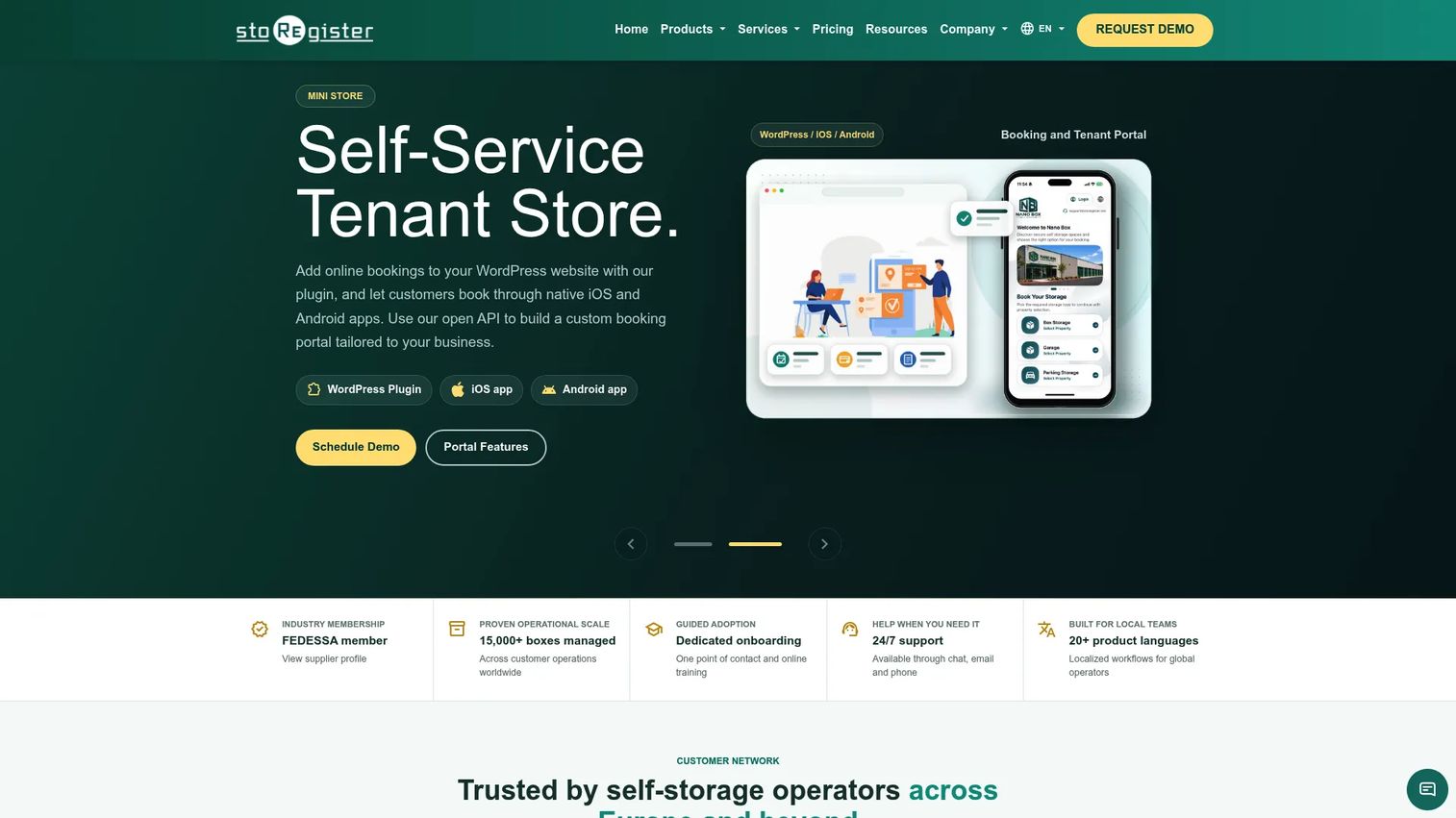
StoRegister is cloud self-storage management software built around bookings, operations, and facility management. It positions itself squarely as container storage management software, and its breadth shows: online booking, a tenant portal, payments, access control, documents, e-signature, reporting, and an interactive sitemap all sit inside one dashboard. For operators who want a broad suite without stitching tools together, it is the most complete portal-first option on this list.
The interactive sitemap is the feature that sets it apart for facility operators. Instead of tracking unit availability in a spreadsheet, you see your whole site visually, click a unit to check status, and manage multiple facilities from the same screen. Pair that with online booking and a tenant portal, and customers can reserve, pay, and sign without ever calling your office.
Best for: Self-storage and container operators who want cloud-based facility management and online booking in a single platform.
Key strengths
- Interactive sitemap and multi-facility management: See unit availability visually and manage several sites from one dashboard.
- Online booking portal: Let customers reserve and pay without phone or email back-and-forth.
- Analytics and reporting dashboard: Track occupancy and revenue with built-in reports for weekly decisions.
Why choose StoRegister: If you want the broadest container storage management coverage with public, predictable pricing, StoRegister is the strongest starting point. It fits operators who value self-service booking and visual facility control over deep ERP accounting, and it is accessible enough to run without a dedicated IT team.
StoRegister pricing: Public plans are Basic at GBP 75/month (GBP 900 billed yearly), Standard at GBP 140/month (GBP 1,680 billed yearly), and Premium at GBP 350/month (GBP 4,200 billed yearly). An Enterprise tier is quote-based with terms confirmed to your scope. A mandatory one-time setup fee also applies. There is no free tier. Verify current figures on the StoRegister pricing page before you commit.
2. Kinnovis
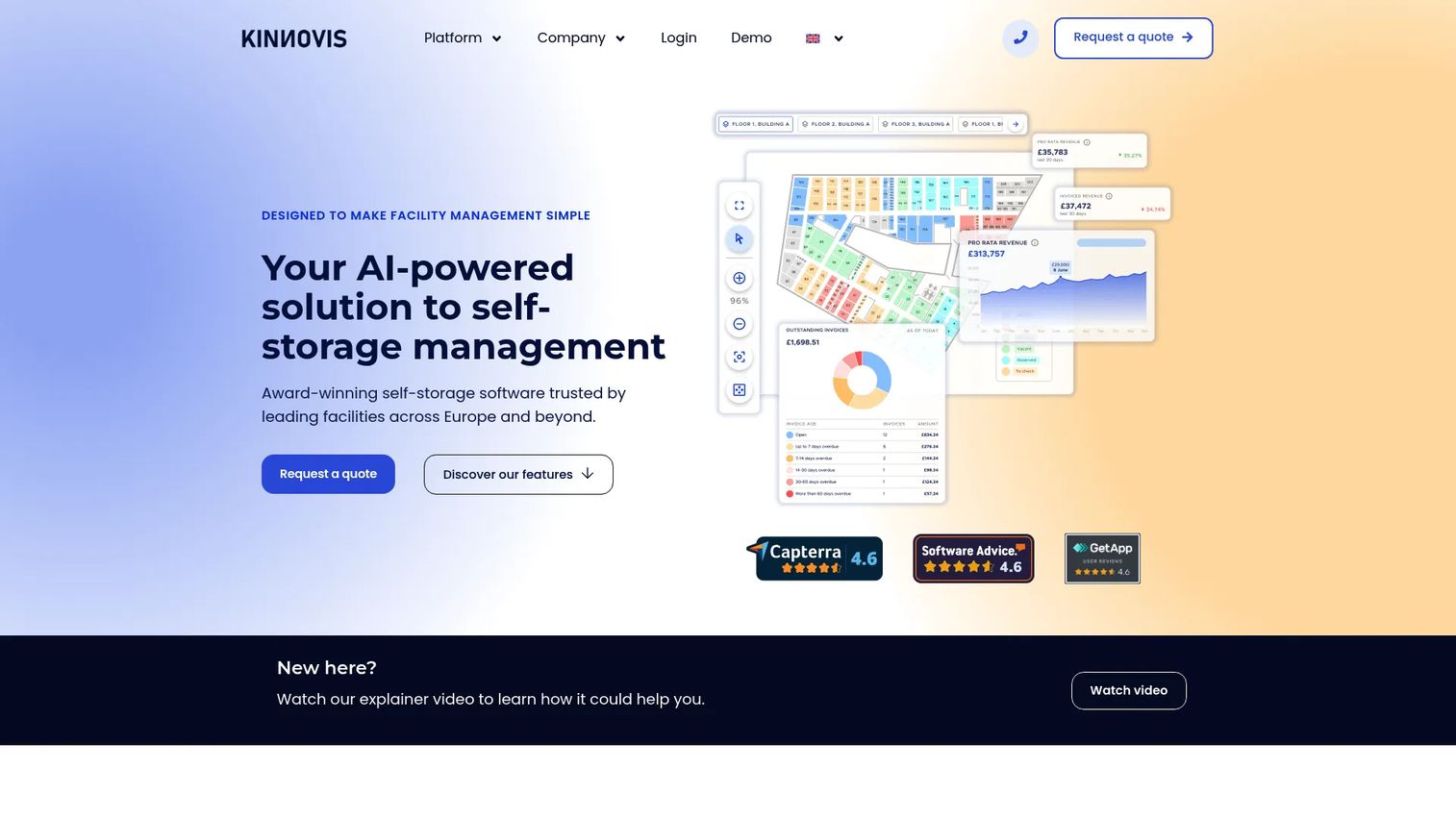
Kinnovis is AI-powered self-storage management software built for operators who want automation to carry the load a bigger team normally would. Its suite covers a booking portal, a customer portal, a facility map, automated emails, access control, an API, reporting, ID verification, and e-signatures. The through-line is workflow automation: the platform handles the repetitive customer-facing steps so a lean team can run more units without adding headcount.
The AI support and automated emails are the practical draw for small operations. When an enquiry comes in, automation can handle the first response, route the lead, and nudge the customer toward booking. That reduces the manual follow-up that eats into a two-person team's day and keeps the pipeline moving without someone watching the inbox.
Best for: Self-storage operators who want an all-in-one management platform with strong automation and a modular product stack.
Key strengths
- Booking portal and customer portal: Give customers self-service reservation, payment, and account access.
- Automated emails and AI enquiry handling: Let automation manage first responses and follow-up so lean teams stay responsive.
- API and reporting: Connect Kinnovis to your wider stack and track performance with built-in reports.
Why choose Kinnovis: Choose Kinnovis if automation is your leverage. The AI enquiry handling and automated emails suit operators who need to punch above their headcount, and the modular suite means you can add capability as you grow rather than buying everything at once.
Kinnovis pricing: Kinnovis uses quote-based pricing. Its pricing page does not list public figures and instead asks operators to request a custom breakdown. Contact the vendor for a quote scoped to your facility count and feature needs.
3. CAVU ERP
CAVU ERP takes an ERP-first angle on container and rental operations. It is industry-specific ERP software with built-in accounting and modular workflows, deployable in the cloud or on-premise. For asset-heavy businesses, the appeal is operational and margin visibility: fleet visibility, a unit availability dashboard, billing cycles, interim charges, service and repair tracking, profitability checks, and parts inventory all live in one system.
Where portal-first tools shine on customer self-service, CAVU ERP shines on control. If your business rents equipment or containers that require maintenance, incur interim charges, and need per-unit profitability analysis, the ERP structure gives you the accounting depth to see exactly where margin is made and lost. The modular design means you configure the workflows to your vertical rather than bending your process to fit generic software.
Best for: Asset-heavy rental and equipment businesses that need ERP accounting, service tracking, and margin visibility in their target verticals.
Key strengths
- Built-in accounting: Run billing cycles, interim charges, and financial reporting inside the same system as operations.
- Modular industry-specific workflows: Configure service, repair, and parts inventory to match your vertical.
- Cloud or on-premise deployment: Choose the hosting model that fits your IT and compliance requirements.
Why choose CAVU ERP: Choose CAVU ERP when your operation is defined by assets and margin rather than high-volume self-service booking. Its accounting depth and service and repair modules fit rental businesses that need to track total cost of ownership and per-unit profitability closely.
CAVU ERP pricing: CAVU ERP does not publish public pricing on its site, so plans are quote-based. On G2, the product carries a 5.0/5 rating. Contact the vendor to scope a plan and request current pricing for your deployment model.
4. ARM Software
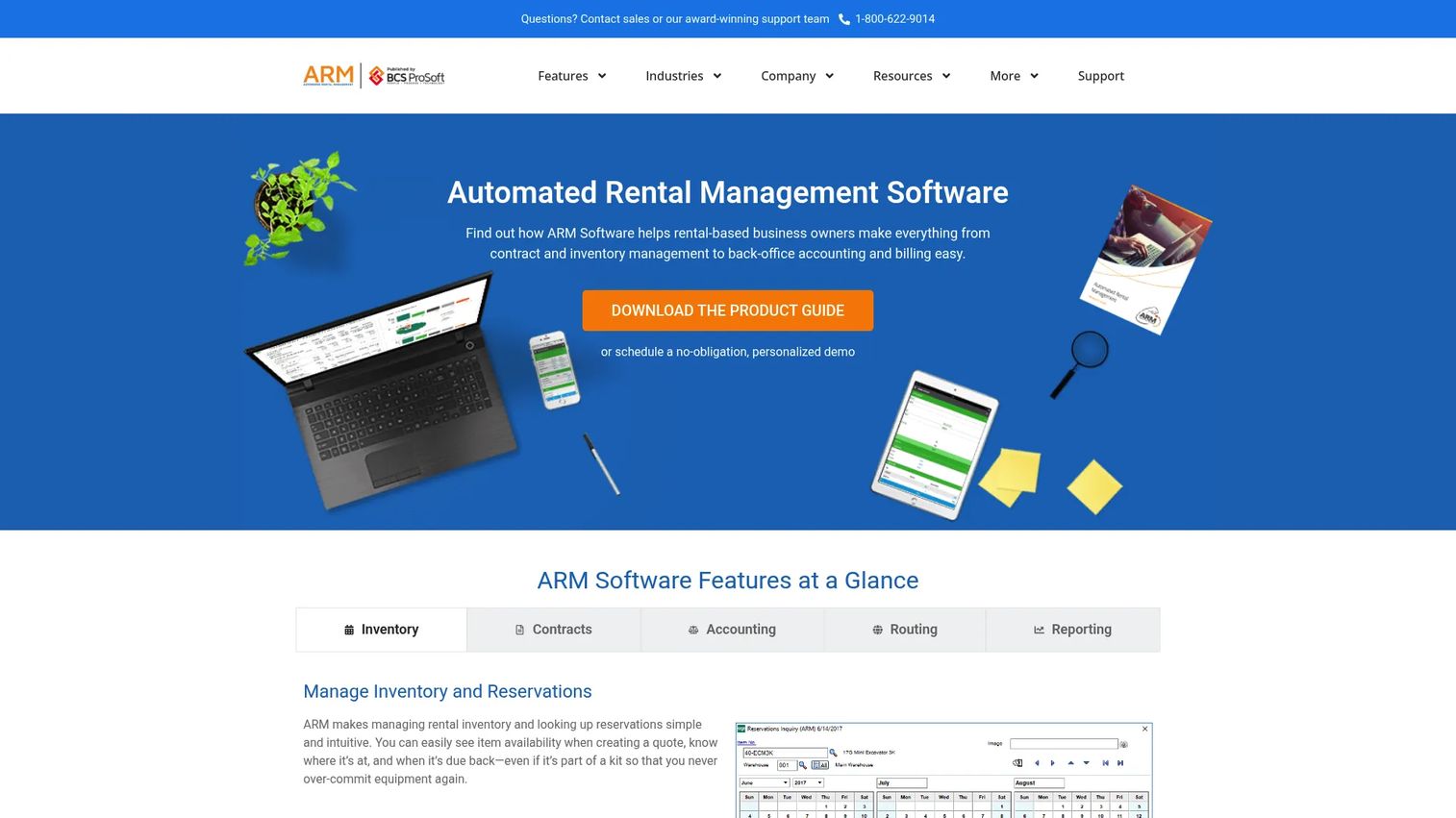
ARM Software is automated rental management software built around Sage 100 ERP. It leans into back-office finance and logistics: rental and sales contracts, inventory management, business intelligence, routing and dispatch, and fixed asset tracking. For teams that need accounting depth alongside delivery coordination, the Sage 100 foundation gives it a financial backbone that lighter tools do not have.
The routing and dispatch capability is what makes it a strong logistics-first choice. If your containers move between yards, sites, and customers on a schedule, ARM Software helps you plan routes, dispatch drivers, and keep the finance side reconciled at the same time. That combination of rental operations and integrated accounting suits businesses that treat delivery as a core part of the service.
Best for: Equipment, event, and container rental companies that need integrated rental operations, routing, and Sage 100 accounting.
Key strengths
- Rental and sales contract management: Handle rental agreements and sales in one contract workflow.
- Routing and dispatch: Plan delivery routes and coordinate drivers for container movement.
- Business intelligence and Sage 100 accounting: Reconcile finance and reporting on a proven ERP base.
Why choose ARM Software: Choose ARM Software when finance and logistics both matter. The Sage 100 relationship gives you accounting depth, and the routing and dispatch tools handle the delivery side that portal-first platforms leave lighter. It fits operators who want one system for contracts, inventory, and movement.
ARM Software pricing: ARM Software does not display public pricing. Its site directs visitors to request a demo or a personalized plan. Contact the vendor for a quote scoped to your rental operations and accounting requirements.
5. Infor
Infor is an enterprise cloud software vendor offering industry-specific ERP and related business applications. For large container and rental operators with complex back-office requirements, it brings enterprise-grade capability: Industry CloudSuite ERP, configure-price-quote (CPQ) and pricing tools, and an analytics and integration platform in Infor OS. This is the heavier-duty option for operators whose processes have outgrown mid-market tools.
Infor is not a niche self-storage product. It is a broad enterprise platform you configure to your industry, which is exactly why it fits large operators managing high volumes across multiple sites, complex accounting, and integrated logistics. If your business needs process control at scale and your IT team can support an enterprise deployment, Infor delivers the depth that lighter tools cannot.
Best for: Large organizations needing industry-specific ERP, CPQ, and cloud business applications at enterprise scale.
Key strengths
- Industry CloudSuite ERP: Configure enterprise ERP to your specific industry and process requirements.
- CPQ and pricing tools: Handle complex configure-price-quote workflows for large rental and sales operations.
- Analytics and integration platform: Connect systems and surface insight through Infor OS.
Why choose Infor: Choose Infor when scale and process control outweigh speed of setup. It suits enterprise operators with complex accounting, multi-site logistics, and the IT resources to run an industry-configured ERP. On G2, Infor carries a 3.9/5 rating.
Infor pricing: Infor does not publish public pricing. Its product pages direct users to contact sales for a scoped quote. Expect enterprise packaging tied to your CloudSuite, module selection, and deployment scale.
6. SiriusOne
SiriusOne is an AI and software development company that builds custom engineering, consulting, and managed services. Rather than a fixed rental product, it delivers custom-built AI, web, mobile, and software development, which makes it a fit for operators whose workflows do not map cleanly onto off-the-shelf tools. If you need rental operations, inventory, dispatch, billing, and service workflows built exactly to your process, a custom-build partner is a legitimate path.
This is a different buying decision from picking a packaged platform. You are commissioning software rather than subscribing to it, which means more upfront investment and a longer path to launch, but full control over how the system behaves. It sits between smaller niche tools and enterprise ERP for portable storage businesses with unusual requirements that packaged software does not serve well.
Best for: Operators who need custom-built AI, software, and digital transformation services rather than a packaged rental product.
Key strengths
- Custom AI and AI-powered agents: Build automation tailored to your specific operational workflows.
- Web, mobile, and custom software development: Get rental, inventory, and dispatch tools built to your exact process.
- Cybersecurity, cloud native, and data engineering: Cover the technical foundations a custom system needs.
Why choose SiriusOne: Choose SiriusOne when no packaged tool fits and you have the budget to build. It suits operators with unusual workflows or integration requirements who want software shaped around their process rather than the other way around.
SiriusOne pricing: SiriusOne does not publish fixed product pricing. Its service pages offer example cost ranges for specific project types and ask visitors to request a quote. Pricing depends entirely on project scope, so contact the vendor with your requirements.
7. RentalMan
RentalMan is enterprise equipment rental ERP software from Wynne Systems, built to manage the full rental lifecycle. It covers quoting, asset tracking, maintenance, and invoicing, plus fleet management with parts, labor, and total cost of ownership tracking, and asset management features including depreciation, utilization reporting, and multi-branch support. For large fleet-heavy operators, that lifecycle coverage maps well onto container storage use cases.
RentalMan is a general equipment rental platform rather than a container-specific one, which is precisely why it appeals to operators running large, multi-branch fleets. If you rent containers alongside other equipment, or your operation spans several locations with heavy asset-tracking demands, a full rental ERP handles the scale and the depreciation reporting that lighter tools do not attempt.
Best for: Large multi-branch equipment rental companies that need full-lifecycle rental management and fleet tracking.
Key strengths
- Full rental lifecycle management: Handle quoting, asset tracking, maintenance, and invoicing in one system.
- Fleet management with TCO tracking: Track parts, labor, and total cost of ownership across your fleet.
- Multi-branch and depreciation reporting: Manage assets, utilization, and depreciation across locations.
Why choose RentalMan: Choose RentalMan when you run a large, multi-branch fleet and need enterprise rental depth. Its full-lifecycle coverage and asset management suit operators for whom containers are one part of a broader equipment rental business.
RentalMan pricing: RentalMan does not publish public pricing; it is contact-sales. On G2, the product carries a 2.8/5 rating. Contact Wynne Systems for a quote scoped to your fleet size and branch count.
Considerations before you buy
Feature lists blur together fast. Narrow your shortlist by evaluating the criteria that map to how you actually operate.
Portal and self-service depth
If customers book, pay, and sign online, portal depth is your first filter. Check whether the tenant or customer portal handles reservations, payments, balance checks, and e-signature end to end, or whether it stops at one step and forces staff to finish the job.
Billing automation
Look at how the tool handles recurring charges, interim charges, failed payments, and dunning. Storage unit computer programs billing and invoicing should recover revenue automatically. If your team still chases late payments by hand after implementation, the automation is too shallow.
Availability and inventory tracking
Double-booking costs you customers. Verify that unit and container availability updates in real time across bookings, and that you can see status visually if you run a physical facility. Fleet-heavy operators should confirm the tool tracks containers as they move, not just when they sit.
Logistics and routing fit
If containers move, routing and dispatch are not optional. Confirm the tool plans routes, assigns drivers, and reconciles delivery against billing. Facility-only tools will leave this gap for you to fill with a separate system.
Implementation time and total cost
Factor setup fees, contract terms, and time to launch into the decision. A quote-based enterprise ERP may cost more in months than a mid-market platform costs in a year. Match the implementation weight to the size of your operation.
Conclusion
The right storage container software depends on your operating model, not the length of the feature list. Sort the shortlist by how you work.
Go portal-first with StoRegister or Kinnovis if online booking, tenant self-service, and billing automation drive your business, which is the common case for self storage software for small business. Go asset-tracking-first with CAVU ERP or RentalMan if your operation is defined by fleet visibility, maintenance, and per-unit margin. Go logistics-first with ARM Software if routing, dispatch, and integrated finance are daily work. Go ERP-first with Infor if you are an enterprise operator that has outgrown mid-market tools. Consider SiriusOne when no packaged product fits and you have the budget to build custom.
The next step is not to compare every feature. It is to name your operating model, pick the two tools that match it, and run a scoped demo against your real workflows. Narrowing by fit beats narrowing by feature count every time.
FAQs
Storage container software centralizes reservations, billing, inventory, logistics, and reporting for businesses that rent or manage storage units and containers. It replaces spreadsheets and disconnected billing tools with one system where every unit, customer, and payment lives together. The category covers self storage, portable storage, and container rental operations.
At minimum, container rental software should handle online bookings, a customer portal, invoicing and payments, inventory and availability tracking, delivery or dispatch tracking, and reporting. Businesses that move containers also need routing and fleet tracking. The strongest tools connect these so a booking automatically reserves a unit, triggers an invoice, and schedules delivery.
They overlap heavily but are not identical. Self storage software focuses on fixed units at a facility, with online booking, tenant portals, and billing. Shipping container management software and portable storage tools add logistics: dispatch, routing, and container movement between yards, sites, and customers. If your containers move, you need the logistics layer that pure self-storage tools may not prioritize.
Manual tools stop scaling once availability, billing, and follow-up outgrow what a spreadsheet and inbox can track reliably. Small teams gain the most from automation: automated invoicing recovers revenue without chasing, and self-service booking cuts inbound calls. Public entry pricing on tools like StoRegister makes it accessible before you have an IT team.
Yes, for businesses that move containers between yards, customers, and sites. Tools with routing and dispatch, such as ARM Software, plan delivery routes, assign drivers, and reconcile movement against billing. Facility-focused self-storage tools may not include routing, so confirm this if logistics is a daily part of your operation.
Focus on six factors: portal and self-service depth, billing automation depth, real-time availability tracking, logistics and routing fit, reporting quality, and implementation time. Match the emphasis to your operating model rather than buying the longest feature list. Run a scoped demo against your real workflows before committing.
It depends on fleet size, accounting complexity, and dispatch volume. For a small self-storage operator, a portal-first platform is usually the better fit. For asset-heavy rental businesses that need service tracking, per-unit profitability, and multi-branch control, an ERP like CAVU ERP, Infor, or RentalMan earns its weight. Scale the tool to the operation.