You are planning a new Java application. Engineering wants room to scale. Design wants a usable interface. Security wants predictable controls. Finance wants fewer surprise infrastructure costs. The framework decision sits underneath all of it.
Java remains a dominant force in enterprise and cloud development. According to the Stack Overflow 2025 Developer Survey, 29.4% of developers use Java, and JetBrains' The State of Java (2025) found that 65% of surveyed Java developers use Spring. Those numbers mean a large, proven talent pool, but they also mean the ecosystem has real variation. Not every Java web framework serves the same product type, team size, or deployment model.
Pick the wrong one and you inherit maintenance debt before shipping a single feature. Pick the right one and your team ships predictably for years.
Which Java web framework gives your team the best path from first release to maintainable product velocity?
What's inside
This guide is for product managers and technical stakeholders at B2B SaaS companies evaluating Java web frameworks for a new build, modernization, or platform decision. Frameworks were selected based on:
- Project fit: Does the framework match the application type (API, internal tool, enterprise system, reactive service)?
- Cloud readiness: How does it behave in containerized or serverless environments?
- Ecosystem maturity: Community size, documentation depth, hiring availability, and long-term support
- Maintenance profile: Upgrade cadence, security response, and operational overhead across releases
You'll find a side-by-side comparison table, ten detailed framework sections, a PM-focused selection checklist, and eight FAQs targeting the most common decision questions.
TL;DR
- Best overall for broad SaaS backends and APIs: Spring Boot, because its ecosystem covers data access, security, observability, and mature engineering workflows in one coherent package
- Best for cloud-native Java services: Quarkus, especially for Kubernetes deployments and startup-sensitive environments
- Best for low-memory and serverless-oriented applications: Micronaut, with compile-time dependency injection that avoids runtime reflection overhead
- Best for internal business applications with reduced frontend overhead: Vaadin, for Java-first teams building data-heavy operational tools
- Best for standards-based enterprise environments: Jakarta EE, where portability across certified runtimes and formal governance matter
Note: Hibernate is a persistence layer, not a web framework. It appears frequently in Java framework searches but is not ranked here.
What are Java web frameworks?
A Java web framework is a set of libraries, conventions, and runtime integrations that helps teams build and operate web applications, APIs, backend services, or browser-based user interfaces with Java.
What Java web frameworks typically provide
- HTTP routing and request handling
- API development and serialization
- Dependency injection and configuration
- Authentication and authorization integration
- Database and persistence integration
- Template rendering or component-based UI development
- Testing, observability, and deployment support
The four categories to distinguish
Category confusion causes bad decisions. Before shortlisting, identify which type your product actually needs:
- General-purpose application frameworks: Spring Boot, Micronaut, Quarkus. These handle APIs, web apps, microservices, and backend services through opinionated but flexible conventions.
- Enterprise standards and runtimes: Jakarta EE. A set of vendor-neutral specifications with multiple certified implementations rather than a single opinionated framework.
- Server-side UI frameworks: Vaadin, Apache Wicket, Apache Tapestry. These build browser interfaces directly in Java, reducing or eliminating the need for a separate JavaScript frontend team.
- Reactive or asynchronous frameworks: Play Framework, Vert.x. Designed for non-blocking I/O, high-concurrency workloads, and event-driven architectures.
Grails fits as a full-stack framework built on Groovy and convention-driven development, sitting alongside the general-purpose group.
What does not belong in this shortlist
Persistence tools like Hibernate, application servers like WildFly, build tools, cloud platforms, and frontend libraries appear in many Java framework searches. They matter for delivery, but they are not interchangeable with a web framework. Include them in your architecture decision, not your framework comparison.
When to use Java web frameworks
Launch a new SaaS backend or public API
Spring Boot, Quarkus, and Micronaut each handle this well. The practical question for a PM is whether cloud runtime efficiency affects your deployment economics. If you ship to Kubernetes with tight container budgets or need fast cold starts, Quarkus or Micronaut earn their place. If your team values ecosystem depth and wants established patterns across security, data, and observability from day one, Spring Boot is the lower-risk starting point.
Build an internal operations application
Server-side UI frameworks like Vaadin, Apache Wicket, and Apache Tapestry let Java teams build admin portals, workflow tools, and internal dashboards without staffing a separate frontend function. This is the right conversation when your product roadmap includes operational tooling and your engineering team is Java-centric rather than full-stack.
Modernize an enterprise application
Spring Boot or Jakarta EE will typically lead this evaluation. The deciding factors are existing architecture standards, application server investments, migration appetite, and procurement governance. Teams with formal Java EE heritage often find Jakarta EE the path of least organizational resistance. Teams looking to move toward cloud deployment patterns usually land on Spring Boot.
Support high-concurrency event-driven workloads
Play Framework and Vert.x address reactive and asynchronous requirements. Before committing to their architectural model, ask engineering for evidence that the concurrency requirement is real, not hypothetical. The added complexity only pays off at meaningful scale or for genuine real-time interaction patterns.
Java web frameworks comparison
Use this table to shortlist, not to finalize. Framework selection requires a proof of concept against your highest-risk user journey. Most Java frameworks are open source, so the framework itself carries no license cost. Infrastructure, developer availability, support contracts, and migration work create the real cost differences.
| # | Product | Best for | Key differentiator | Pricing | G2 rating |
|---|---|---|---|---|---|
| 1 | Spring Boot | Broad SaaS backends and APIs | Mature ecosystem and conventions | Open source | N/A |
| 2 | Quarkus | Cloud-native Java services | Fast startup and native image support | Open source | N/A |
| 3 | Micronaut | Low-memory services and serverless | Compile-time dependency injection | Open source | N/A |
| 4 | Vaadin | Internal apps and Java-first full-stack teams | Server-side component UI model | Free tier available, Pro from $159/developer/month | 4.1/5 |
| 5 | Jakarta EE | Standards-based enterprise systems | Vendor-neutral enterprise specifications | Open source specifications | N/A |
| 6 | Play Framework | Reactive web applications | Asynchronous MVC with Java and Scala | Open source | 4.1/5 |
| 7 | Grails | Convention-driven full-stack development | Groovy productivity with Spring integration | Open source | 3.6/5 |
| 8 | Vert.x | Event-driven, high-concurrency services | Reactive toolkit with polyglot support | Open source | N/A |
| 9 | Apache Wicket | Server-side component web applications | Stateful Java component model | Open source | 3.8/5 |
| 10 | Apache Tapestry | Convention-led component applications | Live class reloading for faster development | Open source | 4.3/5 |
Best 10 Java web frameworks for 2026
1. Spring Boot
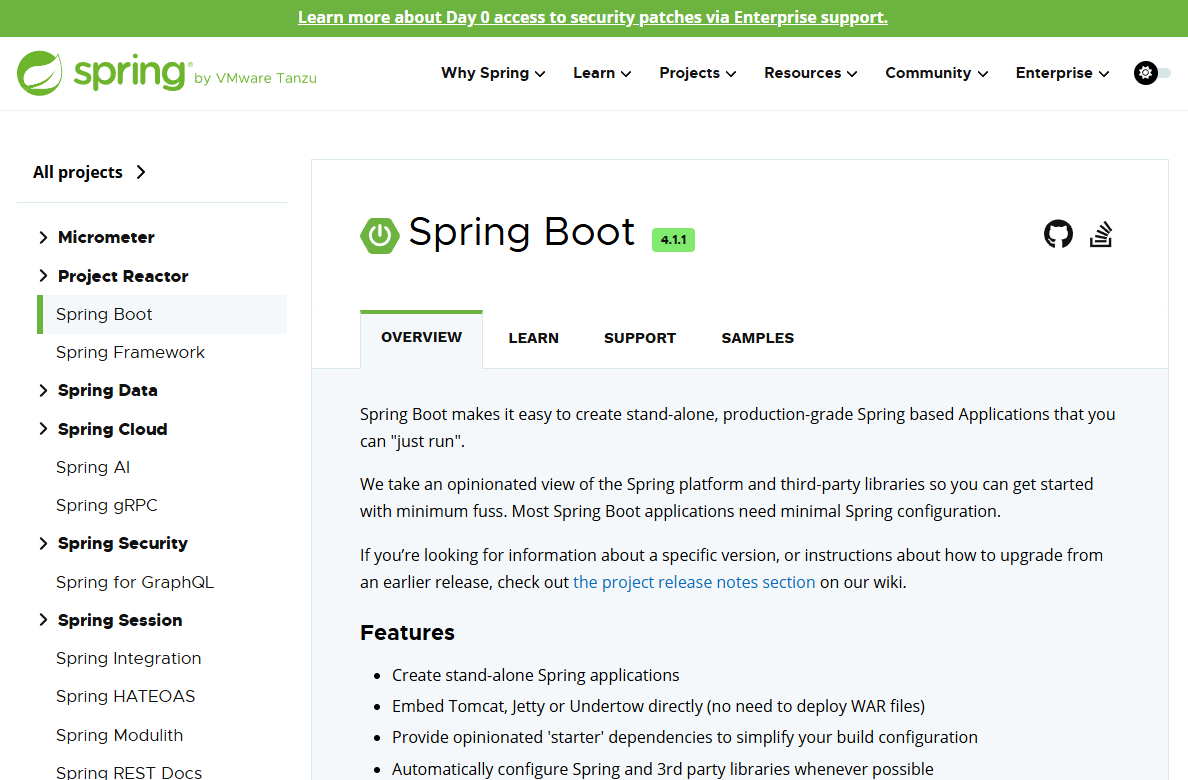
Spring Boot makes it easy to create stand-alone, production-grade Spring-based applications with minimal configuration. It is the default starting point for most teams building Java APIs, SaaS backends, and enterprise web applications. According to JetBrains' The State of Java (2025), 65% of surveyed Java developers use Spring, which translates to a broad hiring pool, extensive documentation, and strong community support.
Best for: Product teams that need a well-supported Java framework for a long-lived SaaS application or public API.
Key features
- Auto-configuration for common application patterns
- Embedded Tomcat, Jetty, or Undertow servers
- Spring Security integration for authentication and authorization
- Actuator health and metrics endpoints
- Opinionated starter dependencies for rapid setup
Why choose Spring Boot: Its value for a PM is reduced decision churn. Engineering gets established patterns across data, security, testing, and deployment. The tradeoff is ecosystem breadth. Teams need clear boundaries to prevent unnecessary dependency sprawl as the application matures.
Spring Boot pricing: Open source under the Apache License 2.0. Enterprise support costs depend on the support provider and hosting environment.
2. Quarkus
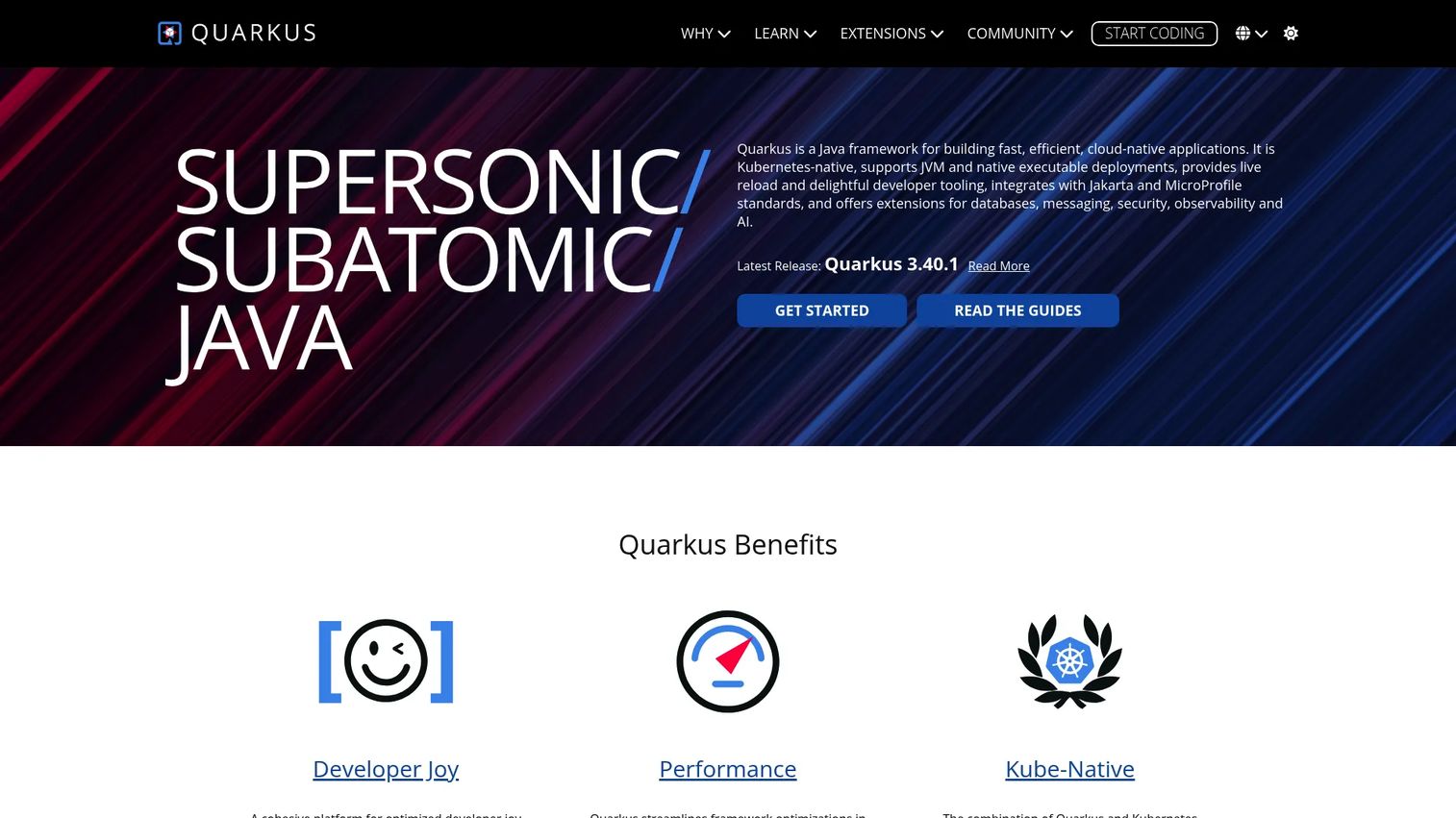
Quarkus is an open-source Java framework built specifically for cloud-native applications. Its core design goal is fast startup and low memory use, achieved through build-time optimization and native image compilation support. Teams shipping Java microservices into Kubernetes or serverless environments find that Quarkus addresses real deployment constraints that general-purpose frameworks were not originally designed for.
Best for: Product teams shipping Java microservices into Kubernetes, serverless platforms, or memory-constrained container environments.
Key features
- Native image compilation via GraalVM
- Kubernetes-native tooling and deployment support
- Developer mode with live reload
- Both reactive and imperative programming models
- Extensions for common cloud services and integrations
Why choose Quarkus: Ask whether runtime efficiency directly affects your product economics or deployment constraints. Shorter startup times reduce cold-start penalties in serverless architectures. Lower memory use increases container density and reduces infrastructure cost at scale.
Quarkus pricing: Open source under the Apache License 2.0. Commercial support and platform costs vary by provider.
3. Micronaut
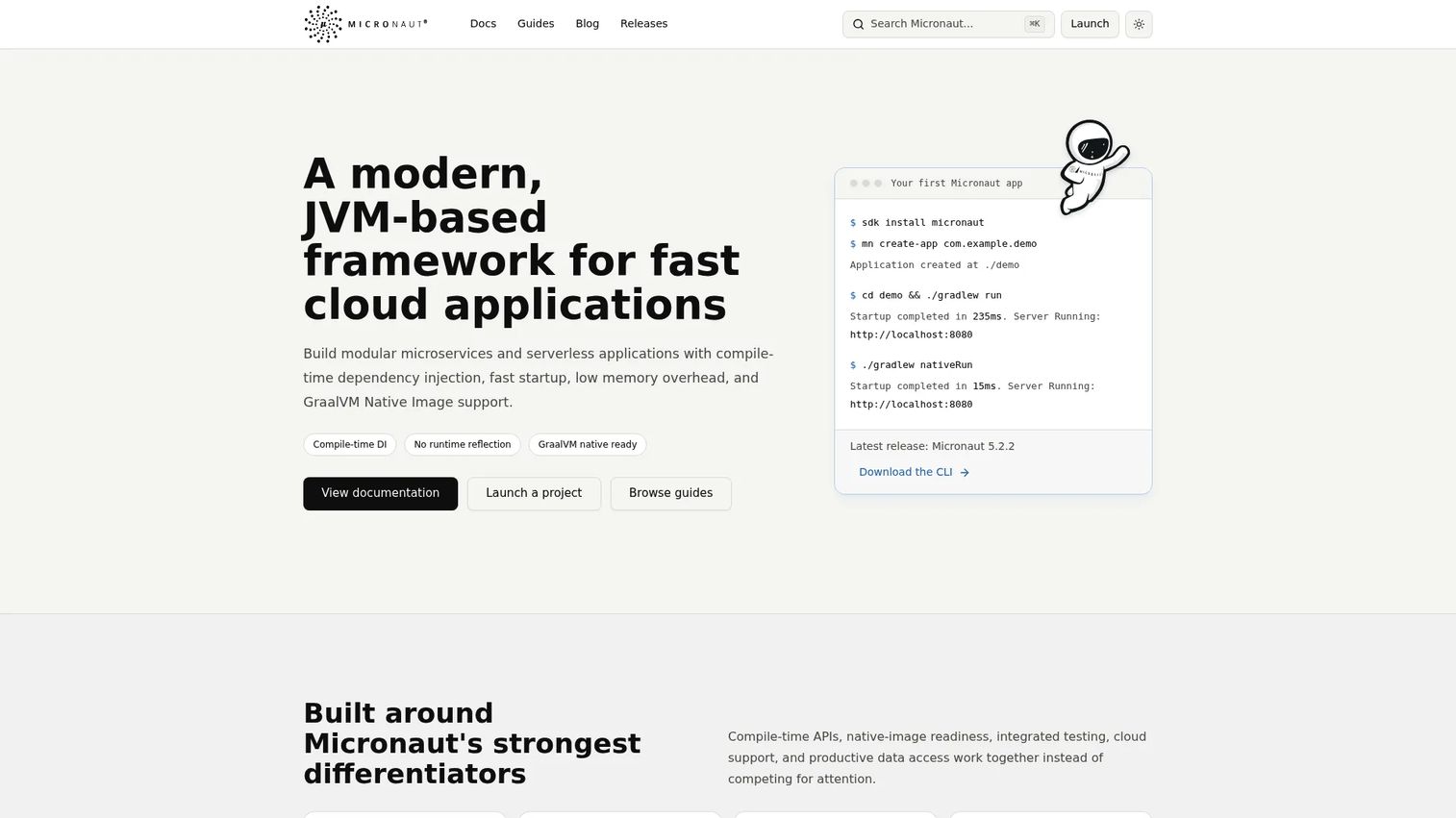
Micronaut is a JVM framework for building modular microservices and serverless applications. Its defining architectural choice is compile-time dependency injection, which avoids runtime reflection entirely. The result is fast startup, low memory overhead, and strong compatibility with GraalVM Native Image, making it a direct competitor to Quarkus for cloud-native workloads.
Best for: Teams building serverless functions, lightweight microservices, or applications that must start quickly with controlled memory use.
Key features
- Compile-time dependency injection without runtime reflection
- Declarative HTTP client and server
- Cloud and serverless integrations across major providers
- Configuration and validation tooling
- GraalVM Native Image compatibility
Why choose Micronaut: Choose it when deployment footprint and startup time are measurable product constraints, not engineering preferences. Where those constraints do not apply, the broader Spring Boot ecosystem often delivers faster initial delivery with fewer unknowns. Compare supported integrations and native-image strategy against Quarkus before committing to either.
Micronaut pricing: Open source under the Apache License 2.0. Commercial support options vary by provider.
4. Vaadin
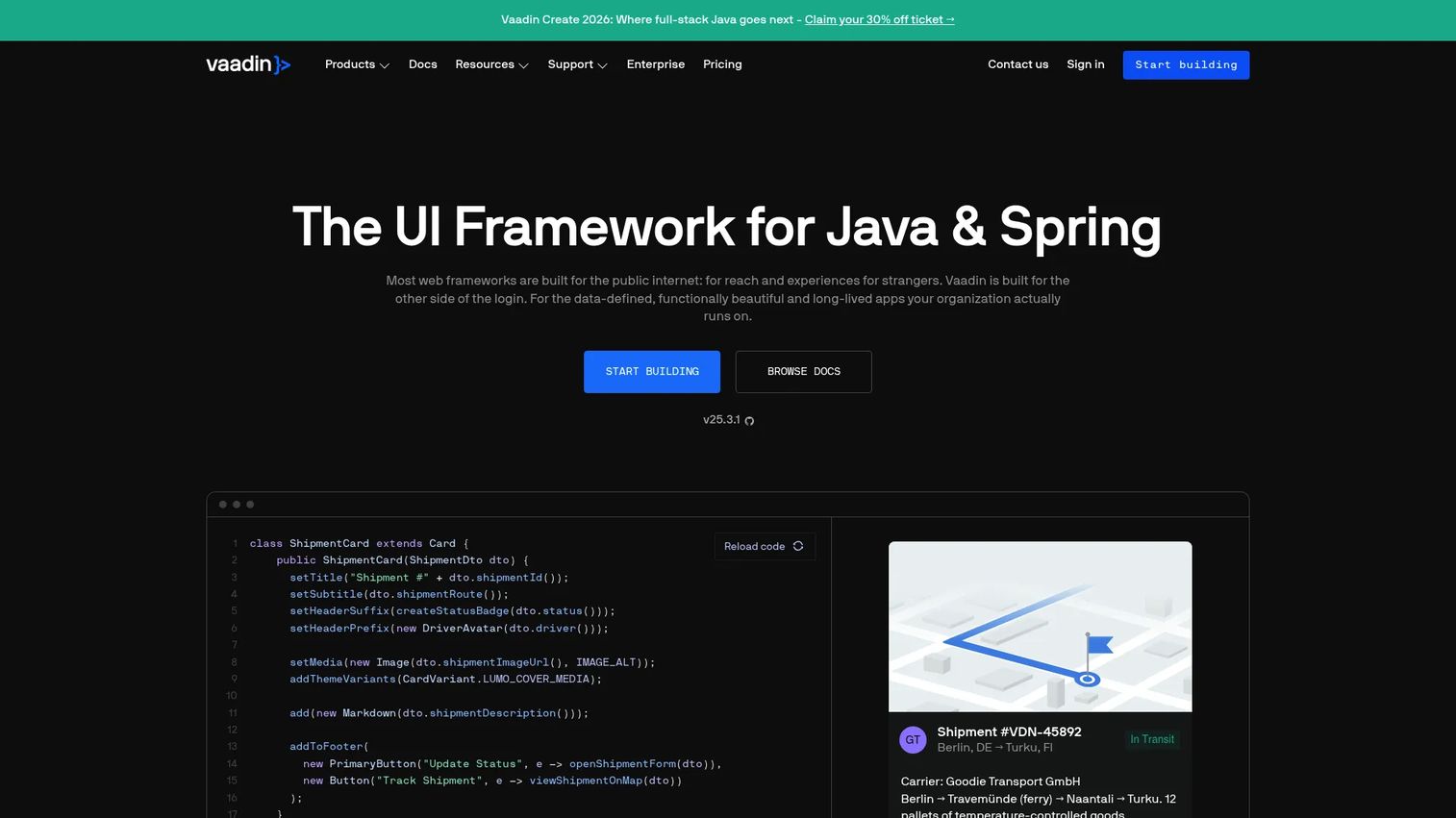
Vaadin is an open-source full-stack Java UI framework for building data-rich business web applications. Unlike the API and backend frameworks above, Vaadin lets Java developers build the entire browser-facing UI in Java, using server-side component rendering. For product teams responsible for internal tools, admin portals, and workflow-heavy operational interfaces, this model reduces the coordination overhead of maintaining separate Java and JavaScript codebases.
Best for: Product teams building internal tools, admin applications, workflow systems, or data-heavy business interfaces where the team is Java-centric.
Key features
- Server-side Java UI components with a rich component library
- Type-safe UI development and data binding
- Data grid with filtering, sorting, and inline editing
- Progressive Web Application support
- Spring Boot integration
Why choose Vaadin: Validate three things early: Accessibility requirements, design-system fit, and the expected degree of frontend customization. Vaadin is strongest when browser experiences are workflow-heavy and business-focused. For consumer-facing products requiring highly bespoke visual design, a dedicated JavaScript framework may be a better fit.
Vaadin pricing: The Free tier includes the open-source framework and core components at no cost. Pro plans start at $159 per developer per month and add commercial UI components and testing tools. Enterprise Edition pricing is custom.
G2 rating: 4.1/5
5. Jakarta EE
Jakarta EE is not a single framework. It is a set of vendor-neutral enterprise Java specifications with multiple certified runtime implementations. This distinction matters. Organizations evaluating Jakarta EE are typically choosing a standards approach rather than an opinionated framework, which affects portability, procurement, and governance rather than daily coding experience.
Best for: Enterprises with existing Java application-server investments, formal architecture standards, and long-lived business systems requiring certified runtime options.
Key features
- Core, Web, and Platform profiles for different application scopes
- RESTful web services and JSON processing APIs
- Dependency injection, security, persistence, transactions, and messaging specifications
- Microservices and cloud-native profile support
- Broad ecosystem of compatible application servers
Why choose Jakarta EE: This is the right conversation when procurement, enterprise architecture review, and multi-vendor portability matter as much as delivery speed. Teams modernizing existing Java EE applications often find Jakarta EE the path of least organizational resistance. Greenfield teams without that legacy context usually move toward Spring Boot or Quarkus faster.
Jakarta EE pricing: The specifications themselves are open source. Runtime, support, and hosting costs depend on the selected application server or vendor distribution.
6. Play Framework
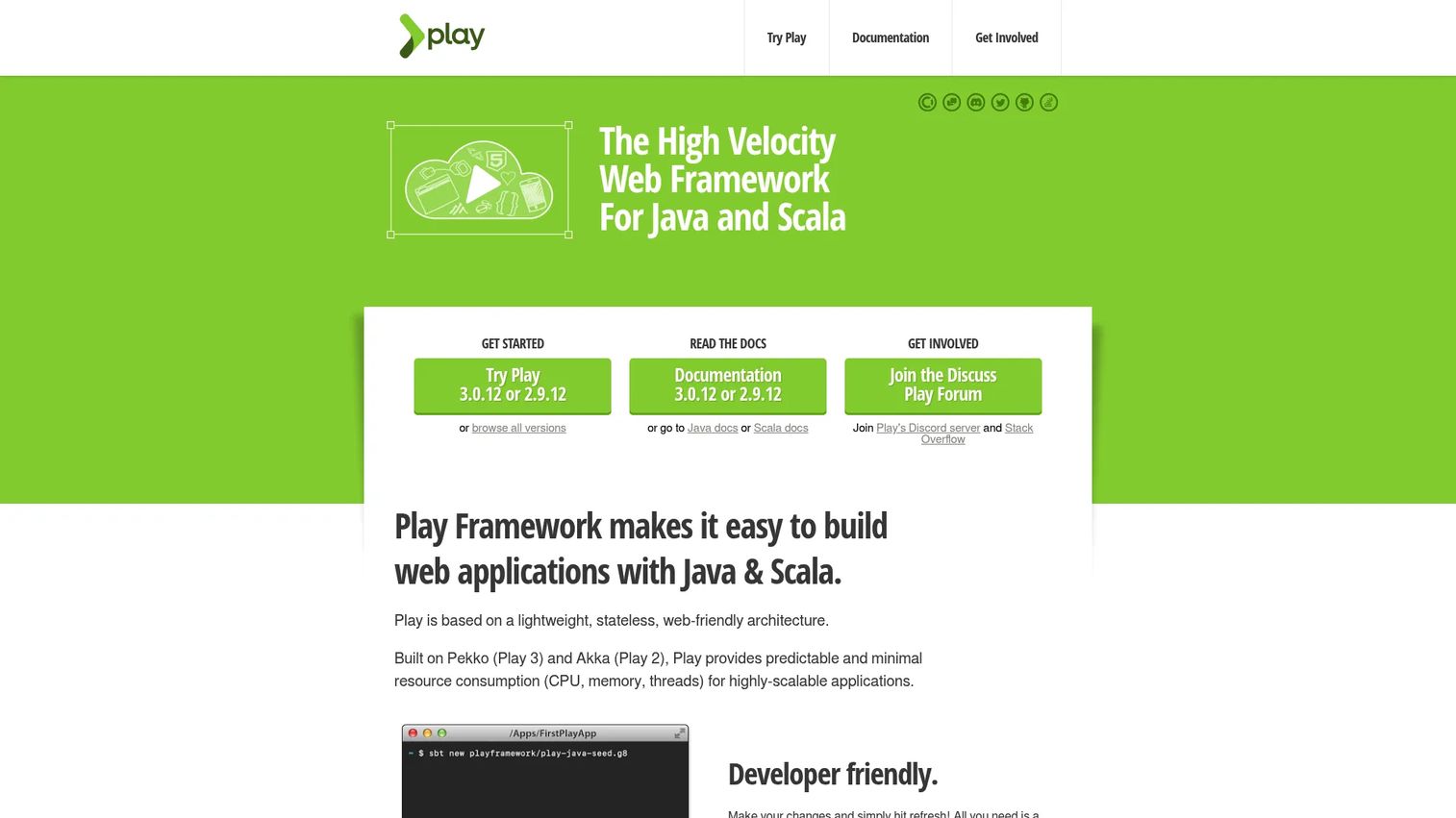
Play Framework is a high-velocity web framework for Java and Scala built on an asynchronous, stateless architecture. Its request lifecycle is non-blocking by design, which makes it well-suited for applications with high concurrency requirements. The dual Java and Scala support is worth noting in your architecture decision: It affects codebase ownership and hiring significantly over a multi-year roadmap.
Best for: Teams building reactive web applications, streaming-style workflows, or services with proven high-concurrency requirements.
Key features
- Stateless, asynchronous request processing
- MVC architecture with type safety
- Java and Scala language support
- WebSocket and real-time event handling
- Built-in testing tools and hot reloading
Why choose Play Framework: Its architecture earns its place when non-blocking I/O and reactive patterns are first-order product requirements, not aspirational ones. Before accepting the added implementation complexity, ask engineering to quantify the expected concurrency profile rather than infer it from technology trends.
Play Framework pricing: Open source under the Apache License 2.0. Hosting and support costs depend on the deployment stack.
G2 rating: 4.1/5
7. Grails
Grails is a Groovy-based web application framework for the JVM, built on Spring Boot. Its convention-over-configuration philosophy compresses delivery time for database-backed applications where teams accept the Groovy language. GORM, its data-access layer, supports SQL, MongoDB, Cassandra, and Neo4j, giving it broader persistence flexibility than its convention-driven reputation suggests.
Best for: Small to mid-sized teams that value rapid full-stack delivery and have Groovy expertise or clear appetite to develop it.
Key features
- Convention-over-configuration development model
- GORM data access for SQL and NoSQL datastores
- Spring Boot integration and plugin architecture
- REST API and modern frontend application profiles
- Scaffolding for rapid initial delivery
Why choose Grails: The productivity gain is real for database-backed applications with familiar conventions. Before committing, confirm the engineering team's Groovy experience and document a long-term ownership plan. Groovy's smaller hiring pool relative to Java is the primary maintenance risk for teams that grow or turn over.
Grails pricing: Open source under the Apache License 2.0. Costs come from hosting, optional support, and engineering capacity.
G2 rating: 3.6/5
8. Vert.x
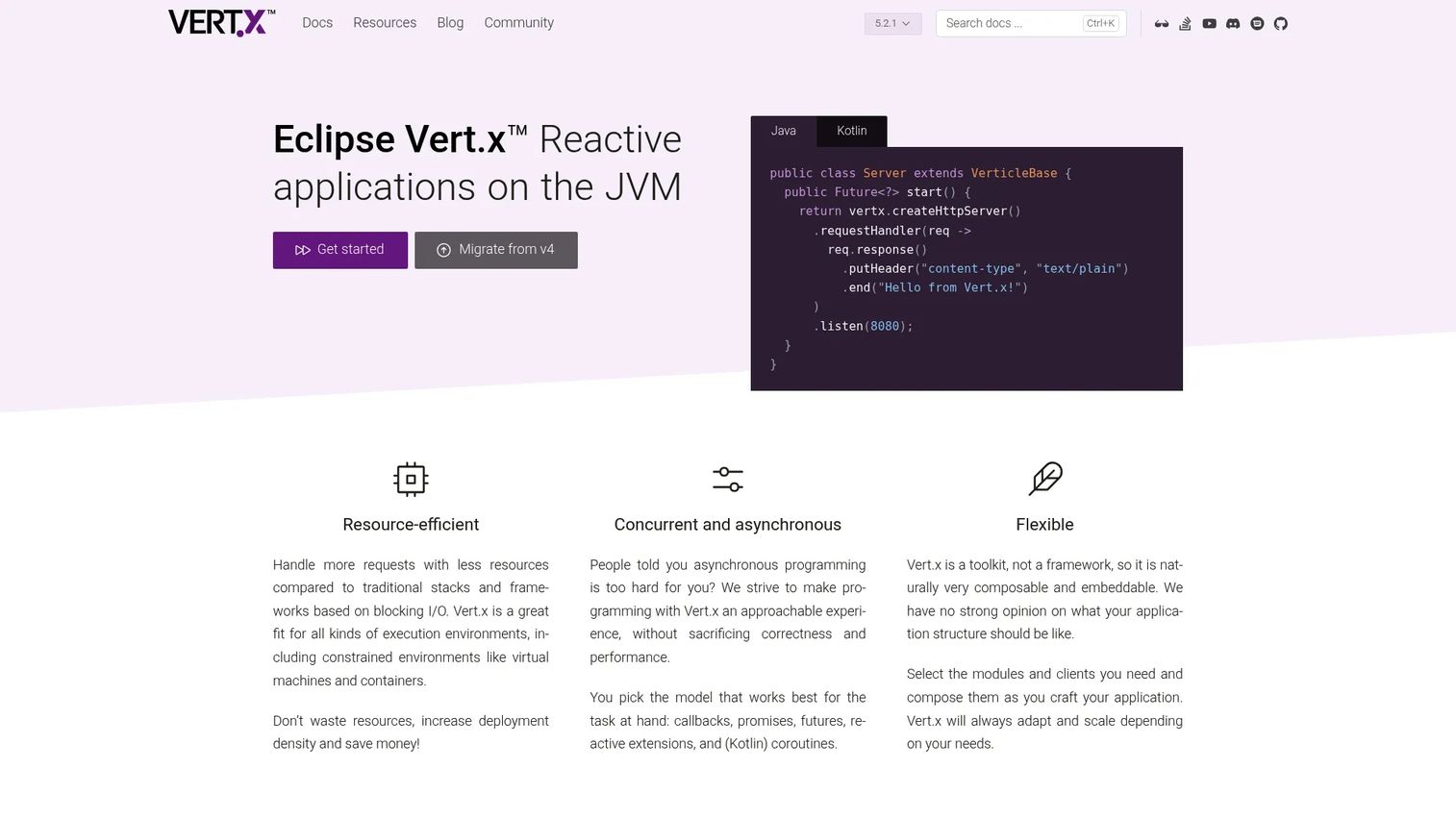
Vert.x is an open-source toolkit for building reactive applications on the JVM. Unlike a convention-heavy framework, it provides event-driven primitives and lets teams compose architecture without prescribed structure. That flexibility accelerates experienced teams but requires strong engineering discipline to prevent fragmentation across a growing codebase. Its polyglot support also covers JavaScript, Kotlin, and Python alongside Java.
Best for: Engineering teams building event-driven services, high-throughput APIs, messaging-heavy systems, or polyglot backend platforms.
Key features
- Event-driven architecture with a resource-efficient event loop
- HTTP and WebSocket client and server support
- Event bus for distributed messaging
- Clustered deployment options
- Reactive programming APIs
Why choose Vert.x: Request concrete performance, throughput, and real-time interaction requirements before prioritizing this approach. It works when concurrency and event handling are first-order product requirements with documented evidence. The flexibility it provides also means fewer guardrails for teams accustomed to more prescriptive frameworks.
Vert.x pricing: Open source under the Eclipse Public License 2.0 and Apache License 2.0. Infrastructure and support costs depend on the operating environment.
9. Apache Wicket
Apache Wicket is a component-oriented, server-side Java web framework that builds browser interfaces through pure Java objects rather than templating languages. Its stateful component model and integration with CDI, Spring, and Jakarta EE make it a durable option for teams maintaining Java-centric web applications with complex forms and server-side UI state.
Best for: Teams maintaining Java-centric web applications with complex forms, workflows, and server-side UI state, or developers who prefer object-oriented UI composition.
Key features
- Server-side Java and HTML component model
- Secure by default with configurable Content Security Policy
- Built-in AJAX components
- Internationalization support for more than 25 languages
- WicketTester for unit and integration testing
Why choose Apache Wicket: Frame this as a continuity choice for teams with existing Wicket applications or a strong Java-first UI heritage. Validate the developer hiring pool, planned maintenance workload, and user experience expectations before committing. For a greenfield product, compare ecosystem activity and documentation depth against Vaadin.
Apache Wicket pricing: Open source under the Apache License 2.0. Costs come from implementation, maintenance, and optional support partners.
G2 rating: 3.8/5
10. Apache Tapestry
Apache Tapestry is a component-oriented Java web framework that emphasizes convention-based development and fast developer feedback loops. Its live class reloading speeds iteration without restarting the server, which experienced teams find genuinely useful. For greenfield products, it is a specialized choice that requires a deliberate evaluation against more widely adopted options.
Best for: Teams maintaining an existing Tapestry application, or experienced Tapestry developers building a conventional server-side Java application.
Key features
- Java POJO-based pages and components
- Live class reloading without server restart
- Built-in AJAX support and reusable components
- Convention-based configuration
- Built-in dependency injection
Why choose Apache Tapestry: It works well for teams that already know its model. For a new product, document why it fits better than Spring Boot or Vaadin before committing. The team should also confirm an active maintenance plan and verify that the hiring pool in their market includes Tapestry experience.
Apache Tapestry pricing: Open source under the Apache License 2.0. Budget for engineering ownership, infrastructure, and any specialized support needs.
G2 rating: 4.3/5
Considerations when choosing a Java web framework
Match the framework to the product surface
A public API, a customer-facing SaaS application, and an internal operations portal can all run on Java. They do not need the same framework. Define the critical user journeys and expected traffic patterns before comparing benchmarks or release notes.
Account for team skills and hiring reality
A framework with strong documentation and a large talent pool lowers onboarding risk and ramp time. The JetBrains State of Java (2025) found that 65% of surveyed Java developers use Spring. A more specialized option can still fit, but only when the existing team carries the expertise and the product benefit is concrete.
Treat cloud economics as a product constraint
Container density, cold starts, memory use, and observability all affect infrastructure cost and release reliability. Ask engineering for expected traffic patterns and deployment targets. General claims about "cloud-native" behavior are less useful than specific numbers for your expected load.
Plan for security and release governance
Evaluate authentication patterns, dependency update cadence, vulnerability response timelines, and audit requirements. The framework does not replace security engineering, but it determines how consistently the team can implement controls across releases, especially important when passing a security review is a gate for a major contract.
Protect maintainability after launch
A rapid first release only helps if future teams can modify it safely. Ask how the framework supports testing, dependency upgrades, and observability across a multi-year roadmap. Frameworks with smaller communities can create real risk as the product evolves and the original engineering team changes.
Conclusion
The Java web framework market has clear lanes. Spring Boot is the broad default for most SaaS backends and enterprise web applications, backed by the largest talent pool and deepest ecosystem. Quarkus and Micronaut earn their place when cloud-native runtime characteristics directly affect deployment cost or startup behavior. Vaadin is compelling for Java-first internal business applications where reducing frontend delivery dependencies is a real product priority. Jakarta EE fits standards-driven enterprise architecture where governance and runtime portability outweigh developer experience preferences. Play Framework and Vert.x serve reactive and high-concurrency needs when those requirements are proven rather than assumed. Grails, Apache Wicket, and Apache Tapestry fit more specific team contexts and legacy situations.
Run a small proof of concept against your highest-risk workflow before finalizing any choice. Do not select from feature lists alone.
Choose the framework that protects the next twelve releases, not only the first twelve weeks.
Start your journey with Guideflow today!
FAQs
Spring Boot is the most common starting point for teams building Java web applications, APIs, and SaaS backends. Its ecosystem covers security, data access, observability, and deployment with well-documented conventions and a large hiring pool. The best choice shifts when cloud runtime efficiency, a server-side UI model, or enterprise governance requirements drive the decision.
Quarkus and Micronaut are common picks when fast startup and lower memory use are measurable requirements. Spring Boot remains strong for microservices when ecosystem depth and team familiarity matter more than runtime optimization. Compare each against your deployment environment, expected traffic, and integration requirements before deciding.
Neither is a universal winner. Both target cloud-native and serverless workloads through fast startup and low memory overhead. Teams should compare their specific integration needs, native-image strategy, existing expertise, and operational tooling. Quarkus has stronger Kubernetes-specific tooling; Micronaut's compile-time injection model eliminates runtime reflection entirely. Run a targeted proof of concept on your most complex workflow.
Yes, for most API, SaaS, and enterprise applications. Its maturity reduces delivery and maintenance risk, and 65% of surveyed Java developers use Spring according to JetBrains' The State of Java (2025). Smaller cloud-native frameworks may fit more constrained runtime environments, but Spring Boot's ecosystem depth means it rarely creates a ceiling for well-structured applications.
Vaadin is the strongest option for Java-first teams building data-heavy internal tools, operational dashboards, and admin portals. Its server-side component model removes the need for a separate JavaScript frontend function. The decision also depends on UI customization requirements and how your team plans to own frontend quality over time.
No. Jakarta EE is a set of vendor-neutral enterprise Java specifications, implemented by multiple certified runtimes such as WildFly and Open Liberty. Spring Boot is an opinionated application framework with a specific development model and ecosystem. Teams evaluate them on different axes: Jakarta EE for portability and procurement governance, Spring Boot for delivery speed and ecosystem depth.
Yes. PMs should not dictate implementation details, but the framework choice directly affects delivery timelines, maintainability, security controls, infrastructure cost, and UI ownership. A PM who understands these tradeoffs can prevent the team from optimizing for the first release at the expense of the next twelve.
Start with product requirements: Expected user journeys, deployment environment, team skills, integration needs, and maintenance expectations. Then run a focused proof of concept against the highest-risk workflow in your product, not a benchmark or tutorial project. The framework that handles your hardest case cleanly is more valuable than the one that scores well on a synthetic test.