Your security team is already collecting identity events, endpoint telemetry, SaaS logs, and cloud activity. The data volume isn't the problem. The problem is prioritization: Static rules catch known patterns, but they miss behavior that becomes risky only in context. A user downloading 5 MB looks routine. That same user suddenly moving gigabytes of data to an external drive at 11 PM on a Friday is a different story entirely.
User and entity behavior analytics, or UEBA software, solves this by building behavioral baselines for every user, device, and application in your environment, then flagging activity that deviates from those patterns. According to Industry Research (2026), 79% of enterprises had implemented behavioral analytics tools in cybersecurity by 2025, up from 61% in 2022. The demand reflects a real shift: Alert fatigue from static rules is a measurable operational problem, and behavioral context is how teams cut through the noise.
The real buying question is which UEBA platform improves detection quality without becoming yet another noisy system that requires constant engineering support to keep current.
What's inside
This guide covers 13 UEBA tools evaluated for security and IT teams, including product managers who own security requirements for SaaS products or internal tooling. Tools were selected based on:
- Behavioral analytics depth and anomaly detection capability
- Data source coverage across identity, endpoint, cloud, and SaaS
- Integration with existing security operations stacks (SIEM, SOAR, XDR, IAM)
- Deployment model and maintenance overhead
- Pricing transparency and verified G2 ratings
TL;DR
- Best overall UEBA platform: Securonix, for broad behavioral analytics and enterprise security operations
- Best for SIEM-centered teams: Splunk User Behavior Analytics, for organizations already invested in Splunk workflows
- Best for data-centric insider risk: Varonis Data Security Platform, for teams focused on sensitive data access and exfiltration
- Best for Microsoft environments: Microsoft Sentinel, for teams standardizing on Microsoft security services
- Best for smaller security teams: ManageEngine Log360, for broader monitoring in a unified package with transparent pricing
- Best for investigation workflows: Exabeam, for behavioral timelines and analyst-focused threat investigation
What is UEBA software?
UEBA software, or user and entity behavior analytics software, analyzes activity from users, devices, applications, workloads, and other entities to identify behavior that deviates from established patterns.
The core workflow runs in five stages:
1. Collect data
- Identity provider and authentication logs
- Endpoint activity and device telemetry
- Cloud and SaaS activity
- Network connections and file access
- Privileged account actions and HR directory context
2. Normalize activity
- Convert events into comparable records
- Associate activity with users, devices, accounts, and locations
- Resolve identity context across systems
3. Build behavioral baselines
- Typical login locations and access times
- Common applications and usual download volumes
- Peer group behavior and privileged activity patterns
4. Detect anomalies
- Impossible travel and unusual access paths
- Sudden privilege escalation
- Large data movement and new device behavior
- Suspicious service account activity
5. Prioritize risk
- Combine multiple weak signals into risk scores
- Link activity to user or entity timelines
- Route high-priority cases to analysts or automated response
Key features to look for
- Behavioral baselining and machine-learning anomaly detection
- Entity and identity resolution across disparate accounts
- Risk scoring and peer group analysis
- Insider threat detection and compromised account detection
- Incident timelines and SIEM, SOAR, XDR, IAM, and DLP integrations
- False positive suppression and tuning controls
UEBA differs from UBA (user behavior analytics) in scope: UBA covers human users only, while UEBA extends analysis to devices, service accounts, applications, workloads, and network resources. For environments where non-human entities carry significant risk, that extension matters.
When to use UEBA software
Detect compromised accounts
UEBA connects signals that individually look unremarkable: An unusual login time, a new device, a location inconsistent with recent activity, and a sudden privilege escalation. No single signal is conclusive. Correlated across a user timeline, they produce investigation leads that a static rule would never surface. This is especially useful for detecting credential theft, where the attacker behaves like a legitimate user until they don't.
Investigate insider risk and data movement
Departing employees, privileged users with broad access, and insiders attempting to exfiltrate data produce patterns UEBA can identify: Repeated access to repositories outside normal scope, large download volumes, transfers to removable storage, or unusual cloud sync activity. Connecting identity context to file and data behavior requires clear investigation policies and privacy controls alongside the technology.
Reduce alert fatigue in security operations
Risk scoring lets analysts focus on the cases most likely to represent genuine threats, rather than triaging every individual alert. Behavioral context groups related signals into incident timelines, suppresses expected activity based on peer group norms, and routes high-confidence cases into response workflows. For product and engineering teams evaluating security tooling, this translates directly to reduced operational overhead and lower maintenance cost.
UEBA software comparison
Use this table as a starting shortlist, not a replacement for a proof of concept. Each tool has different data source requirements, deployment models, and integration assumptions that will affect fit.
| # | Product | Best for | Key differentiator | Pricing | G2 rating |
|---|---|---|---|---|---|
| 1 | Securonix | Enterprise security operations | Unified SIEM, UEBA, and SOAR with 365 days hot data | Custom pricing | 4.0/5 |
| 2 | Splunk User Behavior Analytics | Teams in existing Splunk environments | ML behavior profiling inside Splunk Enterprise Security | Included in ES Premier; contact sales | N/A |
| 3 | Rapid7 | Unified detection and response | Attack surface management plus threat detection | From $1.62/mo per asset (InsightVM) | 4.3/5 |
| 4 | ManageEngine Log360 | Smaller IT and security teams | Unified SIEM, UEBA, and compliance from $245/yr | From $245/yr (100 endpoints) | 4.3/5 |
| 5 | Exabeam | SOC investigation workflows | Behavioral timelines and automated threat storytelling | Custom pricing | 4.2/5 |
| 6 | Microsoft Sentinel | Microsoft-centric environments | Cloud-native SIEM with Entra identity integration | Usage-based; 31-day free trial | 4.4/5 |
| 7 | Varonis Data Security Platform | Data-centric insider risk | Sensitive data discovery plus data access analytics | Custom pricing | 4.7/5 |
| 8 | OpenText Behavioral Signals | OpenText security environments | Unsupervised ML with MITRE ATT&CK mapping | Custom pricing | N/A |
| 9 | Cyberhaven | Data exfiltration and insider risk | Data lineage tracing across endpoints, browsers, and cloud | Custom pricing | 4.5/5 |
| 10 | IBM QRadar User Behavior Analytics | Existing QRadar customers | No additional cost for QRadar clients | Included for QRadar clients | 4.4/5 |
| 11 | Cynet 360 AutoXDR | Lean teams consolidating controls | XDR plus UBA in a single per-endpoint platform | Custom pricing (per endpoint) | 4.7/5 |
| 12 | Gurucul | Dedicated risk analytics programs | AI-powered SIEM with unified entity risk scoring | Custom pricing | 3.0/5 |
| 13 | Proofpoint Insider Threat Management | Context-aware insider threat programs | Sentiment analysis plus behavioral detection and forensics | Custom pricing | 4.3/5 |
Pricing and G2 ratings verified against vendor pages and live G2 listings, October 2026. Verify before publication.
Best UEBA software tools for 2026
1. Securonix
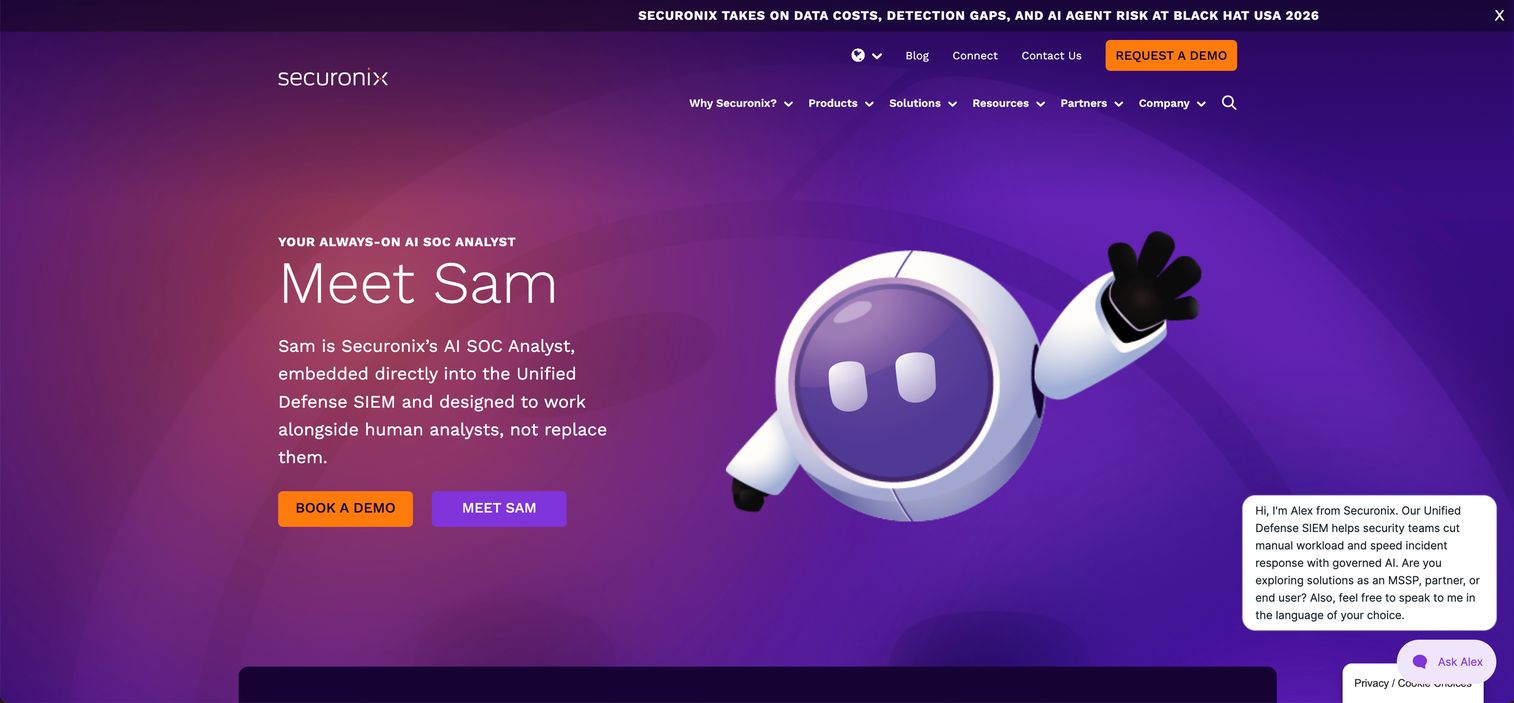
Securonix provides a cloud-native Unified Defense SIEM that combines SIEM, UEBA, SOAR, and threat intelligence into a single platform. Its behavioral analytics engine processes data from 500-plus connectors and retains 365 days of hot, searchable data, meaning analysts can investigate historical activity without querying cold storage. The agentic AI layer automates threat triage and enrichment, reducing manual investigation steps for SOC teams.
Best for: Enterprise security teams that need broad behavioral analytics across users, entities, and security data in one environment.
Key features
- AI-driven behavioral analytics with threat detection and risk scoring
- Integrated SIEM and SOAR with automated response playbooks
- 365 days of hot searchable security data
- 500-plus data connectors and cloud integrations
- Threat intelligence ingestion and enrichment
Why choose Securonix: Securonix suits organizations that want a single platform spanning detection, investigation, and response, rather than assembling those capabilities from separate tools. The data retention model reduces the tradeoff between storage cost and investigation depth. The onboarding and data preparation scope is enterprise-grade, so factor in implementation timeline when comparing against narrower point solutions.
Securonix pricing: Securonix uses a consumption-based model priced by GB/day, with hybrid commitment and pay-as-you-go structures and pre-negotiated overage terms. Contact Securonix sales for a quote, as no public numeric tier prices appear on their site.
G2 rating: 4.0/5
2. Splunk User Behavior Analytics
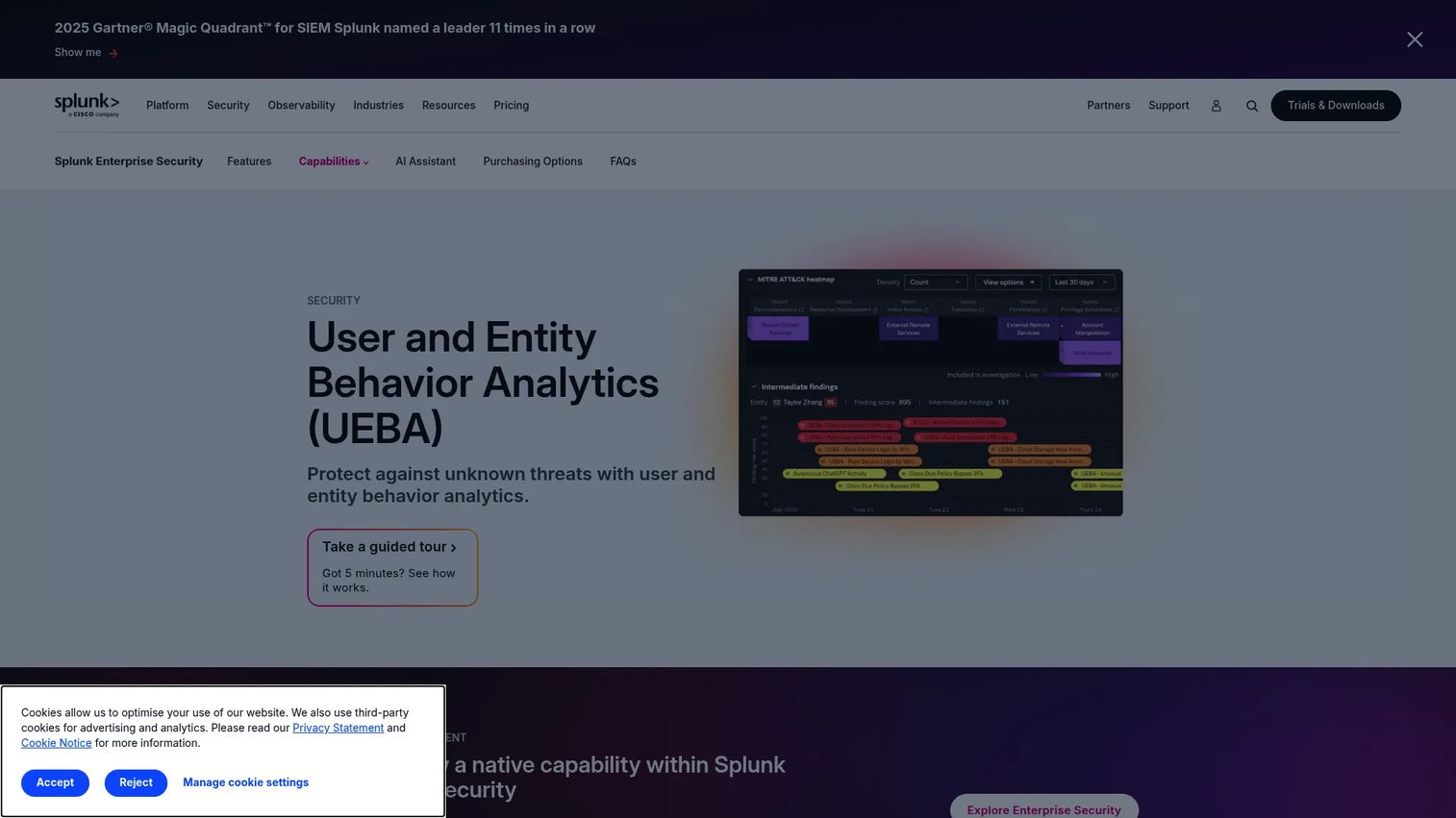
Splunk User Behavior Analytics applies unsupervised machine learning to behavioral profiling across users, devices, and applications. It correlates events from identity, endpoint, and application logs against peer-group baselines to surface anomalous activity. Splunk reached End of Sale for the standalone UEBA product in December 2025; current UEBA capability is included in Splunk Enterprise Security Premier.
Best for: Teams with an established Splunk environment and analysts who want UEBA inside existing search and correlation workflows.
Key features
- Unsupervised ML behavior profiling across users and entities
- Peer group analysis and behavioral baselining
- Risk-based alerting with user and entity scoring
- Kill-chain and geographic investigation visualizations
- Integration with Splunk Enterprise Security
Why choose Splunk User Behavior Analytics: If your team already runs Splunk for SIEM and your analysts work in the Splunk search interface daily, adding UEBA within that environment avoids context switching. The tradeoff is that UEBA is now bundled into Enterprise Security Premier rather than available standalone, so evaluate the full licensing scope and data volume costs before committing.
Splunk User Behavior Analytics pricing: UEBA is included in Splunk Enterprise Security Premier. Standalone UEBA reached End of Sale in December 2025. Contact Splunk sales for Enterprise Security Premier pricing, which varies by data volume and workload.
G2 rating: No current standalone G2 rating verified for Splunk User Behavior Analytics.
3. Rapid7
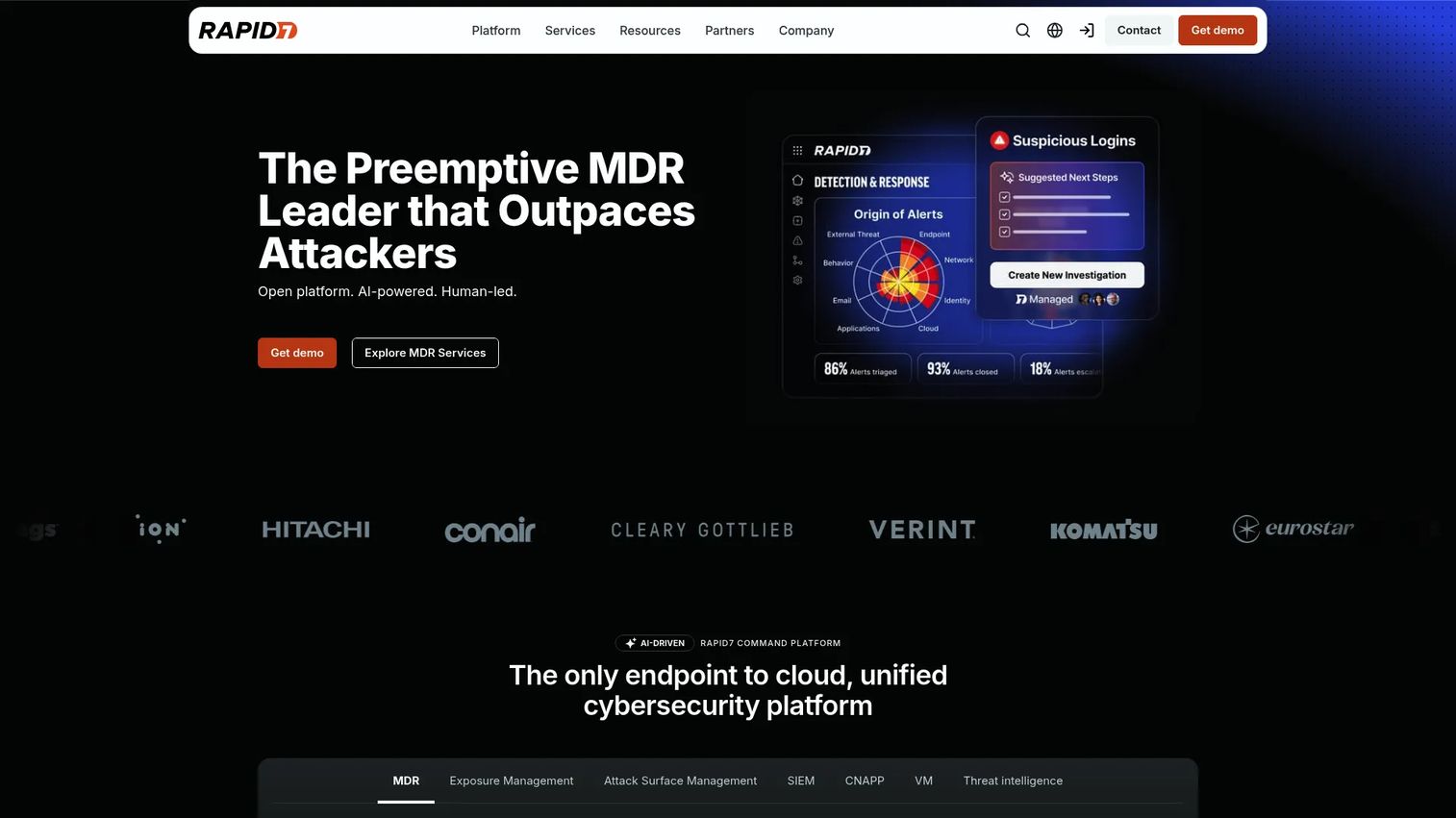
Rapid7 provides an AI-powered security operations platform that unifies exposure management, threat detection, and incident response. Its behavioral analytics capabilities sit within the broader Insight platform, connecting user and entity context with vulnerability data, endpoint telemetry, and cloud signals. Analysts use behavioral context alongside asset risk data to prioritize investigation.
Best for: Security teams seeking behavioral detection inside a broader detection and response platform, particularly those consolidating vulnerability management with threat detection.
Key features
- Attack surface management with continuous asset visibility
- Behavioral anomaly detection across users and endpoints
- Risk prioritization connecting exposure and behavior signals
- Next-generation SIEM with integrated investigation workflows
- Cloud, identity, and endpoint telemetry correlation
Why choose Rapid7: Rapid7 appeals to organizations that want to connect vulnerability exposure to behavioral risk in a single operational view. If your security program already measures attack surface alongside detection, the combined data model reduces the number of systems analysts must cross-reference. Teams that need deep, standalone UEBA as their primary use case may find more depth in dedicated behavioral analytics platforms.
Rapid7 pricing: InsightVM starts at $1.62/month per asset for 500 assets. InsightAppSec runs $175/month per application. InsightCloudSec starts at $5,775/month for up to 500 instances. Command Platform packages, which include detection and response capabilities, require a demo for pricing.
G2 rating: 4.3/5
4. ManageEngine Log360
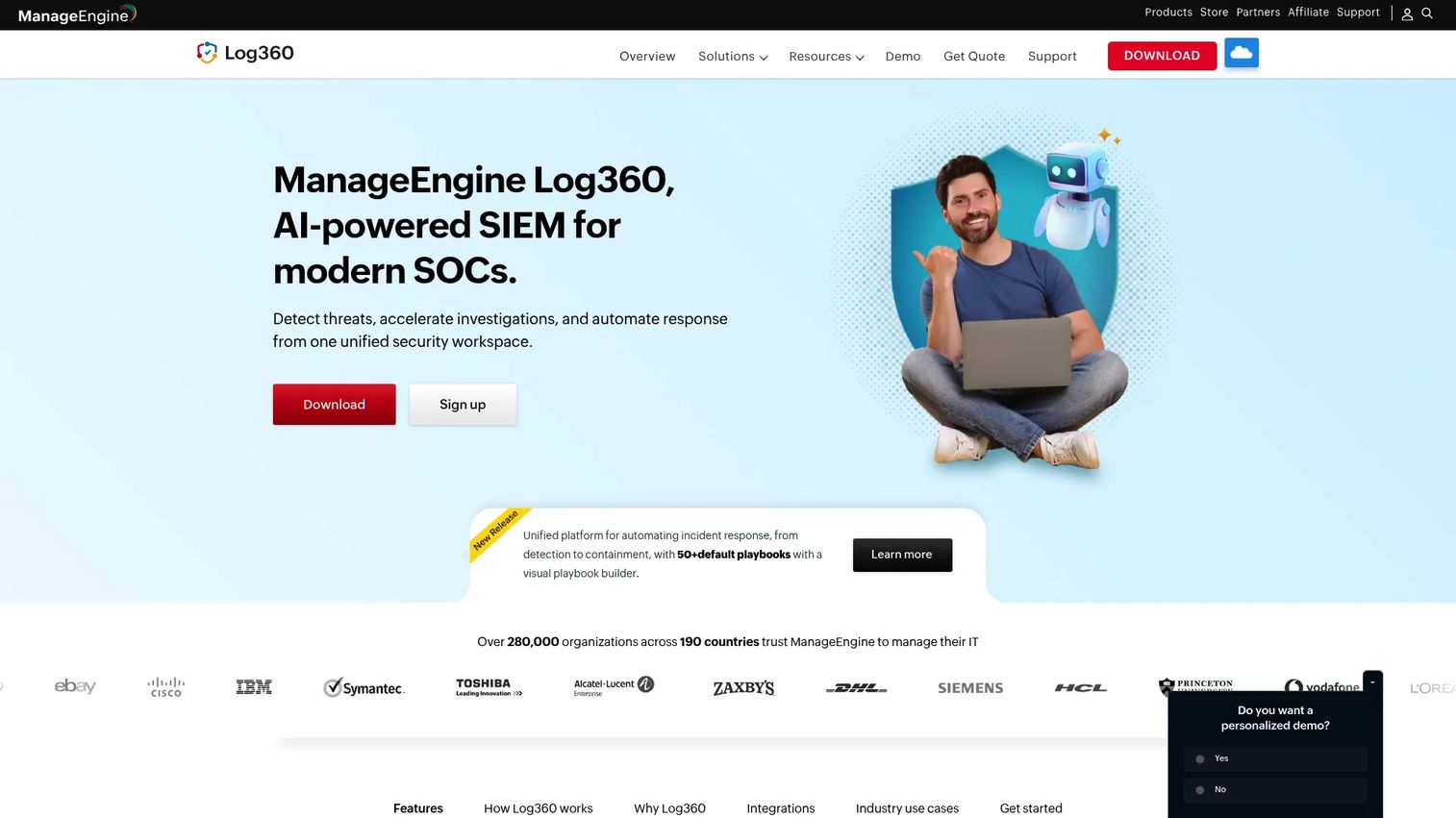
ManageEngine Log360 is a unified SIEM platform covering log management, threat detection, UEBA, Active Directory monitoring, integrated DLP, CASB, compliance reporting, and automated response. For smaller IT and security teams that cannot staff a dedicated SIEM analyst team, it provides broad coverage in a single purchase. The component-based licensing model means you pay for what your environment actually uses.
Best for: Small and mid-sized security and IT teams that want UEBA within a wider security monitoring suite, without buying separate point tools for each function.
Key features
- User behavior analytics with risk scoring
- Log collection and real-time correlation across sources
- Active Directory auditing and identity monitoring
- Integrated DLP and CASB for cloud security visibility
- IT compliance reporting for major frameworks
Why choose ManageEngine Log360: Log360 gives lean teams a single procurement path for SIEM, UEBA, compliance, and cloud monitoring. The tradeoff involves customization depth and data scale: Large enterprise environments with complex detection requirements or high data volumes may outgrow what the platform handles efficiently. For teams prioritizing coverage breadth over analytical depth, it's a practical starting point.
ManageEngine Log360 pricing: Component-based annual licensing. Endpoints start at $245/year for 100 endpoints. Log sources run $795/year for 10 log sources. Domain controllers are $945/year for two controllers. Windows file servers are $495/year for two servers. Cloud accounts are $995/year for one account. A 30-day full-featured trial is available.
G2 rating: 4.3/5
5. Exabeam
Exabeam delivers an AI-driven security operations platform focused on threat detection, investigation, and response. Its behavioral analytics engine builds user and entity timelines that narrate a threat story from first anomaly through escalation, helping analysts understand what happened without manual correlation across disconnected logs. Exabeam and LogRhythm now operate as a single company on a combined SOC platform, so evaluation should cover the unified offering.
Best for: SOC teams that need behavior-based detection alongside structured investigation timelines and automated threat storytelling.
Key features
- User and entity behavior analytics with behavioral baselining
- Risk scoring and automated incident timelines
- Threat detection with kill-chain context
- Investigation workflows with prebuilt playbooks
- Cloud-scale security log management
Why choose Exabeam: Exabeam suits analysts who spend significant time manually correlating events across multiple data sources. The timeline-based investigation model reduces that work by assembling related signals into a coherent sequence. For organizations evaluating a proof of concept, the data coverage requirements and enterprise contract structure are worth scoping early, as implementation complexity scales with environment size.
Exabeam pricing: Exabeam does not display pricing on their site. Contact Exabeam sales or request a demo for current platform packaging and contract terms.
G2 rating: 4.2/5
6. Microsoft Sentinel

Microsoft Sentinel is a cloud-native SIEM with built-in entity behavior analytics, threat intelligence, and automated response. It ingests data natively from Microsoft Entra ID, Microsoft 365, Defender, and Azure, while also supporting third-party connectors. The entity behavior analytics layer establishes baselines for users and entities, then surfaces deviations as incidents alongside correlated security signals.
Best for: Organizations running Microsoft security, identity, cloud, and endpoint services who want UEBA connected to that existing data without adding a separate platform.
Key features
- Cloud-scale data collection across users, devices, and infrastructure
- Entity behavior analytics with Microsoft Entra identity context
- AI-driven threat detection and analytics rules
- Proactive threat hunting and investigation tools
- Built-in orchestration and automation for incident response
Why choose Microsoft Sentinel: For environments where most security data already flows through Microsoft services, Sentinel reduces the data pipeline complexity other SIEM and UEBA platforms require. The consumption-based pricing model means costs scale with data volume, so data ingestion management is a real operational consideration. Teams with significant non-Microsoft infrastructure need to evaluate connector coverage carefully.
Microsoft Sentinel pricing: Usage-based pricing by data volume analyzed. A 31-day free trial with up to 10 GB/day is available for new workspaces. Commitment tiers offer discounts over pay-as-you-go rates. Check the Azure pricing page for current per-GB ingestion rates, as Microsoft displays placeholder values that update frequently.
G2 rating: 4.4/5
7. Varonis Data Security Platform

Varonis Data Security Platform focuses on data security, sensitive data discovery, access behavior, and insider risk. Its UEBA capabilities connect identity context with file access patterns, cloud activity, and data movement, making it particularly strong when the central question is not "who logged in from where" but "who accessed what data and moved it where." The platform covers multi-cloud, SaaS, hybrid, and on-premises environments.
Best for: Teams prioritizing insider risk, sensitive data access governance, and data exfiltration detection over broad network or endpoint behavior analytics.
Key features
- Sensitive data discovery and classification across environments
- Data access analytics with abnormal activity detection
- Automated remediation of risky permissions and misconfigurations
- Insider risk detection with identity and permissions context
- Searchable forensic audit trails and DLP policy enforcement
Why choose Varonis Data Security Platform: Varonis gives security, privacy, and product teams clear visibility into where sensitive data lives, who can reach it, and when access patterns shift. For organizations where a data breach or exfiltration event carries significant regulatory or business risk, the data-centric view produces more actionable investigation context than network-level behavioral analytics alone. Teams that also need broad endpoint or network UEBA coverage should evaluate whether Varonis covers those data sources sufficiently for their environment.
Varonis Data Security Platform pricing: Varonis does not post pricing. A free data-risk assessment provides temporary platform access. Contact Varonis for a quote.
G2 rating: 4.7/5
8. OpenText Behavioral Signals
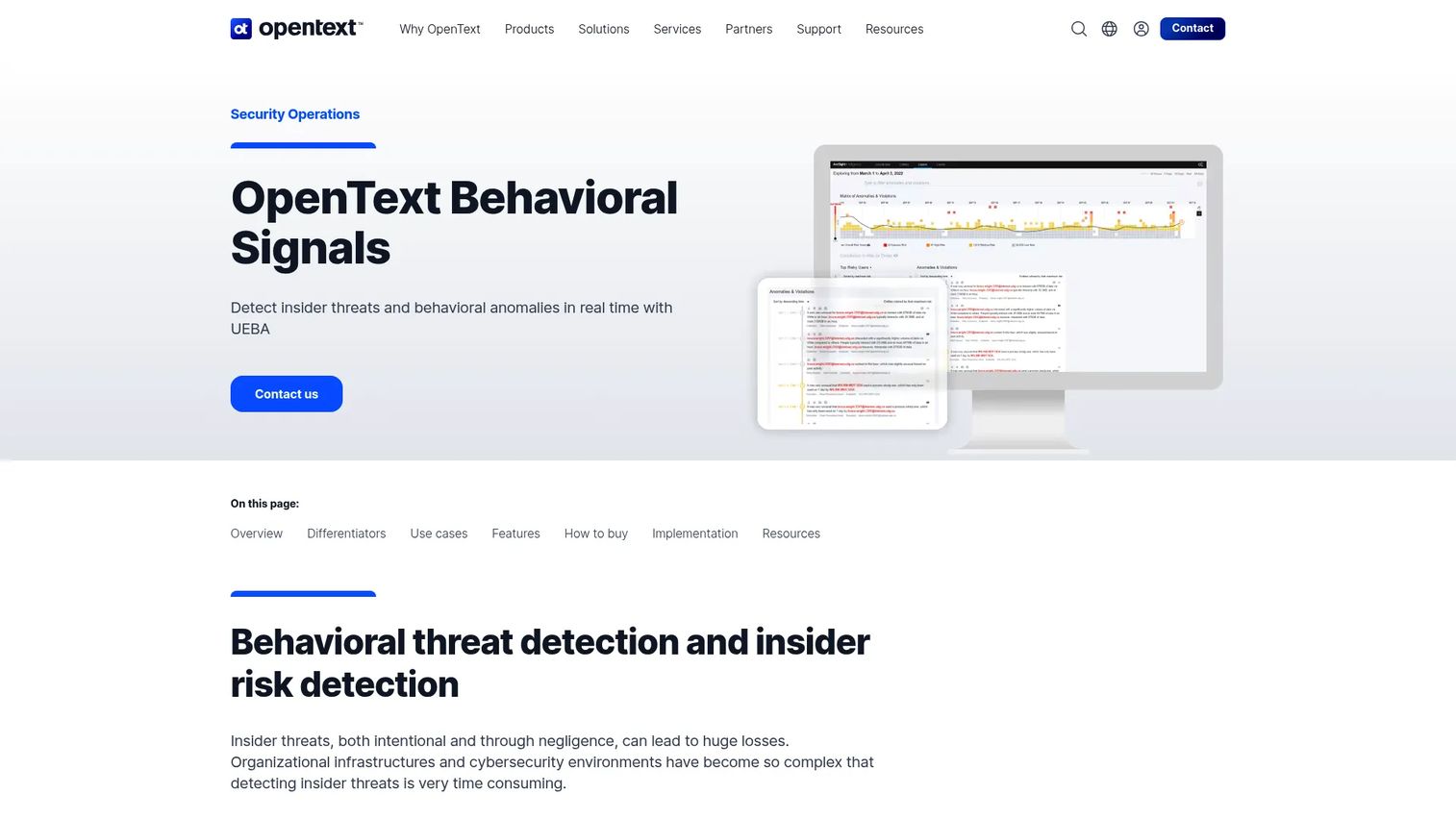
OpenText Behavioral Signals is a UEBA offering that uses unsupervised machine learning to detect insider threats and behavioral anomalies in real time. This product was previously known as ArcSight Intelligence, so organizations evaluating ArcSight-era documentation should confirm they're reviewing the current product packaging and capabilities under the OpenText name.
Best for: Organizations with existing OpenText security infrastructure seeking integrated behavioral analytics with MITRE ATT&CK alignment.
Key features
- Unsupervised machine learning engine for behavioral anomaly detection
- Dynamic anomaly and risk timelines per user and entity
- MITRE ATT&CK mapping for detected behaviors
- APIs for SOAR and ticketing system integration
- CrowdStrike Falcon data support
Why choose OpenText Behavioral Signals: OpenText Behavioral Signals fits organizations where the security team already operates OpenText products and wants to add behavioral detection without introducing a separate vendor relationship. The MITRE ATT&CK alignment helps teams map detected behaviors to known adversary techniques. Confirm current product availability, packaging, and licensing terms directly with OpenText before procurement, as naming and bundling have changed with the transition from ArcSight Intelligence.
OpenText Behavioral Signals pricing: Contact OpenText for current pricing. No public tier prices appear on the product page.
G2 rating: No current G2 rating verified.
9. Cyberhaven
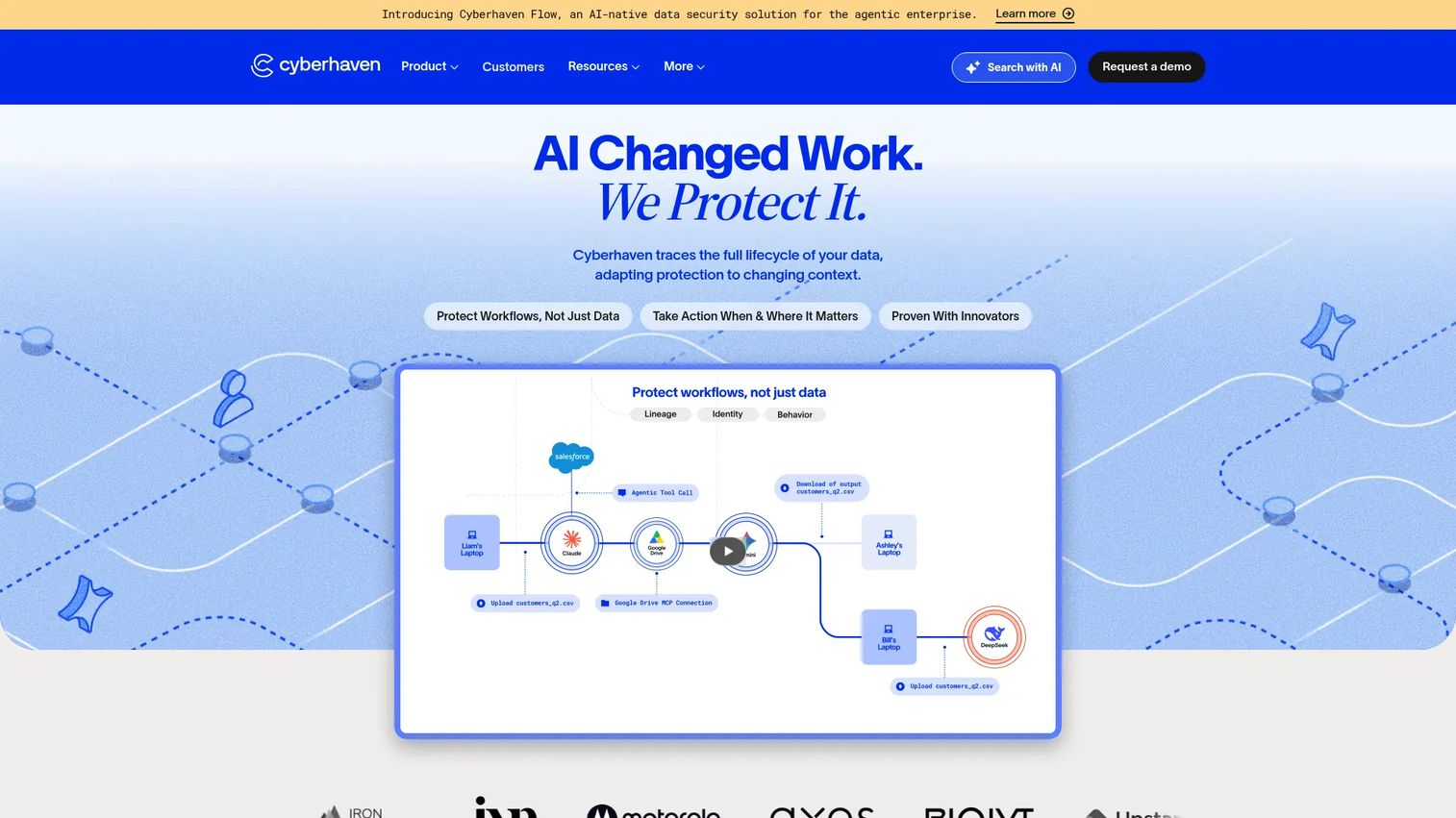
Cyberhaven provides an AI-native data security platform that traces data lineage across endpoints, browsers, cloud services, and email. Its insider risk management capability monitors how sensitive data moves through an organization, connecting the origin of a file or dataset to every downstream copy, transfer, or modification. This lineage model produces investigation context that standard log-based UEBA tools don't generate.
Best for: Security teams focused on protecting sensitive intellectual property and detecting data exfiltration, particularly across browser-heavy or cloud-first environments.
Key features
- Data lineage tracing across the full data lifecycle
- AI-based content intelligence and classification
- DLP across endpoints, browsers, cloud, email, and AI tools
- Autonomous risk detection with AI-assisted investigations
- Role-based access control and tamper protection
Why choose Cyberhaven: Cyberhaven's data lineage model is particularly useful when an investigation needs to answer not just "who moved data" but "where did that data originate and where did it go." For organizations with significant exposure through browser-based SaaS tools or AI-assisted workflows, the breadth of coverage across those channels matters. Verify that your specific endpoint, browser, and cloud combinations are fully supported before deployment, and confirm pricing with Cyberhaven sales.
Cyberhaven pricing: Cyberhaven uses annual subscription pricing based on organization or department size. Contact Cyberhaven for a quote. No numeric tier prices appear publicly.
G2 rating: 4.5/5
10. IBM QRadar User Behavior Analytics
IBM QRadar User Behavior Analytics establishes behavioral baselines and risk profiles using machine-learning analytics applied to QRadar event and flow data. It unifies disparate user identities across accounts, applies time-series profiling and clustering, and generates risk scores for users and entities based on correlated event patterns. IBM offers the UEBA app to existing QRadar clients at no additional cost.
Best for: Enterprise security operations teams already running QRadar SIEM who want behavioral analytics connected to their existing event and flow data.
Key features
- User import via LDAP, Active Directory, reference tables, and CSV
- Risk scoring based on QRadar events and network flows
- Unified user identity resolution across disparate accounts
- Machine-learning time-series profiling and behavioral clustering
- Automatic entity discovery and configurable detection rules
Why choose IBM QRadar User Behavior Analytics: For QRadar customers, adding UEBA at no additional cost is a straightforward way to extend behavioral detection without a new vendor contract or data pipeline. The value depends directly on the depth and quality of QRadar data already in the environment. Teams evaluating IBM's broader security roadmap should also check current platform transition information, as IBM has been evolving the QRadar portfolio.
IBM QRadar User Behavior Analytics pricing: IBM states the UEBA app is included for QRadar clients at no additional cost. Standalone pricing is not available. Contact IBM for QRadar SIEM licensing.
G2 rating: 4.4/5 (IBM QRadar SIEM)
11. Cynet 360 AutoXDR
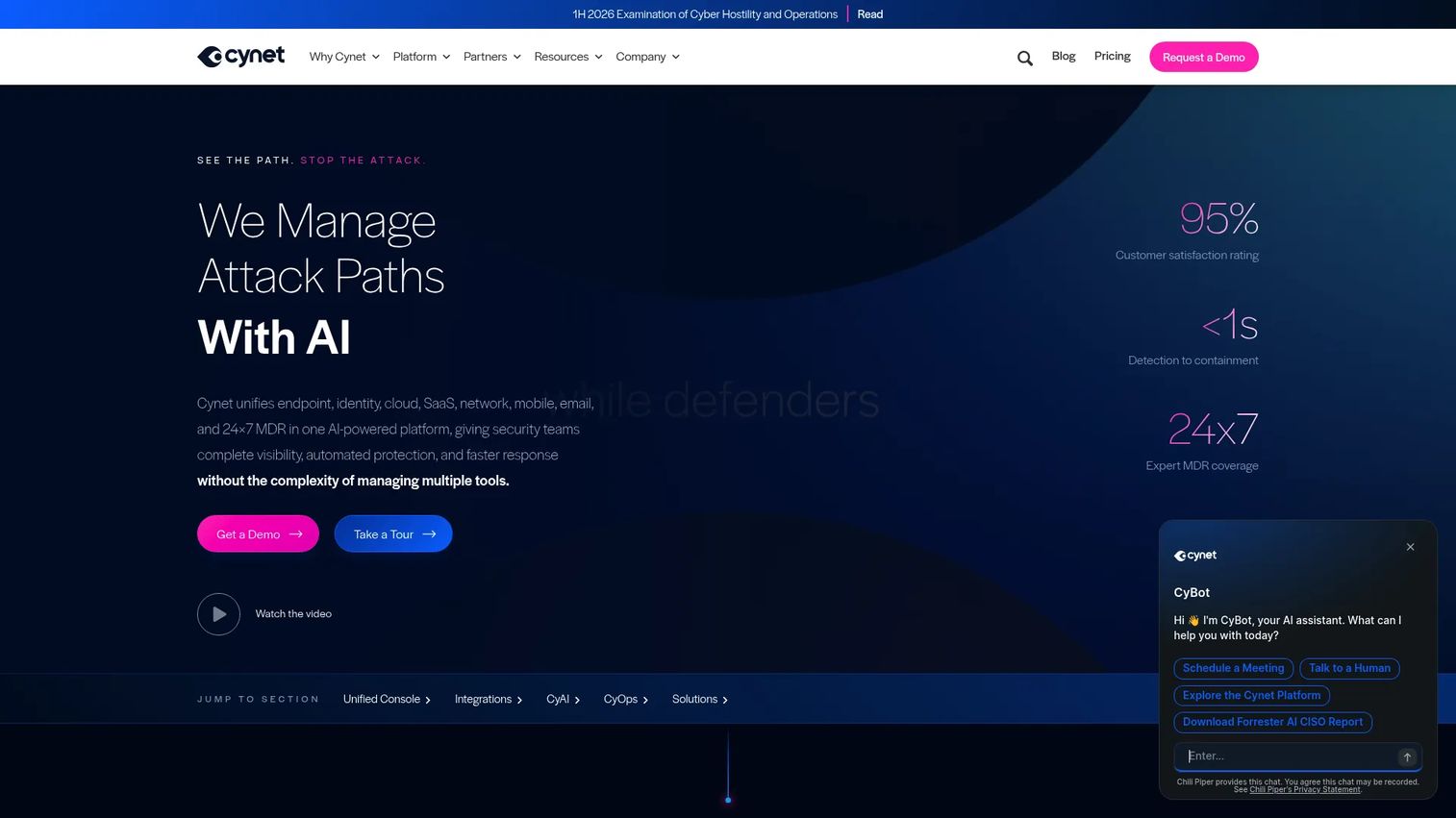
Cynet 360 AutoXDR is an automated cybersecurity platform combining XDR, user behavior analytics, endpoint detection and response, network detection, log correlation, and optional 24/7 MDR service. For smaller security teams that cannot staff deep specialization across each control domain, the consolidated platform reduces the number of tools to manage. User behavior analytics is one component within the broader platform rather than the primary product.
Best for: Lean IT and security teams seeking behavioral detection inside a broader XDR platform, with the option to add managed detection and response.
Key features
- User behavior analytics within a unified XDR platform
- Endpoint detection with NGAV and EDR
- Network detection and response (NDR)
- Automated investigation and remediation workflows
- SaaS and cloud security posture management
Why choose Cynet 360 AutoXDR: Cynet suits organizations consolidating multiple security controls into a single per-endpoint pricing model. If your team currently runs separate endpoint, network, and user behavior tools, the consolidation may reduce both vendor count and overall spend. Teams running specialized insider risk programs that require deep behavioral analytics depth should validate that Cynet's UBA component covers the specific data sources and investigation workflows their program requires.
Cynet 360 AutoXDR pricing: Per-endpoint, per-month pricing across four packages (Value, Collaborative, Proactive, Platinum Care). Numeric prices require a quote from Cynet. A free trial or evaluation may be available; confirm directly with Cynet.
G2 rating: 4.7/5
12. Gurucul
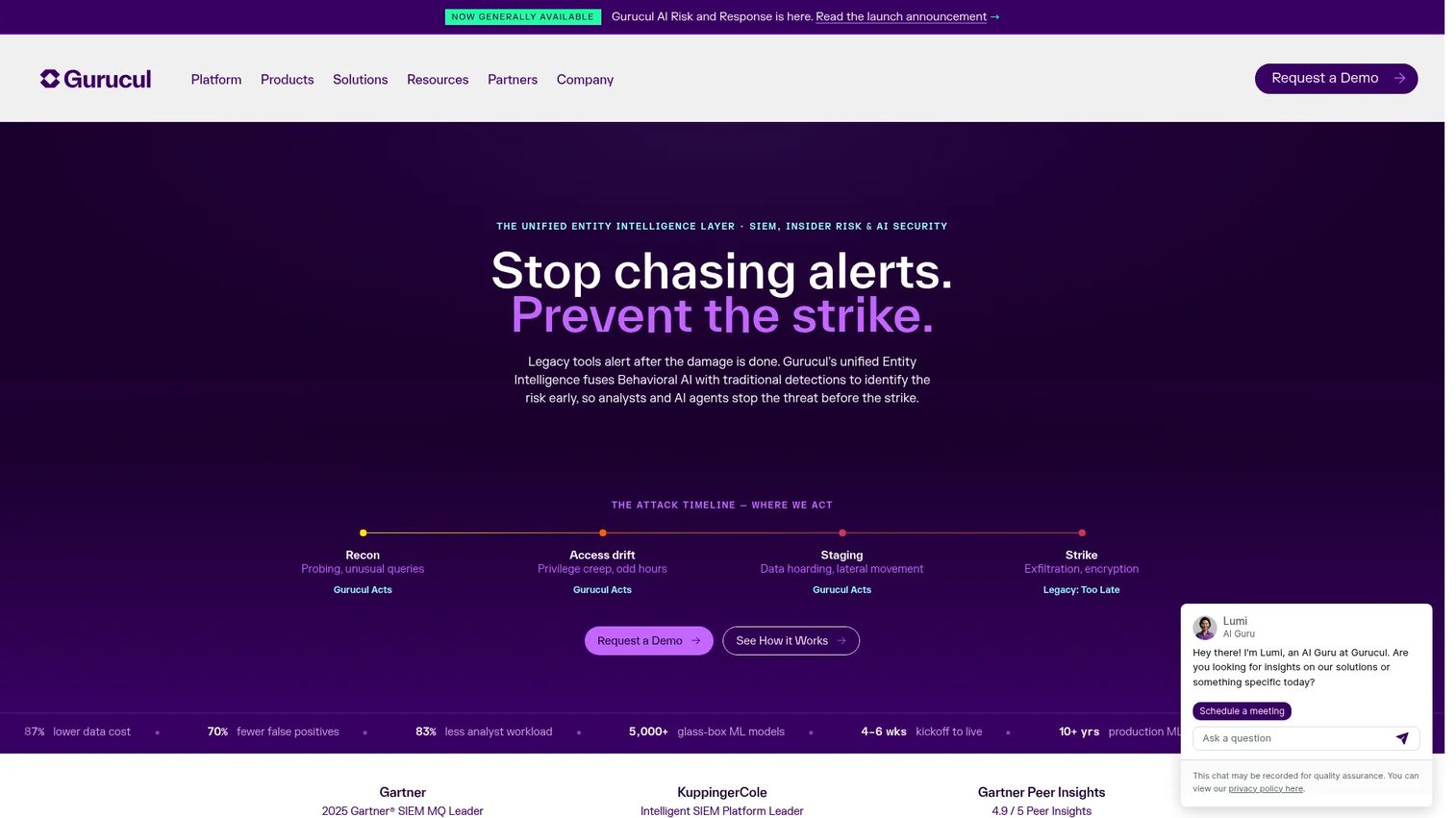
Gurucul provides an AI-powered security analytics platform covering next-generation SIEM, UEBA, insider risk management, SOAR, AI security, and data pipeline management. Its behavioral AI engine applies unified entity risk scoring and machine-learning detection models across users and entities. The AI SOC Analyst capability automates triage, investigation, and guarded response recommendations, reducing analyst time on repetitive case work.
Best for: Enterprise security operations teams seeking dedicated risk analytics and insider threat management with AI-assisted triage.
Key features
- Behavioral AI with unified entity risk scoring
- Next-generation SIEM with detection, investigation, and case management
- AI SOC Analyst for automated triage and investigation recommendations
- Insider risk management across users and entities
- Machine-learning detection models with customizable tuning
Why choose Gurucul: Gurucul suits organizations that want a dedicated behavioral analytics program rather than UEBA bundled into a broader SIEM. The AI-assisted triage capability targets teams where analyst capacity is a bottleneck. Given the low G2 review volume (2 reviews at 3.0/5), request customer references and validate fit through a proof of concept before committing. Contact Gurucul for current pricing.
Gurucul pricing: Gurucul directs prospects to request a demo. No pricing information appears on their site.
G2 rating: 3.0/5 (2 reviews)
13. Proofpoint Insider Threat Management
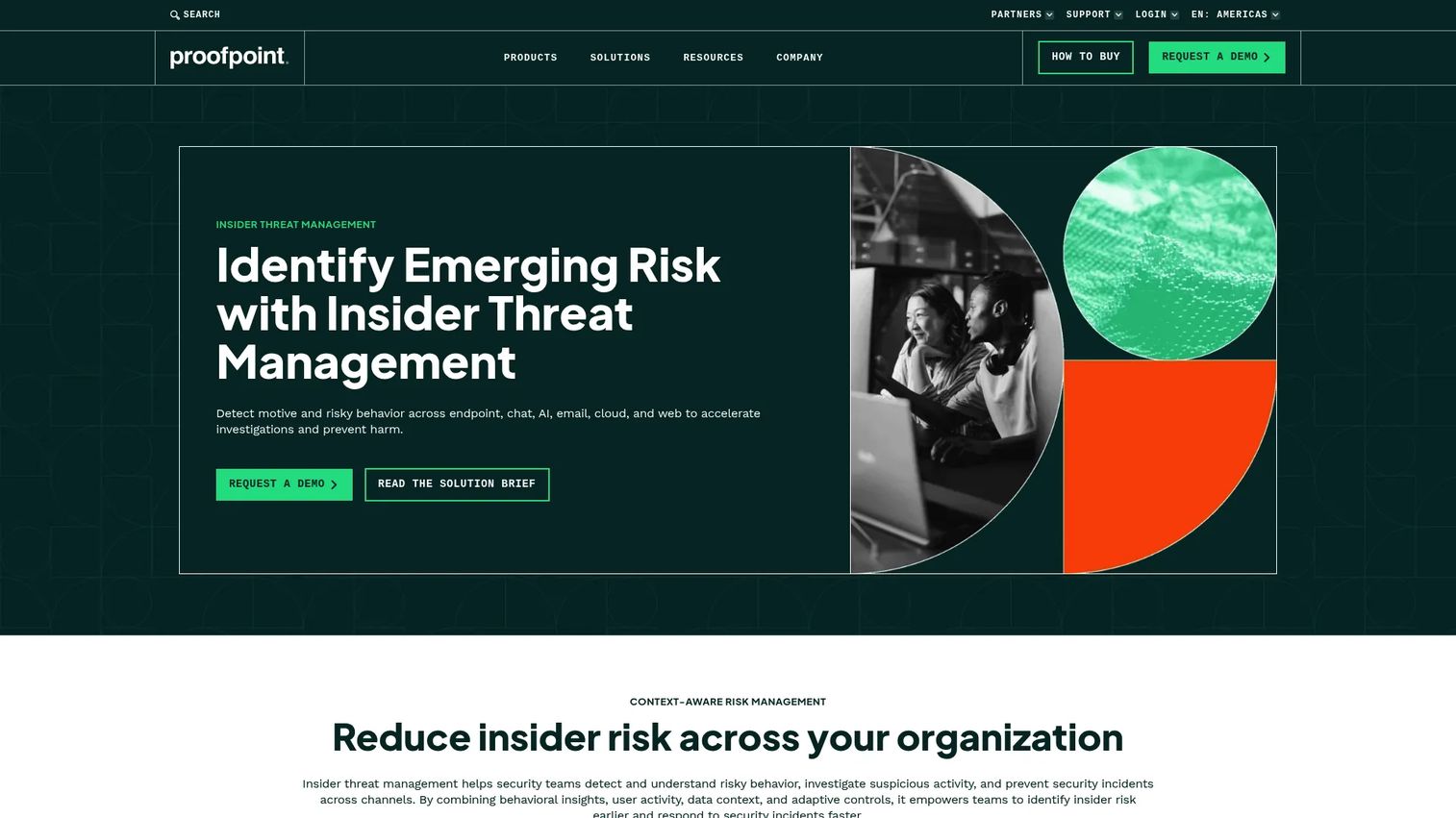
Proofpoint Insider Threat Management detects risky user behavior, supports incident investigation, and helps prevent data loss across endpoints, browsers, cloud, email, web, and generative AI channels. Its sentiment analysis capability identifies behavioral signals that may indicate motive or elevated risk before a data loss event occurs. Privacy controls including anonymization, masking, and role-based access are built into the platform to support investigation programs operating in privacy-sensitive environments.
Best for: Organizations running formalized insider threat programs that need context-aware detection, forensic investigation capabilities, and built-in privacy controls.
Key features
- Real-time user activity monitoring across endpoints, browsers, cloud, and email
- Sentiment analysis for early risk signal identification
- Prebuilt risk detections and customizable detection rules
- Timeline-based investigations with forensic evidence collection
- Adaptive controls for blocking risky transfers and in-moment coaching
Why choose Proofpoint Insider Threat Management: Proofpoint's combination of behavioral detection and sentiment analysis targets organizations where understanding intent, not just activity, matters for investigation and response. The built-in privacy controls make it more practical to deploy in organizations with legal or HR oversight over employee monitoring programs. Teams whose primary UEBA need is broad network or entity coverage beyond the user and data layer should evaluate whether the platform's scope matches their detection requirements.
Proofpoint Insider Threat Management pricing: Proofpoint does not display pricing. Contact Proofpoint sales or request a demo for current packaging and pricing.
G2 rating: 4.3/5
Considerations when evaluating UEBA software
Data source coverage
Confirm which data sources each platform ingests natively versus via connector. A tool that excels at identity and endpoint telemetry may have gaps in SaaS, browser, or cloud activity, sources that matter significantly for modern work environments. Map your actual data sources against each platform's connector library before shortlisting.
False positive controls and tuning
Alert fatigue is the problem UEBA is supposed to solve, not create. Evaluate how each platform handles baseline tuning, peer group configuration, and suppression of known-good activity. Ask vendors specifically how long it takes to reduce false positives to an actionable level after initial deployment.
Integration with existing security operations
A UEBA platform that operates in isolation adds another console for analysts to monitor. Prioritize tools with verified integrations into your SIEM, SOAR, ticketing system, and identity provider. For product and engineering teams evaluating security tooling, also assess the application security testing software and API monitoring tools your team already uses, since behavioral signals from those sources may enrich UEBA context.
Privacy and investigation governance
Employee monitoring carries legal and HR implications that vary by jurisdiction. Confirm that the platform supports role-based access to investigation data, anonymization during early triage, and audit trails for investigator actions. Organizations with distributed teams across multiple geographies need to evaluate data residency requirements alongside detection capability.
Deployment and maintenance overhead
Some platforms require significant data preparation, connector configuration, and ongoing tuning from security engineers. Others include managed onboarding or MDR options that reduce internal engineering burden. Estimate the internal time cost of initial deployment plus ongoing maintenance when comparing total cost of ownership across platforms.
Conclusion
UEBA software spans a wide range of approaches, from dedicated behavioral analytics platforms to SIEM-embedded capabilities and data-centric insider risk tools. The right fit depends on where your security data already lives, what your analysts need to investigate, and how much engineering capacity you can allocate to deployment and maintenance.
Securonix suits enterprise programs that need broad behavioral coverage and retention depth in one platform. Varonis is the clearest choice when sensitive data access is the primary risk vector. ManageEngine Log360 gives smaller teams meaningful UEBA coverage without enterprise-scale procurement complexity. Microsoft Sentinel makes sense for organizations that have already standardized on Microsoft security services. Exabeam serves SOC teams where investigation workflow efficiency is the bottleneck.
Before committing, run a proof of concept with your actual data sources. A platform that performs well in a vendor demo environment can behave very differently when connected to the specific identity providers, endpoint agents, and cloud services your organization uses.
For teams evaluating broader security tooling, the Guideflow blog also covers best AI cybersecurity solutions and application performance monitoring tools that may complement your UEBA evaluation.
Start your journey with Guideflow today!
FAQs
UBA, or user behavior analytics, analyzes behavioral patterns for human users only. UEBA extends that analysis to entities including devices, service accounts, applications, workloads, and network resources. In modern environments where service accounts and cloud workloads generate significant activity, the entity coverage gap in UBA makes UEBA the more complete approach.
UEBA builds a behavioral baseline for each user across dimensions like login location, access times, application usage, and data volumes. When an attacker uses stolen credentials, their behavior typically differs from the legitimate user's pattern, triggering anomaly detection. The strength of compromised account detection depends on how many behavioral dimensions the platform monitors and how well it correlates signals across those dimensions.
Most UEBA platforms ingest identity provider logs, authentication events, endpoint telemetry, and network flow data at minimum. More capable platforms also ingest SaaS activity, cloud workload logs, email metadata, browser activity, and HR directory context. The breadth of data sources directly affects detection coverage, so mapping your environment's actual data sources against a platform's connector library is an early-stage evaluation step.
The timeline varies by platform and environment complexity, but most deployments require two to four weeks of baselining before behavioral profiles stabilize. Tuning peer groups, suppressing known-good activity patterns, and configuring risk score thresholds adds additional time. Platforms with automated tuning capabilities or managed onboarding tend to reach a useful false positive rate faster than those requiring manual configuration.
Most UEBA platforms detect behavioral deviations in near real time, typically within minutes of an anomalous event. Whether that translates to actionable insider threat alerts depends on how the platform combines signals: A single anomalous event rarely triggers a high-priority alert, but a pattern of related behaviors across a short window often does. Real-time detection capability is distinct from real-time response, which requires integration with SOAR or XDR platforms.
UEBA integration with SIEM works in two common patterns. Some platforms embed UEBA natively inside the SIEM, as Splunk does within Enterprise Security and Microsoft Sentinel does with entity behavior analytics. Others operate as standalone platforms that send enriched risk scores and behavioral context to the SIEM via API or connector. The native integration pattern reduces pipeline complexity but limits flexibility; the connector pattern preserves SIEM choice but requires integration maintenance.
UEBA platforms monitor employee activity, which creates legal and HR obligations that vary by jurisdiction and organization type. Most enterprise platforms include controls such as investigator role-based access, anonymization during initial triage, data masking for non-privileged reviewers, and audit logs of investigator actions. Legal and HR teams should review monitoring scope and investigation policies before deployment. Data residency requirements, particularly for organizations with employees in the European Union, also affect platform selection.
A useful proof of concept connects the platform to your actual data sources, not just a vendor-provided sample dataset. Run the baseline period long enough for behavioral profiles to stabilize, typically two to four weeks. Evaluate detection quality on known test scenarios such as a simulated impossible travel event or a staged large file transfer. Measure alert volume, false positive rate, and investigator time per case to establish a baseline for ongoing measurement.