You can carry compliance in spreadsheets longer than you think. Then a regulator, carrier partner, board member, or enterprise customer asks for evidence, and the spreadsheet becomes the operating system nobody trusts.
Insurance organizations face fundamentally different compliance bottlenecks. Some need to automate producer licensing before distribution stalls. Others need governed reporting before the next filing cycle. A few need to stop chasing third-party certificates through email threads.
According to KPMG's 2026 insurance survey, 72% of insurance leaders rank regulatory compliance first among operational priorities. That pressure lands directly on your operations team, your VP of compliance, and eventually your board deck. The right insurance compliance management software removes a specific bottleneck. The wrong one adds a systems project that delays everything else.
This guide cuts through the category overlap and routes you to the right platform type before you book a single vendor demo.
What's inside
This guide covers eight insurance compliance software platforms for 2026, evaluated for insurance specificity, automation depth, integration fit, and auditability. It is written for founders, insurtech operators, MGA leaders, and compliance-focused operations teams making a shortlist decision.
Selection criteria:
- Insurance specificity: Purpose-built for insurance workflows, not adapted from generic GRC tools
- Automation depth: Replaces manual checking, not just digitizes paperwork
- Auditability: Creates records that survive board and regulator scrutiny
- Integration fit: Connects to policy, CRM, finance, and carrier systems already in the stack
This is buyer guidance, not legal or regulatory advice.
TL;DR
- Best for producer licensing and appointment automation: AgentSync handles carrier and MGA distribution compliance with NIPR-connected workflows
- Best for enterprise reporting and governed disclosures: Workiva Platform connects finance, actuarial, and compliance teams around controlled data
- Best for complex agency operations: Applied Epic manages P&C and Benefits operations from client record to policy issuance
- Best for independent agencies: EZLynx combines comparative rating, agency management, and client servicing in one cloud platform
- Best for risk and compliance monitoring: Predict360 gives compliance and risk teams structured visibility into controls, issues, and remediation
- Best for certificate and vendor coverage tracking: SmartCompliance, CertFocus, and Evident each address certificate workflows at different scales and service levels
What is insurance compliance software?
Insurance compliance software helps insurers, agencies, brokerages, MGAs, and related businesses manage the licensing, reporting, document, risk, audit, and verification workflows required to operate under insurance regulations and contractual obligations.
The category is not one product class. Buyers who treat it as uniform end up with enterprise GRC tooling for a certificate-tracking problem, or an agency management system when producer appointment automation is the actual constraint.
Core jobs insurance compliance software can cover
- Producer licensing, renewals, and appointment management
- Regulatory reporting, financial disclosures, and audit evidence retention
- Compliance monitoring, control testing, risk registers, and remediation tracking
- Policy, claim, document, and agency workflow governance
- Certificate of insurance collection and validation
- Contractor, vendor, and third-party insurance verification
- Reporting dashboards and role-based oversight
Key features to look for
- Regulatory change tracking and automated alerts
- Audit trails with approval and workflow history
- Role-based access and configurable approval controls
- NIPR, policy, CRM, and finance integrations
- Document collection and certificate validation workflows
- Reporting exports and executive dashboards
Insurance compliance platform types
| Platform type | Primary job | Typical buyer |
|---|---|---|
| Producer compliance platform | Licensing, appointments, onboarding | Carrier, MGA, distributor |
| Reporting and governance platform | Filings, disclosures, controls, auditability | Finance, actuarial, compliance |
| Agency management system | Client, policy, document, and servicing workflow | Agency or brokerage |
| Certificate platform | COI collection, validation, renewal tracking | Risk, property, vendor operations |
| GRC and risk platform | Controls, incidents, risk, remediation | Compliance and risk teams |
Identify the workflow creating the most manual work, revenue delay, or audit exposure before evaluating any platform.
When to use insurance compliance software
Automate producer licensing before distribution becomes a bottleneck
Carriers, MGAs, and insurance marketplaces should consider specialized licensing tooling when onboarding requires manual checks against producer credentials, resident states, appointments, or eligibility rules. Every day a producer spends waiting for a license or appointment confirmation is a day they cannot sell. This is a revenue constraint, not an administrative inconvenience.
Prepare reporting and audit workflows before the next filing cycle
Finance, actuarial, risk, and compliance teams need governed collaboration when disclosures require reconciled data, review workflows, and a clear audit trail. If multiple contributors are copying numbers between spreadsheets before a regulatory filing, the error risk compounds with every deadline.
Replace certificate chasing and fragmented document records
Businesses tracking third-party coverage need dedicated certificate workflows when teams spend significant time collecting expired documents, following up manually, or trying to prove vendor coverage status from email archives. A dedicated platform creates a single compliance record that ops, legal, and risk teams can all trust.
Insurance compliance software comparison
The right choice depends on which compliance job delays growth today. A carrier scaling producer distribution needs different software than an agency standardizing client workflows or a finance team preparing governed regulatory reporting.
| # | Product | Best for | Key differentiator | Pricing | G2 rating |
|---|---|---|---|---|---|
| 1 | AgentSync | Producer licensing and appointment automation | NIPR-connected producer lifecycle | Quote-based | 4.2/5 |
| 2 | Workiva Platform | Enterprise reporting and governance | Controlled data and audit-ready workflows | Quote-based | 4.5/5 |
| 3 | Applied Epic | Complex agency and brokerage operations | Integrated P&C and Benefits management | Quote-based | 4.4/5 |
| 4 | EZLynx | Independent agencies needing rating plus AMS | Rating, agency management, and client workflow | Quote-based | 4.4/5 |
| 5 | Predict360 | Compliance monitoring and risk management | AI-powered risk and compliance workflows | Quote-based | 5.0/5 |
| 6 | SmartCompliance | Certificate tracking and compliance visibility | COI collection, OCR scanning, and compliance reports | Quote-based | 4.0/5 |
| 7 | CertFocus | Certificate compliance at scale | COI tracking with self-service and full-service tiers | Quote-based | N/A |
| 8 | Evident | Automated third-party insurance verification | Per-vendor pricing with vendor portal access | From $15/vendor/year | 4.4/5 |
Best 8 insurance compliance software tools for 2026
1. AgentSync
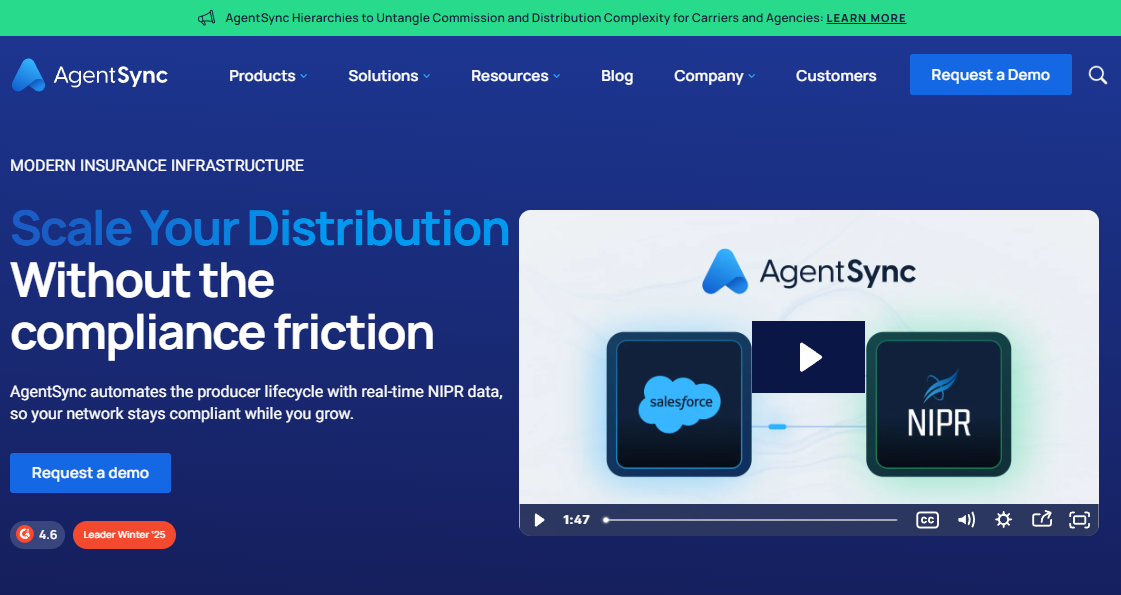
AgentSync is a specialized insurance infrastructure platform for producer onboarding, licensing, appointments, contracting, and distribution compliance. It connects directly to NIPR data, giving carriers, MGAs, and agencies a live view of who is eligible to sell, in which states, and under which appointment rules. The platform covers the full producer lifecycle from initial onboarding through termination.
Best for: Insurance carriers, agencies, and MGAs managing producer distribution, licensing, and contracting across multiple states.
Key features
- Producer onboarding, licensing, and appointment workflows
- NIPR-connected eligibility and compliance checks
- Continuing education tracking and renewal alerts
- Agent-to-carrier contracting and contract management
- Compliance audit trails and ProducerSync API access
Why choose AgentSync: Best fit when producer and agent readiness are the constraint on distribution growth. It is purpose-built for this job, not a module inside a broader platform. Teams that also need agency management, financial reporting, or certificate tracking will need additional tooling alongside it.
AgentSync pricing: AgentSync directs prospects to request a demo; fees are set out in customer order forms based on distribution complexity, transaction volume, and integrations. Contact the vendor for a first-year cost model.
G2 rating: 4.2/5
2. Workiva Platform
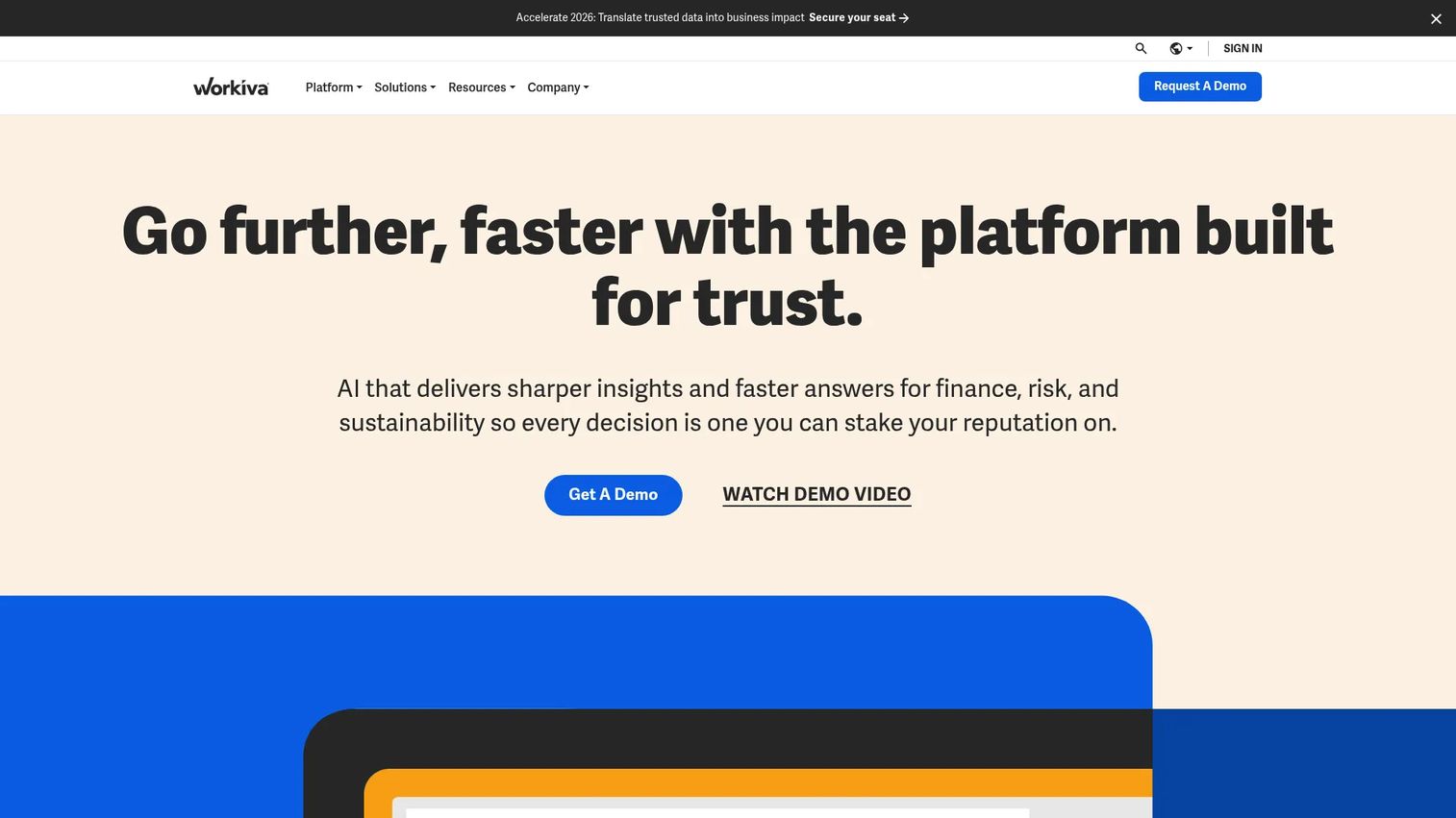
Workiva is a cloud platform built for connected reporting, compliance, data management, and governance workflows. Insurance organizations use it to manage statutory filings, SEC disclosures, regulatory reporting, and audit workflows across finance, actuarial, risk, and compliance teams. Connected documents, spreadsheets, and presentation layers share a single data source, so updates propagate without manual copy-paste cycles. For a deeper look at how audit management software fits into a compliance stack, that category guide covers the broader landscape.
Best for: Insurers and larger insurance organizations that need governed reporting workflows across multiple contributors and source systems.
Key features
- Connected documents, spreadsheets, and presentations on shared data
- SEC filings, XBRL, and regulatory reporting workflows
- Audit trails and role-based collaboration controls
- Data management with reconciliation and data prep tools
- Regulatory disclosure management
Why choose Workiva: Strong fit when reporting reliability, governed data, and audit evidence are the primary requirement. It is a heavier operational investment than a focused certificate or agency tool. Teams evaluating this platform should assess implementation scope, entity count, and the internal owners required to launch.
Workiva Platform pricing: Workiva uses quote-based enterprise pricing. Cost drivers include reporting scope, entity count, module selection, number of users, integrations, and governance requirements. Request a detailed first-year model before comparing against alternatives.
G2 rating: 4.5/5
3. Applied Epic
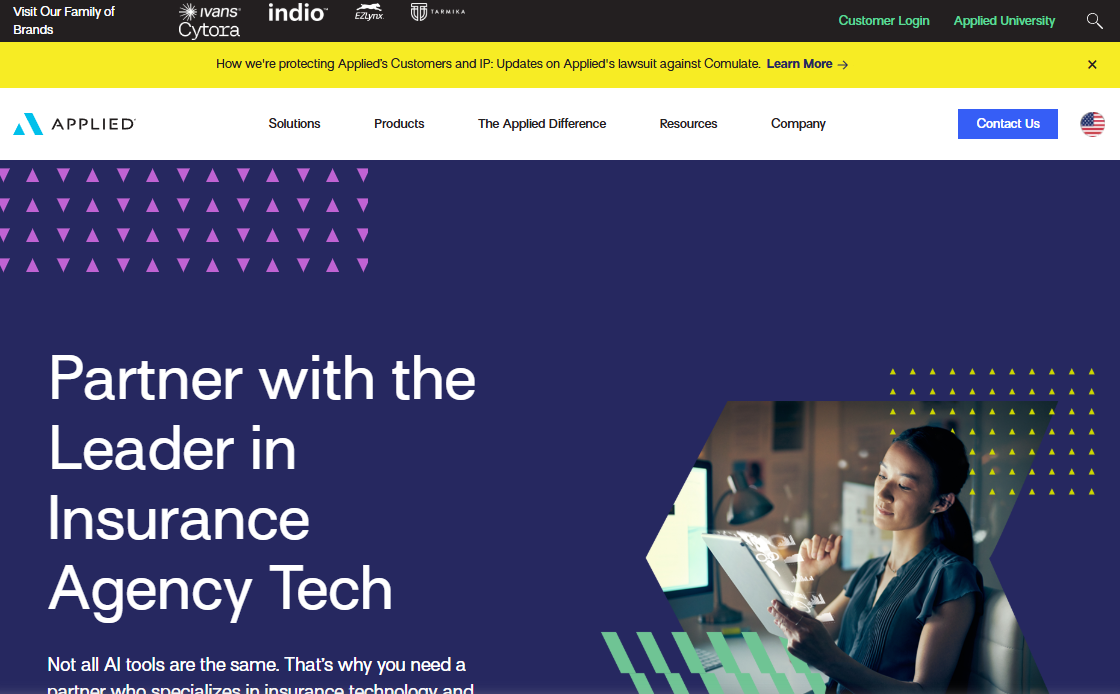
Applied Epic is a browser-native insurance agency management system for mid-size and enterprise independent agencies and brokerages managing P&C and Benefits operations. It covers client records, policy administration, document management, workflow automation, market access, quoting, insurance-specific accounting, and customer self-service in one system. The platform is built specifically for insurance distribution workflows rather than adapted from a general-purpose CRM or ERP. If your team is also evaluating account management software for adjacent client-facing workflows, that guide covers complementary tools.
Best for: Established agencies and brokerages with complex multi-line operations, commercial lines activity, and a need for centralized client and policy records.
Key features
- Integrated P&C and Benefits management
- Market access and commercial and personal lines quoting
- Insurance-specific accounting and reporting
- Policy and document management with workflow automation
- Customer self-service portal and mobile access
Why choose Applied Epic: Best when an agency needs one operational system for client records, policy workflows, and service processes. Teams should assess implementation complexity, data migration requirements, and user adoption investment before committing to a multi-year contract.
Applied Epic pricing: Pricing is quote-based. Ask Applied Systems for costs covering implementation, migration, user licenses, module selection, integrations, and contractual minimums. The first-year total often differs significantly from the headline license figure.
G2 rating: 4.4/5
4. EZLynx
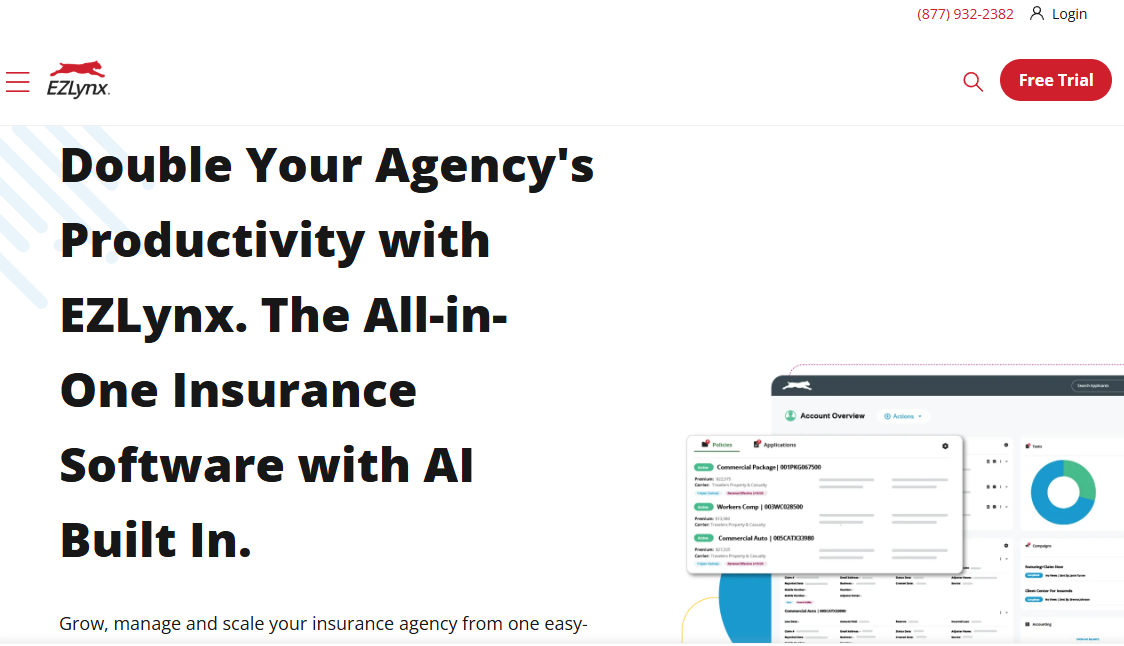
EZLynx is a cloud-based, all-in-one platform for independent insurance agencies, combining comparative personal-lines rating, commercial-lines submissions, agency management, policy servicing, sales and marketing automation, renewals, accounting, and client self-service. Independent P&C agencies that want rating and daily operations connected in one workflow rather than toggling between separate tools use EZLynx to reduce handoffs and give staff a single data environment for the full client lifecycle.
Best for: Independent property and casualty agencies that need comparative rating and daily agency operations in the same platform.
Key features
- Comparative personal-lines rating and commercial-lines submissions
- Policy servicing and client communications
- Sales and marketing automation with CRM and email campaigns
- Renewal and client-retention workflows
- Accounting, commissions, and reporting
Why choose EZLynx: A good fit for agencies that want fewer handoffs between rating, service, and policy workflows. It is more agency-oriented than a specialized producer appointment platform or an enterprise compliance reporting tool. Teams primarily focused on producer licensing or enterprise disclosures should evaluate category-specific tools instead.
EZLynx pricing: Pricing is customized based on agency user count and selected products. EZLynx's pricing page confirms no standard published rate. Contact the vendor to build a package around your agency size and workflow needs.
G2 rating: 4.4/5
5. Predict360
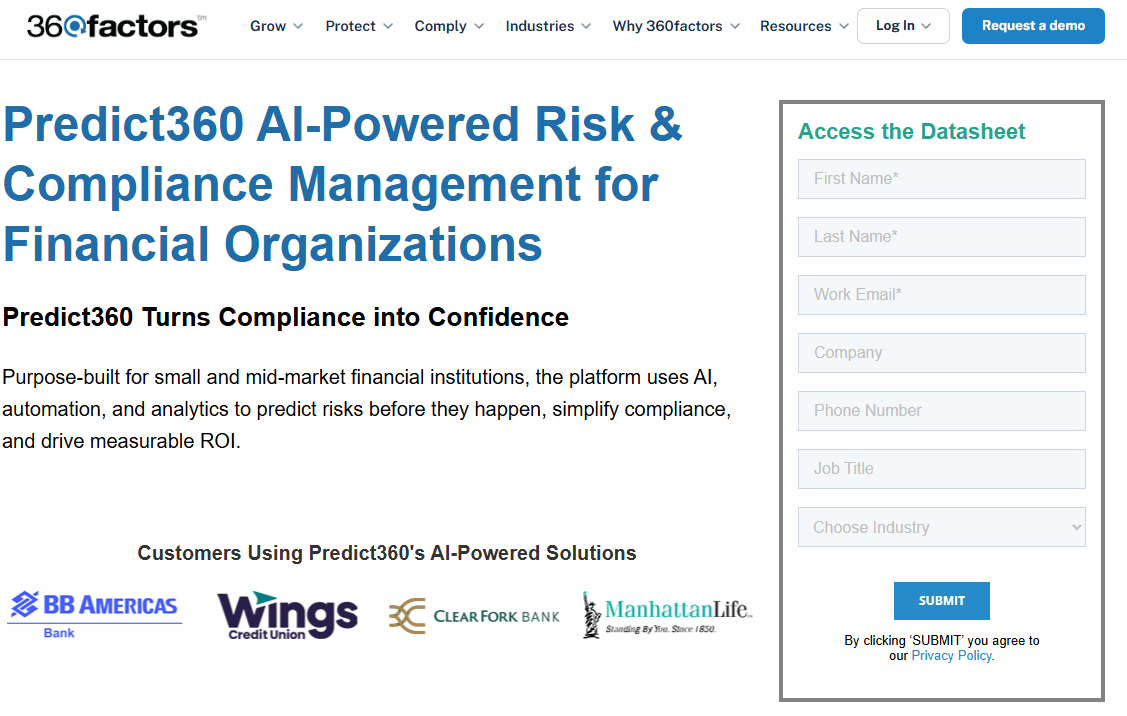
Predict360 is an AI-powered governance, risk, and compliance platform for financial institutions, including insurers. It brings risk assessments, control registers, compliance monitoring, regulatory change management, issue tracking, audit management, and third-party risk together in one environment. Embedded Power BI reporting gives executive teams visibility without requiring a separate BI stack. For teams evaluating broader ACA compliance software alongside insurance-specific GRC, that guide covers the adjacent category.
Best for: Compliance and risk teams at regulated insurers that need structured monitoring, policy workflows, issue management, and executive-level risk visibility.
Key features
- Integrated risk, control, and compliance management
- AI-powered risk insights and predictive analytics
- Regulatory change management and compliance monitoring
- Issue and remediation tracking workflows
- Executive dashboards with embedded Power BI reporting
Why choose Predict360: Best when the core problem is scattered compliance ownership and weak visibility into risks, controls, and open issues. It may require additional insurance-specific systems for producer licensing, policy administration, or certificate validation, so plan the stack integration before purchase.
Predict360 pricing: Pricing is quote-based and not displayed on the vendor's site. Cost drivers include selected modules, user roles, implementation support, and integration scope. The vendor directs prospects to request a demo to discuss pricing.
G2 rating: 5.0/5
6. SmartCompliance
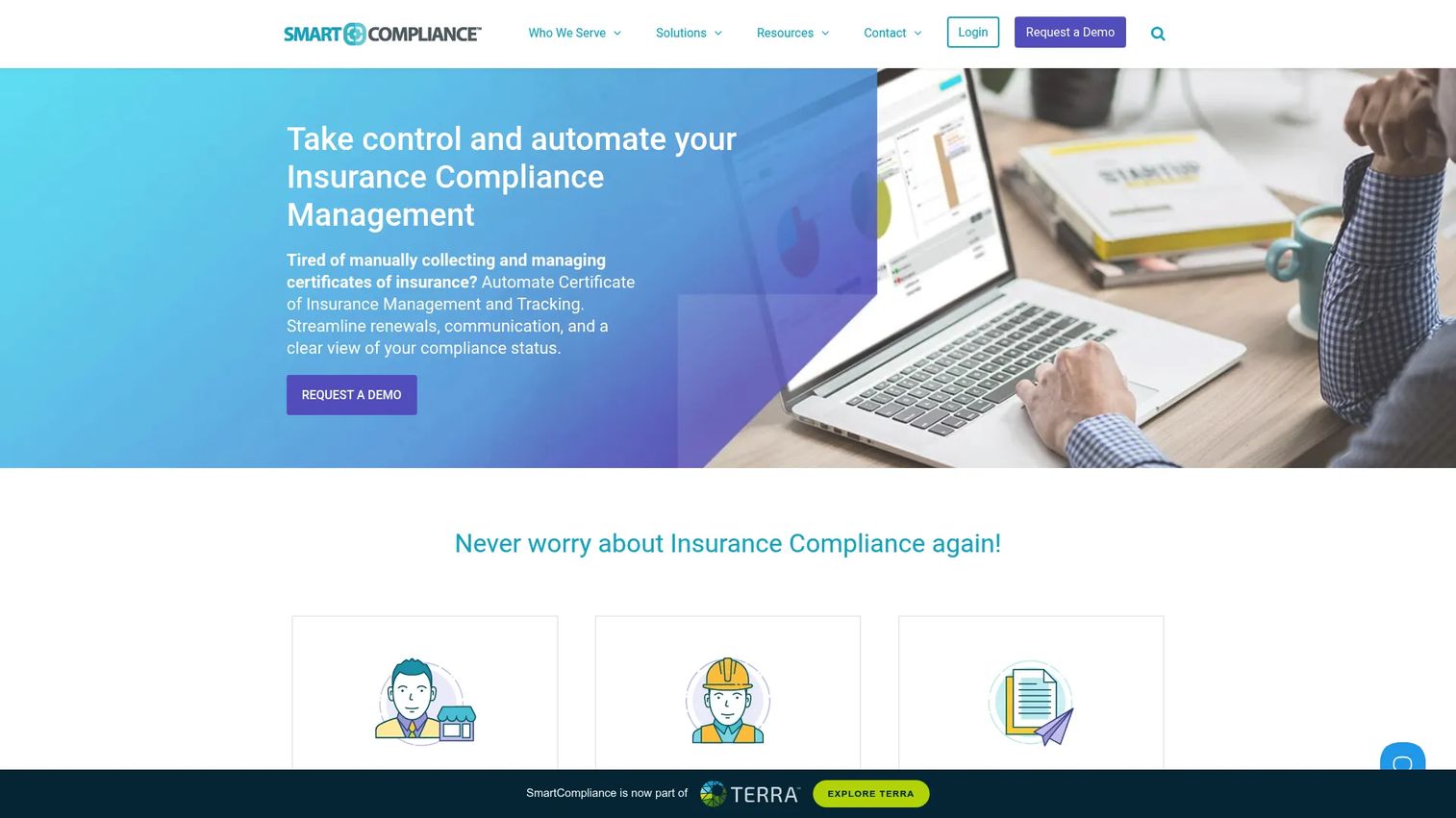
SmartCompliance, part of Terra, is an insurance tracking and compliance management platform for collecting, tracking, issuing, and renewing certificates of insurance. It uses OCR-based certificate scanning and data extraction to reduce manual entry, and centralizes document records, certificate holder data, endorsement tracking, and compliance requirements in one dashboard. Commercial insurance professionals, risk managers, general contractors, and organizations managing subcontractor or vendor insurance compliance use SmartCompliance to replace inbox-based certificate chasing.
Best for: Businesses and commercial insurance professionals that need ongoing visibility into third-party certificates, endorsements, and coverage requirements.
Key features
- Automated COI tracking and renewal request workflows
- OCR-based certificate scanning and compliance verification
- Centralized document and certificate holder management
- Endorsement and requirement tracking
- Compliance reporting dashboards
Why choose SmartCompliance: Best fit when expired certificates, missing endorsements, or unverified vendor coverage create operational risk. It is a focused certificate platform rather than a broad agency management or enterprise reporting system.
SmartCompliance pricing: SmartCompliance directs prospects to contact the vendor for pricing. The first-party site does not display a standard rate. Reach out through their contact page to get a quote based on certificate volume and workflow requirements.
G2 rating: 4.0/5
7. CertFocus
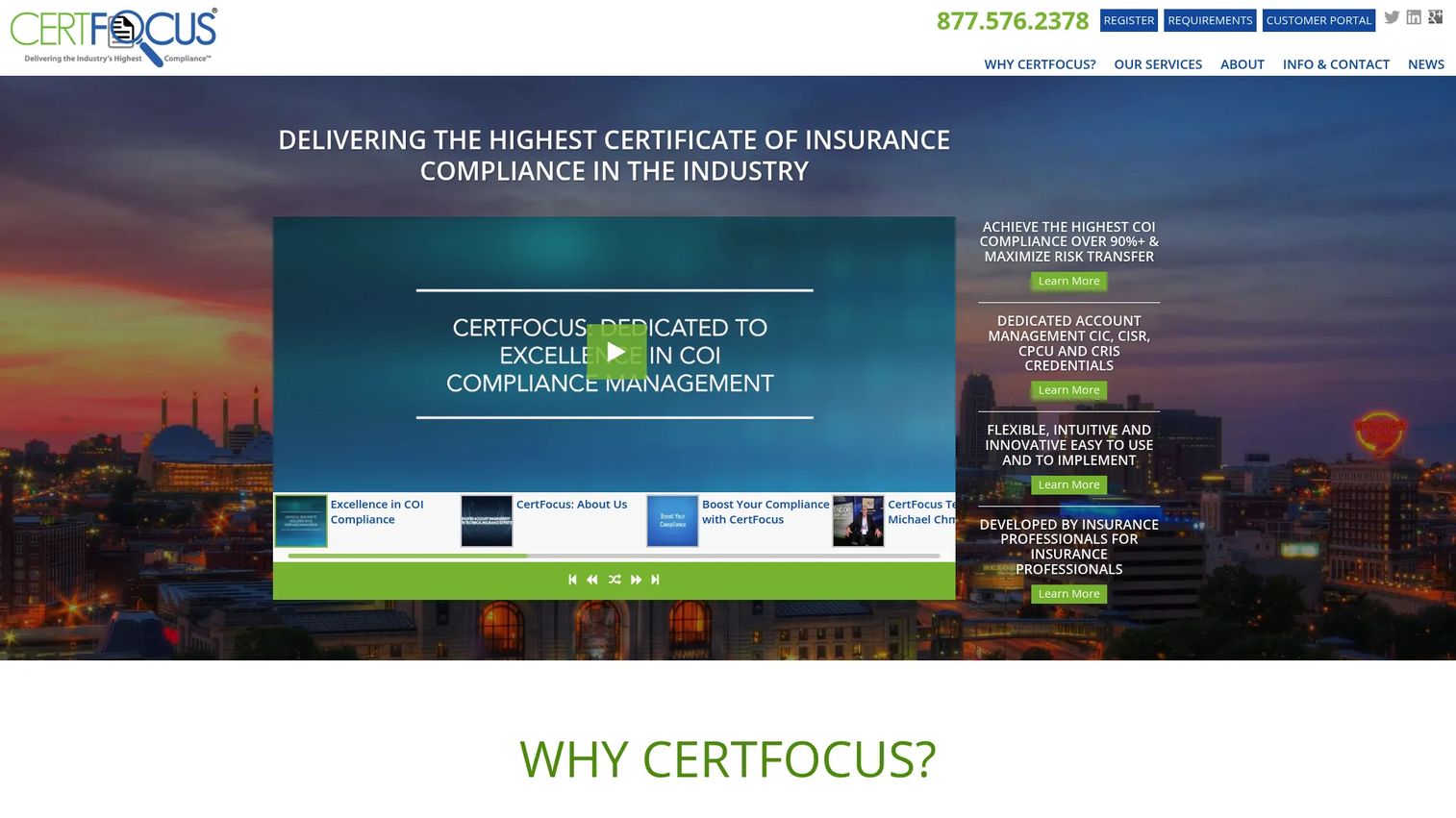
CertFocus is a cloud-based certificate of insurance tracking and document management platform serving Fortune 500 companies and public-sector organizations. It offers four service tiers from self-service through a full-service managed option, covering certificate tracking, compliance dashboards, cross-reference flagging for requirement gaps, AM Best carrier-rating data feeds, and integrations with accounting, contract management, and procurement systems. Unlimited user accounts mean organizations can provision across legal, procurement, operations, and risk without per-seat cost pressure.
Best for: Organizations with complex vendor, contractor, tenant, or partner certificate requirements at scale.
Key features
- Customizable compliance dashboards and reporting
- Cross-reference engine flagging potential requirement gaps
- AM Best carrier-rating data feeds
- Unlimited user accounts and provisioning
- Data integrations with accounting and contract management systems
Why choose CertFocus: Best when the problem is scale. Manual certificate management breaks as third-party counts grow and requirements vary by contract, location, or business unit. The tiered service model lets teams choose between managing the workflow internally or outsourcing tracking to CertFocus's team.
CertFocus pricing: CertFocus lists Self Service, Full Service, Premium, and Vendor Partnership tiers, with all prices listed as "Call for Info" on the vendor's pricing page. Contact CertFocus directly to get a quote that covers implementation, document volume, and ongoing service fees.
8. Evident
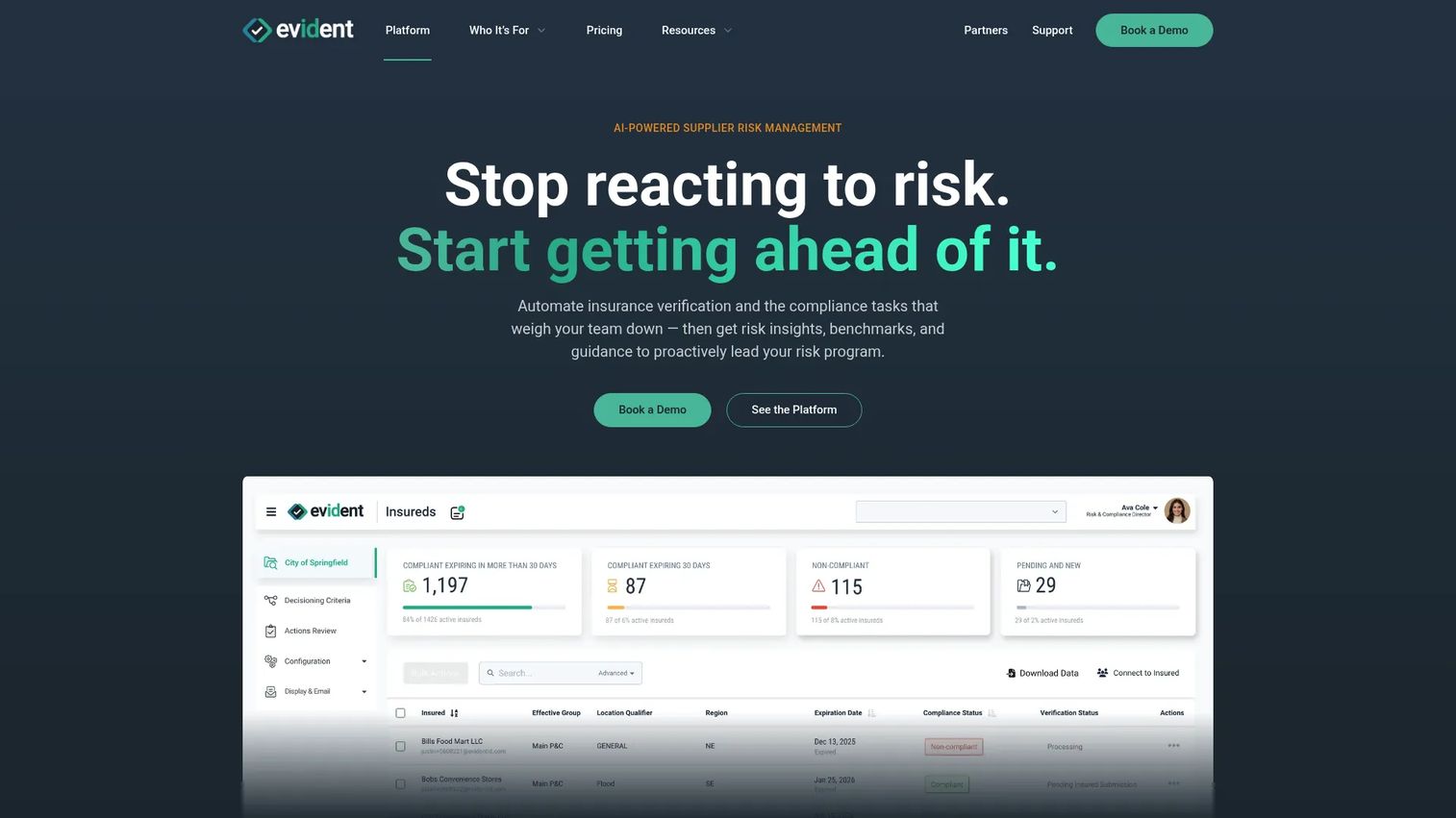
Evident is a third-party risk management and automated insurance verification platform for vendors and suppliers. It automates certificate-of-insurance verification and monitoring, provides vendor portals with unlimited users and document storage, and supports broader risk profiles, compliance workflows, and reporting. Organizations that need proof of insurance as a recurring requirement use Evident to replace manual collection cycles and create a defensible record of coverage status across all active vendors. For teams also evaluating broader asset tracking software to manage vendor and contractor records, that guide covers adjacent inventory and tracking tools.
Best for: Organizations managing vendor insurance compliance and broader third-party risk, particularly those with high vendor counts and recurring verification requirements.
Key features
- Automated COI verification and ongoing monitoring
- Vendor portals with unlimited users and document storage
- Risk profiles, compliance workflows, and reporting
- Coverage status tracking and expiration alerts
- Integrations for procurement and risk systems
Why choose Evident: A focused fit for businesses where proof of insurance is a recurring requirement across a large vendor base. The per-vendor pricing model scales with the size of the third-party program. Evaluate it alongside your existing procurement, vendor management, and risk systems to confirm integration depth before signing.
Evident pricing: Essential tier starts at $15 per vendor, billed annually. Pro is $25 per vendor annually, adding advanced insurance capabilities, contract management, permissions, and customer success support. Enterprise pricing is custom and includes broader risk management, credential checks, contract assessment, SSO, integrations, and embedded UX.
G2 rating: 4.4/5
Considerations when choosing insurance compliance software
Match the platform to the compliance job
Do not buy enterprise GRC tooling for a certificate-tracking problem. Identify the workflow that creates the most manual work, revenue delay, or audit exposure before shortlisting. A platform that solves the wrong job creates a second compliance system, not a first solution.
Check system-of-record integrations
Require a clear map of how the platform connects to your policy administration system, CRM, finance tools, and carrier systems. Ask which data synchronizes automatically, which exports manually, and who owns reconciliation when records disagree. Integration gaps become operational debt fast.
Price implementation, not only licenses
A low starting price can disappear under migration work, integration services, configuration, training, and contract minimums. Ask each vendor for a full first-year cost model, including the internal roles and hours required to launch. That number is what the platform actually costs in year one.
Test auditability and exception handling
A dashboard is not evidence. Confirm how the product records approvals, policy changes, workflow history, document versions, user actions, and unresolved exceptions. A board member or regulator will ask for the underlying record, not the summary chart.
Assign operating ownership before purchase
Software helps only when someone owns the process it automates. Before signing, identify the internal owner for compliance workflows, rules, data quality, release testing, and vendor relationship management. A platform without an owner degrades into the same spreadsheet problem it was meant to replace.
Conclusion
Each platform in this list solves a distinct compliance job. AgentSync handles producer lifecycle compliance for carriers and MGAs. Workiva Platform serves finance and compliance teams preparing governed insurance reporting. Applied Epic standardizes agency operations for complex P&C and Benefits businesses. EZLynx connects rating and daily servicing for independent agencies. Predict360 gives risk and compliance teams structured oversight of controls, issues, and regulatory changes. SmartCompliance, CertFocus, and Evident each address certificate and vendor insurance workflows at different scales and service levels.
Start with the workflow that delays revenue, creates the most manual checking, or produces the weakest audit trail. Then run a short proof of value using your own producer, reporting, certificate, or exception data. A platform that earns its place in the first quarter is worth far more than one that requires six months of configuration before it shows anything useful.
Start your journey with Guideflow today!
FAQs
Insurance compliance software helps insurers, agencies, brokerages, MGAs, and related businesses manage the licensing, reporting, document, risk, audit, and verification workflows required to operate under insurance regulations and contractual obligations. The category covers several distinct platform types, including producer lifecycle tools, enterprise reporting platforms, agency management systems, certificate trackers, and GRC platforms. Buyers should select for the specific compliance job creating the most friction, not the broadest feature checklist.
Specialized producer lifecycle software is the right fit when onboarding, licensing, appointments, renewals, and producer eligibility are the bottleneck. Carriers, MGAs, and distribution-focused organizations should prioritize platforms with NIPR-connected workflows, because NIPR data is the authoritative source for producer credentials and appointment status across U.S. jurisdictions. A platform that reads directly from NIPR eliminates a manual verification step that compounds in time and error as distribution grows.
Agencies typically need a management platform with client, policy, document, renewal, reporting, and service workflows in one environment. The right choice depends on line of business (P&C versus Benefits versus both), carrier connectivity requirements, and whether comparative rating is part of the daily workflow. Before committing, assess data migration requirements, user adoption investment, and integration depth with existing CRM and accounting systems.
The right platform centralizes audit evidence, approvals, controls, reports, policy documents, and workflow history in a structured record. That reduces the time teams spend gathering evidence during a regulatory examination or internal audit cycle. A platform does not guarantee compliance or pass an audit on your behalf. The audit outcome depends on the underlying processes and decisions the software records, not the software itself.
Look for governed data that connects source systems to reporting outputs without manual copy-paste, controlled review cycles with role-based permissions, reconciliation support, and audit trails that capture every change with a timestamp and user attribution. Integrations with policy administration, general ledger, and actuarial systems matter because data that has to be re-entered loses accuracy at every handoff. Support for the specific regulatory reporting framework your organization files under (NAIC statutory, SEC, or both) is a basic requirement before any other evaluation criterion.
Pricing ranges widely by category. Certificate platforms like Evident publish per-vendor rates starting around $15 per vendor annually. Producer lifecycle, enterprise reporting, agency management, and GRC platforms typically price through custom quotes based on transaction volume, user count, module selection, and implementation scope. The headline license cost rarely reflects the first-year investment. Migration, integration, configuration, and training can equal or exceed the software fee. Ask every vendor for a full first-year cost model before comparing options.
Some producer licensing platforms connect directly to NIPR data and workflows, allowing automated verification of resident licenses, non-resident licenses, appointments, and appointment status changes. Buyers should verify whether the vendor supports the specific licensing transactions, jurisdictions, and appointment types relevant to their distribution model. NIPR integration is a foundational requirement for carrier and MGA producer compliance workflows, not a differentiating feature.
Software replaces spreadsheets most effectively when those spreadsheets cause missed renewals, inconsistent approvals, weak audit records, duplicate data entry, or limited visibility across teams. Small teams and early-stage operations can often start with focused workflows before replacing every manual process. The right sequence is to identify one high-cost manual process, prove the platform handles it reliably, then expand scope. A phased approach reduces implementation risk and gives the team time to build process ownership before adding complexity.