
Your donor data lives in six places. A spreadsheet for major gifts. A payment processor for recurring donations. An email tool with its own contact list. A shared inbox where thank-you notes go to die. And two more systems nobody remembers logging into.
Then the board asks a simple question: how many donors gave last year but not this year? You spend four hours reconciling exports to find out. That is the real cost of scattered records. Not the software you are missing, but the reporting, follow-up, and stewardship that never happens because the data will not sit still.
The market has noticed. The nonprofit software market reached $4.95 billion in 2026 and is projected to hit $7.24 billion by 2031, according to Mordor Intelligence (2026). Nearly 45% of that spend goes to fundraising and donation management modules. Nonprofits are consolidating scattered tools into a single donor database that actually reports.
Choosing the right donor management software is less about feature counts and more about system design: one system of record, clean segmentation, and reporting your leadership trusts. If you have compared operational tools before, the logic mirrors how teams pick a CRM or an event management platform, centralize the data, then build repeatable workflows on top. This guide ranks eight options for nonprofits of every size, from lean two-person shops to enterprise development teams running complex fundraising software operations.
What's inside
This guide compares eight donor management software platforms built for nonprofits, ranked by relevance to growing organizations and lean teams. We chose tools based on four criteria: a centralized donor database with clean contact records, real segmentation for targeted outreach, reporting that survives board scrutiny, and pricing transparency you can plan a budget around. We favored platforms that combine donor tracking software with donation workflows and integrations, so you replace multiple tools rather than adding one more. Every pricing figure and rating comes from each vendor's live pages, not from memory. Use the comparison table to shortlist, then read the sections that match your size and complexity.
TL;DR
- Best overall: DonorPerfect, a mature all-in-one nonprofit CRM with donor management, online forms, and reporting.
- Best for smaller teams: Little Green Light, a lightweight donor database priced by record count with every feature included.
- Best for donor stewardship and automation: Bloomerang, built around retention and constituent relationships.
- Best for all-in-one fundraising: Givebutter, with a genuine free forever plan covering donations, events, and CRM.
- Best affordable donor management software: DonorSnap, flat contact-based pricing with no per-user fees.
- Best for enterprise fundraising operations: Blackbaud Raiser's Edge NXT, for large, complex development teams.
What is donor management software?
Donor management software is a nonprofit CRM and donor database that centralizes every supporter record, gift, and interaction in one system. It replaces spreadsheets and disconnected tools with a single source of truth for fundraising, so development teams can track giving history, segment supporters, automate receipts, and report on results without manual reconciliation.
The category overlaps with fundraising software and generic CRMs, but it is purpose-built for how nonprofits actually work: gift entry, pledge tracking, householding, and board reporting rather than sales pipelines.
Core features you should expect in donor management software for nonprofits:
- Centralized donor records: A unified profile per constituent with giving history, contact details, and interaction logs.
- Householding: Linking related donors so a couple or family reads as one relationship, not three duplicate records.
- Donation and pledge tracking: Recording one-time gifts, recurring donations, and multi-year pledges against each record.
- Donor segmentation: Tags, lists, and filters to build targeted appeals and stewardship journeys.
- Reporting and donor analytics: Built-in and custom reports for retention, lapsed donors, campaign performance, and board packets.
- Donation workflows: Online forms, automated receipts, and acknowledgment emails triggered by gift activity.
- Integrations: Connections to payment processors, email marketing, accounting, and event tools.
The distinction from a generic CRM matters. A sales CRM optimizes for deals and quotas. A CRM for nonprofits optimizes for donor relationship management software patterns: retention, recurring gifts, grateful stewardship, and compliance-ready receipting. You can force a sales tool to track donations, but you will rebuild half the reporting yourself.
When to use donor management software
Not every nonprofit needs to switch tomorrow. Here is how to recognize the moment the right system stops being a nice-to-have.
Centralize donor history
Spreadsheets work until they do not. The break point usually arrives when two people edit the same file, a formula silently corrupts a column, or you cannot answer who gave last year but lapsed this year. When your donor database lives across exports and inboxes, every report becomes an archaeology project. Moving to a single system of record means gift history, contact updates, and notes all attach to one profile that your whole team trusts.
Segment donors for better outreach
Blast-everyone appeals leave money on the table. A real system lets you build segments by giving level, recency, campaign, or interest, then tailor the ask. Tags, saved lists, and filters turn a flat contact export into a stewardship engine. Recurring donors get a different message than first-time givers. Lapsed donors get a win-back sequence. Donor segmentation is where retention rates actually move.
Track donations and report
When recurring gifts, pledges, and multi-year commitments pile up, manual tracking cracks. You need a system that records each gift against the right record, flags failed recurring charges, and rolls everything into donor reporting your board can read in five minutes. If you are preparing packets by hand every quarter, the reporting layer alone justifies the switch.
Comparison table
Read this table top to bottom by fit, not alphabetically. The Intent column tells you the buyer type each tool serves best. Pricing reflects each vendor's live pages as of mid-2026, and ratings come from each tool's current G2 or Capterra listing. Where a vendor quotes custom pricing, that reflects tailored packaging rather than a hidden cost.
| # | Product | Intent | Key differentiation | Pricing | Rating |
|---|---|---|---|---|---|
| 1 | DonorPerfect | All-in-one nonprofit CRM | Mature donor management with forms, automation, and reporting | From $99/mo | 4.4/5 (G2) |
| 2 | Bloomerang | Donor stewardship and retention | Retention-focused CRM plus volunteer tools | From $40/mo | 4.6/5 (G2) |
| 3 | Givebutter | All-in-one fundraising | Free forever plan covering donations, events, and CRM | $0/mo | 4.7/5 (G2) |
| 4 | DonorSnap | Affordable donor management | Flat contact-based pricing, no per-user fees | From $50/mo | 4.1/5 (G2) |
| 5 | Neon One | Broad nonprofit stack | CRM, fundraising, events, and memberships in one platform | From $99/mo | 4.2/5 (G2) |
| 6 | Virtuous | Automation and engagement | Responsive fundraising with marketing automation | Custom | 4.3/5 (G2) |
| 7 | Little Green Light | Lean donor database | Record-count pricing with every feature included | From $45/mo | 4.8/5 (Capterra) |
| 8 | Blackbaud Raiser's Edge NXT | Enterprise fundraising | Scalable fundraising CRM for large development teams | Custom | - |
1. DonorPerfect
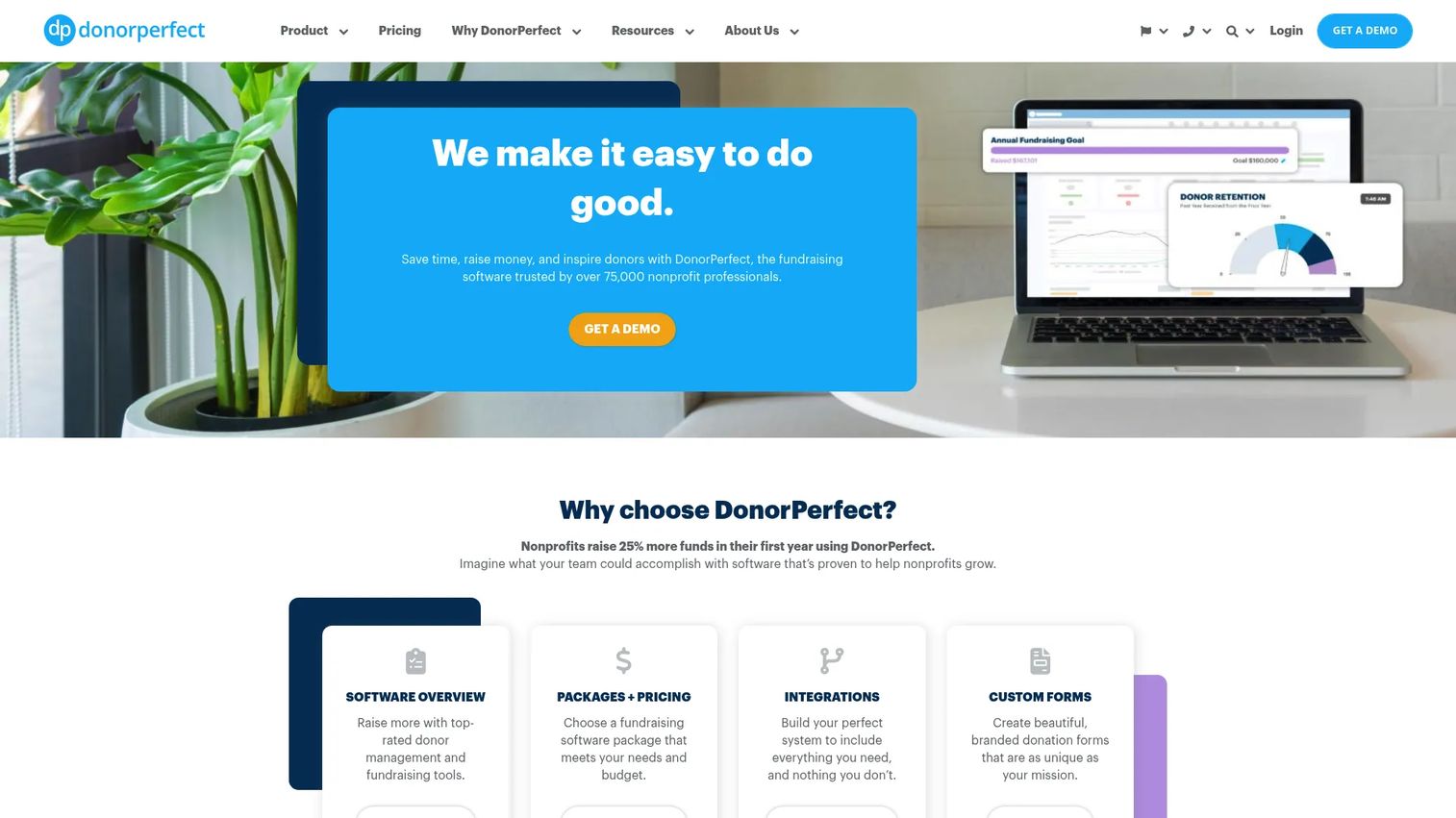
DonorPerfect is a nonprofit CRM and fundraising software platform that pulls donor management, online giving, communications, and reporting into one hub. It has spent decades serving small to mid-sized nonprofits, and that maturity shows in how completely it covers the fundraising lifecycle. Rather than bolting on a payment processor and an email tool, you get a unified donor database with integrated donation forms, automated receipts, and reporting under one login.
Best for: Small to mid-sized nonprofits that want a single mature system for donor management and fundraising instead of a stitched-together stack.
Key strengths
- Unified donor database: Every gift, contact detail, and interaction attaches to one constituent profile, so reporting pulls clean numbers.
- Integrated forms and payments: Online donation forms and payment processing live inside the platform, feeding gifts straight into records.
- Automated receipts and alerts: Receipts, acknowledgment emails, and internal alerts fire automatically off gift activity.
Why choose DonorPerfect: If you want an all-in-one donor management system that has already solved the edge cases smaller tools trip on, DonorPerfect is the safe, capable default. It fits organizations that value depth and reliability over the newest interface, and its long track record with tens of thousands of nonprofit professionals means the workflows are battle-tested.
DonorPerfect pricing: DonorPerfect publicly lists a starting price of $99 per month. It offers three plans, Core, Plus, and Pro, with exact tier prices provided as a quote based on your needs. There is no free plan, but the published entry point gives you a clear budget anchor before you talk to sales.
2. Bloomerang
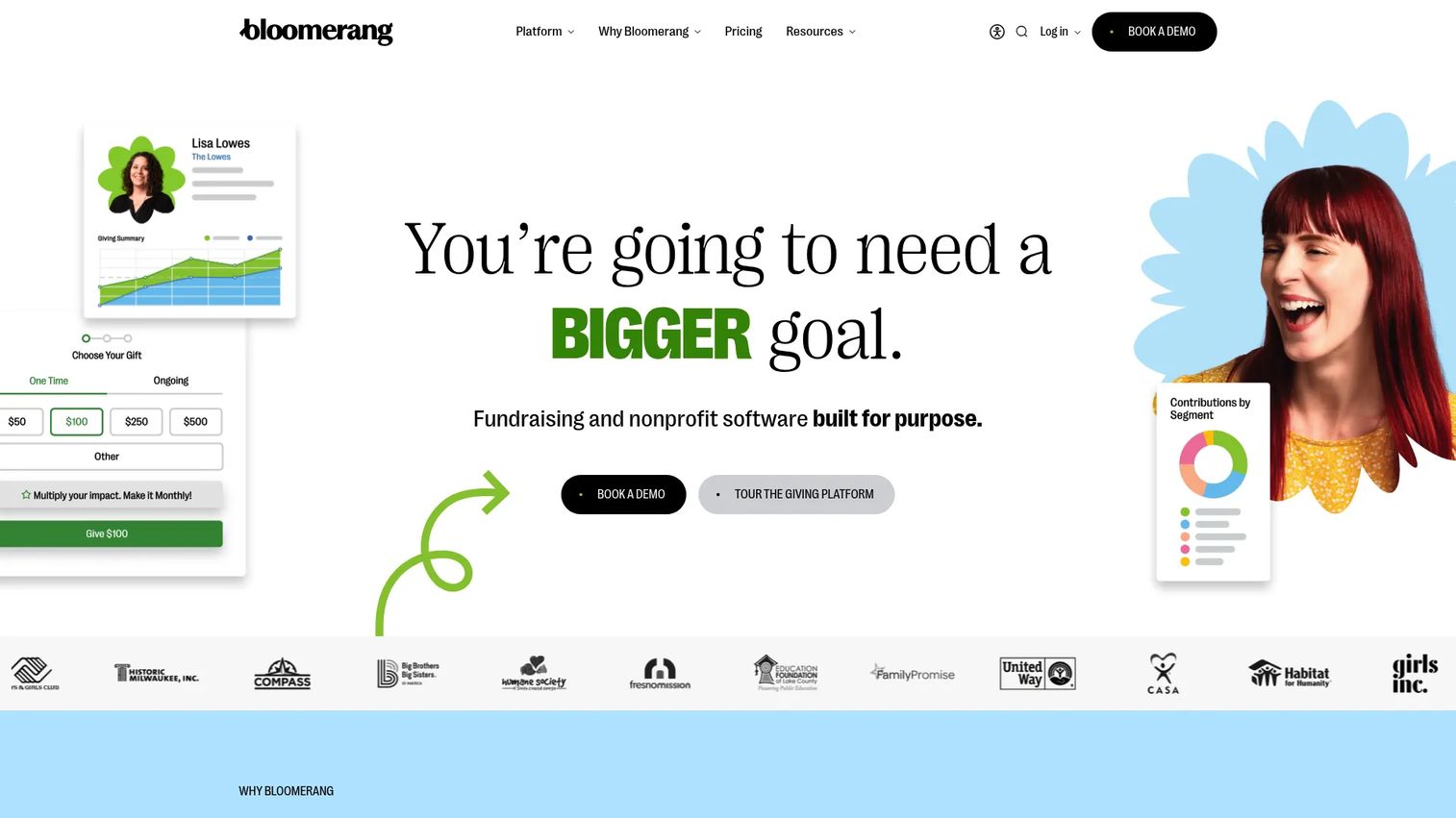
Bloomerang is a nonprofit fundraising, CRM, and volunteer software platform built around a simple premise: retention is cheaper than acquisition. Where many tools optimize for capturing gifts, Bloomerang optimizes for keeping donors, surfacing engagement signals and retention metrics so you act before a supporter lapses. That makes it a strong donor tracking software choice for teams that live and die by recurring relationships.
Best for: Nonprofits that want an integrated fundraising, donor CRM, and volunteer stack with donor retention at the center.
Key strengths
- Donation and fundraising tools: Built-in giving forms and campaigns feed directly into the donor CRM.
- Donor CRM and analytics: Engagement and retention metrics help you spot at-risk donors before they drift.
- Volunteer management: Track volunteers alongside donors, so your whole constituent picture lives in one place.
Why choose Bloomerang: Choose Bloomerang when stewardship is your growth strategy, not an afterthought. The platform's retention framing shapes the whole product, from the dashboard down to the reports, which suits growth-oriented nonprofits trying to lift lifetime value rather than chase one-time spikes.
Bloomerang pricing: Bloomerang publishes pricing per product. Bloomerang Fundraising starts at $40 per month billed annually, Bloomerang CRM starts at $125 per month billed annually, and Bloomerang Volunteer starts at $119 per month billed annually. The combined Giving Platform bundle is quote-based through sales. There is no free plan, but the individual product prices make it easy to start with just the piece you need.
3. Givebutter
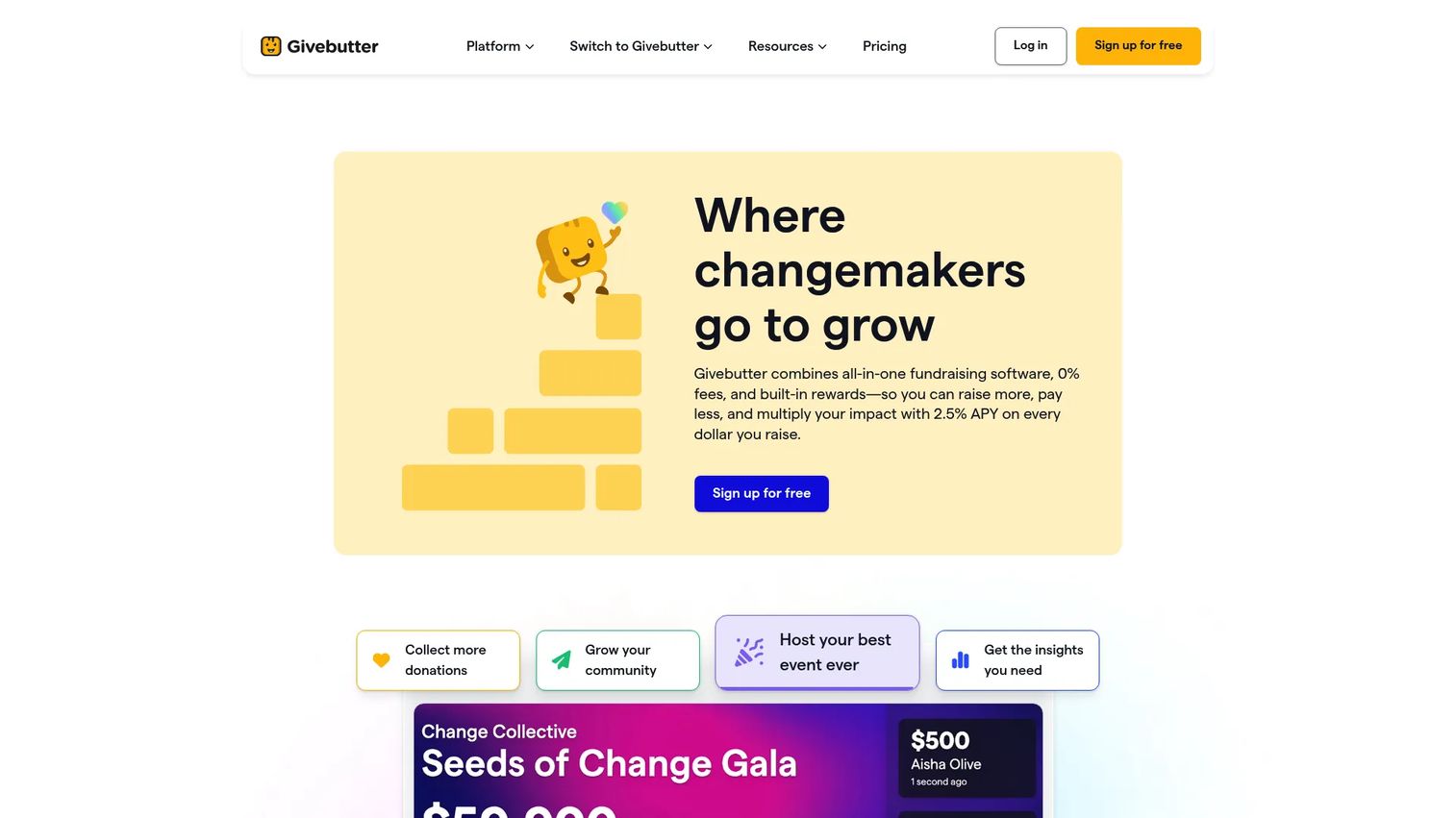
Givebutter is an all-in-one fundraising and nonprofit CRM platform with a genuinely free core. It combines donation forms, fundraising pages, events, and donor management in one place, and the free forever plan covers a remarkable amount of ground. For lean teams that want fundraising and donor tools together without a line item, it removes the usual budget objection entirely.
Best for: Nonprofits that need free fundraising, donations, events, and CRM in a single all-in-one platform.
Key strengths
- Donation forms: Flexible, embeddable giving forms that plug into your site and campaigns.
- Fundraising pages and events: Peer-to-peer pages, campaigns, and event tools built in, not bolted on.
- Donor management and CRM: Donor history, segmentation, and donation workflows sit alongside the fundraising tools.
Why choose Givebutter: Choose Givebutter when budget is tight and you still want a real donor database rather than a bare payment page. The free forever plan lets a small team run donations, events, and CRM together, and you only pay for the Plus tier when you want deeper capabilities. It is the most accessible on-ramp on this list.
Givebutter pricing: Givebutter offers a free forever plan at $0 per month covering a wide set of features. The optional Givebutter Plus tier starts at $29 per month, with additional monthly tiers at $79 and $129 published on the pricing page. A free tier plus transparent Plus pricing makes this the clearest affordable donor management software entry point here.
4. DonorSnap
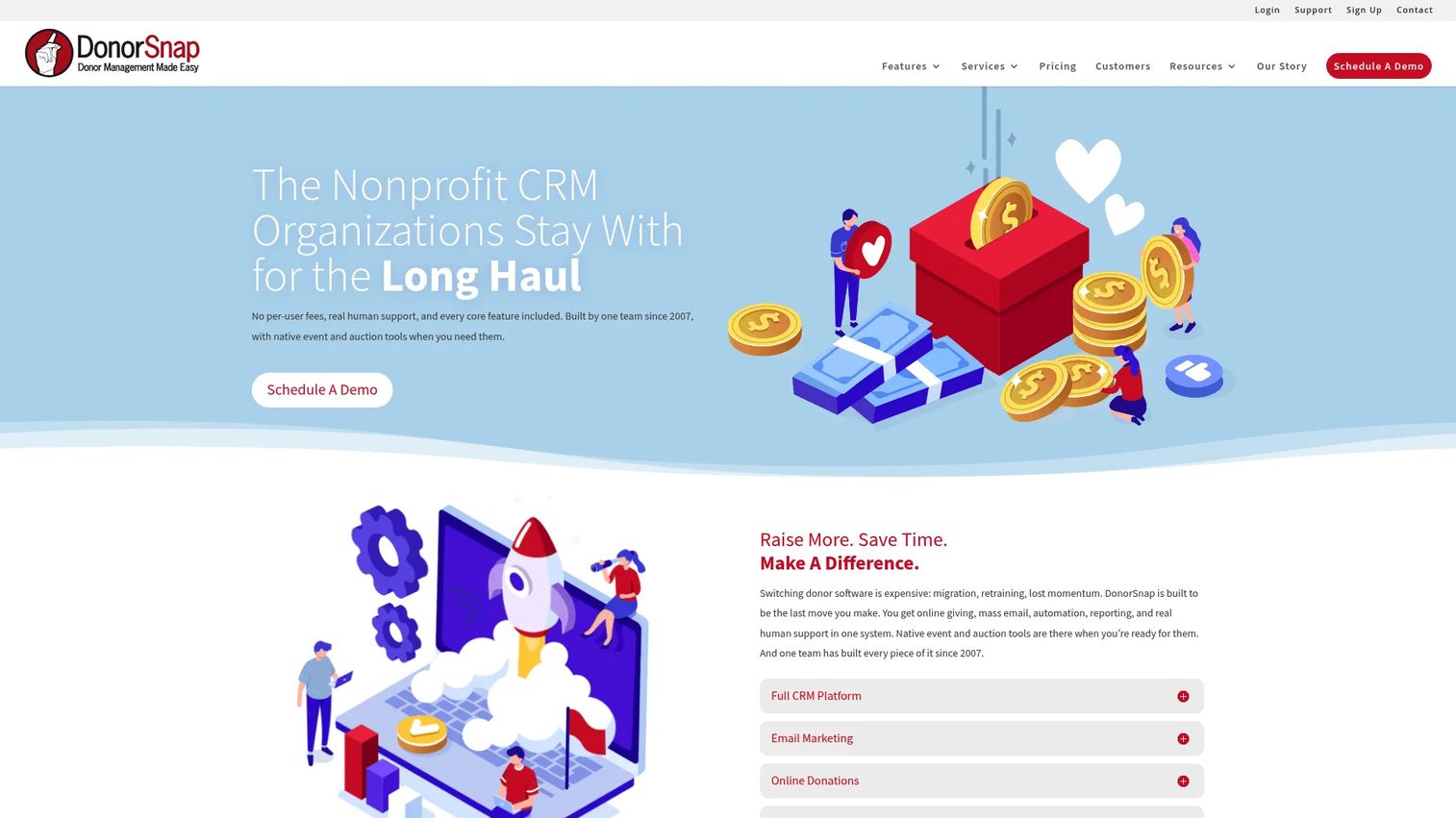
DonorSnap is cloud-based donor management and fundraising software with a refreshingly simple pricing model: you pay by contact count, not per user. Every core feature is included at every tier, so a small team never hits a paywall on the capability they need. That flat, predictable structure makes it a favorite for budget-conscious nonprofits that want a full donor CRM without seat-based math.
Best for: Small to mid-sized nonprofits that need an all-in-one donor CRM with fundraising tools and predictable costs.
Key strengths
- Donor management CRM: A complete donor database with giving history and custom fields at every tier.
- Online donation forms: Built-in forms feed gifts directly into donor records.
- Email marketing and automation: Automated communications and outreach run from inside the platform.
Why choose DonorSnap: Choose DonorSnap when you want every feature included and no surprises on the invoice. Because pricing scales by contacts rather than users, growing teams add staff without growing the bill, and the flat model keeps budgeting simple year over year.
DonorSnap pricing: DonorSnap prices by contact count. Plans start at $50 per month for up to 1,000 contacts, or $540 per year, and scale up through tiers for 2,500, 5,000, 10,000, 20,000, and 30,000 contacts. A one-time $200 setup applies, and the first 30 days are free. No per-user fees means the price you see is the price you pay.
5. Neon One
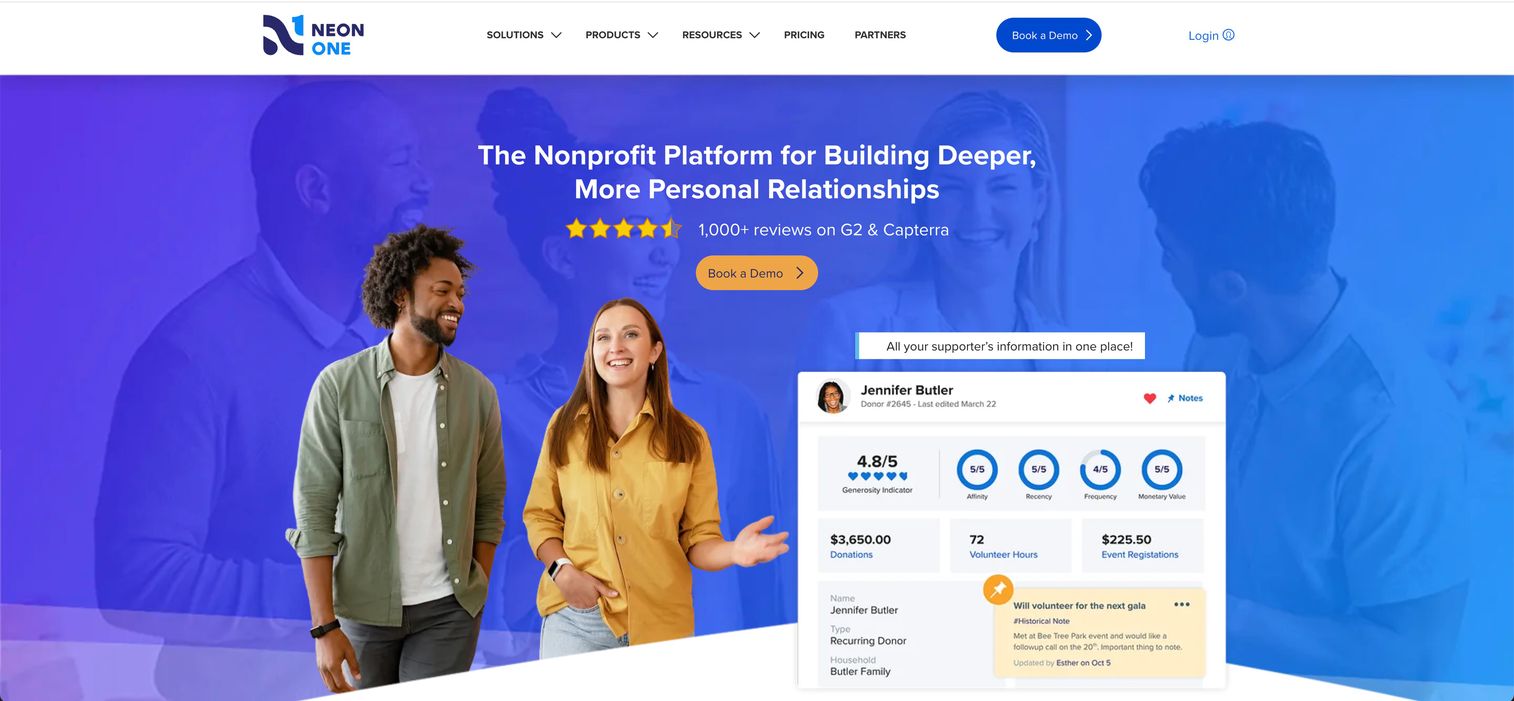
Neon One is a nonprofit relationship management platform that stretches well beyond basic donor tracking. It bundles fundraising, donor management, events, memberships, and communications into one connected ecosystem, so organizations with varied programs run everything from a single platform. If your nonprofit juggles memberships and events alongside donations, Neon One consolidates the whole operation.
Best for: Small and midsize nonprofits that need an integrated CRM and fundraising platform spanning donations, events, and memberships.
Key strengths
- Fundraising and payments: Campaigns, donation forms, peer-to-peer, recurring gifts, and payments in one place.
- Donor management and reporting: Supporter profiles, dashboards, and automated workflows drive donor analytics and follow-up.
- Broad program support: Memberships, events, volunteer tools, websites, and communications extend past pure donor management.
Why choose Neon One: Choose Neon One when your nonprofit's needs span more than fundraising. The platform suits organizations that want memberships, events, and communications living in the same system as their donor database, cutting down on the number of tools your team logs into.
Neon One pricing: Neon One publishes starting prices across its product lineup. Neon CRM starts at $99 per month, Neon Websites at $69 per month, and Neon Fundraise at $158 per month, with additional products like Neon Launch from $49 per month plus transaction fees. The company emphasizes revenue-based pricing, so your exact cost tracks your organization's scale.
6. Virtuous
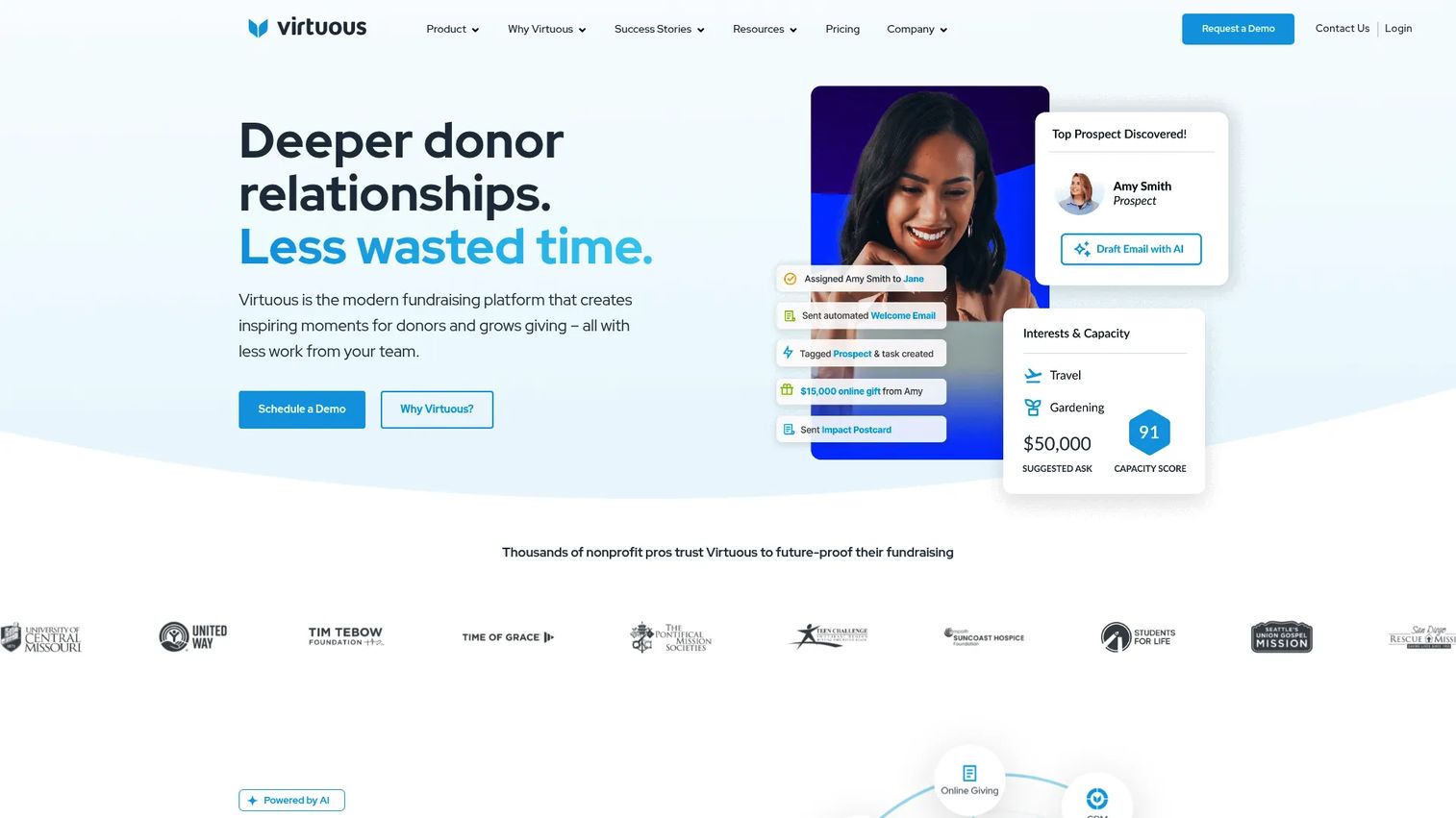
Virtuous is AI-powered responsive fundraising software that leans hard into automation and donor engagement. It pairs a nonprofit CRM and donor management core with marketing automation and online giving, so outreach adapts to donor behavior rather than firing on a fixed schedule. For larger teams with sophisticated stewardship needs, that responsive layer is the differentiator.
Best for: Nonprofits that want a connected fundraising, CRM, and online giving platform with automation at the center.
Key strengths
- Nonprofit CRM and donor management: A full donor database with the segmentation depth larger programs need.
- Online giving and donation pages: Branded giving pages feed straight into donor records and workflows.
- Marketing automation: Behavior-based campaigns and fundraising automation adapt outreach to each donor.
Why choose Virtuous: Choose Virtuous when your team is ready to run sophisticated, automated stewardship rather than manual blasts. The responsive fundraising approach rewards organizations with the volume and staffing to act on donor signals, making it a fit for operationally mature development teams.
Virtuous pricing: Virtuous uses request-pricing for its core platform, providing a personalized quote rather than a public list price. Some professional services are publicly priced, but the software subscription itself is quote-based. Plan a conversation with sales to scope cost against your donor volume and feature needs.
7. Little Green Light
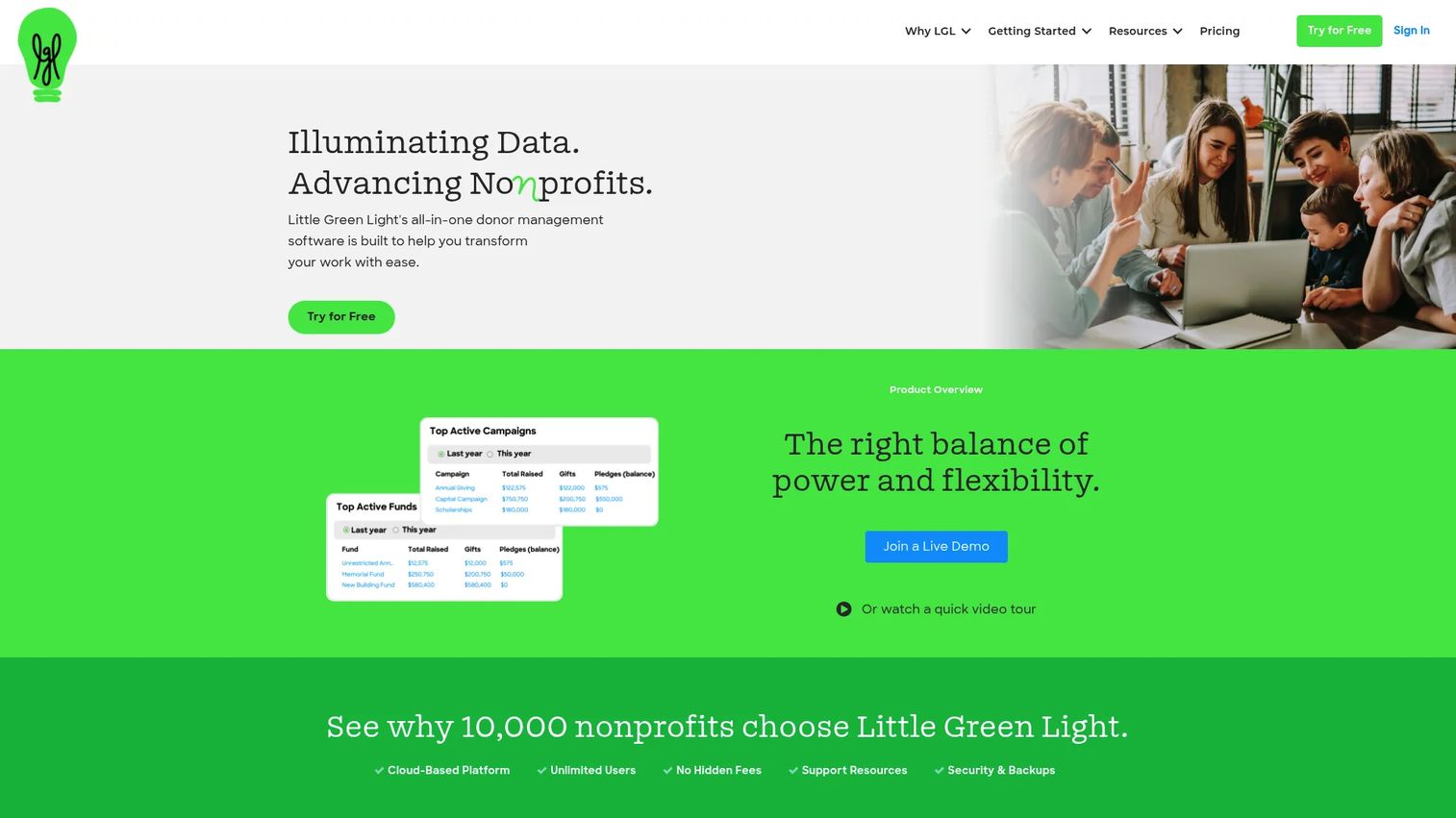
Little Green Light is cloud-based donor management and fundraising software built for teams that want a capable donor database without a heavy platform. Its appeal is clarity: one subscription, every feature included, priced by how many constituent records you keep. Small to mid-sized nonprofits gravitate to it because it does the core donor tracking software job well without overwhelming a two-person team.
Best for: Small to mid-sized nonprofits needing all-in-one donor management and fundraising in a lightweight package.
Key strengths
- Constituent management: A clean, complete donor database with giving history and custom fields.
- Built-in and custom reporting: Ready-made and configurable reports cover retention, campaigns, and board packets.
- Online donation forms: Integrated giving forms feed donations directly into records.
Why choose Little Green Light: Choose Little Green Light when you want every feature included and a price that scales with your data, not your headcount. It suits lean teams that need real donor reporting and segmentation without the complexity of an enterprise suite, and the single-plan model means no feature is locked behind a higher tier.
Little Green Light pricing: Little Green Light uses a single subscription priced by constituent record count. Plans start at $45 per month for up to 2,500 constituents and scale through tiers up to 50,000 constituents at $135 per month. Monthly or annual billing is available, with a 10% discount for prepaying, and every feature is included at every tier.
8. Blackbaud Raiser's Edge NXT
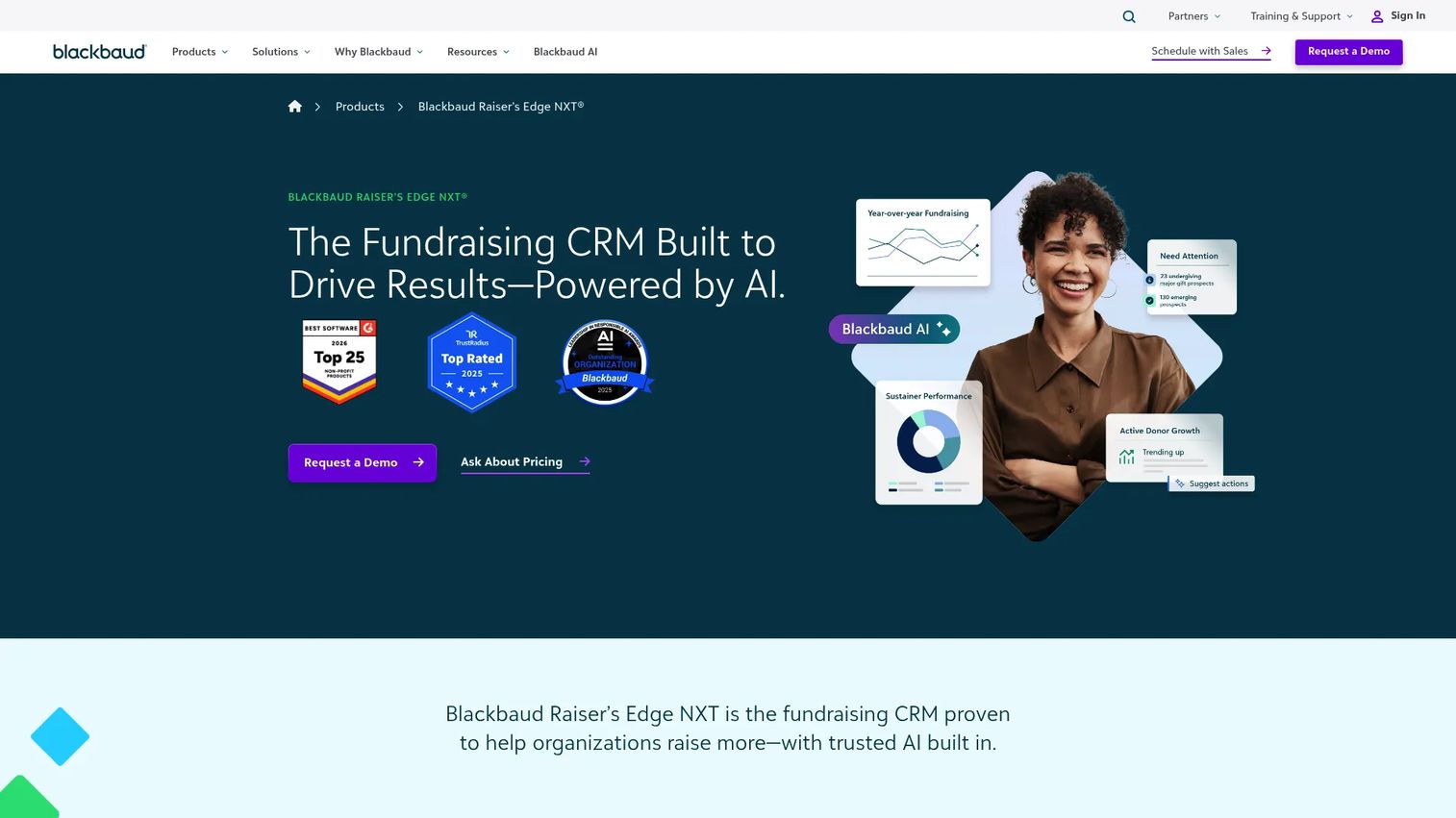
Blackbaud Raiser's Edge NXT is a cloud-based donor management and fundraising CRM built for scale. It is the platform large institutions reach for when donor volume, complex gift types, and multi-team development operations outgrow lighter tools. Unified supporter records, an open API, and deep reporting make it a system of record for organizations with mature fundraising machines.
Best for: Mid-sized to large nonprofits needing a scalable fundraising CRM for complex development operations.
Key strengths
- Unified supporter records: Giving history, engagement, relationships, and interactions in a single constituent view.
- Flexible integrations and open API: Connect the CRM to your broader stack for connected workflows.
- Dashboards and reporting: Fundraising operations and leadership reporting built for scale and scrutiny.
Why choose Blackbaud Raiser's Edge NXT: Choose Raiser's Edge NXT when your organization has the scale and complexity that smaller platforms cannot absorb. It fits established development teams with dedicated operations staff, layered gift types, and reporting requirements that demand enterprise depth. This is infrastructure for organizations raising at volume.
Blackbaud Raiser's Edge NXT pricing: Blackbaud provides pricing as a personalized quote rather than a public list price. Because the platform targets larger, more complex organizations, cost is scoped to your donor volume, modules, and integration needs. Expect an enterprise conversation rather than a self-serve checkout.
What to check before you commit
Shortlisting is the easy part. Before you sign, run every finalist through this checklist so you do not discover a gap in month three.
Data model and reporting
Confirm the tool handles your actual gift types: recurring donations, pledges, matching gifts, in-kind, and soft credits. Then check that donor reporting covers retention, lapsed donors, and campaign performance out of the box. If your board packet needs a custom report, make sure you can build it without a consultant.
Segmentation depth
Test how the tool builds segments. You want to filter by giving level, recency, campaign, and interest, then save those lists for repeatable appeals. Shallow tagging forces manual work every send. Real donor segmentation is what moves retention, so evaluate it hands-on during a trial, not from a feature list.
Integrations and data flow
Map the tools that must connect: payment processor, email marketing, accounting, and any event platform. Verify the integration is native and two-way, not a nightly export. A donor database that does not sync cleanly with your finance system recreates the reconciliation problem you are trying to escape.
Pricing structure and total cost
Understand whether pricing scales by user, contact, or revenue, because that determines your cost curve as you grow. Factor in setup fees, payment processing rates, and any paywalled features. The cheapest starting price is not always the cheapest system of record over three years.
Which donor management software should you choose?
The right pick comes down to size, complexity, and budget. For a mature all-in-one nonprofit CRM, DonorPerfect is the capable default. If stewardship and retention drive your growth, Bloomerang builds the whole product around keeping donors. Lean teams watching every dollar have two strong on-ramps: Givebutter for a free all-in-one platform, and DonorSnap or Little Green Light for flat, feature-complete pricing that scales with data instead of headcount.
Organizations with broader program needs, memberships, events, and communications, will find Neon One consolidates the stack, while Virtuous rewards operationally mature teams ready for responsive, automated fundraising. At the top end, Blackbaud Raiser's Edge NXT is the enterprise system of record for complex development operations.
Treat this like any infrastructure decision: shortlist two or three tools that match your reporting depth, workflow needs, and budget, then request demos and run your real data through a trial. The best CRM for nonprofits is the one your team actually keeps clean, because a system of record only works when everyone trusts it.
FAQs
In practice, they are the same category. Donor management software is a CRM for nonprofits, purpose-built around giving history, stewardship, and receipting rather than sales pipelines. Some vendors brand themselves as a nonprofit CRM and others as fundraising software, but both centralize donor records, segmentation, and reporting in one system.
Prioritize a centralized donor database, real segmentation, and reporting that covers retention and lapsed donors. Then confirm donation workflows like online forms and automated receipts, plus integrations with your payment processor, email, and accounting tools. Feature counts matter less than whether the core data and reporting hold up under board scrutiny.
Entry pricing ranges widely. Givebutter offers a free forever plan, Little Green Light starts at $45 per month, DonorSnap at $50, Bloomerang at $40, and DonorPerfect and Neon One at $99. Enterprise platforms like Blackbaud Raiser's Edge NXT and Virtuous use custom, quote-based pricing scoped to your donor volume and needs.
Yes, especially when spreadsheets start breaking retention and reporting. Affordable donor management software like Givebutter's free plan, DonorSnap, or Little Green Light gives a lean team a real system of record without an enterprise budget. The payoff is time saved on reconciliation and money recovered through better stewardship.
That is the point of the category. A proper donor database replaces scattered spreadsheets, exports, and inboxes with one system of record where every gift and interaction attaches to a single donor profile. You stop reconciling files by hand and start pulling reports your board trusts in minutes.
Most tools on this list handle recurring gifts, but the ones that track them cleanly against each record and flag failed charges stand out. Bloomerang's retention focus and Givebutter's built-in recurring giving are strong fits, and DonorPerfect and Neon One both manage recurring donations well within a broader nonprofit CRM.
Audit your current data first: deduplicate records, standardize fields, and confirm giving history is complete. Then verify the new tool imports your gift types, householding, and custom fields without loss. Ask the vendor about migration support, and run a test import on a data sample before you commit the full database.
Integrations determine whether your donor database becomes a true system of record or another silo. Native, two-way connections to your payment processor, email marketing, and accounting tools keep data flowing without manual exports. Before choosing, map the tools that must connect and confirm each integration is real, not a nightly file dump.