Your feedback lives in three places. Your analytics live in a fourth. Your roadmap sits in a doc nobody opens between planning cycles. And when leadership asks why a feature shipped, you spend an afternoon reconstructing the decision from Slack threads.
That is product operations without a system behind it.
Product teams are drowning in tools and disconnected data. Every extra surface adds handoff cost. The feedback loop breaks. Decisions get made from partial data because pulling the full picture takes too long, and by the time you have it, the release window has closed.
The global product management software market was worth $5.86B in 2024 and is projected to reach $12.8B by 2035, growing at about 7.4% CAGR (Market Research Future, 2024). Adjacent onboarding tooling is growing faster still, at 16.8% CAGR through 2034 (MarketIntelo, 2025). Translation: the tooling stack around product work is expanding, and picking the right pieces matters more each year.
This guide breaks down the seven product ops software platforms worth evaluating for 2026. It covers what product ops software actually is, how it differs from product management, and which tools fit which bottleneck.
What's inside
This guide is for product managers, product ops leads, and heads of product building or refining a connected product ops stack. It is written for people who care about instrumentation, segments, release cadence, and opportunity cost, not another list of interchangeable feature sets.
We picked tools based on four criteria:
- Workflow fit across feedback, planning, analytics, and delivery
- Integration depth with your existing data and GTM stack
- Analytics and reporting quality
- Maintainability as your product and org scale
No pay-to-play placements. Every pricing figure and rating comes from the vendor's own pages or verified sources.
TL;DR
- Best for prioritization and roadmap flexibility: airfocus, with connected feedback, scoring frameworks, and portfolio views.
- Best for feedback centralization: Productboard, for turning customer signal into prioritized roadmaps.
- Best for product analytics: Amplitude and Mixpanel, both built around behavioral event data with free starting tiers.
- Best for in-app guidance plus analytics: Pendo, which pairs usage data with guides and feedback.
- Best for delivery workflow: Jira, the backbone for backlog, sprints, and cross-team coordination.
- Best for discovery and alignment: Miro, for workshops, mapping, and cross-functional planning.
What is product ops software?
Product ops software is the category of tools that helps product teams centralize feedback, analytics, planning, experimentation, and cross-functional coordination in one connected operating layer. It functions as operational infrastructure: the system that lets product managers spend time on decisions instead of reconstructing context.
Where a single-purpose product management tool solves one job, product ops software connects jobs. It reduces the manual work of moving data between feedback, roadmap, analytics, and delivery. That connection is the point.
Key capabilities to expect:
- Feedback collection from customers, sales, and support
- Prioritization and roadmapping with scoring frameworks
- Product analytics on usage, funnels, and retention
- Experimentation support and feature flagging
- Collaboration and cross-functional alignment
- Process standardization across teams and PMs
The distinction from generic PM tools matters. A backlog tracker manages tasks. A product ops platform, or a stack of connected product operations tools, manages the flow of information that produces good product decisions. Most teams do not buy one platform. They assemble a stack from the categories above.
Product ops vs product management
The phrase "product operations vs product management" comes up in nearly every stack conversation. Here is the practical split.
Different jobs, overlapping workflows
Product management owns outcomes and prioritization. A PM decides what to build, why, and in what order, and is accountable for activation, retention, and expansion. Product operations builds the system that lets PMs do that job efficiently.
The overlap is real. Both touch feedback, analytics, roadmaps, and release planning. The difference is ownership. A PM makes the call on a feature. Product ops makes sure the data behind that call is clean, the process is repeatable, and the handoff to engineering does not leak context.
Where they do not overlap: product ops does not own the roadmap or the outcome. It owns the machinery.
When product ops becomes a separate function
Small teams do not need a dedicated product ops function. One PM with good habits covers it. The scale triggers that change the math:
- More than three or four PMs working from different processes
- Feedback and analytics fragmented across five or more tools
- Repeated process bottlenecks in planning or release
- Leadership asking for reporting nobody can produce quickly
When any of these hit, a product operations manager or a formal product ops team structure starts paying for itself. The function exists to remove friction, not to add a layer of approvals.
Where product ops helps PMs most
The highest-leverage areas are consistent. Data visibility, so decisions run on trustworthy numbers instead of guesses. Process consistency, so every PM works from the same playbook. Cleaner cross-functional handoffs, so context survives the trip from product to engineering to GTM. And less manual admin, which is the opportunity cost that quietly eats a PM's week.
When to invest in product ops software
Your team is spending too much time on admin
If your PMs spend more time compiling reports and copying data between tools than talking to users or shaping strategy, that is the signal. Admin is opportunity cost. Every hour spent reconstructing a decision is an hour not spent on discovery. Product ops software exists to give that time back.
Tool sprawl is hiding the truth
When feedback lives in one tool, analytics in another, and the roadmap in a third, you never see the whole picture at once. Decisions get made from whichever slice is easiest to pull. That is how teams build the wrong thing confidently. A connected product ops workflow surfaces the full picture in one place.
Scaling across PMs, products, or segments
As you add PMs, product lines, or customer segments, informal process stops working. What one PM held in their head needs to become shared infrastructure. Centralized visibility and a standard process are what let a growing team move without stepping on each other.
Leadership wants measurable product decisions
When the board or exec team asks you to prove why a feature shipped, or to forecast the impact of the next one, you need reporting that holds up. Product ops software for SaaS teams supports that proof: clean instrumentation, defensible prioritization, and reporting that survives scrutiny.
Comparison table
Seven tools, sorted by relevance to a connected product ops stack. Pricing and ratings are pulled from each vendor's live pages and verified sources.
| # | Product | Best for | Key differentiator | Pricing | G2 rating |
|---|---|---|---|---|---|
| 1 | airfocus | Prioritization and roadmaps | Connected feedback, strategy, and scoring frameworks | From $19/user/mo | 4.4/5 |
| 2 | Pendo | Analytics plus in-app guidance | Usage data, guides, and feedback in one platform | Free tier; paid custom | 4.4/5 |
| 3 | Productboard | Feedback centralization | Customer signal aggregation into prioritized roadmaps | Free; Plus from $19/maker/mo | 4.3/5 |
| 4 | Amplitude | Product analytics | Behavioral analytics with experimentation | Free; Enterprise custom | 4.5/5 |
| 5 | Mixpanel | Event analytics | Funnels, retention, and cohort analysis | Free; Growth from $0 | 4.5/5 |
| 6 | Jira | Delivery workflow | Backlog, sprints, and cross-team coordination | Free; Standard $7.91/user/mo | Not listed |
| 7 | Miro | Discovery and alignment | Infinite canvas for workshops and mapping | Free; Starter $8/mo per member | Not listed |
7 best product ops software for 2026
1. airfocus
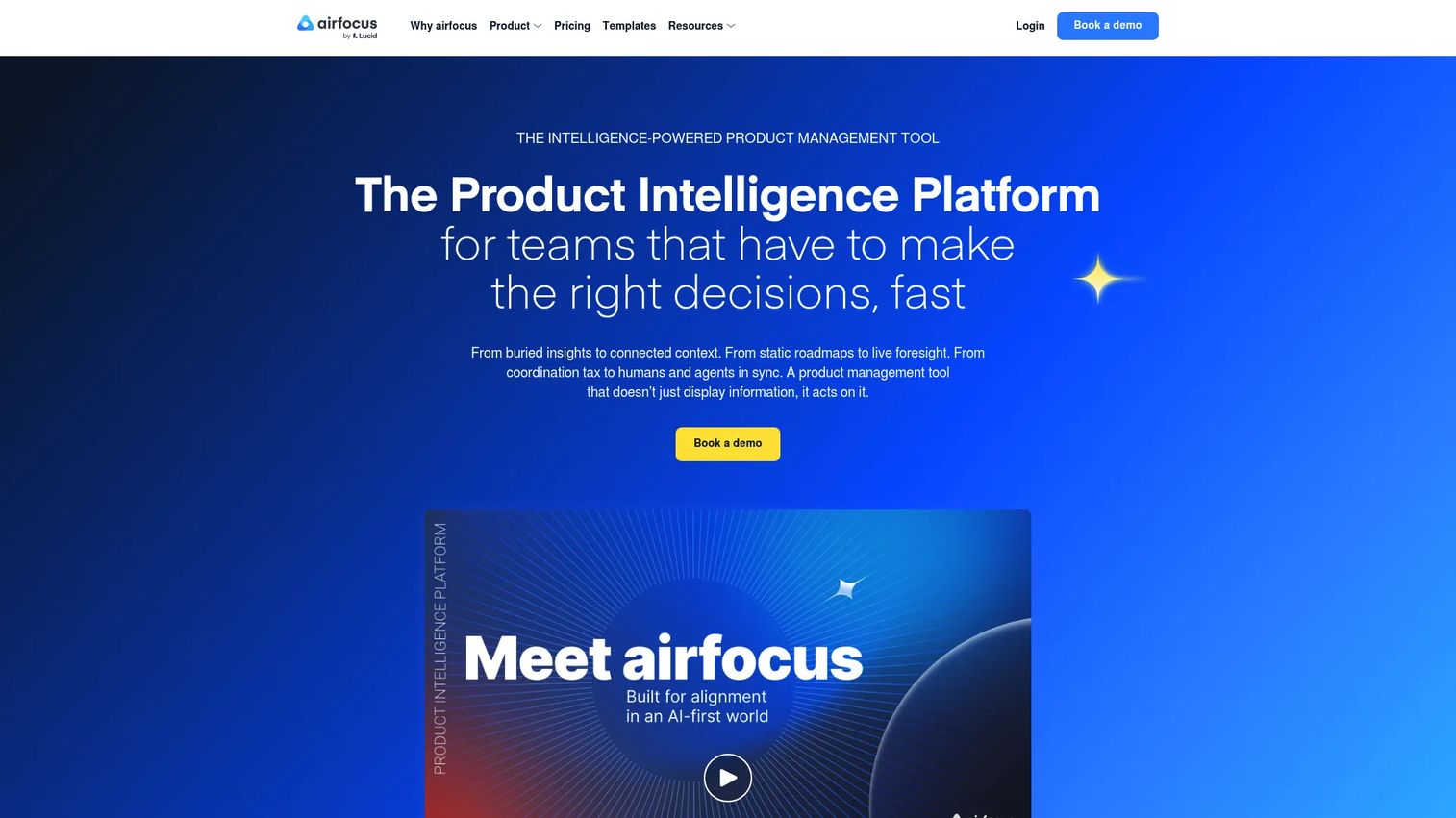
airfocus is an AI-powered product management and roadmapping platform that connects feedback, strategy, OKRs, roadmaps, and delivery in one place. It leans hard into prioritization, which makes it a natural fit for teams where deciding what to build next is the constant bottleneck. Portfolio management with drift detection helps larger product orgs keep multiple lines aligned to strategy.
Best for: Product teams that need flexible roadmaps, structured prioritization, and feedback-to-roadmap workflows.
Key strengths
- Connected feedback, strategy, OKRs, roadmaps, and delivery
- Prioritization frameworks including RICE and weighted scoring
- Portfolio management with drift detection and AI agents
Why choose airfocus: If your team argues about priorities more than execution, airfocus gives you a defensible scoring model and a single view from insight to roadmap. It fits product ops teams that want to standardize how decisions get made across PMs.
airfocus pricing: Plans start at $19 per user per month billed annually. A higher self-serve tier is $69 per month, with Professional and Enterprise tiers available on request.
2. Pendo
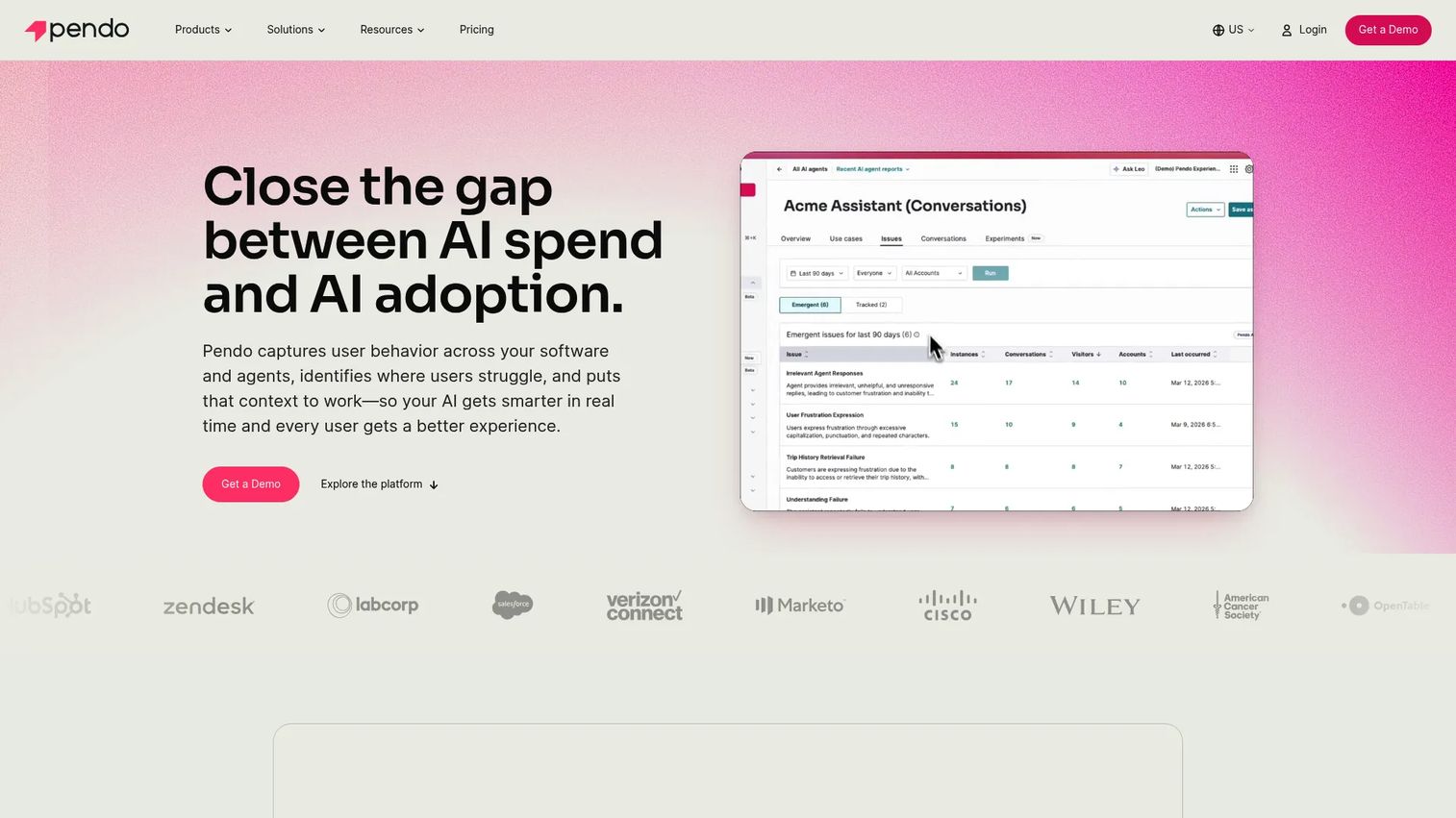
Pendo is a software experience management platform that combines product analytics, in-app guidance, feedback, and adoption tools. That combination is what makes it relevant to product ops: you see how users behave, then act on it inside the product without shipping engineering work for every nudge. Session replay adds context to the raw numbers.
Best for: B2B product teams that want behavioral analytics paired with in-app guides and feedback in one platform.
Key strengths
- Product analytics on usage and adoption
- In-app guides for onboarding and feature adoption
- Session replay for behavioral context
Why choose Pendo: When your bottleneck is adoption, not delivery, Pendo lets you close the loop between seeing a drop-off and fixing it in-app. It suits teams that want analytics and guidance under one roof rather than stitched together.
Pendo pricing: Pendo offers a free tier. Paid plans (Base, Core, and Ultimate) are custom-priced and typically billed on monthly active users, available through a demo request.
3. Productboard
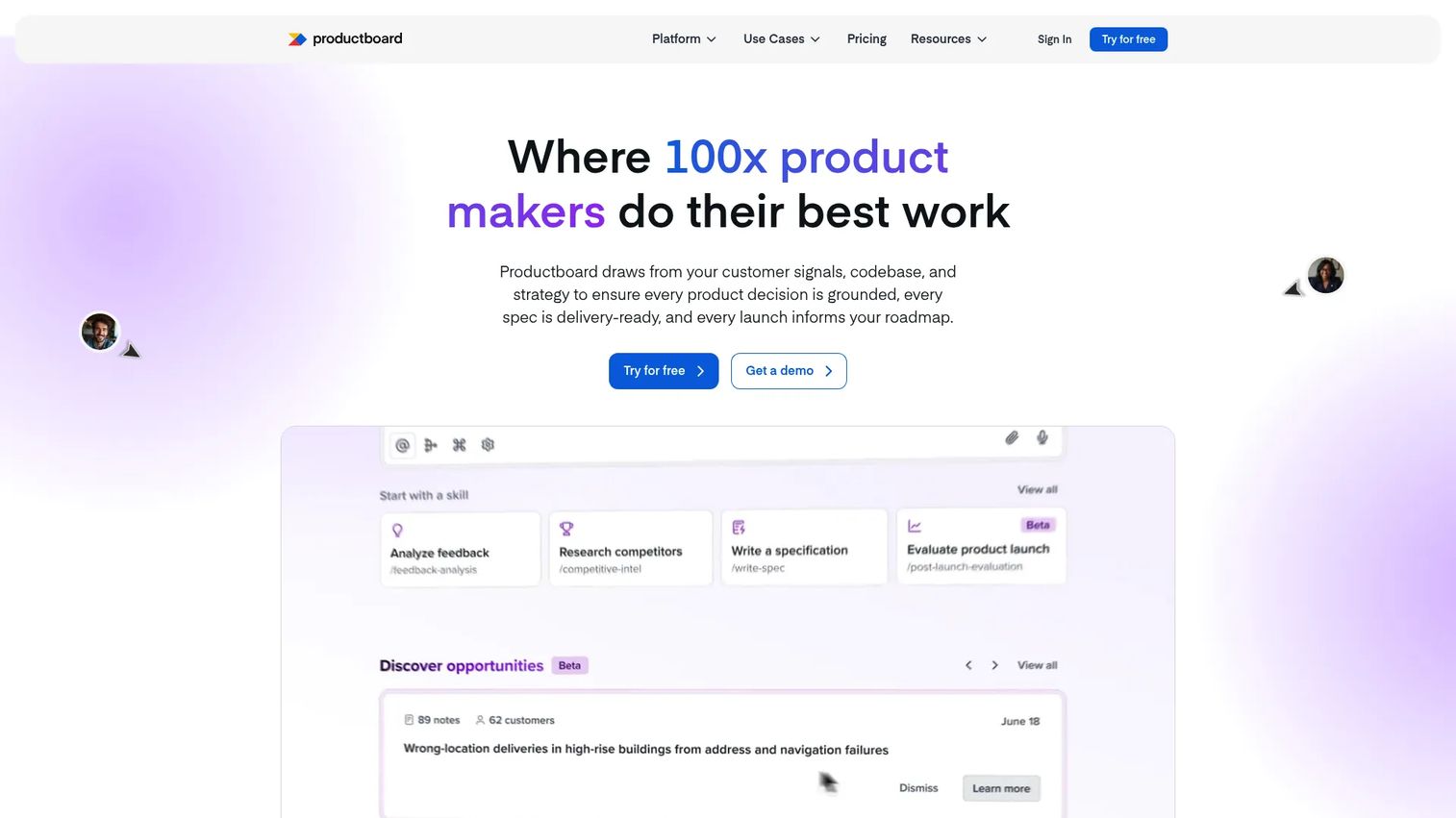
Productboard is a customer-centric product management platform built around collecting feedback, prioritizing it, and turning it into roadmaps. Its strength is signal aggregation: pulling scattered customer input from sales, support, and users into one prioritized view. AI-assisted discovery surfaces opportunities you might otherwise miss in the noise.
Best for: Product teams that need a structured system to collect feedback, prioritize work, and align roadmaps.
Key strengths
- AI-assisted product discovery and opportunity surfacing
- Prioritization, roadmapping, and release planning
- Customer feedback, insights, and collaborative docs
Why choose Productboard: If feedback is your fragmentation problem, Productboard is purpose-built to centralize it and connect it to what you ship. It fits teams that want customer signal driving the roadmap, not the loudest stakeholder.
Productboard pricing: A free plan is available. Plus starts at $19 per maker per month billed annually, Business at $59 per maker per month with a two-maker minimum, and Enterprise is custom-priced.
4. Amplitude
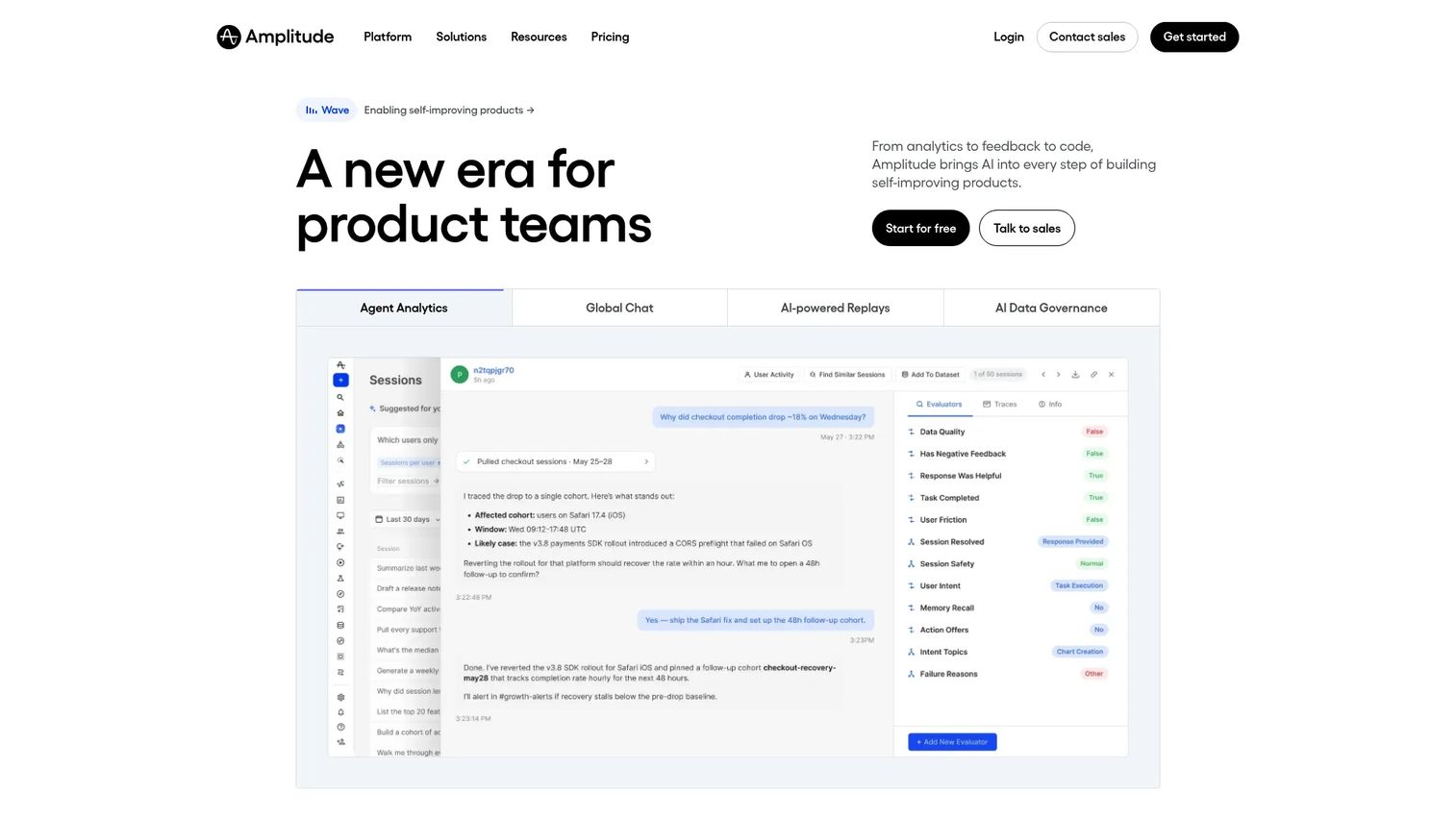
Amplitude is an analytics platform covering product, web, experimentation, activation, and session replay. For product ops, it is the source of truth on behavior: which segments activate, which features retain, and where users drop. Built-in experimentation and feature flags mean you can test a change and measure it in the same system.
Best for: Teams wanting a single analytics and experimentation platform with a free starting tier.
Key strengths
- Product analytics across segments and cohorts
- Session replay tied to behavioral data
- Experimentation and feature flags
Why choose Amplitude: When decisions need to run on behavioral data with segmentation depth, Amplitude gives PMs the instrumentation to prove impact rather than guess. It suits teams that want analytics and experimentation without running two separate tools.
Amplitude pricing: A free plan includes 2M events per month forever. Plus starts at $0 with the first 2M events per month free, and Enterprise is custom, event-based pricing.
5. Mixpanel
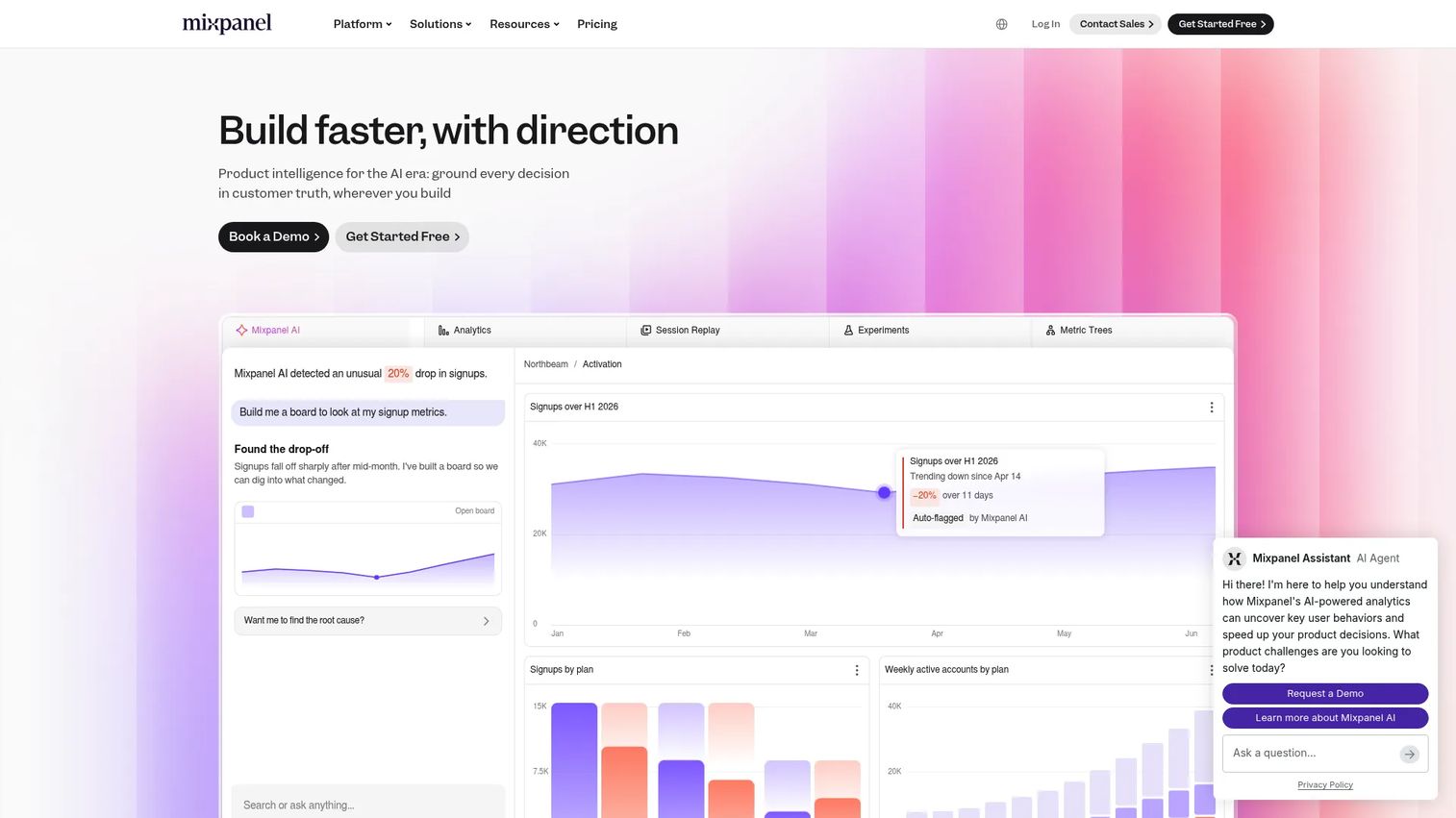
Mixpanel is a product analytics platform focused on understanding user behavior through events, funnels, and retention. It is the tool teams reach for when they want self-serve answers to "where do users drop" and "which cohort retains" without a data team in the loop. Session replay and experimentation round out the picture.
Best for: Teams that need self-serve product analytics with event-based funnels, retention, and replay.
Key strengths
- Funnels and retention analysis
- Cohorts and saved reports
- Session Replay and experimentation
Why choose Mixpanel: If your PMs want to answer their own analytics questions without filing a ticket, Mixpanel is built for that self-serve speed. It fits teams that prioritize fast, event-level insight over a broader suite.
Mixpanel pricing: A free plan includes up to 1M monthly events. Growth starts at $0 with 1M monthly events free and $0.28 per 1K events after, and Enterprise is quote-based.
6. Jira
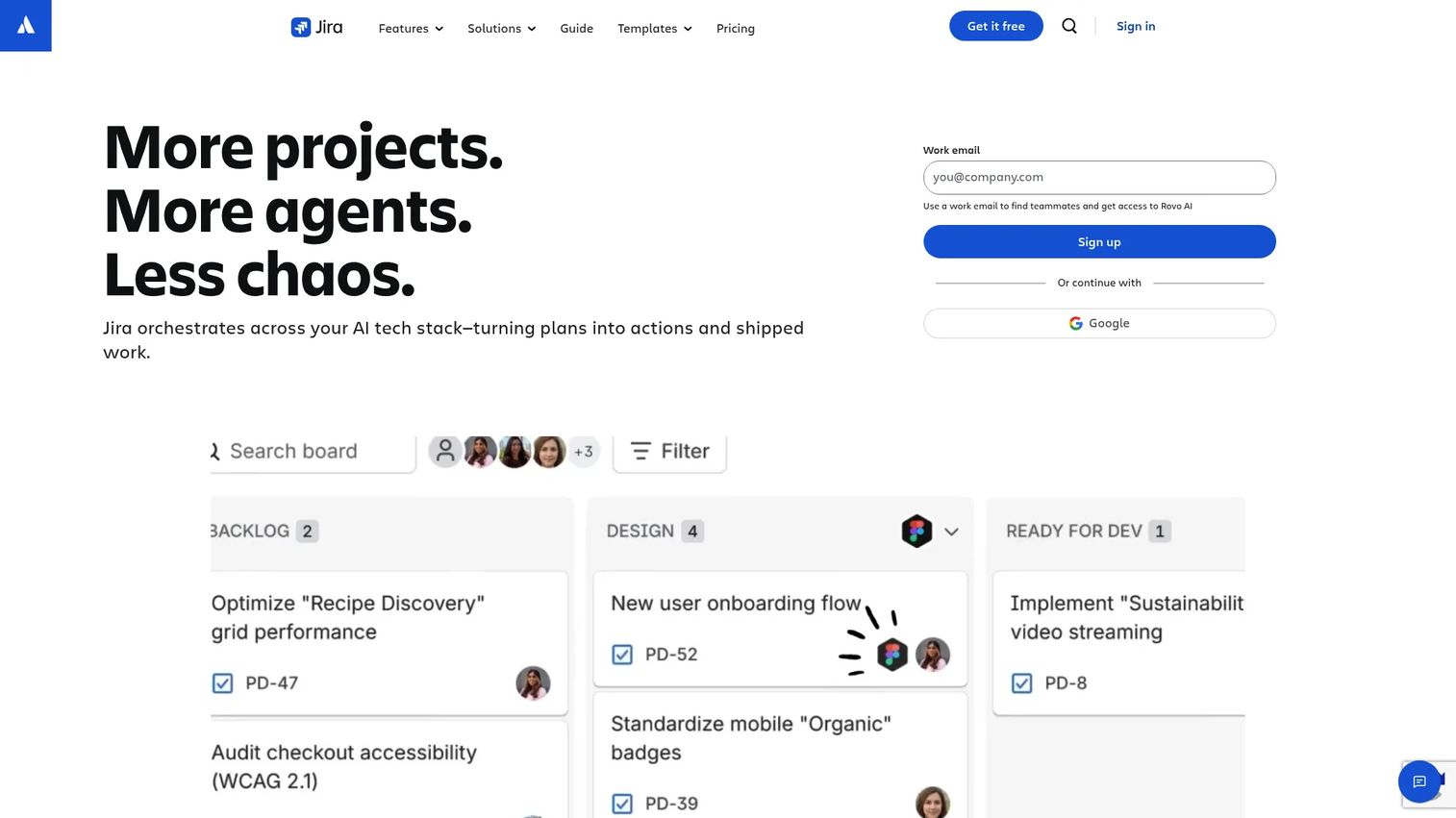
Jira is Atlassian's work management and issue-tracking software, and for most product teams it is the delivery backbone. Backlog, sprints, and cross-team coordination live here. In a product ops stack, Jira is where prioritized decisions become tracked, shipped work, with reporting on delivery cadence along the way.
Best for: Teams needing flexible issue tracking, agile planning, and cross-functional project management.
Key strengths
- Boards, lists, timeline, calendar, and summary views
- Customizable workflows, fields, permissions, and automation
- Reports, dashboards, and 3000+ Marketplace integrations
Why choose Jira: If delivery coordination is your friction point, Jira connects prioritized work to execution with reporting engineering already trusts. It fits teams that need the roadmap decision to translate cleanly into shipped software.
Jira pricing: Free is forever for up to 10 users. Standard is $7.91 per user per month, Premium is $14.54 per user per month, and Enterprise is contact sales.
7. Miro
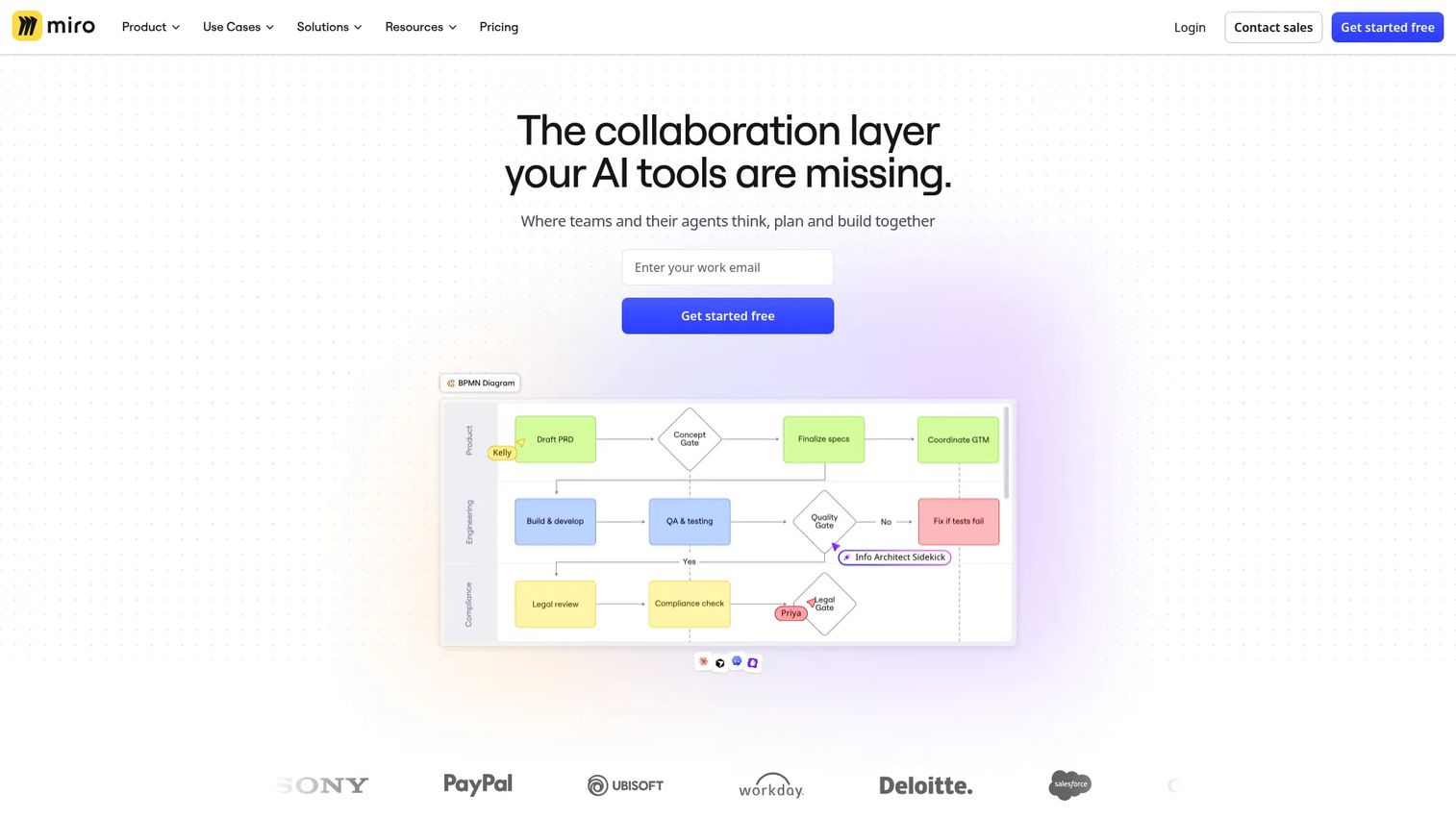
Miro is a visual collaboration platform built around an infinite online whiteboard. In product ops, it is where discovery, workshops, and cross-functional planning happen: mapping user journeys, clustering feedback, and building operating models the whole team can see. With thousands of templates and hundreds of integrations, it plugs into the rest of the stack.
Best for: Teams needing a shared whiteboard for cross-functional collaboration and planning.
Key strengths
- Infinite canvas online whiteboard
- 7,000+ templates
- 250+ integrations
Why choose Miro: When alignment happens in workshops and mapping sessions, Miro gives distributed teams a shared surface to think on. It fits the discovery and planning side of product ops that structured tools do not cover.
Miro pricing: Free includes up to 3 editable boards. Starter is $8 per member per month billed yearly, Business is $20 per member per month billed yearly, and Enterprise is custom-priced from 30 members.
Considerations
Before you commit to any product ops software, run it through this checklist.
Integration with your existing stack
The tool has to fit what you already run: analytics, CRM, support, docs, and delivery. A product ops platform that cannot pull data from your source of truth just adds another silo. Check the integration list against your actual stack, not a hypothetical one, and confirm the connections are two-way where it matters.
Data quality and reporting depth
Product ops lives or dies on trustworthy data. Evaluate how the tool handles instrumentation, segmentation, and reporting. Can you slice by role, plan, or segment? Can you export clean data for a board deck? If the numbers are messy or the reporting is shallow, the tool undermines the decisions it is supposed to support.
Collaboration and approvals
Look at how the software will actually get used across PM, design, engineering, and leadership. Who edits, who reviews, who approves. A tool that only one person touches is a bottleneck, not infrastructure. Check for real collaboration and version control, not just multi-seat access.
Maintainability at scale
The tool has to stay useful as your product and org grow. Evaluate whether it holds up with more PMs, more product lines, and a faster release cadence. Watch for tools that work for a five-person team but buckle at twenty. Maintainability is the difference between a stack that scales and one you replace in eighteen months.
Security and governance
Confirm access control, compliance coverage, and admin visibility. Product ops touches customer data and internal roadmaps, so governance is not optional. Check who can see what, whether the vendor meets your compliance requirements, and how much admin control you get over permissions.
Conclusion
There is no single best product ops software, because product ops is a stack, not a tool. The right pick depends on your bottleneck.
If prioritization is where your team stalls, start with airfocus. If feedback is scattered, Productboard centralizes it. For behavioral analytics, Amplitude and Mixpanel are both strong, with Mixpanel leaning self-serve and Amplitude adding experimentation depth. Pendo fits when analytics and in-app guidance belong together. Jira anchors delivery, and Miro covers discovery and alignment.
The point of product ops software is not more tools. It is less friction and better decisions. Every tool you add should reduce handoff cost and improve data quality, not create another surface to reconcile.
Next step: name your single biggest bottleneck right now, whether it is prioritization, feedback, analytics, or delivery. Then shortlist two or three tools from that category and trial them against your real workflow. Buy the one that removes the most manual work.
Start your journey with Guideflow today!
FAQs
Product management owns outcomes and prioritization: what to build, why, and in what order, measured against activation, retention, and expansion. Product operations owns the system that lets PMs do that efficiently, including instrumentation, process consistency, and clean handoffs. The PM makes the call; product ops makes sure the data and process behind it hold up.
No. It removes the manual admin that steals PM time, so PMs spend more of it on discovery and strategy. Product ops software supports decisions with better data and process, but the prioritization call and the accountability for outcomes stay with the PM. The opportunity cost it recovers is the value, not headcount replacement.
Most teams run a stack, not a single platform. That typically spans feedback and roadmapping (airfocus, Productboard), product analytics (Amplitude, Mixpanel, Pendo), delivery (Jira), and collaboration (Miro). The exact mix depends on which product ops workflow creates the most friction for your team.
The trigger is scale, not stage. Once you have more than three or four PMs working from different processes, or feedback and analytics fragmented across five or more tools, a dedicated product operations manager starts paying for itself. Before that, good habits from one PM usually cover it.
Focus on the metrics tied to product outcomes: activation rate, time to first value, onboarding completion, early retention, and trial-to-paid conversion. Secondary signals include support ticket volume, adoption of critical workflows, and churn reasons. Good instrumentation means you can segment these by role, plan, and use case.
No. SMEs represent about 35.8% of demand in adjacent onboarding software, and adoption in that segment is growing fast (MarketIntelo, 2025). Smaller teams often start with a free analytics tier and a feedback tool, then expand the stack as PM headcount and process complexity grow. The category scales down as well as up.
Start with your single biggest bottleneck, then evaluate on four criteria: integration with your existing stack, data quality and reporting depth, collaboration across teams, and maintainability at scale. Shortlist two or three tools in the relevant category and trial them against your real release cadence. Buy the one that removes the most manual work.","applied_brand_links":[],"skipped_brand_links":[{"reason":"already_linked","name":"airfocus","homepage_url":"https://airfocus.com","source":"step_4"},{"reason":"already_linked","name":"Pendo","homepage_url":"https://www.pendo.io","source":"step_4"},{"reason":"already_linked","name":"Productboard","homepage_url":"https://www.productboard.com","source":"step_4"},{"reason":"already_linked","name":"Amplitude","homepage_url":"https://amplitude.com","source":"step_4"},{"reason":"already_linked","name":"Mixpanel","homepage_url":"https://mixpanel.com","source":"step_4"},{"reason":"already_linked","name":"Jira","homepage_url":"https://www.atlassian.com/software/jira","source":"step_4"},{"reason":"already_linked","name":"Miro","homepage_url":"https://miro.com","source":"step_4"},{"reason":"no_body_mention","name":"SVPG: Product Ops Overview","homepage_url":"https://www.svpg.com/","source":"step_25"},{"reason":"no_body_mention","name":"Pragmatic Institute","homepage_url":"https://www.pragmaticinstitute.com/","source":"step_25"}],"applied_external_links":[{"anchor":"Market Research Future","url":"https://www.marketresearchfuture.com/"},{"anchor":"RICE","url":"https://productschool.com/blog/product-fundamentals/rice-framework"},{"anchor":"feature flags","url":"https://launchdarkly.com/blog/what-are-feature-flags/"}],"skipped_external_candidates":[{"reason":"too_close_to_existing_link","anchor":"OKRs","context_sentence":"airfocus is an AI-powered product management and roadmapping platform that connects feedback, strategy, OKRs, roadmaps, and delivery in one place.","url":"https://en.wikipedia.org/wiki/Objectives_and_key_results"}],"brand_entries_considered":9,"registry_size":19}