You set a budget, picked a DSP that demoed well, and launched. Two weeks later the dashboard shows impressions everywhere and conversions nowhere. The reach was real. The inventory was not the inventory you needed.
That gap is the actual problem with choosing DSP advertising platforms. They all promise scale. Most can buy across display, video, and connected TV. The difference that decides ROAS is narrower: can this platform reach the right inventory, target the right audience, and prove what it drove without you reverse-engineering attribution after the fact.
The stakes keep rising. According to Searchlab and eMarketer, 91.5% of digital display ad spend is transacted programmatically in 2026, and global programmatic spend reaches $725 billion. When nearly all display buying runs through these systems, the platform you sit on stops being a tactical choice and becomes the foundation of your media operation.
2026 sharpens the question. Third-party cookies are unreliable, privacy regulation keeps tightening, and identity is fragmenting across channels. A demand side platform that leaned on cookie-based audiences now has to prove it can target without them. So the buying decision is no longer "which DSP has the most inventory." It is "which DSP reaches quality inventory, respects privacy-first targeting, and gives you measurement your CFO believes." This guide walks through seven platforms against exactly those tests.
If you are still mapping the broader category, our explainer on programmatic advertising covers how the whole supply chain fits together, and the audience targeting guide goes deeper on segmentation.
What's inside
This guide compares seven DSP advertising platforms for marketers who need programmatic reach, real audience control, and measurable performance, not just a louder dashboard. It is written for growth and performance marketers, media buyers, and demand gen teams who are past "what is a DSP" and into "which one do I sign."
We selected and ranked platforms on five criteria that map to how buyers actually evaluate:
- Inventory access and quality: breadth across display, video, CTV, audio, and native, plus the quality of the supply behind it.
- Targeting depth: first-party data activation, identity resolution, and privacy-first segmentation.
- Optimization: bidder controls, pacing, and AI-driven bid management.
- Measurement: reporting depth and attribution that survives leadership scrutiny.
- Buyer fit: self-serve versus managed service, spend minimums, and team size.
TL;DR
Short on time? Here are the quick calls.
- Best for omnichannel reach across the open internet: The Trade Desk.
- Best for teams already inside the Google stack: Google Display & Video 360.
- Best for shopping intent and commerce-heavy attribution: Amazon DSP.
- Best for flexible self-serve performance buying: StackAdapt.
- Best for enterprise control and cookieless readiness: Adform.
- Best for pragmatic cross-channel audience reach: Yahoo DSP.
- Best for API-first, customizable enterprise buying: MediaMath (now part of Infillion).
No single DSP wins every dimension. The right pick is the one that fits your channel mix, data maturity, and measurement needs, not the one with the biggest inventory claim.
What is a DSP advertising platform?
A demand-side platform (DSP) is software that lets advertisers buy digital ad inventory across many publishers and exchanges automatically, in real time, from a single interface. Instead of negotiating placements site by site, you set audience, budget, and bidding rules, and the DSP buys impressions on your behalf as they become available.
That buying happens through real-time bidding (RTB). When a user loads a page or a CTV stream, the available impression is auctioned in milliseconds across an ad exchange. The DSP evaluates whether that impression matches your audience and goals, then submits a bid. Win the auction, and your ad serves. This whole loop, repeated billions of times a day, is what people mean by programmatic buying.
Core features worth knowing before you compare platforms:
- Real-time bidding (RTB): automated, per-impression auctions across exchanges and supply-side platforms.
- Audience targeting: segmentation using first-party data, third-party data, contextual signals, and identity graphs.
- Bidder optimization: algorithmic bid adjustment and pacing to hit CPA, ROAS, or reach goals.
- Omnichannel execution: one platform buying across display, video, CTV advertising, audio, native, and digital out-of-home.
- Reporting and measurement: campaign measurement, frequency control, and attribution views across channels.
- Brand safety and fraud protection: controls that keep spend away from low-quality or fraudulent inventory.
DSP vs SSP
The simplest way to hold the distinction: a DSP works for the buyer, an SSP works for the seller. A demand-side platform helps advertisers buy impressions as cheaply and effectively as possible. A supply-side platform (SSP) helps publishers sell their inventory for as much as possible. Both plug into the same ad exchanges, and they meet in the RTB auction, one side bidding, the other side offering. You operate a DSP. Your publishers operate SSPs.
Where first-party data and privacy fit
As cookie-based targeting fades, first-party data becomes the asset that separates strong DSPs from the rest. The platforms that matter in 2026 let you onboard your own CRM and event data, match it to identity graphs, and activate it for cookieless targeting. Strong audience intelligence feeding clean first-party data into your DSP is now the difference between precise reach and wasted spend. Privacy-first targeting, consent management, and data governance are no longer nice-to-haves. They are the gate.
When to use DSP advertising platforms
DSPs are not the right tool for every campaign. They earn their keep in three specific situations.
Scale programmatic reach without manual buying
When you need to reach audiences across thousands of sites, apps, and streaming environments, negotiating each placement by hand does not scale. A DSP lets you buy that breadth from one seat, with one set of audience and budget rules. This is the core reason media buyers adopt programmatic buying: it turns hundreds of separate insertion orders into a single, controllable campaign.
Improve targeting with audience data
If your current channels treat everyone the same, a DSP lets you buy more precisely. First-party data onboarding, third-party segments, identity resolution, and contextual signals combine so you bid harder on the people who look like buyers and skip the ones who do not. For B2B and ABM advertising, this is where DSPs justify themselves: you can target named-account audiences and lookalikes instead of spraying impressions and hoping.
Measure and optimize across channels
When leadership wants to know what display, video, and CTV actually drove, a DSP gives you the pacing, frequency, and reporting controls to answer. You see cross-channel reach, deduplicated frequency, and conversion paths in one place, then optimize bids toward the outcomes that matter. This is the difference between "we ran a campaign" and "we generated this much pipeline at this CPA."
Comparison table
Read this table top to bottom for relevance to general DSP search intent, then sideways for fit. The Intent column tells you the primary buyer the platform serves. Key differentiation is the one thing that platform does better than the rest. Pricing across this category is almost always quote-based with spend minimums, so treat the pricing column as a directional note, not a published rate card.
| # | Product | Intent | Key differentiation | Pricing | G2 rating |
|---|---|---|---|---|---|
| 1 | The Trade Desk | Omnichannel buyers on the open internet | Independent, audience-first buying across every channel | Custom / contact sales | 4.4/5 |
| 2 | Google Display & Video 360 | Teams inside the Google ad stack | Native integration with Google data and inventory | Custom / contact sales | Not listed |
| 3 | Amazon DSP | Commerce and retail-media advertisers | Amazon shopping signals and audiences | Cost-plus, ~$50K managed minimum | Not listed |
| 4 | StackAdapt | Performance teams wanting flexibility | Native placements with self-serve, managed, or hybrid support | Custom / contact sales | 4.7/5 |
| 5 | Adform | Enterprise buyers needing governance | Cookieless ID Fusion and privacy-by-design | Custom / contact sales | 4.3/5 |
| 6 | Yahoo DSP | Pragmatic cross-channel reach | Machine-learning optimization and cross-device reach | Custom / contact sales | 3.6/5 |
| 7 | MediaMath | API-first enterprise buyers | Customizable omnichannel buying via APIs | Custom / contact sales | 3.9/5 |
1. The Trade Desk
The Trade Desk is the most recognized independent DSP for advertisers who want to buy across the open internet without being tied to a single media owner's inventory. Because it does not own publisher supply, its pitch is neutrality: it optimizes for your outcomes, not for filling its own ad slots. That independence is why large enterprise advertisers and agencies running omnichannel advertising keep it at the center of their stack.
The platform leans hard into audience-first buying. You start with the audience you want to reach, then let the platform find that audience wherever they are, across display, video, audio, CTV, mobile, native, and digital out-of-home. Its identity and measurement ecosystem, anchored by UID2, is built specifically for a cookieless world, which makes it a serious answer to the privacy-first targeting question.
Best for: enterprise advertisers and agencies running data-driven, omnichannel campaigns across premium open-internet inventory.
Key strengths
- Audience-first targeting: start from your audience and reach them across every channel rather than buying channel by channel.
- Premium omnichannel inventory: access to display, video, audio, CTV, mobile, native, and DOOH from one seat.
- AI-powered optimization: automated bidding and measurement tools tuned for performance and reach.
Why choose The Trade Desk: if you want a DSP that is not incentivized to push its own inventory, this is the default choice. The independence matters most when you care about inventory quality over inventory quantity, and when cookieless identity is central to your 2026 plan. It rewards teams with the data maturity and budget to run sophisticated, audience-led buys.
The Trade Desk pricing: The Trade Desk does not publish public pricing and directs buyers to contact sales. Expect a percentage-of-spend model with minimums that fit enterprise and agency budgets. It carries a 4.4/5 rating on G2.
2. Google Display & Video 360
Google Display & Video 360 (DV360) is the enterprise DSP built for teams already living inside Google's ad and measurement stack. If your organization runs Google Ads, Campaign Manager 360, and Google Analytics, DV360 slots in with shared audiences, shared reporting, and a familiar operating model. That integration is the entire reason most teams choose it.
DV360 handles cross-channel media planning and campaign management across display, video, TV, and audio, with automated bidding and reach forecasting baked in. Audience management connects to Google's own signals and to third-party measurement partners, so you can plan reach, buy programmatically, and verify outcomes without leaving the ecosystem.
Best for: large enterprises and agencies that want programmatic display and video buying tightly wired into Google's data and inventory.
Key strengths
- Cross-channel planning: plan, buy, and optimize display, video, TV, and audio from one workspace.
- Automated bidding and forecasting: algorithmic bid management plus reach forecasting before you commit budget.
- Ecosystem integration: shared audiences and reporting across Google Ads, Analytics, and Campaign Manager 360.
Why choose Google Display & Video 360: the case is consolidation. If your stack is already Google-native, DV360 removes the friction of stitching audiences and attribution across separate tools. The shared data layer makes cross-platform measurement cleaner than bolting a third-party DSP onto a Google foundation.
Google Display & Video 360 pricing: Google does not publish a public price for DV360 and routes buyers to sales. Pricing typically reflects a platform fee on media spend, sized for enterprise volume.
3. Amazon DSP
Amazon DSP is the platform to evaluate when shopping intent and commerce attribution sit at the center of your strategy. Its differentiator is data no one else has: Amazon's view of what people browse and buy. For brands that sell on Amazon, or that care about retail-media adjacency, that signal turns ordinary audience targeting into purchase-intent targeting.
The platform buys programmatically across Amazon-owned properties, including Prime Video and Fire TV inventory, and across third-party supply. You can build audiences from Amazon, advertiser, and third-party data, then measure with Amazon-proprietary metrics and Amazon Marketing Cloud for deeper, commerce-aware analysis.
Best for: advertisers and agencies with commerce-heavy attribution needs who want to reach audiences using Amazon shopping signals and premium video.
Key strengths
- Shopping-intent audiences: target using Amazon's first-party purchase and browse signals.
- Cross-channel commerce inventory: buy across Amazon-owned video and properties plus third-party supply.
- Commerce measurement: Amazon-proprietary metrics and Amazon Marketing Cloud for purchase-aware reporting.
Why choose Amazon DSP: if your KPIs tie back to product sales, the closed loop between ad exposure and purchase is hard to replicate elsewhere. The retail-media adjacency makes it especially strong for consumer brands, but the audience and video reach extend well beyond pure ecommerce.
Amazon DSP pricing: Amazon DSP uses a cost-plus-fees model and also supports fixed-CPM campaigns. Amazon notes that managed-service use typically requires a minimum spend of around $50,000, though self-service access has lowered the entry bar over time. No public starting price is published.
4. StackAdapt
StackAdapt is the DSP performance teams reach for when they want flexibility and usability without giving up channel breadth. It is built as an AI-powered advertising and marketing orchestration platform, and it has a reputation for native-style placements that blend into content rather than interrupt it. Growth marketers tend to like how quickly they can get a campaign live and reading results.
The platform runs multi-channel programmatic across native, display, video, CTV, and audio, with cross-channel attribution and real-time analytics built in. Its standout operational trait is flexible support: you can run fully self-serve, hand it to a managed team, or split the difference with a hybrid model as your team scales.
Best for: performance and growth teams that want agile, native-led buying across channels with strong reporting and a usable interface.
Key strengths
- Multi-channel native buying: native, display, video, CTV, and audio from one platform.
- Cross-channel attribution: built-in attribution and real-time analytics to tie spend to outcomes.
- Flexible service model: self-serve, managed, or hybrid depending on team capacity.
Why choose StackAdapt: the appeal is speed and control without complexity. Teams that want to run experiments, shift budget fast, and see clean reporting without filing a ticket gravitate here. The flexible service model means you are not locked into a managed relationship you may outgrow. It holds a 4.7/5 rating on G2, the highest in this list.
StackAdapt pricing: StackAdapt does not publish public pricing. Its plans page lists Basic, Grow, Scale, Accelerate, and Enterprise tiers, with pricing models noted as CPM, CPC, and CPE depending on plan. There is no free tier, and exact figures require a conversation with sales.
5. Adform
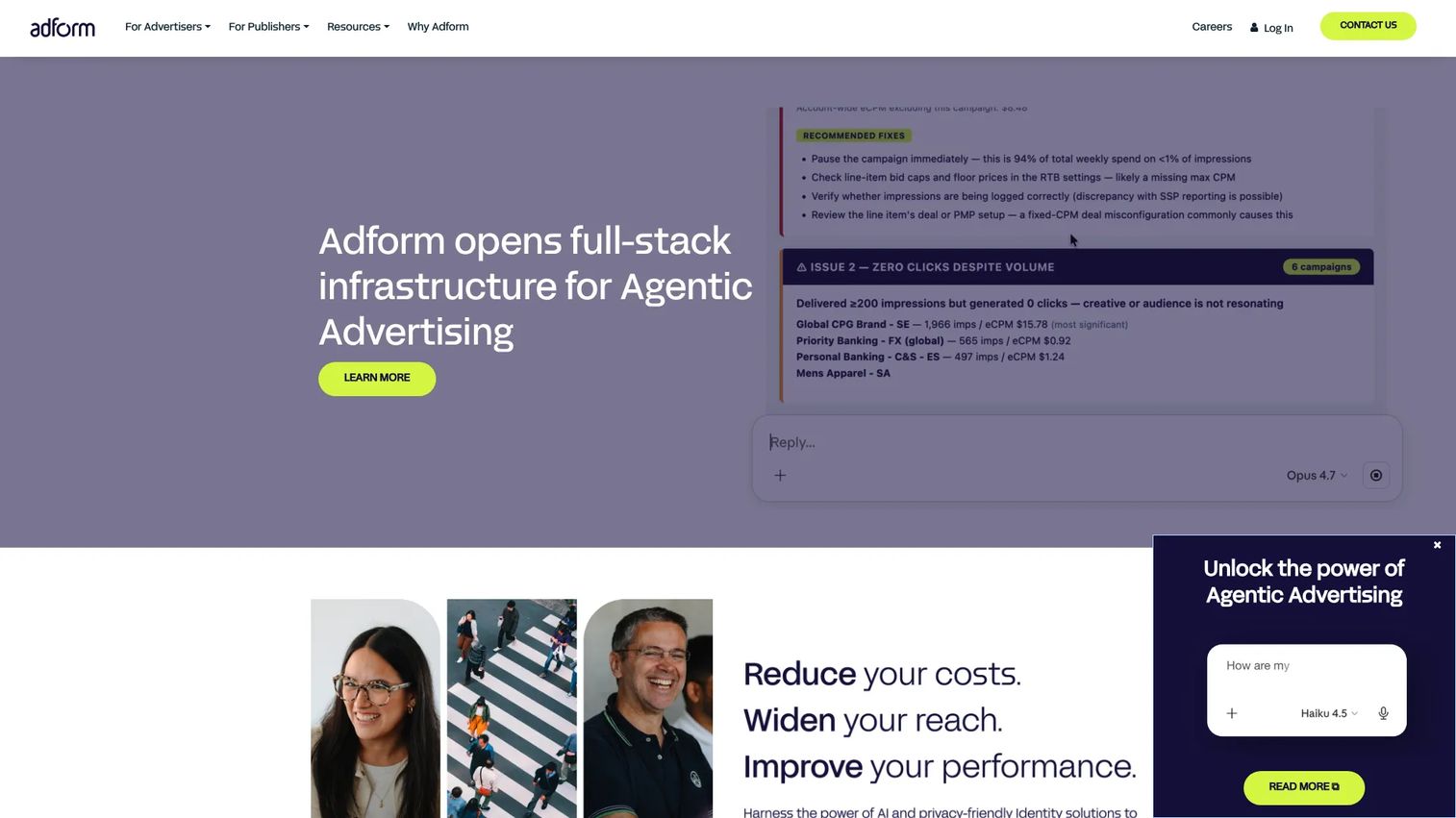
Adform is an independent ad-tech platform built for enterprises and agencies that want one integrated system for building, buying, and measuring programmatic campaigns. Its strongest pitch in 2026 is privacy. ID Fusion, its identity framework, is designed for cookieless targeting and omnichannel reach, which makes Adform a natural fit for teams that put data governance and transparency near the top of the list.
The platform spans the full build-buy-measure workflow, so larger teams that want advanced media operations and stronger governance can run more of their stack in one place. The privacy-by-design and transparency posture is not a marketing line here; it is the organizing principle of the product.
Best for: enterprises and agencies that need an integrated, privacy-first programmatic platform with serious governance and cross-channel control.
Key strengths
- Integrated build-buy-measure: one platform for the full campaign workflow rather than stitched-together tools.
- Cookieless ID Fusion: identity built for omnichannel reach without third-party cookies.
- Privacy-by-design: governance and transparency baked into operations.
Why choose Adform: if your buying committee includes legal, security, and procurement, Adform's privacy-first architecture speaks their language. Independence from the walled gardens means cleaner data governance and fewer conflicts of interest in how your spend is allocated. It carries a 4.3/5 rating on G2.
Adform pricing: Adform does not publish public pricing and runs a demo-request flow instead. Expect enterprise, quote-based pricing tied to media volume and the modules you activate.
6. Yahoo DSP
Yahoo DSP is the platform for marketers who want pragmatic cross-channel reach and dependable programmatic execution. It pairs broad audience reach with machine-learning optimization and cross-device targeting, which makes it a practical option for teams that want solid performance without an exotic feature set. Yahoo's owned audience data adds a layer of first-party signal that not every independent DSP can match.
The platform offers machine-learning optimization, cross-device advertising, and custom reporting, so you can run campaigns across screens and tailor the analytics to how your team measures. For advertisers who value reach and straightforward campaign controls, it remains a credible choice.
Best for: enterprise advertisers buying programmatic media across channels who want reliable optimization and broad reach.
Key strengths
- Machine-learning optimization: automated bid and delivery tuning toward your goals.
- Cross-device advertising: reach the same audience across phones, desktops, and connected screens.
- Custom reporting: flexible analytics shaped to your measurement model.
Why choose Yahoo DSP: the draw is reach plus first-party data from Yahoo's own properties, wrapped in a workflow that does not demand a specialist to operate. Teams that want a capable, no-drama platform for cross-channel buying find value here. It holds a 3.6/5 rating on G2.
Yahoo DSP pricing: Yahoo DSP does not publish public pricing. Access and minimums are arranged through Yahoo's sales team and typically scale with media commitment.
7. MediaMath
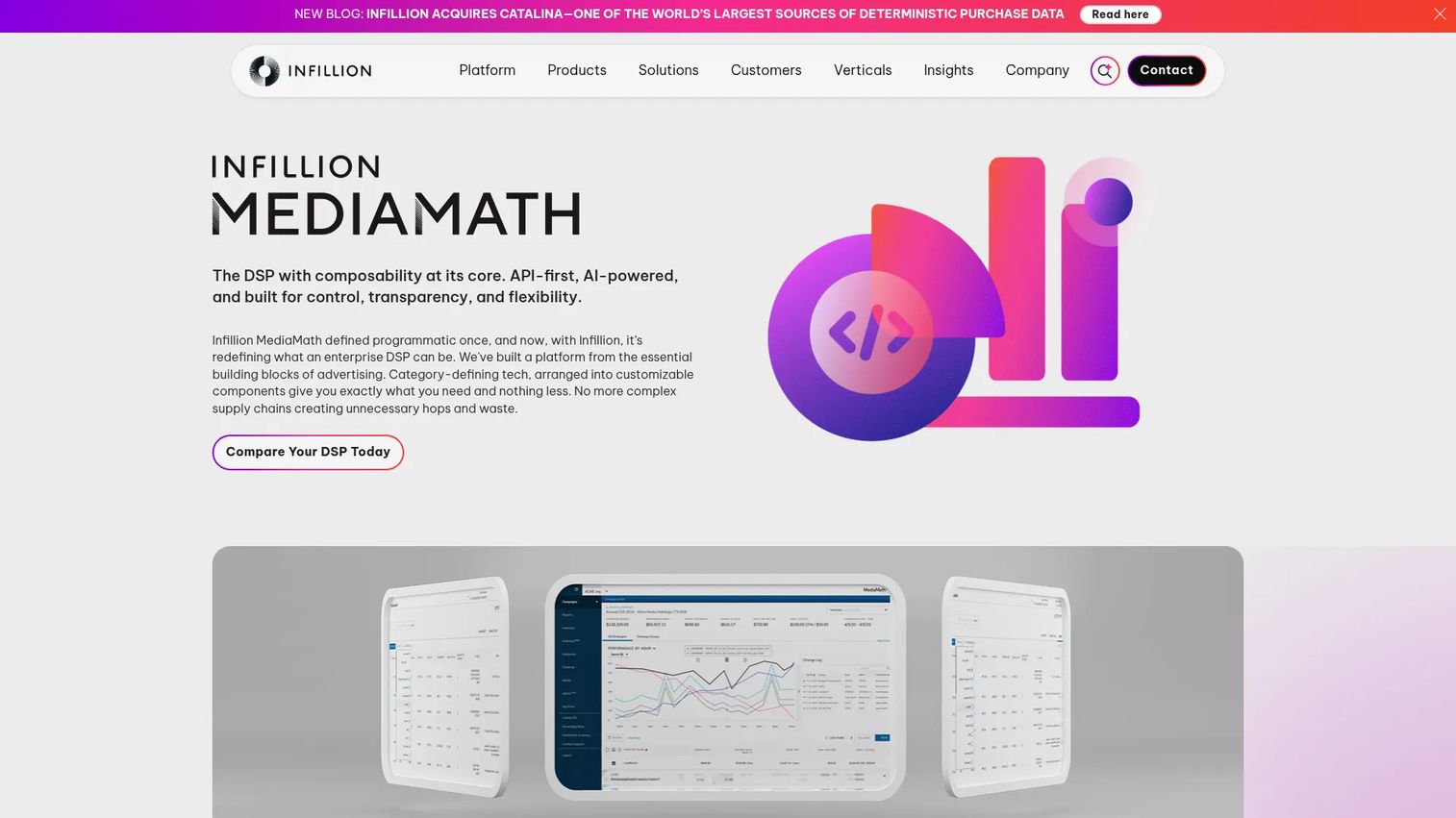
MediaMath, now part of Infillion and presented as Infillion MediaMath, is an API-first omnichannel DSP aimed at enterprise brands and agencies that want deep customization. Following its acquisition, the homepage now routes to Infillion's product experience, so confirm current packaging directly with the company before you commit. The core platform identity remains a programmatic buying system you can extend and integrate at the API level.
The platform exposes campaign, creative, and reporting APIs, alongside identity and audience targeting, which makes it appealing to technical teams that want to build custom workflows rather than work entirely within a fixed UI. For organizations with engineering resources and a desire to wire programmatic buying into their own systems, that flexibility is the point.
Best for: enterprise brands and agencies that want an API-first, customizable DSP for omnichannel programmatic buying.
Key strengths
- API-first architecture: campaign, creative, and reporting APIs for custom workflows and integrations.
- Omnichannel buying: programmatic execution across channels from one platform.
- Identity and audience targeting: built-in targeting tied to the platform's identity capabilities.
Why choose MediaMath: the case is customization and control. Teams that want to integrate a DSP into a larger martech build, rather than operate inside a closed interface, benefit from the API-first design. Given the Infillion transition, verify current product scope and support during your evaluation. It carries a 3.9/5 rating on G2.
MediaMath pricing: MediaMath does not publicly display pricing and directs prospects to contact sales. Expect enterprise, quote-based pricing sized to media spend and the integrations you need.
Considerations
Before you sign anything, run each shortlisted platform through this checklist. It maps to where DSP decisions usually go wrong.
Inventory quality versus inventory breadth
Every DSP claims massive reach. Reach is table stakes. What matters is whether the platform reaches the right inventory: premium, brand-safe, viewable placements where your audience actually spends time. Ask for supply-path transparency, the share of inventory bought through direct vs resold paths, and brand safety controls. A smaller pool of quality inventory beats a huge pool of fraud and made-for-advertising sites.
Targeting and data integration
Check how the platform activates first-party data. Can it onboard your CRM and event data cleanly, match it to an identity graph, and respect consent? Verify the integrations you depend on, your CRM, your CDP, and your data warehouse. A strong customer data platform feeding the DSP is often what turns generic audience targeting into precise, account-level reach.
Measurement and attribution
Reporting depth decides whether you can defend spend to leadership. Look for deduplicated cross-channel reach, frequency control, and conversion paths, not just impression counts. Confirm the platform plays nicely with your attribution software so the numbers reconcile. If you run mobile-heavy campaigns, check fit with your mobile attribution setup too.
Privacy and cookieless readiness
This is the 2026 dividing line. Verify how the DSP handles consent, what identity solutions it supports for cookieless targeting, and how it governs data. Platforms with native, privacy-first identity frameworks are positioned for the post-cookie reality. Ones that still lean on third-party cookies are borrowing against a deadline.
Pricing and operating model
DSP pricing is rarely a published rate card. Spend minimums, managed-service fees, white-label options, and seat-based models all change the math. Decide first whether you want self-serve control, a managed relationship, or a hybrid, then match the operating model to your team's capacity. The cheapest seat is not the cheapest campaign if it forces a managed fee you did not budget for.
Conclusion
The seven platforms here cover the realistic shortlist for most buyers. The Trade Desk wins for independent, audience-first omnichannel buying. Google Display & Video 360 makes the most sense if you are already Google-native. Amazon DSP is the call when shopping intent drives your attribution. StackAdapt fits performance teams that want flexibility and usability. Adform leads on enterprise governance and cookieless readiness. Yahoo DSP delivers pragmatic cross-channel reach. MediaMath suits API-first teams that want to build custom workflows.
The honest takeaway: the best DSP is not the one with the broadest inventory. It is the one that fits your channel mix, your data maturity, and the measurement standard your leadership will accept. A platform with smaller reach but clean first-party activation and defensible attribution will outperform a bigger one you cannot measure.
Next step: take your top two from this list, run a request for proposal that forces each to show supply-path transparency, cookieless targeting options, and a sample measurement report against your actual KPIs. The platform that answers those three clearly is your platform.
FAQs
A DSP, or demand-side platform, is software that lets advertisers buy digital ad inventory across many publishers and exchanges automatically and in real time from one interface. You set audience, budget, and bidding rules, and the platform buys impressions on your behalf. It is the buy-side counterpart to a supply-side platform.
When a user loads a page or stream, the available impression is auctioned across an ad exchange in milliseconds through real-time bidding. The DSP checks whether that impression matches your audience and goals, then submits a bid. If it wins the auction, your ad serves. This loop repeats billions of times a day, which is what powers programmatic buying.
A DSP works for the buyer; an SSP works for the seller. A demand-side platform helps advertisers buy impressions as effectively as possible, while a supply-side platform helps publishers sell their inventory for the most they can. Both connect to the same ad exchanges and meet in the RTB auction, one side bidding and the other offering.
The Trade Desk is the common pick for omnichannel reach because it buys independently across display, video, audio, CTV, native, and digital out-of-home without owning the inventory. Google Display & Video 360 is strong for omnichannel too, especially if your stack is Google-native. The right answer depends on which channels and data sources matter most to you.
Modern DSPs let you onboard first-party data, your CRM records and event data, then match it to an identity graph and activate it as audiences. You can target known customers, build lookalikes, and suppress existing buyers. As cookies fade, this first-party activation is increasingly what separates precise targeting from wasted spend.
Yes, and arguably more so. Leading DSPs have built privacy-first identity frameworks, such as UID2 and Adform's ID Fusion, designed specifically for cookieless targeting. Combined with first-party data, contextual signals, and clean consent management, DSPs can still target precisely without third-party cookies. The key is choosing one whose identity approach does not depend on cookies.
Evaluate inventory quality over raw breadth, first-party data and integration support, measurement and attribution depth, privacy and cookieless readiness, and the pricing or operating model. Run your top two through a request for proposal that forces supply-path transparency and a sample measurement report against your real KPIs. Fit to your channel mix and data maturity matters more than any single feature.
Most DSPs use a percentage-of-media-spend or cost-plus-fees model rather than a published rate card, often with monthly or annual spend minimums. Some, like Amazon DSP, note managed-service minimums around $50,000, while self-serve access can lower the entry point. Managed service, white-label, and seat-based options all change the total cost, so confirm the full model before committing.