Your engineering org doubled in a year. Every open req now runs through the same bottleneck: senior engineers pulled off product work to run technical interviews, screen take-home projects, and debate whether a candidate can actually do the job. The interviews aren't consistent. The signal is soft. And you, the founder, still get looped into the final call on half of them.
That's the real problem technical skills screening software solves. It's not about "finding a tool." It's about removing hiring drag while raising the quality and defensibility of every decision, so your team stops routing every technical hire through your calendar. The broader technical assessment software market reached USD 14.02B in 2025 and is projected to hit USD 42.57B by 2033 at a 14.89% CAGR, according to market analysis published on LinkedIn in 2025. That growth reflects a shift most funded teams already feel: resumes and unstructured interviews no longer scale.
If you're building a repeatable hiring motion the way you'd build a repeatable customer data platform or any other system that has to run without you in the room, the same logic applies here. This guide walks through seven platforms that standardize technical screening, so your recruiting leader can own the process and hand you a shortlist instead of a scheduling problem.
What's inside
This guide covers seven technical assessment tools built for teams that hire engineers, developers, and other technical roles at pace. Each entry covers coding tests, real-world simulations, proctoring and anti-cheat controls, automated scoring, reviewer workflows, and ATS integrations.
We selected platforms based on four criteria that matter for a scaling company:
- Relevance to technical screening - coding depth, not just generic quizzes
- Breadth of assessment formats - from focused coding tests to multi-format suites
- Defensibility - proctoring, code playback, and objective scoring that survives scrutiny
- Stack fit - ATS integrations and pricing that make sense at your stage
TL;DR
Short on time? Here are the decision shortcuts.
- Best overall for skills-based hiring: CodeSignal, with AI interviews plus structured assessments in one platform.
- Best for coding-heavy engineering hiring: Codility, built around structured coding assessment with enterprise controls.
- Best for high-volume developer hiring: HackerRank, with deep question libraries and scale-tested workflows.
- Best for multi-format assessment suites: Testlify or TestTrick, both covering technical plus adjacent screening.
- Best for enterprise governance and breadth: Mercer, for large assessment catalogs and secure testing.
- Best for lean, budget-conscious teams: TestDome, with focused task-based screening and transparent packs.
What technical skills screening software is
Technical skills screening software is a category of candidate screening software that measures a candidate's actual ability to perform job-relevant technical tasks, using standardized assessments instead of relying on resumes or unstructured interviews alone. It replaces subjective gut checks with objective skill validation you can compare across candidates.
At a practical level, most technical hiring software augments two things: resume screening at the top of the funnel and manual technical interviews later on. Instead of a senior engineer spending an hour per candidate, the platform runs a consistent test, scores it automatically, and surfaces a ranked shortlist.
What it typically includes
- Coding challenges and coding tests for hiring - real programming problems in a live IDE, across multiple languages
- Automated scoring - objective, rubric-based evaluation with minimal manual grading
- Real-world simulations - task-based exercises that mirror actual job workflows
- Proctoring and anti-cheat features - secure browser, identity verification, plagiarism detection, and code playback
- ATS integrations - score sync into Greenhouse, Lever, Workday, and similar systems
- Analytics and reviewer workflows - dashboards, benchmarks, and collaborative candidate review
Why it matters for hiring teams
The value is not the test. It's what the test removes. A good skills screening platform gives you objective comparison across a candidate pool, faster shortlisting, and stronger signal at scale, without adding a coordination tax.
For a founder, the outcome is more direct: less of your senior team's time spent on repetitive first-round screening, fewer decisions routed through you, and a hiring process that produces the same quality of signal whether you run 5 reqs or 50. That's the difference between hiring that scales and hiring that stalls.
When to use technical skills screening software
Not every role needs a coding test. Here's how to pattern-match your situation.
Screening a high volume of applicants
When a single req pulls 400 applicants, no human can review them fairly or fast. Use a skills screening platform to apply a consistent, score-based cutoff before anyone reads a resume. Structured filters narrow a large pool to a manageable shortlist in hours, not weeks, which is exactly what high-volume hiring demands.
Hiring for technical roles that need proof, not interviews alone
When the role requires real coding, debugging, system design, or workflow simulation, conversational confidence in an interview is a weak proxy. Use technical assessment tools to gather objective evidence of ability before you spend senior engineer time. A candidate who ships clean code under a time limit tells you more than one who talks smoothly about it.
Reducing cheating and inconsistent evaluation
When candidate integrity matters, and with remote hiring it almost always does, lean on proctoring, secure browser controls, identity verification, and code playback. These features let you defend a hiring decision if it's ever questioned, and they keep your evaluation consistent across every reviewer on the team.
Comparison table
Here's how the seven platforms compare on intent, differentiation, verified pricing, and G2 rating. Use it to narrow your shortlist before reading the full sections.
| # | Product | Intent | Key differentiation | Pricing | G2 rating |
|---|---|---|---|---|---|
| 1 | CodeSignal | Skills-based hiring plus AI interviews | AI interviewer alongside structured assessments | From $79/mo (billed annually) | 4.5/5 |
| 2 | Codility | Structured coding assessment | Engineering-focused Screen and Interview products | From $1,200/yr | 4.6/5 |
| 3 | HackerRank | High-volume developer hiring | Deep question library and scale | From $165/mo | 4.6/5 |
| 4 | Testlify | Multi-format talent assessment | Skills tests plus AI interviews and white-label | From $139/mo | 4.7/5 |
| 5 | TestDome | Focused task-based screening | Practical tests with pack-based pricing | Pack-based | Rating not published |
| 6 | Mercer | Enterprise assessment breadth | Large catalog, simulators, and proctoring | From USD 200/job | 3.8/5 |
| 7 | TestTrick | All-in-one assessment suite | Coding plus video interviews and psychometrics | From $35/mo | 4.6/5 |
1. CodeSignal
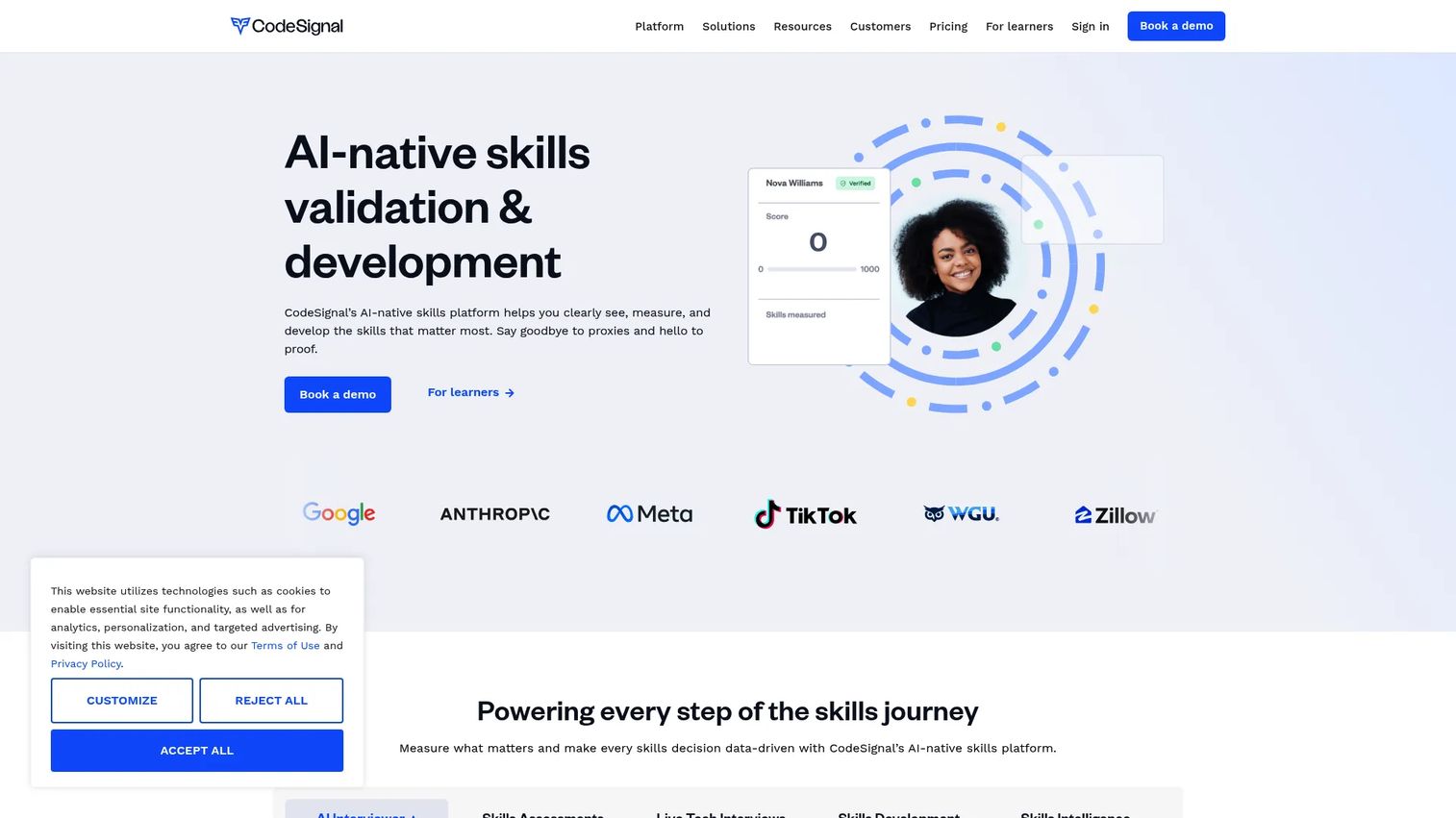
CodeSignal is an AI-native skills platform that spans hiring, learning, and education. For technical hiring, it pairs structured skills assessments with an AI interviewer, so teams can screen candidates on coding ability and then run a consistent, AI-led interview without pulling an engineer into every round. It's built to help teams see, measure, and develop the skills that matter most for a role.
Best for: Hiring teams that want a broader skills platform, not only coding tests.
Key strengths
- Skills assessments: Objective, job-relevant technical evaluation with automated scoring for clean candidate comparison.
- AI interviewer: Runs consistent structured interviews at scale, reducing reviewer bias and freeing senior engineers.
- AI-powered learning paths: Extends beyond screening into skill development, useful if you want one platform across hire and internal upskilling.
Why choose CodeSignal: If your hiring problem is inconsistency, not just volume, CodeSignal's combination of standardized assessments and AI interviews tightens the whole funnel. It fits founders who want one system to validate skills and reduce the number of live rounds that senior staff sit in on. The platform breadth also means it can grow with the org past pure screening.
CodeSignal pricing: The Build plan starts at $79/mo billed annually, or $99/mo billed monthly. The Grow plan is $479/mo billed annually, or $599/mo monthly. The Pro plan uses custom pricing through sales. Individuals can start free and upgrade to Cosmo+ at $24.99/month, and education plans are custom. A free tier is available on the individual side.
2. Codility
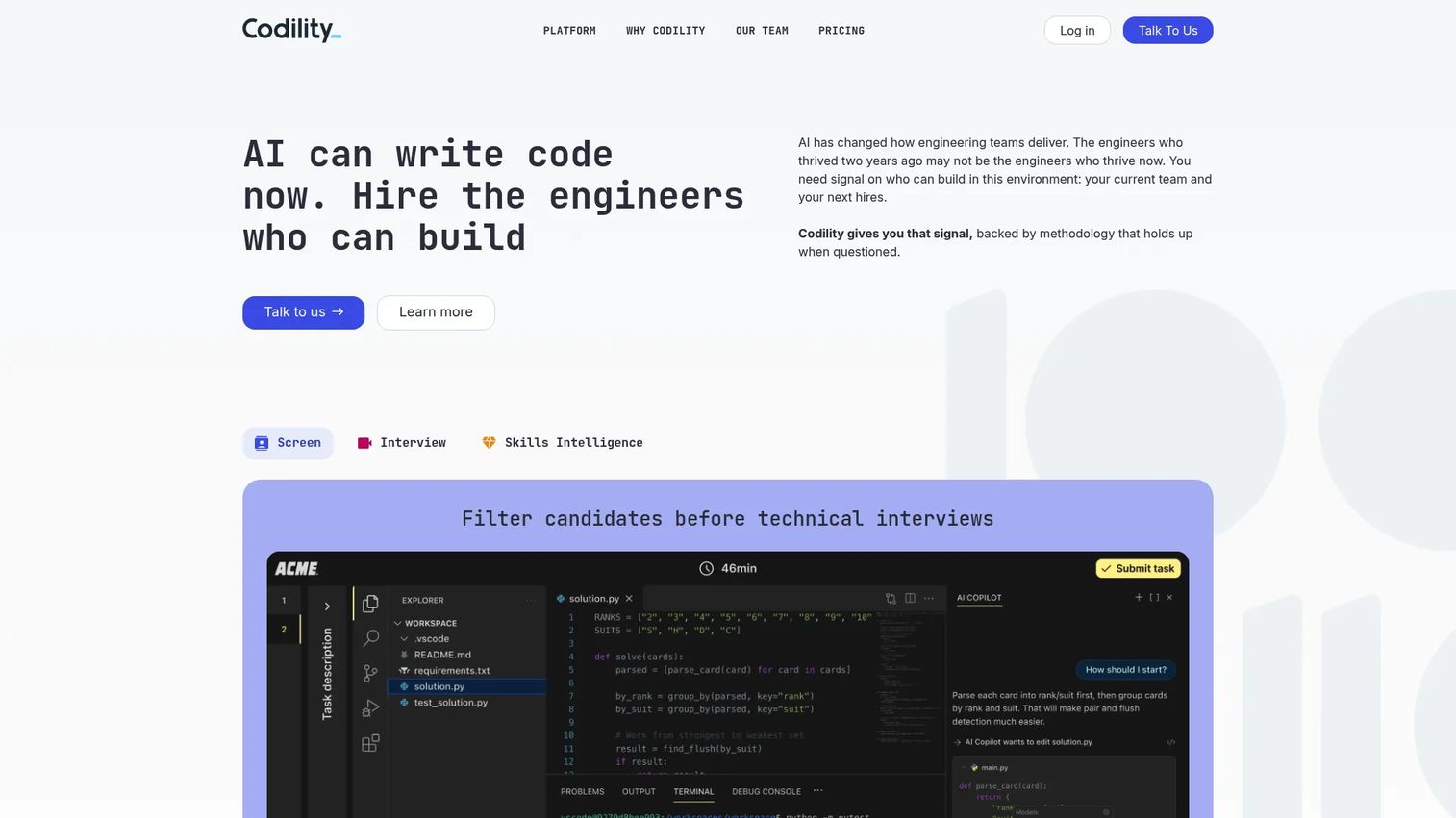
Codility is a technical assessment platform built specifically for engineering hiring and workforce skills evaluation. Its Screen and Interview products give teams structured coding assessments backed by proctoring, plagiarism detection, and analytics. AI features like Copilot and Cody come with reviewable activity, so evaluators can see how a candidate worked, not just the final answer.
Best for: Engineering teams that need structured coding assessment with enterprise controls.
Key strengths
- Structured technical assessments: Purpose-built Screen and Interview flows for consistent engineering evaluation.
- AI features with reviewable activity: Copilot and Cody usage is visible to reviewers, supporting defensible decisions.
- Proctoring, plagiarism detection, and integrations: Integrity controls plus enterprise integrations for a governed workflow.
Why choose Codility: Codility is the pick when the job is genuinely engineering-heavy and you need coding tests for hiring that hold up under review. The reviewable AI activity and plagiarism detection give recruiting leaders and hiring managers the defensibility they want. It suits teams that have moved past scrappy hiring and need a repeatable, integrity-first process.
Codility pricing: The Starter plan is $1,200 with annual billing only. The Scale plan is $6,000, with a monthly or yearly toggle where yearly billing saves 17%. A Custom tier is available through sales. There is no free tier.
3. HackerRank
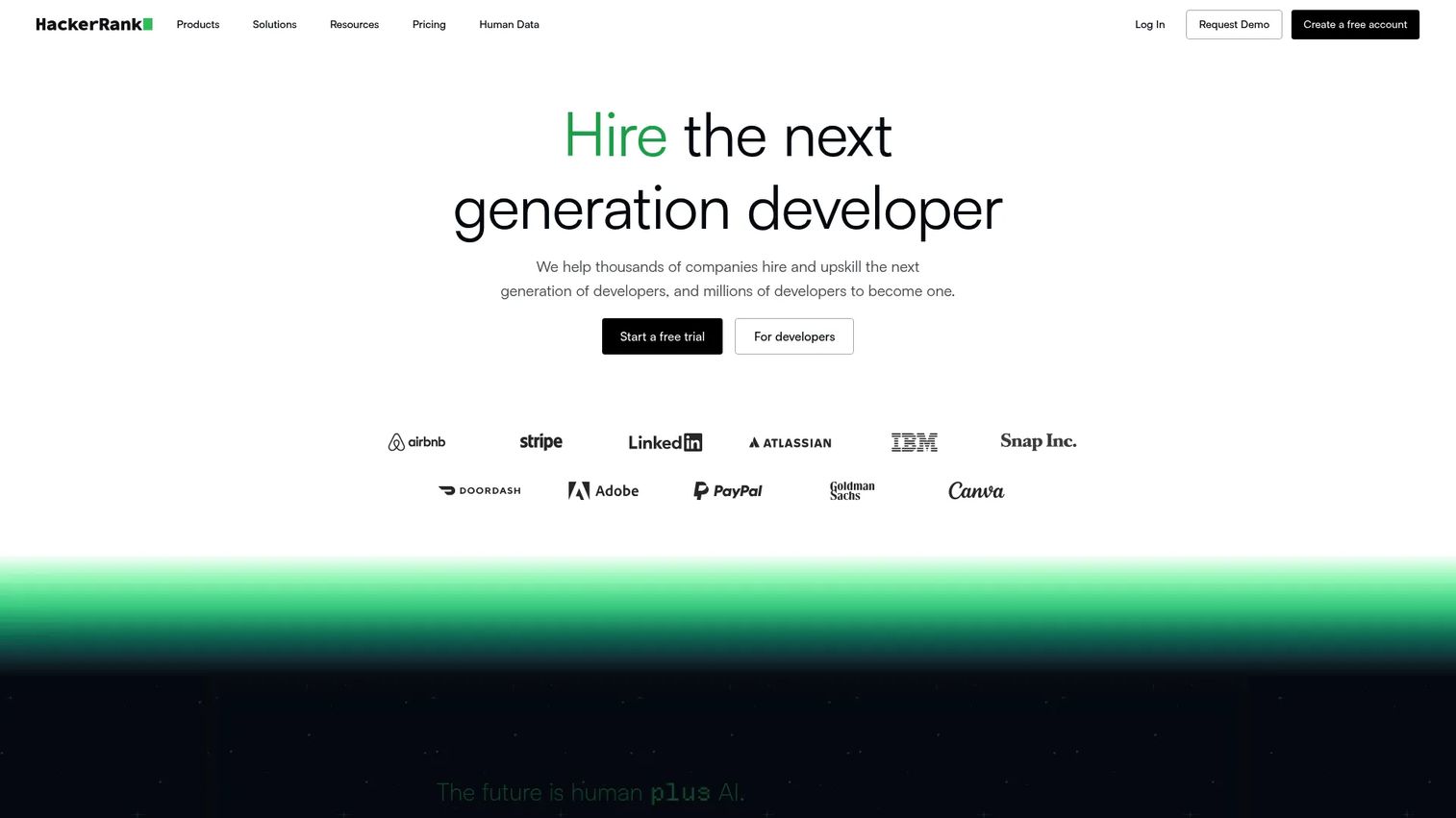
HackerRank is a developer skills assessment and technical hiring platform built for screening software developers at scale. Its Screen and Interview products combine a deep question library with an AI-assisted IDE, proctoring, and ATS integrations, so teams can run high-volume developer hiring without losing signal quality. It's one of the most recognized names in coding assessment software.
Best for: Teams hiring and assessing software developers at volume.
Key strengths
- Screen and Interview products: Cover async coding tests and live coding interviews in one platform.
- AI-assisted IDE and proctoring: Realistic coding environment paired with anti-cheat features for defensible results.
- ATS integrations and SSO/SCIM: Enterprise-grade connectivity so scores sync into your recruiting stack and identity provider.
Why choose HackerRank: When your primary constraint is developer hiring volume, HackerRank's question depth and scale-tested workflows make it a strong default. The candidate familiarity helps too, since many developers have used the platform before, which smooths candidate experience. It fits teams whose bottleneck is running many consistent coding assessments quickly.
HackerRank pricing: The Starter plan is $165/mo, or $1,990 billed annually. The Pro plan is $375/mo, or $4,490 billed annually. Enterprise uses custom pricing. A free trial is available to evaluate the platform before committing.
4. Testlify
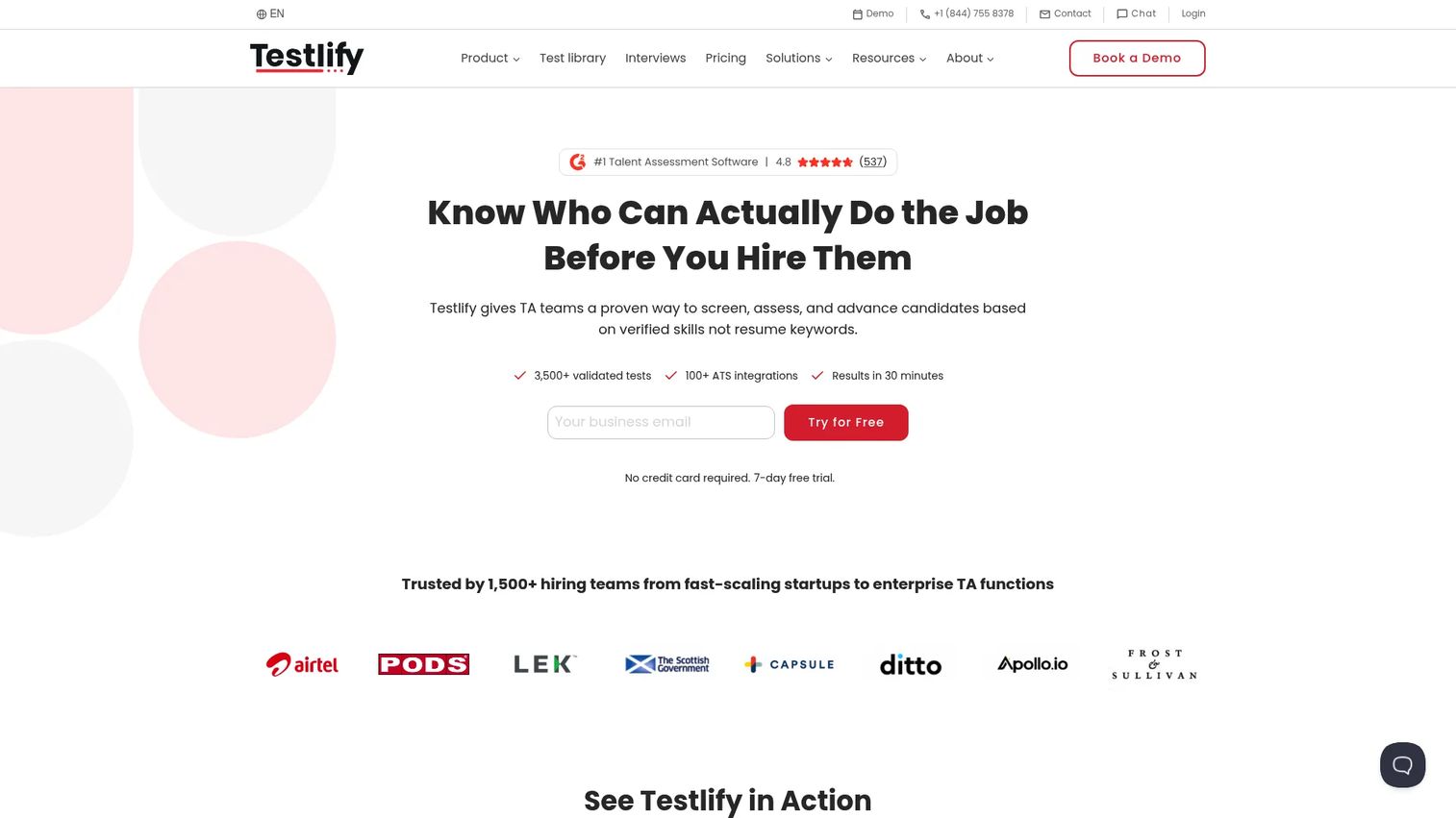
Testlify is an AI-native talent assessment and interview platform that screens candidates on skills across a wide range of roles. It combines skills assessments spanning 4,500+ roles with conversational AI interviews across chat, audio, and video, plus advanced proctoring and white-label branding. For technical hiring, it delivers coding tests alongside adjacent role assessments in one place.
Best for: Hiring teams that need skills-based assessments, AI interviews, and proctoring in one platform.
Key strengths
- Skills assessments across 4,500+ roles: Technical plus adjacent screening from a single library, useful for mixed hiring needs.
- Conversational AI interviews: Chat, audio, and video interview formats that scale first-round evaluation.
- Advanced proctoring and white-label branding: Integrity controls plus a branded candidate experience under your own name.
Why choose Testlify: Testlify fits teams that hire across technical and non-technical roles and want one platform instead of stitching together several. The white-label branding matters for a scaling company that cares about candidate experience and employer brand. It's a practical developer assessment tool that also covers the roles around engineering.
Testlify pricing: Testlify uses credit-based pricing where you pay when a qualified candidate starts an assessment. The Standard plan starts from $139/mo. Business and Enterprise plans are contact-sales, with monthly, annual, or custom billing. A 7-day free trial is available, and add-ons for integrations and white-labeling are priced separately.
5. TestDome
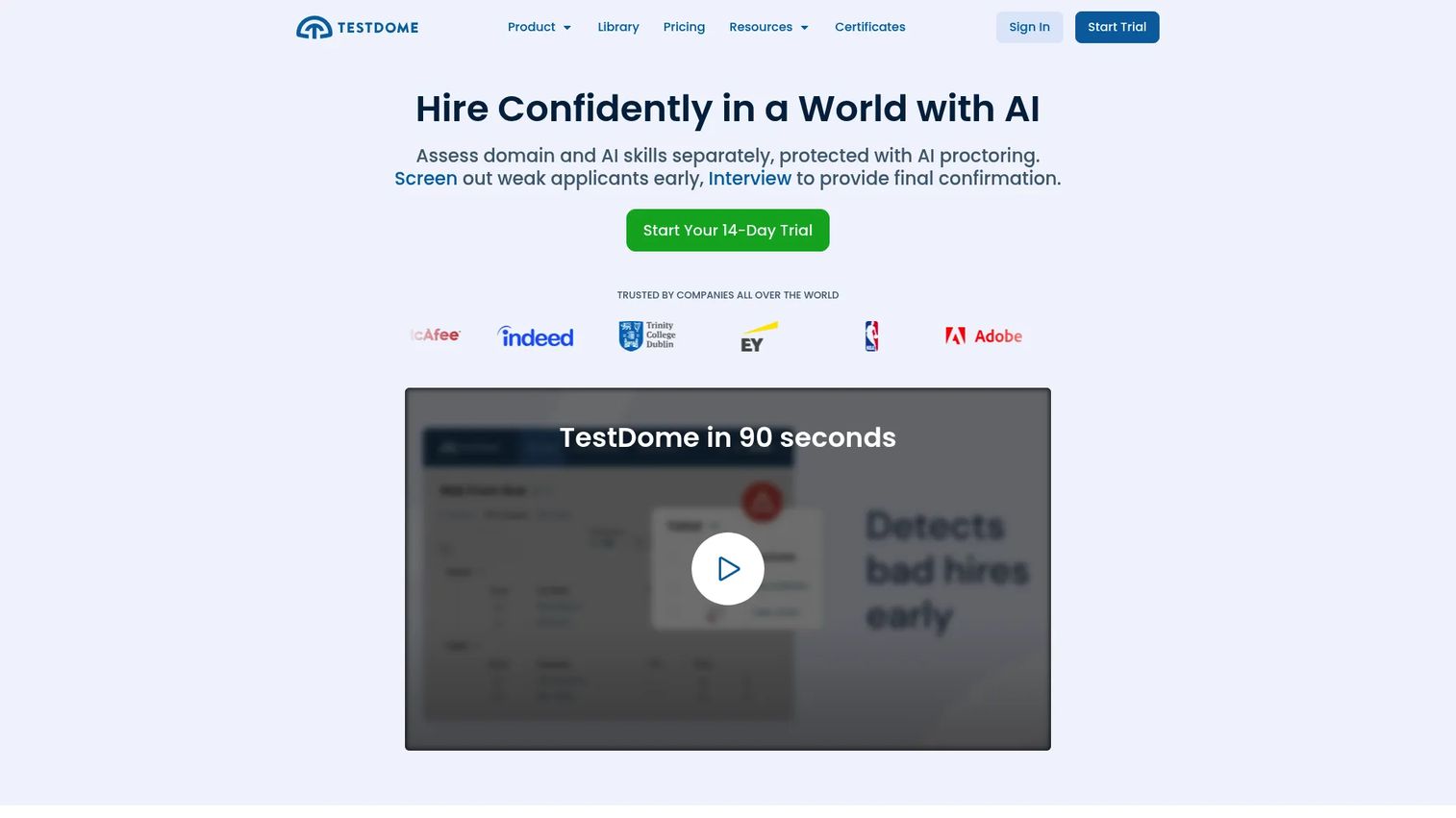
TestDome offers practical coding and skills testing with straightforward review workflows. Its assessments lean on real-world, task-based questions rather than abstract puzzles, and automated scoring surfaces shortlist evidence quickly. For lean teams, it's a focused way to validate technical ability without a heavy platform to administer.
Best for: Lean teams that want straightforward, task-based technical screening.
Key strengths
- Focused assessment design: Practical, job-relevant questions that measure real ability over trivia.
- Automated scoring: Fast, objective results that produce a clear shortlist with minimal manual review.
- Task-based screening: Real-world coding tasks that give hiring managers concrete evidence to act on.
Why choose TestDome: TestDome suits founders and early recruiting teams who want objective skill validation without committing to an enterprise suite. Its pack-based model keeps costs predictable and tied to actual hiring activity. When your highest-friction step is simply getting reliable first-round signal, TestDome solves that directly.
TestDome pricing: TestDome uses a pack-based pricing model, where you purchase candidate test packs rather than a recurring seat subscription. That structure fits teams with variable or seasonal hiring needs who want to pay in proportion to volume. Check the vendor's pricing page for current pack sizes and rates.
6. Mercer
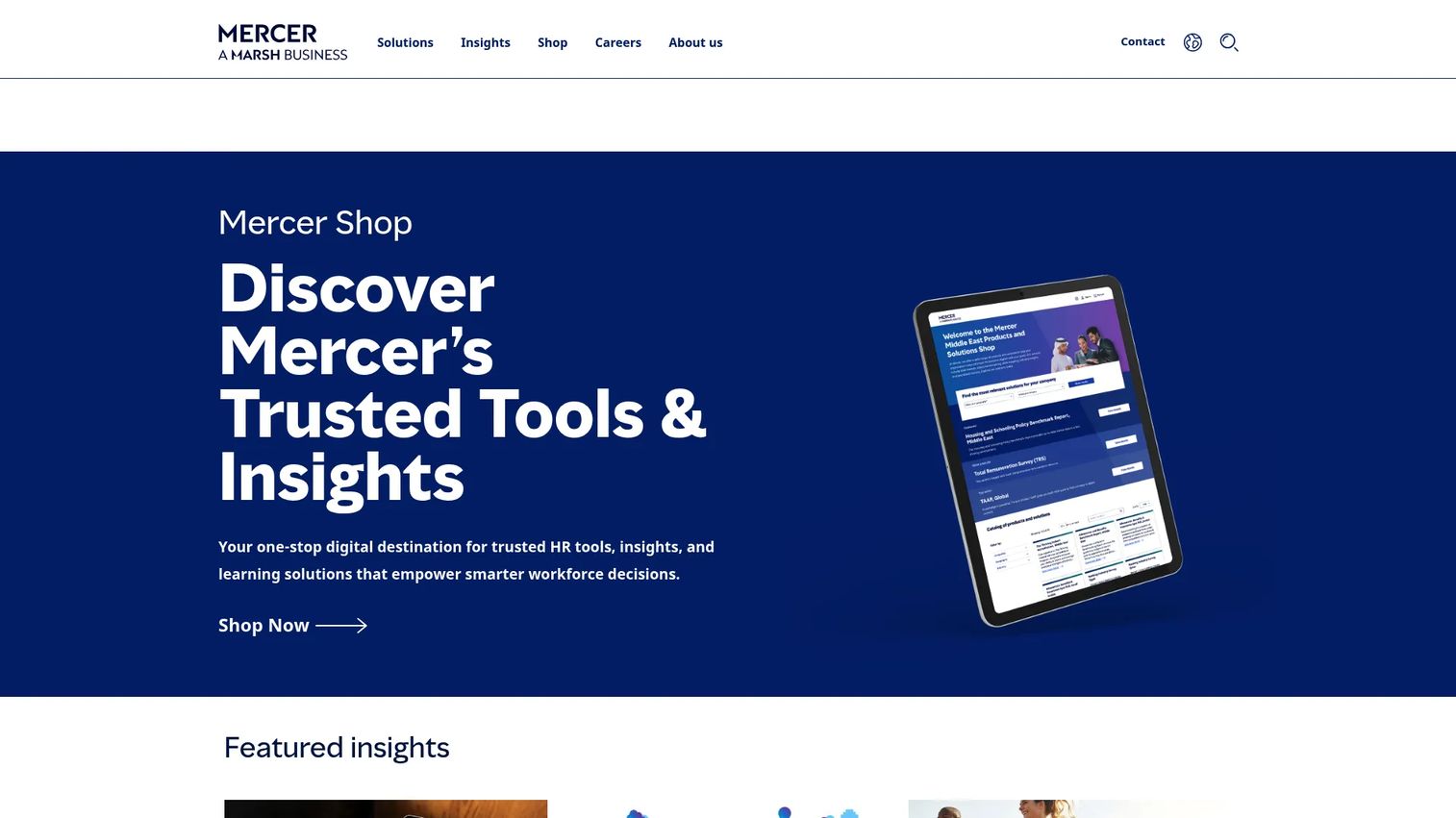
Mercer is a global consulting and solutions firm whose talent and rewards capabilities include broad technical assessment. Its technical assessments cover both IT and non-IT skills across a wide range of job roles, industries, and functions, and any assessment can be combined with a proctoring suite for secure testing. It's the enterprise-scale option on this list.
Best for: Enterprises seeking a large assessment catalog, benchmarking data, and structured governance.
Key strengths
- Broad assessment catalog: Coverage across IT and non-IT skills, many roles, industries, and functions.
- Simulator depth and caselets: Realistic scenario-based assessments that go beyond simple coding tests.
- Powerful proctoring suite: Secure testing controls that pair with any assessment for integrity at scale.
Why choose Mercer: Mercer fits organizations that need governance, breadth, and benchmarking data more than a lightweight coding test. If you're screening across many functions and need consistent, secure assessment at enterprise scale, its catalog and proctoring depth deliver. It's a heavier commitment than the focused tools here, which is exactly the point for large, regulated hiring programs.
Mercer pricing: Mercer is primarily a services and consulting brand, so most offerings are quote-based. Public shop listings show specific products with set prices, such as MarketPricer at USD 200 per job. For assessment programs at scale, pricing is typically arranged directly with Mercer. Note the homepage indicates Mercer is now part of the expanded Marsh brand.
7. TestTrick
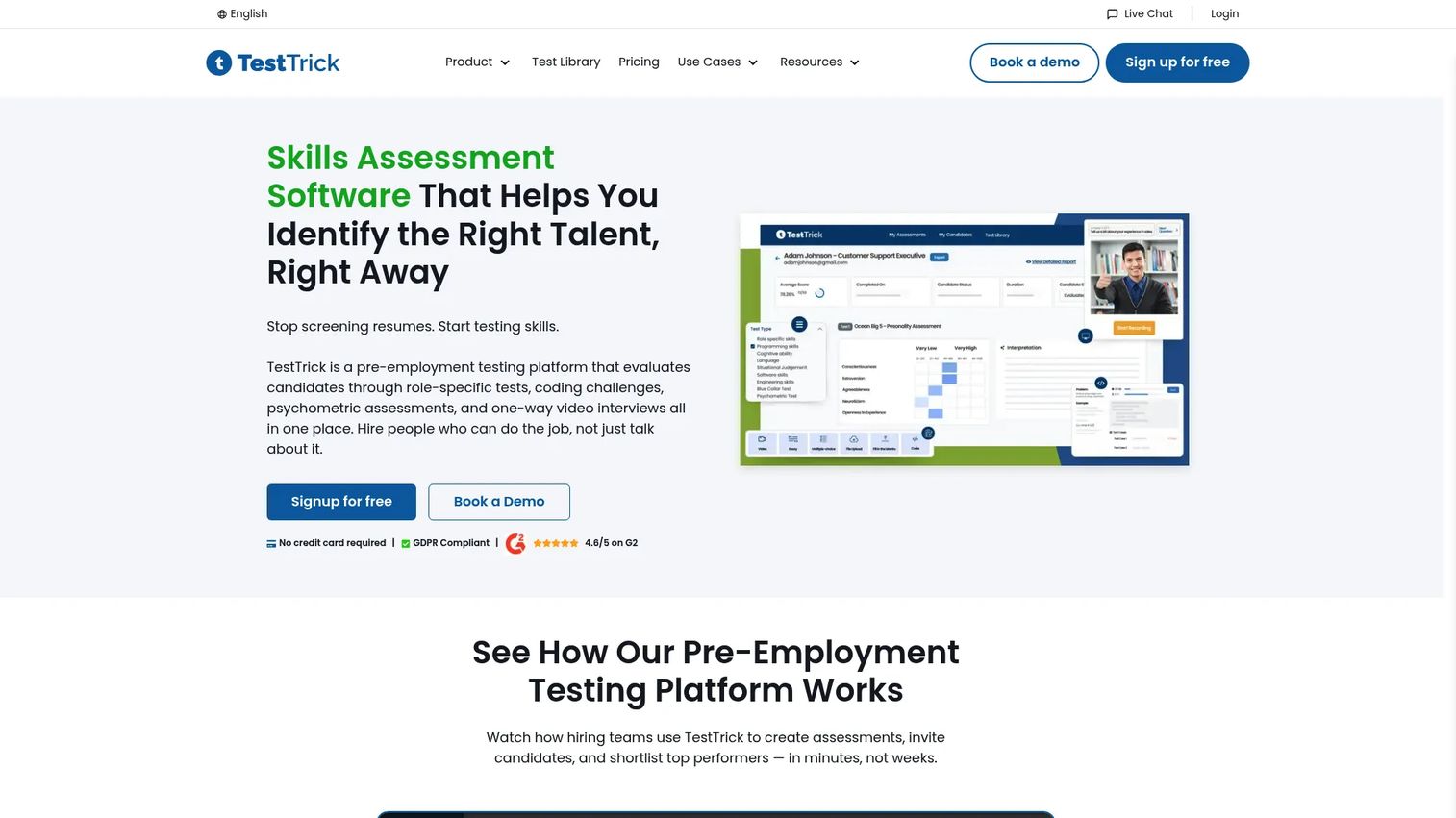
TestTrick is a pre-employment testing platform that covers skills assessments, coding challenges, psychometric tests, and one-way video interviews in one place. It pairs role-specific tests with AI-powered proctoring and browser lockdown, giving teams a broader screening suite that reaches beyond coding alone. Transparent pricing makes it an accessible option for teams scaling their hiring.
Best for: Teams hiring at scale that need skills testing plus video interviewing in one platform.
Key strengths
- Role-specific skills assessments: Pre-built tests mapped to real roles, so you're not building from scratch.
- One-way video interviews: Async video screening that scales first-round evaluation without scheduling.
- AI-powered proctoring and browser lockdown: Anti-cheat features that keep results defensible in remote hiring.
Why choose TestTrick: TestTrick fits teams that want multi-format screening, coding plus video plus psychometrics, without enterprise pricing. Its transparent, published tiers make budgeting easy for a scaling company. When you need one platform to handle varied roles and keep candidate integrity high, TestTrick covers a lot of ground affordably.
TestTrick pricing: The Starter plan is $35/mo billed at $420/year. The Basic plan is $65/mo billed at $780/year. The Business plan is $75/mo billed at $900/year. Enterprise uses custom pricing. All paid plans include full feature access and differ by credits and user seats.
Considerations before you buy
Before you hand a recommendation to your recruiting leader, run each shortlisted tool through this checklist.
Assessment depth versus breadth
Decide whether you need coding depth or multi-format coverage. Coding-only tools like Codility go deep on engineering evaluation. Suites like Testlify and TestTrick cover technical plus adjacent roles. Match the tool to your actual hiring mix, not to a feature list.
Anti-cheat and defensibility
For remote and high-volume hiring, integrity controls are not optional. Look for proctoring, secure browser or browser lockdown, identity verification, plagiarism detection, and code playback. These features let you defend a decision and keep evaluation consistent across reviewers.
ATS integrations and workflow fit
A screening tool that doesn't sync scores into your ATS creates manual work and data drift. Confirm native integrations with your recruiting stack and check whether scores, statuses, and candidate records flow both ways. This is where a tool either reduces coordination drag or adds to it.
Candidate experience
A clunky assessment costs you good candidates. Check completion rates, mobile support, and whether the flow feels fair and job-relevant. White-label branding, where available, keeps the experience on your employer brand rather than a vendor's.
Pricing model versus hiring pattern
Seat-based, credit-based, and pack-based pricing each fit different patterns. Variable or seasonal hiring often favors pack or credit models. Steady, high-volume hiring often favors subscription tiers. Pick the model that matches how you actually hire.
Conclusion
The right technical skills screening software depends on where your friction actually lives. If it's inconsistency across interviews, CodeSignal's assessments plus AI interviews tighten the funnel. If it's deep engineering hiring, Codility gives you structured, defensible coding assessment. For high-volume developer hiring, HackerRank's question depth and scale hold up. Testlify and TestTrick suit teams that want one platform across technical and adjacent roles. TestDome keeps lean teams focused and cost-efficient. Mercer serves enterprise programs that need breadth, simulators, and governance.
The selection lens stays the same across all of them: speed to shortlist, signal quality, integrity, and stack fit. Don't buy the biggest suite you can find. Pick the narrowest tool that solves your team's highest-friction step first, prove it works in a quarter, then expand. That's how you build hiring that scales without routing every technical decision through you.
Start your journey with Guideflow today!
FAQs
The best option depends on your specific need. For deep coding evaluation, Codility and HackerRank are strong picks. For skills-based hiring with AI interviews, CodeSignal fits well. For multi-format screening across technical and adjacent roles, Testlify or TestTrick cover more ground. Match the tool to your hiring mix rather than chasing a single ranking.
The core features are coding tests with automated scoring, anti-cheat features like proctoring and code playback, ATS integrations for score sync, and collaborative reviewer workflows. Together these produce objective skill validation you can compare across candidates and defend later. Prioritize the features that remove your team's biggest coordination or consistency problem first.
Coding tests apply the same standardized challenge and scoring rubric to every candidate, which reduces the unstructured interviewer judgments where bias tends to creep in. When everyone is measured against the same objective criteria, decisions rely on demonstrated ability rather than impression or pedigree. It's not a complete fix, but it materially tightens consistency.
Coding tests validate skills asynchronously, letting candidates complete a standardized challenge on their own time while the platform scores it objectively. Technical interviews test live discussion, problem-solving under pressure, and communication. Most strong hiring processes use both: tests to screen efficiently at the top, interviews to assess depth on shortlisted candidates.
Many do. Platforms like Testlify, TestTrick, and Mercer include adjacent formats such as multiple-choice questions, real-world simulations, one-way video interviews, psychometric tests, and cognitive assessments. That breadth lets a single skills screening platform cover engineering plus the roles around it, which is useful for teams hiring across functions.
They matter most in remote and high-volume hiring, where candidate integrity is harder to verify. Anti-cheat features usually include a secure browser or browser lockdown, identity verification, plagiarism detection, and code playback that shows how a candidate worked. These controls keep evaluation consistent and let you defend a hiring decision if it's ever questioned.
Yes. Most technical hiring software offers ATS integrations with systems like Greenhouse, Lever, and Workday, so assessment scores and candidate statuses sync into your recruiting workflow automatically. This matters because it removes manual data entry, keeps records clean, and lets recruiters act on results without switching tools. Confirm the specific integrations you need before buying.