A generator sits idle on your yard for six days because dispatch did not know it was back from service. A customer disputes an invoice because the meter reading never made it from the field into billing. A preventive maintenance interval slips, the unit fails on site, and the emergency call that follows costs you the relationship. None of these are exotic problems. They are the ordinary friction of running a power rental operation on spreadsheets, email threads, and memory.
That friction is expensive, and the market it sits inside is not small. The global power generator rental market is projected to grow from USD 13.26 billion in 2025 to USD 18.75 billion by 2031 at a 5.95% CAGR, with North America as the largest regional market, according to Mordor Intelligence (2026). Generator rental services alone are expected to climb from USD 8.83 billion in 2026 to USD 13.13 billion by 2034 at a 5.1% CAGR, per Straits Research (2025). More rentals mean more units to track, more maintenance to schedule, and more invoices to get right on the first pass.
The right generator rental management software removes the handoffs that leak revenue. The wrong one adds another admin layer on top of the ones you already have. This guide ranks four tools operators actually use for generator and broader equipment rental work, judged on five things that decide whether software earns its place: generator-specific workflow fit, maintenance depth, billing accuracy, asset tracking, and customer self-service.
What's inside
This list covers four real rental management software platforms used for generator fleets or broader equipment rental operations. Two lean generator- and power-industry specific, one covers end-to-end equipment rental with strong field operations, and one is a broader scheduling and checkout platform that extends into equipment rental.
We chose these four on four criteria: workflow coverage across booking, maintenance, billing, and dispatch; industry fit for power and generator operations; operational visibility into fleet and utilization; and customer-facing capabilities like portals and self-service reservations. The goal is to help you shortlist a system that handles booking, maintenance, billing, tracking, and portals in one place, so you can spend your evaluation time on the two that actually fit.
TL;DR
- Most complete for power rental operations: Alert's rental management software, built for equipment and specialty rental with configurable contracts, billing, dispatch, and maintenance.
- Best for asset-heavy fleets and preventive maintenance: PREXA365, a cloud rental management platform with dedicated asset management and preventive maintenance modules.
- Best for field operations and self-serve access: MCS Rental Software, with real-time fleet and utilization data, customer-specific pricing, and an online portal.
- Best for visual scheduling and checkout workflows: farmerswife, a production and resource management platform that extends into equipment rental with scheduling and check-in/check-out.
- If uptime and emergency response are your priority: favor the tools with the deepest maintenance scheduling and asset tracking, then request a demo of the top two.
What is generator rental software?
Generator rental software is a rental management system that handles the booking, dispatch, preventive maintenance, asset tracking, billing, contracts, and customer portal access required to rent out generators and power equipment. It is a specialized branch of equipment rental software, tuned for fleets where uptime, service history, and billing precision carry more weight than simple availability calendars.
At its core, this category exists to remove manual handoffs between the people who book units, the people who service them, and the people who invoice for them. When those functions live in one system, a meter reading recorded in the field flows straight into rental billing software, a completed work order updates the asset record, and dispatch always knows what is available.
The capabilities that matter most in generator operations:
- Booking and rental scheduling: self-service reservations, availability views, and rental scheduling software that prevents double-booking across the fleet.
- Dispatch: dispatch software that coordinates delivery, pickup, and rapid response when uptime is on the line.
- Preventive maintenance: preventive maintenance scheduling by runtime or date, work order management, and full service history.
- Asset tracking: asset tracking software with real-time asset visibility, often paired with GPS tracking and telematics.
- Billing: meter-based invoicing, cycle billing, and flexible rental periods that reduce disputes.
- Contracts: digital contracts, e-signature workflows, and audit trails for chain of custody.
- Customer portal: a customer portal for self-service reservations, invoices, and account access.
When to use generator rental software
Streamline urgent dispatch and rapid response
Generator rental lives and dies on turnaround. When a customer's power goes down, the operator who can confirm availability, dispatch a unit, and log the contract fastest wins the job. Rental scheduling software and dispatch software replace the phone-and-spreadsheet scramble with a single view of what is available, where it is, and when it comes back.
That visibility matters most during storm season or outage events, when demand spikes and manual coordination breaks down. Real-time asset visibility lets a dispatcher commit a unit with confidence instead of chasing down whether it has already been promised elsewhere.
Track maintenance before downtime becomes expensive
A generator that fails on a customer's site is not just a service call. It is a broken promise on the one thing you were hired to guarantee: uptime. Generator maintenance software ties preventive maintenance scheduling to runtime hours and calendar intervals, so service happens before a fault, not after.
Preventive maintenance software also builds the service history that protects you later. When a unit's log shows every oil change, filter swap, and inspection, you have a defensible record for warranty claims, compliance, and the next customer who asks how well the fleet is maintained. Preventive maintenance is not back-office overhead. It protects the revenue the asset generates.
Improve billing accuracy across complex rental terms
Generators rarely bill on a flat weekly rate. There are meter readings, shift rates, cycle billing, and rentals that run long or return early. Every one of those is a chance for an invoice to be wrong, and every wrong invoice is a dispute that delays payment. Meter-based invoicing pulls actual runtime into the bill automatically, cutting the back-and-forth that stretches your cash conversion cycle.
For an operator watching cash and predictability, billing accuracy is not a finance detail. It is the difference between an invoice that gets paid in fifteen days and one that sits in dispute for sixty.
Comparison table
Use this table to scan fit fast, then read the item sections for the two that match your operation. Ratings and pricing reflect the most recent verified values from each vendor and public review sources; where a vendor does not publish pricing, it is noted as configuration-dependent.
| # | Product | Intent | Key differentiation | Pricing | G2 rating |
|---|---|---|---|---|---|
| 1 | Alert's rental management software | Complete power and equipment rental operations | Configurable contracts, billing, dispatch, and maintenance for specialty rental | Starter subscription from $200/mo; Subscription from $500/mo; Summit from $18,275 one-time | Not listed |
| 2 | PREXA365 | Asset-heavy fleets needing preventive maintenance | Dedicated asset management and preventive maintenance modules, cloud-based | Configuration-dependent; contact sales | 2.5/5 |
| 3 | MCS Rental Software | Field operations and self-serve access | Real-time fleet and utilization data, customer-specific pricing, online portal | Configuration-dependent; contact sales | 4.8/5 |
| 4 | farmerswife | Visual scheduling and checkout workflows | Resource scheduling and production management extending into equipment rental | User-based; contact sales | 4.1/5 |
The 4 best generator rental software for 2026
1. Alert's rental management software
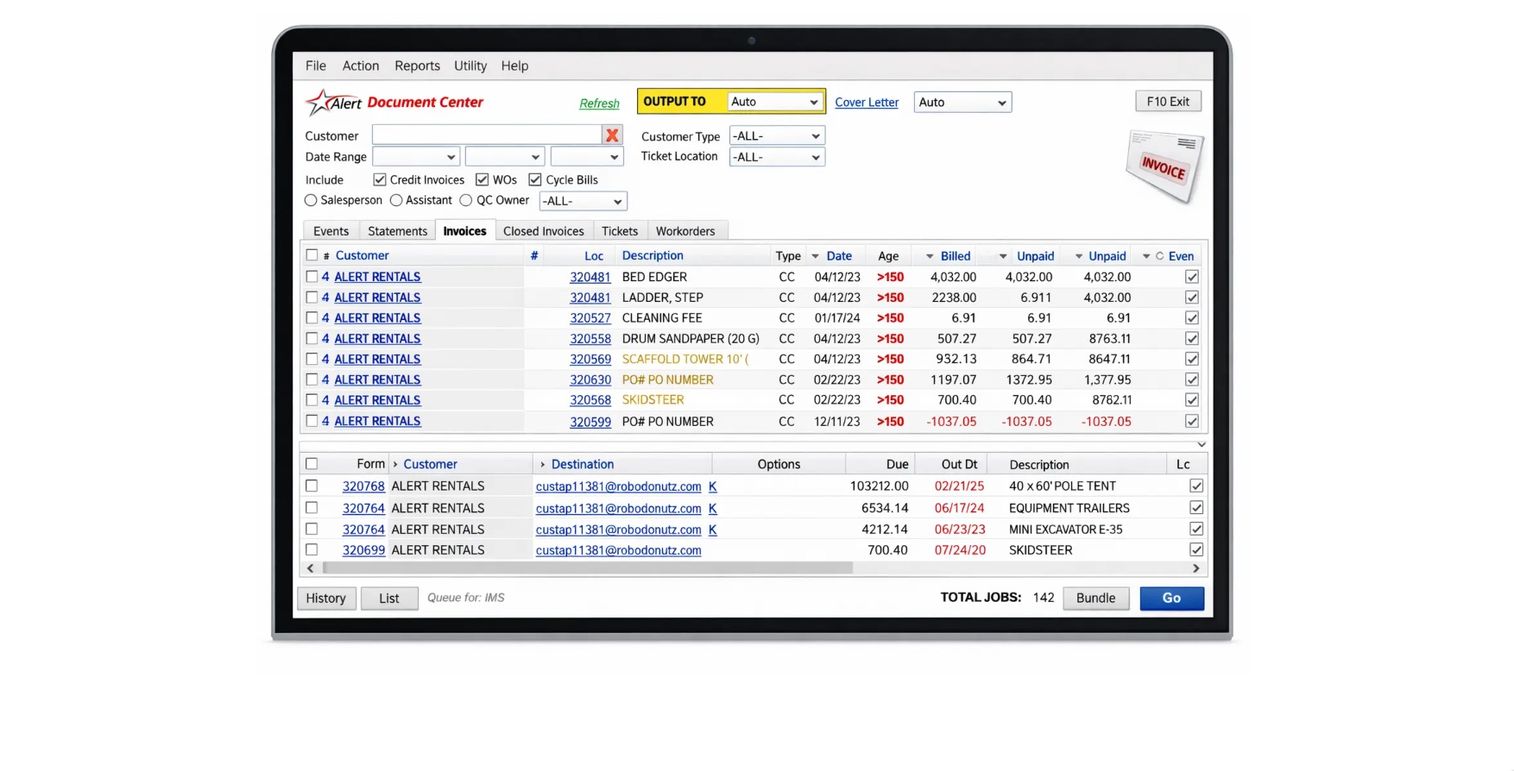
Alert's rental management software is a cloud-based platform built for equipment, tool, construction, event, and specialty rental businesses, which puts it squarely in reach of generator and power rental operators. It handles the full rental lifecycle in one system: inventory management, dispatching, maintenance, contracts, billing, and customer communication. For teams that want broad rental operations coverage with the configurability to model power-industry specifics like shift rates and cycle billing, Alert is the most complete starting point on this list.
The strength here is depth across the whole workflow rather than a single standout module. Rental contract management, inventory tracking, and billing and invoicing all live under one roof, so a booking, its service history, and its invoice stay connected. That matters when a generator rental involves a delivery, a meter reading, a mid-rental service, and a final invoice that has to reconcile all of it.
Best for: rental operators who need a configurable, end-to-end system for inventory, dispatch, contracts, and billing across a mixed or power-focused fleet.
Key strengths
- Rental contract management: digital contracts and billing that keep terms, rates, and service tied to each unit.
- Inventory tracking: asset tracking software that shows what is on rent, in service, or available across the fleet.
- Billing and invoicing: flexible rental billing software that supports the cycle and shift-based terms common in power rental.
Why choose Alert: Alert works best when your operation spans more than generators and you want one configurable system instead of a niche tool that only handles power. The configuration-heavy model means you can shape contracts, billing, and dispatch to how your yard actually runs, rather than bending your process to fit the software.
Alert pricing: Alert publishes illustrative, configuration-dependent pricing on its site. The Starter Subscription begins at $200 per month with a $1,000 deposit, the standard Subscription begins at $500 per month with a $2,500 deposit, and the Summit tier is a one-time purchase starting at $18,275. There is no free tier, and actual pricing depends on your configuration. Alert does not have a verified G2 rating; Capterra lists it at 4.6/5.
2. PREXA365
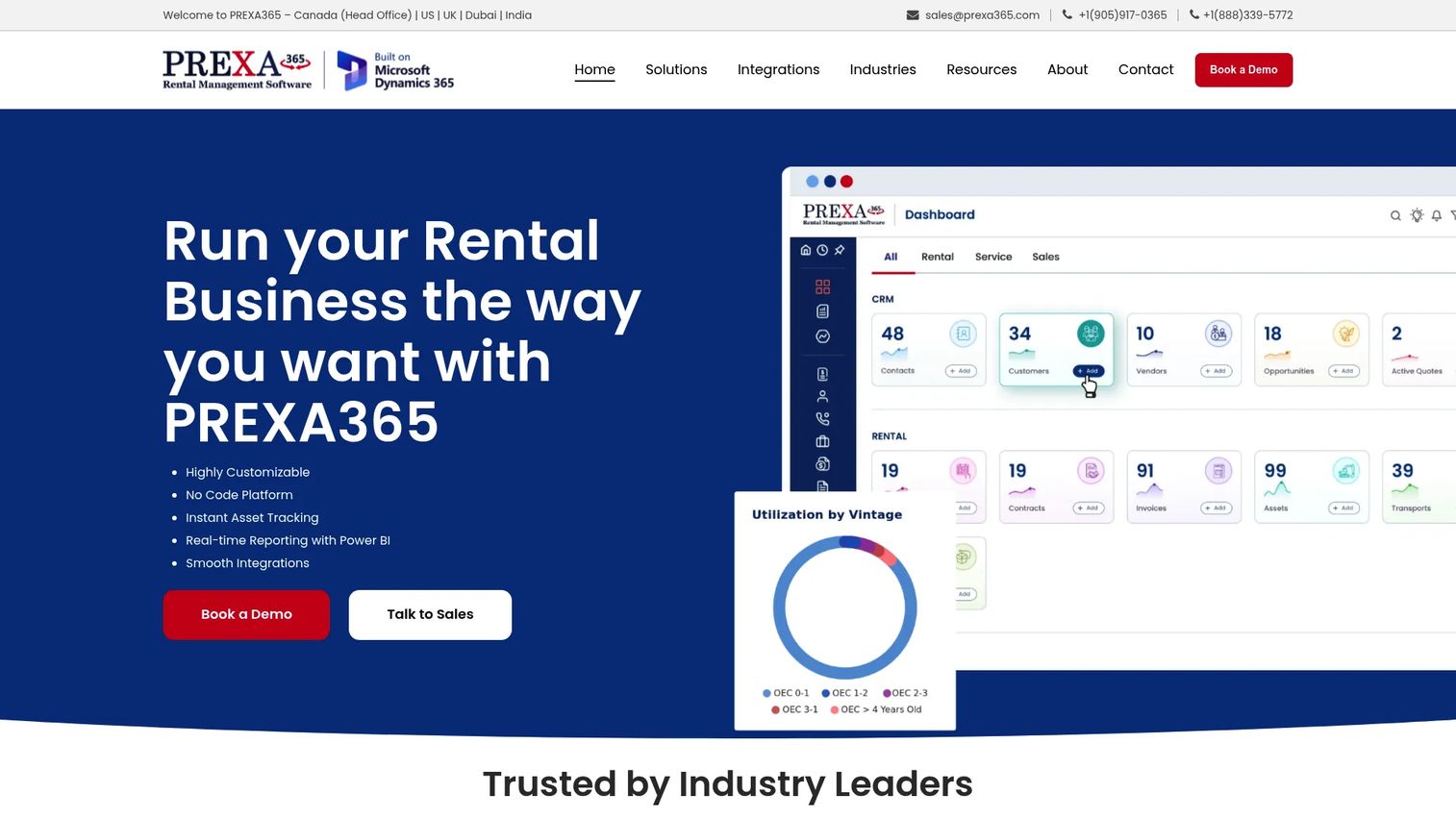
PREXA365 is a cloud-based rental management software built for equipment and asset operations, with a clear emphasis on the asset side of the business. Where some tools treat maintenance as an afterthought, PREXA365 ships dedicated asset management and preventive maintenance modules, which makes it a natural fit for generator fleets where service scheduling is the difference between uptime and a failed unit on site.
For operators, that maintenance focus is the reason to look here. Preventive maintenance software tied to your asset records means service intervals, work orders, and history live alongside the rental data instead of in a separate log nobody updates. When a generator's next service is visible next to its rental status, maintenance stops slipping through the cracks during busy weeks.
Best for: asset-heavy rental businesses that want preventive maintenance and asset management built into the core, not bolted on.
Key strengths
- Rental management: booking, scheduling, and fleet control in one cloud platform.
- Asset management: structured asset records that keep specs, location, and status current for real-time asset visibility.
- Preventive maintenance: preventive maintenance scheduling by runtime or date, with work order management attached to each asset.
Why choose PREXA365: PREXA365 stands out when preventive maintenance is central to how you protect margin. If your biggest recurring cost is unplanned downtime and emergency service, a platform that treats maintenance as a first-class module rather than a reporting tab is worth the evaluation.
PREXA365 pricing: PREXA365 does not publish pricing publicly. The vendor states that cost depends on user count, fleet size, and customization, and directs prospects to contact sales for a personalized quote. On G2, PREXA365 currently holds a 2.5/5 rating, so weigh reviewer feedback carefully against your own hands-on evaluation during a demo.
3. MCS Rental Software
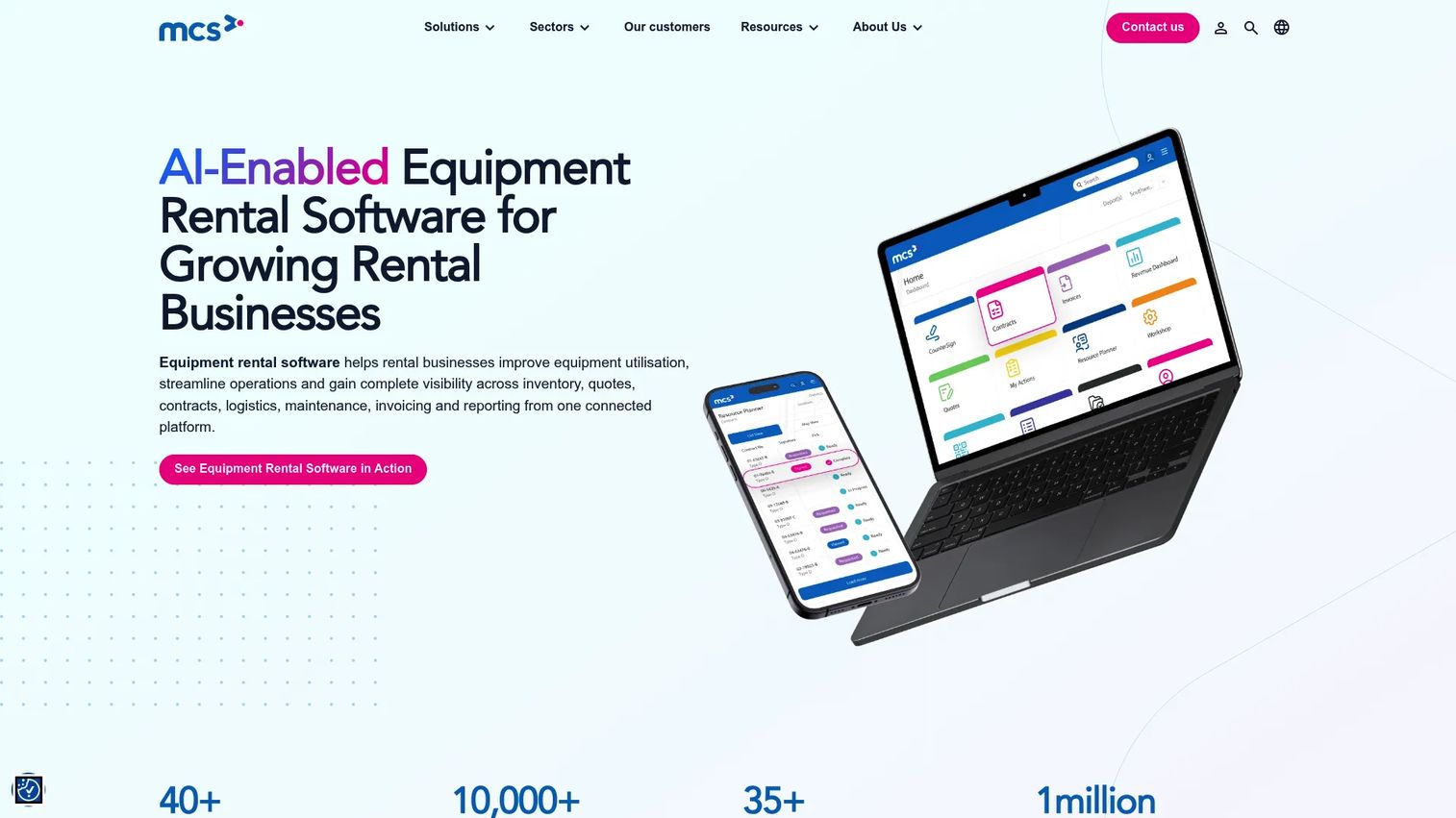
MCS Rental Software is a rental management platform for equipment and hire businesses, with particular strength in field operations and customer-facing access. It centers on end-to-end rental operations: real-time fleet and utilization data, customer-specific pricing, and an online portal that lets customers self-serve. For generator operators who care about what happens between the yard and the job site, MCS is built around exactly that stretch of the workflow.
The field-operations focus shows up in the data. Real-time fleet and utilization data means you can see not just what is on rent, but how hard your fleet is working, which feeds directly into fleet utilization decisions and purchasing. Customer-specific pricing lets you honor negotiated rates without manual overrides, and the customer portal moves routine reservations and invoice access off your team's plate.
Best for: equipment and rental companies that want tighter field operations, real-time visibility, and strong self-serve customer access.
Key strengths
- Real-time fleet and utilization data: live asset tracking software that surfaces utilization for smarter fleet management software decisions.
- Customer-specific pricing: negotiated rates applied automatically for accurate rental billing software output.
- Online portal and self-serve access: a customer portal for self-service reservations, invoices, and account visibility.
Why choose MCS Rental Software: MCS fits teams that live in the field and want customers to self-serve the routine work. Shared service history and audit trails also make it a comfortable fit where compliance-friendly data handling and chain of custody matter across the rental lifecycle.
MCS Rental Software pricing: MCS does not publish a public price on its US site; the available pages describe features and invite you to contact the team for a quote, so treat pricing as configuration-dependent. On G2, MCS holds a 4.8/5 seller rating, the highest verified rating among the tools on this list.
4. farmerswife
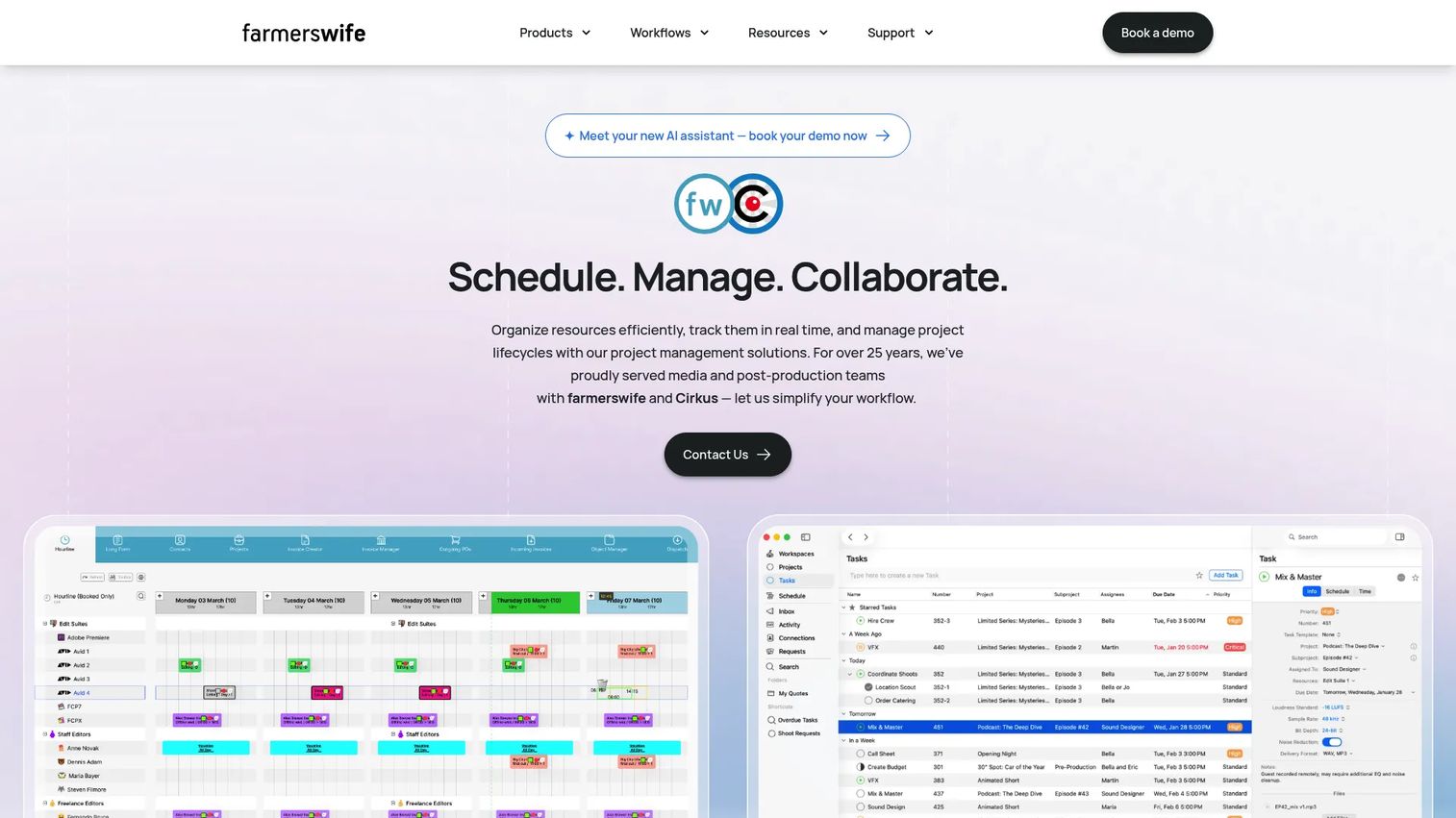
farmerswife is production and resource management software for media, broadcast, and post-production teams that extends into equipment rental. It is the most general option on this list, built around scheduling people, rooms, and equipment, with cost tracking, forecasting, and invoicing on top. For teams that want visual, Gantt-style scheduling and clean check-in/check-out workflows, farmerswife brings a different strength than the power-specific tools above.
Its value for rental operations is in the scheduling and checkout experience. Resource scheduling and project planning give you a visual map of availability, and the check-in/check-out workflows keep custody clear as gear moves out and comes back. Optional add-ons extend it toward budgeting, media management, equipment tracking, and personnel management, so you can shape it around a broader operation.
Best for: teams that prioritize visual scheduling and checkout workflows across a mixed rental or production inventory.
Key strengths
- Resource scheduling and project planning: Gantt-style availability and rental scheduling software across people and equipment.
- Cost tracking, forecasting, and invoicing: financial workflows that connect scheduled work to quotes and invoices.
- Optional add-ons: modular equipment tracking, budgeting, and media management to extend the core.
Why choose farmerswife: farmerswife is the pick when visual scheduling and checkout discipline matter more than power-specific nuance. It is more general than the generator-focused options, so lean on it where broad equipment rental scheduling is the priority rather than uptime and emergency-response depth.
farmerswife pricing: farmerswife prices on a user-based model and does not publish figures publicly; the vendor invites prospects to contact sales for a tailored quote, and mentions a one-off perpetual purchase option. On G2, farmerswife holds a 4.1/5 rating.
What to look for before you buy
Workflow fit for how your yard actually runs
The best demo in the world means nothing if the software forces you to change a process that already works. Map your real workflow first: how a booking becomes a dispatch, how a meter reading becomes an invoice, how a completed service updates the asset. Then check that the tool follows that path rather than fighting it.
Maintenance depth
Confirm the platform schedules preventive maintenance by both runtime hours and calendar date, supports work order management, and keeps full service history against each asset. For generator fleets, this is the single feature most tied to uptime and emergency response, so do not accept a shallow maintenance tab.
Billing accuracy and flexibility
Check that the system handles meter-based invoicing, cycle billing, shift rates, and early returns without manual workarounds. Ask how a field-recorded meter reading reaches the invoice. The fewer manual steps in that chain, the fewer disputes and the faster your cash conversion.
Asset tracking and real-time visibility
Look for real-time asset visibility across on-rent, in-service, and available states, plus GPS tracking or AEMP-standard GPS compatibility if telematics matter to your fleet. Good asset tracking software feeds fleet utilization decisions and prevents the idle-unit problem that quietly drains margin.
Customer portal and self-service
A strong customer portal moves routine reservations, invoice access, and account questions off your team. Evaluate how much a customer can actually do unattended, and whether digital contracts and e-signature workflows are included or gated behind a higher tier.
Conclusion
Four tools, four different centers of gravity. Alert's rental management software is the most complete option for teams that want one configurable system across contracts, dispatch, billing, and maintenance for a power or mixed fleet. PREXA365 leans hardest into asset management and preventive maintenance, which fits operators whose margin is defined by uptime. MCS Rental Software wins on field operations, real-time fleet visibility, and customer self-service. farmerswife is the broad equipment rental and scheduling pick for teams that value visual planning and clean checkout over power-specific depth.
The right choice comes down to what you are optimizing for. If uptime and emergency response drive your business, prioritize maintenance depth and asset tracking. If cash conversion is the pain, weigh billing accuracy first. If your customers keep calling for routine reservations and invoices, put customer portal quality at the top.
Do not decide from a feature page. Shortlist your top two, then request demos and run your own real workflow through each before you commit.
FAQs
It manages bookings, fleet visibility, preventive maintenance, billing, and customer communication for generator rental operations. The best systems reduce manual handoffs between booking, service, and invoicing, which keeps units moving and helps teams hold uptime high. Think of it as equipment rental software tuned specifically for power fleets.
The core set is asset tracking, preventive maintenance, flexible billing, contracts, rental scheduling, and customer portal access. For power fleets, emergency-response workflows and audit trails can be the deciding factors, because they protect both uptime and your compliance record. Prioritize the features that map to how you actually lose money today.
It schedules service by runtime hours and calendar date, and keeps full service history against each asset so nothing slips during busy weeks. That runtime-based scheduling prevents avoidable downtime, and the recorded history gives you a defensible log for repairs, warranty claims, and compliance. Generator maintenance software turns maintenance from a reactive scramble into a scheduled routine.
Yes. Several platforms support meter-based invoicing alongside flexible billing cycles, which matters when generators are billed on actual runtime rather than a flat period. The value is in pulling the field-recorded reading straight into the invoice, cutting the manual re-entry that causes disputes and delays payment.
Verify workflow fit, implementation effort, reporting depth, customer portal quality, integration support, and pricing structure before you commit. The clearest signal of a good fit is simple: the tool should reduce admin time, not add another system your team has to feed. Run your real workflow through a demo before signing.
Not quite. Generator-specific tools emphasize uptime, preventive maintenance, billing precision, and emergency response, while general equipment rental software often leads with scheduling and asset movement. The right choice depends on how specialized your fleet is: the more your business depends on power uptime, the more the generator-specific depth earns its cost.