

You've worked a deal for three months. Discovery went well. The demo landed. The champion is bought in. Then the redlines start, and the deal disappears into legal for two weeks.
That gap is where good deals go cold. The buyer's momentum fades, a competitor gets a second look, and the AE spends afternoons reconstructing which version of the contract is current.
The category built to close that gap is growing fast. The global contract negotiation platform market is forecast to grow from $2.1B in 2024 to $9.4B by 2033, an 17.8% CAGR, according to MarketIntelo (2024). Timing matters too: companies that negotiate software contracts six months ahead of renewal save up to 39% more, versus 14% when they start 30 days out, per Tropic (2026).
Contract negotiation software exists to pull review, redlining, approvals, and signature handoff into one workflow, so a deal doesn't stall the moment it leaves the sales conversation.
What's inside
This guide is for AEs, RevOps, and legal ops teams who feel late-stage deal drag and want to fix it without adding admin.
We picked tools based on four criteria that decide whether software actually reduces cycle time:
- Workflow coverage: intake, drafting, redlining, approvals, signing, storage
- Collaboration: version control, in-line comments, and clean handoffs between sales and legal
- Integrations: CRM, email, storage, and e-signature connections
- Ease of adoption: whether real teams use it, or route around it back to email
Each pick below includes verified pricing context, a G2 rating where available, and a plain fit statement.
TL;DR
- Best for all-in-one contract workflow: Juro
- Best for legal ops automation: Checkbox
- Best for enterprise CLM and CPQ: Conga
- Best for approvals and repository control: Ironclad
- Best for signature handoff and execution: DocuSign CLM
- Best for managed negotiation in private markets: Ontra
- Best for AI-assisted contract review: Lawgeex
Short version: if you want one platform where negotiation and contract management live together, start with Juro. If AI-assisted first-pass review is your bottleneck, look at Lawgeex. Enterprise buyers with complex approval chains lean toward Conga, Ironclad, and DocuSign CLM.
What is contract negotiation software
Contract negotiation software is a category of tools that helps teams manage the full path from contract intake to signature, including drafting, redlining, approval routing, and storage, in one centralized workflow.
It sits inside the broader contract lifecycle management space but focuses on the part where deals stall: review, negotiation, approvals, and execution. Within CLM, the contract creation and negotiation segment is estimated to account for 42.7% of global CLM software revenue in 2026, per Coherent Market Insights (2024).
Core capabilities usually include:
- Centralized contract requests: a single intake point instead of scattered email threads
- Redlining and version control: track changes and know which draft is current
- Approval routing: send contracts to the right approvers automatically
- Audit trails and decision tracking: a record of who changed what and when
- AI-assisted drafting or review: summarize clauses, flag deviations, suggest language
- Integrations: CRM, email, document repository, and e-signature workflow tools
The practical goal is fewer versions, fewer handoff delays, and a shorter path from redline to signature.
When to use contract negotiation software
Speed up late-stage deal approvals
When a deal is verbally agreed and the only thing left is paper, every day in review costs momentum. A contract negotiation platform moves the redline-to-signature handoff into one place, so the AE can see status without pinging legal for updates. That visibility alone shortens the gap between "yes" and signed.
Standardize legal review at scale
When multiple AEs or teams send contracts, inconsistency creeps in. One rep uses an old template, another skips an approval. Legal workflow automation enforces the same intake, the same routing, and the same fallback clauses every time. That consistency is what lets a small legal team support a growing sales org without becoming the bottleneck.
Reduce email and Word chaos
When the real blocker is version confusion, "final_v7_FINAL.docx" and lost email threads, the fix is a shared workflow. Contract review software keeps one live version, tracks every change, and gives sales and legal the same source of truth. No more guessing which redline the buyer actually saw.
Comparison table
Here's a side-by-side view of the seven tools. Pricing for most contract negotiation platforms is quote-based, so treat the pricing column as a guide to model, not a final number.
| # | Product | Best for | Key differentiator | Pricing | G2 rating |
|---|---|---|---|---|---|
| 1 | Juro | All-in-one contract workflow | Browser-native editing plus AI automation in one platform | Custom, volume-based | 4.6/5 |
| 2 | Checkbox | Legal ops automation | AI intake, triage, and matter management for in-house legal | Custom | 3.5/5 |
| 3 | Conga | Enterprise CLM and CPQ | Contracts, pricing, quoting, and billing in one suite | Custom | 4.3/5 |
| 4 | Ironclad | Approvals and repository control | No-code Workflow Designer for complex approval chains | Custom | 4.4/5 |
| 5 | DocuSign CLM | Signature handoff and execution | CLM tied to the DocuSign agreement ecosystem | Custom | Not listed |
| 6 | Ontra | Managed negotiation in private markets | AI plus legal services for high-volume contract work | From $2,000/mo minimum | 4.6/5 |
| 7 | Lawgeex | AI-assisted contract review | Policy-based first-pass review before legal touches it | Custom | 4.2/5 |
Best contract negotiation software for 2026
1. Juro
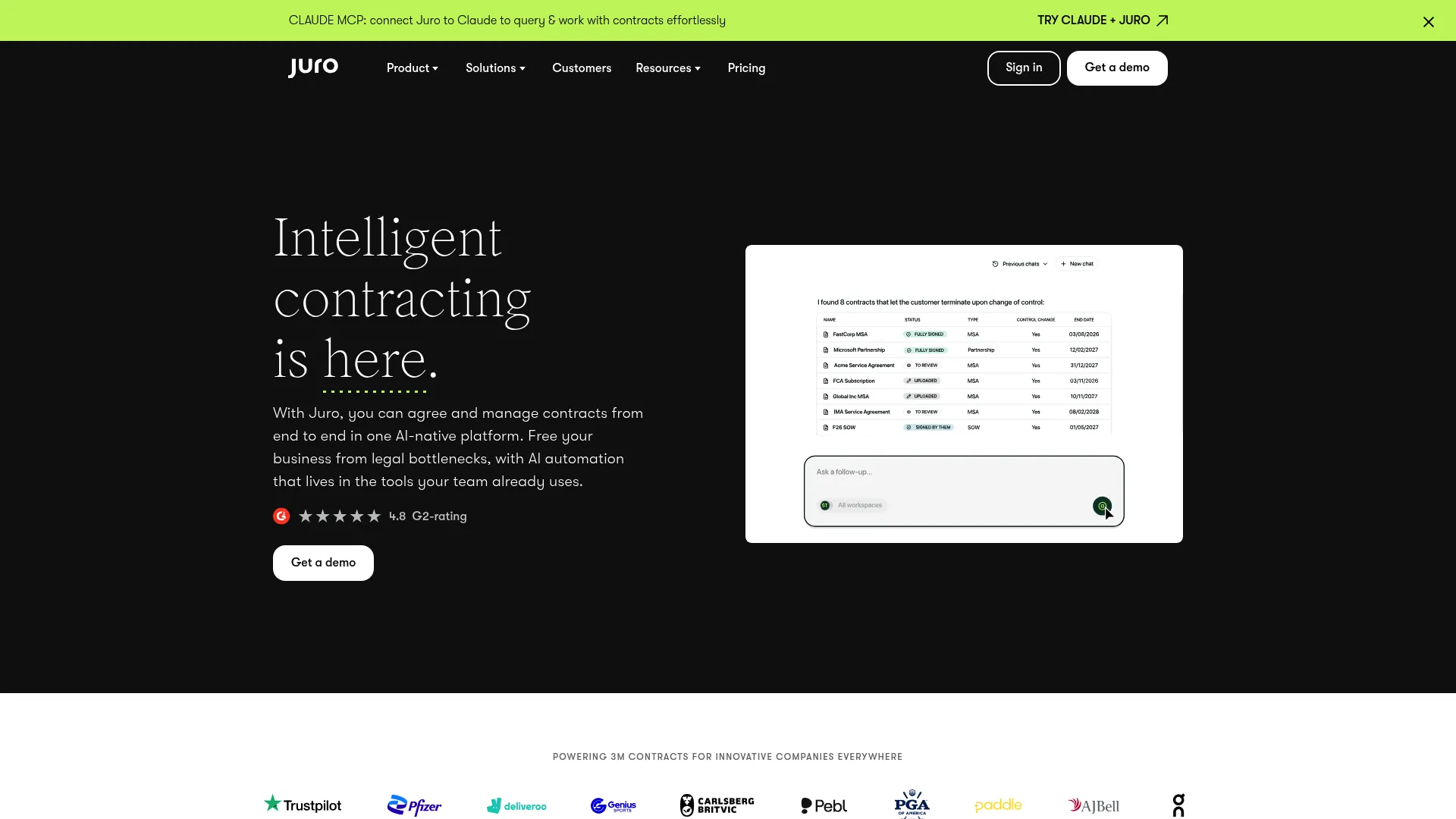
Juro is an AI-native contract automation platform for creating, reviewing, signing, and managing contracts in one place. It's built so legal and business users can work in the same document without exporting to Word and back. For AEs, that means a redline you can watch move through review instead of losing it to an email chain.
The pull here is the unified contract negotiation workflow. Drafting, redlining, approvals, signing, and the repository all live inside one browser-native editor, which cuts the version confusion that stalls late-stage deals.
Best for: teams that want negotiation and contract management in one platform, not stitched across three tools.
Key strengths
- AI contract automation for drafting and review
- Self-serve contract templates and workflows
- Browser-native editing with real-time collaboration
- Integrated contract repository and data capture
- Version history and audit trail
Why choose Juro: if your contracts bounce between Word, email, and a signature tool, Juro collapses that into one flow. It fits mid-market and growth-stage teams where a small legal function supports many reps.
Juro pricing: Juro uses custom pricing based on contract volume and integrations. Plans include Essentials and Growth, both with unlimited users, workflows, and templates. Contact Juro for a quote.
2. Checkbox
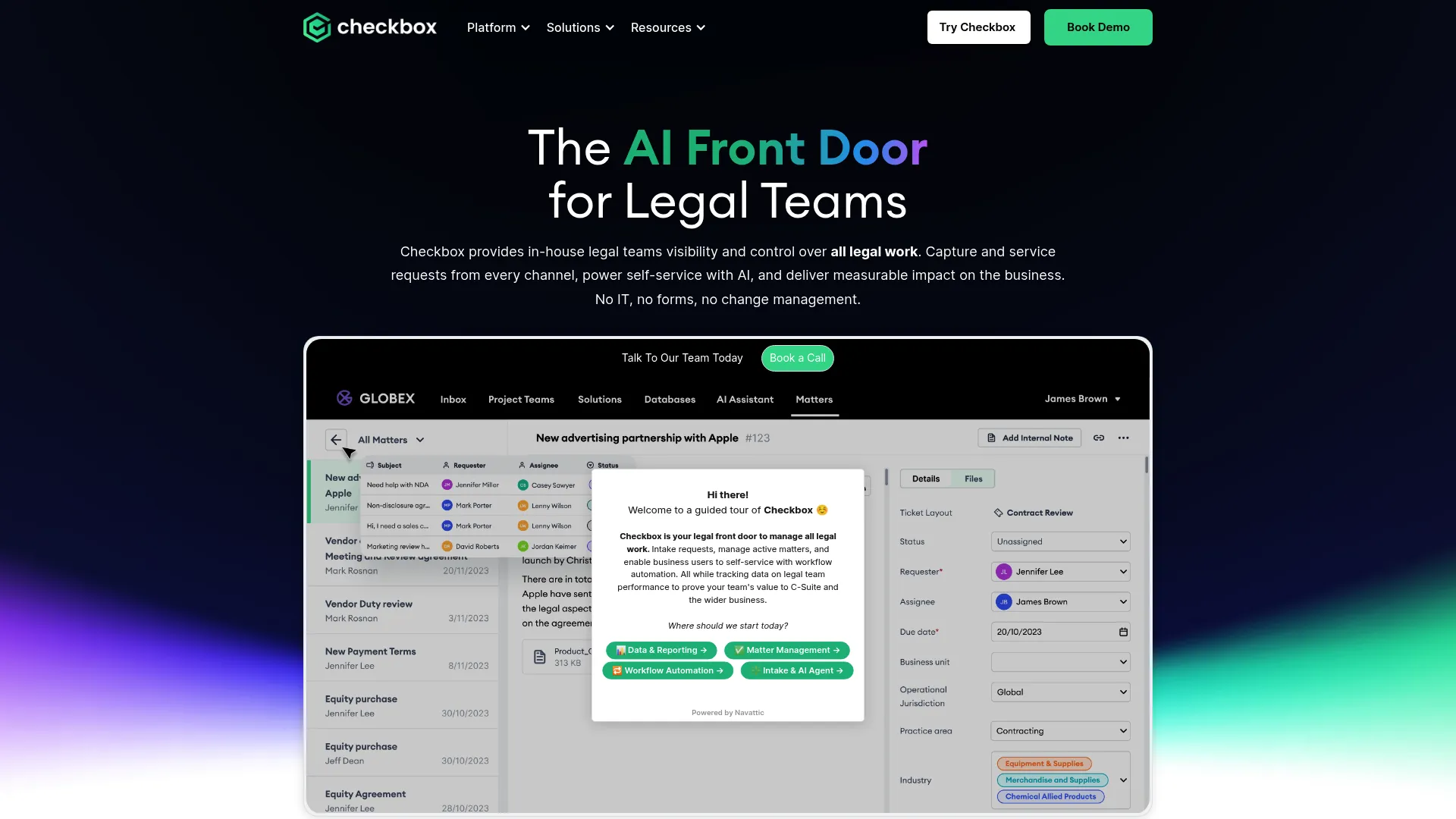
Checkbox is an AI-powered legal service hub built for in-house legal teams. It focuses on the intake side of the contract approval workflow: capturing requests, triaging them, and routing work so nothing sits in a lawyer's inbox untracked. The no-code visual builder lets legal ops design workflows without engineering help.
Where Checkbox stands out is structured intake and reporting. If your legal team can't see what's in the queue or where a request stalled, Checkbox gives them matter visibility and analytics to fix it.
Best for: in-house legal teams that need AI-powered intake, triage, and matter tracking.
Key strengths
- AI intake and triage
- Matter management and tracking
- No-code visual workflow builder
- Reporting and analytics
- Templates and integrations
Why choose Checkbox: it's the pick when the bottleneck is legal operations, not the contract editor itself. RevOps and legal ops teams get a system of record for requests instead of a Slack-and-email pile.
Checkbox pricing: Checkbox does not publish pricing on its site and routes buyers to a demo. Expect a quote based on team size and workflow scope.
3. Conga
Conga is enterprise revenue and commerce software spanning pricing, quoting, contracting, billing, and document automation. Its contract lifecycle management sits alongside CPQ, so the quote and the contract share the same data. For enterprise AEs, that connection removes the gap where pricing gets re-keyed and errors creep in.
Conga's strength is depth. Clause management, automated approvals, repository control, and Salesforce-connected workflows handle the complex process requirements large teams carry.
Best for: large teams that need one suite for pricing, CPQ, contracts, and document automation.
Key strengths
- Contract lifecycle management with clause libraries
- CPQ and price management in the same platform
- Automated approval routing
- Salesforce integration for connected workflows
- Document automation and eSignature
Why choose Conga: if your deals involve complex quoting and multi-step approvals, Conga keeps quote and contract in sync. It fits enterprise orgs already standardized on Salesforce.
Conga pricing: Conga uses custom pricing built around your business and directs buyers to request a quote. No public numeric pricing is listed.
4. Ironclad
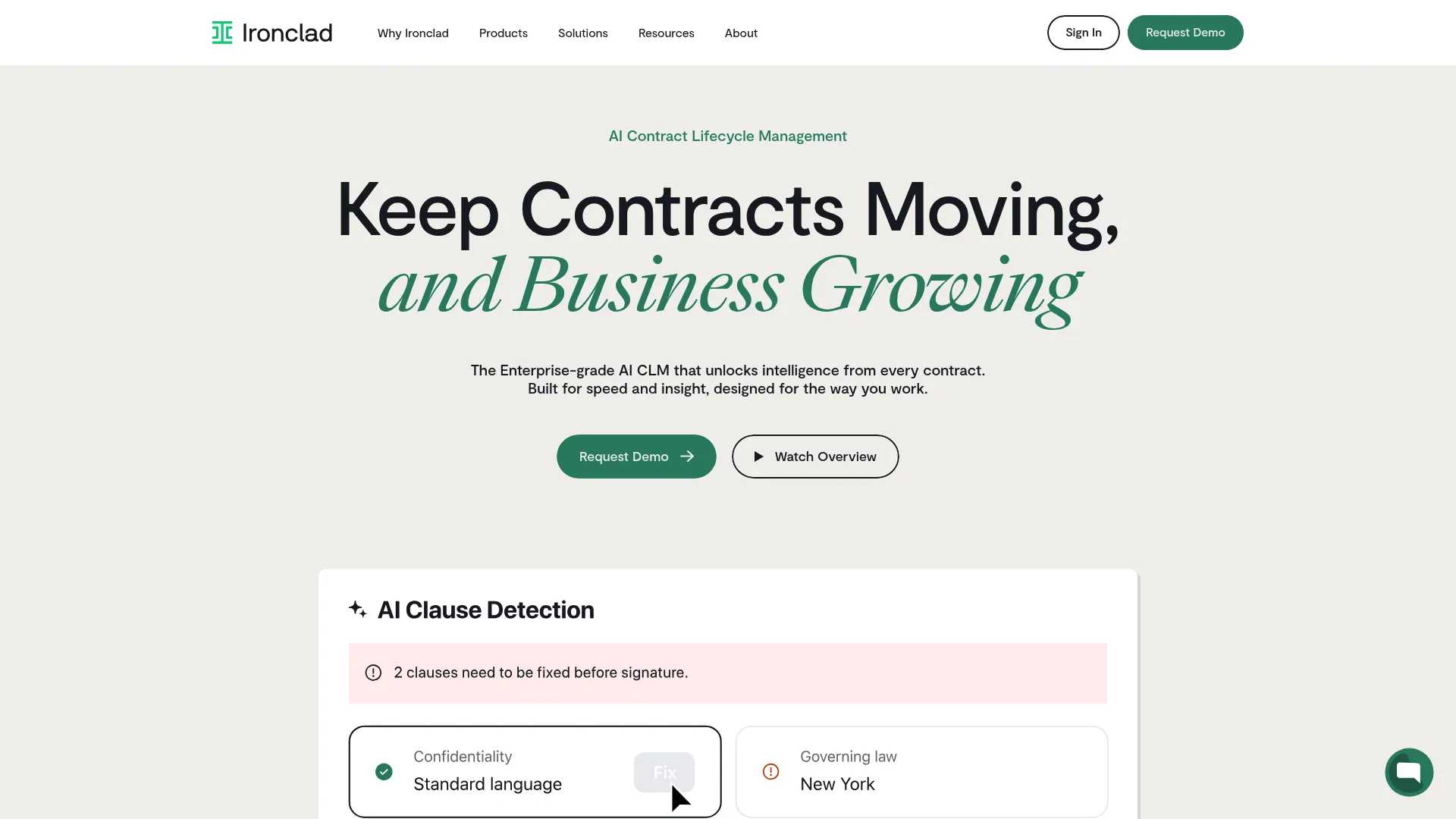
Ironclad is a digital contracting and CLM platform for business and legal teams. Its no-code Workflow Designer lets teams build approval chains that match how they actually work, then track every contract through a central repository. That governance is what enterprise buyers want when audit trails and version control are non-negotiable.
Ironclad leans into structured approvals and deal visibility. AI-assisted review, drafting, and intake speed up the front of the process, while the repository keeps everything findable after signature.
Best for: organizations that want strong governance and clear approval visibility.
Key strengths
- No-code Workflow Designer for approval chains
- AI-assisted review, drafting, and intake
- Central repository for storage and tracking
- Audit trails and version control
- Collaboration across legal and business teams
Why choose Ironclad: pick it when approval routing and governance drive the decision. It fits mid-market and enterprise teams that need repeatable, auditable contract workflows.
Ironclad pricing: Ironclad does not publish figures on its pricing page and structures plans around product, partner, and add-on choices. Contact Ironclad for a quote.
5. DocuSign CLM
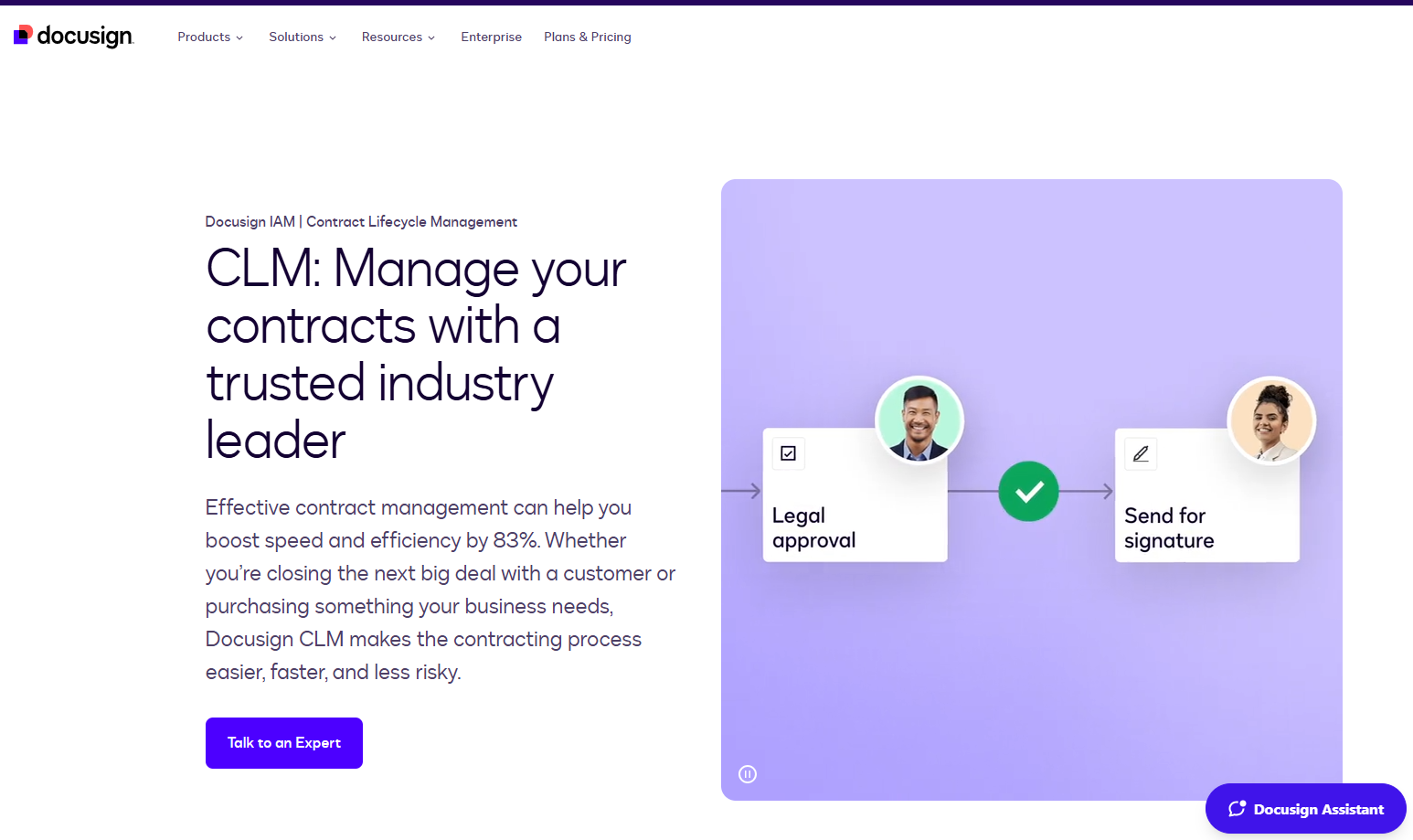
DocuSign CLM is contract lifecycle management software for creating, negotiating, routing, and managing contracts. It extends the e-signature workflow most teams already know into the full contract process. If your reps already send agreements through DocuSign, CLM adds the workflow layer around signature without switching ecosystems.
The differentiator is that signature handoff and execution are native, not bolted on. Automated workflows, an AI-powered repository, and negotiation and summarization tools sit around the signing step teams already trust.
Best for: teams already inside the DocuSign ecosystem that want to extend into full CLM.
Key strengths
- Automated contract workflows
- AI-powered agreement repository
- AI-assisted negotiation and summarization
- Native e-signature handoff
- Routing and approval management
Why choose DocuSign CLM: the case is continuity. If signature already runs on DocuSign, CLM reduces the number of tools in the stack while keeping execution in one place.
DocuSign CLM pricing: pricing is not public and is quoted by sales. Contact DocuSign for a CLM quote based on your needs.
6. Ontra
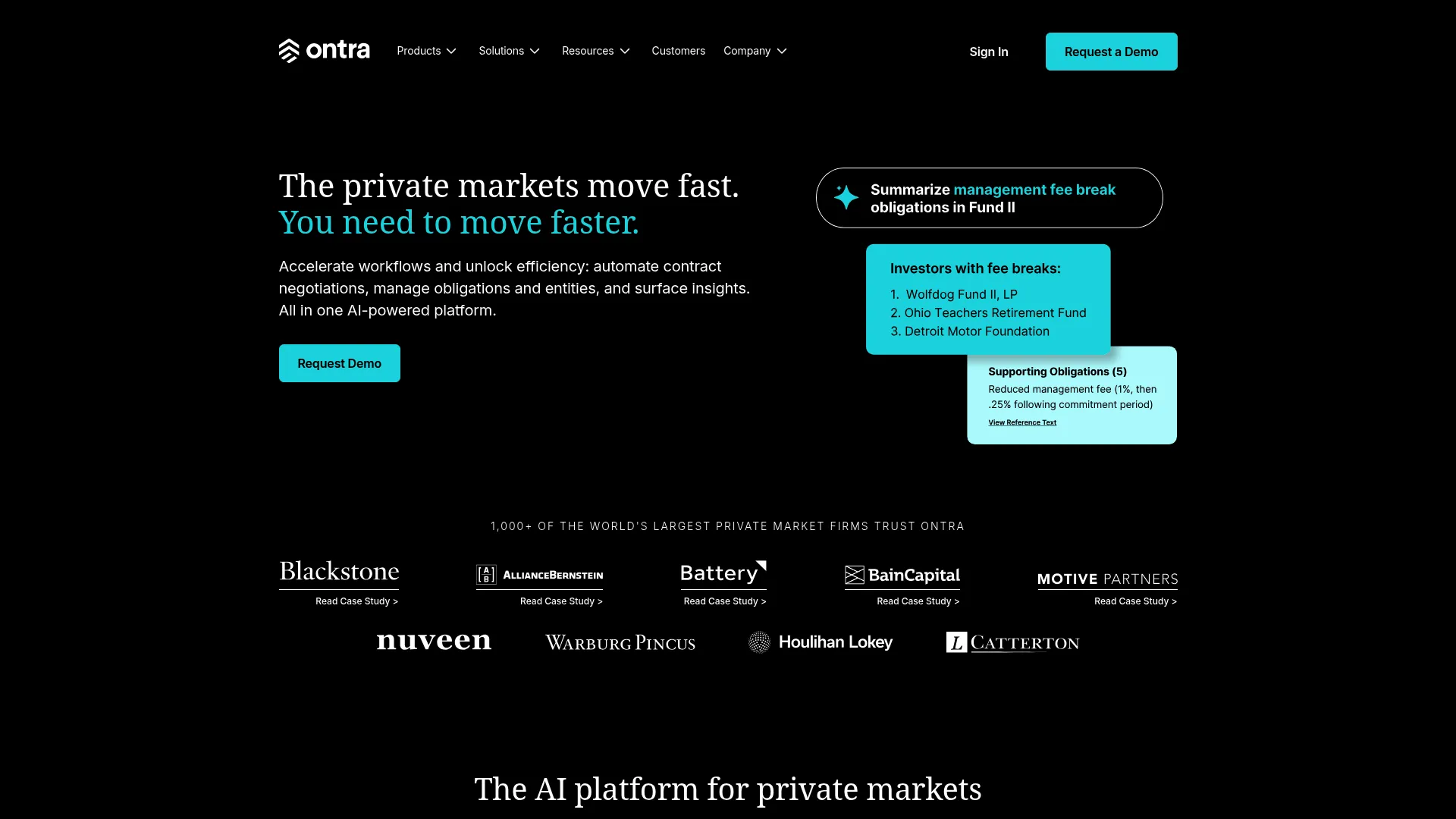
Ontra is an AI-powered software and legal services platform built for private markets firms. It pairs contract negotiation automation with actual legal service delivery, which suits teams handling high volumes of repetitive agreements. For firms drowning in NDAs and routine contracts, Ontra offloads the grind while keeping oversight.
Its differentiator is the managed layer. Beyond software, Ontra combines AI with obligation management, entity management, KYC, and DDQ automation to cover legal operations end to end.
Best for: private markets firms that need AI-assisted contract, compliance, and governance workflows.
Key strengths
- Contract negotiation automation
- Obligation management and compliance workflows
- Entity management, KYC, and DDQ automation
- AI paired with managed legal services
- Audit trail and reporting
Why choose Ontra: it fits teams that want specialized handling for high-volume, repetitive legal work rather than a general-purpose editor. The managed model reduces load on internal counsel.
Ontra pricing: pricing varies by product. Some contract automation editions show public pricing with a $2,000 monthly minimum fee (Advanced and Premier), a free trial is available on the Standard Edition, and other products use request pricing.
7. Lawgeex
Lawgeex is AI contract review automation software for legal teams. It runs first-pass review against predefined legal playbooks, flagging deviations and redlining before a lawyer opens the document. For AEs, that means routine contracts clear faster because legal spends time only on the exceptions.
The value is speed at the front of the process. Policy-based analysis and automated redlining software handle the repetitive review that otherwise eats days.
Best for: in-house legal teams automating pre-signature contract review.
Key strengths
- Automated contract review and redlining
- Predefined legal playbooks and policies
- Deviation detection against policy
- Analytics on review activity
- Integrations with existing tools
Why choose Lawgeex: choose it when the bottleneck is first-pass review volume. It fits legal teams that want AI to clear routine agreements so humans focus on the risky ones.
Lawgeex pricing: Lawgeex does not publish public pricing and routes buyers to request a demo. Expect a quote based on review volume and integrations.
Considerations before you buy
A feature list won't tell you whether a tool reduces cycle time. These criteria will.
Workflow depth vs. adoption
The most complete platform loses if reps route around it. Map the tool to one real deal flow and check whether sales and legal would actually use it, or fall back to email. Depth only pays off when people work inside it.
Integration fit
Contract data should flow from CRM to contract to signature without re-keying. Check for Salesforce integration, e-signature workflow connections, and document repository sync. A tool that lives outside your stack adds a tab, not a fix.
AI review capability
AI contract review can flag deviations and speed first-pass review, but the quality depends on your playbooks. Ask how the tool learns your fallback positions and how it handles clauses it hasn't seen. Test it on real contracts, not a demo template.
Audit trail and version control
For enterprise deals, you need a defensible record of who changed what and when. Confirm the tool keeps a full audit trail and enforces version control, so there's never a question about which redline the buyer approved.
Time to value
A six-month implementation delays every benefit. Ask how long until the first contract runs through the workflow, and who owns setup. The faster a team ships one real contract, the sooner adoption sticks.
Conclusion
The right pick depends less on feature count and more on where your deals actually stall.
If you want negotiation and contract management in one browser-native platform, Juro is the strongest all-in-one start. If your bottleneck is legal ops intake and reporting, Checkbox fits. Enterprise teams with complex quoting and approvals lean toward Conga, Ironclad, and DocuSign CLM, with the choice often coming down to which ecosystem you already run. Ontra suits private markets firms with high-volume repetitive contracts, and Lawgeex fits teams that want AI to clear first-pass review before legal touches a document.
Next step: shortlist two tools and map each one to a single real deal workflow you've lost time on this quarter. Run one live contract through each. The tool your reps and legal team actually use is the one that reduces cycle time, not the one with the longest feature page.
Contracts are one late-stage friction point. The evaluation stage is another, and that's where letting buyers experience your product hands-on pays off. Start your journey with Guideflow today!
FAQs
Contract lifecycle management (CLM) covers the entire contract journey, from creation and negotiation through storage, renewal, and reporting. Contract negotiation software focuses on the stretch where deals stall: review, redlining, approvals, and execution. Most tools in this guide do both, but the negotiation piece is the part AEs care about most.
They benefit most when legal friction slows revenue, which shows up in mid-market and enterprise deals. In SMB deals with a one-page order form, email works fine. But once contracts involve redlines, multiple approvers, and a security review, a workflow that keeps one live version and shows status is the difference between closing this quarter and slipping to next.
Collaboration, approval routing, audit trails, integrations, and version control. Collaboration and version control kill the "which draft is current" problem. Approval routing removes the manual chasing. Audit trails give you a defensible record for enterprise deals. Integrations keep contract data flowing from CRM to signature without re-keying.
It can reduce your dependence on them, but full replacement depends on workflow and team maturity. Browser-native editors keep negotiation inside one platform, which cuts the export-edit-email loop. Adoption is the real test: if reps and legal keep dropping back to Word, the tool isn't shortening cycles. Map it to a real deal before assuming it replaces anything.
AI can summarize long agreements, flag deviations from your playbook, suggest fallback language, and run first-pass review before a lawyer opens the document. The AI-powered contract analysis software market is projected to grow from $4.27B in 2026 to $15.35B by 2032, a 23.59% CAGR, per 360iResearch (2025). The practical win is clearing routine contracts fast so legal time goes to the risky ones.
Align on four things: who owns intake, who owns each approval step, what reporting both teams need, and the handoff rules between sales and legal. Contract tools fail when sales assumes legal owns the workflow and legal assumes sales will follow it. Agree on ownership first, then pick the tool that enforces it.



.avif)
.avif)