You hired six people last quarter. Onboarding lives in three Google Docs, PTO requests hit your inbox, and the one person who knows where the offer letters are template is on vacation. Nobody planned this. It just accumulated. And now the thing you built to scale revenue is quietly bottlenecked on how you manage the people doing the work.
That is the moment most founders start shopping for people management software. Not because HR is broken, but because the manual version stops scaling right around the time headcount does. The global human capital management software market is projected to reach USD 44.74B by 2030, according to Research and Markets (2026), which tells you how many companies hit this same wall.
For a Series B founder, this is a systems decision, not a feature hunt. The question is not "which tool has the most modules." It is "which system gives me one source of truth for employee data, removes manual admin, and hands clean reporting to a VP on day one." The wrong pick adds a tool. The right one replaces spreadsheets, scattered docs, and a lot of founder time. The core criteria that matter: company size fit, all-in-one depth, integration quality, security, and how fast you can actually roll it out.
If you evaluate stacks the way you would any other operational tool, you may also find our roundups of contract lifecycle management software and best onboarding flow software useful for adjacent workflows.
What's inside
This guide covers 8 people management software platforms for managing employees across hiring, onboarding, performance, payroll, time tracking, engagement, reporting, and compliance. It is written for founders and operators choosing a human resources software system as they scale, not for enterprise HR departments with a dedicated buying committee.
We selected tools based on four things: fit by company size, all-in-one depth versus specialization, integration quality with your existing stack, and speed to roll out without a heavy implementation. Every entry includes verified pricing where public, current G2 ratings where available, and a clear note on who the tool actually fits. No feature dumps, no ranking for the sake of ranking.
TL;DR
- Best all-around HRIS for growing teams: BambooHR. Clean employee records, hiring, onboarding, and reporting in one place, with fast rollout.
- Best payroll-first pick: Gusto. Payroll, benefits, and HR basics in one system, strongest for US small businesses.
- Most operationally expansive: Rippling. HR plus IT and finance in a single platform when you need more than core HR.
- Best for people experience and culture: HiBob. Modern HRIS with strong engagement and mid-market fit.
- Best for structured European HR ops: Personio. Unified HR platform for SMB and mid-market teams needing localization sensitivity.
- Best for performance and development: Lattice or Leapsome. Performance, goals, and engagement when people development is the main problem.
What is people management software?
People management software is a system that centralizes the employee lifecycle, from hiring and onboarding through performance, payroll, engagement, and offboarding, in one place. It replaces the patchwork of spreadsheets, docs, and inboxes most companies use before they scale. You will see it called an HR management system, an HRMS, an HRIS, or an HR platform depending on the vendor, but the job is the same: one source of truth for people data plus the workflows around it.
Most platforms in this category cover a core set of modules. Not every tool does all of them, and that is the first thing to sort out when you evaluate.
- Recruiting and ATS: job posting, applicant tracking, and offer management, with ATS integration into the rest of the system.
- Onboarding: employee onboarding software workflows, document collection, and first-day setup.
- Core HR: employee records, org charts, approvals, and self-service profiles.
- Payroll: payroll and HR software that runs pay, taxes, and filings.
- Performance management software: reviews, goals, feedback, and manager workflows.
- Engagement: surveys, sentiment, and recognition.
- Self-service: PTO requests, document access, and profile updates without an HR ticket.
- Analytics: headcount, turnover, and workforce reporting.
- Compliance and reporting: audit trails, policy tracking, and regulatory filings.
One distinction shapes every shortlist: HR-first versus payroll-first. HR-first platforms like BambooHR and HiBob build outward from employee records and people workflows, then connect payroll. Payroll-first systems like Gusto start with running pay accurately and layer HR on top. For a growing SaaS company, the answer depends on where your current pain lives. If onboarding and records are the mess, start HR-first. If payroll and compliance keep breaking, start payroll-first.
When to use people management software
Centralize employee data without more spreadsheets
The first real trigger is data sprawl. Employee records live in one sheet, PTO in another, org changes in a third, and none of them agree. An employee management software system gives you one source of truth, so a headcount number or a reporting line is the same everywhere. When a VP asks "how many people report to this manager," you answer in seconds, not by reconciling tabs. This matters most right when you cross 30 to 50 employees and manual tracking quietly starts producing wrong numbers.
Reduce manual onboarding and admin
Automation pays off most when hiring accelerates. If you are onboarding one person a quarter, a checklist works. If you are onboarding four a month, the manual version breaks and the founder or office manager becomes the bottleneck. People management software automates offer letters, document collection, equipment requests, and first-week setup, so a new hire is productive without anyone chasing paperwork. The same logic applies to recurring admin like PTO approvals and benefits changes.
Add visibility for performance, compliance, and reporting
At some point leadership needs cleaner reporting and fewer blind spots. That means turnover you can track by team, performance cycles that actually complete, and compliance and reporting that survives due diligence. A board asking for revenue-per-employee or a fundraise triggering diligence both expose how much of your people data lives in someone's head. This is when the analytics and compliance layers stop being nice-to-have and start being the reason you buy.
Comparison table
Sorted by relevance to a scaling SaaS team and decision-maker fit. Pricing and ratings reflect each vendor's public pages and current G2 listings where available.
| # | Product | Intent | Key use case | Pricing | G2 rating |
|---|---|---|---|---|---|
| 1 | BambooHR | HR-first HRIS | All-in-one records, hiring, onboarding, reporting | From $10/employee/mo | Not listed |
| 2 | Gusto | Payroll-first HR | Payroll, benefits, HR basics in one system | From $49/mo + $6/person | 4.6/5 |
| 3 | Rippling | HR + IT + finance | Unified workforce, device, and access management | Quote-based | 4.8/5 |
| 4 | HiBob | Modern HRIS | People experience, engagement, mid-market HR | Custom | 4.5/5 |
| 5 | Personio | European HR ops | Structured HRIS, recruiting, onboarding for SMBs | Quote-based | 4.4/5 |
| 6 | Lattice | Performance-first | Performance, goals, engagement, manager workflows | From $4/seat/mo | 4.7/5 |
| 7 | Leapsome | People development | Performance, engagement, learning, HRIS | From 199/mo | 4.8/5 |
| 8 | Zoho People | Budget HRMS | Attendance, self-service, analytics, Zoho ecosystem | Free tier + paid | 4.4/5 |
1. BambooHR
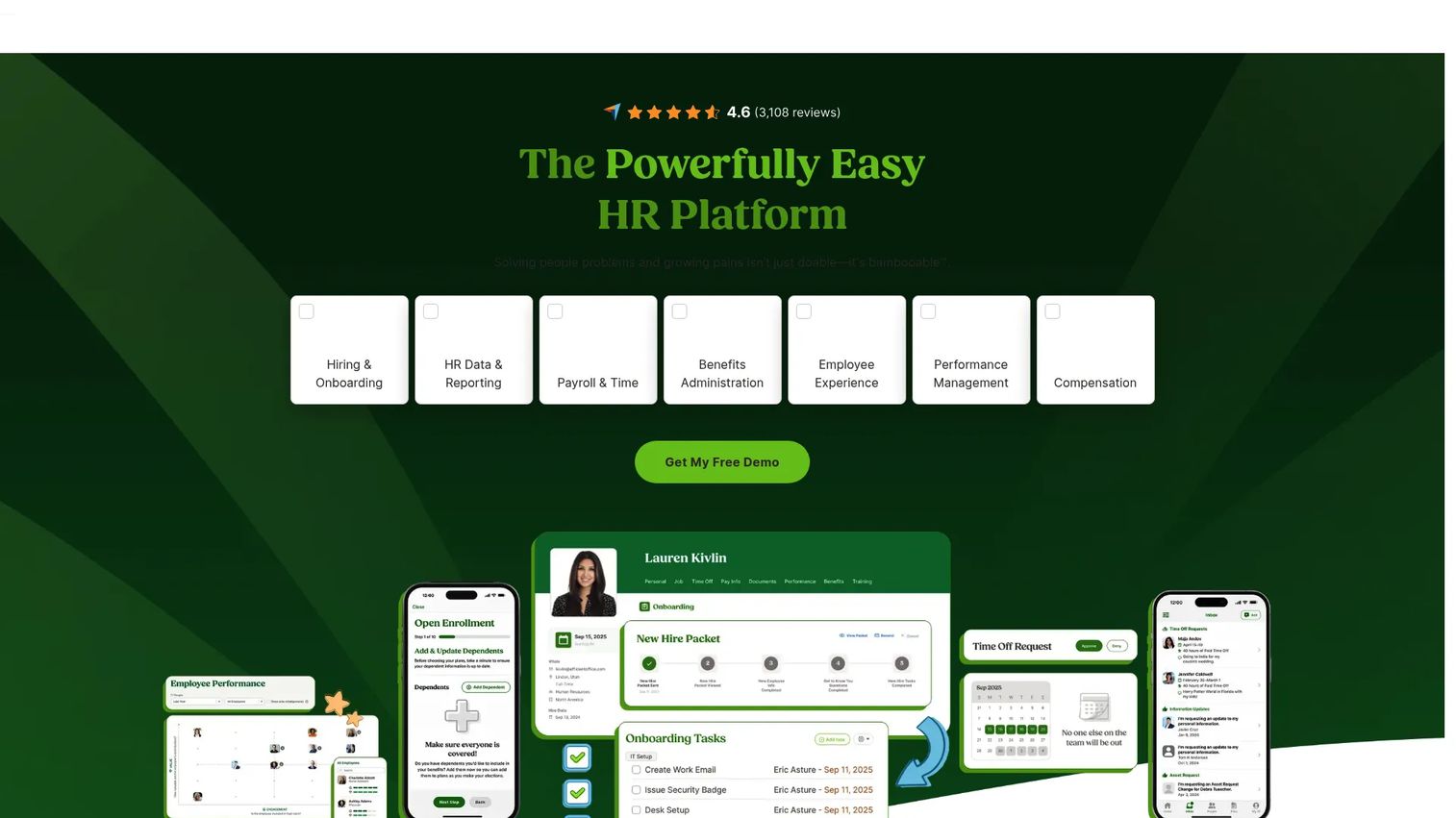
BambooHR is a cloud-based HR platform that brings employee data, hiring, onboarding, time off, performance, and compliance into one place. It is the default answer for small and mid-sized companies that want straightforward HR administration without a heavy implementation. The interface is clean enough that a non-HR founder can run it, and the reporting is good enough to hand to a new People lead on day one.
Best for: Small to mid-sized companies that want an all-in-one HRIS covering records, hiring, and onboarding without complexity.
Key strengths
- Employee records and reporting: One source of truth for people data, with dashboards and workflows that surface headcount and turnover fast.
- Hiring and onboarding: Job posting, offer letters, and structured onboarding so new hires are set up without manual chasing.
- Time off, benefits, and compliance: Built-in PTO tracking, benefits records, performance tools, and an AI assistant for routine HR questions.
Why choose BambooHR: If your pain is scattered employee data and manual onboarding, this is the fastest way out. It is HR-first, so it centralizes people workflows first and connects payroll where needed. For a founder who wants a system running this quarter, not next, the speed to rollout is the real selling point.
BambooHR pricing: Public pricing is per employee per month for companies with more than 25 employees: Core at $10, Pro at $17, and Elite at $25 per employee per month. For teams of 25 employees or fewer, pricing starts at a flat monthly rate around $250. There is no free tier.
2. Gusto
Gusto is an all-in-one payroll and HR platform built for small businesses. Where BambooHR starts with records, Gusto starts with running pay correctly, then layers on benefits, onboarding, and time tracking. For a US company that wants payroll and HR basics in one system without stitching together a separate payroll provider, it is a strong fit.
Best for: US small businesses that want payroll, benefits, and core HR in a single system.
Key strengths
- Automated payroll and filings: Runs payroll, taxes, and filings automatically, which removes the most error-prone manual HR task.
- Benefits administration: Health benefits, retirement, and related admin managed alongside payroll.
- Hiring, onboarding, and time tracking: Offer letters, onboarding flows, and time tracking so new hires are paid and set up from day one.
Why choose Gusto: Choose it when payroll and compliance are your current headache, not employee records. It is payroll-first, so it is strongest where accurate pay and filings matter most. Broader HR suites go deeper on performance and analytics, but few make payroll this painless for a small US team.
Gusto pricing: Plans are Contractor Only, Simple at $49/mo plus $6/mo per person, Plus at $80/mo plus $12/mo per person, and Premium at $180/mo plus $22/mo per person. The contractor-only plan carries a discounted $0/mo base price for the first six months. Gusto holds a 4.6/5 rating on G2.
3. Rippling
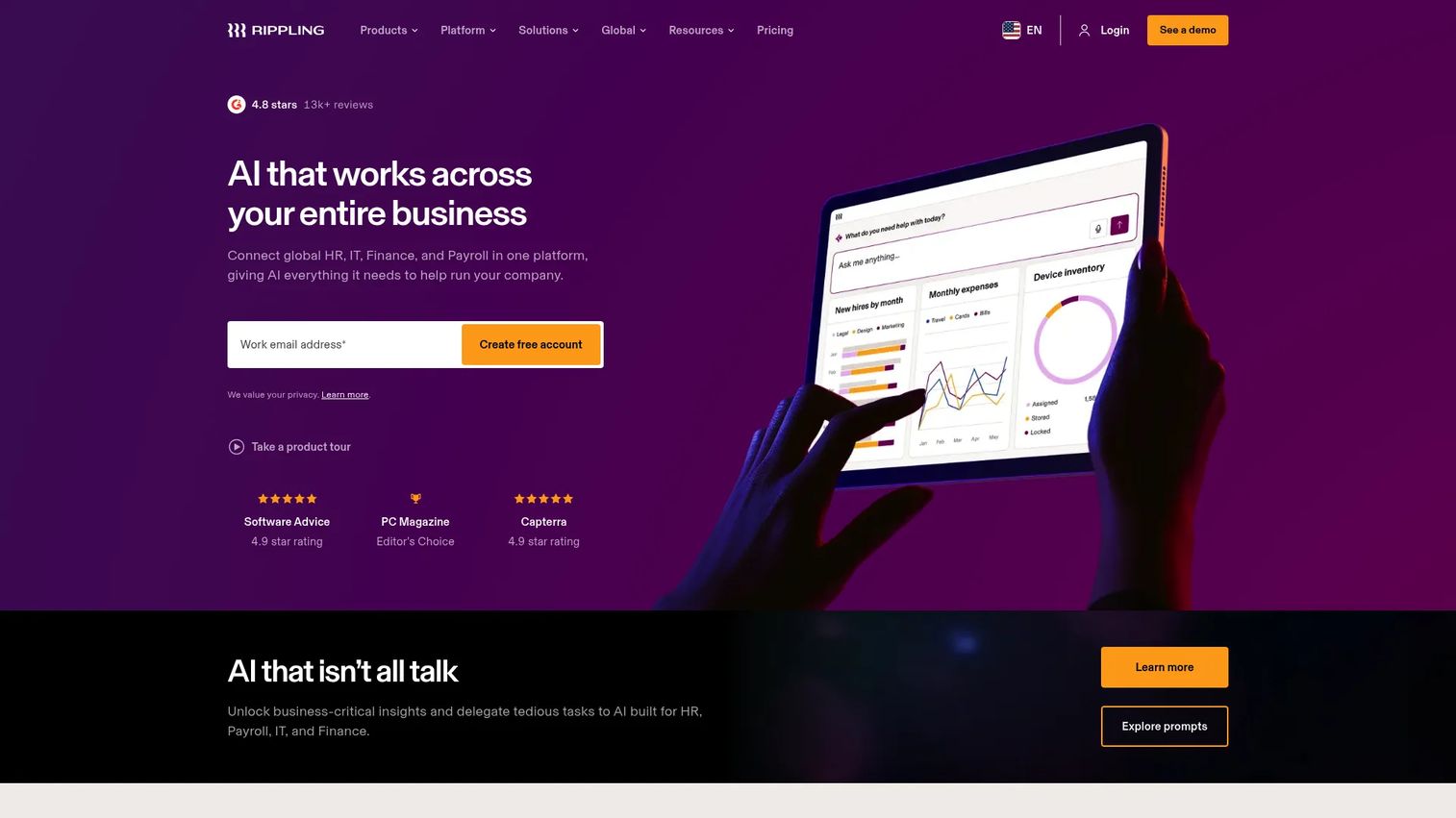
Rippling is a workforce management platform that unifies HR, IT, payroll, and finance operations. It is the most operationally expansive option on this list because it goes well beyond core HR. When a new hire starts, Rippling can provision their payroll, benefits, laptop, and app access from one workflow. For a scaling company where HR and IT admin both keep leaking founder time, that breadth is the point.
Best for: Companies that want an all-in-one HR, IT, payroll, and spend platform in a single system.
Key strengths
- Unified workforce platform: HR, IT, payroll, and finance in one place, so employee lifecycle changes cascade automatically.
- Workflow automation: Trigger onboarding, offboarding, and approvals across systems without manual steps.
- Device and access management: Provision and de-provision laptops and app access tied to the employee record.
Why choose Rippling: Choose it when core HR alone is not enough and you want IT and finance in the same platform. The modular architecture means you can start with HR and add modules as you scale, which fits a company that expects to keep growing headcount and systems. Rippling holds a 4.8/5 rating on G2.
Rippling pricing: Rippling uses quote-based pricing. Most products are billed per employee per month, and some may include a monthly base fee. Because the platform is modular, your price depends on which modules you turn on, so a demo and quote are the practical way to get a real number.
4. HiBob
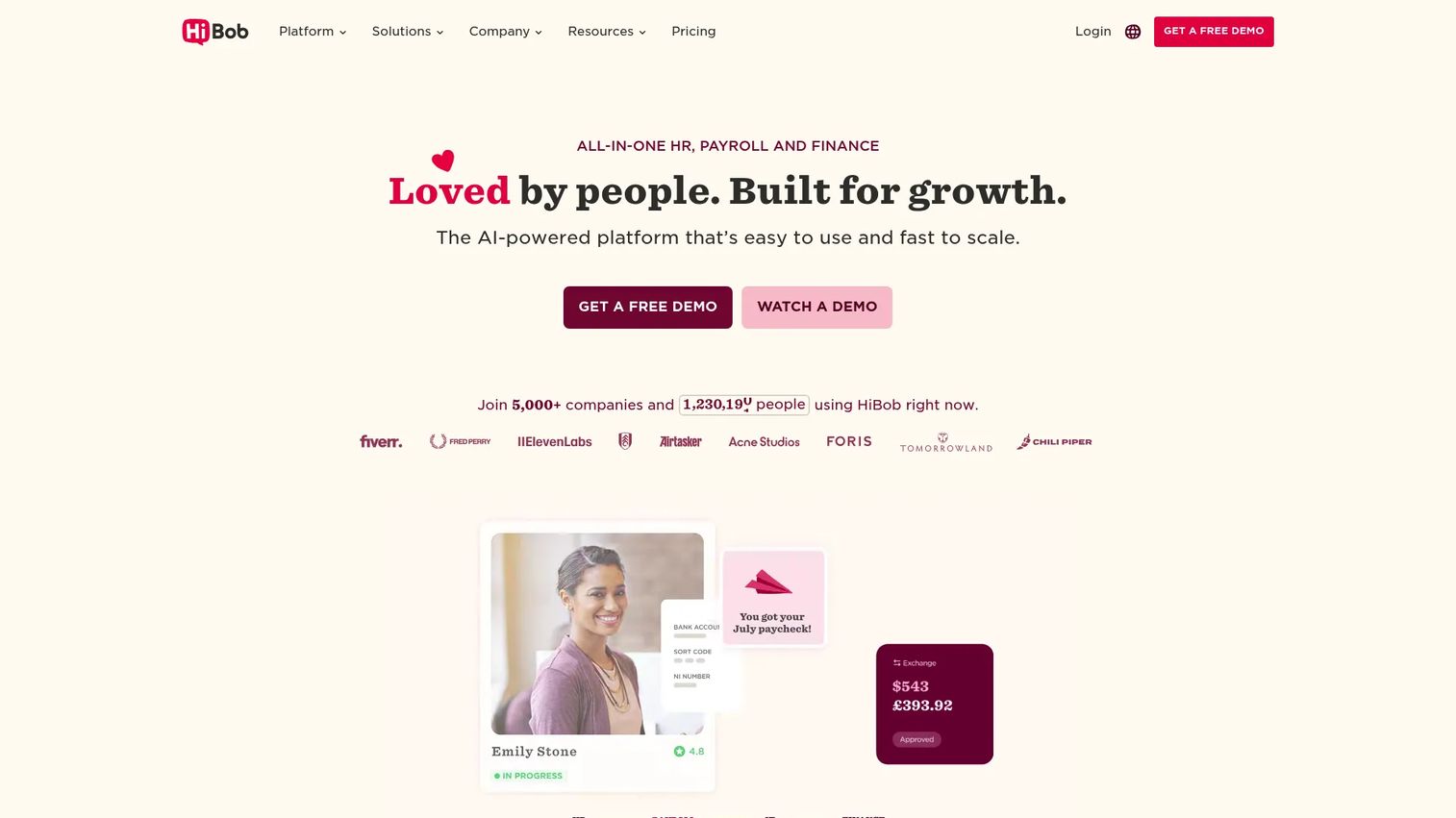
HiBob, often called Bob, is a modern cloud HRIS built around core HR, onboarding, time and attendance, performance, and payroll. It shows up on shortlists for companies that care about people experience and culture as much as administration. The interface is more people-centric than most, which matters when employees, not just HR admins, use the system daily.
Best for: Mid-market teams that want a configurable HRIS with a strong employee experience layer.
Key strengths
- Core HR and onboarding: Employee records, org data, and onboarding built for distributed and growing teams.
- Time and attendance: Track time, absences, and attendance tied to the core record.
- Performance and payroll hub: Performance workflows plus a payroll hub that connects pay across regions.
Why choose HiBob: Choose it when you want an HRIS that employees actually enjoy using and where culture and engagement are first-class, not bolted on. It fits mid-market SaaS companies scaling headcount who want configurability without enterprise weight. HiBob holds a 4.5/5 rating on G2.
HiBob pricing: HiBob uses custom pricing based on company size, features, and the modules you select. Public numeric prices are not listed on the pricing page, so you request a quote. For a mid-market buyer comparing configurable platforms, budget for a demo-driven pricing conversation rather than a self-serve checkout.
5. Personio
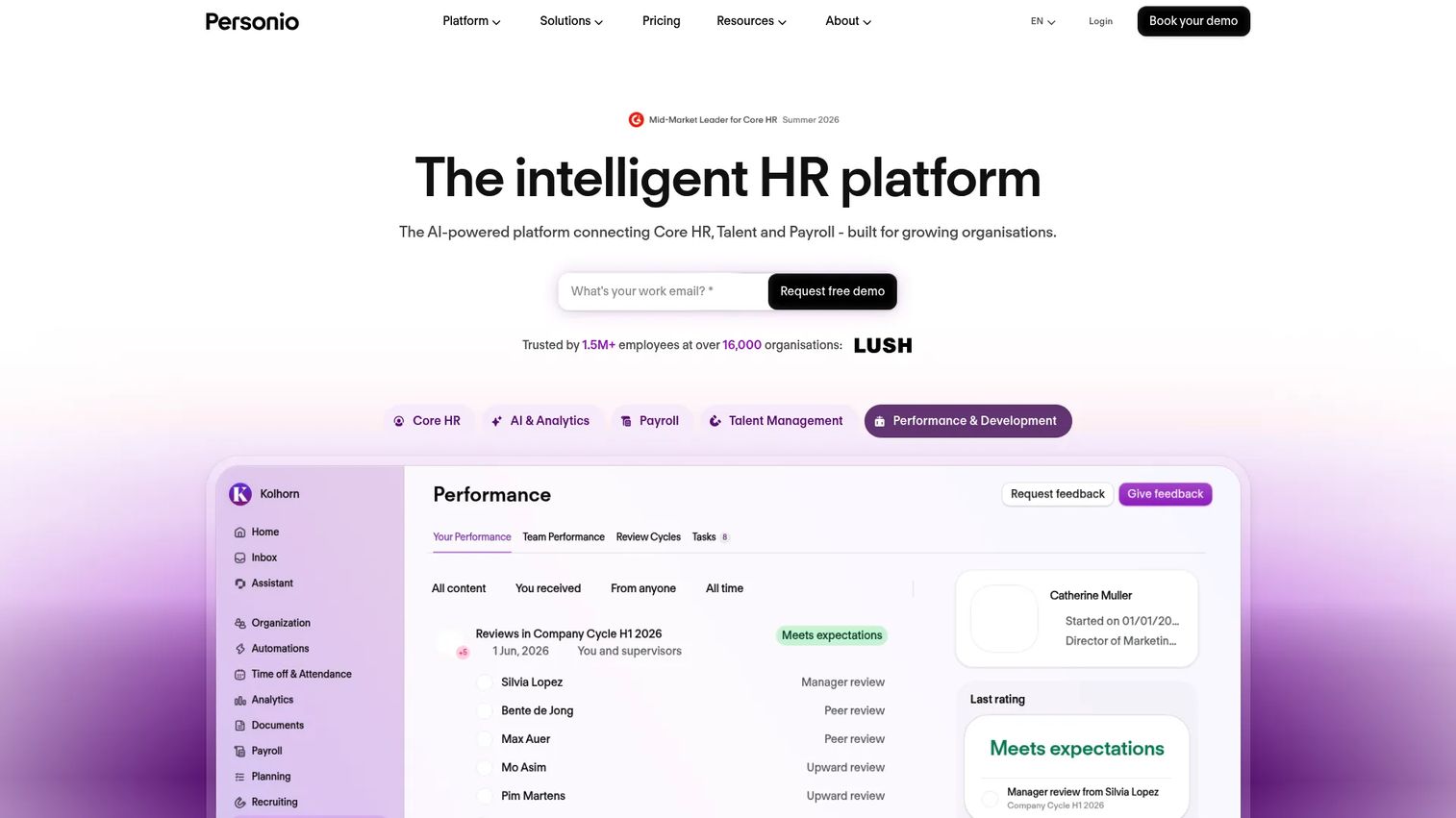
Personio is an all-in-one HR platform for small and mid-sized businesses, with particularly strong adoption across Europe. It brings employee profiles, workflow automation, time tracking, recruiting, and onboarding into one structured system. For teams that need HR ops depth with localization sensitivity across European markets, it is a natural fit.
Best for: SMBs that want a unified HR platform with recruiting, people ops, and localization built in.
Key strengths
- Employee profiles and org chart: Structured records and org visualization as the backbone of the system.
- Workflow automation and approvals: Automate approvals and repetitive HR processes to cut manual admin.
- Recruiting, onboarding, and reporting: ATS integration, onboarding flows, plus time tracking and reporting in one platform.
Why choose Personio: Choose it when you need a structured HRIS with strong recruiting and people ops, especially if you employ people across European markets with different requirements. It is HR-first with real operational depth. For a founder scaling a distributed European team, that structure and localization sensitivity is the differentiator. Personio holds a 4.4/5 rating on G2.
Personio pricing: Personio uses quote-based pricing that depends on employee count and the apps you select. Public numeric prices are not shown; you book a demo for a custom quote. Plans include Core, Core Pro, and add-on Apps, so the final number reflects both headcount and the modules you enable.
6. Lattice
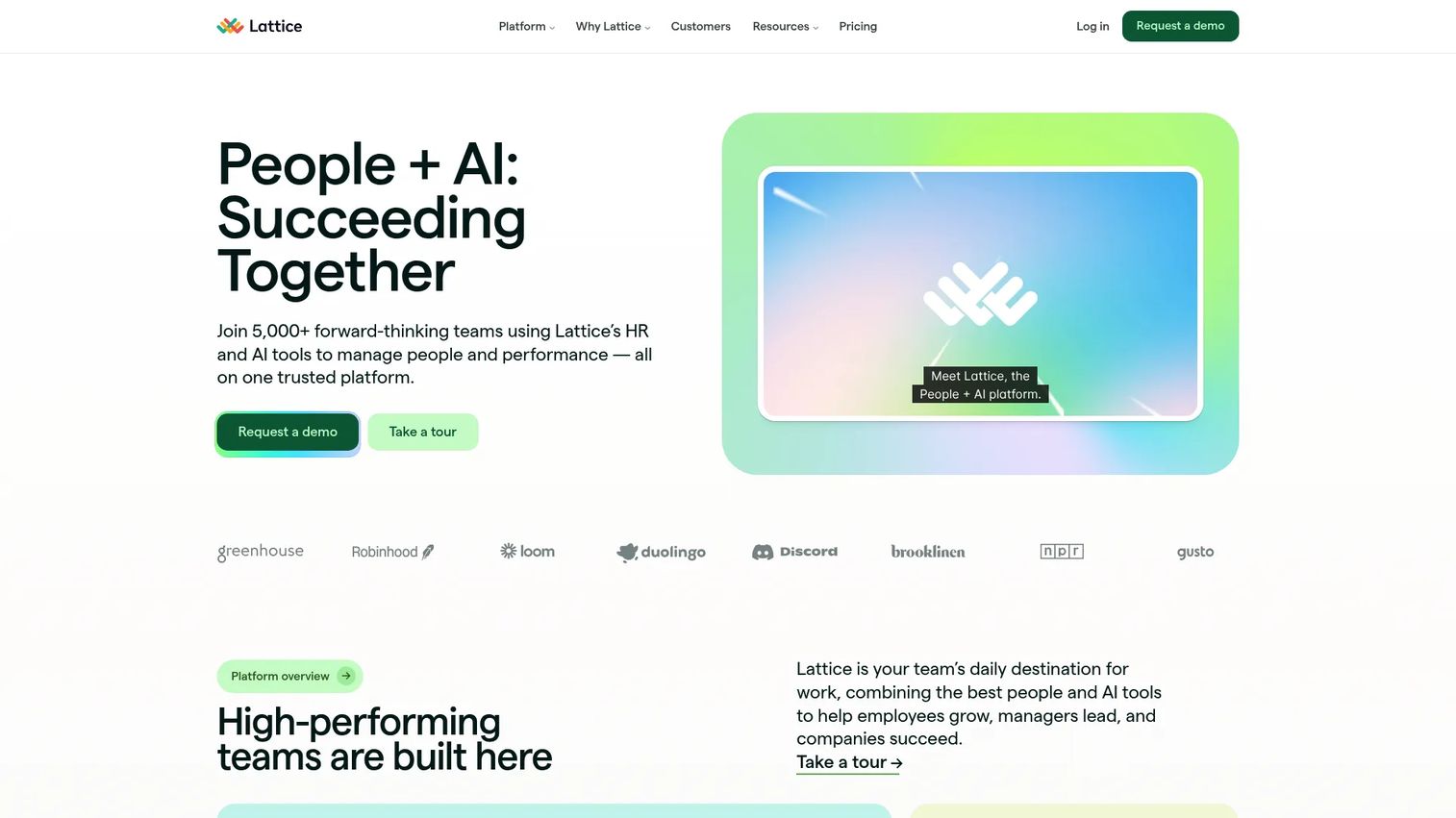
Lattice is a people management platform focused on performance, goals, engagement, and AI-powered HR workflows. It is strongest when performance and people development are the problem you are solving, not payroll. If your managers run inconsistent reviews and goals live in scattered docs, Lattice gives them a shared system with real manager workflows.
Best for: Mid-market and enterprise teams that want an integrated performance and engagement platform.
Key strengths
- Performance reviews and feedback: Structured review cycles and continuous feedback that managers actually complete.
- Goals and OKRs tracking: Company, team, and individual goals visible in one place.
- Engagement and sentiment: Employee updates and sentiment analysis to catch problems before they become churn.
Why choose Lattice: Choose it when people development is the main gap, not core HR administration. It is performance-first, so pair it with an HRIS or payroll system if you need those too. For a founder whose managers need to run consistent reviews and goals at scale, Lattice is built for exactly that. Lattice holds a 4.7/5 rating on G2.
Lattice pricing: Public pricing is billed annually in USD per seat: Engagement at $4, Performance at $8, Goals and OKRs at $8, and Foundations at $11 per seat per month. Add-ons include Compensation at +$6 and Grow at +$4 per seat per month, with Enterprise on a custom quote. There is no free tier.
7. Leapsome
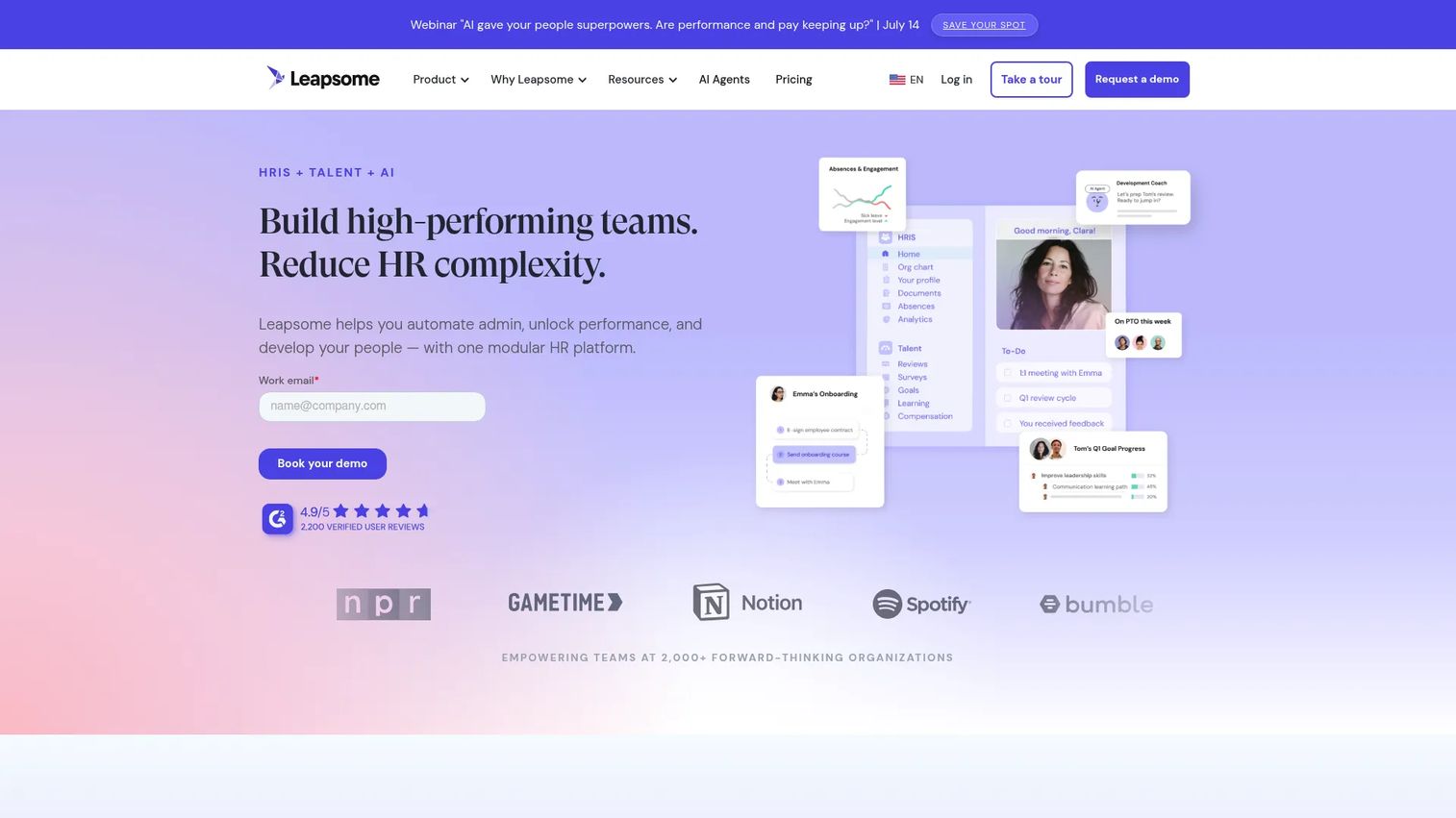
Leapsome is an AI-powered HR and people platform that combines an HRIS with performance, engagement, learning, and goal-setting. Where Lattice concentrates on performance and engagement, Leapsome wraps a broader people development layer around core HR records. It fits teams that want performance, learning, and engagement in one system alongside employee data.
Best for: Mid-market teams that want an all-in-one HRIS plus a performance and development layer.
Key strengths
- HRIS core: Employee records, documents, payroll prep, absences, and workflows in one place.
- Performance and development: Goals, feedback, reviews, surveys, and learning paths for structured people development.
- AI agents and copilot: AI-driven insights, summaries, and recommendations that automate routine HR work.
Why choose Leapsome: Choose it when you want a rounded people development layer, learning included, sitting on top of solid HR records. It suits mid-market SaaS teams investing in manager and employee growth without bolting on separate tools. Leapsome holds a 4.8/5 rating on G2.
Leapsome pricing: Pricing depends on employee count, contract length, and the modules you select. Leapsome lists per-user pricing starting around 199/month, with multi-module and volume discounts available. A 14-day free trial is offered and there is no setup fee. For an exact figure across the modules you want, a custom quote is the practical route.
8. Zoho People
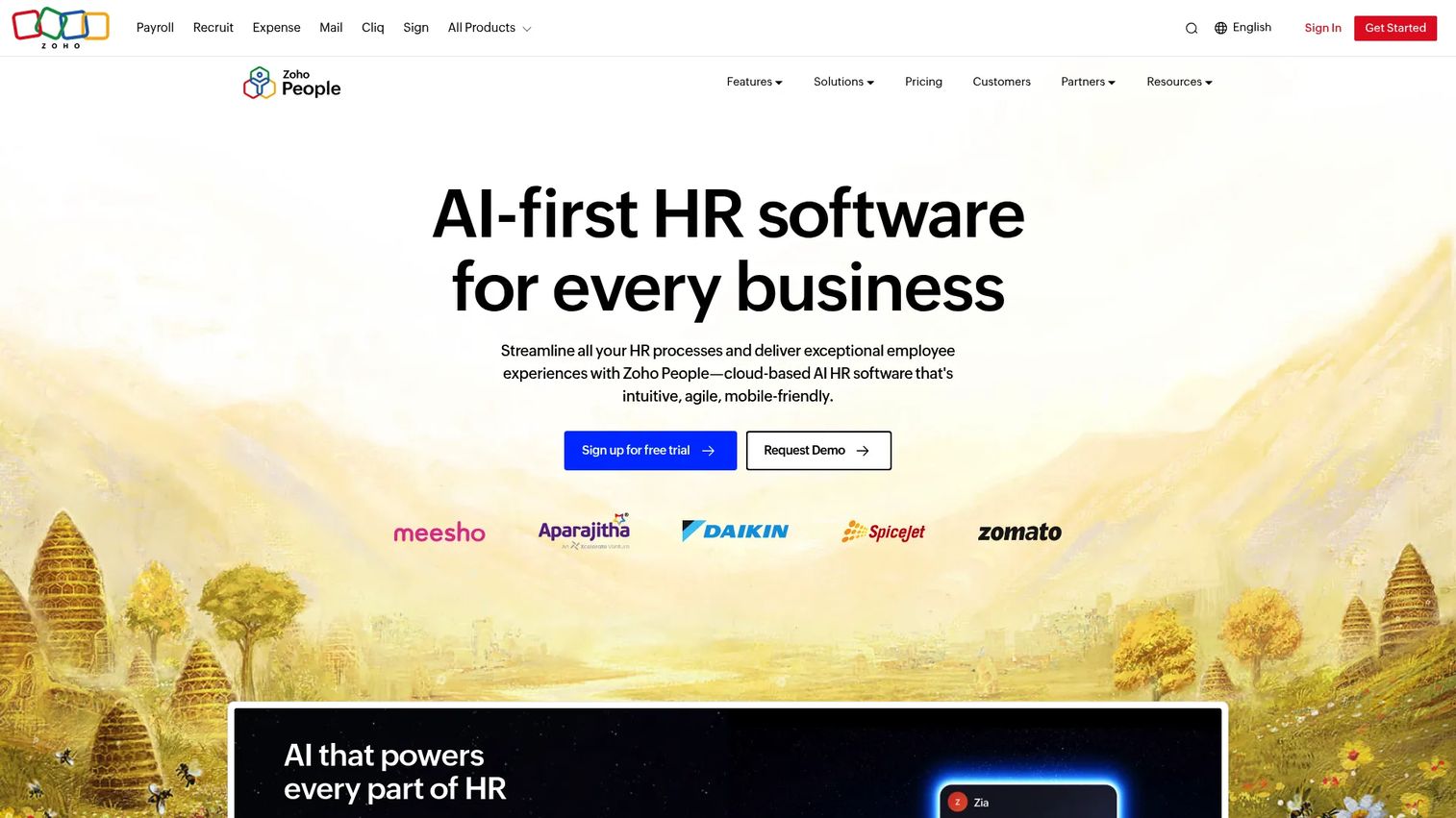
Zoho People is a cloud-based HRMS covering employee data, attendance, onboarding, performance, and analytics, with mobile access and deep Zoho ecosystem integration. It appeals to budget-conscious teams, especially those already running other Zoho products, who want broad HR functionality without a premium price tag.
Best for: Small to mid-sized teams that want an all-in-one HRMS, particularly if they already use the Zoho stack.
Key strengths
- Employee database and self-service: Central records plus self-service so employees handle their own updates and requests.
- Onboarding and document management: Onboarding and offboarding flows with document handling built in.
- Attendance, timesheets, and performance: Attendance, shifts, timesheets, and performance management in one HRMS.
Why choose Zoho People: Choose it when budget matters and you already live in the Zoho ecosystem, since the integrations and pricing compound in your favor. It offers a free edition for up to 5 users plus four paid tiers, which makes it easy to start small and grow. Zoho People holds a 4.4/5 rating on G2.
Zoho People pricing: The first-party pricing page confirms a free edition for up to 5 users, plus four paid tiers: Essential HR, Professional, Premium, and Enterprise, billed monthly or yearly. Public numeric prices for the paid tiers were not visible on the page reviewed, so confirm current per-user rates directly with Zoho when you evaluate.
Considerations before you buy
Company size and stage fit
A tool built for a 5,000-person enterprise will overwhelm a 60-person company, and a lightweight tool will break as you scale past a few hundred. Match the platform to where you are now and where you will be in 18 months. For most Series B teams, that means an HRIS that starts simple and adds depth, not the heaviest suite on the market.
HR-first versus payroll-first
Decide which pain you are solving first. If employee records and onboarding are the mess, start HR-first with BambooHR, HiBob, or Personio. If payroll and filings keep breaking, start payroll-first with Gusto. If performance and development are the real gap, a performance management software like Lattice or Leapsome is the entry point, paired with a records system.
Integration depth and ATS
Your HR platform does not live alone. It needs to sync with your ATS, payroll, and analytics stack so data stays accurate and you avoid double entry. Check ATS integration quality and payroll and HR software connections specifically. Weak integrations recreate the spreadsheet problem you were trying to solve. If you evaluate operational tooling broadly, adjacent guides like best contract management software and audit management software show how integration depth separates real systems from point tools.
Security and compliance
Employee data is sensitive and regulated. Verify SOC 2 or equivalent certification, data residency options if you employ people across regions, and audit trails for compliance and reporting. This is table stakes for diligence, so confirm it before you commit, not during your next fundraise.
Speed to roll out
The best system is the one that goes live. A platform that takes two quarters to implement costs you more than its price tag in lost time. Favor tools with fast setup and clean migration, and score each option on how quickly a non-specialist can run it.
Conclusion
There is no single best people management system, only the best fit for your current pain. If you need an all-around HRIS with fast rollout, BambooHR is the safe default. If payroll and compliance are the headache, Gusto solves that first. If you want HR, IT, and finance in one operationally deep platform, Rippling is the most expansive. HiBob and Personio win on people experience and structured European HR ops respectively, and Lattice or Leapsome lead when performance and development are the real gap. Zoho People fits budget-conscious teams already in the Zoho ecosystem.
The next step is not to pick one today. Narrow to two or three based on whether you are HR-first, payroll-first, or performance-first, then run a short trial or demo with your actual data. The right choice is the one your team adopts without founder babysitting and that a new People or Ops leader can own from day one.
If you want to see how self-serve, interactive product experiences can shorten evaluation for any tool you are shipping, start your journey with Guideflow today!
FAQs
People management software is used to centralize the employee lifecycle in one system, from hiring and onboarding through performance, payroll, engagement, and offboarding. It replaces scattered spreadsheets and docs with a single source of truth for employee data and the workflows around it. The goal is less manual HR admin and cleaner reporting as headcount grows.
They overlap heavily and the terms are often used interchangeably. "People management software" tends to emphasize the employee experience and development layer, while "HR software" is the broader umbrella. Within that, an HRIS focuses on core employee records and processes, an HRMS adds broader workforce management like time and attendance, and payroll-first tools center on running pay. Most modern platforms blur these lines.
Start with employee records, onboarding, reporting, and compliance. Those four solve the most immediate scaling pains: a single source of truth, faster hiring ramp, visibility for leadership, and audit readiness for diligence. Performance, engagement, and advanced analytics matter, but they are easier to add once the core system is running and adopted.
Follow your current pain. If employee records, org changes, and onboarding are the mess, choose an HR-first platform like BambooHR, HiBob, or Personio. If payroll accuracy, taxes, and filings keep breaking, choose payroll-first like Gusto. A more complex, multi-region company often needs the deeper HR ops of an HR-first system, while a small US team may be fine leading with payroll.
For most of the employee lifecycle, yes. It replaces the spreadsheets tracking records, PTO, org changes, and onboarding checklists with structured data and workflows. It should still connect to your analytics stack and finance tools through integrations, so certain custom reporting may live outside the platform while the source data stays clean inside it.
Very. Weak ATS integration or a disconnected payroll system recreates the double-entry and data-drift problems you bought the tool to fix. Strong integrations keep employee data accurate across systems and let the platform scale without manual reconciliation. Verify specifically which ATS, payroll, and analytics tools each vendor supports natively before you commit.
Repeatability, visibility, and operational handoff. The system should make people processes repeatable without founder involvement, give leadership clean reporting for weekly and board-level decisions, and be something a new People or Ops leader can own from day one. A platform that earns its place in your stack within the first quarter, replaces scattered tools, and does not depend on any single person is the one that scales with you.