You hired three people in Berlin, two contractors in São Paulo, and a sales lead in Singapore. Now your finance person is running four payroll processes, in three currencies, against tax rules nobody on the team actually understands. One missed filing in one country, and you are explaining a compliance penalty to your board.
That is the real problem global payroll software solves. Not "pay people." It is centralizing multi country payroll while keeping compliance, controls, and visibility intact as headcount and entities multiply. The cloud-based payroll software market is projected to reach US$14.9 billion in 2026, growing at a 9.6% CAGR through 2033, according to Persistence Market Research. That growth is fueled by exactly the situation you are in: teams going distributed faster than their back office can keep up.
The category is hard to evaluate because the friction is invisible until it breaks. Country coverage looks fine on a sales page, then you discover your platform "supports" a country through a third-party partner with a two-week lag. Pricing reads as one number, then implementation fees and per-country surcharges stack up. This guide cuts through that. We compare ten global payroll providers on what actually matters when you are the one accountable for the number. If you are also rethinking the rest of your operational stack, our roundup of the best marketing automation software tools covers an adjacent piece of the puzzle.
What's inside
This guide is for operators evaluating global payroll software for multi-country teams: founders, heads of finance, and RevOps leads who need to centralize international payroll without living in spreadsheets. We picked these platforms based on a few specific criteria:
- Country coverage across employees and contractors, including in country experts and payment execution
- Payroll compliance handling for local tax, labor law, and filings
- Payroll automation with audit trails, approvals, and reporting
- Payroll integrations with HR, accounting, and finance systems
- Implementation speed and pricing clarity
We weighted founder-level fit: visibility, clean handoff to finance, and total cost you can actually defend.
TL;DR
- Best overall for centralized control and broad coverage: Remote, for teams that want one platform across EOR, payroll, and contractors with strong automation.
- Best for compliance-heavy and enterprise teams: Papaya Global and ADP, for organizations with governance, audit, and global payments requirements.
- Best for fast-growing teams hiring internationally: Deel and Oyster HR, for speed of hiring across many countries without standing up local entities too early.
- Best for HR-suite convergence: Rippling and Ceridian Dayforce, for teams that want payroll inside a larger workforce operating system.
- Best for managed, low-overhead operations: Safeguard Global, CloudPay, and IRIS Software Group, for teams that want service plus software.
What is global payroll software?
Global payroll software is a centralized platform that runs payroll across multiple countries while handling local compliance, currency payments, reporting, and integrations from a single system. It replaces the patchwork of in-country providers, spreadsheets, and manual approvals that breaks down once a team spreads across borders.
The category exists because multi country payroll is not one problem, it is dozens of local problems wearing a trench coat. Each country has its own tax tables, filing deadlines, payment rails, and labor rules. A real global payroll platform abstracts that complexity so your finance team sees one dashboard instead of fifteen.
Must-have capabilities for cloud based payroll solutions in this category:
- Country-level payroll compliance handling for tax, social contributions, and filings
- Local currency payments with reliable execution across borders
- Payroll automation and audit trails for approvals and traceability
- Payroll reporting and analytics for visibility across entities
- HR and accounting payroll integrations so data stays accurate
- Payroll security and permissions to protect sensitive employee and payment data
The strongest global payroll companies do all six without forcing you to bolt on point tools for each gap.
When to use global payroll software
Run payroll across multiple countries from one system
Once you employ or contract people in three or more countries, local payroll processes stop scaling. Each new country adds a provider, a login, and a reconciliation step. A single global payroll platform gives founders visibility across every entity without micromanaging each country's cycle. You see who got paid, what is pending, and where compliance risk sits, all in one view.
Replace spreadsheet-based payroll ops
The signs are familiar: someone copies salary data between sheets, approvals happen over Slack, and one typo means an underpayment in a country you barely understand. Spreadsheet payroll is error-prone and impossible to audit. Software with built-in payroll automation gives finance and RevOps clean handoffs, versioned approvals, and a record of who changed what. That matters when you are preparing for due diligence and every number has to hold up.
Improve compliance and payment control
Teams move to software when local labor law, tax handling, and cross-border payment execution become real risks rather than hypotheticals. The right platform keeps you audit-ready with local currency payments, workflow traceability, and filings handled by in country experts. The goal is fewer surprises: no missed deadline, no mis-classified contractor, no payment stuck in a correspondent bank.
Comparison table
This table helps you shortlist by intent before reading the full sections. Sort by what matters most for your stage: broad coverage, compliance depth, hiring speed, or HR-suite convergence. Pricing varies widely by product line and country, so treat starting prices as directional, not final.
| # | Product | Intent | Key differentiation | Pricing | G2 rating |
|---|---|---|---|---|---|
| 1 | Remote | Centralized control and broad coverage | EOR, payroll, and contractors in one platform | Payroll from £23/employee/mo; free HR tier | 4.5/5 |
| 2 | Papaya Global | Enterprise global payroll and payments | Workforce OS with global payments orchestration | Payroll Plus $29/employee/mo; Payments $3.5/transaction | 4.5/5 |
| 3 | IRIS Software Group | Service plus software for mid-market | Accounting, payroll, HR, and compliance from one vendor | AML from £250; partial public pricing | 4.5/5 |
| 4 | ADP | Enterprise reliability and governance | Full HCM with payroll, time, and benefits | Quote-based | Not listed |
| 5 | Deel | Fast international hiring | Global payroll plus EOR and contractor coverage | Global Payroll $29/employee/mo | 4.8/5 |
| 6 | CloudPay | Managed payroll and payments | Unified payroll, payments, and earned wage access | Quote-based | 4.0/5 |
| 7 | Rippling | HR-suite convergence | HR, payroll, IT, and spend in one platform | Quote-based | 4.8/5 |
| 8 | Ceridian Dayforce | Workforce operating system | HCM with payroll, time, and analytics | Quote-based | 4.2/5 |
| 9 | Safeguard Global | Managed global operations | Workforce platform with hiring and payroll support | Contractor mgmt from $10/freelancer/mo | 4.3/5 |
| 10 | Oyster HR | Distributed hiring without entities | EOR in 180+ countries plus contractor management | Global Contractors $29/contractor/mo | 4.4/5 |
1. Remote
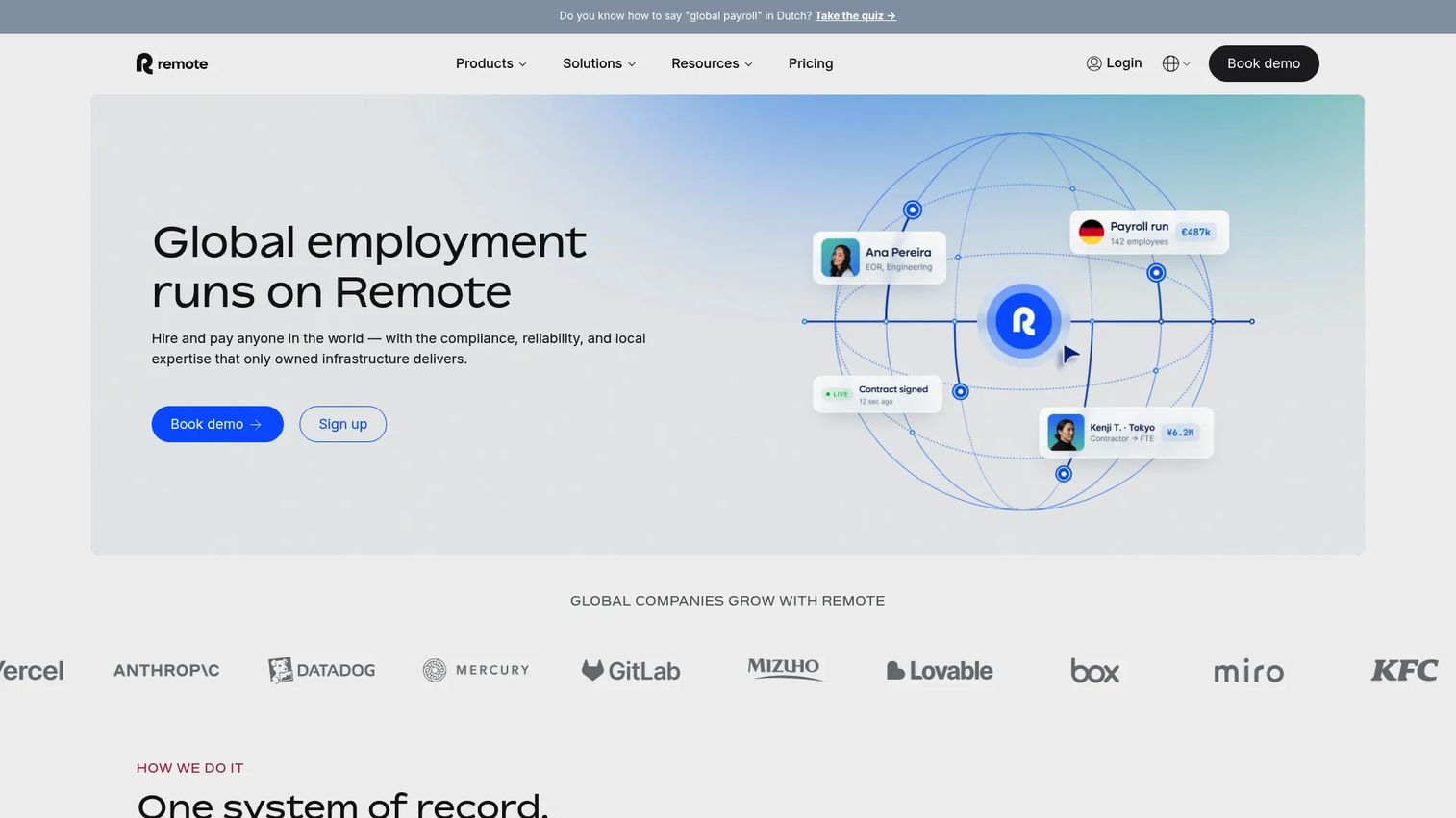
Remote is a global HR, payroll, contractor, and hiring platform built for distributed teams. It combines Employer of Record hiring, global payroll, and contractor management in one place, with its own in-house infrastructure in many countries rather than a thin layer over local resellers. For a founder, that means fewer handoffs and one consolidated view of every person you pay, wherever they sit.
Best for: Companies hiring, paying, and managing distributed teams across countries who want one platform with strong automation.
Key strengths
- Employer of Record hiring: Hire compliantly in countries where you have no legal entity.
- Global payroll: Run multi country payroll with local compliance handled centrally.
- Contractor management: Pay and manage contractors alongside employees in the same system.
Why choose Remote: Remote fits teams that want to consolidate hiring, payroll, and contractor ops without stitching together separate vendors per country. It owns much of its in-country infrastructure, which reduces the lag and finger-pointing you get with partner-dependent models. For founders who want clean data and one dashboard, that consolidation is the point.
Remote pricing: Remote publishes tiered pricing. Payroll starts at £23 per employee per month, and Contractor Management starts at £23 per contractor per month. Employer of Record runs £559 per employee per month billed monthly, or £479 billed annually. There is a free HR Management tier for direct employees. Prices display in GBP with a currency selector on the pricing page.
2. Papaya Global
Papaya Global is a global workforce management platform spanning payroll, contractor management, EOR, payments, and compliance automation. Its differentiator is the payments layer: Papaya treats cross-border salary payments as a first-class product, so the money movement and the payroll calculation live in one system. That appeals to enterprises that need audit-grade control over both compliance and the actual flow of funds.
Best for: Enterprises needing global payroll, contractor, EOR, and payments operations in one platform.
Key strengths
- Global payroll and workforce management: Centralize multi-country payroll with compliance built in.
- EOR and contractor management: Hire employees and contractors across borders from one platform.
- Global payments and compliance automation: Execute and track cross-border payments with audit trails.
Why choose Papaya Global: Papaya is a strong pick when you are comparing top global payroll providers and payments control is non-negotiable. The combined payroll-and-payments model gives finance teams a clearer line of sight from gross pay to settled funds. It is built for scale and governance rather than scrappy early hiring.
Papaya Global pricing: Papaya publishes public pricing across several products. Payroll Plus is $29 per employee per month, Employer of Record is $499 per employee per month, and Contractor of Record is $295 per contractor per month. A lighter contractor solution runs $5 per contractor per month, and Payments OS is priced at $3.5 per transaction. Workforce OS, the broader suite, requires a tailored quote.
3. IRIS Software Group
IRIS Software Group provides integrated accounting, payroll, HR, and compliance software, with a centralized cloud portal through its IRIS Elements products. The pitch is service plus software: you get the tooling, plus local expertise and structured implementation support. For teams that would rather lean on a vendor for execution than build payroll ops internally, that blend is useful.
Best for: Mid-market firms needing accounting, payroll, HR, and compliance software from one vendor.
Key strengths
- Integrated software: Reduce admin by running accounting, payroll, and compliance from one group.
- IRIS Elements cloud products: Cloud-based accounts production, tax, AML, and practice workflows.
- Group accounts production: Enterprise-grade iXBRL tagging and consolidation workflows.
Why choose IRIS Software Group: IRIS suits mid-market teams that value an established vendor handling accounting and payroll under one roof, with reporting and compliance tooling to match. The service layer helps teams that want guidance on implementation rather than a pure self-serve setup. It leans toward firms that prioritize consolidation across finance functions.
IRIS Software Group pricing: IRIS publishes partial public pricing. Accounts Production Essentials includes a free 30-day trial, AML licensing starts from £250 on a 12-month contract, and compliance checks are billed separately at £2.50 per check. Other products direct you to contact the vendor for a quote, so plan to scope pricing during evaluation.
4. ADP
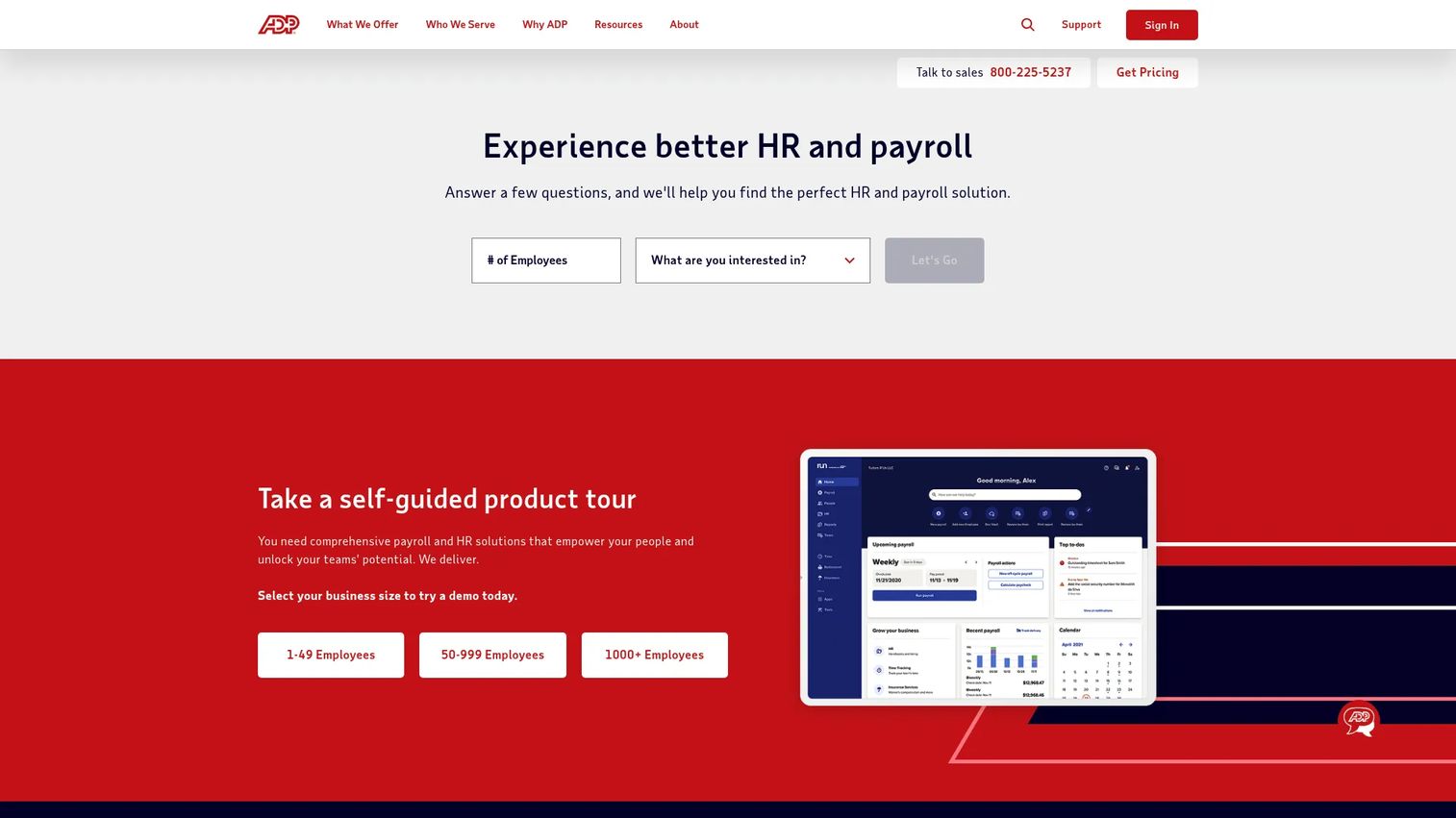
ADP is a cloud-based HCM, payroll, time, tax, and benefits platform with decades of enterprise track record. Where lighter tools optimize for speed, ADP optimizes for reliability and governance at scale. For larger organizations with strict controls, multi-entity structures, and audit requirements, that depth is the draw.
Best for: Businesses that want an all-in-one payroll and HCM platform with time and benefits built in.
Key strengths
- Payroll and HR management: Run payroll and core HR from one established platform.
- Time and attendance tracking: Capture hours and attendance tied directly to pay.
- Benefits administration: Manage benefits and mobile self-service alongside payroll.
Why choose ADP: ADP fits better than lighter tools when governance, scale, and breadth matter more than fast setup. Larger organizations with complex compliance needs and many entities get an enterprise-grade backbone that finance and audit teams trust. It is the choice when reliability outweighs the appeal of a leaner, newer platform.
ADP pricing: ADP's small-business payroll pages present plan comparisons with "Get pricing" prompts rather than public numbers. Pricing is quote-based and depends on headcount, entities, and the modules you need. Expect to go through sales to get a figure tailored to your footprint.
5. Deel
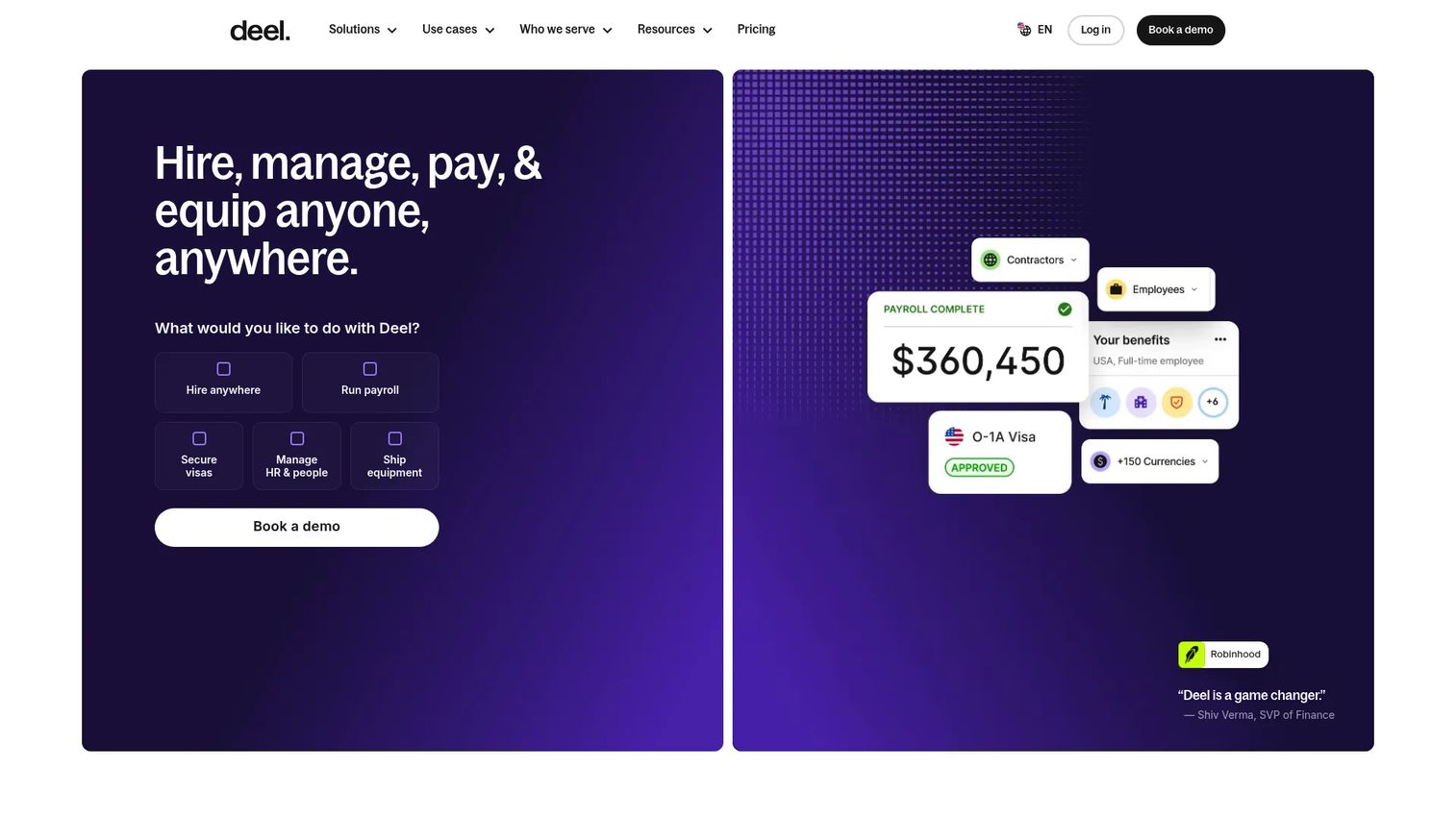
Deel is a global HR platform for hiring, paying, and managing workers across countries, covering EOR, contractors, and global payroll. It is more than payroll: Deel is built around fast international hiring, so onboarding someone in a new country can happen in days rather than weeks. For a Series B team scaling headcount quickly, that speed is often the deciding factor.
Best for: Companies hiring, paying, and managing distributed teams globally.
Key strengths
- Employer of Record hiring: Onboard employees compliantly without local entities.
- Contractor hiring and payments: Manage and pay contractors across many countries.
- Global payroll and HR management: Centralize multi-country payroll alongside core HR.
Why choose Deel: Deel is strong for teams that need to hire internationally fast and want payroll, EOR, and contractor ops in one place. Because it spans more than payroll, it doubles as a workforce platform as you grow. The trade-off worth noting: the breadth means you are buying a wider suite than a pure payroll engine, which is a plus if consolidation is your goal.
Deel pricing: Deel publishes public pricing. Global Payroll starts at $29 per employee per month. EOR Standard is $599 per employee per month, EOR Enterprise is $899, and PEO is $125 per employee per month. Contractor management starts at $49 per contractor per month, with Contractor of Record at $325. Some offerings such as ATS show contact-sales rather than public numbers.
6. CloudPay
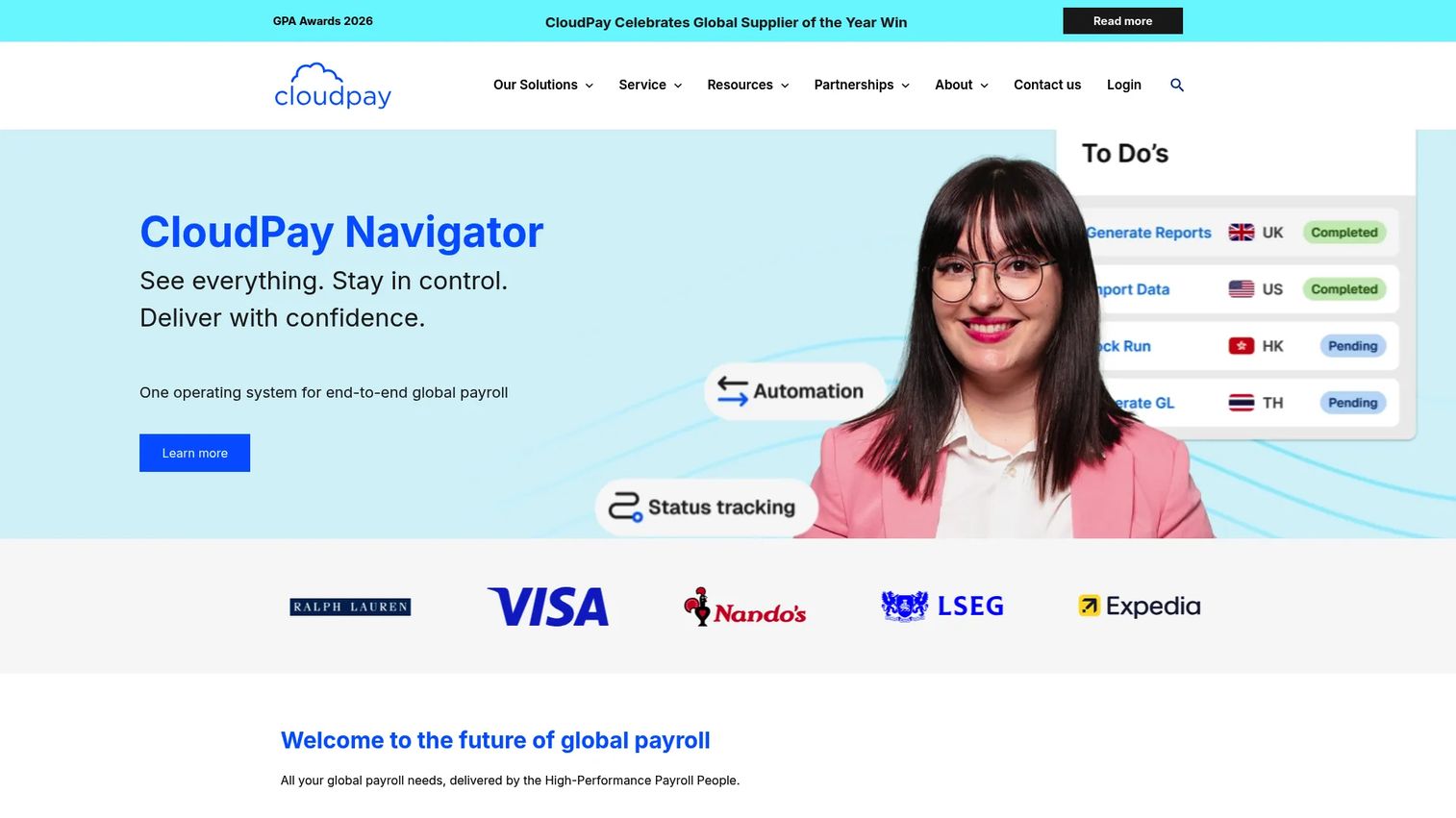
CloudPay is a global payroll, payments, and pay-on-demand provider on a unified cloud platform. Its orientation is managed payroll for multinationals: it handles salary calculation and the payments that follow, with an employee app and earned wage access on top. For teams prioritizing payroll visibility and cross-border payment control, CloudPay leans into that orchestration.
Best for: Multinational companies needing managed global payroll and payments.
Key strengths
- Global payroll and salary payments: Run payroll and execute cross-border salary payments together.
- Pay-on-demand: Offer earned wage access to employees.
- Employee app: Deliver payslips, wellbeing tools, and chatbot support in one app.
Why choose CloudPay: CloudPay fits teams that want a managed approach to global payroll where calculation and payment execution sit in one workflow. The payments and earned wage access features matter for organizations focused on the employee payment experience. It is built for multinational scale rather than early-stage hiring sprints.
CloudPay pricing: CloudPay does not expose public pricing on its site. The platform uses request-a-demo and contact-us flows, so pricing is quote-based and scoped to your country footprint and headcount. Plan to engage sales early to model total cost during your evaluation.
7. Rippling
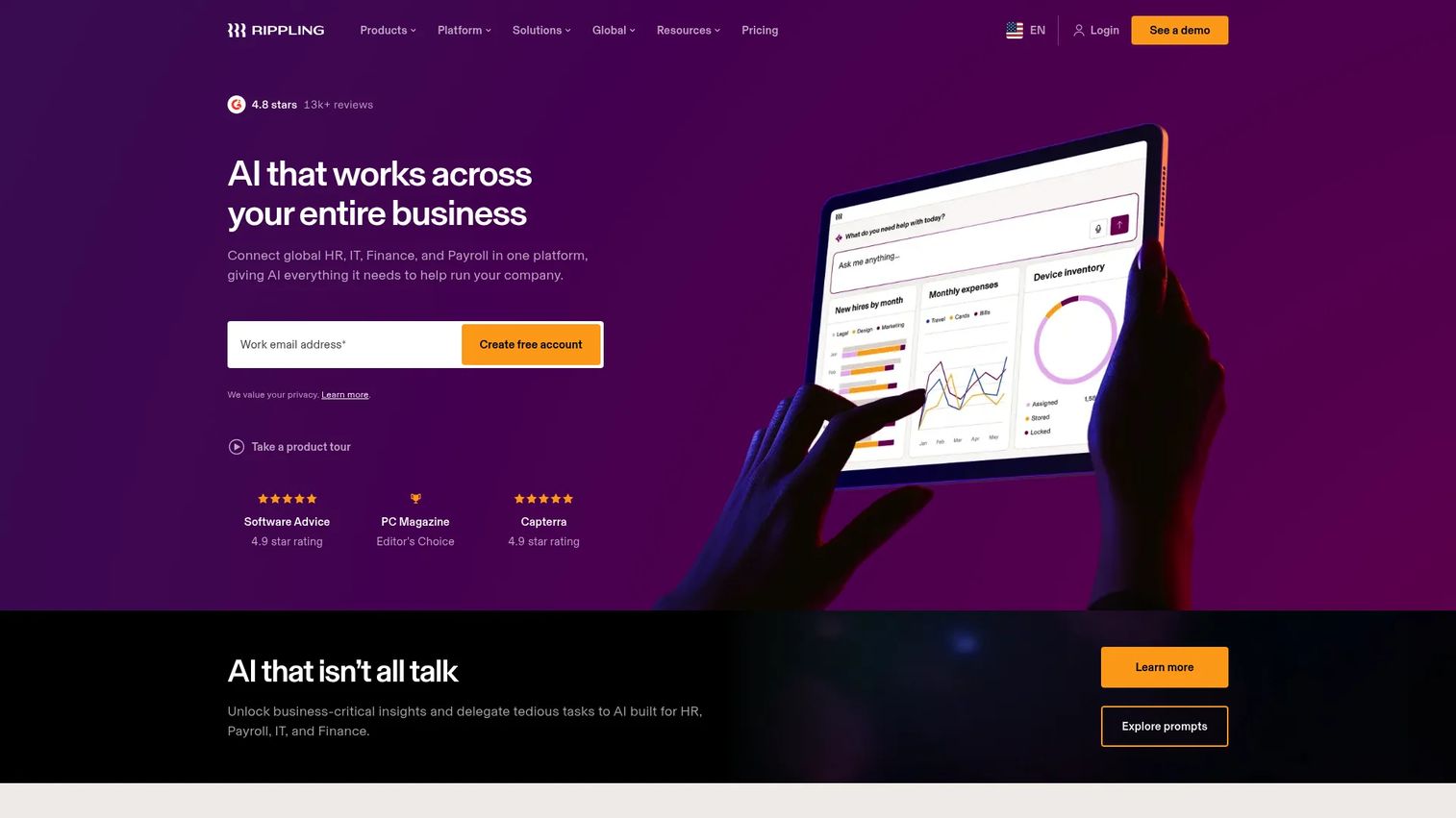
Rippling is a workforce management platform unifying HR, IT, payroll, and spend management. Teams compare it when they want payroll inside a broader operating system rather than as a standalone engine. The pitch is one source of truth for employee data that powers payroll, app provisioning, and expense controls from the same record.
Best for: Companies that want one platform for HR, payroll, IT, and spend operations.
Key strengths
- Unified platform: Run HR, payroll, IT, and finance from one employee record.
- Workflow automation: Automate approvals, onboarding, and permissions across functions.
- Global workforce and spend management: Manage global teams and spend in one place.
Why choose Rippling: Rippling is the pick when you want HR-suite convergence and payroll is one part of a bigger consolidation play. The practical difference worth understanding: global payroll requirements are deep and country-specific, while Rippling's strength is breadth across HR, IT, and spend. If unifying systems is the priority, that breadth is a real advantage.
Rippling pricing: Rippling uses custom, quote-based pricing, and products can be purchased separately alongside the core Rippling Platform. There is no public price number on its pricing page. Pricing scales with the modules and headcount you choose, so you will need a tailored quote.
8. Ceridian Dayforce
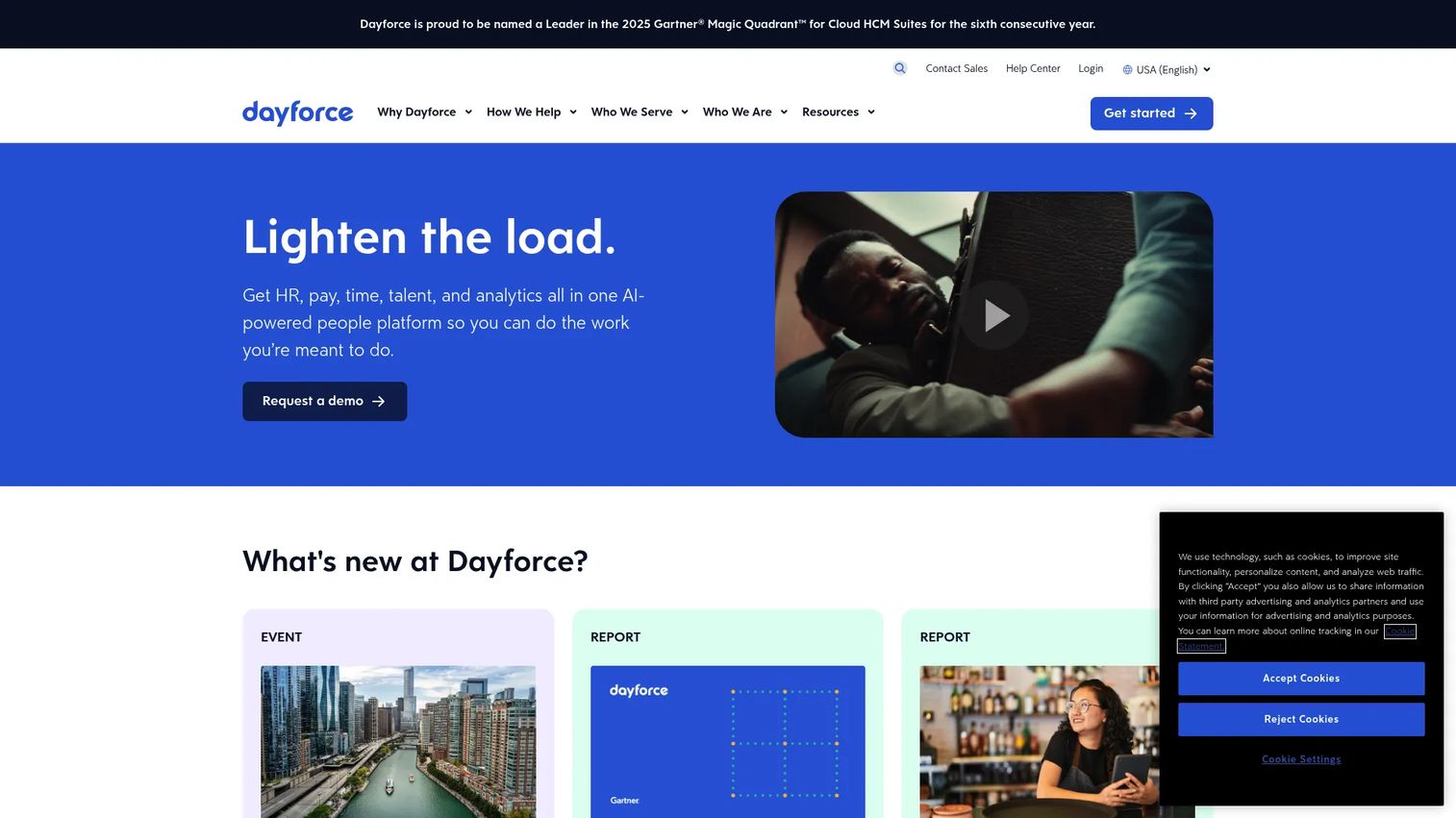
Ceridian Dayforce is a cloud HCM platform spanning HR, payroll, workforce management, talent, and analytics, including global payroll. It matters for teams that want payroll inside a larger operating system, with time, attendance, and reporting tied to the same data. For mid-market and enterprise organizations, that single-platform model reduces reconciliation across HR and pay.
Best for: Midmarket and enterprise organizations needing an all-in-one HCM suite.
Key strengths
- Payroll and global payroll: Run domestic and global payroll from one HCM platform.
- Workforce management: Tie time and attendance directly to pay.
- Reporting and analytics: Get payroll reporting and workforce insights in one place.
Why choose Ceridian Dayforce: Dayforce suits teams that want payroll as part of a full HCM suite rather than a point solution. The unified data model means time, pay, and talent share one source, which helps reporting and audit. It is most relevant for organizations large enough to benefit from an integrated workforce platform.
Ceridian Dayforce pricing: Dayforce does not publish pricing on its official site. The brand directs prospects to request a demo or contact sales, so pricing is quote-based and scoped to your size and module needs. Expect an enterprise sales process rather than a self-serve checkout.
9. Safeguard Global
Safeguard Global is a global workforce enablement platform for hiring, paying, managing, and analyzing international teams. It blends managed service with software, which helps teams that want less internal overhead running multi country payroll. The self-service portal handles worker profiles and documents, while Safeguard's team supports onboarding, payroll, and workforce analytics across countries.
Best for: Companies needing global hiring, contractor management, and payroll support across multiple countries.
Key strengths
- Global workforce platform: Recruit, hire, pay, manage, and analyze international teams.
- Self-service portal: Let workers update profiles and handle documents directly.
- Onboarding and analytics: Manage onboarding, time, expense, and payroll with workforce analytics.
Why choose Safeguard Global: Safeguard fits teams that want a managed-service blend rather than a purely self-serve platform, reducing the internal lift of running payroll across borders. The support layer helps when you would rather offload execution and focus on growth. It is a fit for organizations operating across many countries who value hands-on support.
Safeguard Global pricing: Safeguard publishes public pricing for contractor management at $10 per freelancer per month for 1 to 10 freelancers. The 11+ freelancers tier is listed but the price is not shown, and other solutions direct you to contact sales. Plan to scope broader payroll pricing during evaluation.
10. Oyster HR
Oyster HR is a global employment platform for hiring, paying, and managing international contractors and employees, with EOR in 180+ countries. It is strongest for growing companies hiring internationally without standing up local entities too early. Be clear on scope: Oyster shines at international employment and contractor management, so payroll-only buyers with large in-house payroll needs should confirm fit against pure payroll engines.
Best for: Companies hiring and paying workers across multiple countries.
Key strengths
- Employer of Record in 180+ countries: Hire compliantly almost anywhere without an entity.
- Global contractor management: Onboard and pay contractors across borders.
- Payroll integrations: Connect with HR and payroll tools to keep data accurate.
Why choose Oyster HR: Oyster is a strong pick for fast-growing teams that need to hire across many countries before building local entities. Its broad EOR coverage and contractor tooling make early international expansion practical. The honest note: if your core need is deep, high-volume domestic payroll rather than distributed hiring, evaluate it against dedicated payroll platforms.
Oyster HR pricing: Oyster publishes public pricing. Global Contractors is $29 per contractor per month, Employer of Record is $699 per employee per month, and People Services is $300 per hour. It is free to create an account and explore the platform, with fees applying once you engage a contractor, EOR team member, or payroll team member.
Considerations before you buy
Use this checklist to pressure-test any global payroll platform before committing.
Country coverage and in country experts
Confirm whether coverage is owned infrastructure or a partner network, and how that affects payroll setup time and accuracy. Ask specifically about the countries you operate in today and the next three you plan to enter. Partner-dependent coverage can be fine, but you want to know where the handoffs are.
Payroll compliance and security
Verify how the platform handles local tax, filings, and labor law, and who carries liability when something is wrong. Check payroll security controls: data encryption, permissions, and access logs. For a founder preparing for due diligence, traceable controls are not optional.
Payroll software pricing and total cost
Look past the headline per-employee number. Map implementation fees, per-country surcharges, and payments costs into a total. Quote-based vendors are not a red flag, but model the full cost across your real footprint before signing.
Payroll integrations and reporting
Confirm the platform connects to your HR system and accounting stack, and that payroll reporting gives finance the visibility it needs. Clean payroll integrations are what keep your numbers accurate and your close fast. Weak integrations mean someone is back in spreadsheets.
Implementation and payroll consolidation
Ask for a realistic implementation timeline based on your country count and data complexity. The promise of payroll consolidation only pays off if the migration actually lands. Get reference customers at your stage and size, not just enterprise logos.
Conclusion
The shortlist comes down to your scenario. For centralized control and broad coverage, Remote is the strongest overall pick. For enterprise compliance and global payments, Papaya Global and ADP lead. For fast international hiring without standing up entities, Deel and Oyster HR move quickest. For HR-suite convergence, Rippling and Ceridian Dayforce fold payroll into a larger workforce system. And for a managed-service blend with less internal overhead, Safeguard Global, CloudPay, and IRIS Software Group fit well.
Your next step depends on your stage. If you are consolidating fragmented payroll, pick one primary global payroll platform and validate its compliance coverage in your actual countries. If you are entering new markets, prioritize hiring speed and in-country coverage. Either way, model the total cost and demand an implementation timeline before you sign. The right platform turns payroll from a board-level risk into a quiet, predictable line item.
FAQs
Global payroll software is a centralized platform that runs payroll across multiple countries while handling local compliance, currency payments, reporting, and integrations. It replaces fragmented in-country providers and spreadsheets with one system, giving finance teams a single view of multi country payroll operations.
Local payroll software handles one country's tax tables, filings, and payment rails. Global payroll software adds country coverage across many jurisdictions, multi-currency payment orchestration, and centralized compliance handling. The difference shows up in scale: managing fifteen local tools versus one platform with consistent controls and reporting.
Prioritize payroll compliance handling for local tax and labor law, payroll automation with audit trails, payroll integrations into HR and accounting, reliable cross-border payments, payroll reporting for visibility, and payroll security with granular permissions. The best global payroll companies deliver all six without forcing point-tool bolt-ons.
Payroll software pricing typically comes as per-employee or per-contractor monthly fees, quote-based enterprise packaging, or both. Public pricing is common for contractor and EOR products, while broader suites require a quote. The hidden costs are implementation fees, per-country surcharges, and payments charges, so model total cost across your real footprint.
They overlap but are not identical. An employer of record (EOR) legally employs your workers in countries where you have no entity. Global payroll software runs payroll across countries, often including EOR as one capability. Many global payroll providers bundle both, but you can use payroll software without using EOR.
Prioritize visibility across every entity, compliance coverage in your actual countries, payroll automation that produces audit-ready records, and a clean handoff to finance or ops so you are not the bottleneck. The goal is turning payroll from a board-level risk into a predictable, delegated system.
Timelines vary by country count and data complexity. A single-country setup can go live in a few weeks, while a multi-country migration with many entities can take a few months. Ask vendors for a realistic timeline based on your footprint and request reference customers at your stage.
Yes. Most platforms offer payroll integrations with HR systems and accounting or ERP tools. Integrations matter because they keep employee and pay data consistent across systems, reduce manual entry errors, and feed accurate numbers into payroll reporting and your financial close.