


A change order lands in the field on a Tuesday. By the time it moves through a foreman's phone photo, a project engineer's spreadsheet, three email threads, and a PM waiting on a signature, it's Friday. The crew already did the work. Now nobody agrees on the number.
That gap between field reality and office approval is where margin leaks. Slow sign-offs turn into disputed billings. Disputed billings turn into unpaid work. And the more projects a team runs, the worse the drift gets.
The market is responding. The broader change order management software category is estimated at $1.2 billion in 2024, projected to hit $4.8 billion by 2033 at a 19.5% CAGR, according to a 2024 Change Order Management Software Market Analysis published on LinkedIn. Construction teams are moving off spreadsheets and shared inboxes fast.
Here's what actually separates the tools worth shortlisting: how quickly a change order gets from the field to a decision, whether the budget updates the moment it's approved, and whether you can prove who approved what, when, months later in a dispute.
What's inside
This guide ranks 8 change order software tools built for construction teams in 2026. It's written for general contractors, specialty and trade contractors, owners, and the project managers who own the systems decision.
We selected and ordered tools based on four criteria that matter more than marketing claims:
- Approval workflow depth: multi-level routing, notifications, and field-to-office handoff speed
- Mobile field capture: how easily crews log changes, T&M tags, and photos on site
- Budget and forecast sync: whether approved changes update commitments and cost forecasts live
- Auditability and integrations: version history, audit trails, and ERP or accounting connectivity
TL;DR
- Best for live shared change order logs: Clearstory, built around a shareable COR log and digital T&M tags that keep contractors and owners aligned in real time.
- Best for all-in-one construction platforms: Procore, if your team already runs project execution and financials in one place.
- Best for trade and specialty contractors: eSUB Cloud, purpose-built for commercial subcontractor field-to-office workflows.
- Best for capital project controls: InEight, for change management embedded inside governed project controls.
- Best for configurable enterprise workflows: Kahua, for owners and program managers running complex portfolios.
- Best for highly governed capital programs: Oracle Primavera Unifier, with deep multi-level approvals and audit logs.
- Best for cost-impact clarity: Hexagon EcoSys, for controls-heavy teams tracking change trends against forecast.
- Best for ERP-adjacent financial control: CMiC, linking change events straight to contracts, commitments, and the cost ledger.
What is change order software?
Change order software is a construction tool that captures, routes, approves, and tracks changes to a project's scope, cost, or schedule, then updates budgets and creates an audit trail without spreadsheets or email chains.
It replaces the manual back-and-forth that slows sign-offs and buries accountability. Instead of a photo texted to a PM and a number typed into a spreadsheet, the change moves through a structured workflow everyone can see.
Buyers should expect these core capabilities:
- Capture and submission: log a change from the field with photos, quantities, and T&M detail
- Approval workflows: route for multi-level review with clear ownership at each step
- Notifications: alert the right person the moment a change needs action
- Version tracking: keep a full history of edits, revisions, and status changes
- Audit trails: prove who approved what and when, defensible in a dispute
- Budget updates: push approved changes into commitments, contingency, and forecasts
Three capabilities separate strong construction change order management software from generic tools:
- Mobile access: field crews document changes on a phone or tablet at the point of work, not hours later at a desk.
- Field-to-office collaboration: a single source of truth so the foreman, PM, and finance see the same status without a phone call.
- ERP and accounting connectivity: approved change orders flow into the systems that actually cut invoices and track job cost.
When to use change order software
Reduce approval delays
Change orders stall when they depend on someone being at a desk. A crew logs work in the field, but the approval waits until a PM opens their laptop that evening, or the next morning, or after the weekend.
Construction change order software collapses that gap. The field captures the change on mobile, the system routes it instantly, and the approver gets a notification with everything they need to decide. Faster notifications mean faster sign-offs, which means crews aren't performing disputed work on faith.
Protect budget and forecast accuracy
Finance and project controls can't forecast on stale numbers. When an approved change doesn't hit the budget until someone manually re-keys it, commitments, allowances, and contingency drift out of sync with reality.
Use change order management software when your team needs approved changes to update the budget the moment they're approved. Live budget synchronization keeps forecasts honest and flags cost drift before it becomes a surprise at closeout.
Standardize communication across stakeholders
Owners, general contractors, specialty contractors, and field teams each keep their own version of the truth. That's how a single change ends up with three different dollar amounts.
A shared system gives every stakeholder one source of truth. Everyone sees the same status, the same documentation, and the same audit trail. When a change is contested six months later, the record is already there, versioned and timestamped.
Comparison table
The tools below are ranked by fit for the change order job specifically, not by how big the vendor is. We weighted approval workflow depth, mobile field capture, budget sync, and auditability. Pricing reflects publicly available information as of mid-2026; several vendors quote custom pricing based on construction volume or user count. G2 ratings are pulled from each product's live G2 listing.
| # | Product | Best for | Key differentiator | Pricing | G2 rating |
|---|---|---|---|---|---|
| 1 | Clearstory | Live shared COR and T&M collaboration | Shareable change order log with digital T&M tags | Free Basic tier; higher tiers contact sales | 4.8/5 |
| 2 | Procore | All-in-one construction platform teams | Change orders inside full project and financial platform | Custom quote | 4.6/5 |
| 3 | eSUB Cloud | Commercial trade and specialty contractors | Subcontractor-first field-to-office workflows | Contact sales | 4.0/5 |
| 4 | InEight | Capital construction project controls | Change management inside governed project controls | From $37/mo (NOW); enterprise custom | 4.1/5 |
| 5 | Kahua | Configurable enterprise portfolios | Asset-centric, highly configurable workflows | Custom quote | 4.3/5 |
| 6 | Oracle Primavera Unifier | Highly governed capital programs | 125+ preconfigured processes, deep audit logs | Custom quote | 4.3/5 |
| 7 | Hexagon EcoSys | Controls-heavy cost forecasting | Change trends tied to earned value and forecast | Custom quote | 4.2/5 |
| 8 | CMiC | ERP-adjacent financial control | Change events linked to contracts and cost ledger | Custom quote | 3.8/5 |
Best change order software for 2026
1. Clearstory
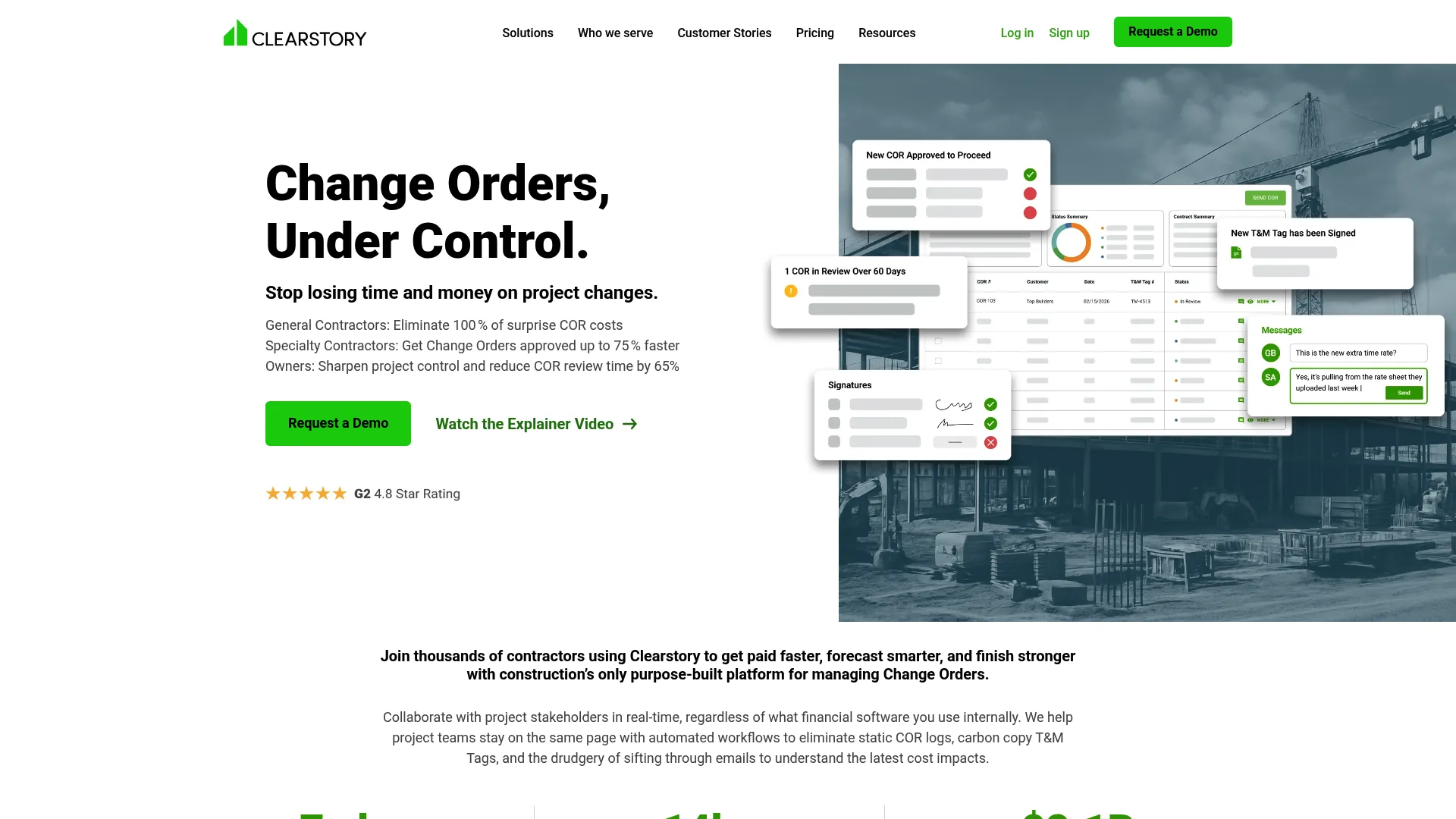
Clearstory is a construction change order communication platform built around a shareable change order request log and digital time and materials tags. Instead of a change order living in one company's inbox, it lives in a shared log that contractors and owners see at the same time. That real-time visibility is the point: fewer surprises, fewer contested numbers, faster alignment.
The T&M mobile app lets field crews document extra work as it happens, with quantities and photos captured on site. Change notifications, analytics, and allowance tracking round out the workflow, and integrations connect the log to the rest of a team's stack.
Best for: Construction teams that want contractors and owners aligned on change orders and T&M in real time.
Key strengths
- Live shareable change order log
- Digital T&M tags and mobile field app
- Change notifications and analytics
- Allowance tracking and integrations
Why choose Clearstory: If disputed change orders and slow owner sign-off are your biggest source of margin leak, a shared log that both sides watch in real time removes the guessing. It's the strongest pick for teams whose pain is stakeholder alignment, not just internal routing.
Clearstory pricing: Clearstory offers a free Basic tier. Standard and Professional plans are contact-sales, with per-user and per-project fees referenced but no public numeric price listed.
2. Procore

Procore is a cloud-based construction management platform that handles change orders inside a broader system for project execution and financials. Change order workflows sit alongside cost management, project financials, bid management, submittals, and scheduling, so an approved change updates the budget without leaving the platform.
For teams already running Procore, change management isn't a separate tool to adopt. Mobile capture pulls field data in, and budget sync keeps project financials current. The tradeoff is scope: this is a full construction platform, not a lightweight change order app.
Best for: Construction teams that want change orders inside one platform covering project execution and financial control.
Key strengths
- Change orders within full project management
- Cost management and project financials
- Mobile field capture
- Bid management, submittals, and scheduling
Why choose Procore: Choose Procore when you'd rather run change orders inside the system that already owns your budgets and field data than bolt on a standalone tool. The value grows with how much of your workflow already lives there.
Procore pricing: Procore uses custom quote pricing based on the products you need and your annual construction volume, billed as an upfront annual fee. Contact Procore for a quote.
3. eSUB Cloud
eSUB Cloud is construction management software built specifically for commercial subcontractors. Where general-contractor platforms treat the sub as one party in a bigger workflow, eSUB centers the trade contractor's reality: daily reports, field notes, RFIs, submittals, purchase orders, and change orders that start on site.
That focus matters for change management. Field crews capture extra work in daily logs and field notes, and change orders flow from documented field activity rather than a reconstructed memory of what happened. For trade teams whose revenue depends on getting paid for scope changes, that documentation trail is the whole game.
Best for: Commercial subcontractors that need field-to-office project management centered on the trade contractor's workflow.
Key strengths
- Daily reports and daily log management
- RFIs, submittals, and change orders
- Field notes for on-site documentation
- Purchase order tracking
Why choose eSUB Cloud: If you're a specialty or trade contractor tired of using tools built for GCs, eSUB fits your workflow instead of forcing you into someone else's. It's the pick when the documentation trail behind each change is what protects your billing.
eSUB Cloud pricing: eSUB does not list public pricing. Contact eSUB for a quote based on your team and project needs.
4. InEight

InEight is a capital construction project controls platform with modular applications spanning planning, scheduling, document control, and project management. Change management here isn't a standalone feature; it's embedded inside a governed project controls environment where cost and forecast sync with the rest of the project.
That's the fit for large, complex work. When a change affects cost and schedule, InEight ties the change to forecasting and reporting through its Report & Explore dashboards, so project controls teams see the ripple effect rather than a disconnected line item. The modular structure lets teams configure the depth they need.
Best for: Large capital-construction teams that need change management inside configurable, governed project controls.
Key strengths
- Modular integrated project controls platform
- Construction scheduling with collaboration and AI tools
- Cost and forecast synchronization
- Report & Explore dashboards and standardized reports
Why choose InEight: Choose InEight when governance and project controls matter as much as speed, and when changes need to flow into cost forecasting rather than sit in an approvals queue. It's built for capital work, not quick field fixes.
InEight pricing: InEight NOW offers public per-user pricing starting around $37/month billed annually, or $55/month monthly. Enterprise project controls pricing is custom; contact InEight for a quote.
5. Kahua
Kahua is a construction project management platform serving owners, program managers, general contractors, and subcontractors. Its differentiator is configurability: an asset-centric, cloud-based system where teams shape document exchange, versioning, and collaborative controls around the way their projects actually run.
For change orders, that flexibility means workflows can match complex approval chains across multiple parties. Versioning keeps a clear history of each change, document exchange keeps the paper trail intact, and integrations connect Kahua to the rest of a program's tools. It's a fit for organizations that don't want to force their process into a rigid template.
Best for: Capital construction organizations that need configurable project, cost, and change workflows across complex portfolios.
Key strengths
- Asset-centric construction project management
- Cloud-based document and workflow management
- Configurable versioning and collaborative controls
- Integrations with leading industry tools
Why choose Kahua: Choose Kahua when your projects are complex enough that off-the-shelf workflows don't fit, and when owners and program managers need to configure approval routing rather than accept a fixed one. Flexibility is the reason to be here.
Kahua pricing: Kahua uses custom quote pricing based on organization needs, project size, user count, and required features. Contact Kahua for a customized quote.
6. Oracle Primavera Unifier
Oracle Primavera Unifier is Oracle's cloud solution for managing capital projects, facilities, and assets. It ships with 125+ preconfigured business processes and 250+ reports and dashboards, giving highly governed organizations a deep foundation for structured change control.
For change orders, the strength is depth of governance. Multi-level approvals route changes through the exact chain a regulated program requires, audit logs capture every action for defensibility, and schedule integration ties changes to project timelines. REST APIs and Oracle Integration support connect it to enterprise systems. This is change management for programs where the audit trail is non-negotiable.
Best for: Enterprises managing capital projects, facilities, and asset lifecycles under strict governance.
Key strengths
- 125+ preconfigured business processes
- Multi-level approval workflows
- Detailed audit logs and 250+ reports
- Schedule integration and REST APIs
Why choose Oracle Primavera Unifier: Choose Unifier when your environment demands rigorous governance and a defensible audit trail on every change, and when the program is large enough to justify Oracle-grade infrastructure. It's built for the highly governed end of capital construction.
Oracle Primavera Unifier pricing: Oracle does not publish current public pricing for Unifier. Contact Oracle for enterprise licensing based on your program requirements.
7. Hexagon EcoSys

Hexagon EcoSys is enterprise project performance software for project controls, earned value management, budgeting, forecasting, and reporting. It positions change management as part of a broader controls environment where the cost impact of every change is visible against the forecast.
That's the differentiator for controls-heavy teams. When a change is proposed, EcoSys shows its cost impact and approval status inside the same system that tracks earned value and progress. Change trend tracking lets teams see where scope is drifting over time, not just in a single order. For organizations that live in forecasting, this keeps changes and cost reality connected.
Best for: Large project-driven organizations that need centralized project controls, EVM, and cost-impact clarity on changes.
Key strengths
- Earned value management
- Budget and change management in one environment
- Progress measurement and forecasting
- Change trend tracking and cost-impact visibility
Why choose Hexagon EcoSys: Choose EcoSys when project controls and earned value are the center of your operation, and when every change needs to be understood in the context of forecast and trend. It's for teams that measure everything.
Hexagon EcoSys pricing: EcoSys does not publish public pricing. Contact Hexagon for enterprise pricing based on your project portfolio.
8. CMiC

CMiC is a construction ERP software suite covering financials, project management, workflow, analytics, and integrations. Its differentiator for change orders is the direct link between change events and the financial backbone: contracts, commitments, and the cost ledger all connect, so an approved change moves into job cost without re-keying.
For contractors who want change management inside their system of financial record, that connection is the whole value. Change events tie to job costing, project management keeps field collaboration in the loop, and workflow and analytics give visibility across the ledger. This is change management for firms that treat construction financials as the source of truth.
Best for: Construction firms that need an integrated ERP linking change events to contracts, commitments, and the cost ledger.
Key strengths
- Construction financials and job costing
- Change events linked to contracts and commitments
- Project management and field collaboration
- Workflow, analytics, and integrations
Why choose CMiC: Choose CMiC when you want change orders living inside your ERP rather than syncing into it later, and when tight financial control across the ledger matters more than lightweight field speed. It fits firms that anchor everything to job cost.
CMiC pricing: CMiC uses quote-based pricing and does not publish public rates. Request a quote through CMiC's site.
Conclusion
The right change order software depends on which part of the workflow hurts most.
If disputed numbers and slow owner sign-off are the problem, Clearstory's shared log keeps both sides aligned in real time. If you want change orders inside one platform that already runs your budgets and field data, Procore fits. Trade and specialty contractors get a workflow built for them in eSUB Cloud.
For capital work under governance, InEight and Oracle Primavera Unifier bring project controls depth and defensible audit trails. Kahua wins on configurability for complex portfolios. Hexagon EcoSys ties changes to earned value and forecast for controls-heavy teams. CMiC links change events straight into an ERP cost ledger.
Don't buy on brand or feature lists alone. One 2026 analysis from USTech Automations, summarizing ENR and FMI data, found contractors who selected platforms based on specific change-order automation capabilities hit 87% full adoption, versus 54% for those who chose mainly by brand or peer recommendation.
Shortlist two or three tools. Then run each against one live project scenario: capture a real change in the field, route it for approval, and watch how fast it hits the budget. The tool that survives that test is your tool.
FAQs
Change order software is a construction tool that captures, routes, approves, and tracks changes to a project's scope, cost, or schedule. It replaces spreadsheets and email threads with a structured workflow that updates budgets and keeps a full audit trail. The goal is faster approvals and defensible documentation when a change is later contested.
The features that matter most are approval workflow depth, mobile field capture, live budget and forecast sync, and a defensible audit trail. Multi-level routing with notifications speeds sign-offs, mobile capture logs changes at the point of work, and budget sync keeps forecasts honest. ERP or accounting integration matters when approved changes need to flow into job cost.
It routes each change through a defined multi-level workflow and notifies the right approver the moment action is needed. Instead of a change waiting for someone to open their laptop, the approver gets a mobile notification with the documentation attached. That collapses the field-to-office gap that causes crews to perform disputed work before it's signed off.
Yes. Most construction change order management software offers ERP or accounting connectivity so approved changes update commitments and job cost automatically. Platforms like CMiC link change events directly to the cost ledger inside an integrated ERP, while others sync to external accounting systems. This removes manual re-keying and keeps financials current.
Mobile access is one of the most important capabilities for construction teams. Field crews document extra work, quantities, and photos at the point of work rather than reconstructing it hours later at a desk. Mobile capture shortens the field-to-office handoff and produces a stronger documentation trail behind every change.
Change order software focuses specifically on capturing, approving, and tracking scope, cost, and schedule changes with a defensible audit trail. Construction project management software covers a broader range including scheduling, submittals, RFIs, and daily reports. Some platforms like Procore and Kahua combine both, so change management lives inside the wider system.
Every contractor type benefits, but the fit varies. Specialty and trade contractors gain the most from field-first tools like eSUB Cloud that protect billing through documentation. General contractors often prefer platform tools like Procore, while owners and program managers running capital work lean toward configurable or governance-heavy systems like Kahua, InEight, and Oracle Primavera Unifier.