
You built a run/walk/ride campaign that should have taken off. Supporters signed up. Then most of them never shared their page, never hit their goal, and never came back the next year. The campaign was fine. The mechanics that turn one supporter into ten donors were not.
That gap is where peer to peer fundraising software either earns its cost or quietly leaks revenue. The tool decides how easy it is for a volunteer to launch a branded page, share it in two taps, watch progress update, and get a thank-you that pulls them back next season. When that path has friction, supporters stall. When it flows, a single email list turns into a network of fundraisers you never had to recruit directly.
The category is growing fast. The global peer-to-peer fundraising tool market was valued at USD 1.2 billion in 2024 and is projected to reach USD 3.46 billion by 2033 at a 12.27% CAGR, according to Straits Research (2024). Yet the same research cites Chronicle of Philanthropy data showing 45% of nonprofits still do not use peer-to-peer methods, mostly because they do not understand the tools. That is the real opportunity. The top 30 U.S. peer-to-peer programs collectively raised more than USD 1.14 billion in the most recent year, marking four consecutive years of growth, per the Peer-to-Peer Professional Forum.
This guide reads like the comparison content you would build if you were shopping yourself: campaign fit, supporter experience, analytics depth, and net revenue after fees. If you also evaluate other parts of your stack, our roundups of affiliate marketing software and AI customer service software follow the same buyer-first format.
What's inside
This guide compares 9 peer to peer fundraising platforms built for nonprofits running supporter-led campaigns. We looked at the tools most often shortlisted by development teams, marketing leads, and fundraising operations owners, then evaluated each against the criteria that actually move net revenue.
Selection was based on four things: supporter experience (how fast a fundraiser can launch and share a page), campaign flexibility (run/walk/ride, ambassador, event, and third-party formats), analytics and reporting depth, and cost transparency (platform fees, processing fees, and tip-based models). Every pricing figure and rating below reflects each vendor's published pages and current G2 listing.
TL;DR
- Best for enterprise nonprofits and integrated suites: Blackbaud, when peer-to-peer sits inside a full fundraising and financial stack.
- Best for campaign variety and gamification: RallyUp, with raffles, a-thons, crowdfunding, and peer-to-peer under one roof.
- Best for donation conversion and global giving: Donorbox, for embeddable forms and recurring giving.
- Best transparent public pricing: Qgiv (now Bloomerang Fundraising), with published per-plan tiers.
- Best for live events plus peer-to-peer: OneCause, for auctions, galas, and team fundraising together.
- Best for digital-first storytelling teams: CauseVox, with branded campaign pages and a built-in CRM.
What is peer to peer fundraising?
Peer to peer fundraising is a model where your supporters raise money on your behalf by creating their own personal fundraising pages and sharing them with their networks. Instead of asking every donor directly, you activate a layer of volunteer fundraisers who ask for you.
Here is what is peer to peer fundraising in practice. A supporter signs up for your campaign, gets a personal page pre-loaded with your branding and their story, sets a goal, and shares the link by text, email, and social. Their friends donate, the page shows a live progress bar, and receipts go out automatically. You get more reach because each fundraiser taps a network you could never email directly.
Non profit peer to peer fundraising software handles the mechanics that make this repeatable:
- Branded campaign pages that match your look and let supporters personalize their story.
- Social sharing tools that make link distribution a two-tap action across channels.
- Team pages and leaderboards that add friendly competition and group goals.
- Automated receipts and tax acknowledgments so no manual admin piles up.
- Analytics and reporting on participants, shares, donations, and conversion.
- CRM connections that push donor data into your system of record for follow-up and donor retention.
The distinction that matters: a crowdfunding page collects donations from anyone who lands on it, while a p2p fundraising software program multiplies a single cause across dozens of supporter-owned pages. The multiplier is the point.
When to use peer to peer fundraising software
Not every campaign needs a peer-to-peer engine. These three patterns are where the model consistently pays off.
Launch run, walk, and ride campaigns
Event-based fundraising is the classic peer-to-peer motion. Participants register, get individual and team pages, and raise money as part of training for a 5K, a cycling event, or a walkathon. The software handles registration, participant pages, team leaderboards, and progress tracking so your staff is not rebuilding a spreadsheet the night before the event.
Activate ambassadors and volunteers
When you have supporters who already love your cause, an online fundraising platform lets them become fundraisers. Ambassador and birthday campaigns, workplace giving drives, and DIY third-party fundraisers all rely on the same mechanic: give a motivated person a page and a share button, and they bring in donors you never reached. This is supporter activation at its most efficient, because network growth compounds without proportional staff effort.
Turn campaigns into repeatable programs
The best fundraising platforms do not just run one event. They store donor data, automate follow-up, and surface which supporters raised the most so you can invite them back. Tie analytics and reporting to a CRM and a one-time walkathon becomes an annual program with rising donor retention year over year.
Comparison table
Read the table left to right by your primary need. "Intent" tells you the buyer this fits best. "Key use case" is the campaign type each tool is strongest at. Pricing reflects published starting points or fee models, and the G2 rating is each tool's current score. Custom pricing means the vendor quotes based on your needs rather than listing a public price.
| # | Product | Intent | Key use case | Pricing | G2 rating |
|---|---|---|---|---|---|
| 1 | Blackbaud | Enterprise nonprofit suite | Full-spectrum fundraising and financials | Custom pricing | 3.8/5 |
| 2 | RallyUp | Campaign variety | Raffles, a-thons, crowdfunding, P2P | Free plan; Flex 2.9%–6.9% | 4.8/5 |
| 3 | Donorbox | Donation conversion | Embeddable forms, recurring giving | Free; Pro $150/mo | 4.6/5 |
| 4 | Giveffect | All-in-one operations | Fundraising plus volunteers and CRM | Custom pricing; 14-day trial | 4.1/5 |
| 5 | GoFundMe Pro | Awareness-driven reach | Branded campaigns and donation forms | Custom pricing | 4.3/5 |
| 6 | Qgiv | Transparent pricing | Configurable event and P2P tools | Free; P2P $259/mo | 4.7/5 |
| 7 | Bloomerang Fundraising | Fundraising plus CRM | Donor management with P2P | From $40/mo, billed annually | 4.6/5 |
| 8 | CauseVox | Digital-first storytelling | Branded campaign pages | Free; Starter $100/mo | 4.3/5 |
| 9 | OneCause | Live event fundraising | Auctions, galas, team P2P | From $200 pay-as-you-go | 4.7/5 |
1. Blackbaud
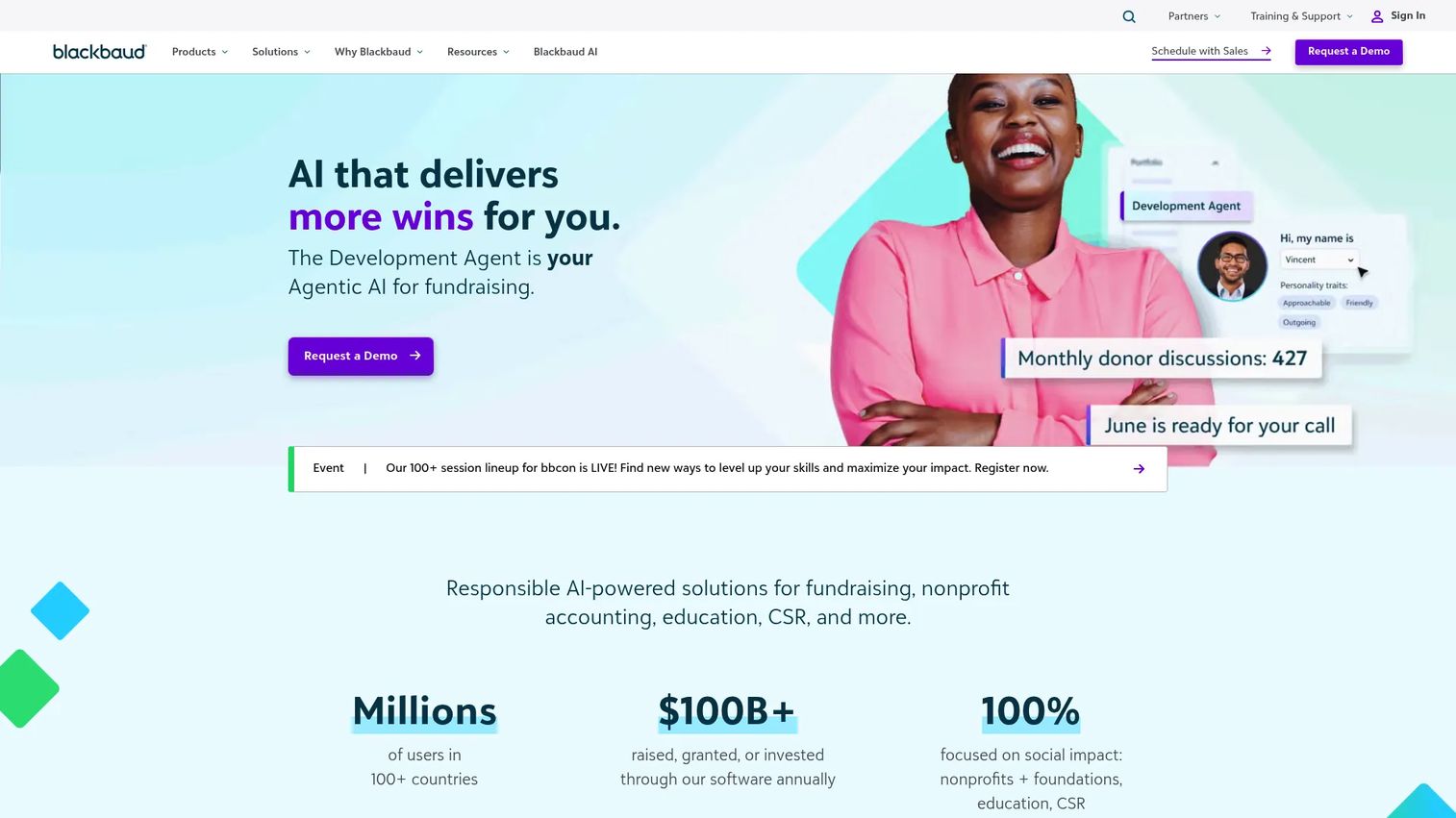
Blackbaud is a software provider for social impact organizations, with products spanning fundraising, nonprofit financial management, education, and grantmaking. For large nonprofits, peer-to-peer is one motion inside a much broader ecosystem, which is exactly the appeal. If your development, finance, and program teams already live in a connected system, keeping supporter campaigns in the same environment avoids the data silos that fragment donor records.
Best for: Enterprise nonprofits and education organizations that want peer-to-peer inside an integrated social impact software suite.
Key strengths
- Integrated suite: Fundraising, financials, and donor management connect so supporter data flows into one record.
- Full-spectrum coverage: Handles events, campaigns, and recurring giving alongside peer-to-peer.
- Enterprise reporting: Deep analytics for teams accountable to boards and grantmakers.
Why choose Blackbaud: The case is consolidation. If your organization is large enough that fragmented tools create real reporting and reconciliation pain, an integrated suite pays for itself in cleaner data and fewer handoffs. Smaller teams may find the breadth more than they need, which is where lighter tools further down this list fit better.
Blackbaud pricing: Blackbaud does not publish a public starting price. The pricing page directs you to request a personalized quote, and cost is customized to your organization's size and product mix. Budget for an enterprise-tier commitment rather than a low monthly plan. Blackbaud holds a 3.8/5 rating on G2.
2. RallyUp
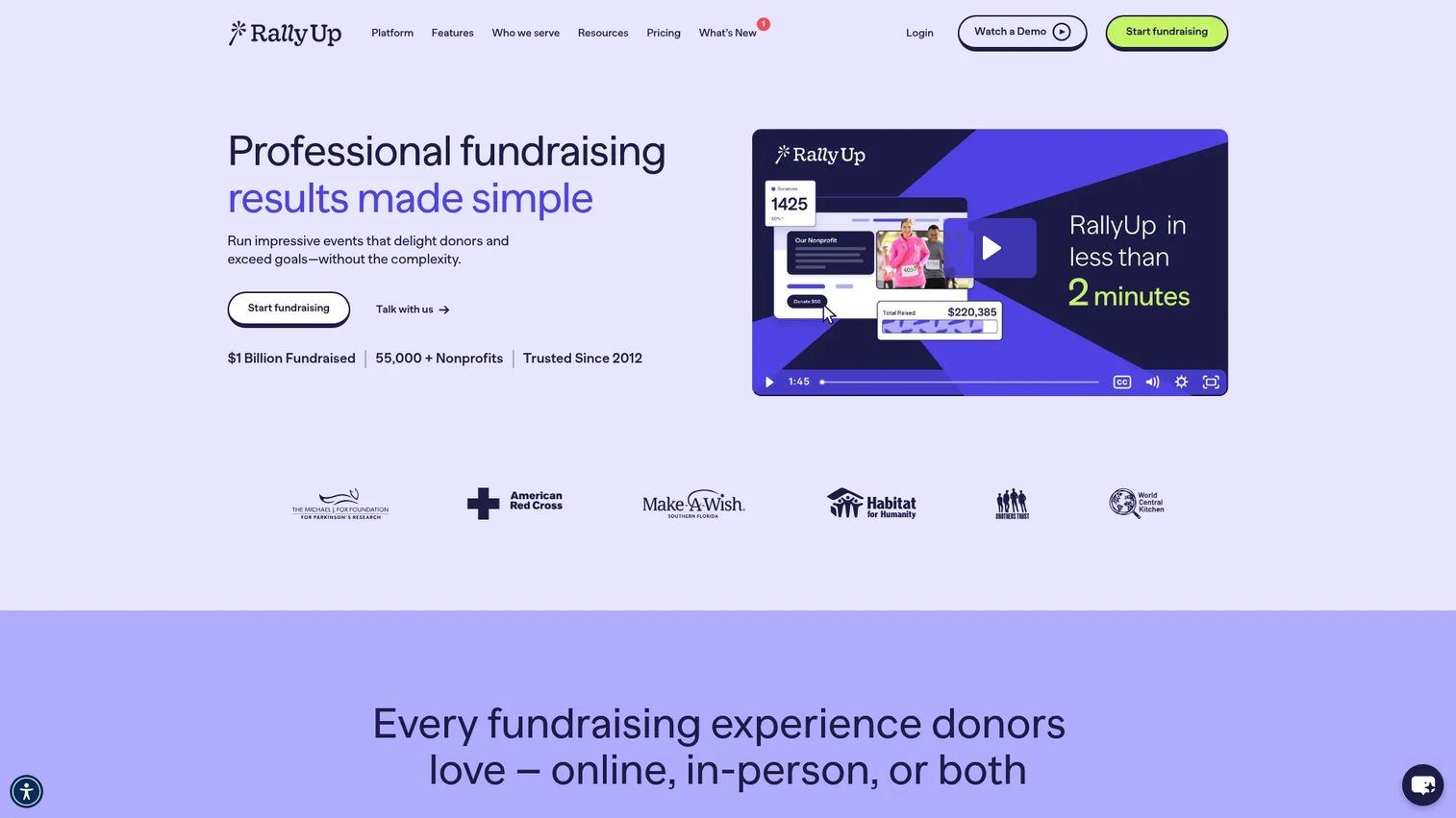
RallyUp is an online fundraising platform built for nonprofits and schools running both online and in-person campaigns. Its standout trait is breadth of campaign types. Raffles, auctions, sweepstakes, ticketing, crowdfunding, a-thons, and peer-to-peer all live under one account, so a team that runs several campaign styles a year does not need separate tools for each.
Best for: Nonprofits and schools that run a mix of campaign types and want gamification built in.
Key strengths
- Campaign variety: Peer-to-peer sits alongside raffles, auctions, a-thons, and crowdfunding.
- In-person event tools: Live and silent auctions, fund-a-need, paddle raise, and automated checkout.
- Supporter experience: Donor profiles, text-to-give, custom branding, and free campaign setup help.
Why choose RallyUp: For teams comparing options, RallyUp ranks high because one platform covers many motions with a fee-based pricing model that scales with activity instead of a fixed subscription. It works best for campaign-driven teams that value flexibility over a single dedicated workflow.
RallyUp pricing: RallyUp offers a Free plan with no platform fee that relies on optional donor tipping, plus a Flex plan charging a 2.9%, 4.9%, or 6.9% platform fee depending on the activity. Enterprise pricing is custom. RallyUp holds a strong 4.8/5 rating on G2.
3. Donorbox
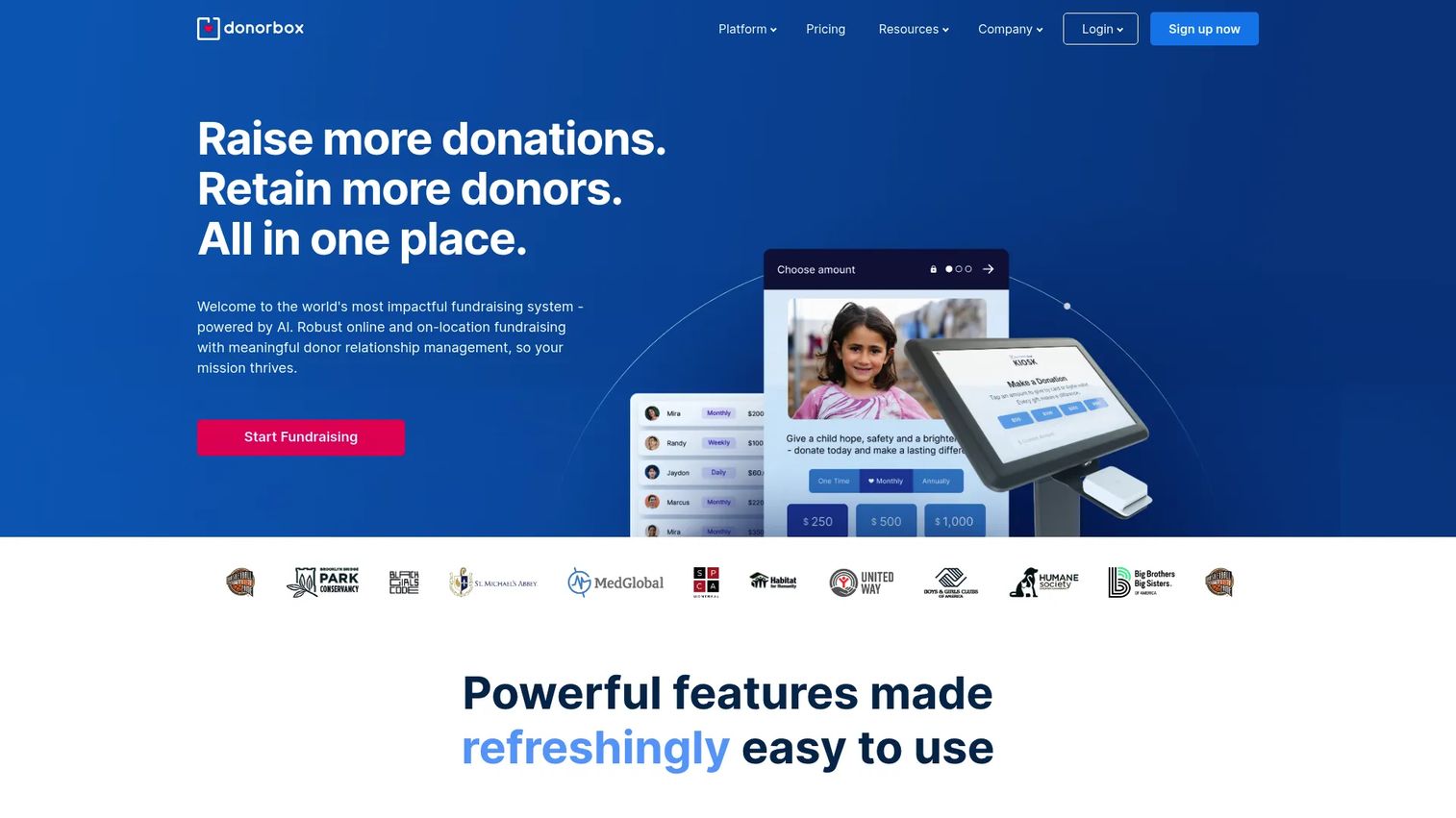
Donorbox is online fundraising software focused on high-converting donation forms and pages you can embed anywhere. Its peer-to-peer feature sits alongside recurring giving, memberships, events, and crowdfunding, and the donation checkout is where it earns attention. Fewer steps between a supporter's ask and a completed gift means more of the traffic your fundraisers drive actually converts.
Best for: Nonprofits that want an embeddable donation platform with strong recurring giving and a fast checkout.
Key strengths
- Donation forms and pages: Embeddable, conversion-focused checkout that reduces donor drop-off.
- Recurring giving: Donor portal and QuickDonate for repeat gifts.
- Multi-format: Text-to-Give, memberships, events, crowdfunding, and peer-to-peer in one place.
Why choose Donorbox: If your peer-to-peer campaigns push donors to a form, checkout performance directly affects net revenue. Donorbox optimizes that moment, with global payment support and localization for organizations raising across borders. Security and payment coverage are decision factors worth weighing here.
Donorbox pricing: Donorbox offers a Standard plan at $0/month, a Pro plan at $150/month, and a Premium plan with custom pricing that requires contacting sales. Platform fees vary by plan and feature. Donorbox holds a 4.6/5 rating on G2.
4. Giveffect
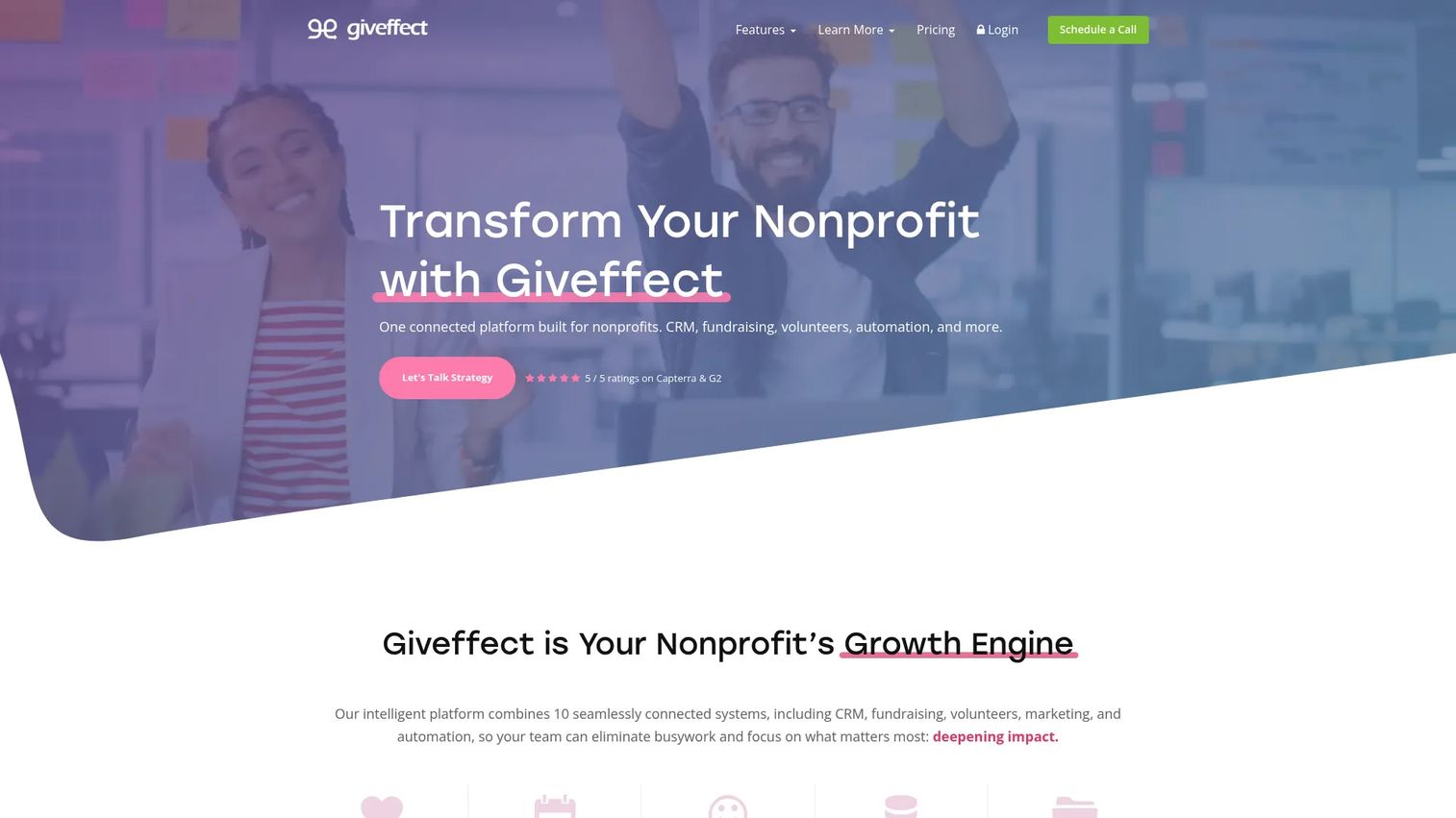
Giveffect is all-in-one nonprofit software that combines fundraising, donor management, volunteer management, and communications in a single system. The pitch is operational efficiency. Instead of stitching together a fundraising tool, a volunteer scheduler, and an email platform, a lean team runs everything from one place, with automation cutting the manual work that usually eats staff hours.
Best for: Nonprofits that want one system for fundraising, volunteers, donor data, and communications.
Key strengths
- Online giving and fundraising pages: Peer-to-peer campaigns launch alongside standard giving.
- Volunteer management: Scheduling and coordination built in, not bolted on.
- Automation and reporting: Email marketing, workflow automation, and real-time reporting.
Why choose Giveffect: For a small team wearing many hats, consolidation is the draw. Referral tracking and integrated website pages mean supporter activity, volunteer hours, and donor records update in one place, which reduces the reconciliation work that fragments most nonprofit stacks.
Giveffect pricing: Giveffect's pricing page lists three plans (Lite, Ultimate, and Ultimate+) without public dollar amounts, so pricing varies by tier and requires a conversation. The FAQ confirms a 14-day free trial. Giveffect holds a 4.1/5 rating on G2.
5. GoFundMe Pro
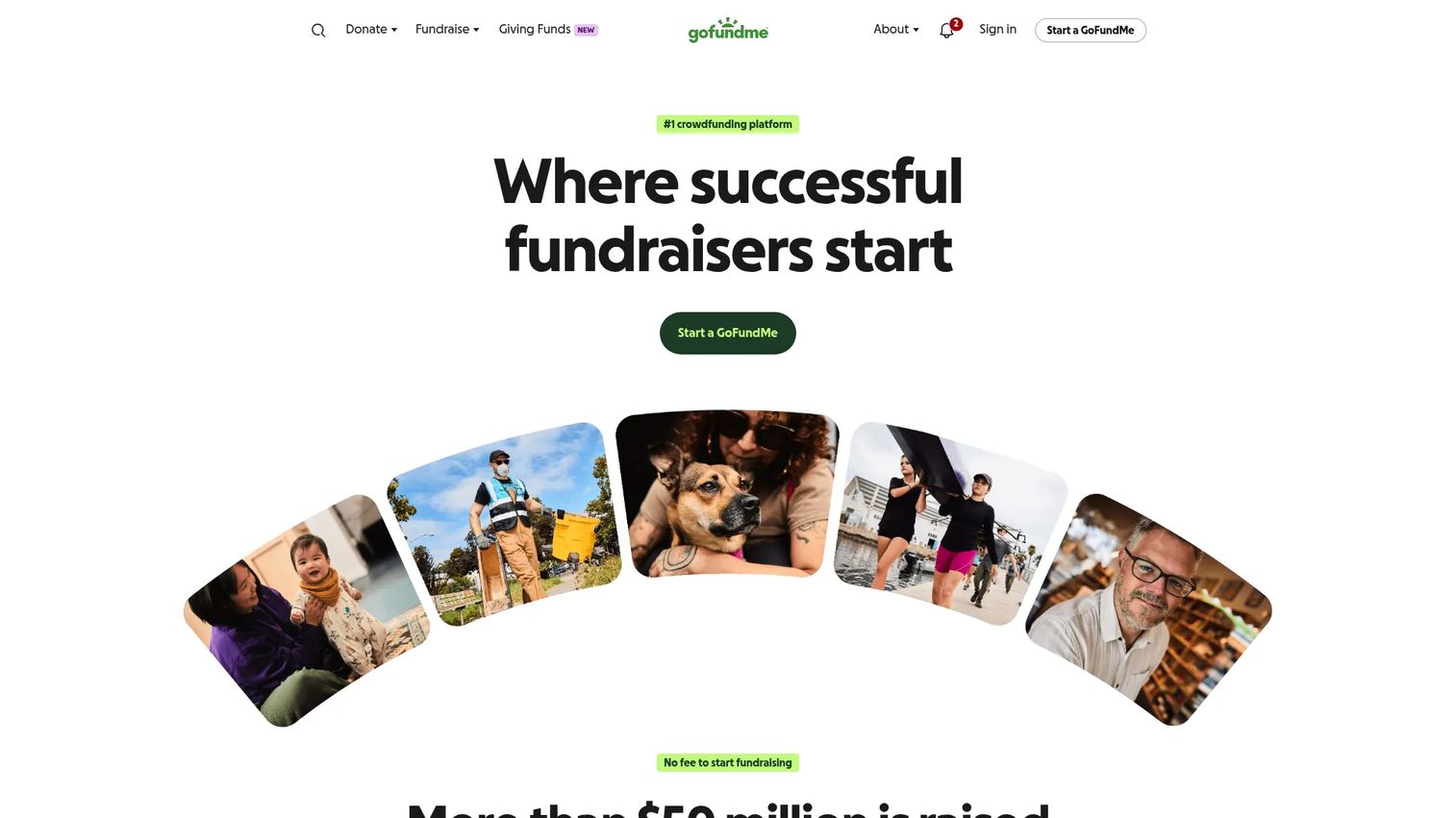
GoFundMe Pro is a nonprofit fundraising platform for branded campaigns, donation forms, peer-to-peer fundraising, and live events. Where it stands out is reach and familiarity. The GoFundMe name carries recognition that lowers the friction of a supporter sharing a link, which matters most in awareness-driven campaigns where trust in the donation page affects conversion.
Best for: Nonprofits that want an all-in-one fundraising and donor engagement platform with strong brand recognition.
Key strengths
- Branded campaigns: Custom donation forms and campaign pages under your identity.
- Peer-to-peer fundraising: Supporter-driven pages built for easy sharing.
- Live events and ticketing: Event fundraising alongside standard giving.
Why choose GoFundMe Pro: For campaigns that lean on reach and social sharing, name recognition reduces the hesitation a first-time donor feels. It fits organizations that run awareness-driven, supporter-led campaigns and want the mechanics of ticketing and events in the same platform.
GoFundMe Pro pricing: GoFundMe Pro uses custom pricing based on your organization's needs, and the brand page does not display a public starting price. Expect a quote-based conversation rather than a self-serve plan. GoFundMe Pro holds a 4.3/5 rating on G2.
6. Qgiv
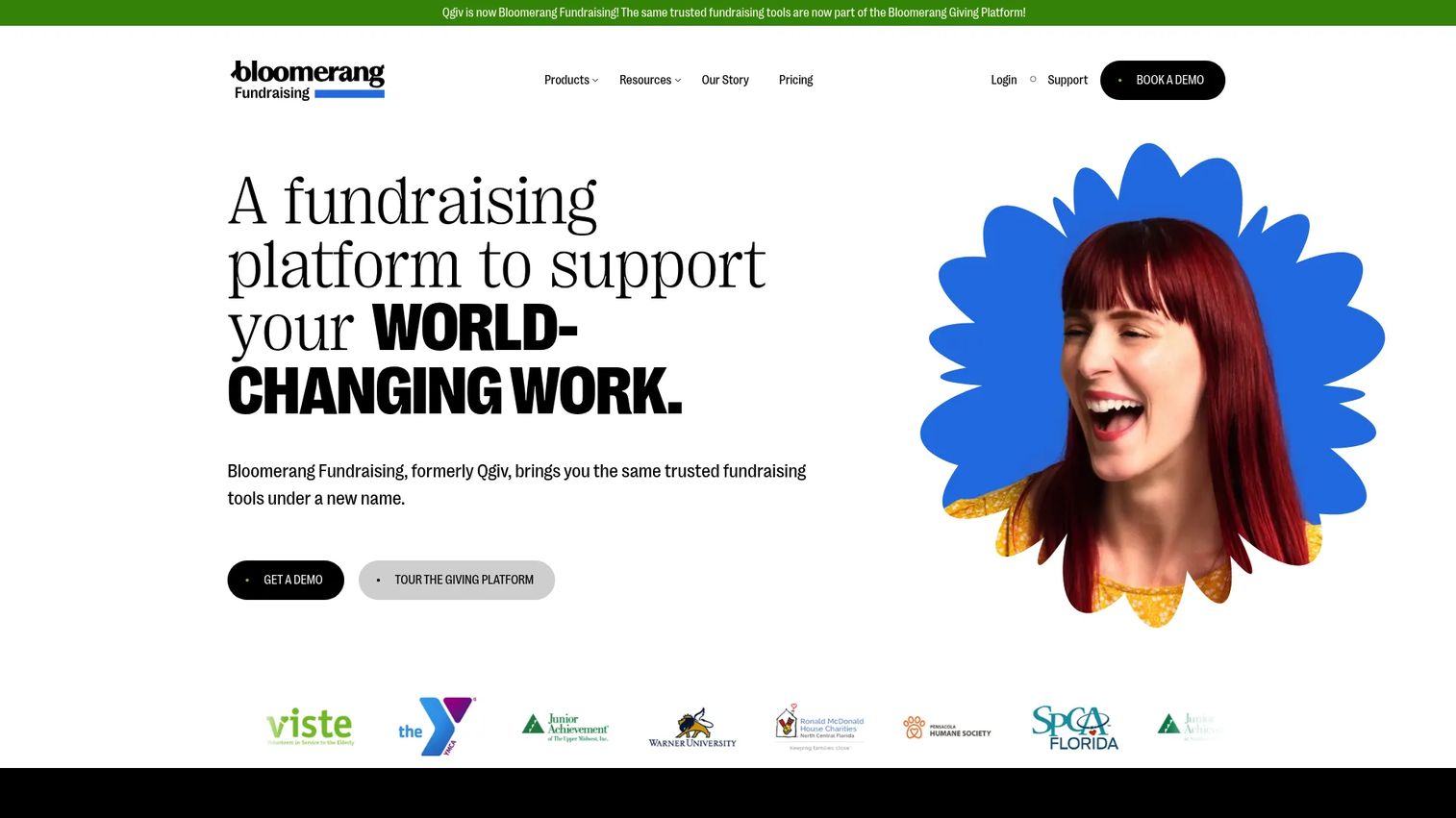
Qgiv, now part of Bloomerang Fundraising, is nonprofit fundraising software covering donation forms, event registration, text fundraising, peer-to-peer, and auctions. Its differentiator is transparency. Where most vendors hide pricing behind a sales call, Qgiv publishes per-plan tiers, which makes budgeting straightforward for mid-sized nonprofits that want to know their cost before they commit.
Best for: Nonprofits running recurring campaigns that want configurable tools with clear public pricing.
Key strengths
- Configurable fundraising: Donation forms, event registration, and text-to-donate.
- Peer-to-peer and auctions: Dedicated plans for supporter-led and event fundraising.
- Reporting and integrations: Analytics and connections into the broader Bloomerang stack.
Why choose Qgiv: For organizations running several campaigns a year, published pricing removes guesswork and lets you match a plan to a specific motion. It fits mid-sized teams that value predictable cost and want peer-to-peer without an enterprise commitment.
Qgiv pricing: Qgiv offers a Get Started plan at $0/month, Giving Essentials at $25/month, Text Fundraising at $159/month, and dedicated Peer-to-Peer and Auctions plans at $259/month each, with monthly and quarterly billing shown publicly. Qgiv holds a 4.7/5 rating on G2.
7. Bloomerang Fundraising
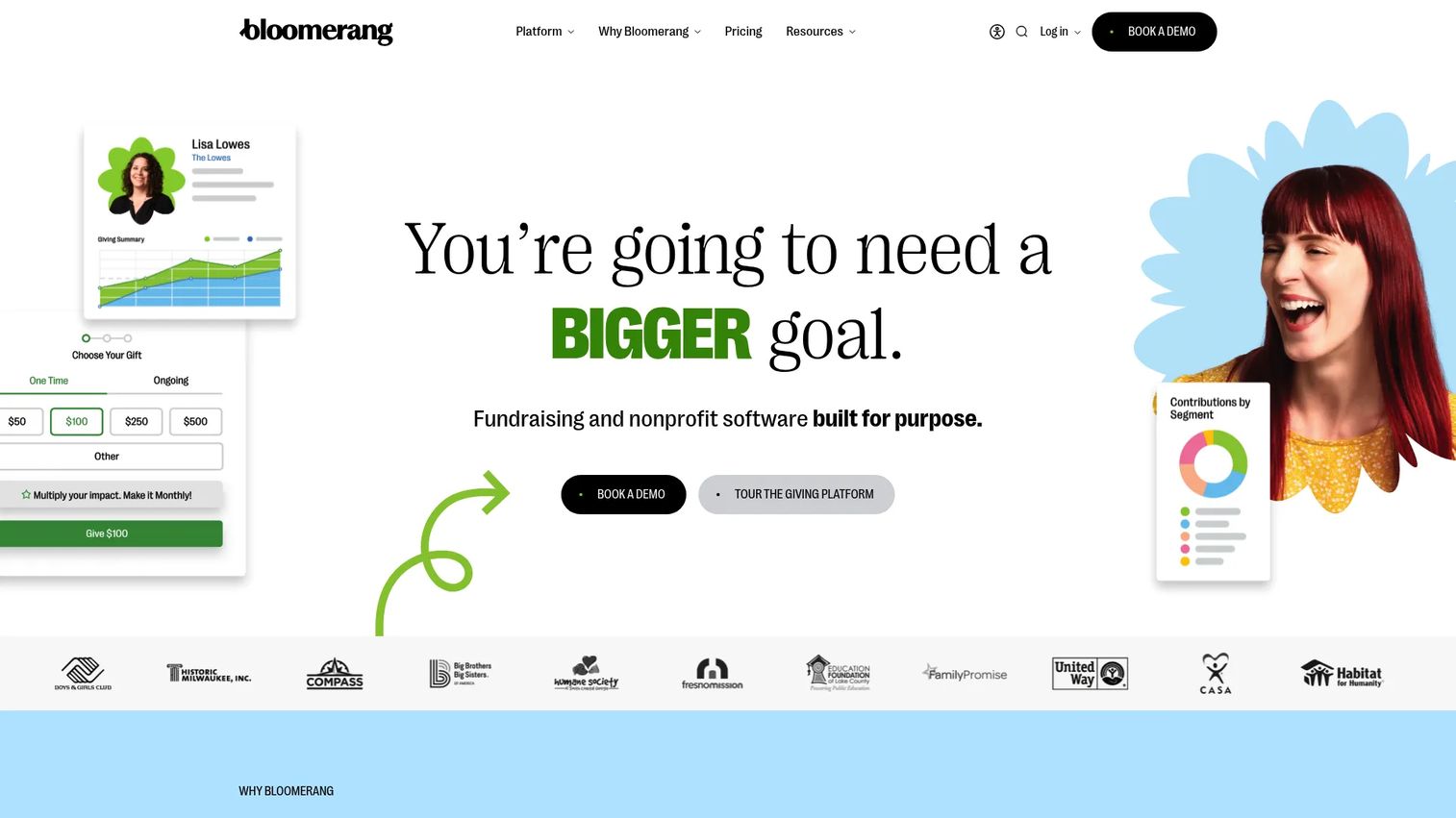
Bloomerang Fundraising is nonprofit fundraising software covering donor management, online giving, events, peer-to-peer, and volunteer management. Its strength is the alignment between fundraising and CRM. When your peer-to-peer campaign data lands directly in a donor management system built for retention, follow-up and stewardship stop being a separate manual step.
Best for: Nonprofits that want fundraising, donor management, and volunteer tools in one platform.
Key strengths
- Donation forms and online giving: Standard giving alongside supporter-led campaigns.
- Text and peer-to-peer fundraising: Supporter pages connected to donor records.
- Event management and auctions: Event fundraising bundled with CRM.
Why choose Bloomerang Fundraising: The case is workflow consolidation. For teams that care as much about keeping donors as acquiring them, having peer-to-peer feed a retention-focused CRM matters more than standalone campaign breadth. Bundled functionality is the reason to choose it over a point solution.
Bloomerang Fundraising pricing: Public starting prices include Qgiv by Bloomerang from $40/month, Bloomerang CRM from $125/month, and Bloomerang Volunteer from $119/month, each billed annually. Bundled Giving Platform Standard and Pro plans require contacting sales. Bloomerang Fundraising holds a 4.6/5 rating on G2.
8. CauseVox
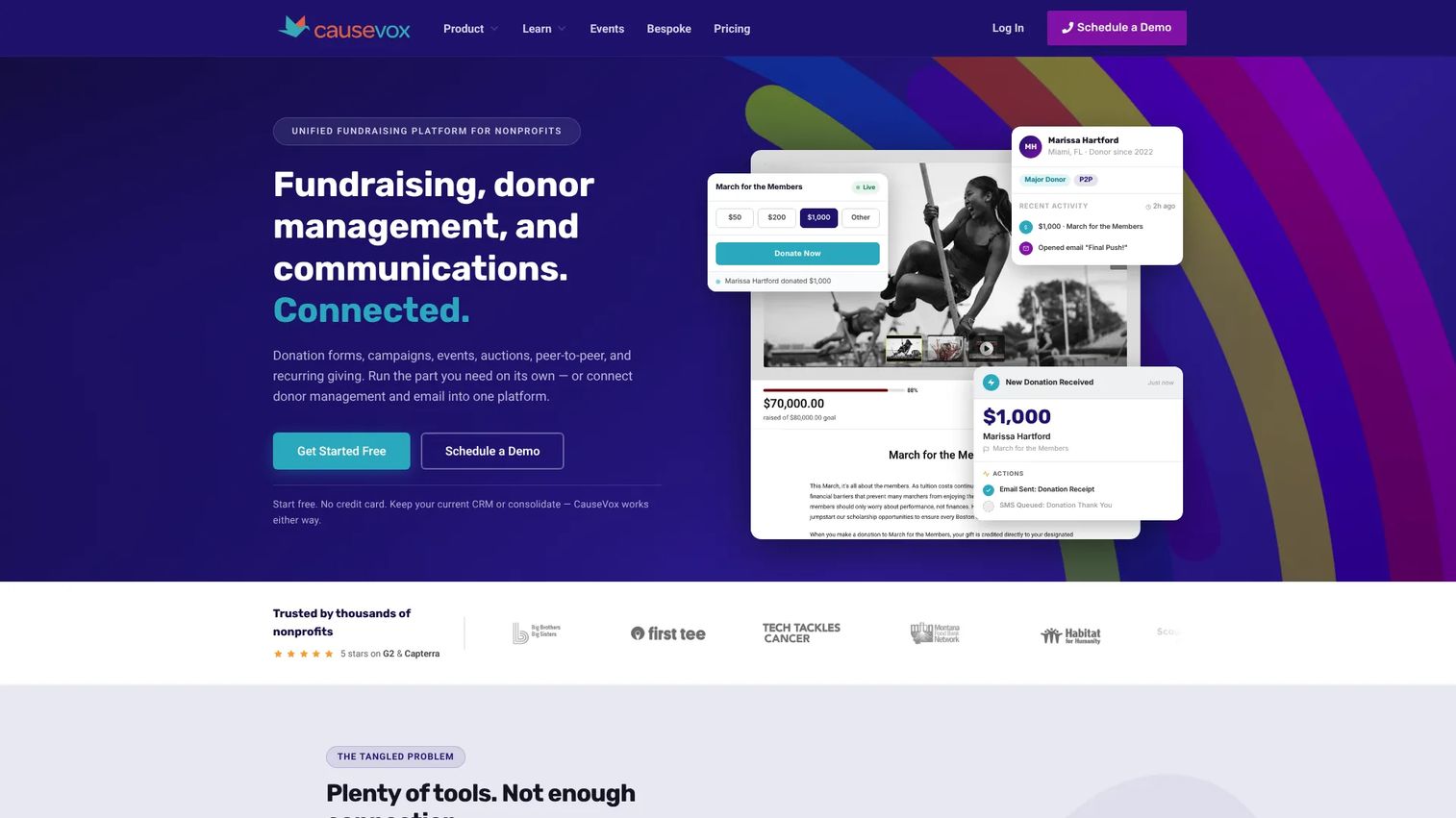
CauseVox is a unified fundraising platform built around branded campaign pages, a built-in donor CRM, and email tools. It leans toward digital-first fundraising teams that care about storytelling and design. If your campaigns live or die on how compelling the page looks and how easily a supporter can rally their network, CauseVox puts that experience front and center.
Best for: Digital-first nonprofits that want branded campaign pages and supporter activation in one place.
Key strengths
- Branded campaign pages: Design-forward pages that match your identity and story.
- Fundraising team support: Individual and team pages with social sharing built in.
- Built-in CRM and email: Donor data, newsletters, and appeals without a separate tool.
Why choose CauseVox: For teams that treat campaign storytelling as a conversion lever, CauseVox pairs polished pages with collaboration tools that let a fundraising team run together. The built-in CRM and email keep supporter activation and follow-up in the same workflow.
CauseVox pricing: CauseVox offers a Free plan at $0, Starter at $100/month, Pro at $300/month, and Premium at $900+ per month, with annual billing saving two months. CauseVox holds a 4.3/5 rating on G2.
9. OneCause
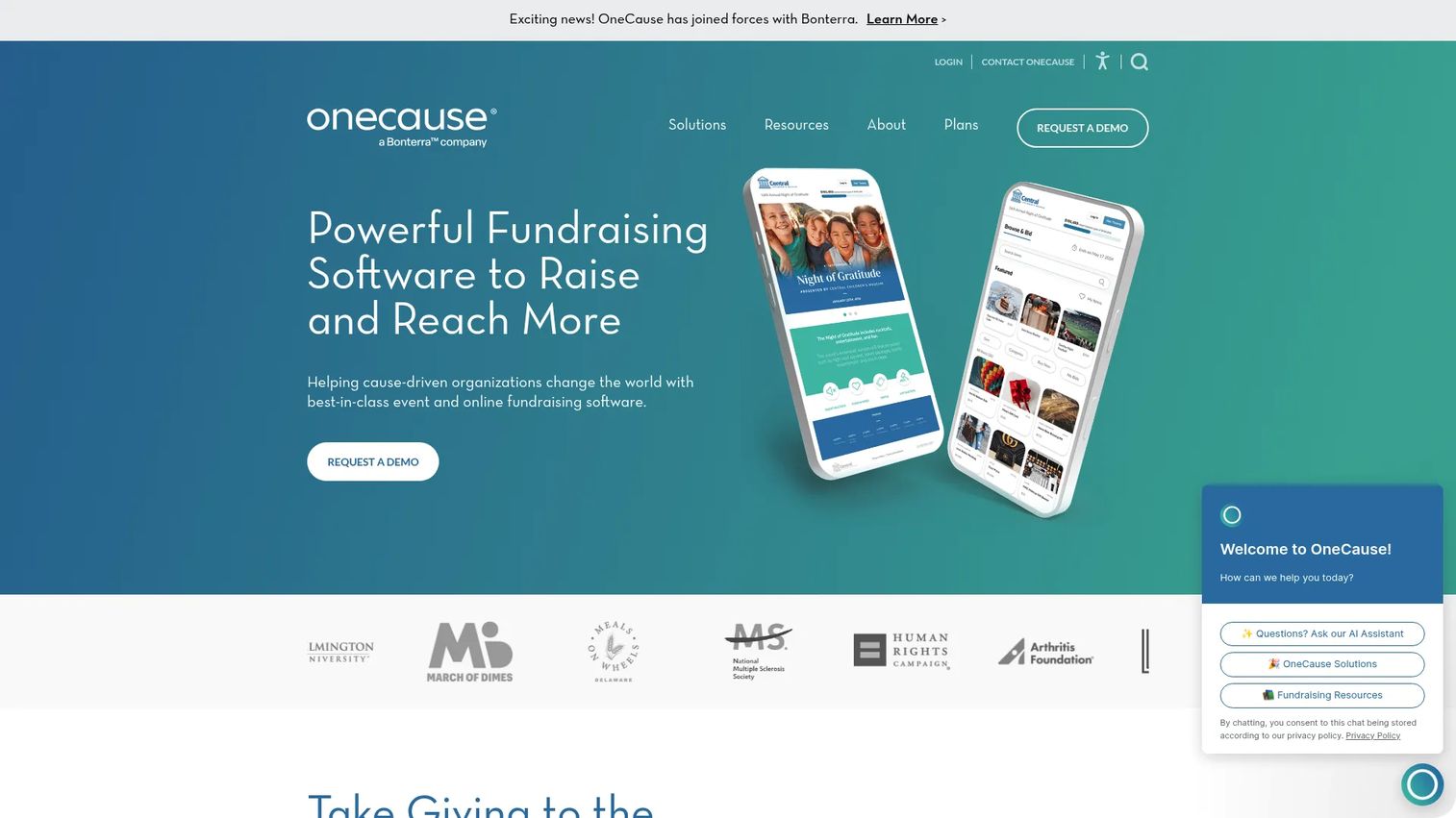
OneCause is fundraising software for nonprofits that spans online giving, auction and event fundraising, and peer-to-peer campaigns. Its center of gravity is live events. If your calendar revolves around galas, auctions, and mobile-friendly giving at in-person gatherings, OneCause connects those moments to supporter and team fundraising in one system.
Best for: Nonprofits that run live events and want peer-to-peer and donor engagement in the same platform.
Key strengths
- Online fundraising and Text2Give: Mobile-friendly giving for events and campaigns.
- Auction and event fundraising: Galas, silent auctions, and paddle raises.
- Peer-to-peer fundraising: Supporter and team pages tied to event participation.
Why choose OneCause: For event-driven organizations, the value is running the gala and the peer-to-peer campaign that feeds it from one place. Teams comparing pure event tools against pure peer-to-peer tools get both, which suits organizations whose fundraising motion is anchored to live gatherings.
OneCause pricing: OneCause publishes a Pay-As-You-Go plan starting at $200 (with a 5% pay-later fee) and a Professional Auction & Event annual subscription at $2,995. Enterprise and Nationals plans are custom quotes. OneCause holds a 4.7/5 rating on G2.
Considerations before you buy
The feature list matters less than how these platforms behave in your actual campaigns. Weigh these six factors before you commit.
Supporter experience
The single biggest predictor of campaign success is how fast a fundraiser can launch a page, share the link, and update progress. If setup takes ten steps or sharing requires a copy-paste dance, most supporters quit before they raise a dollar. Test the fundraiser flow yourself before you decide.
Branding and customization
Campaign pages that look like your nonprofit build trust and lift conversion. Confirm each platform lets you match colors, logos, and messaging without a developer. Generic templates cost you donations at the moment a supporter's friend decides whether to give.
Analytics and reporting
You need to see participants, shares, donations, and conversion in real time, not in a monthly export. Strong analytics and reporting tell you which supporters are driving results so you can coach the rest and invite your top fundraisers back next year.
Integrations and automation
Check how each tool connects to your CRM, email platform, and existing workflows. When peer-to-peer data flows automatically into your donor system, follow-up and stewardship happen without manual exports. That connection is what turns a campaign into a program.
Pricing and total cost
Look past the sticker price. Platform fees, processing fees, and tip-based models all affect net revenue differently. A free plan funded by donor tips is not free if it suppresses average gift size. Model your expected volume against each fee structure to find your true cost.
Retention and reuse
The best peer to peer fundraising platforms support repeat campaigns and donor retention, not just a one-time event. Make sure the platform stores supporter data, automates thank-you flows, and makes it easy to re-invite last year's top fundraisers. Acquisition is expensive; retention is where the compounding happens.
Conclusion
The best p2p fundraising software is the one that matches your campaign complexity, your supporters' sharing behavior, and your reporting needs. There is no universal winner, only the right fit for your motion.
For large organizations that need peer-to-peer inside a full stack, Blackbaud consolidates fundraising and financials. For campaign variety and gamification, RallyUp covers the widest range of formats. Donorbox wins on donation conversion, while Qgiv leads on transparent public pricing. Teams that run live events should look hard at OneCause, and digital-first storytellers will find CauseVox's branded campaign pages a strong fit. If fundraising and CRM alignment drive donor retention for you, Bloomerang Fundraising bundles both.
Your next step is simple: shortlist two or three finalists that match your primary campaign type, then run the supporter flow yourself on each. The platform that makes launching, sharing, and tracking effortless for your fundraisers is the one that will grow your program year over year.
FAQs
Peer to peer fundraising software lets your supporters raise money on your behalf by creating personal fundraising pages and sharing them with their networks. It handles branded pages, social sharing, donation collection, automated receipts, and reporting so a single campaign multiplies across dozens of supporter-owned pages.
You launch a campaign, and supporters sign up to create their own fundraiser pages pre-loaded with your branding and a personal goal. They share the link by text, email, and social, their friends donate, and a live progress bar updates automatically. The software tracks every participant, share, and donation while receipts go out without manual work.
Prioritize branding and customization, easy social sharing, real-time analytics and reporting, CRM and email integrations, automated receipts, and a mobile-friendly supporter experience. The fundraiser flow should let a supporter launch and share a page in minutes, because friction there directly suppresses how much they raise.
It depends on your segment. Enterprise nonprofits often fit Blackbaud, mid-sized teams that want transparent pricing lean toward Qgiv, event-driven organizations choose OneCause, and digital-first storytellers pick CauseVox. Match the tool to your primary campaign type rather than chasing a single universal answer.
Costs range from free plans funded by donor tips to custom enterprise quotes. Qgiv publishes plans up to $259/month for peer-to-peer, Donorbox lists Pro at $150/month, and OneCause starts at $200 pay-as-you-go, while Blackbaud and GoFundMe Pro use custom pricing. Always factor in processing and platform fees, since they affect net revenue more than the headline price.
Yes. Platforms that store supporter data, automate thank-you flows, and surface your top fundraisers make it easy to re-invite last year's participants and turn one-time donors into repeat givers. Tying campaign data to a CRM is what converts a single event into a repeatable program with rising retention.
Crowdfunding collects donations from anyone who lands on a single campaign page, while peer to peer fundraising multiplies your cause across many supporter-owned pages. The peer-to-peer model reaches networks you could never email directly, because each fundraiser asks their own friends and family on your behalf.
Run/walk/ride events, third-party and DIY fundraisers, workplace giving drives, ticketed events, and ambassador campaigns all perform well. Any motion where motivated supporters are willing to ask their networks on your behalf is a strong fit for the peer-to-peer model.