You signed three freelancers last quarter. Now there are eleven. One is in Lisbon, one in São Paulo, one in Manila, and nobody on your team can tell you who signed what contract, who is classified correctly, or what you owe them this month. The work is getting done. The system around the work is held together by a spreadsheet, a Slack channel, and your head of finance chasing invoices on a Friday afternoon.
That is the actual problem a freelancer management system solves. Not staffing. Coordination. As contractor headcount climbs, the admin load grows faster than the value, and the visibility you need to make decisions disappears into email threads. The global freelancer management system market was valued at $6.2 billion in 2025 and is forecast to reach $14.8 billion by 2034 at a 17.3% CAGR, according to MarketIntelo (2025). Cloud deployment already accounts for 72.5% of that market revenue, which tells you where teams are putting their bets.
For a founder under pressure to prove the business scales without your fingerprints on every process, this is a systems decision, not an HR one. The right freelancer management software gives you control over onboarding, contractor compliance, and global payments, plus spend visibility you can actually defend in a board meeting. Below, we break down the 8 best freelancer management systems for 2026, what each does well, and where each fits. If your stack also touches adjacent processes, you may find related reading useful on contract lifecycle management and broader contract management tools.
What's inside
This guide covers tools built to run the full freelancer lifecycle: sourcing, freelancer onboarding, contract execution, worker classification, compliance, payments, and reporting. We focused on platforms that serve teams managing freelancers or a broader external workforce, not generic project trackers or staffing agencies.
We chose and ranked these tools against five criteria that matter to operators:
- Lifecycle coverage from sourcing to payment
- Global payments and currency support
- Compliance depth, including classification and KYC
- Integrations with your existing finance and HR stack
- Reporting and spend visibility for decision-makers
Pricing and G2 ratings reflect publicly available data at the time of writing.
TL;DR
Short on time? Here are the quick picks:
- Best overall for broader external workforce management: Worksome, for teams that want strong workflow control across contractors and freelancers.
- Best for global hiring in one platform: Deel Hire, when you need recruiting, contracts, and compliance across borders.
- Best for marketplace-style hiring: Upwork, when talent discovery is part of the job.
- Best for large enterprises with distributed contractor programs: WorkMarket by ADP, for 1099-heavy operations already leaning on ADP infrastructure.
- Best for a leaner, payments-first entry point: Mellow, for cross-border contractor management without heavy setup.
What is a freelancer management system?
A freelancer management system (FMS) is software that centralizes how a company sources, onboards, contracts, manages, pays, and reports on freelancers and independent contractors in one place.
The lifecycle it covers runs in a predictable sequence. You identify and source talent, onboard them with the right documents and classification, execute contracts, track work and time, process payments across currencies, and report on spend and compliance. A good FMS connects these stages so data does not get re-keyed at every handoff.
This is where an FMS differs from the tools you are probably duct-taping together now. A project management tool tracks tasks, not contracts or tax status. An accounts payable tool pays invoices but does not classify workers or check compliance. A marketplace like Upwork helps you find talent but is not built to be the internal operating layer for workers you sourced elsewhere.
Key capabilities to expect from a modern freelancer management platform:
- Onboarding and classification: Collect documents, run worker classification, and reduce misclassification risk.
- Contract lifecycle management: Generate, sign, store, and renew contracts in one system.
- Global payments: Pay contractors in multiple countries and currencies with automated invoicing.
- Contractor compliance: Handle KYC, AML, tax forms, and local rules with auditability.
- Spend visibility and reporting: See total external workforce cost across teams, regions, and projects.
Optimized for clarity, that is the category. Now the question is which system fits your stage, your geography, and your existing stack.
When to use a freelancer management system
Not every team needs one yet. These three situations are the clearest signals you do.
Centralize scattered freelancer operations
Spreadsheets work until they don't. The moment you cannot answer "how many contractors do we have and what are we paying them" in under five minutes, the spreadsheet has become a liability. Other symptoms: contracts living in personal email, onboarding steps that depend on one person remembering them, and finance reconciling invoices by hand. A dedicated system replaces that scramble with a single source of truth. This is the same consolidation logic behind moving to a customer data platform or a unified marketing resource management layer: one place beats seven tabs.
Manage compliance across regions
The minute you hire across borders, classification, tax handling, KYC, and local payment rules stop being optional. Misclassifying a worker is not a paperwork error; it is a financial and legal exposure that surfaces during due diligence at the worst possible time. An FMS with compliance depth gives you auditability, applies the right rules per region, and keeps a record you can hand to a lawyer or an investor. For founders, this is risk reduction you can put a number on.
Scale repeatable contractor programs
When hiring contractors becomes recurring, when multiple teams need access, or when volume crosses a threshold where manual coordination breaks, you need workflow automation. This is the founder-level shift from doing the work to owning the system. Repeatable onboarding, standardized contracts, and automated approvals mean you can delegate the external workforce program without losing visibility into it.
Comparison table
The table below narrows the shortlist fast. Scan it for intent and differentiation, then read the full sections for the tools that match your situation. Sorted by relevance to founders running a growing external workforce.
| # | Product | Intent | Key differentiation | Pricing | G2 rating |
|---|---|---|---|---|---|
| 1 | Deel Hire | Global hiring and contractor management | Recruiting, ATS, contracts, and compliance in one global platform | Freelance Standard from $49 per freelance/month; ATS contact sales | 4.8/5 |
| 2 | Worksome | External workforce management at scale | Sourcing, classification, contracts, and payments with strong workflow control | Tailored pricing via quote | 4.4/5 |
| 3 | YunoJuno | Source, book, manage, pay freelancers | Marketplace plus FMS with enterprise compliance | Percentage fee on contractor payments; Enterprise custom | 4.7/5 |
| 4 | Worksuite | End-to-end contingent workforce OS | Lifecycle control with contract management and workforce intelligence | Custom plans (Core, Plus, Premium) | 4.4/5 |
| 5 | TalentDesk | Centralized external workforce management | Onboarding, AOR, and payments across 190+ countries | Growth and Enterprise custom quotes; 3%-1% payment fee | 4.8/5 |
| 6 | WorkMarket by ADP | Independent contractor management | 1099-NEC filing, verification, and enterprise control | Contact sales | 4.2/5 |
| 7 | Upwork | Marketplace-led hiring and sourcing | Talent discovery plus hiring and project tools | Freelancer Basic $0; Freelancer Plus $19.99/month | 4.5/5 |
| 8 | Mellow | Cross-border contractor management | Contractor management and contractor-of-record with transparent fees | Contractor Management $35/month per contractor | 4.6/5 |
1. Deel Hire
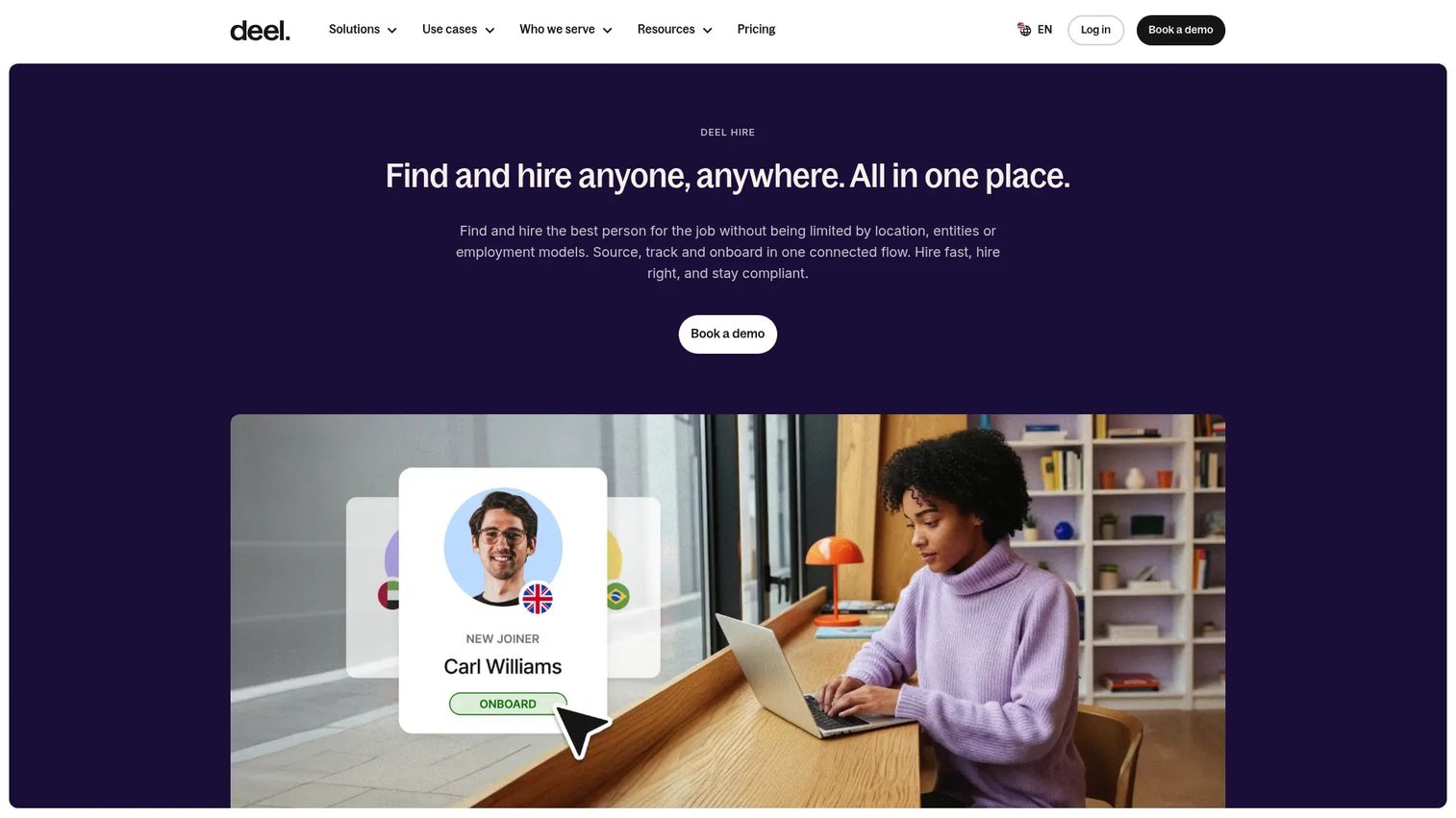
Deel Hire is global hiring and recruiting software for sourcing, applicant tracking, and onboarding inside the wider Deel platform. It is built for companies that want one place to find, hire, contract, and pay workers across borders without stitching together a recruiting tool, a contracts tool, and a payments tool. For a founder hiring globally, the appeal is consolidation: recruiting, compliance, and onboarding connected in one flow.
The strength here is breadth. Deel covers the move from candidate to hire and then keeps going into contractor management, contracts, and payments, with compliance handled across a long list of countries. That makes it a strong fit when your external workforce spans multiple regions and you want fewer vendors touching the same worker record.
Best for: Companies hiring globally that want recruiting, compliance, and onboarding in one platform.
Key strengths
- AI-powered ATS: Manages the full candidate-to-hire workflow so sourcing and onboarding stay connected.
- Talent sourcing support: Recruitment partner options help fill roles without bolting on another tool.
- One connected flow: Offer, onboarding, and payments live in the same system, reducing handoffs.
Why choose Deel Hire: If your hiring problem is global and you are tired of one tool for sourcing, another for contracts, and a third for payments, Deel Hire compresses that into a single platform. It fits founder-led operations teams that need scale across borders and want compliance handled rather than improvised.
Deel Hire pricing: Deel's public pricing page lists adjacent modules with numeric pricing while Deel Hire's ATS itself is quoted via contact sales. The lowest publicly visible first-party price on the page is Freelance Standard at $49 per freelance per month, with Freelance Plus at $325 per freelance per month. Talent Marketplace is listed at $99 per hire plus recruitment fees. There is no free tier. Deel Hire holds a 4.8/5 rating on G2.
2. Worksome
Worksome is an external workforce platform for sourcing, engaging, classifying, contracting, and paying freelancers and contractors. It is built for teams that want tight workflow control across a contractor program rather than a marketplace or a basic payments tool. If your priority is governance over how external workers are classified, contracted, and paid, this is where Worksome earns its place.
The platform leans into compliance and control. Worker classification is automated, contracts and compliance are handled inside the system, and payments, invoicing, and reporting close the loop. For multi-country contractor programs, that combination keeps spend visible and risk contained across regions.
Best for: Companies managing external talent, contractors, or freelancers at scale.
Key strengths
- Omni-channel sourcing: Build private talent pools alongside open sourcing channels.
- Automated classification and contracts: Worker classification and compliance run inside the platform, not in side documents.
- Payments and reporting: Invoicing, payments, and reporting connect to your finance stack through integrations.
Why choose Worksome: Worksome fits operators who treat the external workforce as a program to be governed, not a series of one-off hires. The combination of classification, automated contracts, and spend reporting makes it a strong overall pick for teams that want control and auditability across borders.
Worksome pricing: Worksome does not publish numeric pricing. The site directs you to request tailored pricing through a quote or live demo. Features were verified from Worksome's own product pages, and the platform holds a 4.4/5 rating on G2.
3. YunoJuno
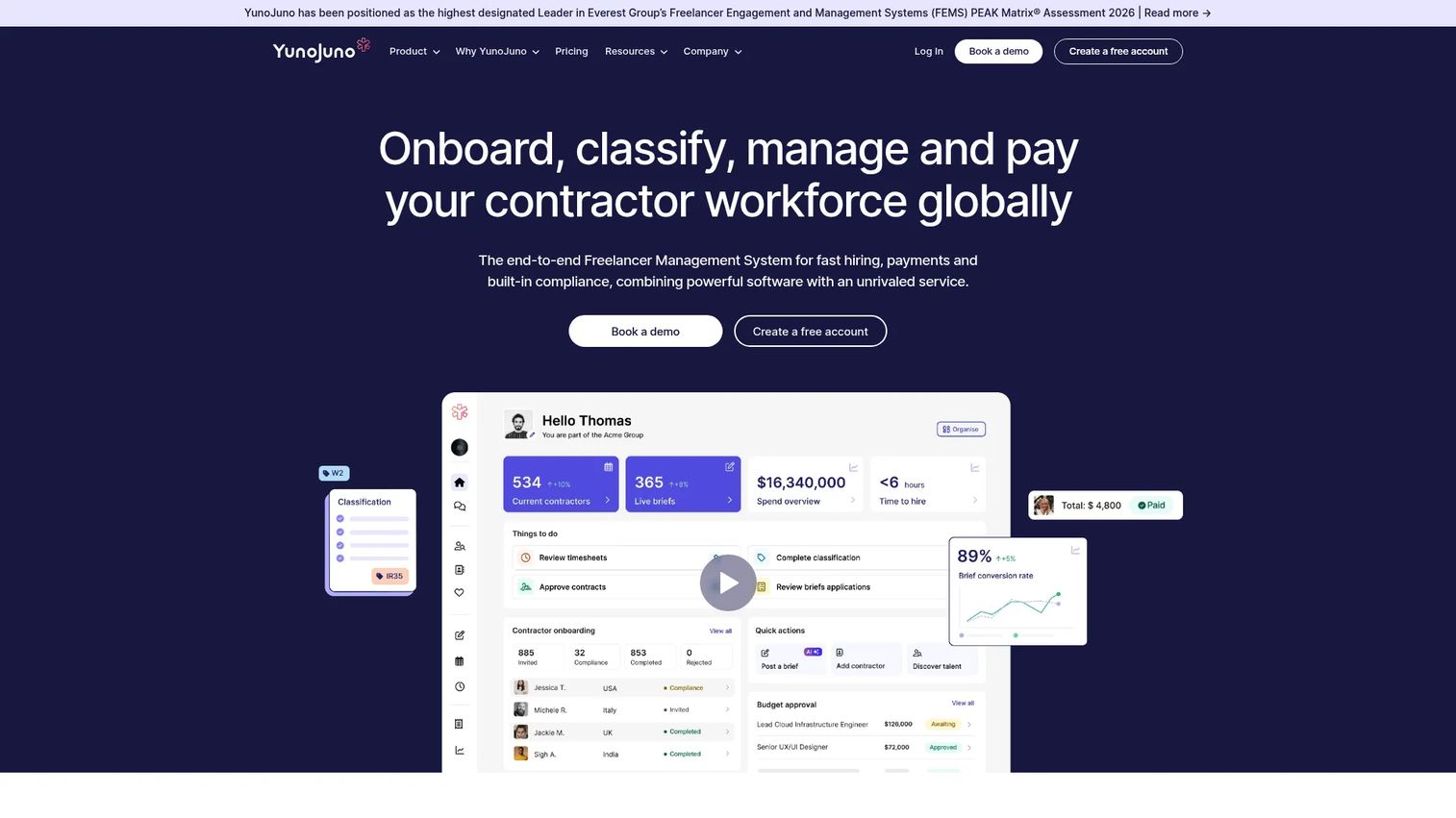
YunoJuno is a contractor workforce management platform for sourcing, onboarding, compliance, payments, and reporting. Its angle is the combination of a curated talent marketplace and a full management system, so you can source freelancers and run them through onboarding, compliance, and payment in the same place. That source-book-manage-pay loop matters when you want discovery and operations under one roof.
The platform is built with enterprise readiness in mind. Global contractor onboarding, worker classification, and compliance workflows are core, and payments handle invoicing and currency conversion. For teams that need both a talent pipeline and operational control, the marketplace-plus-FMS model removes a handoff that usually lives between two separate vendors.
Best for: Enterprises managing global freelance and contractor workforces.
Key strengths
- Global onboarding: Contractor onboarding and management work across regions.
- Compliance workflows: Worker classification and compliance are built into the lifecycle.
- Payments and currency: Invoicing and currency conversion are handled inside the platform.
Why choose YunoJuno: Choose YunoJuno when sourcing and management are both real needs and you would rather not run a marketplace and an FMS as separate systems. It suits enterprises that want the talent pipeline and the operational layer tied together, with compliance handled across a global workforce.
YunoJuno pricing: YunoJuno's pricing page describes its Freelancer Management System as a simple percentage fee on contractor payments, while YunoJuno Enterprise uses custom pricing based on scale, support level, and program complexity. No public numeric price is shown. The site references a free account option. YunoJuno holds a 4.7/5 rating on G2.
4. Worksuite
Worksuite is a freelancer and contingent workforce management platform built around onboarding, compliance, contracts, payments, and reporting. It positions itself as a dedicated operating system for the external workforce, which appeals to organizations that want end-to-end lifecycle control rather than a tool that covers one or two stages. For global teams, that single-system framing is the draw.
The platform covers contingent workforce management, global pay and invoicing, and contract management with workflow automation. Workforce intelligence layers reporting on top, so spend and program health stay visible. When you want one system that owns the whole lifecycle for a large contractor base, Worksuite is built for that scope.
Best for: Enterprises managing large global freelancer or contractor programs.
Key strengths
- Contingent workforce management: Runs the full external workforce lifecycle in one platform.
- Global pay and invoicing: Handles cross-border payments and invoicing centrally.
- Contract management and automation: Contracts and workflows are automated to reduce manual coordination.
Why choose Worksuite: Worksuite fits organizations that want a dedicated operating system for a large, global contingent workforce. If your program has outgrown ad hoc processes and you need lifecycle control plus workforce intelligence in one place, it is built for that scale.
Worksuite pricing: Worksuite offers Core, Plus, and Premium plans. Its pricing pages describe plans as customized and invite you to book a demo rather than listing numeric prices. Features were verified from Worksuite's homepage and contingent workforce management page. Worksuite holds a 4.4/5 rating on G2.
5. TalentDesk
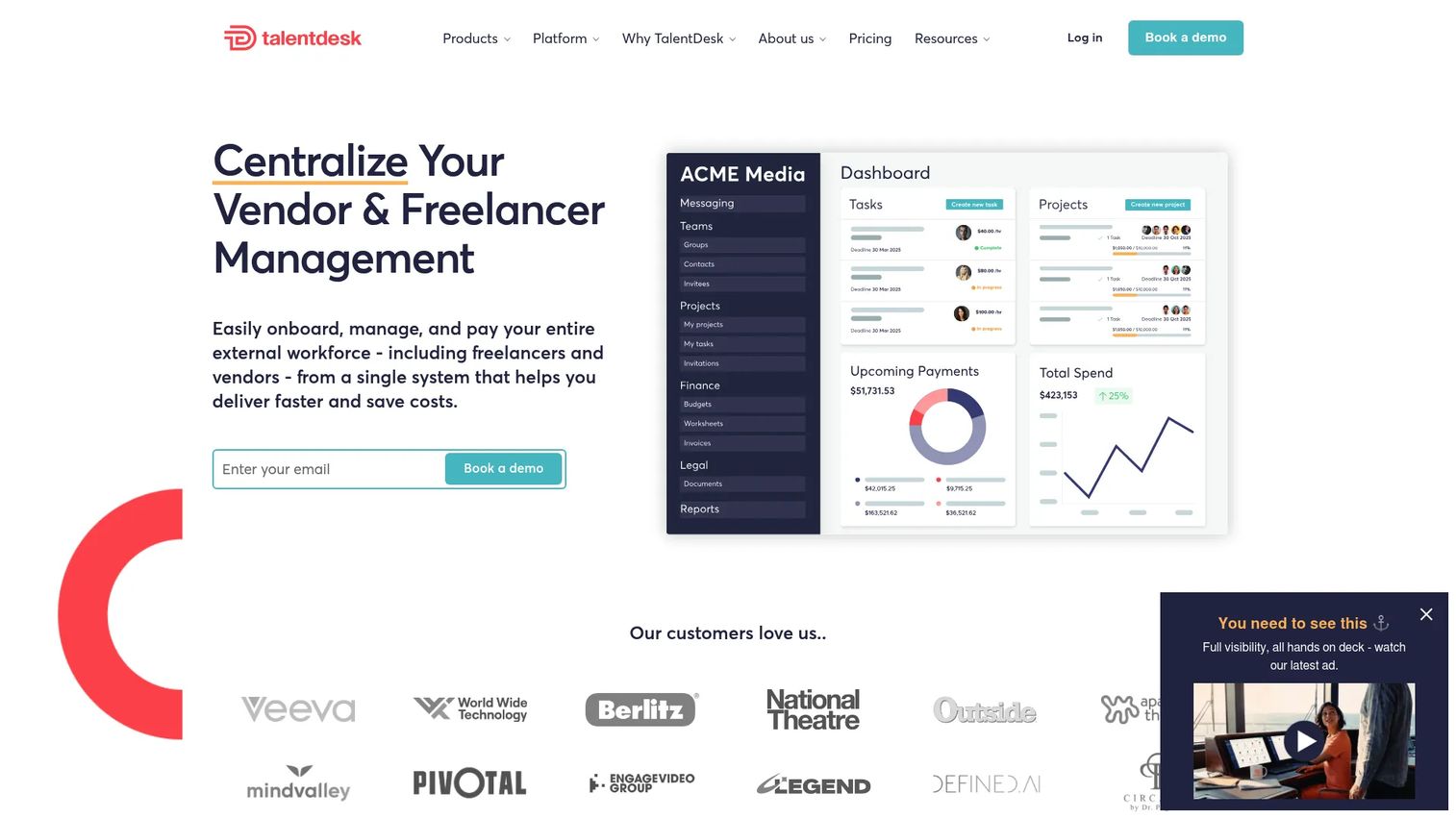
TalentDesk is external workforce management software for onboarding, managing, and paying freelancers, contractors, and vendors. Its positioning is deliberately broader than freelancer management alone: it treats the full external workforce, including vendors, as one population to onboard, govern, and pay. For teams whose external spend spans more than just freelancers, that breadth is the differentiator.
The platform pairs customizable onboarding workflows with payments across 190+ countries and 55+ currencies, plus global compliance that includes IC classification, AML and KYC checks, and Agent of Record support. That makes it a single system for onboarding, workflow, compliance, and payments rather than a point tool. The AOR coverage in particular helps teams that want to engage contractors compliantly without standing up local entities.
Best for: Companies needing a single system to manage freelancer and vendor onboarding, workflows, compliance, and payments.
Key strengths
- Customizable onboarding: Workflows adapt to how you actually onboard different worker types.
- Broad payments coverage: Pay across 190+ countries and 55+ currencies from one platform.
- Deep compliance: IC classification, AML/KYC checks, and AOR support reduce cross-border risk.
Why choose TalentDesk: Choose TalentDesk when your external workforce includes vendors and agencies, not just individual freelancers, and you want onboarding, compliance, and payments centralized. The AOR and compliance depth make it a strong fit for teams that need auditability across a wide payment footprint.
TalentDesk pricing: TalentDesk's pricing page shows Growth and Enterprise plans with custom quotes. Growth is priced per admin seat; Enterprise includes unlimited admin seats. Payment automation is listed at a 3%-1% fee and compliance is a custom fee. There is no free tier. TalentDesk holds a 4.8/5 rating on G2.
6. WorkMarket by ADP
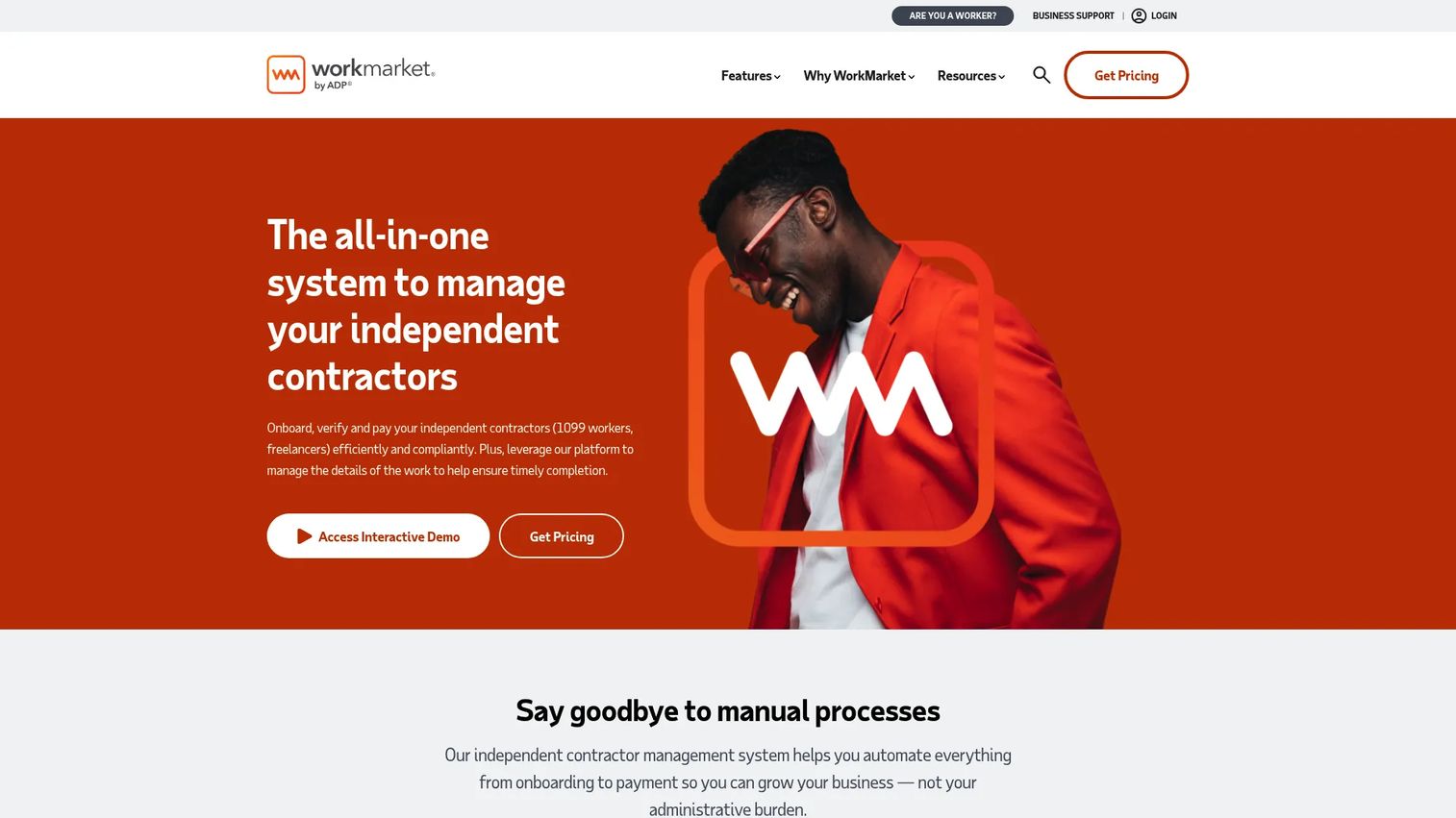
WorkMarket by ADP is independent contractor management software for onboarding, compliance, payment, and work assignment management. Its strength is 1099-heavy operations: onboarding and verifying contractors, paying them with automated invoicing and 1099-NEC filing, and organizing talent through Labor Clouds and work assignments. For US-centric contractor programs with tax and verification burden, that focus pays off.
The ADP connection matters here. Organizations already running on ADP infrastructure get an independent contractor layer that fits the broader workforce stack rather than sitting beside it. Enterprise control, compliance, and automated tax filing make WorkMarket a fit for businesses managing large pools of independent contractors end to end.
Best for: Businesses that need to manage independent contractors end to end.
Key strengths
- Onboard and verify: Contractor onboarding and verification are handled in one workflow.
- Automated payment and 1099 filing: Invoicing and 1099-NEC filing reduce tax-season scramble.
- Talent organization: Labor Clouds and integrations manage work assignments at scale.
Why choose WorkMarket by ADP: WorkMarket fits organizations with distributed 1099 contractor programs, especially those already invested in ADP. The combination of verification, automated payments, and tax filing makes it a strong choice for enterprises that need end-to-end independent contractor control.
WorkMarket by ADP pricing: WorkMarket does not publish public pricing. The site surfaces a Get Pricing and Contact Sales flow, and pricing appears to be sales-led. Features were verified from the WorkMarket homepage and product pages. WorkMarket by ADP holds a 4.2/5 rating on G2.
7. Upwork
Upwork is a human and AI-powered work marketplace connecting businesses with freelancers and agencies. It belongs on this list for a specific reason: when your problem is talent discovery, not just management, Upwork solves the part most FMS tools assume you have already handled. You can source, hire, and run projects with freelancers in one marketplace.
It is honest to be clear about scope. Upwork is strongest as a sourcing and hiring marketplace with project tools layered on, not as a pure internal operating system for a workforce you sourced elsewhere. But for teams that need to find talent first, that distinction is a feature. The marketplace plus hiring tools, vetted talent, reporting, and direct contracts cover the discovery-to-engagement path well.
Best for: Teams and independent professionals looking to hire, find work, or manage freelance projects in one marketplace.
Key strengths
- Marketplace access: A large pool of freelancers and agencies for hiring and work.
- Freelancer Plus membership: 100 Connects per month and Uma AI access for active users.
- Business hiring tools: Vetted talent, reporting, and direct contracts support team hiring.
Why choose Upwork: Choose Upwork when discovery is part of the job and you want sourcing, hiring, and project management in one place. It solves a different problem than the operating-system FMS tools on this list, and for teams that need talent first, that is exactly the point.
Upwork pricing: Freelancer Basic is free at $0. Freelancer Plus is a paid subscription at $19.99 per month. Business Plus is free to join, with usage fees on payments plus $49 per month per active direct contract. Upwork holds a 4.5/5 rating on G2.
8. Mellow
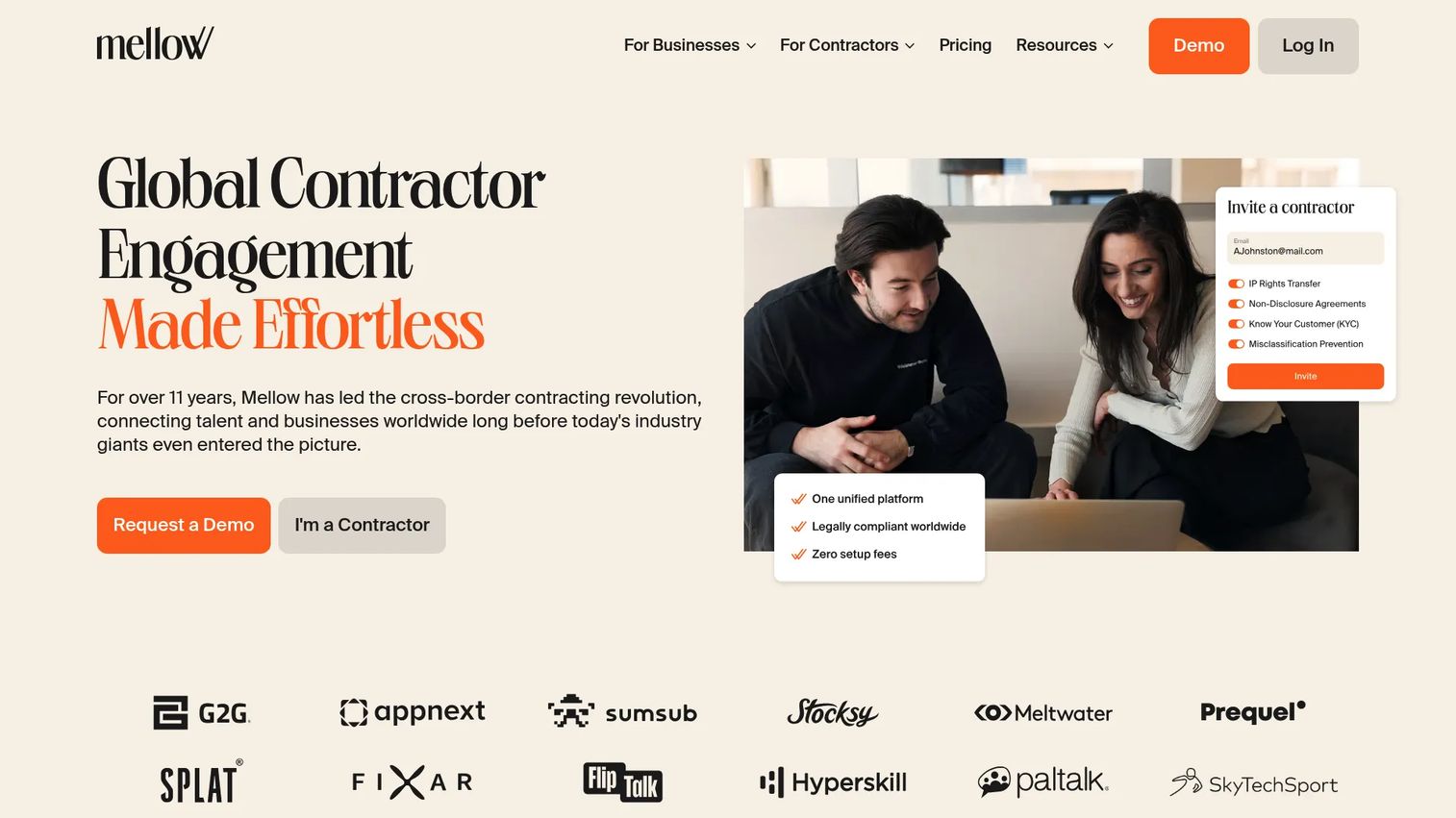
Mellow is a global contractor management and contractor-of-record platform for businesses hiring and paying international freelancers and contractors. It fits as a leaner, payments-first option for teams that want cross-border contractor operations without committing to a heavy enterprise rollout. The transparent fee structure is part of the appeal.
The platform covers contractor management, contractor of record, and global payouts. That contractor-of-record capability lets teams engage international contractors compliantly without standing up local entities, which is a meaningful shortcut for a growing company expanding into new markets. For founders who want modern workflow automation around onboarding and payments, Mellow keeps the footprint light.
Best for: Companies managing and paying contractors across multiple countries.
Key strengths
- Contractor management: Onboard, organize, and manage international contractors centrally.
- Contractor of record: Engage contractors compliantly without local entities.
- Global payouts: Pay contractors across countries with clear, transparent fees.
Why choose Mellow: Mellow fits teams that want cross-border contractor management and payments with a lighter setup and transparent pricing. If your priority is paying and managing international contractors compliantly without a large enterprise implementation, it is a strong specialized choice.
Mellow pricing: Mellow's public pricing page shows three numeric offerings. Get Paid is 5% per month per payment. Contractor of Record runs 3.5-5.5% per payment, with a three-month intro at 3.5%. Contractor Management is $35 per month per contractor. Employer of Record is quote-based. Mellow holds a 4.6/5 rating on G2.
How to choose the right freelancer management system
The strongest fit depends on your geography, your worker mix, and your existing stack.
If your external workforce spans many countries and you want recruiting through payments in one platform, Deel Hire and Worksuite cover the widest lifecycle. If governance and classification control are the priority across a contractor program, Worksome is the strongest overall pick. For teams that need talent discovery as part of the system, YunoJuno blends a marketplace with full management, and Upwork is the right call when sourcing is the core need.
If your external spend includes vendors and agencies and you want deep compliance plus broad payment coverage, TalentDesk is built for that breadth. For US-heavy 1099 programs, especially on ADP infrastructure, WorkMarket by ADP handles verification, payment, and tax filing end to end. And if you want a leaner, transparent, cross-border contractor and contractor-of-record option, Mellow keeps the footprint light.
The founder lens stays the same across all of them: visibility, control, and repeatability. Pick the system that removes the most manual coordination from your team while giving you spend and compliance data you can defend. Run a short evaluation with the one or two tools that match your geography and worker mix, and weigh first-week setup against the admin load you are trying to kill.
FAQs
A freelancer management system is software that centralizes sourcing, onboarding, contracts, compliance, payments, and reporting for freelancers and independent contractors in one place. It replaces the spreadsheets, email threads, and separate payment tools most teams use as contractor headcount grows. The goal is control and visibility across the full external workforce lifecycle.
A vendor management system (VMS) is built primarily for staffing agencies and large contingent programs, often routing work through third-party suppliers. Freelancer management software focuses on directly engaged freelancers and contractors: onboarding, classification, contracts, and payments for workers you source yourself. The lines blur at the enterprise level, but the starting point differs: VMS centers on supplier relationships, FMS centers on the individual worker record.
Worker classification, multi-country payments, currency support, and compliance depth including KYC, AML, and tax handling matter most. Auditability is the quiet essential, since misclassification and weak records surface during due diligence. Integrations with your finance and HR stack and clear spend reporting round out what a global program needs.
Worksome, TalentDesk, and WorkMarket by ADP all lead on compliance depth. Worksome automates worker classification and contracts inside the platform. TalentDesk covers IC classification, AML/KYC checks, and Agent of Record support across 190+ countries. WorkMarket adds 1099-NEC filing for US-heavy programs. The best fit depends on whether your exposure is global or domestic.
Yes. Most platforms on this list automate invoicing and process payments across multiple countries and currencies. TalentDesk pays across 190+ countries and 55+ currencies, Mellow handles global payouts with transparent fees, and Deel covers payments in a wide range of currencies. Payment automation is one of the main reasons teams adopt an FMS in the first place.
When you cannot answer how many contractors you have and what you owe them in under five minutes, the spreadsheet has become a risk. Other triggers include contracts scattered across personal email, onboarding that depends on one person, and finance reconciling invoices by hand. Cross-border hiring accelerates the need, since classification and compliance outgrow manual tracking fast.
Not quite. A marketplace like Upwork is strongest at talent discovery: finding and hiring freelancers you do not already know. A freelancer management system is built to be the internal operating layer for managing, classifying, and paying workers across their lifecycle. Some tools, like YunoJuno, blend both. If sourcing is your core need, a marketplace fits; if governance and operations are, an FMS does.
Look for the system that removes the most manual coordination while giving you spend and compliance data you can defend in a board meeting. Prioritize lifecycle coverage, global payments, compliance depth, and clean integrations with your existing stack. Weigh first-week setup against the admin load you are eliminating, and check that the tool fits your geography and worker mix before committing.