Your engineering lead opened a senior role 87 days ago. Two candidates ghosted after the second round. Your recruiter is drowning in 400 inbound applicants for a role that should have closed last month. Every vendor in your inbox claims their AI recruiting software will fix it.
Most won't. A LinkedIn Future of Recruiting report found that roughly three-quarters of recruiting pros say AI will be very or extremely important to the future of the function. That number explains the noise. It does not tell you which AI recruiting tools actually move metrics versus which ones bolted an LLM onto a 2018 ATS and raised prices.
This guide ranks the 20 AI recruiting tools that earn shortlist consideration in 2026. It is built for the talent leader (or the founder forwarding this to one) who needs the recruiting function to scale without their direct involvement. We cover what each tool does, who it fits, what it costs where pricing is public, and where it sits relative to the rest of the stack. No vendor copy. No "industry-leading" filler.
If you want to evaluate vendors well, ask each one for an interactive demo you can explore on your own time with your team's actual hiring scenarios in mind. The ones who say yes are the ones worth talking to.
What's inside
This guide is for VPs of People, Heads of Talent, recruiting ops leaders, and founders evaluating AI recruitment software in 2026. We selected 20 tools across four criteria:
- Real AI capability beyond keyword matching (genuine LLM reasoning, conversation, or talent graph intelligence)
- Integration depth with the major ATSs (Greenhouse, Lever, Workday, Ashby, BambooHR)
- Transparent pricing on the vendor site or G2-verifiable ranges
- Verified customer reviews weighted over vendor marketing claims
This is not a list of every ATS that added an AI button in 2024.
TL;DR
- Best for high-volume hourly hiring: Paradox
- Best for sourcing passive candidates: Gem
- Best for interview intelligence: BrightHire
- Best AI talent search engine: Findem or SeekOut
- Best ATS-native AI for mid-market: Greenhouse or Ashby
- Best affordable AI recruiting tool for early-stage teams: Manatal or Juicebox
- Best for enterprise talent acquisition software: Eightfold, iCIMS, or Workday Recruiting
What is AI recruiting software?
AI recruiting software is a category of hiring tools that uses machine learning and large language models to automate sourcing, screening, scheduling, and candidate communication across the recruiting funnel.
In 2020, "AI" in recruiting mostly meant rule-based filters and keyword scoring. In 2026, the term covers genuine LLM-driven conversation, natural-language candidate search, agentic outreach, and interview intelligence that transcribes, scores, and structures decisions.
Core capabilities you should expect from an AI powered hiring platform in 2026:
- Resume parsing and candidate ranking based on skills, experience, and role context, not just keyword overlap
- Candidate sourcing from public profiles, the open web, and rediscovery of past applicants
- Conversational screening through chat, SMS, and email handled by AI agents
- Interview scheduling automated end-to-end across calendars and time zones
- Interview intelligence including recording, transcription, AI-generated notes, and scorecard assistance
- Bias auditing and explainability so AI-generated decisions can be reviewed
- Predictive analytics for time-to-hire, pipeline coverage, and quality-of-hire measurement frameworks
AI recruitment software usually sits as a layer on top of, or alongside, your ATS. It rarely replaces the system of record. The best ai recruiting tools augment recruiters rather than replace them: teams hire faster with the same headcount, not with fewer recruiters.
When AI recruiting software actually pays off
Not every team needs an AI recruiter. Three scenarios where the math works.
Cut time-to-hire on high-volume roles
If you screen hundreds of applicants per role (frontline, hourly, sales development, support), conversational AI can handle initial qualification, scheduling, and follow-up at a scale recruiters cannot, dramatically improving time-to-hire benchmarks. Paradox, Humanly, and HireVue are the obvious shortlist here.
Surface passive candidates your team is not finding
Senior engineering, GTM leadership, and specialized technical roles rarely come through the inbound funnel. AI sourcing platforms like Gem, Findem, SeekOut, hireEZ, and Juicebox search the open web and your past pipeline to surface candidates your team would miss.
Standardize the candidate experience as you scale
At Series B and beyond, every recruiter does it slightly differently. Hiring managers complain. Candidates churn. Interview intelligence tools (BrightHire) and structured hiring ATSs based on structured interview research (Greenhouse, Ashby) give you consistency without forcing a centralized playbook everyone ignores. Standardization here often pairs well with user onboarding software approaches that scale internal training without losing consistency.
How we evaluated and ranked these AI recruiting tools
Every tool was checked against four sources at publication: the vendor's pricing page, G2 reviews and ratings, customer-reported integration depth with major ATSs, and the documented presence of real AI capability beyond keyword filtering.
Pricing is reported only where the vendor publishes it or where G2 surfaces verified ranges. Where a vendor gates all pricing, we note that and describe the tier structure they publish. G2 ratings reflect the current product review page at publication. Tools are ranked by how well they fit the most common talent-leader use cases at growth-stage and enterprise companies, not by vendor relationships.
AI recruiting software comparison table
The table below sorts the top 10 most relevant ai hiring tools first, followed by 10 more. Use it to shortlist three for deeper evaluation, then ask each for a live demo against your actual hiring problem. If you want to see how leading vendors present capabilities side by side, browse Guideflow's demo showcase for examples of interactive product walkthroughs.
| # | Product | Intent | Key use case | Pricing | G2 rating |
|---|---|---|---|---|---|
| 1 | Paradox | Conversational AI recruiter | High-volume, hourly, frontline hiring | Custom | 4.6/5 |
| 2 | Eightfold.ai | Enterprise talent intelligence | Deep matching, internal mobility | Custom | 4.2/5 |
| 3 | Gem | AI sourcing + CRM | Outbound recruiting, passive candidates | Custom (Startups, Growth, Enterprise tiers) | 4.7/5 |
| 4 | Findem | AI talent search | Diversity sourcing, hard-to-find profiles | Custom | 4.7/5 |
| 5 | HireVue | AI video interviewing | High-volume structured interviews | Essential, Premium (custom) | 4.1/5 |
| 6 | BrightHire | Interview intelligence | Interview quality at scale | Recruiters, Teams, Enterprises (custom) | 4.7/5 |
| 7 | Humanly | Conversational screening | High-volume frontline hiring | Custom | 4.8/5 |
| 8 | Workable | AI ATS + HRIS | SMB to mid-market all-in-one | From $299/month | 4.4/5 |
| 9 | Greenhouse | Structured hiring ATS | Mid-market to enterprise rigor | Core, Plus, Pro (custom) | 4.4/5 |
| 10 | Fetcher | AI sourcing + managed service | Sourcing-as-a-service | From $115/month | 4.6/5 |
| 11 | SeekOut | AI talent search engine | Technical and diversity hiring | From $149/month | 4.5/5 |
| 12 | hireEZ | AI sourcing at scale | Outbound at agency scale | Custom | 4.6/5 |
| 13 | Manatal | Affordable AI ATS + CRM | Price-sensitive early-stage teams | From $15/user/month (annual) | 4.8/5 |
| 14 | Lever | ATS + CRM with AI matching | Mid-market inbound + outbound | Custom | 4.3/5 |
| 15 | iCIMS | Enterprise ATS with AI | Large enterprise compliance | Custom | 4.2/5 |
| 16 | SmartRecruiters | Enterprise TA suite | Global enterprise requisition volume | From $14,995 (Essential) | 4.2/5 |
| 17 | Workday Recruiting | HCM-native recruiting | Workday-standardized enterprises | Custom | 3.7/5 |
| 18 | Ashby | All-in-one modern ATS | Series A–C SaaS hiring 50–500/year | From $400/month (Foundations) | 4.7/5 |
| 19 | Pinpoint | ATS with AI automation | In-house structured hiring | Custom | 4.7/5 |
| 20 | Juicebox (PeopleGPT) | Natural-language sourcing | ChatGPT-style candidate search | Free plan, paid from $139/seat/month | N/A |
20 best AI recruiting software tools for 2026
1. Paradox
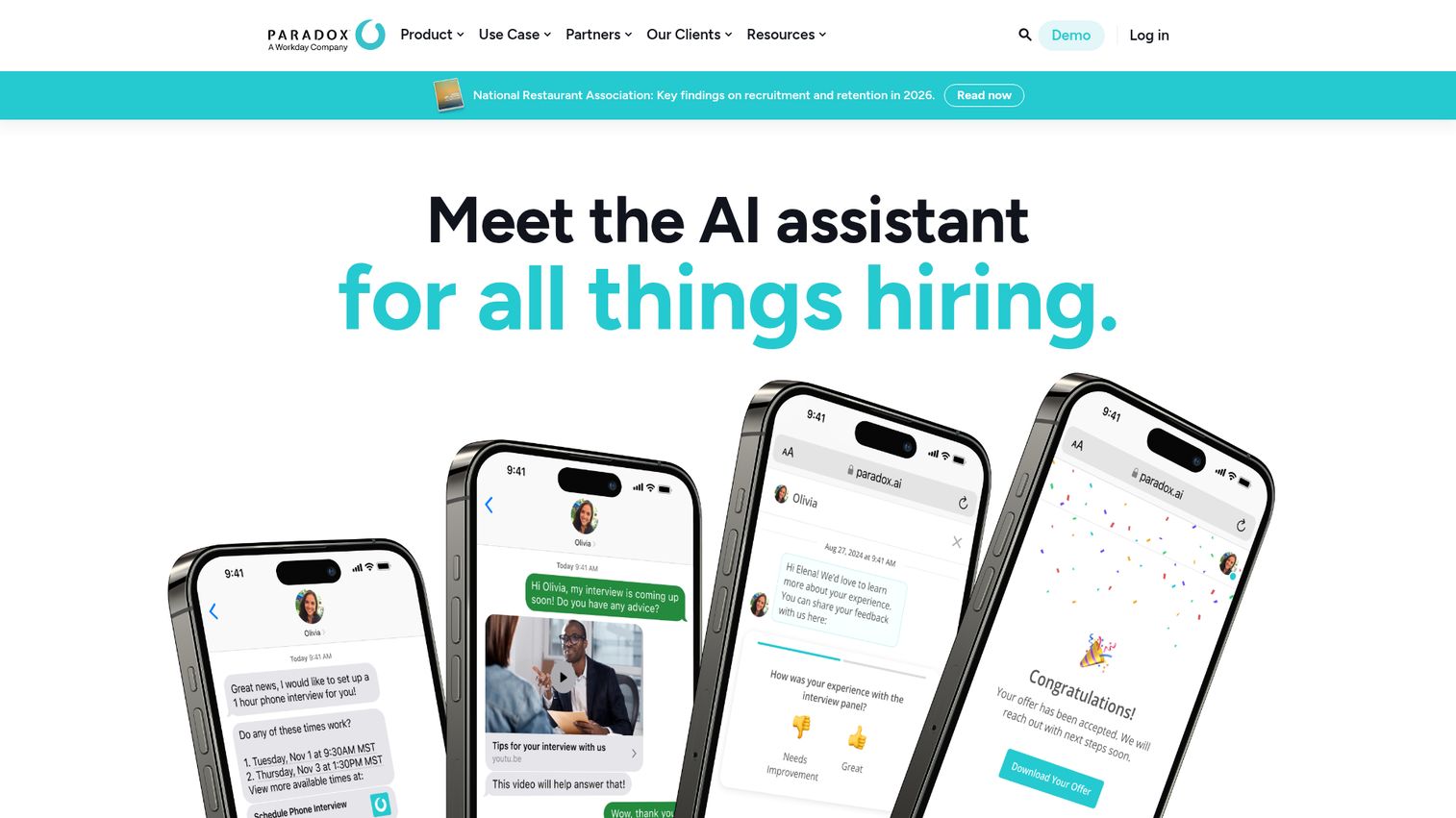
Paradox is a conversational AI hiring platform built around Olivia, an assistant that handles screening, scheduling, and candidate communication over chat, SMS, and WhatsApp. It is the dominant choice for enterprises running high-volume frontline and hourly hiring, where the bottleneck is recruiter time, not candidate supply.
Best for: Enterprise and mid-market teams hiring hundreds or thousands of frontline, hourly, or retail roles per month.
Key strengths
- Conversational candidate screening: Olivia qualifies candidates through natural chat, replacing one-off screening calls.
- AI-powered scheduling: Candidates self-schedule via SMS, WhatsApp, chat, or email without back-and-forth.
- Conversational career sites: AI-powered job search, Q&A, and chat-based apply replace traditional career pages.
Why choose Paradox: If your bottleneck is recruiter throughput on volume hiring, Paradox replaces multiple screening and coordination tools with one conversational layer. It is overkill for a SaaS team hiring 30 corporate roles a year and tuned for organizations where speed-to-hire on hourly roles directly drives revenue.
Paradox pricing: Paradox does not publish pricing on its website. All plans are quoted based on hiring volume and modules. Expect enterprise-tier annual contracts. Ask for pricing tied to requisitions or hires, not seats, given the volume use case.
2. Eightfold.ai
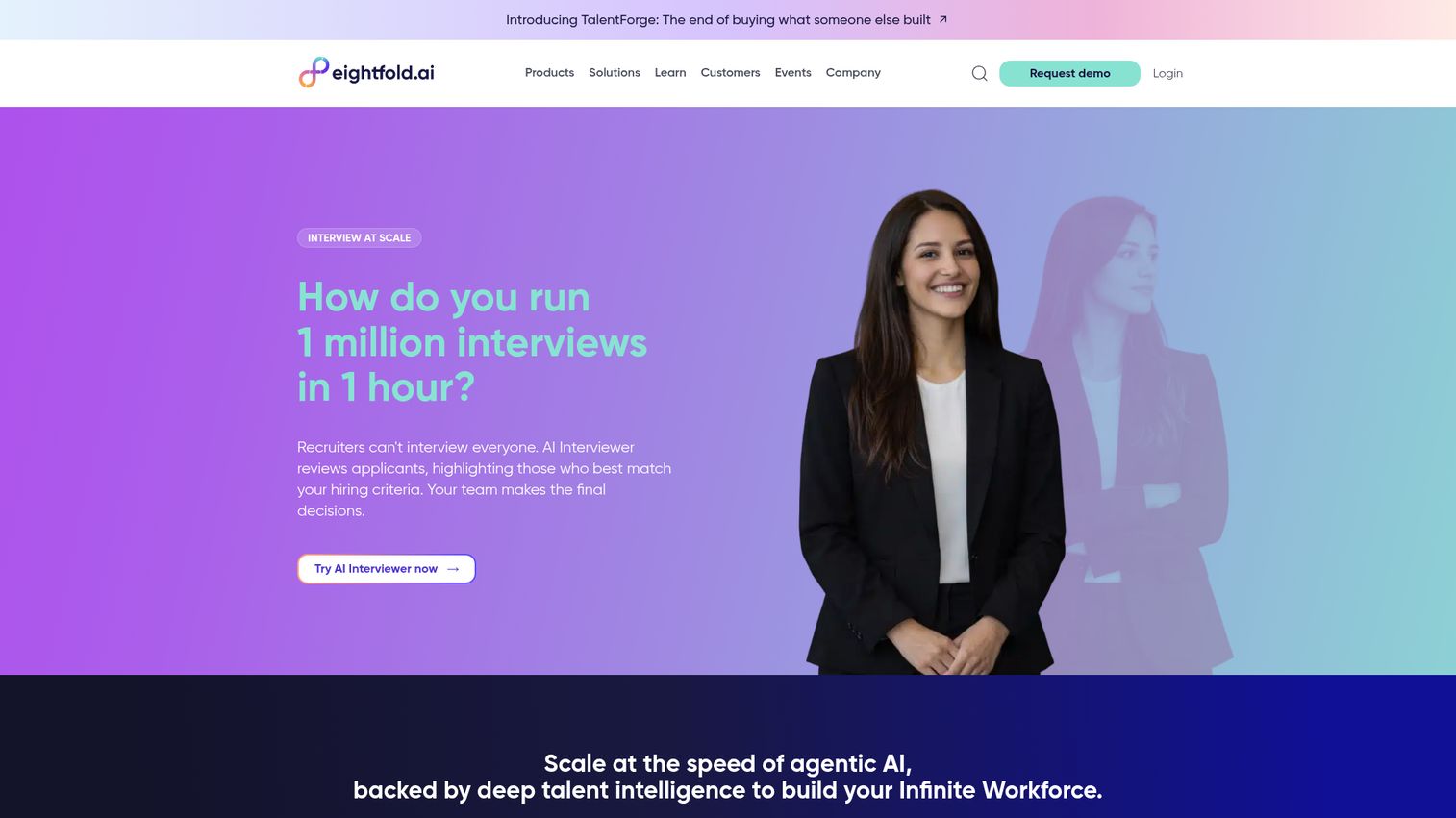
Eightfold.ai is an AI-native talent intelligence platform used by enterprises for recruiting, internal mobility, and workforce planning. Its talent graph methodology matches candidates to roles based on skills and trajectory rather than keyword overlap, which is what enterprise TA teams actually want.
Best for: Enterprise HR and talent teams managing recruiting, internal mobility, and reskilling at scale.
Key strengths
- Skills-based talent matching: Uses real-time work context and a talent graph to surface candidates beyond keyword filters.
- AI Interviewer: Adaptive, conversational candidate interviews at scale for high-volume top-of-funnel.
- Skills intelligence: Supports workforce planning, internal mobility, and upskilling, not just external hiring.
Why choose Eightfold: This is an enterprise platform. If you have 5,000+ employees, multiple business units, and a real internal mobility motion, Eightfold consolidates recruiting and talent management around a shared skills graph. For a 200-person SaaS company, it is overbuilt.
Eightfold pricing: Eightfold does not publish pricing publicly. Enterprise contracts are typical, with pricing scaled to workforce size and modules. Plan for a multi-quarter procurement cycle.
3. Gem
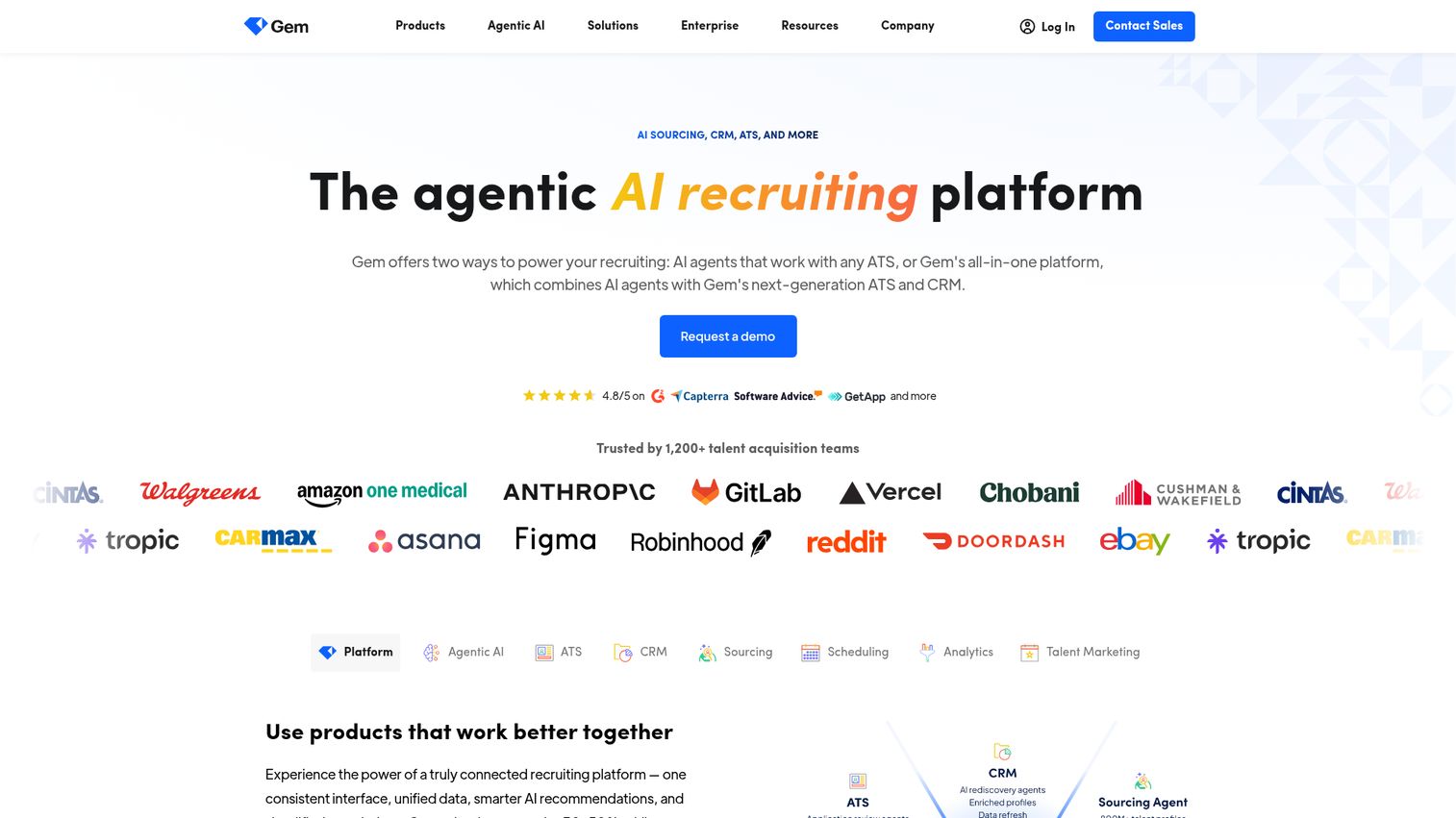
Gem is an agentic AI recruiting platform that offers AI agents for any ATS, plus an all-in-one option combining its own ATS and CRM. It is the default sourcing and CRM choice for in-house outbound recruiting teams at growth-stage and mid-market SaaS companies.
Best for: Talent acquisition teams running outbound to passive candidates who want a CRM, AI sourcing, and analytics in one place.
Key strengths
- AI sourcing and outreach automation: Surfaces passive candidates and personalizes multi-touch sequences. Teams running heavy outbound often pair this with broader outreach software for non-recruiting motions.
- Recruiting CRM: Manages talent pools, nurture, and rediscovery across the full pipeline.
- ATS-native or all-in-one: Works alongside Greenhouse, Lever, or Ashby, or runs as a full ATS + CRM stack.
Why choose Gem: If your team runs real outbound (not just inbound triage), Gem replaces a sourcing tool, a CRM, and a stack of spreadsheets. It earns its place in a Series B to mid-market stack where passive candidate volume matters.
Gem pricing: Gem publishes three plan tiers on its pricing page: Startups (up to 100 FTE), Growth (101–1,000 FTE), and Enterprise (1,000+ FTE). Growth and Enterprise are custom-quoted. The Startups card does not list a numeric price publicly. Pricing source: app.gem.com/pricing.
4. Findem
Findem is an AI platform for talent decisions that combines multichannel sourcing, talent marketing, and custom AI signals. Its differentiator is the ability to define organization-specific attributes (e.g., "candidates who joined a B2B SaaS company within 18 months of Series A") and search across continuously refreshed profiles.
Best for: Enterprise talent acquisition and workforce teams that want AI-driven sourcing, talent marketing, and custom signals in one platform.
Key strengths
- Multichannel sourcing: Covers inbound, rediscovery, referrals, alumni, and external talent in one search.
- AI-powered talent marketing: Personalized outreach with continuously refreshed candidate profiles.
- Custom AI signals and agents: Build organization-specific attributes and AI agents that find non-obvious fits.
Why choose Findem: If your hiring problem is "we cannot find people who match a specific trajectory" rather than "we cannot screen volume," Findem is the closer fit. It is most useful when you have a defined ICP for candidates and a sourcing budget to back it.
Findem pricing: Findem does not publish pricing publicly. The motion is demo-led with custom quotes. Expect enterprise pricing tied to seats and search volume.
5. HireVue
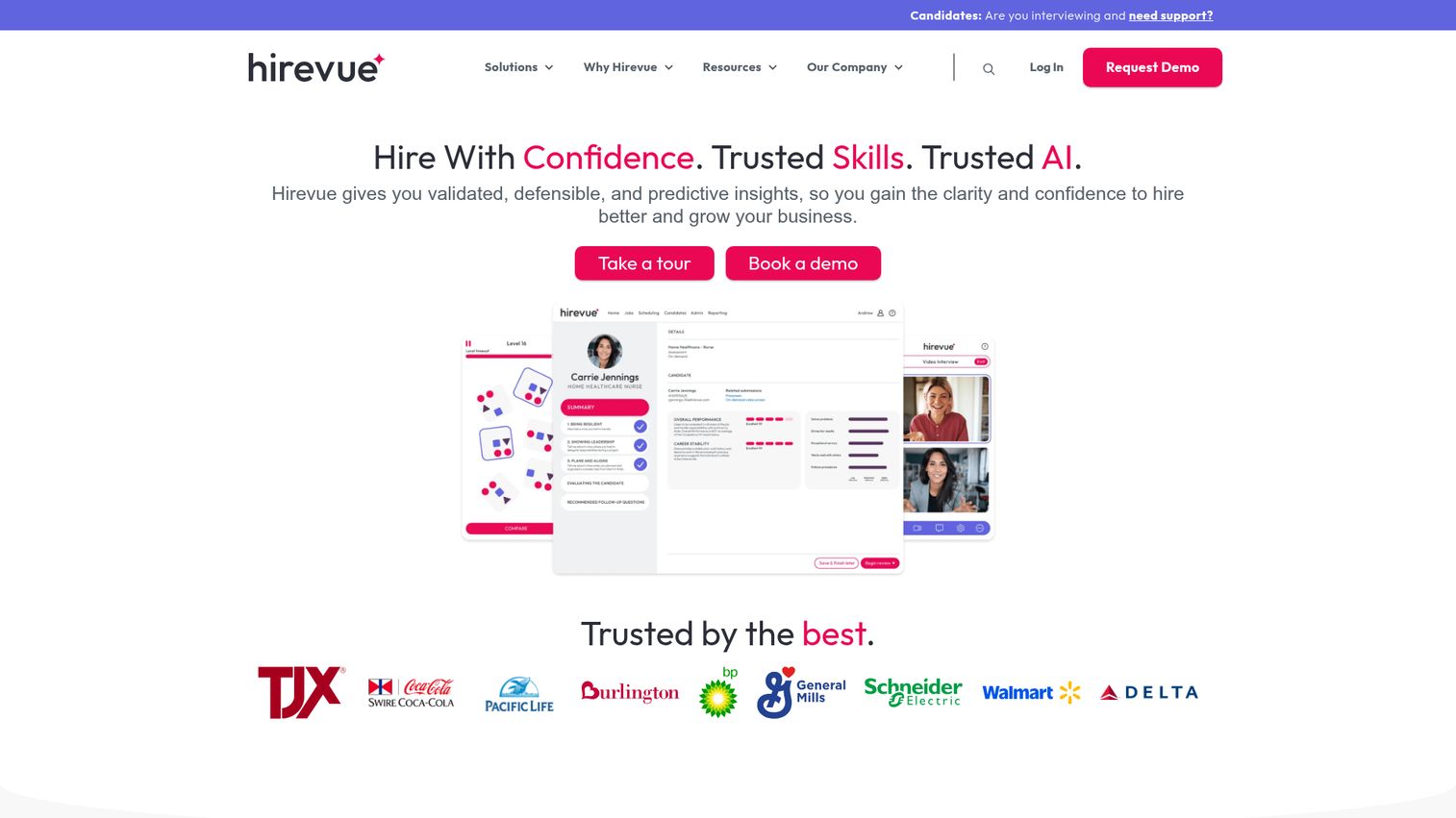
HireVue is an AI-driven hiring platform built around on-demand video interviewing, skills assessments, and conversational AI. It is the standard for organizations running structured interviews at high volume across global candidate pools.
Best for: Organizations that need to standardize and accelerate skills-based hiring across thousands of candidates.
Key strengths
- Automated video interviewing: Candidates record responses on demand, eliminating scheduling for first-round screens.
- Skills assessments: Validates technical and behavioral skills with structured scoring.
- Conversational AI and text automation: Handles candidate communication across SMS and chat.
Why choose HireVue: If your hiring funnel depends on consistent, scalable first-round screening (campus recruiting, hourly hiring, global early-career), HireVue is the most established option for skills-based hiring trends. Bias auditing methodology should be a non-negotiable question in the demo.
HireVue pricing: HireVue publishes plan names on its pricing page (Essential and Premium) but does not list numeric pricing. Plans require contacting sales. The pricing page notes HireVue is free for candidates, which is a candidate experience detail, not a buyer tier.
6. BrightHire
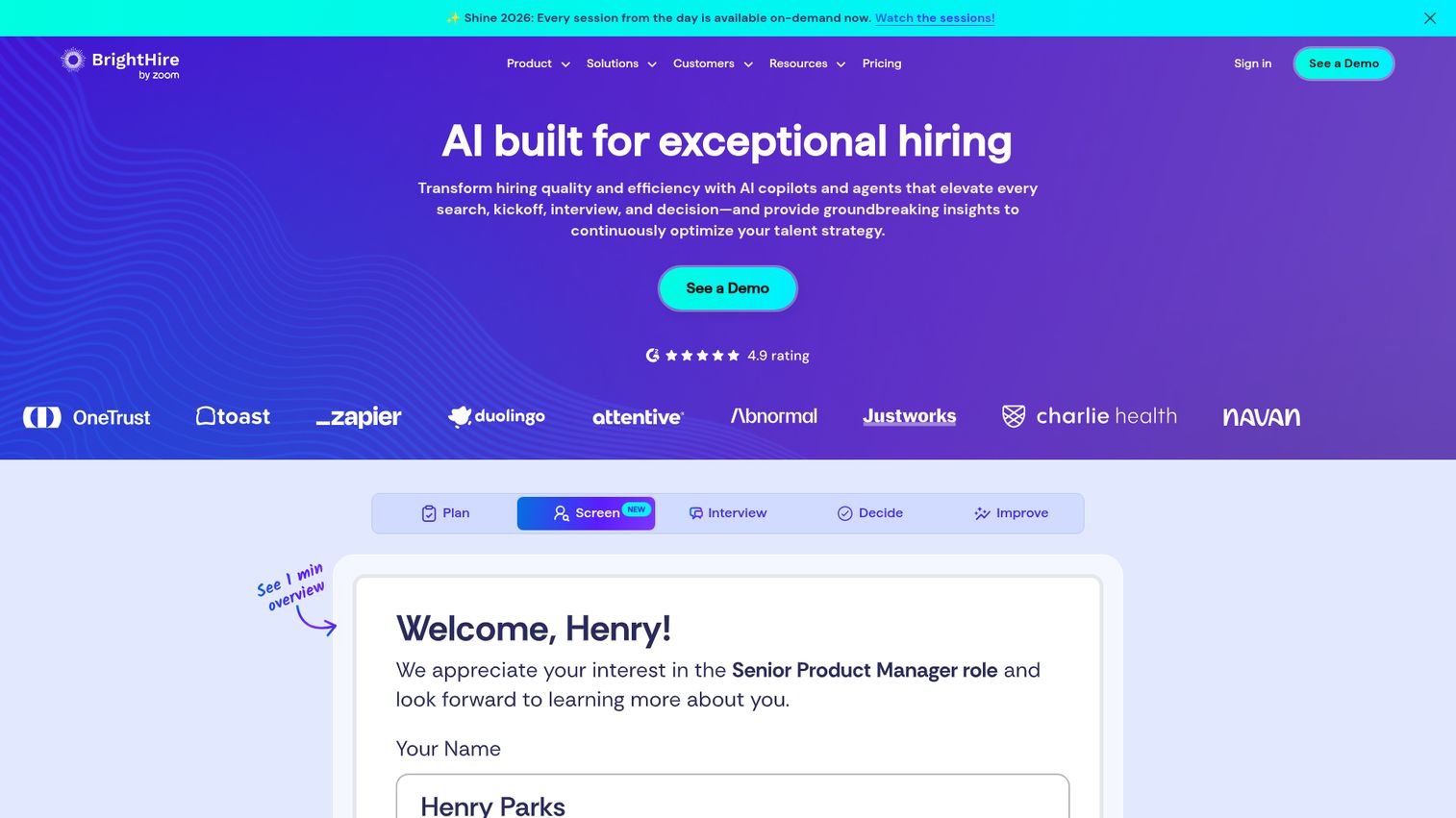
BrightHire is an AI-powered interview intelligence platform that records, transcribes, and analyzes interviews so teams run more consistent processes and make better decisions. For mid-market and enterprise teams worried about interview quality, it is the closest thing to a Gong-for-hiring.
Best for: Talent acquisition and recruiting teams that want AI-supported interview planning, capture, and scorecard assistance inside existing ATS workflows.
Key strengths
- AI-assisted interview planning: Drafts job descriptions and generates structured interview plans.
- Recording, transcription, and AI notes: Captures interviews and produces highlights and summaries automatically. Teams comparing standalone note-taking options can review the best AI note-taking tools for broader use cases.
- ATS integrations and 1-click scorecard completion: Pushes interview signal directly into Greenhouse, Lever, Ashby, and others.
Why choose BrightHire: This is the tool for teams where the bottleneck is interview quality and consistency, not pipeline volume. It also doubles as enablement for managers who interview occasionally and forget the structured process every time.
BrightHire pricing: BrightHire publishes three packaging tiers (Recruiters, Teams, Enterprises) on its pricing page without numeric pricing. BrightHire Screen can be purchased standalone or alongside Interview Intelligence. All pricing is quote-based.
7. Humanly
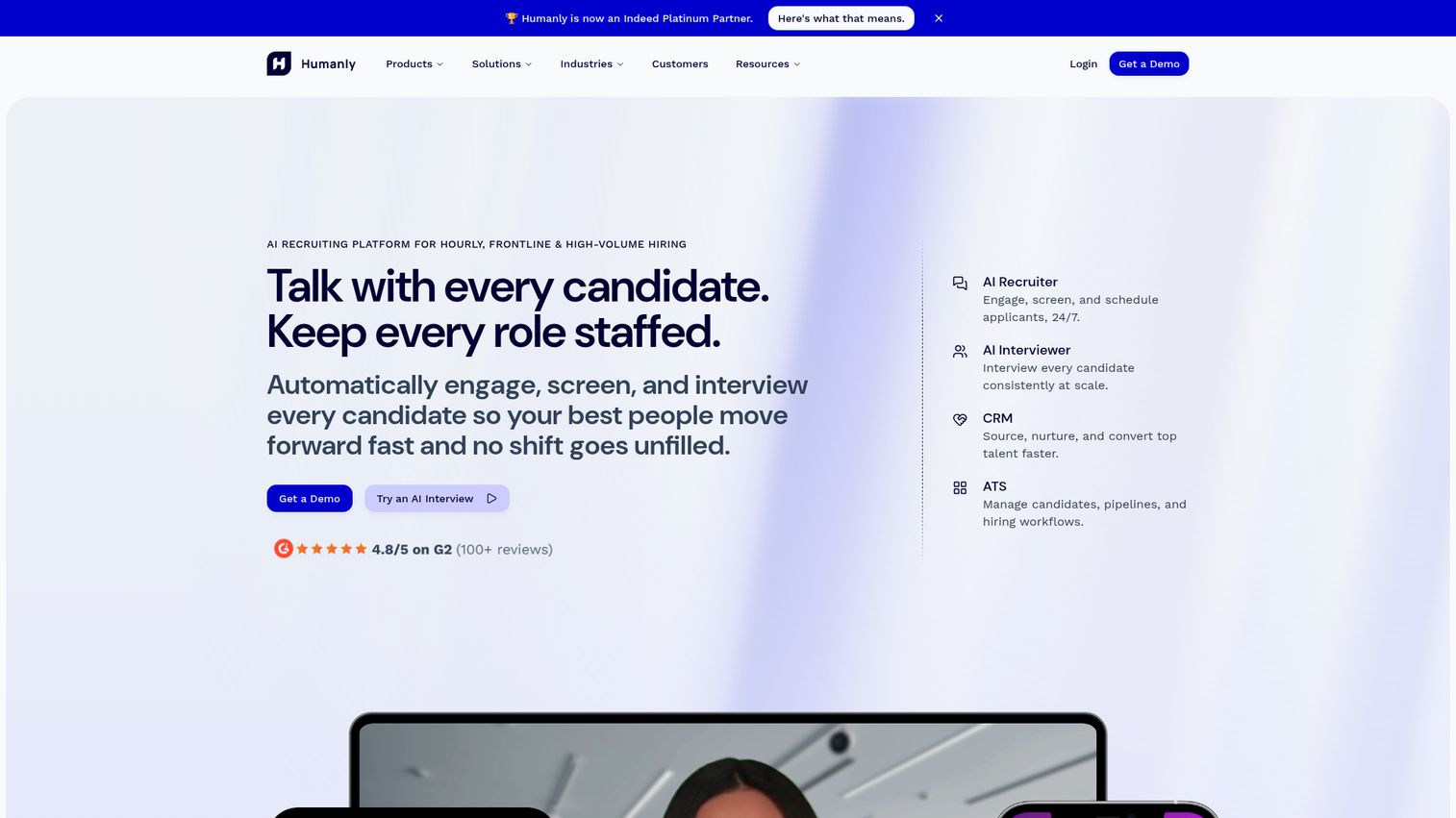
Humanly is an AI recruiting platform with CRM and ATS capabilities that automates screening, scheduling, and interview support over chat, voice, and video. It is often adopted by teams that want conversational AI without the full enterprise weight of larger platforms.
Best for: High-volume and distributed hiring teams that want to automate candidate engagement, screening, scheduling, and interviews.
Key strengths
- AI-powered screening: Conversational screening across chat, voice, and video.
- Automated interview scheduling: Calendar sync handles coordination without recruiter touch.
- Recruiting CRM: Sourcing, rediscovery, and outreach via SMS and email in one workflow.
Why choose Humanly: Humanly is a strong option for mid-market teams running volume hiring (support, sales, frontline) that want conversational AI alongside CRM functionality. It is a credible alternative when Paradox feels too enterprise-shaped for the team's size.
Humanly pricing: Humanly does not publish pricing publicly. The site is demo-led, and contracts are quoted based on hiring volume and modules.
8. Workable
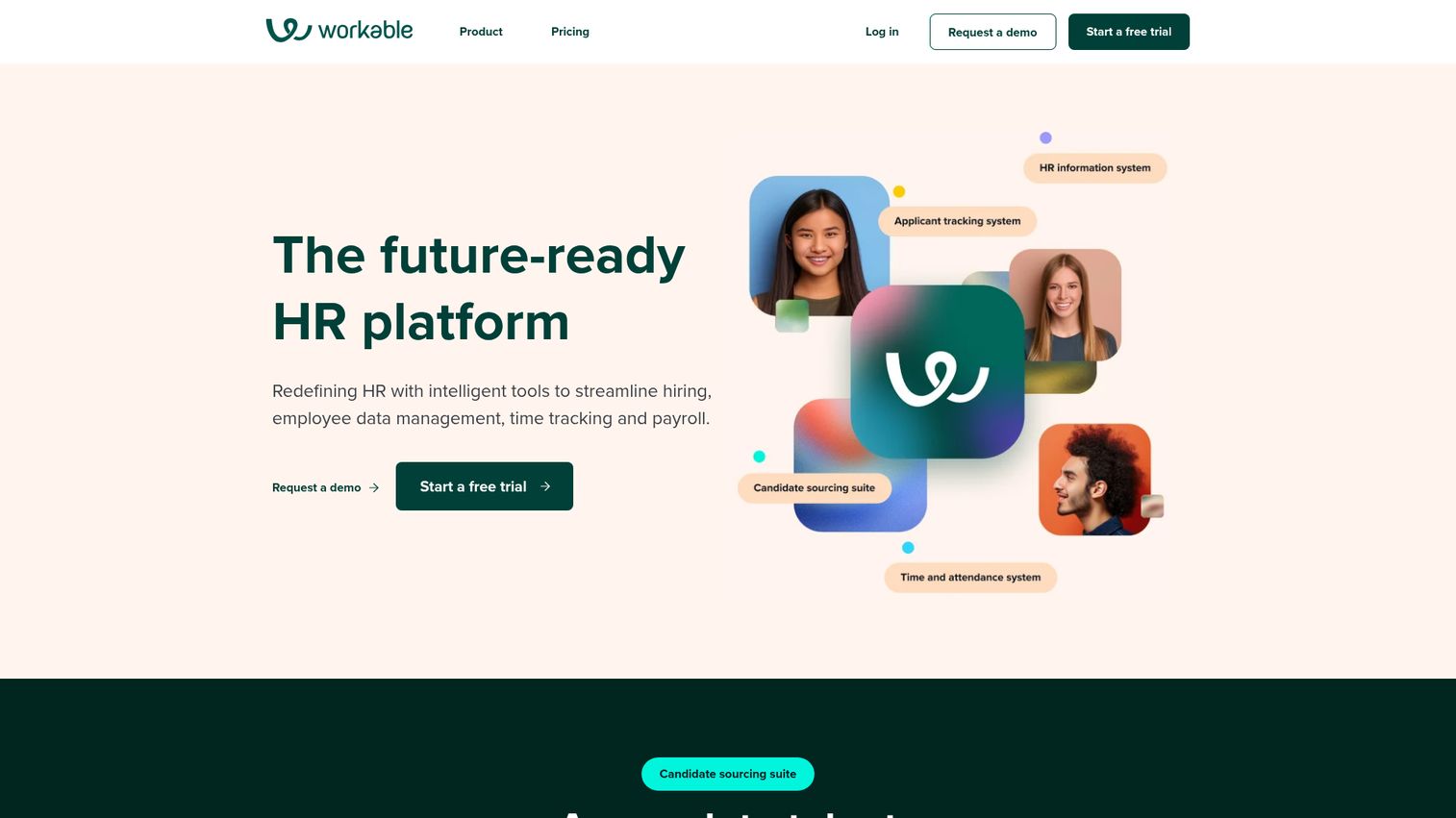
Workable is an all-in-one HR platform that combines an ATS with HRIS, time tracking, onboarding, and payroll reporting. For SMB and lower mid-market teams, it consolidates the recruiting and HR stack into a single tool with AI features baked in.
Best for: Growing companies that want one platform for recruiting and core HR, with AI screening and sourcing included.
Key strengths
- Candidate sourcing suite: Job board distribution, careers page builder, and passive candidate sourcing.
- AI-assisted applicant tracking: AI screening, self-scheduled interviews, interview kits, and scorecards.
- HRIS layer: Onboarding, employee data management, time off, time tracking, and payroll reporting.
Why choose Workable: If you are choosing between buying Workable and stitching together an ATS, an HRIS, and a scheduling tool, Workable usually wins on total cost and admin overhead. It scales well from 20 to a few hundred employees.
Workable pricing: Workable publishes pricing on its site. For 1–20 employees on bundled Recruiting + HR: Standard starts at $299/month, Premier at $599/month (annual), Enterprise at $719/month (annual). Larger employee bands use a selector for adjusted pricing. A 15-day free trial is available with no credit card. Pricing source: workable.com/pricing.
9. Greenhouse
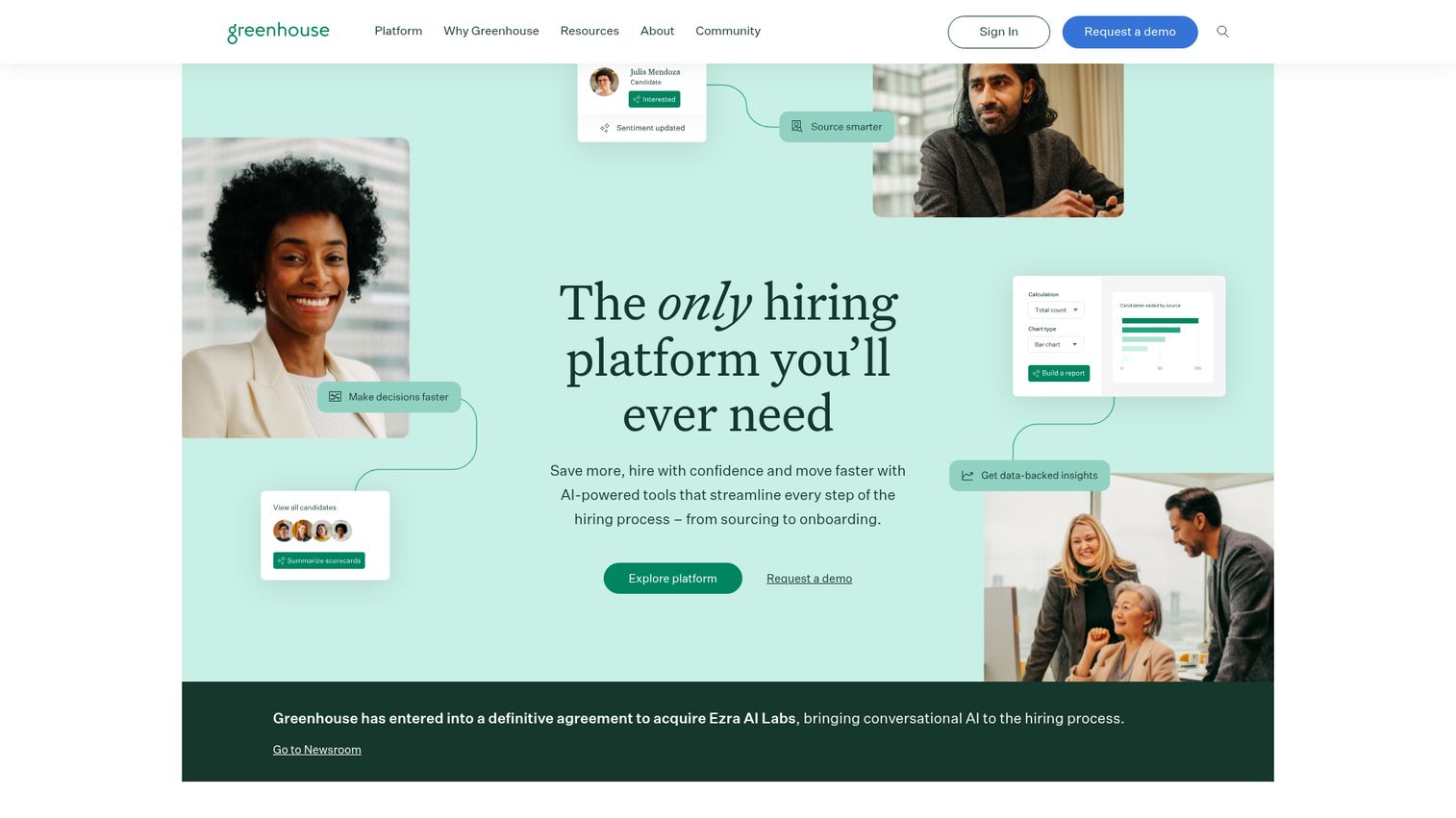
Greenhouse is the default structured hiring ATS for mid-market and enterprise SaaS companies, with AI features layered into sourcing, scheduling, and candidate experience. The brand is built around hiring rigor: structured interviews, scorecards, and consistent process.
Best for: Mid-market to enterprise teams that prioritize structured hiring, candidate experience, and reporting discipline.
Key strengths
- AI recruiting features: AI-assisted job descriptions, sourcing, and workflow automation.
- Talent sourcing: Native sourcing tools plus a strong partner ecosystem (Gem, BrightHire, SeekOut).
- Candidate experience: Branded careers, scheduling, and assessment workflows built around fairness.
Why choose Greenhouse: If your VP People wants hiring rigor and your CFO wants reporting they can defend to the board, Greenhouse is the safe default. The AI features are useful but the real value is the structured hiring opinion the product enforces.
Greenhouse pricing: Greenhouse offers three plans on its pricing page (Core, Plus, Pro) without published numeric pricing. Plus adds automation and advanced configuration; Pro adds enterprise-grade governance, security, analytics, and extensibility. All plans are custom-quoted.
10. Fetcher
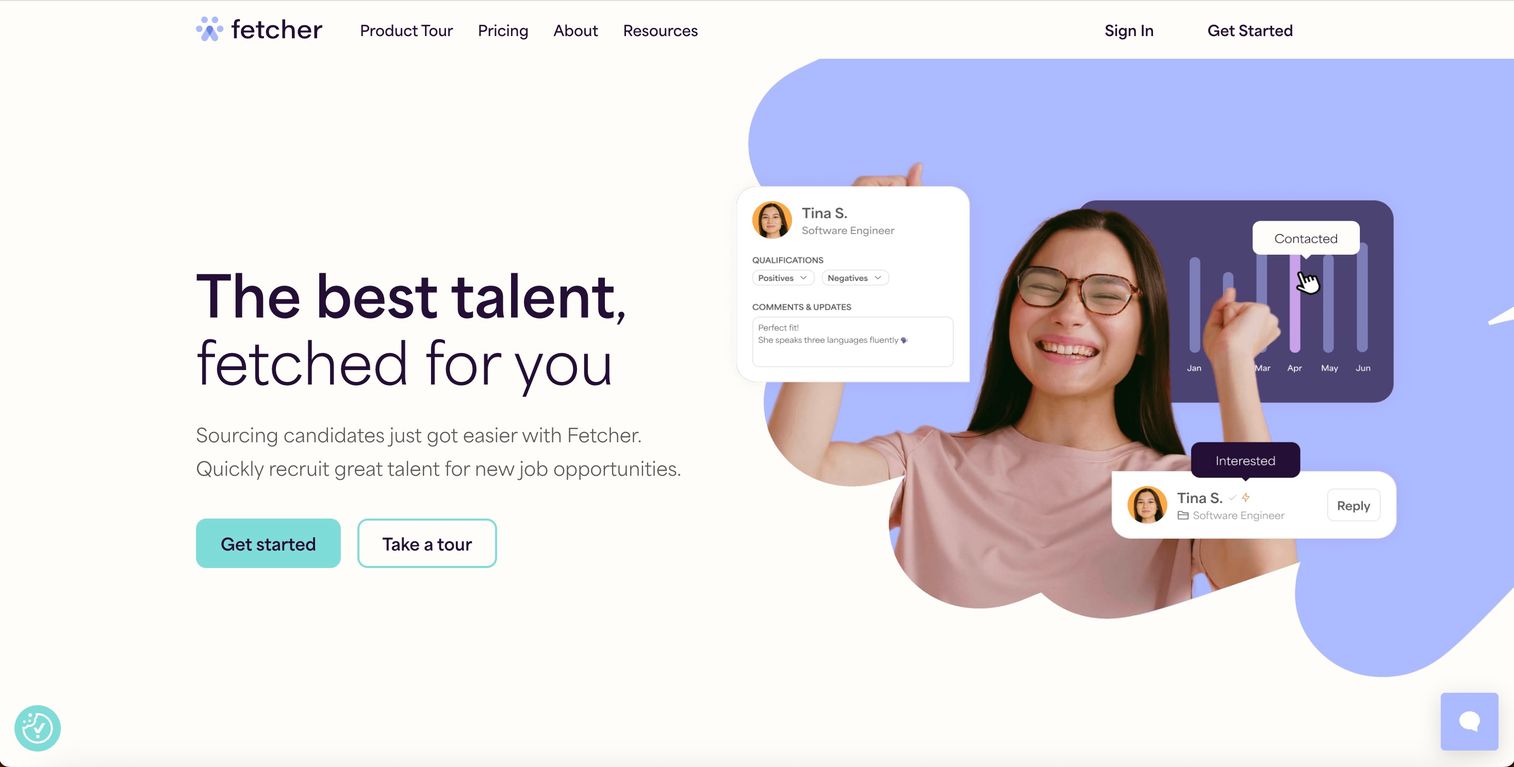
Fetcher is an AI-powered talent sourcing platform that combines automated sourcing with a managed services layer. It is the right fit for teams that want sourcing-as-a-service plus tooling, not just software.
Best for: People teams, small businesses, and staffing firms that want AI-assisted inbound applicant review plus outbound candidate sourcing.
Key strengths
- AI-powered sorting and screening: Triages inbound applicants and surfaces best fits.
- Outbound candidate sourcing: Searches a database of 500M+ candidate profiles for active outreach.
- Integration coverage: Connects to major ATS, HRIS, CRM, email, and chat systems.
Why choose Fetcher: If you do not have a dedicated sourcer and do not want to build that function in-house, Fetcher's managed-service layer fills the gap. It is most useful for teams hiring across a handful of senior roles at a time without a full recruiting bench.
Fetcher pricing: Fetcher's pricing page lists Self-serve at $115/month, Growth at $379/month, Amplify at $649/month, and Enterprise as quote-based. The page notes annual payment saves 30%. Pricing source: fetcher.ai/pricing.
11. SeekOut
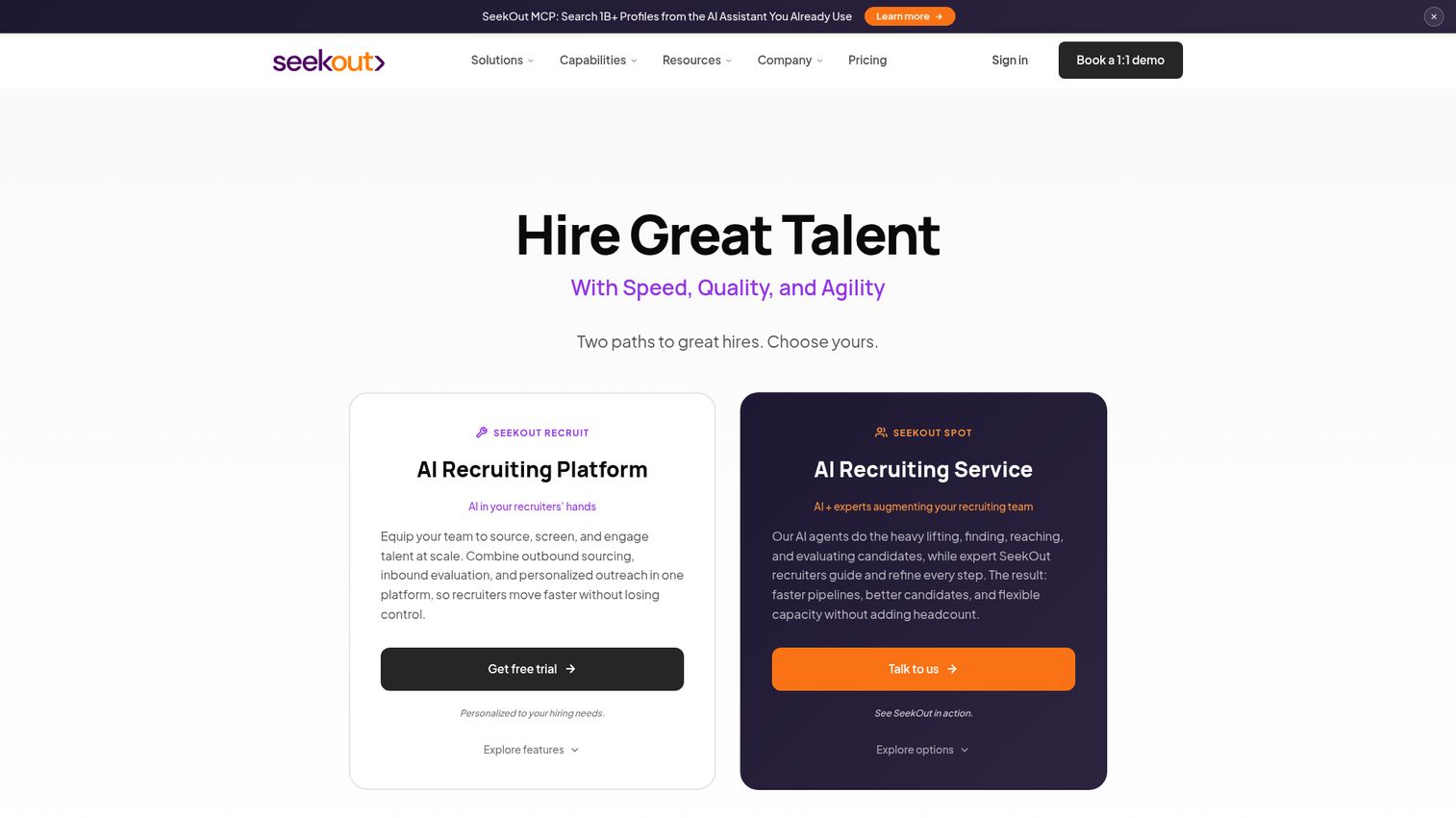
SeekOut is an agentic AI recruiting platform built around talent search, applicant evaluation, and personalized outreach. It is particularly strong for technical recruiting and diversity hiring, with searchable signals other tools do not surface.
Best for: Talent acquisition teams that need AI-assisted sourcing, inbound screening, outreach, and ATS rediscovery in one recruiting platform.
Key strengths
- Intelligent search across 1B+ external profiles: Surfaces candidates from public data plus your ATS history.
- Inbound applicant evaluation: AI scoring and qualified shortlists for incoming applicants.
- Personalized multi-touch outreach campaigns: Sequences for passive candidate engagement.
Why choose SeekOut: If technical roles or diversity targets are central to your hiring plan, SeekOut's search filters and signal depth are stronger than generic sourcing tools. It is also a credible rediscovery engine for teams sitting on years of past applicant data.
SeekOut pricing: SeekOut's pricing page lists Recruit Lite at $149/month (billed annually, upfront) and three custom-priced Recruit plans (Sourcing; Sourcing + Integration; Full Recruiting Funnel). The pricing FAQ notes SeekOut Recruit starts at $833/month for enterprise teams. A 14-day free trial is offered; no free tier. Pricing source: seekout.com/pricing.
12. hireEZ
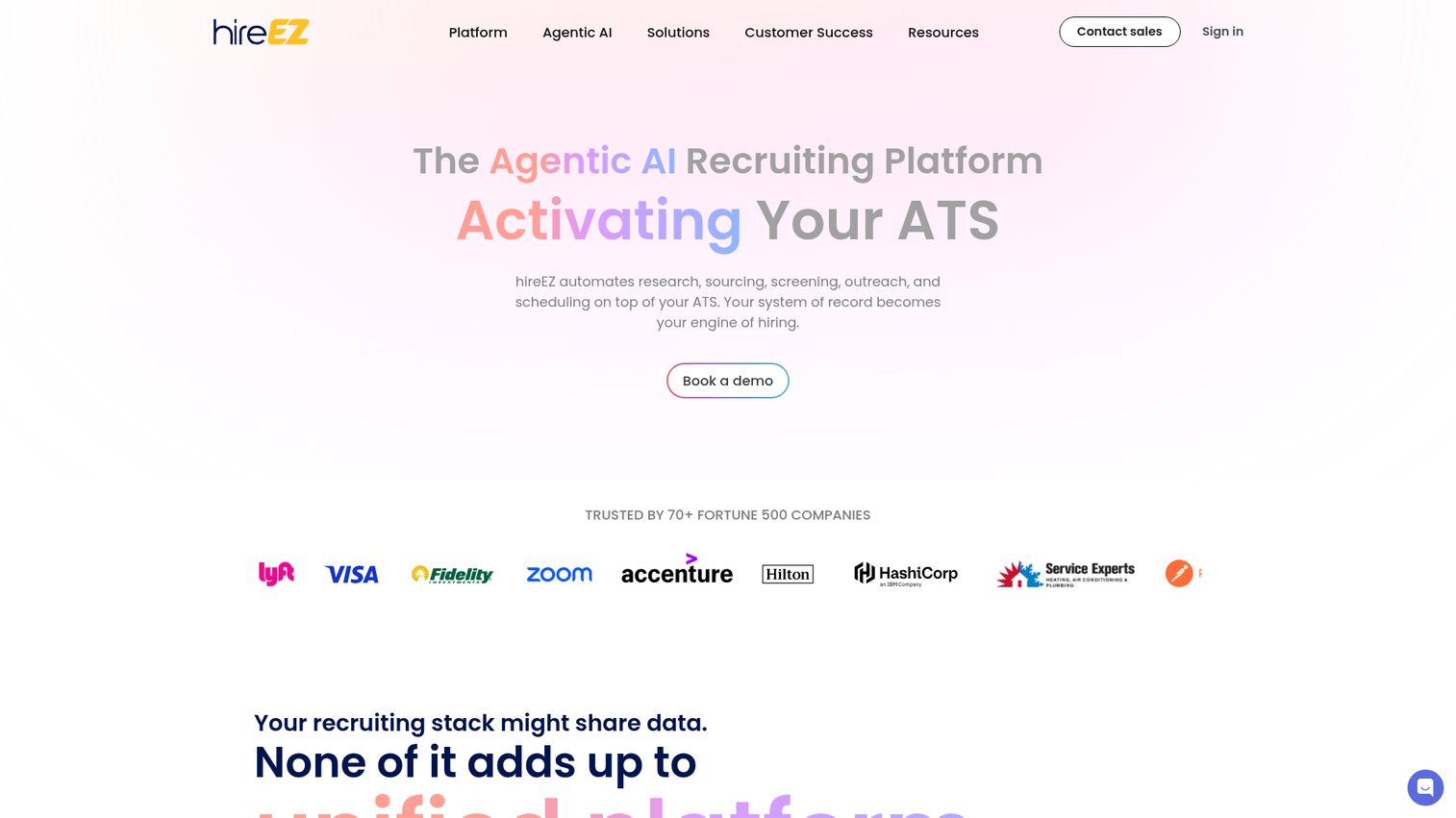
hireEZ is an AI recruiting platform built on top of an ATS to automate sourcing, screening, outreach, and scheduling at scale. It is the workhorse for agencies and in-house teams running heavy outbound.
Best for: Organizations that want an AI recruiting platform layered on top of their ATS to automate sourcing, screening, outreach, and scheduling.
Key strengths
- Open web sourcing: Searches public profiles across the open web.
- Applicant screening: AI evaluation of inbound applicants against role requirements.
- Scheduling agentic automation: Agents handle scheduling end-to-end. Teams evaluating broader agent stacks can compare options in the best AI orchestration platforms roundup.
Why choose hireEZ: If your team runs outbound at agency scale (or you are an agency), hireEZ's volume and automation depth justify the spend. It pairs well with structured ATSs like Greenhouse, Lever, and Workday rather than replacing them.
hireEZ pricing: hireEZ does not publish pricing publicly. The motion is demo-led with custom quotes based on seats and modules.
13. Manatal
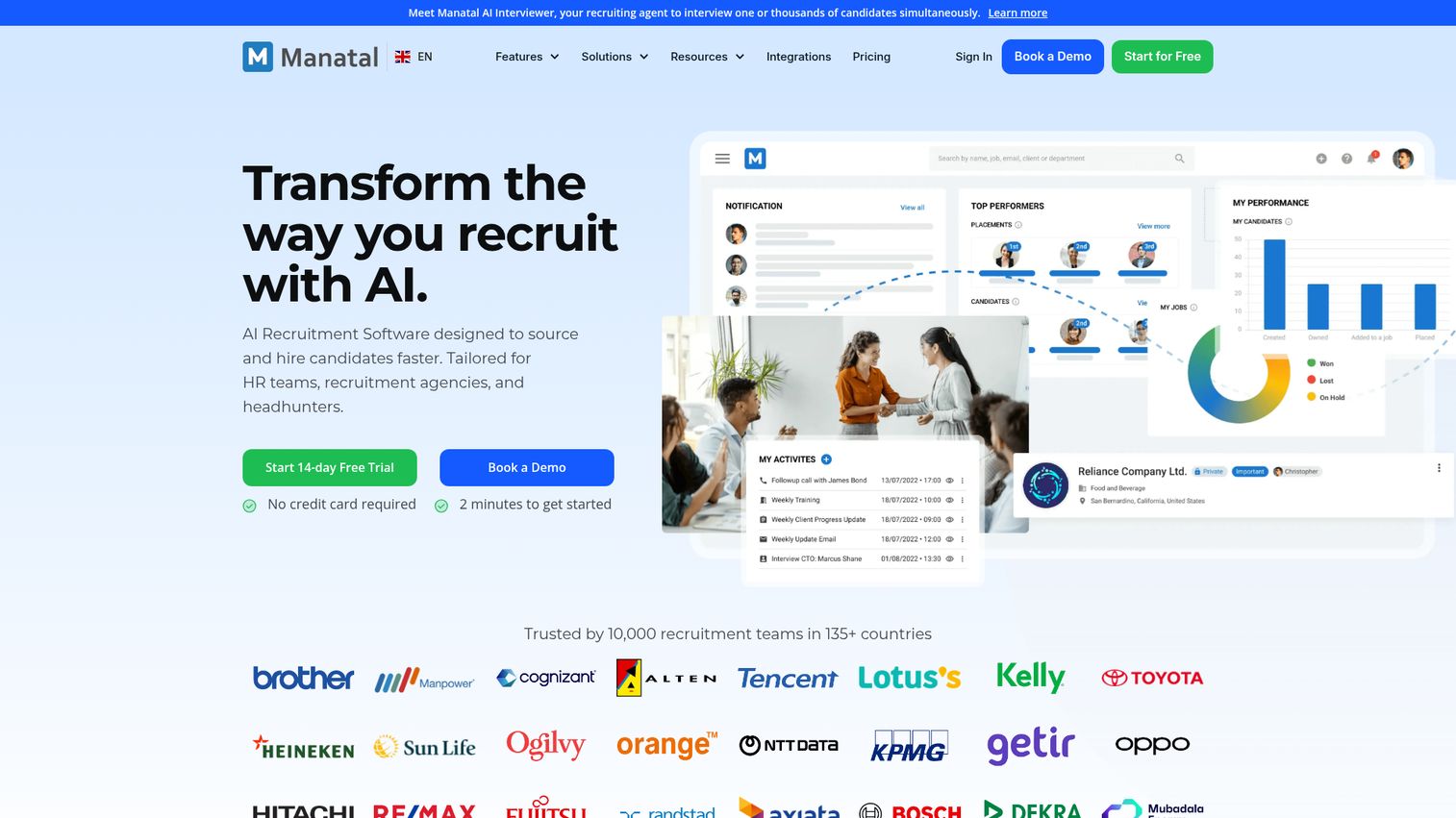
Manatal is an AI recruitment software designed for HR teams, recruitment agencies, and headhunters. It is one of the most affordable AI recruiting tools that still delivers a credible ATS, CRM, and AI screening experience.
Best for: HR teams, recruitment agencies, and headhunters that want an AI-enabled ATS plus recruitment CRM without enterprise pricing.
Key strengths
- Applicant tracking with customizable pipeline: Drag-and-drop pipeline management.
- Recruitment CRM included on all plans: Outbound candidate management is not gated to higher tiers. Compare with general-purpose options in the best CRM software guide.
- AI interviewer: Automated candidate screening across roles.
Why choose Manatal: For early-stage teams, agencies, and price-sensitive buyers, Manatal delivers the core ATS + AI workflow at a per-user price most competitors cannot match. It is not the tool to standardize a 500-person hiring engine, but for the 30-person company hiring its first 20 people, it earns its place.
Manatal pricing: Manatal publishes per-user pricing on its site. Yearly plans: Professional $15/user/month, Enterprise $35/user/month, Enterprise Plus $55/user/month. Monthly plans: Professional $19, Enterprise $39, Enterprise Plus $59. A Custom Plan is available on demand. 14-day free trial; no permanent free tier. Pricing source: manatal.com/pricing.
14. Lever
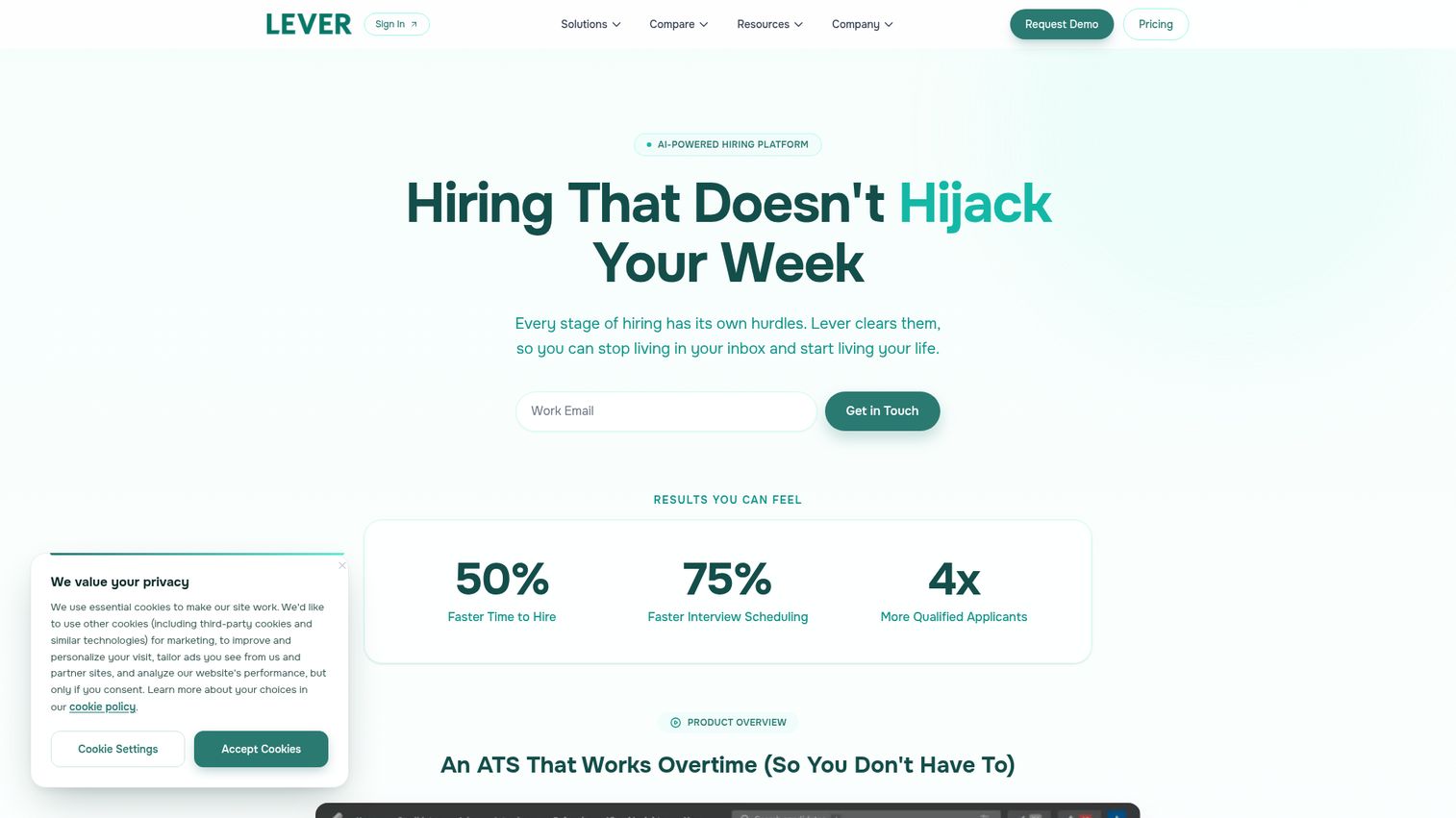
Lever (LeverTRM) combines an ATS, CRM, and analytics in one platform. It is a long-standing alternative to Greenhouse for mid-market teams that want native CRM functionality alongside the ATS.
Best for: Talent acquisition teams that want a unified ATS + CRM platform with automation and analytics for scalable hiring.
Key strengths
- Built-in ATS and CRM: Inbound and outbound managed in one platform.
- Automation across the funnel: Interview scheduling, follow-ups, and one-click posting to 200+ boards.
- Real-time dashboards and reporting: Custom reports and pipeline analytics.
Why choose Lever: If your team runs both inbound and outbound and you do not want to layer a separate CRM on top of an ATS, Lever's native CRM is the differentiator. It is a mature platform with a long enterprise customer base.
Lever pricing: Lever does not publish numeric pricing. The pricing page describes the core AI-powered hiring platform plus add-ons including Candidate Insights, AI Screening by VONQ, and Onboarding, all custom-quoted.
15. iCIMS
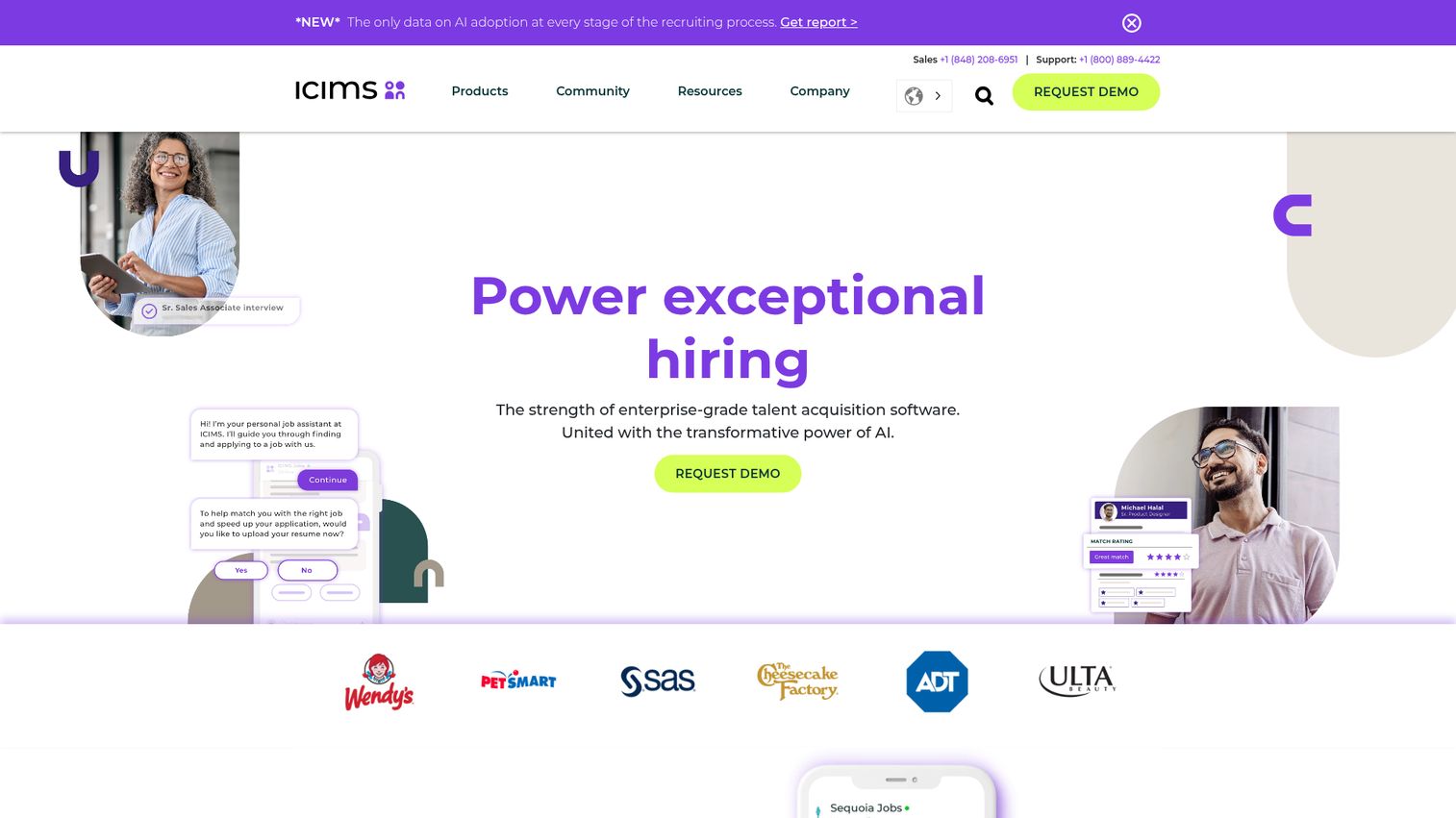
iCIMS is an enterprise talent acquisition platform with AI-powered recruiting software for attracting, engaging, hiring, and onboarding talent. It is built for organizations with complex compliance, global hiring, and high-volume requisition flow.
Best for: Enterprise and global hiring teams that need a configurable recruiting platform for high-volume and complex talent acquisition workflows.
Key strengths
- Applicant tracking system: Configurable workflows for complex hiring processes.
- Candidate relationship management: Manages candidate pools and outbound nurture.
- Career sites: Branded employer marketing and candidate attraction.
Why choose iCIMS: This is enterprise-grade. If you have 10,000+ employees, regulated industries, multi-country compliance, or complex requisition workflows, iCIMS is on the shortlist with Workday and SmartRecruiters. It is overbuilt for mid-market SaaS.
iCIMS pricing: iCIMS does not publish pricing publicly. Enterprise contracts only, quoted by sales.
16. SmartRecruiters
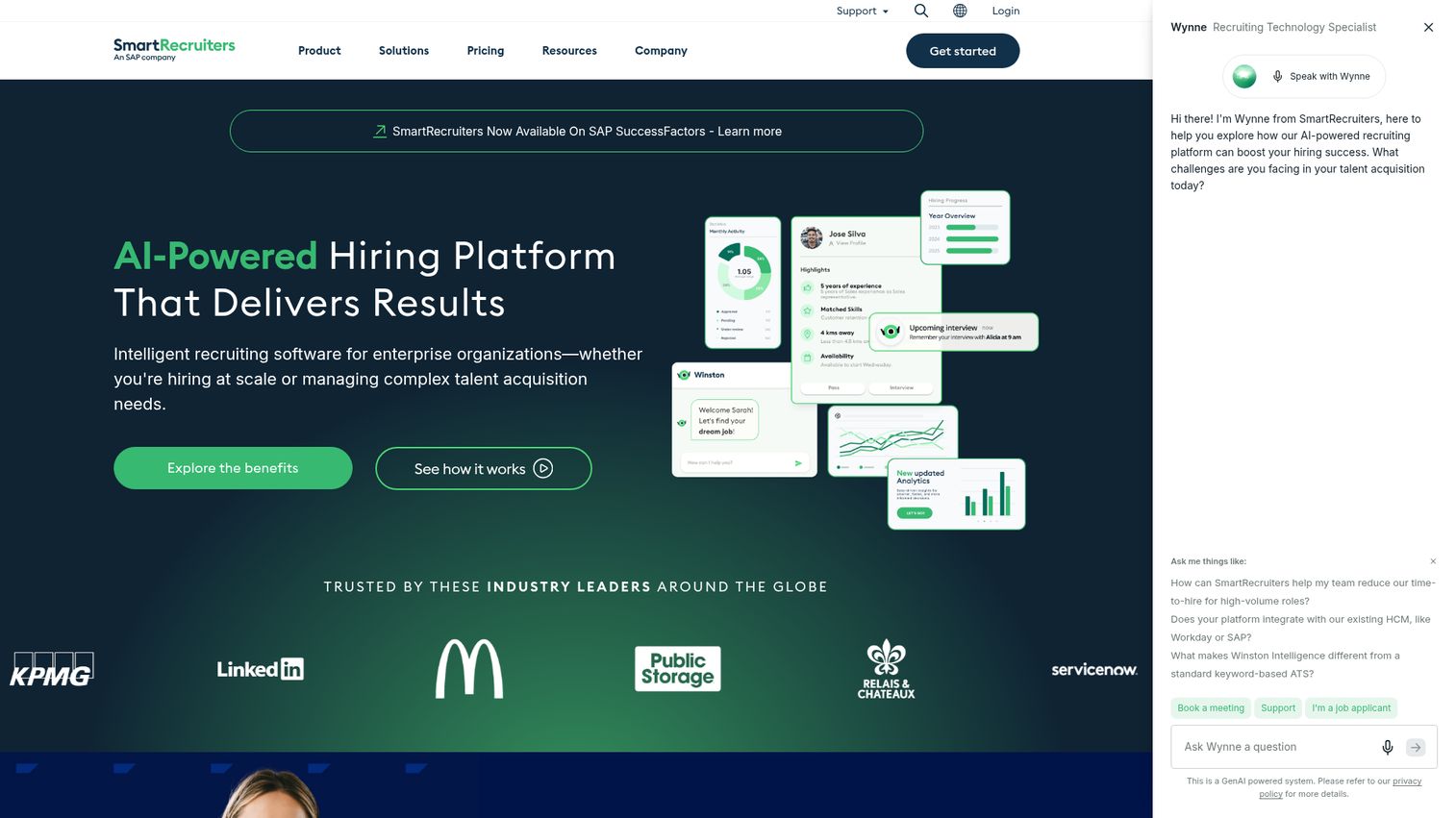
SmartRecruiters is an AI-powered hiring platform for enterprise organizations hiring at scale or managing complex talent acquisition needs. Its differentiator in 2026 is depth of AI automation across the funnel, packaged into named plan tiers.
Best for: Enterprise and high-volume hiring teams that need an AI-powered talent acquisition platform with ATS, CRM, and workflow automation.
Key strengths
- Applicant tracking: Configurable enterprise workflows.
- Candidate relationship management: Outbound CRM with talent pools.
- Dynamic scheduling: Automated coordination across complex interview loops.
Why choose SmartRecruiters: SmartRecruiters publishes more transparent enterprise pricing than most of its peers, which makes shortlisting easier. Higher tiers add the AI-powered Hiring Agent, AI Talent Matching Engine, AI-powered Candidate Screening, and Conversational AI Chat.
SmartRecruiters pricing: Essential starts at $14,995 (billing cadence not specified on the page). Professional, High Volume, and Complete tiers are quote-based. Essential includes Applicant Tracking, CRM, Onboarding, SMS Messaging, Job Distribution, and Dynamic Scheduling. Pricing source: smartrecruiters.com/pricing.
17. Workday Recruiting
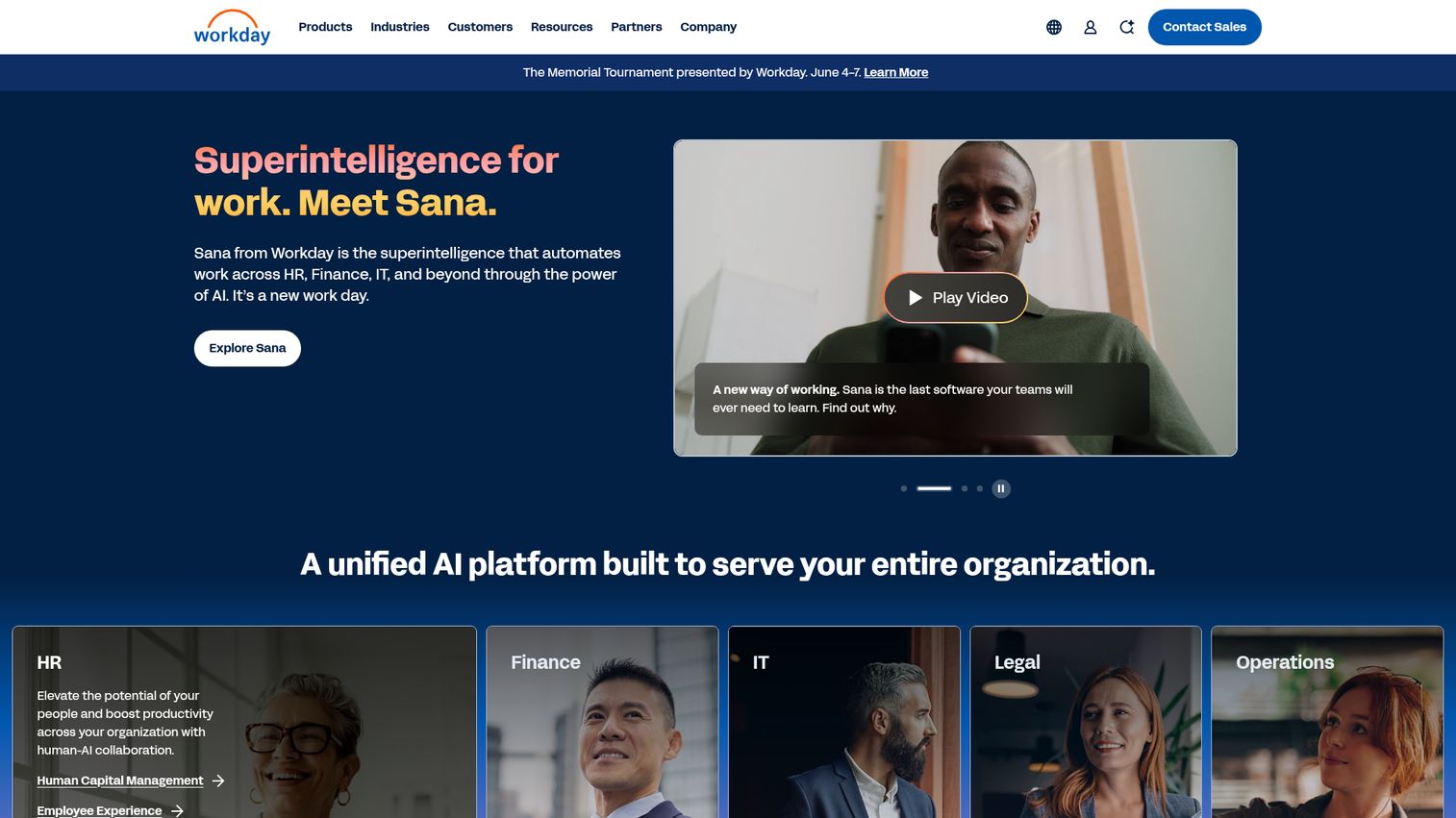
Workday Recruiting is part of Workday Talent Acquisition, an AI-powered suite running modern recruiting across full-time and contingent hiring. It is the default choice for organizations already standardized on Workday HCM.
Best for: Enterprises that need AI-powered, end-to-end recruiting workflows for high-volume and complex hiring across frontline, corporate, full-time, and contingent roles.
Key strengths
- Job requisition management: Integrated with Workday HCM for headcount planning.
- AI-powered sourcing and grading: Surfaces and ranks candidates against role criteria.
- Conversational apply and scheduling: Reduces friction in apply flows and coordination.
Why choose Workday Recruiting: If your company runs on Workday HCM, the case is mostly made for you. Switching to a third-party ATS introduces integration debt that rarely justifies the upside. If you are not on Workday HCM, this is not the right entry point.
Workday Recruiting pricing: Workday does not publish pricing publicly. All sales are enterprise contracts negotiated through the Workday account team.
18. Ashby
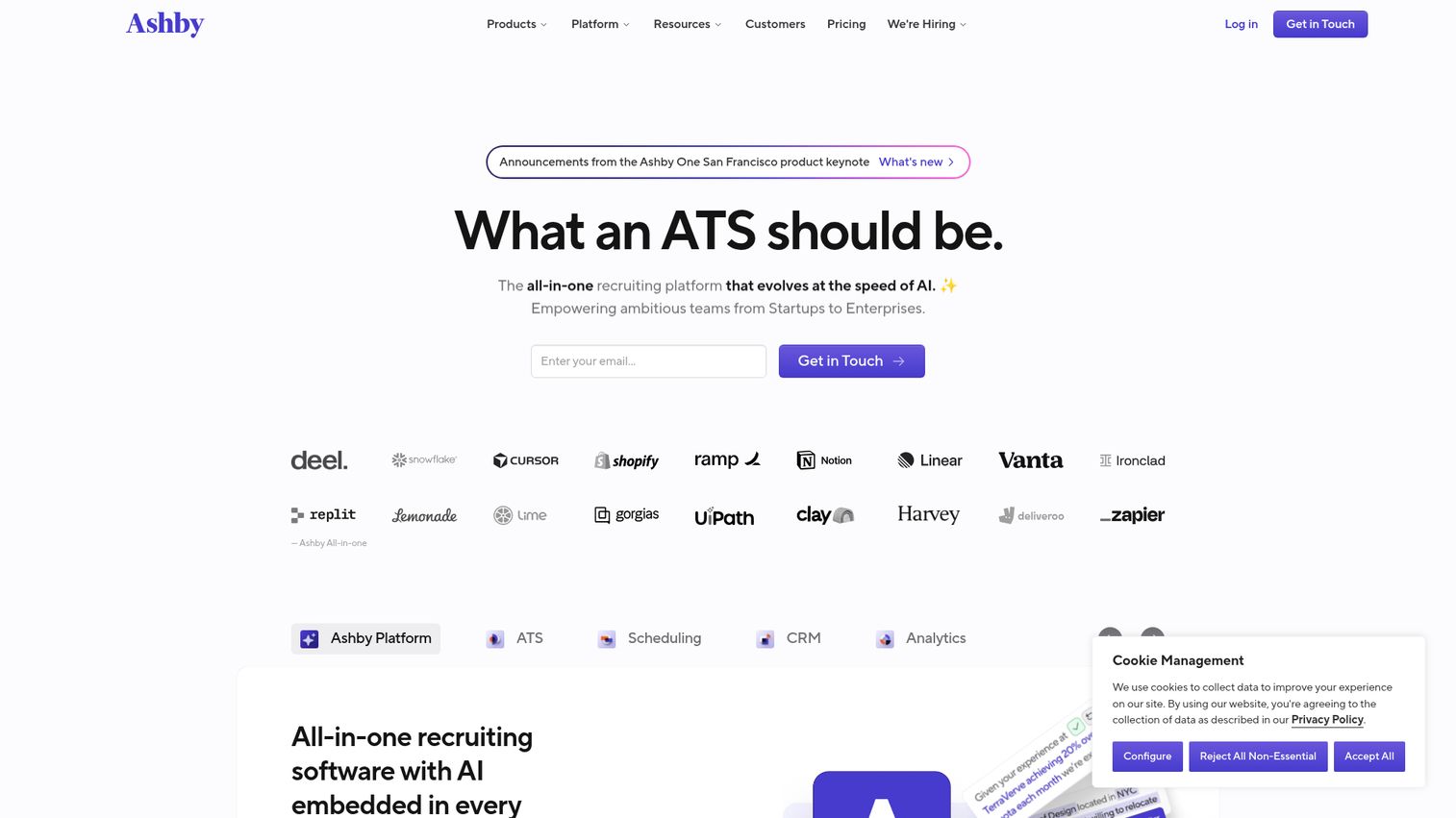
Ashby is an all-in-one recruiting platform combining ATS, CRM and sourcing, scheduling, and analytics with AI embedded throughout. It has become the default ATS for modern Series A to Series C SaaS companies hiring at scale.
Best for: Series A–C SaaS companies hiring 50–500 a year that want a single platform for ATS, sourcing, scheduling, and analytics.
Key strengths
- Applicant tracking: Customizable jobs, interview plans, workflows, and visual pipelines.
- Native sourcing and CRM: Chrome extension, talent pools, and AI-powered outreach sequences.
- Recruiting analytics: Dashboards, report templates, and a custom report builder.
Why choose Ashby: Ashby is the rare modern ATS where the analytics are actually usable on day one. For a growth-stage SaaS company that wants to consolidate the recruiting stack and give a new VP People something that works in week one, Ashby is the strongest fit.
Ashby pricing: Foundations Plan starts at $400/month (covers startups up to 100 employees) with a 10% annual discount available. Plus (101–1,000 employees), Enterprise (1,000+), and Ashby Analytics (for existing ATS users) are custom-quoted. Pricing source: ashbyhq.com/pricing.
19. Pinpoint
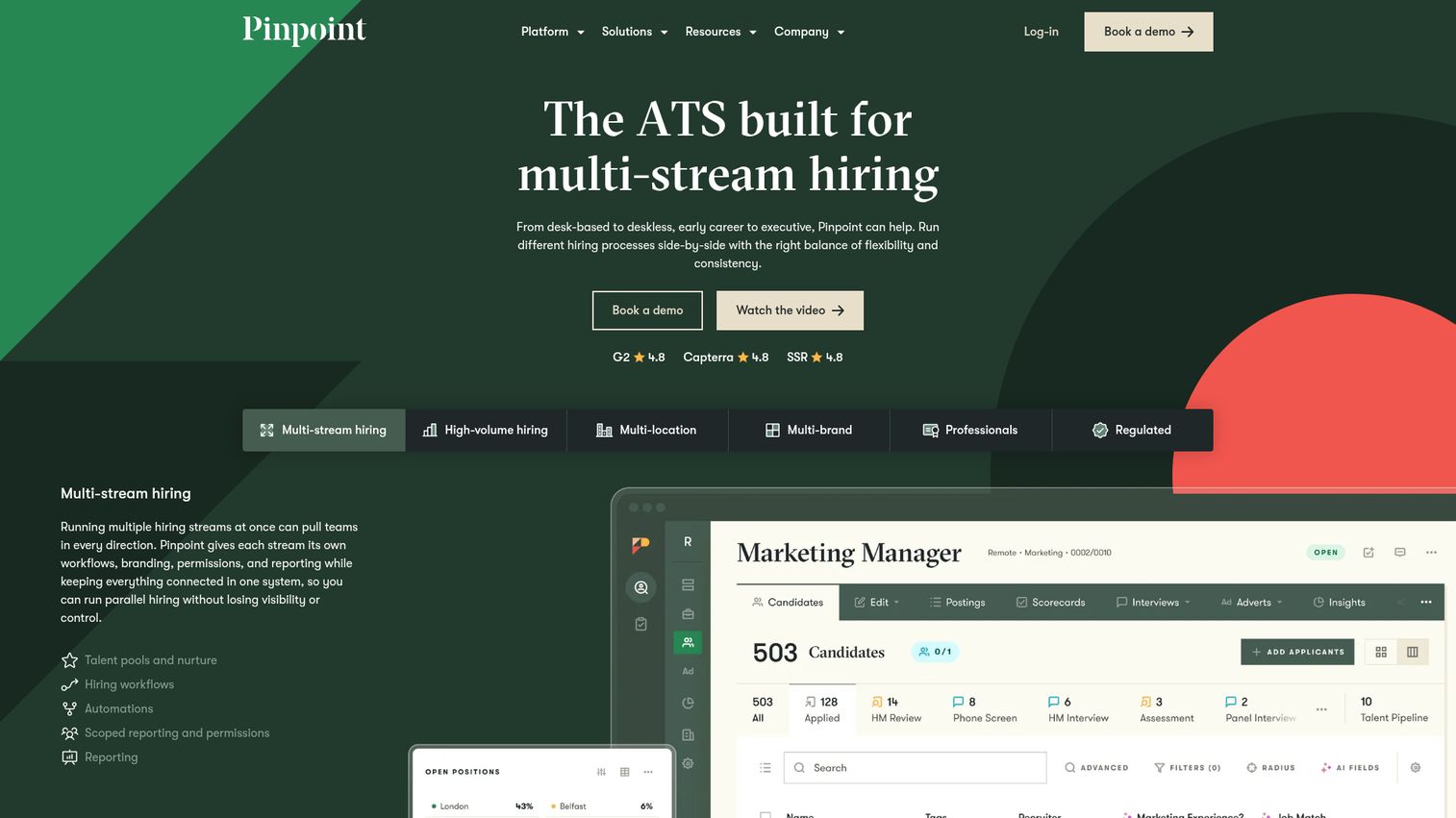
Pinpoint is an applicant tracking system built for multi-stream hiring. It is the right fit for in-house teams running structured hiring across multiple brands, business units, or hiring types without enterprise overhead.
Best for: Organizations that need one ATS to manage multiple hiring streams with different workflows, brands, or hiring types.
Key strengths
- Branded careers site: Configurable per brand or business unit.
- Talent pipeline CRM: Manages candidate pools and rediscovery.
- One-way video interviews: Asynchronous interviewing for first-round screens.
Why choose Pinpoint: Pinpoint is a strong mid-market choice when you run multiple hiring workflows (corporate, hourly, contractor) but do not want to take on Workday or iCIMS. The UI is modern and the implementation is faster than enterprise alternatives.
Pinpoint pricing: Pinpoint does not publish numeric pricing. All quotes come through a request-pricing call. The model is custom and based on hiring volume and team size.
20. Juicebox (PeopleGPT)
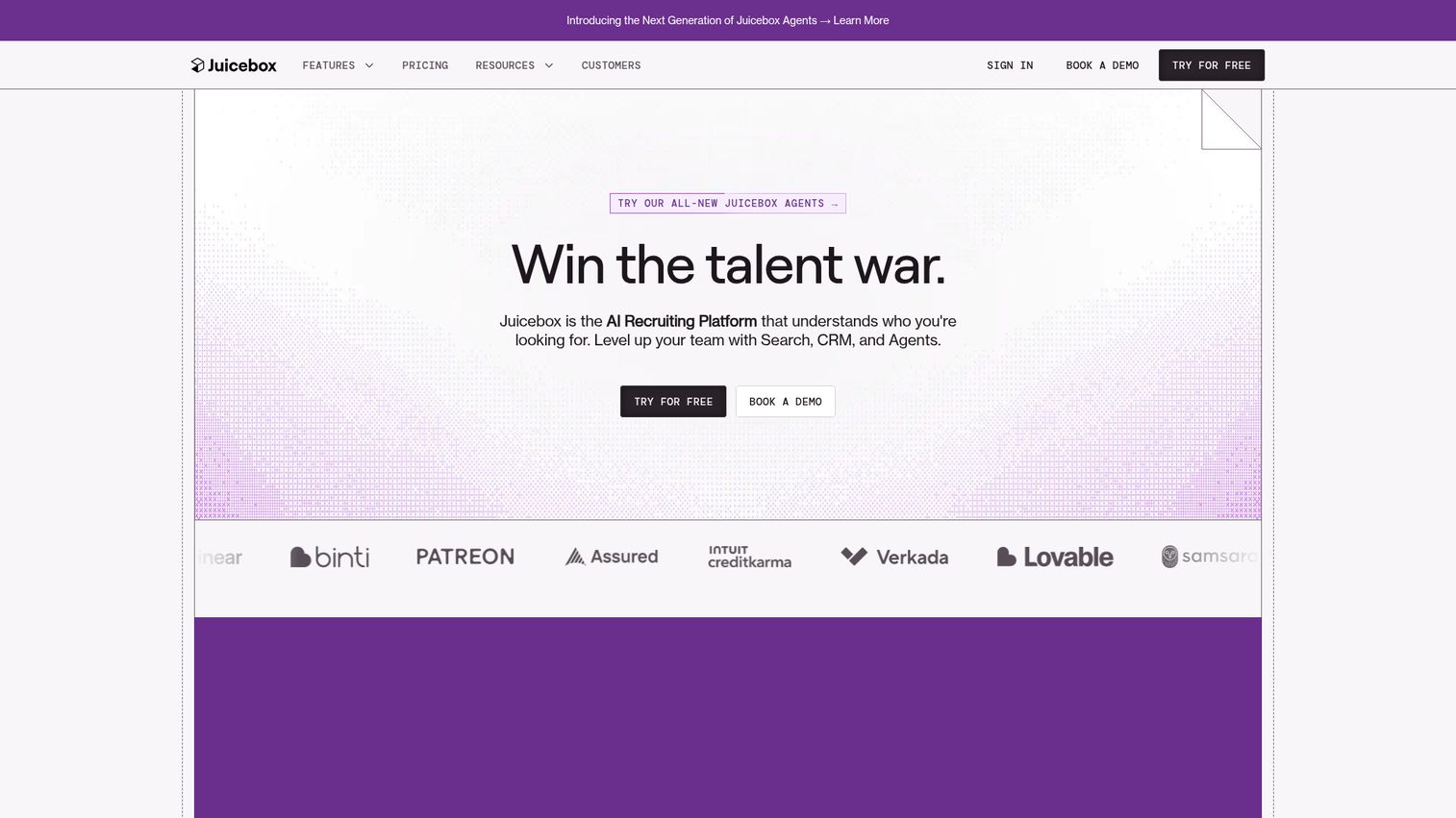
Juicebox is an AI recruiting platform with Search, CRM, and Agents centered around natural-language candidate search. PeopleGPT lets recruiters type queries the way they would describe a hire to a colleague, then surface matches across 800M+ profiles.
Best for: Recruiters and talent teams that want AI-driven sourcing, candidate discovery, and automated outreach without an enterprise platform commitment.
Key strengths
- Natural-language candidate search: Query 800M+ profiles across 30+ data sources in plain English.
- AI evaluation and stack-ranking: Ranks up to 5,000 profiles for role fit automatically.
- Recruiting agents: AI agents that search on autopilot and support automated outreach. For broader agentic motions outside hiring, see the best AI SDR tools.
Why choose Juicebox: This is the easiest entry into AI-powered sourcing in 2026. The free tier and per-seat pricing let small teams test it without procurement friction. It is a complement to (not a replacement for) a structured ATS.
Juicebox pricing: Juicebox publishes plan pricing on its site. Free plan available at $0/seat/month. Paid plans: Starter $139/seat/month, Growth $199/seat/month, Business custom. Juicebox Agents is $199/agent/month. All prices in USD. Pricing source: juicebox.ai/pricing.
What to look for when buying AI recruiting software
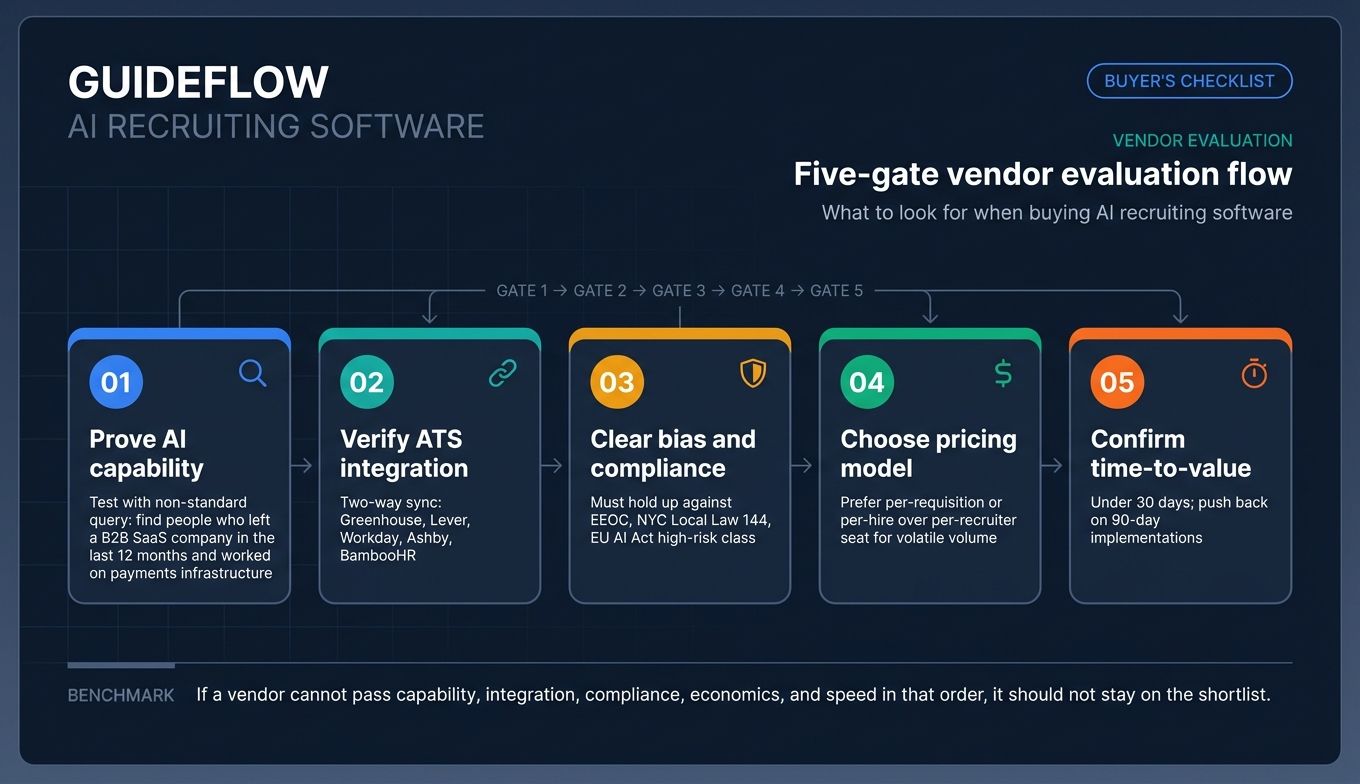
Four criteria separate AI recruiting software that earns a renewal from software that gets ripped out in 18 months.
#### Real AI capability, not a rebranded keyword filter
Test this in the demo. Ask the vendor to run a non-standard query against their system. Example: "find me people who left a B2B SaaS company in the last 12 months and worked on payments infrastructure." Watch what comes back. If it is a keyword match, you know what you bought. The vendors confident in their AI will often hand you an interactive demo so you can stress-test the workflow yourself.
Integration depth with your ATS
A Zapier connection is not integration. Verify two-way sync with your ATS (Greenhouse, Lever, Workday, Ashby, BambooHR), candidate enrichment in-context, and write-back of AI-generated scores or interview notes. If the integration is shallow, your team will work in two systems and trust neither. Review the vendor's full integrations list before signing.
Bias auditing and explainability
Regulators are increasingly scrutinizing AI hiring tools. In the U.S., the EEOC guidance on AI in employment decisions enforces anti-discrimination law in the use of AI, and some jurisdictions (notably New York City) explicitly require bias audits of automated employment decision tools under NYC Local Law 144 on automated employment decision tools. In the EU, the EU AI Act classification of high-risk AI systems classifies recruiting AI as high-risk, imposing risk management and oversight requirements. Ask the vendor for their bias audit methodology. If they cannot produce one, that is the answer.
Pricing that scales with hiring, not just headcount
Per-recruiter seat pricing punishes growing teams and rewards consolidation. If your hiring volume is volatile, look for per-requisition or per-hire pricing. If you are at SaaS scale with steady hiring, seat-based may work, but model the cost at 2x your current team size before signing.
Time-to-first-value under 30 days
Mid-market buyers should not accept a 90-day implementation for an AI tool layered on top of an existing ATS. The point of buying a sourcing or screening layer is to see signal in week one, not week thirteen. Push back on long implementations.
Common mistakes when adopting AI recruiting software
Four patterns that kill the ROI case.
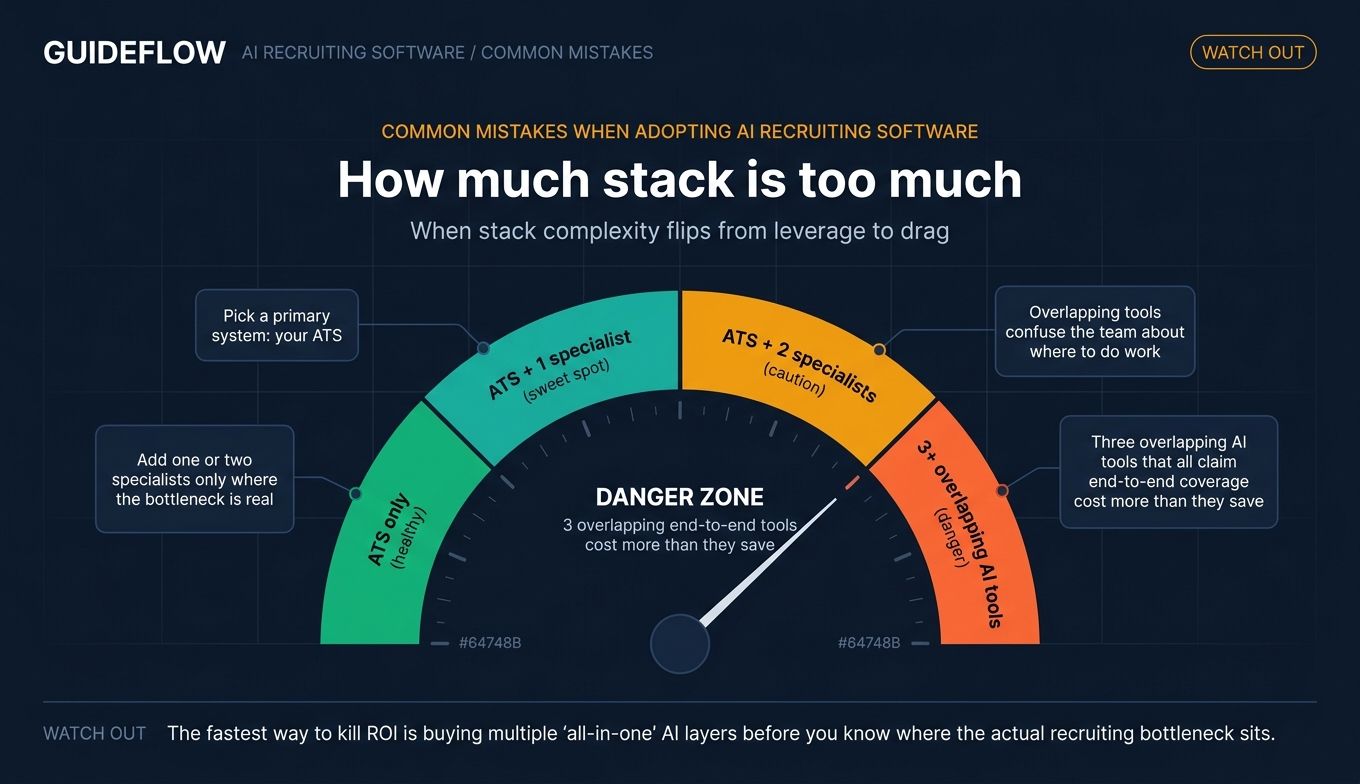
1. Buying for sourcing when the bottleneck is screening (or vice versa). Diagnose the funnel before buying. Look at where applications convert and where they stall. If you have 400 inbound applicants per role and 12 days of screening backlog, you do not have a sourcing problem. 2. Skipping the bias audit. The lawsuit risk is real and growing. NYC Local Law 144, the EU AI Act, and increasing EEOC scrutiny mean an unaudited tool is a board-level liability waiting to happen. 3. Letting AI write candidate communication without a human review layer. Tone drift, hallucinated promises, and brand-damaging responses are real risks. Treat AI-generated candidate messaging the way you treat AI-generated marketing copy: review before send, especially in early stages. 4. Stacking three AI tools that all claim end-to-end coverage. Pick a primary system (your ATS), then add one or two specialists where the bottleneck is real. Three overlapping AI tools cost more than they save and confuse the team about where to do work.
Conclusion
The right ai recruiting tool depends on what your funnel actually needs.
- For high-volume hourly hiring: Paradox or Humanly
- For passive sourcing: Gem, Findem, or SeekOut
- For interview quality at scale: BrightHire
- For early-stage SaaS teams on a budget: Manatal or Juicebox
- For growth-stage SaaS teams (Series A–C): Ashby, Greenhouse, or Gem
- For enterprise talent acquisition software: Eightfold, Workday Recruiting, iCIMS, or SmartRecruiters
Shortlist three tools that match your bottleneck. Run demos with the same test case (a real role you are struggling to close) against each vendor. Verify integration with your ATS in the same session. Get pricing in writing before the call ends. Decide within 30 days.
By the end of 2026, AI in recruiting will look less like a separate "AI category" and more like an assumed layer inside every ATS. The choice will not be whether to use it. The choice will be whose AI is doing the work, and whether you can explain it to the EEOC and your board.
FAQs
The best ai recruiting software depends on the use case. Paradox leads for high-volume hourly hiring, Gem for outbound sourcing, BrightHire for interview intelligence, and Ashby for growth-stage SaaS teams that want an all-in-one ATS. Eightfold and Workday Recruiting are the enterprise picks.
Pricing ranges from $15/user/month for Manatal's annual entry tier to custom enterprise contracts in the five and six figures for platforms like Eightfold, iCIMS, and HireVue. Most mid-market AI ATSs and sourcing tools land in the low hundreds to low thousands of dollars per month, depending on seats and modules. SmartRecruiters publishes an Essential plan starting at $14,995, which is unusually transparent for the enterprise segment.
Manatal's Professional plan at $15/user/month (annual) is among the lowest-cost AI-enabled ATSs. Juicebox offers a free plan for AI-powered sourcing, with paid seats starting at $139/seat/month. Fetcher's self-serve tier starts at $115/month. Workable starts at $299/month for small teams on bundled Recruiting + HR.
No. AI recruiting software removes repetitive work (resume review, scheduling, follow-up, basic screening) so recruiters spend more time on hiring manager alignment, candidate experience, and senior search. Teams that adopt these tools well tend to hire faster with the same recruiter headcount, not fewer recruiters.
It can be, depending on training data and oversight. NYC Local Law 144 explicitly requires bias audits of automated employment decision tools. The EU AI Act classifies hiring AI as high-risk. The EEOC enforces existing discrimination law in the use of AI. Choose vendors that publish audit methodology and let humans override AI-generated rankings.
An ATS (Greenhouse, Workday, Lever, Ashby) is the system of record for candidates and requisitions. AI recruiting software is usually a layer that adds sourcing, screening, or interview capabilities. Some AI lives inside the ATS (Greenhouse, Ashby, Workable). Some lives alongside it (Gem, Paradox, BrightHire, SeekOut). The category lines are blurring as ATSs add AI and AI tools add ATS functionality.
Bring a real hiring problem. Ask the vendor to handle it live, not in a scripted demo. Verify integration with your ATS in the same session. Ask for the bias audit methodology. Get pricing in writing before the call ends. The vendors who say yes to an unscripted demo are the ones worth evaluating further.
Eightfold, Workday Recruiting, iCIMS, and SmartRecruiters dominate ai recruiting software for enterprises. They handle compliance, multi-country deployments, and integration with full HCM stacks. Mid-market ai talent acquisition software like Gem, Greenhouse, and Ashby scales comfortably into the low thousands of employees before enterprise-specific requirements become a forcing function.