You added an age gate to satisfy a regulator. Now your signup completion dropped, support tickets about failed checks are climbing, and engineering is asking why the verification flow breaks on mobile. The compliance box is checked. The product experience is not.
That tension sits at the center of every age verification decision. The global age verification software market is forecast to grow from USD 1.47 billion in 2025 to USD 5.0 billion by 2035 at a 13.1% CAGR, according to Wiseguy Reports (2024). Demand is rising because regulators keep raising the bar, and because more digital products now serve audiences where age matters. But buying the wrong tool means trading one problem (legal exposure) for another (conversion loss and operational drag).
For product managers, this is not a legal checkbox. It is a workflow decision that touches activation, retention, support load, and engineering opportunity cost. The right age verification software protects users, satisfies regulators, and preserves the funnel you spent months optimizing. The wrong one quietly taxes all three.
This guide ranks eight options by how well they balance those forces. If you also handle signup hygiene downstream, our roundup of the best email verification tools covers a related slice of the onboarding stack. For now, let's focus on age.
What's inside
This is a buyer-facing shortlist for product, compliance, and trust and safety teams that need compliant age checks without adding operational drag. It covers age verification software for regulated and age-gated digital products, from adult content and gaming to alcohol, tobacco, cannabis, and retail.
We ranked tools on five criteria that matter to product teams:
- Privacy model: what data gets collected, stored, and shared
- Compliance coverage: which regions and age thresholds are supported
- Verification methods: document checks, facial age estimation, reusable credentials
- Implementation options: API, SDK, hosted UI, and workflow builders
- Conversion impact: completion rates and friction relative to assurance level
Pricing and G2 ratings reflect publicly verifiable values where available.
TL;DR
- Best for privacy-first age checks: Yoti, with facial age estimation and data minimization built in.
- Best for regulated, multi-market compliance workflows: Ondato, with KYC, KYB, AML, and age verification in one platform.
- Best for speed and conversion-oriented flows: Sumsub, with self-serve pricing and published per-verification rates.
- Best for biometric authentication depth: authID, for enterprises that need unphishable identity proofing.
- Best for broad geographic identity coverage: Veriff, with self-serve plans and transparent pricing.
- Best for enterprise document verification at scale: Entrust (Onfido), supporting 6,000+ ID document types.
- Best for reusable digital identity: ID.me, where members verify once and reuse across services.
What is age verification software?
Age verification software confirms that a user meets a minimum age requirement before granting access to a product, content, or transaction. It does this through verification methods like government ID document checks, facial age estimation, database lookups, or reusable digital credentials, then returns a pass or fail signal to your application.
It helps to separate three terms that get used interchangeably:
- Age verification confirms a specific age or date of birth, usually by checking an identity document. It is the most exact and the most data-heavy.
- Age assurance is the umbrella term for any method that establishes age to a required level of confidence. It includes verification and estimation.
- Age estimation predicts an age range from a signal like a selfie, without collecting an identity document. It is privacy-minimizing because it can return "over 18" without storing who you are.
Understanding age verification vs age assurance matters because regulators increasingly accept assurance, not just hard verification, for many use cases. That distinction shapes how much friction you add and how much data you hold.
Most age verification systems share a core capability set:
- Document verification: scanning and validating passports, driver's licenses, and national IDs
- Facial age estimation: predicting an age band from a live selfie
- Liveness and anti-spoofing: confirming a real person is present, not a photo or deepfake
- Reusable credentials: letting verified users skip repeat checks across services
- Workflow controls: routing, fallbacks, and escalation rules for edge cases
- Implementation surfaces: API, SDK, and hosted UI options
- Compliance tooling: audit logs, retention controls, and regional rule coverage
The strongest age checking software lets you pick the lightest method that still satisfies the regulation you face. That is the lever that protects conversion.
When to use age verification software
Enforce access in age-gated products
Some products legally cannot serve users below a threshold. Adult content, online gambling, alcohol, tobacco, cannabis, and certain financial products all carry hard rules. Here, age verification is not optional and a failed check must block or segment access.
Jurisdiction-specific rules drive the requirement. The UK Online Safety Act pushes platforms toward "highly effective" age assurance. The US has COPPA for under-13 data. The EU's Digital Services Act and GDPR shape what you can collect. Map your audience to these rules before you choose a method.
Reduce compliance risk without storing more data than needed
Every identity document you collect becomes a liability you must secure, retain, and eventually delete. Privacy-first age verification flips that equation. If a regulation accepts an "over 18" signal, facial age estimation or a reusable credential can satisfy it without you ever holding a passport scan.
Data minimization is both a privacy stance and a risk reduction strategy. Less stored data means a smaller breach surface, fewer retention obligations, and less GDPR exposure. For products that only need a threshold answer, estimation often outperforms heavier identity collection on both privacy and conversion.
Balance verification with conversion
Every step in an age check is a chance to lose a user. Product teams should treat the flow like any other activation funnel: measure drop-off, test friction, and pick the lightest assurance level the law allows.
Implementation pattern matters here. A hosted UI gets you live fast with the vendor owning the interface. An SDK embeds the check inside your product for a native feel. An API gives you full control over the experience. The right choice depends on whether you optimize for launch speed or deep product integration.
Comparison table
We ranked these age verification companies by breadth of fit for product teams balancing compliance, privacy, and conversion, not by marketing strength. The Intent column describes the primary buyer motion each tool serves best. Pricing and G2 ratings reflect publicly verifiable values; where a vendor gates pricing behind sales, we note that.
| # | Product | Intent | Key use case | Pricing | G2 rating |
|---|---|---|---|---|---|
| 1 | Yoti | Privacy-first age assurance | Facial age estimation with data minimization | From £0.40 per document | 4.9/5 |
| 2 | Ondato | Regulated compliance workflows | KYC, KYB, AML, and age verification in one platform | From €600 | 4.8/5 |
| 3 | Sumsub | Speed and conversion | Self-serve verification with published rates | From $1.35 per verification | 4.6/5 |
| 4 | authID | Biometric authentication | Unphishable identity proofing for enterprises | Contact sales | Not listed |
| 5 | Veriff | Global identity coverage | Scalable KYC and identity verification | From $0.80 per verification | 4.4/5 |
| 6 | Entrust (Onfido) | Enterprise document verification | 6,000+ ID document types across 196+ countries | Contact sales | 4.4/5 |
| 7 | Jumio | Identity assurance | AI-driven verification with liveness | Contact sales | 4.0/5 |
| 8 | ID.me | Reusable digital identity | Verify once, reuse across services | Contact sales | 4.6/5 |
1. Yoti
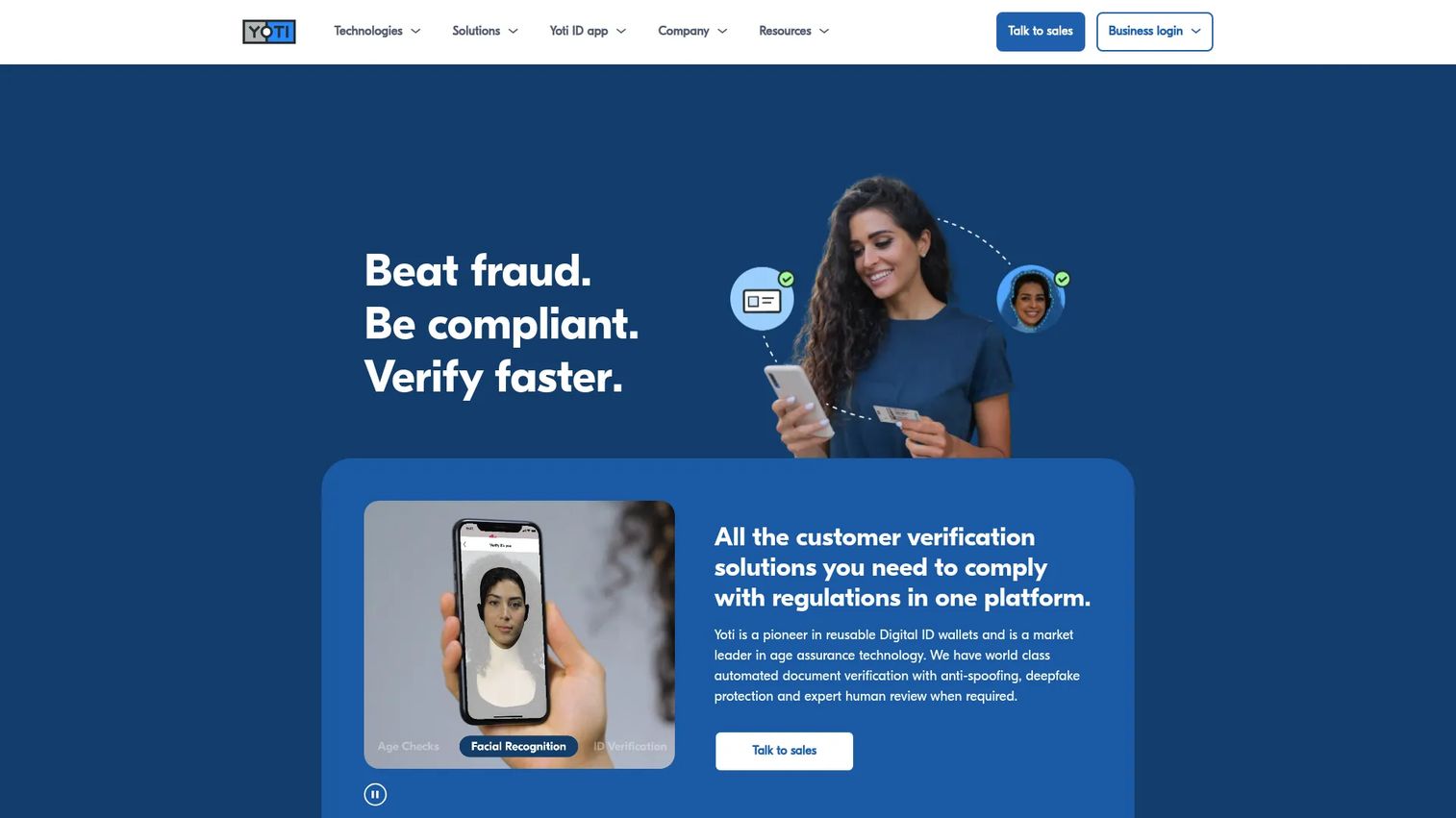
Yoti is a privacy-focused identity and age assurance platform built for businesses and individuals. It pairs facial age estimation with document checks and digital ID wallets, so you can pick the lightest method that satisfies your regulation. For product teams that care about data minimization, Yoti is the most natural starting point on this list.
Best for: Businesses needing identity, age, and e-signature verification from a single privacy-first provider.
Key strengths
- Facial age estimation: Returns an "over 18" style signal from a selfie without collecting an identity document, which keeps your stored data minimal.
- Multiple verification methods: Combines document checks, expert human review, and alternative age methods so you can route users by risk and region.
- Digital ID reuse: Lets verified users reuse a digital ID across services, cutting repeat friction on return visits.
Why choose Yoti: If your regulatory need is a threshold answer rather than a full identity record, Yoti's estimation-first approach reduces both breach surface and drop-off. It fits teams that want broad verification coverage but refuse to hold more data than the law requires.
Yoti pricing: Public pricing is published for Yoti eSignatures, starting at £0.40 per document, with Standard at £30/month, Advanced at £60/month, and volume-based Enterprise pricing. A 14-day free trial is available with no payment details required. Broader identity and age verification pricing is sales-led and not publicly numbered. Yoti holds a 4.9/5 rating on G2.
2. Ondato
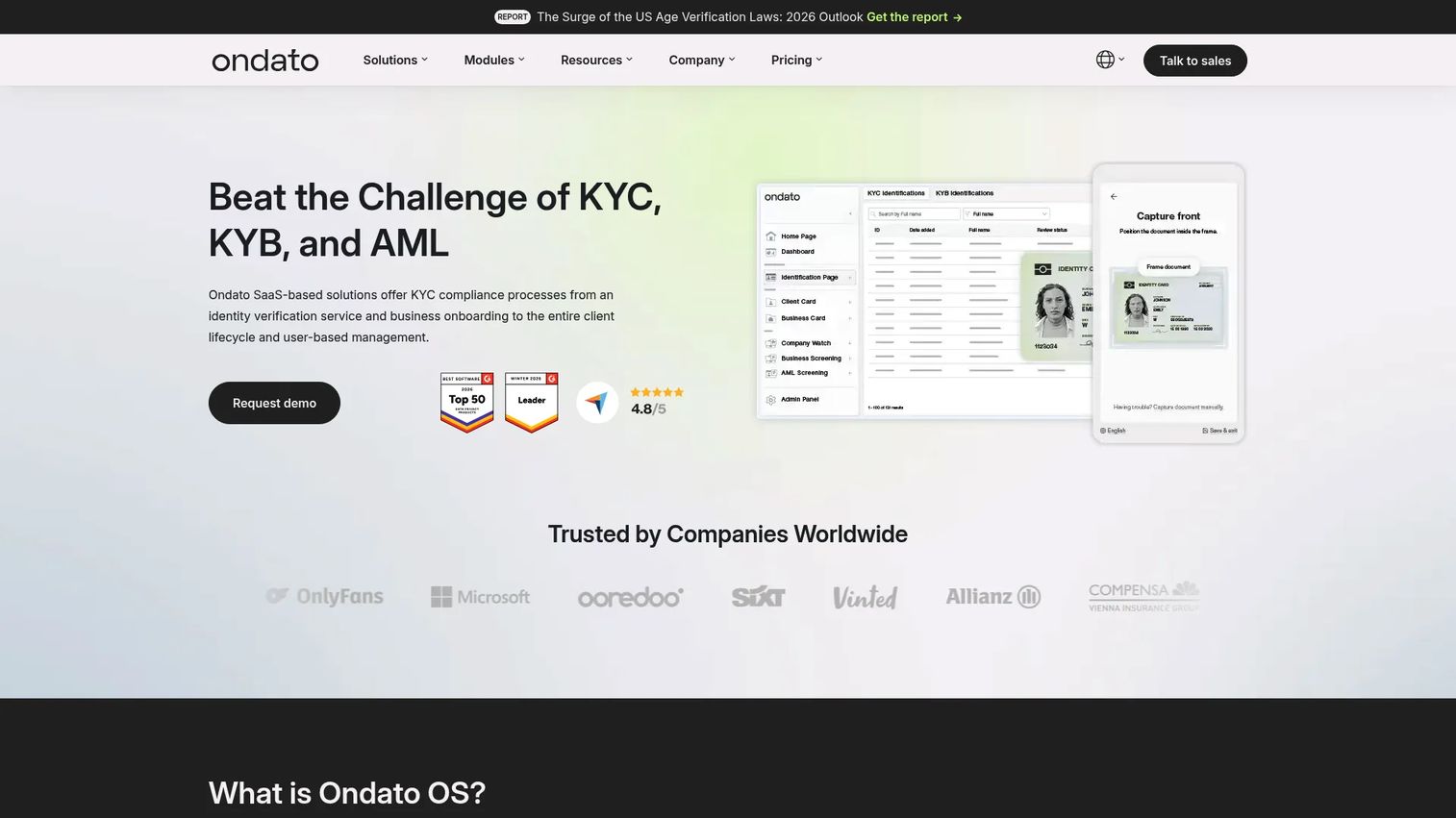
Ondato is a KYC, KYB, AML, identity verification, and age verification platform built for regulated businesses. It positions itself as a compliance-first toolkit, which makes it a strong fit for teams operating across multiple regulated markets at once. If you need age verification alongside broader onboarding and AML workflows, Ondato consolidates them.
Best for: Regulated businesses needing automated identity, KYB, AML, and age-verification workflows in one place.
Key strengths
- All-in-one compliance: Combines identity verification, business onboarding, AML, and age checks, so you evaluate one vendor instead of stitching several together.
- Workflow automation: Routes onboarding and verification steps automatically, reducing manual review load on your compliance team.
- Multi-market coverage: Supports verification across many jurisdictions, useful when your product crosses borders.
Why choose Ondato: Ondato earns its place when age verification is one part of a larger compliance burden. Teams already managing KYC and AML get a single platform and one integration rather than a patchwork. That consolidation reduces both vendor overhead and the surface area you have to maintain.
Ondato pricing: Public pricing starts at €600 for Business Onboarding, with final pricing depending on solution mix, request volume, and additional checks. The pricing page exposes a free trial offer. Ondato holds a 4.8/5 rating on G2.
3. Sumsub
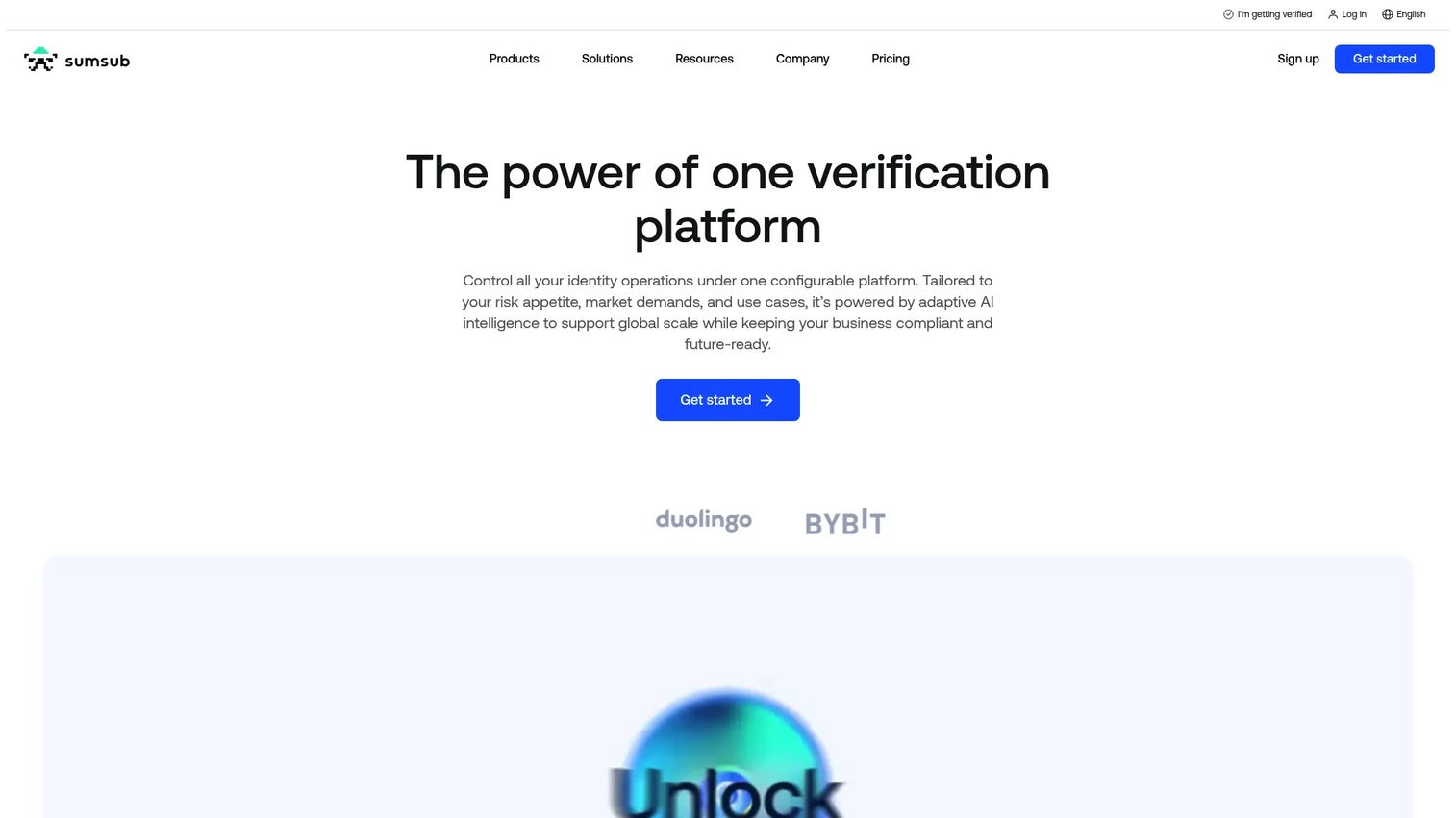
Sumsub is an identity verification and compliance platform covering KYC, KYB, AML, fraud prevention, and monitoring. Its published self-serve pricing and fast verification flows make it a strong choice for teams that need to launch quickly and watch unit economics. For conversion-focused product teams, the transparency helps with forecasting.
Best for: Businesses needing automated KYC, KYB, AML, and fraud and compliance workflows with predictable per-check costs.
Key strengths
- Published per-verification pricing: Self-serve Basic and Compliance plans let you model cost per check before you commit, which is rare in this category.
- Fraud and liveness resistance: Combines verification with fraud prevention and monitoring to catch spoofing attempts.
- Workflow flexibility: Offers API, SDK, and no-code builder options so you can match the implementation to your team's bandwidth.
Why choose Sumsub: When speed to launch and predictable cost matter as much as compliance, Sumsub's self-serve model removes the sales-cycle wait. The published rates also make it easier to justify spend internally against expected verification volume.
Sumsub pricing: The Basic plan starts at $1.35 per verification with a $149 minimum monthly commitment. The Compliance plan is $1.85 per verification with a $299 minimum. Enterprise is custom. A 14-day free trial includes 50 free checks. Sumsub holds a 4.6/5 rating on G2.
4. authID
authID is a biometric identity verification and passwordless authentication platform for enterprises. Its strength is identity proofing tied to unphishable biometric credentials, which matters when an age check needs to be bound to a verified, reusable identity rather than a one-time document scan. It is the most identity-centric option here.
Best for: Enterprises needing biometric authentication, identity proofing, and workforce or customer access security.
Key strengths
- Passwordless, unphishable authentication: Ties access to a biometric credential, reducing account sharing and credential theft.
- Privacy-preserving biometrics: Stores biometric credentials in a privacy-aware way rather than retaining raw images.
- IAM integrations: Connects with identity systems like Okta and Microsoft Entra ID, fitting into existing enterprise stacks.
Why choose authID: authID excels when you need age and identity bound together with strong, repeatable authentication, not just a single check at signup. Enterprises that already run an IAM layer get a verification approach that plugs into it.
authID pricing: Pricing is contact-us only. The site describes flexible pricing billed per transaction or by active users per year, with monthly or annual options, plus a 30-day free trial. A public G2 rating was not available at the time of writing.
5. Veriff
Veriff is an identity verification and fraud prevention platform for onboarding and authentication. It offers broad geographic coverage and self-serve plans with transparent per-verification pricing, which suits teams that need global identity workflows without a long procurement cycle. For products scaling across regions, Veriff's coverage is a draw.
Best for: Businesses needing scalable KYC, identity verification, and fraud prevention across many countries.
Key strengths
- Identity verification at scale: Handles document and identity checks across a wide range of countries and document types.
- Self-serve plans: Essential, Plus, and Premium tiers with published pricing let smaller teams start without sales involvement.
- Fraud prevention: Layers AML screening and fraud signals on top of identity checks.
Why choose Veriff: Veriff fits teams that need both global reach and pricing they can model up front. The self-serve tiers lower the barrier to entry, while the broader identity workflows scale as your verification volume grows.
Veriff pricing: Self-serve plans include Essential at $0.80 per verification with a $49/month minimum, Plus at $1.39 per verification with a $99/month minimum, and Premium at $1.89 per verification with a $209/month minimum. All include a 15-day free trial and pay-as-you-go pricing. Veriff holds a 4.4/5 rating on G2.
6. Entrust (Onfido)
Entrust (Onfido) offers identity verification and related trust and security products for onboarding, fraud prevention, and compliance. Its document verification depth and no-code workflow orchestration make it a fit for enterprises running age-gated onboarding at scale. The breadth of supported documents is a standout.
Best for: Organizations needing enterprise identity verification for onboarding and compliance across many regions.
Key strengths
- Broad document support: Verifies over 6,000 government-issued ID documents from 196+ countries, covering nearly any market you serve.
- Biometric and data checks: Combines biometrics, document validation, and data checks for layered assurance.
- Workflow Studio: A no-code orchestration tool lets teams build identity journeys without engineering for every change.
Why choose Entrust (Onfido): Entrust suits enterprises that need document verification across a global footprint and want to orchestrate verification journeys without constant developer involvement. The no-code Workflow Studio reduces the maintenance burden as rules change.
Entrust (Onfido) pricing: Public pricing is not displayed; the identity verification pages route to sales. Entrust IDV, formerly Onfido, holds a 4.4/5 rating on G2.
7. Jumio

Jumio is an identity verification and AML compliance platform for onboarding, fraud prevention, and continuous trust. Its AI-driven verification with liveness detection suits regulated industries where strong identity assurance matters more than lightweight age gating. When the stakes are high, Jumio leans toward thorough verification.
Best for: Enterprises needing automated ID verification and AML workflows with strong assurance.
Key strengths
- AI-driven verification: Automates document and identity checks to reduce manual review while maintaining accuracy.
- Selfie and liveness detection: Confirms a live person is present, defending against photo and deepfake spoofing.
- AML screening and monitoring: Adds ongoing compliance checks beyond the initial verification.
Why choose Jumio: Jumio is the pick when your use case demands high identity assurance, not just a threshold age answer. Regulated financial and gaming products that need defensible verification records benefit from its depth.
Jumio pricing: Public pricing is not displayed; the site routes to a demo or sales request. Jumio holds a 4.0/5 rating on G2.
8. ID.me
ID.me is a digital identity wallet and verification platform for individuals and businesses. Its model centers on reusable digital identity: a user verifies once and reuses that credential across services. For products that want to reduce repeated verification friction on return users, this approach is compelling.
Best for: Organizations that need identity verification and authentication for customers or members, especially where reuse reduces friction.
Key strengths
- Reusable digital identity: Members verify once and reuse the credential, cutting friction on repeat checks across services.
- Multi-factor authentication: Layers strong authentication on top of identity to protect accounts.
- Omnichannel verification: Supports identity verification across multiple channels and entry points.
Why choose ID.me: ID.me works best where a network of services accepts the same credential, so users avoid re-verifying each time. That reuse reduces drop-off on return flows and lowers repeat verification cost.
ID.me pricing: Public pricing is not shown; the business products page offers a Contact Sales path. ID.me holds a 4.6/5 rating on G2.
Considerations before you choose
Privacy model
Check exactly what data each vendor collects, stores, and shares, and for how long. A tool that returns an "over 18" signal without retaining a document scan carries far less risk than one that holds full identity records. Confirm retention windows and whether credentials are reusable, because reuse cuts both friction and stored data.
Compliance coverage
Validate that the vendor covers your specific regions and age thresholds before you sign. Different rules apply across the UK Online Safety Act, COPPA, GDPR, and the DSA, and the accepted assurance level varies by use case. Ask whether the vendor supports specific schemes like Germany's KJM approval if you operate there.
Fraud resistance
Confirm how each vendor handles presentation attacks. Liveness detection, anti-spoofing, and deepfake protection separate a robust check from one that a printed photo can defeat. Ask for the vendor's approach to evolving spoofing techniques, since attackers improve faster than annual review cycles.
Implementation options
Compare API, SDK, and hosted UI approaches against your team's bandwidth. A hosted UI gets you live fastest with the vendor owning the interface. An SDK embeds a native-feeling check in your product. An API gives full control. Pick based on whether launch speed or deep integration matters more right now.
Conversion impact
Treat the verification flow as an activation funnel. Measure completion rates, drop-off by step, and the support tickets each failure generates. Then test friction against your actual compliance requirement, because the lightest method the law allows usually wins on conversion. Look for vendors that expose SOC 2 and ISO 27001 attestations to satisfy your own security review.
Conclusion
The best age verification software depends on your privacy expectations, fraud risk, compliance scope, and implementation constraints, not on any single vendor's marketing.
For privacy-first teams that need a threshold answer rather than a full identity record, Yoti's facial age estimation minimizes both data and friction. For regulated businesses juggling KYC, AML, and age checks together, Ondato consolidates the workload. For teams optimizing for launch speed and predictable cost, Sumsub and Veriff offer published self-serve pricing. For enterprises needing deep document verification or biometric authentication, Entrust (Onfido), Jumio, and authID bring assurance depth. And where reuse matters, ID.me lets members verify once and reuse the credential.
Your next step: map your audience to the regulations you face, decide whether you need verification or assurance, then shortlist two or three vendors and run their free trials against your real funnel. Measure completion and drop-off before you commit.
Start your journey with Guideflow today!
FAQs
Age verification confirms a specific age or date of birth, usually by checking an identity document, and is the most exact and data-heavy method. Age assurance is the broader umbrella for any approach that establishes age to a required confidence level, including estimation. In short, all verification is assurance, but not all assurance requires hard verification.
Facial age estimation and reusable digital credentials are typically the most privacy-friendly. Estimation can return an "over 18" signal from a selfie without storing an identity document, and reusable credentials let users verify once and skip repeat document collection. Both reduce the amount of personal data you hold, which shrinks your breach surface and GDPR exposure.
An age verification API connects your application to a vendor's verification engine. Your product sends a verification request, the user completes a check such as a document scan or selfie, and the API returns a pass or fail result plus any required metadata. APIs give you full control over the experience, while SDKs and hosted UI options trade some control for faster implementation.
Start with the regulations that apply to your audience and content. The UK Online Safety Act sets expectations for highly effective age assurance, COPPA governs data for users under 13 in the US, and GDPR and the EU Digital Services Act shape what you can collect and how. Map your users and content type to these before choosing a method or vendor.
Treat the flow as an activation funnel and use the lightest assurance method the regulation allows. Facial age estimation usually completes faster than full document verification, and reusable credentials remove repeat checks for return users. Measure drop-off by step, test friction against the actual compliance requirement, and route only higher-risk cases to heavier checks.
It depends on your fraud risk and the assurance level you must meet. Liveness detection confirms a real person is present and defends against photos, masks, and deepfakes, which matters for high-stakes use cases like gambling or adult content. For lower-risk products where a threshold answer suffices, lighter estimation may be enough, but confirm what your regulation expects.
The most common are adult content, online gambling and gaming, alcohol, tobacco, cannabis, and certain financial products, all of which carry hard legal age thresholds. Retail and e-commerce platforms selling age-restricted goods also need it, and e-commerce is the largest application segment of the age verification software market. Any product serving audiences where age determines access should evaluate it.