A customer signs up. Their card works fine for six months. Then it expires, or hits a daily limit, or gets flagged by a bank's fraud filter, and the next charge fails. Nobody on your team notices for days. By the time someone does, the customer has forgotten they ever subscribed.
That is involuntary churn, and it is quietly expensive. Subscription businesses lose about 9% of monthly recurring revenue to failed payments and involuntary churn without effective dunning management, according to Baremetrics (2026). Across 148 subscription businesses, dunning automation recovered over $1.35 million in failed payments in a single month in December 2024. Roughly 9 out of every 100 subscription dollars sit at risk every month, purely because a charge didn't go through and no one followed up in time.
Manual collections can't keep pace with that. A finance analyst chasing overdue invoices by hand is slow, inconsistent, and impossible to scale past a few hundred accounts. Retries fire at the wrong time. Reminder emails go out late or not at all. Escalation depends on whoever remembers to check the aging report. The result is cash leaking out of an otherwise healthy book of business.
Dunning software fixes the follow-up problem the same way good enablement fixes the content-chaos problem: by making the right action automatic, consistent, and measurable. If you have ever evaluated how scattered processes hurt outcomes, the parallel is clear. The teams choosing this software are usually weighing automation depth, retry intelligence, and how cleanly the tool plugs into their existing billing and CRM stack. The same instinct that drives teams toward marketing automation applies here: stop doing by hand what a system can do better.
What's inside
This guide covers nine dunning and payment recovery tools built for recurring billing and B2B collections workflows. It is written for RevOps, finance, billing operations, and subscription teams evaluating software to recover failed payments, automate invoice reminders, and protect cash flow. We selected and ordered tools based on four criteria: automation depth (retry logic, reminder sequencing, escalation), recovery intelligence (decline-aware retries, smart timing), reporting and analytics, and stack fit (billing, ERP, CRM, and payment gateway integrations). Each tool entry includes a clear "best for," verified pricing where public, G2 ratings, and honest guidance on which buyer it actually fits.
TL;DR
- Best for enterprise AR and complex ERP environments: HighRadius, for finance teams automating order-to-cash across multiple systems.
- Best for subscription recovery: Churn Buster, for recurring-revenue businesses fighting involuntary churn with adaptive dunning.
- Best for billing plus dunning in one system: ChargeOver, when you want recurring invoicing and reminders under one roof.
- Best for subscription billing at scale: Chargebee, when dunning is one part of a broader billing and revenue stack.
- Best for retention plus recovery: ChurnKey, for SaaS teams pairing cancel flows with failed payment recovery.
- Best for performance-based recovery: Butter Payments and FlyCode, when you want to pay based on dollars actually recovered.
What is dunning software?
Dunning software automates the follow-up process for overdue invoices and failed payments, recovering revenue that would otherwise be lost to involuntary churn or slow manual collections.
The core workflow is consistent across tools, even when the labels differ:
- Overdue invoice or failed payment detection: the system flags a declined charge or past-due invoice the moment it happens, not days later.
- Reminder sequencing: automated emails, and sometimes SMS, go out on a defined schedule before and after the due date.
- Payment retry logic: for card failures, the tool re-attempts the charge using rules or machine learning that account for decline codes and optimal timing.
- Escalation: unresolved invoices move through a defined path, from gentle nudge to firmer notice, with optional handoff to a human.
- Payment collection: hosted card-update pages and embedded payment links make it easy for the customer to fix the problem in one click.
- Reporting and optimization: dashboards track recovery rate, time to recovery, and revenue saved, so you can tune messaging and retry timing over time.
Modern automated dunning software should give you, at minimum, decline-aware retries instead of dumb fixed-interval re-attempts, multi-channel reminders, customizable schedules and escalation rules, hosted card-update flows, and recovery analytics tied to your billing data. The stronger tools layer in A/B testing on messaging, AI-driven retry timing, and deep integrations with your payment gateway, billing platform, ERP, and CRM.
When to use dunning software
Recover failed subscription payments
If you run recurring billing, a meaningful slice of your churn is involuntary. Cards expire, balances run short, and banks decline charges for reasons that have nothing to do with whether the customer wants your product. A dunning management system catches these failures automatically and re-attempts payment with timing that improves recovery odds. Once your monthly failed-payment volume crosses a few hundred dollars, manual recovery stops being worth anyone's time. Automated retry logic and reminder sequences pay for themselves fast.
Reduce manual collections work
When finance or RevOps is drowning in overdue-invoice follow-ups, collections automation moves that work off people's plates. Instead of a spreadsheet and a calendar reminder, the system sends invoice reminders on schedule, escalates aging accounts, and surfaces only the exceptions that genuinely need a human. That frees your team for the high-value work that actually requires judgment, the same way good enablement frees sellers from chasing scattered content.
Improve cash flow visibility
Leadership needs to forecast cash, not guess at it. Dunning tools give you recovery rate, time to recovery, and aging trends in one place, so you can see how much revenue is at risk and how much you are clawing back. That visibility turns cash recovery from a reactive scramble into a measurable, improvable process, and gives finance a defensible number for the board.
Comparison table
Here is a compact view of all nine tools, sorted with the most broadly applicable option first. Pricing reflects publicly listed figures verified in June 2026; where a vendor prices by quote or revenue share, that is noted.
| # | Product | Intent | Key differentiation | Pricing | G2 rating |
|---|---|---|---|---|---|
| 1 | HighRadius | Enterprise AR automation | AI-driven order-to-cash across ERP and finance systems | Quote-based | 4.3/5 |
| 2 | Churn Buster | Subscription recovery | Adaptive dunning plus cancel flows | From $149/mo | 4.3/5 |
| 3 | ChargeOver | Billing plus dunning | Recurring invoicing with built-in reminders | From $229/mo | 4.7/5 |
| 4 | Chargebee | Subscription billing | Dunning inside a full billing and revenue platform | Free tier, then paid | 4.4/5 |
| 5 | ChurnKey | Retention plus recovery | Cancel flows paired with payment recovery | From $250/mo | 4.6/5 |
| 6 | Butter Payments | Performance-based recovery | Revenue-share, ML-based failed payment recovery | Revenue share | 4.4/5 |
| 7 | Baremetrics Recover | Lightweight recovery | Recovery bundled with subscription analytics | Standalone module | - |
| 8 | Revaly | Payment performance | Approval-rate optimization across the transaction | Custom | 5.0/5 |
| 9 | FlyCode | Outcome-based recovery | AI retries with backup payment routing | Revenue share | 4.8/5 |
1. HighRadius
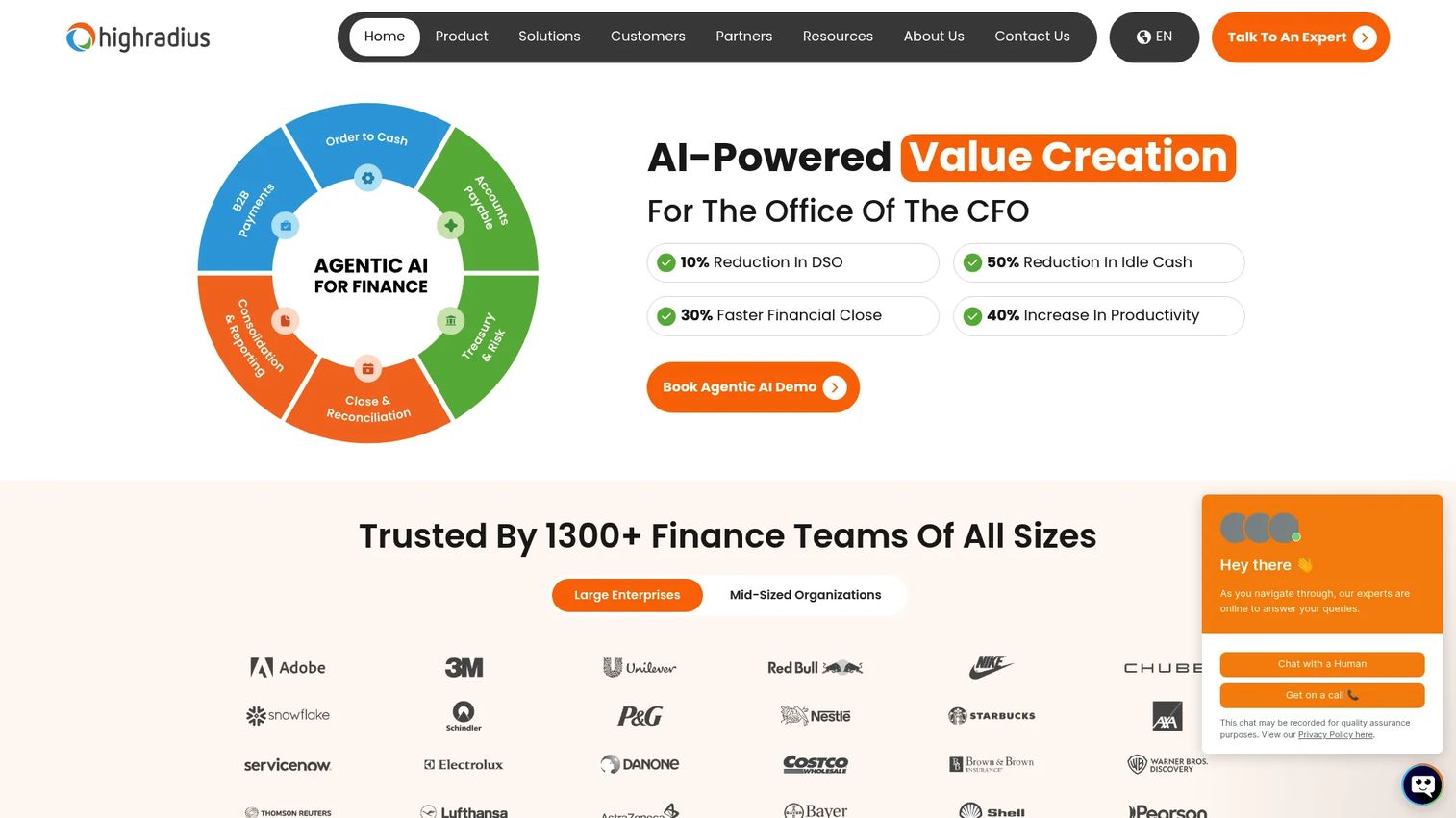
HighRadius is AI-powered autonomous finance software for the Office of the CFO, spanning order-to-cash, treasury, close, reconciliation, AP, and payments. Within that broad suite, its collections and dunning capabilities sit inside a full receivables platform, so dunning is one motion in a connected order-to-cash workflow rather than a standalone tool. For large finance teams with complex receivables across multiple systems, that breadth is the whole point.
Best for: Mid-market to enterprise finance teams automating receivables and other CFO workflows across multiple connected systems.
Key strengths
- Order-to-cash automation: ties dunning and collections into invoicing, cash application, and reconciliation so nothing falls between systems.
- AI-driven collections: prioritizes accounts and times outreach based on payment behavior and risk signals, not fixed schedules.
- ERP integrations: connects to the financial systems enterprise teams already run on, keeping receivables data in sync.
Why choose HighRadius: This is the option for finance organizations where dunning is part of a larger AR automation mandate, not a point solution. If you are juggling embedded payment links, risk forecasting, and collections across business units, a connected platform beats stitching together separate tools. Smaller subscription teams will find it heavier than they need.
HighRadius pricing: HighRadius does not publish a fixed price. Pricing is based on the modules you use, integration requirements, and operational complexity, and is quoted per customer. Expect an enterprise sales conversation rather than a self-serve checkout. HighRadius holds a 4.3/5 rating on G2.
2. Churn Buster

Churn Buster is dunning and customer retention software built specifically for subscription businesses. It runs adaptive dunning campaigns that combine intelligent retries with email and SMS, then pairs them with cancel flows that present targeted offers when a customer tries to leave. The focus is squarely on involuntary churn reduction and recovering failed payments before they turn into lost customers.
Best for: Subscription businesses looking to recover failed payments and reduce cancellation churn in one tool.
Key strengths
- Adaptive dunning campaigns: retries plus email and SMS, sequenced by what actually moves recovery rather than a fixed cadence.
- Cancel flows: targeted offers and analytics that catch voluntary churn alongside involuntary churn.
- Broad integrations: connects with Stripe, Shopify, Recharge, Braintree, and others, plus an API for custom setups.
Why choose Churn Buster: If your churn problem is mostly failed payments and last-minute cancellations, Churn Buster handles both motions without forcing you into a full billing migration. It sits on top of your existing payment stack and gets to work. Teams that want billing, invoicing, and dunning in a single system may prefer a platform play instead.
Churn Buster pricing: Pricing starts from $149/mo for the Complete Retention Solution, scaled by your MRR. There are also Dunning Only and Cancel Flows Only options, plus a one-time Advisory engagement from $1,000. There is no free tier. Churn Buster holds a 4.3/5 rating on G2.
3. ChargeOver
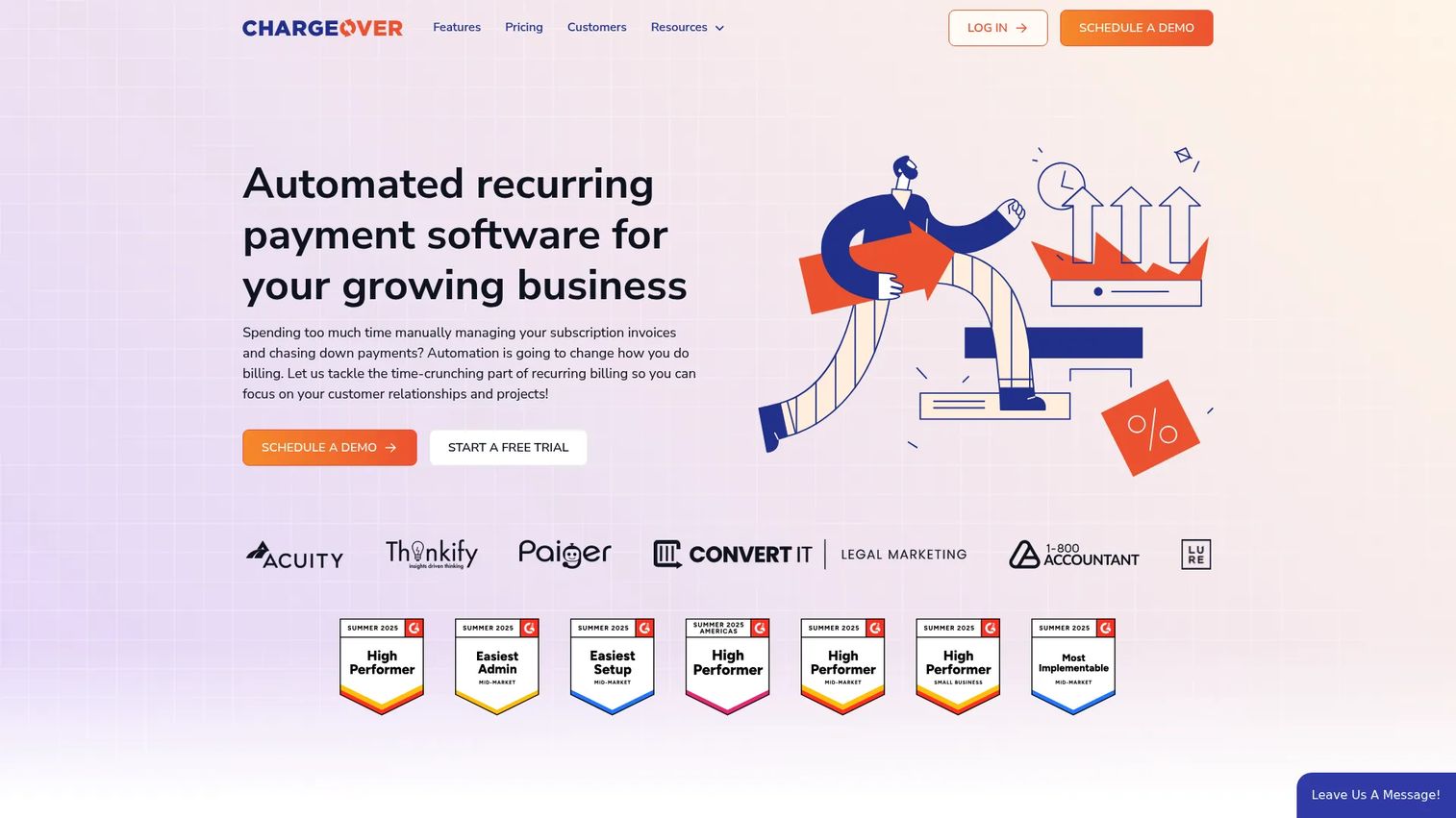
ChargeOver is recurring billing software that handles subscription invoicing, payments, and dunning in one place. Beyond reminders and retries, it manages the full billing motion: automated subscriptions, flexible pricing models, and a customer billing portal. For businesses that want their invoicing engine and their collections automation under one roof, that consolidation is the draw.
Best for: Businesses that need subscription billing and recurring invoicing automation with dunning built in.
Key strengths
- Automated subscriptions and invoicing: handles the billing lifecycle end to end, with reminders and retries baked in.
- Flexible billing models: flat, unit, tiered, and volume pricing, so dunning works across however you charge.
- Customer billing portal: lets customers update payment details and resolve failures without a support ticket.
Why choose ChargeOver: When you would otherwise pay for a billing tool and a separate dunning tool, ChargeOver collapses that into one system. The reminders, customizable schedules, and payment retries live next to the invoices that triggered them. If you already run a mature billing platform and only need a recovery layer, a dedicated recovery tool may fit better.
ChargeOver pricing: ChargeOver's Growth plan starts at $229/month, with pricing scaled by the number of paying customers you bill. A free sandbox account is available for testing, though there is no public free production tier. ChargeOver holds a strong 4.7/5 rating on G2.
4. Chargebee
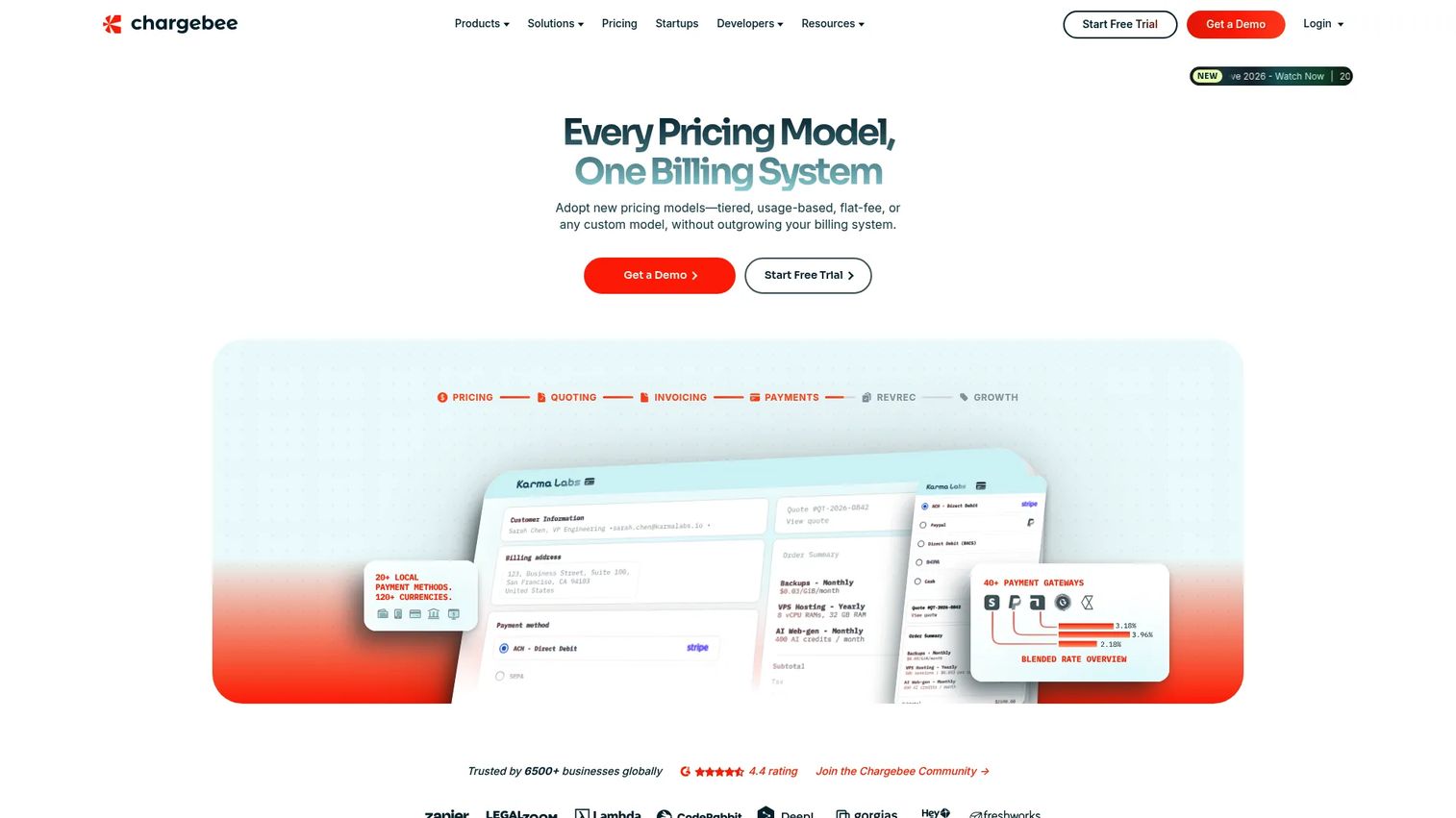
Chargebee is a subscription billing and monetization platform that supports recurring, usage-based, and hybrid revenue models. Dunning and payment recovery sit inside a much larger system that also handles hosted checkout, a self-serve customer portal, revenue recognition, and payment gateway integrations. For companies already standardizing on Chargebee for billing, the recovery automation is a native extension rather than a bolt-on.
Best for: B2B companies needing subscription billing, usage-based billing, and revenue operations automation with dunning included.
Key strengths
- Flexible billing: supports usage-based, subscription, and hybrid models in one platform.
- Hosted checkout and self-serve portal: customers can update cards and resolve failed payments themselves.
- Revenue recognition and dunning: recovery automation and gateway integrations live alongside compliant revenue reporting.
Why choose Chargebee: Chargebee is strongest when dunning is one requirement among many in a broader billing and revenue operations need. If you are already running recurring billing through it, turning on recovery automation keeps everything in one place. Teams that only need failed payment recovery and nothing else may find a focused tool lighter.
Chargebee pricing: Chargebee's Billing line offers a Starter plan at $0/mo, free for the first $250K of cumulative billing and then 0.75% on billing thereafter. The Performance plan runs $7,188/year on an annual commitment, and Enterprise is custom-quoted. Chargebee holds a 4.4/5 rating on G2.
5. ChurnKey
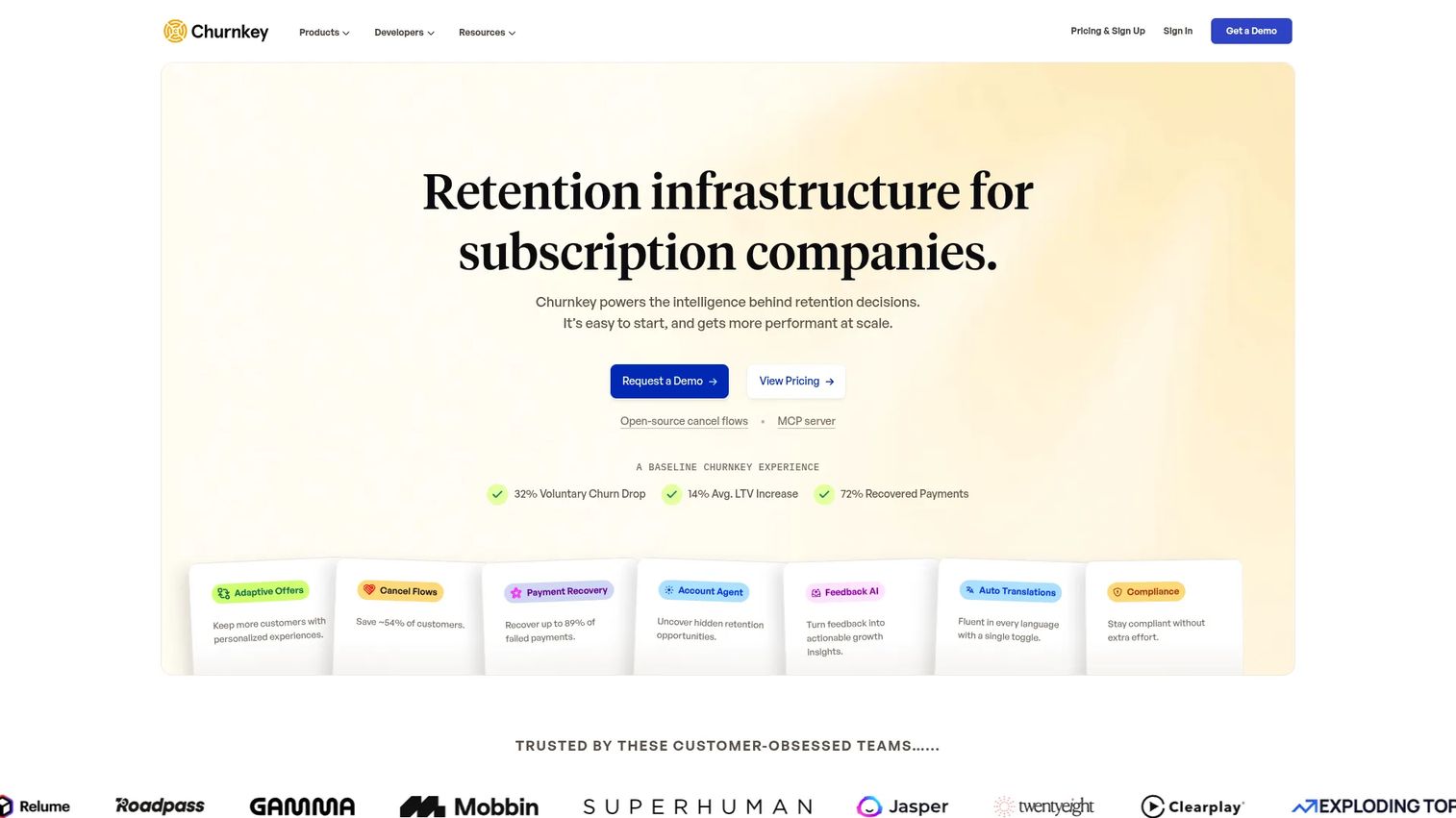
ChurnKey is retention infrastructure for subscription companies focused on reducing churn and recovering revenue. It pairs personalized cancel flows with failed payment recovery and reactivation campaigns, so the dunning layer works alongside the broader retention motion. For teams that think about recovery and retention as one problem, that combination is the appeal.
Best for: Subscription SaaS teams that want to reduce churn with cancellation flows and payment recovery in one layer.
Key strengths
- Personalized cancel flows: intercept voluntary churn with offers tailored to why the customer is leaving.
- Failed payment recovery: dunning email sequences and hosted card-update pages recover declined charges.
- Reactivation campaigns: win back lapsed customers instead of treating churn as final.
Why choose ChurnKey: ChurnKey fits when failed payment recovery is part of a wider retention strategy rather than a standalone need. The cancel flow builder and payment recovery sequences work together, which is hard to replicate by gluing two tools together. Teams whose only concern is invoice recovery may not need the retention layer.
ChurnKey pricing: ChurnKey's Starter plan is listed at $250/month billed yearly and includes the cancel flow builder, payment recovery sequences, a hosted card-update page, and a basic analytics dashboard. Core and Intelligence tiers are positioned for teams with $10K or more in monthly churn, and Enterprise is custom-quoted. ChurnKey holds a 4.6/5 rating on G2.
6. Butter Payments
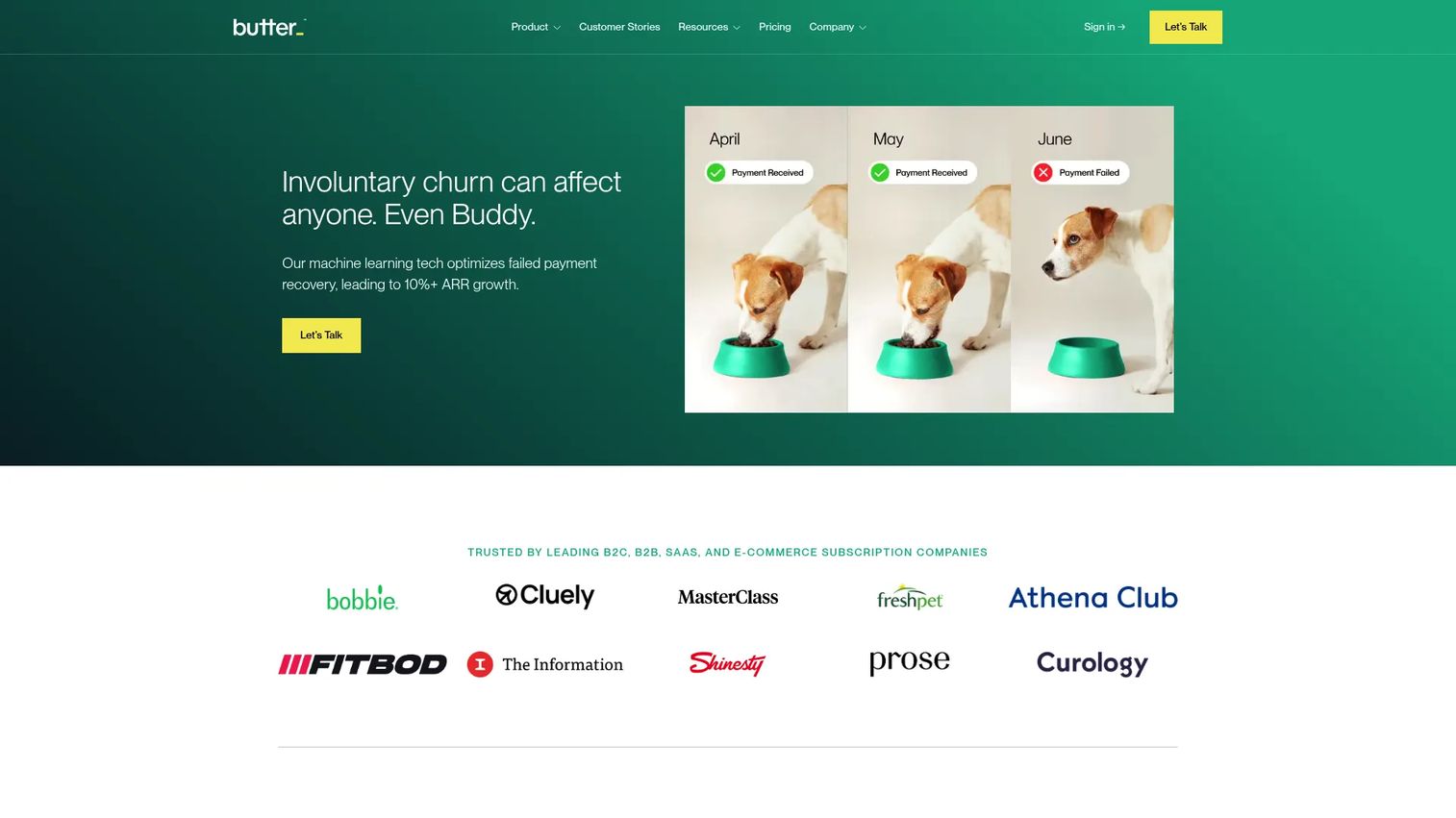
Butter Payments is payment recovery software for subscription businesses, focused on reducing involuntary churn and recovering failed payments. Its model is built around machine learning that analyzes payment health and optimizes retries, with pricing tied to results. Beyond recovery, it works to reduce disputes and chargebacks, so the value extends past simple retry logic.
Best for: Subscription businesses that want performance-based payment recovery and dispute reduction without a fixed software fee.
Key strengths
- ML-based failed payment recovery: retries are timed and routed by models trained on payment outcomes, not static rules.
- Revenue-share pricing: you pay based on recovered revenue, which aligns the vendor's incentive with yours.
- Dispute and chargeback reduction: addresses payment friction beyond declines, protecting more of your revenue.
Why choose Butter Payments: The performance-based model is the differentiator. If you would rather pay only when recovery actually happens, Butter's revenue-share structure removes the upfront-cost risk. That makes it appealing for teams that want recovery handled without committing to a flat subscription. Teams that prefer predictable fixed software costs should weigh the revenue-share math.
Butter Payments pricing: Butter Payments uses performance-based revenue-share pricing and bills only on recovered revenue. There is no fixed public price or free tier. Butter Payments holds a 4.4/5 rating on G2.
7. Baremetrics Recover
Baremetrics Recover is the failed payment recovery module within the broader Baremetrics subscription analytics platform. It runs automated retries and email sequences to recover declined charges, with the recovery data sitting right next to your subscription metrics. For teams already living in Baremetrics dashboards, recovery in the same place is a natural fit.
Best for: Teams already using Baremetrics, or anyone wanting a lighter recovery tool tied to subscription analytics.
Key strengths
- Automated retries: re-attempts failed charges on a schedule designed to recover more without annoying customers.
- Email recovery sequences: prompts customers to update their card before the subscription lapses.
- Metrics context: recovery sits alongside MRR, churn, and other subscription metrics for a single view.
Why choose Baremetrics Recover: If you already track your subscription metrics in Baremetrics, adding Recover keeps recovery and reporting in one tool. It is a focused, lighter-weight option compared to full retention platforms, which suits teams that want declined payment recovery without extra complexity. Companies needing deep cancel-flow logic may want a dedicated retention tool alongside it.
Baremetrics Recover pricing: Recover is available as a standalone module on top of the Baremetrics platform. Check the Baremetrics pricing page for the current rate, as module and plan pricing can change over time.
8. Revaly

Revaly is a Payment Performance Management platform aimed at improving payment approvals and reducing involuntary churn. Rather than focusing only on after-the-fact retries, it optimizes the transaction itself: pre-, during-, and post-transaction, with AI-powered analysis and recovery workflows. The angle is lifting approval rates so fewer payments fail in the first place, then recovering the ones that still do.
Best for: Subscription businesses that want to improve approval rates and recover failed payments across the full transaction lifecycle.
Key strengths
- AI-powered payment performance: analyzes and optimizes payment approvals before declines happen.
- Full-lifecycle optimization: works across pre-, during-, and post-transaction stages, not just retries.
- Recovery and retry workflows: re-attempts failed payments with intelligent timing.
Why choose Revaly: Revaly's strength is treating recovery as a payment-performance problem, not just a follow-up problem. By lifting approval rates upstream, it aims to shrink the pool of failures you have to recover at all. That makes it a practical option for teams focused on the underlying approval mechanics. Its G2 footprint is still small, so weigh that during evaluation.
Revaly pricing: Revaly uses custom pricing tailored to each business, structured as a flat platform fee plus a performance-based component. No public price is listed. Revaly holds a 5.0/5 rating on G2, though from a small number of reviews.
9. FlyCode
FlyCode is failed-payment recovery software for SaaS and eCommerce brands. It combines AI-optimized retries with backup payment-method routing and predictive dunning, then prices on outcomes by charging only on the dollars it actually recovers. The pitch is operational simplicity: hand off recovery, pay for results, and let the system handle retry timing and routing.
Best for: Subscription businesses trying to recover failed payments and reduce involuntary churn with minimal operational overhead.
Key strengths
- AI-optimized retries: retry timing is driven by models, improving recovery odds over fixed schedules.
- Backup payment routing: routes to an alternate card or method when the primary one fails.
- Predictive dunning and analytics: anticipates failures and reports on recovery performance.
Why choose FlyCode: FlyCode suits teams that want recovery to run quietly in the background and prefer to pay only for results. The outcome-based pricing and alternate-card routing reduce both cost risk and the number of payments that ultimately fail. Teams that want recovery bundled with billing or retention in one platform may prefer a broader tool.
FlyCode pricing: FlyCode uses outcome-based pricing and charges only on the revenue it recovers above your baseline. There is no fixed public price. FlyCode holds a 4.8/5 rating on G2.
Considerations before you buy
Picking the right dunning management software comes down to how your business bills, how complex your stack is, and how you want to pay. Run through these before committing.
Automation and retry depth
Look past "we send reminders." Ask whether retries are decline-aware and timed by data, or just fired on a fixed interval. Smarter payment retry logic recovers materially more than dumb re-attempts. Confirm the tool supports the reminder cadence, escalation rules, and multi-channel outreach your customers actually respond to.
Integrations with your stack
A dunning tool is only as good as its connections. Verify support for your payment gateway, billing platform, ERP, and CRM before you buy. For enterprise AR, ERP integrations are non-negotiable. For subscription teams, native links to Stripe, Shopify, or your billing system determine how fast you go live and how clean your data stays.
Reporting and measurement
You cannot improve what you cannot see. Demand recovery rate, time to recovery, and revenue-saved reporting at a minimum. The better tools let you A/B test messaging and retry timing, then show the incremental lift so you can prove the investment to finance and leadership.
Pricing model fit
Flat subscription, MRR-scaled, or revenue share each fit different situations. Performance-based pricing removes upfront risk but can cost more on high recovery volume. Fixed pricing is predictable but you pay regardless of results. Model the math against your actual failed-payment volume before deciding.
Native billing dunning vs dedicated tools
If your billing platform already includes capable dunning, you may not need a separate tool yet. Dedicated recovery software earns its place when your failed-payment volume is high, your retry logic needs to be smart, or your billing platform's built-in recovery is too basic to move the number.
Conclusion
The right pick depends entirely on how you bill and where your revenue leaks. For enterprise finance teams running receivables across multiple ERP and finance systems, HighRadius is the most complete order-to-cash play. For subscription businesses fighting involuntary churn, Churn Buster and ChurnKey pair recovery with retention, while Butter Payments and FlyCode offer performance-based recovery you pay for on results. If you want billing and dunning in one system, ChargeOver and Chargebee fold recovery into a full billing platform, and Baremetrics Recover keeps things light for teams already in its analytics.
Start by matching your billing model and stack complexity to the comparison table above, then read the two or three item sections that fit. Confirm the integrations, the reporting depth, and the pricing math against your real failed-payment volume before you commit. The teams that recover the most are not the ones with the fanciest tool, they are the ones whose tool fits their workflow and runs without anyone having to remember to chase a payment.
Whatever you choose, treat recovery as a measurable, improvable process rather than a quarterly cleanup. That mindset, more than any single feature, is what protects your cash flow.
Start your journey with Guideflow today!
FAQs
Dunning software automates the follow-up process for overdue invoices and failed payments. Instead of manually chasing declined charges, it detects failures, sends reminder sequences, re-attempts payment with retry logic, and provides ways for customers to update their card. The goal is recovering revenue that would otherwise be lost to involuntary churn or slow collections.
Most involuntary churn comes from card failures the customer never intended, like expired cards or temporary bank declines. Dunning software re-attempts those charges at smart intervals, sends timely reminders across email and SMS, and gives customers a one-click way to fix their payment details. Catching and resolving failures before the subscription lapses keeps customers who never meant to leave.
At minimum, look for decline-aware payment retry logic, multi-channel reminders, customizable schedules and escalation rules, hosted card-update pages, and recovery analytics. Stronger tools add A/B testing on messaging, AI-driven retry timing, and deep integrations with your payment gateway, billing platform, ERP, and CRM. The right mix depends on whether you run subscriptions, B2B invoicing, or both.
No. It is most common in subscription and recurring billing, where failed payments drive a large share of churn. But it is equally useful for B2B invoicing and broader AR automation, where overdue invoices and slow collections tie up cash. Any business that bills repeatedly and chases payment by hand can benefit from invoice recovery software.
Built-in billing dunning is often enough when your failed-payment volume is low and your retry needs are simple. A dedicated tool earns its place when volume is high, when you need smart decline-aware retries, or when your billing platform's recovery features are too basic to meaningfully move recovery rate. Model the recoverable revenue against the tool's cost to decide.
Payment gateways come first, since that is where charges actually fail and retry. Next is your billing platform, so recovery stays in sync with invoices and subscriptions. For enterprise finance teams, ERP integrations matter for clean receivables data. CRM integrations help connect recovery activity to customer records, and support-tool links keep service teams informed when a payment issue surfaces.
Track recovery rate, the percentage of failed charges you successfully recover, and time to recovery, how long it takes. Pair those with cash flow impact, the actual dollars recovered, and bad debt reduction over time. The best tools show incremental lift, so you can attribute recovered revenue directly to the software and prove the ROI.
Yes, in specific places. AI helps most with retry timing, predicting when a re-attempt is most likely to succeed based on decline codes and payment behavior. It also helps prioritize which accounts to chase first and forecast recovery, and some tools use it to optimize message timing. Used well, it lifts recovery rate above what fixed-rule systems achieve.