Your sustainability data lives in 14 spreadsheets. One person owns the master file. Three columns reference emission factors nobody can trace back to a source. Then the auditor asks a simple question: where did this Scope 2 number come from? Silence.
That is the moment most teams realize spreadsheets do not survive assurance. They were never built to.
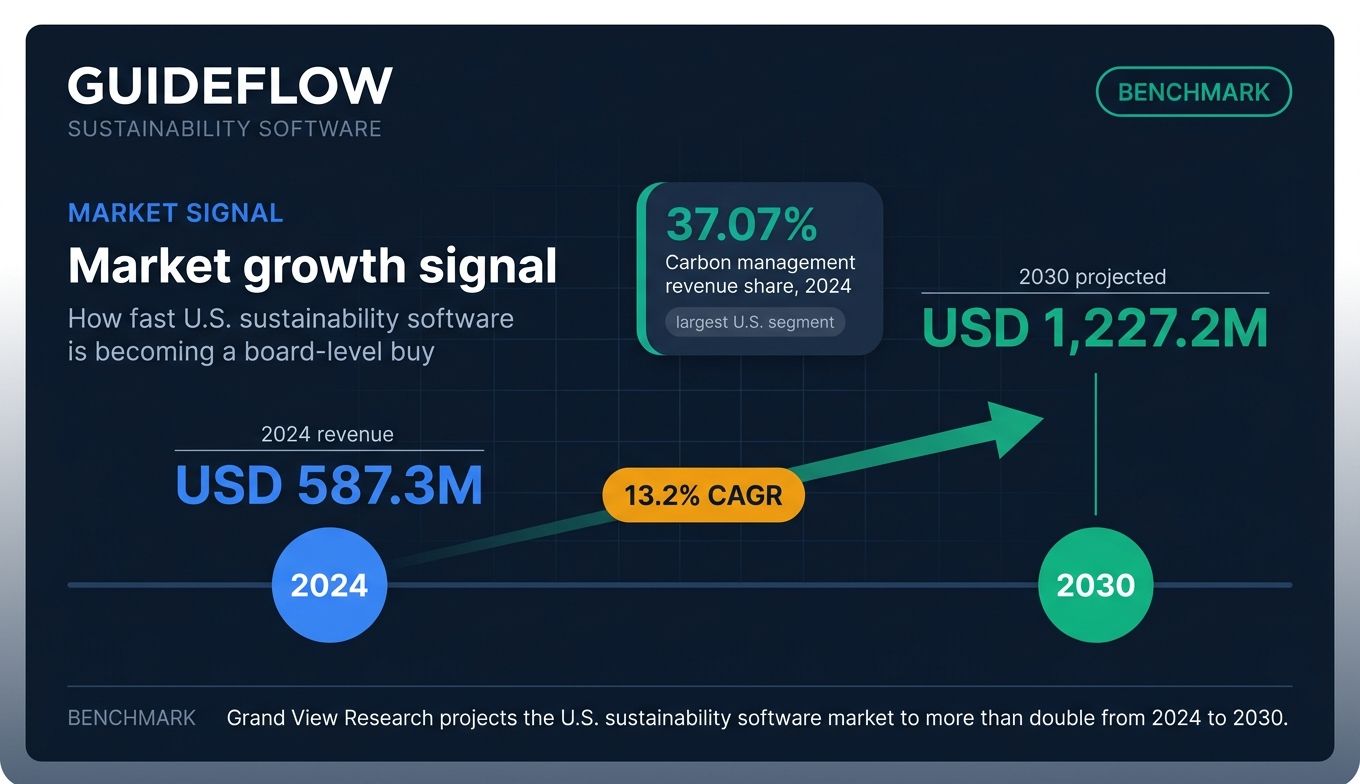
The pressure is not letting up. CSRD phase-in timelines, emerging SEC climate disclosure rules, and California's SB 253 and SB 261 are pushing structured, audit-ready reporting from "nice to have" to "required." The market is responding fast. According to Grand View Research's U.S. sustainability software market analysis, the U.S. sustainability management software market generated USD 587.3 million in revenue in 2024 and is projected to more than double to USD 1,227.2 million by 2030, at a 13.2% CAGR. Carbon management was the largest segment in 2024, holding a 37.07% revenue share.
That growth tells you something simple. Companies are moving emissions and ESG data out of manual files and into governed platforms. Not because software is trendy, but because manual data breaks under scrutiny, and the cost of a failed disclosure is real.
This guide cuts through the noise. We compare 11 sustainability management software tools so you can build a shortlist you can defend to stakeholders, finance, and your board. No vendor hype. Just what each platform does, who it fits, and what it costs.
What's inside
This guide is for sustainability leads, ESG program owners, finance and controller-adjacent reporting teams, and operations buyers who are either replacing spreadsheets or consolidating a fragmented set of tools into one corporate sustainability software platform.
We evaluated each tool against four criteria that decide whether a platform survives real-world use:
- Data management and governance: lineage, audit trails, and traceability that hold up under assurance.
- Carbon accounting depth: Scope 1, 2, and 3 coverage, including supplier and value-chain emissions.
- Multi-framework reporting: CSRD, SEC, GRI, ISSB, and related compliance coverage.
- Usability, integrations, and pricing transparency: how it connects to your stack and what it actually costs.
TL;DR
Short on time? Here are the decision shortcuts.
- Best for unified financial and ESG reporting: Workiva, for enterprises connecting finance, sustainability, and risk in one auditable system.
- Best for a single ESG data system of record: IBM Envizi ESG Suite, for large organizations centralizing ESG data at scale.
- Best for SAP-native enterprises: SAP Sustainability Control Tower, when your ERP is already SAP.
- Best for carbon accounting rigor: Persefoni, for teams that need financial-grade carbon data and financed emissions.
- Best for utility and energy-led carbon accounting: EnergyCAP, for facilities teams building carbon from utility bills.
- Best for getting off spreadsheets fast: Persefoni's free tier or Normative, for mid-market teams starting their carbon accounting.
Background: what is sustainability management software?
Sustainability management software is a platform that collects, governs, calculates, and reports an organization's environmental, social, and governance (ESG) data, including carbon emissions across Scopes 1, 2, and 3, to meet disclosure requirements and track performance against targets.
Put plainly, it replaces the spreadsheet sprawl. Instead of one master file and a dozen feeder tabs, you get a centralized system that ingests data from ERP systems, utility providers, IoT meters, and supplier portals, then turns it into auditable disclosures. Both Watershed and Sweep describe the category the same way in their 2026 overviews: a central place to collect, validate, and disclose sustainability data at scale.
The terms blur together in the market. "ESG software," "carbon accounting software," "sustainability reporting software," and "sustainability data management software" all describe overlapping slices of this category. The common thread is governed data feeding trustworthy reports.
Most sustainability management platforms share a core set of capabilities:
- Data collection and integration: automated ingestion from ERP, utilities, meters, spreadsheets, and supplier surveys.
- Carbon and emissions accounting: Scope 1, 2, and 3 greenhouse gas calculations using managed emission factor libraries, mapped to the GHG Protocol Scope 1, 2, and 3 standards.
- Multi-framework reporting: outputs mapped to CSRD, ESRS reporting standards, ISSB, GRI, SASB, and TCFD from a single dataset.
- Audit trail, lineage, and governance: traceability and change history that hold up under assurance.
- Dashboards and target tracking: progress against science-based or internal reduction targets.
- Regulatory compliance modules: support for digital tagging, double materiality, and jurisdiction-specific rules.
The shift toward this category is well documented. Carbon management software was the largest sustainability management software segment in the U.S. in 2024, per Grand View Research, which reflects how central emissions accounting has become to the buying decision. Many of these vendors are SaaS platforms you can evaluate through interactive demos before committing, much like the way buyers now expect to test CRM software and product analytics software hands-on.
When to use sustainability management software
Not every team needs a full platform on day one. Here is how to recognize when spreadsheets have run their course.
Replace spreadsheets with audit-ready data
The clearest trigger is assurance. When a third-party auditor or your finance team starts asking where each number came from, manual files crack. Spreadsheets carry no lineage, no change history, and no factor versioning. A sustainability management platform records every calculation, source, and edit, so you can answer "where did this come from?" without a panic. If your disclosures are heading toward formal assurance, this is the moment to switch.
Manage Scope 3 and supplier emissions at scale
Scope 3 is where manual tracking dies. Value-chain emissions span hundreds of suppliers, spend categories, and activity types. Collecting that by email and stitching it together in tabs does not scale past a handful of vendors. Software with supplier portals, survey workflows, and spend-based plus activity-based calculation methods turns a chaotic data pull into a repeatable process. If supply-chain complexity already exceeds what your team can track manually, you have outgrown spreadsheets.
Meet CSRD, SEC, and multi-framework deadlines
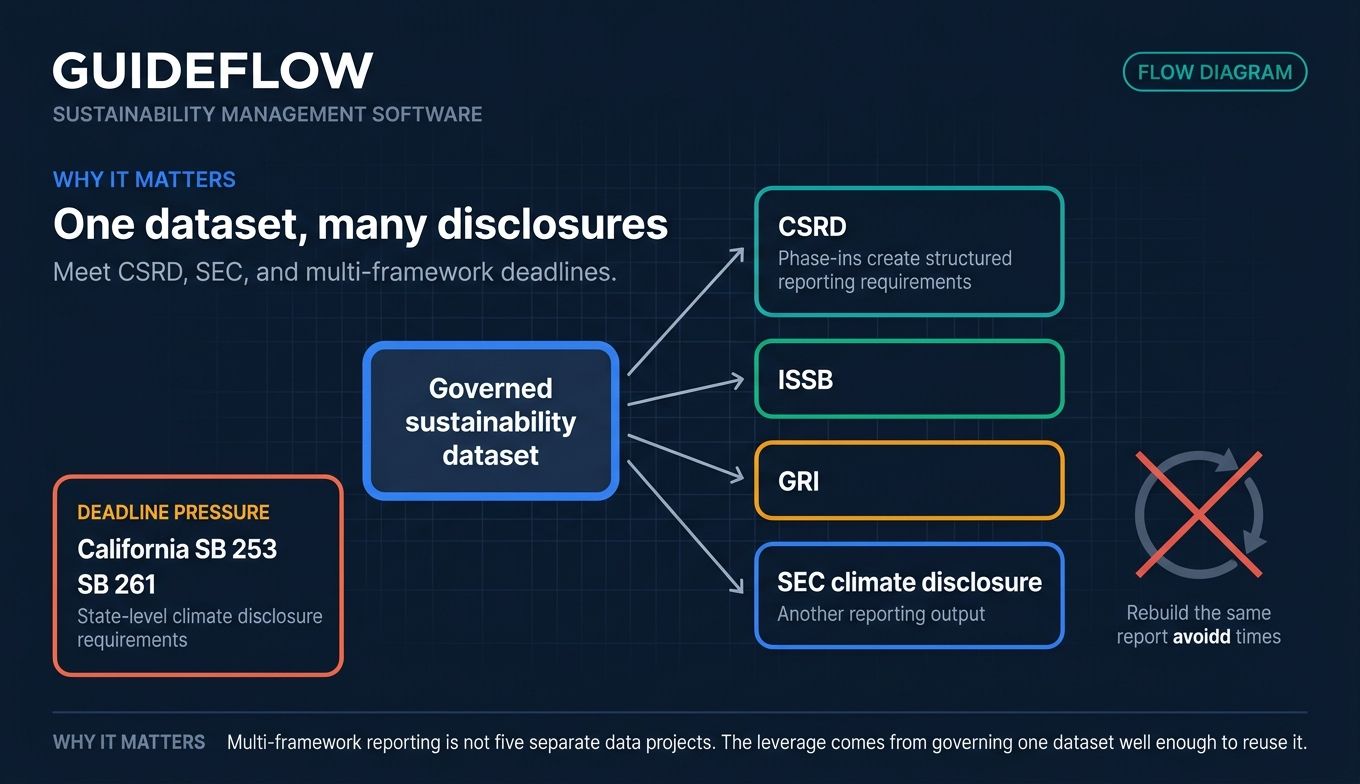
Regulatory timelines force structure. CSRD phase-ins, SEC climate disclosure, and California's SB 253 and SB 261 climate disclosure laws each carry deadlines and formats that manual processes struggle to hit consistently. Worse, you often need to report the same underlying data across multiple frameworks. A platform that maps one dataset to CSRD, ISSB, GRI, and SEC climate disclosure rules outputs saves you from rebuilding the same report five times. When deadlines stack up, structured workflows stop being optional.
What to look for in sustainability management software
Before you scan the list, set your evaluation lens. The strongest buyers do not chase feature counts. They pressure-test five things.
First, data governance and lineage. Can the platform trace every number back to its source, version emission factors over time, and log every change? This is the difference between audit-ready and audit-anxious, and most vendor pages bury it.
Second, Scope 3 depth. Does it support both spend-based and activity-based methods, and does it give you real supplier engagement tooling rather than a manual survey export?
Third, framework and regulatory coverage. CSRD and ESRS, SEC, ISSB sustainability disclosure standards, GRI, plus XBRL and ESEF digital tagging where required.
Fourth, integrations and time-to-value. How does it connect to your ERP, utility, and CRM data, and how long until you produce a real report?
Fifth, pricing transparency. Seat-based, flat, or data-volume models each change your total cost differently.
Many of these vendors are SaaS companies themselves, and the better ones let you evaluate the product through interactive demos before a single sales call. Use those to test the workflows that matter to you.
Comparison table
Here is how the 11 best sustainability management software tools compare at a glance. Pricing for this category is overwhelmingly quote-based, so we note public pricing where it exists and flag where vendors direct you to sales. G2 ratings reflect each tool's current listing.
| # | Product | Intent | Key use case | Pricing | G2 rating |
|---|---|---|---|---|---|
| 1 | Workiva | Unified reporting | Connect finance, ESG, and risk reporting | Custom (contact sales) | 4.5/5 |
| 2 | IBM Envizi ESG Suite | ESG data management | Single ESG system of record | Custom (data-volume based) | 4.3/5 |
| 3 | SAP Sustainability Control Tower | Enterprise steering | SAP-native sustainability data | Custom (contact sales) | 4.3/5 |
| 4 | Sphera | ESG + EHS + LCA | Industrial sustainability and LCA | Custom (contact sales) | 4.0/5 |
| 5 | Salesforce Net Zero Cloud | Carbon accounting | Salesforce-native ESG data | Custom (contact sales) | 4.4/5 |
| 6 | Persefoni | Carbon accounting | Financial-grade carbon ledger | Free PRO tier; ADVANCED custom | 4.8/5 |
| 7 | EnergyCAP | Utility-led carbon | Carbon from utility bill data | Custom (per meter per year) | 4.8/5 |
| 8 | Normative | Science-based carbon | Full value-chain Scope 3 | Custom (get a quote) | Not yet rated |
| 9 | Sweep | Carbon + ESG data | Collaborative supplier data capture | Custom (book a demo) | 4.8/5 |
| 10 | FigBytes (Quentic) | ESG + strategy | Strategy linked to reporting | Custom (modular) | 4.0/5 |
| 11 | UL 360 | EHS + sustainability | Audit-ready disclosure data | Custom (contact sales) | 4.7/5 |
1. Workiva
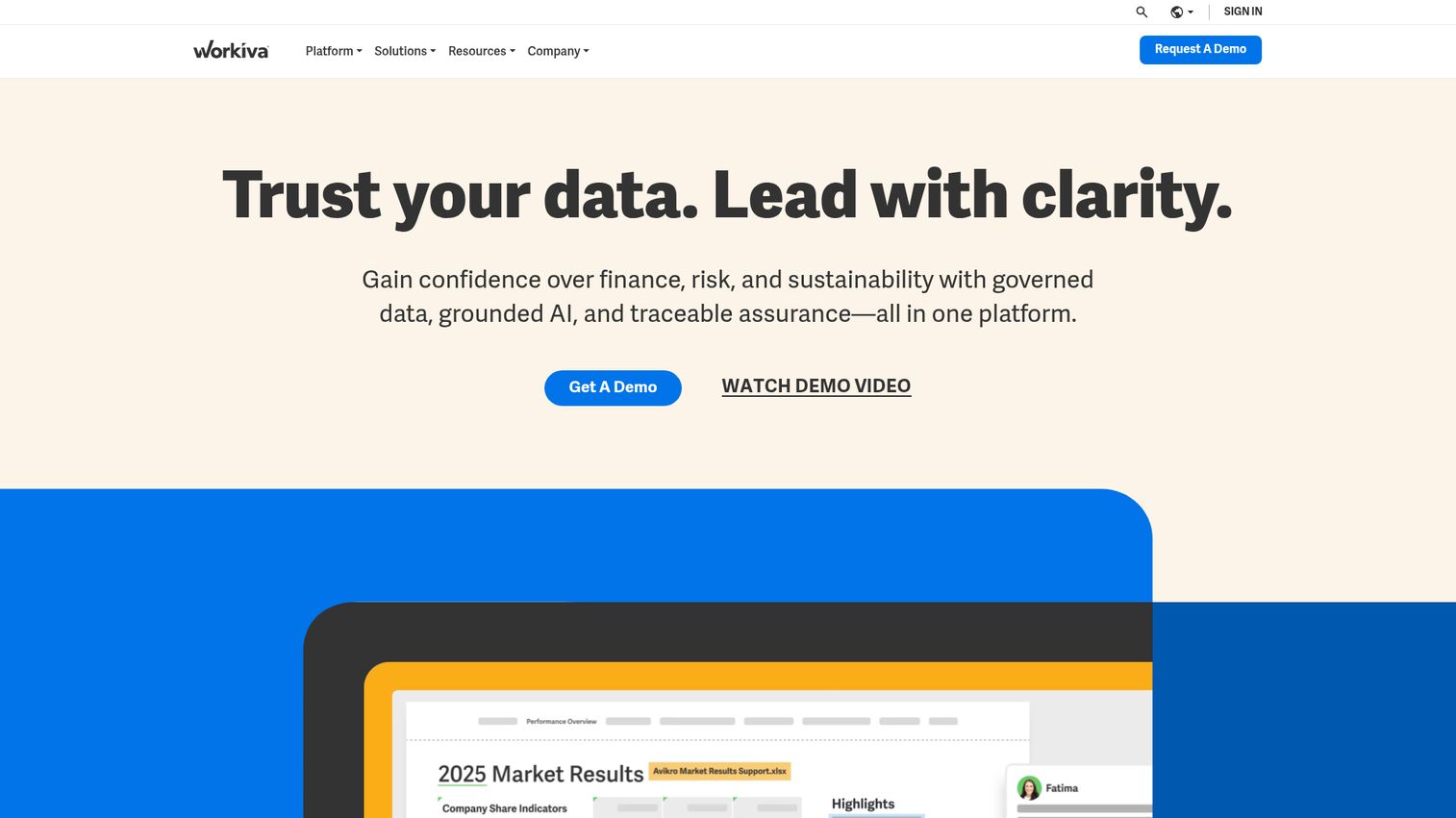
Workiva is an AI-powered platform that connects finance, risk, sustainability, and legal teams around a single source of trusted data. Its core strength is data linking: numbers flow across documents, spreadsheets, and presentations so a change in one place updates everywhere. That makes it a natural fit for teams who treat ESG disclosure with the same rigor as financial reporting.
Best for: Enterprise finance, risk, sustainability, and legal teams that need connected, auditable reporting workflows.
Key strengths
- Connected data linking: One change propagates across every document, spreadsheet, and presentation, so reports stay consistent.
- Workiva AI Intelligent Companion: A built-in AI assistant with a pre-built prompt library to speed drafting and review.
- Collaboration and audit controls: In-app comments, version control, review tools, and blackline capabilities for assurance-grade workflows.
Why choose Workiva: If your sustainability reporting needs to sit alongside financial reporting under the same controls, Workiva removes the seams between them. It is built for organizations where the same numbers feed regulatory filings, investor reports, and ESG disclosures. Teams that only need lightweight carbon tracking may find it more platform than they require.
Workiva pricing: Workiva does not publish numeric pricing. The company states that pricing is based on each organization's value and needs, uses good/better/best packaging for some solutions, and directs prospects to contact sales. No free tier is listed on its pricing page. Expect a custom quote scoped to your reporting footprint.
2. IBM Envizi ESG Suite
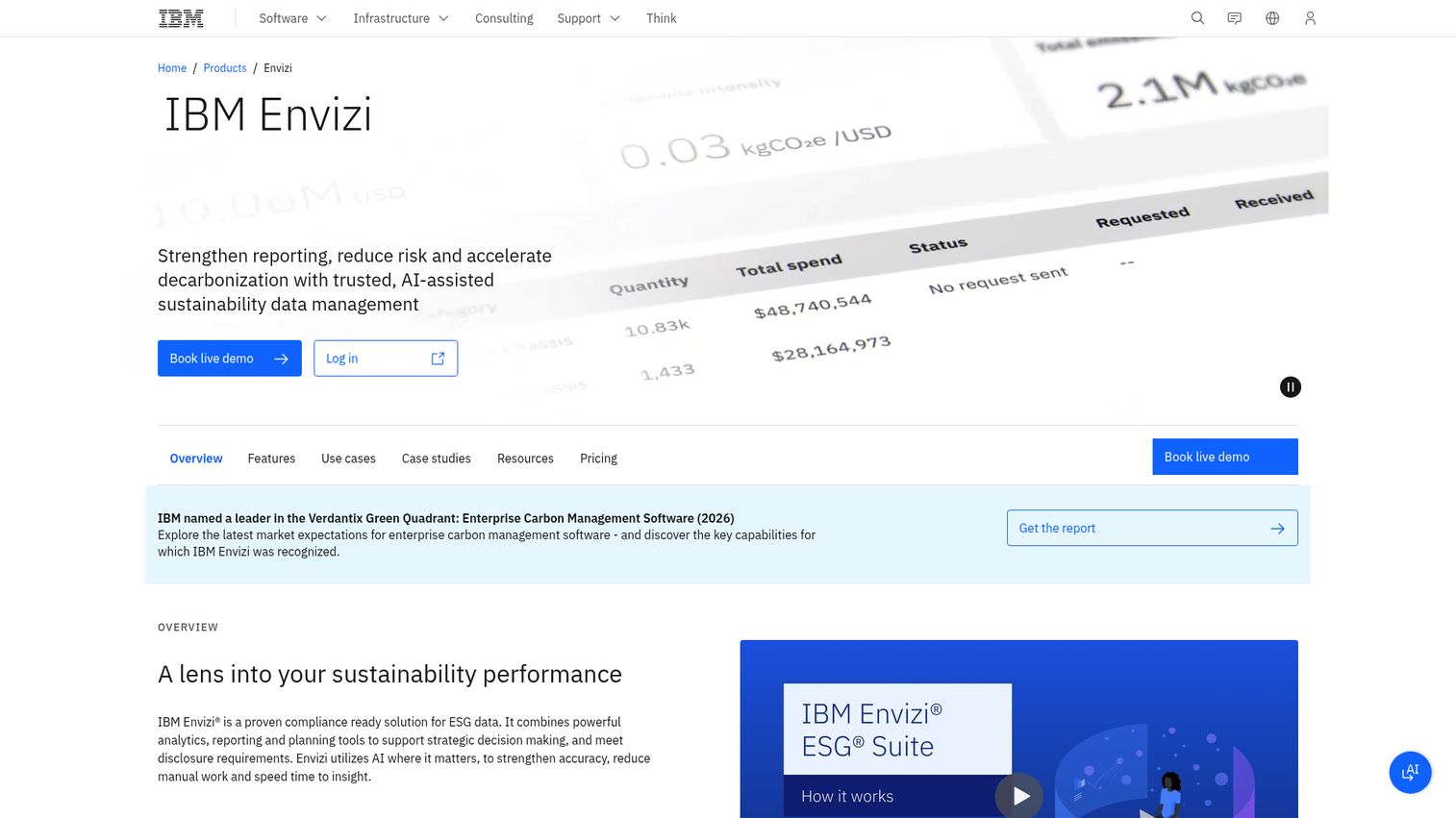
IBM Envizi ESG Suite is an AI-assisted ESG data management suite built for sustainability reporting, emissions management, decarbonization planning, and audit-ready disclosures. It pulls data from a wide range of sources and treats ESG data with finance-grade controls, which makes it a strong candidate for a single system of record.
Best for: Large organizations needing auditable ESG data management, emissions accounting, regulatory reporting, and decarbonization analytics at scale.
Key strengths
- Broad data ingestion: Automated capture from ERP systems, IoT and metering platforms, utility providers, spreadsheets, and supplier portals.
- Full scope emissions accounting: Scope 1, 2, and 3 greenhouse gas accounting and reporting in one place.
- Finance-grade governance: Reporting frameworks paired with data health checks and audit trails.
Why choose IBM Envizi: If you want one consolidated ESG data layer rather than a stack of point tools, Envizi is designed to be that hub. It fits organizations already invested in the IBM ecosystem and those who prioritize data quality and auditability over a lightweight setup. Smaller teams may find the enterprise scope heavier than they need.
IBM Envizi pricing: IBM bases Envizi pricing on ESG data volume, calculated by Account bundles. Packages run Essentials (up to 1,000 Accounts), Standard (1,001 to 5,000 Accounts), and Premium (5,001 to 15,000+ Accounts). IBM does not publish a fixed starting price; exact requirements are scoped during the sales process, and the online calculator provides only an indicative estimate.
3. SAP Sustainability Control Tower
SAP Sustainability Control Tower centralizes sustainability and ESG data and performance using embedded AI to support auditable compliance and sustainability management. Its biggest advantage is proximity to enterprise transactional data: if your business already runs on SAP, the sustainability data has a short trip from source to disclosure.
Best for: Enterprises that need centralized ESG data management, sustainability KPI tracking, and regulatory sustainability reporting, especially SAP-native organizations.
Key strengths
- Enterprise-wide data capture: Pulls ESG metrics from SAP and third-party systems into one steering layer.
- ESG report generation: Builds reports using metrics and content from SAP and partners.
- Standards compliance: Supports reporting standards such as ESRS and EU Taxonomy framework.
Why choose SAP Sustainability Control Tower: The case is strongest when SAP is already your system of record. Emissions and ESG metrics tied to transactional data give you traceability that is hard to match with bolt-on tools. Organizations without an SAP backbone will weigh integration effort more heavily and may prefer a platform-agnostic option.
SAP Sustainability Control Tower pricing: SAP does not display public pricing, tier names, or billing terms for this product. The pricing page directs prospects to request a demo or trial. Expect a custom quote scoped through SAP's sales process.
4. Sphera
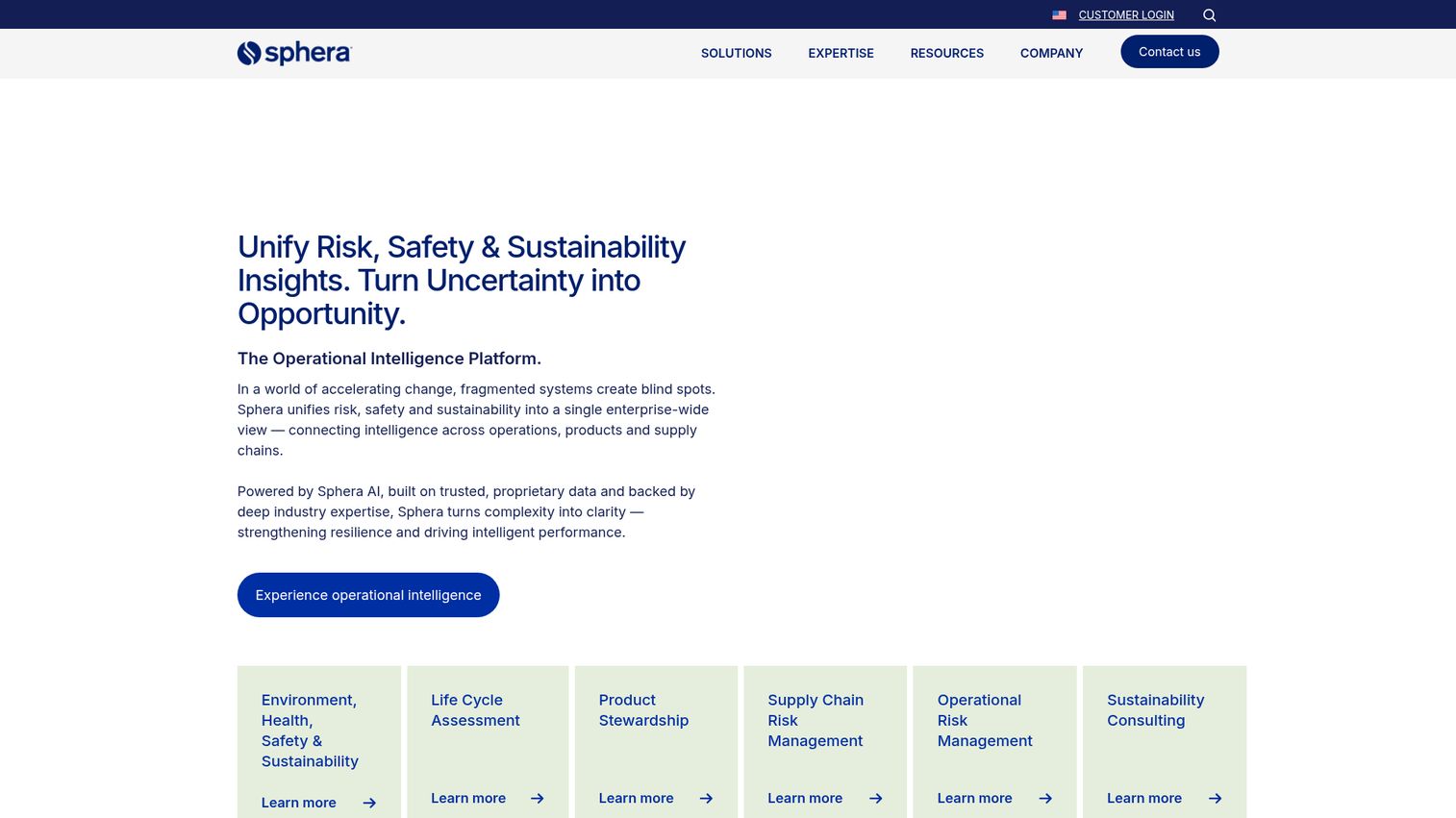
Sphera provides integrated sustainability and operational risk management software, data, and consulting services spanning EHS and sustainability, process safety, product stewardship, and supply chain risk. Its standout is depth in life cycle assessment, backed by a large library of verified datasets, which makes it a fit for industrial and manufacturing buyers.
Best for: Large enterprises managing sustainability, EHS, operational risk, product stewardship, and supply chain risk programs.
Key strengths
- SpheraCloud platform: Integrated environment for enterprise sustainability and operational risk management.
- Auditable ESG reporting: ESG and sustainability data collection, aggregation, and auditable reporting.
- Deep LCA content: Over 20,000 annually updated, DEKRA-verified life cycle assessment datasets.
Why choose Sphera: If your sustainability program is inseparable from EHS, product stewardship, and supply chain risk, Sphera covers all of it in one platform. The LCA depth is particularly valuable for manufacturers who need product-level environmental accounting. Teams focused purely on corporate carbon disclosure may not use the full breadth.
Sphera pricing: No public pricing figures were available on Sphera's site. Pricing, tiers, and free-tier status are not disclosed, and the company scopes quotes through sales. Plan for a custom enterprise engagement.
5. Salesforce Net Zero Cloud
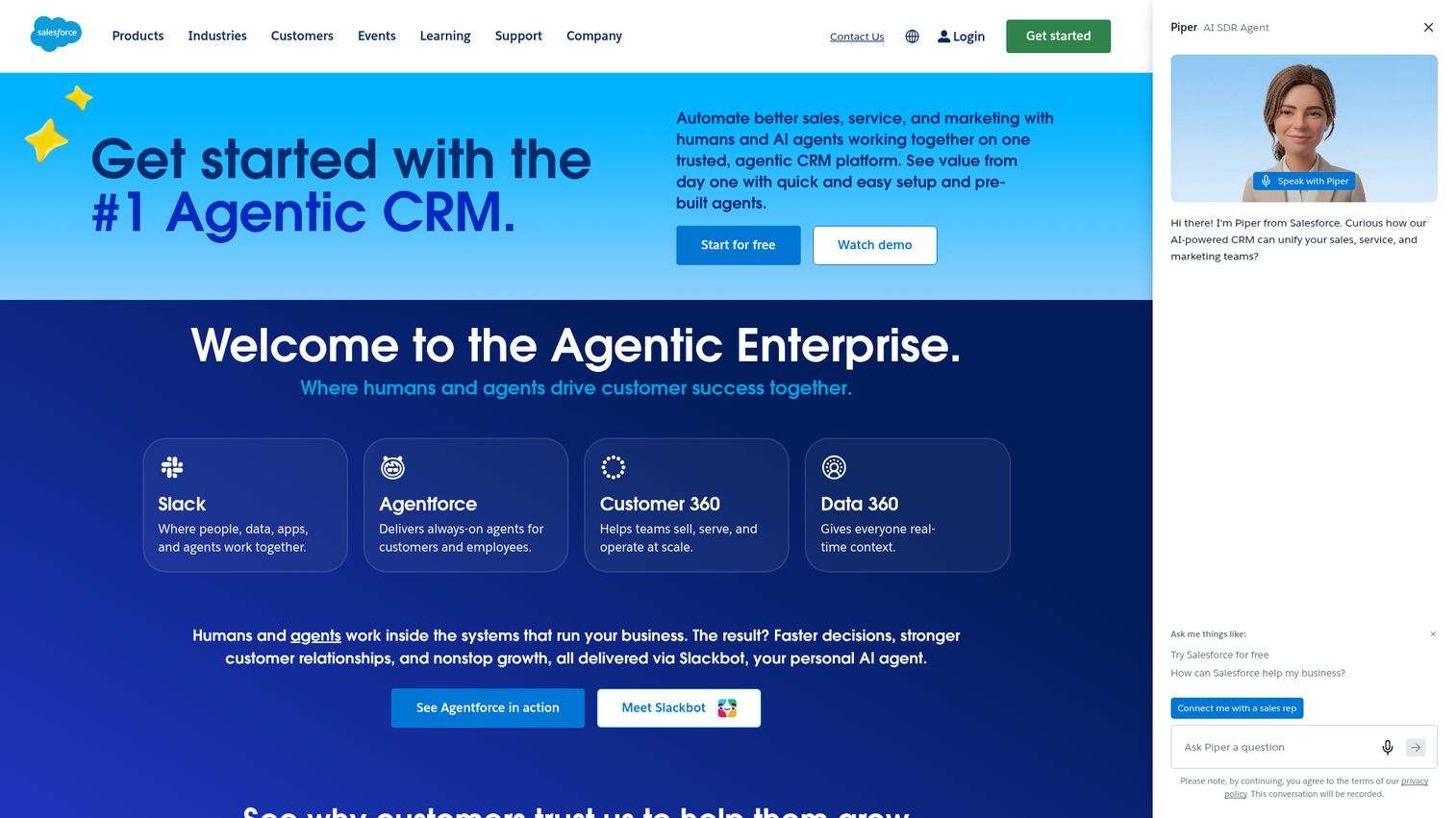
Salesforce Net Zero Cloud is sustainability software for managing ESG data, carbon accounting, forecasting, supplier data, and disclosure reporting on the Salesforce platform. For organizations already standardized on Salesforce, it keeps sustainability data inside familiar infrastructure with native dashboards and reporting.
Best for: Enterprises that need ESG data management, carbon accounting, emissions forecasting, supplier engagement, and compliance reporting integrated with Salesforce.
Key strengths
- Scope 1, 2, and 3 analysis: Emissions accounting across all three scopes.
- Disclosure and Compliance Hub: A dedicated workspace for ESG reporting and disclosure.
- Forecasting and targets: science-based targets methodology and emission forecasting built in.
Why choose Salesforce Net Zero Cloud: The pull is platform consistency. If your teams already work in Salesforce, sustainability data joins the same environment, with CRM-native reporting and dashboards. Organizations without a Salesforce footprint will find less reason to adopt it over a dedicated carbon platform.
Salesforce Net Zero Cloud pricing: Salesforce lists Net Zero Cloud Growth as the main edition and directs buyers to contact sales for pricing. Add-ons such as Advanced Analytics and Forecasting, External Engagement Management, and an Agentforce add-on also show contact-us pricing. No public monetary price or free tier is listed.
6. Persefoni
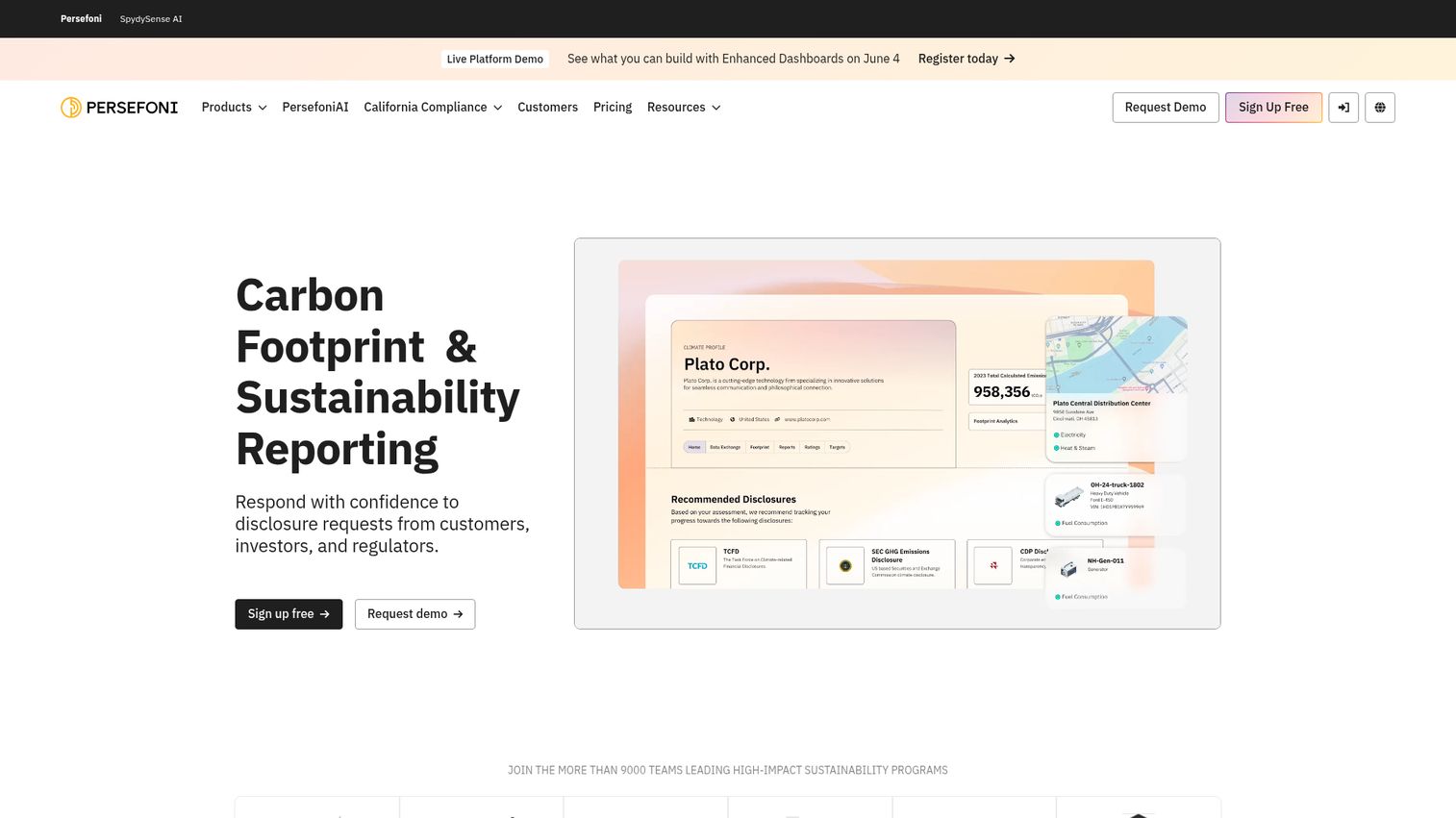
Persefoni is a carbon accounting and sustainability management platform for measuring, managing, reporting, and reducing organizational and financed emissions. It is one of the few platforms in this list with a genuinely free entry tier, which makes it a strong starting point for teams getting off spreadsheets.
Best for: Companies and financial institutions that need carbon accounting, sustainability disclosure workflows, and decarbonization planning.
Key strengths
- Full scope footprint measurement: Scope 1, 2, and 3 carbon footprint measurement in one ledger.
- Sustainability Report Builder: Reporting for frameworks including CSRD, ISSB, and CDP.
- PersefoniAI: Copilot, anomaly detection, and emission factor mapping to speed accurate accounting.
Why choose Persefoni: The rigor is the draw. Persefoni is built around financial-grade carbon data and financed emissions, which matters for financial institutions and any team that expects assurance. The free PRO tier also lets smaller teams start without a procurement cycle. It earns a 4.8/5 on G2, the highest in this list alongside two others.
Persefoni pricing: Persefoni offers a free PRO plan, a self-service tier aimed at organizations with low-to-medium operational complexity. The ADVANCED plan targets sustainability-ambitious or enterprise-scale organizations and requires requesting a demo, with no public numeric price. The free tier makes it unusually accessible for the category.
7. EnergyCAP
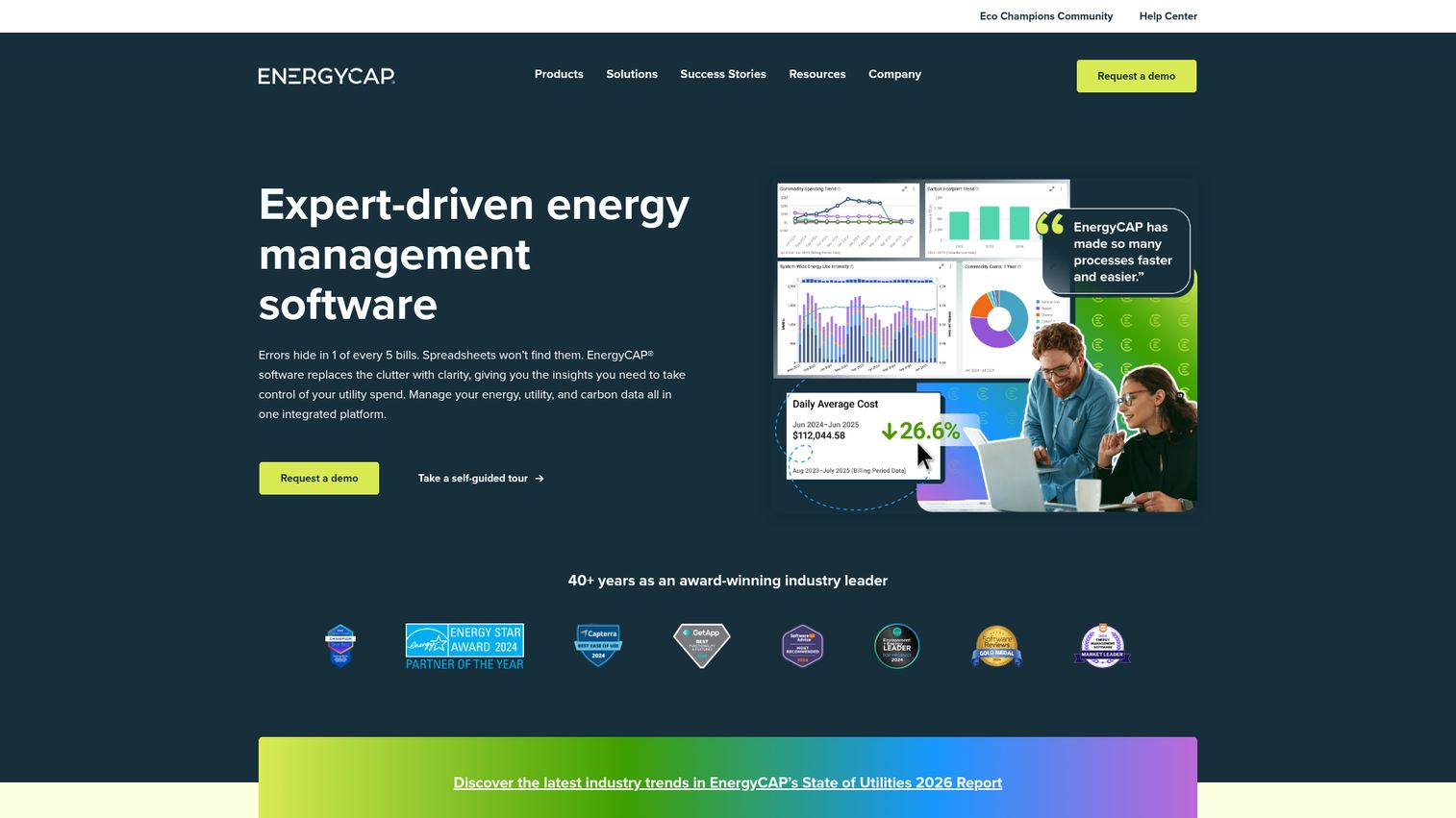
EnergyCAP is an energy, utility, and carbon data management platform that centralizes utility bill data, analytics, reporting, and sustainability workflows. Its angle is distinctive: it builds carbon accounting up from utility and commodity data, which makes it a natural fit for facilities and energy teams.
Best for: Organizations managing multi-site utility bills, energy usage, finance workflows, and emissions reporting in one platform.
Key strengths
- Utility bill data management: Centralized capture and reporting of utility bills across sites.
- Carbon Hub: Scope 1, 2, and 3 carbon accounting tied to energy data.
- Smart Analytics: Interval data, use and demand spike analysis, and cost avoidance insights.
Why choose EnergyCAP: If your emissions story starts with utility bills, EnergyCAP lets you build carbon accounting from data you already collect for finance. Energy and carbon live in one platform, which suits facilities teams who manage both. It also holds a 4.8/5 on G2. Teams whose emissions are dominated by Scope 3 supply chain rather than energy may need to pair it with a value-chain tool.
EnergyCAP pricing: EnergyCAP prices per meter per year. Customers typically start with Utility Management and add modules like Carbon Hub, Smart Analytics, finance tools, and Bill CAPture Services. The pricing page lists no public price number and directs buyers to sales for a scoped quote.
8. Normative
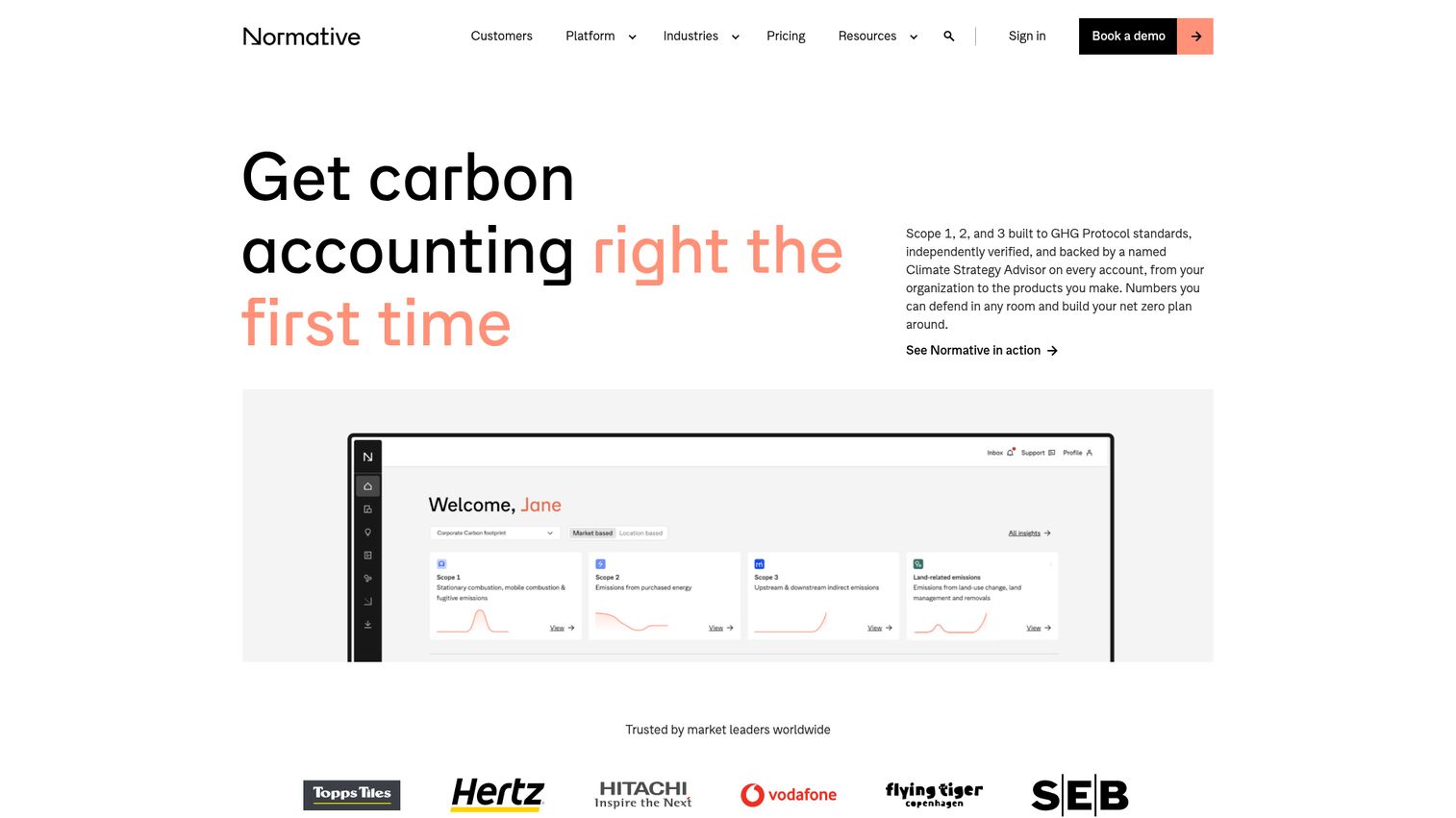
Normative is a carbon accounting engine that helps businesses calculate, report, and reduce their carbon emissions, with particular depth in Scope 3 and value-chain accounting. Its large emissions factor database supports both spend-based and activity-based methods, which matters when supplier data is incomplete.
Best for: Businesses needing carbon accounting, Scope 3 reporting, supplier engagement, and sustainability compliance support.
Key strengths
- Automated carbon accounting: AI-powered data matching to reduce manual calculation work.
- Large emissions database: 349,000 scientific emissions factors for granular calculations.
- Reporting suite: Built for frameworks including SECR and CSRD.
Why choose Normative: When the value chain is your biggest emissions source, Normative's Scope 3 depth and large factor library do the heavy lifting. The combination of spend-based and activity-based methods means you can produce a defensible inventory even before supplier data is complete. It is a focused carbon tool rather than a broad ESG suite, so teams needing wide social and governance disclosure may want to pair it.
Normative pricing: Normative offers Essential and Premium plans, both quote-based with a "get a quote" call to action and no public price. Essential covers data and calculation tools with AI validation, carbon reporting and compliance, dashboards, and support. Premium adds enhanced data management, value chain engagement, strategic reduction planning, and exclusive support.
9. Sweep
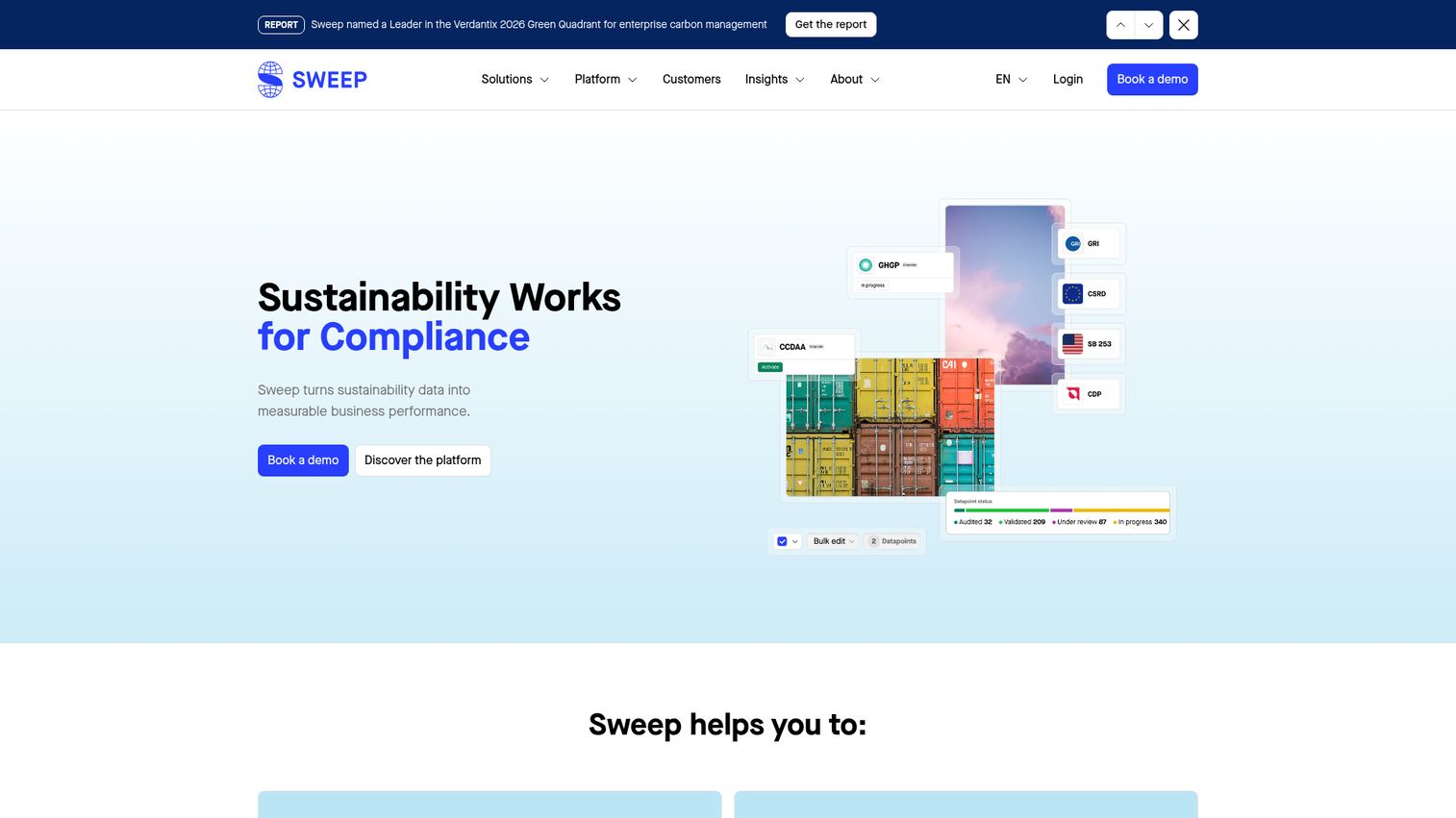
Sweep is a sustainability intelligence platform that centralizes ESG and carbon emissions data for reporting, operations, and business decisions. Its supplier engagement tooling and automated data collection make it a strong fit for distributed teams that need collaborative data capture across the value chain.
Best for: Complex organizations that need audit-ready carbon accounting, ESG reporting, and supplier sustainability data collection.
Key strengths
- Full scope carbon accounting: Coverage across Scope 1, 2, and 3 emissions.
- Broad framework support: ESG disclosure for CSRD, ISSB, GRI, CDP, SB 253, and TCFD.
- Value chain engagement: Supplier portals and automated data collection to gather supplier data at scale.
Why choose Sweep: If your data lives across many teams and suppliers, Sweep's collaborative workflows turn data collection from a chore into a managed process. Its framework coverage is unusually wide, including California's SB 253, which matters for U.S. companies tracking state-level rules. It carries a 4.8/5 on G2. Sweep directs all pricing conversations to a demo, so budget-conscious buyers will want an early scoping call.
Sweep pricing: Sweep does not publish public pricing. The site repeatedly directs users to book a demo, and while Starter and Pro packages are referenced, no public prices are listed. Plan for a custom quote scoped to your data complexity.
10. FigBytes (Quentic)
FigBytes is now part of Quentic, an AI-enabled EHS and ESG management SaaS that combines sustainability reporting and management with safety compliance and incident management. The platform links ESG data to strategy and reporting, which suits teams who want their sustainability program connected to operational goals rather than siloed.
Best for: Organizations needing centralized ESG, sustainability, carbon accounting, and regulatory reporting workflows.
Key strengths
- Carbon accounting: Data collection, calculation, GHG inventory management, and pre-loaded emission factors.
- Climate disclosure reporting: Audit-ready data and tools for regulations such as SEC Climate Disclosure and CSRD.
- Scope 3 management: Supplier engagement, communication, calculation, and estimation tools.
Why choose FigBytes: The combined EHS and ESG footprint is the differentiator. After joining Quentic, the platform pairs sustainability reporting with safety and incident management, which fits organizations managing both under one roof. Note that FigBytes.com now redirects to Quentic, following AMCS Group's 2023 acquisition of Quentic, so evaluate it as part of that unified product.
FigBytes pricing: Quentic describes modular licensing with low monthly charges but does not display public pricing figures, plan names, or free-tier details. Pricing is scoped per module through sales. Expect a tailored quote based on the modules you select.
11. UL 360
UL 360 is ESG and sustainability data management software from UL Solutions, built to simplify data collection, management, reporting, and disclosure. Its emphasis on investment-grade data quality and auditability makes it a fit for organizations that combine EHS and sustainability and need disclosures that hold up.
Best for: Enterprises managing ESG, sustainability reporting, carbon accounting, and audit-ready disclosure data across complex organizations and supply chains.
Key strengths
- Investment-grade data: Advanced data quality management and auditability for sustainability data.
- Automated data collection: Cleaning, standardization, integrations, and audit trails built in.
- ESG disclosure workspace: Reporting for CDP, ISSB, and CSRD with progress tracking and traceability.
Why choose UL 360: UL Solutions brings a heritage in safety and compliance, and UL 360 reflects that with a strong focus on data quality and traceability. If audit readiness and EHS alignment are top priorities, it fits well. It holds a 4.7/5 on G2, though from a small review base. Pricing transparency is limited, so an early sales conversation is the practical next step.
UL 360 pricing: No public pricing page or price number was available. UL directs prospects to schedule a demo, and pricing details are not currently published. Plan for a custom quote scoped through UL Solutions.
Considerations: how to choose
The list narrows fast once you apply your own constraints. Use this checklist to pressure-test finalists before a demo or RFP.
Data governance, lineage, and factor versioning
This is the criterion most vendors bury, and the one auditors care about most. Ask whether the platform stores date-effective emission factors, keeps a full change history, and lets you trace any reported number back to its source. Without it, you have a prettier spreadsheet, not an audit-ready system.
Scope 3 and supplier data quality
Scope 3 makes or breaks most inventories. Confirm whether the tool supports both spend-based and activity-based methods, and whether it ships real supplier engagement tooling such as portals and surveys. Manual exports do not scale past a handful of vendors.
Framework and regulatory coverage
Map your obligations first, then check coverage. CSRD and ESRS, SEC climate disclosure, ISSB, GRI, and XBRL or ESEF digital tagging where required. The best platforms generate multiple framework outputs from a single dataset, so you do not rebuild the same report five times.
Integrations and time-to-value
A platform is only as good as the data it can reach. Verify connectors for your ERP, utility providers, and CRM, then ask realistically how long until you produce a first report. Advisory support can shorten that, but it adds cost. The smoothest tools pair strong integrations with guided onboarding so your team reaches value fast.
Pricing model and total cost
Models vary widely here: seat-based, flat, data-volume, and per-meter all appear in this list. Map the model to your data footprint and growth, and confirm what the enterprise tier gates behind it, such as SSO, advanced governance, and API access. If pricing strategy is on your radar, our roundup of pricing software is worth a scan.
Conclusion
The right sustainability management software depends on what you are replacing and who needs to trust the output.
For enterprises that want sustainability reporting held to the same standard as financial reporting, Workiva connects finance, ESG, and risk in one auditable system. If you need a single ESG data system of record at scale, IBM Envizi ESG Suite is built for it, and SAP Sustainability Control Tower is the natural choice when SAP is already your backbone. For carbon accounting rigor and financed emissions, Persefoni stands out, with a free tier that lowers the barrier to start. Facilities and energy teams building carbon from utility bills will fit EnergyCAP, while Normative and Sweep go deep on full value-chain Scope 3 and supplier data.
The smart next step is to shortlist the two platforms that best match your framework requirements and data sources, then book a demo of each. Bring your hardest question to the call: where does this number come from, and can it survive assurance? The answer will tell you more than any feature list. If you are also evaluating how vendors present their products, browsing a demo showcase of real interactive walkthroughs can sharpen what to expect from a strong demo experience.
FAQs
Sustainability management software is a platform that collects, governs, calculates, and reports an organization's ESG data, including carbon emissions across Scopes 1, 2, and 3. It replaces manual spreadsheets with a centralized, auditable system that feeds disclosures for frameworks like CSRD, SEC, and GRI. The category spans ESG software, carbon accounting software, and sustainability reporting software, which often overlap.
Most enterprise tools in this category use custom pricing scoped through sales, since cost depends on data volume, number of sites, and framework coverage. IBM Envizi, for example, prices by ESG data Account bundles, while EnergyCAP prices per meter per year. A few options lower the barrier: Persefoni offers a free PRO tier. SMB and mid-market buyers should expect lower entry points than full enterprise deployments.
ESG software covers the broader spectrum of environmental, social, and governance disclosure, including data management and multi-framework reporting. Carbon accounting software focuses specifically on building greenhouse gas emissions inventories across Scopes 1, 2, and 3. Many platforms do both, but some, like Persefoni and Normative, lead with carbon accounting depth, while others, like Workiva and IBM Envizi, emphasize broad ESG data management.
For CSRD, look for ESRS framework coverage, support for double materiality assessment requirements, and XBRL or ESEF digital tagging for machine-readable filings. Audit-ready data lineage is essential, since CSRD reports require assurance. Platforms like Workiva, IBM Envizi, Sweep, and UL 360 explicitly support CSRD reporting workflows.
Sustainability software handles Scope 3 using two main methods: spend-based, which estimates emissions from financial spend, and activity-based, which uses actual activity data from suppliers. Better platforms ship supplier engagement tooling such as portals and surveys to collect primary data at scale, plus large emission factor libraries. Normative, Sweep, and Persefoni offer notable Scope 3 depth.
Yes, and that is the most common reason teams adopt it. Spreadsheets carry no data lineage, no change history, and no factor versioning, which means they break under audit scrutiny. Software adds governance, audit trails, and scale that manual files cannot match, reducing error risk as your data grows. The shift becomes urgent when disclosures head toward formal assurance.
Smaller teams should look at options with accessible entry points and lighter setup. Persefoni offers a free PRO tier aimed at organizations with low-to-medium operational complexity, which makes it a practical starting point. Normative and Sweep also serve mid-market buyers, though both scope pricing through a demo. Prioritize ease of setup and a free or low-cost trial before committing.
Audit readiness comes down to three markers: data lineage that traces every number to its source, factor versioning that records which emission factors applied and when, and assurance support that produces evidence auditors accept. Platforms like Workiva, IBM Envizi, and UL 360 emphasize finance-grade governance and audit trails. Always confirm these capabilities directly during a demo, since they decide whether your disclosure survives scrutiny.