Your scanner ran last night. It flagged 14,000 vulnerabilities across your estate. Your team has bandwidth to patch maybe 200 this sprint. So which 200?
That gap is where most security programs quietly bleed. The vulnerable assets are known. The CVEs are logged. And the fix window still closes before anyone acts on the ones that actually matter. Attackers do not wait for your next quarterly scan.
The category exists to close that gap. The global security and vulnerability management market reached USD 17.9 billion in 2025 and is projected to hit USD 32.71 billion by 2034, growing at a 6.93% CAGR, according to Fortune Business Insights (2026). That growth tracks a simple reality: asset counts keep climbing, hybrid environments keep sprawling, and manual triage stopped scaling years ago.
Good vulnerability management software does three jobs well. It finds vulnerabilities continuously across every asset you own. It prioritizes what matters using exploit likelihood and business context, not just raw severity. And it helps teams remediate faster without drowning in alerts they can never clear.
This guide ranks 8 vulnerability management tools for 2026 and shows where each one earns its place. If your evaluation touches adjacent domains, our roundups on audit management software and AI security posture management tools cover related buying decisions. Selection criteria matter more than logos here, so read the considerations section before you shortlist.
What's inside
This is a shortlist of 8 vulnerability management software platforms built for real 2026 environments. Every tool earned its spot against the same criteria: lifecycle coverage from discovery to verification, risk-based prioritization that uses exploit data, remediation workflow depth, compliance reporting, integration breadth, and fit for hybrid or cloud environments.
The list favors platforms that move teams from detection to verified fix, not tools that only pile up scan results. You will find each tool's ideal buyer, verified pricing where public, key strengths, and honest guidance on where it performs best. Use it to defend a recommendation in front of security, IT, and procurement.
TL;DR
- Best overall lifecycle coverage: Tenable Vulnerability Management for continuous discovery, prioritization, and reporting in one platform.
- Best for unified discovery-to-remediation: Qualys VMDR, which folds detection, prioritization, and patch work into a single flow.
- Best for Microsoft-centric environments: Microsoft Defender Vulnerability Management for teams already standardized on Defender and Microsoft 365 E5.
- Best for dashboards and reporting: Rapid7 InsightVM, with Live Dashboards and clear remediation progress views.
- Best for existing CrowdStrike customers: Falcon Spotlight for scanless endpoint exposure inside the Falcon platform.
- Best where privilege and vulnerability overlap: BeyondTrust Vulnerability Management for teams running both programs together.
What vulnerability management software is
Vulnerability management software is a continuous system that discovers assets, scans them for security weaknesses, prioritizes those weaknesses by risk, and drives remediation until each exposure is verified as fixed. It is a program, not a one-time report.
The lifecycle runs in five repeating stages: identify assets, assess them for vulnerabilities, prioritize by real risk, remediate the exposures that matter, and verify the fix held. That verification loop is what separates a vulnerability management system from a point-in-time vulnerability assessment, which snapshots your risk once and goes stale the moment your environment changes.
How modern programs work
Modern continuous vulnerability management starts with asset discovery across everything you run: on-prem servers, cloud environments, containers, remote endpoints, and hybrid infrastructure. You cannot secure what you cannot see, and asset inventory now changes hourly in cloud-native shops.
From there, continuous scanning replaces the old quarterly sweep. The best vulnerability scanning tools assess assets as they appear and change, then rank findings using threat intelligence, exploit likelihood, and asset criticality. A critical CVE on an internet-facing database matters more than the same CVE on an isolated test box, and good prioritization knows the difference.
What strong platforms include
Strong platforms in this category share a common core:
- Continuous scanning across on-prem, cloud, container, and remote assets
- Risk-based vulnerability management that ranks findings by exploitability and business context, not raw severity
- Patch management and remediation orchestration, including mitigation and virtual patching options
- Remediation verification to confirm fixes actually held
- Compliance reporting with audit evidence mapped to standards like PCI DSS, SOC 2, and ISO 27001
- Integrations with ticketing, patch tools, CMDBs, and collaboration platforms
The prioritization layer is where tools diverge most. Raw CVSS ranks a vulnerability's theoretical severity in isolation. Business-context ranking blends CVSS with EPSS exploit-probability scoring, CISA KEV known-exploited data, and your own asset value. That shift, from "how bad could this be" to "how likely is this to hurt us now," is the defining feature of the category in 2026.
When to use vulnerability management software
When your asset inventory is changing fast
Cloud and remote work broke manual asset tracking. Instances spin up and down, containers live for minutes, and remote laptops connect from everywhere. A spreadsheet cannot keep pace with an environment that reshapes itself daily.
Look for continuous asset discovery and coverage that spans cloud environments, on-prem, and endpoints without gaps. If a tool cannot see an asset, it cannot protect it, and shadow inventory is where breaches start.
When remediation is slower than exposure
Scan volume is not the problem for most teams. Time-to-fix is. If your mean time to remediate stretches past the window attackers need to weaponize a public exploit, more scanning will not save you.
Focus on remediation workflow depth: can teams patch, mitigate, or apply virtual patching from the platform? Does it push tickets into your existing workflow and then run verification scans to confirm the fix? Speed to verified fix beats raw detection every time.
When leadership wants proof
Boards and auditors want numbers, not vibes. When leadership asks whether the program is working, you need reporting on MTTR, SLA adherence, backlog reduction, and compliance readiness.
This matters across stakeholders. Security wants risk trends, IT wants remediation queues that fit their sprints, and executives want audit evidence and compliance reporting they can hand to regulators without a fire drill.
Comparison table
Here is a compact view of the 8 vulnerability management tools before the detailed sections. Pricing reflects publicly listed figures where vendors publish them; several enterprise platforms use quote-based pricing.
| # | Product | Intent | Key use case | Pricing | G2 rating |
|---|---|---|---|---|---|
| 1 | Tenable Vulnerability Management | Continuous lifecycle coverage | Discovery, prioritization, and reporting at scale | From $3,500/year (100 assets) | 4.5/5 |
| 2 | Qualys VMDR | Unified detect-to-remediate | Discovery, prioritization, and patch in one flow | Quote-based | 4.4/5 |
| 3 | Microsoft Defender Vulnerability Management | Microsoft-native VM | VM inside the Microsoft security stack | From $2.00/user/month | 4.4/5 |
| 4 | Rapid7 InsightVM | Visibility and reporting | Dashboards and remediation tracking | From $1.62/mo per asset (500 assets) | Not listed |
| 5 | CrowdStrike Falcon Spotlight | Endpoint exposure | Scanless VM inside Falcon | Quote-based | 4.5/5 |
| 6 | BeyondTrust Vulnerability Management | Privilege-aware VM | VM tied to access and privilege controls | Quote-based | 4.2/5 |
| 7 | Tripwire IP360 | Enterprise monitoring | Discovery and compliance in regulated estates | Quote-based | 3.3/5 |
| 8 | Fortra Frontline Vulnerability Manager | Practical risk-based VM | Prioritization and audit-friendly reporting | Quote-based | 4.3/5 |
1. Tenable Vulnerability Management
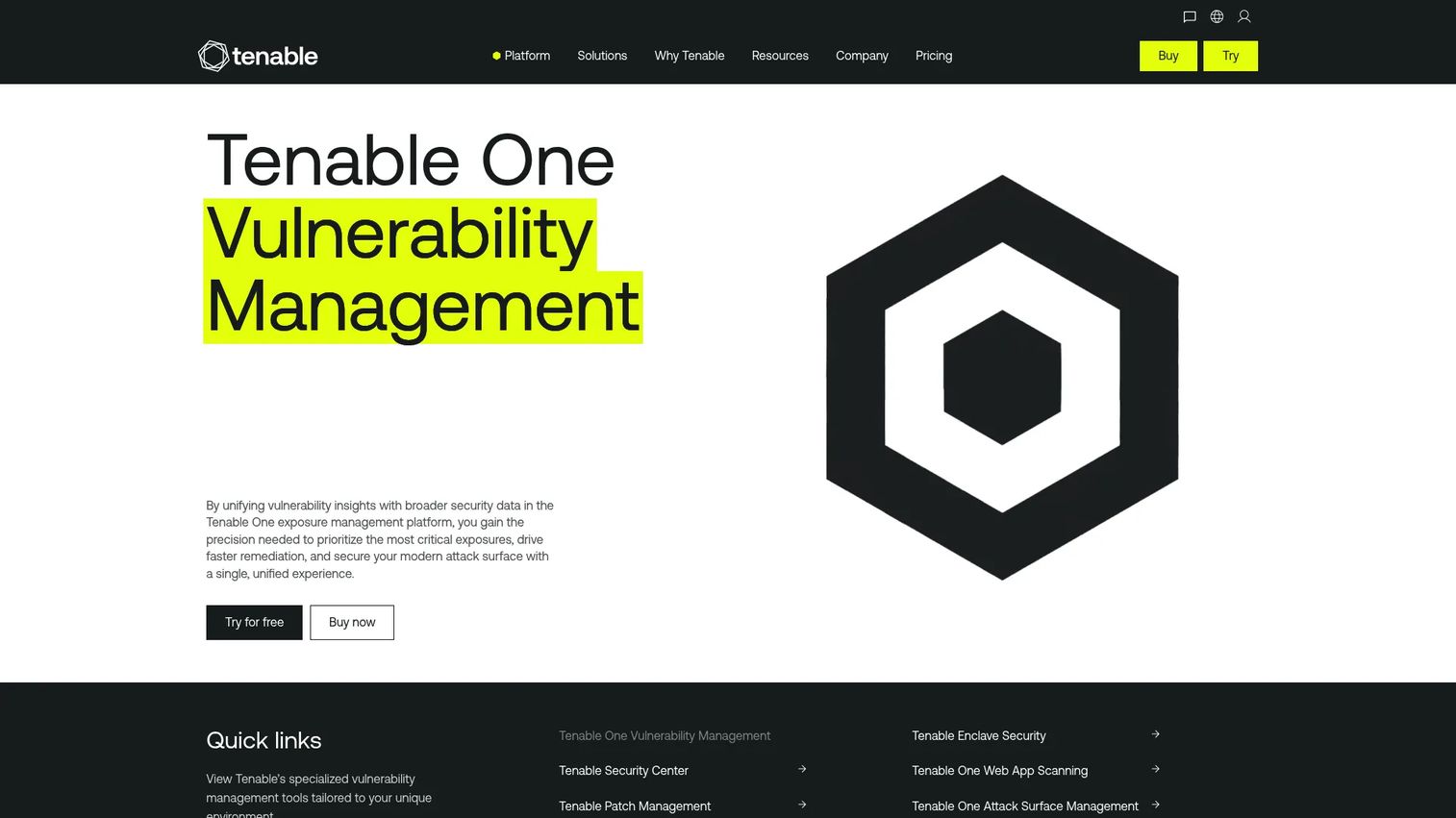
Tenable Vulnerability Management is a cloud-based platform for continuous discovery, assessment, and risk-based prioritization across large, mixed environments. Built on Tenable's Nessus scanning heritage, it gives security teams always-on visibility into what they own and where the real risk sits. For teams that want mature scanning plus prioritization that goes beyond raw counts, it is a strong anchor for a modern program.
Best for: Enterprise security teams that want continuous discovery and risk-based prioritization in one mature platform.
Key strengths
- Continuous discovery and assessment: Always-on scanning maps assets and vulnerabilities across large hybrid estates without waiting for a scheduled sweep.
- Prioritization beyond counts: Built-in threat intelligence and risk scoring rank findings by real exploitability, not just severity, so teams work the vulnerabilities that matter.
- Reporting and integrations: Real-time reporting and asset visibility feed remediation workflows and stakeholder dashboards.
Why choose Tenable: it fits presales and enterprise evaluations because the prioritization and reporting stand up to scrutiny from security, IT, and audit teams at once. The breadth of asset coverage makes it defensible when a customer's inventory spans cloud, on-prem, and everything between.
Tenable pricing: Tenable One Vulnerability Management is publicly listed starting at $3,500 for one year at 100 assets, with multi-year terms at $6,825 for two years and $9,975 for three years. Online purchase protection covers up to 250 assets, and larger deployments route to sales. If you are also weighing broader governance tooling, our guide to contract lifecycle management software covers adjacent procurement workflows.
2. Qualys VMDR
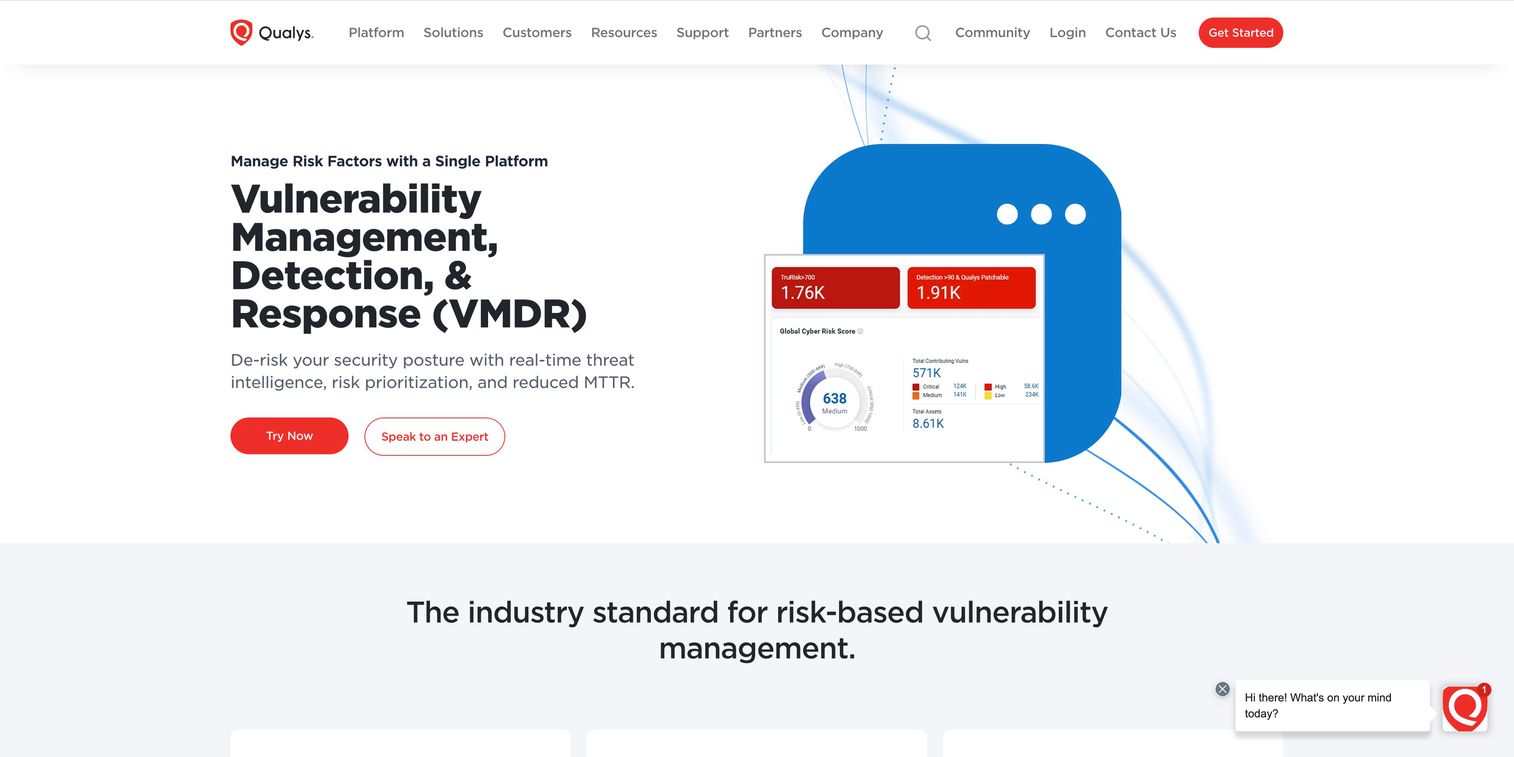
Qualys VMDR folds vulnerability detection, prioritization, and response into a single platform. VMDR stands for Vulnerability Management, Detection and Response, and the naming reflects the pitch: one workflow from discovery through remediation. For teams tired of stitching a scanner to a separate patch tool, that consolidation is the draw.
Best for: Security teams that want a unified workflow from asset discovery to verified remediation in one platform.
Key strengths
- Continuous assessment: Ongoing evaluation across hybrid and remote environments keeps the asset inventory and risk picture current.
- TruRisk prioritization: Threat-intel-informed scoring ranks vulnerabilities by real-world risk so teams focus remediation where it counts.
- Patch orchestration: Patch detection and remediation workflows live inside the same platform, closing the loop from finding to fix.
Why choose Qualys: it is compelling for compliance-heavy programs because discovery, prioritization, and patch management sit in one system with a shared audit trail. That single pane reduces handoff gaps that slow remediation in stitched-together stacks.
Qualys pricing: Qualys does not publish a fixed VMDR price. Pricing is quote-based and depends on selected Cloud Platform Apps, network addresses, web applications, and user licenses. A free trial is available to test the platform before committing. Teams evaluating multiple compliance-adjacent systems may also find our roundup of contract management software tools useful during procurement.
3. Microsoft Defender Vulnerability Management
Microsoft Defender Vulnerability Management delivers risk-based vulnerability management natively inside the Microsoft security stack. For organizations already running Defender for Endpoint and Microsoft 365 E5, it surfaces vulnerability data where security teams already work, without adding a separate console. It covers endpoints, servers, and cloud workloads.
Best for: Microsoft-centric organizations that want vulnerability visibility inside a broader security stack they already own.
Key strengths
- Native Microsoft integration: Vulnerability data flows through the same Defender workflows teams use for endpoint protection and threat response.
- Risk-based prioritization: Findings are ranked and tracked for remediation using Microsoft's threat intelligence and asset context.
- Continuous monitoring: Ongoing assessment and device inventory span endpoints and cloud workloads without a dedicated scanner deployment.
Why choose Microsoft Defender: presales teams should surface it whenever a customer is already invested in Microsoft licensing. The marginal cost is low, the integration is native, and the learning curve for existing Defender admins is short.
Microsoft Defender pricing: the add-on for Defender for Endpoint Plan 2 and Microsoft 365 E5 customers starts at $2.00 per user per month, paid yearly. The standalone Microsoft Defender Vulnerability Management offer is $3.00 per user per month, paid yearly with an annual commitment. Coverage is also included with Defender for Servers Plan 2.
4. Rapid7 InsightVM
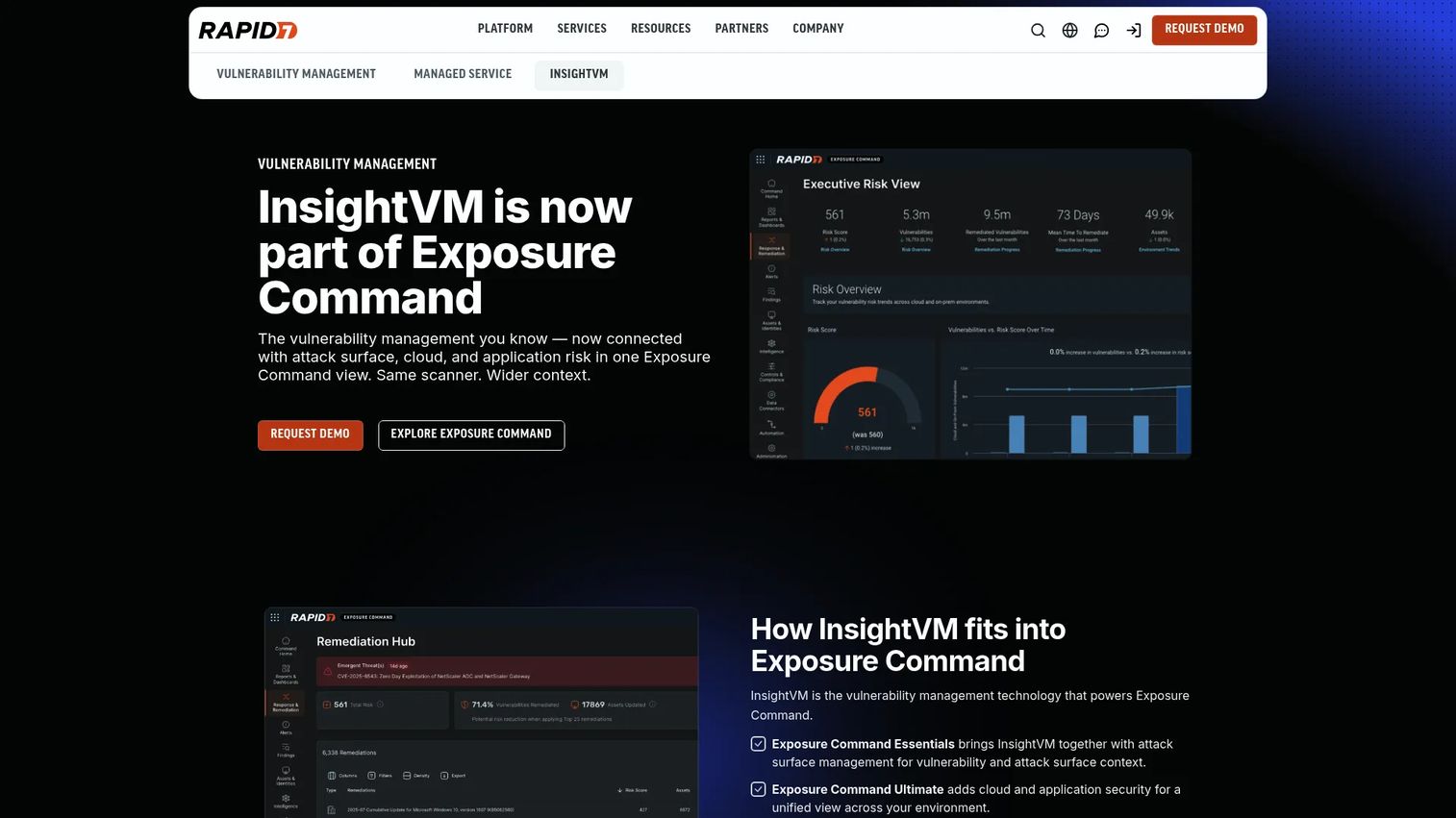
Rapid7 InsightVM is an established vulnerability risk management platform known for its dashboards and asset context. Now part of Rapid7's Exposure Command, it remains available as a standalone product for teams that want clear visibility into exposure and remediation progress. Dynamic asset discovery via agent and agentless scanning keeps coverage current.
Best for: Security teams that want strong visibility, Live Dashboards, and remediation tracking with practical workflow integrations.
Key strengths
- Dynamic asset discovery: Agent and agentless scanning assess assets as they appear and change across the environment.
- Multi-factor prioritization: Rankings blend CVSS, exploitability, malware exposure, and vulnerability age so teams see true risk, not just severity.
- Live Dashboards and reporting: Customizable dashboards make remediation progress and backlog trends visible to security and IT alike.
Why choose Rapid7: it fits teams that need to coordinate remediation across security and IT without exporting data into spreadsheets. The dashboards translate raw findings into progress leadership can read at a glance.
Rapid7 InsightVM pricing: Rapid7 publicly lists InsightVM starting at $1.62 per month for 500 assets, priced per asset, on its pricing page. Billing is monthly and asset-based, so cost scales with your estate. There is no free tier, though Rapid7 offers evaluation paths for prospective buyers.
5. CrowdStrike
CrowdStrike is a scanless vulnerability management module inside the CrowdStrike Falcon platform. Because it rides the Falcon agent already deployed on endpoints, it delivers real-time exposure data without a separate scanner or scheduled sweep. For existing Falcon customers, that operational simplicity is the headline.
Best for: Teams already running CrowdStrike Falcon that want unified endpoint exposure data without deploying another scanner.
Key strengths
- Real-time endpoint exposure: Continuous vulnerability assessment runs on the Falcon agent, so exposure data is always current.
- Native Falcon integration: Vulnerability context sits alongside endpoint detection and threat intelligence in one platform.
- Scanless operation: No separate scan infrastructure to maintain, with prioritized remediation tied to active exposure.
Why choose Falcon Spotlight: it is a strong fit when endpoints are the priority and Falcon is already in place. Teams that need broad coverage across cloud infrastructure, containers, and network assets may pair it with a wider-scope platform, since Spotlight's strength is endpoint-centric exposure.
CrowdStrike Falcon Spotlight pricing: CrowdStrike does not publish a standalone Spotlight price. The public pricing page shows Falcon bundles and a free trial, but Spotlight-specific pricing is quote-based and typically tied to Falcon platform packaging.
6. BeyondTrust Vulnerability Management
BeyondTrust identifies exposures, prioritizes remediation with risk context, and supports compliance across network, web, cloud, and virtual environments. Its distinguishing angle is the tie to BeyondTrust's identity and privilege portfolio, which appeals to teams running vulnerability and least-privilege programs together.
Best for: Enterprises that want vulnerability assessment plus remediation prioritization within a broader identity and privilege security stack.
Key strengths
- Scan, identify, assess: Discovers and evaluates vulnerabilities across network, web, cloud, and virtual environments.
- Risk-context prioritization: Ranks remediation by risk so teams address the exposures most likely to be exploited.
- Reporting for ops and compliance: Produces reporting useful to both security operations and compliance stakeholders.
Why choose BeyondTrust: the practical value shows up in teams where privilege and vulnerability programs overlap, since remediation decisions can factor in access context. For security operations teams with existing BeyondTrust deployments, consolidating vulnerability work into the same vendor reduces tool sprawl.
BeyondTrust pricing: BeyondTrust does not display public pricing for its vulnerability management offering. The vendor directs prospective buyers to a pricing request form, so budgeting requires a sales conversation scoped to your environment.
7. Tripwire
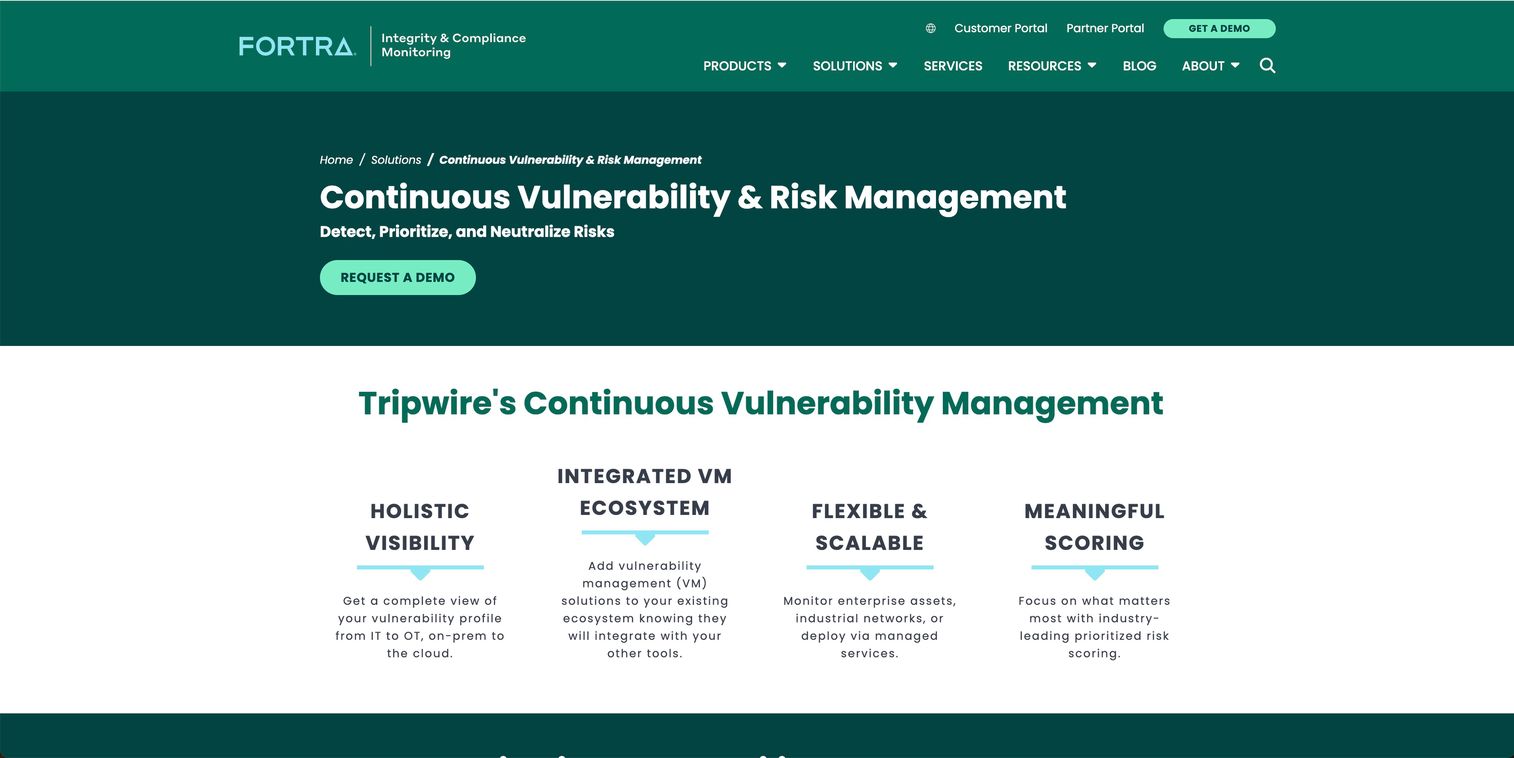
Tripwire is a long-standing vulnerability management product with deep roots in enterprise monitoring and compliance. It focuses on complete network asset discovery, granular vulnerability scoring, and centralized management, which makes it a familiar choice in regulated and legacy-heavy estates.
Best for: Large organizations needing enterprise vulnerability management, asset profiling, and risk prioritization across established infrastructure.
Key strengths
- Complete network discovery: Discovers and profiles network assets so teams know exactly what is on the network.
- Granular scoring: Vulnerability scoring and prioritization rank exposures with fine control over risk weighting.
- Centralized management: A single interface manages assessment and reporting across distributed enterprise environments.
Why choose Tripwire IP360: it is strongest in regulated or legacy-heavy environments where mature reporting and infrastructure visibility carry weight. Teams with compliance mandates and long-lived on-prem assets tend to value its discovery depth and established track record.
Tripwire IP360 pricing: Tripwire does not publish list pricing. The vendor states that pricing is tailored to system requirements and directs buyers to request a custom quote scoped to their deployment size and needs.
8. Fortra Vulnerability Manager
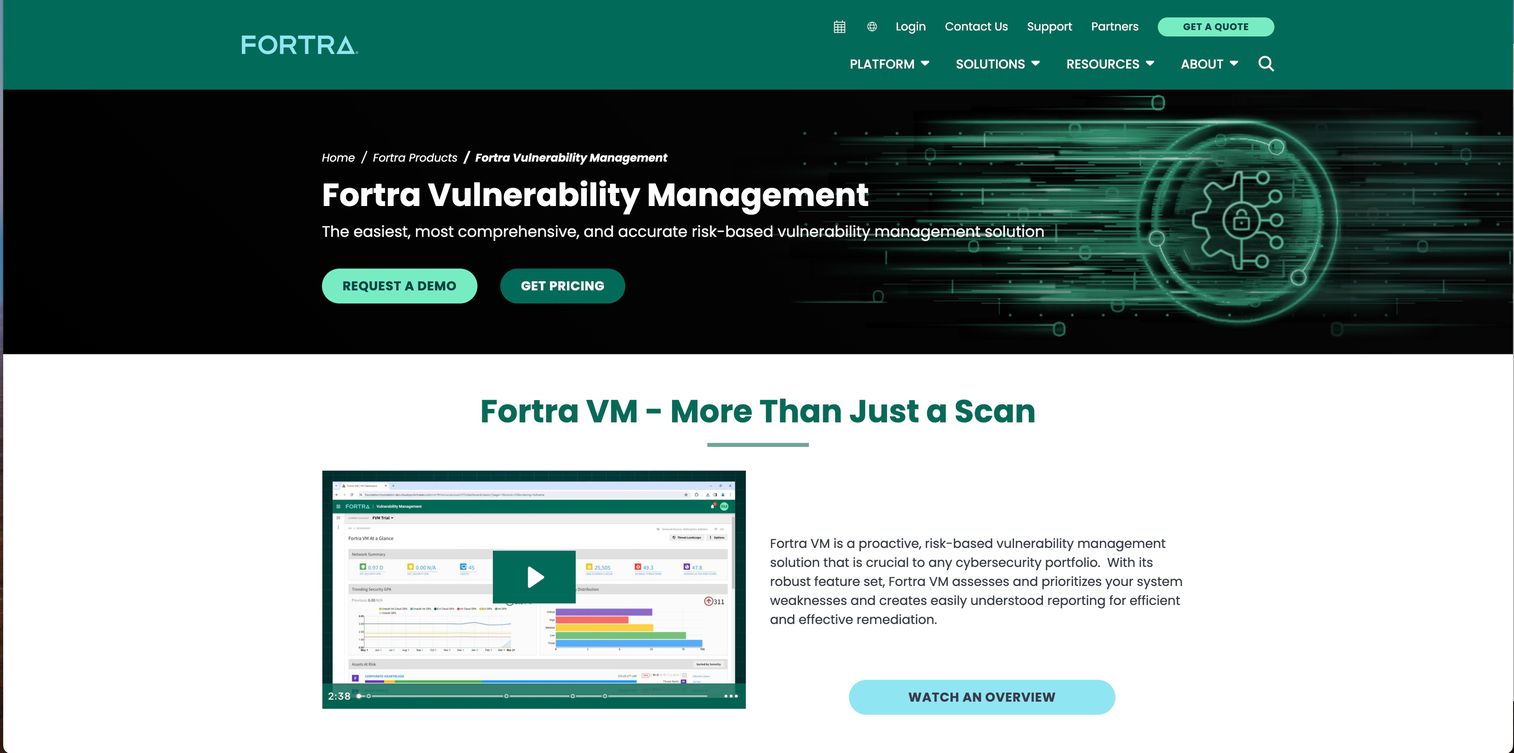
Fortra Vulnerability Manager is a cloud-based, risk-based vulnerability management platform aimed at security teams that want practical operations without unnecessary complexity. It leans on prioritized remediation, threat landscape context, and audit-friendly reporting, now aligned under Fortra's broader vulnerability management line.
Best for: Organizations that want a usable risk-based VM platform with compliance-friendly outputs and prioritized remediation.
Key strengths
- Risk-based identification: Discovers and prioritizes vulnerabilities using risk context so teams focus on what matters.
- Threat Landscape and Security GPA scoring: Distills risk posture into scores that make trends easy to communicate.
- Audit and operational reporting: Network Map and peer comparison reporting support audit evidence and remediation follow-through.
Why choose Fortra Frontline: it fits security teams that want risk-based prioritization and clear reporting without a heavyweight rollout. The Security GPA framing gives leadership a simple way to track posture over time, which helps when reporting to non-technical stakeholders.
Fortra Frontline pricing: Fortra does not publish public pricing for this product. Its pages indicate quote-based pricing tied to active devices and assets, with larger deployments requiring custom pricing. Teams building out broader security operations may also review our list of AI security posture management tools as a complement.
Considerations
Before you shortlist, pressure-test each tool against your actual environment and workflow. Vendor claims and buyer reality often diverge.
Coverage across your real environment
Ask whether the tool covers your endpoints, servers, cloud assets, containers, and remote systems. Then verify it against your real inventory, not the vendor's demo estate. A platform that maps your on-prem fleet flawlessly but misses ephemeral cloud workloads leaves your fastest-changing attack surface unwatched.
Prioritization quality
Ask exactly how the platform ranks risk. Does it blend exploit data like EPSS and CISA KEV with asset value and threat context, or does it just sort by CVSS severity? A tool that only sorts by severity score will bury the internet-facing exploitable vulnerability under a thousand theoretical criticals nobody will ever weaponize.
Remediation workflow fit
Ask whether teams can patch, mitigate, or apply virtual patching from the platform, and whether it runs remediation verification afterward. Check the integrations with ticketing, patch management, and collaboration tools your team already lives in. Remediation that requires manual re-keying into a separate system is remediation that stalls.
Reporting and audit readiness
Check for evidence exports, SLA tracking, and executive reporting. Compliance teams need audit evidence mapped to standards, and leadership needs MTTR and backlog trends in plain language. If both groups can pull usable output without a data analyst, the tool earns points.
Operational scalability
Evaluate workflow fit for your scale, whether SMB, mid-market, or enterprise. Check ease of ownership, governance, and admin overhead. A powerful platform that needs a dedicated full-time admin to operate may cost more in headcount than it saves in risk.
Conclusion
The best-fit tool depends on your buying motion. Tenable Vulnerability Management anchors programs that want mature, continuous lifecycle coverage. Qualys VMDR consolidates detection through remediation for teams that want one workflow. Microsoft Defender Vulnerability Management is the natural pick when a Microsoft stack is already in place, and Rapid7 InsightVM wins on dashboards and remediation visibility. Falcon Spotlight suits Falcon customers, BeyondTrust fits privilege-aware programs, Tripwire IP360 serves regulated enterprises, and Fortra Frontline keeps risk-based VM practical.
The winning platform is not the one with the loudest scanner story. It is the one that reduces exposure fast, prioritizes by real risk, and proves remediation actually held. Your next step: shortlist two or three tools, map them against your real asset coverage and remediation workflow, then validate reporting and integration fit before you commit. MTTR reduction, not scan volume, is the number that tells you the program is working.
FAQs
Vulnerability management software is a continuous system that discovers assets, scans them for security weaknesses, prioritizes those weaknesses by risk, and drives remediation until each exposure is verified as fixed. Unlike a one-time scan, it runs as an ongoing program that keeps pace with a changing environment. It is the operational backbone of a modern vulnerability management system.
It runs a repeating five-stage lifecycle: identify assets across your environment, assess them for vulnerabilities, prioritize findings by real risk, remediate the exposures that matter, and verify the fix held. Continuous scanning feeds the loop, and threat intelligence plus asset context drive the prioritization so teams work the right issues first.
Look for continuous asset discovery, risk-based prioritization, patch management and remediation orchestration, remediation verification, and compliance reporting with audit evidence. Strong integrations with ticketing, patch tools, and collaboration platforms matter just as much, since remediation stalls when data has to be re-keyed between systems.
Risk-based vulnerability management ranks vulnerabilities by real-world risk rather than raw severity. It blends CVSS scores with exploit-probability data like EPSS, known-exploited intelligence such as CISA KEV, and your own asset criticality. The result answers "how likely is this to hurt us now," which is far more actionable than a wall of theoretical criticals.
It produces audit evidence and compliance reporting mapped to standards like PCI DSS, SOC 2, HIPAA, and ISO 27001. SLA tracking, remediation logs, and exportable reports let compliance teams demonstrate continuous control rather than scrambling before an audit. This turns compliance readiness into a byproduct of daily operations instead of a separate project.
Track mean time to remediate (MTTR), SLA adherence, backlog reduction, and asset coverage. Falling MTTR and shrinking backlog show the program is closing exposures faster than new ones appear. Rising coverage confirms fewer blind spots. Together, these metrics tell leadership whether risk is actually going down.
A vulnerability assessment is a point-in-time snapshot that identifies weaknesses at one moment. Vulnerability management is the continuous lifecycle that follows every finding through prioritization, remediation, and verification, then repeats as the environment changes. Assessment tells you where you stood; management keeps you covered as things move.