You need to share a copy of production data with your dev team. The data has real names, real emails, real health records. Legal says no. Engineering says they need realistic data or the tests are worthless. You are stuck between a compliance wall and a velocity wall.
This is the core problem data de-identification tools solve. They reduce re-identification risk while keeping enough signal in the data for development, testing, analytics, and research. The market reflects how urgent this has become. Coherent Market Insights valued the global data de-identification market at USD 1.93B in 2026, projected to reach USD 5.87B by 2033 at a 17.2% CAGR.
The hard part is not removing identifiers. The hard part is the privacy utility tradeoff. Strip too much and your test data, development data, and staging data stop behaving like the real thing. Strip too little and you fail HIPAA or broader compliance review. Every tool on this list makes a different bet on where that line sits.
This guide is written for product managers and data teams who own that tradeoff across privacy, engineering effort, and release velocity. If you are mapping a broader stack, our roundups on the best customer data platform options and best data visualization tools cover adjacent decisions. The de-identification choice is the one that keeps sensitive data usable without keeping you up at night.
What's inside
This guide ranks 9 data de-identification software platforms for 2026, from structured test data tools to differential privacy engines and tokenization vaults. We selected each tool based on four criteria that matter to teams shipping software: the de-identification methods it supports, how well it preserves utility for real workflows, its compliance fit for frameworks like HIPAA, and the operational burden of running it across frequent releases. Each entry covers what the tool does, who it fits, key strengths, and pricing where a verified figure exists. The goal is a shortlist you can actually evaluate, not a glossary.
TL;DR
- Best for structured test data: Tonic Structural turns sensitive production databases into safe, referentially intact test data.
- Best open-source anonymization: ARX supports k-anonymity, generalization, and suppression with a GUI and Java library.
- Best for differential privacy analytics: Tumult Analytics computes aggregate queries with formal privacy guarantees.
- Best for payment and PII tokenization: VGS Platform handles PCI-scoped tokenization across processors.
What are data de-identification tools?
Data de-identification tools are software that removes or transforms identifying information in a dataset so individual records can no longer be linked to specific people, while preserving enough structure for the data to stay useful. Under HIPAA de-identification rules, data that meets the standard is no longer treated as PHI, which changes what you can legally do with it.
These tools apply a mix of methods, and most production setups combine several. The common techniques include:
- Masking: replacing real values with realistic but fake ones, often format-preserving so a credit card field still looks like a credit card.
- Tokenization: swapping sensitive values for non-sensitive tokens that map back only through a controlled vault.
- Pseudonymization: replacing identifiers with consistent pseudonyms so referential relationships survive across tables.
- Generalization and aggregation: widening a value (age 34 becomes 30 to 40) or rolling records up to reduce uniqueness.
- Suppression and redaction: removing or blanking high-risk fields entirely.
- Synthetic data: generating new records that mirror the statistical shape of the source without copying any real row.
Regulatory framing usually drives the method choice. HIPAA defines two de-identification pathways: safe harbor, which requires removing 18 enumerated identifiers, and expert determination, where a qualified expert certifies that re-identification risk is very small. Some teams need full anonymization with no path back to the individual. Others need pseudonymization or tokenization where authorized re-linking is part of the workflow. The right tool depends on which of these governance models your use case demands, and how much utility you can afford to trade for privacy.
When to use data de-identification software
Build safe test, dev, and staging data
When engineering needs production-like data for testing and development, raw copies of the database are a liability. De-identification software produces test data and staging data that behaves like the real thing, with the same edge cases and referential structure, but without exposing PII or PHI. This is the most common driver for product teams.
Share data for analytics and research
When analysts, data scientists, or external researchers need access to deidentified data, you need privacy preserving data that still supports valid analysis. Tools built for statistical disclosure control or differential privacy let you publish aggregates and microdata while bounding re-identification risk.
Meet compliance and governance requirements
When you operate under HIPAA, GDPR, or internal privacy policy, de-identification is often the path that lets data move between environments at all. The right software bakes compliance framing into the workflow with audit trails, predefined rules, and consistent transformations that hold up under review.
Comparison of the best data de-identification tools
The table below summarizes how each tool fits, its primary de-identification approach, pricing where a public figure exists, and verified G2 rating. Use it as a fast scan, then read the full sections for the detail that matters to your stack. Pricing and ratings reflect verified values at the time of writing.
| # | Product | Intent | Key use case | Pricing | G2 rating |
|---|---|---|---|---|---|
| 1 | Tonic Structural | Structured test data | De-identify production databases for dev and QA | Professional & Enterprise, custom | 4.2/5 |
| 2 | ARX | Open-source anonymization | k-anonymity, generalization, suppression | Free, open source | - |
| 3 | sdcMicro | Statistical disclosure control | Research microdata anonymization | - | - |
| 4 | Informatica Data Security Cloud | Enterprise privacy | Masking and discovery at scale | Consumption-based, quote | 4.0/5 |
| 5 | IBM InfoSphere Optim | Enterprise masking | Non-production data privacy | Contact sales | - |
| 6 | Tumult Analytics | Differential privacy | Private aggregate analytics | Contact for paid tier | 4.4/5 |
| 7 | VGS Platform | Tokenization | PCI and PII tokenization | Starter $1,000/mo | 4.7/5 |
| 8 | Evervault | Payments security | Tokenization and encryption | Platform $995/mo plus usage | 4.4/5 |
| 9 | Privacy Vault | AI data privacy | Masking and tokenization for AI | Free trial; Enterprise custom | - |
1. Tonic Structural
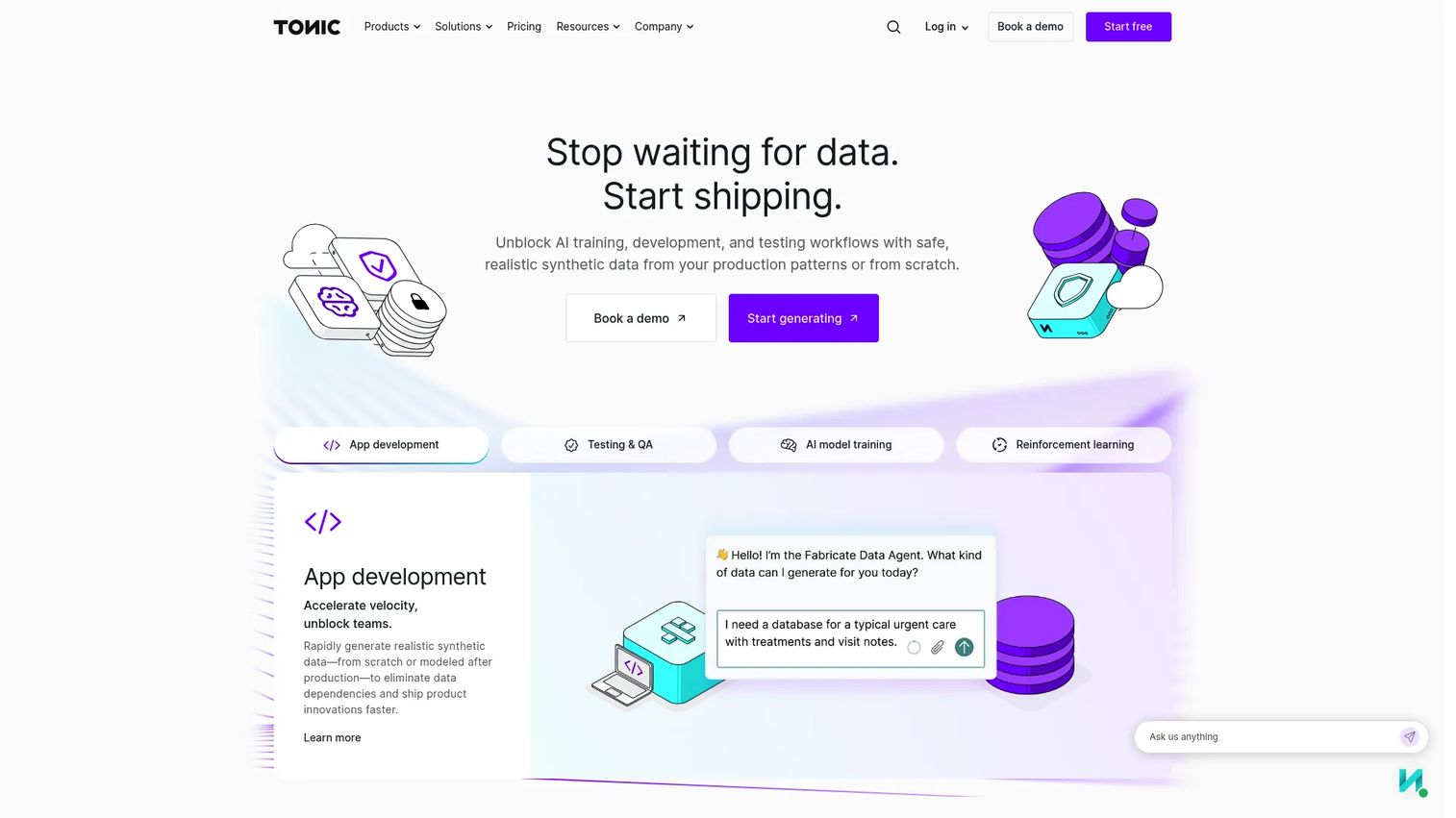
Tonic Structural is a structured data de-identification and test data management platform. It connects to your production databases, finds the sensitive fields, and transforms them into safe, high-fidelity test data your engineers can actually use. The thing that separates it from a basic masking script is referential integrity: when it changes a customer ID in one table, the change propagates everywhere that ID appears, so foreign keys and joins still behave.
For product managers, this is the tool that unblocks development data without a six-week legal review for every new environment. The de-identification is consistent and repeatable, which matters when you are refreshing test data on every release.
Best for: Teams needing production-like test data from sensitive structured databases.
Key strengths
- Automated sensitive data discovery: Scans schemas to flag PII and PHI before you mask, so nothing slips through.
- Consistent masking and synthesis: Applies the same transformation to the same value everywhere, preserving relationships across tables.
- Patented database subsetting: Pulls a smaller, referentially intact slice of production so test environments stay fast and realistic.
Why choose Tonic Structural: If your primary problem is getting safe, realistic data out of a relational database and into staging without breaking the data model, Structural is built for exactly that workflow. It fits teams that refresh test data often and need de-identification that survives schema complexity.
Tonic Structural pricing: Structural is sold on Professional and Enterprise plans, both custom-priced; contact sales for a quote.
2. ARX Data Anonymization Tool
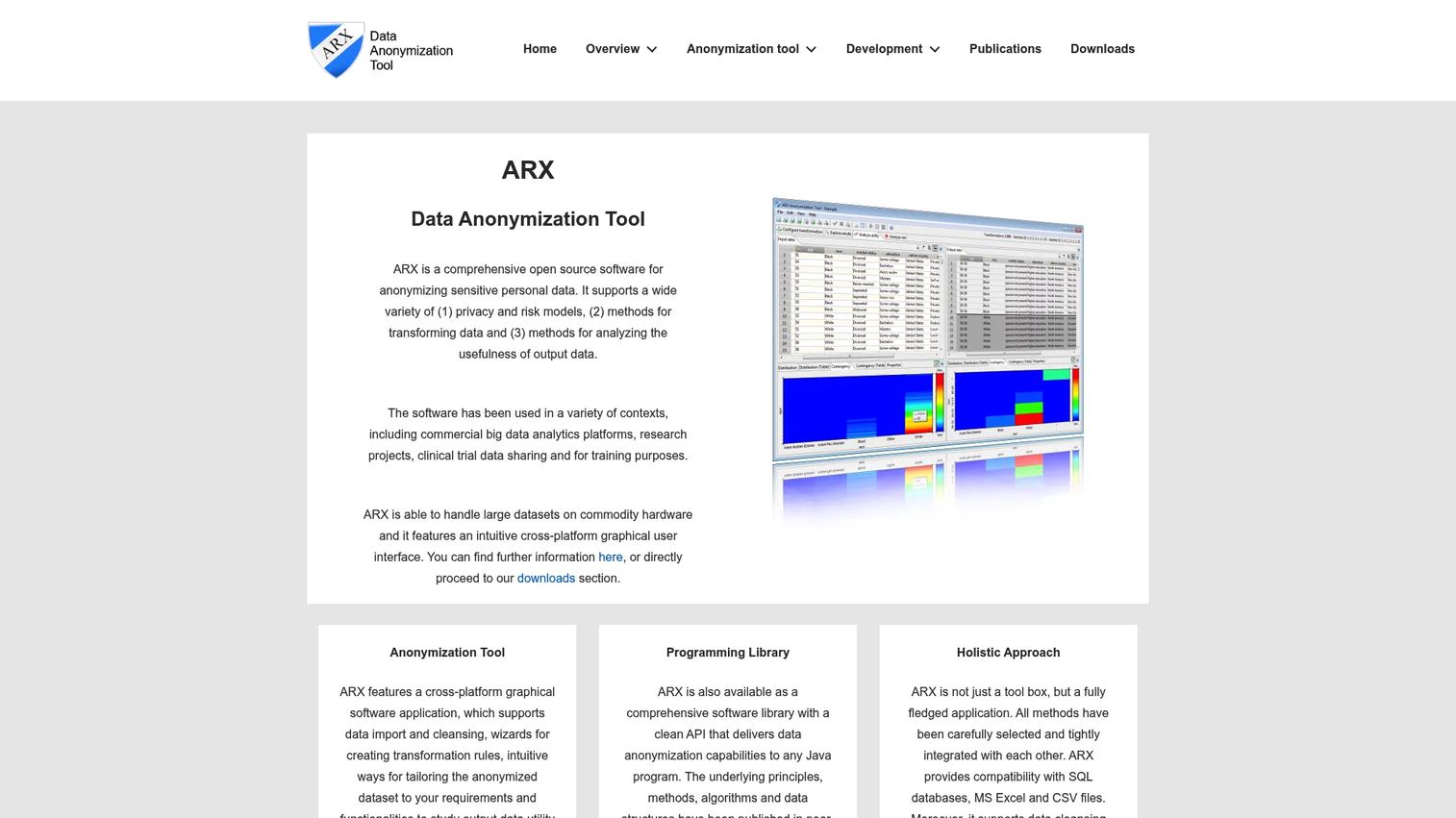
ARX is open-source software for anonymizing structured personal data, available as both a cross-platform desktop tool and a Java library. It is one of the most rigorous options for teams that want formal privacy models rather than ad-hoc masking. ARX lets you apply k-anonymity, l-diversity, t-closeness, and differential privacy, then shows you the utility and risk tradeoff for each configuration.
For PMs and data teams with engineering depth, ARX is appealing because it is free, transparent, and embeddable. You can wire the Java library into a pipeline or use the GUI for one-off anonymization with full visibility into how much re-identification risk remains.
Best for: Researchers or teams needing an open-source data anonymization tool with both GUI and Java library support.
Key strengths
- Formal privacy models: Supports k-anonymity, l-diversity, t-closeness, and differential privacy out of the box.
- Rich transformation methods: Applies generalization, suppression, microaggregation, and sampling.
- Utility and risk analysis: Quantifies the privacy utility tradeoff so you can tune configurations with evidence.
Why choose ARX: Choose ARX when you want methodological rigor and zero license cost, and you have the in-house skill to run it. It suits research, statistical, and compliance-sensitive work where you need to defend exactly how anonymization was performed.
ARX pricing: ARX is free and open source, licensed under the Apache License 2.0. There are no paid tiers, which makes it a strong fit for teams with the technical capacity to self-host and integrate it.
3. sdcMicro
sdcMicro sits in the statistical disclosure control space, the discipline of anonymizing microdata so it can be released for research without revealing individuals. It is most at home with statistical and survey datasets, where you need to balance disclosure risk against the analytical value of the released file.
This is a specialist tool. If your job is publishing research microdata, census-style files, or survey results under a defined disclosure standard, sdcMicro gives you the methods to measure risk and apply suppression, generalization, and other controls with statistical grounding. For pure software test data, the Tonic family or ARX will usually fit a development workflow more directly.
Best for: Research and statistical teams anonymizing microdata for safe release.
Key strengths
- Disclosure risk measurement: Quantifies re-identification risk across records before release.
- Statistical control methods: Applies suppression, generalization, and aggregation tuned for microdata.
- Research-grade rigor: Built for the statistical disclosure control workflows that data archives and agencies rely on.
Why choose sdcMicro: Pick sdcMicro when your output is a research dataset that must meet a formal disclosure standard, not a test database. It is the right tool for statisticians and data stewards who need defensible, measurable anonymization.
sdcMicro pricing: No public pricing tiers were verified for sdcMicro. Teams evaluating it should confirm licensing and access terms directly before planning a deployment.
4. Informatica Data Security Cloud
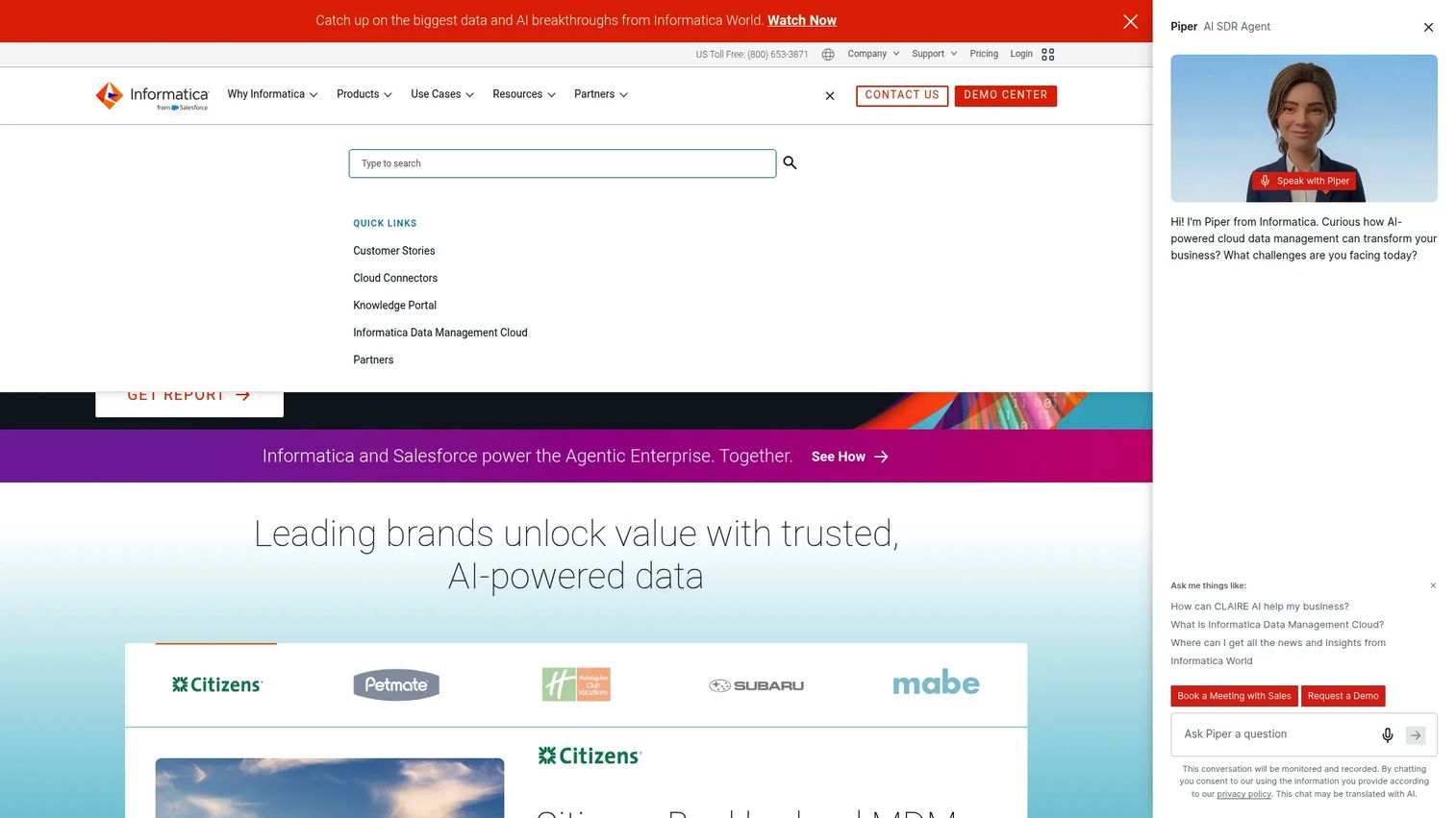
Informatica Data Security Cloud brings de-identification into the broader enterprise data governance program. Part of Informatica's Intelligent Data Management Cloud, it combines sensitive data discovery, masking, and policy enforcement so privacy controls live alongside the rest of your data management stack rather than in a separate tool.
For larger organizations, the appeal is consolidation. Instead of bolting de-identification onto an already crowded toolset, you run discovery, classification, masking, and governance through one platform with consistent policy. That fits teams where privacy is one workstream inside a wider data security and compliance mandate.
Best for: Enterprises that need governed cloud data privacy and masking controls.
Key strengths
- Data masking: Protects sensitive fields across cloud data sources with policy-driven masking.
- Sensitive data discovery: Classifies and monitors risk so you know where PII and PHI live.
- Privacy governance: Enforces policy consistently across the data estate for compliance.
Why choose Informatica Data Security Cloud: Choose it when de-identification needs to plug into an enterprise governance program, not stand alone. It suits organizations already invested in Informatica or those wanting discovery, masking, and policy under one roof.
Informatica Data Security Cloud pricing: Informatica uses consumption-based pricing and directs buyers to request a quote rather than publishing list prices. Plan for a sales-led evaluation scoped to your data volume and the modules you need.
5. IBM InfoSphere Optim Data Privacy
IBM InfoSphere Optim Data Privacy is enterprise data masking software focused on protecting confidential data in non-production environments. It is built for the classic test data problem at scale: you have many databases and applications, and you need consistent masking across all of them so dev, test, and training environments never hold raw sensitive data.
Optim leans into context-aware masking and predefined privacy rules, which speeds compliance work for frameworks like HIPAA, GLBA, and PIPEDA. For enterprises with sprawling database estates, the value is breadth of coverage and the governance reporting that comes with it.
Best for: Enterprises that need to de-identify sensitive data across apps, databases, and systems.
Key strengths
- Context-aware masking: Preserves data meaning and relationships while replacing sensitive values.
- Predefined privacy rules: Ships with compliance-oriented rule sets and reporting to accelerate audits.
- API-driven masking: Supports AES-256 and format-preserving encryption for programmatic workflows.
Why choose IBM InfoSphere Optim: Pick Optim when scale and heterogeneity are the challenge, many databases, many applications, and a need for consistent masking and compliance reporting across all of them. It fits enterprises with established IBM data infrastructure.
IBM InfoSphere Optim pricing: IBM does not publish public pricing for Optim Data Privacy and routes buyers to a sales conversation. Expect enterprise licensing scoped to your environment, so budget for a quote-based procurement cycle.
6. Tumult Analytics
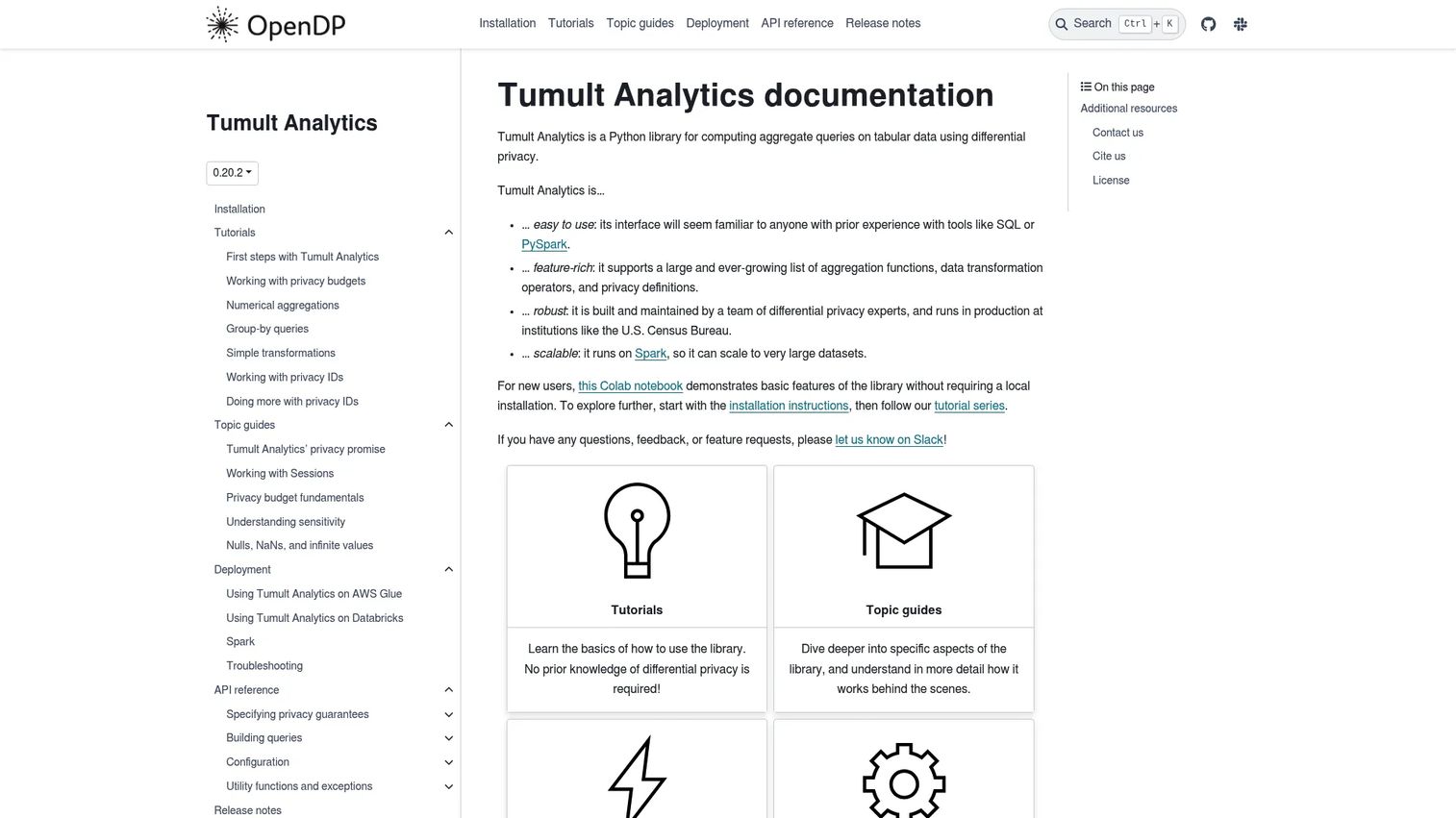
Tumult Analytics is differential privacy software for computing aggregate queries on tabular data with formal mathematical guarantees. Rather than transforming records, it adds calibrated noise to query results so you can publish statistics, counts, and aggregations with a provable bound on what any individual contributes to the output.
This is the tool for teams that need to share analytical results, not raw rows. Differential privacy gives you a rigorous, defensible answer to the re-identification question, which matters when you publish data externally or under regulatory scrutiny. It runs on Spark, so it scales to large datasets.
Best for: Teams that need production-grade differential privacy for tabular analytics.
Key strengths
- Python API for DP queries: Computes differentially private aggregates without requiring a privacy PhD on staff.
- Spark-backed scale: Runs over large datasets rather than capping out on small files.
- Private transformations: Supports joins, filters, and aggregations under a unified privacy budget.
Why choose Tumult Analytics: Choose it when the output is aggregate statistics and you need formal privacy guarantees you can defend to a regulator or partner. It fits analytics and data science teams releasing results from sensitive datasets.
Tumult Analytics pricing: Tumult does not publish numeric pricing. Some capabilities are gated to a paid version, with users directed to contact Tumult for access, so plan for a conversation to scope the paid tier.
7. VGS Platform
VGS Platform is a tokenization and sensitive-data platform built for secure collection, storage, and exchange of data like payment details and PII. Tokenization replaces a sensitive value with a non-sensitive token, keeping the real data inside a controlled vault. That lets your systems work with tokens while the raw PII never touches your environment, which dramatically shrinks compliance scope.
For PCI workflows in particular, VGS is a strong fit because tokenizing card data keeps your applications out of scope for much of the standard. It sits adjacent to classic de-identification: instead of anonymizing data for analysis, it protects sensitive values in live transactional flows while keeping them usable.
Best for: Teams needing PCI-focused tokenization and payment-data protection across multiple processors.
Key strengths
- Network tokens: Maintains tokenized card credentials across processors for resilient payment flows.
- Account updater: Keeps stored payment tokens current without re-collecting card data.
- 3DS support: Adds authentication into the tokenized payment path for fraud reduction.
Why choose VGS Platform: Choose VGS when your sensitive data is payment and PII in production flows, and your goal is to reduce PCI scope while keeping data usable. It fits fintech and commerce teams handling cards across multiple processors.
VGS Platform pricing: VGS lists a Starter Package at $1,000 per month based on VGS Vault interactions, with a Growth Package on custom, contact-sales pricing. A free option is available to try the platform, so you can validate tokenization flows before committing.
8. Evervault
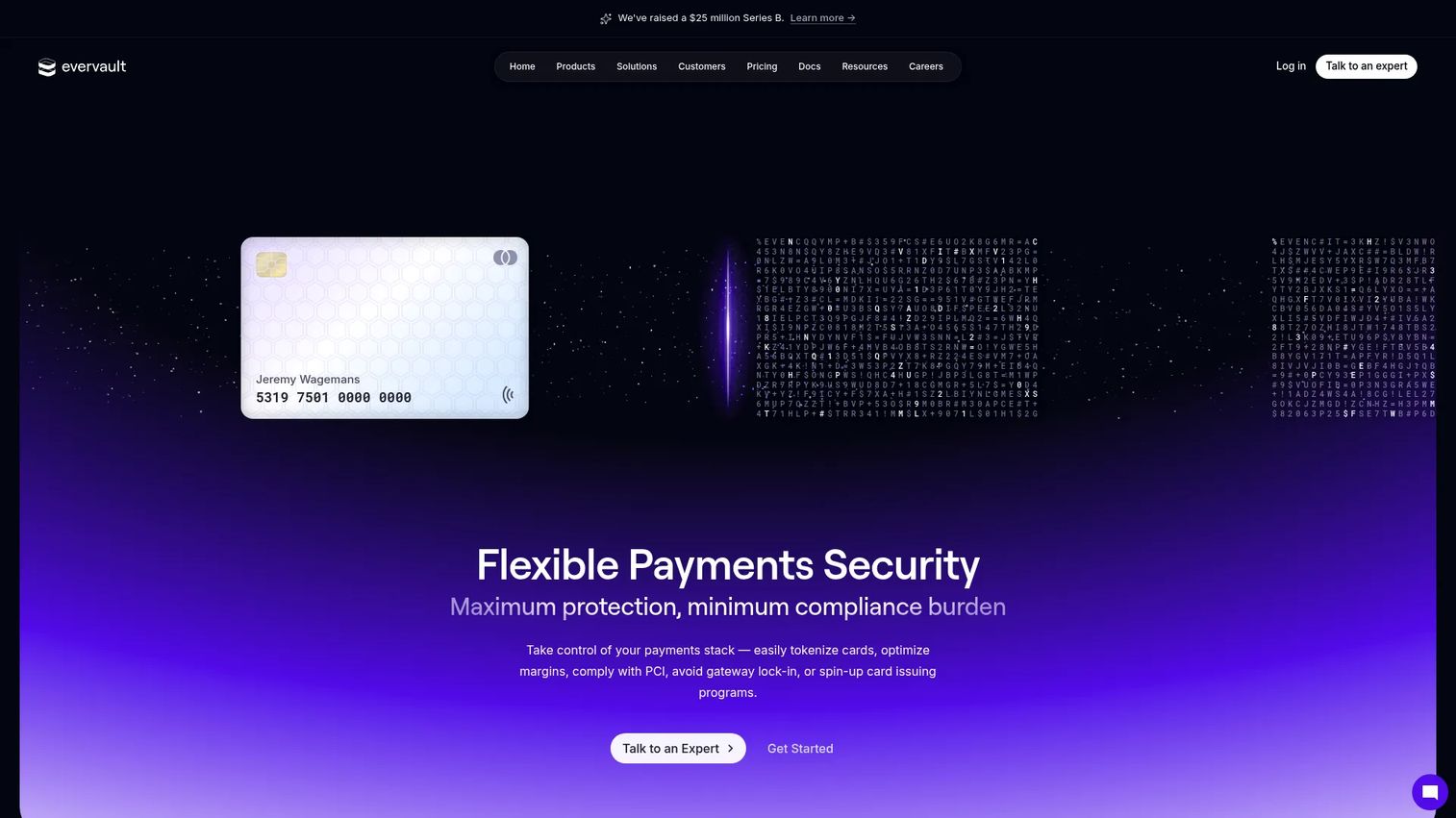
Evervault is a payments security platform offering tokenization, encryption, 3D Secure, network tokens, and secure enclaves. It is developer-first, focused on giving engineering teams application-layer primitives to collect, encrypt, and tokenize sensitive data without building cryptographic infrastructure themselves.
Like VGS, Evervault sits in the de-identification-adjacent space of protecting sensitive values in live workflows rather than anonymizing datasets for analysis. The draw for product teams is implementation speed: the platform handles card collection, encryption, and PCI reduction through APIs that engineers can wire in directly, keeping raw payment data out of their systems.
Best for: Teams building secure payment workflows that need PCI reduction and payment data protection.
Key strengths
- Card collection and encryption: Captures and encrypts payment data before it reaches your servers.
- 3D Secure: Builds authentication into the payment flow to cut fraud.
- Network tokens: Maintains tokenized credentials for higher payment success rates.
Why choose Evervault: Choose Evervault when developer experience and application-layer control matter most, and your sensitive data is payments. It fits engineering-led teams that want to ship secure payment workflows quickly without standing up their own crypto stack.
Evervault pricing: Evervault lists a Platform plan at $995 per month plus usage, aimed at startups and scaling teams, with a Custom plan for enterprises and high-volume platforms. Sandbox access is free, so teams can build and test against the platform before paying.
9. Privacy Vault
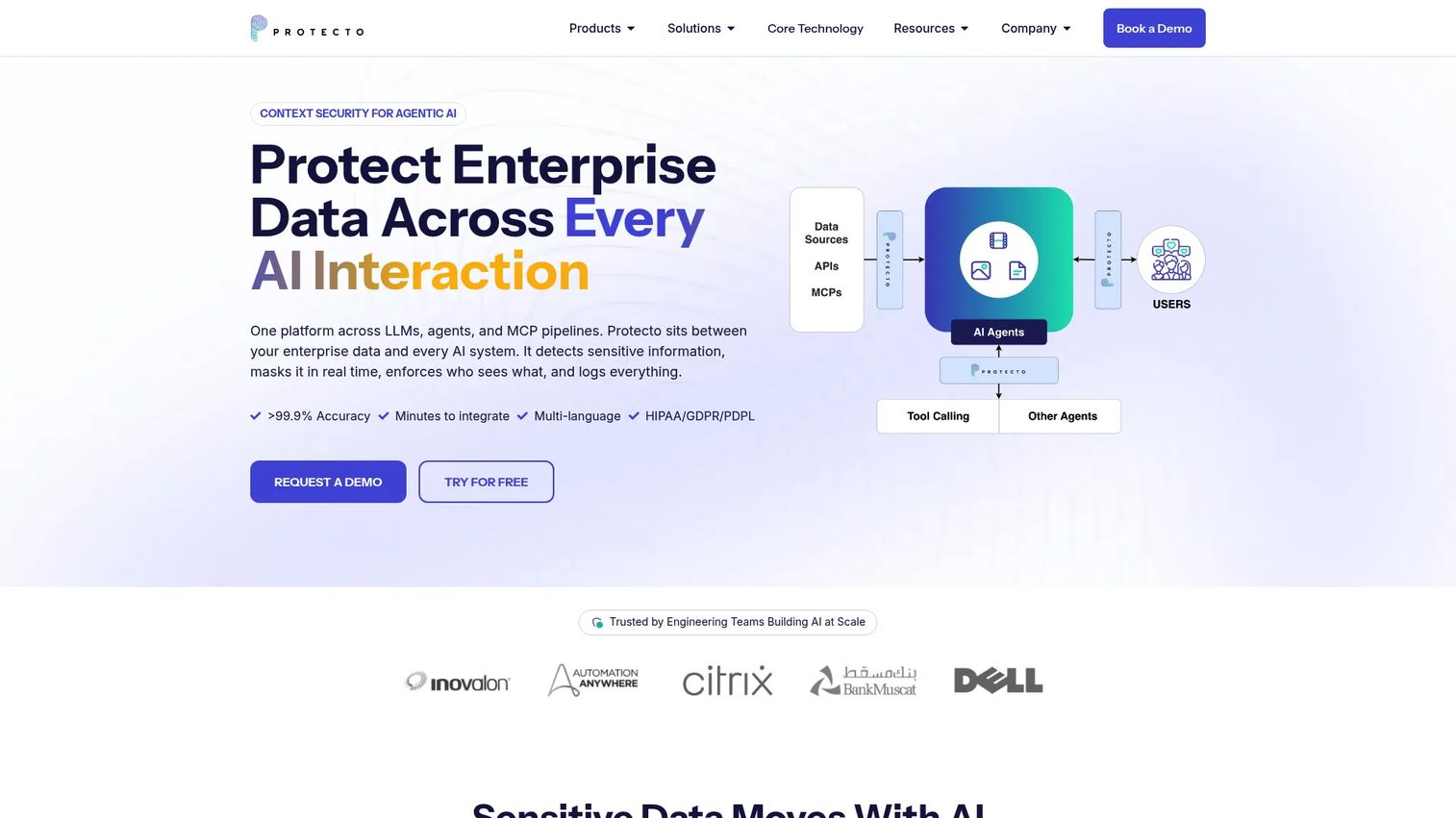
Privacy Vault, Protecto's enterprise data privacy product, scans, masks, tokenizes, and controls detokenization of sensitive data, with a clear focus on AI and compliance workflows. As teams feed more data into models and pipelines, the need to mask PII and PHI without destroying the data's usefulness has become a distinct problem, and Privacy Vault targets exactly that.
The differentiator is the round-trip: it tokenizes sensitive values for safe use, then allows controlled detokenization with an audit trail and access control when authorized re-linking is needed. That makes it a fit for governed AI workflows where you need privacy preserving data going in and accountable access coming out.
Best for: Teams building AI workflows that need PII and PHI masking and tokenization without breaking data utility.
Key strengths
- Sensitive data scanning: Detects sensitive values across structured and unstructured data.
- Intelligent tokenization: Applies format-preserving masking that keeps data usable downstream.
- Controlled detokenization: Re-links data only under audit trail and access control.
Why choose Privacy Vault: Choose it when your de-identification problem is AI-centric and you need both masking and governed re-identification with a full audit trail. It fits teams operationalizing sensitive data in models while keeping compliance and access control intact.
Privacy Vault pricing: Protecto offers a Free Trial and an Enterprise Plan, with pricing based on the number of data source connections. Public numeric pricing is not listed, so plan to scope a quote around your connection count and data volume.
How to choose data de-identification software
Match the method to the governance model
The first question is whether your use case needs full anonymization, pseudonymization, or tokenization. Anonymization with no path back fits external research and public release. Pseudonymization and tokenization fit cases where authorized re-linking is part of the workflow. Pick the method your compliance scope actually requires, not the strictest one available.
Weigh utility against re-identification risk
Every configuration trades data utility for privacy. Before you buy, define what the data needs to do, run realistic tests, and edge cases, model training, valid statistics, and confirm the de-identified output still supports it. A tool that produces unusable test data is not safer, it is just unused.
Check compliance fit for your frameworks
If you operate under HIPAA, GDPR, or PCI, confirm the tool supports the right safe harbor or expert determination workflow and produces audit-ready records. Predefined rules and compliance reporting save real review time, but they never remove the need for human governance.
Account for operational and maintenance burden
A de-identification tool runs on every release, not once. Evaluate how it handles schema changes, how it fits your pipeline, and how much engineering time it consumes to maintain. The right choice fits your release cadence without becoming its own backlog item. Use a short procurement checklist covering method, utility, compliance, and maintenance before you commit.
Conclusion
The right data de-identification tool depends on three things: your data type, your compliance scope, and the maintenance burden you can absorb. For structured test, dev, and staging data, Tonic covers most software workflows from relational databases to healthcare. For methodological rigor and open-source control, ARX and sdcMicro deliver formal privacy models and statistical disclosure control. For enterprise governance at scale, Informatica and IBM InfoSphere Optim fit existing data programs. For differential privacy analytics, Tumult Analytics gives defensible guarantees, and for tokenization in live workflows, VGS, Evervault, and Privacy Vault protect sensitive values without anonymizing whole datasets.
Whichever you choose, the decision comes back to the privacy utility tradeoff. Start by defining what your data must do, then pick the tool that reduces re-identification risk while leaving that capability intact. Test with real workloads before you standardize, and keep a human in the governance loop.
FAQs
HIPAA recognizes two pathways to de-identified data. Safe harbor requires removing 18 enumerated identifiers, such as names, dates, and contact details. Expert determination has a qualified expert certify that the re-identification risk is very small. Once data meets either standard, it is no longer treated as PHI, which broadens how you can use and share it.
Safe harbor is a checklist method: remove the 18 specified identifiers and the data qualifies. Expert determination is risk-based: a qualified statistician or expert analyzes the dataset and certifies that the chance of re-identification is very small, often allowing you to retain more useful detail. Safe harbor is simpler to apply, while expert determination can preserve more utility for analysis.
Masking is one method used within de-identification, not a synonym for it. Masking replaces sensitive values with realistic substitutes, but on its own it may not satisfy a formal standard if indirect identifiers still allow re-linking. Strong de-identification usually combines masking with techniques like generalization, suppression, or pseudonymization, then measures the remaining re-identification risk.
Use synthetic data when you cannot expose source records at all, when you need more volume than production holds, or when you are training models and want realistic structure without any real individual in the output. Direct de-identification transforms real rows, while synthetic data generates new ones, so it removes a class of re-identification risk that transformation alone does not.
Look at utility preservation for your specific workloads, compliance fit for frameworks like HIPAA or PCI, segmentation across data types and environments, automation that fits your release cadence, and the ongoing maintenance burden. The best tool reduces re-identification risk without creating a new operational backlog, and it produces data your engineers and analysts will actually use.
Start from the use case, not the tool. Define exactly what the data must support, edge-case testing, valid statistics, model training, then choose the de-identification configuration that meets that requirement with the lowest re-identification risk. Test the output against real workloads before standardizing, because a configuration that is too aggressive produces safe but useless data.
Re-identification risk is the chance that someone can link a de-identified record back to a real individual, either through direct identifiers that were missed or by combining indirect identifiers like ZIP code, age, and gender. Good de-identification tools measure this risk explicitly so you can tune transformations and prove the residual risk is acceptable for your compliance scope.
No. De-identification tools automate detection, transformation, and reporting, which removes a lot of manual work, but compliance still depends on human governance. You need policy decisions about which method to use, expert review for expert determination, and ongoing oversight as data and regulations change. The tools accelerate the work, they do not replace accountability.