You booked the venue. You lined up the speakers. Then someone asked how remote attendees would join, how you would capture leads from both rooms, and how you would prove any of it drove pipeline. Suddenly one event became three systems taped together.
That is the actual problem with running virtual and in-person events at the same time. The friction is not the streaming. It is the seams: registration that does not sync with the app, a networking tool that ignores your onsite crowd, badge printers that live outside your analytics, and a ROI story you reconstruct by hand three weeks later.
The market has grown up around that pain. The global hybrid events market was valued at USD 14.6 billion in 2025 and is projected to reach USD 39.8 billion by 2034 at a 12.8% CAGR, according to MarketIntelo (2026). More budget means more platforms competing to own the whole workflow, not just one slice of it.
So the question is not "which tool streams video." It is which hybrid events platform handles registration, engagement, networking, streaming, onsite operations, and reporting as one buying decision. If you run demos or product walkthroughs at your booth, a purpose-built interactive demo can run on a tablet without conference wifi, but that is a companion to your event stack, not a replacement for it.
What's inside
This guide is for event marketers, field marketers, demand gen managers, and event ops leaders comparing software for hybrid events in 2026. We picked platforms based on four things that matter when virtual and in-person run together:
- Workflow coverage: registration, engagement, networking, streaming, onsite check-in, and analytics under one roof
- Hybrid fidelity: whether remote and in-person attendees get a connected experience, not two separate ones
- Measurement: event analytics and ROI reporting your CFO will actually believe
- Verified pricing and ratings: current public pricing and G2 scores, not figures from memory
TL;DR
- Best for large, complex enterprise events: Cvent covers registration, Attendee Hub, venue sourcing, and onsite tech end to end.
- Best all-in-one for mid-size teams: EventMobi packages registration, apps, check-in, and engagement without overcomplication.
- Best for content-heavy virtual participation: BigMarker runs branded webinars and virtual events with strong lead capture.
- Best for networking and interaction: Airmeet leans into virtual tables, matchmaking, and audience engagement.
- Best for marketing and pipeline alignment: Bizzabo ties event experience to analytics and revenue workflows.
- Best attendee utility for conferences: Whova brings agenda, networking, and community tools attendees actually use.
What is hybrid event software?
Hybrid event software is a platform that manages both in-person and virtual attendees for a single event from one system, covering registration, engagement, networking, live streaming, onsite operations, and reporting. Instead of stitching a webinar tool to an onsite check-in tool to a separate analytics export, a hybrid events platform runs the whole event as one dataset.
The point is a connected experience. A remote attendee and someone standing in the venue should see the same agenda, join the same sessions, and appear in the same lead reports.
Core capabilities most hybrid event management software includes:
- Event registration and audience management: ticketing, forms, approval flows, and attendee segmentation
- Live streaming: broadcasting sessions to virtual attendees with recording and on-demand replay
- Attendee engagement: polls, Q&A, surveys, gamification, and session chat
- Networking and matchmaking: attendee profiles, meeting scheduling, and AI-driven introductions
- Onsite check-in and badge printing: kiosks, QR scanning, and walk-up registration
- Sponsor and exhibitor tools: virtual booths, lead capture, and ROI reporting for partners
- Event analytics and ROI: session attendance, engagement scores, lead attribution, and pipeline influence
Buyers evaluating hybrid event solutions usually weigh how well these pieces talk to each other, not whether each exists in isolation. The seams are where events break.
When to use hybrid event software
Run one event for two audiences at once
You are hosting a conference where some attendees fly in and others join from their desk. You need both groups in the same sessions, the same networking pool, and the same reporting. A dedicated platform keeps virtual and in-person attendees on one agenda instead of forcing you to run parallel events.
Capture and qualify leads from the whole room
Field marketers care about pipeline, not headcount. Hybrid event software captures engagement signals from onsite badge scans and virtual session activity, then routes them into your CRM. That lets you score leads from both audiences on the same scale.
Prove event ROI without a spreadsheet marathon
When leadership asks what the event returned, you need attribution you can defend. Platforms that unify registration, engagement, and CRM sync give you session-level and lead-level data in one place. That turns your post-event report from a three-week reconstruction into a dashboard.
Hybrid event software comparison
The table below compares each hybrid conference platform on who it fits best, its standout capability, current public pricing, and G2 rating. Pricing reflects publicly listed figures at the time of writing; several enterprise plans are quote-based, which is normal for hybrid event management software at scale.
| # | Product | Best for | Key use case | Pricing | G2 rating |
|---|---|---|---|---|---|
| 1 | Cvent | Large, complex enterprise events | End-to-end orchestration with Attendee Hub | Diagramming from $49/mo; event management by quote | 4.3/5 |
| 2 | EventMobi | Mid-size all-in-one event teams | Registration, apps, and check-in in one | From $3,000 per event | 4.6/5 |
| 3 | BigMarker | Content-heavy virtual participation | Branded webinars and virtual events | Priced per event | 4.7/5 |
| 4 | Airmeet | Networking and audience interaction | Virtual tables and matchmaking | Webinars from $167/mo | 4.6/5 |
| 5 | Bizzabo | Marketing and pipeline alignment | Event Experience OS with analytics | From $499/user per month | 4.3/5 |
| 6 | Whova | Attendee utility at conferences | Agenda, networking, community | Quote-based | 4.8/5 |
| 7 | Hubilo | Branded webinars and hybrid events | Engagement plus analytics | From $800/mo | Not listed |
Best hybrid event software tools for 2026
1. Cvent
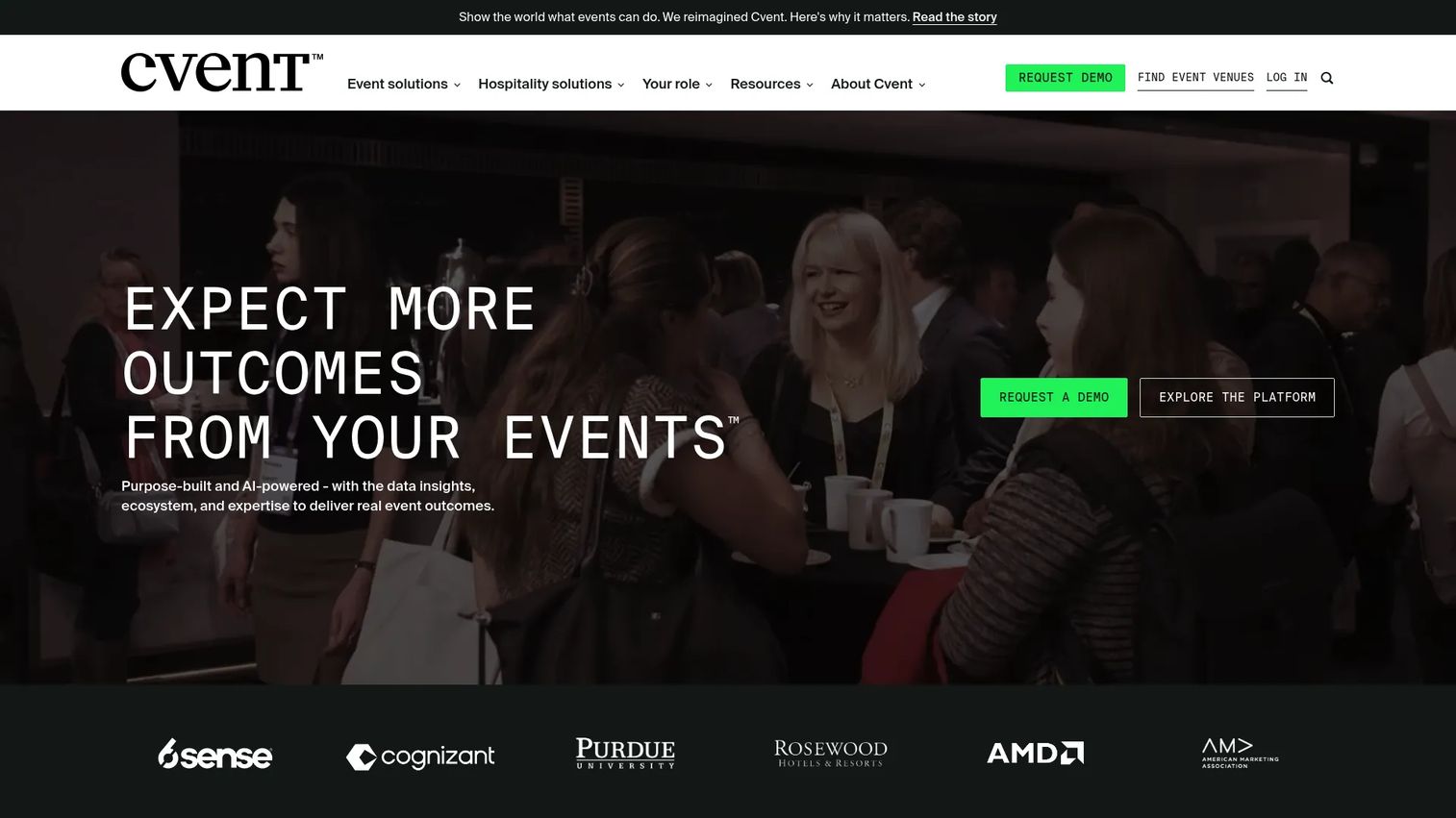
Cvent is an event platform for in-person, virtual, and hybrid events and webinars. It is built for organizations running complex events at scale, where registration, venue sourcing, onsite technology, and reporting all need to sit inside one system. If your event program spans dozens of events a year across regions, Cvent is designed to be the backbone.
The platform's Attendee Hub gives virtual and in-person attendees a shared destination for agenda, sessions, and networking. Event diagramming helps you plan floor layouts and seating, while OnArrival handles onsite check-in and badge printing. That combination is why large event teams standardize on it: fewer vendors, one dataset, and enterprise-grade governance.
Best for: Enterprise event teams running high-volume, multi-format event programs.
Key features
- Registration and attendee management
- Attendee Hub for virtual and in-person attendees
- OnArrival onsite check-in and badge printing
- Event diagramming for floor plans and seating
- Venue sourcing and event ROI tracking
Why choose Cvent: Choose Cvent when your event operation is large enough that consolidation and enterprise controls matter more than a fast, lightweight setup. It rewards teams that run events as an ongoing program, not a one-off.
Cvent pricing: Cvent Event Diagramming lists public plans: Free at $0, Standard at $49/month or $480/year, Pro at $150/month or $1,500/year, and Premium at $320/month or $3,500/year. Paid diagramming plans carry a 12-month commitment. Broader Cvent event management is quote-based through sales.
2. EventMobi
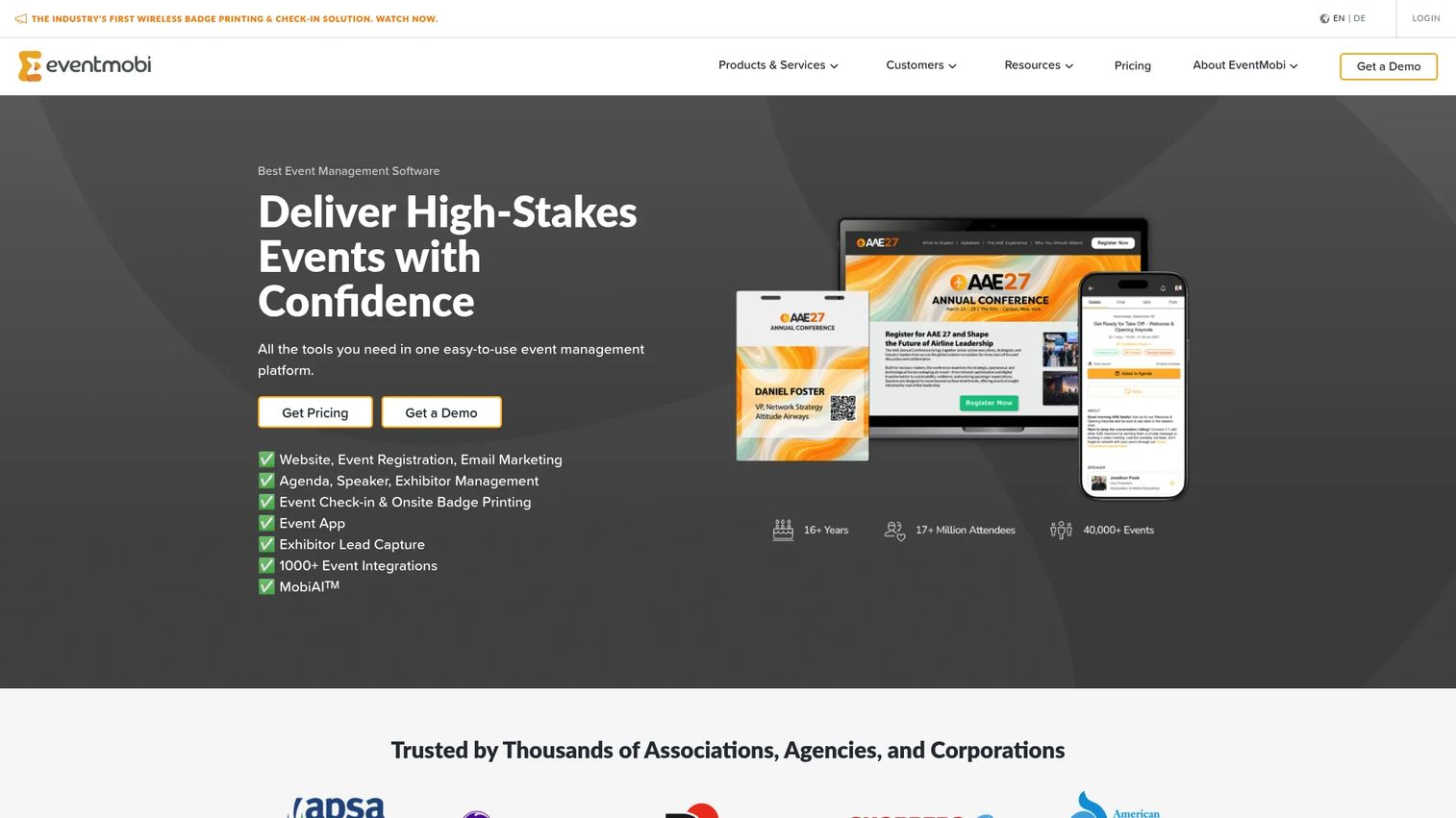
EventMobi is event management software covering registration, check-in, event apps, engagement, and virtual or hybrid events. It fits organizations that want an all-in-one platform without the weight of an enterprise suite. Teams that need flexible hybrid event management, not a long implementation, tend to land here.
The mobile event app is the center of gravity. Attendees get personalized agendas, networking, and live engagement, while organizers get analytics on what people did. Registration, call for speakers, check-in, and badge printing round out the operational side, so a mid-size team can run a full hybrid event without bolting on extra tools.
Best for: Mid-size teams needing an all-in-one platform for in-person, hybrid, or virtual events.
Key features
- Event registration and call for speakers
- Event check-in and badge printing
- Mobile event app with networking
- Attendee engagement and analytics
- Virtual and hybrid event support
Why choose EventMobi: Choose EventMobi when you want broad workflow coverage in a package you can actually stand up before your event date. It suits teams that value simplicity over deep enterprise configuration.
EventMobi pricing: EventMobi offers per-event pricing from $3,000 per event and per-year pricing from $8,900 per year, with custom pricing for large or unique requirements. Usage-based add-ons, such as streaming and video storage, start from $500 per event.
3. BigMarker
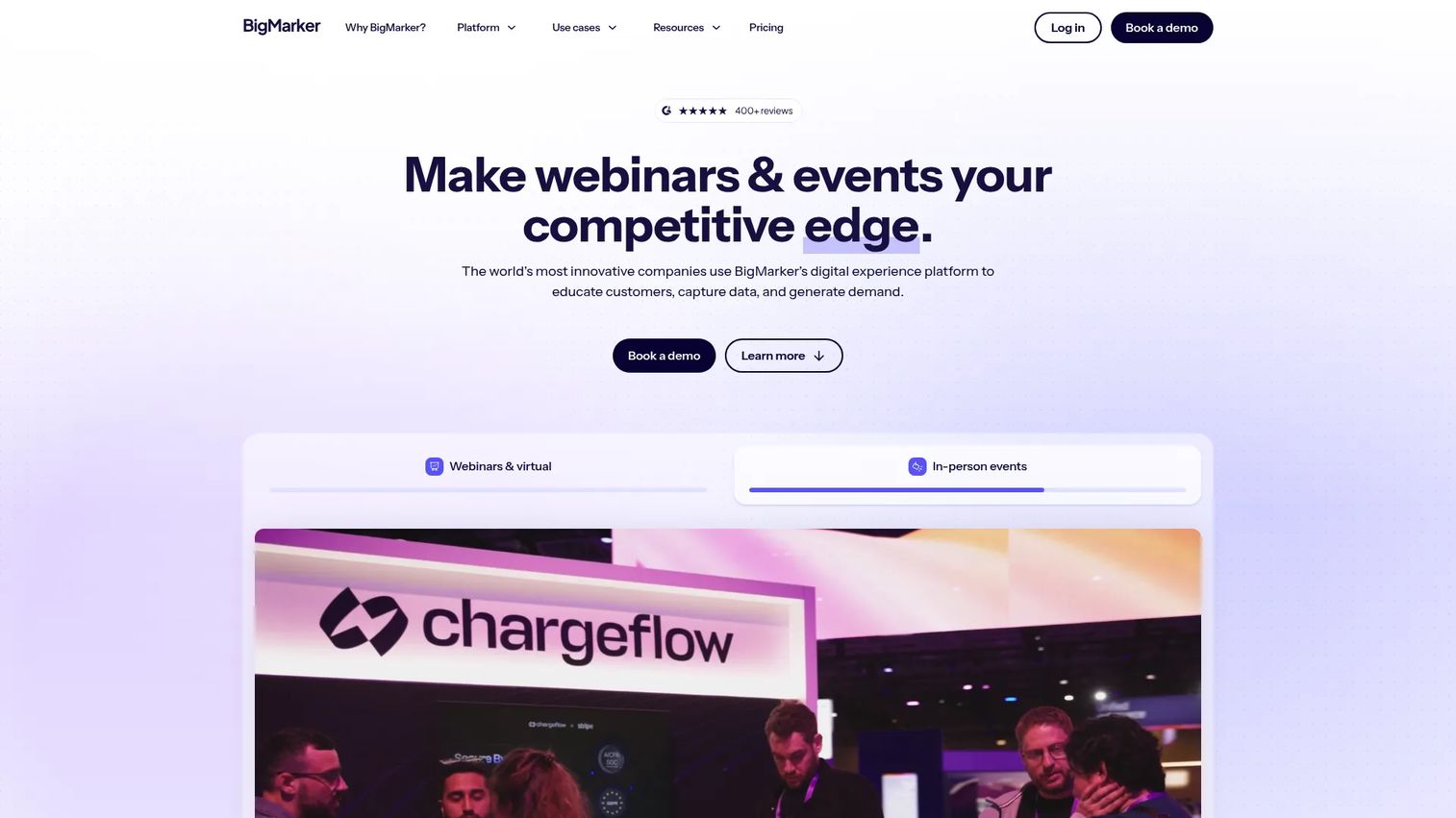
BigMarker is a webinar and virtual events platform for hosting, marketing, and analyzing interactive online events. It is the strongest fit when the virtual side of your hybrid event carries most of the weight, think content-heavy programs, lead-gen webinars, and large online audiences that need to feel branded and polished.
Customizable landing pages and registration keep the funnel on-brand from click to attendance. Live sessions support chat, Q&A, polls, handouts, and up to nine presenters, so your content stays interactive rather than one-directional. Integrations with CRM and marketing automation, plus embeddable registration and live experiences, make it a natural fit for marketing teams focused on pipeline.
Best for: Marketing teams running branded webinars, virtual events, and lead-gen programs.
Key features
- Customizable landing pages and registration
- Live webinars with chat, Q&A, and polls
- Handouts and up to nine presenters
- CRM and marketing automation integrations
- Embeddable registration and live experiences
Why choose BigMarker: Choose BigMarker when your hybrid strategy is content-first and virtual participation is where most attendees engage. It rewards teams that treat webinars as a demand channel.
BigMarker pricing: BigMarker prices its products per event with volume pricing available; the pricing page uses request-pricing contact flows rather than listed amounts. A 7-day free trial is available.
4. Airmeet
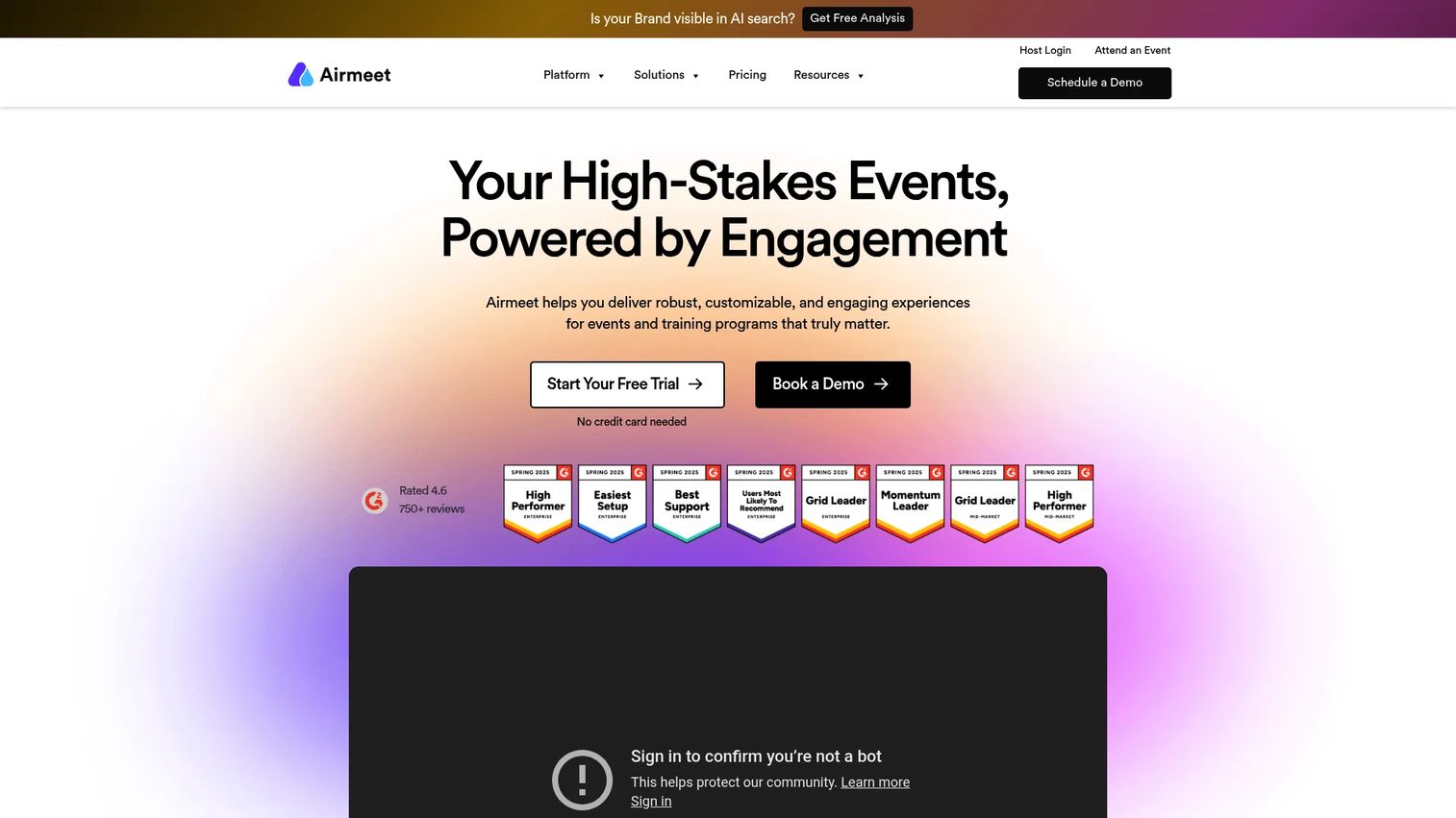
Airmeet is an event experience platform for webinars, conferences, hybrid events, and managed events. It stands out for teams that care about interaction and audience participation, where the goal is not just broadcasting sessions but getting attendees talking to each other.
Airmeet supports live, simulive, and on-demand webinars alongside multi-track virtual and hybrid events. Networking is a first-class feature, with virtual tables and matchmaking that recreate hallway conversations for remote attendees. Branding, customization, and analytics let event marketers keep the experience on-brand while tracking engagement across both audiences.
Best for: Event marketers who prioritize networking, interaction, and audience participation.
Key features
- Live, simulive, and on-demand webinars
- Multi-track virtual and hybrid events
- Virtual tables and networking
- Branding and customization
- Engagement analytics
Why choose Airmeet: Choose Airmeet when connection between attendees is the point, and you want networking and matchmaking baked into the platform rather than added on. It fits community-driven and participation-heavy events.
Airmeet pricing: Premium Webinars start at $167/month billed yearly or $199/month billed monthly. The Events plan is quote-based, and Managed Events start from $4,999 per brand conference. An agency plan is also quote-based.
5. Bizzabo
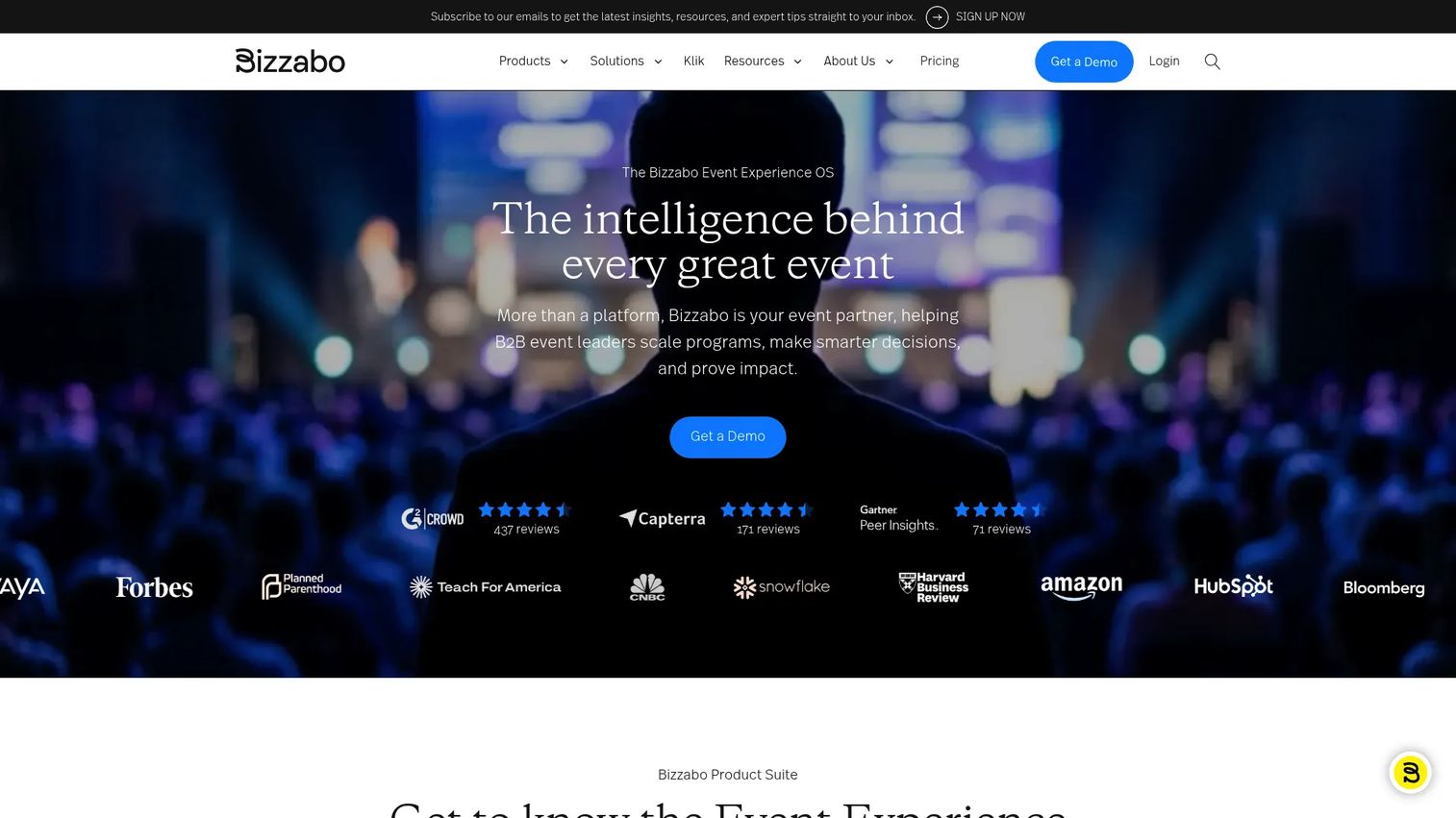
Bizzabo is an event management software platform for in-person, virtual, hybrid, and webinar experiences. It is positioned for mid-market and enterprise teams that need events to plug directly into marketing and pipeline workflows, not sit off to the side as a standalone activity.
Its Event Experience OS combines registration, marketing, onsite check-in, engagement, networking, and analytics. The Klik SmartBadge adds onsite data capture, turning physical attendee movement into engagement signals. For teams that measure events on influenced revenue, that connection between attendee behavior and analytics is the reason to choose it.
Best for: Mid-market and enterprise teams running complex events tied to marketing and pipeline.
Key features
- Event registration and marketing
- Event management and onsite check-in
- Engagement and networking
- Klik SmartBadge onsite data capture
- Event analytics
Why choose Bizzabo: Choose Bizzabo when event ROI and marketing alignment sit at the center of your evaluation. It suits teams that want attendee data flowing into the same systems that track pipeline.
Bizzabo pricing: Bizzabo's Event Experience OS starts at $499 per user per month, billed annually with a three-user minimum, which works out to roughly $17,999 per year. Klik SmartBadge has single and multi-event pricing available through sales. Add-ons and professional services are sold separately.
6. Whova
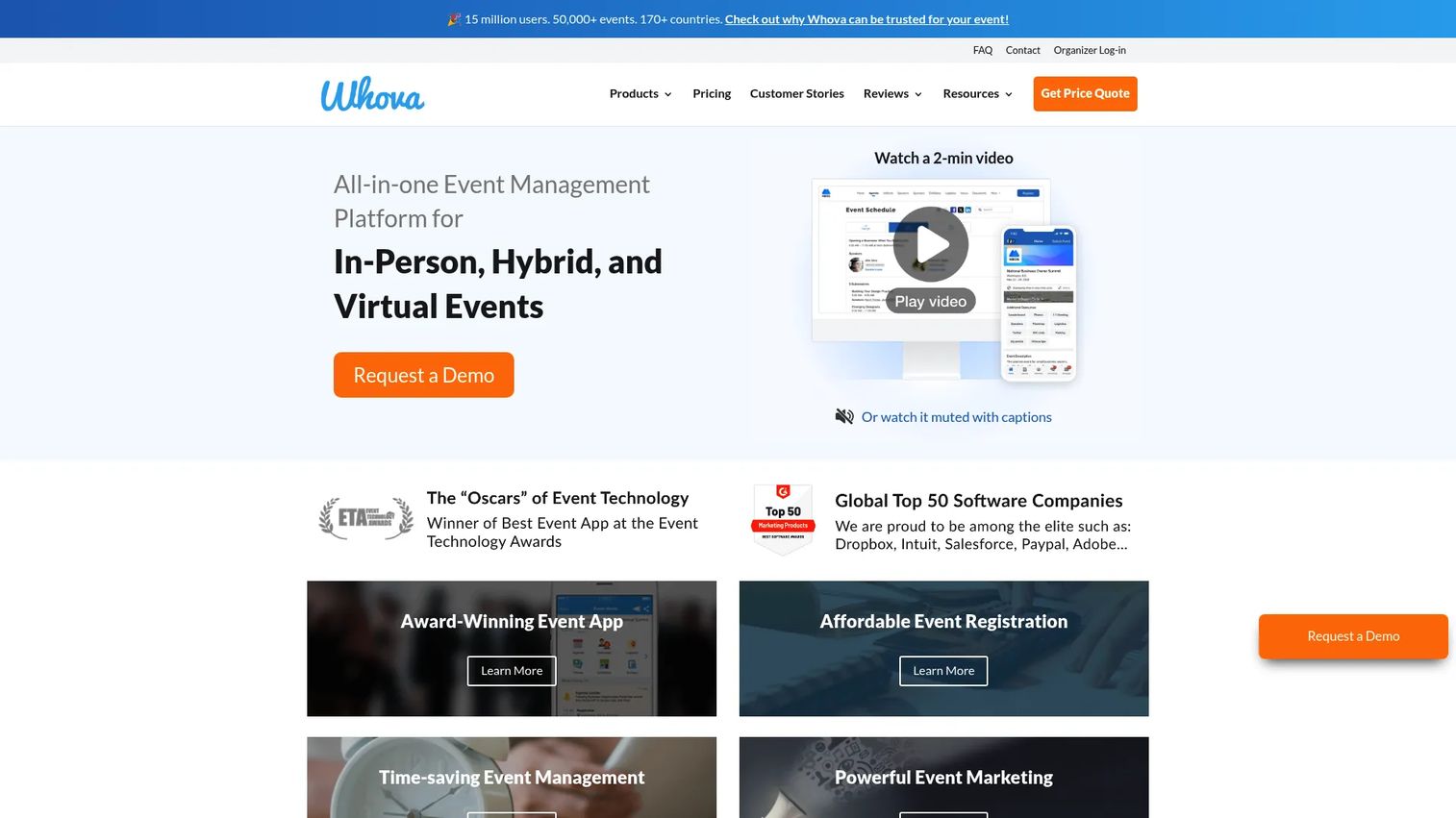
Whova is an all-in-one event management platform for planning, promoting, and running in-person, virtual, and hybrid events. It earns its reputation on attendee utility, the day-to-day experience for people actually attending, which is why it is a common pick for conferences and recurring event programs.
Attendees get personalized agendas, interactive maps, document sharing, and instant updates. Engagement tools include live polling, surveys, community boards, and gamification, while networking covers matchmaking, messaging, and lead capture. Sponsor and exhibitor tools with ROI reporting round out an offering built to keep both attendees and partners active.
Best for: Event organizers needing an all-in-one platform for registration, engagement, networking, and sponsor management.
Key features
- Personalized agendas and interactive maps
- Live polling, surveys, and gamification
- Community boards and messaging
- Networking and matchmaking
- Sponsor and exhibitor ROI reporting
Why choose Whova: Choose Whova when attendee experience and community are your priority, especially for conferences you run year after year. Its high G2 rating reflects strong day-of usability.
Whova pricing: Whova says pricing is flexible and depends on event size and add-on options, and the pricing page is a quote request form.
7. Hubilo
Hubilo is an event and webinar platform for virtual, hybrid, and in-person experiences. It targets marketing teams that want polished, branded experiences with engagement and analytics built in, so the event looks professional and the results are measurable.
The platform pairs webinar hosting and event management with no-code landing pages and email automations, so marketers can run the full campaign without waiting on other teams. Lead scoring, analytics, and content repurposing extend each event beyond the live moment, turning session recordings into ongoing demand assets.
Best for: Teams running branded webinars and hybrid events that need engagement and analytics.
Key features
- Webinar hosting and event management
- No-code landing pages
- Email automations
- Lead scoring and analytics
- Content repurposing
Why choose Hubilo: Choose Hubilo when brand polish and measurable engagement drive your decision, and you want landing pages and automations without engineering support. It fits marketing-led event programs.
Hubilo pricing: Hubilo lists Webinar Plus from $800/month for one webinar per month and Webinar Multiply from $1,200/month for two to three webinars per month, both billed annually. The Enterprise plan, covering webinars plus virtual, hybrid, and in-person events, is custom priced through sales.
Considerations before you buy
Workflow coverage versus your actual event mix
Map the platform against how you really run events. A team that runs mostly content webinars with an occasional in-person day has different needs than one running large multi-track conferences. Buy for your dominant motion, then confirm the platform handles your edge cases without duplicate tools.
Hybrid fidelity, not two separate events
Ask how remote and in-person attendees share an agenda, a networking pool, and a lead report. The value of hybrid event software is a connected experience. If virtual and onsite attendees live in separate systems, you have bought two tools wearing one logo.
Integrations with your CRM and marketing stack
Event data is only useful if it reaches the systems where you track pipeline. Check native integrations with your CRM and marketing automation, and confirm how engagement signals map to lead records. Clean sync is the difference between defensible ROI and manual exports.
Onsite operations at your scale
If in-person is a real part of your program, pressure-test check-in and badge printing. Look at walk-up registration, QR scanning, kiosk hardware, and how onsite data feeds analytics. Onsite friction shows up on event day, when it is too late to fix.
Pricing model versus your cadence
Per-event pricing suits occasional events; annual plans suit high-frequency programs. Match the model to how often you run events, and factor in add-ons like streaming, storage, and onsite hardware that can move the total materially.
Conclusion
The right hybrid conference platform depends on your dominant event motion and how tightly it must connect to pipeline. For large, multi-region enterprise programs, Cvent gives you end-to-end orchestration and onsite tech in one system. For mid-size teams wanting broad coverage without heavy implementation, EventMobi packages registration, apps, and check-in cleanly.
If virtual participation carries your program, BigMarker and Hubilo both strengthen the content-and-webinar side, while Airmeet leans hardest into networking and interaction. For marketing and pipeline alignment, Bizzabo ties attendee data to revenue workflows, and for pure attendee utility at recurring conferences, Whova's day-of experience is hard to beat.
Start by listing your event mix, your must-have integrations, and your onsite requirements. Shortlist two platforms that match your dominant motion, then run a scoped demo against a real upcoming event. The best software for hybrid events is the one that removes the seams you are living with today.
If you also demo your product at events, on a booth tablet, in a follow-up email, or on a landing page, Start your journey with Guideflow today!
FAQs
Hybrid event software manages in-person and virtual attendees for a single event from one platform. It typically covers registration, live streaming, engagement, networking, onsite check-in, and analytics, so both audiences share one agenda and one dataset instead of two disconnected experiences.
Prioritize registration and audience management, live streaming, attendee engagement, networking and matchmaking, onsite check-in and badge printing, and event analytics and ROI. The bigger question is how well these pieces connect, since the seams between tools are where hybrid events usually break down.
Virtual event software handles online attendees only, so it focuses on streaming, chat, and virtual networking. Hybrid event solutions add onsite operations like check-in, badge printing, and floor planning, then unify both audiences into one agenda, one networking pool, and one set of reports.
Cvent and Bizzabo are common enterprise picks. Cvent covers high-volume, multi-format programs with registration, Attendee Hub, venue sourcing, and onsite tech. Bizzabo suits mid-market and enterprise teams that need events tied tightly to marketing analytics and pipeline. Both offer quote-based enterprise pricing.
Most platforms offer attendee profiles, meeting scheduling, and AI-driven matchmaking. Airmeet and Whova lean hardest into this, with virtual tables and community tools that recreate hallway conversations for remote attendees. Strong networking puts virtual and in-person attendees in the same pool rather than separate rooms.
Check workflow coverage against your real event mix, hybrid fidelity between remote and onsite attendees, CRM and marketing automation integrations, onsite operations at your scale, and the pricing model against your event cadence. Buy for your dominant motion, then confirm it handles edge cases.
They track session attendance, engagement scores, lead capture, and attribution, then sync those signals to your CRM. Platforms that unify onsite badge scans with virtual session activity let you score leads from both audiences on the same scale and connect engagement to influenced pipeline.
Cvent, EventMobi, Bizzabo, and Whova all cover registration plus onsite check-in and badge printing. Cvent's OnArrival and Bizzabo's Klik SmartBadge are built for larger onsite operations, while EventMobi and Whova package registration and check-in into more accessible all-in-one offerings.