You approved 47 speakers for the conference. Their bios live in three different email threads. Two headshots came in as blurry phone photos. One presenter changed their session title after you already published the agenda, and nobody flagged it until an attendee emailed asking why the schedule didn't match the app.
This is how most event teams still run speaker workflows. Forms feed a spreadsheet, the spreadsheet feeds a shared drive, and the shared drive feeds a slow trickle of "can you resend that file?" emails. Every handoff loses information. Every deadline creates a scramble.
The category exists to fix that fragmentation. The global event management software market reached roughly USD 7.2 billion in 2025 and is projected to hit USD 14.7 billion by 2034, according to IMARC Group (2026). Speaker management is a growing slice of that spend, and cloud-based deployment already holds the majority share of speaker-focused solutions, per MarketIntelo (2025). Teams are moving off manual coordination because the volume finally broke the spreadsheet.
The right platform does more than store a directory. It gives speakers a self-service portal, handles submission and review workflows, pushes clean data into your agenda, and keeps everyone communicating in one place. That is the difference between managing 200 speakers and drowning in 200 speakers.
What's inside
This guide compares eight speaker management platforms for conference and event teams evaluating tools in 2026. Some are specialist speaker and content systems. Others are broader event platforms where speaker management is one module inside a larger operation.
We selected and ranked tools on the criteria event teams actually weigh: workflow coverage across the full speaker lifecycle, speaker portal quality, abstract and submission handling, scheduling and agenda support, integrations with the rest of your event stack, and the overall speaker experience. Pricing and ratings are included where publicly verified, and omitted where a vendor keeps them behind a sales conversation.
TL;DR
- Best specialist for end-to-end speaker and content management: Sessionboard. Strong speaker CRM, submission review, and agenda building in one dedicated layer.
- Best for call for papers and community events: Sessionize. Purpose-built CFP forms, review workflows, and a free tier for free community events.
- Best for association and academic programs: X-CD or Cadmium. Both handle abstract-heavy conference content management alongside registration and CE tracking.
- Best for formal review workflows: OpenWater. Multi-round scoring and application intake for abstracts, awards, and scholarship programs.
- Best broad event platforms with speaker modules: Cvent and Bizzabo for enterprise teams that want speaker workflows connected to registration and the full attendee journey.
- Best mid-market all-in-one: InEvent for teams linking speaker data to virtual, hybrid, and in-person event experiences.
What is speaker management software?
Speaker management software is a platform that centralizes the full speaker lifecycle for events, from invitation and submission through profile updates, approvals, scheduling, content collection, and post-event reuse. It replaces the scattered mix of forms, inboxes, and spreadsheets most event teams start with.
The core workflow moves through predictable stages. Teams open a call for speakers or call for papers, collect submissions and abstracts, route them through review and scoring, approve sessions, gather bios, headshots, disclosures, and presentation assets through a speaker portal, then feed confirmed data into the agenda and event app. Good platforms keep speaker communications logged and reusable so you are not rebuilding profiles every year.
Key capabilities to expect from a speaker management platform:
- Speaker portal: A self-service space where speakers update their own profiles, upload assets, and confirm session details without emailing your team.
- Abstract management software: Structured submission intake, review assignment, scoring, and decision tracking for content-heavy conferences.
- Agenda builder: Tools that turn approved sessions into a published schedule, with conflict checks and room assignments.
- Speaker database: A persistent record of speaker profiles you can reuse across recurring events.
- Reporting and integrations: Dashboards for submission and review status, plus connections to event platforms, CRM, email, and registration systems.
Optimized well, this category turns conference content management from a manual scramble into a repeatable process that scales with your event.
When to use speaker management software
Not every event needs dedicated software. A 12-person internal summit runs fine on a shared doc. The threshold is volume, complexity, and how many people touch the workflow.
Centralize call for speakers workflows
When submissions climb past what one person can track in a spreadsheet, you need a structured system. Call for speakers software gives you a single intake form, automatic confirmation to submitters, and a review queue your committee can score in one place. This matters most when multiple reviewers rate the same abstracts and you need a clean decision trail. It also stops the classic failure mode: a great submission that slips through because the follow-up email never got sent.
Simplify speaker onboarding and communication
Once speakers are approved, the asset collection begins. Bios, headshots, disclosures, presentation files, AV requirements, travel details. A speaker portal turns this into self-service. Speakers log in, update their own profiles, and upload what you need on their own schedule. Speaker communications stay logged against each profile, so anyone on your team can see what was sent and what is still outstanding. That is the difference between chasing 50 people over email and watching a completion dashboard fill in.
Build and update event agendas faster
Approved sessions have to become a published schedule, and this is where manual workflows break. When a speaker changes a title or a session moves rooms, that update needs to flow to the website, the app, and the printed program without a human retyping it three times. An agenda builder that pulls directly from confirmed speaker data cuts manual errors and lets you publish and republish quickly. For recurring conferences, reusable speaker profiles mean next year starts from a database, not a blank sheet.
Comparison table
The table below ranks the eight platforms by relevance to dedicated speaker management, starting with the specialist tools and moving toward broader event platforms. Read the "Intent" column to match a tool to your primary pain, then check pricing and rating for fit. Ratings reflect verified G2 or listed sources where available.
| # | Product | Intent | Key differentiation | Pricing | G2 rating |
|---|---|---|---|---|---|
| 1 | Sessionboard | Specialist speaker + content management | Speaker CRM, submissions, agenda planning in one layer | $249/month | Not listed |
| 2 | Sessionize | Call for papers + schedule building | CFP forms, review workflows, free community tier | Free; $499 per pro event | Not listed |
| 3 | X-CD | Academic + association conferences | Speaker, abstract, and registration in one system | From $1,950/year | 4.8/5 |
| 4 | InEvent | All-in-one event platform | Speaker data linked to virtual, hybrid, in-person | Quote-based; free trial | 4.5/5 |
| 5 | OpenWater | Submission + review programs | Multi-round scoring, application intake | Custom quote | 4.4/5 |
| 6 | Cadmium | Association content operations | Abstract and conference content management | Not public | Not listed |
| 7 | Cvent | Enterprise event platform | Speaker workflows inside full event stack | Quote-based | 4.3/5 |
| 8 | Bizzabo | Enterprise event orchestration | Speaker sessions inside broader event OS | From $499/user/month | 4.3/5 |
The 8 best speaker management platforms
1. Sessionboard
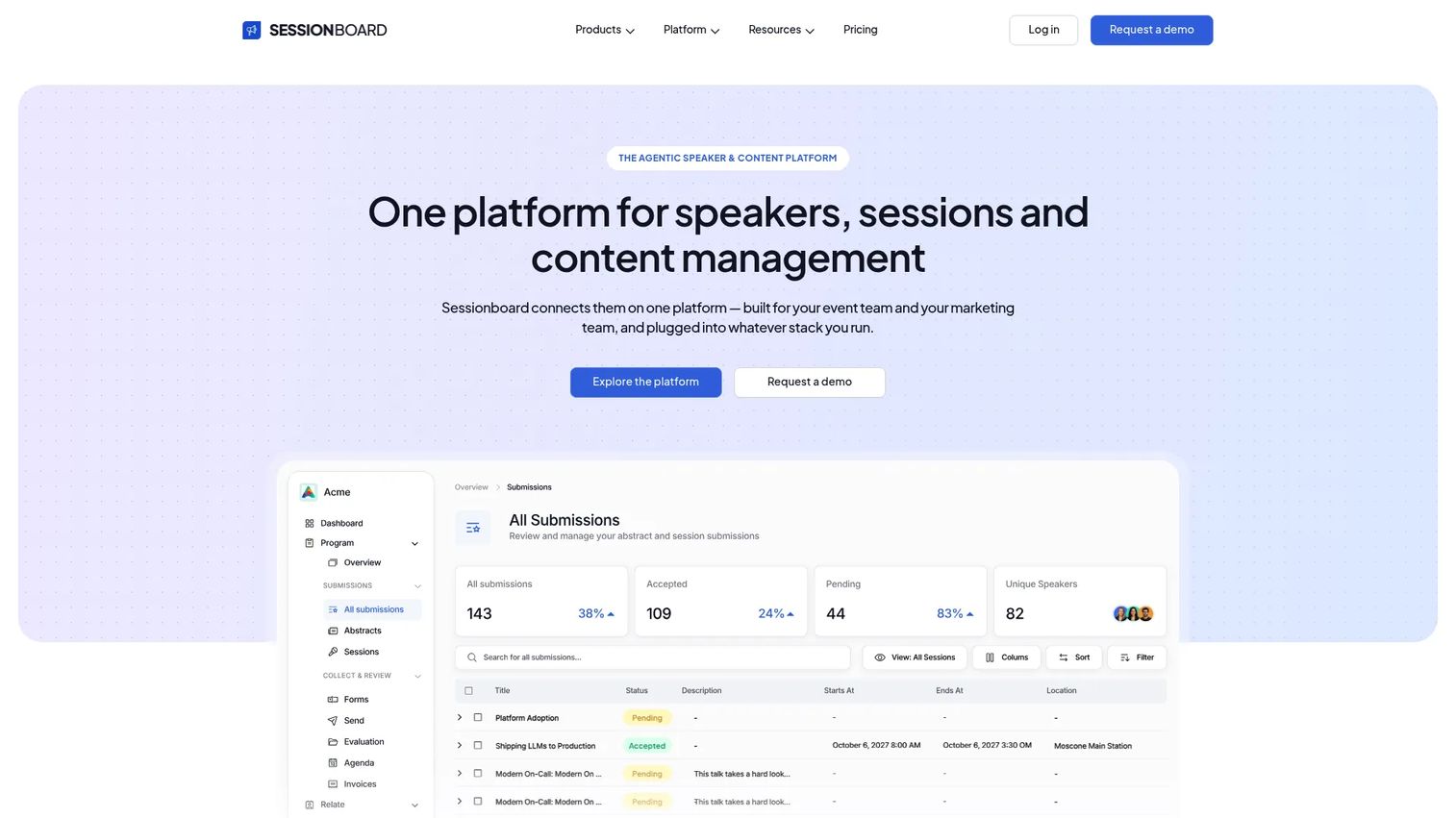
Sessionboard is the strongest specialist option for teams that want a dedicated speaker and content layer rather than a module bolted onto a larger platform. It combines a speaker CRM, submission management, and agenda planning into one system built specifically for the speaker lifecycle. For conference producers juggling hundreds of submissions and dozens of reviewers, that focus shows.
The platform handles the full arc: open a call for speakers, collect and score abstracts, manage a persistent speaker database, and build sessions into a published agenda. Because speaker profiles persist, recurring conference programs start each cycle from real data instead of a fresh spreadsheet.
Best for: Conference and event teams that need a dedicated speaker and content management system, not a side feature.
Key strengths
- Speaker CRM: A persistent speaker database that keeps profiles, history, and communications reusable across events.
- Submission management: Structured intake, review assignment, and scoring for abstract-heavy conference content management.
- Agenda and session planning: Turns approved sessions into a published schedule with clean data flow.
Why choose Sessionboard: If your main pain is coordinating a large volume of speakers and submissions, a purpose-built speaker layer beats a general event platform. Sessionboard concentrates on the workflow that eats your team's time, so the speaker experience and internal review process both get first-class attention.
Sessionboard pricing: Sessionboard publishes Professional, Enterprise, and Tailored plans, each listed at $249 per month on its pricing page. Professional and Enterprise route to a demo request, and Tailored routes to a sales conversation. No free tier is listed.
2. Sessionize
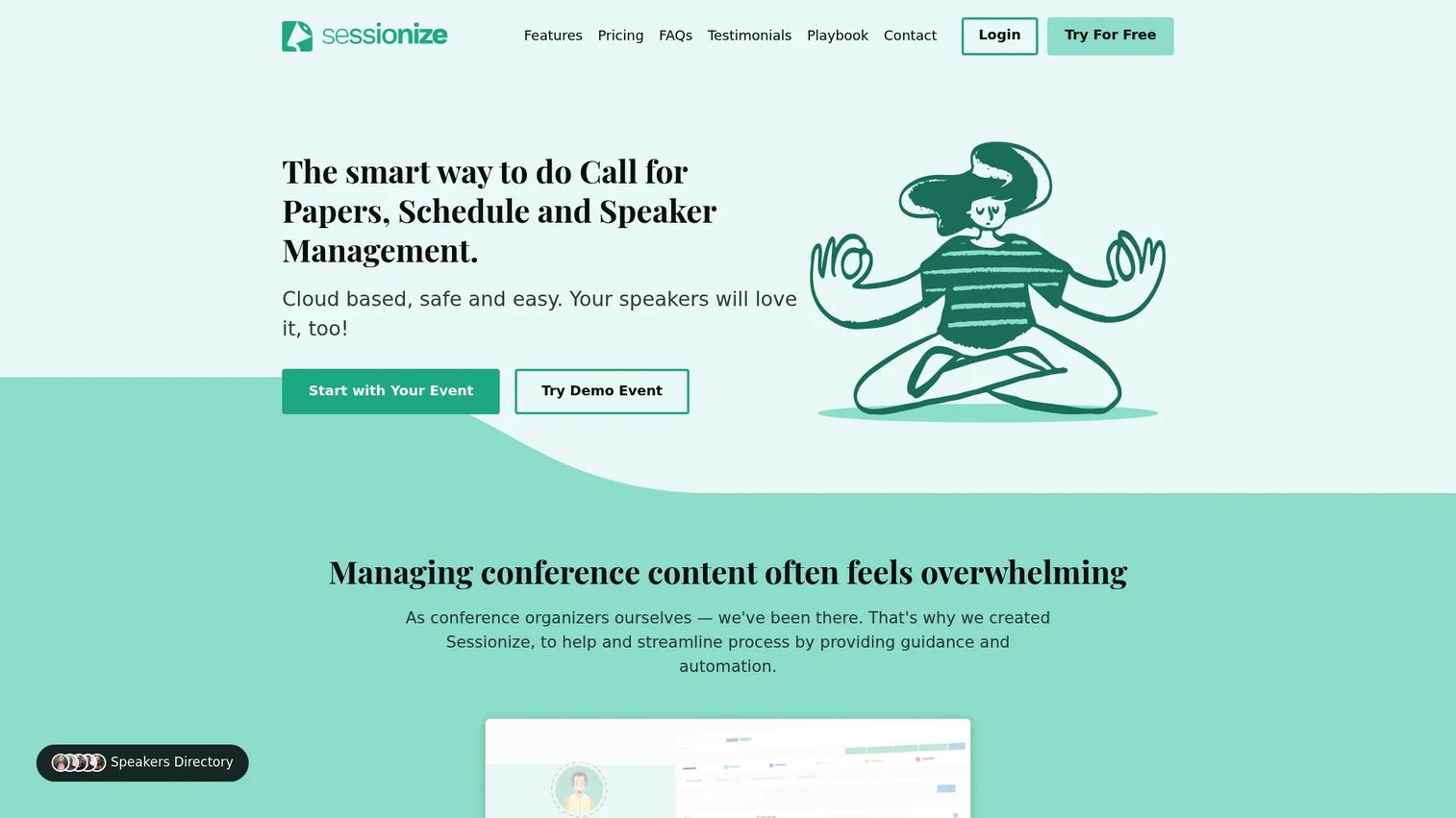
Sessionize is a cloud-based platform built around call for papers, submission review, and schedule building. It is a favorite among community and conference organizers because the CFP experience is clean for both submitters and reviewers, and because it offers a genuinely free tier for free community events. That combination makes it easy to adopt without a procurement cycle.
The tool covers speaker profiles, submission and evaluation workflows, agenda publishing, and embeddable public-facing speaker pages you can drop onto your event site. For organizers who run recurring meetups, developer conferences, or community summits, it hits the essential workflow without extra weight.
Best for: Community and conference organizers who need strong call for speakers software with a free option.
Key strengths
- Call for papers and submission forms: Purpose-built CFP intake that speakers find easy to complete.
- Submission review and evaluation workflows: Committee scoring and decision tracking in one place.
- Schedule building plus attendee app: Turns accepted sessions into a published agenda with mobile and web access.
Why choose Sessionize: The free community tier removes the biggest adoption barrier for volunteer-run and grassroots events. Paid professional events unlock the same workflow for commercial conferences, so you can grow into it without switching tools.
Sessionize pricing: Sessionize uses per-event pricing. Free community events pay nothing. A professional event license is 499 USD plus tax per event occurrence. Organizers running five or more events per year can arrange bulk pricing through sales.
3. X-CD speaker management software
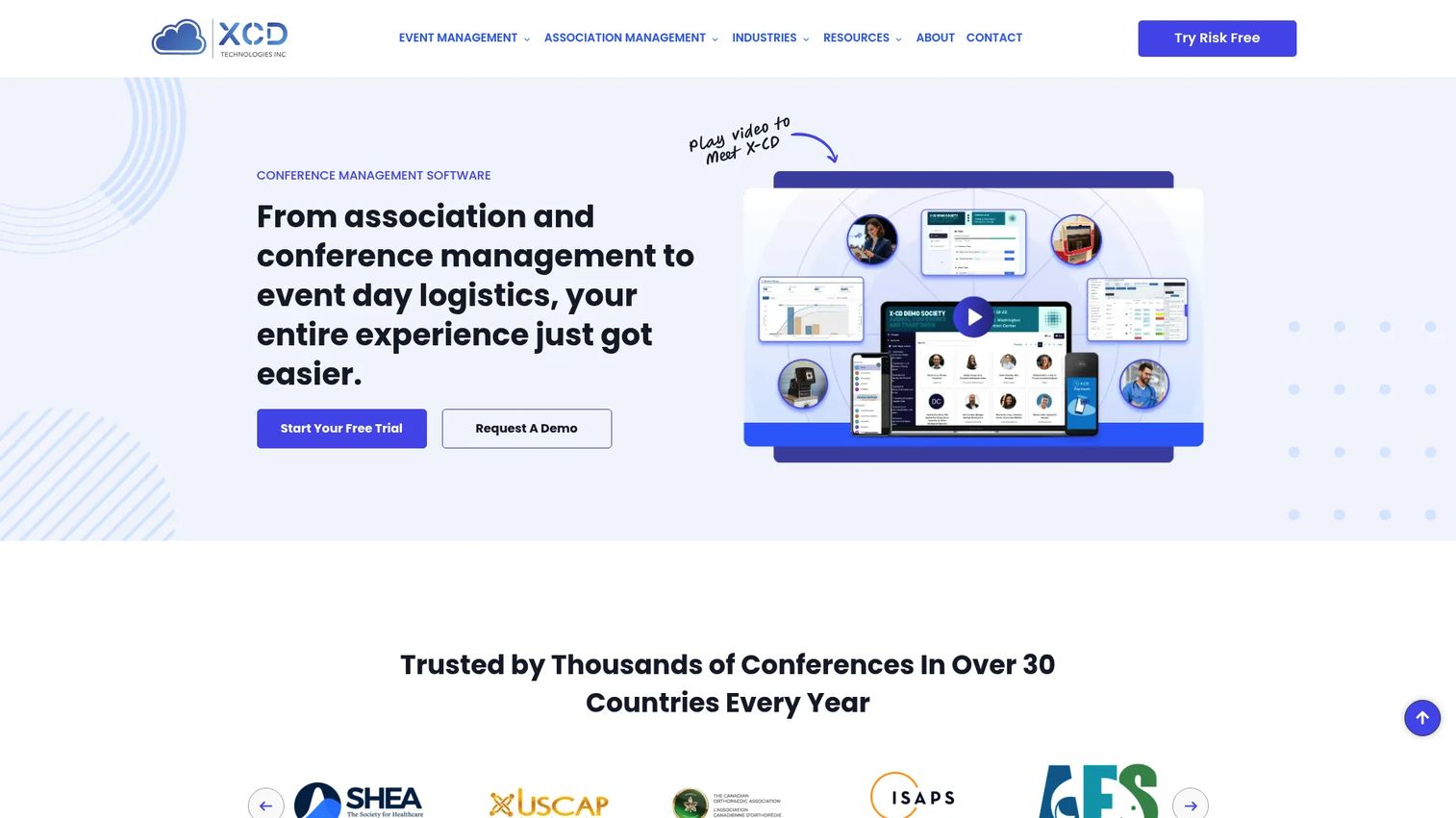
X-CD delivers speaker management as part of a broader conference and association management suite. Its strength is depth for academic, medical, and association event teams that need speaker workflows running alongside abstract management, registration, continuing education tracking, and a mobile app. When speaker coordination cannot be separated from the rest of your conference infrastructure, that integration matters.
The speaker module handles invitations, profile management, disclosures, and session building, and it connects directly to abstract intake and registration data. For association teams running the same complex event every year, keeping all of it in one system reduces the handoffs where data usually gets lost.
Best for: Academic, medical, and association event teams needing speaker management inside a full conference platform.
Key strengths
- Speaker management: Invitations, profiles, disclosures, and session building in one place.
- Abstract management: Submission and review workflows tuned for academic and scientific content.
- Event registration: Registration data connected to the same system as speakers and abstracts.
Why choose X-CD: If your conference already needs abstracts, registration, and CE credit in one platform, running speakers there too avoids a separate tool and a separate export. The cross-module fit is the reason association teams pick it.
X-CD pricing: Public pricing is not listed on the X-CD site, but G2 reports a Starter edition beginning at $1,950.00 per year, with a free trial available. X-CD holds a 4.8 out of 5 rating on G2.
4. InEvent
InEvent is an event management platform for virtual, hybrid, and in-person events, with speaker management as one part of a larger system. Its appeal is linking speaker data directly to the broader attendee journey: registration, the event app, and virtual or hybrid session hosting all draw from the same records. For teams that want speaker profiles and agenda updates to flow into the live event experience, that connection is the point.
The platform centralizes speaker profiles, supports profile editing, and integrates speaker data into agenda and session views. When a speaker updates a detail, that change can propagate into the schedule attendees actually see, which cuts the manual sync work that breaks so many events.
Best for: Mid-market and enterprise teams that want speaker data connected to registration and the full event experience.
Key strengths
- Registration and ticketing: Speaker data lives in the same platform as attendee registration.
- Virtual and hybrid hosting: Sessions and speakers connect directly to the live event delivery.
- Onsite check-in and badging: Speaker and attendee logistics handled in one system.
Why choose InEvent: Choose InEvent when speaker management is one requirement among many and you want a single platform for the whole event. The value is consolidation, one system instead of a speaker tool plus a separate event platform.
InEvent pricing: InEvent uses mostly quote-based pricing, with some plans charged per registration and a free trial available. Public numeric prices are not shown on its pricing pages. InEvent holds a 4.5 out of 5 rating on G2.
5. OpenWater
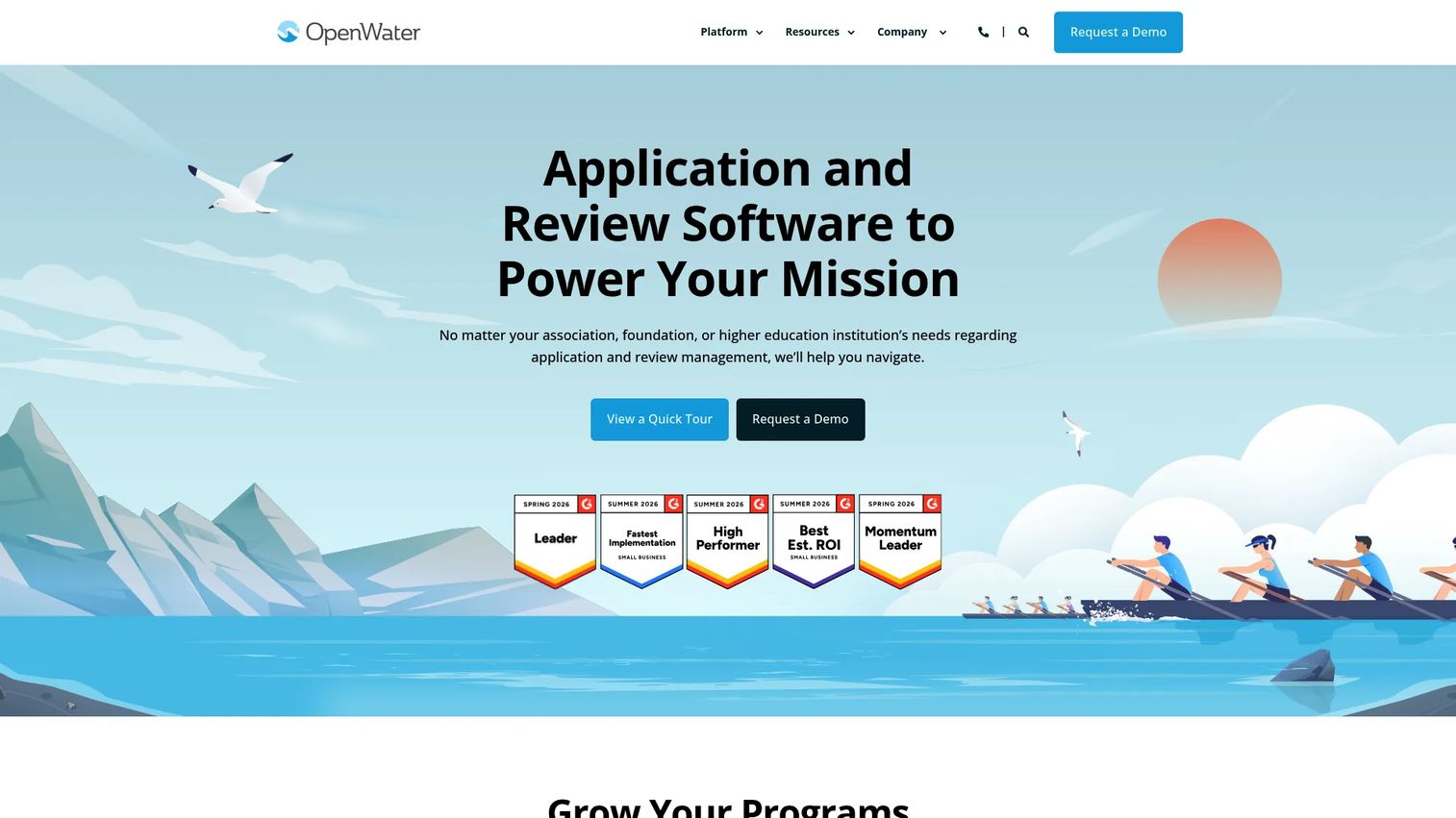
OpenWater is an application and review platform built for programs with formal submission and evaluation processes. While it spans awards, grants, and scholarships, it maps cleanly onto abstract-heavy conference programming where intake, multi-round review, and scoring drive the agenda. For associations and nonprofits running rigorous review, it is a natural fit.
The platform pairs a branded website builder with drag-and-drop form creation, conditional logic, and file attachments, then routes submissions through multi-round review, scoring, and session scheduling. If your conference content lives or dies on the quality of your review process, OpenWater treats that review as the core workflow rather than an afterthought.
Best for: Associations and nonprofits running formal abstract, application, or awards review workflows.
Key strengths
- Branded website builder: A submission site that matches your program's brand.
- Drag-and-drop form creation: Conditional logic and attachments for complex intake.
- Multi-round review and scheduling: Scoring, review rounds, and session scheduling in one flow.
Why choose OpenWater: When your programming depends on a defensible, multi-round review process, OpenWater builds around exactly that. It excels for teams where abstract management software and evaluation rigor matter more than a full event platform.
OpenWater pricing: OpenWater does not publish public pricing; it provides custom, subscription-based quotes. The platform holds a 4.4 out of 5 rating on G2.
6. Cadmium
Cadmium is an event and association software provider with a long history in abstract management, submissions, and conference content operations. It is positioned for associations and recurring conference programs where content collection, speaker communication, and complex programming all need to run together, year after year, on the same reliable base.
Cadmium supports the content-heavy side of conferences: submission intake, speaker communication, and schedule workflows for events with intricate programming needs. For association teams that treat their annual conference as a major operation, the depth around content and abstracts is the draw.
Best for: Associations and recurring conference programs with complex content and abstract workflows.
Key strengths
- Abstract management: Submission and review workflows built for content-heavy conferences.
- Speaker communication: Coordinated outreach tied to conference content operations.
- Schedule workflows: Programming tools for complex, multi-track events.
Why choose Cadmium: Choose Cadmium when your conference content operation is the center of gravity and you want a provider with deep roots in association and abstract-heavy programming. It fits teams running the same demanding event on a repeatable cycle.
Cadmium pricing: Cadmium does not publish public pricing. Interested teams contact the vendor for a quote based on program needs.
7. Cvent
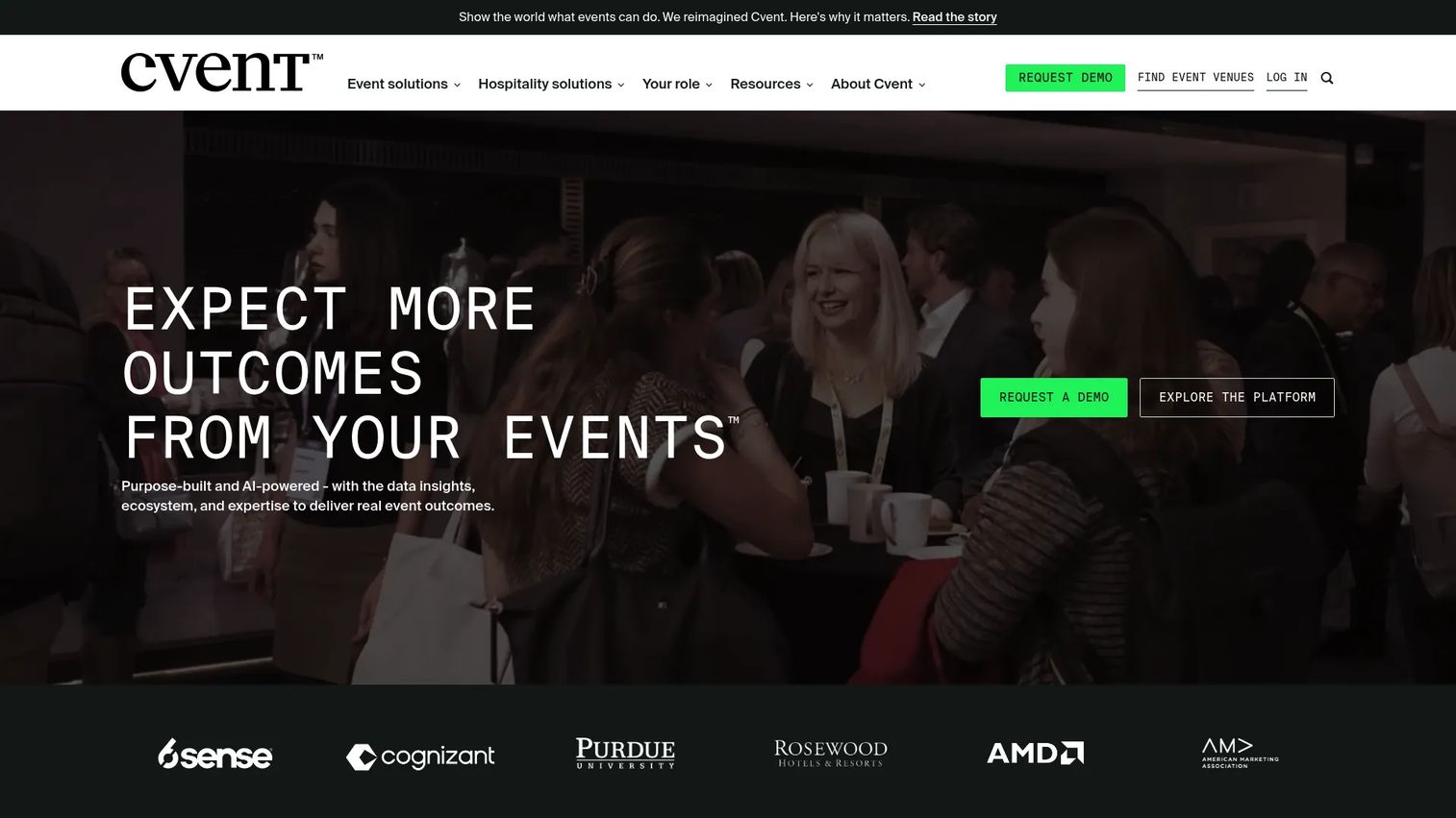
Cvent is an enterprise event marketing and management platform where speaker management is one workflow inside a much larger stack. Its practical appeal is for teams already inside the Cvent ecosystem: speaker data connects to registration, marketing, the Attendee Hub app, and onsite check-in without leaving the platform. If you run complex events at scale, keeping speakers in the same system as everything else reduces integration overhead.
Cvent covers registration and marketing, the Attendee Hub with AI agenda building and virtual experiences, and OnArrival for check-in and badging. Speaker workflows plug into that broader operation rather than standing alone, which is exactly what enterprise event teams tend to want.
Best for: Enterprises and event teams managing complex in-person, virtual, or hybrid events at scale.
Key strengths
- Registration and marketing: Speaker data connected to the full attendee acquisition workflow.
- Attendee Hub: Mobile app, AI agenda building, and networking tied to sessions.
- OnArrival: Check-in, badging, and attendance tracking for onsite events.
Why choose Cvent: If you already run Cvent for registration and event operations, adding speaker workflows inside the same platform is the path of least friction. The value is a single connected system rather than a specialist speaker tool.
Cvent pricing: Cvent does not display public numeric pricing for its core platform. It offers Professional and Enterprise options on a customized, quote-based basis. Cvent holds a 4.3 out of 5 rating on G2.
8. Bizzabo
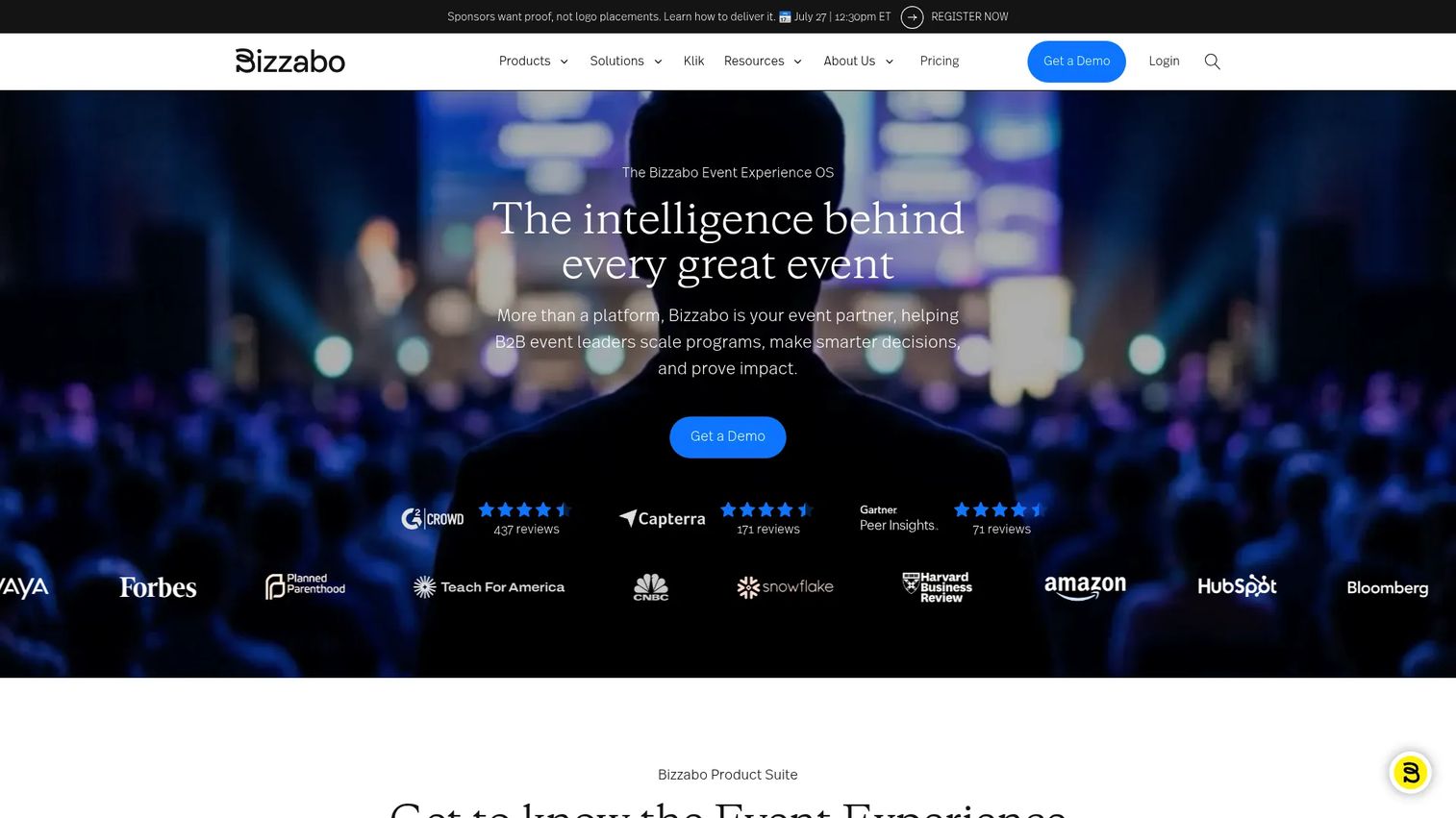
Bizzabo is an event management platform for in-person, virtual, hybrid, and webinar events, with speaker capabilities for sessions, content, and agenda workflows. It is strongest when speaker management is one part of a larger event program run by a mid-market or enterprise team that wants broad orchestration from a single Event Experience OS.
The platform pairs registration and website building with networking and attendee engagement tools, plus Klik SmartBadges for onsite check-in. Speaker sessions and agenda workflows sit inside that broader experience layer, so speaker data connects to the attendee-facing event rather than living in a silo.
Best for: Enterprise event teams running a portfolio of in-person, virtual, and hybrid events.
Key strengths
- Registration and website builder: Speaker sessions connected to the event site and signup flow.
- Networking and engagement: Attendee tools tied to session and speaker content.
- Klik SmartBadges: Onsite check-in and engagement hardware for in-person events.
Why choose Bizzabo: Bizzabo fits teams that treat events as an ongoing program, not a one-off. When speaker management is one workflow inside broader event orchestration, the connected experience layer is the reason to pick it.
Bizzabo pricing: Bizzabo's Event Experience OS is listed at $499 per user per month, billed annually, with a separate published tier starting at $17,999 per year, billed annually. Klik SmartBadge uses custom single and multi-event pricing. Bizzabo holds a 4.3 out of 5 rating on G2.
Considerations before you buy
Before you commit to a platform, run each candidate through the criteria that actually predict whether it will reduce your team's admin burden.
Workflow coverage
Map the tool against your real lifecycle: invitation, submission, review, approval, portal onboarding, agenda publishing, and post-event reuse. A tool that nails submissions but forces you to rebuild the agenda by hand only moves the bottleneck. Confirm it covers the stages where your team currently loses the most time.
Speaker portal quality
The speaker portal is the part your speakers actually touch, and a clumsy one generates support emails instead of reducing them. Test the self-service flow yourself. Can a speaker update a bio, swap a headshot, and upload a deck without a call? A strong speaker self-service portal is the single biggest lever on speaker experience.
Integrations
A speaker tool that does not connect to your event platform, CRM, email, registration, or website becomes another data island. Check event platform integrations against your existing stack. The right connections mean an approved session flows into the agenda and the app without a manual export.
Scale and reuse
If you run the same conference every year, reusable speaker profiles turn next year's setup into an update instead of a rebuild. Ask how the speaker database persists across events and whether historical data stays queryable. For recurring programs, this compounds into real time savings.
Pricing model fit
Per-event, per-seat, per-registration, and annual models each suit different teams. A per-event tool is cheap for one summit and expensive for a busy calendar. Match the pricing structure to how often you actually run events, not to a headline number.
Conclusion
The right speaker management software depends on where your pain lives. If submissions and reviews are drowning you, a specialist like Sessionboard or a CFP-focused tool like Sessionize will give you the most relief fastest. If your conference is content-heavy and review-driven, X-CD, Cadmium, and OpenWater handle abstract management and formal evaluation with the depth associations need.
If speaker management is one requirement inside a bigger event operation, the broader platforms fit better. InEvent connects speaker data to the full mid-market event journey, while Cvent and Bizzabo bring enterprise-scale orchestration for teams already committed to a single event OS.
Decide by naming your primary bottleneck. Is it submissions, speaker communications, agenda publishing, or broader event operations? Pick the tool built around that job, run a real submission through its portal before you sign, and confirm it integrates with your existing stack. The best choice is the one that makes next year's conference start from a database instead of a blank spreadsheet.
Start your journey with Guideflow today!
FAQs
Speaker management software is a platform that centralizes the speaker lifecycle for events, covering invitations, submissions, profile updates, approvals, scheduling, content collection, and post-event reuse. It replaces the manual mix of forms, inboxes, and spreadsheets most teams start with. The goal is one system where speaker data, communications, and agenda details stay connected.
No. Speaker management software is a focused layer that handles the speaker and content workflow specifically. Event management software is a broader system that covers registration, marketing, attendee engagement, and onsite logistics, often with speaker management as one module. Specialist tools go deeper on submissions and speaker experience, while platforms like Cvent and Bizzabo connect speakers to the full event operation.
Prioritize a strong speaker portal for self-service updates, submission and abstract management for content intake, an agenda builder that pulls from confirmed data, and integrations with your event platform, CRM, and registration system. A persistent speaker database matters if you run recurring events. Together these determine how much manual admin the tool actually removes.
Yes. Most platforms include call for papers software with a structured submission form, automatic confirmations, and a review queue where committees score and rank submissions. Tools like Sessionize and OpenWater are built around this intake-review-decision flow. The workflow typically ends with approved sessions feeding directly into the agenda.
For a small event with a handful of speakers, a shared spreadsheet and a few forms can be enough. Dedicated software becomes worthwhile once submission volume, reviewer coordination, or asset collection outgrows what one person can track manually. If you are chasing bios and headshots over email or worried a submission slipped through, that is the signal to move to a platform.
Look for connections to your event platform, CRM, email or marketing automation, registration system, and your website or CMS. These integrations let approved speaker data flow into the agenda, the event app, and public speaker pages without manual re-entry. The fewer manual exports between systems, the fewer places your data goes stale.
A speaker portal lets speakers update their own bios, headshots, disclosures, and presentation assets on their own schedule, instead of trading emails with your team. That means fewer email chains, cleaner asset collection, and a completion dashboard your team can watch fill in. For speakers, it feels organized and low-effort, which reflects well on your event.