A senior living operator runs three motions at once. Clinical documentation and medication administration have to be right every shift. Billing has to reflect the actual level of care each resident receives. And admissions, move-ins, and family communication have to keep pace across every community in the portfolio. When those three motions live in separate systems, the gaps show up as missed care changes, unbilled services, and leadership flying blind on occupancy.
The money at stake is not small. The global long-term care software market is expected to reach roughly USD 6.13 billion in 2026 and grow to USD 9.49 billion by 2031 at a 9.13% CAGR, according to Mordor Intelligence (2026). Assisted-living facilities are projected to be the fastest-growing end-user segment, posting a 10.44% CAGR through 2031. That growth is a signal: operators are replacing paper and disconnected point tools with platforms that tie clinical, financial, and engagement workflows together.
The problem most teams hit is not a shortage of features. It is that the wrong platform creates more manual coordination, not less. A system with deep clinical charting but weak billing means care changes never reach revenue capture. A system built for property accounting but light on eMAR leaves medication safety exposed. The right choice depends on which workflow pain is costing you the most right now.
This guide compares the leading platforms so you can shortlist faster and buy against your actual bottleneck. If you spend a lot of time evaluating tools that need clear buyer walkthroughs, teams often build these comparisons the same way they'd build an audit management software roundup or a best contract lifecycle management software shortlist: by mapping features to the one workflow that hurts most.
What's inside
This guide is for operators, administrators, and leadership teams at assisted living, memory care, nursing home, and independent living communities, plus the analysts and buyers evaluating the category on their behalf. We selected platforms based on breadth of modules, implementation and onboarding speed, reporting and analytics depth, and fit for multi-community operators. The list covers all-in-one senior living software platforms and category leaders, not narrow point solutions. Where a platform leans toward a specialized job like caregiver training or property accounting, we say so plainly so you can match it to your priority.
TL;DR
- Best all-in-one for clinical plus revenue: Eldermark ties EHR, eMAR, billing, and analytics into one system for operators who want care changes to flow straight to revenue capture.
- Best for connected clinical-to-billing: ECP pairs pharmacy-initiated eMAR, care plans, CRM, move-ins, and billing in a single assisted living platform.
- Best for workforce training and compliance: CareAcademy fits teams whose bottleneck is caregiver training, compliance automation, and audit-ready reporting.
- Best for resident engagement: LifeLoop leads on resident engagement, family communication, and activities across care settings.
- Best for skilled nursing and post-acute scale: PointClickCare and MatrixCare fit larger, more regulated environments needing deep clinical documentation.
- Best for financial operations and portfolio oversight: Yardi Voyager suits operators prioritizing accounting, billing, and property-level performance.
Background: what senior living software does
Senior living software is a platform that connects clinical documentation, medication management, billing, admissions, resident communication, and reporting so a community or portfolio can run care and operations from one system instead of many.
Core capabilities most buyers evaluate:
- EHR and care planning: resident charts, level-of-care tracking, and care plans in one record.
- eMAR and medication safety: electronic medication administration records that reduce errors and document every pass.
- Billing and revenue capture: charges that reflect the real services delivered, so care changes do not leak revenue.
- CRM and move-ins: lead management, tours, and admissions tied to occupancy.
- Dashboards and multi-site analytics: portfolio-level visibility into census, care, and financial performance.
- Resident engagement and communication: activities, family updates, and staff messaging.
- Compliance and HIPAA support: audit-ready records and controls for regulated environments.
Needs shift by care setting. Independent living leans on billing, occupancy, and engagement more than heavy clinical charting. Assisted living and memory care need tight eMAR, care plans, and level-of-care tracking because acuity changes often. Skilled nursing and post-acute environments demand the deepest clinical documentation and revenue-cycle rigor to satisfy regulators and payers. The platform that fits an independent living operator is rarely the same one a skilled nursing chain should buy.
When to use senior living software
Manage care and documentation without paper
When shift notes, care plans, and medication records still live on paper or in disconnected apps, errors and rework pile up. A connected clinical system with EHR and eMAR cuts manual entry and keeps care plans current as resident acuity changes. This matters most in assisted living and memory care, where a shift in level of care needs to update charting, staffing, and billing at the same time.
Tie admissions and billing to occupancy
When move-ins, lead management, and billing run in separate tools, occupancy and revenue drift out of sync. A platform that connects CRM, admissions, and billing lets a filled unit trigger the right charges automatically. That is how operators stop revenue leakage between a resident moving in and the first correct invoice going out.
Consolidate reporting across communities
When leadership stitches together spreadsheets from each community, decisions arrive late. Portfolio-level dashboards give multi-community operators one view of census, care, and margin. This is the difference between reacting to last month's numbers and catching an occupancy dip while you can still act on it.
Comparison table
The table below sorts platforms by relevance to the senior living software buyer, not alphabetically. Most vendors in this category price through sales conversations rather than public plans, so verify current pricing and ratings directly before you commit. G2 ratings shown reflect verified listings at time of writing.
| # | Product | Intent | Key use case | Pricing | G2 rating |
|---|---|---|---|---|---|
| 1 | Eldermark | All-in-one clinical plus revenue | EHR, eMAR, billing, and analytics tied together | Contact sales | 4.0/5 |
| 2 | ECP | Connected assisted living platform | Pharmacy-initiated eMAR, care plans, CRM, move-ins, billing | Contact sales | Not listed on G2 |
| 3 | CareAcademy | Training and compliance | Caregiver training, compliance automation, reporting | From $239/mo | 4.4/5 |
| 4 | LifeLoop | Resident engagement | Engagement, family communication, activities | Contact sales | 4.3/5 |
| 5 | PointClickCare | Skilled nursing and post-acute | EHR, care coordination, clinical analytics | Contact sales | Not retrieved |
| 6 | MatrixCare | Post-acute EHR | Clinical documentation, billing, revenue cycle | Contact sales | 3.8/5 |
| 7 | Yardi Voyager | Financial operations | Accounting, billing, property and resident operations | Contact sales | 3.9/5 |
The 7 best senior living software platforms
1. Eldermark
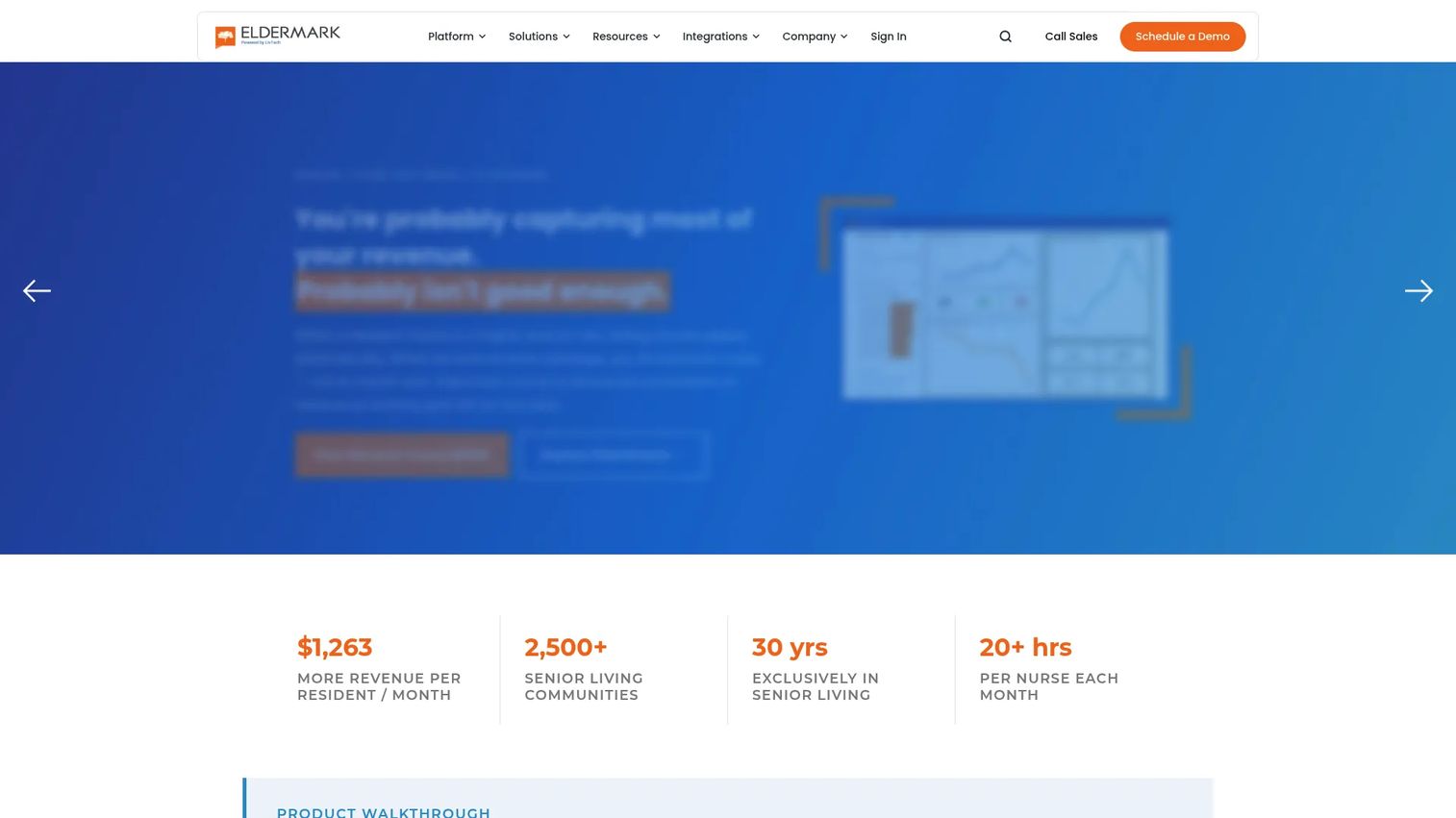
Eldermark is senior living software built to connect EHR, eMAR, billing, and analytics in one system. It is aimed at operators who want clinical documentation and revenue workflows to talk to each other, so a change in a resident's level of care flows straight into billing rather than getting lost between departments. Executive dashboards and predictive analytics sit on top, giving leadership a read on census, care, and financial performance.
Best for: Senior living operators who need clinical, medication, and revenue workflows tied together in one platform.
Key strengths
- EHR and eMAR for senior living: resident records and medication administration in one connected clinical system.
- Billing tied to clinical documentation: charges reflect the care actually delivered, reducing revenue leakage.
- Predictive analytics and dashboards: portfolio-level visibility for executives and multi-community leadership.
Why choose Eldermark: If your biggest pain is care changes that never reach billing, Eldermark's tight link between clinical documentation and revenue capture is the reason to look here first. It suits operators who want fewer systems and cleaner handoffs between care and finance teams, with reporting built for people accountable for the number.
Eldermark pricing: Eldermark does not publish public pricing. The site directs prospects to schedule a demo and quote through sales, which is standard for platforms priced by community count and module mix. Expect pricing to scale with the number of communities and the modules you turn on.
2. ECP
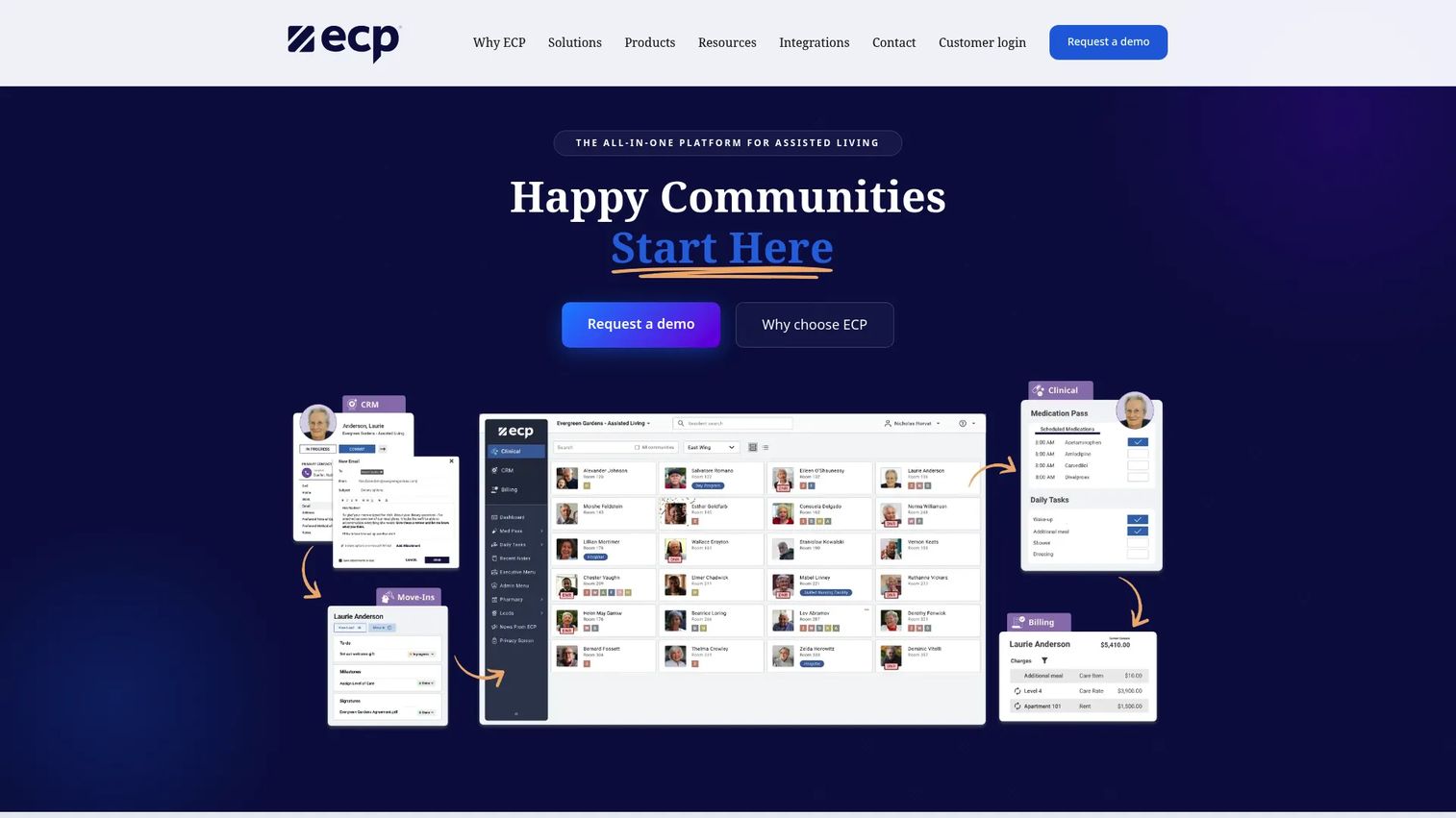
ECP is cloud-based senior living software built around assisted living operations, clinical care, move-ins, and billing in one connected platform. Its eMAR supports pharmacy-initiated medication records, which shortens the loop between the pharmacy and the community and cuts manual re-entry. EHR and care plan workflows sit alongside CRM, move-ins, and billing, so the same record follows a resident from lead to move-in to daily care.
Best for: Senior living operators who want an all-in-one assisted living platform with clinical, admissions, and billing in one place.
Key strengths
- Pharmacy-initiated eMAR: medication records flow from the pharmacy, reducing manual entry and transcription risk.
- EHR and care plan workflows: resident charts and care plans update together as acuity changes.
- CRM, move-ins, and billing connected: admissions and revenue run on the same platform, tying occupancy to charges.
Why choose ECP: ECP fits operators whose bottleneck is the gap between clinical care and the back office. The pharmacy-initiated eMAR is a genuine differentiator for medication-heavy assisted living and memory care, and connecting move-ins to billing helps keep occupancy and revenue aligned without spreadsheet reconciliation.
ECP pricing: ECP does not display public pricing on its site and directs visitors to request a demo. Third-party review sites report strong buyer sentiment, with a 4.7/5 rating across 146 reviews on Capterra, though a G2 rating was not confirmed. Confirm current packaging and per-community pricing directly with the vendor.
3. CareAcademy
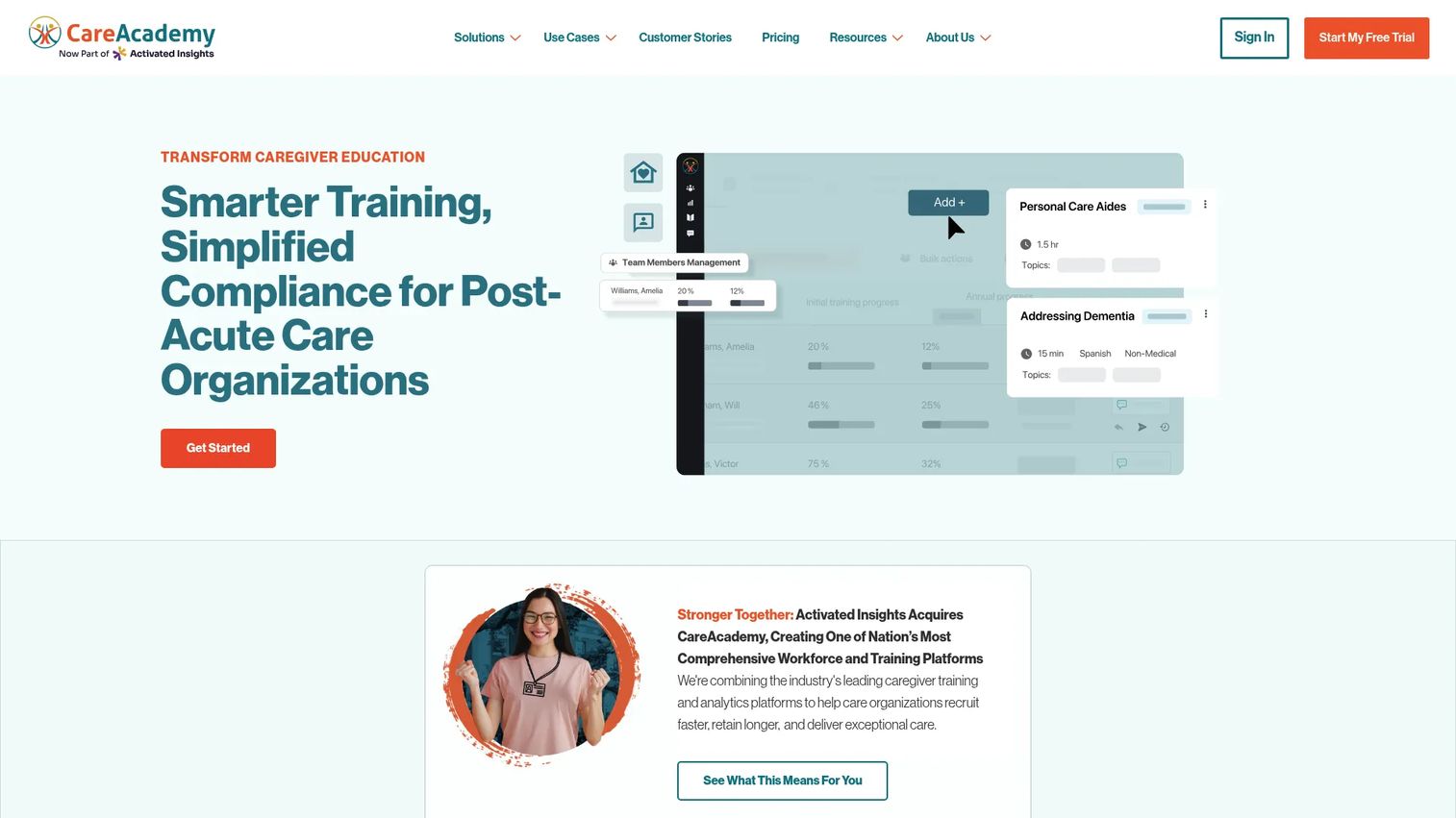
CareAcademy approaches the senior living software question from the workforce side. It is a caregiver training and workforce management platform for home care, home health, hospice, and senior living teams, built around a training dashboard, compliance automation, and audit-ready reports. That makes it a strong assisted living software entry when your operational risk lives in staff readiness and compliance rather than clinical charting.
Best for: Care organizations whose priority is caregiver training plus compliance and reporting automation.
Key strengths
- Compliance automation and audit-ready reports: training requirements track automatically, so audits are less painful.
- Mobile learning experience: caregivers complete training on their phones, including a Spanish-translated experience.
- Integrations with back-office systems: training and compliance data connect to the tools operators already run.
Why choose CareAcademy: CareAcademy is not an all-in-one EHR and billing platform, and it does not pretend to be. It is the better fit when your bottleneck is a distributed workforce that has to stay trained and compliant. Operators often run it alongside a clinical platform rather than instead of one.
CareAcademy pricing: CareAcademy publishes public pricing, which is rare in this category. Plans run Essentials at $239 per month, Advanced at $383 per month, and Complete at $419 per month, with monthly or annual billing on a minimum one-year contract. A free trial is available, and add-ons are priced separately. It holds a 4.4/5 rating on G2.
4. LifeLoop
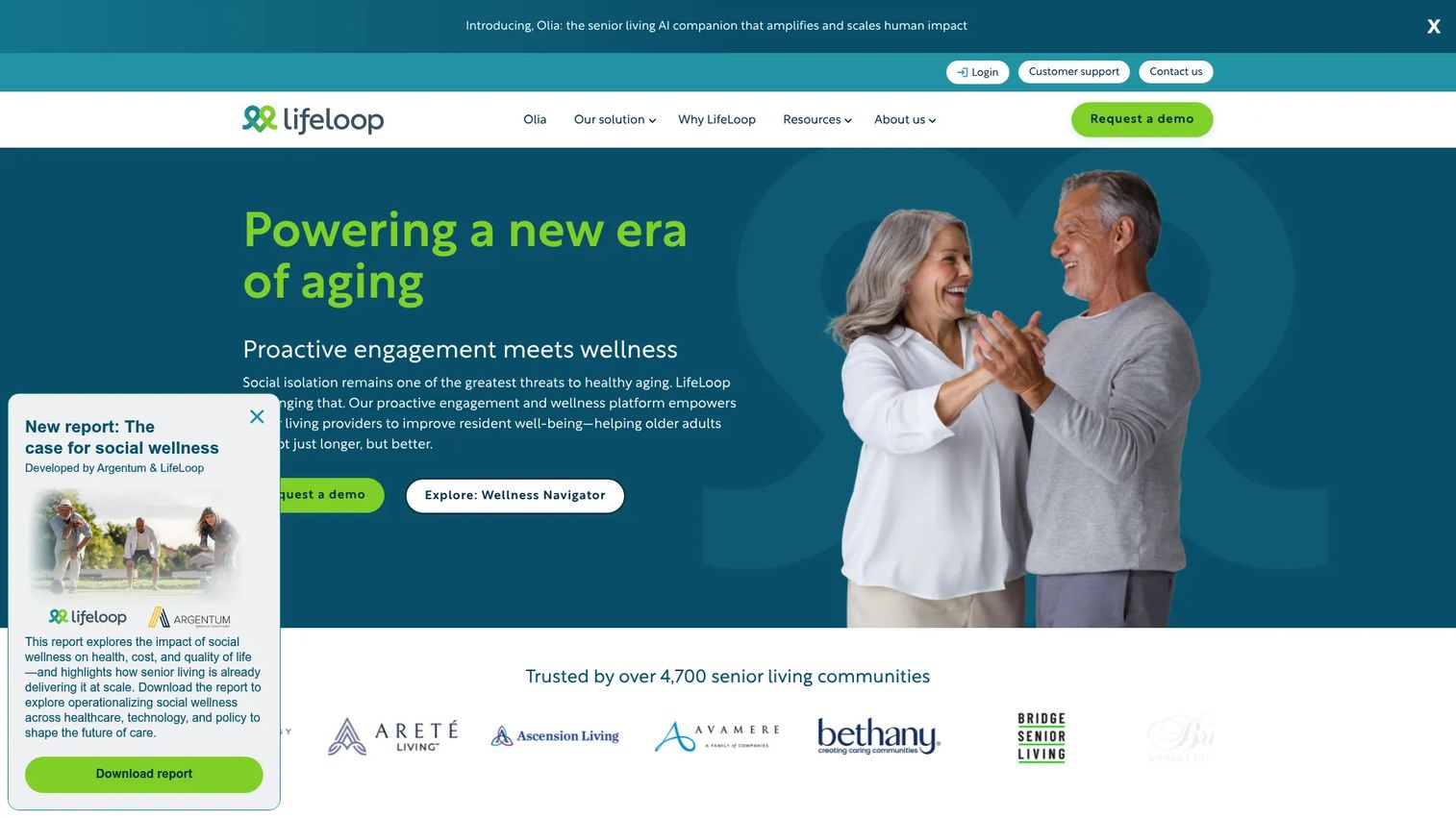
LifeLoop is senior living software centered on resident engagement, operations, and family communication. It covers resident engagement tools, family and staff communication, and workflows that span care settings, which makes it the pick when the experience side of the community is your priority. Engagement platforms like this matter more as families expect visibility into daily life and activities, not just clinical status.
Best for: Senior living communities that need engagement and communication software across independent living, assisted living, and memory care.
Key strengths
- Resident engagement tools: activities and programming that keep residents connected and active.
- Family and staff communication: updates flow to families and messages route to staff in one place.
- Cross-setting workflows: supports engagement and operations across multiple levels of care.
Why choose LifeLoop: LifeLoop maps to the resident engagement and family communication side of senior living software rather than deep clinical or revenue-cycle work. Choose it when occupancy and retention hinge on experience and family trust, and pair it with a clinical or billing platform to cover documentation and revenue.
LifeLoop pricing: LifeLoop does not list public pricing and directs prospects to request a demo. Pricing typically scales with community count and resident volume. It holds a 4.3/5 rating on G2, reflecting strong sentiment on the engagement and communication side.
5. PointClickCare
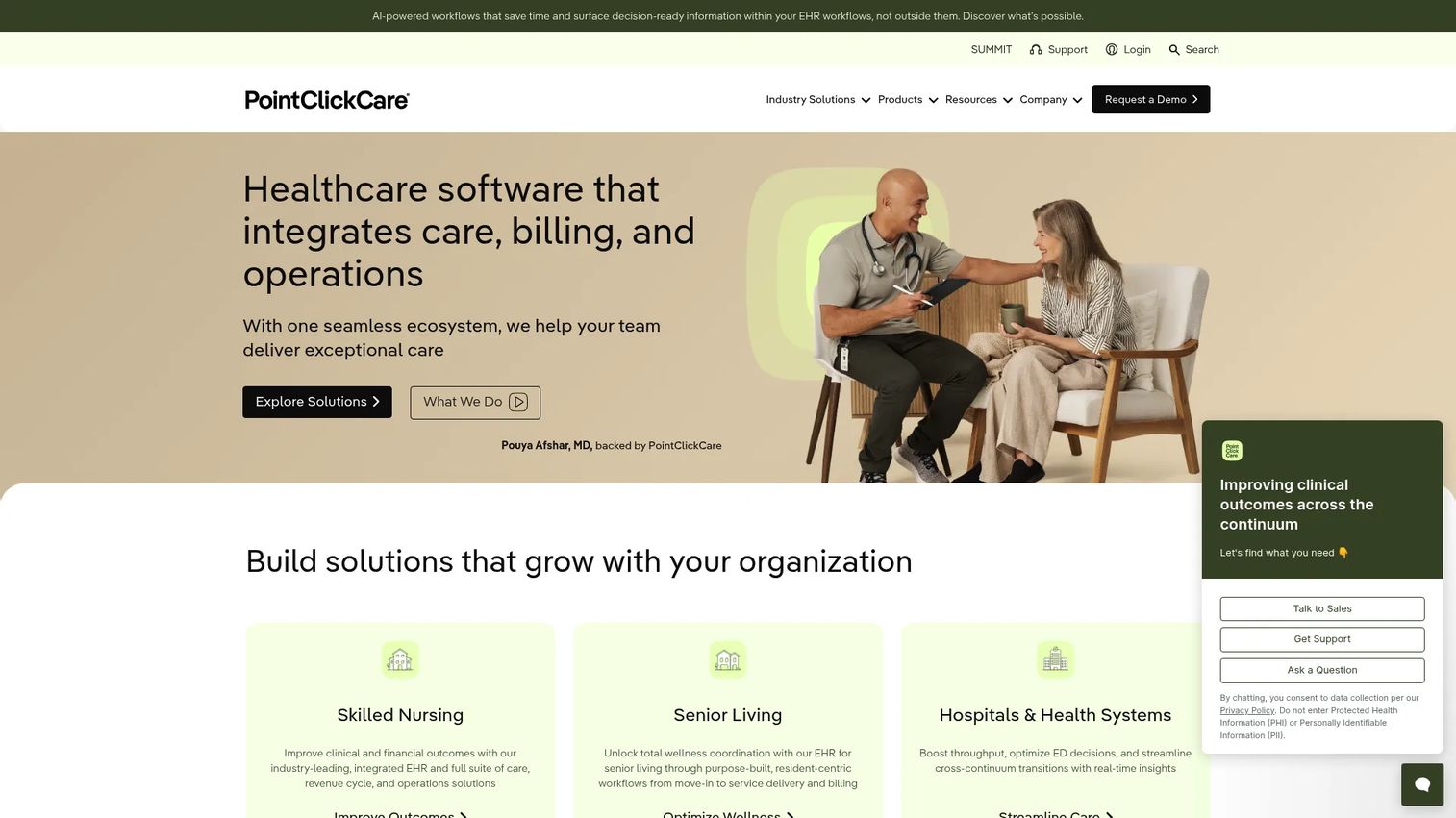
PointClickCare is a healthcare software platform for senior care, post-acute, and care coordination workflows. It is one of the most recognized names in nursing home software, with an EHR built for skilled nursing and senior care, care coordination and secure messaging, and clinical intelligence and analytics. It is built for environments where clinical documentation depth and regulatory rigor are non-negotiable.
Best for: Long-term and post-acute care organizations needing an integrated care and revenue-cycle platform.
Key strengths
- EHR for skilled nursing and senior care: deep clinical documentation built for regulated settings.
- Care coordination and secure messaging: clinical teams stay aligned across care transitions.
- Clinical intelligence and analytics: data surfaces risk and supports quality and compliance reporting.
Why choose PointClickCare: PointClickCare fits larger and more regulated organizations where the clinical record is the center of gravity. If you run skilled nursing or a post-acute network with heavy compliance demands, its documentation depth and care coordination are the draw. Smaller assisted living operators may find it more platform than they need.
PointClickCare pricing: PointClickCare does not publish standard plan pricing. Its costs page lists some implementation and ongoing charges by capability rather than a posted subscription price, and the site directs buyers to request a demo. Confirm implementation and per-capability costs directly with the vendor.
6. MatrixCare
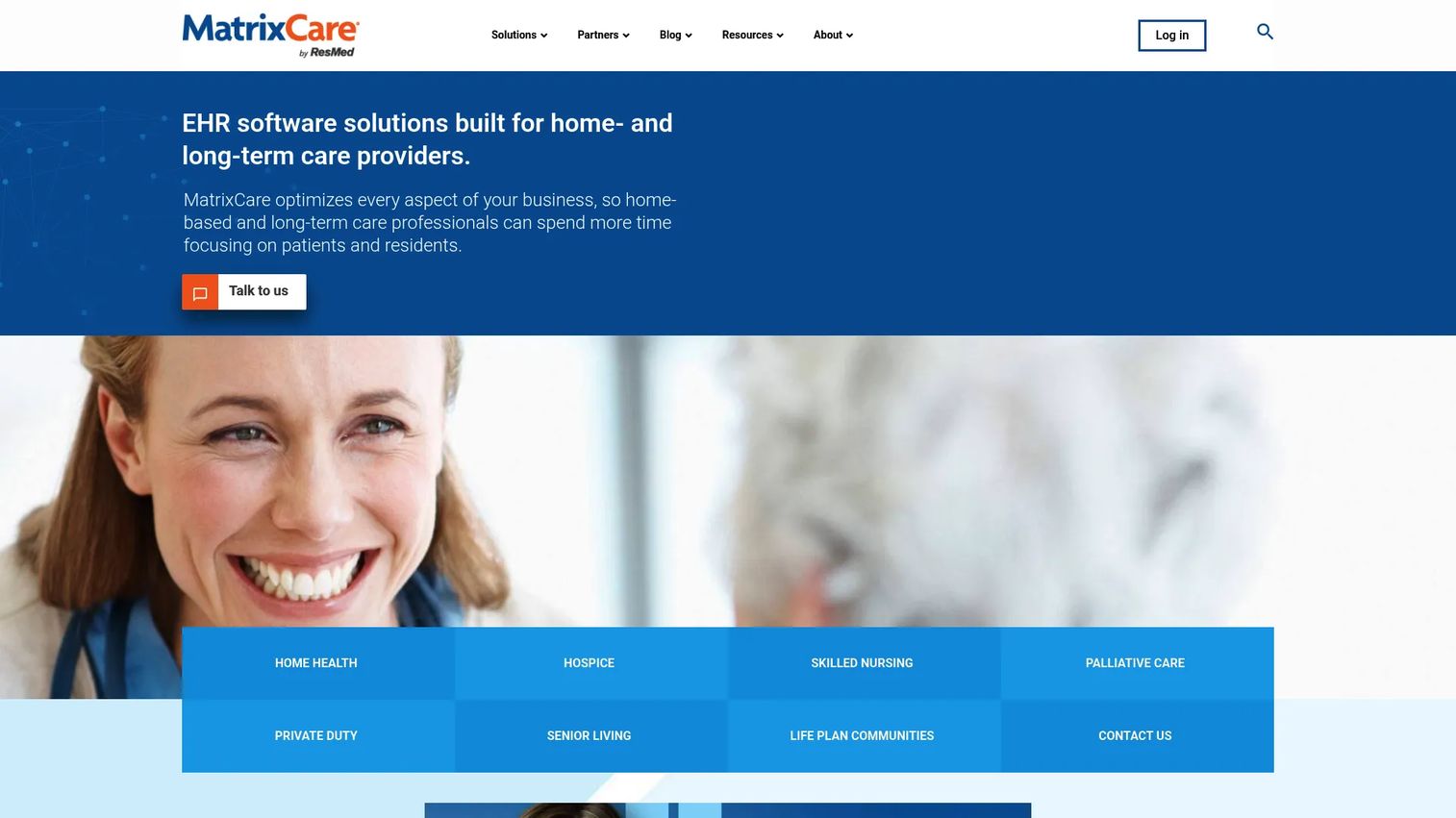
MatrixCare is EHR software for home-based, long-term, and senior care providers. It covers home health and hospice documentation and scheduling, interoperability and data exchange, and financial, billing, and revenue-cycle workflows. Operators evaluate it for larger or more complex facilities where clinical documentation, billing, and data exchange all have to work at scale.
Best for: Post-acute and senior care organizations needing a unified EHR platform across care types.
Key strengths
- Clinical documentation and scheduling: home health and hospice workflows in one system.
- Interoperability and data exchange: shares data across care settings and external partners.
- Financial, billing, and revenue-cycle workflows: ties clinical activity to billing and collections.
Why choose MatrixCare: MatrixCare suits operators running multiple care types who need one EHR to span them, with billing and revenue cycle built in. Its interoperability focus helps organizations that exchange data across partners and settings. Evaluate implementation timelines and support closely, as depth at this scale takes planning to roll out.
MatrixCare pricing: MatrixCare does not display public pricing and directs visitors to contact sales for a consultation. Pricing depends on care types, facility count, and modules. It holds a 3.8/5 rating on G2. Confirm current packaging and implementation scope with the vendor before shortlisting.
7. Yardi Voyager
Yardi Voyager is web-based, fully integrated property management and accounting software for real estate portfolios, and it earns a place in senior living software conversations for teams that prioritize financial operations. It centralizes operations, leasing, accounting, and maintenance, layers on real-time performance analytics and dashboards, and offers mobile access with an integrated multi-property database.
Best for: Large operators who need an all-in-one property management and accounting platform across a portfolio.
Key strengths
- Centralized operations and accounting: leasing, accounting, and maintenance in one integrated database.
- Real-time performance analytics: dashboards give portfolio-level financial and operational visibility.
- Mobile access and multi-property database: one record across every property in the portfolio.
Why choose Yardi Voyager: Yardi Voyager belongs on the list when financial operations and portfolio oversight are the priority rather than clinical depth. Operators who think first in terms of accounting, occupancy, and property performance will find it strong. Communities that need deep eMAR and care planning usually pair it with a clinical platform.
Yardi Voyager pricing: Yardi does not publish public Voyager pricing, and its pages describe features rather than plans. Pricing scales with portfolio size and modules and is quoted through sales. It holds a 3.9/5 rating on G2. Request a scoped quote based on your portfolio and module needs.
Considerations before you buy
Module breadth versus your actual bottleneck
More modules is not automatically better. A platform strong in one area can still leave your worst workflow exposed. Map your single most expensive pain, whether that is revenue leakage, medication safety, or occupancy, then weight the evaluation toward the platform that closes it.
Implementation and onboarding speed
Ask how long a comparable community took to go live and what the support model looks like after launch. A platform that takes two quarters to implement delays every downstream benefit. Get named references at your size and care type, not just logos.
Compliance and HIPAA support
Every platform here handles some level of compliance, but depth varies. Skilled nursing and post-acute environments need the deepest audit trails and controls. Confirm HIPAA support, audit-ready reporting, and how the vendor handles regulatory changes.
Multi-site visibility and analytics
If you run more than one community, portfolio-level dashboards are not optional. Test whether the analytics answer the questions leadership actually asks, and whether reporting rolls up cleanly across sites without manual export.
Revenue capture and ROI
The clearest ROI in this category comes from closing the gap between care delivered and revenue billed. Ask each vendor to show exactly how a level-of-care change flows into billing, and quantify the leakage that closing that gap recovers.
Conclusion
The best senior living software depends entirely on which workflow is costing you the most. Eldermark and ECP lead when you want clinical documentation and billing tied together, with ECP's pharmacy-initiated eMAR standing out for medication-heavy communities. CareAcademy fits when workforce training and compliance are the bottleneck. LifeLoop leads on resident engagement and family communication. PointClickCare and MatrixCare fit larger, regulated skilled nursing and post-acute environments where clinical depth is non-negotiable. Yardi Voyager suits operators who think first about financial operations and portfolio oversight.
Do not shortlist by feature count. Shortlist by pain. Name the one workflow leaking the most time or money, whether that is revenue capture, medication safety, occupancy, or reporting, then run two or three vendors against that single scenario. Ask each to demonstrate it live, with references at your size and care type. The platform that closes your worst gap fastest, with an implementation timeline you can live with, is the one worth buying.
FAQs
Senior living software is a platform that connects clinical documentation, medication management, billing, admissions, resident communication, and reporting for assisted living, memory care, nursing home, and independent living communities. It replaces paper and disconnected point tools so care and operations run from one system, giving operators cleaner handoffs between clinical, financial, and engagement workflows.
Assisted living software should include EHR and care planning, eMAR for medication safety, billing tied to level of care, CRM and move-ins for admissions, dashboards for multi-site analytics, resident engagement and family communication, and compliance and HIPAA support. The right mix depends on acuity: memory care communities weight eMAR and care plans heavily, while independent living leans more on billing, occupancy, and engagement.
It links clinical documentation to billing so charges reflect the care actually delivered. When a resident's level of care changes, that change flows into billing automatically rather than getting lost between the care team and the back office. That connection is where operators recover revenue that would otherwise leak between a service being delivered and an invoice being sent.
An EHR is the electronic health record, the full resident chart covering care plans, assessments, level of care, and clinical notes. An eMAR is the electronic medication administration record, a focused system that documents every medication pass to reduce errors. eMAR is often part of a broader EHR, but medication-heavy assisted living and memory care communities pay close attention to eMAR depth specifically.
Multi-site operators need portfolio-level dashboards and analytics that roll up cleanly across communities. Eldermark and ECP fit operators wanting clinical and billing consolidation, PointClickCare and MatrixCare fit larger regulated networks, and Yardi Voyager fits teams prioritizing financial operations across a portfolio. Test whether reporting answers the questions leadership actually asks before you commit.
Engagement-focused platforms route updates to families and messages to staff, publish activity calendars, and give families visibility into daily life beyond clinical status. LifeLoop is built around this, with resident engagement, family and staff communication, and activities across care settings. Strong resident engagement supports occupancy and retention because family trust often drives move-in and stay decisions.
Most senior living software prices through sales conversations rather than public plans, so pricing scales with community count, resident volume, and the modules you enable. CareAcademy is a rare exception with public plans starting at $239 per month. For everyone else, get a scoped quote against your actual portfolio and care types, and confirm implementation costs separately from subscription.
Ask how long implementation takes for a community at your size and care type, what the support model looks like after go-live, and how the vendor handles data migration from your current system. Confirm HIPAA and compliance depth, request named references, and have each vendor demonstrate your single worst workflow live. The switch is worth it only if the new platform closes that gap with a timeline you can actually absorb.