A new feature ships with a fresh data flow. A marketing team wants to pipe customer events into a third tool. Product wants to add an AI model that touches user records. Each of these triggers a privacy review, and each review tends to stall in the same place: a spreadsheet nobody owns, an email chain that loses context, and a legal stakeholder who finds out about the change a week before launch.
That friction is expensive. The global privacy impact assessment software market is projected to grow from $314.8M in 2025 to $1,065.9M by 2034, a roughly 14.6% CAGR, according to Dataintelo (2026). The broader data privacy software market sat at $5.8B in 2025 and is forecast to reach $18.9B by 2032, per Strategic Market Research (2026). Spend is rising because manual review does not scale with release cadence.
For product managers, the real cost is not the assessment itself. It is the delay. A PIA or DPIA that takes three weeks to route, score, and document holds a launch hostage. Privacy impact assessment software exists to compress that cycle: standardize the questionnaire, route the review automatically, score the risk, track remediation, and produce audit-ready reporting without anyone rebuilding a template from scratch.
This guide ranks 12 platforms worth evaluating in 2026. If your stack also touches adjacent compliance work, you may find related shortlists useful, like our roundups of audit management software, contract lifecycle management software, and AI security posture management tools.
What's inside
This list is for privacy, legal, security, and product stakeholders who need to operationalize PIAs and DPIAs without drowning in spreadsheets. It covers tools that handle reusable templates, approval routing, risk scoring, remediation tracking, and evidence export.
We chose the 12 platforms below on four criteria: automation depth (how much of the workflow runs without manual chasing), compliance fit (GDPR, CCPA, and adjacent frameworks), collaboration across teams, and the quality of reporting and evidence export. Each entry includes who it suits, where it is strong, verified G2 ratings where available, and current pricing structure.
TL;DR
- Best for enterprise privacy programs: OneTrust, for teams that need assessment workflows inside a broader governance platform.
- Best for open-source or self-hosted deployment: CNIL open-source PIA software, free and built around the official DPIA methodology.
- Best for workflow automation: TrustArc, with configurable assessment routing and AI-assisted privacy workflows.
- Best for data-aware risk management: BigID, which ties assessments to actual discovered data flows.
- Best for smaller privacy teams: Osano and PrivacyEngine, which favor a lighter, faster path into structured privacy work.
What is privacy impact assessment software?
Privacy impact assessment software is a tool that helps organizations evaluate the privacy risk of a project, feature, data flow, or vendor before it goes live, then document the decision and produce evidence for auditors and regulators.
In practice, it replaces the spreadsheet-and-email version of a PIA or DPIA with a structured workflow. Instead of one person owning a static document, the platform standardizes the questionnaire, routes it to the right reviewers, scores the risk, assigns remediation tasks, and keeps a timestamped record of who approved what.
Core capabilities most teams look for:
- Questionnaires and templates: reusable DPIA questionnaires and assessment templates mapped to frameworks like GDPR, so teams stop rebuilding the same form.
- Workflow automation: automatic routing, reminders, and approvals that move a review forward without manual chasing.
- Risk scoring and remediation: consistent risk scoring plus remediation tracking so flagged issues get owners and due dates.
- Reporting and evidence export: audit-ready reporting and evidence export that proves an assessment happened and how it was resolved.
- Collaboration: shared workflows that connect privacy, legal, security, and product on the same record.
A strong privacy management platform treats the assessment as the start of a tracked process, not a filed PDF. That is the difference between privacy by design as a slogan and privacy by design as a workflow.
When to use privacy impact assessment software
Before launching a new feature, data flow, or AI use case
Any time you collect new data, change how data moves, or introduce a model that processes personal information, you are creating privacy risk. A privacy risk assessment tool lets you surface that risk early, while design decisions are still cheap to change, rather than after a launch is committed.
When manual spreadsheets are slowing reviews
If your PIAs live in shared docs and the bottleneck is chasing reviewers, you have outgrown the spreadsheet. Privacy impact assessment automation removes the manual follow-up: the workflow routes itself, sends reminders, and flags overdue steps so reviews stop stalling.
When legal, privacy, and product need a shared workflow
Reviews break down when each function works in its own tool. A shared set of assessment workflows gives legal, privacy, security, and product one record, one status, and one source of truth, which kills the "who has the latest version" problem.
When audits need cleaner documentation and evidence trails
When a regulator or auditor asks for proof, you need more than a finished assessment. You need the trail: who reviewed it, what risks were flagged, how they were remediated, and when it was signed off. Software produces that evidence automatically.
Comparison table
The table below ranks the 12 tools by relevance to teams operationalizing PIAs and DPIAs. Pricing for this category is almost entirely quote-based, so the pricing column reflects each vendor's published model rather than a public sticker price. G2 ratings are current where a verified rating was available.
| # | Product | Intent | Key differentiation | Pricing | G2 rating |
|---|---|---|---|---|---|
| 1 | TrustArc | Enterprise privacy automation | AI-assisted assessment workflows and governance | Custom quote | 4.2/5 |
| 2 | OneTrust | Enterprise governance suite | Privacy, AI, and risk in one platform | Custom quote | 4.4/5 |
| 3 | BigID | Data-aware risk | Assessments informed by discovered data | Custom quote, free trial | 4.3/5 |
| 4 | CNIL open-source PIA software | Self-hosted DPIA | Free, official DPIA methodology | Free / open source | - |
| 5 | Securiti | Privacy + AI operations | Unified data, privacy, and AI controls | Custom quote | 4.7/5 |
| 6 | Collibra | Data governance fit | Assessments tied to governance and lineage | Custom quote | 4.2/5 |
| 7 | Osano | Mid-market simplicity | All-in-one privacy with a fast start | Free 30-day trial | 4.5/5 |
| 8 | heyData | SMB compliance | Software plus guided expert support | Quote-based | 4.4/5 |
| 9 | DataGuard | Managed compliance | Platform with expert support | Quote-based | 4.6/5 |
| 10 | PrivacyEngine | GDPR-focused teams | Unified compliance operations | Start free | 4.7/5 |
| 11 | PrivIQ | Configurable compliance | Privacy and operational risk management | Request quote | 4.7/5 |
| 12 | Transcend | Automated privacy ops | Assessments tied to systems and data flows | Custom quote | 4.6/5 |
The 12 best privacy impact assessment software tools
1. TrustArc
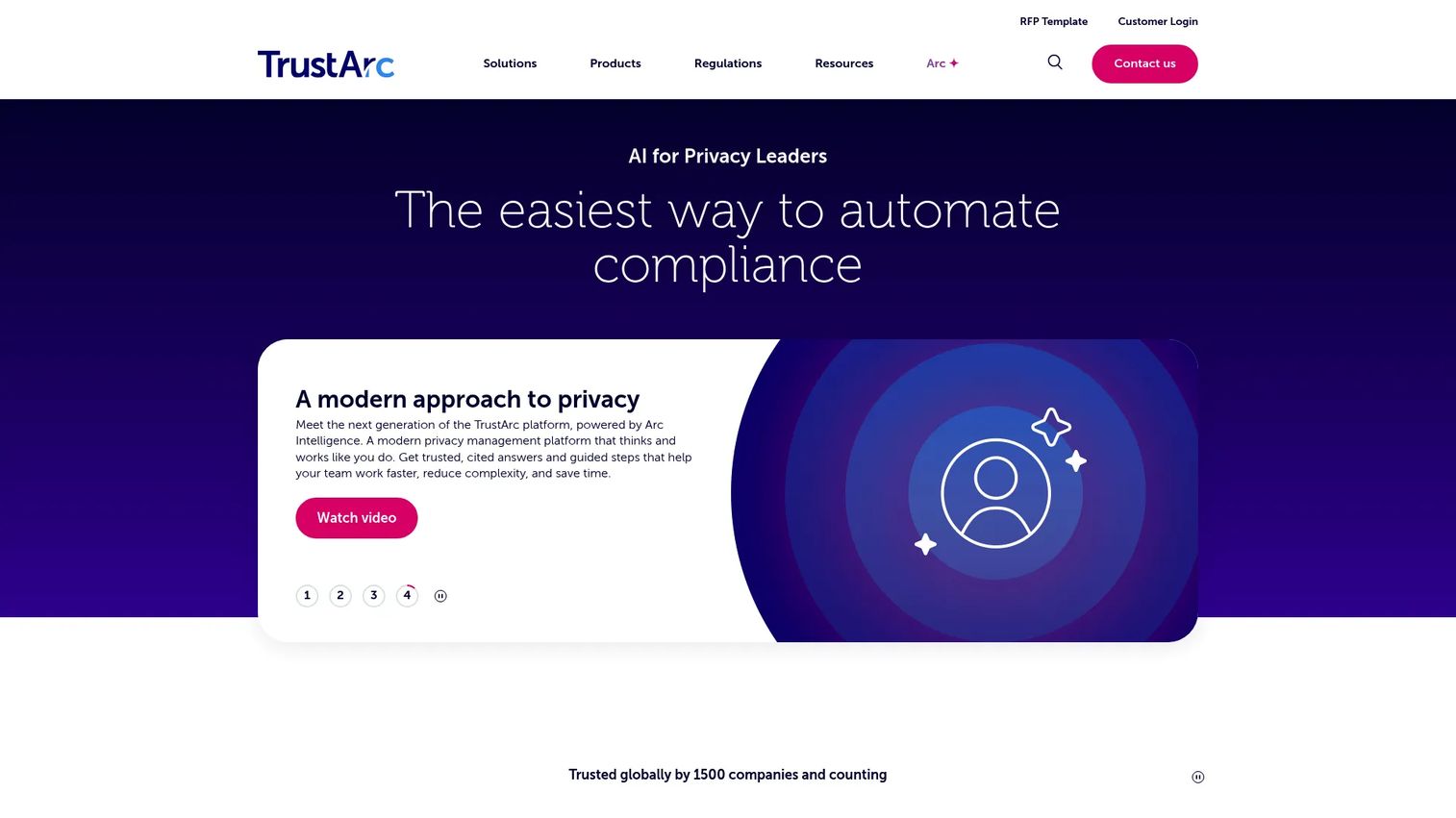
TrustArc is an AI-powered privacy management platform built around compliance, consent, data governance, and trust center workflows. For assessment work, it offers configurable assessment management that spans PIAs, DPIAs, transfer impact assessments, vendor reviews, and AI assessments, with its Arc Intelligence layer assisting the privacy workflows underneath.
Best for: Enterprises that want privacy compliance automation with AI-assisted governance across many assessment types.
Key strengths
- Arc Intelligence AI layer: applies AI to privacy workflows so assessments and reviews move faster.
- Consent and preference management: cookie consent and consumer preference handling alongside assessments.
- Operational breadth: data subject request automation, data mapping, and vendor risk management in one place.
Why choose TrustArc: If your team runs many assessment types and wants them governed under one configurable system, TrustArc fits. It suits product and privacy teams that need executive summaries, remediation routing, and assessments that plug into a wider privacy operation rather than living as standalone forms.
TrustArc pricing: TrustArc does not list public pricing. The site directs prospective buyers to request a demo or message sales for a quote, which is standard for enterprise privacy platforms. Expect a custom annual contract scoped to your program size.
2. OneTrust
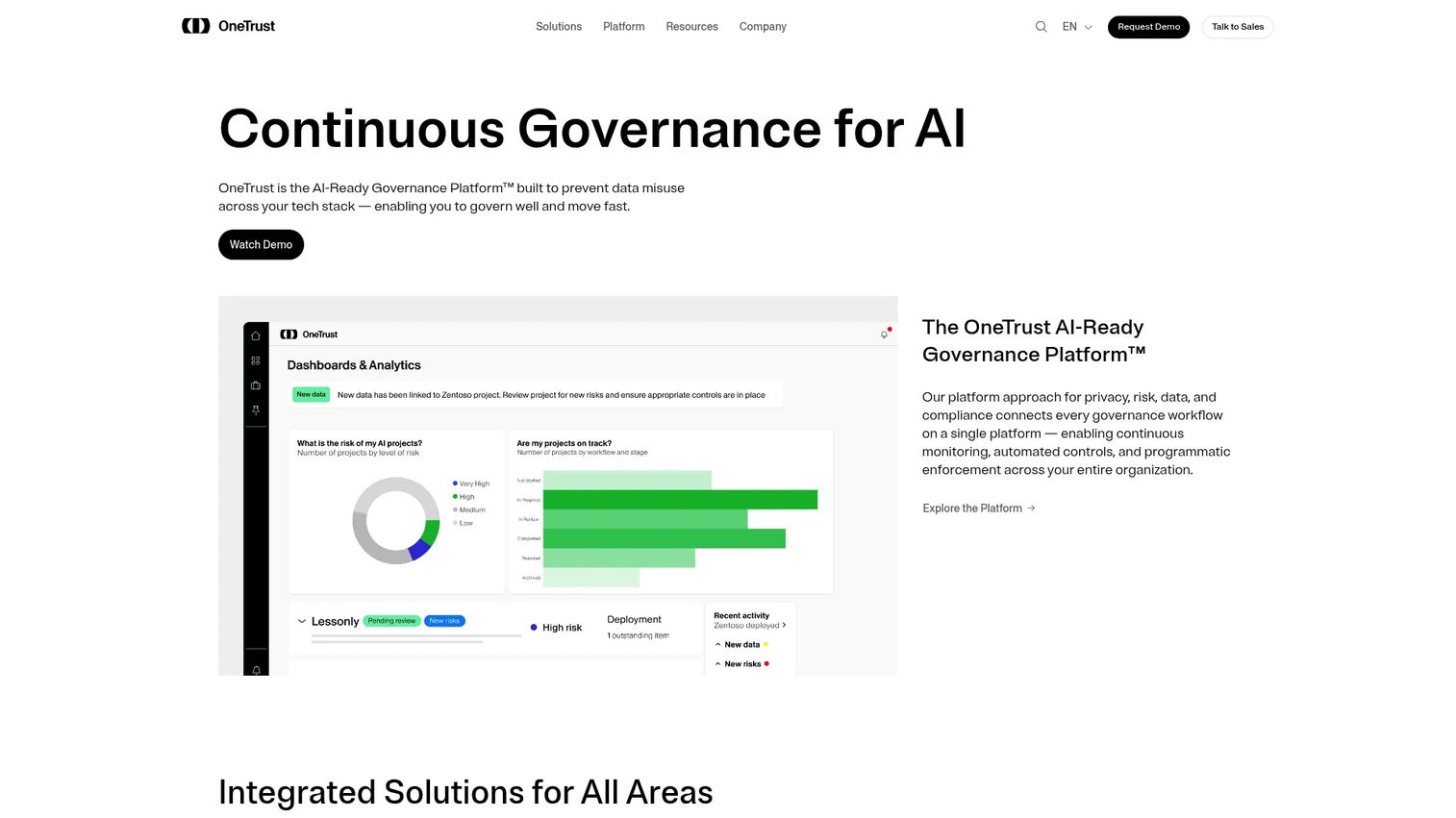
OneTrust is enterprise governance software covering privacy, AI, risk, and compliance. Assessment workflows sit inside a much larger platform, which is why it tends to land with organizations that want PIAs and DPIAs alongside consent management, third-party risk, and AI governance rather than as a point tool.
Best for: Large organizations needing one platform for privacy, consent, AI governance, and third-party risk.
Key strengths
- AI governance: governs models, agents, datasets, and vendors as part of the same program.
- Consent and preference management: handles consent across web, mobile, and CTV.
- Privacy automation: privacy automation and third-party risk management connected to assessment workflows.
Why choose OneTrust: OneTrust is the scale play. If you are standardizing privacy operations across business units and jurisdictions, having assessments inside a broader governance suite reduces tool sprawl and keeps cross-program reporting consistent. It rewards teams ready to commit to a platform, not a single workflow.
OneTrust pricing: OneTrust publishes solution packages but no public dollar amounts. Pricing is value-based and metered on factors like admin users, inventory, visitors, profiles, or data volume, with a customized quote per buyer. There is no free tier.
3. BigID
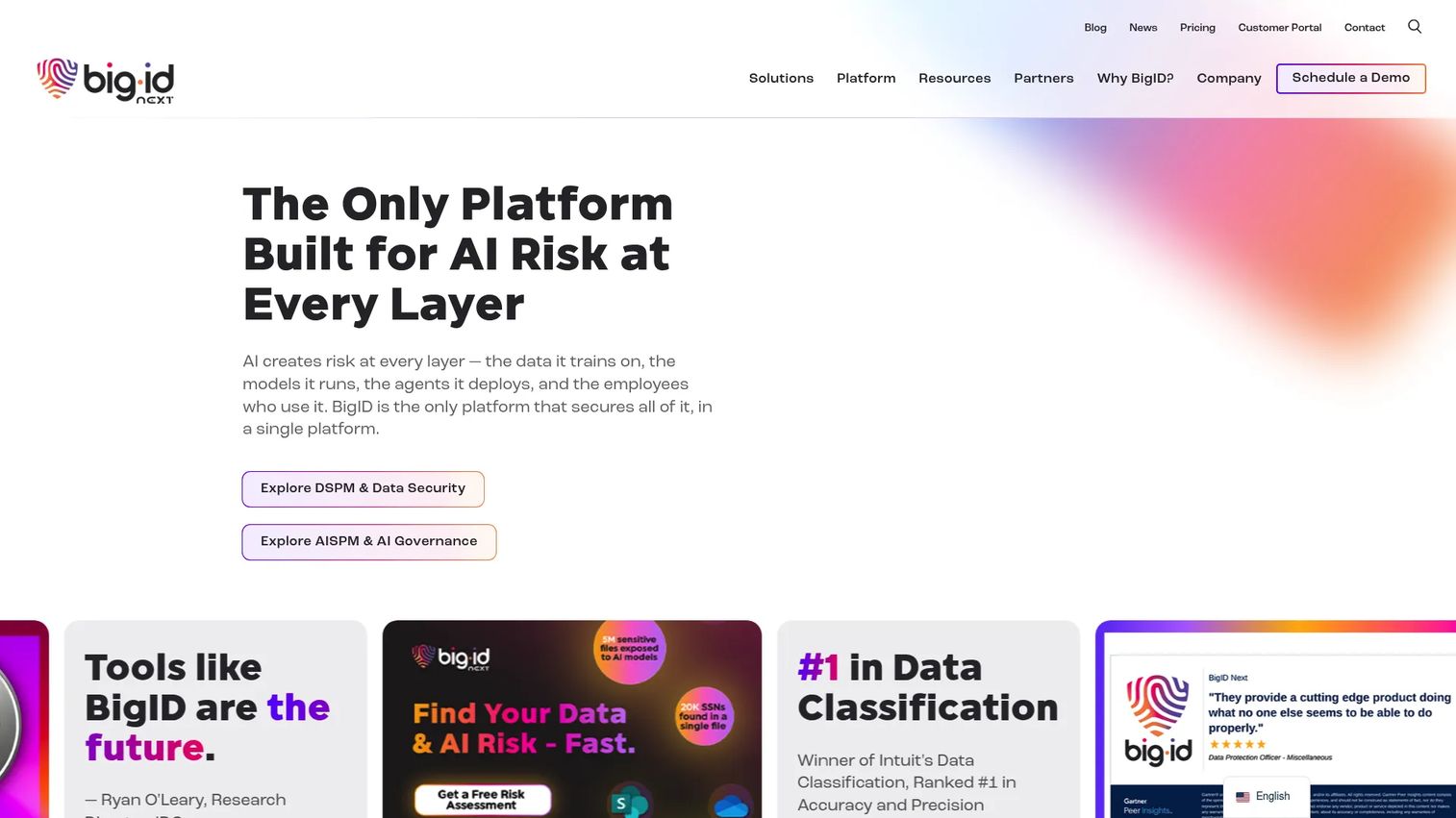
BigID is an enterprise data security, privacy, and governance platform built to discover, classify, and remediate sensitive data at scale. Its assessment value is distinct: PIAs and DPIAs can be informed by data the platform has actually discovered, so risk routing and remediation tracking reflect real data flows rather than self-reported guesses.
Best for: Large enterprises that want assessments grounded in discovered, classified data across many sources.
Key strengths
- Data discovery and classification: enterprise-scale discovery and classification feeding assessment context.
- Security and access governance: DSPM, DLP, access governance, and remediation in one platform.
- Data-aware privacy workflows: privacy and compliance workflows plus AI data governance tied to real data.
Why choose BigID: Choose BigID when the weakness in your current PIAs is accuracy. If assessments depend on someone remembering which systems touch personal data, BigID closes that gap by connecting the assessment to discovered data flows. That makes risk scoring and data mapping more defensible.
BigID pricing: BigID does not publish public pricing. Cost depends on factors like data sources, connectors, deployment type, and support, and the site directs buyers to contact sales. A free trial is available.
4. CNIL open-source PIA software
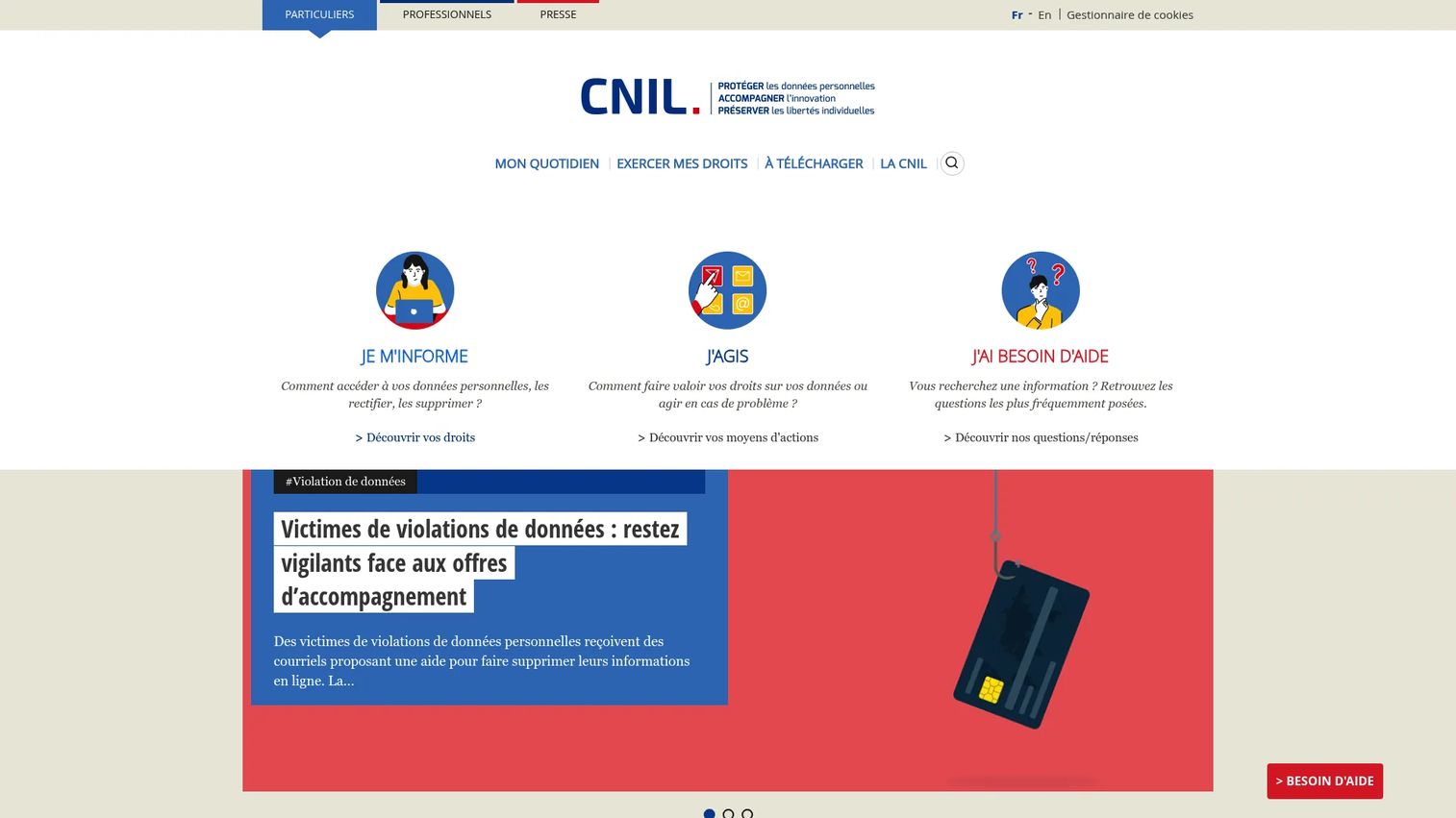
The CNIL open-source PIA software is a free tool from France's data protection authority for conducting data protection impact assessments. It is built around the official DPIA methodology, with a guided, step-by-step workflow and a legal and technical knowledge base baked in. It can run locally or on a server, which appeals to teams that want control over where assessment data lives.
Best for: Organizations that need a free, methodologically sound tool to perform GDPR DPIAs and AIPDs.
Key strengths
- Guided DPIA workflow: a structured, didactic step-by-step process aligned to the official methodology.
- Knowledge base: legal and technical guidance built into the tool.
- Customizable templates: modular knowledge bases and templates teams can adapt.
Why choose CNIL open-source PIA software: This is the option for teams that value transparency, control, and self-hosting. Because it is open source and free, it suits organizations that want defensible DPIA documentation without committing to a commercial contract, and teams that prefer keeping assessment data inside their own environment.
CNIL open-source PIA software pricing: It is free and open source. There are no public paid tiers.
5. Securiti
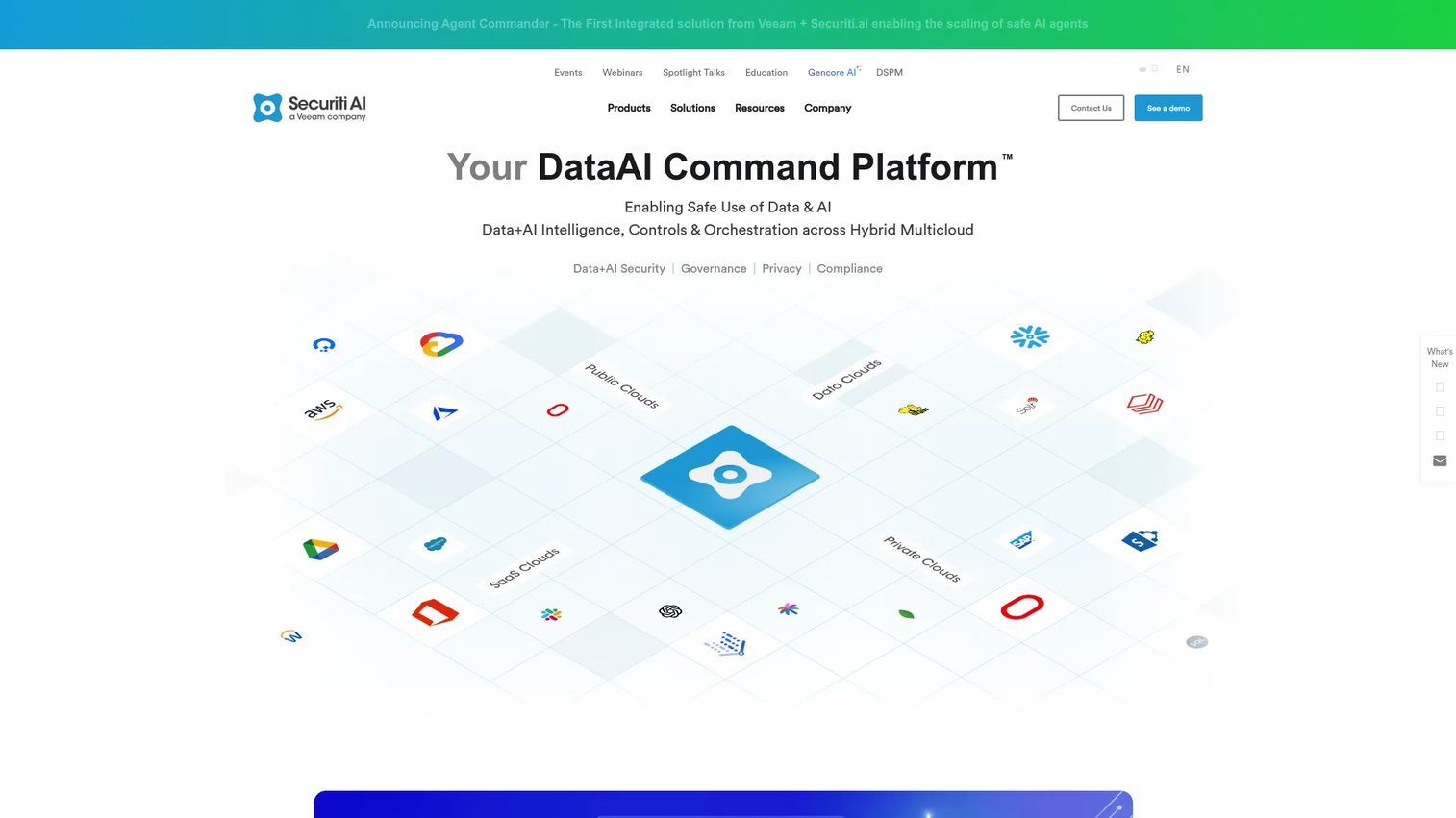
Securiti is a Data and AI command platform spanning data security, privacy, governance, and compliance. For assessment work, it pairs PrivacyOps tooling with program-level orchestration, which makes it a fit for teams already weighing privacy management alongside AI governance in the same buying cycle.
Best for: Enterprises that want unified data security, privacy, governance, and AI controls in one platform.
Key strengths
- Data security posture management: DSPM across hybrid multicloud and SaaS environments.
- PrivacyOps: privacy center, DSR automation, and data mapping supporting assessments.
- AI security and governance: LLM firewalls and agent security for AI risk reviews.
Why choose Securiti: Securiti suits teams whose privacy and AI risk programs are converging. If you expect AI use cases to drive a growing share of your assessments, having privacy workflows and AI governance orchestrated together avoids running two disconnected programs. Its high G2 rating of 4.7/5 reflects strong reviewer sentiment.
Securiti pricing: Securiti uses personalized, quote-based pricing. The pricing page directs buyers to request a custom quote, with no public numeric price listed.
6. Collibra
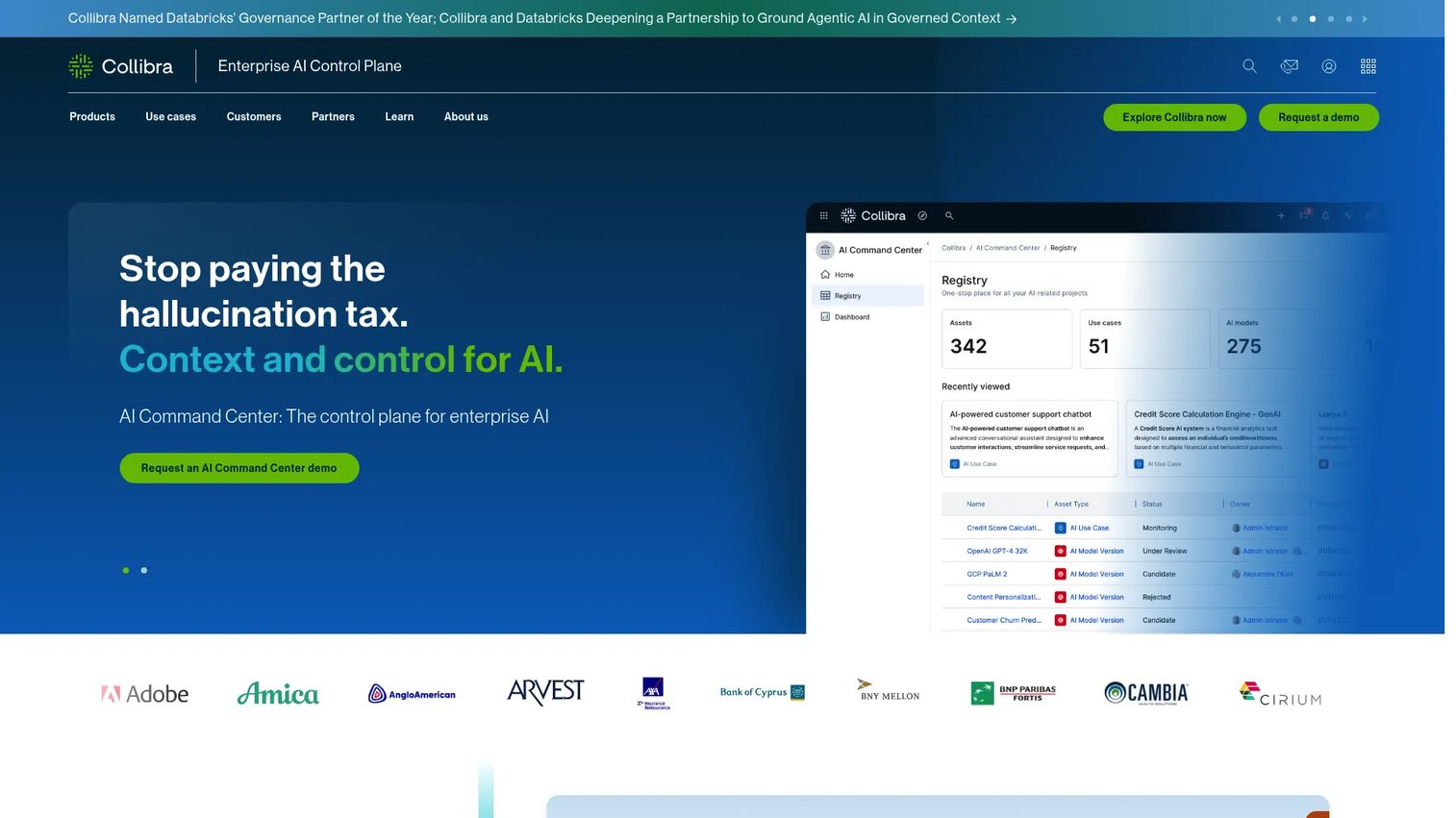
Collibra is an enterprise data and AI governance platform. Its relevance to privedge assessments comes from connection: when privacy assessments live next to data governance, lineage, and stewardship, teams get a clearer picture of what data an assessment actually concerns and where it flows.
Best for: Large organizations that want privacy assessments connected to broader data governance and lineage.
Key strengths
- Data governance: structured governance and stewardship across the data estate.
- Data lineage: lineage that shows where data originates and moves.
- AI governance: an AI governance control plane alongside data governance.
Why choose Collibra: Collibra makes sense when your organization already treats data governance as a discipline and wants privacy assessments to inherit that context. For data-heavy enterprises with mature stewardship functions, tying assessments to lineage strengthens cross-functional coordination and the quality of data mapping and risk management.
Collibra pricing: Collibra does not publish public pricing. Its product pages direct visitors to request a demo or contact sales for a quote scoped to the deployment.
7. Osano
Osano is data privacy management software covering consent, DSARs, vendor risk, data mapping, and assessments. Its appeal is usability: it gives smaller and mid-market teams a quicker, less heavy route into structured privacy workflows without a long implementation.
Best for: Smaller and mid-market teams that want an all-in-one privacy compliance platform with a fast start.
Key strengths
- Cookie consent management: consent handling for web properties.
- Subject rights automation: DSAR automation to manage data subject requests.
- Vendor risk management: vendor assessments alongside privacy workflows.
Why choose Osano: Osano fits teams that want privacy operations running quickly without the overhead of an enterprise rollout. For a privacy lead at a growing company, it covers the core jobs (consent, DSARs, vendor risk, assessments) in one place, which keeps the stack simple while the program matures.
Osano pricing: Osano emphasizes self-service plans plus demo-led sales and offers a free 30-day trial. No public dollar amount was visible on its plans page at the time of writing.
8. heyData
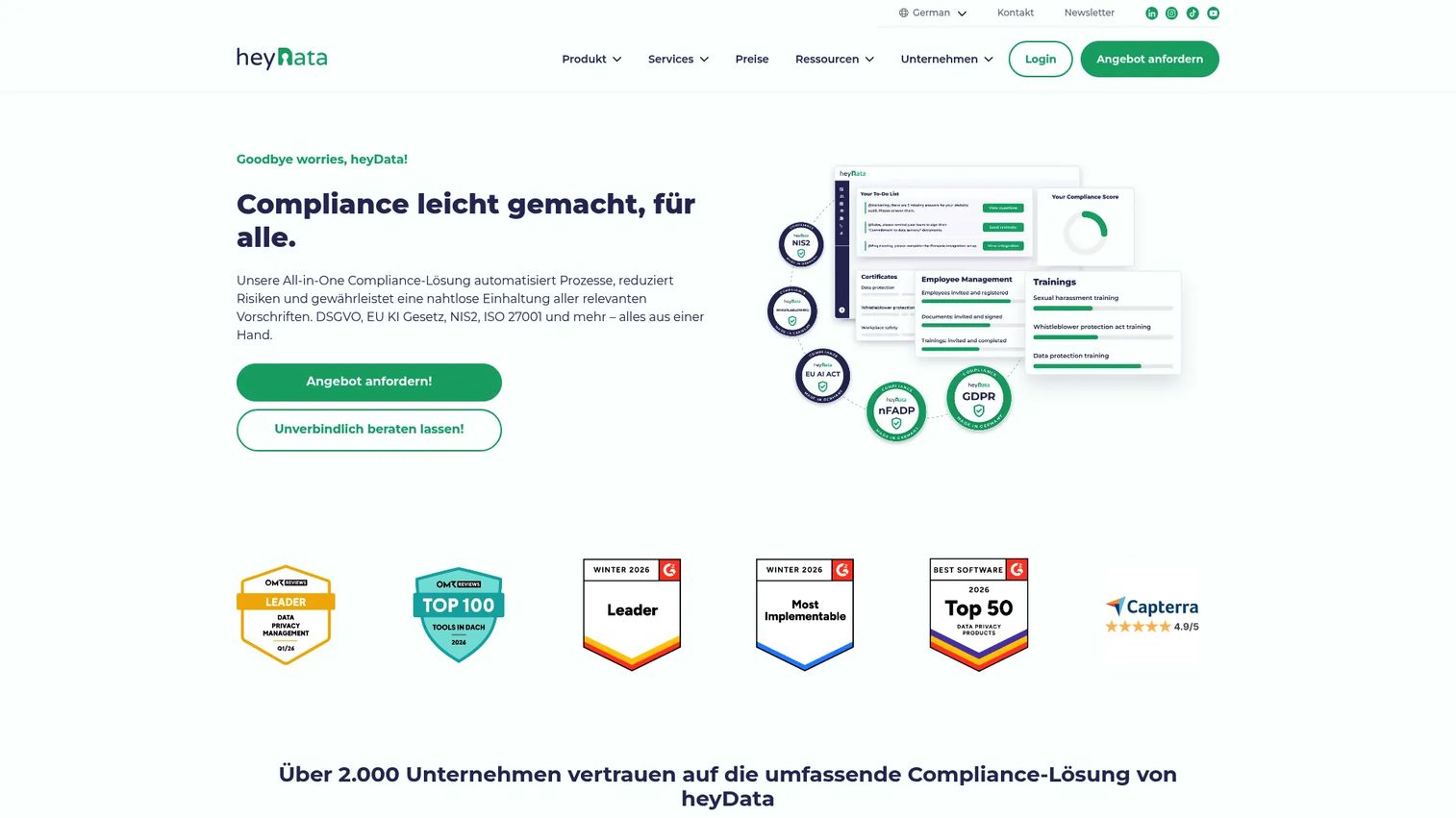
heyData is compliance software paired with expert services, aimed at SMBs working through GDPR and related frameworks. The emphasis is on streamlined, guided compliance management rather than a heavyweight platform, which suits teams that want practical assessment management plus a human to ask.
Best for: SMBs that want guided compliance management for privacy and security requirements.
Key strengths
- Compliance dashboard: a digital compliance management dashboard to track status.
- Automated processes: automated audits and processes that reduce manual work.
- Expert support: online training and access to legal experts.
Why choose heyData: heyData fits smaller teams without a dedicated privacy department who still need defensible compliance. The combination of software and expert support means a product manager or office lead can run assessments and audits with guidance rather than figuring out the methodology alone.
heyData pricing: heyData presents pricing as a free consultation followed by a personalized offer rather than public prices on its own site. Plan tiers are referenced through third-party listings, but the brand routes buyers to a custom quote.
9. DataGuard
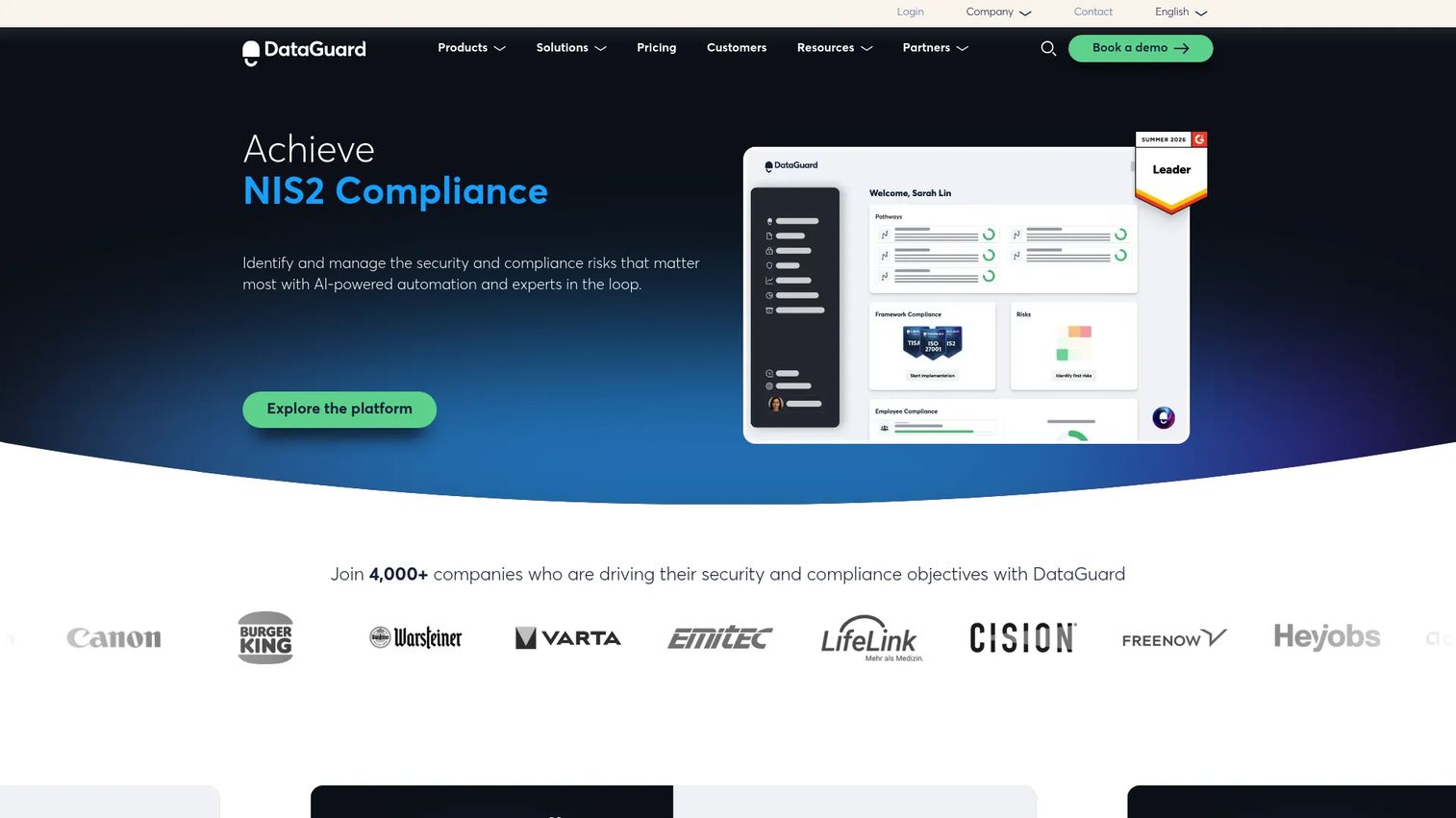
DataGuard is a security and compliance software platform for managing privacy, risk, and governance programs. It positions itself as software plus expert support, with frameworks and workflows for GDPR, ISO 27001, TISAX, NIS2, and the EU AI Act, making it a fit for organizations that want operational help as well as tooling.
Best for: Teams that want a guided security and compliance platform with expert support.
Key strengths
- Unified platform: security and compliance managed in one place.
- AI-powered automation: automation paired with expert support to cut manual work.
- Multi-framework coverage: workflows for GDPR, ISO 27001, TISAX, NIS2, and the EU AI Act.
Why choose DataGuard: DataGuard suits teams that want more than software, they want a managed path to compliance. If your privacy program is understaffed and you would rather lean on guided workflows and expert support than build the methodology in-house, DataGuard is built for that. Its 4.6/5 G2 rating reflects strong support sentiment.
DataGuard pricing: DataGuard offers Base, Pro, and Enterprise tiers, all quote-based. The pricing page shows "Get a quote" for each tier with no public numeric price.
10. PrivacyEngine
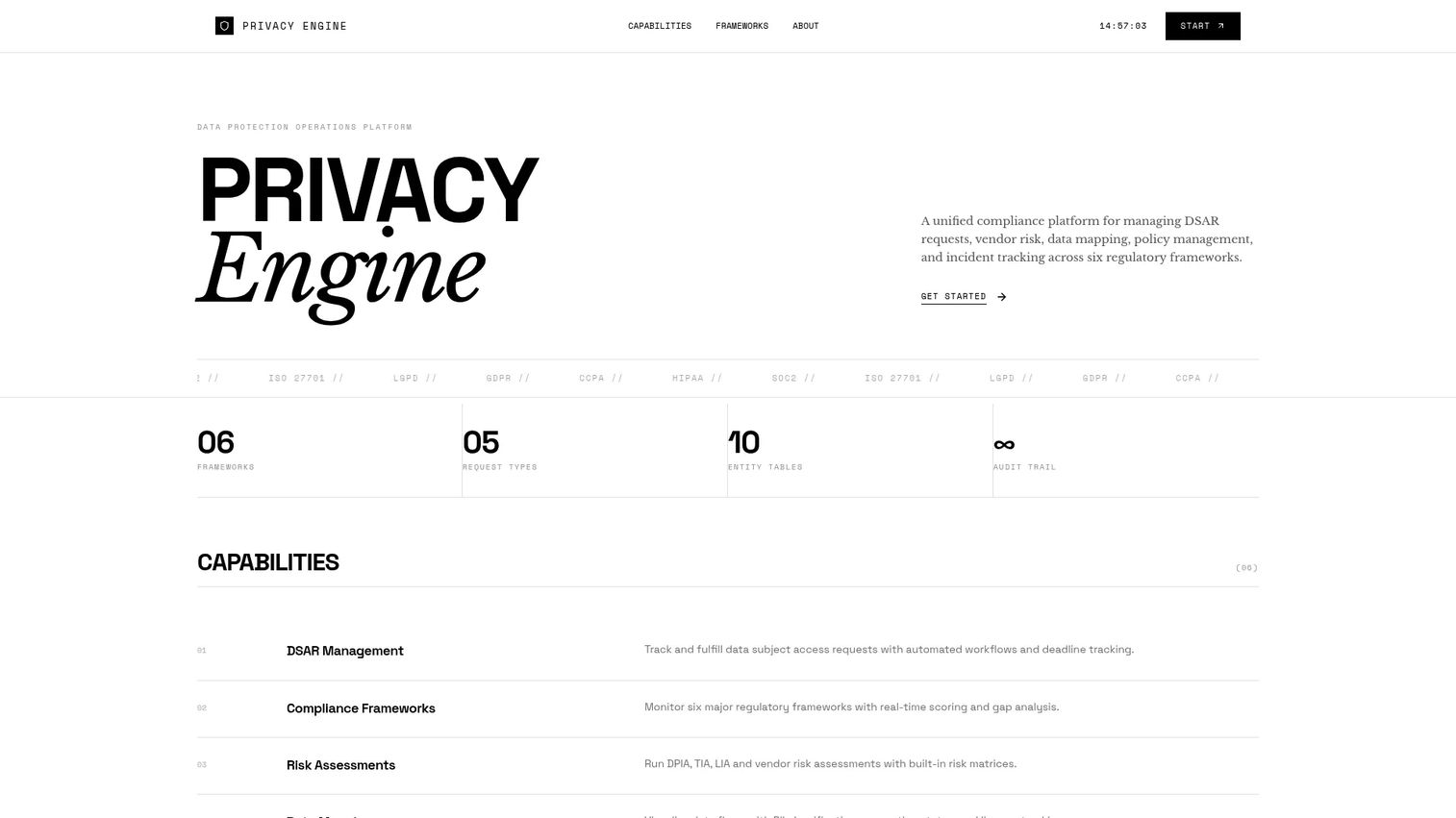
PrivacyEngine is a data protection operations platform for managing privacy compliance workflows. It consolidates DSAR management, vendor risk, data mapping, policy management, and incident tracking into a single platform, which makes it practical for smaller European and GDPR-focused teams running real compliance operations.
Best for: Privacy and compliance teams needing a unified platform for GDPR and CCPA-style operations.
Key strengths
- DSAR management: structured handling of data subject access requests.
- Vendor and risk assessments: vendor risk and risk assessment workflows.
- Data mapping and incident response: data mapping, policy management, and incident tracking together.
Why choose PrivacyEngine: PrivacyEngine fits teams that want one platform to run day-to-day privacy operations without enterprise complexity. For a GDPR-focused team, having assessments, DSARs, data mapping, and incidents under one roof keeps execution tight. Its 4.7/5 G2 rating signals strong user satisfaction.
PrivacyEngine pricing: PrivacyEngine shows a "Start Free" call to action on its site, indicating a free entry point, but no public pricing figures were visible at the time of writing. Expect to request a quote for paid tiers.
11. PrivIQ
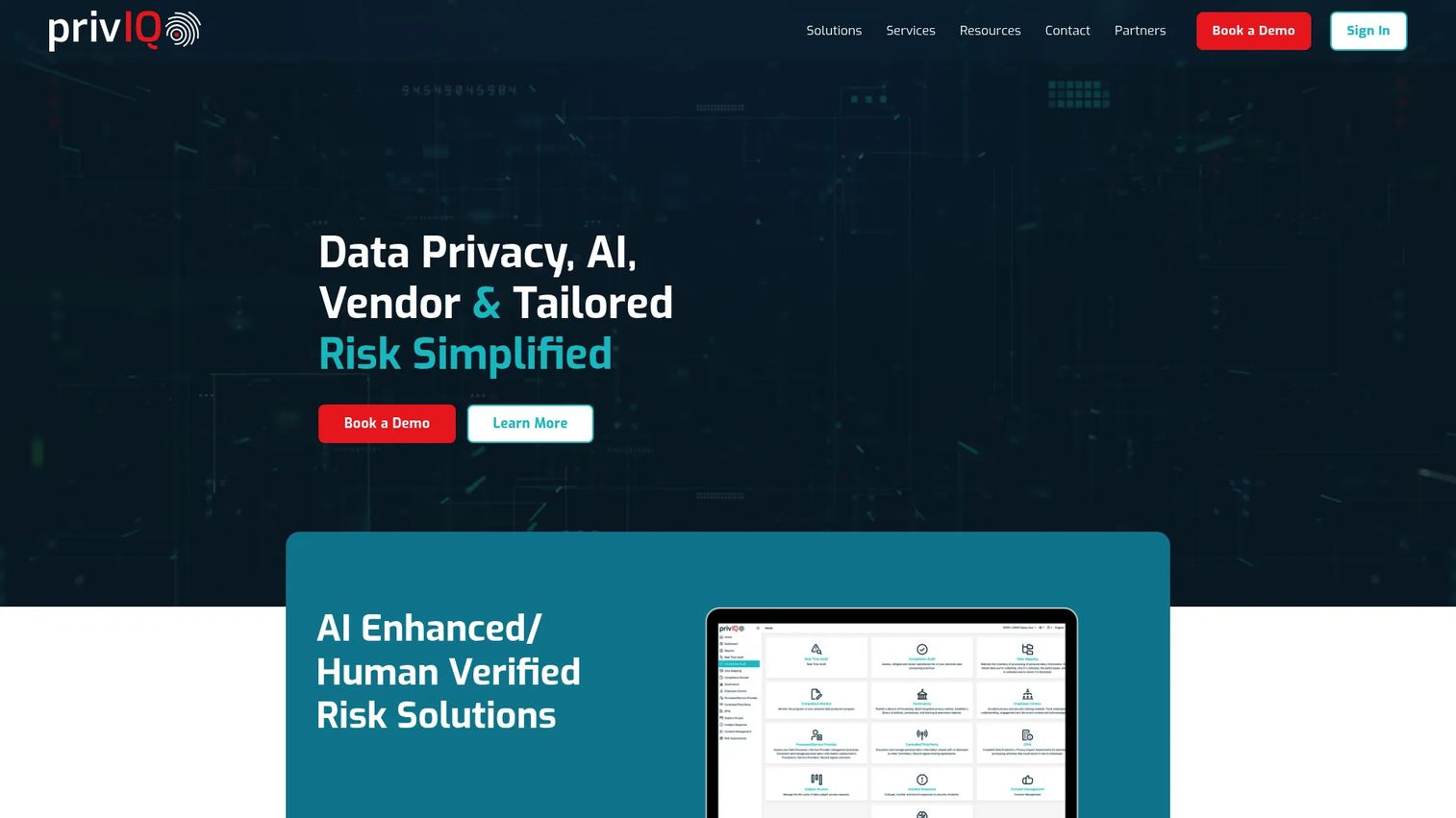
PrivIQ is privacy and operational risk management software for compliance programs. It covers assessment handling, data mapping, and reporting, positioning itself as a configurable compliance management platform for teams that want assessment support inside a broader privacy program.
Best for: Teams that want a configurable privacy compliance and risk management platform.
Key strengths
- AI-assisted compliance: AI-assisted privacy compliance management.
- Records of processing: data mapping and record-of-processing support.
- Risk and breach management: DSAR, breach, and privacy risk management together.
Why choose PrivIQ: PrivIQ suits teams that want configurability without enterprise overhead. If your privacy program spans data mapping, DSARs, breach handling, and assessments, PrivIQ brings them under one configurable platform. Its 4.7/5 G2 rating reflects positive reviewer sentiment.
PrivIQ pricing: PrivIQ does not publish public pricing. The site uses a pricing request form, so expect a custom quote based on your program scope.
12. Transcend

Transcend is enterprise privacy and AI governance software for managing data inventory, consent, data subject requests, discovery, and assessments. Its strength is automation tied to systems and data flows, which fits organizations that want privacy processes wired directly into their data infrastructure rather than handled as separate paperwork.
Best for: Large organizations needing a unified privacy operations platform tied to systems and data.
Key strengths
- Data inventory: automated system and data discovery feeding privacy operations.
- Consent management: consent across web, app, and backend flows.
- DSR automation: automated access, deletion, export, and preference updates.
Why choose Transcend: Transcend fits engineering-forward organizations that want privacy automation connected to actual systems. If your data flows are complex and you want assessments and privacy processes to reflect what is really happening in your infrastructure, Transcend's systems-level approach is the differentiator. Its 4.6/5 G2 rating supports the case.
Transcend pricing: Transcend uses quote-based pricing. The pricing page directs buyers to reach out for package quotes, with custom packages available for more complex needs.
Considerations before you buy
The right tool depends less on feature counts and more on how your team actually works. Use this checklist before committing.
Workflow depth, not just a questionnaire form
A pretty DPIA questionnaire is table stakes. The value is in what happens after submission: routing, reminders, approvals, and status tracking. Evaluate whether the tool moves a review forward on its own or just stores a form.
Data mapping and risk visibility
Assessments are only as accurate as the data picture behind them. If you struggle to know which systems touch personal data, prioritize tools with strong data mapping and risk management, or data-aware platforms that ground assessments in discovered data.
Approval routing and ownership
Reviews stall when ownership is unclear. Check that the platform assigns owners, escalates overdue steps, and routes to legal or security review automatically based on risk score. Clear ownership is what keeps launches on schedule.
Reporting and evidence quality
When an auditor asks for proof, you need audit-ready reporting and clean evidence export: who reviewed, what was flagged, how it was remediated, and when it was signed off. Test the export quality, not just the dashboard.
Integrations with your stack
A privacy tool that does not connect to your ticketing, data, and CRM systems creates a new silo. Confirm it integrates with the systems your team already uses so assessments fit existing workflows instead of adding a tab.
Implementation effort and maintenance
Match the tool to your maturity. A heavyweight platform you cannot staff is worse than a lighter tool you actually use. Be honest about who will own and maintain the workflow over time.
Conclusion
The best privacy impact assessment software is the one that matches your current workflow complexity and reporting needs, not the one with the longest feature list.
Enterprise teams running many assessment types across jurisdictions should prioritize deep workflow automation and cross-program reporting, where platforms like OneTrust, TrustArc, and Transcend fit. Data-heavy companies should look for data-aware risk workflows that ground assessments in discovered data, which is where BigID, Securiti, and Collibra stand out. Smaller and mid-market teams often move faster with lighter, all-in-one tools like Osano, PrivacyEngine, or heyData, and teams that want a free, methodologically sound starting point can begin with the CNIL open-source PIA software.
Start with the tool whose workflow depth and evidence export match how your reviews actually run today. The goal is simple: make PIAs and DPIAs move fast enough to keep launches on schedule while still producing documentation you can defend.
FAQs
Privacy impact assessment software helps teams evaluate the privacy risk of a project, feature, or data flow before launch, then document and route the review for sign-off. It replaces spreadsheets and email chains with structured questionnaires, risk scoring, remediation tracking, and audit-ready reporting.
A privacy impact assessment (PIA) is a general process for evaluating privacy risk in any initiative. A data protection impact assessment (DPIA) is the specific form required under GDPR for processing likely to result in high risk to individuals. A DPIA is essentially a regulated, more formal type of PIA, and most modern tools support both.
If you process personal data and have to demonstrate compliance, structured assessments help, even at small scale. Smaller teams often start with lighter, all-in-one platforms or the free CNIL open-source PIA software rather than a full enterprise suite. The trigger is usually rising review volume or an audit request, not company size alone.
Workflow automation, risk scoring, remediation tracking, and audit-ready reporting matter most, because they are what turn a static form into a managed process. Reusable templates and data mapping come next. The single biggest differentiator is whether the tool moves reviews forward on its own or just stores them.
Yes. Many platforms now include AI governance and AI risk assessment workflows alongside traditional PIAs and DPIAs. If AI use cases are a growing share of your reviews, prioritize tools that treat AI assessments as a first-class workflow rather than a bolt-on.
The proof is the evidence trail: a timestamped record of who reviewed the assessment, what risks were flagged, how they were remediated, and when sign-off happened. Strong privacy assessment software generates this automatically through evidence export, so you can hand an auditor a complete record rather than reconstructing it.
No. It structures and accelerates the process, routes reviews to the right people, and documents decisions, but it does not replace legal judgment. The software makes legal and privacy review faster and more consistent. The professional sign-off still belongs to qualified reviewers.
Product teams should prioritize speed and integration: reviews fast enough to avoid delaying releases, automatic routing so privacy is looped in early, and connections to ticketing and data systems so assessments fit existing workflows. The goal is to gate launches responsibly without making privacy review the bottleneck.