You are buying display in one tool, paid social in another, retargeting in a third, and CTV through an agency. Five dashboards. Three attribution windows that disagree. A finance team that wants one number for ROAS, and a spend report that takes you most of a Monday to assemble by hand.
That fragmentation is not a small annoyance. It quietly inflates CAC, hides which channels actually move pipeline, and forces you to defend budget with data you do not fully trust. And the stakes keep rising. The global cross-channel advertising software market was valued at roughly US$993.2M in 2024 and is projected to reach US$2.9B by 2034, growing at a 12.6% CAGR, according to Prophecy Market Insights (2024). Spend is consolidating, and so are the tools that manage it.
The fix is not another point solution. It is a platform that plans, buys, measures, and optimizes across channels from one place, so you spend less time stitching reports together and more time finding the levers that work. If you are already auditing the wider stack, it helps to look at adjacent categories too, like marketing automation, marketing analytics, and how a customer data platform feeds clean audiences into ad delivery. This guide focuses on the buying decision: which cross channel advertising software fits your channels, your attribution model, and your budget in 2026.
What's inside
This guide covers 8 cross channel advertising platforms chosen for real buyer fit, not feature-sheet bragging. We weighed four things: genuine channel coverage (search, social, display, video, CTV, retail media), measurement and attribution depth, data and integration quality with your CRM and analytics, and how pricing scales with spend.
It is written for growth marketers, demand gen leads, and media buyers evaluating a platform to centralize campaign execution and reporting. If you are trying to reduce tool sprawl and prove paid media ROI across channels, this is the shortlist to start from. Each entry includes who it fits, where it stands out, and pricing context where it is public.
TL;DR
- Strongest overall for most teams: The Trade Desk for independent, omnichannel programmatic reach with deep measurement, holding a 4.4/5 G2 rating.
- Best for teams already in Google: Google Marketing Platform unifies ad buying and analytics under one roof.
- Best for ecommerce and retail media: Criteo Commerce Growth and Skai for commerce-data-driven activation.
- Best for fast setup and retargeting: AdRoll for smaller teams that want cross-channel ads live quickly.
- Best for mid-market programmatic: StackAdapt for AI-driven buying across display, native, video, and CTV.
- Best for enterprise media workflows: Adobe Advertising Cloud and Innovid for centralized, multi-screen campaign management.
What cross channel advertising software actually is
Cross channel advertising software is a platform that lets marketers plan, buy, measure, and optimize paid campaigns across multiple channels, such as search, social, display, video, CTV, and retail media, from a single interface.
The terms get muddied, so worth being precise. Multi-channel means you run ads on several channels, but each operates more or less independently. Cross-channel means those channels are coordinated, sharing audiences, budgets, and measurement so a prospect's journey carries across them. Omnichannel goes one step further, treating every touchpoint as part of one continuous, consistent customer experience. A cross channel advertising platform sits squarely in the middle and tilts toward omnichannel as its data and identity capabilities mature.
Core capabilities you should expect from any serious cross channel marketing platform:
- Media buying and activation across programmatic and managed channels (display, video, CTV, native, audio, social, retail media).
- Audience targeting and segmentation using first-party and third-party data, with identity resolution to connect users across devices.
- Campaign orchestration so budgets, pacing, and creative are managed centrally rather than per channel.
- Attribution and measurement that ties spend to outcomes with a model your finance team will accept.
- Reporting and integrations that pull everything into unified dashboards and sync with your CRM, analytics, and broader stack.
In the ad tech stack, these tools sit between your data layer (CDP, analytics, CRM) and the channels themselves. Some are full demand-side platforms (DSPs) that buy programmatic inventory directly. Others are orchestration and ad management software layers that coordinate buying across owned channel accounts and DSPs. Most modern platforms blend both, which is exactly why the category matters for teams drowning in disconnected tools. If your acquisition motion also leans on account-based plays, pair this with account based marketing software for tighter targeting.
When to use cross channel advertising software
Use it when your channels are fragmented
If you are managing paid search in one console, paid social in two ad managers, display in a DSP, and retargeting somewhere else, you are paying a coordination tax every single day. Audiences overlap without you knowing. Frequency caps do not hold across channels. The same prospect sees the same creative six times in one place and never in another. A cross channel ad platform consolidates that buying so your budget works as one system, not five competing ones.
Use it when reporting needs to be cleaner
When leadership asks which channels drove pipeline last quarter, you should not need a week and three exports to answer. These platforms surface unified metrics and attribution so you can show, with defensible data, where spend actually influenced revenue. That clarity is what lets you protect budget in a tight planning cycle and reallocate fast when a channel starts deteriorating. Clean marketing analytics is the difference between defending CAC and guessing at it.
Use it when the team is scaling
Manual campaign management works at small scale. It breaks the moment your channel mix grows, more stakeholders need sign-off, and budgets get big enough that a pacing mistake costs real money. As you add markets, product lines, and reviewers, cross channel campaign management tools give you the orchestration, governance, and automation to scale without the process collapsing under its own weight.
Comparison table
We ranked these 8 tools by relevance to the core cross channel advertising software job: genuine channel coverage, measurement strength, data integration, and how well pricing scales with spend. Ratings reflect current G2 listings. Pricing reflects what each vendor publishes; several gate exact figures behind sales, which is common for media-buying software priced on spend.
| # | Product | Intent | Key differentiation | Pricing | G2 rating |
|---|---|---|---|---|---|
| 1 | The Trade Desk | Independent omnichannel programmatic | Largest independent DSP, deep CTV and identity | Contact sales | 4.4/5 |
| 2 | Google Marketing Platform | Unified ad buying plus analytics | Native Google ecosystem and measurement | Free tools and enterprise solutions | 4.1/5 |
| 3 | StackAdapt | AI-driven programmatic | Multi-channel buying with strong UX | Contact sales | 4.7/5 |
| 4 | Skai | Omnichannel commerce media | Retail media, search, and social in one | From $114k/year | 4.0/5 |
| 5 | Criteo Commerce Growth | Commerce performance advertising | Commerce data set for acquisition and retention | Contact sales | 3.8/5 |
| 6 | AdRoll | Cross-channel retargeting | Fast setup, pay-as-you-go entry | Pay-as-you-go | 4.1/5 |
| 7 | Adobe Advertising Cloud | Enterprise DSP plus Adobe stack | Adobe Analytics integration | Contact sales | 3.7/5 |
| 8 | Innovid | Multi-screen ad serving and measurement | Creative versioning and CTV measurement | Contact sales | 4.1/5 |
Best cross channel advertising software for 2026
1. Google Marketing Platform
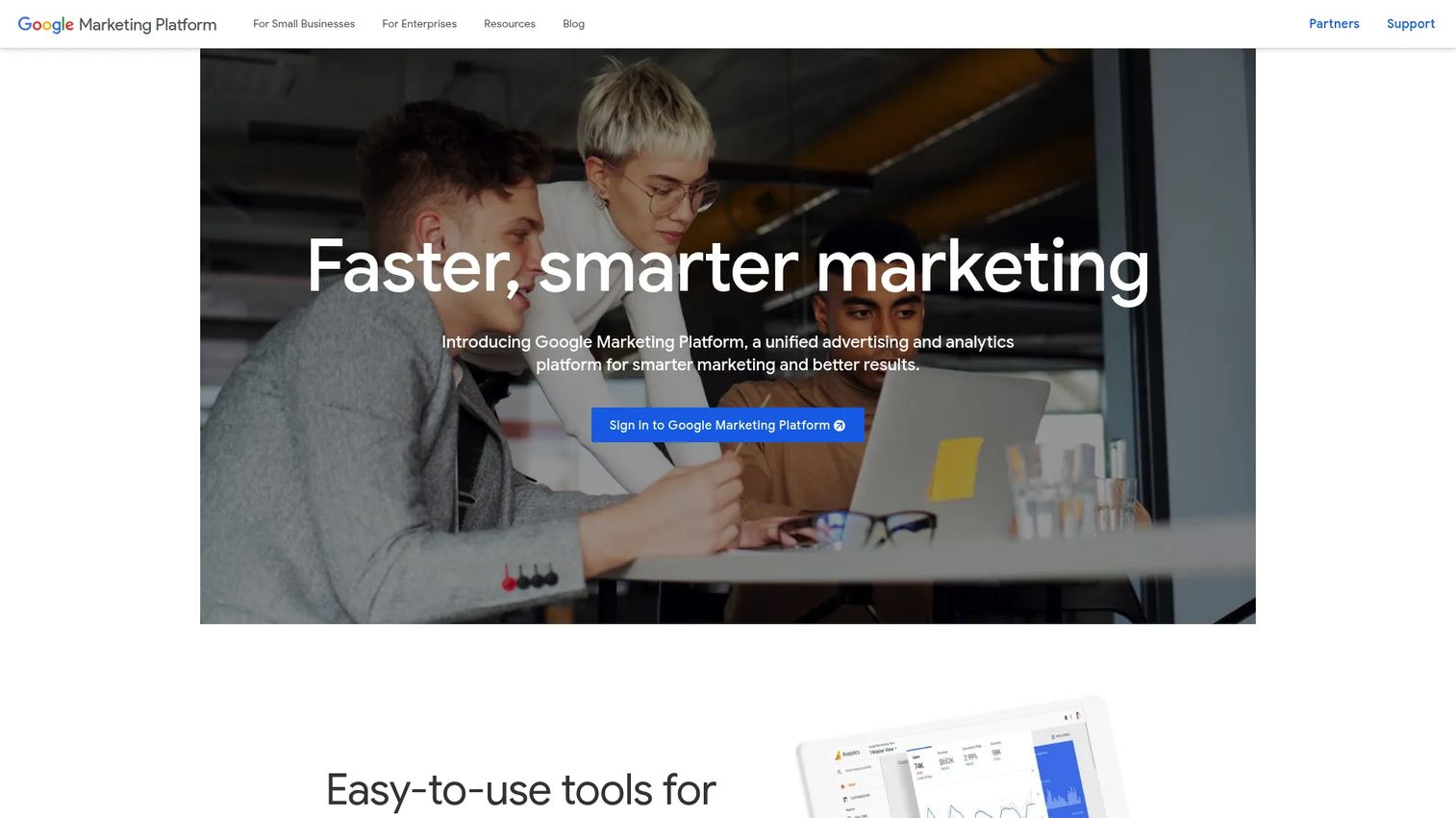
Google Marketing Platform is Google's unified advertising and analytics platform, bringing together Analytics, Tag Manager, Campaign Manager 360, Display & Video 360, and Search Ads 360 under one umbrella. For teams that already run paid search and analytics inside Google, it removes the seams between buying and measurement that usually cost you the most reconciliation time.
Best for: Large teams already living in Google's ad-tech and analytics ecosystem who want buying and measurement in one stack.
Key strengths
- Unified advertising and analytics: Buy across display and video while measuring in the same environment, so attribution stays consistent.
- Display & Video 360 reach: Programmatic buying across display, video, and connected inventory at scale.
- Search Ads 360 management: Manage and optimize large search programs across engines from one console.
Why choose Google Marketing Platform: If your measurement already runs on Google Analytics and your search spend is significant, the native integration is hard to beat for reducing data discrepancies. Teams that buy heavily outside Google's inventory, especially independent CTV and retail media, may find a dedicated DSP gives broader neutral reach.
Google Marketing Platform pricing: Google offers free tools for small businesses and advanced enterprise solutions, but no public list price is shown on the brand site. Pricing for enterprise products is handled through sales and partners, so plan to scope a quote against your spend and seat needs.
2. The Trade Desk
The Trade Desk is an independent omnichannel demand-side platform for programmatic advertising. Because it is not tied to its own media inventory, buyers get neutral reach across CTV, mobile, display, audio, native, and video, paired with a strong identity framework for targeting across devices. It is the platform most performance teams reach for when they want scale without a walled garden.
Best for: Advertisers and agencies running programmatic campaigns across multiple channels who want independence from any single media owner.
Key strengths
- Omnichannel activation: Plan, buy, and measure across CTV, mobile, display, audio, native, and video from one platform.
- Identity and audience targeting: Combine first-party and third-party data with an identity framework that follows users across devices.
- Measurement depth: Connect spend to outcomes with reporting built for cross-channel optimization, not single-channel vanity metrics.
Why choose The Trade Desk: Its independence is the differentiator. You buy the best inventory across the open internet rather than being steered toward one owner's supply. With a 4.4/5 G2 rating and one of the strongest reputations in programmatic, it is the default for teams serious about CTV and identity. Smaller teams without programmatic experience may want managed support to use it well.
The Trade Desk pricing: No public price is listed; The Trade Desk routes pricing through its sales team. Programmatic platforms typically price on a percentage of media spend or platform fee, so cost scales with your buying volume.
3. Adobe Advertising Cloud
Adobe Advertising Cloud is Adobe's digital advertising platform for planning, buying, measuring, and optimizing campaigns across channels. Its biggest pull is the connection to Adobe Analytics and the wider Adobe experience stack, which matters for enterprises that already run their data and content there.
Best for: Enterprise marketing teams that need an integrated DSP with deep Adobe ecosystem connections.
Key strengths
- Omnichannel media buying: A demand-side platform that buys across display, video, audio, and more from one workflow.
- Adobe Analytics integration: Pull campaign data into the same analytics environment your team already uses for reporting.
- Brand safety and attribution: Built-in tools for safe placements, measurement, and cross-channel attribution.
Why choose Adobe Advertising Cloud: For large teams standardized on Adobe, the value is centralization. Media buying, analytics, and content live in one connected environment, which cuts handoffs between systems. Teams without an existing Adobe footprint should weigh whether the ecosystem benefit justifies the commitment versus an independent DSP.
Adobe Advertising Cloud pricing: Adobe states it offers flexible packages, including usage-based or subscription plans, but no public price is displayed. Expect a sales-led quote scoped to your media volume and the Adobe products you already license.
4. AdRoll

AdRoll is a multichannel advertising platform best known for retargeting, brand awareness, and ABM campaigns. It leans into ease of use and fast setup, which is exactly why smaller and growth-stage teams gravitate to it. You can get cross-channel ads live across display, native, social, and connected TV without a dedicated media-buying specialist.
Best for: Brands and agencies that want self-serve cross-channel retargeting and paid media management with minimal ramp time.
Key strengths
- Retargeting across channels: Re-engage visitors across display, native, social, and mobile from one platform.
- Cross-channel attribution: See how channels work together rather than crediting the last click by default.
- Multi-channel campaign management: Run social and display campaigns and an automation builder without juggling separate tools.
Why choose AdRoll: The appeal is speed and simplicity. For a lean team that needs retargeting and cross-channel ads working this week, AdRoll's pay-as-you-go entry lowers the barrier. Teams running large, complex programmatic programs across many markets may eventually need a broader DSP, but for fast setup and retargeting, AdRoll holds a solid 4.1/5 on G2.
AdRoll pricing: Self-service Ads are pay-as-you-go with no fee to get started, billed on dynamic CPM. Managed Services and the Advanced Package require contacting sales. AdRoll notes a minimum daily spend of $5 and a minimum daily budget of $10 to launch a campaign.
5. Skai
Skai is an omnichannel commerce media platform for managing, automating, and optimizing digital advertising across search, social, and retail media. It is purpose-built for advertisers with a complex channel mix where retail media networks sit alongside search and social, and it layers GenAI-powered optimization on top.
Best for: Brands and agencies managing large-scale omnichannel media programs, especially those with significant retail media spend.
Key strengths
- Omnichannel commerce coverage: Manage retail media, search, and social campaigns in one platform built for commerce.
- Celeste AI optimization: GenAI-powered features for bidding, budgeting, and campaign optimization.
- Automation at scale: Bidding, budgeting, and optimization tools designed for large, complex programs.
Why choose Skai: If retail media is a serious part of your mix, Skai's commerce focus is a genuine differentiator over general-purpose DSPs. The public pricing also signals who it is for: this is an enterprise-scale platform for advertisers spending millions per year. Smaller teams will find the entry tier well above their budget.
Skai pricing: Skai publishes annual pricing. The Standard plan starts at $114k per year for advertisers spending up to $4M/year, Advanced is $276k per year (up to $10M/year), Enterprise is $504k per year (up to $20M/year), and Enterprise Premier is $756k per year (up to $35M/year). Enterprise Premier + is custom. There is no free tier.
6. Criteo Commerce Growth
Criteo Commerce Growth is an AI-powered commerce advertising platform built for customer acquisition and retention across channels. Its edge is its commerce data set, drawn from a vast volume of shopping journeys, which feeds audience modeling for performance campaigns. For ecommerce teams, that commerce signal is the whole point.
Best for: Brands and agencies that need commerce-data-driven performance advertising across web, social, video, and CTV.
Key strengths
- AI-powered audience modeling: Build high-intent audiences from commerce behavior rather than generic interest data.
- Cross-channel reach: Run acquisition and retention campaigns across web, social, video, and CTV.
- Measurement with GA4 and incrementality: Validate true lift with incrementality testing, not just last-click credit.
Why choose Criteo Commerce Growth: For ecommerce and retail teams, the commerce data set is what separates it from horizontal DSPs. If your goal is acquiring and retaining shoppers, Criteo's modeling is built for exactly that. Teams whose advertising is not commerce-led may not get full value from its strongest signal, and it carries a 3.8/5 G2 rating worth weighing against your specific use case.
Criteo Commerce Growth pricing: Criteo does not display public pricing for Commerce Growth; it routes inquiries through contact sales. Plan for a quote scoped to your media budget and goals.
7. StackAdapt
StackAdapt is an AI-powered marketing and programmatic advertising platform with a reputation for strong usability. It runs cross-channel campaigns across CTV, display, native, audio, video, DOOH, email, and direct mail, with AI-driven contextual targeting and real-time optimization. Mid-market teams especially favor its buying workflow.
Best for: Agencies and brands running multi-channel programmatic campaigns who want capable buying without a steep learning curve.
Key strengths
- Broad channel coverage: Buy across CTV, display, native, audio, video, DOOH, email, and direct mail from one platform.
- AI contextual targeting: Contextual targeting, retargeting, and real-time optimization powered by AI.
- Integrated reporting and CRM: Attribution, CRM integrations, and email workflows in one connected system.
Why choose StackAdapt: It earns its standout 4.7/5 G2 rating largely on usability and support, which matters when your team is running complex programmatic without a large media operations group. For mid-market teams that want serious channel breadth with an approachable workflow, it is a strong fit. Buyers who need fully public, fixed pricing should note it is scoped per engagement.
StackAdapt pricing: StackAdapt publishes plan names, Basic, Grow, Scale, Accelerate, and Enterprise, but no public dollar amount. Pricing varies by support model and investment level, so you will scope it with their team. There is no free tier.
8. Innovid
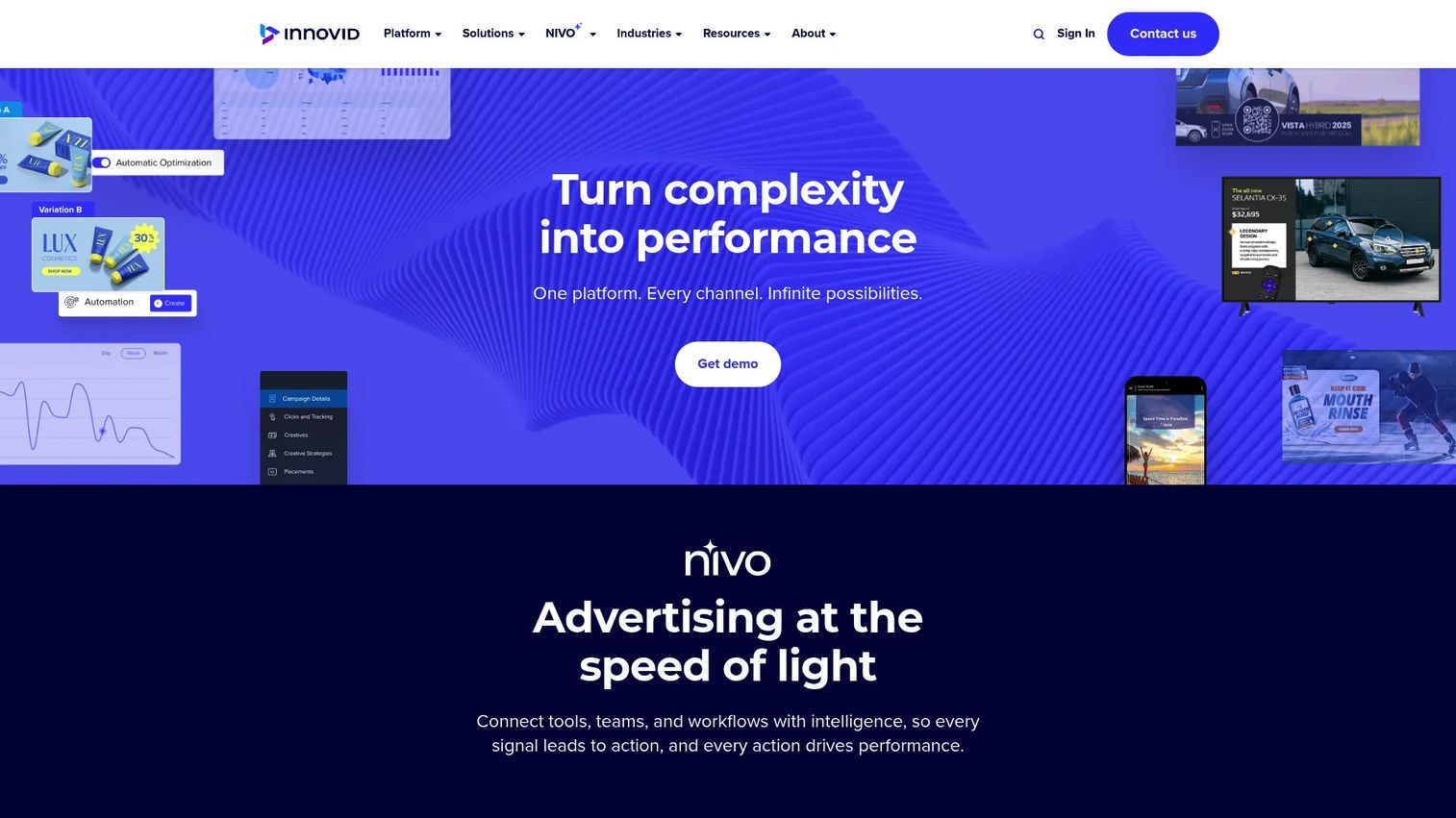
Innovid is an omnichannel advertising platform for creating, delivering, measuring, and optimizing ads across CTV, linear, display, social, and audio. Its strength is the creative and measurement layer: personalized creative versioning and independent ad serving across screens, which is exactly what multi-screen video campaigns need.
Best for: Enterprise advertisers and agencies that need unified ad creation, serving, measurement, and optimization across screens.
Key strengths
- Creative versioning: Build personalized content and unlimited creative versions for different audiences.
- Independent ad serving: Serve ads across channels from a neutral, independent platform.
- Cross-channel measurement: Measure and optimize performance across CTV, linear, display, social, and audio.
Why choose Innovid: For teams managing video-led, multi-screen campaigns, Innovid's combination of creative management and independent measurement is a genuine differentiator over buying-only DSPs. It is most valuable when creative versioning and CTV measurement are central to your media plan. Teams focused purely on search and social may find a lighter platform sufficient.
Innovid pricing: Innovid does not display public pricing; the site uses demo and contact-us CTAs. Expect an enterprise, sales-led quote scoped to your channel mix and creative volume.
Considerations before you buy
Channel coverage
Map the channels you actually buy most often, then confirm the platform covers them natively, not through a clunky workaround. A DSP that excels at CTV may be light on retail media, and a commerce platform may not give you the open-web display reach you need. Buy for your real channel mix, not the demo's highlight reel.
Measurement and attribution
Ask whether the platform supports the attribution model your team actually uses, whether that is last-touch, multi-touch, or incrementality testing. A platform with beautiful dashboards is useless if its attribution contradicts your marketing analytics and your finance team refuses to trust the number. Verify the model before you sign.
Data and integrations
Clean integrations with your CRM, analytics, and existing ad accounts matter far more than any marketing claim. Confirm exactly which systems connect, how data flows, and whether audiences sync both ways. This is where tool sprawl either gets solved or quietly gets worse, so it deserves more scrutiny than the feature checklist. Feeding clean audiences from a customer data platform is often the unlock.
Workflow and approvals
If multiple people own different channels or budgets, governance is not optional. Check how the platform handles collaboration, stakeholder review, permissions, and approval flows. As your team grows, the absence of real governance turns into pacing mistakes and brand-safety incidents that cost real money.
Pricing and scale
Read the contract terms, not just the headline number. Look at minimums, platform fees, percentage-of-spend models, and how cost scales as you add channels and volume. Several platforms here price entirely on spend, so model your costs at next year's budget, not today's. If you are also evaluating email marketing or conversational marketing tools, factor the total stack cost, not each tool in isolation.
Conclusion
If you want the single strongest overall pick for most teams, The Trade Desk is it: independent, omnichannel, deep on CTV and identity, with measurement that holds up under scrutiny. Teams already standardized on Google should lean into Google Marketing Platform for its native buying-plus-analytics integration. Ecommerce and retail advertisers will get the most from Criteo Commerce Growth and Skai, while AdRoll wins for fast setup and retargeting, StackAdapt for approachable mid-market programmatic, and Adobe Advertising Cloud and Innovid for enterprise, multi-screen media workflows.
The mistake is trying to evaluate all eight at once. Narrow to one or two that match your real channel mix, attribution model, and budget, then run a focused pilot with live spend. That is how you prove the platform reduces fragmentation and improves ROI before you commit. For the wider stack, it is worth reviewing growth marketing tools and mobile marketing software alongside your ad platform decision.
FAQs
Cross channel advertising software is a platform that lets marketers plan, buy, measure, and optimize paid campaigns across multiple channels such as search, social, display, video, CTV, and retail media from one interface. It centers on channel orchestration and unified reporting, so coordinated audiences and budgets replace siloed, channel-by-channel buying.
Cross-channel advertising coordinates several channels so they share audiences, budgets, and measurement, with the prospect's journey carried across them. Omnichannel goes further, treating every touchpoint as part of one seamless, consistent customer experience regardless of channel. In practice, cross-channel is the coordination layer, and omnichannel is the experience goal that strong cross-channel data makes possible.
Look for media buying across the channels you actually use, audience targeting and segmentation with identity resolution, and campaign management that centralizes budgets and pacing. Just as important are attribution and measurement that match your model, plus reporting and integrations that sync cleanly with your CRM and analytics. Missing any of these tends to recreate the fragmentation you are trying to solve.
Growth teams running paid media across several channels, ecommerce brands, retail advertisers with retail media spend, and enterprise demand gen teams get the most value. These are the organizations where channel coordination, identity, and attribution complexity make manual management expensive and error-prone. The more channels and stakeholders involved, the stronger the case.
It is worth it when fragmentation is already costing you time and accuracy, and when a single platform would replace two or more tools you pay for today. If you run one or two channels at modest spend, a simpler marketing automation setup or self-serve platform like AdRoll may be enough. The value shows up as channel count, spend, and reporting complexity grow.
Choose a pure DSP when programmatic buying across the open internet, especially CTV and display, is your priority and you have the expertise to run it. Choose a broader cross channel ad platform when orchestration, retail media, and unified reporting across many channel types matter more than deep programmatic control. Many teams end up with a platform that blends both, which is why coverage and integrations should drive the decision.
Prioritize unified metrics that pull every channel into one view, attribution clarity that your finance team will actually trust, and exportability so the data flows into your own dashboards. Reporting that looks polished but cannot reconcile with your marketing analytics creates more arguments than insight. Verify the numbers reconcile before you rely on them for budget decisions.
Narrow your shortlist by the channels you truly buy, your team size, and your real reporting needs before talking to any vendor. Several platforms here price on a percentage of spend or carry six-figure entry tiers, so model costs against next year's budget, not a best-case demo. Then pilot one or two tools with live spend and only commit once a platform proves it cuts fragmentation and improves ROI.