

You have three exchange tabs open, a charting window, a spreadsheet tracking positions, and a Telegram feed of signals you half trust. A move happens. By the time you switch tabs and place the order, the edge is gone.
That is execution drift. Not a discipline problem, not a qualification problem. A workflow problem. The gap between deciding to trade and actually trading widens every time volatility outpaces your setup.
The market is not waiting for you to catch up. Global Market Insights valued the crypto trading platform market at USD 27 billion in 2024, projecting USD 84.8 billion by 2034 at a 12.6% CAGR. On the automation side, Grand View Research estimated the automated crypto trading market at USD 22.23 billion in 2025, headed to USD 66.61 billion by 2033. More capital is flowing into software that closes the gap between signal and fill.
The right crypto trading software collapses that gap. It puts execution, market data, order control, and automation in one place. The question is which one fits how you actually trade, whether that means institutional execution depth, a crypto trading bot running strategies unattended, or an open-source framework you build on yourself.
What's inside
This guide covers seven crypto trading software options for 2026, chosen for serious traders and operators rather than hobbyists.
We selected tools based on four criteria that matter when you are choosing a platform, not chasing a moonshot:
- Automation and strategy execution: bots, trailing logic, and algorithmic trading support
- Exchange coverage and account management: multi exchange trading and centralized oversight
- Order control and risk management: crypto order types, stops, and execution tools
- Charting, market data, and trust: visibility, security, and regulatory context
Each entry includes what the tool does, who it fits, key strengths, pricing where verified, and a G2 rating where one exists.
TL;DR
- Best for advanced execution: TT® platform, for institutional-grade multi-asset trading and execution control
- Best for automated crypto strategies: Cryptohopper, for bots, copy trading, and strategy design across exchanges
- Best for regulated spot access: OANDA, for a regulated, broker-led crypto trading platform with TradingView charts
- Best for low-friction bot workflows: Pionex, for built-in grid, DCA, and arbitrage bots without building from scratch
- Best for open-source customization: Hummingbot, for a Python-native trading bot framework across CEX and DEX
- Best for Python-native backtesting: Gekko and Enigma Catalyst, for self-hosted strategy development and testing
What is crypto trading software?
Crypto trading software is any platform, bot, or framework that lets you execute, automate, and manage cryptocurrency trades, usually connecting to one or more exchanges through an interface or API.
The category splits into four shapes, and knowing which one you need saves you weeks of evaluation.
- Trading platforms: professional interfaces for order entry, market data, and execution across venues, often with advanced crypto order types and workspace customization
- Trading bots: software that runs strategies automatically, using rules, signals, or templates so you are not watching every chart
- Brokered trading access: regulated platforms that offer crypto through a broker relationship, prioritizing trust, custody, and simplicity
- Open-source frameworks: code-first tools for developers who want full control over strategy logic and backtesting
Core capabilities to weigh across all four:
- Automation and strategy execution: trailing stops, DCA, grid logic, and algorithmic trading rules that run without manual input
- Exchange connectivity and account management: multi exchange trading, API keys, and unified position views
- Order types and risk controls: market, limit, stop, and conditional crypto order types plus risk management guardrails
- Charting and market data: real-time crypto market data, charting software, and depth visualization
- Security, trust, and regulation: custody model, access permissions, and regulatory standing
The best crypto trading tools do not just place orders faster. They give you repeatable control over how and when trades happen.
When to use crypto trading software
Use it when you need faster execution
Manual trading breaks the moment the market moves faster than your workflow. You see the setup, you reach for the order ticket, and the price has already run. Dedicated execution tools cut the steps between decision and fill. Aggregated order books, one-click order entry, and preset order sizes turn a ten-second scramble into a single action.
Use it when you need automation without watching every chart
Nobody sustains 18-hour screen time. Automated crypto trading lets you encode a strategy once and let it run. Trailing stops lock in gains without you hovering. Grid bots work ranges while you sleep. DCA logic accumulates on schedule. A crypto trading bot does not get tired, distracted, or emotional, which is the point.
Use it when you need multi-exchange visibility
Founders and operators managing capital across venues care less about any single chart and more about oversight. Where is the exposure? Which accounts hold what? Multi exchange trading platforms centralize positions, balances, and orders so you make weekly decisions from one screen instead of stitching five dashboards together. Fewer tabs, cleaner signal, faster calls.
Comparison table
Here is how the seven options stack up on intent, differentiation, pricing, and rating. Pricing and ratings reflect values verified at publication; crypto pricing and fees shift, so confirm on the vendor's page before committing.
| # | Product | Best for | Key differentiator | Pricing | G2 rating |
|---|---|---|---|---|---|
| 1 | TT® platform | Professional and institutional execution | Multi-asset execution with Autospreader, Aggregator, and ADL | Subject to agreement | 4.5/5 |
| 2 | Cryptohopper | Automated crypto strategies | Bots, copy trading, and Strategy Designer across exchanges | From $24.16/mo | 3.8/5 |
| 3 | OANDA | Regulated spot access | Regulated broker access with TradingView and MT4 | Spreads from 0.0 pips | 4.3/5 |
| 4 | Pionex | Low-friction bot workflows | Exchange with built-in grid, DCA, and arbitrage bots | 0.05% trading fee | 4.8/5 |
| 5 | Hummingbot | Open-source customization | Python framework for CEX and DEX market making | Free, open source | N/A |
| 6 | Gekko | Lightweight backtesting | Self-hosted backtesting and live trading bot | Free, open source | N/A |
| 7 | Enigma Catalyst | Python-native development | Zipline-based algorithmic trading library | Free, open source | N/A |
Best crypto trading software for 2026
1. TT® platform

TT® platform from Trading Technologies is a multi-asset trading and surveillance platform built for capital markets. It supports crypto spot, futures, perpetual swaps, and options alongside FX, fixed income, and traditional derivatives. This is not a beginner tool. It is what professional desks and institutions use when execution quality is the whole game.
The platform runs across browser, desktop, and mobile, with market data, MD Trader, and advanced charts feeding real-time decisions. Where it separates from retail crypto trading platforms is execution control. Autospreader handles multi-leg spread trading. Aggregator pulls pricing across venues for multi exchange trading. ADL runs algorithmic trading and automated strategies with the kind of order precision institutional flow demands.
Best for: Professional traders and institutions trading crypto and multiple asset classes who need execution depth and market visibility.
Key strengths
- Multi-asset coverage: crypto spot, futures, swaps, and options
- MD Trader and charting for real-time crypto market data
- Autospreader and Aggregator for multi-venue execution
- ADL for automated and algorithmic trading strategies
- Browser, desktop, and mobile access
Why choose TT® platform: If your priority is execution control and surveillance across venues and asset classes, TT is built for that. It fits desks running serious size where slippage and order precision translate directly to P&L.
TT® platform pricing: Trading Technologies does not publish a public price for its crypto platform. Access is subject to agreement and typically arranged through account setup or distributors. Contact the company for terms.
2. Cryptohopper
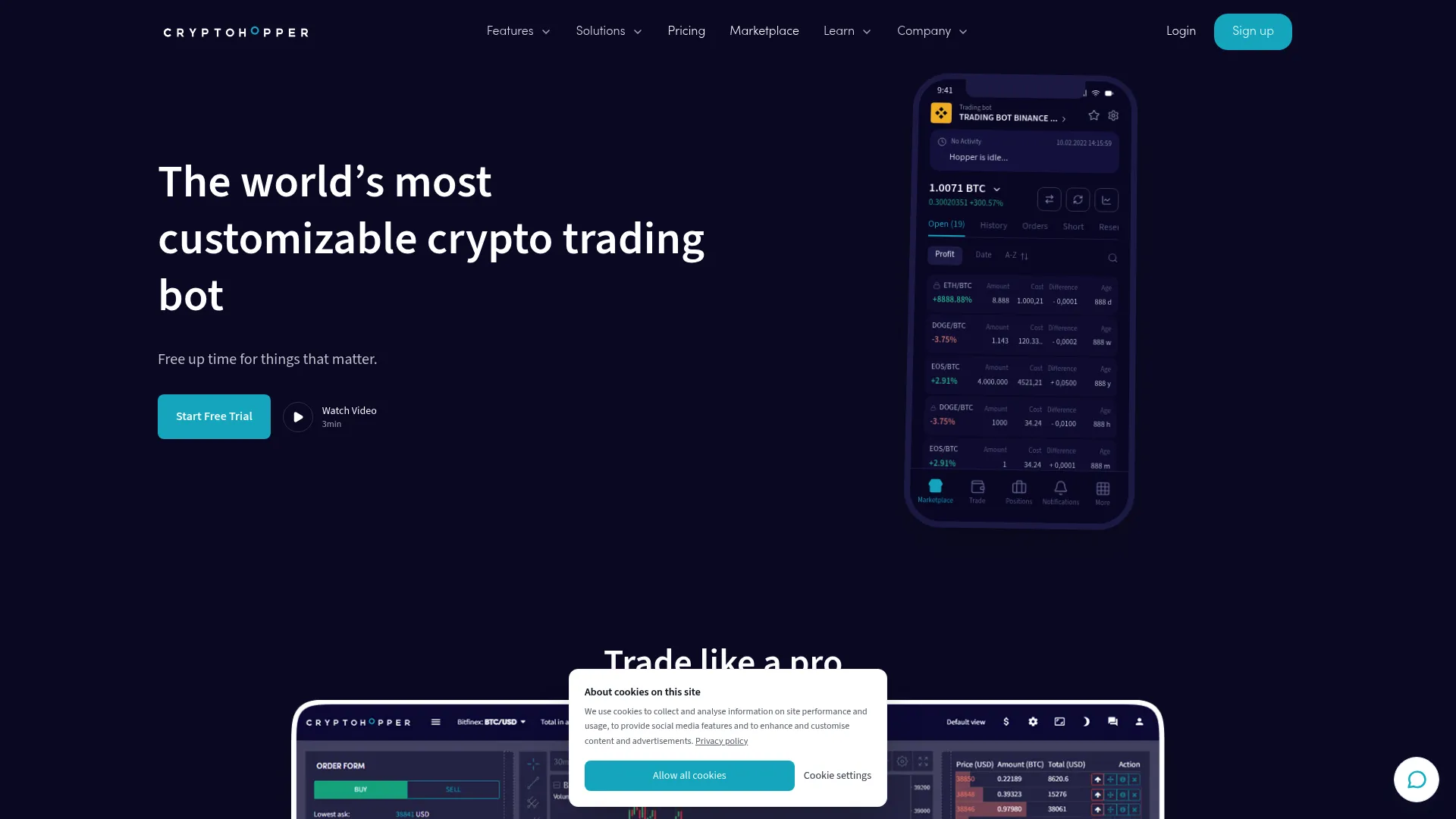
Cryptohopper is a crypto trading automation platform built around bots, copy trading, backtesting, and strategy design. If your goal is automated crypto trading without writing code, this is one of the more complete off-the-shelf options. It connects to multiple exchanges and runs strategies while you are away from the screen.
The feature set is broad. Automatic trading executes your rules. The Copy Bot mirrors other traders for a copy trading approach. The Strategy Designer lets you build logic visually, and backtesting plus paper trading let you validate before risking capital. It also includes exchange arbitrage, a market making bot, and AI trading tools. For traders who want depth without a developer, the range covers most automated strategies.
Best for: Crypto traders who want automated bots and strategy tools across multiple exchanges without coding.
Key strengths
- Automatic trading with rule-based execution
- Copy Bot for copy trading strategies
- Strategy Designer for visual bot building
- Backtesting and paper trading to validate first
- Exchange arbitrage and market making bot
Why choose Cryptohopper: It fits traders who want a ready-made crypto trading bot with real depth, from copy trading to arbitrage, without maintaining their own code. Newer traders may need time to configure strategies well, but the paper trading mode lowers that risk.
Cryptohopper pricing: Plans start at $24.16/mo for Explorer, $57.50/mo for Adventurer, and $107.50/mo for Hero, billed monthly. A 3-day free trial is available for Explorer. Verify current tiers on the pricing page before subscribing.
3. OANDA

OANDA is an established online forex and CFD trading platform that also offers crypto access through a regulated, broker-led model. If trust, regulation, and custody rank above deep bot automation for you, OANDA sits at the opposite end of the spectrum from open-source frameworks. It trades simplicity and oversight for do-it-yourself flexibility.
The platform gives you OANDA Trade, MT4, and TradingView integration, so charting software and crypto order types feel familiar to anyone coming from traditional markets. It supports a wide range of currency pairs, publishes FX data services and exchange-rate APIs, and delivers a clean crypto trading app experience across devices. This is a brokerage-style approach: regulated access, clear execution, and less emphasis on building your own automated strategies.
Best for: Forex and crypto traders who want regulated, broker-led access with familiar charting and order tools.
Key strengths
- Regulated, broker-led crypto trading platform
- OANDA Trade, MT4, and TradingView integration
- Wide range of supported currency pairs
- FX data services and exchange-rate APIs
- Clean trading app across desktop and mobile
Why choose OANDA: Choose it when regulation and execution clarity matter more than running a fleet of bots. The tradeoff is real: you get trust and simplicity, not deep automated crypto trading. For traders who value oversight, that tradeoff is the point.
OANDA pricing: OANDA uses a core spreads plus commission model, with spreads from 0.0 pips and an Elite Trader rebate program starting at $5.00 per million traded. FX Data Services API pricing is tailored and requires contacting the company, with a 7-day free API key trial available.
4. Pionex

Pionex is a crypto exchange with trading bots built directly into the platform. That distinction matters. Instead of connecting a third-party bot to an exchange, you trade and automate in one place. For traders who want automated crypto trading without stitching tools together, that removes a whole layer of setup.
The built-in bots cover the workhorses of automated strategies: grid trading for ranging markets, DCA for scheduled accumulation, and arbitrage bots for spread capture. REST and WebSocket APIs give more technical traders programmatic access, and the Pionex Card extends the account into spending. Mobile apps keep the bots reachable from anywhere. The appeal is straightforward. You get functional automation without building or maintaining anything yourself.
Best for: Crypto traders who want automated bot-based exchange tools without building from scratch.
Key strengths
- Built-in crypto trading bots on the exchange
- Grid, DCA, and arbitrage bot strategies
- REST and WebSocket APIs for programmatic access
- Mobile apps for on-the-go bot management
- Pionex Card for account spending
Why choose Pionex: It fits traders who want low-friction automation and prefer their bots and exchange in one account. You give up the customization depth of an open-source framework in exchange for speed to running strategies.
Pionex pricing: Pionex charges a trading fee of 0.05% according to its published fees page. There is no subscription tier for the built-in bots. Withdrawal fees vary by asset, so check the fees page for current rates.
5. Hummingbot
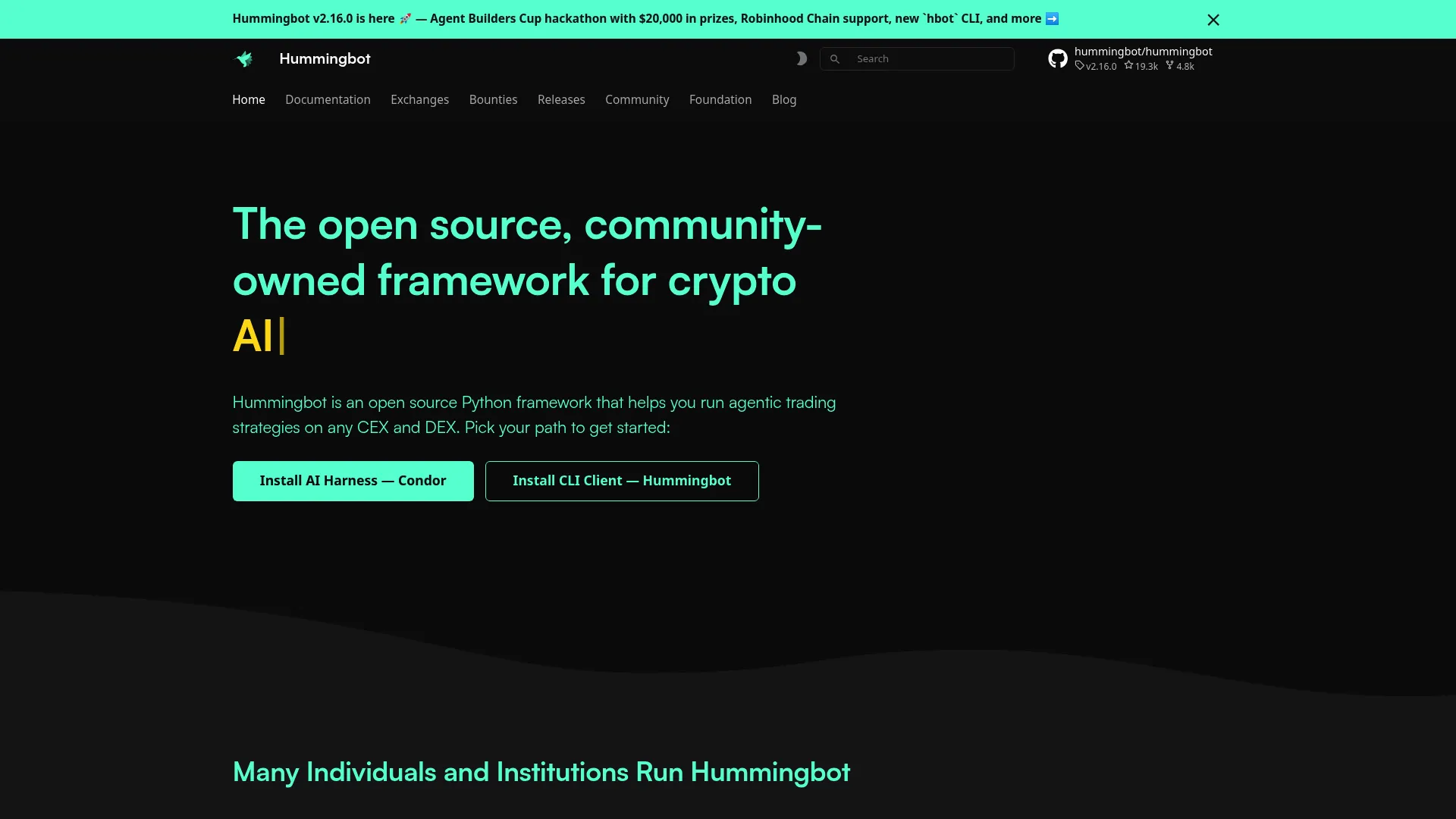
Hummingbot is an open-source framework for running automated crypto trading strategies across both centralized and decentralized exchanges. This is where the article shifts from packaged products to tools you build on. If you are technical and want full control over strategy logic, Hummingbot gives you the codebase and the community to do it.
It runs through a command-line interface where you build and operate trading bots. The framework ships with strategies like market making and arbitrage out of the box, and its Gateway middleware handles interaction with blockchain networks and DEXs. That CEX and DEX reach is a real differentiator: most retail bots stop at centralized venues. Being open source means you can read, modify, and extend every strategy. The active community adds connectors and strategies over time, so the framework keeps pace with new venues.
Best for: Crypto traders and developers who want open-source automated trading bots with full customization.
Key strengths
- Open-source Python trading bot framework
- Command-line interface for building and running bots
- Market making and arbitrage strategies included
- Gateway middleware for DEX and blockchain access
- Active community adding connectors and strategies
Why choose Hummingbot: It fits technical traders who want to own their strategy logic and run algorithmic trading across CEX and DEX. You trade convenience for control, which is exactly what code-first traders want.
Hummingbot pricing: Hummingbot is free software. You download, install, and run it at no cost. There are no public paid plans on the official site. Your only costs are exchange fees and any infrastructure you run it on.
6. Gekko
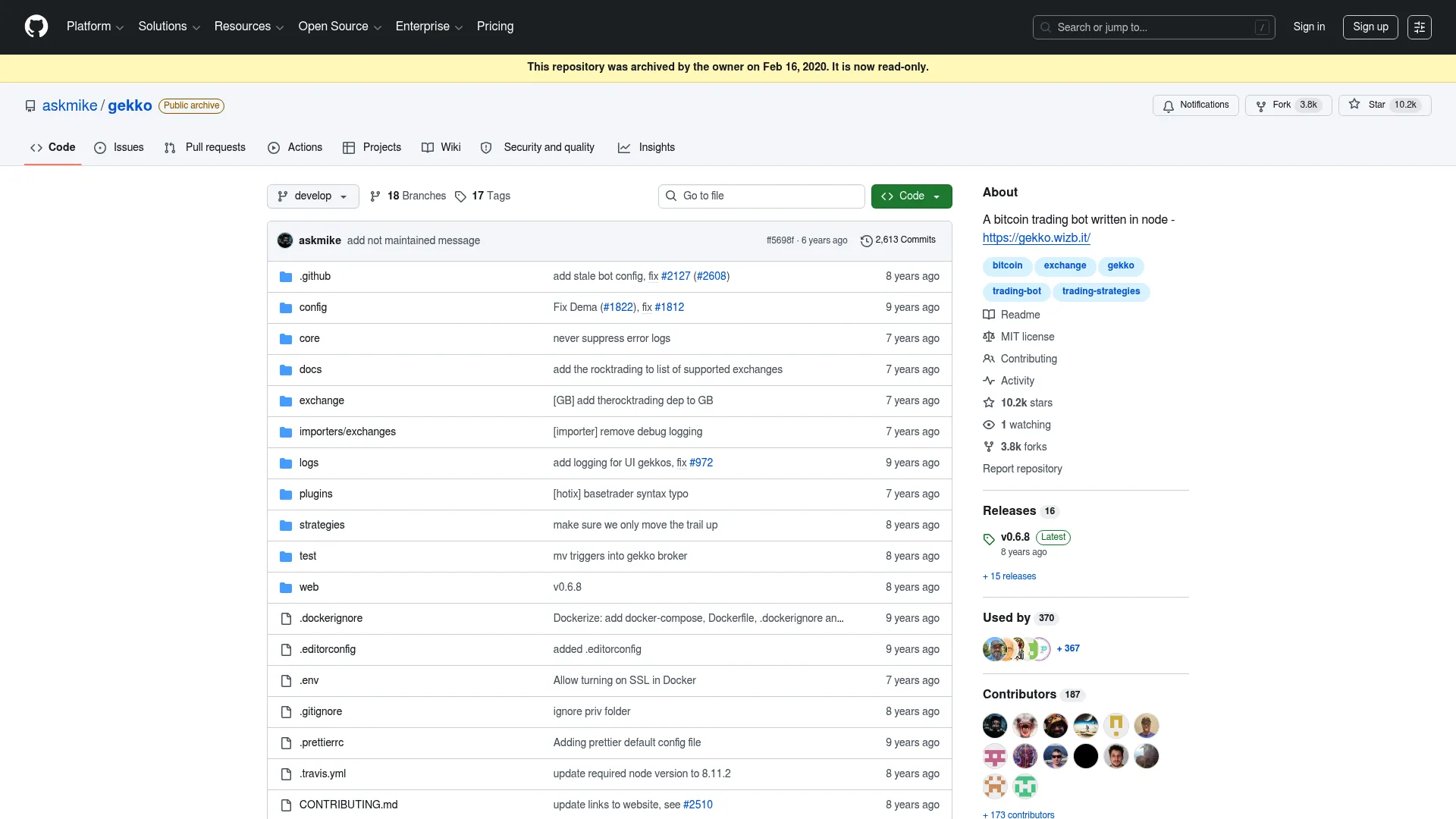
Gekko is a free and open-source Bitcoin trading and backtesting tool. It appeals to traders who want a lightweight, self-hosted starting point rather than a full commercial platform. If you are learning strategy development or want to test ideas against historical crypto market data before going live, Gekko is a practical on-ramp.
The core loop is backtesting, paper trading, and live trading. You feed it historical data, test a strategy, run it in paper mode to validate, then flip to live trading when you trust it. It supports a range of exchanges and includes a web GUI, so you are not stuck entirely in a terminal. Being open source, the code is yours to read and modify. It is not the most actively maintained project in the category, but its simplicity is the draw for developers who want something they can understand end to end.
Best for: Developers who want a self-hosted, lightweight crypto trading bot and backtesting tool.
Key strengths
- Free and open-source codebase
- Backtesting against historical market data
- Paper trading to validate before going live
- Live trading bot across supported exchanges
- Web GUI alongside command-line control
Why choose Gekko: It fits developers who want a simple, readable starting point for building and testing strategies. You get lightweight self-hosted control rather than the breadth of a commercial platform.
Gekko pricing: Gekko is free and open source. There are no paid tiers on the project's own site. Costs are limited to exchange fees and the infrastructure you host it on.
7. Enigma Catalyst
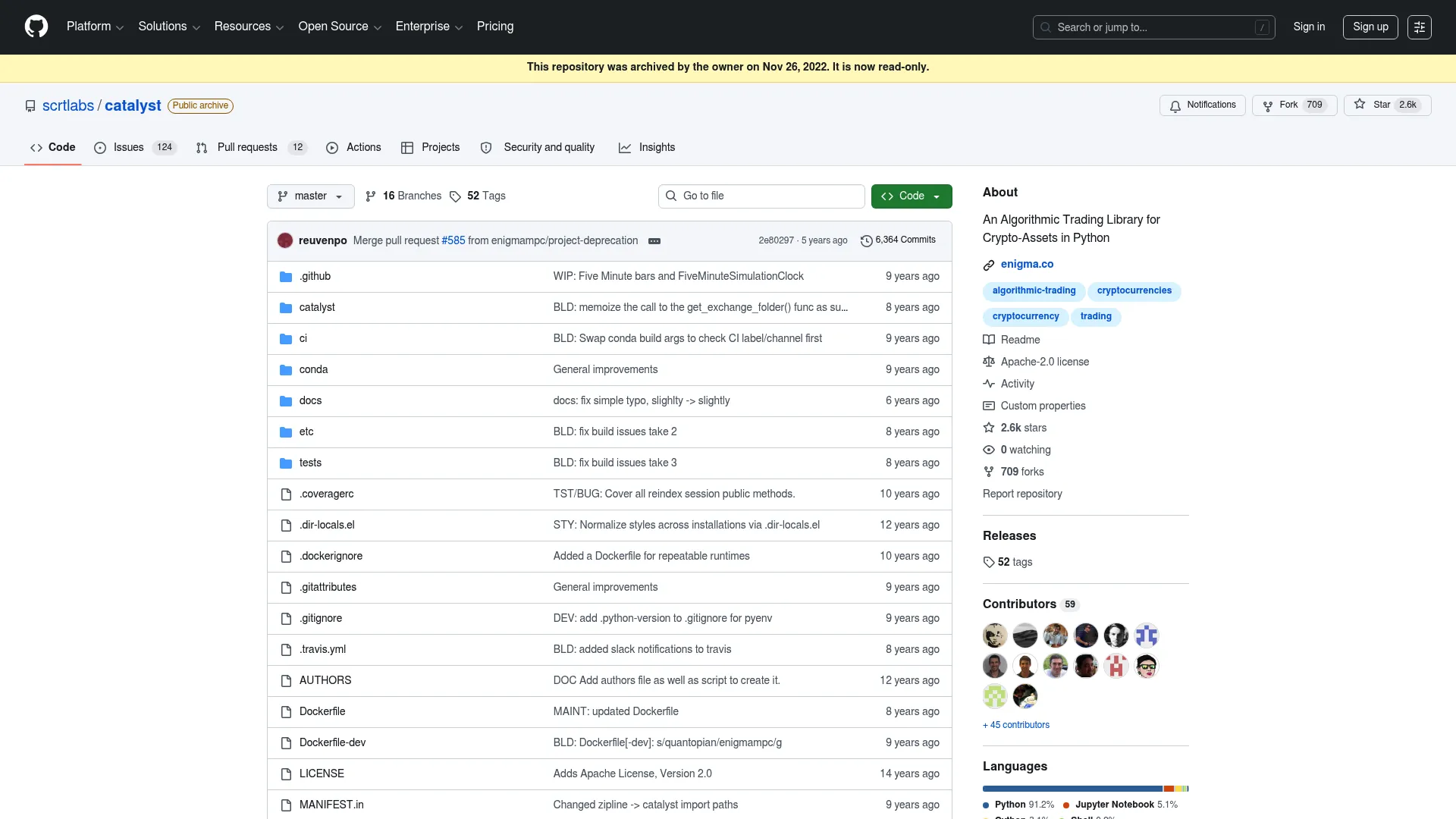
Enigma Catalyst is an open-source algorithmic trading library for crypto assets, written in Python and built on the Zipline foundation. It is aimed squarely at developers who want to build and backtest custom strategies in code. If you already work in Python and want a familiar quant-style workflow applied to crypto, Catalyst speaks your language.
The library supports backtesting against historical data and live trading on crypto exchanges. It provides daily and minute-resolution market data, which matters when you are testing strategies that depend on intraday movement. Because it builds on Zipline, developers coming from equities algorithmic trading will recognize the structure and can port mental models over quickly. This is a code-first tool through and through, best suited to people comfortable writing and maintaining their own trading logic.
Best for: Python developers building and backtesting crypto trading strategies in code.
Key strengths
- Open-source Python algorithmic trading library
- Built on the Zipline backtesting foundation
- Backtesting against historical crypto data
- Live trading support for crypto exchanges
- Daily and minute-resolution market data
Why choose Enigma Catalyst: It fits Python developers who want a quant-style framework for crypto strategy development. The Zipline lineage makes it familiar for anyone with an equities algorithmic trading background.
Enigma Catalyst pricing: Enigma Catalyst is an open-source project with no public pricing or paid tiers. Costs are limited to exchange fees and any infrastructure you use to run it.
Considerations
Check exchange coverage
Supported venues matter more than a long feature list. A tool with brilliant automation is useless if it cannot connect to the exchanges you actually use. Confirm the specific exchanges, account types, and whether it handles spot, futures, and options where you need them. For multi exchange trading, check whether positions and balances unify into one view or stay siloed per venue.
Check execution controls
Order precision is where money is made and lost. Look at the crypto order types on offer: market, limit, stop, stop-limit, trailing stops, and conditional orders. Test how fast the order ticket responds and whether preset sizes and hotkeys exist. For risk management, confirm the platform enforces stops reliably and supports the position sizing logic your strategy depends on.
Check charting and data visibility
Decision speed depends on what you can see. Evaluate the charting software, the depth of real-time crypto market data, and how clearly positions and open orders display. A platform that surfaces the right information in one glance shortens the gap between reading the market and acting on it. Cluttered or laggy data views cost you the edge you built the workflow to protect.
Check trust and security
For any platform holding funds or keys, security is not optional. Evaluate the custody model, whether you control your own keys, and how API permissions are scoped. For regulated brokered access, check the regulatory standing and jurisdictions. For bots and open-source tools, review how API keys are stored and whether withdrawal permissions can be disabled to limit exposure.
Check onboarding and maintenance burden
How fast can you go from signup to first trade, and what does upkeep look like? Commercial platforms ship ready to run with support behind them. Open-source frameworks give you full control but you own the maintenance. Be honest about your team's capacity. A powerful tool nobody keeps running is worse than a simpler one that stays live.
Conclusion
The category comes down to a choice between three things: execution depth, automation, and simplicity. Match the tool to how you actually trade, not to the loudest marketing.
For professional and institutional execution across asset classes, TT® platform leads on order control and market visibility. For automated crypto trading without code, Cryptohopper covers the most ground, from bots to copy trading to arbitrage. For low-friction bots in one account, Pionex bakes automation straight into the exchange. If regulated, broker-led access with familiar charting matters most, OANDA fits.
For developers who want to own their strategy logic, the open-source options deliver. Hummingbot spans CEX and DEX with a Python framework, while Gekko and Enigma Catalyst give you self-hosted backtesting and live trading you can read and modify.
Your next step depends on what you are solving for. Want professional execution controls? Start with TT. Want bot automation without code? Try Cryptohopper or Pionex. Want open-source flexibility? Spin up Hummingbot or Enigma Catalyst and test a strategy against historical data before you risk a dollar.
FAQs
Crypto trading software is any platform, bot, or framework that lets you execute, automate, and manage cryptocurrency trades. It usually connects to one or more exchanges through an interface or API, and covers everything from professional execution platforms to no-code bots and open-source development libraries.
For no-code automation, Cryptohopper offers the broadest ready-made toolkit, including bots, copy trading, and a Strategy Designer. Pionex bakes grid, DCA, and arbitrage bots directly into the exchange. For developers who want full control, Hummingbot and Enigma Catalyst provide open-source frameworks for building custom automated strategies.
A trading platform is an interface for executing and managing trades manually, with order tickets, charts, and market data. A crypto trading bot automates strategy execution, running rules or signals without you placing each order. Some tools, like Pionex, combine both by building bots directly into the exchange platform.
Yes. Many tools support multi exchange trading through API connections. Cryptohopper and Hummingbot connect to multiple centralized exchanges, and Hummingbot also reaches decentralized exchanges. Professional platforms like TT aggregate pricing and execution across venues. Always confirm the specific exchanges each tool supports before committing.
Open-source tools like Hummingbot, Gekko, and Enigma Catalyst let you inspect the code, which is a security advantage. The risk sits in how you configure and host them, and how you handle API keys. Scope API permissions tightly, disable withdrawals where possible, and keep your infrastructure secure. Safety depends heavily on your own setup.
Prioritize exchange coverage, execution controls, and risk management over long feature lists. Confirm the crypto order types you need, the real-time market data and charting quality, and the automation depth your strategy requires. For any tool holding funds or keys, custody model and security should rank near the top.
Yes. Regulated, broker-led platforms like OANDA offer crypto access alongside forex and CFDs, with familiar tools like MT4 and TradingView. These prioritize regulation, custody, and execution clarity over deep bot automation. They suit traders who value oversight and simplicity more than building their own automated strategies.
For professional and institutional execution, TT® platform leads with multi-asset coverage and tools like Autospreader, Aggregator, and ADL. It supports crypto spot, futures, swaps, and options with the order precision serious desks need. It is built for execution control across venues rather than beginner use.