Your recruiters spent three days trading calendar invites for a single first-round screen. The candidate took another job before the call happened. Multiply that across 40 open roles and you have a hiring funnel that leaks at the top, where it hurts most.
Most teams blame scheduling. It is not really scheduling. It is friction: every step between application and decision where a candidate waits, a recruiter chases, and a hiring manager loses context. The category built to remove that friction is video interviewing software, tools that let teams screen candidates asynchronously, run live interviews with structure, and feed clean signal back into the hiring stack.
The shift is already underway. According to Incruiter (2026, citing 4 Corner Resources), 81% of recruiters now use video interviews in their hiring process, and Global Growth Insights reports that over 70% of enterprises are adopting video interviewing platforms. The market itself reflects that pull: OMR Global valued global video interview software at USD 511.3 million in 2024, with a projected climb to USD 1.33 billion by 2035.
This guide ranks eight video interview platforms by how well they fit real hiring motions: async screening at volume, structured live rounds, AI evaluation, ATS depth, and candidate experience. If you care about hiring efficiency without sacrificing fairness, this is your shortlist.
If you also run buyer-facing product motions, the same self-serve logic shows up in adjacent stacks. Teams comparing ai recruiting software or ai customer service software will recognize the pattern: remove friction, capture signal, decide faster.
What's inside
This guide is for talent acquisition leaders, recruiters, people ops teams, and founders building a hiring stack. We compared eight virtual interview software platforms on four criteria that decide real outcomes:
- Interview formats supported: async one-way interviews, live real-time interviews, or both.
- ATS integration: how cleanly the tool connects to your applicant tracking system and recruitment workflow.
- AI capabilities: scoring, screening, scheduling automation, and interview analytics.
- Compliance and candidate experience: security, fairness controls, multilingual support, and self-scheduling.
We did not rank on feature count. We ranked on fit to hiring motion.
TL;DR
Short on time? Here are the decision shortcuts.
- Best for enterprise and high-volume teams: HireVue, for AI assessments, structured video interviewing, and deep automation at scale.
- Best for video interviewing plus assessments: Jobma, for one-way and live interviews with an AI interviewer and validation.
- Best for structured interview process control: VidCruiter, for configurable workflows, scheduling, and compliance.
- Best for simple async screening: Hireflix, for transparent flat-rate one-way interviews.
- Best if you want an ATS and interviews in one: Workable, for integrated recruiting plus AI hiring software.
- Best for high-volume assessment-led hiring: Harver, for predictive assessments and automated workflows.
These are decision shortcuts, not the whole picture. The full comparison and item sections follow.
What is video interviewing software?
Video interviewing software is a category of recruiting tools that lets hiring teams conduct candidate interviews over video, either asynchronously or live, while capturing structured data for evaluation and ATS integration. It replaces the back-and-forth of phone screens and the scheduling drag of early-round calls.
There are two core formats, and the difference matters for how you deploy them.
- Asynchronous one-way video interviews: Candidates record answers to preset questions on their own time. Recruiters review on theirs. No calendar coordination required. This is the workhorse for first-round screening at scale.
- Live video interviews: Real-time conversations between candidate and interviewers, often for panels, final rounds, and stakeholder alignment where back-and-forth and nuance matter.
The category exists because the old model does not scale. Phone screens consume recruiter hours. Scheduling delays kill candidate interest. Inconsistent questions make fair comparison impossible. Video interview platforms standardize the first touch and compress the timeline.
Core capabilities to expect across modern ai video interview software:
- ATS integration: push interviews, scores, and statuses into your applicant tracking system.
- Interview scheduling software: self-scheduling, calendar sync, and automated reminders.
- AI analysis: structured scoring, transcription, candidate screening signals, and interview analytics.
- Security and compliance: data handling, proctoring, identity checks, and audit trails.
- Global hiring support: multilingual flows and time-zone-aware scheduling for distributed teams.
A strong video interview platform does not just record video. It standardizes the process and feeds the rest of your recruitment workflow.
When to use video interviewing software
Not every role needs every format. Here is how to match the tool to the moment.
Screen candidates at scale
When you have hundreds of applicants and a handful of recruiters, async video interviews are the unlock. Candidates record on their own time, so you remove scheduling delays entirely. Every applicant answers the same questions, which standardizes first-round screening and makes comparison fair. This is where online interview software pays for itself fastest: reviewing 80 recorded screens takes a fraction of the time 80 phone calls would.
Run live interviews with better structure
Some conversations need to happen in real time. Final rounds, panel interviews, and stakeholder alignment all benefit from live video interviews where interviewers can probe, follow up, and read nuance. The software adds structure here too: shared scorecards, recording for absent panelists, and consistent question sets keep even live rounds disciplined and comparable.
Improve hiring efficiency and candidate experience
The best platforms reduce friction for both sides. Self-scheduling lets candidates pick slots without email tag. Multilingual flows support global hiring. Faster reviews mean faster decisions, which means fewer candidates lost to slow competitors. When the process feels smooth, candidate experience improves, and that shows up in offer-acceptance rates.
Comparison table
The table below ranks platforms by breadth of capability and relevance to the keyword. Read it as a starting filter: match the Intent column to your hiring motion first, then dig into the item sections. Pricing reflects publicly listed figures where available; several enterprise platforms use custom pricing and direct buyers to sales.
| # | Product | Intent | Key differentiation | Pricing | G2 rating |
|---|---|---|---|---|---|
| 1 | HireVue | Enterprise AI hiring | AI assessments, scheduling, conversational AI agents | Custom (Essential, Premium) | 4.1/5 |
| 2 | Jobma | Video interviews plus assessments | Async and live interviews, AI interviewer, validation | Custom | 4.7/5 |
| 3 | VidCruiter | Structured interviewing | Configurable workflows, scheduling, compliance | Custom | 4.8/5 |
| 4 | Hireflix | Async screening | Flat-rate one-way interviews, unlimited usage | From $75/mo (billed yearly) | 5.0/5 |
| 5 | Talview | Secure enterprise hiring | AI interviewing plus proctoring and identity checks | Custom | 4.4/5 |
| 6 | Workable | ATS plus interviews | All-in-one recruiting, HR, and AI hiring | From $299/mo | 4.4/5 |
| 7 | Spark Hire | Interview-led screening | ATS, one-way and live interviews, assessments | From $249/mo | 4.7/5 |
| 8 | Harver | Volume assessment hiring | Predictive assessments, automated workflows | Custom | 4.6/5 |
1. HireVue
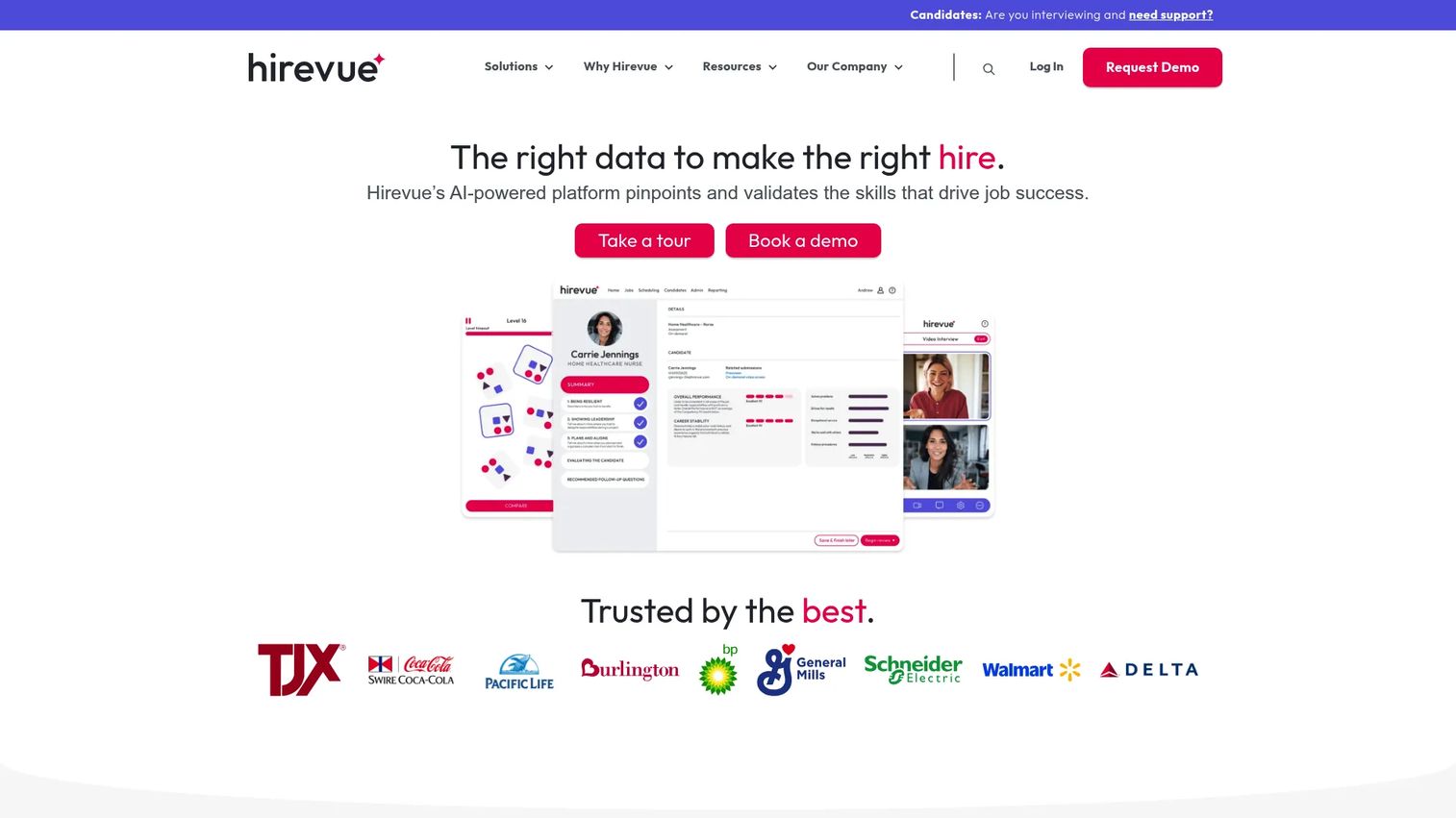
HireVue is an AI-powered hiring platform built for enterprise teams that need structured video interviewing and skills-based hiring at scale. It combines on-demand and live interviews with assessments, automated scheduling, and conversational AI hiring agents that engage candidates earlier in the funnel. For large organizations processing high applicant volumes, it functions less like a single tool and more like a hiring operating layer.
Best for: Enterprise teams that need structured video interviewing and skills-based hiring workflows across high volumes.
Key strengths
- AI skills assessments: Validates the competencies that predict job success, not just resume keywords.
- Automated interview scheduling: Removes calendar coordination from recruiters with self-scheduling and reminders.
- Conversational AI agents: Engages and screens candidates through guided, automated conversations.
Why choose HireVue: If your hiring motion spans thousands of candidates and multiple regions, HireVue's combination of assessments, async and live interviewing, and AI automation is the broadest fit on this list. It is built for talent teams that need consistency and compliance at enterprise scale, not a lightweight screening tool.
HireVue pricing: HireVue does not publish numeric pricing. Its pricing page describes Essential and Premium packages and directs buyers to request a demo and ROI information. Expect custom, volume-based quotes typical of enterprise recruiting platforms. HireVue holds a 4.1/5 rating on G2.
2. Jobma
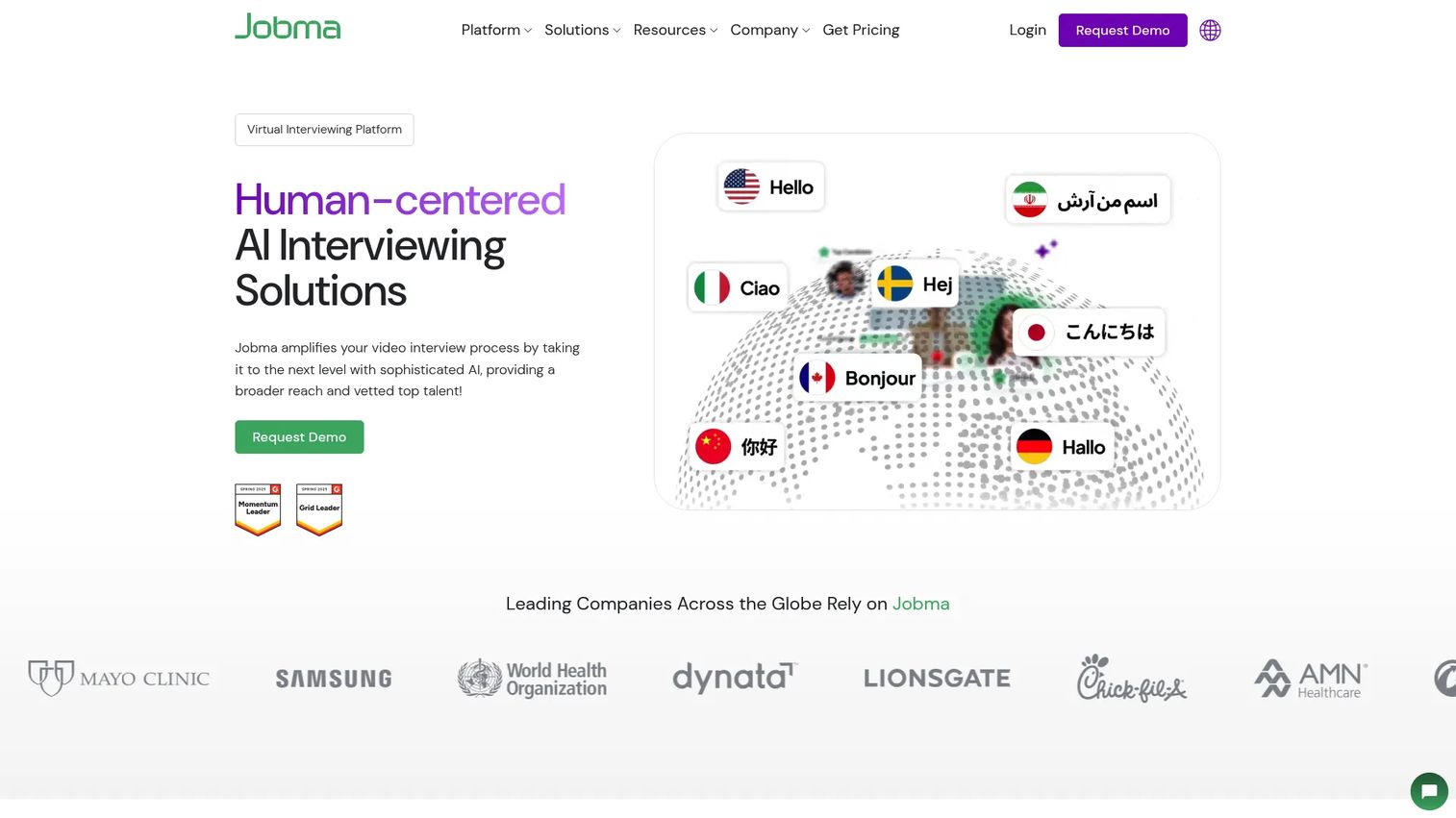
Jobma is an AI video interviewing and candidate assessment platform for hiring teams that want more than recorded video. It supports asynchronous one-way interviews, live interviews, and skill assessments with validation, wrapped in an AI interviewer that helps standardize evaluation. The result is a platform that handles screening and deeper assessment in one place.
Best for: Enterprise and mid-market teams that want structured video interviewing combined with assessments and ATS integration.
Key strengths
- Async and live interviews: Covers both first-round screening and real-time rounds in a single tool.
- AI interviewer and scoring: Adds consistency and structure to candidate evaluation.
- Skill assessments and validation: Tests competencies alongside interviews to sharpen screening.
Why choose Jobma: Teams that want video interviewing plus a broader assessment workflow get both here, without stitching together separate tools. Multilingual support and enterprise workflow automation make it a strong fit for organizations hiring across regions and roles. Its 4.7/5 G2 rating reflects strong reviewer sentiment.
Jobma pricing: Jobma uses custom pricing based on volume, integrations, and feature needs. Its pricing page and FAQs both direct buyers to request a quote rather than listing public numbers. Plan to scope a quote against your hiring volume. Jobma holds a 4.7/5 rating on G2.
3. VidCruiter
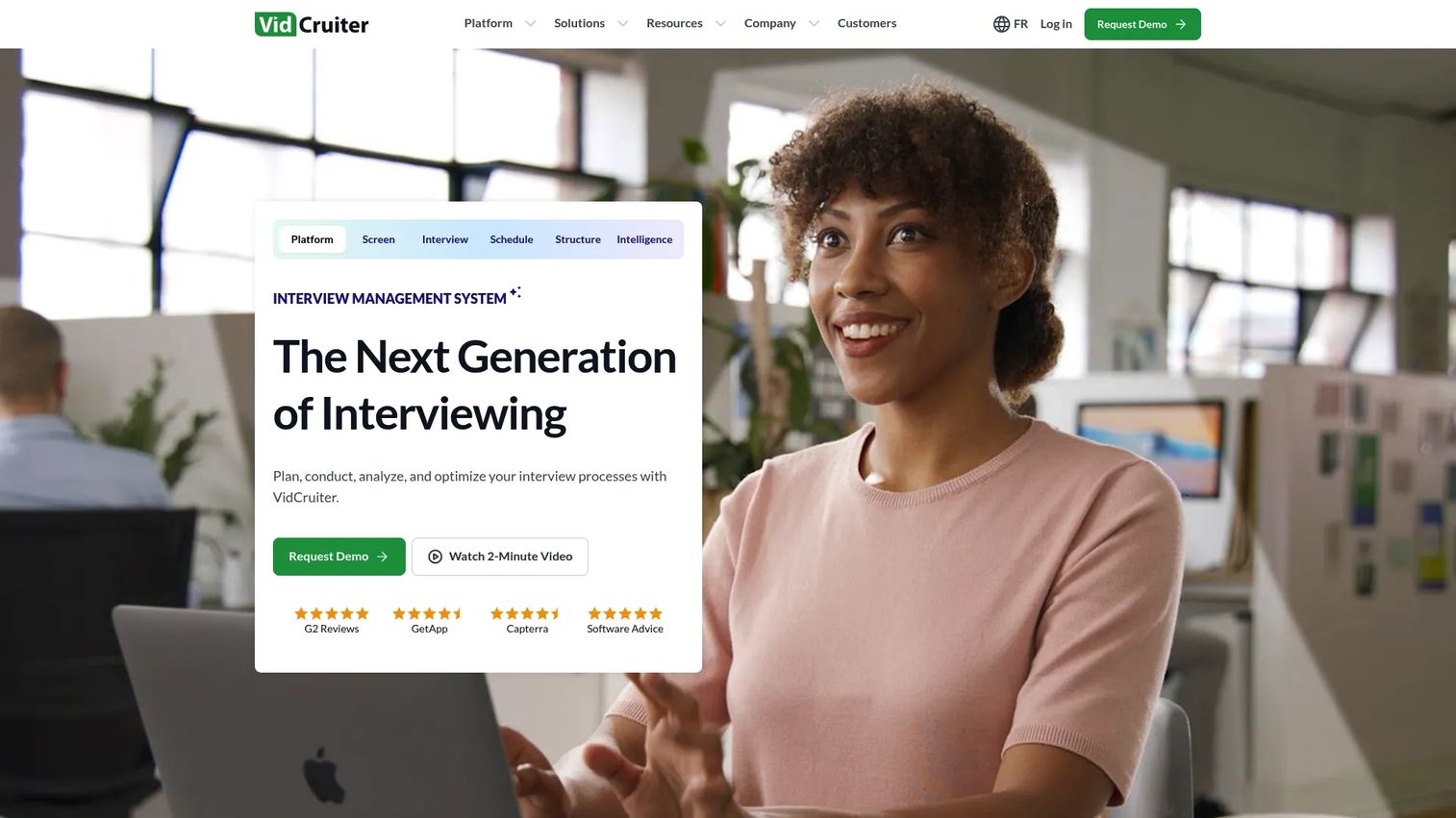
VidCruiter is interview management and recruiting software built around structured interviewing. It pairs pre-recorded and live video interviews with interview scheduling and configurable workflows, so teams can standardize how every candidate moves through the process. For organizations that treat hiring consistency as a compliance requirement, that control matters.
Best for: Organizations that need a customizable, structured hiring platform with strong process control.
Key strengths
- Structured interviewing: Standardizes questions and scoring for fair, comparable evaluations.
- Interview scheduling: Automates coordination across candidates, recruiters, and panels.
- Pre-recorded and live interviews: Supports both async screening and real-time rounds.
Why choose VidCruiter: If your priority is process control, with configurable stages, structured scorecards, and compliance built in, VidCruiter is purpose-built for it. It suits teams that want to engineer their recruitment workflow rather than adapt to a rigid template, and it positions well as an interview and scheduling layer alongside an existing ATS.
VidCruiter pricing: VidCruiter does not display public pricing. Its pricing page asks visitors to request a quote, which is standard for configurable enterprise platforms scoped to each team's workflow. VidCruiter holds a 4.8/5 rating on G2, among the highest on this list.
4. Hireflix
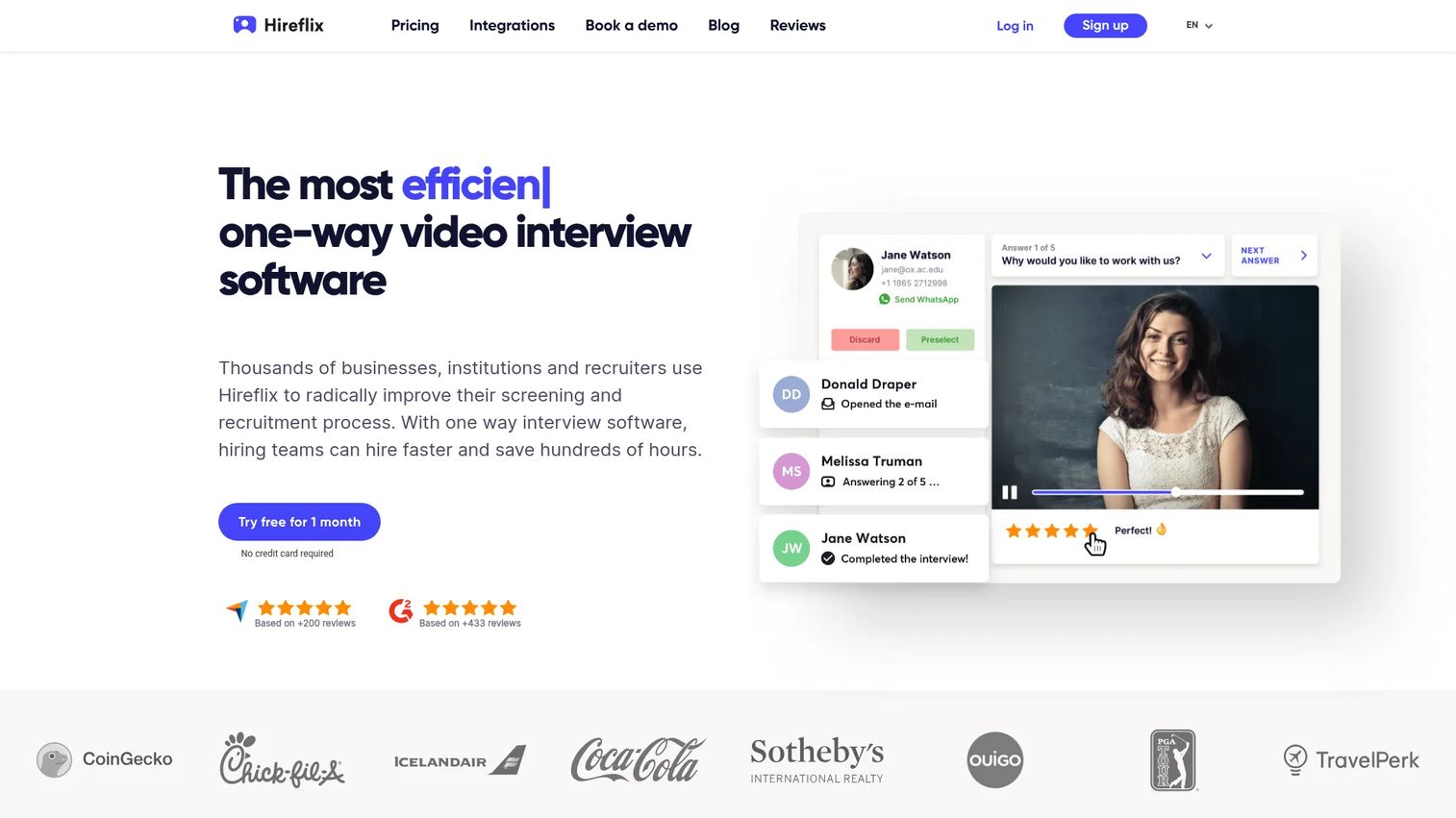
Hireflix is one-way video interviewing software focused on async screening done simply. It strips the category down to what most teams actually need first: a clean way to send one-way video interviews, review them fast, and connect results to the rest of the stack. The transparent flat-rate pricing is a deliberate contrast to the custom-quote norm.
Best for: Teams that want a transparent, flat-rate one-way video interview tool for first-round screening.
Key strengths
- Unlimited usage: Unlimited user seats, positions, and interview responses on every plan.
- Branding and white label: Custom domains, themes, and white-label options for a branded candidate experience.
- ATS integrations and API: Connects to ATS tools plus a GraphQL API with webhooks.
Why choose Hireflix: If you want async screening without enterprise complexity or opaque pricing, Hireflix is the cleanest option here. Every plan includes all features, so smaller teams are not gated out of branding or integrations. It is a focused tool that does one-way interviews well rather than a sprawling suite.
Hireflix pricing: Hireflix lists transparent pricing. The Small plan (for companies under 50 employees) starts at $75 per month billed yearly, and the Medium plan (50 to 250 employees) is $150 per month billed yearly. A Custom plan covers high-volume and agency use, and a one-month free trial is available. Hireflix holds a 5.0/5 rating on G2.
5. Talview
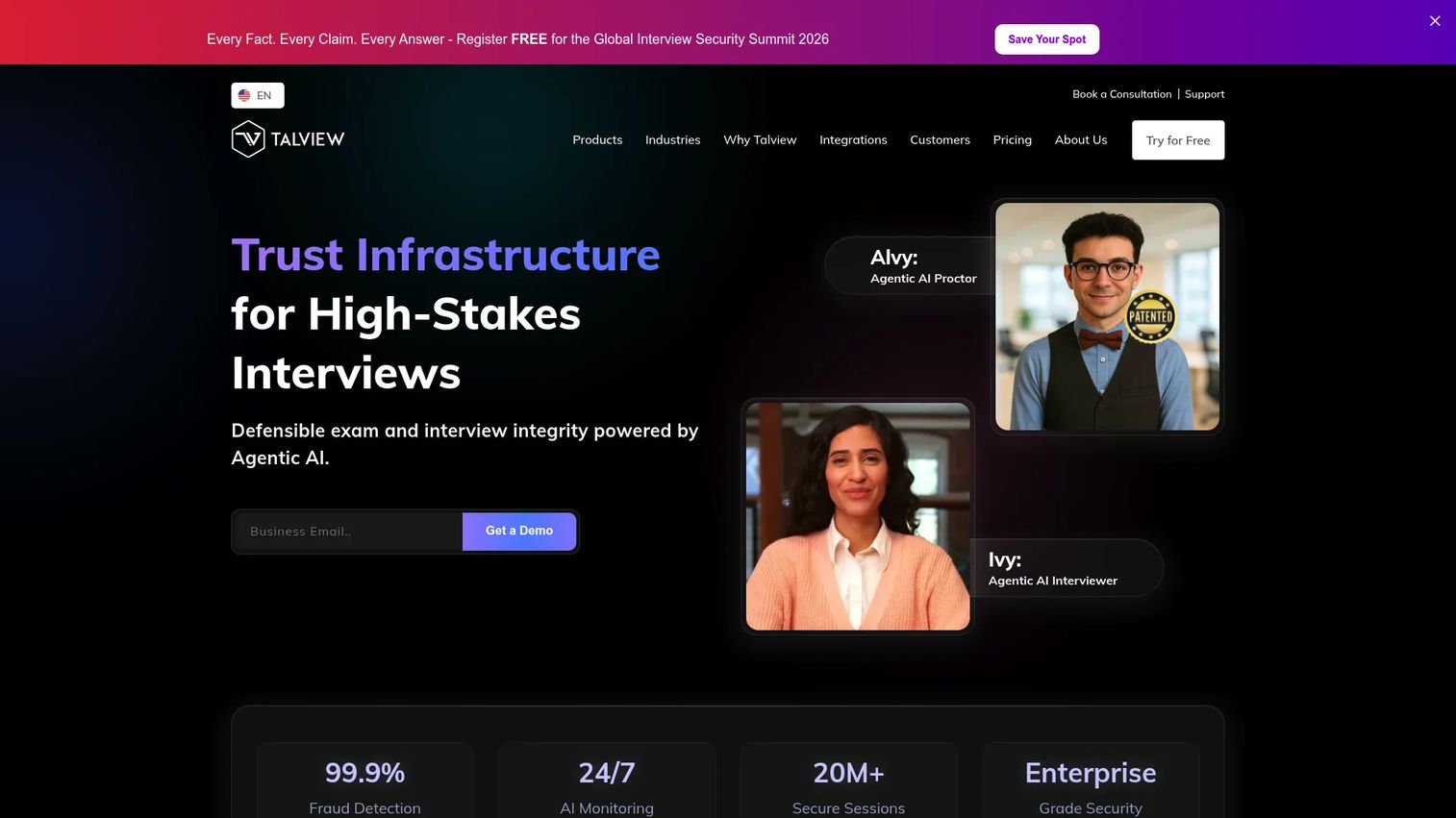
Talview is an AI-powered hiring, interviewing, and online proctoring platform built for high-stakes assessments. It bridges video interview screening with secure, monitored evaluation, adding identity verification and remote exam controls that most interview tools do not. For regulated industries and credential-based hiring, that security layer is the differentiator.
Best for: Enterprises that need secure, scalable hiring and exam proctoring workflows in one platform.
Key strengths
- AI interviewing and scheduling: Combines automated interviewing with coordinated scheduling.
- AI proctoring: Monitors remote exams and assessments to protect integrity.
- Identity verification: Adds secure browser controls and identity checks for high-stakes hiring.
Why choose Talview: Talview fits teams whose hiring overlaps with testing and certification, where security and compliance are not optional. It connects interview screening to broader hiring operations, so organizations running assessments at scale get evaluation and integrity controls in a single workflow rather than two.
Talview pricing: Talview does not publish public pricing. Its site uses unit-based, bundled pricing with minimum commitments typically required, and asks buyers to request a quote. Scope your needs around assessment volume and proctoring. Talview holds a 4.4/5 rating on G2.
6. Workable
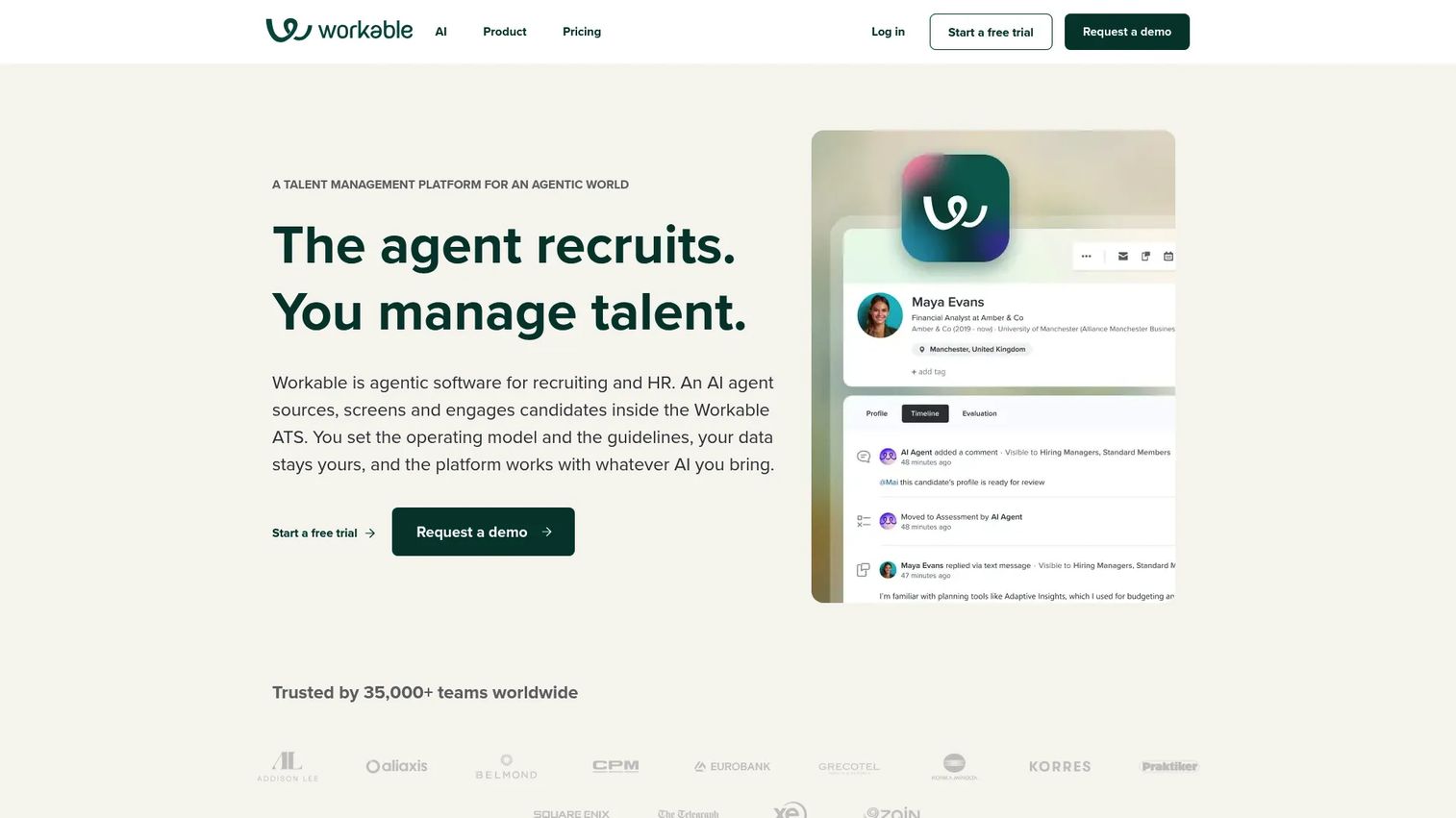
Workable is all-in-one recruiting, HR, and AI hiring software where video interviewing is one capability inside a broader applicant tracking system. If you already run hiring through Workable, video interviews live natively beside sourcing, your ATS pipeline, and onboarding, so there is no separate tool to maintain. The appeal is consolidation.
Best for: Companies that want an integrated ATS plus HR platform with AI-assisted hiring built in.
Key strengths
- Applicant tracking system: Manages the full pipeline from application to offer in one place.
- Candidate sourcing suite: Finds and attracts candidates alongside interviewing.
- Onboarding and HR management: Carries hires from offer into employee onboarding.
Why choose Workable: If you want video interviewing as part of your hiring hub rather than a standalone purchase, Workable is the natural pick. Its AI features help screen inbound candidates, and the integrated model means recruiters work in one system instead of toggling between an ATS and a separate interview tool. It fits SMB to mid-market teams well.
Workable pricing: Workable publishes public pricing. The Standard plan starts at $299 per month, Premier at $599 per month, and Enterprise at $719 per month. A free trial is available, and paid accounts include Workable Agent credits. Confirm tier features against your headcount and hiring volume. Workable holds a 4.4/5 rating on G2.
7. Spark Hire
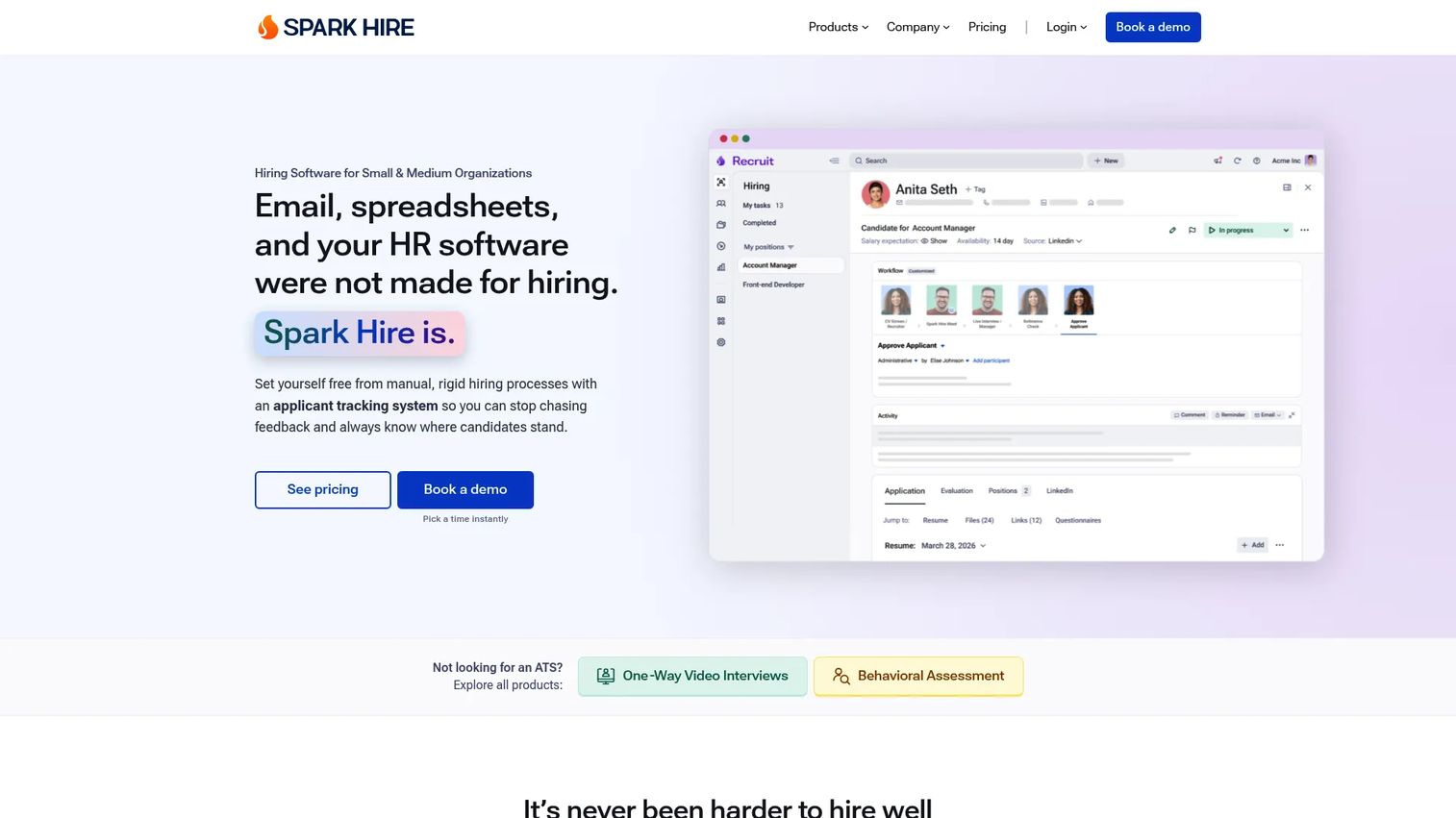
Spark Hire is hiring software that pairs video interviewing with an ATS and behavioral assessments. It supports one-way and live video interviews alongside collaboration tools that keep hiring teams aligned on candidates. The platform works as a straightforward interview-led layer for structured screening, with ATS depth available when teams need it.
Best for: Mid-market hiring teams that want an ATS plus video interviewing and candidate assessment in one platform.
Key strengths
- One-way and live interviews: Covers async screening and real-time rounds.
- Applicant tracking (Spark Hire Recruit): Adds pipeline management to the interview workflow.
- Predictive behavioral assessment: Layers candidate evaluation onto interview data.
Why choose Spark Hire: Teams that want structured screening with hiring team collaboration baked in will find Spark Hire practical and approachable. It scales from interview-only use up to a fuller ATS-plus-assessment workflow, which suits growing mid-market teams that do not want to over-buy early. Its integrations span job boards, assessments, background checks, and HRIS providers.
Spark Hire pricing: Spark Hire publishes pricing across product lines. Recruit Pro starts at $335 per month billed annually and Recruit Growth at $499 per month billed annually, while Recruit Enterprise is quote-based. Standalone Video Interviews start at $249 per month and Behavioral Assessment at $249 per month billed annually. ATS pricing scales by company size. Spark Hire holds a 4.7/5 rating on G2.
8. Harver
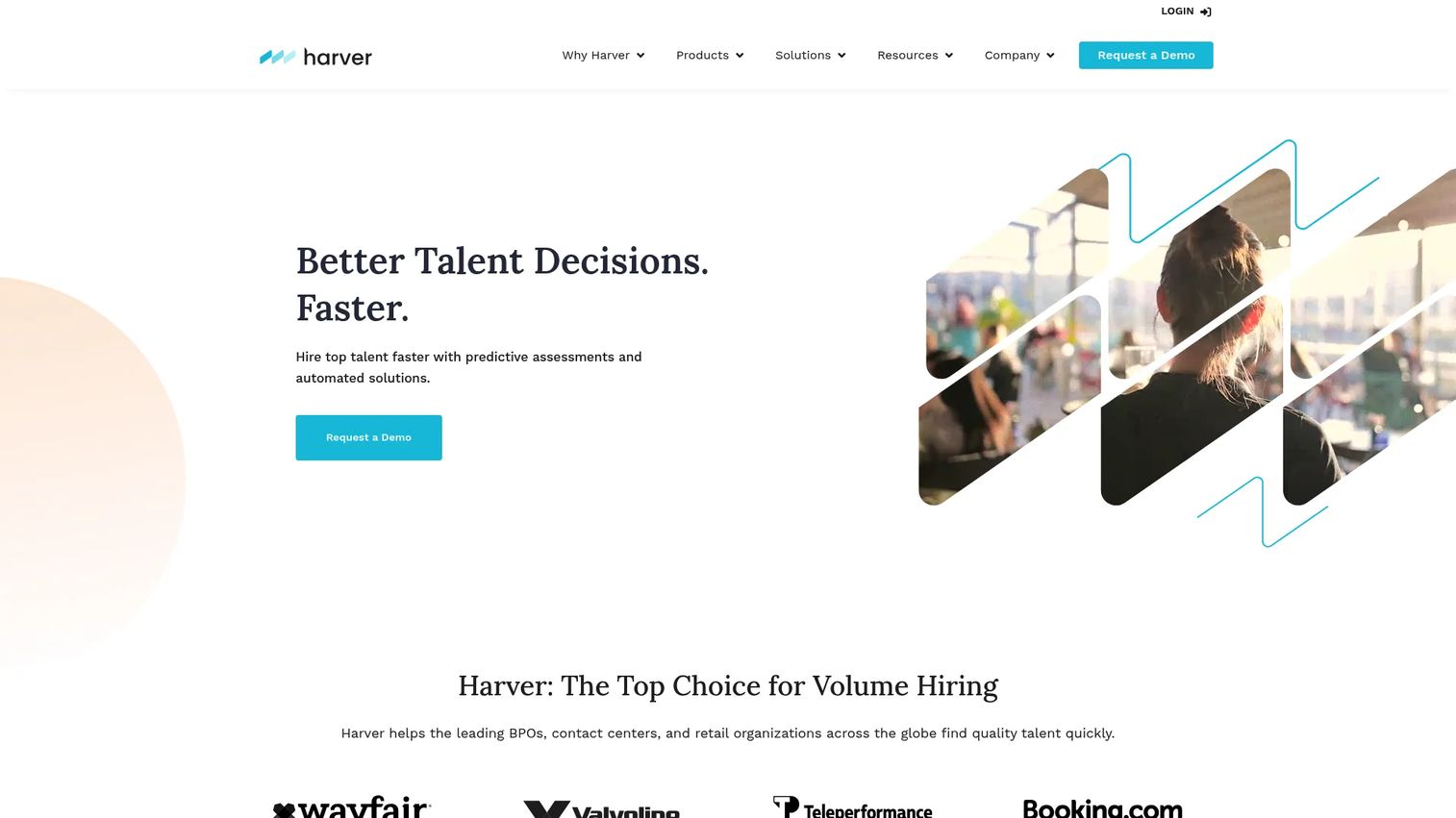
Harver is a talent assessment and automated hiring platform built for volume hiring and candidate evaluation. Rather than leading with interviews, it leads with predictive assessments and automated workflows that filter large applicant pools before humans get involved. Video interviewing sits inside that assessment-led model, which is why it ranks here for high-volume motions.
Best for: Enterprise and high-volume hiring teams that need assessments and automation across large applicant pools.
Key strengths
- Predictive assessments: Scores candidates on traits that correlate with on-the-job performance.
- Automated hiring workflows: Moves candidates through stages with minimal manual touch.
- Branded candidate experience: Keeps high-volume hiring on-brand and consistent.
Why choose Harver: When you are hiring hundreds or thousands for similar roles, Harver's assessment-first approach and automation do the heavy filtering so recruiters focus on finalists. It fits retail, contact center, and other high-volume recruiting motions where consistency and speed matter more than bespoke, role-by-role process design.
Harver pricing: Harver does not expose public pricing and operates on a request-demo basis. Pricing is scoped to hiring volume and assessment needs, which is typical for enterprise volume-hiring platforms. Harver holds a 4.6/5 rating on G2.
Considerations before you buy
The right platform depends on your hiring motion, not the longest feature list. Run any shortlist through these criteria before committing.
Interview format fit
Decide whether your bottleneck is first-round screening, final-round structure, or both. If you are drowning in applicants, prioritize async one-way interviews. If your problem is messy panels and inconsistent final rounds, prioritize live interview structure and shared scorecards. Most teams need both, but the weighting changes which tool wins.
ATS integration depth
A video interview tool that does not talk to your applicant tracking system creates a second silo. Confirm the integration is native, not a brittle workaround, and that scores, statuses, and recordings sync both directions. If you lack an ATS entirely, an all-in-one platform may be the cleaner buy than a standalone interview tool.
AI and fairness controls
AI scoring can speed screening, but only if you can audit it. Ask how models are evaluated for bias reduction, what data they use, and whether you can override or explain scores. Structured interviewing plus transparent AI is the combination that improves both speed and defensibility.
Security, compliance, and global reach
For regulated industries or global hiring, verify data residency, proctoring, identity verification, and multilingual support. Security and compliance gaps surface late and cost the most. If you hire across regions, confirm time-zone-aware scheduling and localized candidate flows are real, not roadmap.
Conclusion
The best video interviewing software for your team comes down to hiring motion. For enterprise scale with AI assessments and deep automation, HireVue is the broadest fit. For video interviewing plus assessments, Jobma stands out. For structured process control, VidCruiter leads. For simple async screening, Hireflix is the cleanest pick. For an ATS and interviews in one, Workable wins, while Spark Hire suits mid-market teams wanting interviews plus assessment. For high-volume assessment-led hiring, Harver is built for it, and Talview is the choice when proctoring and security are non-negotiable.
Weigh the same factors every time: interview format, ATS depth, AI and fairness, scheduling automation, and compliance. The fastest way to decide is practical: shortlist two or three tools, then test each against one real open role. Run the same candidates through each, measure time-to-decision and candidate experience, and let the results pick the winner. You will learn more from one live trial than from any feature matrix, including this one.
FAQs
Video interviewing software lets hiring teams interview candidates over video, either asynchronously or live, while capturing structured data for evaluation. It standardizes early-round screening, reduces scheduling friction, and feeds results into your ATS and recruitment workflow so hiring moves faster and stays consistent.
Async, or one-way video interviews, have candidates record answers to preset questions on their own time, which removes scheduling entirely and is ideal for screening at scale. Live video interviews are real-time conversations used for panels, final rounds, and stakeholder alignment where follow-up questions and nuance matter.
Usually no. Most video interview platforms integrate with your applicant tracking system rather than replacing it, syncing interviews, scores, and statuses. Some all-in-one tools include both an ATS and video interviewing, which can replace separate systems if you want consolidation. Match the choice to whether you already run a dedicated ATS.
For enterprise teams, prioritize ATS integration depth, AI assessments with auditable scoring, automated scheduling, security and compliance controls, and multilingual support for global hiring. Volume handling and structured interviewing also matter, because consistency across thousands of candidates and many regions is what protects fairness and defensibility.
AI handles transcription, structured scoring, candidate screening signals, and scheduling automation. Some platforms add AI interviewers or conversational agents that engage candidates earlier. The value depends on transparency: look for AI scoring you can audit, explain, and override, with documented bias reduction, so speed never comes at the cost of fairness.
Strong interview scheduling software offers candidate self-scheduling, two-way calendar sync, automated reminders, and time-zone awareness for distributed teams. The goal is eliminating the email back-and-forth that delays hiring. Confirm it syncs with your existing calendar and ATS so availability and bookings stay accurate without manual updates.
Yes, for most remote and distributed teams. It removes geographic and scheduling barriers, lets candidates interview from anywhere, and standardizes evaluation across locations. Async formats are especially useful across time zones, and multilingual flows plus time-zone-aware scheduling make global hiring and remote interviews far more manageable.
Look at completion rates, self-scheduling options, mobile-friendliness, and multilingual support as candidate experience signals. For fairness, evaluate structured interviewing, consistent question sets, and how AI scoring is tested for bias reduction. The strongest virtual interviews combine a smooth candidate flow with auditable, standardized evaluation that holds up under scrutiny.