


Your board wants clean numbers by Tuesday. You have eleven entities, three currencies, and a consolidation workbook that only one person on the team fully understands. That person is on vacation.
This is where most growing companies hit the wall. Spreadsheet consolidation works fine at two entities. It breaks quietly, then loudly, as you add subsidiaries, currencies, and ownership layers. Every close becomes a fire drill. Every audit becomes an archaeology project.
The financial consolidation software market reflects that pressure. It is projected to grow from about USD 3.27 billion in 2025 to USD 7.77 billion by 2035, at a 9% CAGR, according to Business Research Insights (2025). Cloud already accounts for 58.4% of revenue in 2025, and 72% of new deals are cloud-native SaaS, per MarketIntelo (2025).
The stakes are simple for a founder or finance leader. If your consolidated numbers cannot survive board scrutiny or due diligence, nothing else you report matters. This guide is a shortlist for that high-stakes decision, not a generic vendor roundup.
What's inside
This guide is for CFOs, controllers, finance operators, and founders who need consolidated financials they can trust across entities and currencies. It covers seven financial consolidation tools and how to match them to your structure.
We chose tools based on the factors that actually matter under audit and board pressure:
- Multi-entity support and ownership hierarchy handling
- Multi-currency translation and intercompany eliminations
- ERP and system integration depth
- Audit trail, governance, and drill-through reporting
- Fit across mid-market and enterprise finance teams
TL;DR
- Best for enterprise finance teams: OneStream and Oracle Financial Consolidation and Close both handle deep, complex group structures with heavy automation.
- Best for reporting and governance: CCH Tagetik pairs close management with strong controls for regulated groups.
- Best for mid-market usability: Planful and Vena give smaller finance functions modern reporting without an enterprise-scale rollout.
- Best for modern reporting workflows: Board and Datarails suit teams that want planning and reporting alongside consolidation.
- Best overall fit depends on your priorities: automation, governance, ERP alignment, or speed of adoption. There is no single winner, only the right match for your structure.
What is financial consolidation software
Financial consolidation software is a system that combines the financial results of multiple legal entities into a single, accurate set of group financial statements.
It exists to solve the problem spreadsheets cannot: producing reliable consolidated numbers when entities, currencies, and ownership structures multiply. Accounting consolidation software automates the mechanical work and creates an audit trail around it.
Core capabilities you should expect:
- Multi-currency translation: converting subsidiary results into the group reporting currency using correct rates and methods.
- Intercompany eliminations: removing transactions between entities so revenue and balances are not double-counted.
- Ownership hierarchies: handling minority interests, partial ownership, and complex group structures.
- Adjustments and journals: posting consolidation entries with clear documentation.
- Audit trails: capturing who changed what, when, and why, for audit-ready financial reporting.
- Drill-through reporting: tracing any consolidated figure back to its source transaction.
One distinction matters. Financial close software manages the whole period-end process: reconciliations, task workflows, journal approvals, and sign-offs. Consolidation is the specific step that rolls entity numbers up into group statements. Most modern financial close and consolidation software does both, but they are not the same job.
When to use financial consolidation software
Replace spreadsheet-based group reporting
Spreadsheet consolidation is fine until it isn't. Add a subsidiary, and the links break. Add a currency, and someone hardcodes a rate. Add a partial-ownership entity, and the eliminations logic becomes tribal knowledge.
Multi-entity consolidation software removes the fragility. Each entity feeds a central model, eliminations run on rules instead of memory, and the group statement rebuilds automatically. When your CFO or a new VP of Finance arrives, the process does not live in one analyst's head.
Standardize multi-entity close and reporting
Every entity closing on its own timeline with its own template creates rework. A financial consolidation system centralizes the workflow so entities submit in a standard format, on a standard calendar, with validation checks that catch errors before they reach the group level.
That standardization is what shortens the close from weeks to days. It also produces the consistent reporting your board expects quarter over quarter, without a scramble each period.
Support audit and compliance readiness
Auditors want traceability. They want to see the source of every number, the logic behind every elimination, and a record of every adjustment. Manual consolidation makes that hard to produce and easy to question.
Financial reporting consolidation software captures controls, permissions, and evidence as a byproduct of doing the work. Multi-currency consolidation software also documents translation methods and rates. When due diligence hits, you are answering questions instead of reconstructing history.
Comparison table
The table below is sorted by overall relevance to enterprise and mid-market consolidation needs. Pricing across this category is almost entirely quote-based, so pricing reflects each vendor's public model. G2 ratings are shown where a current value was verified.
| # | Product | Best for | Key differentiator | Pricing | G2 rating |
|---|---|---|---|---|---|
| 1 | OneStream | Enterprise CPM and unified close | Unifies close, planning, reporting, and ESG on one platform | Custom quote | Not listed |
| 2 | Oracle Financial Consolidation and Close | Oracle-aligned enterprises | Cloud consolidation within Oracle's EPM ecosystem | Custom quote | Not listed |
| 3 | CCH Tagetik | Reporting and governance | Close, reconciliation, and regulatory reporting depth | Custom quote | 4.3/5 |
| 4 | Planful | Mid-market FP&A plus consolidation | Usable planning and close in one cloud platform | Custom quote | 4.3/5 |
| 5 | Vena | Excel-native finance teams | Full Microsoft Excel workflow with a central database | Custom quote | 4.5/5 |
| 6 | Board | Enterprise planning plus consolidation | Unified planning, forecasting, and analytics layer | Custom quote | 4.4/5 |
| 7 | Datarails | Excel-connected reporting | Governed consolidation on top of existing spreadsheets | Custom quote | 4.6/5 |
1. OneStream
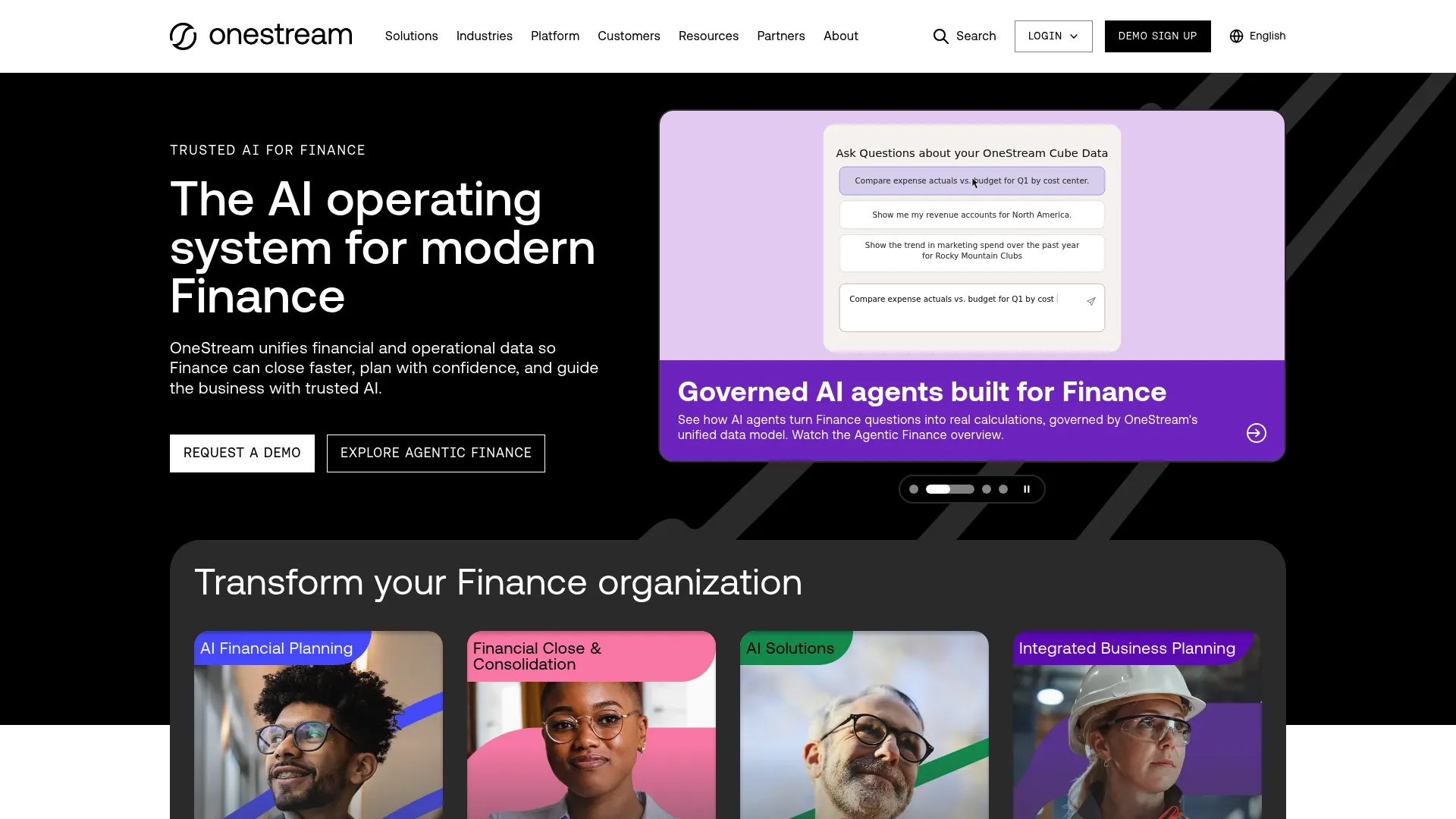
OneStream positions itself as an AI operating system for modern finance that unifies financial and operational data in a single platform. Instead of bolting consolidation onto a separate planning tool, it runs financial close, planning, reporting, and ESG together. For enterprise finance teams tired of stitching modules from different vendors, that unification is the whole pitch.
The platform handles deep, complex group structures with heavy workflow automation. It is built for organizations where the consolidation logic itself is genuinely hard: many entities, layered ownership, multiple standards, and demanding reporting cycles.
Best for: Enterprise finance teams needing unified CPM, close, planning, and reporting in one platform.
Key strengths
- Unifies financial close, planning, reporting, ESG, and operational data
- Embedded AI and SensibleAI capabilities
- Extensible platform with Solution Exchange and Microsoft integration
Why choose OneStream: If your finance function spans consolidation, planning, and reporting across many entities, OneStream's single platform reduces the handoffs and reconciliation between separate tools. It is aimed squarely at complex enterprise structures, so a two-entity startup would find it more than the job requires.
OneStream pricing: Pricing is quote-based and not published publicly. You engage their team for a tailored quote based on scope and scale.
2. Oracle Financial Consolidation and Close
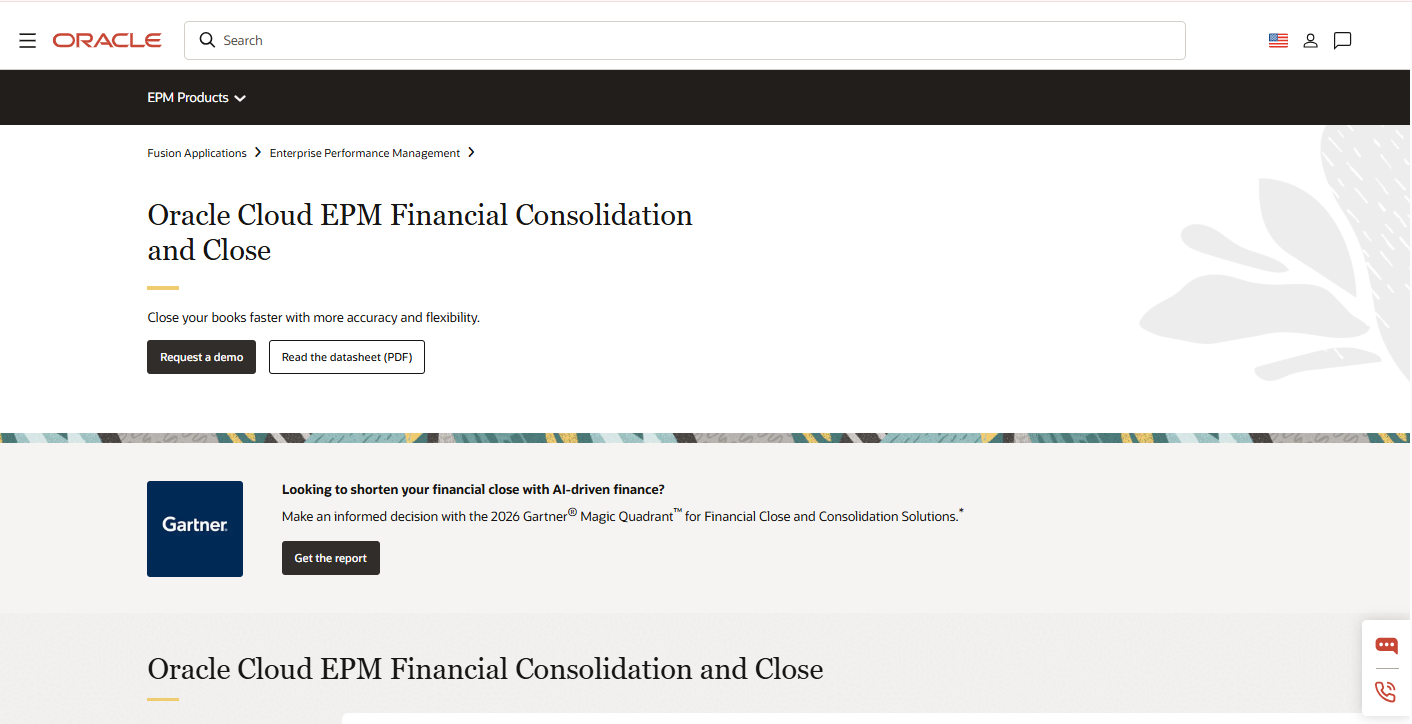
Oracle Financial Consolidation and Close is a subscription-based, cloud consolidation and reporting service built to accelerate the financial close. It lives inside Oracle's broader EPM ecosystem, which is the main reason teams shortlist it. If you already run Oracle systems, the alignment is a real advantage.
The product covers the mechanics enterprise finance teams need: currency translation, eliminations, and close workflow management. It is designed for large organizations with structured, repeatable close processes and multiple stakeholders in the cycle.
Best for: Large finance teams needing cloud-based consolidation, eliminations, and close workflow automation, especially within or near the Oracle stack.
Key strengths
- Currency translations and FX adjustment calculations
- Close calendar task management and workflow
- Supplemental schedule data management
Why choose Oracle Financial Consolidation and Close: The strongest case is ERP-connected financial consolidation software fit. If Oracle is already your system of record, keeping consolidation in the same ecosystem simplifies data flow and governance. Teams with no Oracle footprint should weigh whether that alignment outweighs the depth of the platform.
Oracle pricing: Oracle describes the service as subscription-based, with pricing handled through EPM sales rather than a public price list.
3. CCH Tagetik
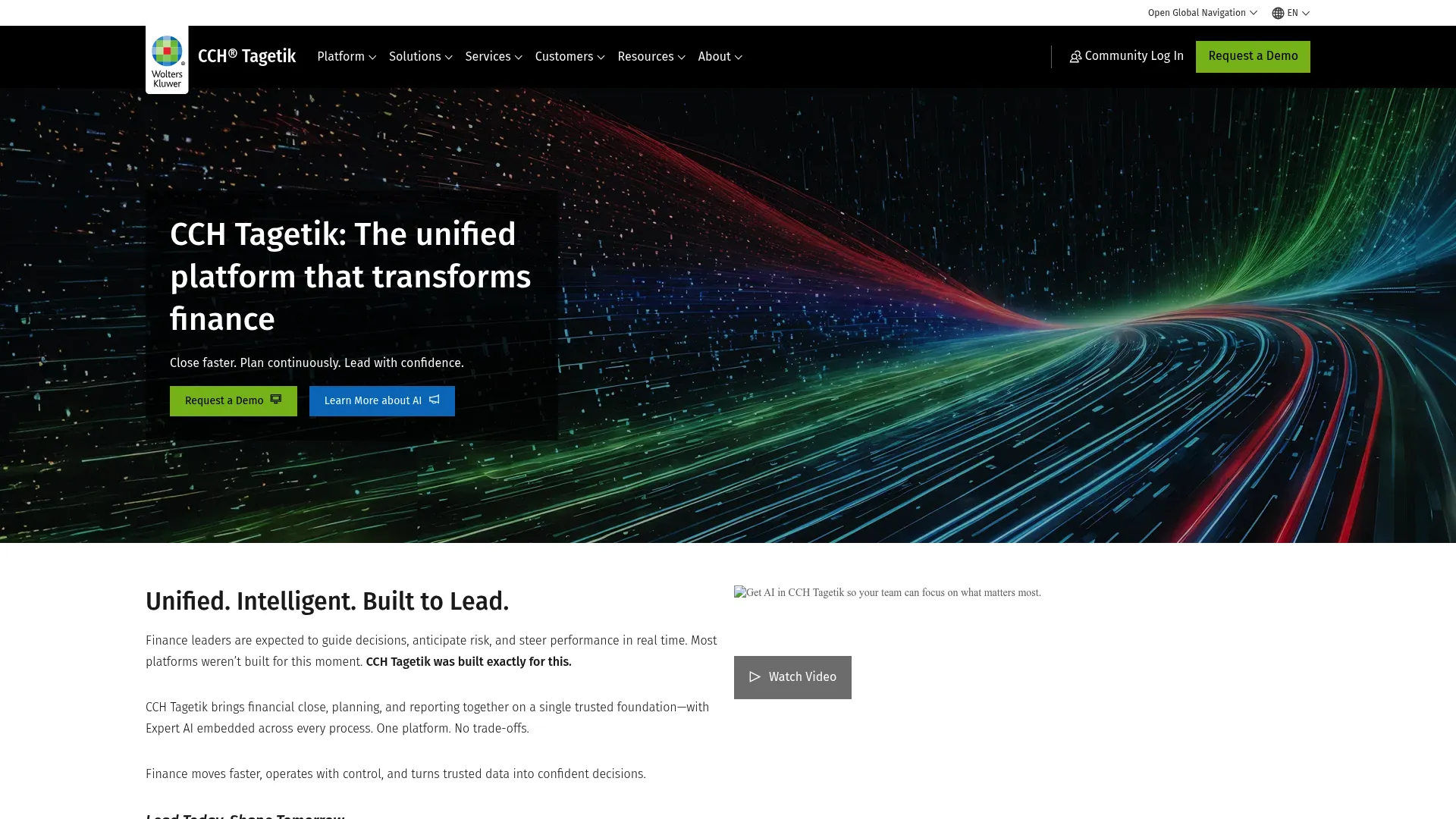
CCH Tagetik is corporate performance management software from Wolters Kluwer, covering planning, close, reporting, and ESG or regulatory processes. Its reputation sits in governance and reporting depth, which is why finance leaders in regulated or complex group structures tend to put it on the list.
The platform brings close management, account reconciliation, and consolidated reporting together with strong controls. For teams where compliance and reporting rigor are non-negotiable, that control layer is the draw.
Best for: Enterprise finance teams needing a unified CPM platform with strong close, reconciliation, and reporting governance.
Key strengths
- Financial close and consolidation
- Budgeting, planning, and forecasting
- ESG and regulatory reporting
Why choose CCH Tagetik: Finance leaders often evaluate it alongside Oracle and OneStream because all three handle complex group accounting. CCH Tagetik's differentiation leans toward reporting and regulatory governance, so it appeals to teams where audit and disclosure requirements drive the decision.
CCH Tagetik pricing: Pricing is contact-based. Wolters Kluwer works through a demo and quote process rather than publishing figures.
4. Planful
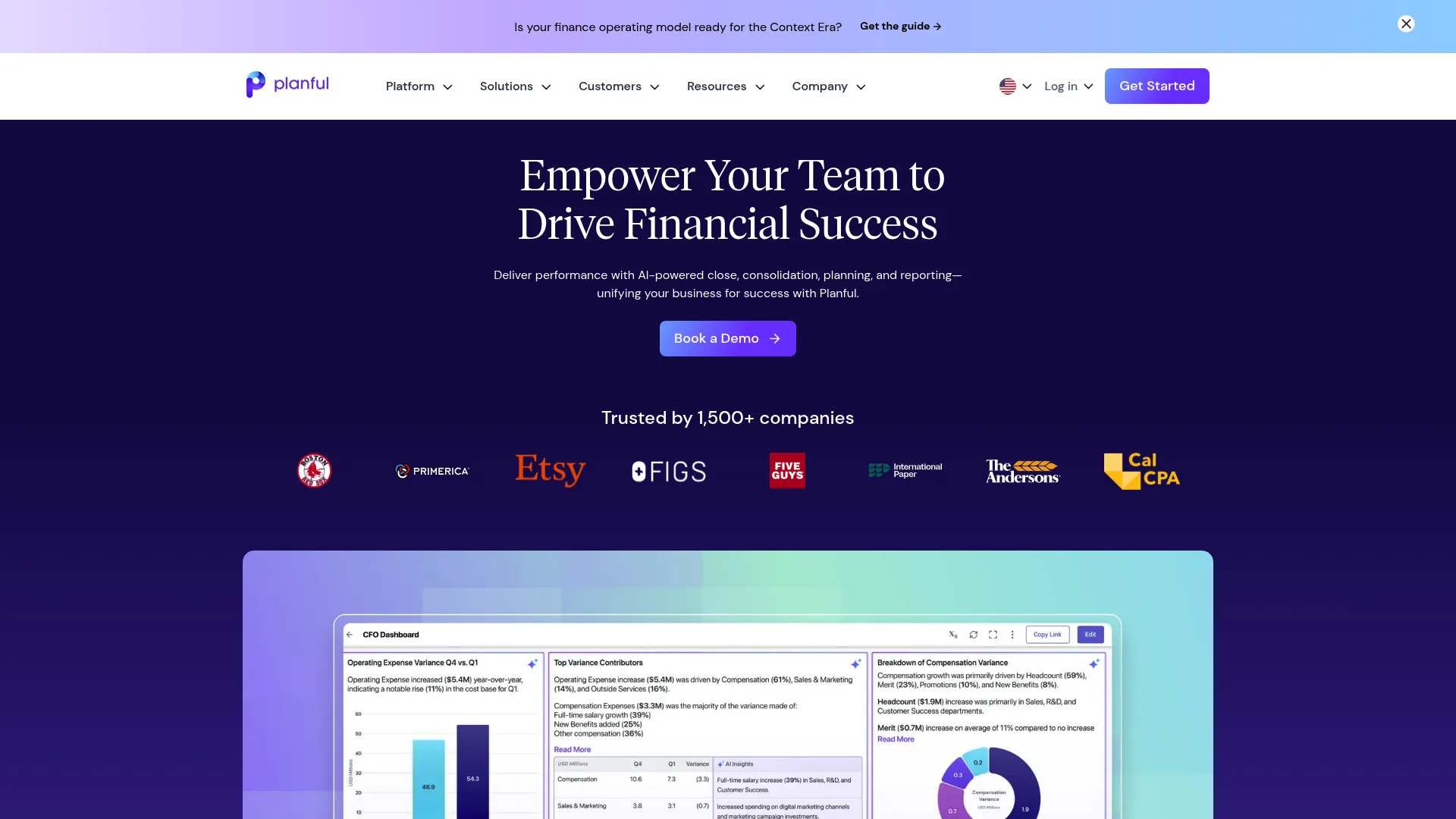
Planful is cloud-based financial performance management software for planning, forecasting, reporting, consolidation, and close. Its appeal is usability. Mid-market finance teams that want structured consolidation without a heavy enterprise rollout gravitate toward it.
The platform pairs FP&A and close in one place, so planning and consolidation share a system rather than living in separate tools. For a smaller finance function, that combination covers a lot of ground with one platform to learn.
Best for: Mid-market and enterprise finance teams needing FP&A and financial performance management with approachable consolidation.
Key strengths
- AI-powered planning and forecasting
- Financial close and consolidation
- Reporting, dashboards, and analysis
Why choose Planful: Teams with leaner finance staff often pick Planful because it delivers planning plus consolidation without demanding enterprise-scale implementation effort. Highly complex global structures with intricate ownership layers should confirm the consolidation depth matches their specific needs.
Planful pricing: Planful uses subscription pricing tailored to company size, user count, and selected modules. No public price is published.
5. Vena

Vena is cloud FP&A and corporate performance management software built around Microsoft Excel. That is the point. Instead of retraining your team on a new interface, Vena keeps the Excel workflow they already know and adds a central database, governance, and automation underneath it.
For finance teams that want structure without abandoning the tool they use every day, that familiarity drives faster adoption. Planning, consolidation, and reporting all happen in an environment that feels like Excel but behaves like a governed system.
Best for: Finance teams needing Excel-based FP&A planning, reporting, and workflow automation with governed consolidation.
Key strengths
- Full Microsoft Excel integration
- Central database
- Workflow and collaboration
Why choose Vena: If your team resists leaving Excel, Vena removes that objection while adding the controls and single source of truth that raw spreadsheets lack. It suits teams that want usability and adoption speed without giving up structure.
Vena pricing: Vena lists two plans, Professional and Complete, both quote-based. No public numeric prices are shown; pricing is custom.
6. Board
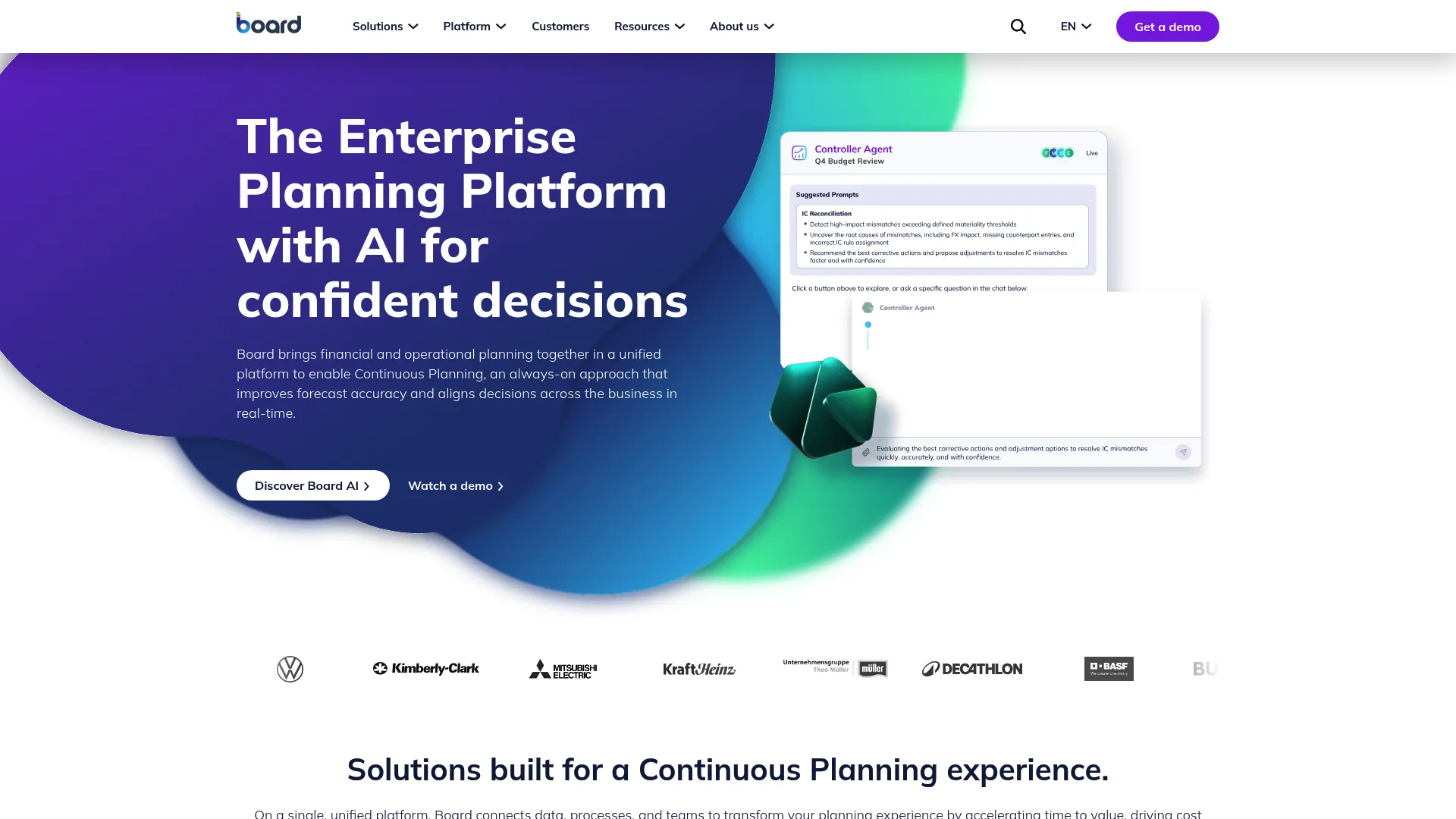
Board is an enterprise planning platform for continuous planning, forecasting, and analytics, with consolidation as part of a broader analytics layer. Teams that want financial statement consolidation software alongside a wider planning and modeling capability tend to consider it.
The platform's strength is unification across planning and analytics. If your finance and operations teams want one environment for modeling, forecasting, and reporting, Board covers more than consolidation alone.
Best for: Large enterprises needing unified FP&A and operational planning with integrated consolidation.
Key strengths
- Unified planning platform
- Flexible deployment on-premise, on-hosting, or on-cloud
- Data connectivity, simulation, and real-time modeling
Why choose Board: Choose Board when consolidation is one piece of a larger planning and analytics mandate, not the whole job. Teams that need only tightly-scoped consolidation may find the broader platform more than they require, while teams wanting planning and consolidation together see the value.
Board pricing: Board provides a customized quote. No public starting price is shown on its pricing page.
7. Datarails
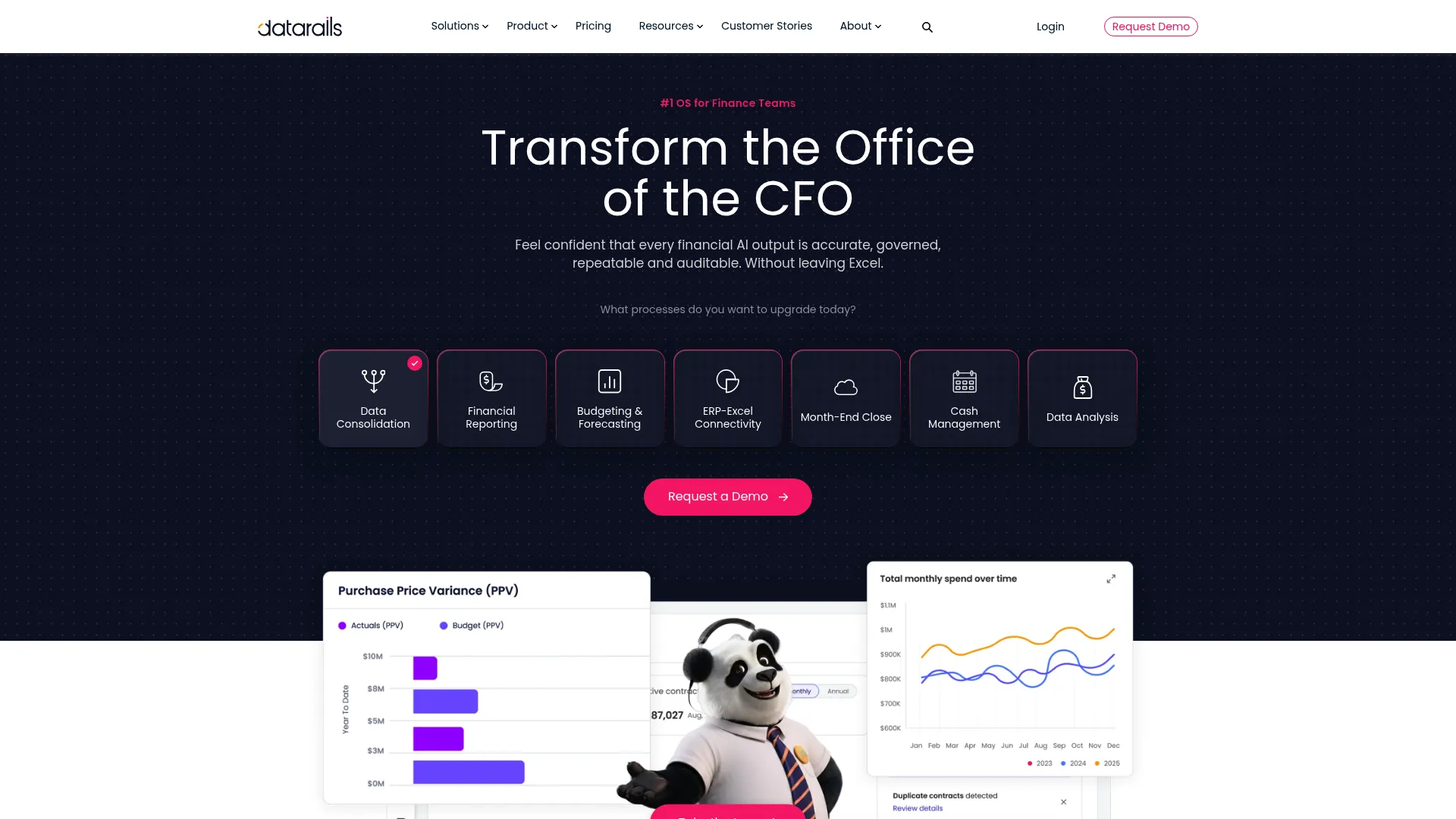
Datarails is Excel-native FP&A and finance operating software for consolidating, reporting, planning, and analyzing financial data. It connects to your existing spreadsheets rather than replacing them, which appeals to teams moving away from manual reporting but not yet needing the heaviest enterprise stack.
The core idea is governed consolidation on top of the workbooks finance already uses. Data consolidation software like this bridges the gap between fully manual spreadsheets and a full enterprise CPM rollout.
Best for: Finance teams that want an Excel-connected FP&A platform with governed consolidation and reporting.
Key strengths
- Data consolidation
- Financial reporting and dashboards
- Budgeting and forecasting
Why choose Datarails: Datarails is strongest for teams outgrowing manual spreadsheet reporting who want automation and governance without a large-scale platform migration. Organizations with deeply complex global consolidation and intricate ownership hierarchies should confirm it covers their most demanding requirements.
Datarails pricing: Pricing is quote-based and customized to use cases, users, and integrations. Datarails asks visitors to request pricing rather than publishing rates.
Considerations
Before you shortlist, run each option through these criteria against your actual structure.
Multi-entity complexity
Be honest about how hard your consolidation really is. Two entities in one currency is a different problem than fifteen entities with partial ownership across six currencies. Match the platform's depth to your group structure, not to a hypothetical future you may never reach.
ERP and system integration
Check how cleanly the tool connects to your current finance stack. If you run Oracle, ERP-connected options carry an obvious advantage. If your data lives in NetSuite, QuickBooks, or a mix, verify the integration path before committing.
Audit trail and governance
Inspect the permissions model, reviewability, and evidence capture. Ask how the system records who changed what and when. If you cannot easily show an auditor the trail behind a consolidated number, the tool has not solved your real problem.
Reporting and drill-through
Confirm your team can trace any figure back to its source transaction. Drill-through is what turns a board question into a two-minute answer instead of a two-day investigation. Test it with your own numbers during evaluation.
Implementation effort
Match platform complexity to your finance team's capacity and timeline. Enterprise CPM platforms deliver depth but ask for a real implementation. A leaner Excel-connected tool gets you running faster. Pick the effort curve your team can actually absorb.
Conclusion
There is no single best financial consolidation software. There is the right fit for your structure, your ERP, and your reporting demands.
For complex enterprise groups that want everything on one platform, OneStream and Oracle Financial Consolidation and Close lead. For governance and regulatory reporting depth, CCH Tagetik earns its shortlist spot. For mid-market teams that want usable planning plus consolidation, Planful and Vena fit well, with Vena the pick for Excel-first teams. Board suits organizations where consolidation is part of a wider planning mandate, and Datarails works for teams outgrowing manual spreadsheets without a full enterprise rollout.
Your next step is narrowing the field by three things: how complex your multi-entity structure really is, how well each tool fits your ERP, and what your audit and reporting requirements demand. Shortlist two or three, then test them against your own numbers.
Interactive product demos are one of the fastest ways to evaluate any software before you commit. If you want to build guided, self-serve product experiences for your own buyers, Start your journey with Guideflow today!
FAQs
Prioritize multi-entity support, multi-currency translation, intercompany eliminations, ownership hierarchy handling, and a complete audit trail. Strong drill-through reporting matters too, so you can trace any consolidated figure back to its source. These are the capabilities that determine whether the tool actually replaces your spreadsheets or just moves them around.
It standardizes the consolidation process so eliminations, translations, and adjustments run on documented rules instead of manual memory. Every change is captured with a timestamp and an owner, which creates the traceability auditors expect. That combination of standardization and control reduces errors and makes compliance a byproduct of normal work rather than a separate scramble.
Yes. Multi-currency handling is a core requirement for almost every tool in this category. The software translates subsidiary results into your group reporting currency using the correct rates and methods, and documents how it did so. For any company with entities across borders, this is table stakes, not a premium feature.
It depends heavily on complexity. A leaner, Excel-connected tool can be running relatively quickly, while a full enterprise CPM platform with many entities and integrations takes a more substantial implementation. Match the effort curve to your team's capacity, and ask each vendor for a realistic timeline based on your specific entity count and ERP setup.
Nearly all platforms in this category use quote-based pricing tied to company size, user count, and selected modules. Beyond the subscription, budget for implementation services, data integration, and internal time. Total cost of ownership matters more than the headline license figure, so ask vendors to scope the full rollout, not just the software.
To a degree. Cloud platforms increasingly support current, near real-time reporting as entity data flows in, though some consolidation steps still run in defined cycles. If real-time reporting is a priority, ask each vendor exactly which figures update live versus which are refreshed on a batch or close-cycle basis.
Financial close is the full period-end process: reconciliations, journal approvals, task workflows, and sign-offs. Consolidation is the specific step that combines entity results into group financial statements, including eliminations and currency translation. Most modern financial close and consolidation software handles both, but they are distinct jobs within the period-end cycle.
Frame the answer by structure, not brand. If you have many entities with complex ownership and heavy reporting demands, an enterprise platform like OneStream or Oracle fits. If you are a growing SaaS company with a handful of entities and a lean finance team, Planful, Vena, or Datarails often match the need without an enterprise-scale rollout. Shortlist by your entity count, ERP, and audit requirements, then test against your own numbers.