Your sponsor list lives in three places that never agree. A spreadsheet tracks who paid. An inbox holds the logo files and the booth requests. A slide deck somewhere has last year's package tiers, mostly out of date.
Then the sponsor emails: "Where's our logo on the app? And can I get the lead list from the booth?" You don't have a clean answer. You have three tabs open and a growing suspicion you missed an upsell.
This is the tax of running sponsor programs by hand. Missed placements. Renewals that stall because you can't prove value. Packages that never get upgraded because nobody tracked which sponsor asked for more.
The sponsor management software market hit $3.2B in 2025 and is projected to reach $7.8B by 2034, according to MarketIntelo (2025). That growth reflects a simple shift: event teams are done stitching sponsor operations together with email threads and manual trackers. They want one place to build packages, control visibility, communicate, and measure what a sponsorship actually returned.
What's inside
This guide is for partner marketing managers, event leads, and ecosystem marketers who manage sponsor relationships across conferences, trade shows, associations, and recurring event programs.
We selected tools based on four criteria that matter for sponsor operations:
- Sponsor workflow centralization: package creation, asset intake, and tier management in one system
- Sponsor visibility and branding: control over placements, profiles, app banners, and session associations
- Communication and collaboration: sponsor portals, updates, and asset collection without email chaos
- ROI and value assessment: reporting that proves impact and supports renewals
We include tools built for sponsor operations, tools stronger on event apps and exhibitor workflow, and one marketplace for researching the category itself.
TL;DR
Quick decision shortcuts if you're skimming:
- Best for marketplace-style research: Gartner, for comparing platforms before you shortlist
- Best for event app and lead retrieval: Bizzabo, for large recurring B2B event programs
- Best for sponsor branding and exposure: Sched, for mobile-first sponsor visibility
- Best for sponsor registration and updates: ClearEvent, for smaller teams managing tiers and assets
- Best for multi-venue and seasons: Elevent, for festivals and performing arts programs
- Best for community and recurring events: Eventeny, for fairs, associations, and expos
- Best for application and approval flows: Evalato, for structured, submission-based programs
What is event sponsorship software?
Event sponsorship software is a tool that helps teams manage sponsor packages, collect sponsor assets, control sponsor visibility, distribute sponsor communications, and measure sponsor value across an event lifecycle. It centralizes the operational work that otherwise scatters across spreadsheets, inboxes, and disconnected event portals.
The category overlaps with broader event management software, but the sponsor-specific job is distinct. You're not just running registration or building an agenda. You're monetizing placements, tracking what each sponsor bought, and proving the deal paid off so it renews.
Core capabilities of sponsor management software usually include:
- Sponsor package creation and tiering: build gold, silver, and bronze levels with defined benefits and pricing
- Asset collection and intake: gather logos, copy, banners, and booth requirements in one place
- Visibility and branding controls: manage placements on websites, event apps, session pages, and mobile banners
- Sponsor portals and communication: give sponsors a self-serve place to update details and receive announcements
- Lead retrieval and engagement data: connect sponsors to the leads and attention their spend generated
- ROI and impact reporting: quantify visibility, leads, and engagement to support renewals
It helps to separate three related but different jobs. Sponsor management centers on the sponsor relationship: packages, assets, branding, and ROI. Exhibitor management focuses on booth logistics, floor plans, and on-site vendor operations. Event app tooling handles the attendee-facing experience where sponsor branding often appears. Many platforms cover more than one. Knowing which job you're solving keeps your shortlist honest.
The full sponsorship lifecycle runs from discovery (packaging and prospecting sponsors), through fulfillment (collecting assets, activating placements, communicating), to impact assessment (reporting on visibility, leads, and value). The best sponsorship management platforms cover more of that arc rather than a single slice.
When to use event sponsorship software
Centralize sponsor operations
You know you've outgrown spreadsheets when the same sponsor detail exists in four versions and none is authoritative. When a colleague asks "did the platinum sponsor send their logo?" and the answer requires searching three inboxes, the manual approach has stopped scaling. Sponsorship tracking software gives you one record per sponsor, so package, assets, and status live together instead of drifting apart.
Increase sponsor visibility and value
When sponsors pay for placements, they expect to see them delivered. That means branded pages, session associations, event app banners, and mobile visibility that actually show up where promised. If you're manually placing logos and hoping nothing gets missed, a sponsor management platform with visibility controls turns delivery into a checklist you can verify rather than a scramble the week of the event.
Measure sponsor ROI more clearly
Renewal season is when weak reporting hurts. A sponsor asking "what did we get for this?" deserves numbers, not adjectives. When retention pressure builds or you want to upsell a tier, sponsorship management tools that track impressions, leads, and engagement give you the proof to defend the spend and justify the upgrade.
Comparison table
The table below sorts the seven tools by how directly they serve sponsor operations versus broader event management. Read "best for" as the primary fit, not the only use. Pricing reflects publicly listed figures at the time of writing; verify current numbers on each vendor's page, since tiers change.
| # | Product | Best for | Key differentiator | Pricing | G2 rating |
|---|---|---|---|---|---|
| 1 | Gartner | Marketplace research before shortlisting | Independent reviews and vendor comparison across the category | Not publicly listed | 4.1/5 |
| 2 | Bizzabo | Large recurring B2B event programs | Sponsor portal, lead retrieval, and event app branding in one platform | From $499/user per month (billed annually, 3-user minimum) | 4.3/5 |
| 3 | Sched | Mobile-first sponsor exposure | Sponsor profiles and branding across branded event apps | From $500 per event | 4.4/5 |
| 4 | ClearEvent | Smaller teams managing sponsor tiers | Sponsor registration, asset intake, and simple tier management | From $895 per year | 4.3/5 |
| 5 | Elevent | Multi-venue seasons and festivals | Multi-event ticketing with sponsor and add-on management | Not publicly listed | 4.5/5 |
| 6 | Eventeny | Community events, fairs, and associations | Sponsor, vendor, and application management in one workflow | Free tier; paid from $60/mo (billed annually) | 4.2/5 |
| 7 | Evalato | Application and approval-based programs | Submission and judging workflows with branded applicant experiences | From €2,500 per program | 4.8/5 |
Best 7 tools for event sponsorship management
1. Gartner
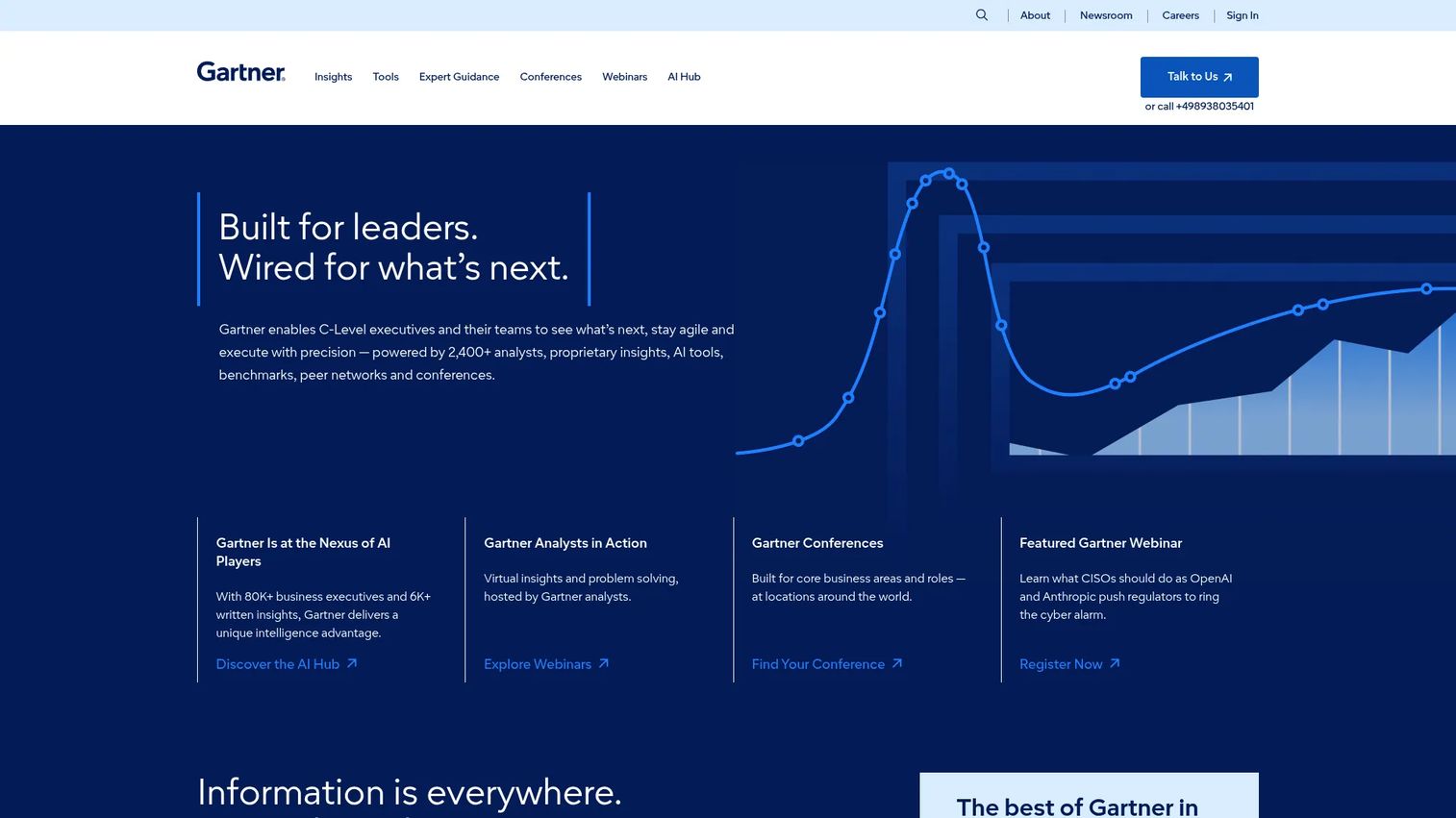
Gartner is not a sponsor management platform. It's a research and advisory firm whose review marketplace helps buyers compare sponsorship management platforms before committing budget. If you're early in the process and want an independent read on the category, this is where the research usually starts.
The value is structure. Gartner organizes vendor listings, filters, and peer reviews so you can scan the landscape without opening 20 tabs. Its framing covers the sponsorship lifecycle from discovery through impact assessment, which helps you understand what "complete" coverage looks like before you judge any single tool.
Best for: Enterprises and event teams doing early-stage vendor research before shortlisting.
Key strengths
- Independent, objective insights: peer reviews reduce vendor spin
- AskGartner AI-powered tool: guided research on categories and vendors
- BuySmart vendor evaluation workflows: structured comparison and shortlisting
Why choose Gartner: It fits the research phase, not the operations phase. You use it to decide what to shortlist, then move to a purpose-built tool to run sponsors day to day. Treat it as a map, not a destination.
Gartner pricing: Gartner doesn't list pricing for its research and advisory services. You'll usually need to go through a sales conversation, and cost depends on things like seat count and coverage.
2. Bizzabo
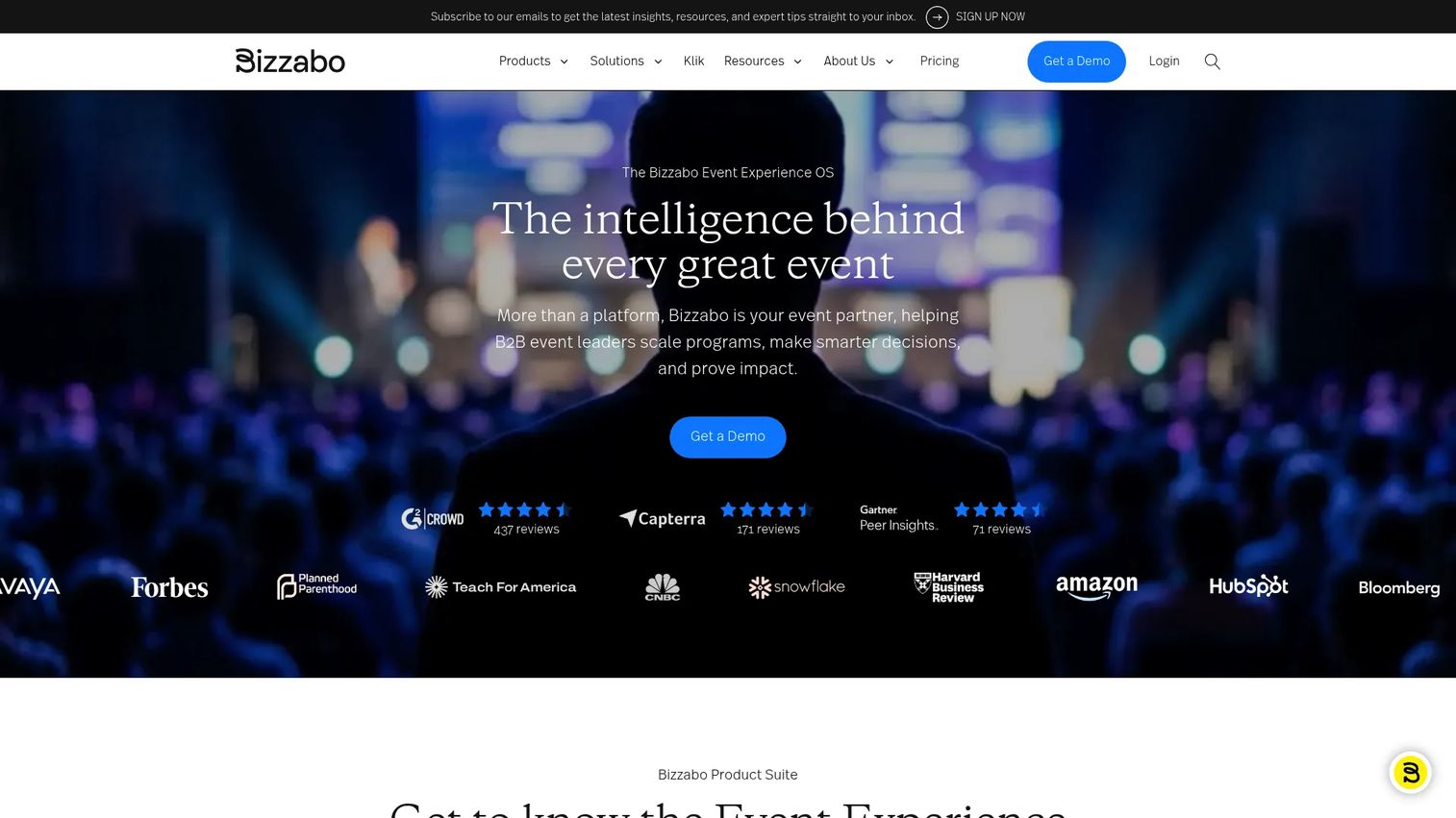
Bizzabo is an event management platform for in-person, virtual, and hybrid events, with sponsor and exhibitor management built in. It's aimed at mid-market and enterprise teams running recurring B2B events where sponsor visibility and lead retrieval need to sit inside the same system as registration and the event app.
For sponsor operations, the draw is placement plus proof. Sponsors get branded exposure in the event app and on session pages. Lead retrieval connects them to the attendees they actually engaged, which is the number they care about at renewal. Communication and partner coordination run through the platform rather than a side channel.
Best for: Mid-market and enterprise teams running large, recurring B2B event programs.
Key strengths
- Event registration and marketing: sponsor promotion inside the attendee funnel
- Onsite check-in, badge printing, and scanning: lead retrieval tied to real engagement
- Audience engagement tools: chat, polls, Q&A, and networking with sponsor placement
Why choose Bizzabo: It's the strong pick when sponsorship is one part of a bigger event operation and you want branded placement, lead capture, and engagement data in one platform. Smaller teams running a single event may find it more than they need.
Bizzabo pricing: The Event Experience OS starts at $499 per user per month, billed annually with a three-user minimum, and is also listed starting at $17,999 per year. Klik SmartBadge hardware is priced separately for single and multi-event use.
3. Sched
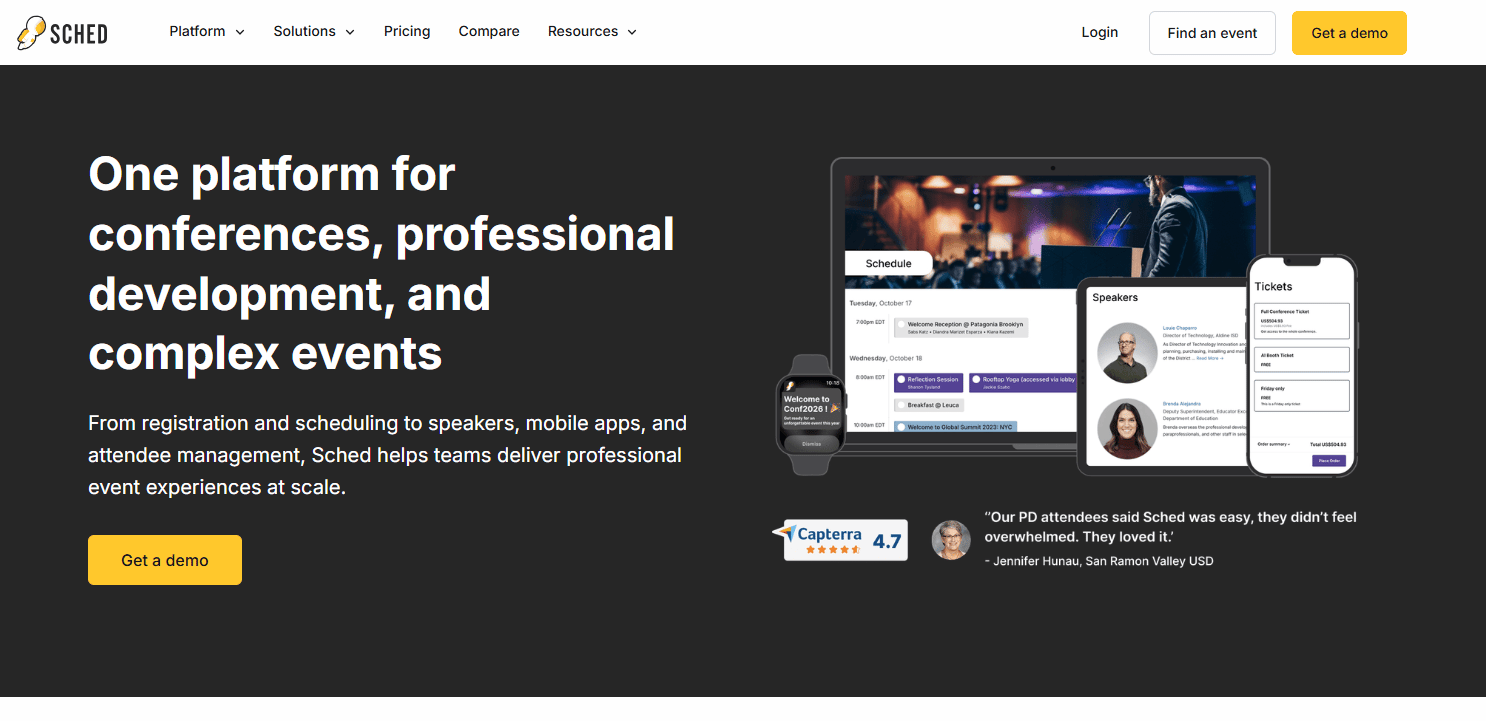
Sched is event scheduling and management software for conferences, festivals, schools, and hybrid events, with sponsor exposure built into its branded apps. It leans mobile-first, so sponsor visibility shows up where attendees spend the most time: the schedule and the app they check throughout the day.
The sponsor story here is display and association. Sponsors get profiles, branding, and placement tied to sessions and the agenda. That connection matters because it puts a sponsor's brand next to the content attendees came for, across desktop and mobile. For events that sell exposure as the core sponsor benefit, this presentation-focused approach fits well.
Best for: Organizations running multi-track in-person, virtual, or hybrid events that prioritize sponsor display.
Key strengths
- Scheduling: sponsor branding tied to sessions and the agenda
- Event registration: sponsor visibility inside the attendee sign-up flow
- Branded mobile apps: sponsor exposure on the device attendees use most
Why choose Sched: It's the fit when sponsor exposure and brand placement are the primary value you're selling, and mobile presentation matters. Teams needing deep ROI dashboards or complex package monetization may pair it with additional reporting.
Sched pricing: Plans start at $500 per event (Engage), with Reserve at $1,500 and Native at $2,500, each including 500 attendees. Events over 5,000 attendees get a same-day quote. All plans include a mobile-responsive website and Sched's native apps.
4. ClearEvent
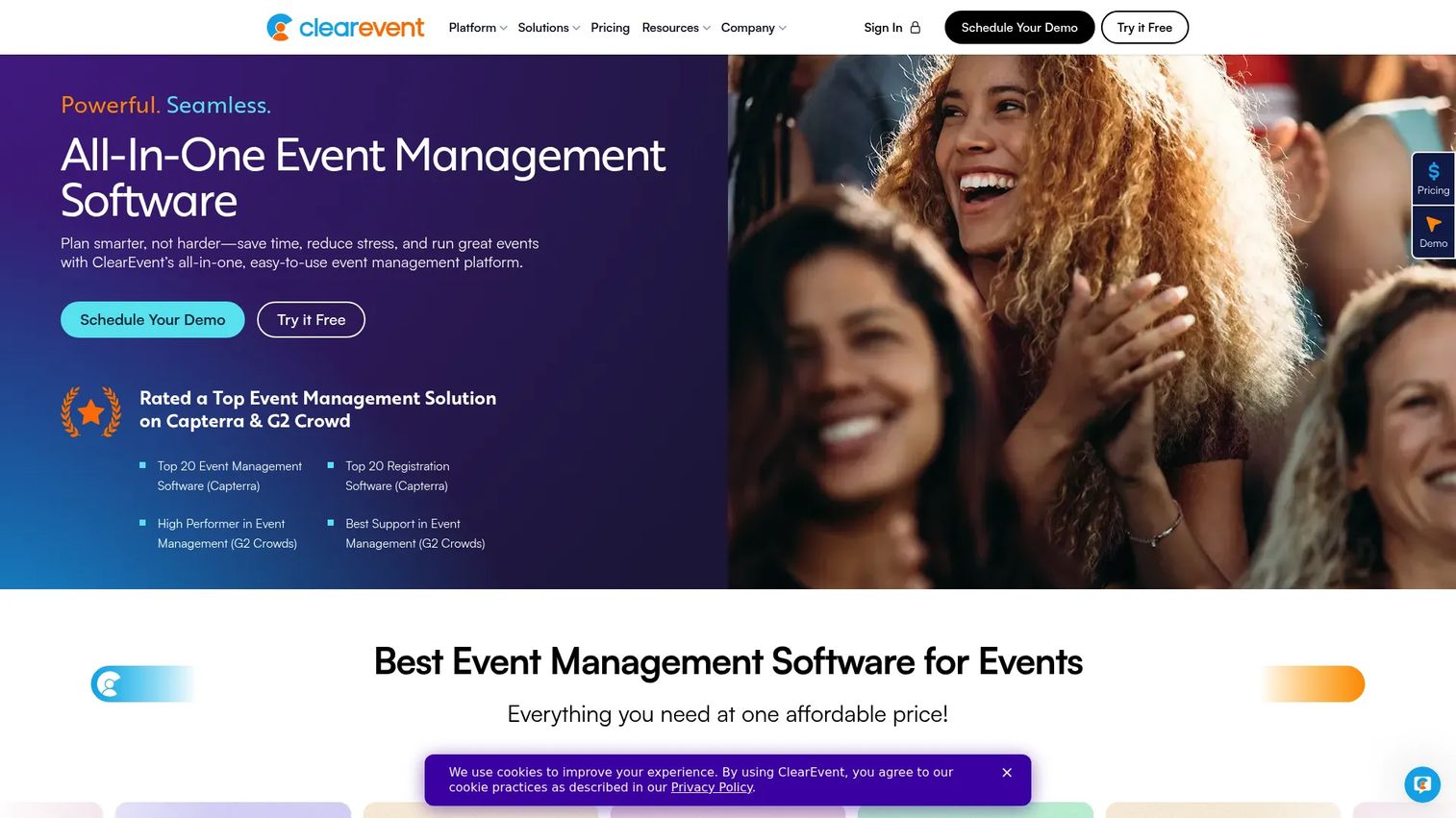
ClearEvent is web-based event management software covering registration, ticketing, scheduling, messaging, and event operations, with practical sponsor management for smaller teams. It's built for nonprofits, associations, and lean event crews who need sponsor tiers and asset intake without enterprise overhead.
The sponsor workflow is refreshingly direct. You handle sponsor registration, collect assets, set visibility, and manage tiers in a system where every feature is available on every plan. Message updates keep sponsors informed without a separate email thread. If your friction is "we're doing this in spreadsheets and it's breaking," ClearEvent is the straightforward step up.
Best for: Nonprofits, associations, and small event teams managing one or several events.
Key strengths
- Event dashboards and reporting: sponsor status and activity in one view
- Job assignments and to-do lists: track sponsor deliverables to completion
- Integrations via Zapier and webhooks: connect sponsor data to your stack
Why choose ClearEvent: It's the practical choice for smaller teams who want organized sponsor operations without a heavy platform. Larger programs needing advanced ROI analytics or app-level branding may outgrow it.
ClearEvent pricing: The Single Event plan is $895 paid yearly, Up to 5 Events is $1,795, and Up to 10 Events is $2,995. All plans include every feature, and a 14-day trial is available on the Single Event plan.
5. Elevent
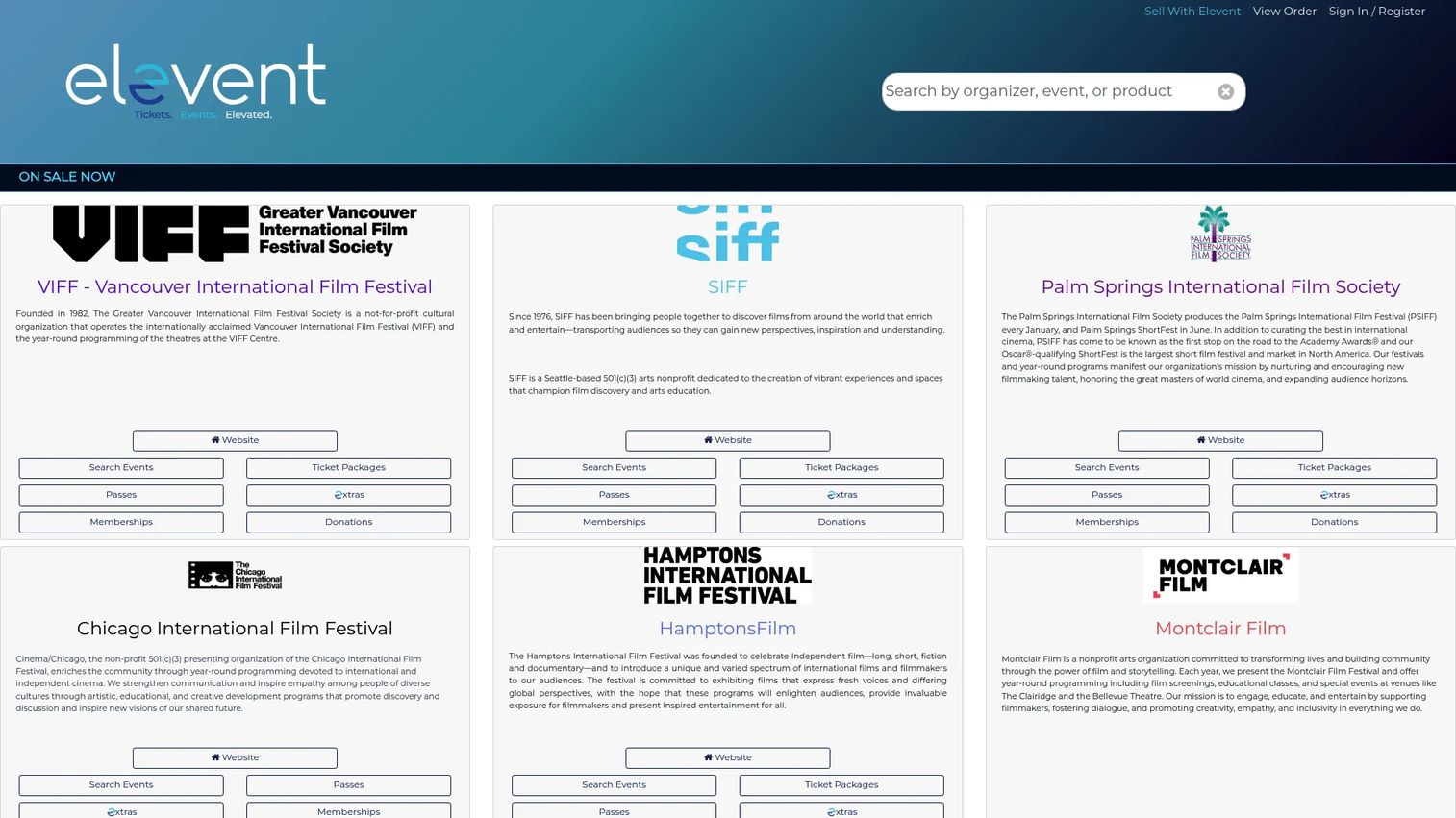
Elevent is multi-event ticketing and membership software for festivals, cinemas, performing arts, and museums, with sponsor and add-on management inside its commerce workflows. It fits organizations running seasons or multi-venue programs where sponsorship is one revenue stream among ticketing, memberships, and passes.
For sponsor operations, the strength is centralization across a program rather than a single event. You manage sponsors alongside the broader commerce engine, which suits recurring seasons where the same partners return year over year. A REST API and integrations let sponsor data flow into your reporting and CRM, so impact tracking doesn't stay siloed in the ticketing tool.
Best for: Organizations running seasons, festivals, or multi-venue live events.
Key strengths
- Multi-event, multi-venue management: sponsors managed across a whole season
- Shopping cart for tickets, memberships, passes, and add-ons: sponsor packages inside commerce
- REST API and integrations: sponsor data connected to reporting and CRM
Why choose Elevent: It's the fit when sponsorship rides alongside ticketing and memberships across a recurring program. Teams whose only job is sponsor management may prefer a more sponsor-specific tool.
Elevent pricing: Elevent doesn't list its pricing on the site. Sales can talk through discounts and enterprise pricing directly, so those numbers get worked out one on one.
6. Eventeny
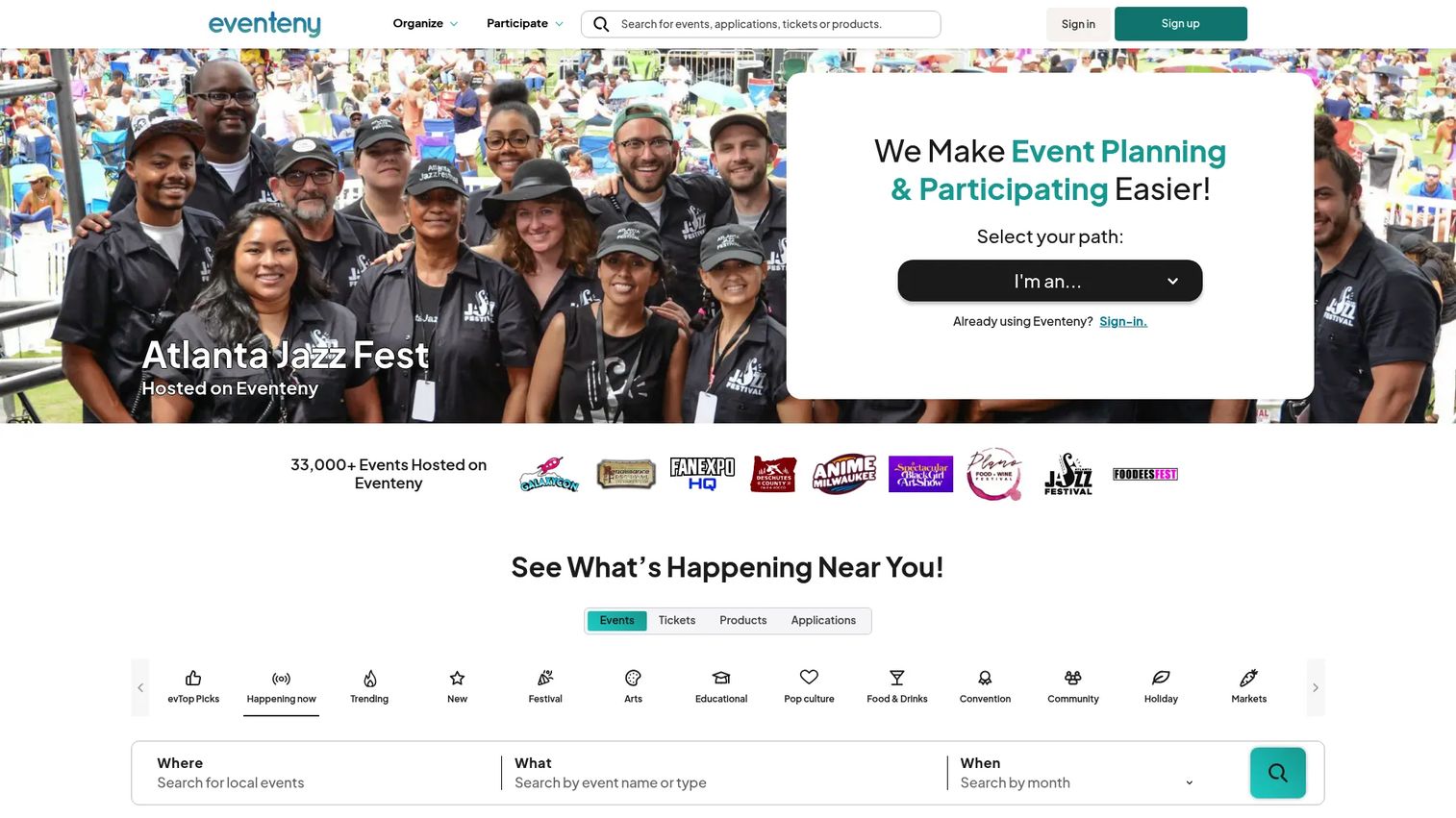
Eventeny is an all-in-one event management platform that handles sponsors, vendors, volunteers, and applications in one workflow. It's a natural fit for community events, fairs, festivals, and associations where sponsor management sits next to vendor coordination and event operations.
The sponsor value is package handling plus promotion inside a broader operational hub. You manage sponsor placement and visibility, organize packages, and run the application-style intake that community and recurring events depend on. Because sponsors, vendors, and volunteers live in the same system, you avoid the usual fragmentation of running each group in its own tool.
Best for: Event organizers needing an all-in-one platform for applications, ticketing, and event operations.
Key strengths
- Event management workflows: sponsors managed alongside vendors and volunteers
- Ticketing and registration: sponsor visibility inside the attendee flow
- Vendor, sponsor, volunteer, and application management: one intake for every group
Why choose Eventeny: It's the pick for community and recurring event programs that want sponsors, vendors, and applications in one place. Enterprise B2B teams needing deep lead retrieval and app engagement analytics may need more.
Eventeny pricing: A free Basic plan is available. Paid plans are Starter at $60/mo, Plus at $120/mo, and Pro at $240/mo, each billed annually, with annual billing discounted 33% versus monthly.
7. Evalato
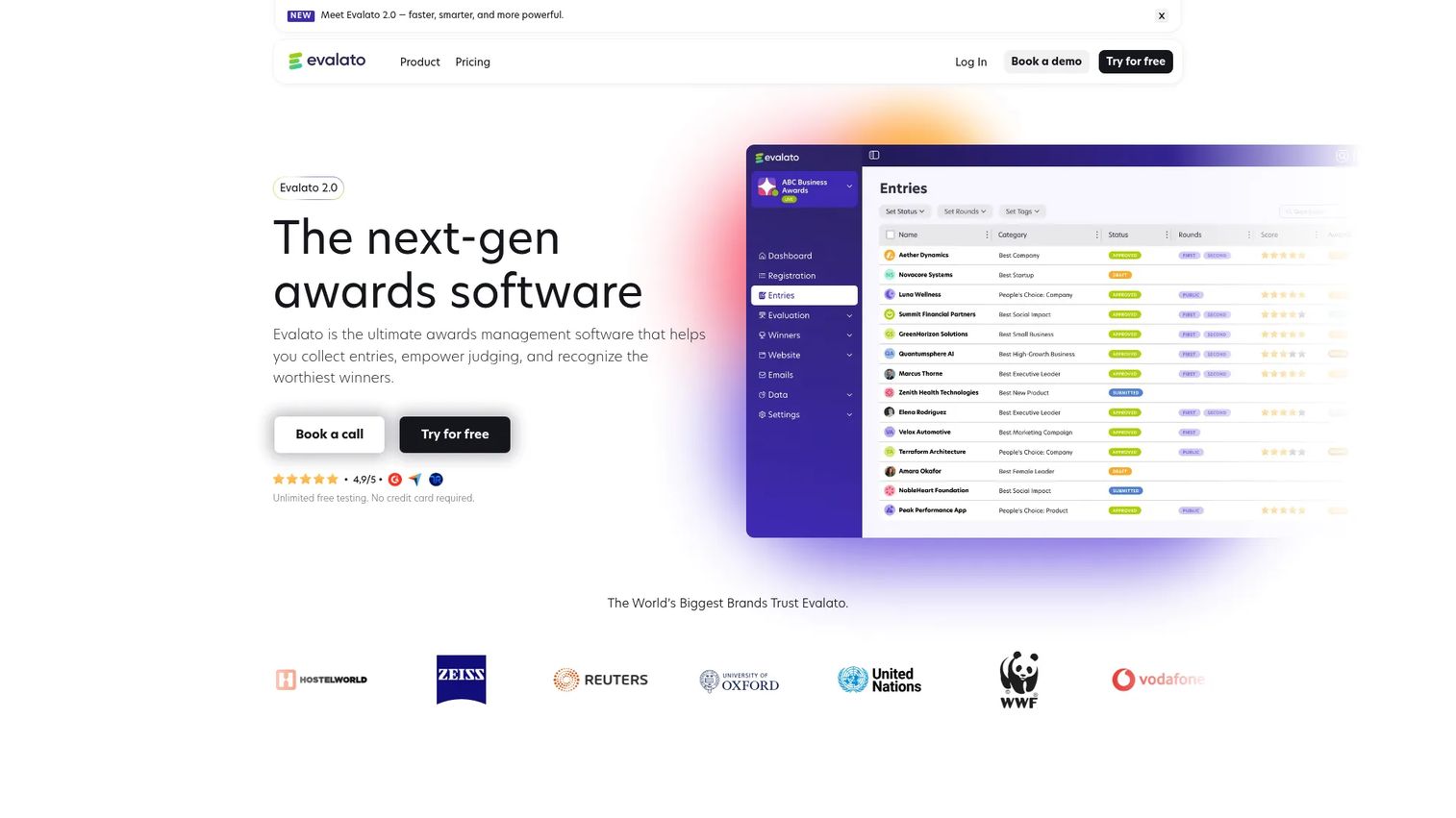
Evalato is awards and submission management software for programs like awards, competitions, grants, and scholarships, with structured application and approval flows that extend to sponsor coordination. It fits programs where sponsorship runs through submission, review, and approval rather than simple package purchase.
The sponsor angle here is workflow coordination inside structured programs. Where sponsorship involves applications, tiers, and approval steps, Evalato's judging and submission engine organizes the process end to end. Branding, custom domains, and multilingual support give sponsors and applicants a polished, on-brand experience, and reporting supports evaluation of the program itself.
Best for: Organizations running awards or submission-based programs that need judging workflows and branded applicant experiences.
Key strengths
- Unlimited free testing: build and validate the workflow before you go live
- Entry submission and judging management: structured approval flows for sponsors and applicants
- Branding, custom domains, and multilingual support: an on-brand experience across languages
Why choose Evalato: It's the fit when your sponsorship or program runs on applications and approvals rather than off-the-shelf package tiers. Teams needing event app branding or lead retrieval will look elsewhere.
Evalato pricing: Grow is €2,500 per program and Pro is €5,500 per program, both billed when the program goes live. Enterprise is quote-based, and free testing is available before launch.
Considerations
Before you shortlist, run each tool through these five checks against your actual event program.
Sponsor workflow depth
Decide whether you need full lifecycle coverage or just one slice. Some tools handle package creation, asset intake, and fulfillment end to end. Others cover branding or reporting well but leave gaps you'll fill manually. Map your real workflow first, then check which stages each tool actually owns.
Branding and visibility controls
Sponsors pay for exposure, so check how much control you get over placements. Look at banners, sponsor profiles, session associations, and event app visibility. The question is whether you can deliver and verify every placement a sponsor bought, or whether you're back to manual logo drops.
Communication and collaboration
Evaluate the sponsor portal and messaging. Can sponsors self-serve their own updates and asset uploads, or does everything route through your inbox? Portal-based collection and announcements cut the email chaos that eats event-week time.
ROI and renewal reporting
Verify the tool helps you prove value. At renewal, you need impressions, leads, and engagement numbers, not vibes. Check whether reporting is exportable and detailed enough to hand a sponsor a defensible impact summary.
Event stack fit
Confirm integrations with your existing tools. Your event app, CRM, registration system, and reporting stack should exchange sponsor data cleanly. A tool that can't connect becomes another silo, which is the exact problem you're trying to solve.
Conclusion
The right pick depends on event size, sponsor complexity, and how much you need to prove at renewal.
For early research, Gartner helps you compare the category before you commit. For large recurring B2B programs where sponsor portal, lead retrieval, and app branding all matter, Bizzabo brings them into one platform. When sponsor exposure and mobile display are the core value you sell, Sched fits. Smaller teams managing tiers and assets get a clean step up with ClearEvent.
For seasons and multi-venue programs, Elevent centralizes sponsors alongside ticketing. Community events, fairs, and associations that juggle sponsors, vendors, and applications lean toward Eventeny. And programs built on submissions and approvals fit Evalato.
Your next step: shortlist two or three based on your event's size and sponsor mix, then book demos and pressure-test the sponsor portal and ROI reporting specifically. Those two features separate tools that centralize sponsor operations from tools that only look like they do.
FAQs
Event sponsorship software helps teams manage sponsor packages, collect assets, control visibility, distribute communications, and measure sponsor value across an event. It replaces the spreadsheets, inboxes, and disconnected portals that make sponsor operations error-prone. The goal is one system where package, placement, and proof of value live together.
Prioritize sponsor package creation and tiering, asset collection, visibility and branding controls, a sponsor portal for communication, and ROI reporting. The exact weighting depends on your program. A team selling exposure prioritizes branding controls, while a team facing renewal pressure prioritizes reporting that proves value.
A sponsor portal gives sponsors a self-serve place to upload assets, update their details, and receive announcements. That moves logo files and booth requests out of your inbox and into one tracked system. The practical payoff is fewer missed placements and less scrambling the week of the event.
Yes. Sponsorship tracking software captures impressions, leads, and engagement tied to each sponsor's placements. At renewal, that data lets you hand a sponsor a defensible impact summary instead of anecdotes. Check that reporting is detailed and exportable before you buy, since ROI proof is often the difference between a renewal and a lost account.
Sponsor management centers on the sponsor relationship: packages, branding, communication, and ROI. Exhibitor management focuses on booth logistics, floor plans, and on-site vendor operations. Many platforms cover both, but the jobs are distinct. Knowing which one you're solving keeps your shortlist focused on the right features.
Teams running recurring events with multiple sponsor tiers feel the pain first, because manual tracking breaks fastest at scale. Associations, trade shows, conferences, and festivals with renewal cycles benefit most, since they need to prove value year over year. A one-off event with a single sponsor can often manage with simpler tools.
Use a marketplace review platform like Gartner during research, to compare options and understand the category. Use an event operations tool to actually run sponsors day to day. They serve different phases. Research narrows your shortlist; operations software builds packages, controls visibility, and reports on ROI once you've chosen.