You counted 400 one-gallon shrubs in block C last week. The order that shipped Tuesday says 340. The physical count this morning says 290. Nobody knows where the gap came from, and now a wholesale customer is asking why their invoice does not match what arrived on the truck.
That is the daily reality of running a nursery on spreadsheets and disconnected tools. Inventory lives in one file, production schedules in another, spray records in a binder, and sales in a shoebox of paper tickets. Every handoff between those systems is a place where numbers drift, timing slips, and revenue quietly leaks. The nursery management system market is forecast to grow from USD 384.92 million in 2024 to USD 819.55 million by 2030 at a 13.42% CAGR, according to Research and Markets (2024). Growers are moving off paper because the cost of guessing has gotten too high.
The fix is not another spreadsheet. It is software for nurseries that connects inventory, production planning, sales, compliance, and field work into one source of truth. This guide compares seven tools built for that job, so you can match the right nursery software to the way your operation actually runs.
What's inside
This guide covers seven nursery management software tools chosen for how well they handle real grower operations, not generic farm admin. We evaluated each on inventory accuracy across fields and greenhouses, production and crop planning, order fulfillment, compliance and traceability, mobile field access, and reporting depth. The list ranges from all-in-one nursery platforms to ERP-grade systems for large commercial growers, plus flexible farm management options. Pricing and ratings reflect verified vendor sources as of mid-2026. If a figure was not publicly confirmed, we left it out rather than guess.
TL;DR
- Best overall all-in-one platform: Planting Nursery, built specifically for inventory, production, and sales in one nursery-native system.
- Best for production planning and finance: Tend, which pairs crop planning and task automation with farm accounting.
- Best for ERP-heavy operations: Velosio, running Microsoft Dynamics 365 Business Central for large, process-driven growers.
- Best flexible farm management: Farmbrite, for operators who need crops, livestock, and accounting under one roof.
- Best for early-stage evaluation: Argos Software and Little Green Light, useful when you are scoping requirements or organizing records before committing to a full platform.
What is nursery management software?
Nursery management software is a system that connects inventory, production planning, sales, compliance, and reporting for plant growing operations into one platform. It replaces the patchwork of spreadsheets and paper records that most nurseries start with, giving operators a single accurate view of what they have, what is growing, and what has sold.
The strongest plant nursery management software covers a consistent set of capabilities. Here is what to look for:
- Inventory tracking across locations: Real-time counts across fields, greenhouses, warehouses, and holding areas, so a nursery inventory management system reflects reality instead of last month's estimate.
- Production and crop planning: Scheduling propagation, potting, and finishing so plants are ready when orders land. This is the backbone of production planning for nurseries.
- Orders, invoicing, and fulfillment: Taking wholesale and retail orders, generating pick lists, and invoicing without re-keying data.
- Compliance and traceability: Spray log software, scouting records, and traceability software for nurseries that hold up to audits and regulatory review.
- Mobile field access and barcode scanning: A mobile nursery management app so crews can update counts, log tasks, and scan barcodes from the yard.
- Reporting and forecasting: Dashboards for margin, availability, and demand so you can plan the next season from data, not gut feel.
Cloud deployment now dominates this category. Cloud-based deployments account for roughly 73 to 75% of market share across 2023 and 2024, per Market.us (2024) and DataHorizon Research (2024), reflecting a clear preference for SaaS over on-premise installs.
When to use nursery management software
Not every operation needs the same depth. These three scenarios signal it is time to move off spreadsheets and into a real system.
When inventory errors are costing real money
If you are shipping short, overselling availability, or writing off plants nobody knew were dying, your counts are lying to you. A nursery inventory software system with location-level tracking and barcode scanning closes the gap between what the spreadsheet says and what is actually on the bench. The moment a bad count causes a customer dispute or a missed shipment, the software has already paid for itself.
When production plans need to drive the whole operation
Nurseries live and die on timing. If plants finish late, orders slip. If they finish early, you carry cost. When your propagation and finishing schedules need to coordinate labor, inputs, and sales commitments, you need production planning that connects to inventory and orders, not a standalone calendar that nobody updates.
When field teams need mobile tools and faster updates
Crews work in the yard, not at a desk. If updates only happen when someone gets back to the office and types them in, your data is always a day behind. Greenhouse inventory software with mobile access lets teams scan, count, and log spray applications in the moment, so office and field stay in sync.
Comparison table
The seven tools below serve different operation sizes and needs. The all-in-one nursery platforms lead the list because they map most directly to the keyword and to typical grower requirements. ERP-grade and broader farm management options follow, since they fit larger or more diversified operations. Use the table as a fast filter, then read the sections for the detail that matters to your buying decision.
| # | Product | Intent | Key use case | Pricing | G2 rating |
|---|---|---|---|---|---|
| 1 | Planting Nursery | All-in-one nursery ops | Inventory, production, and sales for wholesale growers | From $289/feature/mo | Not listed |
| 2 | Tend | Planning plus finance | Crop planning, tasks, and farm accounting | Free; Pro from $30/mo | Not listed |
| 3 | Velosio | ERP for large growers | Business Central ERP, finance, logistics | M365 from $6/user/mo | 3.0/5 |
| 4 | Argos Software | Modular operations | Warehouse, order, and transport modules | Contact vendor | Not listed |
| 5 | Farmbrite | Flexible farm management | Crops, livestock, accounting, tasks | Free trial; from $35/mo | 4.7/5 |
| 6 | HanfTek | Material handling automation | Warehouse control and automation systems | Contact vendor | Not listed |
| 7 | Little Green Light | Records and database org | Constituent and record management | From $45/mo | 4.4/5 |
1. Planting Nursery
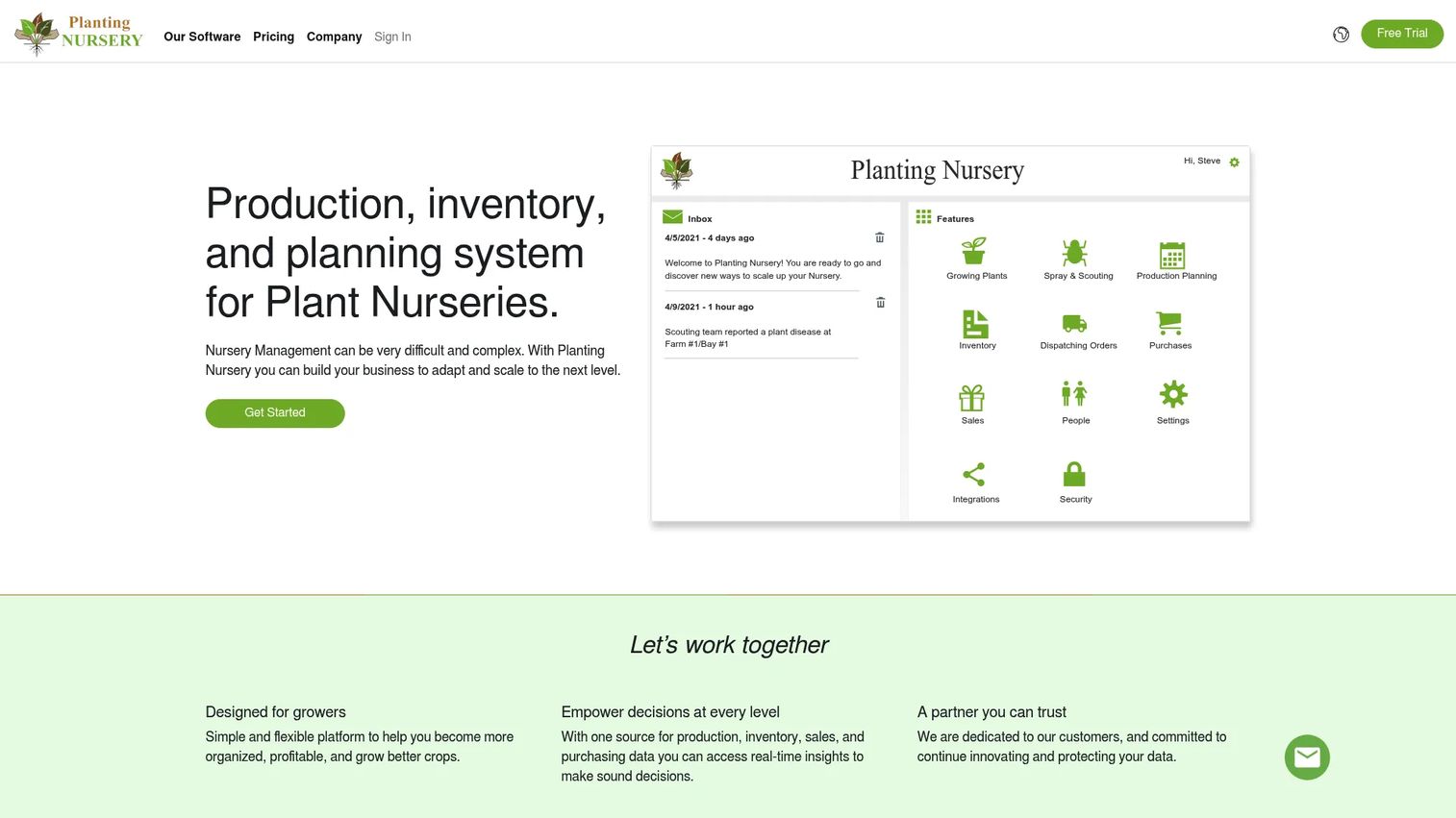
Planting Nursery is built for one job: running a plant nursery end to end. It handles inventory across fields, greenhouses, and warehouses, ties that inventory to production planning, and connects both to sales and purchasing. Rather than bending general farm software to fit a nursery, it starts from the workflows growers actually use, including spray and scouting logs, procurement, and order fulfillment.
Best for: Wholesale nurseries and growers who need inventory accuracy and production tracking in one nursery-native system.
Key strengths
- Location-level inventory: Track counts across fields, greenhouses, and warehouses so availability reflects what is actually on the bench.
- Production and task scheduling: Plan propagation and finishing, then assign the tasks that make the schedule real.
- Spray, scouting, and sales workflows: Log applications, record scouting observations, and move orders through purchasing and fulfillment in the same system.
Why choose Planting Nursery: If your operation is a nursery first and foremost, a purpose-built platform beats a general tool you have to configure into shape. The connected inventory, production, and sales flow means a count in the field updates what a customer can order, closing the gaps that cause short shipments. It is the closest thing on this list to true all-in-one nursery management software.
Planting Nursery pricing: The public pricing page lists a Basic plan at $289.00 per feature, per month, billed monthly, with a free trial available. There is no free tier shown. Because pricing is structured per feature, your total depends on which modules you activate, so it pays to scope exactly which inventory, production, and sales functions you need before committing.
2. Tend
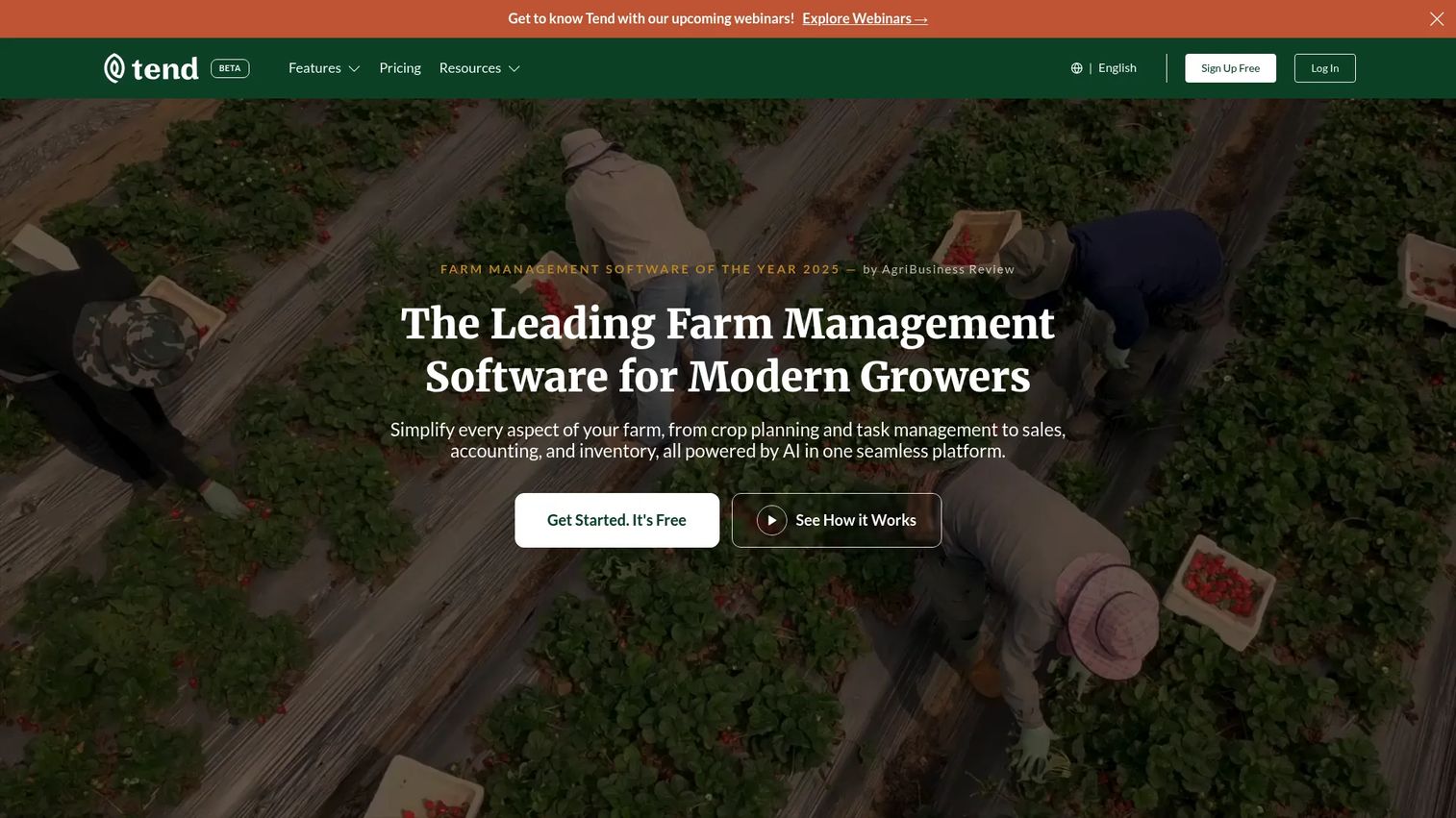
Tend is farm management software built for modern growers, with strengths in crop planning, task management, and inventory. It brings planning and finance into one platform, so the schedule that decides what gets seeded also feeds the numbers you use to run the business. For nurseries that treat production planning as the engine of the whole operation, that connection matters.
Best for: Growers who want nursery-specific planning, traceability, and farm accounting in a single stack.
Key strengths
- Crop planning: Map out what to grow and when, so production timing lines up with demand.
- Task management: Turn plans into assigned, trackable work for the crew.
- Inventory management: Keep counts current and connected to the planning and sales side of the operation.
Why choose Tend: Tend fits growers who want their planning, records, and finances working from the same data instead of three disconnected tools. The farm accounting and traceability layers make it a strong pick when compliance and margin visibility matter as much as scheduling. Operators scaling up appreciate that the free tier lets them start before committing budget.
Tend pricing: Tend offers a Free Forever plan with no trial period, a Pro plan at $30 USD per month billed monthly, and an Ultimate plan at $75 USD per month billed monthly. Enterprise pricing starts at $400 USD per month and is arranged directly with the vendor. The free plan makes Tend easy to test against your own crop plan before you scale into a paid tier.
3. Velosio

Velosio is a Microsoft-focused technology and consulting firm that implements ERP, CRM, and analytics on Microsoft Dynamics 365 Business Central. For large, process-heavy nurseries, this is the nursery ERP software route: finance, inventory, order processing, logistics, and reporting running inside a single enterprise platform, backed by implementation services rather than a self-serve signup.
Best for: Larger commercial growers who need Microsoft ecosystem ERP with accounting, inventory, and logistics in one system.
Key strengths
- ERP and CRM implementation: Full Business Central and Microsoft 365 deployment tailored to your operation.
- Data and analytics: Velosio Insights for Business Central turns transaction data into reporting and forecasting.
- Cloud migration and support: Migration, integration, and ongoing support services for the whole Microsoft stack.
Why choose Velosio: When a nursery is large enough that finance, inventory, and logistics need to live in one governed ERP, a Business Central implementation partner makes sense. Velosio suits operations that already run on Microsoft or want to, and that value hands-on implementation over configuring software themselves. It is the heaviest option here, aimed at the top end of operational complexity.
Velosio pricing: Velosio lists Microsoft 365 licensing on its product page: Business Basic at $6.00 per user, per month, Business Standard at $12.50, Apps for Business at $8.25, and Business Premium at $22.00 per user, per month. These cover licensing only; the ERP implementation itself is quoted separately. Velosio holds a 3.0/5 rating on G2 from a small review sample.
4. Argos Software
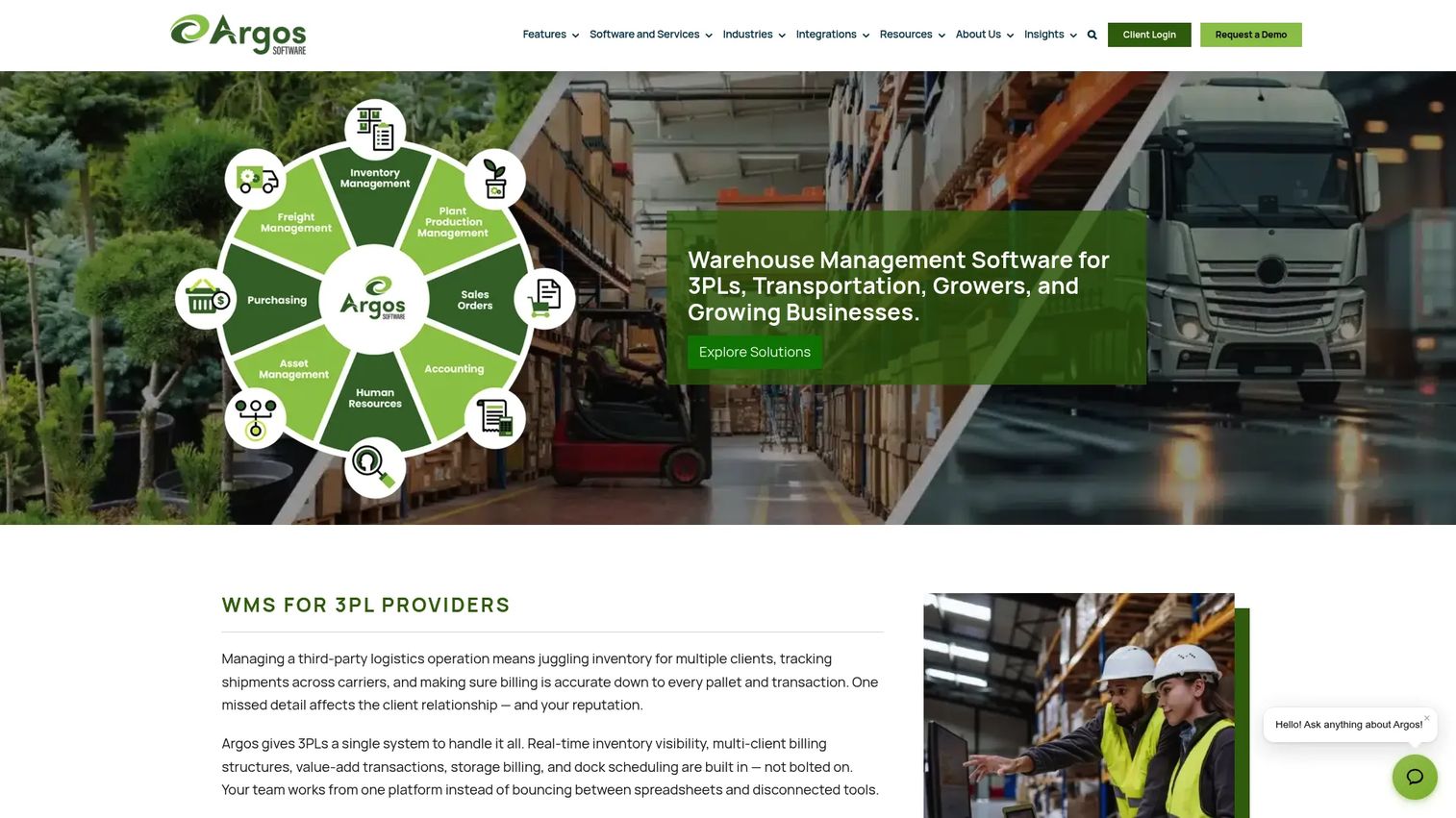
Argos Software offers modular business, warehouse, and transport management software for B2B operations. Its strength is breaking operations into modules you can combine, covering warehouse and inventory management, order and freight handling, accounting, and automated reporting. For a grower scoping which operational pieces to systematize first, that modular approach makes early-stage evaluation more concrete.
Best for: Small-to-mid-sized B2B operators mapping out which warehouse, order, and transport functions to systematize.
Key strengths
- Warehouse and inventory management: Track stock and movement across storage and fulfillment.
- Order, freight, and accounting modules: Handle sales orders, shipping, and finance as connected pieces.
- AI assistant and automated reporting: Surface operational data without manual report building.
Why choose Argos Software: The modular structure helps operators who are still deciding which parts of their operation need software first. You can start with the functions that hurt most, then expand. It reads more as an operations and logistics platform than a plant-specific nursery tool, so it fits teams that want warehouse and order discipline and can map plant workflows onto that structure.
Argos Software pricing: Argos Software does not publish first-party pricing; the sales process runs through direct contact and a demo. Scope your module needs before that conversation so the quote reflects only the warehouse, order, or accounting pieces you actually plan to use. Public rating data for this exact product was not available at the time of writing.
5. Farmbrite
Farmbrite is farm management software covering crops, livestock, accounting, tasks, inventory, and sales. It is the most flexible option on this list, built for farms and ranches that need broad operational coverage rather than nursery-only depth. For a grower whose operation spans more than plants, that breadth is the draw.
Best for: Small to mid-sized operations that need crops, accounting, and general farm management in one platform.
Key strengths
- Farm accounting and tax reporting: Bookkeeping and tax-ready records built into the platform.
- Crop planning and yield tracking: Plan crops, map fields, and track yields across the season.
- Livestock and herd records: Manage animals alongside crops for diversified operations.
Why choose Farmbrite: Farmbrite fits operators who want one tool for a mixed operation instead of a nursery-only system. The accounting and mapping features make it practical for teams that need finance and field records together. If your nursery is one part of a broader farm, the flexibility earns its place; if you run a pure plant nursery, a nursery-native tool will map more directly to your workflows.
Farmbrite pricing: Farmbrite publishes multiple plan tracks. Crop grower plans start at $35 per month, with Plus at $65 per month; livestock plans run from $45 to $109 per month, and a farm accounting-only option is $119 per year. Enterprise pricing is custom. A free trial is available, and Farmbrite holds a strong 4.7/5 rating on G2.
6. HanfTek
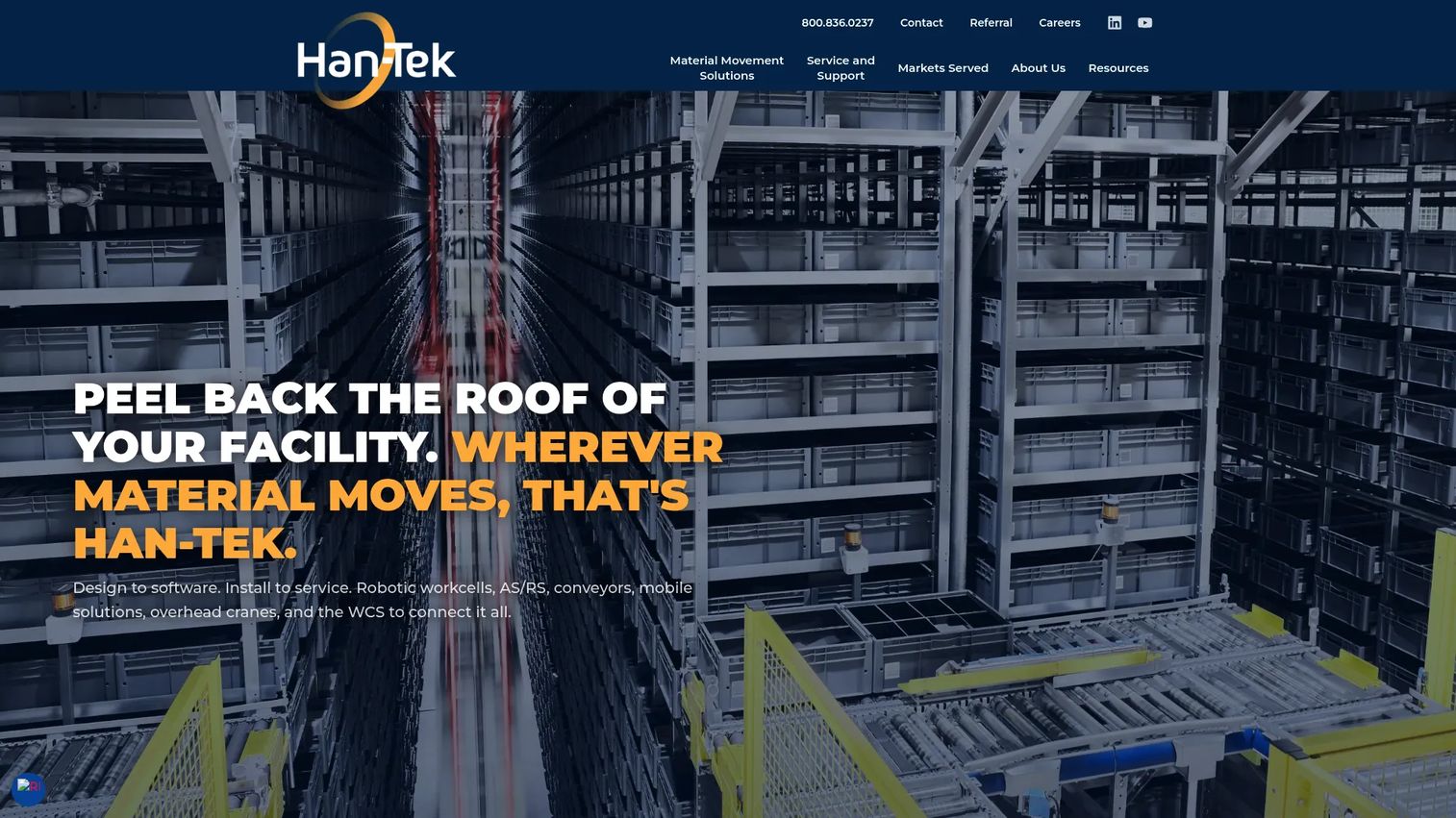
HanfTek is an industrial material-movement integrator that builds automation, cranes, and warehouse control software. This is a specialized option: it fits large operations where physical material handling and automated storage are the bottleneck, rather than plant records and availability. For a high-volume nursery moving product through a warehouse at scale, the automation angle can matter.
Best for: Manufacturers and high-volume distribution operations that need custom material-handling automation.
Key strengths
- Automated storage and retrieval: AS/RS systems for high-density, high-throughput storage.
- Mobile automation: AMRs, AGVs, and AGCs for moving product without manual handling.
- Warehouse control software: WCS to coordinate automated equipment and material flow.
Why choose HanfTek: HanfTek is the outlier on this list, aimed at the physical automation layer rather than nursery record-keeping. It suits operations large enough that moving plants and materials through a facility is the real constraint. Sales run through assessment and quoting, so treat it as an infrastructure project rather than a software subscription. Pair it with a nursery-native inventory system for the plant data side.
HanfTek pricing: HanfTek does not publish public pricing; the process is quote and assessment based, consistent with custom automation projects. Expect a scoping conversation rather than a plan signup. Verified public rating data for this exact brand was not available at the time of writing.
7. Little Green Light
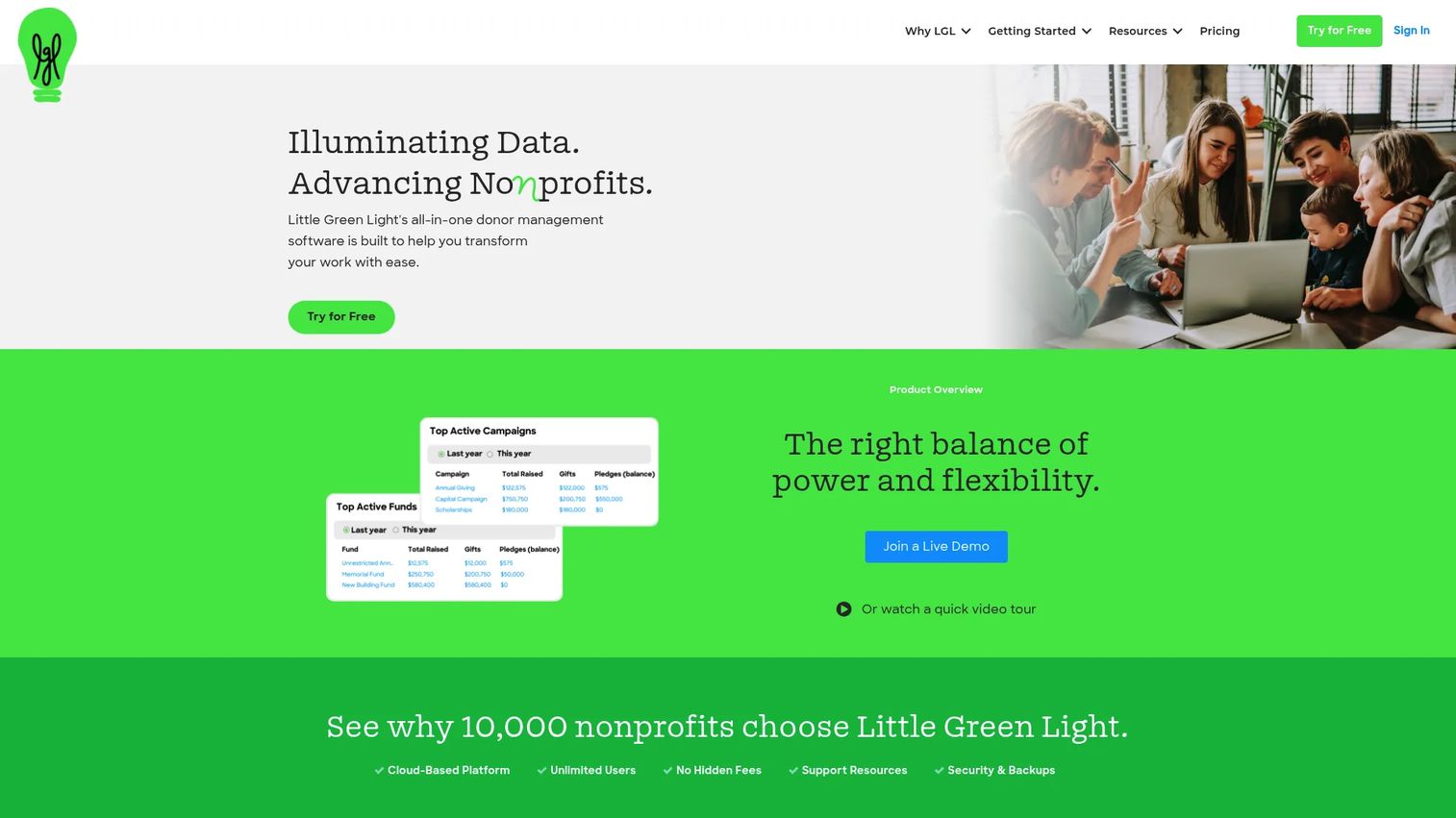
Little Green Light is a cloud-based database platform, best known for donor and constituent management for nonprofits. Its relevance here is narrow: the underlying strength is structured record-keeping, reporting, and database organization. For a grower who mainly needs to organize records, contacts, and tracking rather than run full production, that database discipline can bridge a gap.
Best for: Small operations or teams that need affordable, structured record and contact management.
Key strengths
- Constituent-based database: A flexible record system for organizing contacts and history.
- Online forms and payment processing: Capture information and payments through built-in forms.
- Reports, automation, and email: Turn records into reports and automated communications.
Why choose Little Green Light: Little Green Light is the most specialized fit on this list and skews toward records rather than nursery production. Consider it only if your core need is organizing a database of contacts, records, and transactions on a small budget. For inventory accuracy, production planning, or spray compliance, a nursery-native tool higher on this list will serve you better.
Little Green Light pricing: Pricing is a single subscription tiered by record count. Plans start at $45 per month for up to 2,500 constituents and scale to $135 per month for up to 50,000, with all features and unlimited users included at every tier. The first 30 days are free, though there is no permanent free plan. Little Green Light holds a 4.4/5 rating on G2.
Considerations before you buy nursery software
Once you have a shortlist, evaluate each tool against the operational realities that actually break nurseries. Use this checklist to pressure-test fit.
Inventory complexity
Count your locations, container sizes, and SKUs honestly. A nursery with dozens of blocks, multiple pot sizes, and thousands of variants needs location-level tracking and barcode scanning; a smaller operation may not. Match the depth of the nursery inventory management system to the messiness of your real inventory, not the version you wish you had.
Production planning depth
Ask how far ahead you plan and how tightly production ties to sales. If finishing dates drive your order commitments, you need planning that connects schedules to inventory and fulfillment. A standalone calendar that nobody updates will not move the needle on timing.
Compliance and traceability
If you spray, ship across state lines, or face audits, confirm the tool includes spray log software and traceability software for nurseries. Reconstructing application records from memory during an inspection is a risk you can design out with the right system.
Mobile field access
Decide whether crews will enter data in the yard or only back at a desk. A mobile nursery management app with offline-friendly scanning keeps field and office in sync. If your data always lags a day, the software cannot deliver accurate availability.
Total cost and fit
Weigh pricing against what you will actually use. Per-feature and per-user models scale differently, and an ERP implementation is a different commitment than a monthly SaaS plan. Choose the system that fits your operation's size today with room for the next two seasons of growth.
Conclusion
The right nursery software depends on how your operation runs, not on which vendor has the longest feature list. For a plant nursery that needs inventory, production, and sales in one native system, Planting Nursery is the most direct fit. Growers who want planning and finance together should look hard at Tend, while large, process-heavy operations that need governed ERP will find that in Velosio. Farmbrite covers mixed farm operations well, and Argos Software or Little Green Light can help teams still scoping requirements or organizing records.
The next step is simple: map your biggest operational pain first. If bad counts are costing you orders, start with inventory depth. If timing is the problem, prioritize production planning. If compliance keeps you up at night, weight traceability and spray logs. Pick the one tool that solves the pain hurting you most this season, then expand from there.
FAQs
Nursery management software connects inventory, production planning, sales, compliance, and reporting for a plant growing operation into one system. It replaces spreadsheets and paper records so growers have an accurate, real-time view of what they have on the bench, what is in production, and what has sold. The goal is fewer blind spots and fewer costly counting errors.
The core features are location-level inventory tracking, production and crop planning, order and invoicing workflows, compliance and traceability, mobile field access, and reporting. Which ones matter most depends on your operation: a wholesale grower prioritizes inventory accuracy and fulfillment, while a compliance-heavy nursery weights spray logs and traceability. Match the tool to the pain that costs you the most.
Nursery inventory software focuses on tracking plants, counts, and availability across growing locations, often with production planning attached. Nursery ERP software, like a Business Central implementation, is broader, adding finance, logistics, procurement, and enterprise-grade reporting across the whole business. Inventory-focused tools suit most growers; ERP fits large, process-heavy operations that need everything in one governed platform.
Smaller operations usually do best with a tool that has a low entry price and a free trial or free tier. Tend offers a Free Forever plan, and Farmbrite starts at $35 per month with a trial, making both accessible for smaller growers. The key is not overbuying: match the plan to the inventory and planning complexity you actually have.
Large commercial growers with complex finance, logistics, and inventory needs tend to fit ERP-grade systems best. A Microsoft Dynamics 365 Business Central implementation through a partner like Velosio brings accounting, order processing, and reporting into one enterprise platform. Operations moving high volumes of physical product through a warehouse may also evaluate automation systems for the material-handling layer.
Yes, nursery-native tools typically include spray log software, scouting records, and traceability features designed to hold up during audits and regulatory review. Purpose-built platforms like Planting Nursery record spray applications and scouting alongside inventory and production. If compliance is central to your operation, confirm these features are included before you commit, since coverage varies by tool.
Many nursery management platforms offer a mobile nursery management app so crews can update counts, assign tasks, and scan barcodes directly from the yard. Mobile access keeps field and office data in sync, which is what makes availability numbers trustworthy. If your teams work primarily outdoors, prioritize a tool with strong mobile and scanning support and verify offline behavior before buying.