You launched the feature. You wrote the messaging. Sales got the deck. Then activation data comes back flat, support tickets pile up, and nobody can tell you whether the launch moved a single number.
That gap between shipping something and proving it changed behavior is the product marketer's daily reality. Messaging drifts across the website, the emails, the in-app prompts, and the sales calls. Data lives in five tools that do not talk to each other. And when leadership asks whether the work mattered, the honest answer is often a shrug.
Product engagement software exists to close that gap. It connects product behavior, outreach, personalization, and analytics into one system so you can reach the right user with the right message and actually measure what happens next. The category is growing fast for a reason: the broader customer engagement software market is projected to reach USD 30.92 billion by 2030, growing at a 10.45% CAGR according to Research and Markets (2024). Buyers now expect to be met with relevant, behavior-driven experiences, not generic blasts.
For a PMM, the right platform keeps positioning consistent across every touchpoint, helps launches land, powers adoption campaigns, and gives you proof points you can defend in a board meeting. The wrong one adds another silo. This guide breaks down 13 platforms so you can shortlist without wasting a quarter on demos.
What's inside
This guide is written for product marketers, product-led growth teams, and lifecycle owners comparing platforms that centralize engagement across the product lifecycle. We evaluated each tool on five criteria that matter to a PMM buyer: omnichannel reach across web, app, email, and in-app; unified customer profiles built on first-party data; depth of personalization and behavior-driven automation; analytics that tie engagement to outcomes; and fit for product-led or SaaS teams. We did not rank by raw feature count. We ranked by how well each platform supports consistent launches, faster adoption, and measurable feedback loops.
TL;DR
- Best for feedback and roadmap loops: Productboard centralizes customer feedback, prioritization, and roadmap communication for teams that live and die by the loop between users and product.
- Best for enterprise omnichannel: Insider One and Braze lead on unified profiles, journey orchestration, and personalization at scale for mature lifecycle operations.
- Best all-in-one for consolidating teams: HubSpot pairs a free CRM with lifecycle automation, forms, and email in one place.
- Best for mobile-first engagement: CleverTap and Firebase suit teams whose product lives inside an app.
- Best for product analytics plus in-app guidance: Pendo combines usage analytics, in-app guides, and feedback in a single product experience layer.
- Best for self-serve buyer education: Consensus supports behavior visibility and self-serve evaluation for sales-led motions.
What is product engagement software?
Product engagement software is a category of tools that helps teams reach, activate, and retain users by connecting product behavior to personalized communication and measurable engagement across the customer lifecycle.
It overlaps with a customer engagement platform but leans toward the product side of the funnel: activation, adoption, feedback, and retention rather than pure top-of-funnel demand. It is broader than a CRM, which stores relationship and deal data, and broader than marketing automation, which mostly triggers email sequences. A digital engagement platform ties all three together and adds the product signal that CRM and email tools usually lack.
Here is how the core capabilities break down:
- Omnichannel communication: Reach users through web, mobile app, email, SMS, push, and in-app messaging from one system, so the message stays consistent wherever they are.
- Journey orchestration: Map and automate multi-step flows that move a user from signup to activation to expansion, branching on what they do.
- Unified customer profiles: Build a single customer view by combining first-party data, product events, and CRM records into one profile per user.
- Behavior-driven automation: Trigger messages and campaigns off real actions, like a feature used, a step skipped, or a plan viewed, instead of static list membership.
- Analytics and measurement: Track engagement analytics and real-time engagement so you can attribute adoption and conversion back to specific campaigns and messages.
The strongest platforms treat these as one connected system. That is the difference between a tool that sends messages and a platform that changes behavior you can measure.
When to use product engagement software
Coordinate launches across product, marketing, and success
A launch fails quietly when the website says one thing, the onboarding email says another, and the in-app prompt says a third. Product engagement software gives you one place to define the message and push it consistently across site, email, in-app, and support. When you pair that consistency with an interactive demo inside your launch email or landing page, prospects experience the new capability at their own pace instead of reading about it. That combination keeps launches feeling like a system, not a scramble, and gives you shared analytics on what actually landed.
Personalize journeys based on user behavior
Activation is rarely a targeting problem. It is a relevance problem. When you segment users by role, plan, or behavior and trigger messages off real actions, you move people toward the next meaningful step instead of blasting everyone the same nudge. A user who explored billing gets a different path than one who never left the dashboard. Personalization and behavior-driven automation are how you make in-app messaging feel like guidance instead of noise, which is exactly what shortens time-to-value.
Close the feedback loop with customers
Product feedback collection, feature voting, beta invites, and roadmap updates all build trust when the loop actually closes. Users who see their input show up in the product stay engaged and become references. The platforms strongest here turn scattered feedback into prioritized signal, then broadcast what shipped back to the people who asked for it. That loop is one of the most reliable engines of product adoption and customer education a PMM can run.
Comparison table
We ranked this list by relevance to product marketing workflows: how well each platform supports consistent launches, adoption campaigns, feedback loops, and measurable engagement. Pricing and ratings reflect verified values at the time of writing and can change.
| # | Product | Intent | Key differentiation | Pricing | G2 rating |
|---|---|---|---|---|---|
| 1 | Productboard | Feedback and roadmap loops | Customer feedback, prioritization, roadmap comms | Free; Plus from $19/maker/mo | 4.3/5 |
| 2 | Insider One | Enterprise omnichannel | Unified profiles, AI journey orchestration | Custom | 4.8/5 |
| 3 | Countly | Product analytics plus engagement | Privacy-focused analytics, self-hosting | Flex from $175/mo | 4.1/5 |
| 4 | Consensus | Self-serve buyer education | Buyer signals, product simulations | Starter from $600/mo | 4.7/5 |
| 5 | Braze | Lifecycle messaging | Cross-channel orchestration, BrazeAI | Contact sales | 4.5/5 |
| 6 | HubSpot | All-in-one CRM engagement | Free CRM, lifecycle automation | Free; Starter from $7/seat/mo | 4.4/5 |
| 7 | Netcore Cloud | AI omnichannel personalization | 13+ channels, value-based pricing | Custom | 4.5/5 |
| 8 | Salesforce Marketing Cloud | Enterprise journeys | Data unification inside Salesforce | From $1,500/org/mo | 4.0/5 |
| 9 | Pendo | Product analytics plus in-app | Analytics, guides, feedback in one | Free; paid custom | High |
| 10 | CleverTap | Mobile-first engagement | App lifecycle, retention automation | Essentials from $75/mo | 4.6/5 |
| 11 | Firebase | Developer engagement basics | Push, messaging, analytics, backend | Spark free; Blaze pay-as-you-go | 4.5/5 |
| 12 | ActiveCampaign | Email-first lifecycle | Automation, segmentation, CRM | From $15/mo | 4.4/5 |
| 13 | Twilio | API-first communication | Programmable messaging infrastructure | Pay-as-you-go | 4.1/5 |
Best product engagement software for 2026
1. Productboard
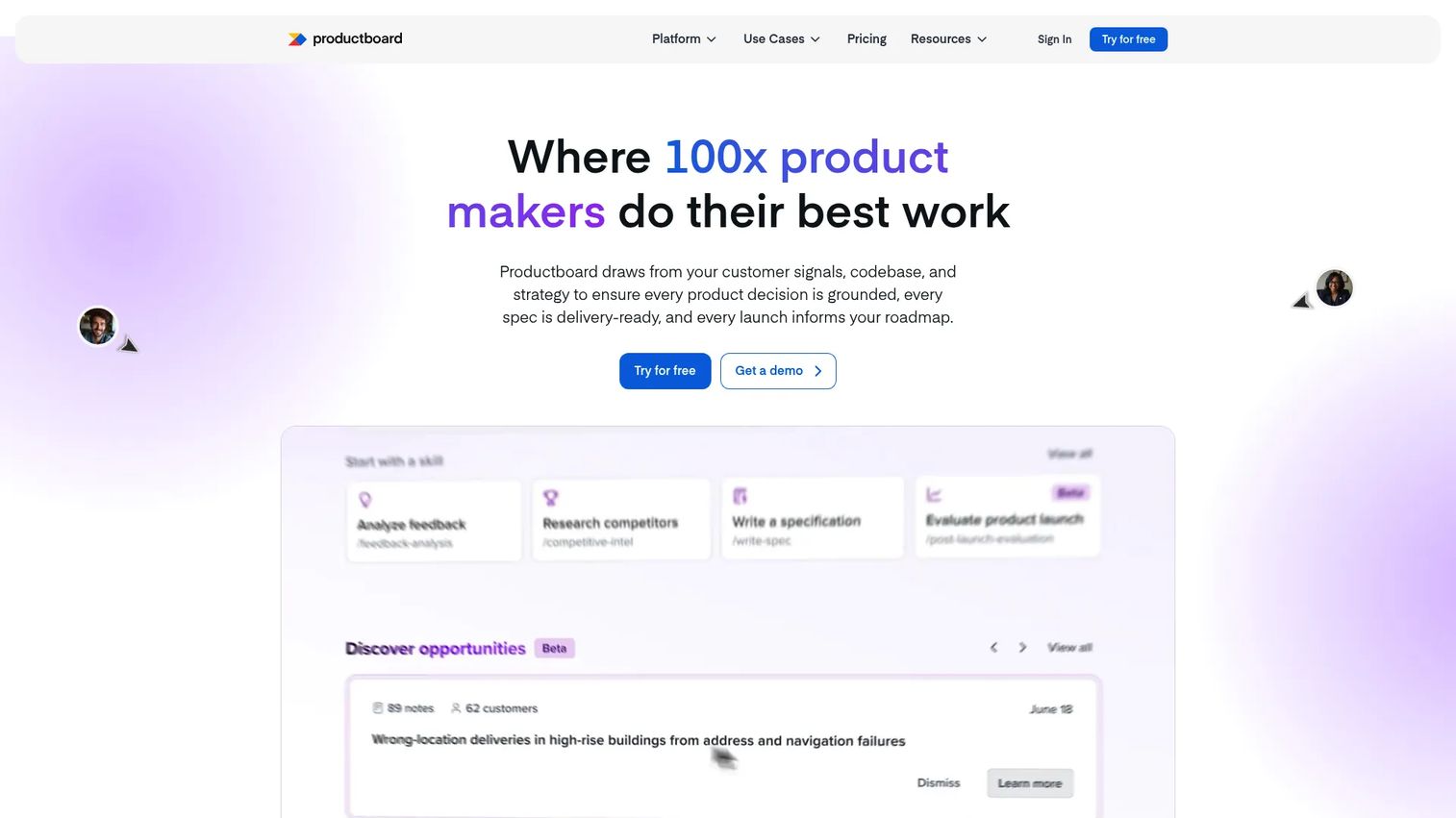
Productboard is an AI-powered product management platform built around customer feedback, prioritization, and roadmapping. For PMMs, it is the system that turns scattered input from sales calls, support tickets, and surveys into a prioritized signal you can act on. It closes the loop by tying roadmap decisions back to the customers who asked, which is where trust and engagement compound.
Best for: Product teams that need centralized feedback, prioritization, and roadmap alignment.
Key strengths
- Customer feedback and insights: Collect feedback from multiple channels and centralize it into one searchable source.
- Prioritization and planning: Score and rank ideas against strategy so the roadmap reflects real demand.
- Roadmapping and alignment: Communicate what is shipping and why to internal teams and customers.
Why choose Productboard: If your engagement challenge is the loop between what users want and what the product delivers, Productboard is the strongest fit. It is less a messaging tool and more a decision engine that makes feedback collection defensible. PMMs use it to validate positioning bets with real customer voice before a launch.
Productboard pricing: A free plan is available, billed annually. The Plus plan starts at $19 per maker per month, and Business starts at $59 per maker per month, both billed annually. Enterprise pricing is available on request. Its G2 rating sits at 4.3 out of 5.
2. Insider One
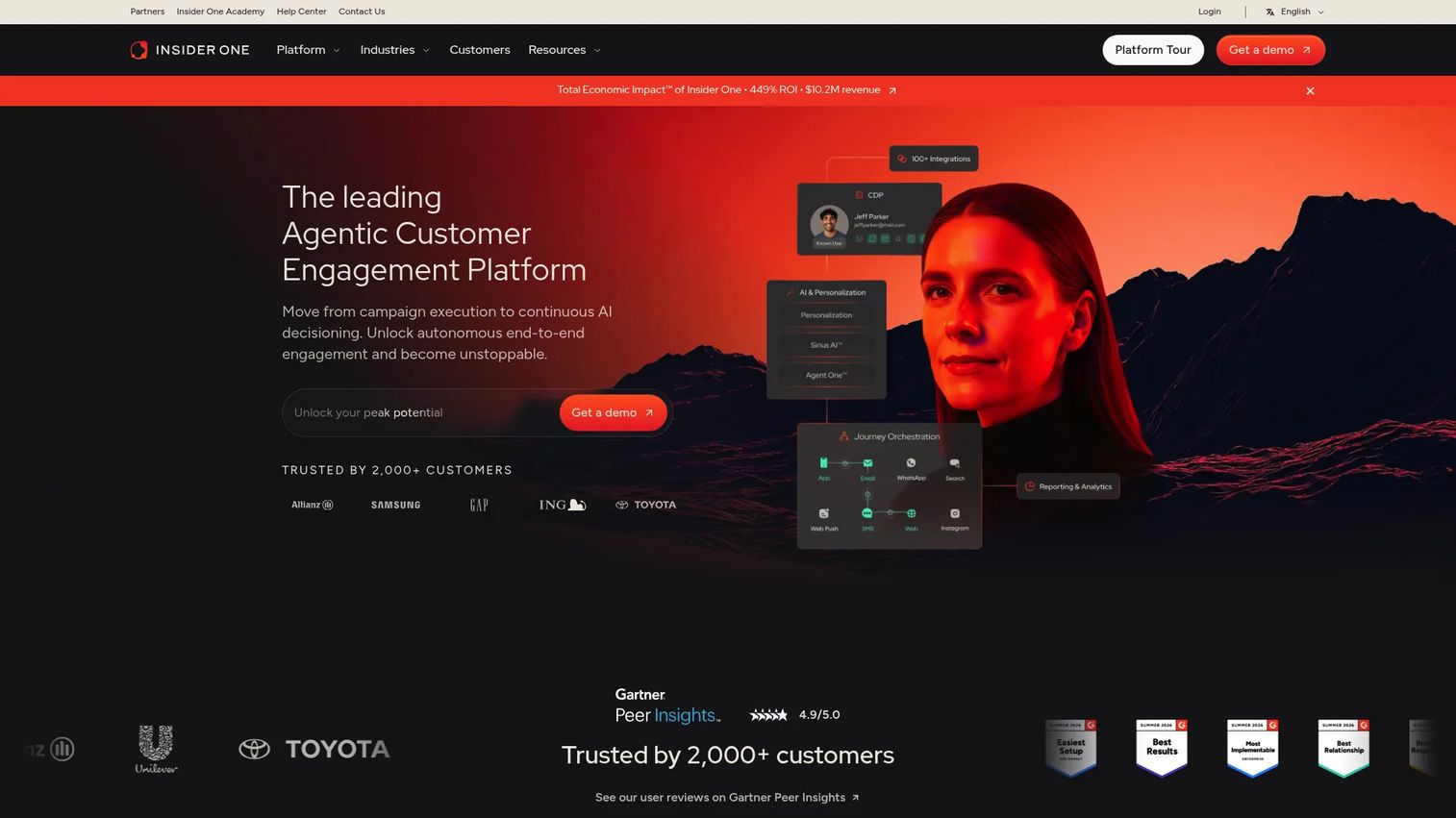
Insider One is an AI-powered customer engagement platform built for marketing teams that need omnichannel reach and deep personalization at scale. It unifies customer data into a single profile, then orchestrates journeys across web, app, email, SMS, WhatsApp, and push. For enterprise PMMs, it is the kind of platform that keeps a launch message coherent across a dozen channels at once.
Best for: Enterprise marketing teams that need omnichannel customer engagement and personalization.
Key strengths
- Unified customer data: Combine first-party data into one profile for a single customer view.
- Journey orchestration: Coordinate messages across web, app, email, SMS, WhatsApp, and push.
- Personalization: Deliver product recommendations and tailored content driven by behavior.
Why choose Insider One: Teams pick Insider One when scale and breadth are the requirement, not the nice-to-have. Its AI journey optimization suits organizations running many concurrent campaigns across regions. The single customer profile is the backbone that keeps personalization consistent.
Insider One pricing: Public pricing is not listed on the site and is quoted based on needs. On G2, Insider One holds a strong 4.8 out of 5 rating.
3. Countly
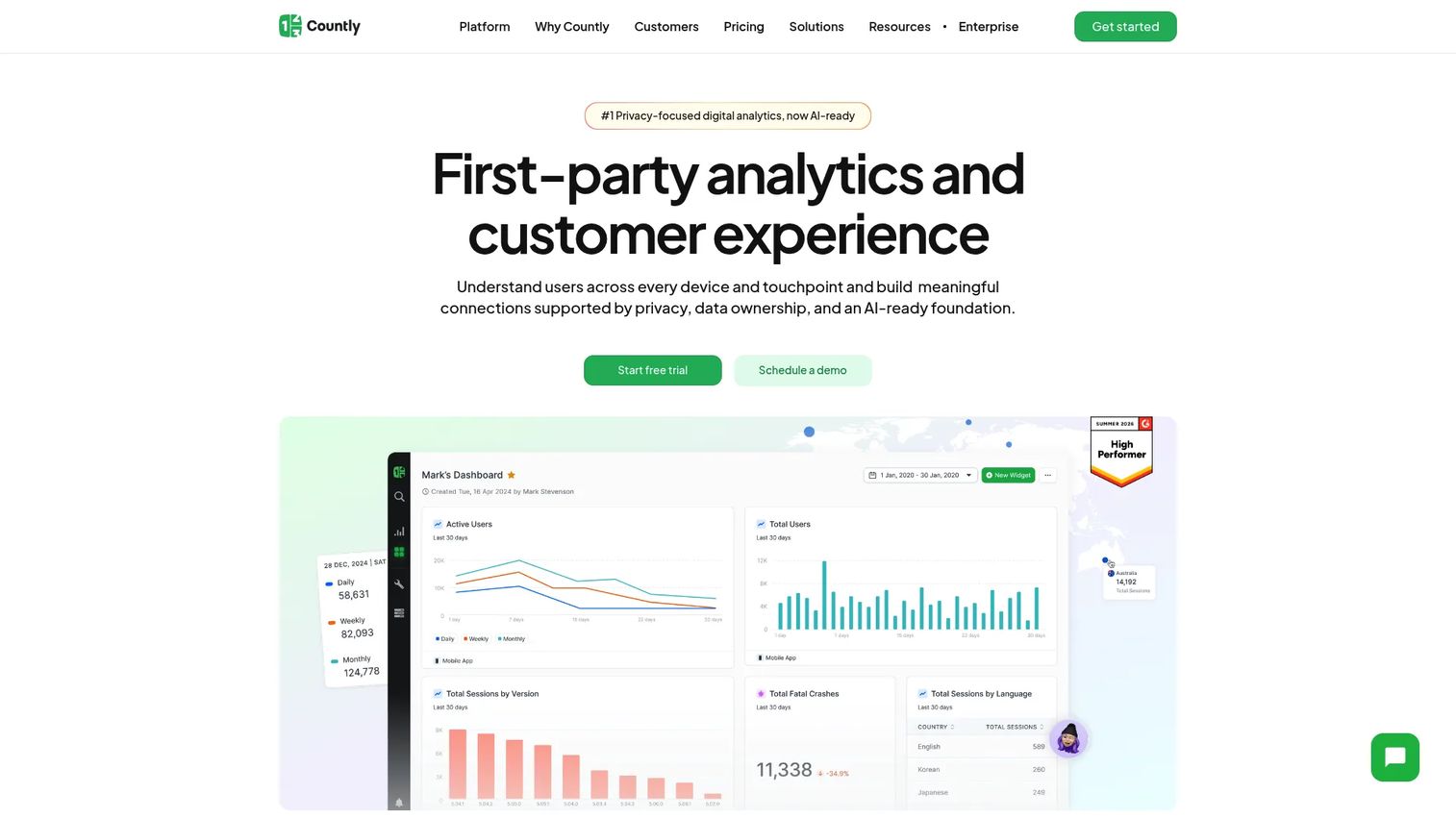
Countly combines product analytics with customer engagement in one platform, spanning web, mobile, desktop, and IoT. Its differentiator is a privacy-first posture with self-hosted and private-cloud options, which matters to teams handling sensitive first-party data. Real-time analytics and event tracking feed directly into engagement actions like push notifications.
Best for: Teams that need privacy-focused product analytics with self-hosted or private-cloud deployment.
Key strengths
- Real-time analytics: Understand user behavior as it happens across every surface.
- Event tracking: Capture granular product events to power segmentation.
- Push notifications: Turn insight into action with targeted, behavior-driven messages.
Why choose Countly: If data ownership and deployment control are non-negotiable, Countly earns a close look. It pairs first-party insight with the ability to act on it in the same system, which reduces the analytics-to-engagement handoff most stacks struggle with.
Countly pricing: The Flex plan starts at $175 per month and is usage-based, with a free trial available. Enterprise is custom-priced and self-hosted. Its G2 rating is 4.1 out of 5.
4. Consensus
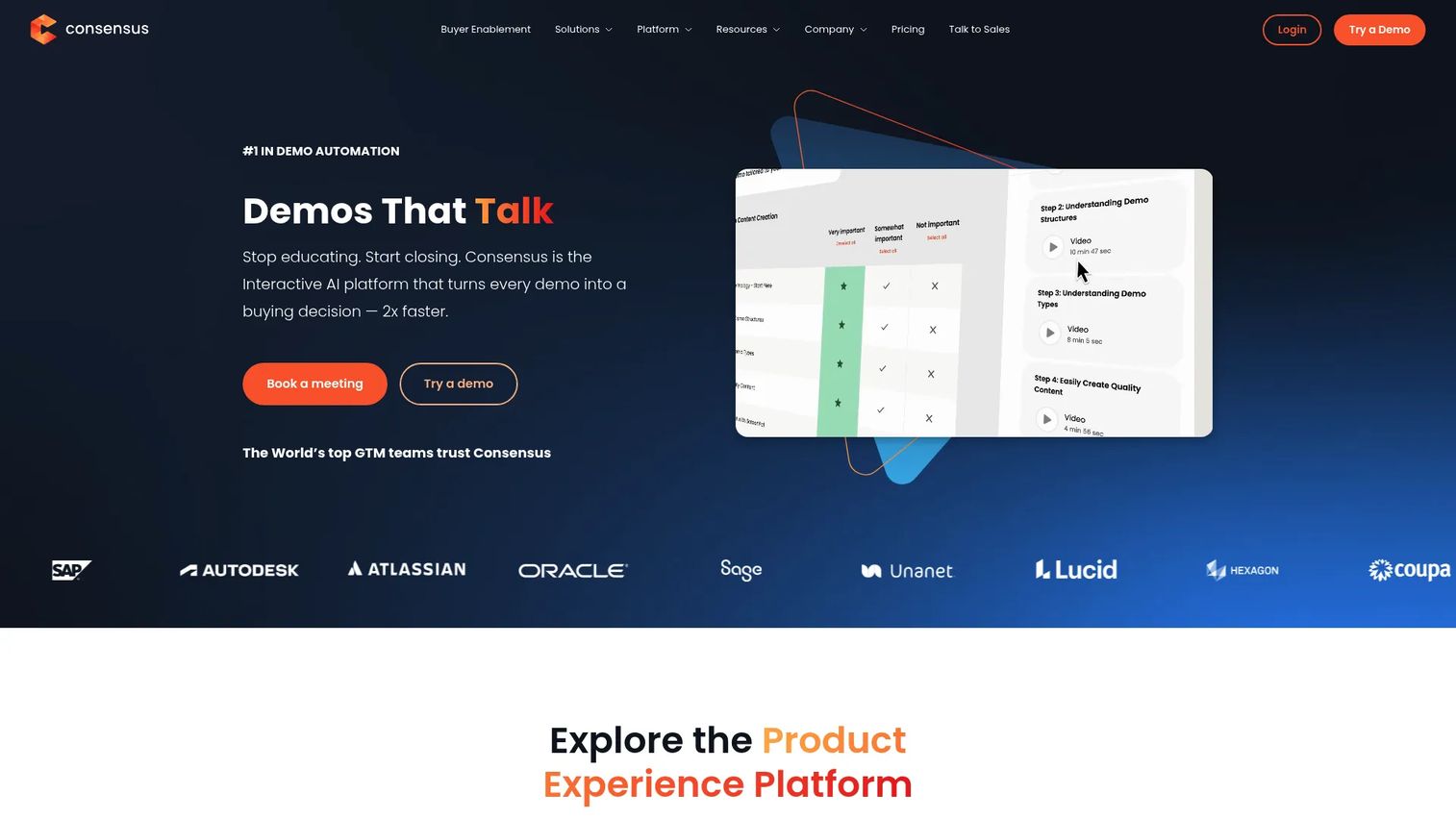
Consensus is an AI-powered product experience platform focused on self-serve buyer education, product tours, simulations, and buyer signals. For teams running sales-led motions, it lets prospects explore and validate on their own terms while surfacing intent data back to the revenue team. That behavior visibility is what makes it a strong fit for complex B2B buying cycles.
Best for: Revenue teams that need scalable interactive product experiences for complex B2B evaluation.
Key strengths
- AI-powered product tours: Guide buyers through curated product journeys at scale.
- Automated simulations: Let prospects experience the product without a live environment.
- Buyer signals and analytics: Track who engaged and what they cared about to prioritize follow-up.
Why choose Consensus: Pick Consensus when buyer education and self-serve evaluation drive your pipeline. It performs best for teams that want prospects to build conviction before a call, then hand the sales team a clear read on intent.
Consensus pricing: Starter begins at $600 per month, Pro at $1,250 per month, both billed annually. Enterprise is custom-priced. No free tier is listed. Its G2 rating is 4.7 out of 5.
5. Braze
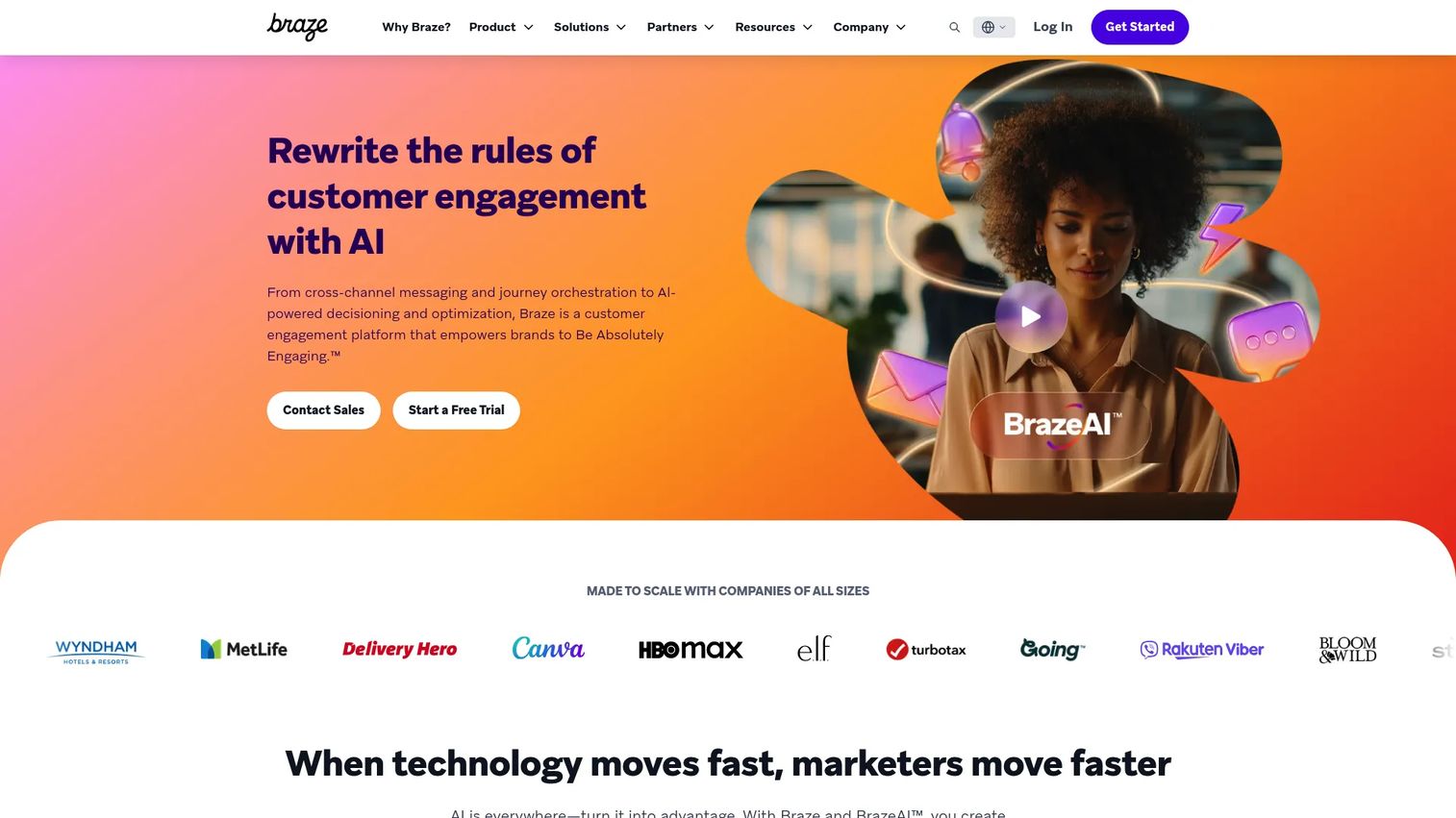
Braze is a customer engagement platform built for cross-channel messaging, orchestration, and personalization at enterprise scale. It combines a data platform, AI-driven orchestration, and campaign control that mature lifecycle teams rely on to run sophisticated, behavior-triggered programs. If your engagement operation is already advanced, Braze gives it room to scale.
Best for: Enterprises and growth teams managing personalized cross-channel engagement.
Key strengths
- Cross-channel messaging: Coordinate email, push, in-app, and more from one orchestration layer.
- BrazeAI and orchestration: Optimize timing, channel, and content with AI.
- Braze Data Platform: Unify customer data to power real-time personalization.
Why choose Braze: Braze fits teams with mature lifecycle operations and the resources to run them. Its orchestration depth rewards organizations that have already outgrown basic marketing automation and need granular control over multi-channel journeys.
Braze pricing: Braze offers four editions, Go, Select, Pro, and Enterprise, all quoted on request, with a free trial available. Its G2 rating is 4.5 out of 5.
6. HubSpot
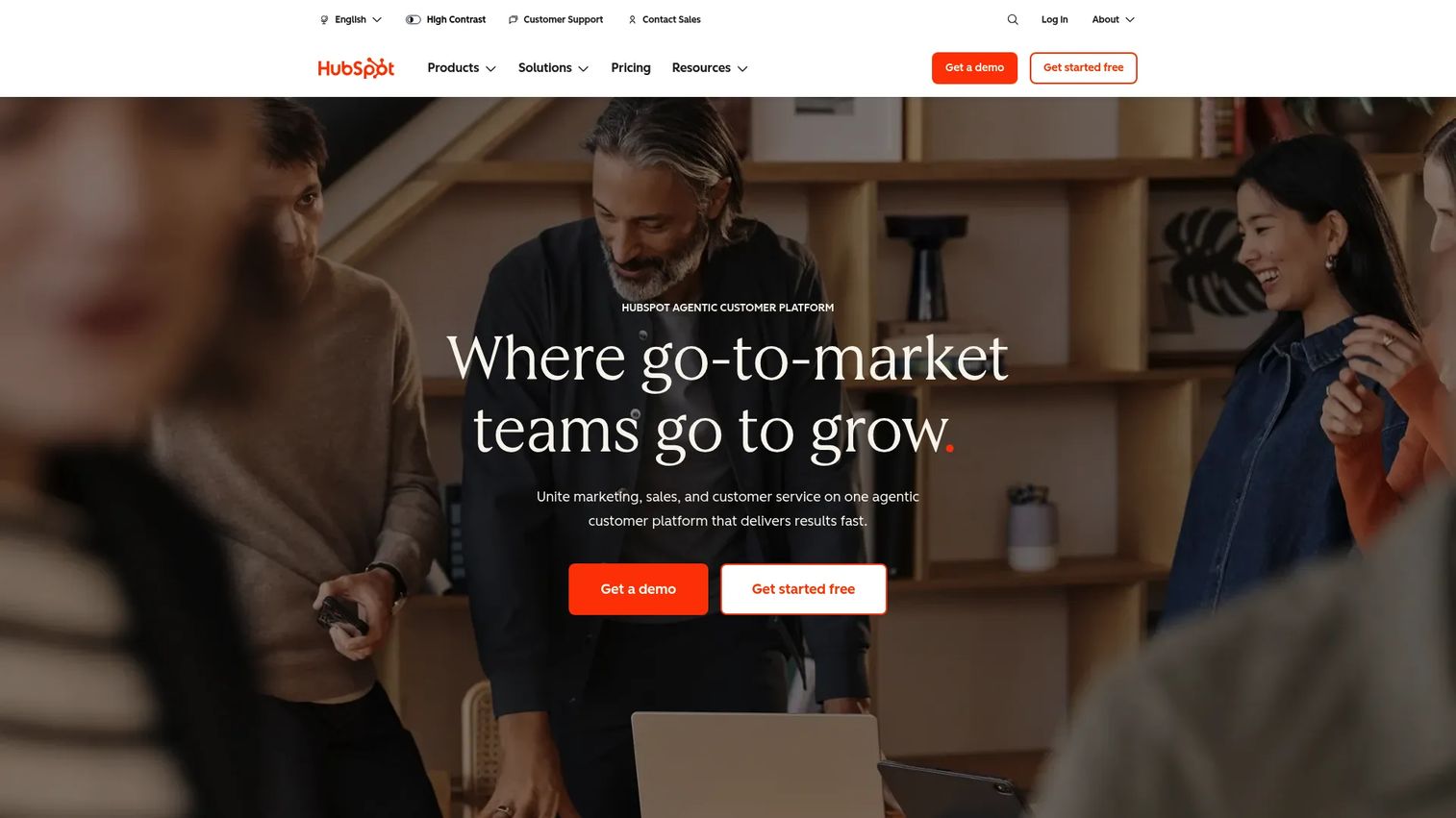
HubSpot is a CRM-centric customer platform spanning marketing, sales, service, content, and data. Its appeal for engagement is the native link between CRM records and lifecycle automation, so email, forms, and workflows run off the same customer data without stitching tools together. For smaller teams or those consolidating a scattered stack, that convenience is the whole point.
Best for: Teams that want an all-in-one, CRM-centric customer platform.
Key strengths
- Free CRM and tools: Start with a genuinely free CRM and grow into paid hubs.
- Connected hubs: Run marketing, sales, service, content, and data on one record.
- AI agents: Automate routine engagement and support work with built-in AI.
Why choose HubSpot: HubSpot is the practical choice when you want fewer tools and tighter integration between CRM and marketing automation. It rewards teams that value a single source of customer data over best-of-breed depth in any one channel.
HubSpot pricing: Free tools are available at $0. Starter begins at $7 per seat per month, Professional starts at $1,300 per month, and Enterprise is quoted by sales. Pricing varies by product line. Its G2 rating is 4.4 out of 5.
7. Netcore Cloud
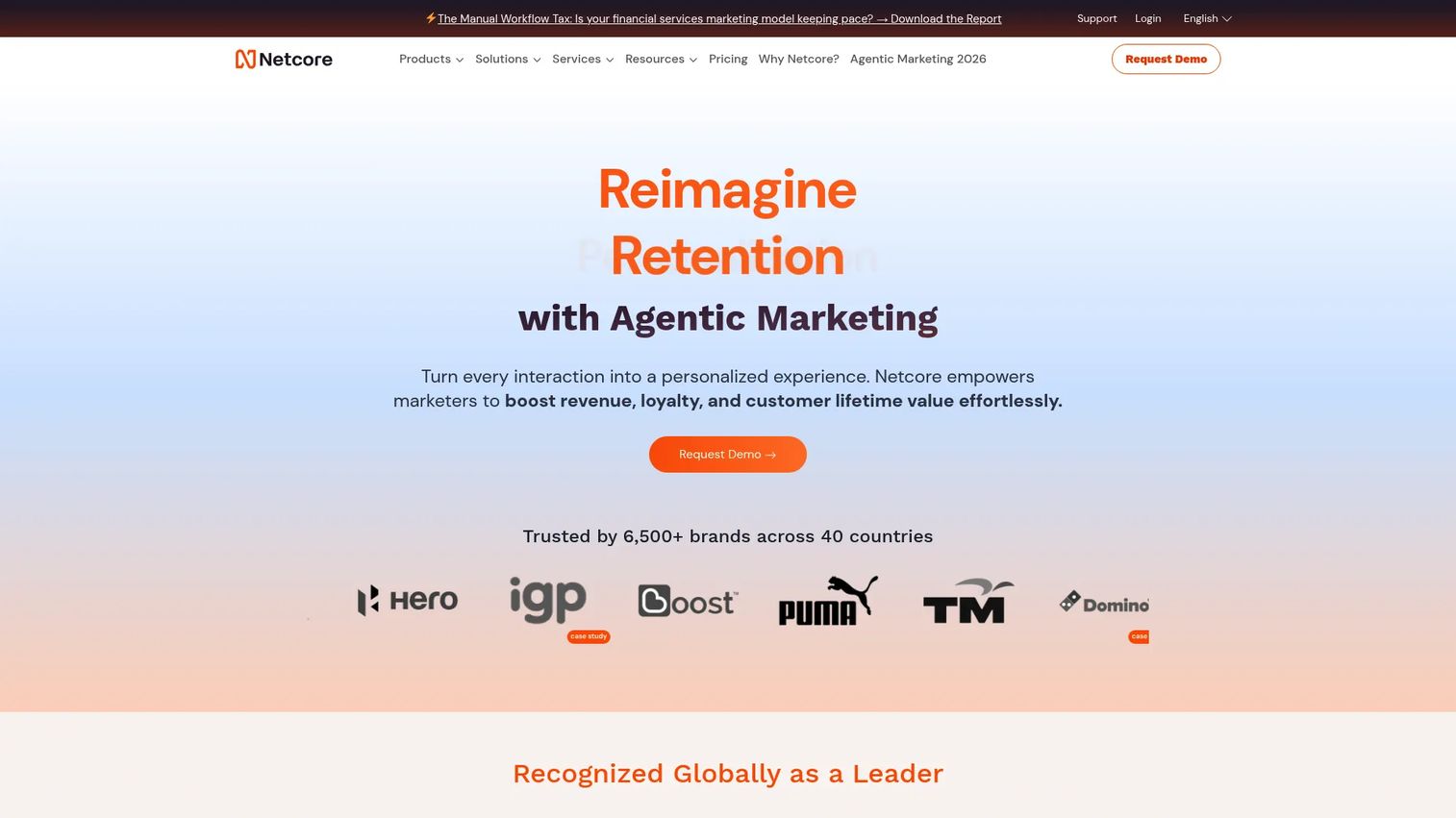
Netcore Cloud is an AI-powered customer engagement and personalization platform spanning more than 13 channels. It pairs a customer data platform with product experience tooling and journey orchestration, with particular strength among ecommerce and retail teams. Teams evaluating scaled engagement workflows often shortlist it for its channel breadth.
Best for: Ecommerce and retail teams that need AI-driven omnichannel engagement and personalization.
Key strengths
- Omnichannel reach: Engage users across 13+ channels from one platform.
- Customer data platform: Unify profiles to power personalization at scale.
- Journey orchestration: Automate product experiences and lifecycle flows.
Why choose Netcore Cloud: Netcore Cloud suits teams that want wide channel coverage and AI personalization without assembling multiple point tools. Its value-based pricing model appeals to organizations that want cost tied to outcomes.
Netcore Cloud pricing: Pricing is value-based with a 75% fixed and 25% variable structure across Startup, Growth, and Enterprise plans; no public numeric price is listed. Its G2 rating is 4.5 out of 5.
8. Salesforce Marketing Cloud
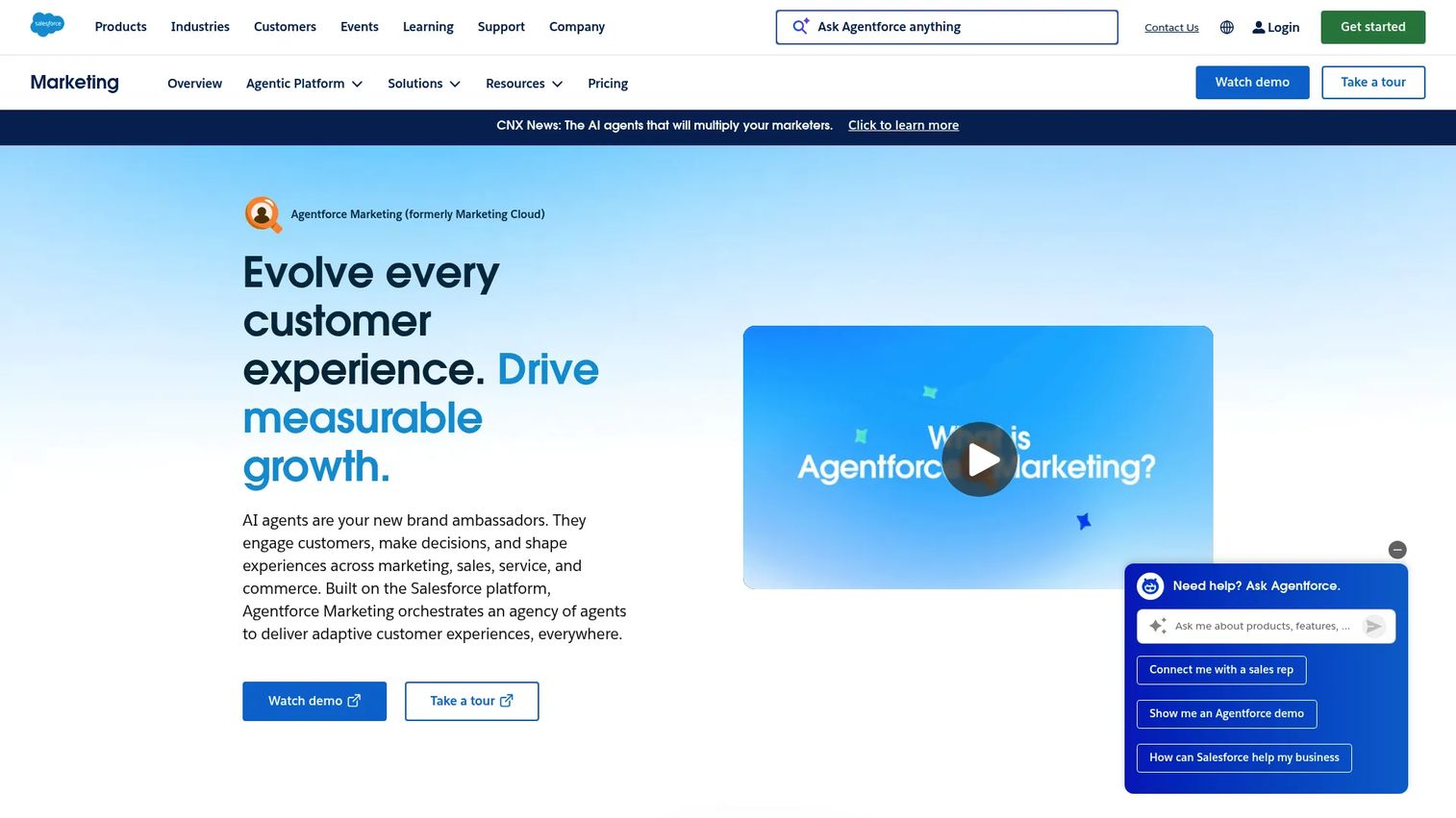
Salesforce Marketing Cloud is a marketing automation platform for enterprise customer journeys, data unification, and cross-channel orchestration inside the Salesforce ecosystem. For organizations already standardized on Salesforce, it keeps engagement data and CRM data in one place. The depth is real, and it rewards teams with the resources to implement it fully.
Best for: Enterprises that need multi-channel marketing automation inside the Salesforce ecosystem.
Key strengths
- Cross-channel automation: Run journeys across email, SMS, web, and WhatsApp.
- Two-way conversations: Engage users interactively across channels, not just broadcast.
- AI personalization: Optimize campaigns and content with built-in AI.
Why choose Salesforce Marketing Cloud: The clear fit is teams already invested in Salesforce that want engagement and CRM unified. That depth comes with a meaningful implementation effort, so it rewards organizations with the resources and roadmap to adopt it properly.
Salesforce Marketing Cloud pricing: The Growth Edition starts at $1,500 per org per month and the Advanced Edition at $3,250 per org per month, both billed annually. Broader packaging is sales-led. Its G2 rating is 4.0 out of 5.
9. Pendo
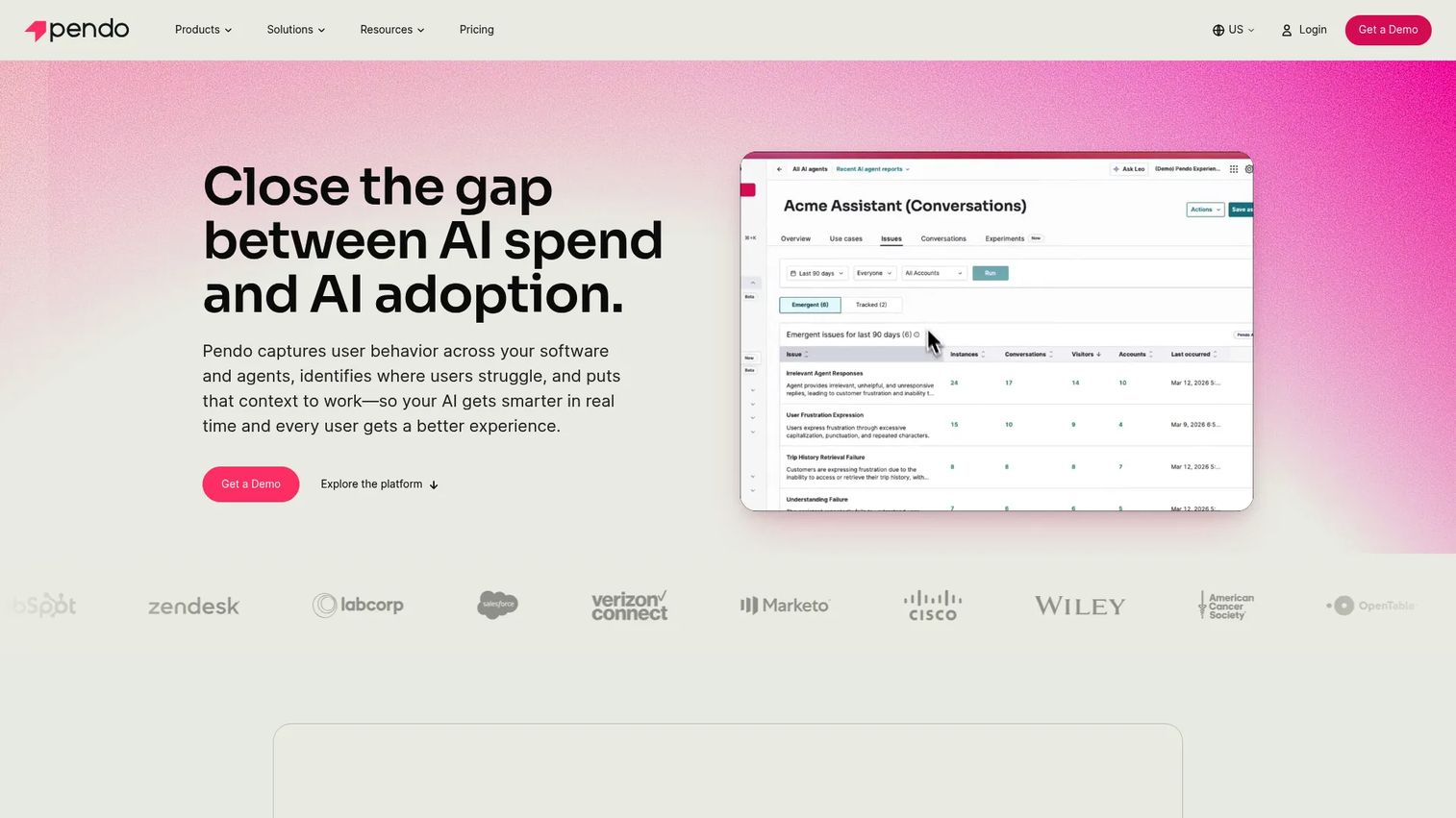
Pendo is a product experience platform combining product analytics, in-app guidance, and feedback in one place. For PMMs and product teams, it connects what users do with what you tell them inside the product, then captures their feedback without leaving the app. That makes it a natural fit for product adoption and onboarding-style engagement.
Best for: Teams that want product analytics plus in-app engagement and feedback in one platform.
Key strengths
- Product analytics: See how users move through the product and where they drop.
- In-app guides: Deliver onboarding, announcements, and nudges inside the product.
- Feedback and Listen: Collect and prioritize user feedback in context.
Why choose Pendo: Pendo fits teams that want analytics and in-app engagement to live together rather than in separate tools. It ties adoption campaigns directly to usage data, which makes proving impact on activation and retention far easier.
Pendo pricing: A free plan is available up to 500 monthly active users. Base, Core, and Ultimate tiers are custom-priced and require a demo. Public pricing is MAU-based and feature-based.
10. CleverTap
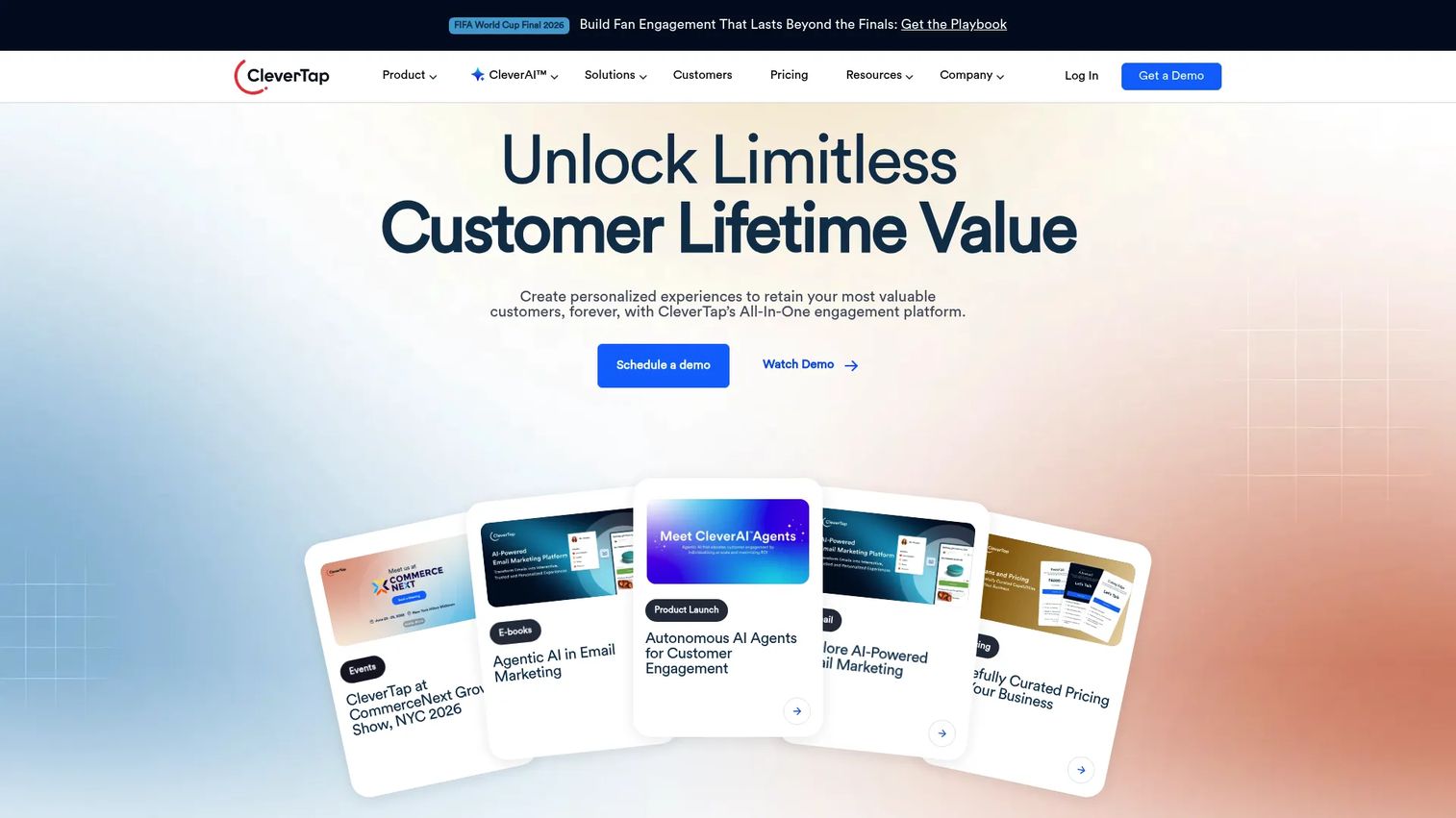
CleverTap is a customer engagement and retention platform built for app and web personalization, analytics, and omnichannel orchestration. Its strength is app lifecycle and retention: segmentation, experimentation, and automated messaging across push, email, WhatsApp, in-app, web, SMS, and RCS. For mobile-first teams, it centers engagement on the app experience.
Best for: Teams that need customer engagement, analytics, and personalized multi-channel lifecycle messaging.
Key strengths
- Customer data and analytics: Segment and analyze users to drive retention.
- Experimentation and personalization: Test and tailor experiences per segment.
- Omnichannel messaging: Reach users across push, email, WhatsApp, in-app, web, SMS, and RCS.
Why choose CleverTap: CleverTap fits teams whose product lives inside an app and whose growth depends on retention. Its app-centric journeys and experimentation tools make it a strong choice for mobile lifecycle engagement.
CleverTap pricing: The Essentials plan starts at $75 per month for startups. Advanced and Cutting Edge tiers are not publicly priced and require contacting sales. Its G2 rating is 4.6 out of 5.
11. Firebase
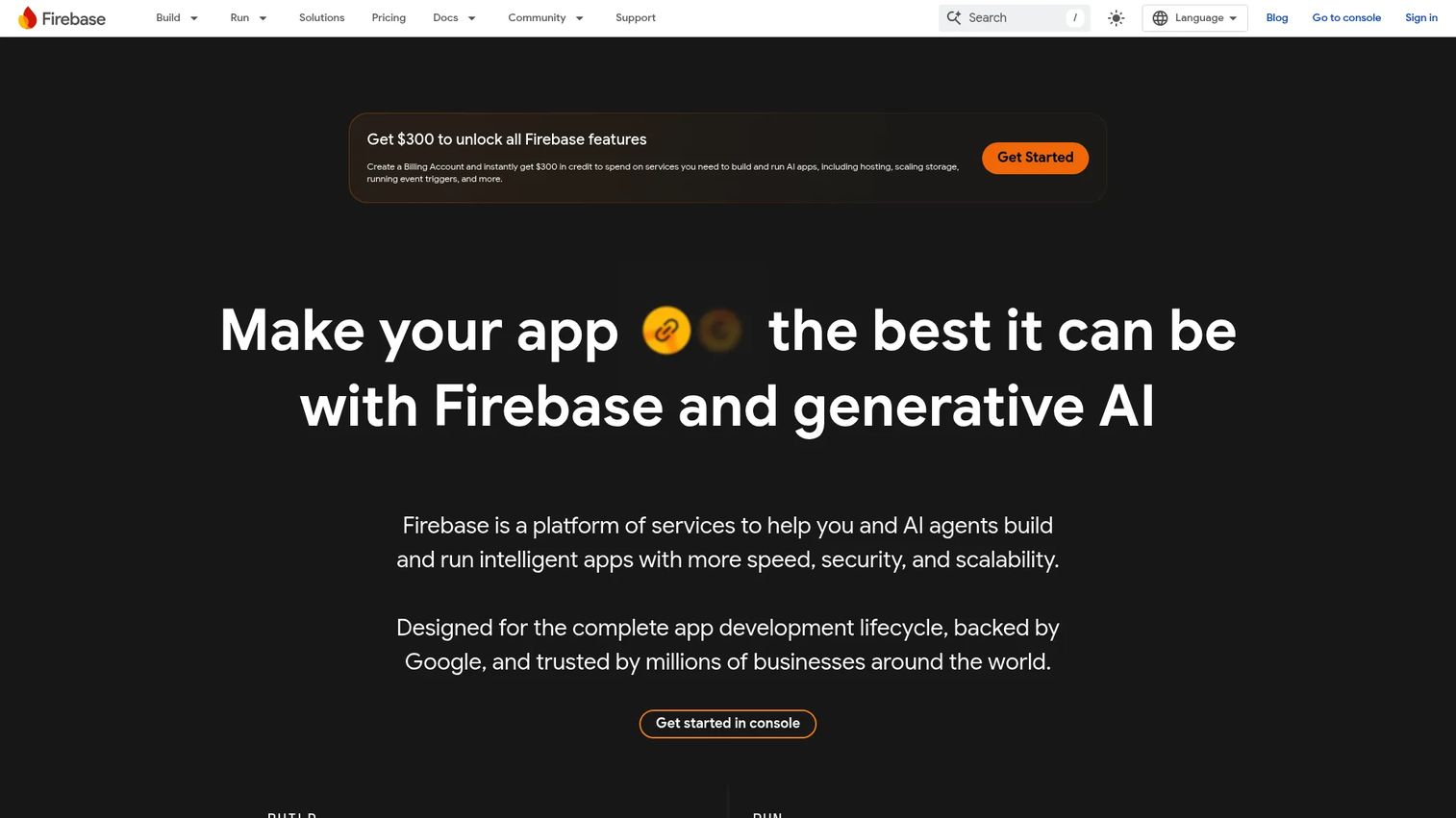
Firebase is Google's mobile and web app development platform, and its engagement basics make it a fit for teams that want a technical foundation with fast implementation. Cloud Messaging, in-app messaging, and analytics sit alongside authentication and a managed backend, so engineering-led teams can ship engagement features without adding a separate vendor.
Best for: Teams building apps that want a managed backend, analytics, and real-time features.
Key strengths
- Authentication: Manage user identity and access out of the box.
- Cloud Firestore: Store and sync app data in real time.
- Cloud Messaging: Send push and in-app messages driven by user behavior.
Why choose Firebase: Firebase suits teams with engineering resources that want engagement built into their app infrastructure rather than bolted on. Its pay-as-you-go model keeps early costs low while the backend scales with usage.
Firebase pricing: The Spark plan is free at $0. The Blaze plan is pay-as-you-go and usage-based. Its G2 rating is 4.5 out of 5.
12. ActiveCampaign
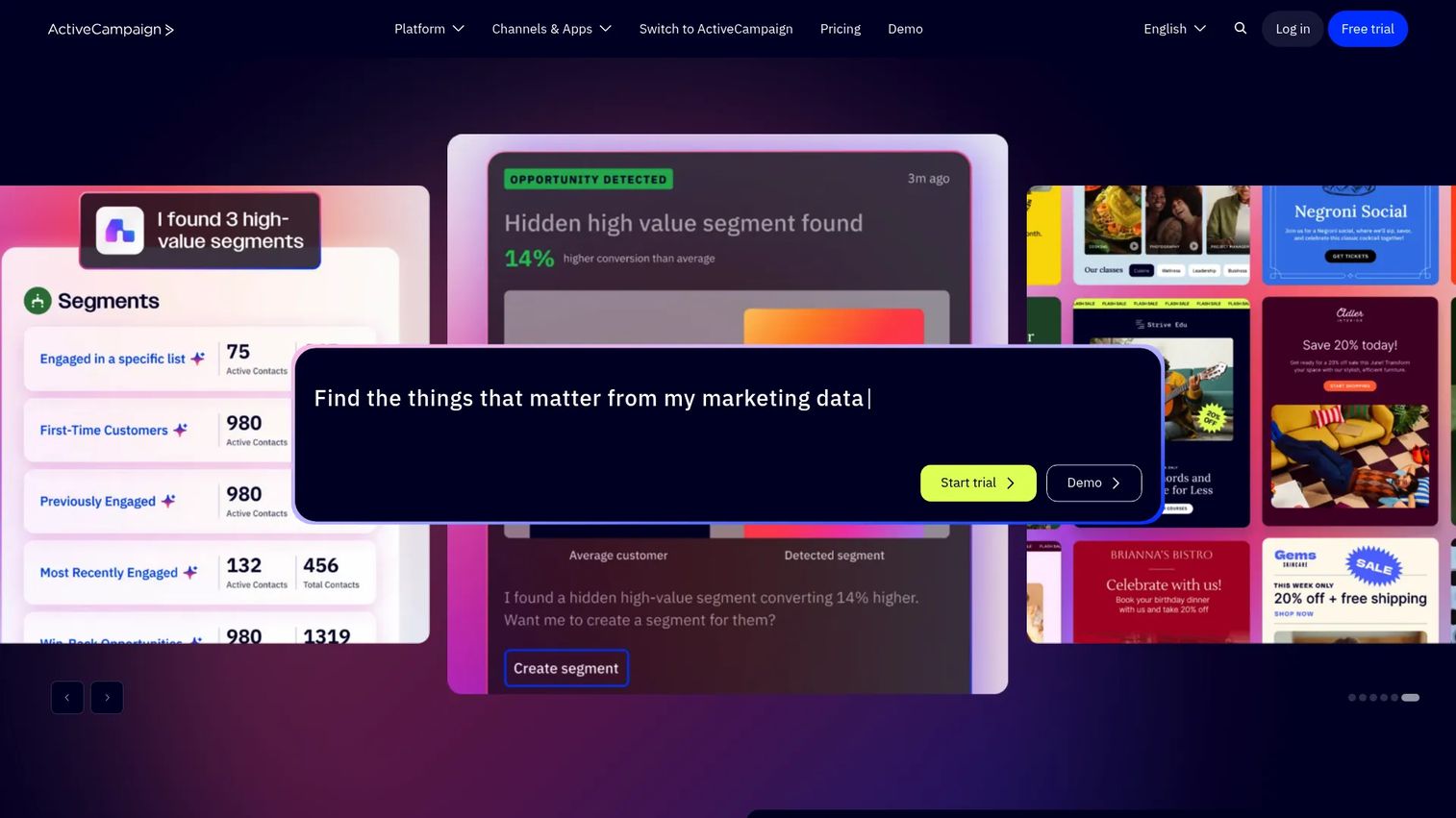
ActiveCampaign is a marketing automation platform built around email-first, behavior-driven engagement with CRM and multichannel messaging across SMS and WhatsApp. Its automation and segmentation give teams more than basic email marketing without the complexity of an enterprise suite. For lifecycle workflows, it hits a practical middle ground.
Best for: Teams that want email-first marketing automation with CRM and multichannel messaging.
Key strengths
- Autonomous marketing: Use Active Intelligence AI to automate campaign decisions.
- Email with segmentation: Run targeted email with reporting built in.
- CRM and multichannel: Coordinate SMS and WhatsApp alongside email in one platform.
Why choose ActiveCampaign: ActiveCampaign fits teams that have outgrown basic email tools but do not need enterprise orchestration. Its automation depth and CRM link make lifecycle campaigns easier to build and measure.
ActiveCampaign pricing: Public pricing starts at $15 per month and scales by contact volume and features, with a 14-day free trial. Detailed tier prices are not publicly listed. Its G2 rating is 4.4 out of 5.
13. Twilio
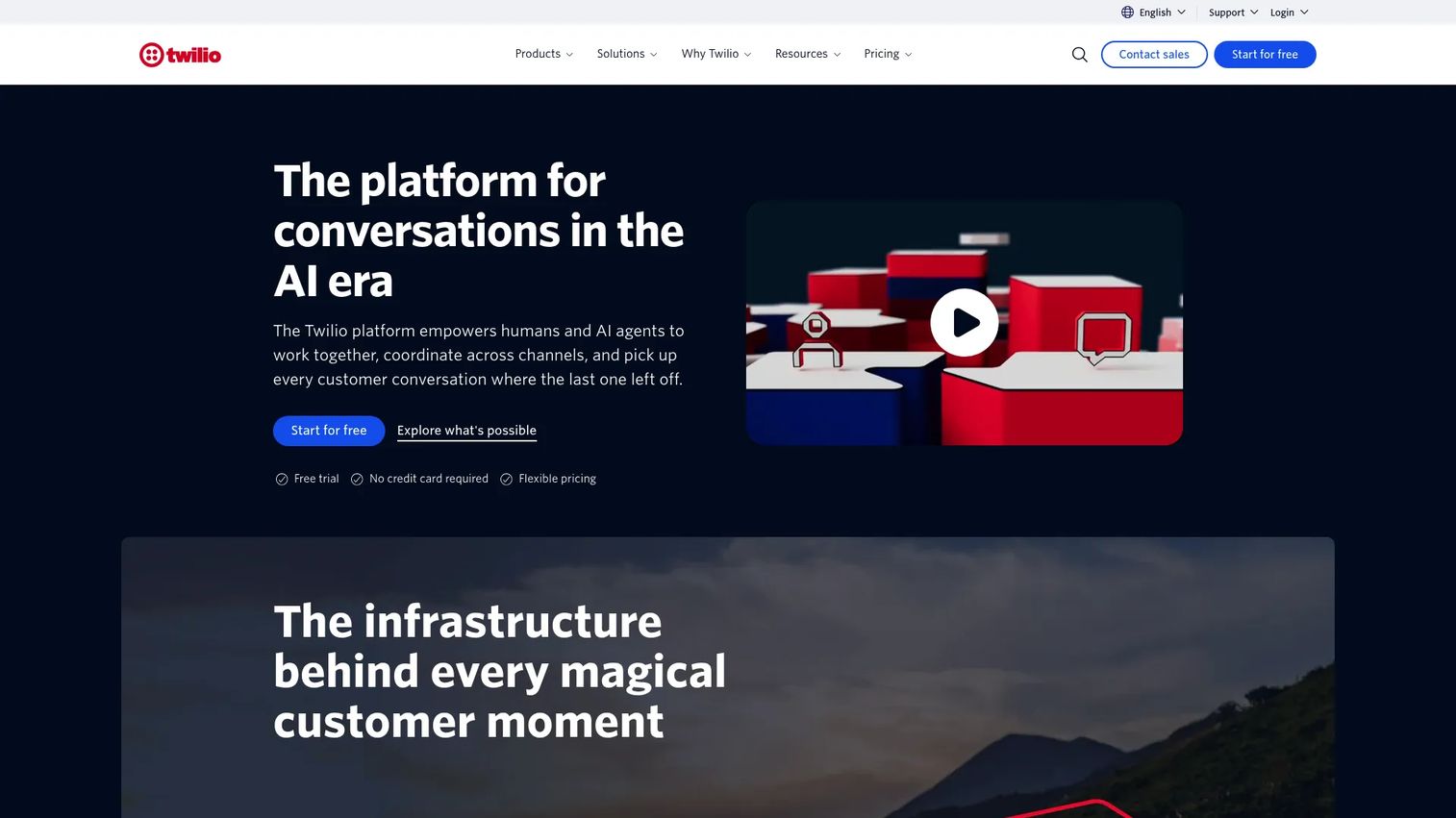
Twilio is a cloud communications platform offering programmable messaging, voice, and email APIs. It is the builder-friendly option: rather than a packaged engagement suite, it gives teams with engineering resources the infrastructure to compose exactly the engagement flows they need across SMS, RCS, WhatsApp, email, and voice.
Best for: Developer teams that need programmable communications infrastructure at scale.
Key strengths
- Messaging APIs: Send SMS, RCS, WhatsApp, MMS, and more programmatically.
- SendGrid Email API: Send and manage email at scale.
- Voice API: Add calling and phone number capabilities to any workflow.
Why choose Twilio: Twilio fits teams that want to build custom engagement flows rather than configure a packaged tool. Its API-first model gives maximum flexibility for organizations with the engineering capacity to use it.
Twilio pricing: Twilio uses usage-based, pay-as-you-go pricing with a free trial and no credit card required to start. Voice starts at $0.0140 per minute and phone numbers at $1.15 per month, with rates varying by product. Its G2 rating is 4.1 out of 5.
Considerations before you buy
The best platform on paper is the wrong platform if it does not fit how your team actually works. Run any shortlist through these criteria before you commit.
Integrations with your existing stack
An engagement platform is only as useful as the data flowing into it. Confirm it connects cleanly to your CRM, marketing automation, product analytics, and knowledge base. Broken integrations create the exact silo you are trying to eliminate.
Unified profiles and first-party data
Check whether the platform builds a genuine single customer view from first-party data, or just stitches together shallow list segments. A real unified customer profile is what makes personalization and behavior-driven automation possible instead of theoretical.
Analytics you can defend
Engagement without measurement is guessing. Look for engagement analytics that tie messages and campaigns to activation, adoption, and conversion, not just open and click rates. If you cannot show influenced behavior, you cannot prove impact.
Governance and collaboration
For PMMs, consistency across touchpoints is the job. Evaluate versioning, approvals, and permissions so messaging stays on-brand as more people publish. Speed to publish matters, but not at the cost of message drift.
Fit for your motion and team size
Enterprise orchestration suites reward teams with the resources to run them. Leaner teams often move faster with a consolidated all-in-one. Match the platform's depth to your actual operating capacity, not your aspirations.
Conclusion
There is no single best product engagement software, only the best fit for what your team prioritizes. If your engine is the feedback-to-roadmap loop, Productboard is the sharpest choice. If you need omnichannel orchestration at enterprise scale, Insider One and Braze lead the field, with Salesforce Marketing Cloud the natural pick for Salesforce-standardized teams. If your product lives in an app, CleverTap and Firebase center engagement on that experience. Pendo is the strongest option when analytics and in-app guidance need to live together, and HubSpot wins for teams consolidating a scattered stack into one CRM-centric platform.
Start by naming your primary job: feedback, omnichannel orchestration, analytics, or self-serve evaluation. Shortlist the two platforms that map to it, then pressure-test each against your integration and measurement requirements. The most balanced choice for a PMM is usually the one that keeps messaging consistent across every touchpoint and gives you proof you can defend. Pick for that, and adoption follows.
FAQs
Product engagement software is a category of tools that helps teams reach, activate, and retain users by connecting product behavior to personalized communication across the customer lifecycle. It spans omnichannel messaging, journey orchestration, unified customer profiles, and engagement analytics. The goal is to move users toward activation, adoption, and expansion while measuring what drives that behavior.
A CRM is a system of record for relationships, contacts, and deals, focused on the sales and account side. Product engagement software focuses on how users interact with the product itself: activation, adoption, feedback, and retention. Many teams connect the two so product behavior enriches the CRM and CRM data informs engagement campaigns.
Yes. It keeps launch messaging consistent across your website, email, in-app prompts, and support, and lets you trigger announcements off real user behavior. Pairing a launch with an interactive walkthrough or demo lets users experience the new capability rather than just read about it. Shared analytics then show whether the launch actually moved adoption.
Productboard is the strongest dedicated option for feedback collection, prioritization, and closing the roadmap loop with customers. Pendo also collects and prioritizes feedback in-app alongside product analytics. Both help PMMs turn scattered input into a defensible signal that informs positioning and the roadmap.
Prioritize clean integrations with your CRM, marketing automation, and analytics, a genuine unified customer profile built on first-party data, and engagement analytics that tie campaigns to activation and adoption. Governance features like versioning and approvals keep messaging consistent across touchpoints. Speed to publish matters, but only if it does not create message drift.
Marketing automation is strong at email-driven sequences, while product engagement platforms add product behavior, in-app messaging, and omnichannel orchestration on top. For lifecycle messaging that reacts to what users actually do inside the product, a broader engagement platform usually gives you more control. Many teams use both, with the engagement layer sitting closer to the product.
Analytics capture what users do, and engagement acts on it. In connected platforms, a product event like a skipped onboarding step can trigger a targeted message automatically, then analytics measure whether that message changed behavior. This real-time engagement loop is what separates a platform that sends messages from one that changes outcomes you can measure.
It depends on the SaaS motion. Product-led teams often favor Pendo for analytics plus in-app guidance, or CleverTap and Firebase for app-centric products. Sales-led SaaS teams lean toward Consensus for self-serve buyer education and Productboard for feedback loops, while enterprise lifecycle teams choose Braze, Insider One, or Salesforce Marketing Cloud for omnichannel orchestration.