Your auction does not fail in a spreadsheet. It fails when bidders cannot register, the mobile bidding page stalls at checkout, or your team has to rebuild the entire workflow between sales. The global auction software market reached $626.93 million in 2025 (The Insight Partners, 2026), and mobile-based bidding is projected to grow at 9.5% annually, according to Dataintelo (2026). That growth reflects real operational pressure: Buyers expect a branded, fast, self-serve experience, and the platform underneath it either holds or breaks.
Picking the wrong auction software is not a minor inconvenience. It is a missed sale, a damaged bidder relationship, and a founder back in the weeds fixing problems their VP should own. The right platform handles the full workflow from lot creation to settlement without requiring a different tool for every step.
This guide compares 12 auction software platforms for 2026, covering formats, bidder experience, payments, and implementation fit.
What's inside
This guide is for auction house operators, founders building auction or liquidation businesses, nonprofits running fundraising events, and operations leaders replacing manual or legacy auction workflows. Platforms were selected based on four criteria:
- Auction format coverage: live, timed, silent, simulcast, and hybrid support
- Bidder experience: mobile bidding, outbid alerts, branded websites, registration flows
- Payment and back-office completeness: invoicing, settlement, consignor management, reporting
- Implementation fit: pricing transparency, setup complexity, and who can run it without the founder
Pricing and G2 ratings reflect figures verified from live vendor pages and G2 listings.
TL;DR
- Best overall for branded online auctions: AuctionMethod covers the full workflow with white-label websites, online bidding, invoicing, and reporting from $100/month
- Best for professional auction houses: Auction Flex handles consignors, cataloging, clerking, and settlements with workstation-based pricing from $85/month
- Best for enterprise auction marketplaces: Bidpath provides configurable white-label infrastructure for live, timed, and hybrid auctions at custom pricing
- Best for nonprofit silent auctions: Auctria supports donors, tickets, sponsorships, raffles, and mobile bidding, with a free plan available
- Best for mobile-first bidder experience: Auction Mobility delivers branded apps and live simulcast bidding with three package tiers
- Best for schools and fundraising events: SchoolAuction.net starts at $79/event and covers online bidding, ticketing, Text-to-Give, and donor records
What is auction software?
Auction software is a platform that helps organizations create, publish, manage, and close auctions across online, live, timed, silent, hybrid, or marketplace formats.
G2 describes the category as software that manages auction events, builds auction websites, supports mobile or paperless bidding, and helps organizers focus on participation rather than manual administration.
Core capabilities typically include:
- Auction setup and lot cataloging
- Bidder registration and approval workflows
- Online and mobile bidding
- Branded auction websites
- Live, timed, silent, or simulcast auction formats
- Payment processing and checkout
- Invoicing and settlement
- Consignor, donor, or seller management
- Reporting and data exports
- Integrations with CRM, payment, and email tools
The category splits into three distinct operating models:
Professional auction houses focus on consignors, lot management, live clerking, and settlement. They need back-office depth and often run hybrid or webcast events.
Nonprofit and fundraising teams focus on donors, tickets, sponsorships, raffles, and mobile silent auctions. Payment flows and donor records matter more than consignor reports.
Marketplace operators focus on multi-seller infrastructure, bidder scale, custom branding, and payment governance. These buyers are often founders building a business around auction functionality rather than running occasional sales.
Matching the software to the operating model matters more than comparing feature counts across the board.
When to use auction software
Replace duct-taped workflows before the next sale
If your team runs auctions across a listing tool, a separate payment processor, a spreadsheet for consignors, and a manual email sequence for outbid notifications, you already have the problem. Every handoff between tools is a risk during a live sale. Auction software consolidates the workflow so your operations team can run a sale without your involvement in each step.
Give bidders a mobile experience that holds up under pressure
Bidder participation drops when mobile registration is clunky, outbid alerts are delayed, or checkout breaks at the invoice screen. Mobile-based bidding now represents the fastest-growing segment in the category, projected at 9.5% annual growth (Dataintelo, 2026). Platforms with native apps, SMS notifications, and mobile-optimized checkout convert more participants into active bidders and bring them back for future sales.
Manage multiple auction formats without switching platforms
A nonprofit silent auction has almost nothing in common with an industrial webcast sale or a real estate auction. Format fit is the filter most buyers apply last, when it should come first. Pick software around the two formats you run most often, then verify it can handle the next format you plan to add. Switching platforms mid-growth is expensive.
Auction software comparison
The table below covers all 12 platforms in order, with verified pricing and G2 ratings as of November 2026. Where vendors require a quote, that is noted; where no G2 listing exists, the field reflects N/A.
| # | Product | Best for | Key differentiator | Pricing | G2 rating |
|---|---|---|---|---|---|
| 1 | AuctionMethod | Branded online auctions | White-label auction websites with end-to-end management | From $100/month | 5.0/5 |
| 2 | Auction Flex | Professional auction houses | Back-office operations: Cataloging, clerking, settlement | From $85/month | 0.0/5 (1 review) |
| 3 | RocketBid | Benefit auctions and events | Fundraising event workflows and mobile bidding | Contact vendor | N/A |
| 4 | Bidpath | Enterprise auction marketplaces | White-label infrastructure for live, timed, and hybrid auctions | Contact vendor | 0.0/5 |
| 5 | NextLot | Live and simulcast auctions | Webcast auctions with HD video and SMS outbid alerts | Contact vendor | 2.0/5 |
| 6 | Bidsquare Cloud | Fine art and collectibles houses | White-label site, live and timed auctions, bidder intelligence | Contact vendor | 0.0/5 |
| 7 | Auctria | Nonprofit silent auctions | Donor management, tickets, raffles, and mobile bidding | Free to $750/year | 4.8/5 |
| 8 | Auction Mobility | Mobile-first auction brands | Branded Android and iOS apps with live simulcast | Contact vendor | 4.6/5 |
| 9 | AuctionWorx | Auction marketplaces | Configurable multi-seller marketplace software | Contact vendor | N/A (4.9 Capterra) |
| 10 | Maxanet | Established auction companies | End-to-end online auction hosting with WordPress integration | $300/month | 5.0/5 |
| 11 | Auctioneer Software | Live, timed, and real estate auctions | White-label websites plus auction marketing services | Contact vendor | 0.0/5 |
| 12 | SchoolAuction.net | School fundraising auctions | School gala workflows with Text-to-Give and mobile bidding | From $79/event | 4.6/5 |
Best 12 auction software platforms for 2026
1. AuctionMethod
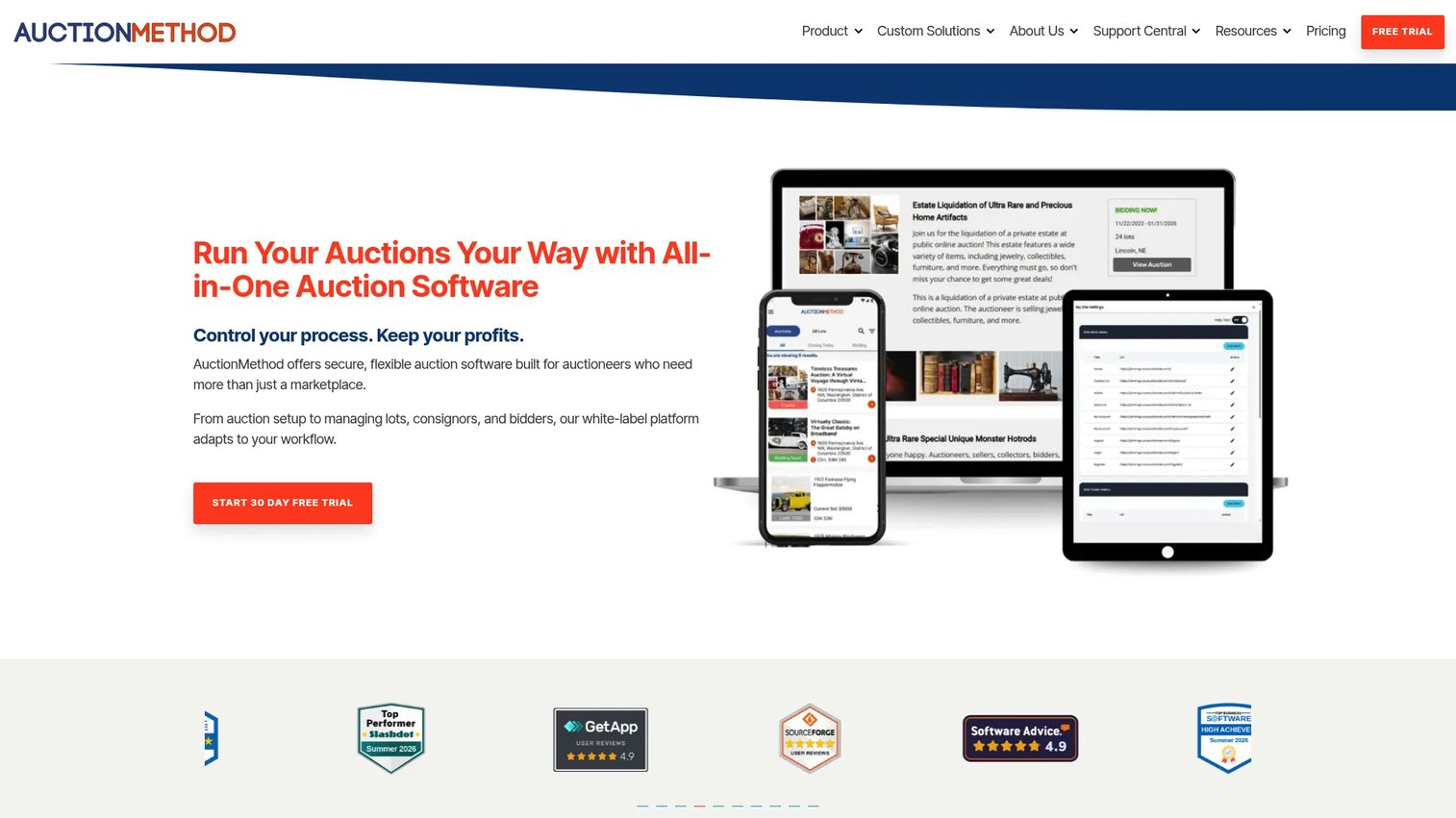
AuctionMethod is an all-in-one auction management platform built for auction businesses that want branded online auctions without piecing together separate tools for bidding, invoicing, and websites. The platform covers lot setup, bidder registration, real-time bidding, payment integrations, and reporting in a single workflow. It supports white-label auction websites so your brand controls the bidder relationship from first registration through final invoice. A 30-day free trial is available.
Best for: Auction businesses that want a branded online auction operation their team can run independently.
Key features
- White-label auction websites with custom branding
- Online and mobile bidding with real-time updates
- Built-in invoicing and payment integrations
- Bidder registration and account management
- Reporting, analytics, and data exports
Why choose AuctionMethod: It suits founders who want auction operations off their plate and into a repeatable workflow their VP can own. The Growth plan covers unlimited auctions, lots, and admin users, which means no per-sale billing surprises.
AuctionMethod pricing: Plans start at $100/month (Growth), $750/month (Scale), and $1,500/month for custom solutions. All plans include unlimited auctions and admin users.
G2 rating: 5.0/5
2. Auction Flex
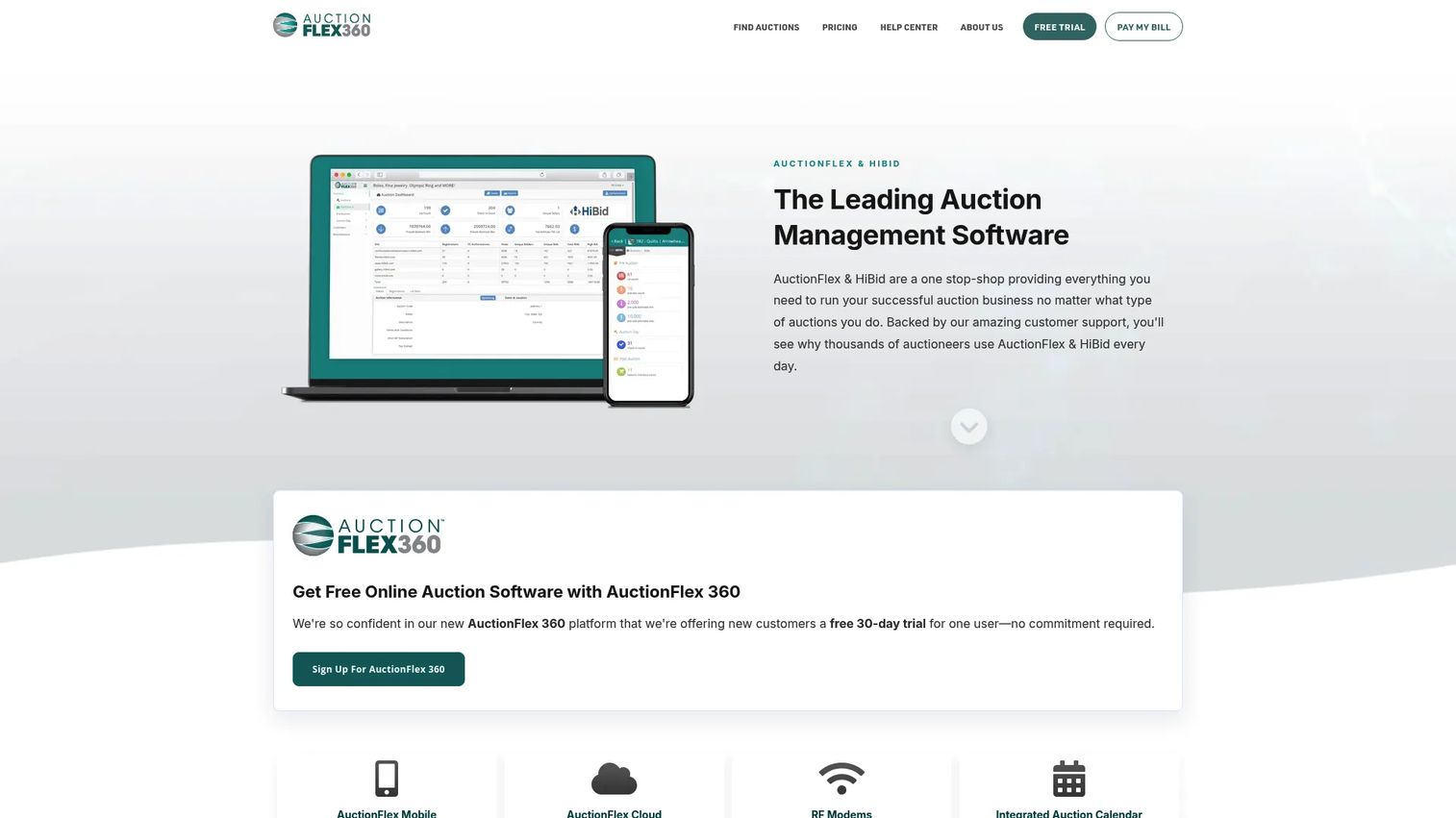
Auction Flex is established auction-house software focused on back-office auction management: Cataloging, clerking, cashiering, and settlement. It handles inventory through barcode scanning or image capture, runs live auction clerking, and generates consignor settlement reports. The companion HiBid integration extends operations to online bidding, with HiBid charging a 2% auction fee and $0.25 per unique bid. The first 25 GB of cloud storage is included; additional storage runs $0.25/GB.
Best for: Professional auction houses with established workflows that need depth in consignor management, clerking, and financial settlement.
Key features
- Barcode and image-based lot cataloging
- Live auction clerking and cashiering tools
- Consignor management and settlement reports
- Invoice generation and accounting
- HiBid integration for online bidding
Why choose Auction Flex: It fits teams where back-office operational depth matters more than a polished marketing website. Staff who already know auction-house workflows will find the tool matches how they think about a sale.
Auction Flex pricing: Workstation plans start at $85/month for one workstation, scaling to $550/month for unlimited workstations. Each additional workstation adds $30/month. A 30-day free trial is available.
3. RocketBid
RocketBid targets organizations running benefit auctions, fundraising galas, and event-based silent auctions. The platform is positioned around mobile bidding, guest management, checkout, and fundraising reporting. The website currently redirects through a domain-profile page, so first-party pricing and detailed feature verification were not possible at the time of writing. If you are evaluating RocketBid, confirm current availability and pricing directly with the vendor before committing.
Best for: Organizations running event-based benefit auctions that need mobile bidding and guest management in one place.
Key features
- Mobile bidding for silent auctions
- Guest and attendee registration
- Checkout and payment tools
- Fundraising event reporting
- Silent auction workflows
Why choose RocketBid: The platform suits fundraising event teams over commercial auction houses. Verify current availability before shortlisting.
RocketBid pricing: Contact the vendor directly for current pricing.
4. Bidpath

Bidpath provides auction management, bidding, back-office, and marketplace software for auction businesses that need configurable infrastructure at scale. The platform supports live webcast auctions, timed online auctions, and hybrid formats. It includes multilingual and multicurrency auction portals, API access, invoicing, financial reporting, and CMS tools for managing inventory, clients, and compliance. Bidpath positions itself for auction houses that want white-label control over their entire auction operation rather than a hosted SaaS product.
Best for: Larger auction businesses and marketplace operators that need configurable, white-label auction infrastructure across multiple formats.
Key features
- Live webcast, timed, and hybrid auction support
- Multilingual and multicurrency auction portals
- White-label branded websites and mobile bidding
- Back-office tools for inventory, finance, and compliance
- API access and custom integrations
Why choose Bidpath: It fits operators building a serious, scalable auction business rather than running occasional sales. The configurability suits teams with technical resources to set up and maintain the platform.
Bidpath pricing: Contact vendor for a quote.
5. NextLot
NextLot delivers branded online auction software for auctioneers running webcast and timed online events. The platform includes real-time webcast auctions with HD video and audio, timed auctions with SMS outbid notifications and watchlists, and a mobile cataloging app with offline mode. Invoicing supports online payment and autocharge. NextLot also provides auction marketing support and dedicated customer service for auctioneers expanding from floor-only events to hybrid online selling.
Best for: Auctioneers running live or simulcast events who need remote bidder participation without losing the live-room experience.
Key features
- Real-time webcast auctions with HD video and audio
- Timed online auctions with SMS outbid alerts
- White-labeled auction websites and mobile bidding
- Mobile cataloging app with offline capability
- Online invoice payments and autocharge support
Why choose NextLot: It suits auctioneers moving from in-person-only to hybrid formats. The webcast infrastructure is the core differentiator; teams that primarily run timed-only sales may find the feature depth unnecessary.
NextLot pricing: Contact vendor for current pricing.
G2 rating: 2.0/5
6. Bidsquare Cloud
Bidsquare Cloud offers white-label auction infrastructure for independent auction houses, with a focus on inventory management, live and timed auctions, and bidder data intelligence. The platform supports Buy Now events alongside traditional auction formats and includes integrated invoicing, payments, and settlement tools. Pricing is customized to each auction house's event volume and revenue, so the vendor directs prospects to request a demo before quoting.
Best for: Independent auction houses in fine art, antiques, collectibles, or luxury categories that want branded infrastructure with deep inventory and bidder tools.
Key features
- Inventory management and lot cataloging
- White-label branded website and native app
- Live and timed auctions plus Buy Now events
- Integrated invoicing, payments, and settlement
- Bidder and underbidder data intelligence
Why choose Bidsquare Cloud: It fits auction houses where presentation quality and category-specific audience data matter as much as the bidding engine. The data intelligence layer on bidder behavior is a differentiator for houses that actively market to past buyers.
Bidsquare Cloud pricing: Contact vendor for a quote.
7. Auctria
Auctria is fundraising event software for nonprofits running silent auctions, galas, and donor-led events. The platform handles live, silent, and online auctions alongside ticket sales, sponsorships, donations, paddle raises, and raffles. It includes customizable event websites, integrated payment processing, mobile bidding, texting tools, and post-event reporting. The Explorer plan is free and supports up to $10,000 in tracked annual income, making it accessible for smaller organizations testing the platform before committing to an annual plan.
Best for: Nonprofits and community organizations running fundraising galas, silent auctions, and hybrid events with donor management needs.
Key features
- Silent, live, and online auctions with mobile bidding
- Ticket sales, sponsorships, donations, and paddle raises
- Customizable event websites with donor records
- Integrated payments with credit-card fee handling
- Raffles, texting tools, and post-event analytics
Why choose Auctria: It is purpose-built for fundraising rather than commercial auction operations, which means the donor management, ticketing, and sponsorship tools receive the same attention as the bidding engine. For nonprofit teams, that balance is the point.
Auctria pricing: The Explorer plan is free (up to $10,000 in annual tracked income). Emerald runs $375/year (up to $50,000 in income), and Diamond runs $750/year with no income cap.
G2 rating: 4.8/5
8. Auction Mobility
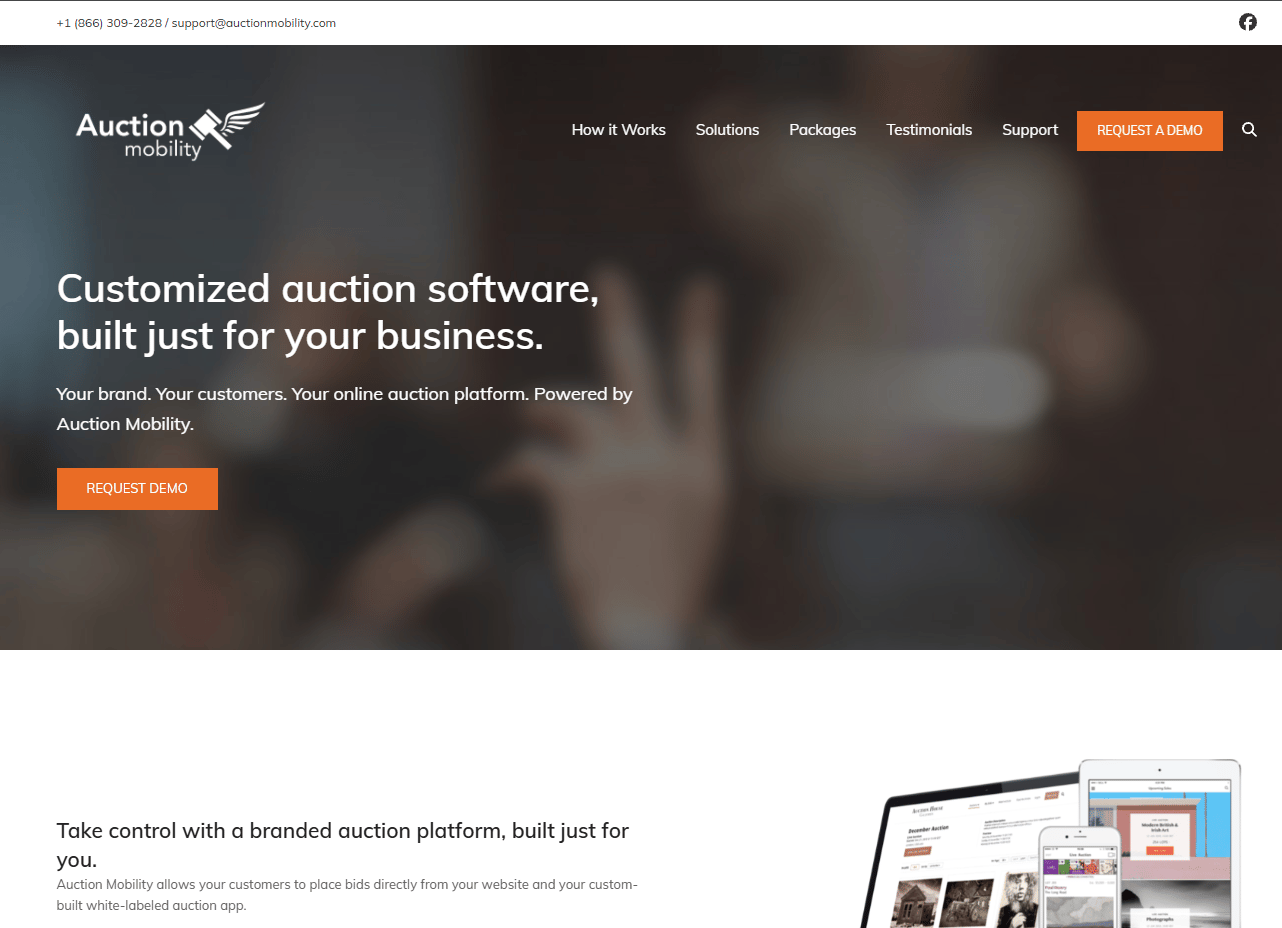
Auction Mobility delivers white-label online auction software with a clear emphasis on the mobile bidder experience. Auction houses get branded Android and iOS apps, live simulcast auction support, timed online auctions, push notifications, video streaming, and pre-bidding. The platform auto-extends auctions to maintain competitive bidding and allows buyers to browse past catalogs. Three package tiers (Lite, Core, Custom) are available; exact pricing requires contacting the vendor. Support runs 24/7.
Best for: Auction brands where repeat bidders and app-based participation are central to growth, not a secondary channel.
Key features
- Branded native iOS and Android apps
- Live simulcast auctions with video streaming
- Timed online auctions with auto-extend bidding
- Pre-bidding and customized push notifications
- Catalog browsing and past auction access
Why choose Auction Mobility: If your bidder retention strategy depends on a native app experience rather than a mobile browser, this is the platform built for that. The branded app ties your business identity directly to the bidder's phone.
Auction Mobility pricing: Packages are available in Lite, Core, and Custom tiers. Contact Auction Mobility for specific pricing.
G2 rating: 4.6/5
9. AuctionWorx
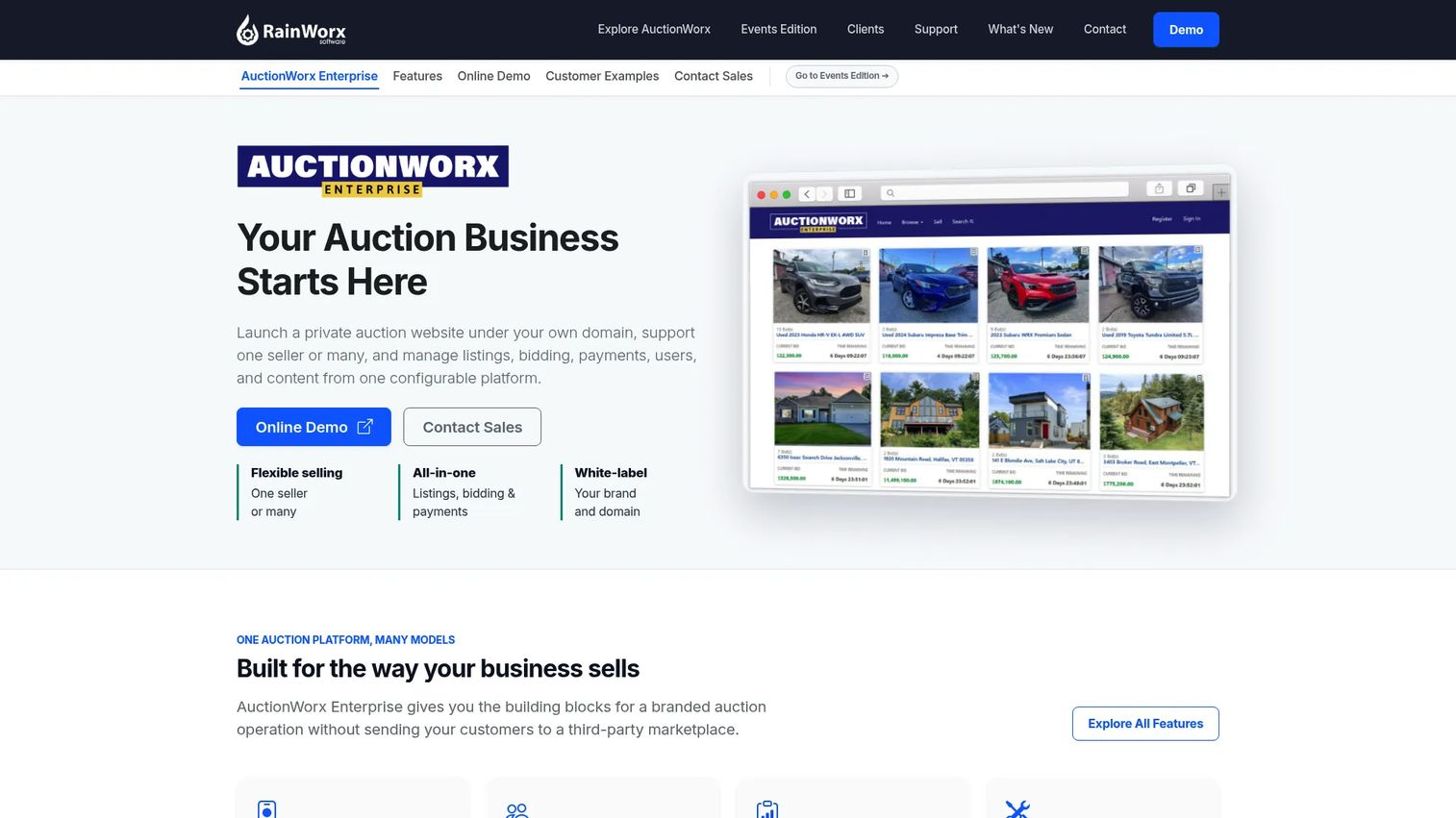
AuctionWorx by RainWorx is configurable auction website and marketplace software for teams building branded auction businesses rather than running a single auction format. It supports forward auctions, reverse auctions, fixed-price listings, multi-seller accounts, custom domains, proxy bidding, reserve prices, Buy Now pricing, and auto-extend controls. Staggered closings allow catalog-style lot sequencing. The platform uses the customer's own domain and brand identity throughout. Pricing requires a quote; two editions (Enterprise and Events) are available.
Best for: Founders and operators building configurable auction marketplaces or niche bidding platforms where multi-seller infrastructure matters.
Key features
- Forward and reverse auctions with proxy bidding
- Multi-seller and consignment account management
- Fixed-price listings alongside auction events
- Custom domain with full brand identity support
- Staggered closings and auto-extend bid controls
Why choose AuctionWorx: It suits technical or operator-led teams that want configuration flexibility across auction types rather than a fixed workflow. If auction functionality lives inside a broader marketplace model, this is worth evaluating.
AuctionWorx pricing: Contact vendor for a quote.
10. Maxanet
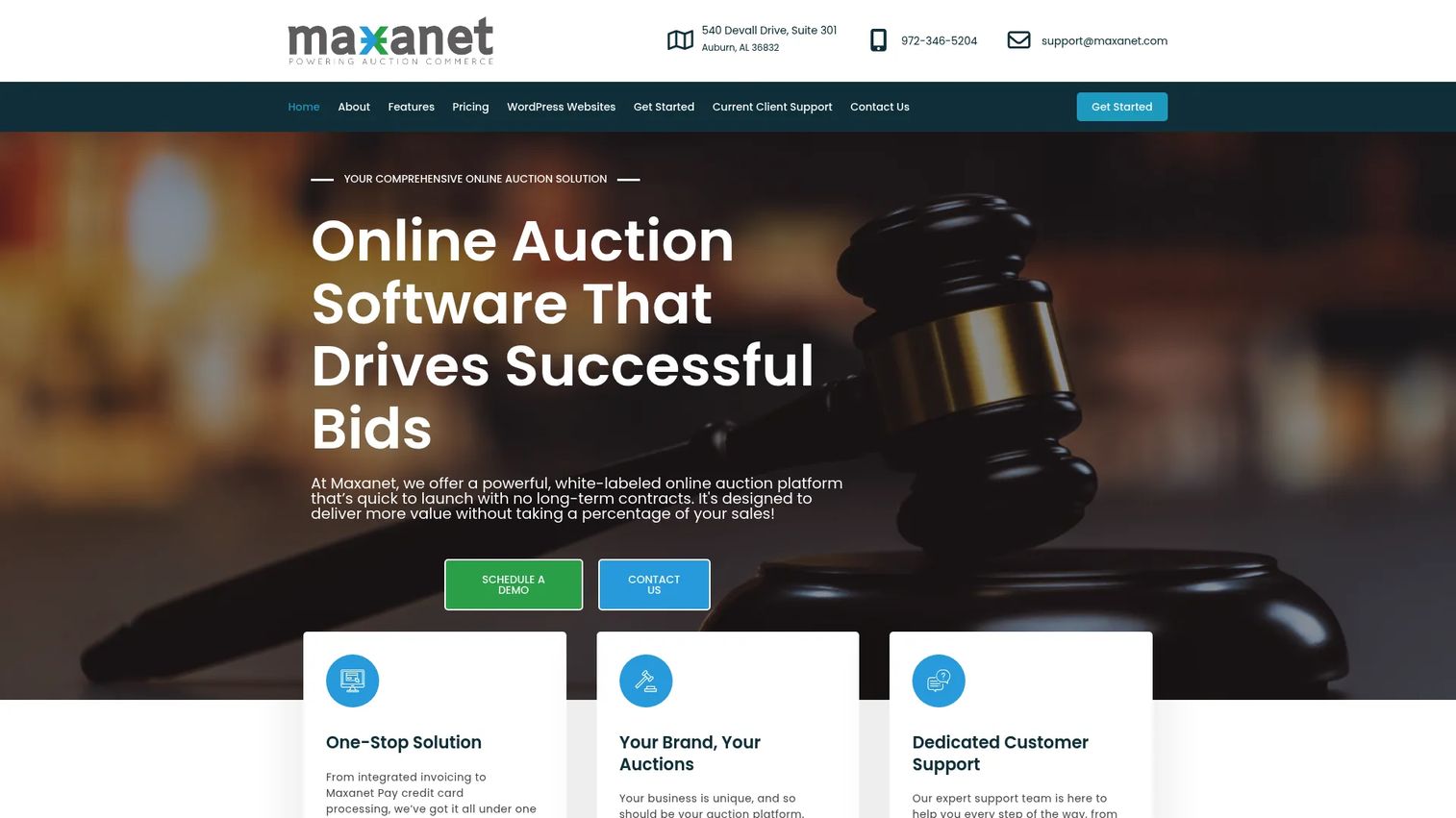
Maxanet provides white-label online auction software covering auction management, inventory, mobile administration, invoicing, and consignor settlement reporting. The platform integrates with WordPress, which makes it a practical choice for auction businesses already running WordPress-based websites. Payment processing runs through MaxanetPay. A $500 one-time setup fee applies alongside the monthly subscription, and a 7-day free trial is offered without requiring a credit card.
Best for: Auctioneers and established auction businesses that want hosted online auction tools with WordPress integration and dedicated support.
Key features
- Auction management with customizable bidding rules
- Administrative iOS and Android mobile app
- Inventory and high-resolution photo management
- Invoicing with MaxanetPay credit-card processing
- Consignor management and settlement reporting
Why choose Maxanet: The WordPress integration is the differentiator for teams already invested in that stack. The standard plan covers the full feature set at a predictable monthly rate, which suits businesses that want to avoid per-auction billing structures.
Maxanet pricing: $300/month with a $500 one-time setup fee. A 7-day free trial is available with no credit card required.
G2 rating: 5.0/5 (2 reviews on MaxanetNEXT listing)
11. Auctioneer Software
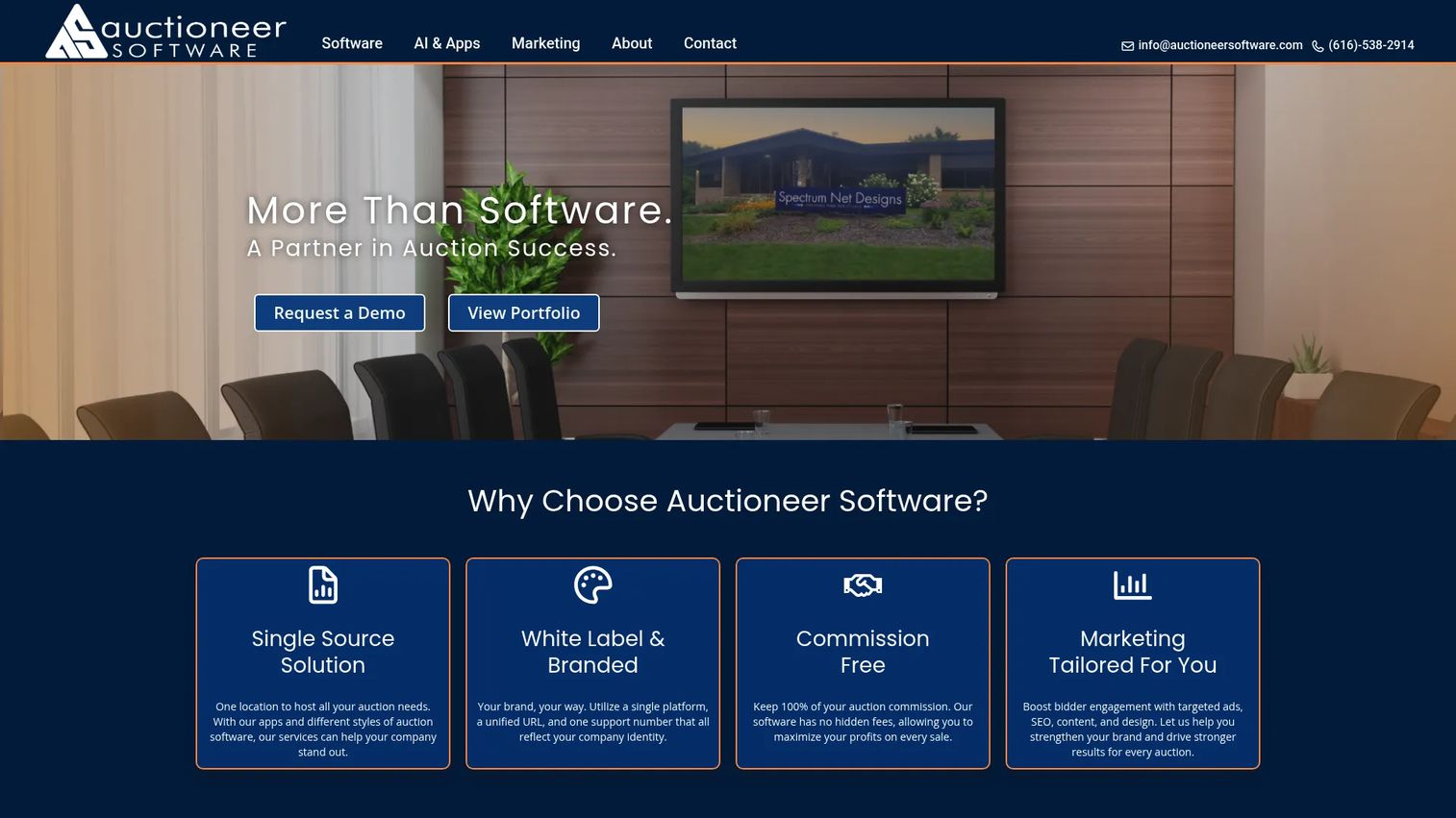
Auctioneer Software covers online, live, timed, simulcast, and multi-parcel real estate auction formats with white-label branded websites. The platform includes bidder registration and approval, payment integration, watchlists, auto-refresh bidding, invoices, and clerking tools. Beyond the software, the vendor offers digital marketing services and custom development for auction companies that want a partner rather than a self-serve platform. Pricing is not displayed and requires contacting the vendor.
Best for: Auction companies that want a single vendor for branded auction software, website development, and ongoing marketing support.
Key features
- Online, live, timed, and simulcast auction support
- White-label branded websites and custom development
- Bidder registration, approval, and mobile cataloging
- Invoices, statements, and clerking tools
- Digital marketing and auction promotion services
Why choose Auctioneer Software: It fits buyers who want a partner model rather than a pure SaaS subscription. The marketing services component means teams can hand off auction promotion alongside auction technology.
Auctioneer Software pricing: Contact vendor for pricing.
12. SchoolAuction.net
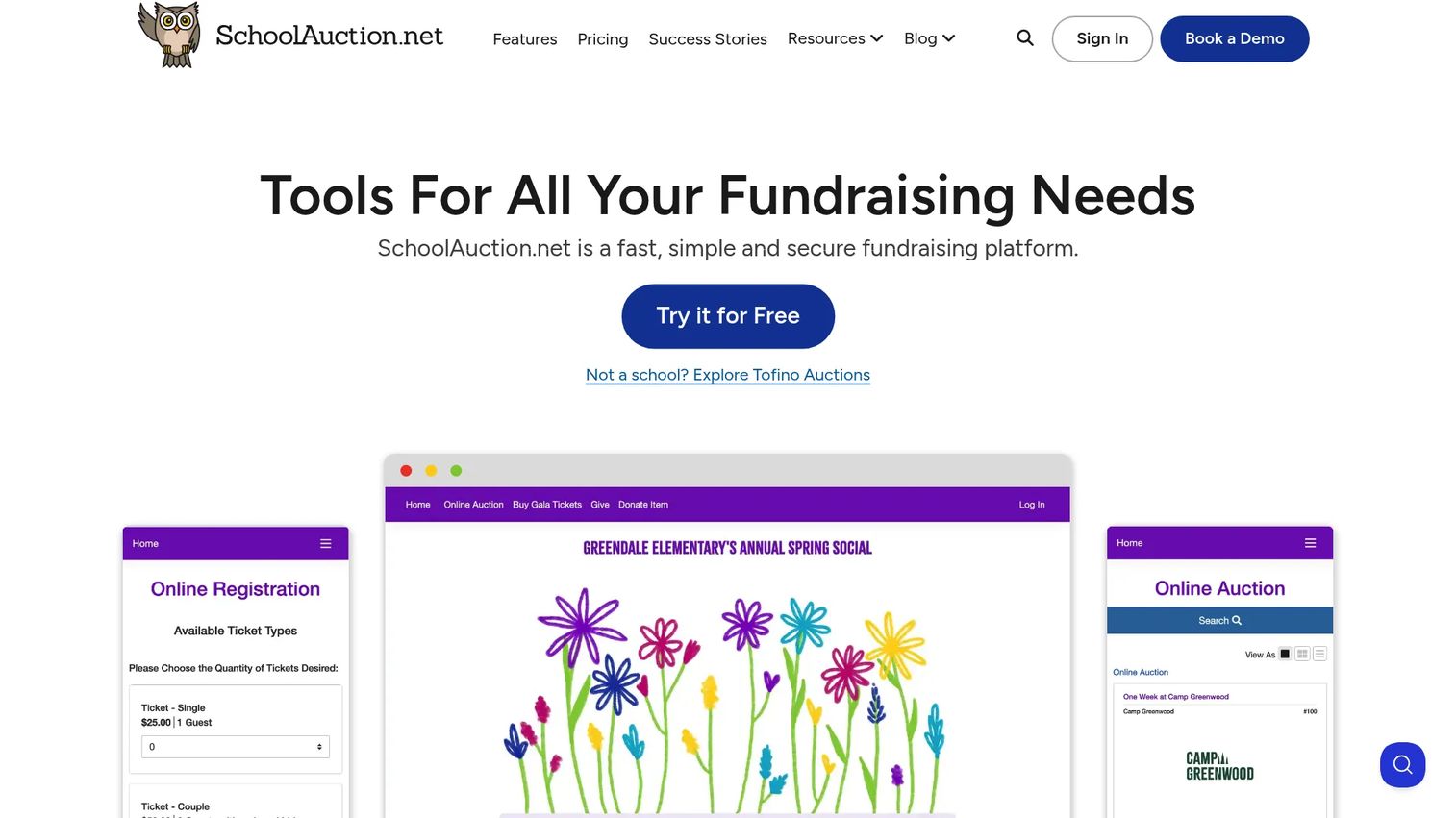
SchoolAuction.net is fundraising software built specifically for schools and education-adjacent nonprofits. It covers online and mobile bidding, virtual and hybrid live auctions, Text-to-Give, sponsorships, recurring donations, ticket sales, voting contests, self-checkout, and unique event websites. The Acorn plan starts at $79/event with a 3% transaction fee plus a 3% performance fee, making it accessible for one-time school galas before committing to an annual plan. Credit card processor choice gives schools flexibility in managing payment costs.
Best for: Schools and parent-teacher organizations running annual fundraising galas, silent auctions, and hybrid events with volunteer-operated workflows.
Key features
- Online and mobile bidding with hybrid live auction support
- Text-to-Give and recurring donation tools
- Ticket sales and sponsorship packages
- Self-checkout and unique event websites
- Donor records and post-event reporting
Why choose SchoolAuction.net: The platform is narrow on purpose. Volunteer committees and school staff need something that works without auction expertise, and the event-specific pricing removes commitment risk for organizations that auction once a year. It is not the default for commercial auction houses or marketplace operators.
SchoolAuction.net pricing: Acorn starts at $79/event. Annual plans run $1,000/year (Essentials), $1,500/year (Plus), and $2,000/year (Professional). A free trial is available.
G2 rating: 4.6/5
Considerations when choosing auction software
Match the software to your auction format first
Map your top two current formats before comparing vendors. A platform built for nonprofit silent auctions handles donor records and ticket sales well but will not run an industrial webcast with a hundred concurrent bidders. Confirm format support from the vendor's product page rather than a feature checklist; live simulcast, timed online, and silent auction workflows require genuinely different architecture.
Check who owns the bidder relationship
White-label auction websites and data export capability determine whether your bidder database belongs to you or the platform. For founders, that database is a defensible business asset. Ask specifically about CRM integrations, email list ownership, and what happens to bidder data if you switch platforms. Hosted platforms that do not export bidder records create lock-in that compounds over time.
Inspect auction payment processing and total fee load
Monthly software fees are only one line item. Model card processing rates, buyer premiums, per-transaction fees, settlement timing, and refund handling across a realistic sale volume. Several platforms charge a percentage of auction revenue on top of the subscription, which shifts the cost structure significantly as your business scales. Check the vendor's payment page and G2 reviewer comments for candid fee experiences.
Test the mobile bidder journey before launch
Register as a bidder on a test auction, place a bid, receive an outbid alert, and complete checkout on a phone. Friction at any step suppresses participation. Mobile bidding projected at 9.5% annual growth (Dataintelo, 2026) reflects where bidder behavior is heading, not where it has been. A platform that works in a desktop demo but breaks on mobile checkout costs you real bidders during a live sale.
Verify reporting before the first auction
Ask to see the lot report, consignor settlement, bidder history, and revenue summary before you sign. Operations leaders and VPs need clean data to run weekly reviews without building custom exports. Board-ready reporting requires that the platform surfaces the numbers in a format someone other than the founder can interpret and act on.
Conclusion
There is no single best auction software for every operating model. The right platform depends on the formats you run, the bidder experience you want to deliver, and whether your team can operate it without founder involvement.
For branded online auctions where your team needs full workflow coverage, AuctionMethod is the clearest starting point. Auction Flex earns its place for professional houses with established back-office workflows and staff roles built around clerking and settlement. Bidpath suits operators building configurable marketplace infrastructure at scale.
For nonprofit and fundraising use cases, Auctria's free plan removes the commitment risk, and SchoolAuction.net is purpose-built for school events in a way that general platforms are not. Auction Mobility is the pick when a branded native app is central to bidder retention rather than a nice-to-have.
Shortlist three platforms based on your primary auction format, payment requirements, and whether you need your team to run sales independently. Run a test auction on each before you commit. The operational risk of picking the wrong platform goes up with every sale you add to the calendar.
Start your journey with Guideflow today!
FAQs
The best platform for online auctions depends on three factors: Auction format (live, timed, or silent), bidder volume, and whether you need a branded website your team controls. AuctionMethod suits businesses running full-cycle branded online auctions. For nonprofits running online silent auctions, Auctria's free tier is a practical starting point without upfront commitment.
At minimum, auction software should cover lot setup and cataloging, bidder registration and approval, online and mobile bidding, payment processing, invoicing, outbid notifications, and post-sale reporting. Nonprofits should also evaluate donor management, event ticketing, sponsorships, and raffles. Auction houses selling through consignors need settlement reporting and consignor account management as core requirements, not add-ons.
Pricing models vary significantly. AuctionMethod starts at $100/month; Auction Flex starts at $85/month per workstation; Maxanet charges $300/month with a one-time setup fee. Nonprofit tools like Auctria offer a free plan, while SchoolAuction.net starts at $79/event. Enterprise platforms like Bidpath and Auction Mobility require a quote. Add card processing fees, transaction percentages, and any per-bid charges to model total cost accurately across a realistic sale volume.
Auction software typically supports one organization running its own auctions, managing its own lots and bidders. Auction marketplace software supports multiple sellers, each with their own listings, accounts, and payment flows under a single branded platform. AuctionWorx is an example of the marketplace model. The operational complexity, bidder account governance, and payment infrastructure requirements are materially different for a marketplace build.
Silent auction software should support mobile bidding, donor records, item procurement, event tickets, sponsorships, raffles, checkout, and event reporting. Auctria and SchoolAuction.net are the strongest options in this list for nonprofit and school fundraising contexts. Both include donor management alongside the bidding engine, which is the key difference from commercial auction-house software.
Yes. Several platforms support simulcast or webcast auctions that run live in-room bidding alongside online bidder participation in real time. NextLot and Auction Mobility are specifically built for this format. Before running a hybrid event, test the clerk controls, bidder approval process, latency under load, and what happens if the connection drops mid-lot. A live sale simulation before launch is worth the time.
White-label matters when your organization wants its own branded auction website, controls the bidder registration experience, and owns the bidder data after each sale. For a one-time fundraiser, a hosted platform with shared branding may be fine. For founders building a repeat-bidder business, white-label is a long-term brand equity decision. Bidder recognition of your brand, not a platform name, drives return participation and repeat revenue.
Start with the two auction formats you run most often and confirm both are supported natively. Evaluate payment fee structure across a realistic sale volume, not just the subscription line. Check mobile bidder experience on a real device before signing. Confirm reporting outputs meet what your ops lead or VP needs for weekly reviews. Pick a platform your team can operate without you in the loop for every sale.