You have terabytes of raw data. You still can't ship the model with confidence.
That gap is where most AI teams get stuck. Not on model architecture, not on compute, but on labeled training data that is clean, consistent, and actually reflects the problem you're solving. A mislabeled edge case doesn't announce itself. It shows up three weeks later as a confidence drop in production, and now you're re-annotating instead of iterating.
The category matters more in 2026 than it did two years ago. Multimodal AI, LLM tuning, and RLHF workflows all depend on annotation quality that scales without collapsing into rework. The global data annotation tools market sat at USD 3.07 billion in 2026 and is forecast to reach USD 12.42 billion by 2031 at a 32.27% CAGR, according to Mordor Intelligence (2026). Teams are spending because bad training data is expensive in a way that hides until it doesn't.
So the real question isn't "which platform has the most features." It's "which platform keeps my model training data clean as I scale across modalities and teams." That's the lens this guide uses.
What's inside
This guide is built for product managers, ML ops leads, and AI platform buyers who need to pick a data annotation platform that fits a real workflow, not a feature demo.
We shortlisted platforms using four criteria:
- Modality coverage across image, video, text, audio, and 3D
- QA and review controls, including gold standards and inter-annotator agreement
- Collaboration, permissions, and template support for cross-functional teams
- Integrations and export paths into your model training pipeline
The list covers both broad multimodal platforms and tools with sharper specialization. Pricing and ratings reflect publicly available figures where they exist.
TL;DR
- Best for broad multimodal teams: BasicAI Data Annotation Platform or SuperAnnotate handle image, video, text, audio, and 3D under one workflow.
- Best for enterprise workflow governance and QA: Labelbox or Encord give you structured review, analytics, and permissions.
- Best for 3D and LiDAR-heavy use cases: Dataloop or V7 support complex sensor and video-adjacent pipelines.
- Best for managed global annotation scale: Appen pairs human-in-the-loop quality with contributor scale.
- Best for teams balancing quality and collaboration: SuperAnnotate, with structured QA and dataset management.
What is a data annotation platform?
A data annotation platform is software that helps teams label, review, manage, and export training data for AI and ML models across multiple modalities.
The difference between a simple labeling tool and a full platform comes down to what happens after the first label. A tool draws boxes. A platform manages the workflow around those boxes: who reviews them, how disagreements resolve, how output flows into training, and how the whole thing stays maintainable as your data grows.
Most modern data annotation software shares a core set of capabilities:
- Image, video, text, audio, and 3D annotation support for multimodal annotation
- Pre-labeling and AI-assisted labeling to reduce manual load
- Review loops and QA rules, including gold standards and consensus scoring
- Collaboration, permissions, and reusable templates
- Integrations and export paths into training pipelines
Put simply: a data labeling platform turns raw, unstructured data into structured, reviewable, model-ready training data, with the controls a team needs to trust the output.
When to use a data annotation platform
Build training data for a new model
When the model is still being shaped, your annotation choices change weekly. Label schemas shift, edge cases surface, and you re-label more than you expect. A platform that supports fast iteration and AI-assisted labeling keeps that loop tight, so you validate hypotheses in days instead of weeks.
Scale multimodal workflows across teams
Image-only annotation rarely stays image-only. The moment you add text, audio, video, or 3D, shared workflows stop being a convenience and become a requirement. A platform that handles multimodal annotation under one set of permissions and templates prevents the fragmentation that comes from stitching three separate tools together.
Tighten QA before model release
Annotation quality is model quality. Before release, you want review loops, inter-annotator agreement, and gold-standard checks that catch inconsistency before it reaches training. This is where QA workflows earn their keep: a 2% labeling error rate you can measure is far cheaper than the same error discovered post-deployment.
Comparison table
Here is how the seven platforms compare on fit, differentiation, pricing, and rating. Figures reflect publicly available values; several vendors use quote-based pricing.
| # | Product | Best for | Key differentiator | Pricing | G2 rating |
|---|---|---|---|---|---|
| 1 | BasicAI Data Annotation Platform | Multimodal and 3D-heavy teams | Strong 3D point cloud and sensor fusion annotation | From $6,600/y; free trial | 4.4/5 |
| 2 | SuperAnnotate | Quality and collaboration at scale | Multimodal editor plus dataset management and QA | Custom pricing | 4.8/5 |
| 3 | Appen | Managed global annotation scale | Human-in-the-loop workforce plus data platform | Custom pricing | 4.2/5 |
| 4 | Labelbox | Enterprise labeling operations | Catalog, workflows, and model-based labeling | Free tier; from $0.10 per LBU | Not published |
| 5 | Encord | Data-centric model training | Curation, evaluation, and active learning | Custom pricing | 4.8/5 |
| 6 | Dataloop | Multimodal and pipeline automation | Unstructured data pipelines for training and RAG | Custom pricing | 4.4/5 |
| 7 | V7 | Document-heavy and agentic workflows | AI agents plus document annotation (Darwin) | Custom pricing | Not published |
Best 7 data annotation platforms for 2026
1. BasicAI Data Annotation Platform
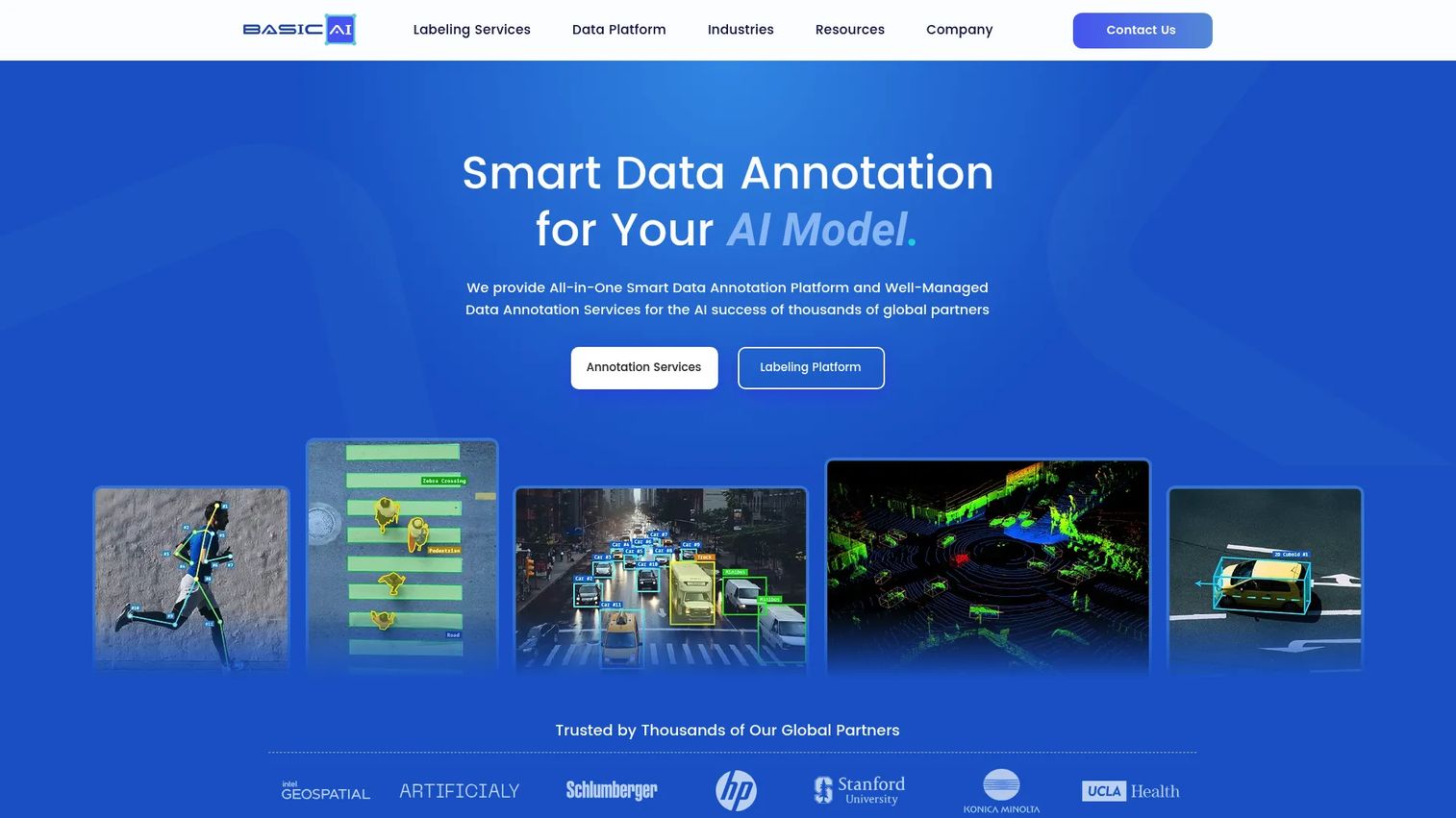
BasicAI Data Annotation Platform is an AI data annotation platform built for teams that need broad modality coverage in a single environment. It pairs AI-assisted annotation with strong 3D point cloud and sensor fusion support, which makes it a natural fit for autonomous systems, robotics, and any workflow leaning into 3D LiDAR annotation. Team workflow, QA, and project management sit alongside the labeling tools, so the platform scales past one-off labeling jobs.
Best for: Teams needing an enterprise or private-deployment platform for multimodal and 3D-heavy labeling.
Key strengths
- AI-assisted annotation across modalities
- 3D point cloud and sensor fusion annotation
- Team workflow, QA, and project management
- Private-cloud deployment option
Why choose BasicAI: If your roadmap includes 3D LiDAR annotation and sensor fusion alongside standard image and video work, BasicAI covers that range without forcing a second tool. The private-deployment option suits teams with data residency or security constraints.
BasicAI pricing: A Private-Cloud Deployment plan starts from $6,600 per year. A free trial is available, and seats, storage, and model calls can be customized.
2. SuperAnnotate
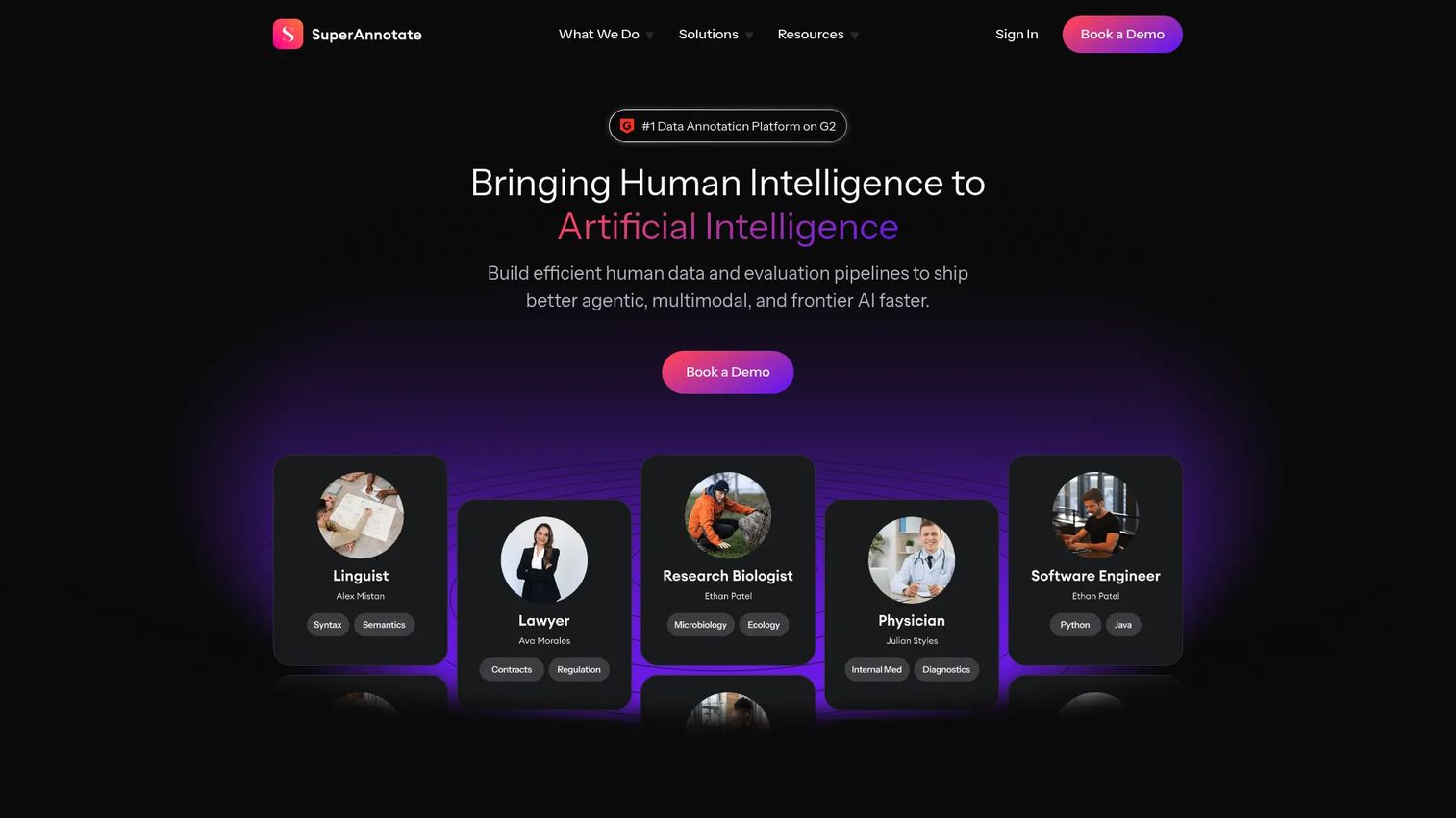
SuperAnnotate is a data annotation and dataset management platform built for teams that treat quality and collaboration as first-order concerns. Its multimodal editor handles image, video, text, and audio, and it layers on data curation, exploration, analytics, and project management. For teams running LLM annotation and structured review flows, the custom annotation UI builder and orchestration tools let you shape the workflow around your data rather than the other way around.
Best for: Enterprises building and managing high-quality AI training datasets at scale.
Key strengths
- Multimodal annotation editor for image, video, text, audio
- Data curation, exploration, and analytics
- Custom annotation UI builder and orchestration
- QA workflows and project management
Why choose SuperAnnotate: The combination of a flexible annotation editor and serious dataset management makes SuperAnnotate a strong pick when QA and cross-team collaboration matter as much as raw labeling speed. It fits teams that want to standardize review across many annotators.
SuperAnnotate pricing: The pricing page lists Starter, Pro, and Enterprise plans. Enterprise is contact sales; public numeric prices are not currently published.
3. Appen

Appen is an AI data platform and services company for training, evaluating, and improving AI models. Where the software-first platforms give you the tooling, Appen pairs its AI Data Platform (ADAP) with a managed global contributor workforce, which is the differentiator for teams that want human-in-the-loop quality without building an annotation team from scratch. It supports text, image, audio, video, 3D point cloud, and 4D annotation, with built-in analytics and workforce management.
Best for: Enterprises needing human-in-the-loop AI training data and evaluation workflows at scale.
Key strengths
- AI Data Platform (ADAP) for annotation workflows
- Text, image, audio, video, 3D point cloud, and 4D support
- Managed global contributor workforce
- Analytics, workforce management, and API integrations
Why choose Appen: A managed approach makes sense when you need throughput and human judgment more than software-only control, or when your annotation demand spikes and hiring in-house isn't practical. It also suits LLM evaluation and RLHF-adjacent tasks that lean on human raters.
Appen pricing: Appen does not publish public pricing. The site directs teams to contact its team for a quote based on scope.
4. Labelbox
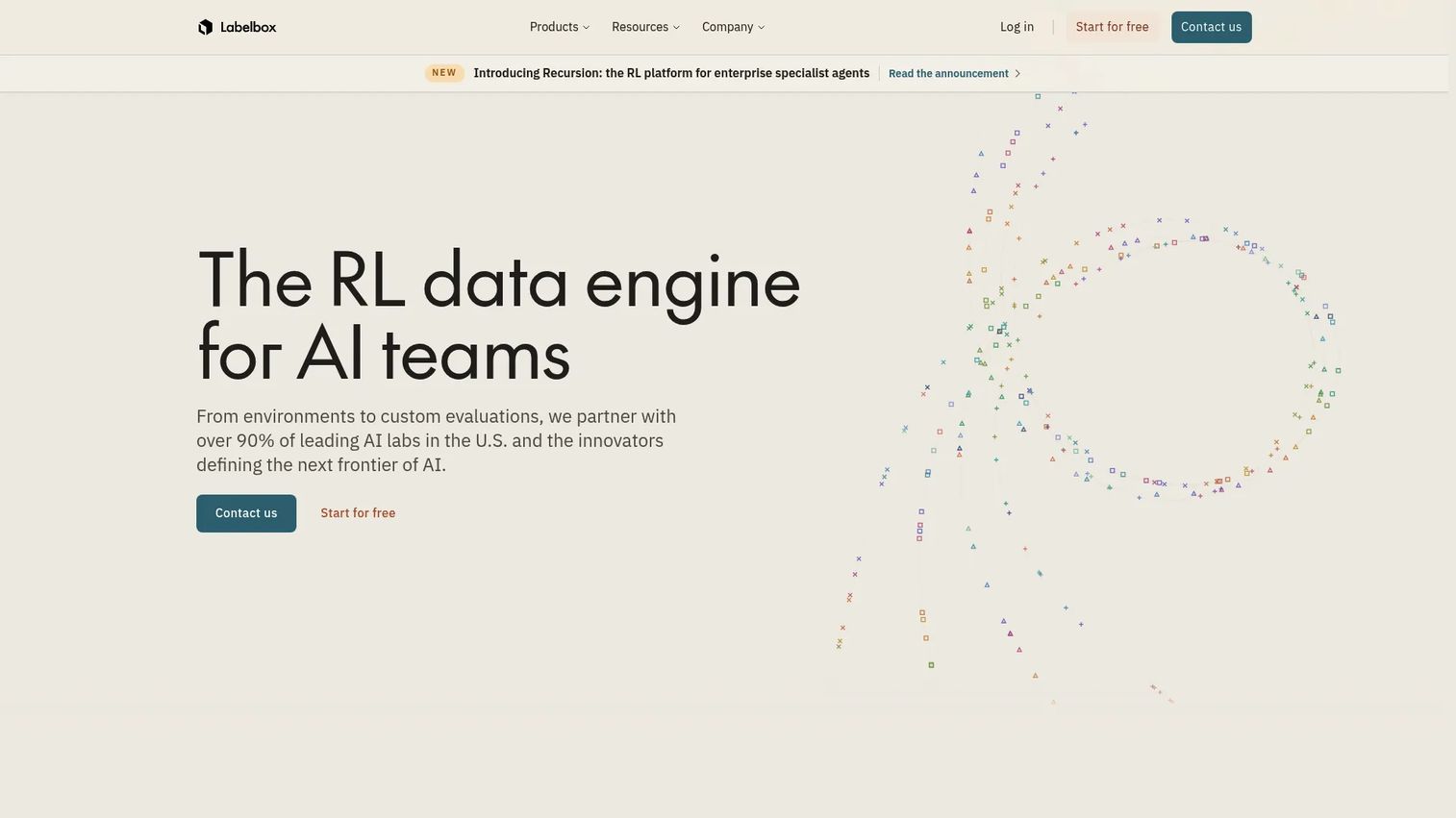
Labelbox is an AI data platform for labeling, managing, and evaluating training data and model workflows. It's built around labeling operations and platform governance: Catalog for data management, structured labeling workflows, and model- and foundry-based labeling and evaluation. For product managers who care about maintainability, that governance layer is the draw, because it keeps annotation consistent as the team and dataset grow.
Best for: Teams building and managing AI training-data labeling and evaluation workflows with governance needs.
Key strengths
- Data labeling and annotation workflows
- Catalog for data management
- Model- and foundry-based labeling and evaluation
- Usage-based pricing with a free tier
Why choose Labelbox: The metered pricing and free tier make it easy to start small and scale spend with actual usage, which appeals to PMs wary of committing before they've validated the workflow. The governance and catalog features matter most as annotation volume climbs.
Labelbox pricing: Free accounts include 500 LBU credits each month. The Starter plan is billed at $0.10 per LBU. Enterprise pricing is available by contacting sales.
5. Encord
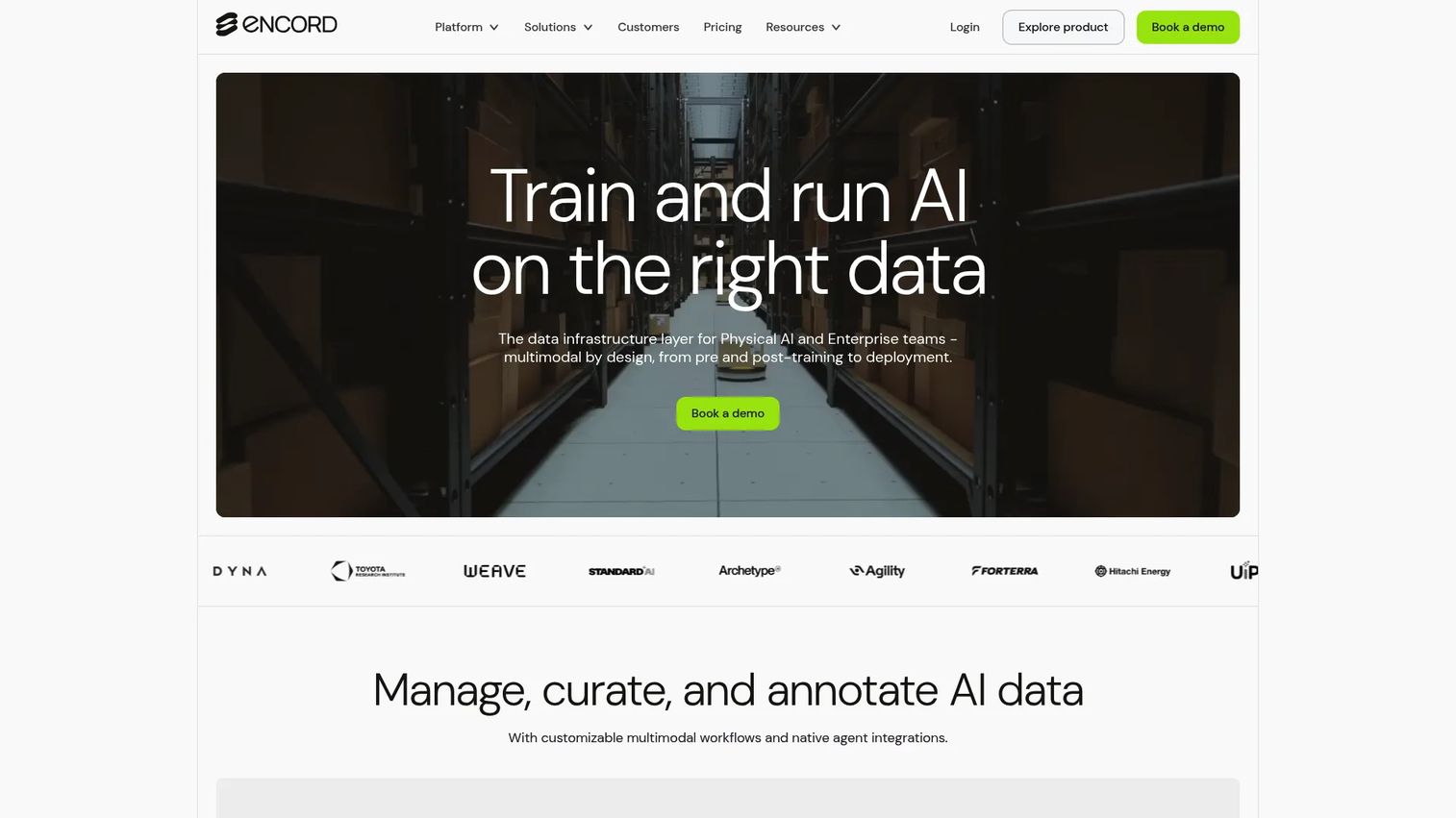
Encord is an AI data platform for annotating, curating, and evaluating multimodal datasets. It leans hard into data-centric model training: image and video annotation sit next to data curation and search, model evaluation, and active learning. That combination fits teams that want annotation and evaluation in one operational platform rather than bolting evaluation on afterward.
Best for: Teams building multimodal AI workflows that need labeling, curation, and evaluation in one platform.
Key strengths
- Image and video annotation
- Data curation and search
- Model evaluation and active learning
- Multimodal dataset support
Why choose Encord: Encord suits teams that treat data quality as an ongoing loop, using active learning and model evaluation to prioritize what gets annotated next. That is a materially different posture from label-everything-then-train.
Encord pricing: The pricing page lists Starter, Team, and Enterprise plans. Enterprise is contact sales; public dollar amounts are not currently shown.
6. Dataloop
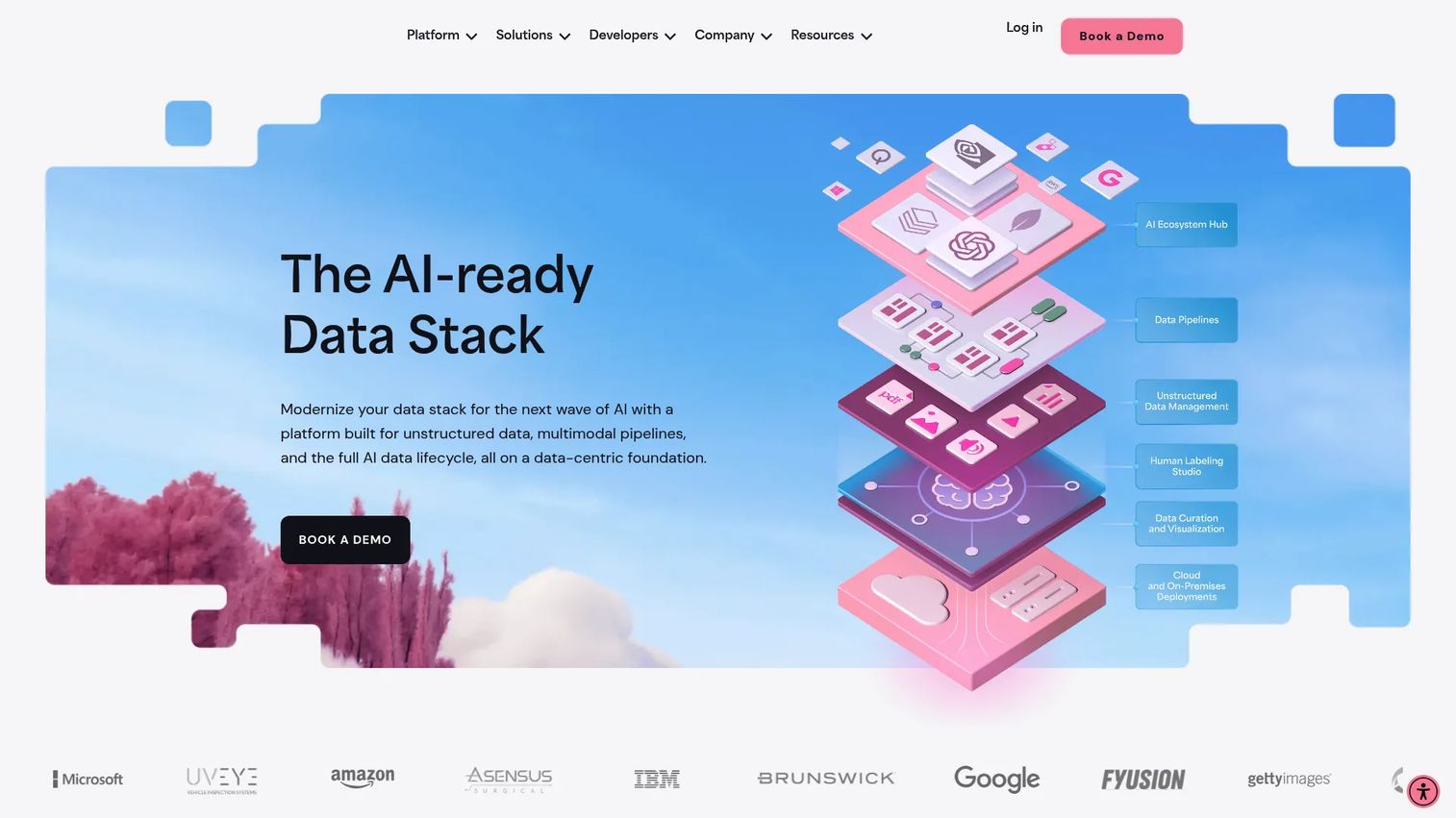
Dataloop is an AI development platform for unstructured data, multimodal pipelines, and human-in-the-loop workflows. Its strength is pipeline automation: unstructured data management and curation, human-in-the-loop annotation and feedback, and AI data pipelines that span training, validation, retraining, and RAG. For technical teams building repeatable annotation-to-training pipelines, that orchestration depth is where Dataloop stands out.
Best for: Teams building AI and data workflows for unstructured, multimodal data.
Key strengths
- Unstructured data management and curation
- Human-in-the-loop annotation and feedback
- AI data pipelines for training, validation, retraining, RAG
- Multimodal and complex workflow support
Why choose Dataloop: Dataloop is a fit when the annotation step is one node in a larger automated pipeline, and you want QA, feedback loops, and retraining wired together rather than managed by hand. Video and 3D-adjacent workflows benefit from its pipeline model.
Dataloop pricing: Dataloop uses quote-based pricing. The site directs teams to book a demo or schedule a specialist call for pricing details.
7. V7
V7 is an AI platform for document-heavy workflows, with V7 Go for agentic automation and V7 Darwin for data labeling. It covers image, video, and 3D annotation, but its sharpest edge is document-intensive work: custom AI agents, OCR, and support for printed and handwritten text. That makes it a strong fit for finance, insurance, and legal teams automating document processing alongside more traditional annotation.
Best for: Private equity, finance, insurance, and legal teams automating document-heavy workflows.
Key strengths
- Custom AI agents for document-intensive workflows
- Image, video, and 3D annotation
- OCR for printed and handwritten text
- Volume-based, custom pricing model
Why choose V7: V7 earns its place when document automation is central to your use case and you want agentic workflows layered on top of labeling. It also suits teams that value speed and a flexible editor for image and video work.
V7 pricing: V7 uses custom pricing based on platform access, users, and data volume. No public numeric price is published.
Considerations
Before you commit, run the shortlist through a few checks that reflect how annotation actually plays out over a model's lifecycle.
Match modality coverage to your roadmap
Current needs undersell future ones. A team labeling images today often adds video, audio, or 3D within a year. Assess whether the platform handles the modalities on your roadmap, not just the ones in front of you, so you avoid migrating mid-project.
Review QA workflows carefully
Labeling speed is easy to demo; QA is what protects model quality. Look for gold standards, configurable review loops, and inter-annotator agreement scoring. A platform that surfaces disagreement early saves you the rework that surfaces after deployment.
Check collaboration and permissions
Annotation is rarely a solo job. Evaluate roles, access control, reusable templates, and how handoffs between annotators and reviewers work. For cross-functional teams, clean permissions prevent the mess of everyone editing everything.
Verify export and integration support
Annotation output has to fit your downstream pipeline. Check supported formats, APIs, storage connections, and how output hands off to model training. A platform that exports cleanly into your stack saves engineering time on every iteration.
How to choose the right data annotation platform
The best platform is the one that matches your modality mix, QA needs, and workflow complexity. Here is how the shortlist breaks down by team situation.
For broad multimodal teams, BasicAI Data Annotation Platform or SuperAnnotate cover the widest range under one workflow, with SuperAnnotate leaning toward dataset management and QA depth.
When managed scale and human quality matter more than software-only control, Appen makes sense, especially for RLHF-adjacent and LLM evaluation tasks that depend on human raters.
For enterprise workflow governance, Labelbox and Encord give you structured review, analytics, and permissions, with Encord adding active learning for data-centric training loops.
For teams leaning heavily into 3D, video, or operational flexibility, Dataloop and V7 stand out, with Dataloop strong on pipeline automation and V7 strong on document-heavy and agentic workflows.
Match the tool to the workflow, not the other way around.
Conclusion
The seven platforms here cover the range most AI teams need in 2026, from broad multimodal labeling to specialized 3D and document workflows.
If you want broad coverage under one roof, start with BasicAI or SuperAnnotate. If governance and maintainability drive your decision, look at Labelbox or Encord. If you need managed human scale, Appen fits. If your pipeline is complex or document-heavy, Dataloop and V7 earn a closer look.
The right choice comes down to three questions: which modalities you'll label over the next year, how rigorous your QA and review loops need to be, and how cleanly the platform exports into your training pipeline. Answer those honestly and the shortlist narrows itself.
Start with the platform that fits your workflow today and scales into your roadmap tomorrow.
FAQs
A labeling tool draws annotations; a platform manages the workflow around them. Platforms add QA, collaboration, permissions, templates, and integrations, so annotation stays consistent and maintainable as your team and dataset grow. A tool handles the label. A platform handles everything that keeps labels trustworthy.
For broad multimodal AI covering image, video, text, audio, and 3D, BasicAI Data Annotation Platform and SuperAnnotate both handle the full range under one workflow. Encord and Dataloop are also strong for multimodal datasets. The best choice depends on which modalities dominate your roadmap and whether you also need evaluation or pipeline automation.
Tie the decision to speed of validation, model quality, maintainability, and cross-team coordination. Prioritize segmentation of roles and permissions, low ongoing maintenance, strong QA controls, and clean integration with your data and analytics stack. A platform that reduces re-annotation and support overhead is worth more than one that only labels faster.
QA is where model quality is won or lost. Inconsistent labels produce inconsistent models, and errors caught after deployment cost far more than errors caught in review. Gold standards, review loops, and inter-annotator agreement scoring are the controls that keep training data reliable and reduce expensive rework.
Yes, if it supports preference ranking, review workflows, and model evaluation tasks. LLM annotation and RLHF depend on human raters comparing outputs, ranking responses, and flagging issues, so look for platforms with strong review and evaluation tooling. SuperAnnotate, Encord, and Appen all support these workflow patterns.
Focus on LiDAR support, sensor fusion, and interpolation across frames. 3D LiDAR annotation is far more demanding than 2D, so speed, accuracy, and a clean reviewer workflow matter as much as raw feature count. BasicAI and Appen both handle 3D point cloud and sensor fusion work.
The tradeoff is control versus hands-off scale. Software platforms give you full workflow control and are ideal when you have annotators or want to build the process in-house. A managed model like Appen makes sense when demand spikes, human judgment is central, or building an annotation team isn't practical.