You have 4,000 devices in the field. A firmware bug ships to 300 of them. You need to know which ones, push a patch, and confirm the rollout without bricking a single unit. If your answer to that involves SSH scripts and a spreadsheet, you already know why this category exists.
Managing connected devices at scale is not one problem. It is provisioning, authentication, remote configuration, telemetry, alerts, firmware updates, and security reviews, all happening across distributed fleets that never sit still. Every new device multiplies the surface area. The IoT device management market reflects this pressure: Grand View Research (2025) estimates it at USD 8.84 billion in 2025, projected to reach USD 43.82 billion by 2033 at a 21.8% CAGR. Market Research Future (2023) projects 30 billion connected IoT devices worldwide by 2030.
For presales and sales engineers, this category shows up in technical validation constantly. Prospects want proof that your platform handles their protocols, their scale, and their security posture before they sign. If you build IoT products yourself, the same questions land on your desk during architecture review. A good IoT device management platform answers those questions without a custom build.
This guide is a shortlist for technical evaluators, not a gadget roundup. If you also spend time comparing evaluation tooling, our roundups on application performance monitoring tools and best AI security posture management tools cover adjacent infrastructure decisions.
What's inside
This guide covers eight platforms for provisioning, remote monitoring, security, device lifecycle management, analytics, and enterprise-scale fleet operations. We selected tools that are genuinely IoT device management software, not generic monitoring or IT dashboards dressed up for the search term.
We ranked each platform against five criteria that matter during technical validation: workflow fit for device operations, protocol support (MQTT, HTTP, REST), security and access control, scalability and enterprise readiness, and deployment flexibility across cloud, hybrid, and self-managed models. Pricing and ratings reflect verified vendor sources. Where a vendor gates numeric pricing behind sales, we say so instead of guessing.
TL;DR
- Best overall for open-source control and platform flexibility: ThingsBoard.
- Best for cloud-scale managed fleets: AWS IoT Device Management.
- Best for Azure-native buyers: Azure IoT Hub.
- Best for enterprise IoT operations with strong visual governance: Cumulocity IoT.
- Best for teams needing app and workflow extensibility: Losant.
- Best for developer-friendly connected products: Particle.
- Best for device-centric remote management: Digi Remote Manager.
- Best for broad industrial IoT operations: Bosch IoT Suite.
For a lightweight, developer-friendly option outside the main eight, Ubidots is worth a look. The right IoT management platforms depend on your deployment model and scale, so shortlist two or three and validate against your real requirements.
What IoT device management software is
IoT device management software is a platform that provisions, authenticates, configures, monitors, updates, and secures connected devices across their entire lifecycle from a central control plane.
That definition covers a lot of ground, and it should. These platforms handle device onboarding and identity, remote configuration and control, health monitoring, firmware updates, and security enforcement. Most also layer on telemetry collection, dashboards, automation rules, and integrations into the rest of your stack. An IoT device management platform is the operational layer that keeps a fleet running without an engineer babysitting every device.
Core capabilities buyers expect
- Device provisioning and authentication: zero-touch onboarding, per-device credentials, and identity management at scale.
- Remote configuration and control: push settings, run commands, and change device state without physical access.
- Monitoring, alerts, and diagnostics: real-time telemetry, health checks, and alerting when devices misbehave.
- Security, access control, and auditability: encryption, role-based access, credential rotation, and audit trails.
- Firmware and software update management: OTA updates with staged rollouts and rollback.
- Data collection, visualization, and integrations: dashboards, data pipelines, and connections to cloud services.
- Scalability and high availability: multi-tenancy, fault tolerance, and the ability to grow from hundreds to millions of devices.
Deployment and architecture models
Three models dominate. Cloud-hosted platforms (AWS, Azure) offload infrastructure entirely and scale on demand. Self-managed and open-source options (ThingsBoard) give you full control over data residency and customization. Hybrid and edge-capable platforms (Cumulocity, Bosch) run processing closer to devices for latency or compliance reasons.
Architecture matters more here than in most software categories. It dictates where telemetry lands, how you meet data residency rules, what latency your control loops tolerate, and how much operational burden your team carries. Decide the model before you shortlist vendors, not after.
When to use IoT device management software
Manage a growing device fleet without manual firefighting
Once a fleet crosses a few hundred devices, manual operations stop scaling. Centralized provisioning, remote configuration, and fleet-wide monitoring turn a chaotic on-call queue into a dashboard. This matters most for distributed teams managing devices they cannot physically reach, where every truck roll costs real money.
Replace custom scripts and fragmented tooling
Home-grown device management starts as a few scripts and a cron job. It ends as brittle infrastructure that only one engineer understands. A platform consolidates provisioning, updates, and telemetry into one system with a support contract behind it, freeing your engineers to build product instead of maintaining plumbing.
Support security reviews and lifecycle updates
Enterprise deals stall on security. Firmware update management, credential rotation, and audit trails are exactly what security reviewers ask about during technical validation. A platform with built-in OTA updates and access logging turns a multi-week security back-and-forth into a documented answer.
Comparison table
This table gives technical evaluators a fast read on where each platform fits. Use it to map platform strengths to customer requirements around scale, deployment model, and security, then dig into the sections below for the detail your architecture review will demand.
| # | Product | Intent | Key use case | Pricing | G2 rating |
|---|---|---|---|---|---|
| 1 | ThingsBoard | Open-source platform control | Device management, telemetry, and dashboards with full customization | From $10/month; free open-source edition | 4.4/5 |
| 2 | AWS IoT Device Management | Cloud-scale managed fleets | Bulk onboarding, fleet indexing, and remote actions on AWS | Pay-as-you-go; free tier available | 4.3/5 |
| 3 | Azure IoT Hub | Azure-native connectivity | Bidirectional messaging and per-device auth at scale | Free tier; Basic and Standard tiers | 4.3/5 |
| 4 | Cumulocity IoT | Enterprise AIoT operations | Zero-touch provisioning, dashboards, and edge/cloud deployment | From €215/month; custom enterprise tiers | 4.3/5 |
| 5 | Losant | Application and workflow layer | Visual workflows, dashboards, and digital twins | From $250/month | 4.5/5 |
| 6 | Particle | Connected product development | Device cloud, OTA updates, and multi-radio connectivity | Free plan; from $299/month per block | Not available |
| 7 | Digi Remote Manager | Device-centric remote ops | Remote access, config management, and firmware control | Premier subscriptions (contact vendor) | Not available |
| 8 | Bosch IoT Suite | Industrial IoT operations | Device, data, and edge services across the lifecycle | Free plan; from $60/month | Not available |
1. ThingsBoard
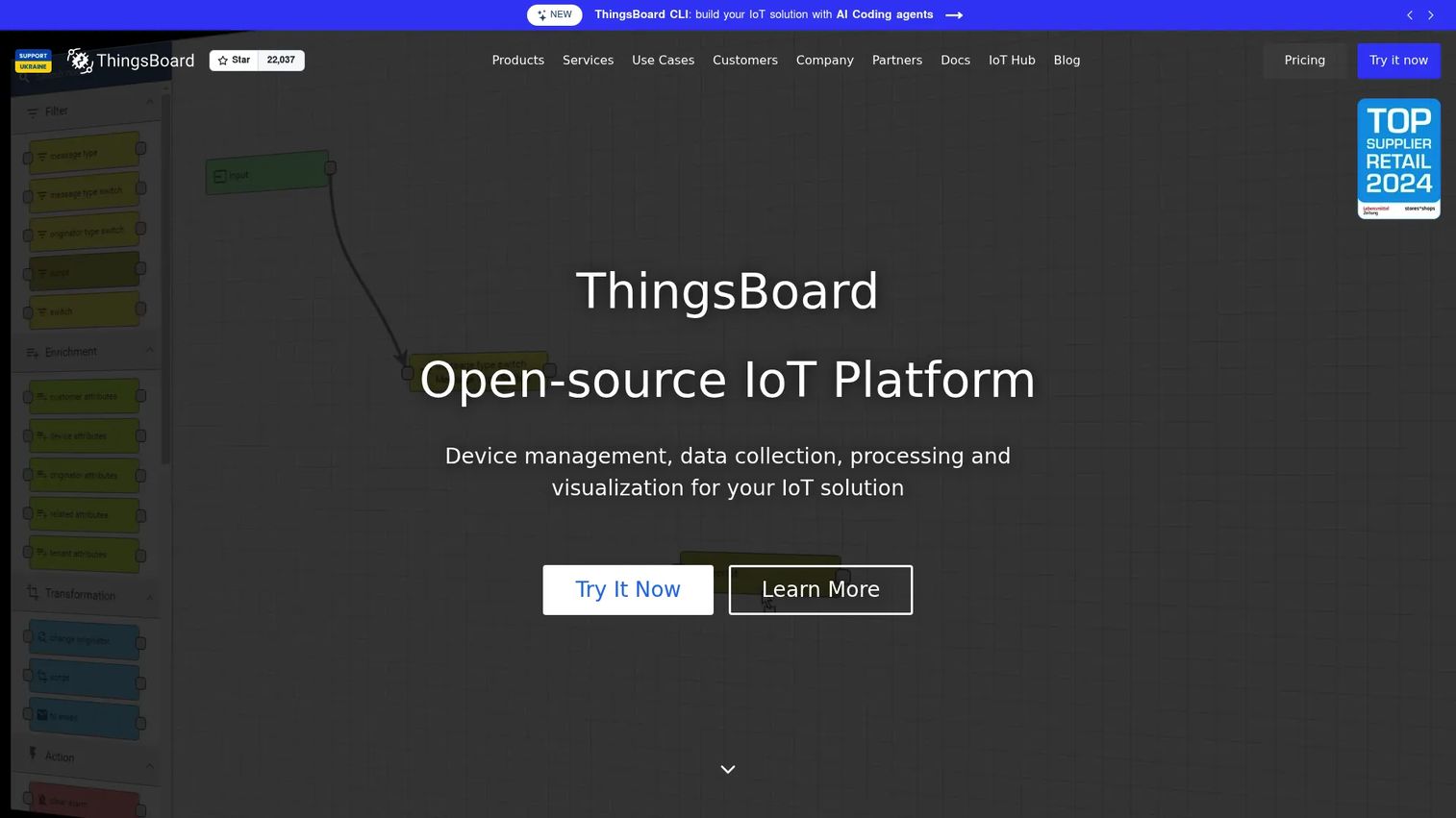
ThingsBoard is an open-source IoT platform for device management, data collection, processing, and visualization. Licensed under Apache 2.0, it gives teams full control over the codebase, data residency, and customization, which is why it lands first for buyers who want to own their stack rather than rent it. It runs self-hosted or as a managed cloud service.
The platform covers device provisioning and management, telemetry ingestion, dashboards, and a rule engine for automation. Rule chains process incoming data, trigger alarms, and route events without custom code. Multi-tenancy lets you isolate customers or business units in a single deployment, and the visualization layer builds SCADA-style dashboards and digital twin views that resonate in technical demos.
Best for: teams that want deep platform control, strong visualization, and the freedom to self-host or extend the source.
Key strengths
- Open-source flexibility: Apache 2.0 licensing means full source access, self-hosting, and no vendor lock-in.
- Rule engine and alarms: visual rule chains handle telemetry processing, alerting, and automation without external services.
- Multi-tenancy and dashboards: isolate tenants and build SCADA-style dashboards and digital twins for operational visibility.
Why choose ThingsBoard: If your requirements include data sovereignty, deep customization, or a fixed infrastructure budget, the open-source edition gives you room to build exactly what you need. Teams that want managed hosting without giving up the platform's flexibility can move to the cloud tiers. It supports MQTT, HTTP, and CoAP out of the box, which covers most protocol requirements a security review will raise.
ThingsBoard pricing: The open-source Community Edition is free. Paid cloud plans start at $10/month for the Maker tier, then Prototype at $39/month, Pilot at $99/month, Startup at $299/month, and Business at $499/month, all billed monthly. The pricing page also lists add-ons and perpetual license options for private-cloud deployments. ThingsBoard holds a 4.4/5 rating on G2.
2. AWS IoT Device Management
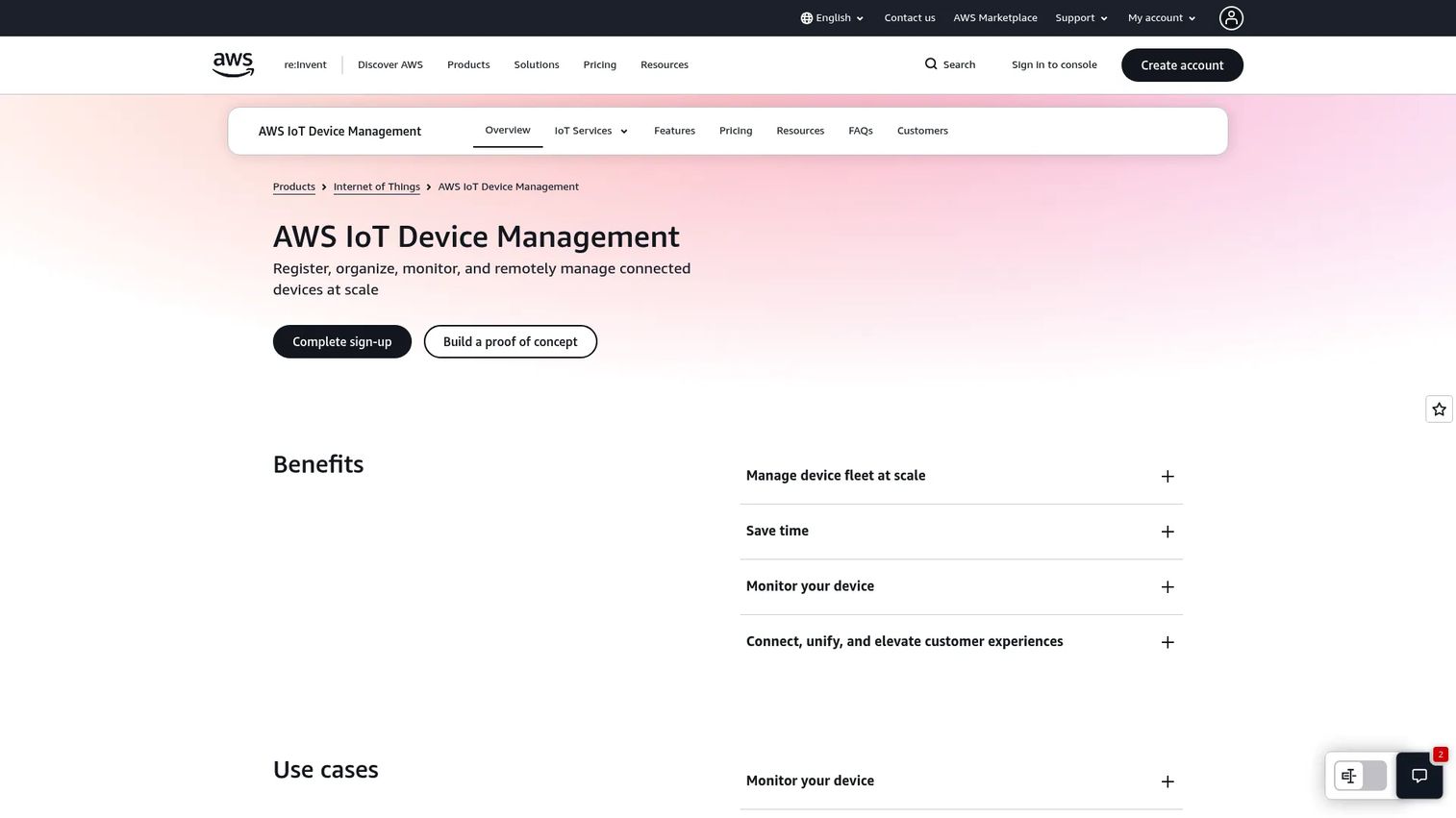
AWS IoT Device Management is a cloud service for registering, organizing, monitoring, and remotely managing connected devices at scale. It plugs directly into the broader AWS ecosystem, so if your telemetry already flows into AWS analytics, storage, and compute, device management sits in the same account with the same IAM controls.
Its strengths show up at scale. Bulk device registration and onboarding handle large fleets in one operation. Fleet indexing and search let you query device state across millions of units. Remote actions, jobs, commands, and secure tunneling cover OTA updates and remote troubleshooting without opening inbound ports. Lifecycle management ties it together across the device's operational life.
Best for: teams already committed to AWS that need fleet onboarding, indexing, and remote management at high scale.
Key strengths
- Fleet indexing and search: query device state, connectivity, and attributes across massive fleets in near real time.
- Remote actions and OTA: device jobs, commands, and secure tunneling push updates and troubleshoot without inbound ports.
- AWS-native integration: shared IAM, analytics, and storage across the AWS account with high availability by default.
Why choose AWS IoT Device Management: For AWS-native teams, the integration story is the differentiator. You inherit AWS security, scale, and regional availability without standing up separate infrastructure. Secure tunneling is a strong answer to remote-access questions during a security review, and pay-as-you-go pricing means you only pay for what the fleet actually uses.
AWS IoT Device Management pricing: Pricing is pay-as-you-go with no minimum fees, metered by component. Device jobs cost $0.003 per remote action, secure tunneling is $1.00 per tunnel created, and managed integrations run $0.01 per hub-connected device. The AWS Free Tier includes 50 remote actions per month, and new AWS customers may receive up to $200 in Free Tier credits. It holds a 4.3/5 rating on G2.
3. Azure IoT Hub
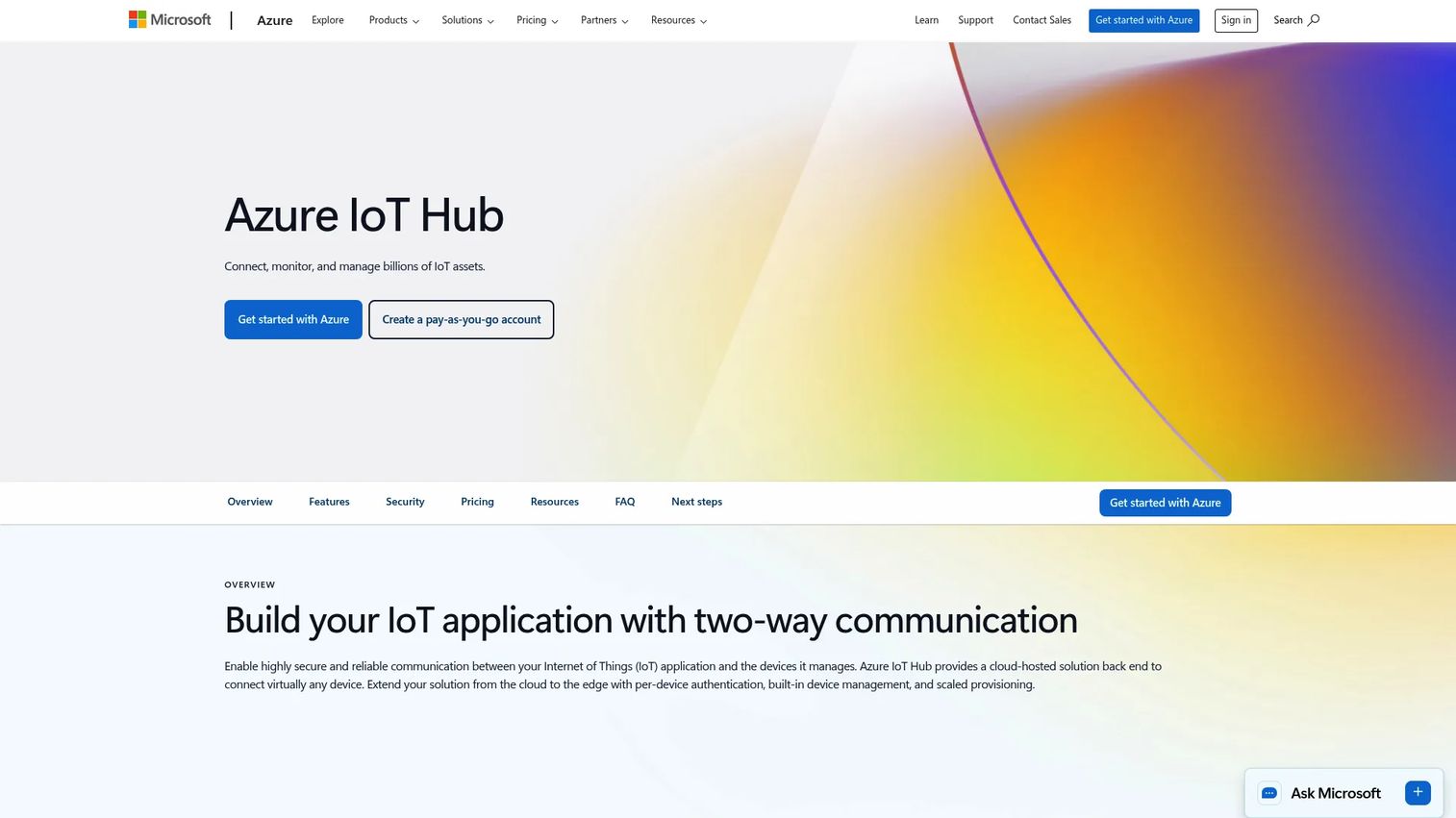
Azure IoT Hub is a cloud-hosted Microsoft service for connecting, monitoring, and managing IoT devices at scale. For teams already standardized on Azure and Microsoft identity, it slots into the existing tenant with the same access controls and billing, which removes a real procurement hurdle in Microsoft-centric enterprises.
The platform handles bidirectional device-to-cloud and cloud-to-device communication, which covers both telemetry ingestion and remote command delivery. Per-device authentication and built-in device management give each unit its own identity and lifecycle. Device provisioning, IoT Edge compatibility, and Event Grid integration extend it toward edge processing and event-driven architectures.
Best for: enterprise IoT programs built on Azure and Microsoft identity infrastructure.
Key strengths
- Bidirectional messaging: device-to-cloud telemetry and cloud-to-device commands in a single managed pipeline.
- Per-device authentication: individual device identities and security credentials for granular access control.
- Edge and event integration: IoT Edge compatibility and Event Grid support for edge processing and event routing.
Why choose Azure IoT Hub: If your organization runs on Azure, the native fit shortens both integration and security review. Per-device authentication and Microsoft's compliance posture answer many enterprise diligence questions before they are asked. It supports MQTT, AMQP, and HTTPS, so protocol coverage rarely becomes a blocker.
Azure IoT Hub pricing: A free edition is available for evaluation and small workloads. Basic (B1, B2, B3) and Standard (S1, S2, S3) tiers scale by IoT Hub unit per month, priced by message throughput and feature set. Microsoft does not expose flat numeric prices in a single view, and estimates vary by tier and message volume, so model your expected throughput before committing. Azure IoT Hub holds a 4.3/5 rating on G2.
4. Cumulocity IoT
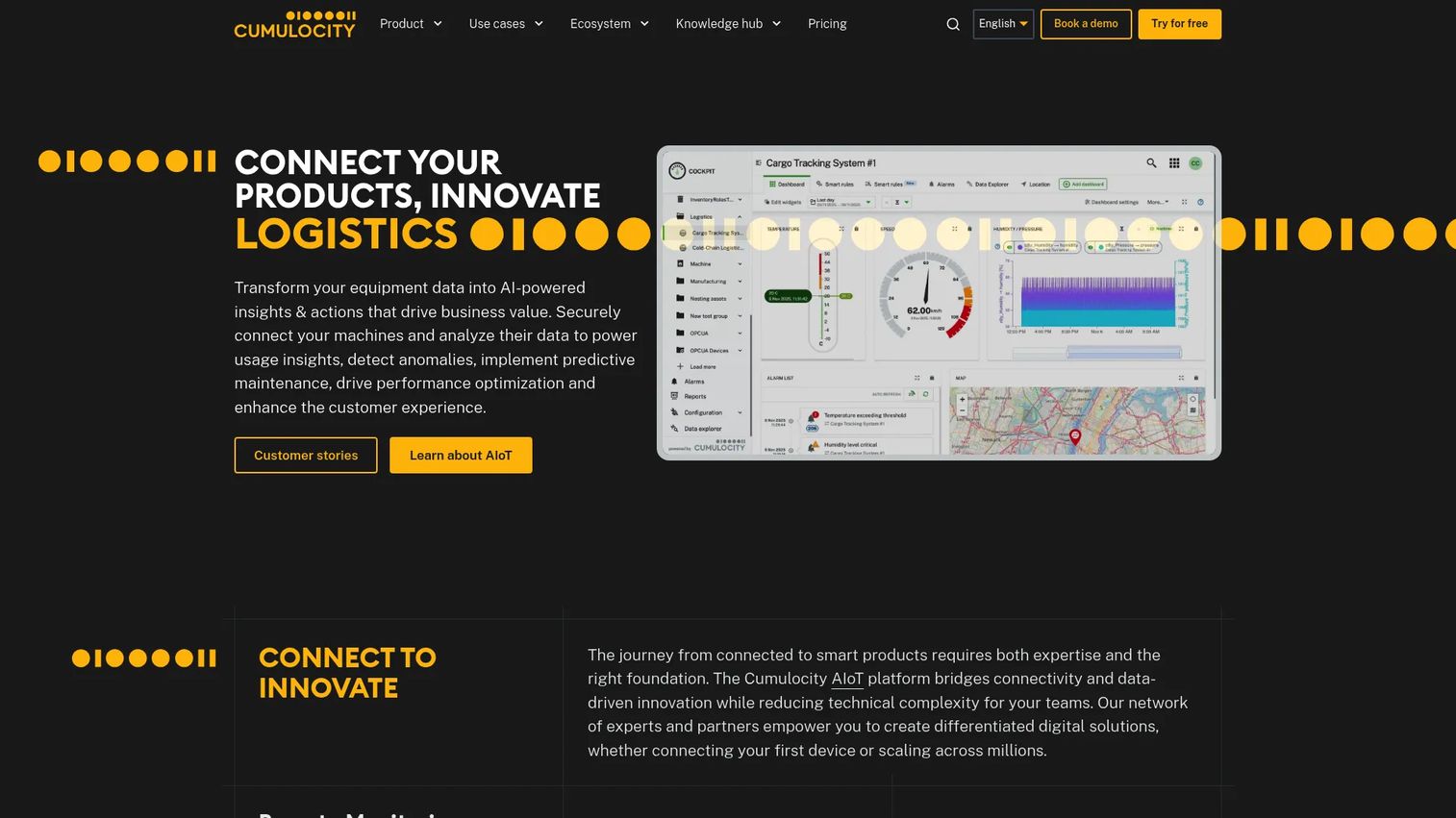
Cumulocity IoT is an enterprise AIoT platform for connecting, managing, analyzing, and securing IoT devices and data from cloud to edge. It targets industrial and enterprise operations that need broad device management alongside strong operational visibility, without writing platform code from scratch.
Its capabilities center on device management and zero-touch provisioning, real-time dashboards, and alarm management. The multi-tenant architecture supports cloud, edge, and air-gapped deployment, which matters for compliance-heavy industries. Application enablement lets teams build custom operational apps on top of the device layer, so the platform grows with the use case rather than boxing it in.
Best for: enterprise and industrial teams needing device connectivity, fleet management, and flexible edge or cloud deployment.
Key strengths
- Zero-touch provisioning: onboard large device fleets automatically with minimal manual configuration.
- Real-time dashboards and alarms: operational visibility and alarm management built for industrial monitoring.
- Flexible deployment: multi-tenant cloud, edge, and air-gapped options for latency and compliance requirements.
Why choose Cumulocity IoT: For enterprise buyers who need visual governance and broad IoT operations in one platform, Cumulocity balances out-of-the-box device management with application extensibility. The air-gapped deployment option is a strong answer for defense, utilities, and other sectors where cloud is off the table. Its multi-tenancy and fault tolerance support the scale enterprise fleets demand.
Cumulocity IoT pricing: The Starter plan begins at €215/month billed annually. Business, Enterprise, and Air-Gapped tiers are custom-priced based on device count and deployment model. A 30-day free trial is available. Cumulocity IoT holds a 4.3/5 rating on G2.
5. Losant
Losant is an enterprise IoT platform for building connected solutions, workflows, dashboards, and edge applications. It stands out for teams that want to turn device data into business workflows and customer-facing applications, not just monitor a fleet in isolation.
The Visual Workflow Engine is the centerpiece: a low-code environment for building automation, routing, and integration logic without writing backend services. Dashboards and batch analytics turn raw telemetry into reports and customer-facing views. Device management and digital twins model the physical fleet as data objects you can query, automate, and expose through applications.
Best for: teams building enterprise IoT products that need low-code workflows and customer-facing experiences on top of device operations.
Key strengths
- Visual Workflow Engine: low-code automation and integration logic without standing up custom backend services.
- Dashboards and batch analytics: turn telemetry into operational reports and customer-facing application views.
- Device management and digital twins: model the fleet as queryable data objects for automation and app building.
Why choose Losant: When the goal is a connected product or a customer-facing IoT application rather than internal fleet monitoring alone, Losant's application layer earns its place. The Visual Workflow Engine lets solution teams ship logic fast, and the digital twin model keeps device data organized as the fleet grows. It fits teams that treat IoT data as a product feature, not just an ops signal.
Losant pricing: Self-service plans are published: Launch at $250/month and Growth at $1,000/month, both billed monthly. The Enterprise tier is custom and requires contacting sales. Losant holds a 4.5/5 rating on G2, the highest verified rating in this list.
6. Particle
Particle is an IoT platform for connected devices that combines cloud software, networking, and hardware. It appeals to product teams shipping connected hardware who want less platform overhead and a developer-first workflow from prototype through production.
The device cloud provides secure device-to-cloud communication as the backbone. OTA firmware and software updates push new code to the fleet remotely, which is central to shipping and maintaining connected products. Multi-radio connectivity across LTE, 5G, Wi-Fi, satellite, and LoRaWAN means the same platform manages devices regardless of how they connect, a real advantage for mixed or hard-to-reach deployments.
Best for: product and engineering teams building and managing connected IoT hardware from prototype to enterprise scale.
Key strengths
- Device cloud: secure device-to-cloud communication as a managed backbone for connected products.
- OTA updates: remote firmware and software delivery across the fleet without physical access.
- Multi-radio connectivity: LTE, 5G, Wi-Fi, satellite, and LoRaWAN support in one platform.
Why choose Particle: For teams building connected products, Particle removes much of the infrastructure work between hardware and cloud. The developer-oriented workflow and integrated connectivity let small teams ship without standing up their own device backend. OTA updates keep shipped products maintainable, which is exactly what a hardware roadmap needs.
Particle pricing: A Free plan is available forever, including 100 devices and 100K Data Operations. Basic runs $299/month per block (100 devices, 720K Data Operations), and Plus is $599/month per block (100 devices, 5M Data Operations). Professional and Enterprise tiers are custom and require contacting sales. A verified third-party rating was not available for Particle at the time of writing.
7. Digi Remote Manager
Digi Remote Manager is a cloud-based IoT device management platform for remote monitoring, configuration, automation, and secure access. It is built around device-centric remote operations, which makes it a strong fit for distributed deployments and environments where devices sit in hard-to-reach locations.
The platform provides centralized device inventory and group management, so large fleets stay organized by type, location, or function. Firmware and configuration management pushes updates and settings across groups. Remote access via Digi Remote Reach gives operators secure connections into devices for diagnostics and troubleshooting without physical visits, which is the core value for teams running remote or field-deployed hardware.
Best for: organizations managing fleets of Digi-connected IoT and OT devices remotely across distributed sites.
Key strengths
- Centralized inventory and group management: organize and act on large device fleets by group.
- Firmware and configuration management: push OTA updates and configuration changes across device groups.
- Secure remote access: Digi Remote Reach connects operators into devices for diagnostics without truck rolls.
Why choose Digi Remote Manager: For teams already running Digi hardware or managing distributed OT fleets, the remote access and lifecycle control are purpose-built for the job. Secure remote access reduces field visits, and centralized configuration keeps a scattered fleet consistent. It shines in scenarios where devices are physically remote and every on-site trip is expensive.
Digi Remote Manager pricing: Publicly listed plans are Premier subscriptions in 1-year, 3-year, and 5-year terms. Numeric pricing is not exposed on the public shop page, so contact Digi for a quote tied to your fleet size and term. Digi documentation confirms a free trial account is available for evaluation. A verified third-party rating was not available at the time of writing.
8. Bosch IoT Suite
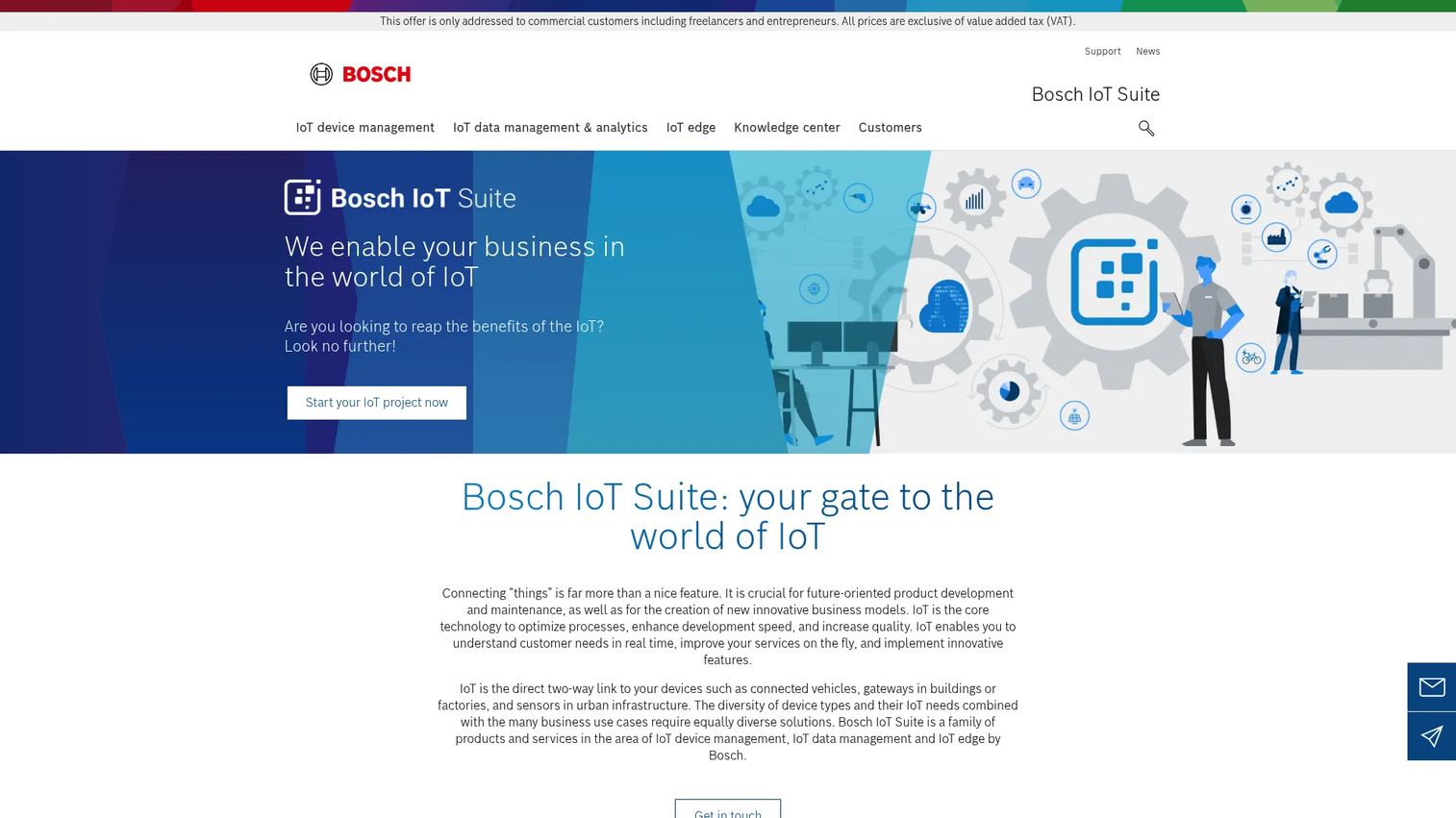
Bosch IoT Suite is Bosch's cloud-based IoT suite for device management, data management and analytics, and edge services. It fits larger industrial IoT programs that need a broad platform spanning the full device lifecycle, backed by Bosch's industrial engineering pedigree.
The suite covers IoT device management throughout the device lifecycle, from onboarding through decommissioning. IoT data management and analytics provide dashboards and APIs for turning telemetry into insight. IoT edge services handle connectivity and local processing closer to devices, which matters for latency-sensitive or bandwidth-constrained industrial settings. Together, these cover device operations as part of a wider industrial IoT program.
Best for: commercial and industrial IoT teams needing Bosch-hosted device, data, and edge services in one suite.
Key strengths
- Lifecycle device management: onboard, manage, and decommission devices across the full lifecycle.
- Data management and analytics: dashboards and APIs for telemetry analysis and integration.
- Edge services: connectivity and local processing near devices for latency and bandwidth control.
Why choose Bosch IoT Suite: For industrial programs that want a broad platform from a vendor with deep manufacturing roots, Bosch IoT Suite bundles device, data, and edge capabilities under one roof. The lifecycle coverage and edge services suit larger operations building on top of connected industrial equipment. It is a fit when device management is one piece of a bigger industrial IoT initiative.
Bosch IoT Suite pricing: Bosch IoT Insights offers a free plan for evaluation. Paid plans include Starter at $60/month and Standard at $600/month, both billed monthly, with a Premium plan whose base fee was not publicly exposed at the time of writing. A verified third-party rating was not available at the time of writing.
Considerations before you buy
Use this checklist during technical validation to separate a demo-friendly platform from one that survives production.
Deployment model and data residency
Decide cloud, hybrid, or self-managed before shortlisting. Cloud platforms scale fastest, self-managed and open-source options give you data sovereignty, and hybrid or edge-capable platforms serve latency and compliance needs. The wrong model surfaces as a blocker in month three, not month one.
Protocol and integration coverage
Confirm the platform speaks your devices' protocols: MQTT, HTTP, REST, and any industrial or low-power protocols like CoAP or LoRaWAN. Then check cloud integrations, APIs, and how telemetry flows into your existing analytics and storage. Protocol gaps are expensive to work around later.
Security, access control, and auditability
Security reviews decide enterprise deals. Verify encryption in transit and at rest, per-device credentials, role-based access control, credential rotation, and audit trails. Confirm the platform documents these clearly, because your reviewers will ask for evidence, not assurances.
Firmware update and lifecycle management
OTA update support with staged rollouts and rollback is non-negotiable for any fleet you cannot physically reach. Evaluate how the platform handles device provisioning, ongoing configuration, and eventual decommissioning across the full device lifecycle.
Scalability and enterprise readiness
Check multi-tenancy, high availability, and fault tolerance against your projected fleet size. A platform that runs 500 devices cleanly may behave differently at 500,000, so ask for evidence at your target scale.
Conclusion
The strongest pick depends on your deployment model, scale, and security requirements, not on popularity. ThingsBoard leads for teams that want open-source control and self-hosting freedom. AWS IoT Device Management and Azure IoT Hub are the cloud-native picks, each best when you already live in that ecosystem. Cumulocity IoT suits enterprise and industrial operations that need visual governance and flexible deployment. Losant fits teams building applications on top of device data, Particle serves connected-product developers, Digi Remote Manager excels at device-centric remote operations, and Bosch IoT Suite anchors broad industrial IoT programs.
Your next step: shortlist two or three platforms based on deployment model, protocol coverage, and security posture, then run each against your real fleet requirements during technical validation. The platform that answers your security reviewer's questions cleanly is usually the one worth signing.
If your evaluation stack extends beyond device management, our guides on audit management software and best customer data platform cover adjacent tooling technical teams evaluate alongside IoT infrastructure.
FAQs
IoT device management software focuses on the operational layer: provisioning, authentication, configuration, monitoring, updates, and security for connected devices. A full IoT platform is broader, often bundling device management with data pipelines, analytics, application enablement, and integrations. Many vendors ship both together, so the line blurs, which is why you should map features to your requirements rather than trust the label.
The core set is device provisioning and authentication, remote configuration and control, firmware and OTA update management, monitoring and alerts, security with access control and auditability, and integrations into your data stack. For enterprise fleets, scalability, multi-tenancy, and high availability move to the top of the list. Prioritize based on your deployment model and fleet size.
Yes, when governance, support, and scaling are addressed. Open-source platforms like ThingsBoard give enterprises data sovereignty, deep customization, and no vendor lock-in. The tradeoff is that you own more of the operational responsibility, so confirm you have the internal skills or a commercial support arrangement before committing at scale.
At minimum, look for MQTT, HTTP, and REST, which cover most modern IoT communication. Depending on your devices, you may also need CoAP for constrained devices, AMQP for enterprise messaging, or low-power protocols like LoRaWAN for wide-area deployments. Confirm protocol support against your actual hardware before shortlisting, because gaps are costly to bridge later.
Enterprise buyers weigh security and auditability, scalability, deployment model, and integration depth heaviest. Security reviews check encryption, access control, credential management, and audit trails. Architecture reviews check protocol support, high availability, and data residency. The deciding factor is often how cleanly the platform answers the security team's diligence questions during validation.
Yes, and OTA update support is one of the most important operational features. Platforms like AWS IoT Device Management, Azure IoT Hub, Particle, and Digi Remote Manager push firmware and software updates across fleets without physical access. Look for staged rollouts and rollback so a bad update never takes down an entire fleet at once.
It depends on your cloud. AWS IoT Device Management is the natural fit for AWS-native teams, inheriting AWS scale, IAM, and analytics. Azure IoT Hub is the match for Microsoft and Azure environments, with per-device authentication and IoT Edge integration. Both scale on demand, so the deciding factor is usually which cloud your organization already runs on.