You built the estimate in a spreadsheet. Priced it against a vendor list that was current three months ago. Spent a full afternoon on takeoff by hand, counting fixtures off a printed plan. Then the bid landed a few points high, and someone with faster tooling took the job.
That gap is the whole problem. When estimates live in disconnected spreadsheets, manual takeoffs, and scattered pricing, bids move slow and margins erode. A single missed quantity or stale unit cost can turn a profitable job into a loss you find out about at closeout.
The construction estimating software market reached USD 2.19 billion in 2025, with North America holding 38% of that share, according to Growth Market Reports. That growth tracks a real shift: contractors are moving off spreadsheets toward tools that connect takeoff, cost data, and bid output into one repeatable process. Cloud deployment alone captured 68.14% of the market in 2025 per Mordor Intelligence, which tells you where the category is heading.
The right construction estimating software cuts bid turnaround, tightens accuracy, and protects margin across the takeoff-to-estimate-to-bid workflow. The wrong one adds a tab nobody opens. This shortlist helps you pick based on project type, workflow depth, and team size, whether you run residential remodels, commercial preconstruction, or heavy civil bids. If you also evaluate adjacent GTM and ops tooling, our roundups on AI content creation tools and ai design tools cover related territory.
What's inside
This guide covers 8 estimating software programs chosen for how well they handle the full takeoff-to-bid workflow. We weighted four things: takeoff depth and measurement accuracy, cost database and assembly strength, integrations with accounting or job costing, and ease of use for a real team.
The list spans residential, commercial, and heavy-civil use cases, so you can match a tool to your trade instead of picking on brand recognition alone. Each entry includes verified pricing where a vendor publishes it, a G2 or Capterra rating where available, and a clear read on who should choose it. Pricing and ratings reflect current published values at the time of writing.
TL;DR
- Best overall for takeoff-heavy estimating: PlanSwift, for point-and-click measurement and deep assemblies.
- Best for residential remodelers: Clear Estimates, for localized cost data and proposal-ready output.
- Best for commercial preconstruction: ProEst, for structured cost databases and bid-day analysis.
- Best for cloud-first estimating and trade versatility: STACK, for accessible takeoff and team collaboration.
- Best for growing contractors: Buildxact, for estimating plus job management in one system.
- Best for heavy civil bids: HCSS HeavyBid, for production rates and bid recap.
- Best for BIM and quantity precision: CostX, for 2D, 3D, and model-based takeoff.
- Best for connected platform workflows: Procore Estimating Software, for estimate-to-job-costing handoff.
What is construction estimating software?
Construction estimating software is a tool that calculates quantities, applies labor, material, and overhead costs, and produces bids or proposals from project plans. It replaces manual spreadsheets and paper takeoffs with a structured, repeatable process built for speed and accuracy.
The core workflow runs in three stages. First, takeoff: you measure quantities off drawings, counting fixtures, measuring linear feet, calculating areas. Second, estimate: those quantities get priced with labor rates, material costs, overhead, and margin. Third, bid or proposal: the estimate becomes a client-ready document that wins or loses the job. Takeoff software construction workflows feed the estimate, and the estimate feeds the bid. When those stages connect cleanly, you get a faster, more defensible number.
Most construction cost estimating software shares a common set of capabilities:
- Quantity takeoff and measurement: point-and-click or AI-assisted counting, scaling, and area calculation from PDFs, scans, or CAD files.
- Assemblies, templates, and cost databases: prebuilt line items and reusable assemblies that pull current unit costs so you stop rebuilding estimates from scratch.
- Bid and proposal generation: client-ready documents with markup, pricing, and branding.
- Integrations with accounting or job costing: clean handoff from won bid to active job so budgets and actuals stay connected.
- Cloud access and team collaboration: shared projects, version control, and access from the field or the office.
The strongest estimating programs tie all five together. That is what turns estimating from a bottleneck into a system your team can run without you.
When to use construction estimating software
Not every contractor needs the same depth. Here is how to pattern-match your situation to the category.
Speed up bid turnaround
If you are losing bids because estimates take too long, automation and templates matter most. Point-and-click takeoff, saved assemblies, and reusable cost databases cut hours off every bid. Teams that bid high volume, like residential remodelers or specialty trades, feel this immediately. The faster you turn a clean estimate, the more shots you get at closing work.
Standardize estimates across the team
If estimating quality swings depending on who built it, you have a repeatability problem. Templates and assemblies enforce consistency, so a junior estimator produces the same structure as your best one. This matters when you are trying to make estimating a system that runs without the founder or lead estimator in every bid. Standardized cost databases also keep pricing current across everyone.
Handle more complex project types
Commercial, civil, and multi-trade work needs deeper control. Advanced takeoff, bid management, production rates, and BIM-linked quantities become necessary when a single estimate spans dozens of trades and thousands of line items. If you are moving upmarket into preconstruction or heavy civil, the estimating software programs built for depth pay for themselves on the first complex bid.
Comparison table
Compare by project type first, then workflow depth, then budget. A residential remodeler and a heavy civil contractor need very different tools, so match the intent column to your work before you weigh price. Pricing and ratings below reflect current published values.
| # | Product | Intent | Key use case | Pricing | G2 rating |
|---|---|---|---|---|---|
| 1 | PlanSwift | Takeoff-heavy estimating | Point-and-click takeoff with assemblies | $1,749/year per license | 4.3/5 |
| 2 | Clear Estimates | Residential remodeling | Localized cost data and proposals | From $59/mo (annual) | Not listed |
| 3 | ProEst | Commercial preconstruction | Cost databases and bid-day analysis | From $5k/year, unlimited users | 4.3/5 |
| 4 | STACK | Cloud-first estimating | Takeoff, estimate, and collaboration | From $249/user/mo (annual) | 4.4/5 |
| 5 | Buildxact | Growing contractors | Estimating plus job management | Free plan; from $169/mo (annual) | 4.4/5 |
| 6 | HCSS HeavyBid | Heavy civil bidding | Production rates and bid recap | Custom | 4.6/5 (Capterra) |
| 7 | CostX | BIM and quantity precision | 2D, 3D, and BIM takeoff | Custom | 4.2/5 |
| 8 | Procore Estimating Software | Connected platform | Estimate-to-job-costing handoff | Custom | 4.6/5 |
1. PlanSwift
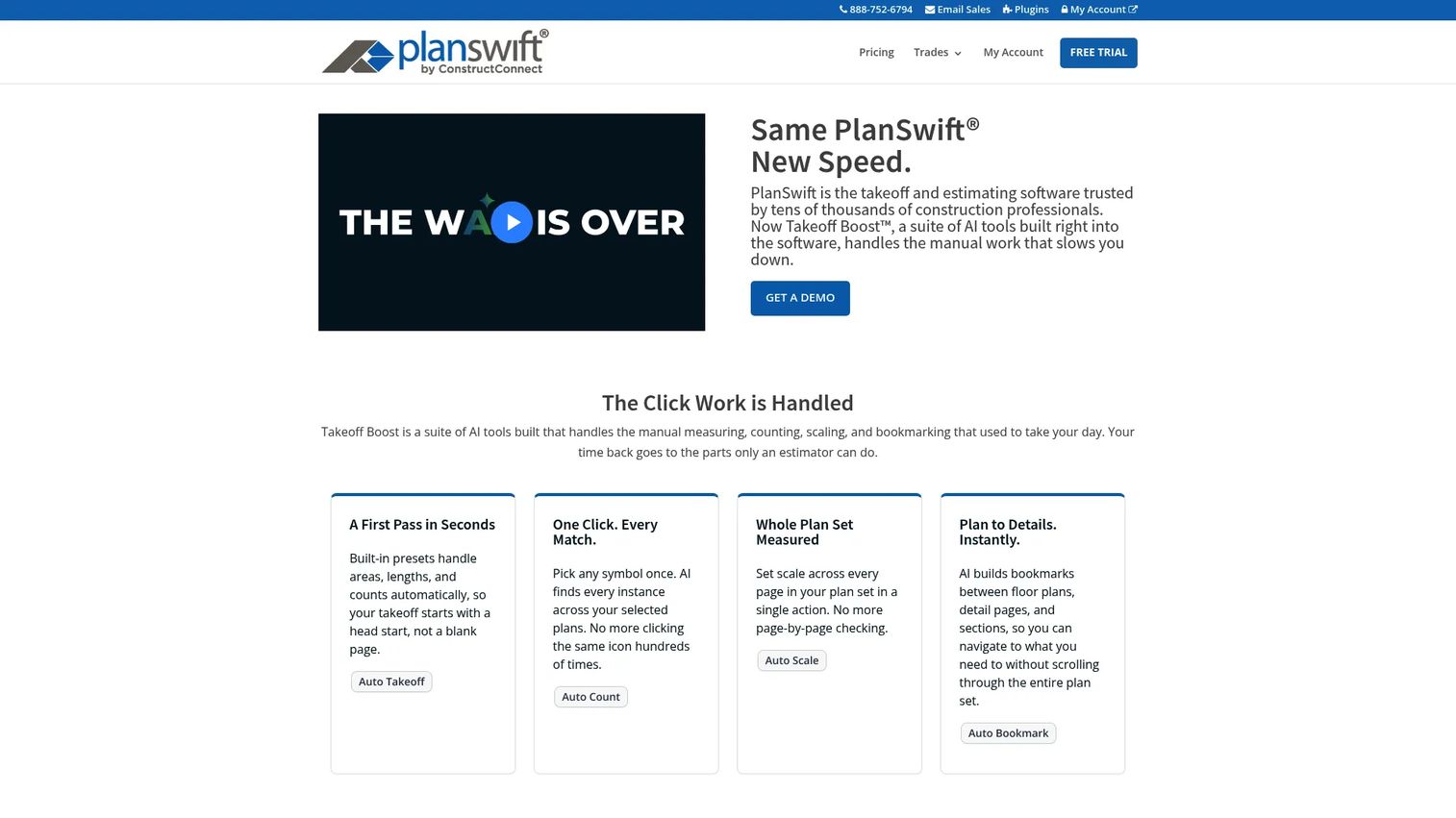
PlanSwift is construction takeoff and estimating software built for contractors and estimators who live in the takeoff process. You measure directly on digital plans with point-and-click tools, then turn those quantities into priced estimates using customizable assemblies. It is a desktop-anchored tool that trades on measurement speed and depth, which is why takeoff-heavy trades keep coming back to it.
Best for: General contractors and specialty trade estimators who need fast, accurate construction takeoff feeding directly into estimates.
Key strengths
- Point-and-click takeoff: Measure areas, counts, and linear quantities directly on plans without a printed sheet in sight.
- Customizable assemblies and templates: Build reusable assemblies with labor and material calculations so repeat bids take minutes, not hours.
- Excel integration and team sharing: Push data to Excel and share takeoffs with SwiftShare or Free Viewer Mode for collaboration.
Why choose PlanSwift: If takeoff volume is your bottleneck, PlanSwift is built around exactly that job. The point-and-click measurement and deep assembly library reward trades that bid frequently and need every quantity counted fast. It suits estimators who want a dedicated takeoff-to-estimate workhorse rather than a broad platform.
PlanSwift pricing: PlanSwift is sold as an annual subscription at $1,749.00 per year per license. The subscription includes support, software updates, and two hours of training. A 14-day free trial is available, and there is no perpetual free tier. It holds a 4.3/5 rating on G2.
2. Clear Estimates
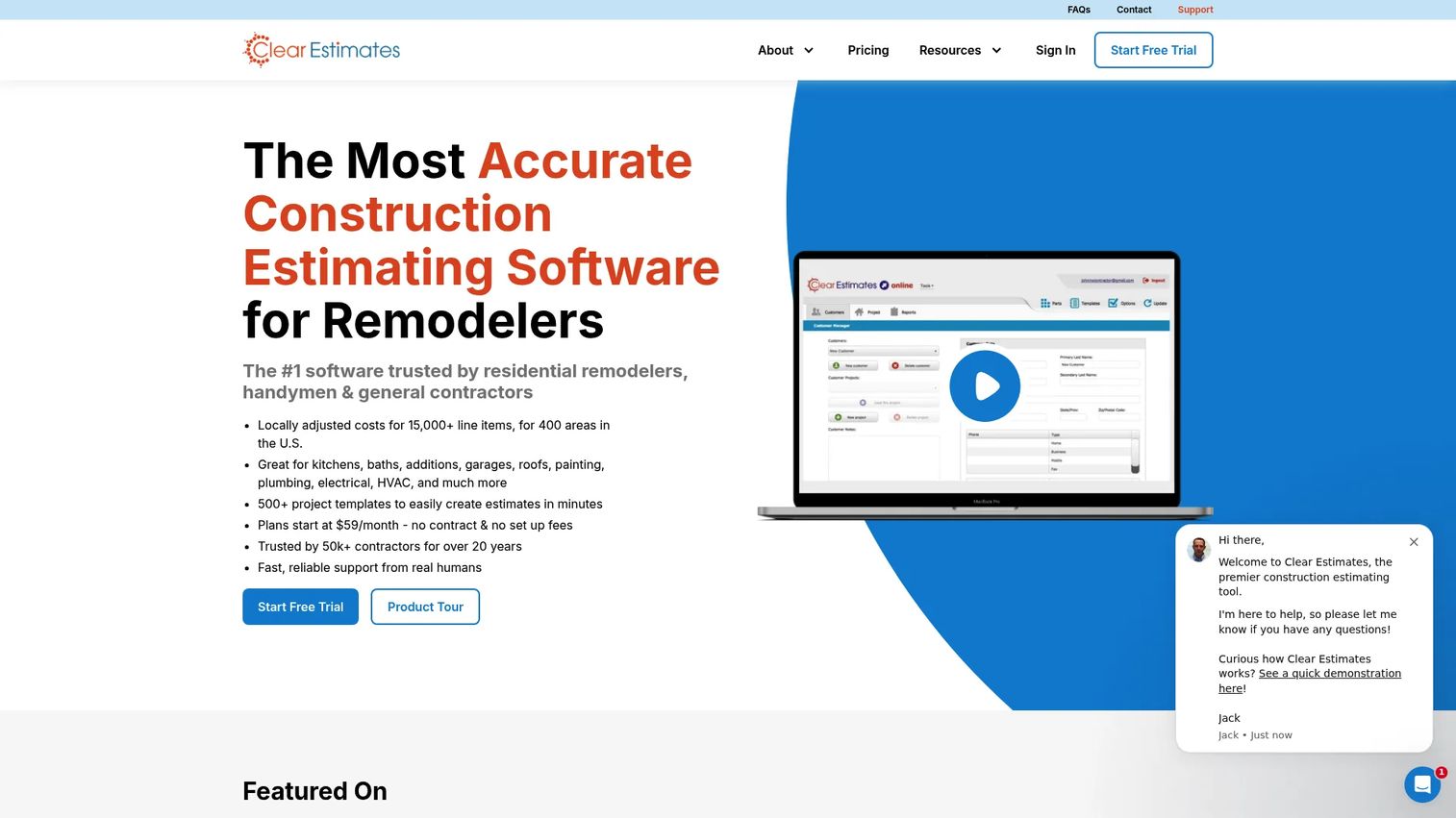
Clear Estimates is estimate software built specifically for residential remodelers and contractors. It leans on a large line-item database and localized cost data so you can produce accurate, proposal-ready estimates fast. Instead of building pricing from scratch, you start from preloaded templates tuned to residential work and adjust to your market.
Best for: Residential remodelers and contractors who need localized estimating and polished proposals without heavy setup.
Key strengths
- 13,000+ line item database: A deep cost library that reduces the guesswork in pricing common residential work.
- 200+ preloaded templates: Start estimates from proven templates by project type instead of a blank sheet.
- Unlimited estimates and customers: No caps on how many estimates or clients you manage, which suits high-volume remodelers.
Why choose Clear Estimates: For a remodeler who wants fast, credible estimates and clean proposals, this residential estimating software removes most of the manual pricing work. The localized cost data keeps your numbers grounded in your market, and the template library makes repeat project types quick to quote.
Clear Estimates pricing: Plans are Standard, Pro, and Franchise, with annual billing discounted versus monthly. Standard starts at $59 per month billed annually or $79 billed monthly. Pro runs $99 per month annual or $119 monthly. Franchise starts at $199 per month billed annually, with pricing based on customization scope. There is no free tier.
3. ProEst
ProEst is cloud-based construction estimating software that combines cost estimating, 2D takeoffs, and bid-day analysis in one platform. It is now offered within the Forma for Preconstruction bundle and targets commercial teams that need structured estimating operations rather than a single-estimator tool. The cloud model supports collaboration across a preconstruction team working the same bid.
Best for: Commercial construction contractors who need estimating, takeoffs, and bid analysis in one connected cloud platform.
Key strengths
- Cost databases: Centralized, maintainable cost data that keeps pricing consistent across estimators and projects.
- Digital takeoffs: 2D takeoff tools that feed quantities directly into the estimate without re-entry.
- Bid-day analysis: Structured reporting and analysis tools built for competitive commercial bidding.
Why choose ProEst: Commercial preconstruction teams need more than a takeoff tool; they need a shared, structured estimating process. ProEst fits teams standardizing cost data and bid workflows across multiple estimators, especially those already invested in the Autodesk preconstruction ecosystem.
ProEst pricing: ProEst uses a yearly subscription model starting at around $5,000 per year, described as an unlimited subscription with unlimited users, support, and storage. Pricing is confirmed through G2's pricing listing rather than a public first-party price. It holds a 4.3/5 rating on G2.
4. STACK
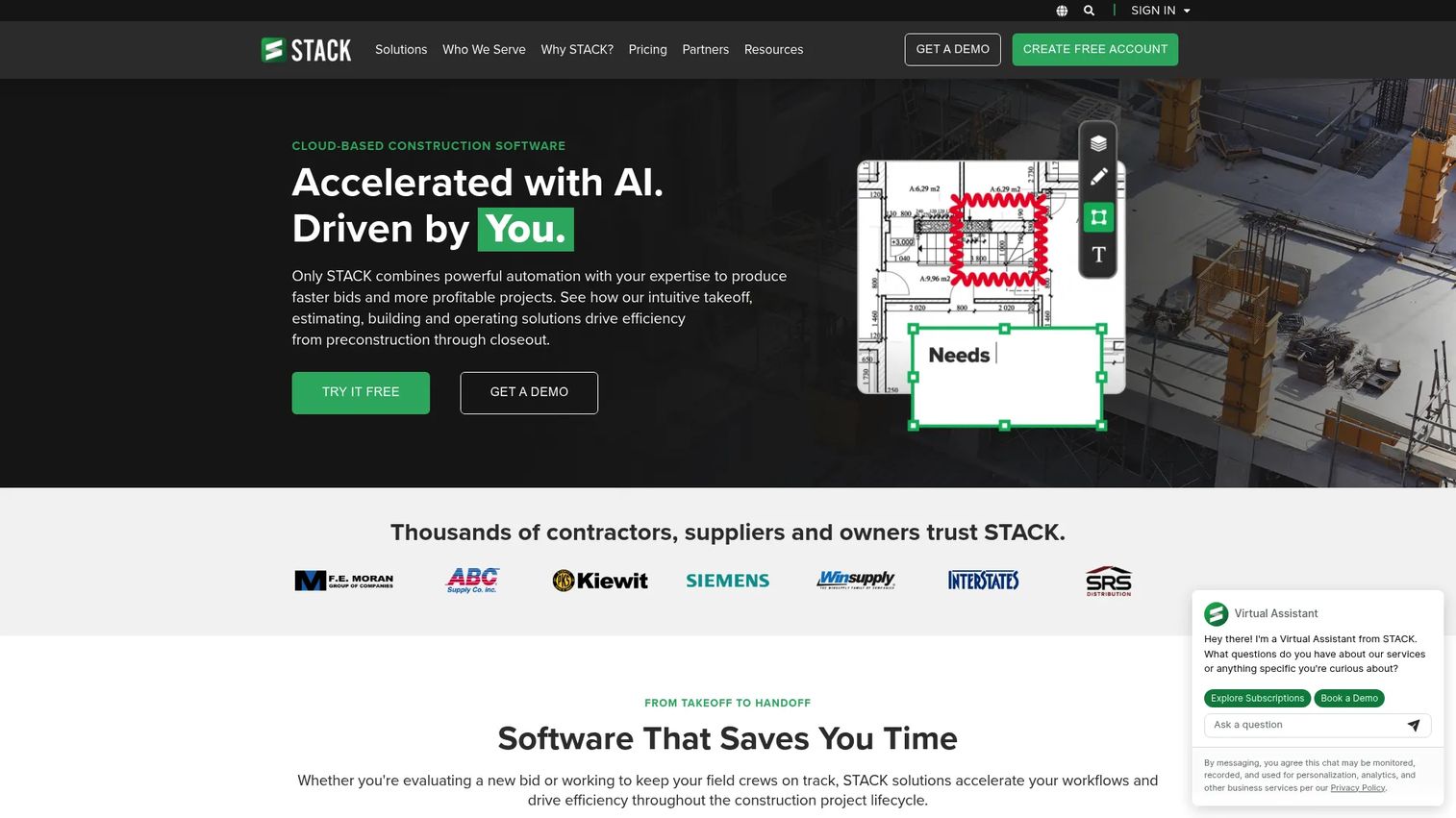
STACK is cloud-based construction takeoff, estimating, and collaboration software for contractors. It combines plan and document management with quantity takeoff and detailed cost estimating in one browser-based tool. The cloud-first design makes it easy for teams to work the same plans and estimates without wrangling desktop licenses or file versions.
Best for: Construction contractors who want cloud takeoff and estimating with plan management and team collaboration, across trades.
Key strengths
- Plan, spec, and document management: Keep drawings and specs organized and current in one shared workspace.
- Quantity and material takeoff: Measure and count directly on plans in the browser, from any device.
- Detailed cost estimating and proposals: Turn takeoffs into priced estimates and client-ready proposals in the same tool.
Why choose STACK: For teams that want accessible, cloud-based estimating without heavy setup, STACK covers takeoff through proposal in one place. Its trade versatility and collaboration model suit growing contractors who need multiple people in the same estimate. Reviewers consistently point to ease of use as a reason it scales across a team.
STACK pricing: STACK's public pricing shows Premium at $249 per user per month and Pro at $299 per user per month, both billed annually in USD. A customizable Build Your Own option is available through sales. A free account covers 7 days on up to 2 concurrent projects. It holds a 4.4/5 rating on G2.
5. Buildxact
Buildxact is cloud construction estimating and project management software for builders, remodelers, and dealers. It pairs digital takeoffs and estimating with quote generation and job management, so the same tool that wins the bid also runs the job. For a growing contractor, that adjacency means fewer disconnected systems between estimate and delivery.
Best for: Residential builders and remodelers who need estimating plus end-to-end job management in one practical system.
Key strengths
- Digital takeoffs and estimating: Measure on-screen and build estimates without separate takeoff software.
- Quote generation and customizable quote letters: Produce branded, professional quotes that move deals forward.
- Job management and accounting integrations: Scheduling, invoicing, and accounting connections carry the job past the bid.
Why choose Buildxact: Growing contractors who want estimating and operations in one place get a practical system that scales with them. The job management adjacency means you are not stitching your estimate to a separate project tool. It fits small to mid-sized teams building a repeatable process from quote to invoice.
Buildxact pricing: Buildxact offers a free Go plan, then paid tiers. Foundation runs $169 per month billed annually or $199 monthly. Pro is $339 per month annual or $399 monthly. Master is $509 per month annual or $599 monthly. Annual plans carry a 12-month commitment. It holds a 4.4/5 rating on G2.
6. HCSS HeavyBid
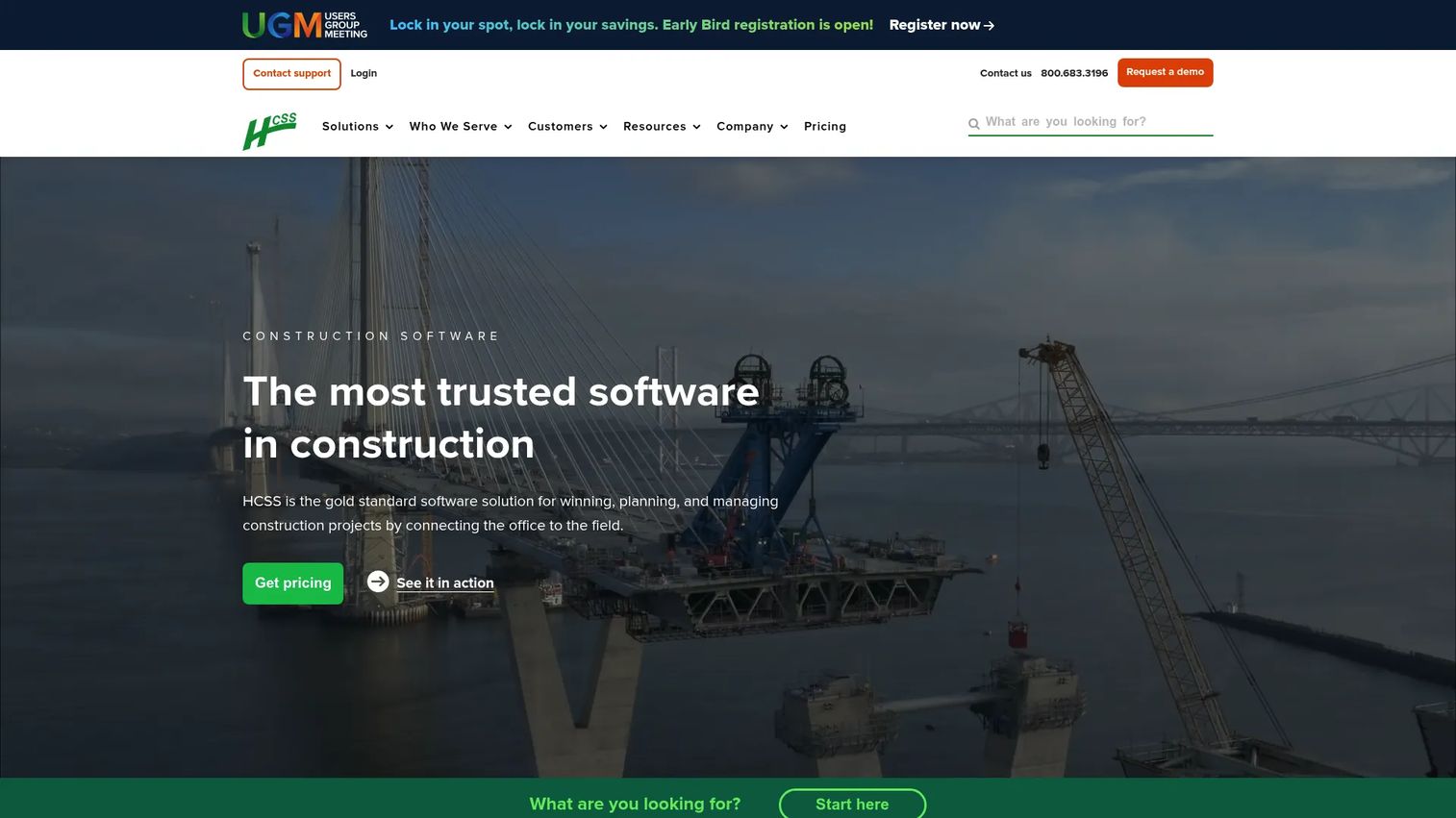
HCSS HeavyBid is construction estimating software built for heavy civil contractors. It handles the depth that large civil and infrastructure bids demand: bid management, markup and pricing, and proposal generation tuned to production-rate estimating. For contractors bidding roads, bridges, and site work, it speaks the language of the trade.
Best for: Heavy civil contractors and larger estimating teams who need detailed estimating and bid pricing workflows.
Key strengths
- Bid management: Organize and control complex, multi-item civil bids from a single system.
- Markup and pricing: Apply production-rate logic and structured markup across large bid quantities.
- Proposal generation: Produce detailed, bid-ready proposals for competitive civil work.
Why choose HCSS HeavyBid: Heavy civil bids are a different animal, with production rates, crews, and equipment driving cost. HeavyBid is purpose-built for that complexity and for larger estimating teams working big bids together. If you bid infrastructure or site work, it fits the way civil estimators actually think.
HCSS HeavyBid pricing: HCSS does not publish public pricing; the site prompts you to request pricing or book a demo. On Capterra, HeavyBid holds a 4.6/5 rating across a large review base, which reflects strong sentiment among civil contractors.
7. CostX

CostX is construction estimating and takeoff software from RIB, built for 2D, 3D, and BIM workflows. It is the choice for teams that need measurement precision and model-based estimating, especially quantity surveyors and estimators handling detailed dimensional work. Where other tools stop at PDFs, CostX pulls quantities from CAD and BIM models.
Best for: Quantity surveyors and estimators who need digital takeoff and estimating across 2D, 3D, and BIM workflows.
Key strengths
- 2D takeoff from scans, PDF, and CAD: Measure precisely from any drawing format, not just PDFs.
- 3D and BIM support: Pull quantities directly from models for faster, more accurate takeoff.
- Live-linked workbooks and custom reporting: Connect takeoff to estimate workbooks so changes flow through automatically.
Why choose CostX: For teams where measurement precision and model-based workflows matter most, CostX brings BIM-linked quantity takeoff that few tools match. It fits quantity surveyors and estimators doing detailed dimensional work on complex projects. The live-linked workbooks mean a model change updates the estimate without manual re-entry.
CostX pricing: RIB does not publicly list CostX pricing; the site asks visitors to request individual pricing, and packages vary by license and region. CostX holds a 4.2/5 rating on G2.
8. Procore Estimating Software

Procore Estimating Software is estimating that connects takeoff, estimates, and proposals inside Procore's broader construction platform. Its value is the handoff: the estimate you win flows into the same platform that manages the job, so budgets and actuals stay connected from bid to closeout. For teams already running Procore, that continuity is the point.
Best for: Construction teams who want integrated estimating inside a broader project management platform.
Key strengths
- 2D and 3D takeoff with auto-mapped extraction: Pull quantities with automated mapping to reduce manual counting.
- AI-assisted area detection and auto-counting: Floor plan area detection and auto-count speed up repetitive takeoff work.
- Estimate-to-bid-to-contract workflow: Carry the number from estimate through bid to contract without leaving the platform.
Why choose Procore Estimating Software: If you already run Procore or want estimating connected to job costing and project management, this closes the loop between bid and delivery. The connected workflow means fewer handoffs and cleaner margin tracking across the job lifecycle. It fits teams that value platform continuity over a standalone estimating tool.
Procore Estimating Software pricing: Procore uses custom, quote-based pricing charged as an upfront annual fee by product and based on Annual Construction Volume. No public price is listed. Procore holds a 4.6/5 rating on G2 for the overall platform.
What to check before you buy
The right pick depends less on brand and more on fit. Run any shortlist through these criteria before you commit.
Workflow fit
Match the tool to your actual takeoff-to-bid workflow. A takeoff-heavy trade needs different depth than a remodeler producing fast proposals. Map how an estimate moves through your team, then check that the tool handles each stage without a workaround.
Team adoption
Software only helps if your estimators use it. Cloud-based estimating tends to lower the barrier for teams that share plans and work remotely. Test the editor with the people who will live in it daily, not just the person approving the purchase.
Integrations
Check how the tool connects to accounting, job costing, or a broader construction platform. A clean handoff from won bid to active job protects margin and kills double entry. If the integration is weak, the estimate becomes an island.
Pricing and support
Confirm whether pricing is per user, per license, or platform-based, and whether billing is monthly or annual. Factor in training and support, since a tool nobody can learn is a tool nobody uses. Match cost to your bid volume and margin, not to a competitor's stack.
Choosing the right estimating software
There is no single best tool, only the best fit for your trade and workflow. For takeoff-heavy estimating, PlanSwift rewards trades that count high volumes of quantities. Residential remodelers get fast, localized estimates from Clear Estimates. Commercial preconstruction teams standardize on ProEst, while STACK gives cloud-first contractors accessible takeoff and collaboration across trades.
Growing contractors who want estimating and operations together lean on Buildxact. Heavy civil teams need HCSS HeavyBid for production rates and complex bids. Quantity surveyors doing model-based work choose CostX for BIM-linked precision. Teams invested in a connected platform get estimate-to-job-costing continuity from Procore Estimating Software.
Narrow by workflow first. Decide whether takeoff depth, residential speed, commercial structure, civil complexity, or platform continuity matters most for how you actually bid. Then validate pricing, integrations, and team adoption with a trial before you commit. The goal is a repeatable estimating process that produces faster bids, fewer errors, and protected margin, without routing every estimate through one person.
FAQs
Construction estimating software calculates quantities, applies labor, material, and overhead costs, and produces bids or proposals from project plans. It connects three stages: takeoff to measure quantities, estimating to price them, and proposal output to win the job. The result is faster, more accurate bids than manual spreadsheets can produce.
Takeoff software measures quantities off drawings, counting fixtures, measuring linear feet, and calculating areas. Estimating software turns those quantities into priced bids by adding labor, material, overhead, and margin. Many modern tools combine both into a single takeoff-to-estimate workflow, so measurements flow straight into pricing without re-entry.
Small contractors usually do best with approachable, template-based tools that offer pricing transparency. Clear Estimates suits residential remodelers with localized cost data, while Buildxact adds job management for contractors ready to grow. Both emphasize speed, ease of use, and clear pricing over heavy setup, which matters when you do not have a dedicated estimator.
Commercial teams typically need structured cost databases, collaboration across estimators, and integrations with broader construction platforms. ProEst fits commercial preconstruction with cost databases and bid-day analysis, and Procore Estimating Software connects estimating to job costing inside a full platform. STACK also serves commercial contractors that want cloud-first takeoff and estimating.
Yes, most construction cost estimating software includes templates, assemblies, and cost databases. Clear Estimates ships with a 13,000+ line item database and 200+ templates, while PlanSwift offers customizable assemblies. These libraries reduce repeat work by letting you reuse proven pricing structures instead of rebuilding every estimate from scratch.
Yes, many estimating programs integrate with accounting or broader construction platforms. Buildxact connects to accounting tools, and Procore ties estimating directly to job costing and project management. Clean integration matters because it carries the won bid into the active job, keeping budgets and actuals connected so you can track margin instead of re-entering numbers.
Check workflow fit, team adoption, integrations, pricing, and support. Match the tool to your project type and how your team actually moves an estimate from takeoff to bid, not just to brand reputation. Run a trial with the people who will use it daily, and confirm the integration into your accounting or job costing stack works before you commit.
It depends on your collaboration and access needs. Cloud-based estimating like STACK or Buildxact suits teams that share plans, work remotely, and want current data everywhere. Desktop tools like PlanSwift can offer deep, fast takeoff for a single estimator. Cloud captured 68.14% of the market in 2025 per Mordor Intelligence, but the right choice comes down to how your team actually works.