You know exactly how a bad week starts in a cold store. A pallet gets picked out of expiry order. A customer disputes a storage invoice because the days on file don't match the days on the dock. Someone finds a spoiled lot that a spreadsheet swore was still good. None of these are dramatic on their own. Together, they quietly eat margin every single month.
The market has noticed. The global cold storage software market was valued at USD 4.55 billion in 2025 and is projected to reach USD 8.72 billion by 2033 at an 8.48% CAGR, according to Future Market Report (2025). That growth isn't about novelty. It reflects a simple operational truth: manual tracking in temperature-controlled warehouse operations breaks down at scale, and the cost of that breakdown shows up as write-offs, billing leakage, and hours lost reconciling paper.
The real problem isn't that operators lack data. It's that the data lives in the wrong places: a clipboard on the dock, a spreadsheet on a manager's laptop, an accounting file that never talks to the floor. A proper cold storage software solution ties inventory, expiry, mobile execution, and billing into one system so leadership gets real-time visibility instead of a reconstruction after the fact.
This guide compares seven cold warehouse software options so you can shortlist by fit, not by feature checklist.
What's inside
This is a buyer's shortlist for teams that run cold storage, refrigerated 3PL, food distribution, or temperature-controlled logistics and need a system that holds up under real throughput. We looked at cold storage management software across five criteria that actually decide whether a tool earns its place:
- Cold chain fit: lot and expiry control, FEFO or FIFO logic, temperature zones, and traceability
- Operational depth: receiving, putaway, picking, dispatch, and inventory counting
- Mobile usability: barcode and handheld scanning, low-training adoption on the floor
- Visibility and reporting: dashboards, real-time data, and audit-ready records
- Billing and deployment clarity: how storage charges, invoicing, and pricing or setup are handled
If you're weighing depth against simplicity, mobile against back-office billing, this guide maps each tool to the operation type it fits best.
TL;DR
- Best for large or complex operations: Royal4 WISE Polar, for deep warehouse execution and freezer-rated scanning.
- Best for process-heavy cold chain: AEB Cold Storage WMS, for FEFO picking, catch-weight, and inbound-to-dispatch workflows.
- Best all-in-one for SMB operators: ColdStoreApp, for inward/outward, billing, and mobile in a single system.
- Best for frontline operations and adoption: SafetyCulture, for mobile task tracking and easy rollout.
- Best for straightforward cold storage management: eColdStore, for inventory, billing, and reporting without enterprise overhead.
- Best for formal WMS plus billing: Datex FootPrint WMS and Microlistics Chilled WMS, for configurable warehouse control with activity-based invoicing.
What is cold storage software?
Cold storage software is a warehouse management system built specifically for temperature-controlled facilities, combining inventory control, lot and expiry management, mobile execution, reporting, and storage billing in one platform. It differs from generic warehouse management software by treating shelf life, temperature zones, and catch-weight as first-class data rather than afterthoughts.
A general WMS assumes a widget is a widget. A cold chain WMS assumes every unit has an expiry date, a lot number, a variable weight, and a temperature it must never leave. That distinction changes how the software handles nearly every workflow on the floor.
Core capabilities a cold storage inventory management system typically covers:
- Inventory control: real-time stock positions across chambers, zones, and locations, with cold storage inventory tracking down to the pallet or bag
- Lot and expiry management: FEFO and FIFO enforcement, best-before tracking, and dispatch checks that block expired stock from shipping
- Warehouse workflows: receiving, putaway, picking, packing, and dispatch management tied to real-time inventory
- Mobile execution: barcode scanning and handheld scanning built for freezer conditions and gloved hands
- Reporting and dashboards: stock, aging, throughput, and compliance reports leadership can trust
- Billing and invoicing: storage rent, handling charges, and service fees calculated from actual warehouse activity
- Catchweight management: capturing variable weights at receiving and dispatch for accurate stock and billing
The strongest cold storage WMS platforms connect all of these so a scan on the dock updates inventory, feeds the expiry logic, and lands on the invoice without anyone re-keying it.
When to use cold storage software
Not every operation needs a full WMS on day one. These four signals tell you it's time.
Use it when expiry risk is eating margin
If write-offs are a recurring line item, lot and expiry control pays for itself fast. A cold storage system enforces FEFO or FIFO at the pick, flags stock approaching its best-before date, and blocks expired lots from dispatch. That turns expiry from a monthly surprise into a managed process, and it removes the guesswork that leads to shipping the wrong pallet.
Use it when warehouse work still lives in spreadsheets or paper
Paper travels slowly and lies often. When receiving, putaway, and picking run on clipboards, your inventory is always a few hours out of date and always a little wrong. Mobile workflows with barcode scanning close that gap. Staff scan as they move, inventory updates in real time, and the floor stops depending on someone typing counts into a spreadsheet at end of shift.
Use it when billing and operations need to stay in sync
Cold storage billing is where money quietly leaks. If storage days, handling events, and service charges are tracked separately from warehouse activity, disputes and undercharging follow. Tying billing and invoicing to actual movements means every stored pallet-day and every handling touch is captured automatically, which protects revenue and shortens billing cycles.
Use it when leadership needs cleaner visibility
Warehouse operations automation only matters if it surfaces signal. Dashboards and reporting give operators and general managers real-time visibility into stock, aging, throughput, and compliance without stitching together five sources. For founders and operators trying to build repeatable operations, that clean reporting layer is often the whole point.
Comparison table
Here's the shortlist at a glance. Pricing for several cold storage warehouse management software products is quoted per operation rather than published publicly, which is common for WMS platforms scoped to facility size.
| # | Product | Intent | Key use case | Pricing | G2 rating |
|---|---|---|---|---|---|
| 1 | Royal4 WISE Polar | Enterprise cold storage WMS | Deep warehouse execution with freezer-rated scanning and compliance | Not publicly listed | Not listed |
| 2 | AEB Cold Storage WMS | Process-heavy cold chain | FEFO picking, catch-weight, inbound-to-dispatch workflows | By requirement | Not listed |
| 3 | ColdStoreApp | SMB all-in-one ERP | Inward/outward, billing, and mobile in one system | From ₹11,990/year | Not listed |
| 4 | SafetyCulture | Frontline operations platform | Mobile inspections, task tracking, and training | Free; Premium from $24/seat/mo | 4.6/5 |
| 5 | eColdStore | Straightforward cold storage management | Inventory, billing, and reporting for cold stores | Not publicly listed | Not listed |
| 6 | Datex FootPrint WMS | Configurable WMS with billing | Warehouse control plus activity-based invoicing | Not publicly listed | Not listed |
| 7 | Microlistics Chilled WMS | Specialized cold-chain WMS | Multi-chamber control and client billing | Not publicly listed | 4.5/5 |
1. Royal4 WISE Polar
Royal4 WISE Polar is the cold-storage-focused warehouse management software from Royal 4 Systems, built for facilities where throughput and compliance both run high. It handles temperature-controlled inventory management with traceability, and it's deployable either web-hosted or on-premise depending on how your IT wants to run it. The product carries FSMA Section 204 support, which matters for food and pharma operators facing real traceability mandates.
Where WISE Polar earns its place is depth. This is a full cold chain WMS, not a lightweight tracker. Receiving, putaway, picking, packing, and shipping all run inside one system, with freezer-rated RF scanning built for staff working in sub-zero conditions with gloves on. Lot control and expiration methods like FEFO run natively, so the software enforces the right pick order instead of trusting the operator to remember it.
Best for: Cold storage, refrigerated 3PL, and food or pharma distribution operations that need enterprise-grade warehouse execution.
Key strengths
- Freezer-rated RF scanning: Handheld scanning designed for the physical reality of a freezer floor, not a room-temperature warehouse.
- Traceability and compliance: FSMA Section 204 support and full track-and-trace for regulated food and pharma stock.
- End-to-end warehouse execution: Receiving through shipping in one system, with lot and expiry logic driving picks.
Why choose Royal4 WISE Polar: If you run a large or complex operation where compliance reporting and labor efficiency both move the P&L, this is a system built for that scale. It rewards operators who want a single, deep platform rather than a stack of point tools, and it's a fit when audit-readiness is non-negotiable.
Royal4 WISE Polar pricing: Royal 4 Systems does not publish pricing on its site. Cost is scoped per operation, so you'll need to contact the vendor for a quote based on facility size, deployment model, and modules. Expect enterprise WMS pricing rather than a self-serve subscription.
2. AEB Cold Storage WMS
AEB Cold Storage WMS is cloud warehouse management software for cold chain logistics and temperature-sensitive goods. It's structured around the flow of work: inbound, fulfilment, dispatch, and inventory counting, each with cold-chain logic baked in. Real-time temperature monitoring sits alongside inventory management with lot and best-before tracking, so the system knows both where stock is and how long it has left.
The reason process-heavy operators gravitate to AEB is its handling of the awkward parts of cold storage. Catch-weight management captures variable weights accurately, shelf-life-driven picking enforces FEFO at the pick face, and mobile-app-supported receiving and picking keep the floor moving. Cross-docking and inventory counting round out a workflow set built for facilities where product moves fast and shelf life is short.
Best for: Mid-sized or large businesses managing refrigerated, frozen, or other temperature-sensitive warehouse operations with complex inbound-to-dispatch flows.
Key strengths
- FEFO and shelf-life picking: Picking driven by best-before dates so the oldest stock leaves first, automatically.
- Catch-weight management: Accurate variable-weight capture at receiving and dispatch for correct stock and billing.
- Real-time temperature monitoring: Temperature data tied to inventory, supporting compliance and cold chain integrity.
Why choose AEB Cold Storage WMS: AEB pairs the software with an implementation and consulting ecosystem, which matters when your workflows are intricate enough that configuration is a project, not a toggle. It fits operators who want a partner through rollout rather than a tool dropped on the dock.
AEB Cold Storage WMS pricing: AEB does not publicly display pricing. Its help center notes that cost depends on individual requirements and directs prospects to a price calculator or a conversation with the AEB team. Plan for requirement-based scoping rather than a fixed list price.
3. ColdStoreApp
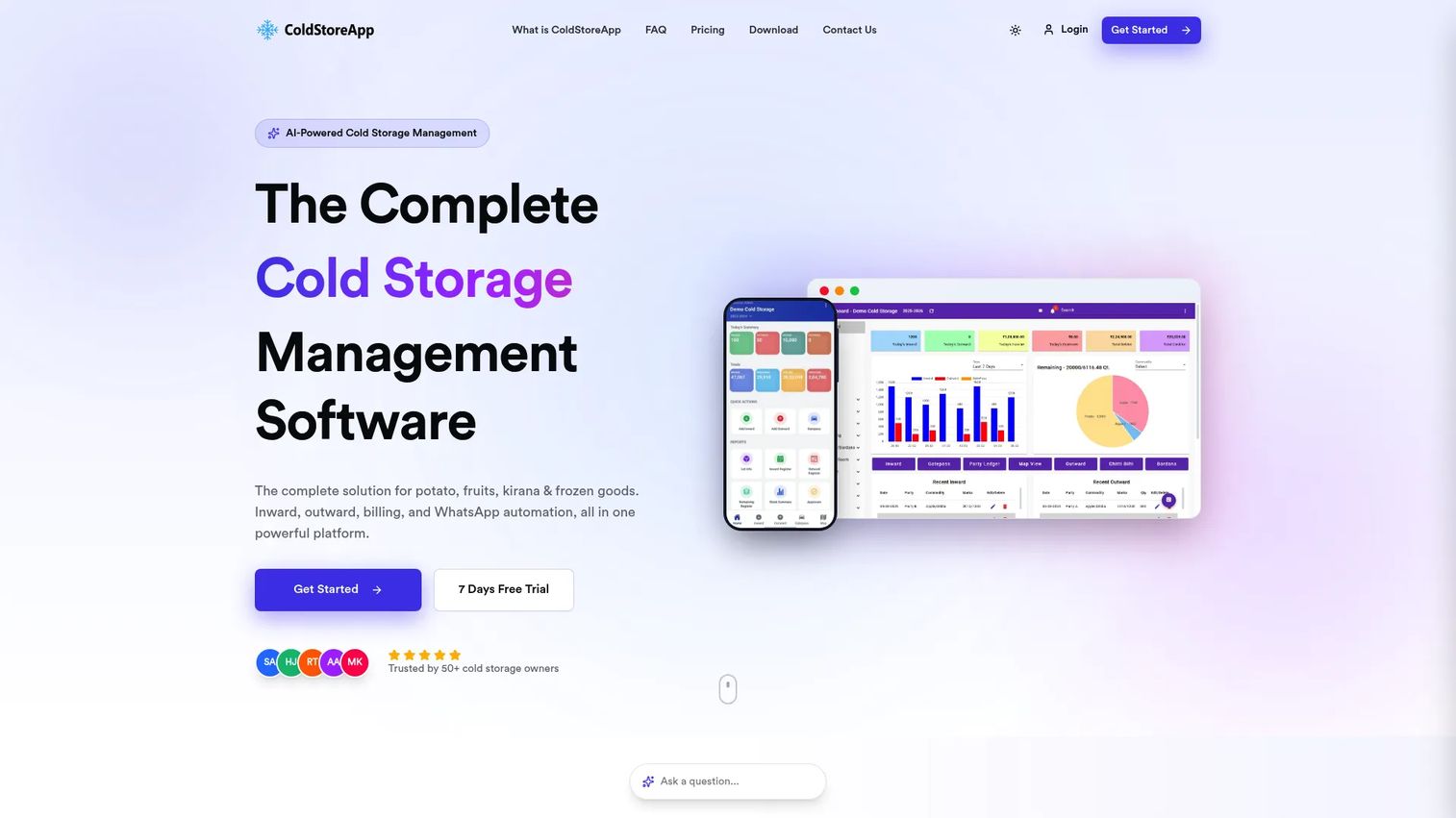
ColdStoreApp is a cold storage ERP that pulls storage, billing, and dispatch into one app-centric system. It's built for operators who want quick adoption without a heavy implementation cycle. Inward and outward management, billing, invoicing, and accounting all live in one place, and the mobile app keeps the workflow accessible on the floor rather than chained to a back-office desktop.
What makes ColdStoreApp practical for smaller operations is how much it bundles. Warehouse mapping, lot tracking, and barcode scanning cover the operational side, while the built-in billing, ledger, and accounting handle the money side. Gatepass workflows and WhatsApp or SMS updates keep customers and drivers in the loop without extra tooling. It runs in the cloud, which keeps setup light.
Best for: Cold storage operators needing an all-in-one system for storage, billing, and dispatch workflows without enterprise complexity.
Key strengths
- All-in-one operations and billing: Inward/outward, billing, invoicing, and accounting in a single system.
- Mobile and cloud access: App-based workflows with barcode scanning for low-training adoption on the floor.
- Customer communication built in: Gatepass, WhatsApp, and SMS updates keep stakeholders informed automatically.
Why choose ColdStoreApp: If you run a smaller cold store and want one system instead of a WMS plus a separate accounting tool, this consolidation is the draw. It fits teams that value speed to adoption and a lower learning curve over deep enterprise configurability.
ColdStoreApp pricing: ColdStoreApp publishes tiered annual pricing in INR. The Starter plan begins at ₹11,990/year, Professional at ₹19,990/year, and Ultra at ₹29,990/year, with a ₹500/month trial offer available. Add-ons cover WhatsApp API, SMS credits, extra users, and customization. GST is added at checkout, and there's no free tier.
4. SafetyCulture
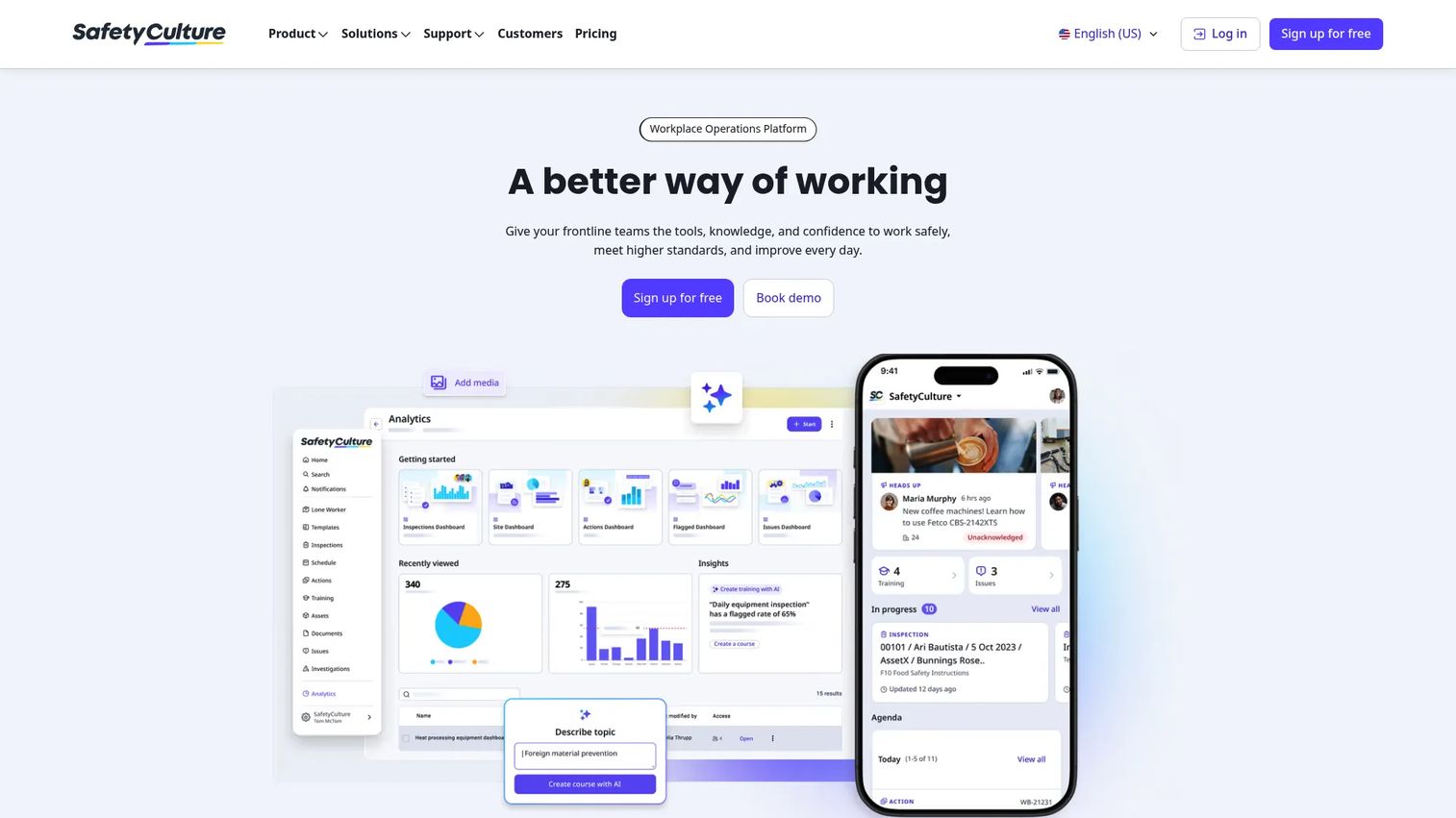
SafetyCulture is a workplace operations platform for inspections, checklists, training, actions, and analytics. It isn't a dedicated cold storage WMS, and it's honest to say so. What it does well is the frontline layer: mobile-first task tracking, compliance checks, and training that staff actually complete. For cold storage teams, that translates into temperature check logs, inspection routines, and corrective actions captured on a phone.
The appeal here is adoption. SafetyCulture is built to be easy for frontline staff to pick up, with a mobile app that supports the kind of repeatable checks a cold facility runs daily. If your inventory and billing already live elsewhere and the gap is operational discipline, temperature compliance, and task visibility, this fills it without a heavy rollout.
Best for: Teams needing frontline inspections, compliance workflows, and training in one easy-to-adopt platform.
Key strengths
- Inspections and checklists: Mobile temperature checks and compliance routines captured in real time.
- Actions and task management: Corrective actions assigned and tracked so issues don't fall through.
- Training: Frontline training delivered and tracked to keep standards consistent.
Why choose SafetyCulture: Choose it when your bottleneck is frontline execution and compliance rather than inventory depth. It pairs well alongside a dedicated inventory system, handling the operational and safety layer that a pure WMS often leaves thin.
SafetyCulture pricing: SafetyCulture offers a Free plan for small teams up to 10 users. Premium runs $24/seat/month billed annually or $29/seat/month billed monthly, and Enterprise is custom-priced. Lite seats start from $5/seat/month billed annually. It holds a 4.6/5 rating on G2.
5. eColdStore
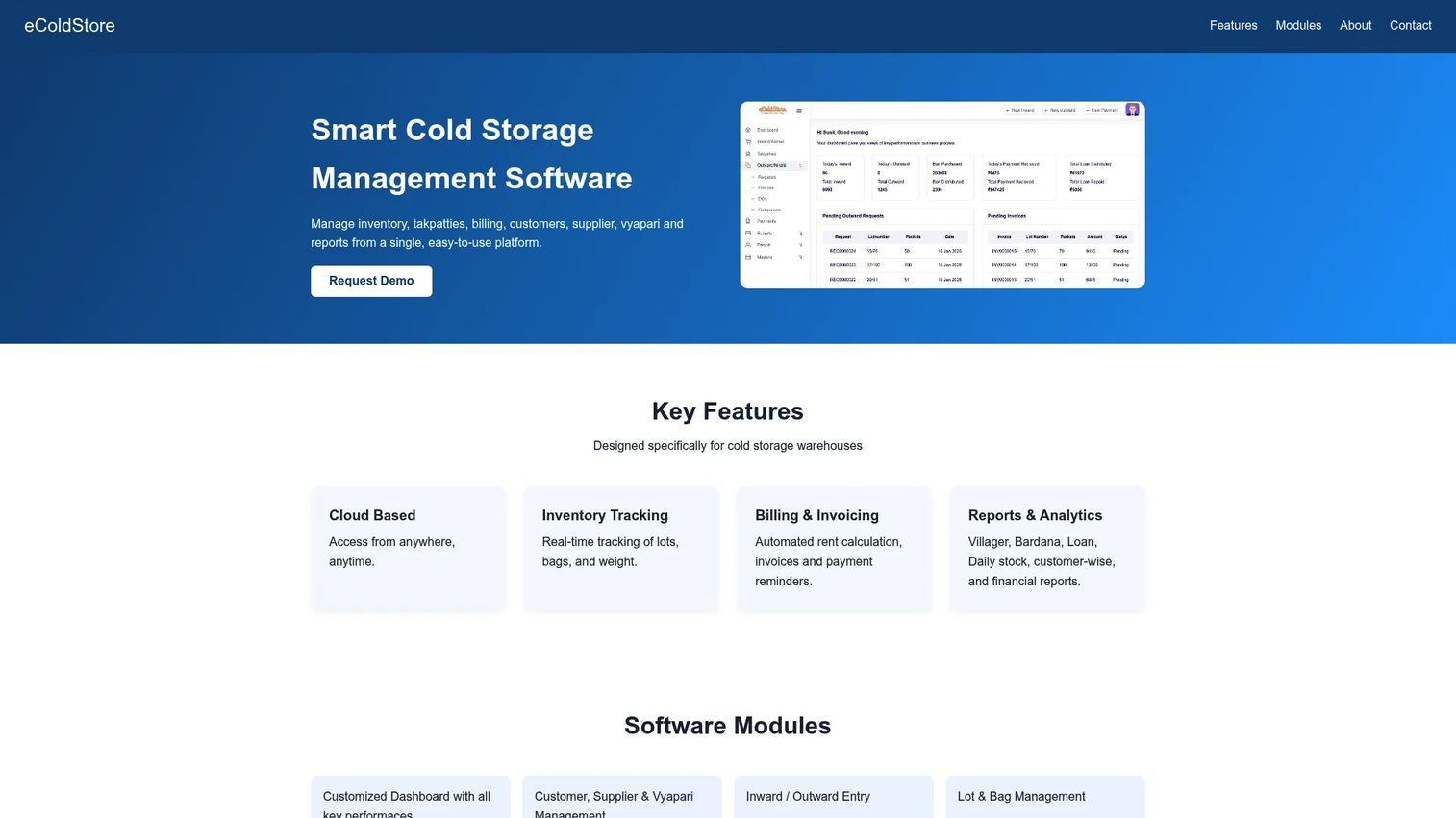
eColdStore is cold storage management software aimed at cold storage businesses that want inventory, billing, and reporting in one straightforward system. It's cloud-based, so access isn't tied to a single machine, and it's built around the daily realities of a cold store rather than the broad requirements of a generic enterprise WMS. Inventory tracking works at the level operators actually count: lots, bags, and weight.
The billing side is where eColdStore fits its audience. It handles rent calculation and invoicing with payment reminders, which is the practical core of running a storage business that charges by stored volume and time. Customer and supplier records, plus reporting, round out a system meant to keep the whole operation legible without demanding a specialist to run it.
Best for: Cold storage warehouses needing inventory, billing, and reporting in one system without heavy enterprise complexity.
Key strengths
- Lot, bag, and weight tracking: Inventory measured the way cold stores actually count stock.
- Billing with rent calculation: Automated rent invoicing and payment reminders built for storage businesses.
- Cloud-based access: Available beyond a single desktop, keeping records accessible across the team.
Why choose eColdStore: Pick it when you want a focused cold storage management system rather than a sprawling platform. It suits operators who need clean inventory and reliable billing without the configuration overhead of an enterprise WMS.
eColdStore pricing: eColdStore does not publish pricing on its site. You'll need to contact the vendor to scope a plan for your operation. Given its positioning toward smaller cold storage businesses, expect pricing scaled to that segment rather than enterprise rates.
6. Datex FootPrint WMS
Datex FootPrint WMS is cloud-native warehouse management software built for 3PLs and complex warehouse operations, including cold storage. It brings the rigor of a formal WMS: real-time inventory visibility, configurable workflows, and low-code customization that lets the system flex to how your facility actually runs rather than forcing your process into a template.
The standout for cold storage 3PLs is billing. Datex includes activity-based billing and audit-ready invoicing, so storage and handling charges are calculated from real warehouse activity and hold up under scrutiny. That tight coupling of operations and billing is exactly what multi-client cold storage operators need, since every stored pallet-day and handling event has to reconcile against an invoice.
Best for: 3PLs and regulated warehouses needing configurable WMS plus built-in, activity-based billing.
Key strengths
- Activity-based billing: Invoicing driven by actual warehouse activity, audit-ready for client disputes.
- Configurable, low-code workflows: The system adapts to your process instead of the other way around.
- Real-time inventory visibility: Live stock positions across the operation for cleaner decisions.
Why choose Datex FootPrint WMS: Choose it when you want warehouse execution and billing in one formal WMS environment, especially in a regulated or multi-client 3PL setting. It fits operators who value configurability and audit-ready records over out-of-the-box simplicity.
Datex FootPrint WMS pricing: Datex does not publish a public price. It prompts prospects to request a demo and describes SaaS, Flex Cloud, and Enterprise editions without listed figures. Pricing is scoped per operation, so plan for a vendor conversation to size it to your facility and edition.
7. Microlistics Chilled WMS
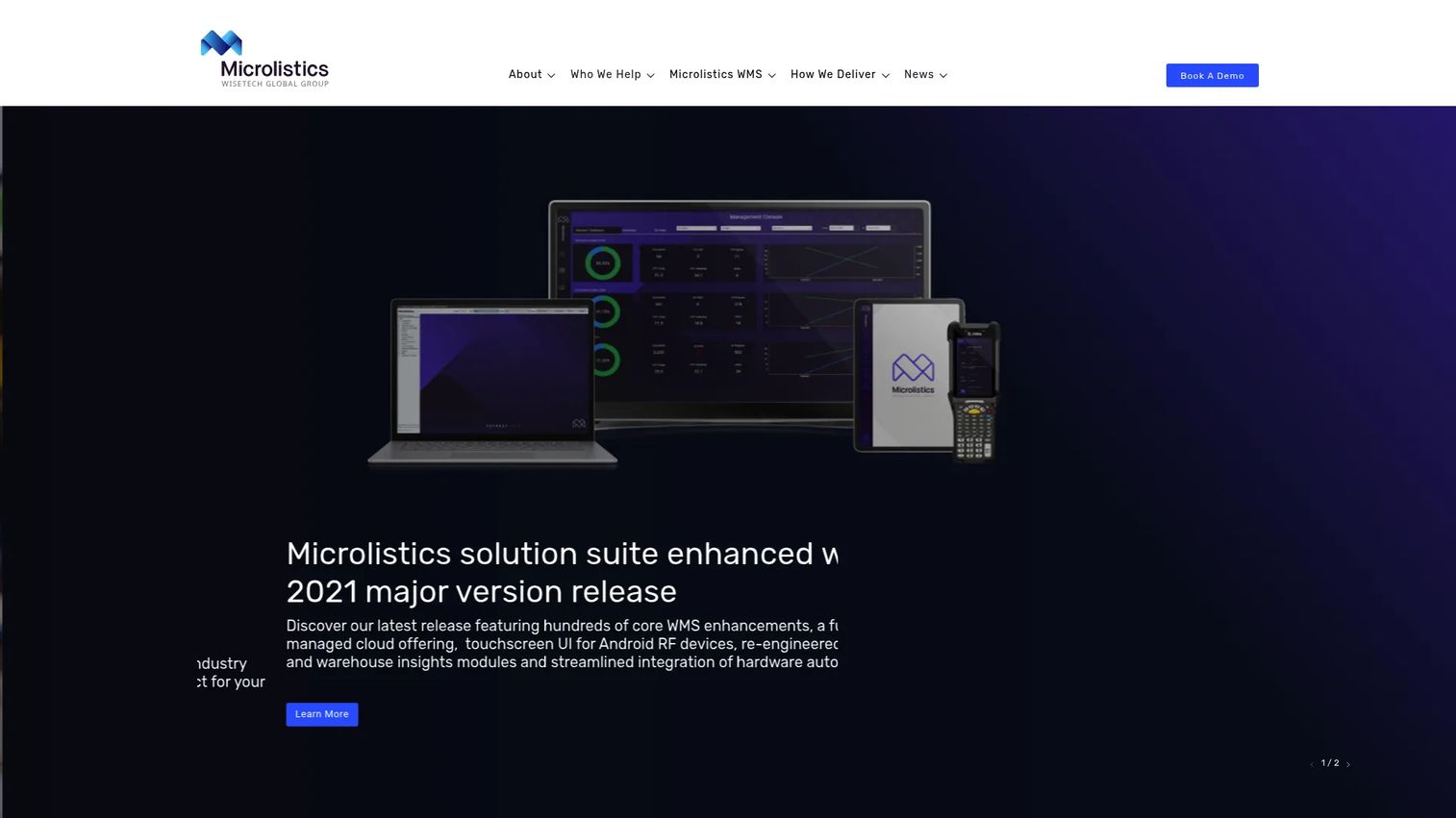
Microlistics Chilled WMS is a pre-templated cold-chain warehouse management system built specifically for cold storage and 3PL operations. The pre-templated approach means the cold-chain logic comes configured rather than assembled from scratch, which suits operators who want specialization without a ground-up build. Multi-chamber temperature control handles facilities running several distinct temperature zones under one roof.
It belongs on a cold storage shortlist because it's purpose-built for the category. Catch-weight, grading, and compliance support address the variable-weight and quality-control realities of food cold chains. Track-and-traceability by batch, lot, and serial gives the granular audit trail regulated stock demands. Client billing supports the multi-client model that third-party cold storage operators run.
Best for: Cold storage and third-party logistics operators needing cold-chain controls, traceability, and multi-client billing.
Key strengths
- Multi-chamber temperature control: Manage several temperature zones within a single facility.
- Track-and-traceability: Batch, lot, and serial-level traceability for regulated and audit-heavy stock.
- Catch-weight and grading: Variable-weight capture and quality grading built for food cold chains.
Why choose Microlistics Chilled WMS: Choose it when you want a specialized, pre-templated cold-chain WMS rather than a general platform bent into shape. It fits multi-client 3PL operators who need traceability and client billing without a long custom-build phase. It holds a 4.5/5 rating on G2.
Considerations before you buy
Feature lists sell software. Fit keeps it. Before you commit, pressure-test each shortlist candidate against the realities of your operation.
Cold chain depth versus general WMS
Confirm the tool treats expiry, temperature zones, and catch-weight as native, not bolt-ons. A general warehouse management software can be forced to track a best-before date, but a purpose-built cold chain WMS enforces FEFO at the pick and blocks expired dispatch automatically. Ask exactly how the system handles lot and expiry management in a live pick scenario.
Mobile adoption on the floor
Software only works if the floor uses it. Check that mobile workflows and handheld scanning are built for freezer conditions: gloved taps, cold-tolerant devices, and screens readable in a chilled aisle. Low-training adoption matters more than feature depth if staff turnover is high or shifts run lean.
Billing and invoicing fit
Match the billing model to how you charge. Activity-based billing suits multi-client 3PLs; simpler rent-and-reminder billing suits single-operator cold stores. The tighter billing and invoicing couples to actual warehouse activity, the less revenue leaks through disputes and manual reconciliation.
Reporting and real-time visibility
Decide what leadership needs to see weekly, then confirm the reporting and dashboards deliver it without exports and spreadsheet surgery. Real-time visibility into stock, aging, and throughput is the difference between managing an operation and reconstructing it after the fact.
Implementation speed and deployment
Ask how long a realistic rollout takes and whether it's cloud, on-premise, or either. A system that takes two quarters to configure has a cost beyond its license: the operational drag of running the old way while you wait.
Conclusion
The right cold storage software depends far more on your operation than on any single feature. If you run a large or complex facility where compliance and labor efficiency both move the number, a deep system like Royal4 WISE Polar or a configurable one like Datex FootPrint WMS gives you the warehouse execution and billing rigor to match. If your workflows are process-heavy with short shelf life, AEB Cold Storage WMS and Microlistics Chilled WMS bring FEFO, catch-weight, and traceability built for cold chain reality.
For smaller operators who want one system rather than a stack, ColdStoreApp and eColdStore consolidate inventory, billing, and reporting without enterprise overhead. And when the gap is frontline execution and temperature compliance rather than inventory depth, SafetyCulture layers in mobile task tracking and inspections with fast adoption.
Choose by workflow fit and implementation speed, not by the longest feature list. Shortlist two or three that match your operation type, run a real scenario through each, and pick the one your floor will actually use on day one. That's the system that pays back its cost in fewer write-offs, cleaner billing, and reporting you can trust.
FAQs
Cold storage software is a warehouse management system built for temperature-controlled facilities. It combines inventory control, lot and expiry management, mobile execution, reporting, and storage billing in one platform. Its job is to keep temperature-sensitive stock accurate, compliant, and shipped in the right order while capturing the activity that drives customer invoices.
Five capabilities carry the most weight: real-time inventory control, lot and expiry management with FEFO or FIFO enforcement, mobile workflows with barcode scanning, reporting and dashboards, and billing tied to warehouse activity. The right mix depends on your operation, but a system weak in any one of these will show the gap fast in a live cold store.
There's heavy overlap, but not everything. A cold storage WMS is a warehouse management system with cold-chain logic built in: it treats expiry dates, temperature zones, and catch-weight as core data rather than optional fields. A general WMS can sometimes be configured to track those, but a cold-storage-focused system enforces them natively across picking, dispatch, and billing.
Smaller operators tend to fit best with all-in-one systems that keep setup light and adoption fast. ColdStoreApp bundles inward/outward, billing, and mobile in one app, while eColdStore focuses on inventory, rent billing, and reporting. Both avoid the configuration overhead of an enterprise WMS, which matters when you don't have a dedicated IT team to run it.
Operators who need tight billing usually look for activity-based invoicing that reconciles against real warehouse movements. Datex FootPrint WMS offers audit-ready, activity-based billing suited to multi-client 3PLs, and Microlistics Chilled WMS supports client billing for the same model. For single-operator cold stores, eColdStore handles rent calculation and payment reminders in a simpler package.
It enforces the right pick order automatically. Lot and expiry management applies FEFO or FIFO logic at the pick face, so the oldest or nearest-to-expiry stock leaves first without relying on operator memory. Dispatch checks block expired lots from shipping, and aging reports flag stock approaching its best-before date before it becomes a write-off.
If work still runs on paper or spreadsheets, yes. Mobile workflows with handheld scanning let staff scan as they receive, put away, and pick, so inventory updates in real time instead of at end of shift. In freezer conditions that means cold-tolerant devices and gloved-hand usability, which is exactly why freezer-rated scanning shows up as a headline feature in dedicated cold storage systems.