A lab can survive a bad dashboard. It cannot survive a specimen that loses its trail between collection, accessioning, testing, and reporting.
That chain-of-custody gap is where operational risk lives. Manual workarounds mask the problem until volume grows or a quality audit exposes it. According to the MLO State of the Industry Survey (2025), 93% of U.S. medical labs already use their LIS for electronic orders and results, yet 52% still run on in-house servers. The infrastructure question, cloud versus on-premise, is only one layer. The harder decision is which platform actually fits your operating model.
Pick the wrong system and you inherit years of interface debt, billing rework, and reporting friction that no team member can fully explain. The right choice depends on your lab type, your test menu, your integration requirements, and who will own the system after go-live.
This guide cuts through the vendor positioning to give you a practical shortlist.
What's inside
This guide covers eight medical lab software platforms evaluated for 2026. Each entry examines workflow fit, interoperability, billing and reporting, quality controls, and deployment burden.
- Who this is for: Laboratory owners, operators, clinical directors, and founders evaluating vertical healthcare software for their clinical lab or as a market investment
- How tools were chosen: Clinical LIS and LIMS category fit, verified G2 ratings, confirmed pricing, and integration scope
- Key selection criteria: Specimen tracking and accessioning depth, EHR and analyzer connectivity, revenue-cycle or billing support, deployment model and implementation burden
TL;DR
- Best for fast cloud rollout: CrelioHealth suits growing diagnostic labs that need portals, billing, and configurable workflows without a lengthy enterprise deployment
- Best for pathology and revenue-cycle: LigoLab Informatics Platform connects clinical pathology workflows with billing and reporting on one platform
- Best for physician office and independent labs: CGM LABDAQ covers day-to-day accessioning, reporting, and administrative workflows for clinics and independent facilities
- Best for regulated enterprise labs: LabVantage and LabWare LIMS fit organizations that need deep configuration and formal governance across complex operations
- Best open-source option: OpenELIS works for public-health programs and technically capable organizations that can own implementation and support
- Best for API-first high-complexity testing: Dendi LIS targets molecular and toxicology labs that treat integrations as a core operational asset
What is medical lab software?
Medical lab software is the operational system a clinical laboratory uses to manage orders, specimens, testing workflows, results, reporting, quality processes, interfaces, and often billing.
Medical lab software usually combines LIS and LIMS capabilities
The two terms overlap in practice but describe different primary functions:
- LIS (laboratory information system): Centers on clinical orders, accessioning, results, reporting, analyzer interfaces, patient and provider workflows, and billing. This is the backbone of most diagnostic and clinical labs.
- LIMS (laboratory information management system): Emphasizes sample lifecycle management, configurability, laboratory data, quality, and regulated process control. More common in enterprise, research, manufacturing, and multi-discipline environments.
- Combined platforms: Many vendors blend both models. A pathology lab, for example, may need LIS depth for clinical workflows and LIMS-style configuration for quality and data governance.
Core capabilities to expect
- Order entry and accessioning with barcode specimen tracking
- Test routing and instrument connectivity
- Result review and rule-based autoverification
- Patient, provider, and client reporting
- Quality control and exception management
- Interfaces for HL7, FHIR, ASTM, APIs, and EHRs
- Billing, claims, and revenue-cycle workflows
- Audit trails, permissions, and data retention controls
- Laboratory analytics for volume, turnaround time, and exceptions
What medical lab software is not
A research electronic lab notebook alone does not replace a clinical LIS. Generic inventory tools cannot manage clinical orders or result distribution. A hospital may need an EHR-embedded lab module, while an independent reference lab needs a specialized standalone platform. Knowing which category your operation requires should precede any vendor demonstration.
| Capability | Clinical LIS | LIMS | Generic lab management tools |
|---|---|---|---|
| Orders and accessioning | Core | Varies | Limited |
| Result reporting | Core | Varies | Limited |
| Instrument interfaces | Common | Varies | Rare |
| Quality workflows | Common | Core | Varies |
| Billing and claims | Common | Varies | Rare |
| Research workflow support | Limited | Strong | Varies |
When to use medical lab software
Replace spreadsheet-based specimen tracking
Multiple handoffs create ambiguity around sample status fast. Barcoding and accession workflows become necessary when volume, complexity, or chain-of-custody expectations rise beyond what a spreadsheet can honestly support. Before comparing vendors, map your current specimen journey from collection to reporting and identify where status goes dark.
Connect testing, reporting, and billing
Disconnected tools create unmeasured rework. The operational and financial risk sits in the gaps between order intake, test execution, result validation, report delivery, and claims follow-up. A platform that manages those steps as one accountable workflow removes the reconciliation burden and makes unit economics legible.
Scale across sites, modalities, or outreach programs
Growth creates new integration requirements: New sites need routing logic, new analyzers need interfaces, new test menus need configuration, and physician-office outreach programs need client portals. A platform chosen at low volume must earn its position at the next scale point, not just the current one.
Medical lab software comparison
No single platform fits every lab. Your priority order should be laboratory type, interface scope, reporting requirements, billing model, and implementation capacity. Pricing and G2 ratings below were verified against each vendor's pricing page and G2 listing as of October 2026.
| # | Product | Best for | Key differentiator | Pricing | G2 rating |
|---|---|---|---|---|---|
| 1 | CrelioHealth | Growing cloud-first diagnostic labs | Cloud LIS with portals, billing, and interoperability | From $600/mo (annual) | 4.7/5 |
| 2 | LigoLab Informatics Platform | Pathology and high-volume diagnostic labs | Unified LIS and revenue-cycle management | Custom pricing | 4.7/5 |
| 3 | CGM LABDAQ | Physician office and independent labs | Established LIS for clinical workflows and lab administration | Custom pricing | 4.2/5 |
| 4 | LabVantage | Regulated enterprise labs | Configurable LIMS and laboratory informatics depth | Custom pricing | 3.8/5 |
| 5 | LabWare LIMS | Complex enterprise laboratory environments | Broad configuration and enterprise workflow control | Custom pricing | 4.5/5 |
| 6 | STARLIMS | Multi-discipline regulated laboratories | Configurable enterprise LIMS for complex workflows | Custom pricing | 4.5/5 |
| 7 | Dendi LIS | Molecular and high-complexity testing labs | API-first cloud LIS with provider and patient workflows | From $2,200/mo | 4.5/5 |
| 8 | OpenELIS | Public-health and budget-sensitive lab programs | Open-source FHIR-native LIS | Open-source (no license fees) | Not listed on G2 |
Pricing and ratings verified October 2026 from each vendor's pricing page and G2 listing.
Best 8 medical lab software tools for 2026
The shortlist spans cloud-first clinical LIS products, pathology platforms, enterprise LIMS tools, and an open-source route. The right product depends on your operating model, not the longest feature list.
1. CrelioHealth
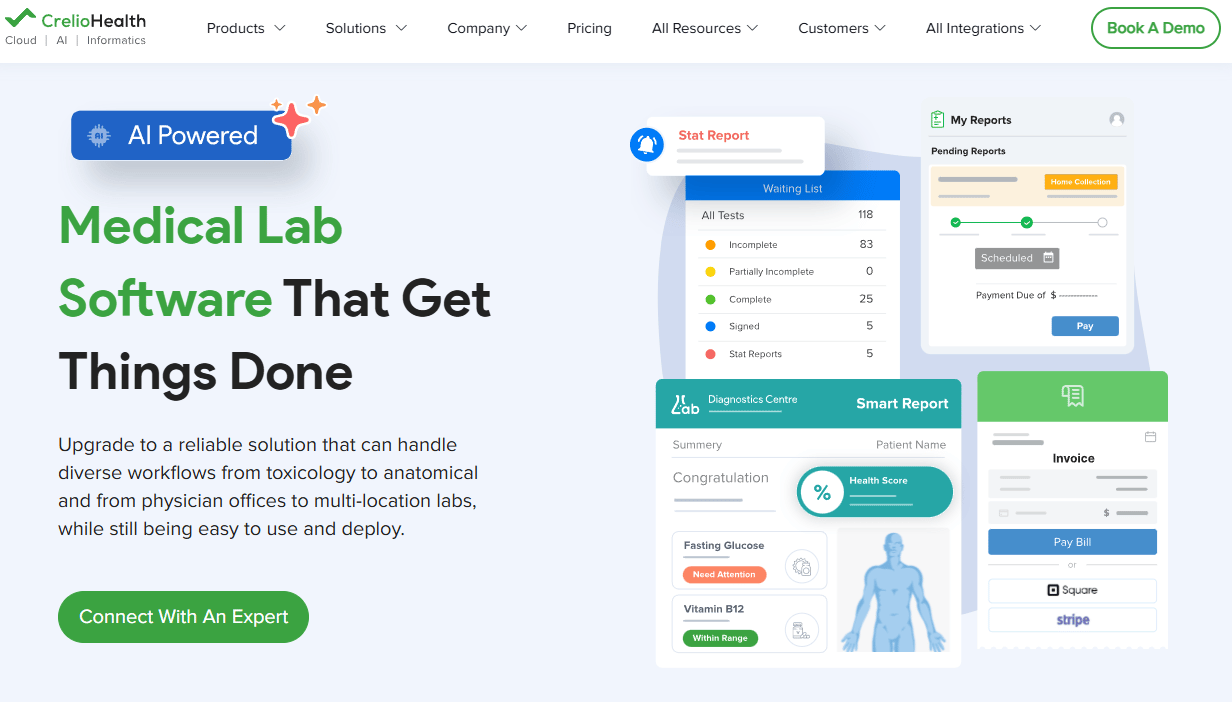
CrelioHealth is a cloud-based healthcare diagnostics platform that combines laboratory information management and radiology workflow software for diagnostic labs and imaging centers. Its LIMS covers order management, barcoding, reporting, inventory, branch management, and integrations. The platform positions itself for independent diagnostic labs, multi-site operations, and outreach programs where portals and billing must operate as connected workflows.
Best for: Independent diagnostic labs and growing multi-site operations that want cloud deployment, patient and physician portals, and configurable workflows.
Key features
- Cloud-based LIMS with order management, barcoding, and branch management
- HL7, FHIR, and API integrations with EHR and analyzer connections
- Patient and physician result portals with branded white-labeling
- Inventory management and quality control dashboards
- Radiology PACS/RIS with DICOM viewing and cloud image storage
Why choose CrelioHealth: It suits teams that need diagnostic workflow depth and are prioritizing speed to go-live over enterprise LIMS configuration. Portals, analyzer connectivity, and billing operating together from a cloud environment removes the infrastructure overhead that slows down smaller or mid-size labs.
CrelioHealth pricing: Annual plans start at $600/month for the Smart tier, with Optimized at $1,400/month, Pro at $2,750/month, and Power at $4,900/month. Monthly billing is available at a 15% premium. Onboarding fees and radiology-module pricing are separate.
G2 rating: 4.7/5
2. LigoLab Informatics Platform
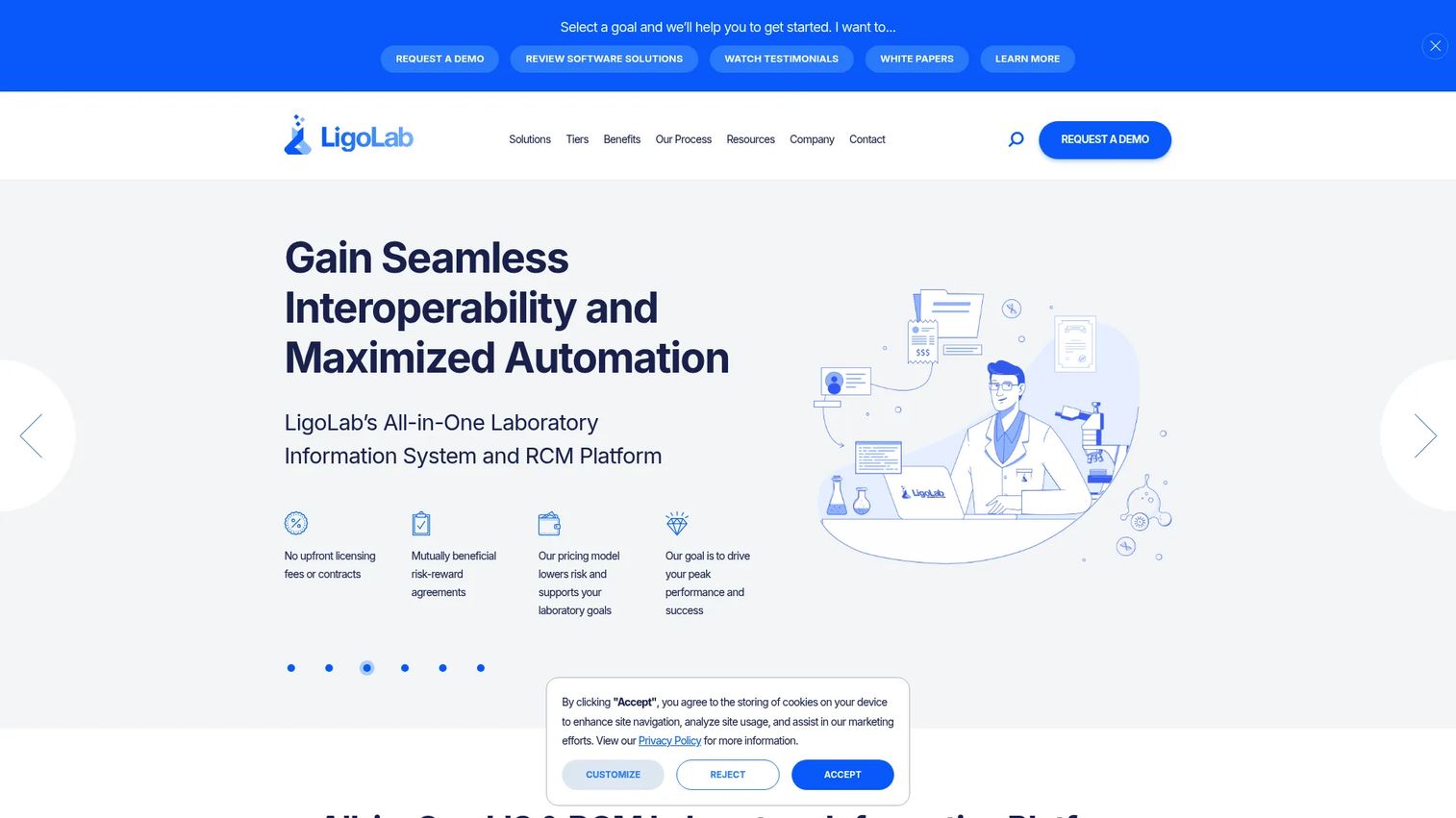
LigoLab Informatics Platform is an all-in-one LIS and revenue cycle management platform built for pathology, clinical, molecular, and direct-to-consumer laboratories. The platform combines anatomic pathology, clinical pathology, molecular diagnostics, and laboratory revenue cycle management in a single operating environment. Its interface engine supports FHIR, HL7, XML, X12, CSV, ASTM, and RESTful API integrations.
Best for: Mid-market and enterprise pathology or diagnostic laboratories where clinical operations and reimbursement workflows must connect through one platform.
Key features
- Anatomic pathology, clinical pathology, and molecular diagnostics modules
- Built-in revenue cycle management with billing and reimbursement workflows
- Barcode specimen tracking with autoverification and configurable reporting
- Interface engine supporting HL7, FHIR, ASTM, X12, and RESTful APIs
- Configurable rules, dashboards, and audit trails
Why choose LigoLab Informatics Platform: The strategic value is reducing handoffs between lab operations, reporting, and billing. For a founder or operator, this matters when the bottleneck spans clinical throughput and reimbursement rather than specimen tracking alone.
LigoLab Informatics Platform pricing: LigoLab prices through a tailored implementation quote with volume-based or transactional tiers. The pricing page describes tiered options but does not display specific amounts. Contact LigoLab for a quote and confirm contract minimums and implementation fees during the sales process.
G2 rating: 4.7/5
3. CGM LABDAQ
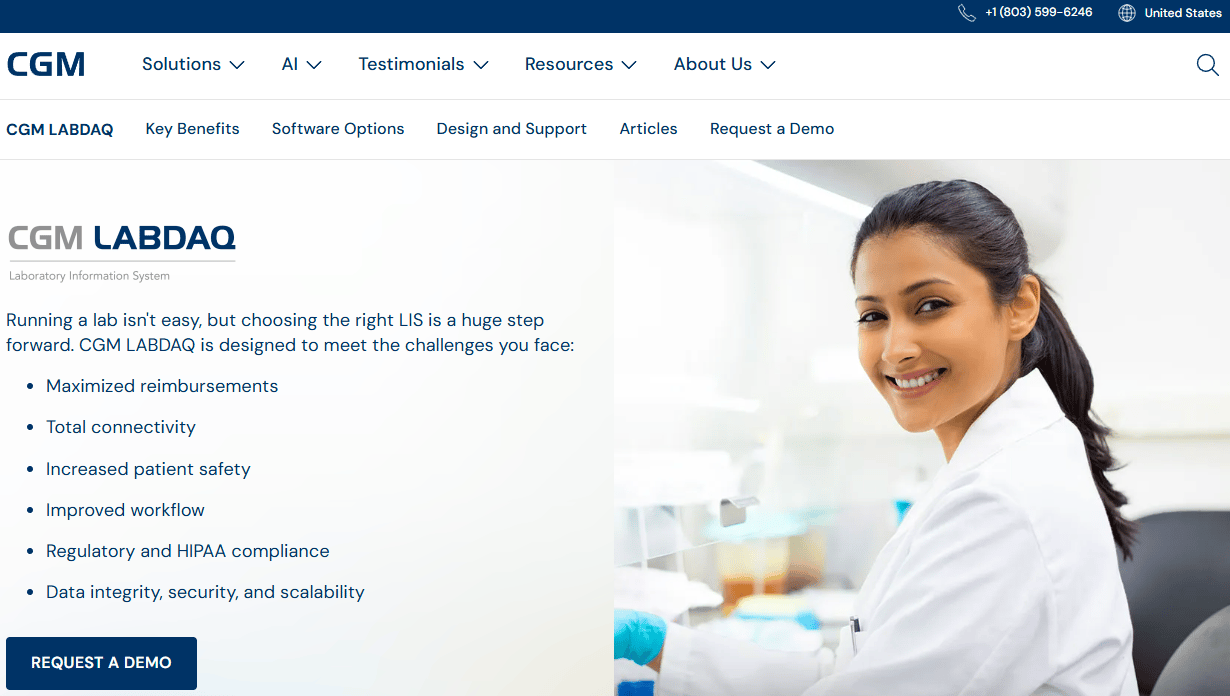
CGM LABDAQ is a laboratory information system designed for physician office labs, clinics, independent laboratories, reference labs, and veterinary facilities. It covers clinical workflows including accessioning, PCR testing support, document management, and patient data handling. The platform includes CGM LABNEXUS as a web portal and outreach layer for provider access.
Best for: Physician office laboratories and independent labs that want a mature clinical LIS built around day-to-day accessioning, reporting, and laboratory administration.
Key features
- Clinical accessioning and specimen management workflows
- PCR and diagnostic testing support
- CGM LABNEXUS web portal for provider outreach
- Data Miner analytics and Lab IQ performance dashboard
- Analyzer and EHR connectivity with HIPAA compliance support
Why choose CGM LABDAQ: It is a practical shortlist candidate for clinics and independent labs that need established LIS functionality without enterprise LIMS complexity. Validate specialty test-menu support and specific interface requirements early in the sales process.
CGM LABDAQ pricing: CGM LABDAQ uses a sales-led pricing model. Contact CGM directly for package structure, onboarding costs, and current subscription terms. No pricing is displayed on the official product pages.
G2 rating: 4.2/5
4. LabVantage
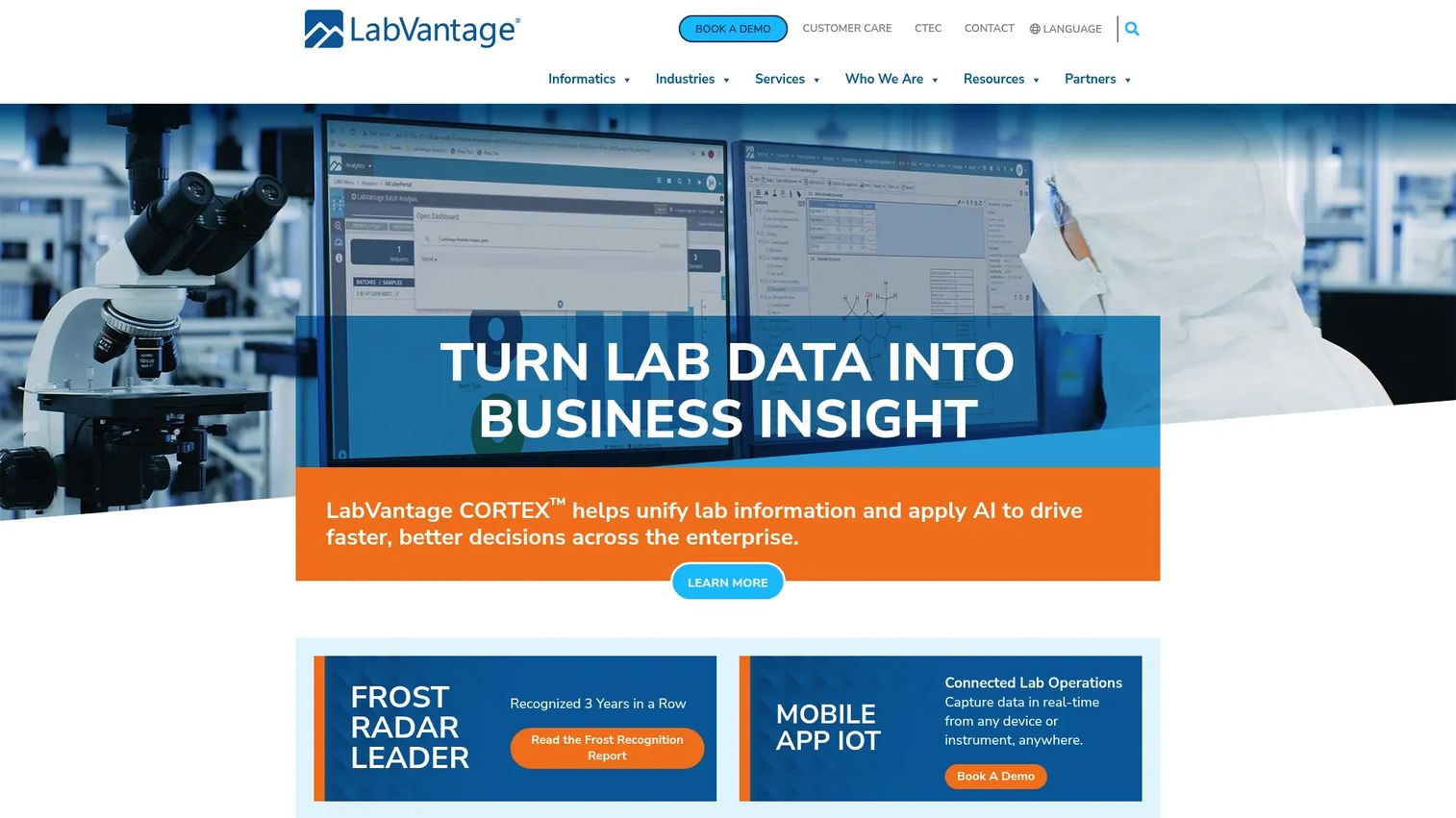
LabVantage provides an enterprise laboratory informatics platform centered on LIMS, with integrated electronic lab notebook, laboratory execution, scientific data management, and analytics capabilities. The platform targets regulated laboratory environments across research, diagnostics, manufacturing, and biobanking. Configuration capabilities, quality workflows, and governance tools are core to its positioning.
Best for: Enterprise laboratory organizations that need configurable laboratory informatics, quality workflows, and governance across complex or regulated operations.
Key features
- Sample lifecycle, consumables, and stability management
- Integrated ELN, workflow designer, barcode generation, and instrument management
- Dashboards, reporting, and AI-powered analytics
- Instrument and enterprise-system integrations with RESTful web services
- Security, auditing, electronic signatures, and compliance support
Why choose LabVantage: It fits when the lab needs deep process configuration and has internal capacity to govern and maintain it. Ask vendors to detail the implementation timeline, validation requirements, and configuration ownership model before signing.
LabVantage pricing: LabVantage does not display pricing on its website. Contact their team for a tailored quote. Reviewer feedback on G2 suggests enterprise contracts with implementation fees that vary by deployment scope and integration complexity.
G2 rating: 3.8/5
5. LabWare LIMS
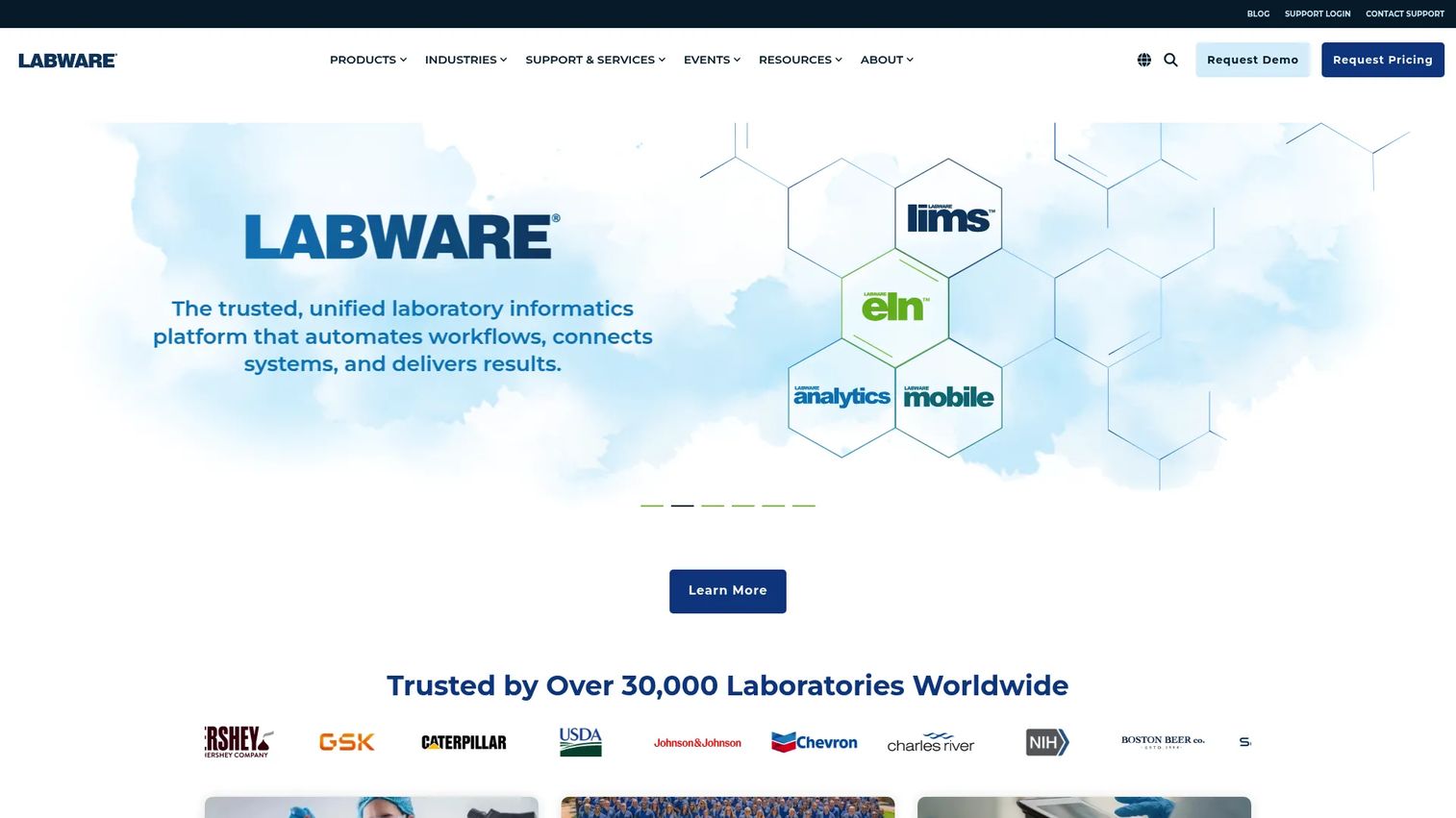
LabWare LIMS is a configurable laboratory information management system with a long track record in regulated and enterprise laboratory environments. Its scope covers lot management, stability studies, environmental monitoring, instrument interfacing, sample management, and multi-site governance. Deployment options include LabWare SaaS, hosted, customer-cloud, and self-hosted configurations.
Best for: Large laboratory networks and regulated organizations that need deep workflow configuration, audit controls, and long-term operational governance.
Key features
- Configurable laboratory workflows, dashboards, and batch management
- Lot management, stability study management, and environmental monitoring
- Instrument interfacing and external stakeholder portal
- Audit trails, electronic signatures, and training management
- Inventory management with barcode and analytical search support
Why choose LabWare LIMS: LabWare belongs on the shortlist where system durability, configuration depth, and governance matter more than deployment speed. Evaluate it with a detailed requirements matrix and a clear internal owner for configuration and release management.
LabWare LIMS pricing: LabWare prices through a quote-based commercial process. Four deployment models are available, each with separate subscription or licensing terms. Contact LabWare for current figures; G2 reviewers note that enterprise implementations carry significant initial investment.
G2 rating: 4.5/5
6. STARLIMS
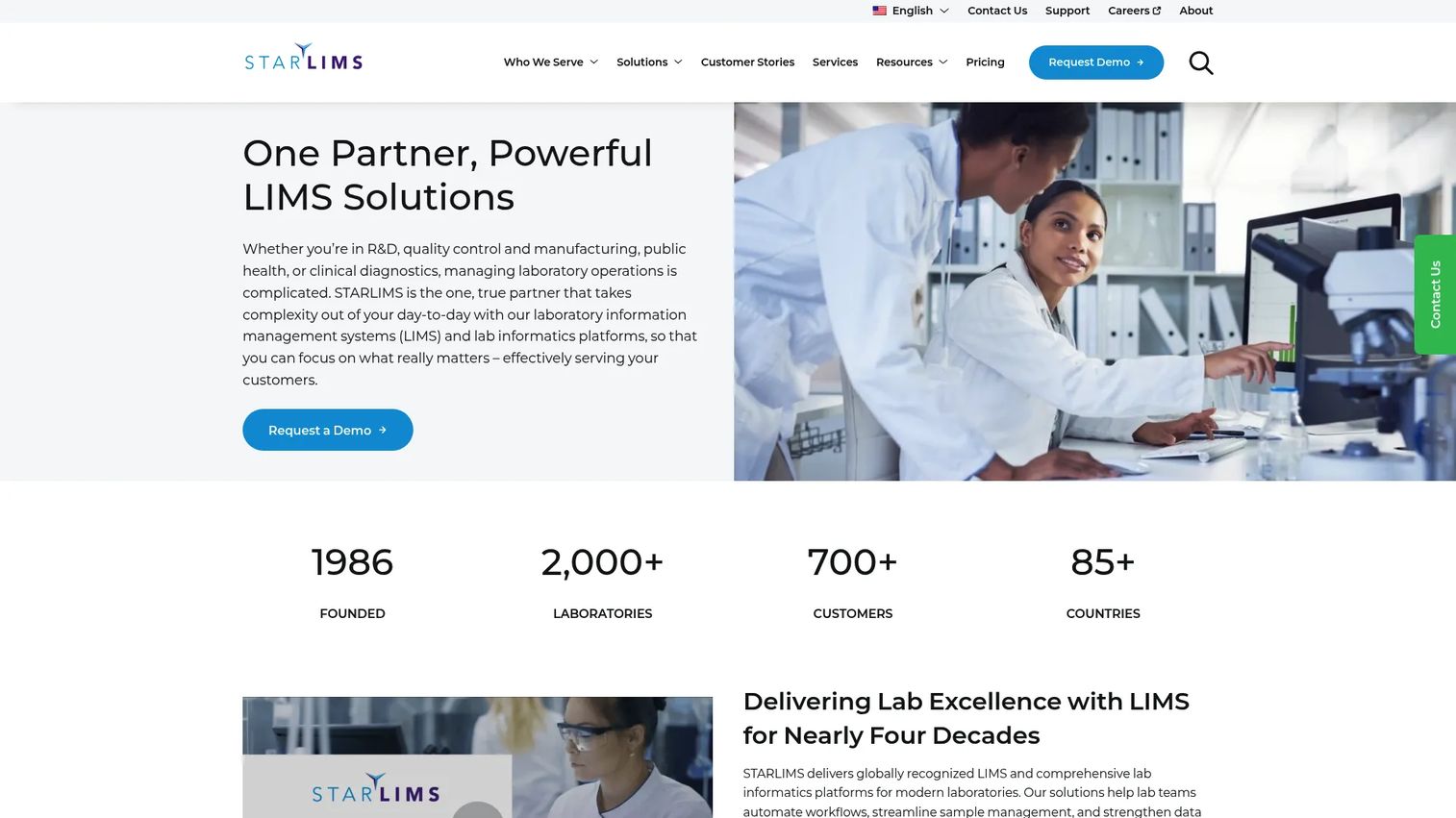
STARLIMS provides laboratory informatics software including LIMS, electronic lab notebook, laboratory execution, scientific data management, and advanced analytics for clinical, public health, research, quality, and manufacturing laboratories. The platform supports regulated and complex laboratory operations across multiple disciplines, with cloud and on-premise deployment options.
Best for: Regulated laboratories with multiple workflow types, formal governance requirements, and sufficient implementation capacity.
Key features
- Sample and specimen management with end-to-end traceability
- Workflow automation and instrument integration
- Scientific document management through SDMS
- Electronic laboratory notebooks with real-time data capture
- Audit trails, electronic signatures, compliance controls, and advanced analytics
Why choose STARLIMS: STARLIMS fits buyers who need a structured enterprise platform across multiple laboratory programs. Evaluate it through scenario-based demonstrations using your actual workflows, and confirm the deployment model, implementation partner requirements, and validation scope before contracting.
STARLIMS pricing: STARLIMS prices through vendor-led proposals. Contact STARLIMS for a quote covering licensing model, delivery options, and implementation scope. Verify current terms directly with the vendor.
G2 rating: 4.5/5
7. Dendi LIS
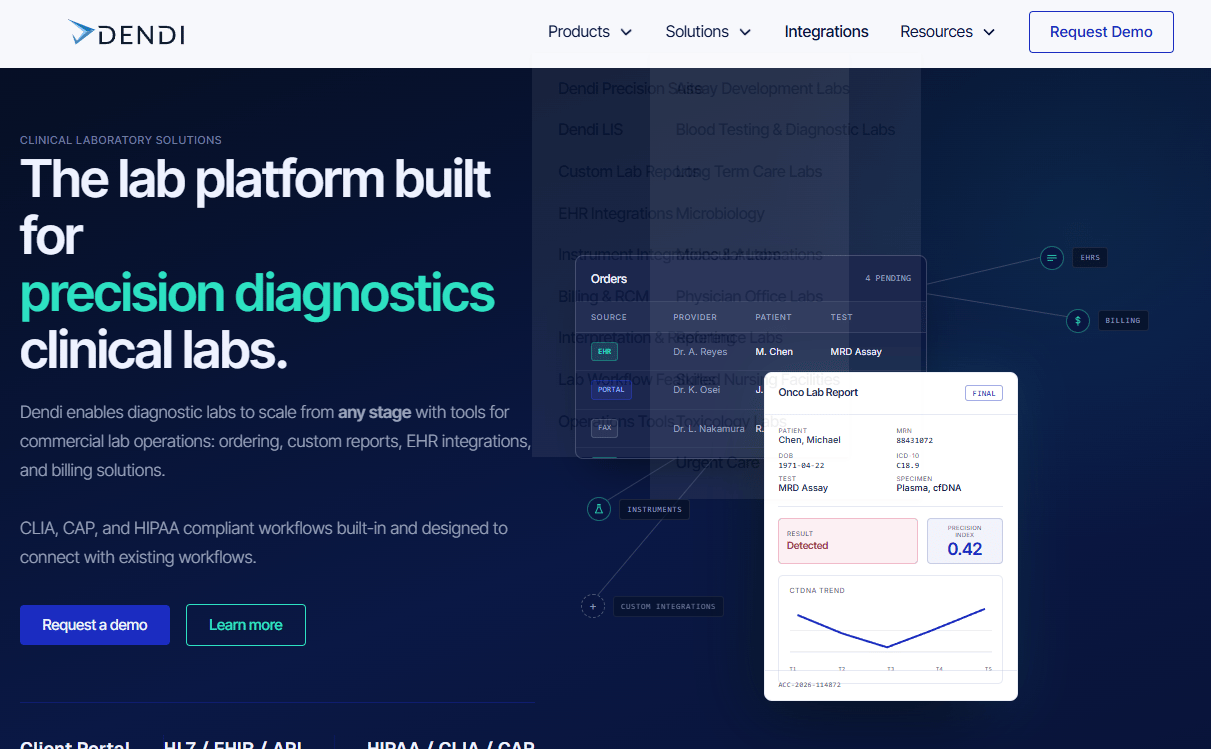
Dendi LIS is a cloud-native laboratory information system built for clinical and precision-diagnostics laboratories. Its API-first architecture makes it a strong fit for molecular diagnostics, toxicology, and high-complexity testing labs that view integrations as a core operational asset. The platform includes provider and patient portals for ordering and report access, along with EHR, EMR, instrument, and billing integrations.
Best for: Molecular, toxicology, and high-complexity testing labs that need cloud delivery and flexible integration architecture.
Key features
- API-first system architecture with extensive integration support
- Provider ordering portal and patient result access
- EHR/EMR, instrument, and billing integrations
- Configurable reports, test menus, permissions, and audit logs
- Quality control module with updates and support included
Why choose Dendi LIS: It is a strong option for modern diagnostic labs that treat integrations as a product advantage. Flexibility only creates value when the lab has clear interface ownership. Validate your full interface backlog, not just the API documentation, before committing.
Dendi LIS pricing: The starter tier runs $2,200/month, billed monthly. Pricing scales with integration quantity and types. The monthly subscription includes unlimited tests, users, and client accounts, along with the provider portal, QC module, data exports, updates, and support.
G2 rating: 4.5/5
8. OpenELIS
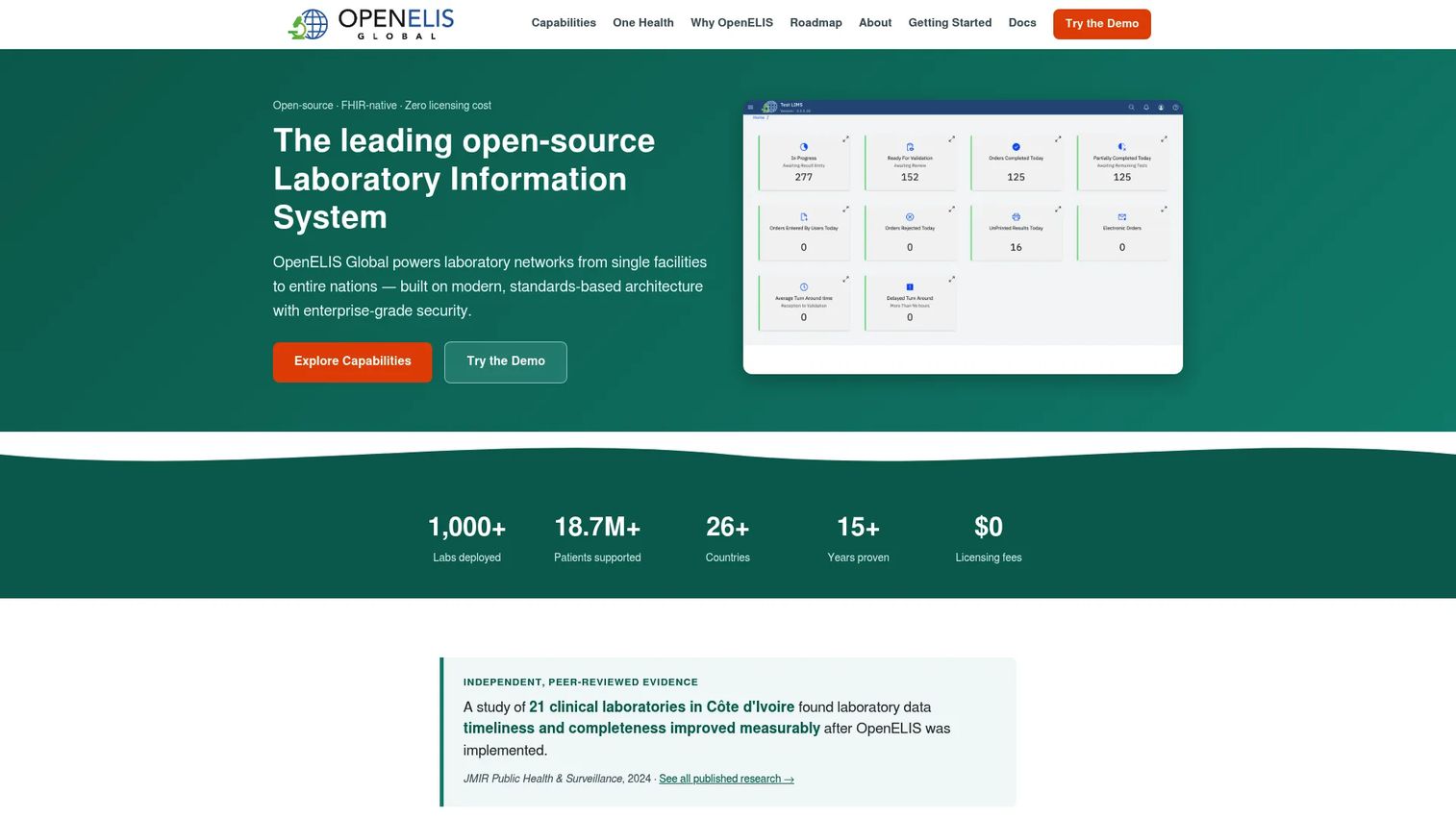
OpenELIS Global is a free, open-source, FHIR-native laboratory information system for clinical, environmental, and vector surveillance workflows. It covers end-to-end lab workflow management from patient registration through results reporting, with FHIR R4 interoperability connecting to EMRs, national health systems, DHIS2, and SORMAS. Analyzer integration runs through ASTM, HL7, and file-based protocols.
Best for: Public-health programs, nonprofits, and laboratories with strong technical capacity that need an open-source LIS foundation.
Key features
- End-to-end workflow management from registration through reporting
- FHIR R4 interoperability with EMRs, DHIS2, and SORMAS
- Analyzer integration through ASTM, HL7, and file-based protocols
- Sample storage, chain-of-custody, barcode, and aliquot tracking
- Quality control with Westgard rules, Levey-Jennings charts, and corrective-action tracking
Why choose OpenELIS: OpenELIS gives technically capable organizations more control over the software stack and removes recurring license costs. It is a serious option when your team can own implementation, configuration, ongoing maintenance, and validation.
OpenELIS pricing: The software carries no licensing fees, per-user costs, or annual renewals. Your total cost depends on implementation services, hosting, interfaces, upgrades, and support. Open-source does not eliminate operating cost; budget accordingly before committing to this route.
Considerations when choosing medical lab software
Confirm your clinical workflow fit before comparing feature lists
Pathology, molecular testing, toxicology, microbiology, and physician office workflows are not interchangeable. Ask which test types create the most operational complexity, which workflow requires the tightest chain of custody, and where exceptions need manual review. A platform that handles anatomic pathology well may be oversized for a physician office lab or undersized for a high-complexity molecular program.
Audit every interface and data handoff
Build an interface inventory before booking demos. Cover analyzer interfaces, EHR and EMR connectivity, HL7 and FHIR requirements, ASTM protocols, billing and clearinghouse connections, API dependencies, and data migration sources. Missing a single interface during vendor evaluation can translate into months of post-go-live remediation.
Treat quality and compliance controls as operating requirements
Audit trails, role permissions, result review workflows, quality control, document controls, and reporting requirements are not optional features. Do not assume any platform automatically satisfies CLIA, CAP, HIPAA, or other standards. Your lab must validate its own processes, configuration, and controls against applicable requirements.
Price the full implementation, not just the subscription
Implementation cost includes data migration, interface development, training, validation, configuration, go-live support, and ongoing administration. A platform with a low monthly subscription but high interface fees and a long validation cycle may cost more than a higher-priced option with a faster path to usable workflows.
Ask who owns the system after go-live
A tool that requires constant executive intervention will not scale. Require named owners across lab operations, IT, billing, quality, and finance before signing. If your team cannot staff those roles now, factor that into the deployment timeline and total cost.
How to choose the right medical lab software for your team
If you run a physician office or independent diagnostic lab
Start with CrelioHealth and CGM LABDAQ. Both are built around the workflows that matter most at this scale: Accessioning, analyzer interfaces, reporting, outreach, and billing. CrelioHealth suits teams that want cloud deployment with portals ready out of the box. CGM LABDAQ fits labs that want a mature LIS with an established track record in clinical and physician-office environments.
If pathology and reimbursement workflows create the bottleneck
Start with LigoLab Informatics Platform. Connecting pathology workflows, configurable reporting, and revenue cycle management in one operating environment removes the handoff risk between clinical and billing teams. Implementation scope will vary by pathology workflow and integration complexity, so validate those specifics early.
If your lab needs deep enterprise configuration
Evaluate LabVantage, LabWare LIMS, and STARLIMS against a detailed requirements matrix. Each rewards organizations that bring internal capacity to govern configuration and manage releases. Test each platform against your actual workflow scenarios, and confirm implementation partnership, validation requirements, and deployment model before contracting.
If your differentiation depends on integrations
Start with Dendi LIS for cloud and API-first evaluation. Confirm the full interface backlog, including analyzer connections, EHR and EMR versions, billing workflows, and ordering portal requirements, before making a decision based on API documentation alone.
If budget is constrained but technical capacity is strong
Evaluate OpenELIS. License cost is only one variable. Factor in hosting, implementation services, interface development, upgrades, and validation before treating it as a low-cost default.
Conclusion
The right medical lab software is the one that fits your lab's operating model, not the vendor with the longest feature list.
CrelioHealth suits growing diagnostic labs that need cloud deployment and connected portals without a lengthy enterprise rollout. LigoLab Informatics Platform is worth evaluating wherever pathology workflows and revenue-cycle management must operate on one platform. CGM LABDAQ fits physician office and independent clinical labs that need mature LIS functionality. LabVantage, LabWare LIMS, and STARLIMS each serve organizations with deep enterprise configuration requirements and internal capacity to govern them. Dendi LIS is the right starting point for API-first, high-complexity testing environments. OpenELIS makes sense when technical ownership is strong and license cost is a real constraint.
Before booking vendor calls, document the five workflows, interfaces, reports, and billing handoffs that create the most operational risk today. That list should drive every demonstration.
Start your journey with Guideflow today!
FAQs about medical lab software
Medical lab software is the broad category. A laboratory information system (LIS) specifically manages clinical orders, accessioning, results, reporting, analyzer interfaces, and billing workflows for diagnostic laboratories. A laboratory information management system (LIMS) centers on sample lifecycle management, configurability, quality workflows, and regulated process control, often in research, manufacturing, or multi-discipline environments. Many vendors combine both models in a single platform, which is why the terms frequently overlap in vendor marketing.
Prioritize accessioning, barcode specimen tracking, analyzer and EHR interfaces, result reporting, quality controls, role-based permissions, audit trails, and billing support. Focus on the workflows that create the most rework or exception handling in your current operation. A platform that solves your highest-friction workflow first will deliver more value faster than one with the broadest feature count.
Most clinical LIS and LIMS platforms support EHR and EMR connectivity through HL7, FHIR, APIs, and vendor-specific interfaces. The key detail is your specific EHR version, the interface scope, and who owns implementation and ongoing maintenance. Ask each vendor for a list of confirmed integrations and validate those claims against your actual EHR environment before contracting.
Clinical diagnostic laboratories typically need LIS functionality for order management, results reporting, analyzer connectivity, and billing. Labs with broader research programs, complex quality workflows, or highly configurable process requirements may also need LIMS capabilities. The answer depends on your order management model, results reporting requirements, compliance workflow, and how much process configuration your operations require.
Costs range from cloud subscriptions starting around $600 per month for smaller diagnostic lab platforms to enterprise contracts with implementation fees that can reach six figures or more. The total cost includes subscription or license fees, interface development, data migration, training, validation, and ongoing support and administration. For enterprise platforms like LabVantage, LabWare, and STARLIMS, implementation cost often exceeds the first year of licensing.
Focus on accessioning, configurable pathology reporting, specimen traceability, document and image workflows where relevant, billing, quality controls, and integration with clinical systems. Request scenario-based demonstrations using your actual case types. Revenue cycle management integration is a meaningful differentiator for labs where billing and clinical workflows currently operate as separate systems.
Yes, if the organization has adequate technical, implementation, and support capacity. OpenELIS is a serious option with FHIR-native interoperability and quality control capabilities built for clinical and public-health environments. The software is free to use, but hosting, interface development, upgrades, validation, and operational support still require budget and dedicated ownership. Open-source works when those costs are honestly assessed upfront.
Timeline depends on the number of interfaces, data migration complexity, test menu size, number of sites, validation requirements, and training scope. A focused cloud LIS deployment for a single-site lab may reach go-live in weeks. A multi-site enterprise LIMS implementation with extensive analyzer interfaces and formal validation can take a year or more. Ask each vendor for a phased project plan tied to specific workflow milestones, not just a total timeline estimate.
CLIA, CAP, HIPAA, and relevant state regulations apply to most U.S. clinical laboratories. Describe your accreditation requirements, data retention obligations, and access control needs during vendor evaluation. A platform's audit trail, role permissions, and validation documentation support your compliance program, but the lab is responsible for configuring and operating the system in a compliant manner. No software purchase alone satisfies a regulatory requirement.