A regulatory update lands in your inbox. Finding it was the easy part. Proving which obligations it touches, which policies need updating, who owns the remediation, and whether the evidence is complete - that's where organizations lose weeks.
The problem isn't awareness. It's fragmentation. Updates arrive in one system, impact analysis happens in a spreadsheet, task ownership lives in email threads, and audit documentation sits somewhere no one can find. According to the PwC Global Compliance Survey (2025), 85% of compliance professionals say requirements have become more complex over the past three years. The same report found that 82% plan to increase investment in at least one technology to automate or optimize compliance.
Regulatory change management software closes that gap by connecting monitoring, impact analysis, obligation mapping, workflow automation, and audit trails inside a single platform. For marketing operations teams in regulated industries, this matters directly: A missed regulatory update can delay a product launch, halt a campaign, or trigger an enforcement review. This guide covers 17 regulatory change management tools evaluated for compliance, risk, and legal teams, with secondary framing for operations and marketing functions that sit downstream of the compliance decision.
What's inside
This guide is for compliance officers, regulatory affairs teams, enterprise risk managers, legal operations leaders, and governance teams evaluating enterprise compliance software. It also speaks to marketing and demand gen teams in regulated organizations who need to understand the compliance stack their campaigns depend on.
Tools were selected and compared based on:
- Regulatory source coverage and horizon scanning breadth
- Impact analysis depth and obligation mapping capability
- Workflow automation, task assignment, and remediation tracking
- Audit trails, evidence collection, and GRC integration quality
TL;DR
- Best overall regulatory change management platform: MetricStream, for broad GRC coverage across regulatory intelligence, obligation mapping, and audit workflows
- Best for dedicated regulatory intelligence: Compliance.ai (now Archer Evolv Compliance), for automated horizon scanning and obligation extraction
- Best for broader GRC integration: IBM OpenPages with Watson, for organizations standardizing risk, compliance, and controls in one platform
- Best for policy and control mapping: Clausematch, for teams focused on the full policy lifecycle and regulatory alignment
- Best for marketing compliance monitoring: PerformLine, for regulated marketing oversight across channels, partners, and campaigns
- Best for financial services use cases: Predict360 or CUBE RegPlatform, depending on the required intelligence and workflow depth
What is regulatory change management software?
Regulatory change management software is enterprise compliance software that monitors regulatory developments, assesses their impact, maps obligations to internal controls and policies, assigns remediation work, and preserves evidence for oversight and audits.
The core regulatory change lifecycle runs in this order:
- Monitor regulatory sources across relevant jurisdictions
- Identify and classify a change
- Assess affected obligations, policies, controls, and business processes
- Assign owners and deadlines
- Track remediation tasks
- Collect and store supporting evidence
- Report status to compliance leadership and oversight bodies
- Review and update records as requirements evolve
Core capabilities
Strong compliance automation software in this category typically includes:
- Regulatory intelligence and horizon scanning
- Regulatory tracking across jurisdictions and publication types
- Regulatory impact analysis and applicability assessment
- Compliance obligation management and control mapping
- Policy and procedure management
- Compliance workflow automation and task assignment
- Enforcement action monitoring
- Compliance evidence collection and retention
- Audit trails and reporting dashboards
- GRC integration and role-based access controls
- AI-assisted classification with human review
Category boundary
The category spans several product types. Dedicated regulatory intelligence tools focus on monitoring and classifying external developments. Regulatory change management platforms add impact analysis, obligation mapping, and workflow automation on top of that intelligence layer. Broader GRC suites cover risk, audit, policy, and controls, with regulatory change as one module among many. Policy management systems focus on the internal document lifecycle rather than external monitoring. Some products in this list cover the entire regulatory change lifecycle; others focus on a specific layer. The tool sections below clarify where each platform sits.
When to use regulatory change management software
Track changes across jurisdictions
Organizations operating across multiple states, countries, or regulatory bodies face alert fatigue when monitoring manually. A platform with configurable jurisdiction filters, source coverage across regulators, and automated horizon scanning reduces the time spent finding relevant changes and routes them to the right owners automatically.
Map regulatory changes to controls and obligations
Knowing a rule changed is only useful if you can trace its downstream effects. Teams that need to show auditors exactly which policies, procedures, controls, and business lines were affected by a specific update require traceable obligation mapping. This is where regulatory impact analysis separates useful platforms from basic alert tools.
Coordinate remediation and audit preparation
When a regulatory change requires action, the work typically spans compliance, legal, risk, product, operations, IT, and sometimes marketing operations. Platforms with task assignment, deadline tracking, approval workflows, and evidence collection keep cross-functional remediation on schedule. The same data that drove the remediation then feeds directly into audit readiness reporting, removing the scramble before examination.
Regulatory change management software comparison
The table below is a shortlist, not a substitute for product validation. Verify pricing and ratings against vendor pages and live G2 listings before making a purchase decision, as both change frequently.
| # | Product | Best for | Key differentiator | Pricing | G2 rating |
|---|---|---|---|---|---|
| 1 | MetricStream | Enterprise GRC and regulatory program management | Integrated AI-first platform across risk, compliance, and audit | Custom pricing | 3.8/5 |
| 2 | Compliance.ai (Archer Evolv) | Automated horizon scanning and obligation extraction | Business-profile relevance assessment with citation lineage | Custom pricing | 0.0/5 (0 reviews) |
| 3 | Archer Evolv Compliance | Cross-jurisdiction obligation mapping and gap analysis | Obligation extraction with traceable citation lineage | Custom pricing | 3.6/5 |
| 4 | IBM OpenPages with Watson | Enterprise GRC with AI-assisted compliance workflows | Configurable GRC canvas connecting risks, controls, and processes | From $3,300 (indicative) | 4.2/5 |
| 5 | PwC Compliance Insights | Multi-jurisdiction regulatory monitoring across 150+ jurisdictions | Advisory-integrated compliance software with centralized obligation tracking | Custom pricing | |
| 6 | LogicGate Risk Cloud | Configurable GRC workflows for risk and compliance teams | No-code graph database with 200+ integrations and GRC AI agents | Custom pricing | 4.6/5 |
| 7 | CorityOne | EHS, quality, and sustainability compliance management | Unified EHS+ platform with Cortex AI and human-in-the-loop intelligence | Custom pricing | 3.9/5 |
| 8 | LogicManager | Enterprise risk management with regulatory compliance scope | Connected risk-based governance with fixed-fee, unlimited-user pricing | Custom pricing | 4.2/5 |
| 9 | ComplianceHR | U.S. employment law and HR regulatory compliance | 50-state employment law guidance with compliant document generation | Custom pricing | 4.8/5 |
| 10 | Corlytics | Regulatory intelligence and non-financial risk for financial services | AI-driven obligation extraction and regulatory library | Custom pricing | |
| 11 | Clausematch | Policy lifecycle management and regulatory obligation mapping | Policy-to-regulation traceability with full audit history | Custom pricing | 4.0/5 |
| 12 | GlobalSuite | Integrated GRC across risk, security, audit, and compliance | All-in-one platform covering ESG, AI governance, and privacy | Custom pricing | 4.5/5 |
| 13 | OneSumX for Compliance Program Management | Financial services compliance program management | FIS-backed compliance and regulatory change tracking | ||
| 14 | PerformLine | Marketing compliance monitoring and channel oversight | Omni-channel compliance monitoring with configurable rulebooks | Custom pricing | 0.0/5 (0 reviews) |
| 15 | Predict360 | AI-assisted risk and compliance for financial and insurance organizations | Integrated risk and compliance with AI analysis | Custom pricing | 5.0/5 (1 review) |
| 16 | SAI360 Regulatory Change Management | Multi-jurisdiction regulatory monitoring and compliance workflows | AI-powered impact assessment integrated with broader GRC | Custom pricing | 4.1/5 |
| 17 | CUBE RegPlatform | Automated regulatory intelligence and obligation management for financial services | Agentic AI with real-time horizon scanning and RegConnect API | Custom pricing |
Pricing and ratings verified September 2026 from each vendor's official pricing page and G2 listing. Indicative IBM prices are from the IBM product page and labeled as such; IBM notes they may vary by country and exclude taxes.
17 best regulatory change management software tools for 2026
1. MetricStream
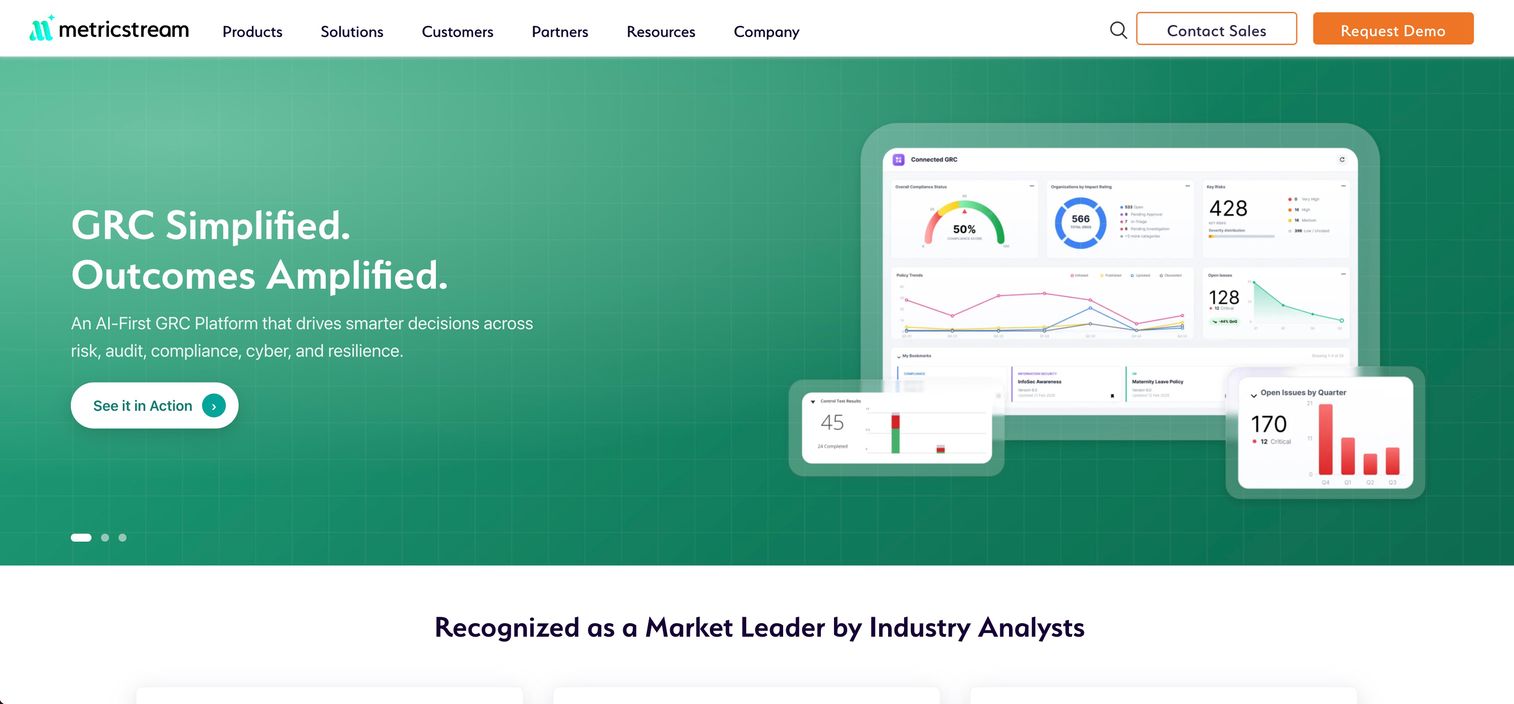
MetricStream is an AI-first governance, risk, and compliance platform covering regulatory compliance, internal audit, cybersecurity risk, third-party risk, and enterprise resilience. It positions itself as a connected GRC suite where regulatory change feeds directly into risk assessments, control monitoring, and audit workflows. Organizations use it to manage the full regulatory change lifecycle from horizon scanning through to audit-ready evidence packages.
Best for: Large enterprises managing multiple compliance domains who need regulatory change connected to broader GRC programs.
Key features
- Federated data model connecting regulatory changes to risks and controls
- AI-powered recommendations and semantic search across GRC records
- Continuous control monitoring with automated testing
- Low-code/no-code AppStudio for workflow configuration
- REST APIs and integrations with enterprise systems
Why choose MetricStream: It suits organizations that need regulatory change management as part of a wider GRC infrastructure rather than as a standalone tool. Teams evaluating audit management software alongside regulatory tracking will find the connected data model useful for demonstrating traceability across functions.
MetricStream pricing: MetricStream does not post pricing; contact the sales team directly for a tailored quote. Pricing reflects organizational scope, selected modules, and implementation requirements.
G2 rating: 3.8/5 (MetricStream seller profile, verified September 2026).
2. Compliance.ai
The Compliance.ai brand currently resolves to Archer Evolv Compliance, an enterprise regulatory compliance platform built by Archer. It monitors regulatory changes, extracts obligations from citations, rulebooks, and statutes, assesses their relevance against a business profile, and publishes records to Archer workflows. The platform targets regulated organizations that need defensible compliance evidence and traceable obligation extraction.
Best for: Enterprise compliance teams that need continuous regulatory monitoring with citation-level traceability and automated obligation extraction.
Key features
- Regulatory horizon scanning and jurisdiction-specific alerts
- Business-profile relevance assessment for incoming changes
- Obligation extraction with citation lineage from statutes and rulebooks
- Cross-jurisdiction requirements mapping and clustering
- Automated evidence collection and Archer record publishing
Why choose Compliance.ai / Archer Evolv: The business-profile relevance assessment distinguishes it from simpler alert tools. Instead of routing every regulatory update to every team, it filters for applicability before the change reaches a compliance analyst.
Compliance.ai pricing: Pricing requires a direct conversation with Archer. Check Archer's pricing page or request a quote to get figures specific to your jurisdiction coverage and user count.
G2 rating: The Compliance.ai seller profile on G2 currently shows 0 reviews. Verify current standing directly on G2 before making a decision.
3. Archer Evolv Compliance
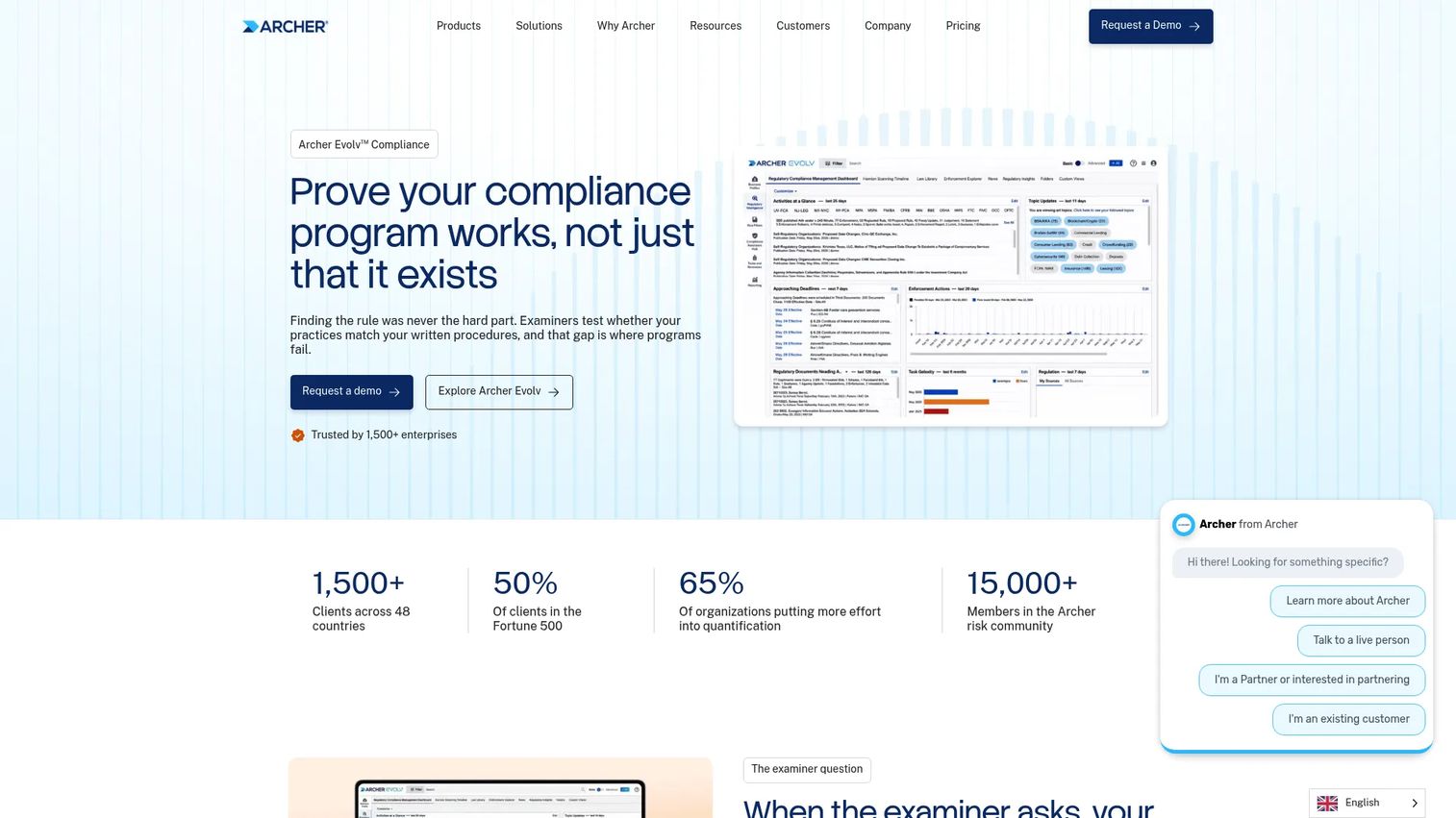
Archer Evolv Compliance is a dedicated compliance management platform within the Archer ecosystem. It covers regulatory requirements management, cross-jurisdiction obligation mapping, control gap analysis, and evidence tracking for audit readiness. Organizations already using Archer for broader governance workflows benefit from its native integration with Archer records and risk data.
Best for: Regulated enterprises already on Archer governance workflows who need structured obligation management and gap analysis against existing controls.
Key features
- Tuned horizon scanning with business-profile relevance scoring
- Obligation extraction with full citation lineage
- Cross-jurisdiction mapping, grouping, and clustering
- Gap analysis against existing controls with proposed remediation
- Cross-framework control mapping integrated with Archer records
Why choose Archer Evolv Compliance: The gap analysis capability is the practical differentiator. It does not just identify which obligations apply; it compares them against your current control inventory and surfaces specific gaps, which shortens the path from regulatory change to remediation plan.
Archer Evolv Compliance pricing: Archer does not publish pricing. Contact the team for a quote based on your regulatory scope, number of jurisdictions, and integration requirements.
G2 rating: 3.6/5 across 20 Archer Technologies reviews (September 2026). Note this reflects the broader Archer platform rather than the Evolv Compliance module specifically.
4. IBM OpenPages with Watson
IBM OpenPages is a configurable GRC platform for managing regulatory compliance, operational risk, internal audit, IT governance, and third-party risk. Its GRC Canvas visualizes how risks, controls, processes, and regulatory obligations connect, and AI-powered automation handles classification and issue creation without custom code. IBM offers both AWS SaaS and IBM Cloud hosted deployment options.
Best for: Large organizations standardizing risk and compliance processes across multiple functions who want a configurable platform without heavy development overhead.
Key features
- GRC Canvas for visualizing risks, controls, and regulatory obligations
- AI-powered issue creation and compliance classification
- Configurable workflows, dashboards, and views without custom code
- REST APIs and enterprise integrations
- Modular solutions covering operational risk, regulatory compliance, IT governance, privacy, and ESG
Why choose IBM OpenPages: The combination of AI-assisted workflows and a no-code configuration layer makes it accessible to compliance teams that need depth without depending on IT for every change. It also connects compliance workflows to risk and audit data in the same system.
IBM OpenPages pricing: IBM publishes indicative starting prices on its pricing page. AWS SaaS Essentials starts at USD 3,300 and Standard at USD 6,050; IBM Cloud hosted Single Solution starts at USD 6,250 and Enterprise at USD 9,000. IBM notes these are indicative, may vary by country, and exclude taxes. On-premises pricing requires a direct IBM quote.
G2 rating: 4.2/5 (IBM OpenPages, verified September 2026).
5. PwC Compliance Insights

PwC Compliance Insights is an AI-powered cloud platform for centralized regulatory compliance management. It monitors laws, regulations, statutory forms, and licenses across more than 150 global jurisdictions, tracks regulatory changes, and automates compliance task assignment with alerts, reminders, and customizable dashboards. PwC positions it as a software product distinct from its advisory services, though the two often complement each other for regulated financial services clients.
Best for: Organizations in regulated industries that need multi-jurisdiction monitoring with centralized obligation tracking and risk-based compliance prioritization.
Key features
- Central repository for laws, regulations, statutory forms, and licenses
- Risk-based classification of compliance obligations
- Automated task tracking with alerts and reminders across 150+ jurisdictions
- Customizable dashboards and audit trails
- Regulatory change tracking and mobile support
Why choose PwC Compliance Insights: The 150+ jurisdiction coverage is the practical draw for multinational organizations. Teams that currently split regulatory monitoring across regional spreadsheets and advisors can consolidate source coverage into a single platform.
PwC Compliance Insights pricing: PwC does not display pricing. Book a demo through the PwC website to receive a tailored quote.
G2 rating: A verified G2 rating specific to PwC Compliance Insights was not confirmed at time of publication. Check the G2 listing directly before finalizing a shortlist.
6. LogicGate Risk Cloud
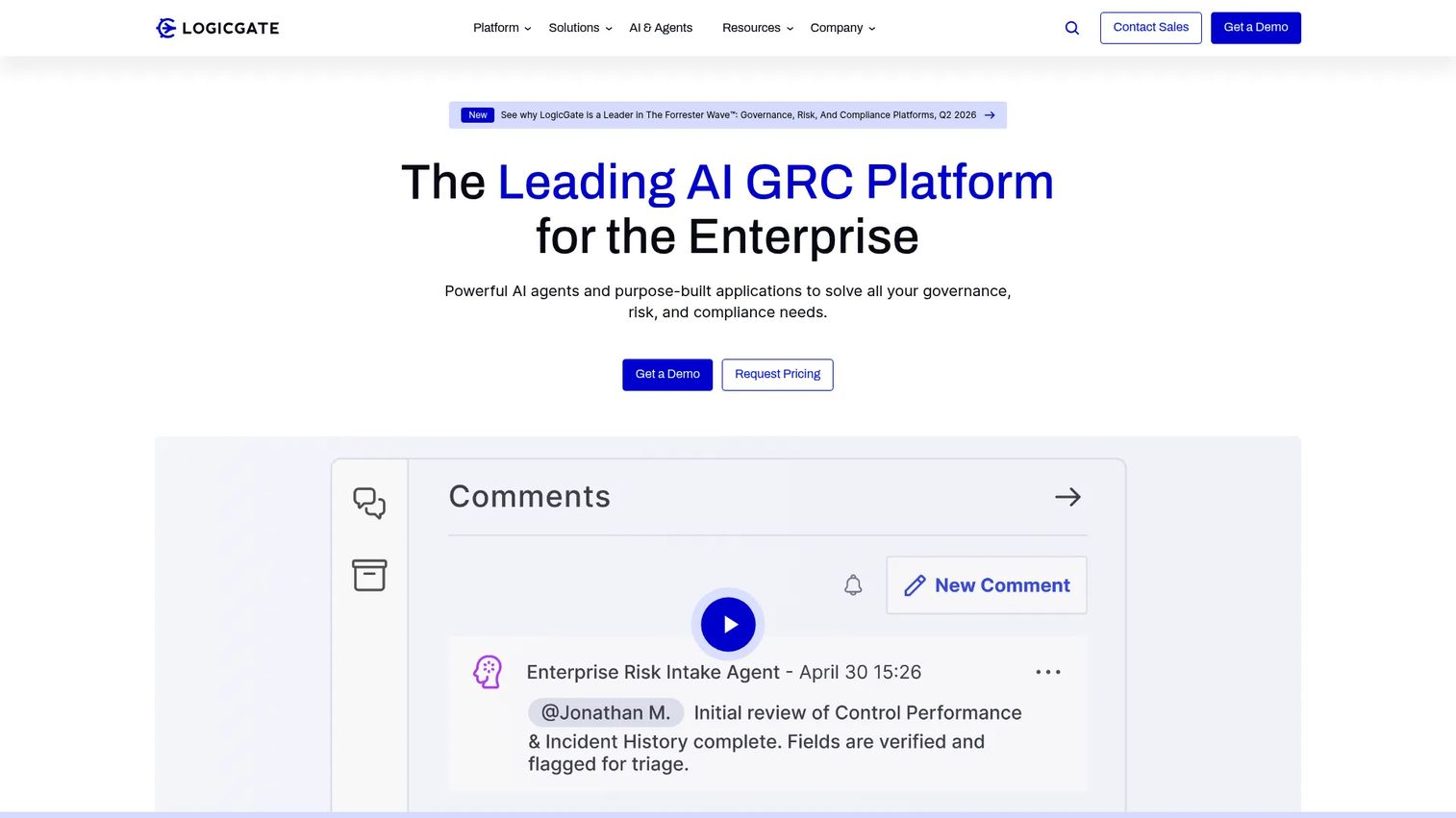
LogicGate Risk Cloud is a configurable GRC platform built on a no-code graph database. Teams use it to model regulatory change workflows, manage controls and issues, run automated control testing, and connect risk and compliance data across the organization. Its GRC Agents bring foundational AI capabilities into workflow execution, and 200-plus integrations connect it to the broader enterprise stack.
Best for: Enterprise risk and compliance teams that need configurable GRC workflows without dependence on development resources.
Key features
- No-code graph database for connected risk and compliance modeling
- Automated control testing across regulatory obligations
- GRC Agents and foundational AI for workflow execution
- 200+ integrations with enterprise and security tools
- Reporting and analytics dashboards
Why choose LogicGate Risk Cloud: The no-code configurability is the key argument for teams whose regulatory obligations change frequently. Workflow adjustments happen inside the platform rather than through an IT queue, which matters when regulators move faster than development cycles.
LogicGate Risk Cloud pricing: Pricing is tailored based on selected Applications, Power User licenses, and additional features. Standard and External User licenses are included at no additional charge. Request a quote through LogicGate's pricing page.
G2 rating: 4.6/5 (LogicGate, verified September 2026).
7. CorityOne
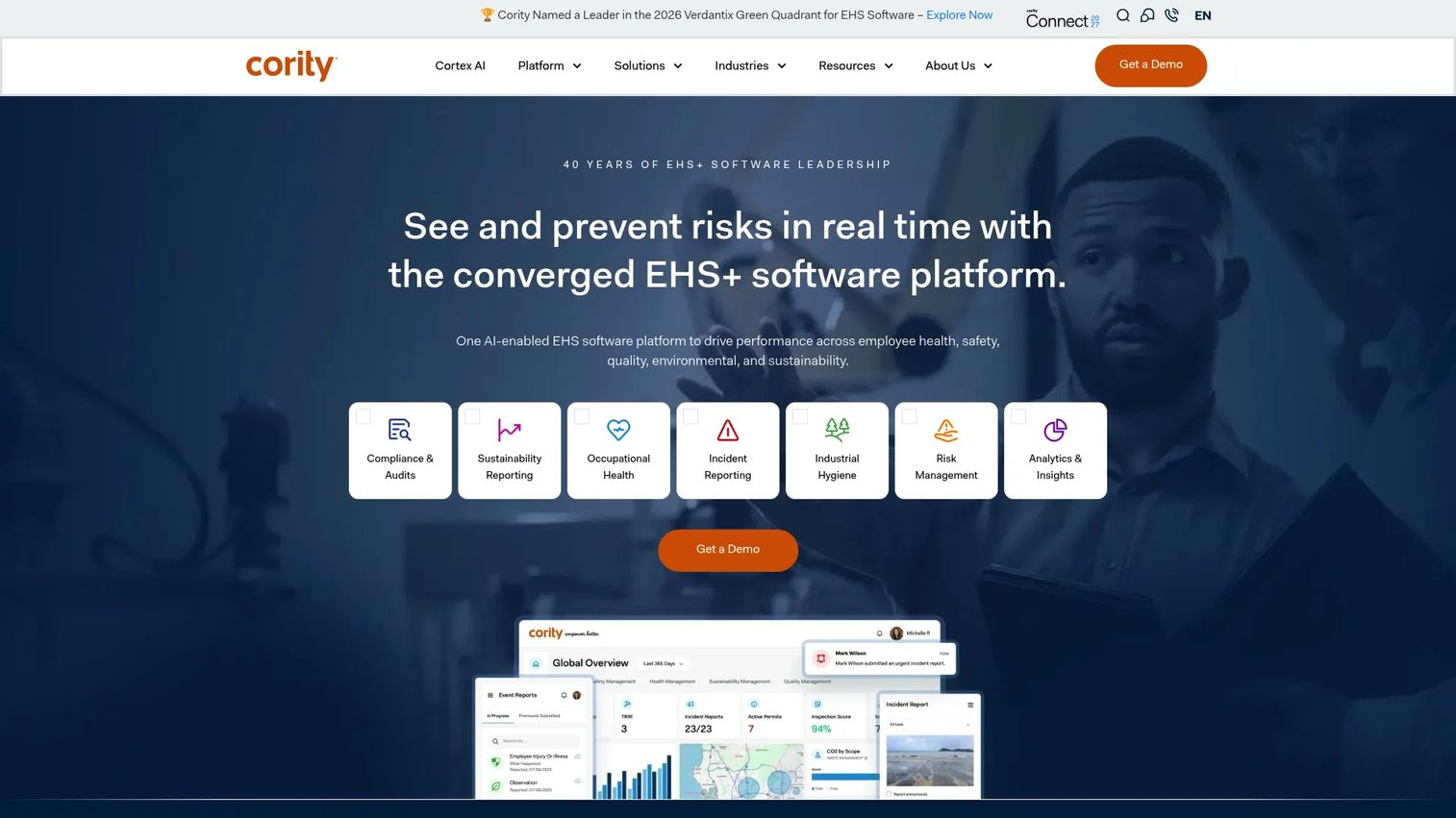
CorityOne is a unified EHS+ platform for environmental, health, safety, quality, sustainability, and AI governance workflows. Its Cortex AI brings human-in-the-loop intelligence to compliance management, audits, inspections, incident management, and risk assessments. CorityOne is best understood as a compliance platform for organizations where regulatory obligations are operationally rooted in EHS, quality, or sustainability requirements.
Best for: Large, complex organizations in manufacturing, energy, healthcare, or other sectors where EHS and quality regulatory obligations drive the compliance program.
Key features
- Unified EHS, quality, and sustainability data with Cortex AI
- Compliance management, audits, and inspection workflows
- Incident management and corrective action tracking
- No-code configuration with RESTful API integrations
- Mobile applications for frontline data capture
Why choose CorityOne: If the regulatory obligations your team tracks connect to EHS, quality, or sustainability requirements rather than financial services rules, CorityOne's deep operational integration with frontline workflows makes it a stronger fit than a purely financial compliance platform.
CorityOne pricing: CorityOne uses Standard and Enterprise subscription models, each committed initially over a three-year term. Implementation fees are charged separately. Contact Cority for a quote specific to your solutions, user count, and integration scope.
G2 rating: 3.9/5 (CorityOne, verified September 2026).
8. LogicManager Enterprise Risk Management Platform
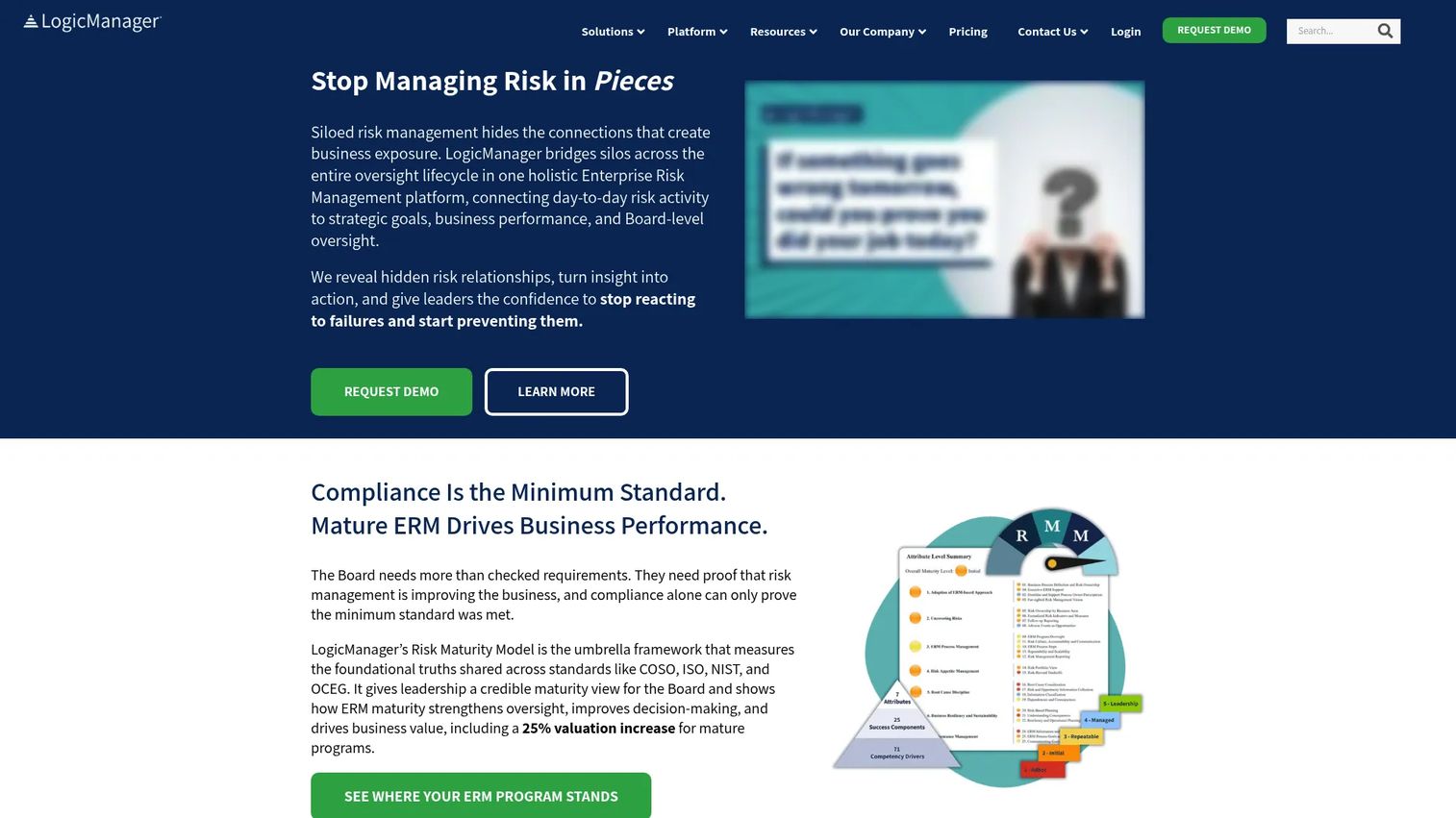
LogicManager is a SaaS enterprise risk management platform that connects risks, controls, vendors, processes, and stakeholders across the organization. Regulatory change flows into the platform through risk identification, obligation mapping, and issue management workflows. LogicManager's fixed-fee, unlimited-user packaging is notable in a category where per-seat pricing can balloon at scale.
Best for: Mid-market and enterprise organizations managing regulatory compliance as part of a connected enterprise risk program.
Key features
- Enterprise-wide risk identification and assessment
- Risk mitigation planning with controls and procedures
- Risk monitoring with dashboards, heatmaps, and incident workflows
- Regulatory obligation and control mapping
- Audit support workflows
Why choose LogicManager: The unlimited-user model removes the per-seat cost barrier that slows adoption across large cross-functional teams. For organizations where regulatory change touches compliance, legal, IT, operations, and business units simultaneously, this pricing structure keeps the platform accessible without budget surprises.
LogicManager pricing: Custom, value-based pricing tied to organizational scope. The package includes licensing, advisory services, onboarding, and unlimited users. Contact LogicManager for a fixed-fee proposal.
G2 rating: 4.2/5 (LogicManager, verified September 2026).
9. ComplianceHR
ComplianceHR is a SaaS platform providing self-service U.S. employment law compliance tools for HR and legal teams. It covers 50-state and locality-specific guidance, compliant employee document generation, multi-jurisdiction handbook creation, and classification risk assessments for overtime and independent contractor situations. It is a domain-specific tool rather than a general enterprise compliance platform.
Best for: Multi-state HR and legal teams needing attorney-backed employment law guidance, compliant document generation, and handbook policy tracking.
Key features
- 50-state and locality-specific employment law reference guidance
- Compliant document generation: Offer letters, separation agreements, leave notices
- Multi-jurisdiction employee handbook creation and policy-change tracking
- Overtime and independent contractor classification risk assessments
- Regulatory alert notifications for employment law changes
Why choose ComplianceHR: It narrows the scope deliberately. Teams managing employment law complexity across U.S. states need a purpose-built tool, not a feature buried inside a broad GRC suite. ComplianceHR's attorney-backed content and document generation reduces the time lawyers spend on routine compliance questions.
ComplianceHR pricing: Pricing is quote-based. Reference Center, Document Center, and Policy Center use user-based pricing with volume discounts. Navigator IC and Navigator OT are priced per use. Contact ComplianceHR for a quote.
G2 rating: 4.8/5 based on 2 reviews (ComplianceHR, verified September 2026).
10. Corlytics
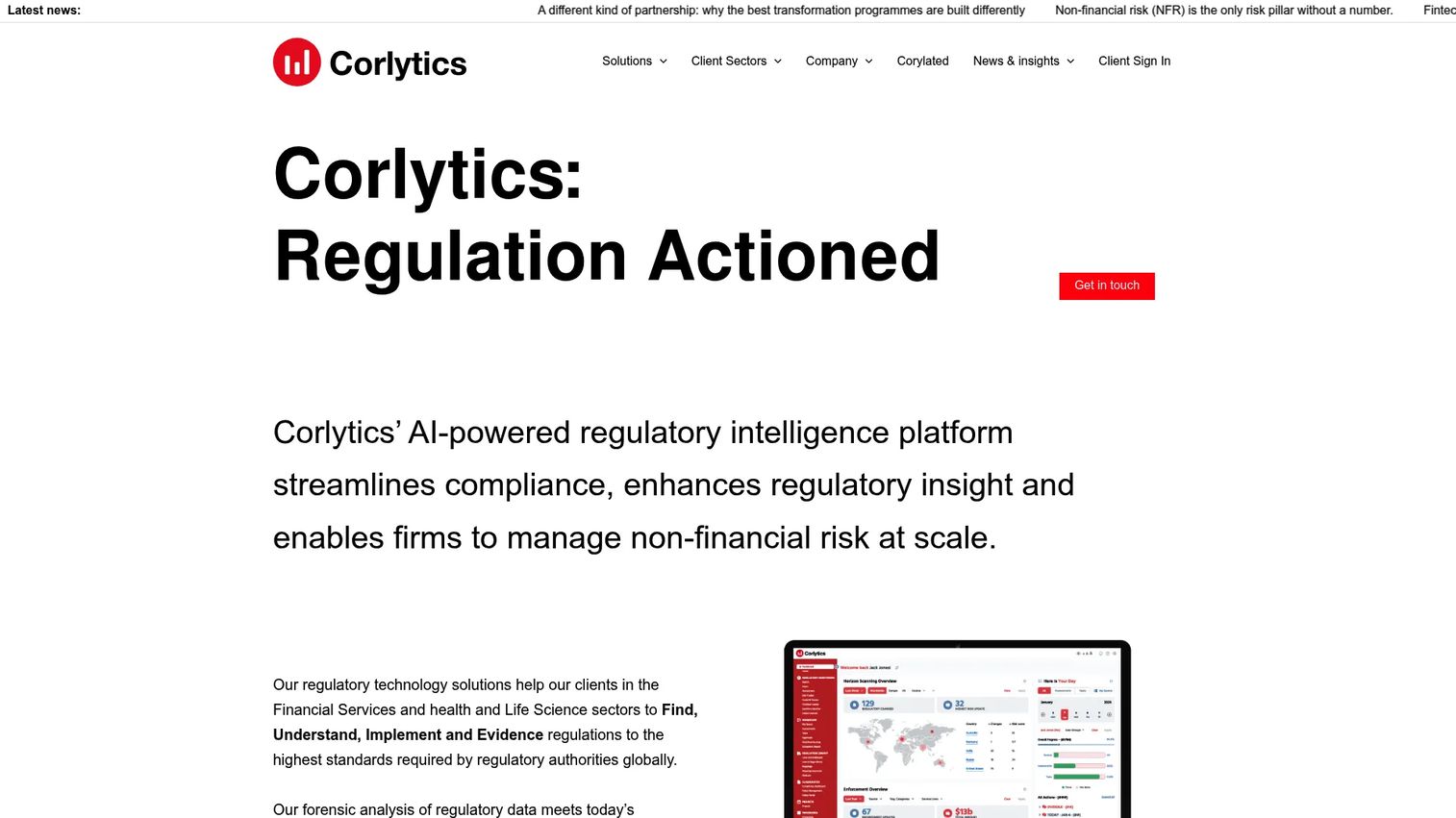
Corlytics is an AI-powered regulatory intelligence and non-financial risk management platform. It covers regulatory monitoring, a structured regulatory library, policy management, controls mapping, and AI-driven obligation extraction. The platform targets global financial services organizations managing regulatory change, compliance obligations, and non-financial risk across multiple jurisdictions.
Best for: Global financial services and other regulated organizations managing the intersection of regulatory intelligence, policy management, and non-financial risk.
Key features
- Regulatory monitoring and horizon scanning
- AI-driven regulatory analysis and obligation extraction
- Regulatory library with structured content
- Policy management with version control
- Controls mapping and non-financial risk management
Why choose Corlytics: The AI-driven obligation extraction sits on top of a curated regulatory library, which gives compliance teams structured data rather than raw regulatory text. For financial services teams dealing with high regulatory volume across jurisdictions, that distinction reduces the manual classification burden meaningfully.
Corlytics pricing: Corlytics does not display pricing. Contact the team directly for a quote based on your regulatory scope and organization size.
G2 rating: A verified G2 rating for Corlytics was not confirmed at time of publication. Check the G2 listing directly before shortlisting.
11. Clausematch
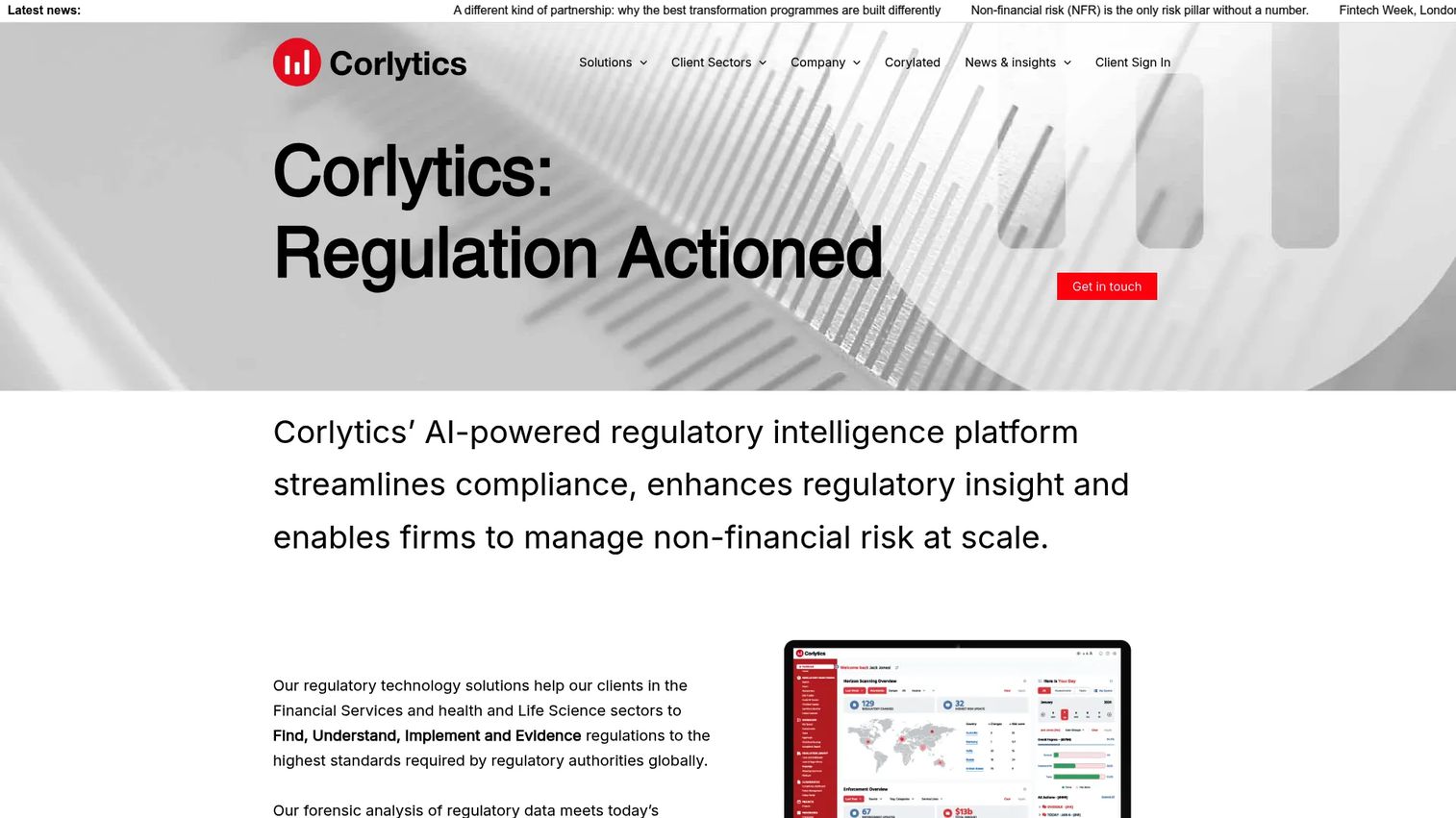
Clausematch is a regulatory technology platform for policy management, regulatory change, and non-financial risk. It connects external regulatory obligations to internal policies through a traceable mapping layer, with full version control, approval workflows, and audit history. Note that the Clausematch site currently redirects to Corlytics, indicating a product relationship between the two.
Best for: Regulated financial services and life-sciences organizations that center their compliance program on the policy lifecycle and need regulatory-to-policy traceability.
Key features
- Policy lifecycle management with approval workflows
- Regulatory change management and horizon scanning
- Regulatory obligation management and controls mapping
- Version control with full audit history
- Dashboards and compliance reporting
Why choose Clausematch: The traceability from external regulation to internal policy to control is the practical differentiator. Audit teams can follow the chain from a specific regulatory change to the updated policy to the evidence of control implementation, which is exactly what regulators ask for during an examination.
Clausematch pricing: Pricing was not verifiable from first-party sources at time of research. Contact Clausematch directly or check G2's pricing tab for reviewer-reported context before requesting a formal quote.
G2 rating: 4.0/5 based on 1 review (Clausematch, verified September 2026).
12. GlobalSuite
GlobalSuite is an all-in-one GRC platform covering risk assessment, security and compliance management, business continuity, third-party risk, audit management, privacy, ESG management, and AI governance. Its breadth makes it relevant for organizations that need regulatory obligation management alongside a wider set of governance functions without purchasing separate tools for each.
Best for: Organizations seeking an integrated enterprise GRC platform across multiple governance domains including risk, security, compliance, and ESG.
Key features
- Risk assessment and compliance management
- Business continuity and disaster recovery planning
- Third-party risk management
- Audit workflows and reporting
- ESG management and AI governance modules
Why choose GlobalSuite: Its coverage across security, compliance, ESG, and AI governance in a single platform addresses the tool-consolidation concern directly. For organizations asking "what does this replace?", GlobalSuite's breadth makes the consolidation case easier to bring to a procurement conversation.
GlobalSuite pricing: GlobalSuite does not display pricing. Contact the team through the product site for a quote.
G2 rating: 4.5/5 across 92 reviews (GlobalSuite, verified September 2026).
13. OneSumX for Compliance Program Management
OneSumX for Compliance Program Management is offered by FIS through its OneSumX suite, targeting financial services compliance and regulatory change management. The platform connects regulatory change tracking, compliance obligations, policy and control mapping, and issue remediation within a financial services-focused compliance program framework.
Best for: Financial services organizations already within the FIS ecosystem that need compliance program management integrated with regulatory change tracking.
Key features
- Regulatory change tracking and obligation management
- Policy and control mapping
- Issue identification and remediation tracking
- Compliance reporting and oversight
- Integration with broader OneSumX risk and compliance workflows
Why choose OneSumX: The FIS ecosystem connection matters for organizations already using FIS for financial infrastructure. Compliance data that flows through the same vendor stack reduces integration complexity and simplifies data governance conversations with IT.
OneSumX pricing: Pricing for this specific offering was not confirmed from first-party sources. Contact FIS directly or request verification through G2's pricing tab before including in a formal RFP.
G2 rating: A verified G2 rating specific to this product was not confirmed at time of publication..
14. PerformLine
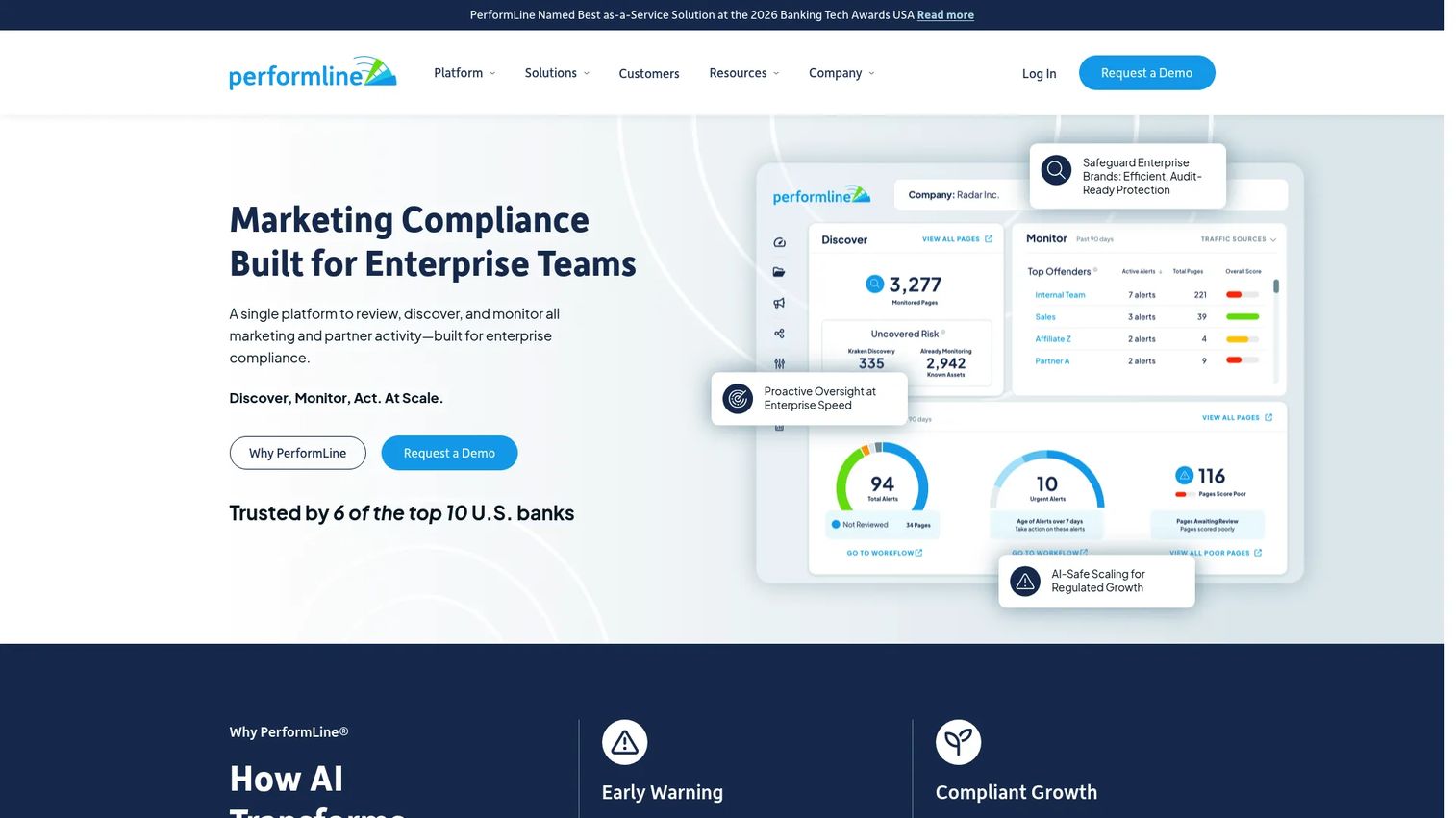
PerformLine provides enterprise marketing compliance software for reviewing, discovering, monitoring, remediating, and archiving marketing and partner activity across channels. It covers omni-channel monitoring across web, social, email, calls, documents, and AI-generated responses, with configurable regulatory and brand rulebooks. For marketing operations teams in regulated industries, it is the most directly relevant tool on this list.
Best for: Enterprise compliance teams in regulated industries monitoring marketing content, partner activity, and customer communications for regulatory adherence.
Key features
- Pre-publication review of marketing assets before distribution
- Omni-channel monitoring: Web, social, email, calls, messages, documents
- Automated discovery and regulatory risk detection
- Configurable rulebooks for regulatory and brand standards
- Workflow-based remediation with audit trails and archiving
Why choose PerformLine: It sits at the intersection of compliance and marketing operations. While the compliance team owns regulatory interpretation, marketing teams benefit from PerformLine's automated pre-publication review and channel monitoring, reducing the manual back-and-forth between legal, compliance, and campaign managers before a launch. This is the only tool on this list purpose-built for regulated marketing content oversight rather than enterprise GRC.
PerformLine pricing: PerformLine does not publish pricing. Contact the sales team directly for a quote based on channel coverage and organization size.
G2 rating: The PerformLine seller profile on G2 currently shows 0 reviews. Verify current standing directly on G2 before finalizing a shortlist.
15. Predict360
Predict360 is described by G2 as an integrated risk and compliance management platform for financial and insurance organizations. It covers enterprise risk management, compliance management, and risk insights and analytics. AI-assisted analysis is a positioning element, though buyers should verify current AI feature availability directly with the vendor, as the company's primary domain was not accessible for first-party verification at time of research.
Best for: Financial and insurance organizations managing enterprise risk and compliance who need AI-assisted analysis alongside structured workflow management.
Key features
- Enterprise risk management and regulatory monitoring
- Compliance management with workflow support
- AI-assisted impact analysis
- Risk insights and analytics dashboards
- Remediation workflow tracking
Why choose Predict360: The financial and insurance focus means the platform's default configurations and content are shaped for the regulatory environment those teams operate in. Generic GRC platforms often require substantial configuration to reflect sector-specific obligations; Predict360's positioning suggests a shorter path to usability for those buyer profiles.
Predict360 pricing: Pricing was not verifiable from first-party sources at time of research. Contact the Predict360 team directly for current pricing and package details.
G2 rating: 5.0/5 based on 1 review for the Enterprise Risk Management Software profile (Predict360, verified September 2026). With a single review, this rating carries limited predictive weight. Check the full G2 profile for additional context.
16. SAI360 Regulatory Change Management
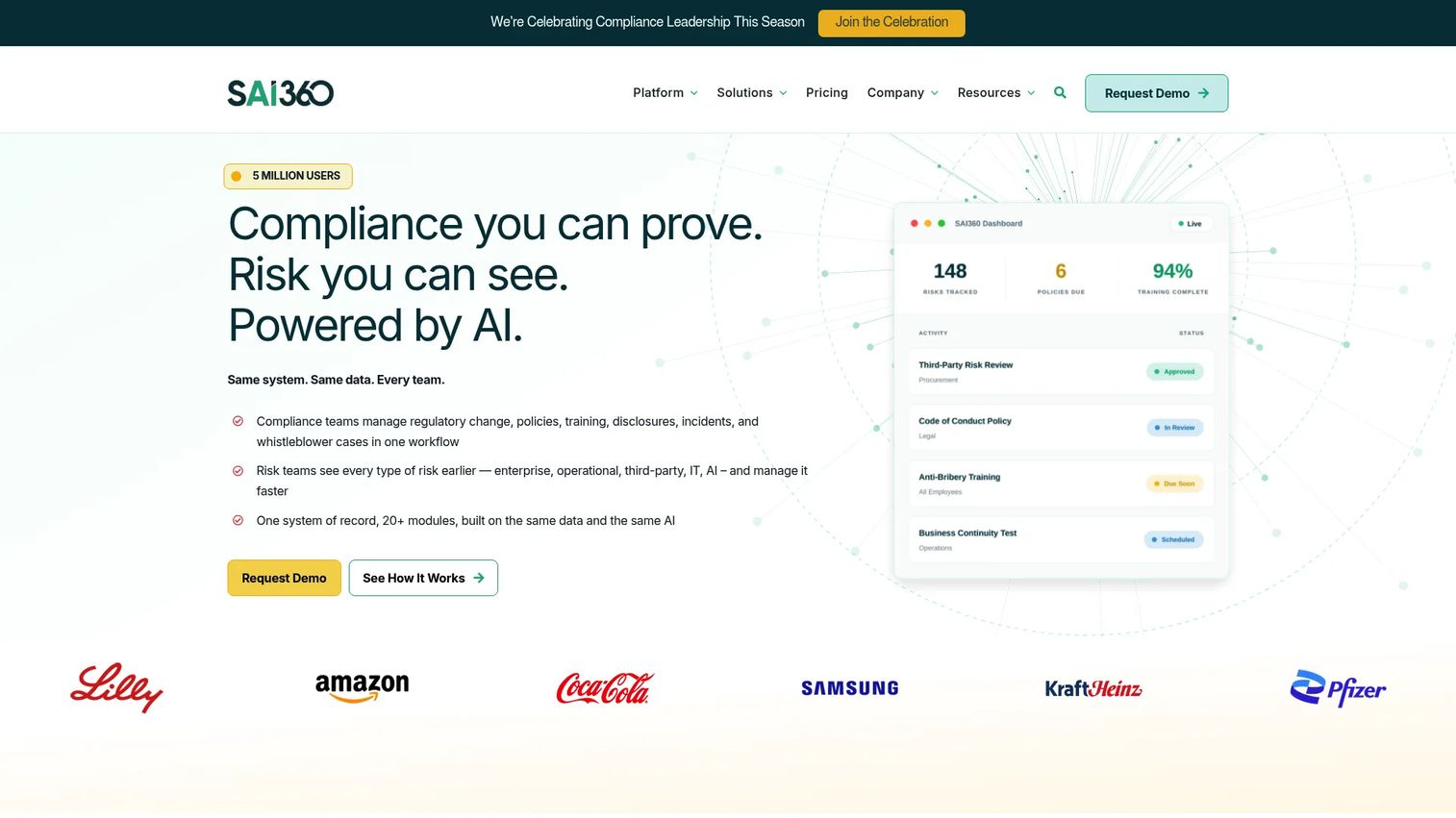
SAI360 provides dedicated regulatory change management software within a broader GRC portfolio. The platform monitors real-time regulatory updates, applies AI-powered analysis to assess impact, and routes remediation through configurable workflows connected to policy and control mapping. Audit-ready dashboards and reports pull from the same underlying data, making the path from regulatory change to audit evidence shorter.
Best for: Organizations needing centralized, multi-jurisdiction regulatory monitoring with AI-assisted impact assessment integrated into a broader GRC program.
Key features
- Real-time regulatory update monitoring across jurisdictions
- AI-powered regulatory analysis and impact assessments
- Configurable workflow management with task assignment
- Policy and control mapping connected to regulatory changes
- Audit-ready dashboards and reports
Why choose SAI360: The dedicated regulatory change management module within a wider GRC portfolio gives compliance teams a focused tool without losing the ability to surface regulatory data in risk and audit workflows. Teams evaluating both standalone and suite-based approaches will find SAI360 sits usefully between the two.
SAI360 pricing: Pricing is customized based on organization size, users, and feature requirements. Contact SAI360 for a tailored quote through its regulatory change management page.
G2 rating: 4.1/5 (SAI360, verified September 2026). Note this reflects the overall SAI360 platform rather than the regulatory change management module specifically.
17. CUBE RegPlatform
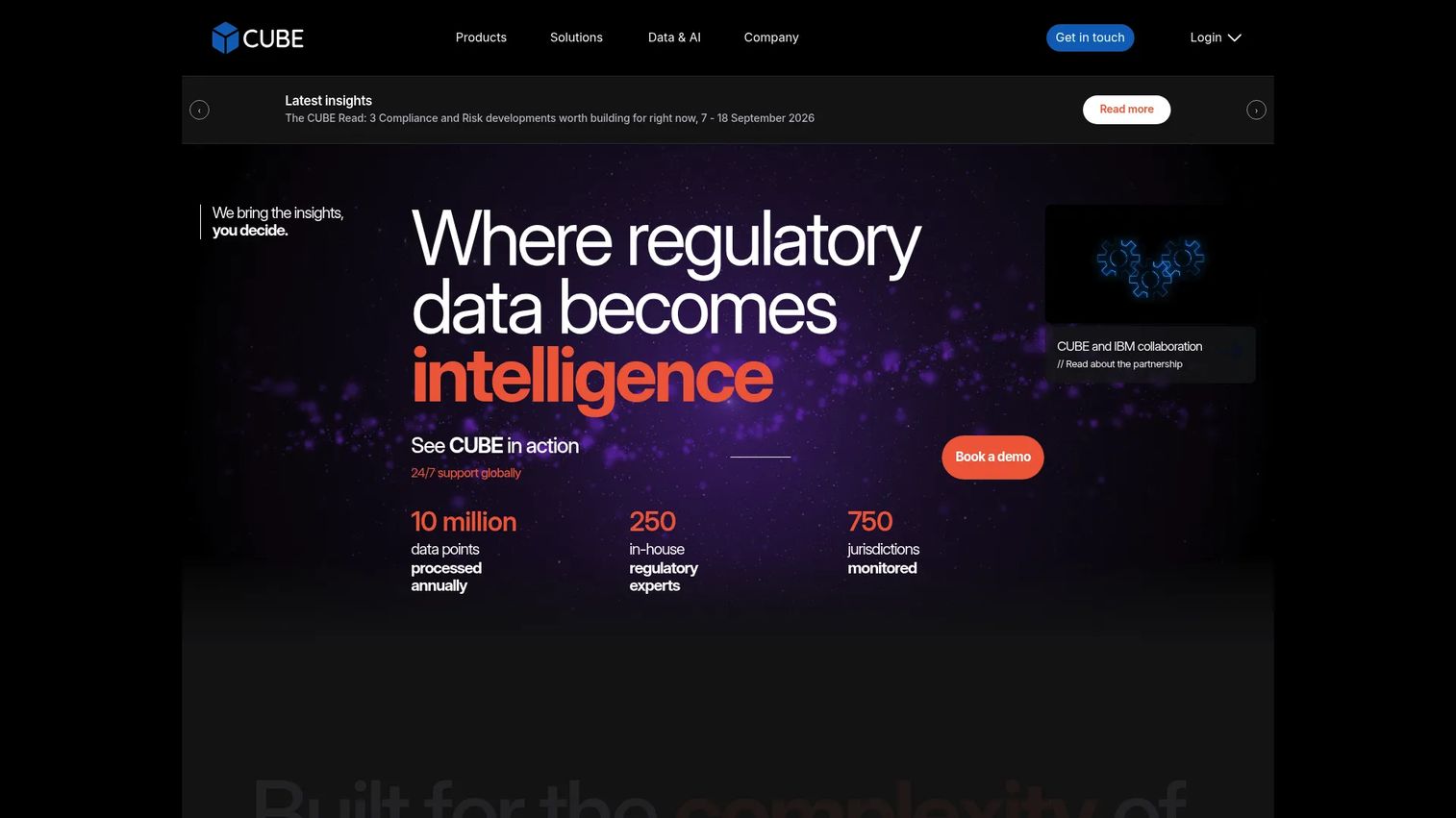
CUBE RegPlatform is an end-to-end regulatory change management platform built specifically for financial services compliance. It combines real-time horizon scanning across global regulatory sources with AI-powered regulatory mapping, obligations management, configurable workflows, and bi-directional API integration through its RegConnect layer. Agentic AI coworkers handle regulatory research and workflow support, and compliance reporting supports Excel export for offline analysis.
Best for: Compliance and risk teams in highly regulated financial services organizations managing complex, multi-jurisdictional regulatory change at scale.
Key features
- Real-time horizon scanning across global regulatory sources
- Regulatory inventory, profiling, taxonomy mapping, and grouping
- Obligations management with lineage, applicability, and audit history
- AI-powered regulatory mapping and compliance gap analysis
- Bi-directional API integration through RegConnect
- Agentic AI coworkers for regulatory research and workflow support
Why choose CUBE RegPlatform: The depth of the obligations management layer distinguishes it from alert-only regulatory intelligence tools. Each obligation carries lineage back to the source, applicability assessment, ownership, and a full audit history. For financial services compliance teams facing examination, that level of traceability matters.
CUBE RegPlatform pricing: CUBE does not publish pricing. Contact the team through cube.global to receive a quote based on regulatory scope and organizational requirements.
G2 rating: A verified G2 rating specific to CUBE RegPlatform was not confirmed at time of publication..
Considerations when buying regulatory change management software
Regulatory source coverage
Evaluate which regulators, jurisdictions, publication types, and update frequencies the platform monitors. Ask whether it covers your primary and secondary jurisdictions with the same depth, whether it archives historical content, and whether language support matches your operating geography.
Impact analysis and obligation mapping
Check whether the platform automatically identifies affected obligations, controls, policies, and business units from a single regulatory change. Ask how much of the obligation mapping requires manual configuration after initial setup, and whether the linkage from regulation to internal control is traceable for audit purposes.
Workflow and ownership
Review how the platform handles task assignment, escalation paths, deadlines, evidence collection, and approval routing. Platforms vary significantly in whether workflow is configurable without developer support, which affects how quickly you can adapt when regulatory requirements change.
Auditability and reporting
Evaluate whether the platform maintains an immutable change history, retains evidence with timestamps, and produces exportable audit trails. Board-level and regulator-ready reporting formats reduce manual assembly before an examination. Check whether the system supports compliance evidence collection as a native capability rather than an add-on.
Integrations and implementation
Check APIs and connectors for your GRC, policy management, document, ticketing, and identity systems. Plan for taxonomy design, data migration, governance configuration, training, and adoption. Implementation timelines for enterprise platforms in this category typically run weeks to months. Budget for configuration and change management, not just licensing.
Conclusion
Regulatory change management is a solved problem only when monitoring, impact analysis, obligation mapping, workflow, and audit evidence all operate in the same system. Spreadsheets handle one layer at a time; platforms handle the full regulatory change lifecycle.
For broad enterprise GRC and regulatory program coverage, MetricStream and IBM OpenPages with Watson are the natural starting points. Teams centered on regulatory intelligence and obligation extraction should evaluate Compliance.ai (Archer Evolv) or CUBE RegPlatform. For policy lifecycle management and regulatory-to-control traceability, Clausematch is the focused option. PerformLine stands apart as the only tool built specifically for regulated marketing content oversight, which makes it the right conversation starter for marketing operations teams in financial services or insurance.
Before requesting demos, map the regulatory sources and jurisdictions that matter to your organization, document the current spreadsheet or email-based workflow, and identify who needs to be in the room: Compliance, risk, legal, IT, and the business functions most affected by regulatory change. Run a proof of concept against one complete regulatory change lifecycle before committing.
Interested in other compliance-adjacent software categories? See our guides on compliance management software, audit management software, and contract lifecycle management software.
FAQs
Regulatory change management software is enterprise compliance software that monitors regulatory publications, classifies changes, assesses which internal obligations and controls are affected, routes remediation tasks to owners, and preserves evidence for audit. It replaces manual tracking through spreadsheets and email threads with a connected workflow from regulatory source to documented compliance action.
The platform monitors configured regulatory sources continuously, surfaces relevant changes based on a business profile or jurisdiction filter, and triggers a structured workflow: Impact assessment, obligation identification, owner assignment, deadline tracking, evidence collection, and reporting. Each step creates an auditable record that compliance leadership and oversight bodies can review.
Core capabilities include regulatory intelligence and horizon scanning, regulatory impact analysis, compliance obligation management, policy and control mapping, compliance workflow automation, enforcement action monitoring, audit trails, and GRC integration. AI-assisted classification is increasingly common, but look for human review controls and source traceability alongside any automated analysis.
Banking is a major use case because regulatory volume in financial services is exceptionally high, but insurance, fintech, healthcare, energy, manufacturing, and any organization operating across multiple regulatory jurisdictions benefits from the same capabilities. Employment law compliance is a relevant use case even for companies outside financial services, as tools like ComplianceHR illustrate.
Regulatory tracking software focuses on monitoring external regulatory developments, classifying changes, and surfacing their applicability to the organization. GRC software manages the broader internal infrastructure of governance, risk, controls, policies, audits, and issues. Many platforms in this list combine both: Regulatory tracking feeds directly into GRC workflows, but some tools focus on one layer rather than the full stack.
Pricing in this category is almost universally custom. The primary drivers are number of jurisdictions monitored, user count, selected modules, integration requirements, and implementation scope. IBM OpenPages publishes indicative starting prices from USD 3,300 for its Essentials edition; most other vendors require a direct quote. Budget for implementation and configuration costs separately from licensing, as these can be substantial for enterprise deployments.
AI can assist with classification, summarization, and preliminary applicability assessment. It reduces the volume of manual triage a compliance analyst performs. However, AI-assisted analysis requires human review before regulatory conclusions are acted upon. Evaluate platforms for source traceability (which regulatory document did the AI analyze?), explainability (why was this obligation flagged?), and approval controls (who confirmed the assessment?) before relying on automated outputs.
Duration depends on source coverage required, taxonomy maturity, the complexity of existing obligation and control mappings, integrations needed, data migration scope, and training requirements. Simple configurations with limited jurisdictions and no GRC integration can go live in weeks. Enterprise deployments with multi-jurisdiction coverage, custom taxonomies, and deep GRC connections typically run several months.
The platform maintains an immutable record of every regulatory change, the impact assessment, the obligations identified, the tasks assigned, the evidence collected, and the approvals granted. When an auditor or regulator asks for evidence that a specific rule change was assessed and addressed, the system produces a traceable record rather than requiring manual reconstruction from emails and spreadsheets.
Marketing teams in regulated industries are downstream buyers, not the compliance owner. Before a purchase decision, confirm that the platform supports campaign review workflows, content monitoring, and deadline visibility. Ask whether the system integrates with marketing operations tools or requires manual status reporting. PerformLine is the category most directly relevant to marketing content compliance; broader GRC platforms support marketing primarily through deadline and evidence workflows rather than campaign-level oversight.