You can ship the right feature and still make the wrong call if the data underneath it can't be trusted. Product, Marketing, and Customer Success each define "activation" differently. Retention metrics shift depending on who pulled the report. Feature adoption numbers change based on which warehouse query ran last.
This fragmentation isn't a data engineering problem. It's a business problem. And it compounds: The longer teams operate on mismatched definitions, the harder it becomes to defend roadmap decisions in reviews, align cross-functional stakeholders, or build AI workflows on a foundation that holds up under scrutiny.
The global data management platform market reached $2.58 billion in 2025 and is projected to grow at a 13.68% CAGR through 2031, according to Mordor Intelligence (2026). That growth reflects how seriously organizations now treat data as a strategic asset, not just an operational byproduct.
The right data management platform depends on the specific problem: Data integration, governance, quality, cataloging, observability, master data, or AI readiness. This guide helps you match platform to problem.
What's inside
This guide compares 12 data management platforms for 2026 and explains how to choose one for product, analytics, governance, and activation workflows.
- Who it's for: Product Managers, analytics leaders, and data-aware PMs evaluating platforms that affect instrumentation, segmentation, and metric trust
- How tools were chosen: Coverage of the major platform categories, verified pricing, current G2 ratings, and relevance to modern data stack architecture
- Selection criteria:
- Functional fit (integration, governance, quality, cataloging, observability, master data, or transformation)
- Architecture and integration compatibility with existing analytics and operational systems
- Governance, data quality, and AI readiness depth
- Total cost of ownership across compute, storage, seats, and implementation
TL;DR
- Best overall enterprise data management platform: Informatica IDMC covers integration, governance, quality, and master data in a single suite
- Best for Microsoft-centered environments: Microsoft Purview for cataloging, lineage, and governance inside the Microsoft stack
- Best for lakehouse and AI workflows: Databricks for engineering, machine learning, and governed analytics at scale
- Best for scalable cloud analytics: Snowflake for warehousing, cross-team data sharing, and workload management
- Best for governance programs: Collibra for stewardship and operating model; Alation for discovery and collaborative cataloging
- Best for pipeline reliability: Monte Carlo for data observability and incident detection across modern data stacks
Pricing and G2 ratings verified in September 2026.
What is a data management platform?
A data management platform is software that helps organizations collect, integrate, organize, govern, secure, analyze, and activate data across business systems.
The category is broad by design. Some platforms provide a unified suite spanning the full data lifecycle. Others specialize in a single layer: Ingestion, transformation, cataloging, observability, master data, warehouse infrastructure, or audience activation.
How a data management platform works
The typical flow moves through five stages:
- Collect and ingest: Pull in product events, CRM records, ERP data, application logs, files, APIs, and third-party sources
- Process and transform: Standardize formats, clean records, join sources, and prepare data for analysis
- Organize and model: Store data in warehouses, lakehouses, catalogs, semantic layers, or master data models
- Govern and secure: Assign ownership, manage permissions, track lineage, classify sensitive data, and enforce policies
- Analyze and activate: Support dashboards, product decisions, machine learning, audience segmentation, and operational workflows
Key features to look for
- Data integration connectors and pipeline management
- Metadata management and data cataloging
- Data quality rules and monitoring
- Lineage and impact analysis
- Identity resolution and master data management
- Role-based access and privacy controls
- Cloud, hybrid, and multi-cloud deployment options
- Semantic models and AI readiness
- APIs, reverse ETL, and activation workflows
Category boundaries
Understanding what each adjacent category actually does helps avoid buying the wrong layer:
- Data warehouse: Primarily stores and queries analytical data
- Data lakehouse: Combines flexible storage with warehouse-style analytics
- CDP (customer data platform): Unifies customer profiles for customer-facing activation. For a deeper look at CDP options, see this guide to the best customer data platform tools
- Marketing DMP: Focuses on audience segmentation and advertising activation
- Data management platform: A broader category covering governance, integration, quality, organization, and activation across all data domains
When to use a data management platform
Align product and business metrics
When Product, Marketing, Sales, and Customer Success operate on different definitions of activation, retention, or expansion, roadmap reviews become arguments about data rather than decisions about direction. A data management platform with shared models, lineage, and business glossaries gives teams a common reference. Product Managers can defend instrumentation choices and metric calculations with documented lineage instead of spreadsheet exports.
Govern data before scaling AI and analytics
AI outputs depend on accessible, well-described, and permissioned data. Metadata quality, classification of sensitive fields, stewardship ownership, and lineage all affect whether AI workflows produce trustworthy results. A platform with governance depth creates the operating conditions for reliable AI, not just the infrastructure. This is an active capability that requires ownership, not a feature to activate at sign-up.
Activate trusted data across customer journeys
Storage alone doesn't create activation. Teams need reliable identity resolution, usable audience segments, and connections to downstream systems like lifecycle email, in-app messaging, or paid media. For teams exploring tools that sit closer to customer engagement, the best customer data platform guide covers the CDP layer in detail. Data management platforms handle the upstream foundation that makes those activation layers trustworthy.
Data management platform comparison
The 12 platforms below solve different parts of the data management problem. No single tool is the right answer for every team. Use this table as a starting shortlist, then match each platform to the specific bottleneck you're trying to clear.
| # | Product | Best for | Key differentiator | Pricing | G2 rating |
|---|---|---|---|---|---|
| 1 | Informatica IDMC | Enterprise integration, governance, quality, and MDM | Broadest enterprise suite across multiple data management disciplines | Custom pricing | 4.2/5 |
| 2 | Microsoft Purview | Microsoft-stack governance, cataloging, and lineage | Native integration across Microsoft 365, Azure, and Fabric | From $10/user/mo (annual) | 4.7/5 |
| 3 | Databricks | Lakehouse engineering, analytics, ML, and AI | Unified platform for engineering, analytics, and governed AI | Usage-based; free trial with $400 credits | 4.6/5 |
| 4 | Snowflake | Scalable cloud warehousing and data sharing | Separate storage and compute with cross-cloud data sharing | Consumption-based; 30-day trial | 4.6/5 |
| 5 | Collibra | Enterprise data governance and stewardship programs | Governance operating model with AI asset lifecycle management | Custom pricing | 4.2/5 |
| 6 | Alation | Data discovery, cataloging, and cross-team collaboration | Active metadata graph with AI agents for documentation | Custom pricing | 4.4/5 |
| 7 | Fivetran | Managed data ingestion into cloud destinations | 700+ managed connectors with automated schema handling | Free tier; usage-based paid plans | 4.4/5 |
| 8 | dbt | Analytics engineering and SQL transformation workflows | Versioned, tested, documented transformations with semantic layer | Free developer tier; Starter from $100/user/mo | 4.7/5 |
| 9 | Monte Carlo | Data observability and pipeline reliability | Automated incident triage with lineage-based impact analysis | Custom pricing (pay per monitor) | 4.3/5 |
| 10 | Alteryx | Analyst-led data preparation and automation | Visual drag-and-drop workflow builder for non-engineers | Starter from $250/user/mo (annual) | 4.6/5 |
| 11 | Precisely | Data integrity, enrichment, and location intelligence | Integrated quality, enrichment, and geo addressing | Free 30-day trial; Basic from $50/mo | 4.2/5 |
| 12 | Syniti | Enterprise data migration, quality, and governance | Unified platform for complex SAP and cloud migration programs | Custom pricing | 4.2/5 |
Pricing and G2 ratings verified in September 2026.
12 best data management platforms for 2026
1. Informatica IDMC
Informatica IDMC (Intelligent Data Management Cloud) is one of the most comprehensive enterprise data management suites available. It covers cloud data integration, data quality, metadata management, master data management, governance, and privacy controls under a single platform umbrella. Organizations running complex multi-source environments often choose Informatica when they need several disciplines to work together rather than sourcing point tools separately.
Best for: Large enterprises managing integration, governance, quality, and master data under a unified operating model.
Key features
- Cloud data integration and ingestion across hybrid environments
- Data quality profiling and rules-based monitoring
- Metadata management and automated lineage
- Master data management across customer, product, and supplier domains
- Governance, privacy controls, and sensitive data classification
Why choose Informatica IDMC: The breadth of its suite means Product and Data teams can address instrumentation quality, metric consistency, and governance within a single vendor relationship. The tradeoff is implementation complexity: Realizing value across multiple modules requires strong internal ownership and typically a professional services engagement.
Informatica IDMC pricing: Informatica uses consumption-based and subscription models depending on the module, and pricing is quote-based. Reviewer-reported ranges on G2 and Capterra reflect significant variation by module combination, data volume, and organization size. Contact Informatica directly to scope the relevant modules before requesting a quote.
Informatica IDMC holds a 4.2/5 rating on G2.
2. Microsoft Purview
Microsoft Purview is a portfolio of data governance, security, and compliance solutions covering cataloging, lineage, sensitive data classification, data loss prevention, insider risk management, and compliance management. For organizations already running on Microsoft 365, Azure, or Microsoft Fabric, Purview's native integration removes a significant amount of connector and mapping overhead that other platforms require. Teams get a unified catalog and data map across their Microsoft estate with relatively low deployment friction compared to standalone cataloging tools.
Best for: Teams operating primarily within the Microsoft cloud and data stack who need governance, cataloging, and lineage without a separate vendor relationship.
Key features
- Unified Catalog and Data Map for data discovery
- Automated data lineage discovery across Microsoft services
- Sensitive data classification and Data Loss Prevention
- Insider Risk Management and Data Security Posture Management
- Compliance Manager and eDiscovery tools
Why choose Microsoft Purview: If your data environment is predominantly Microsoft, Purview reduces the governance and cataloging gap without introducing a new vendor. Organizations with significant non-Microsoft infrastructure should evaluate connector coverage and governance workflow depth carefully before committing.
Microsoft Purview pricing: The Purview Suite for Microsoft 365 Business Premium starts at $10.00 per user per month (annual subscription, maximum 300 seats). The Purview Suite for Microsoft 365 E3 or equivalent starts at $12.00 per user per month (annual). Microsoft 365 E5, which bundles Purview capabilities, starts at $60.00 per user per month. Pay-as-you-go options for scanning and data governance workloads are also available but priced on consumption rather than a fixed seat rate.
Microsoft Purview Data Governance holds a 4.7/5 rating on G2.
3. Databricks
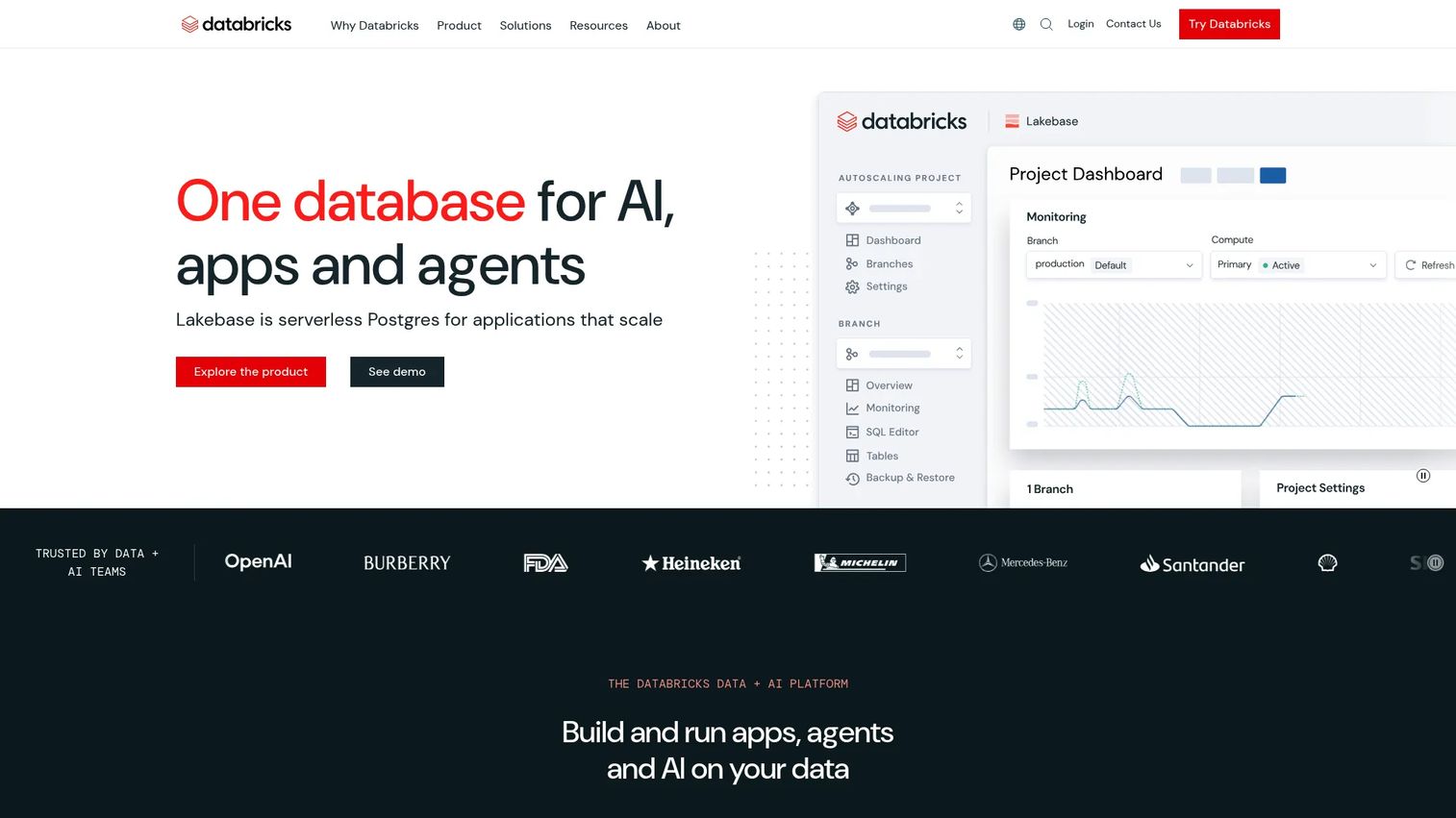
Databricks is a unified, open analytics platform designed for data engineering, machine learning, real-time analytics, and governed AI at scale. Its lakehouse architecture combines the flexibility of data lake storage with warehouse-style query performance, and its Unity Catalog layer provides governance, lineage, discovery, and secure cross-team data sharing. For Product teams running behavioral analysis, experimentation, or building ML-powered product features, Databricks brings engineering, analytics, and AI workflows into a single governed environment.
Best for: Data engineering and analytics teams building a lakehouse foundation that needs to support machine learning and governed AI alongside standard analytics workloads.
Key features
- Lakehouse storage and processing built on Delta Lake
- Machine learning lifecycle management: Feature engineering, training, serving, and monitoring
- Unity Catalog for governance, lineage, discovery, and secure data sharing
- Real-time and streaming analytics with Apache Spark
- SQL analytics, dashboards, notebooks, jobs, and Git integration
Why choose Databricks: Its value compounds as engineering and analytics maturity grows. Teams that treat data products like software, with version control, testing, and deployment pipelines, get proportionally more from the platform. The consumption model means cost tracks directly with usage, which rewards efficiency but requires active monitoring of compute spend.
Databricks pricing: Databricks uses pay-as-you-go pricing with per-second billing; consumption drivers include compute type, runtime, storage, and workload volume. Committed-use contracts can reduce the effective rate. A 14-day trial with up to $400 in credits is available, and a free edition exists for personal, non-commercial use.
Databricks holds a 4.6/5 rating on G2.
4. Snowflake
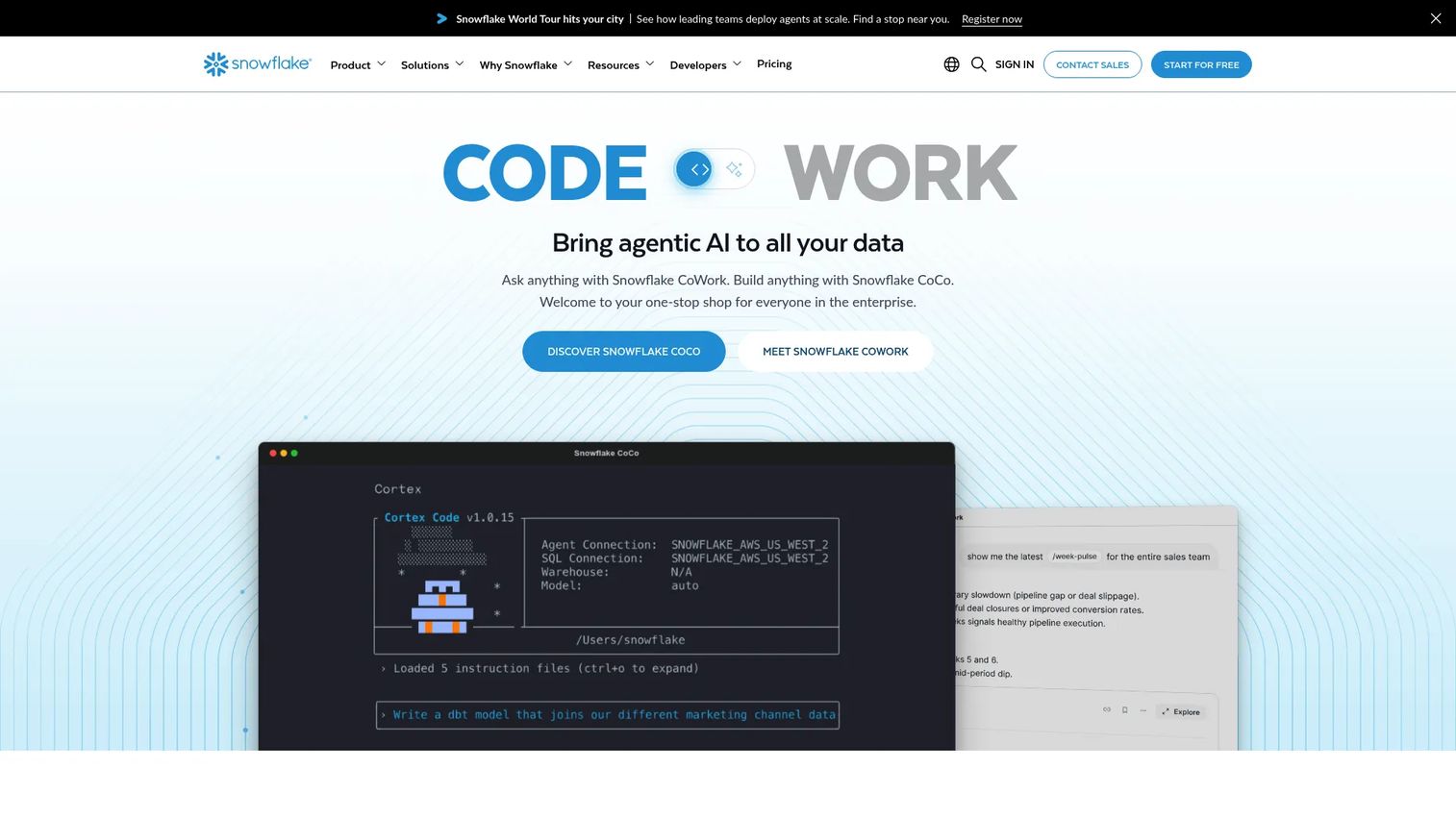
Snowflake is a fully managed, cross-cloud data platform for warehousing, analytics, data sharing, AI workloads, and application development. Its architecture separates storage and compute, which means teams can scale query capacity independently of data volume and pay for what they actually run. Snowflake's Data Marketplace and secure data sharing capabilities make it particularly useful for organizations that need to share or acquire data across organizational boundaries, a common need in product analytics and customer data workflows. Governance and access policies sit alongside SQL analytics, making it a viable foundation for cross-functional metric standardization.
Best for: Organizations that want a scalable, managed cloud analytical foundation with strong data sharing and cross-team access capabilities.
Key features
- Fully managed cloud data warehousing across AWS, Azure, and GCP
- Data sharing and Snowflake Data Marketplace access
- Separated storage and compute for independent scaling
- Governance and access policies with column-level security
- SQL analytics workloads and Snowpark for programmatic access
Why choose Snowflake: Snowflake's managed nature means less operational overhead for engineering teams compared to self-managed alternatives. Compute costs vary with warehouse size and query duration, so workload patterns and idle warehouse management affect total spend meaningfully.
Snowflake pricing: Snowflake uses consumption-based pricing; the rate varies by cloud provider, edition, and region. Editions include Standard, Enterprise, Business Critical, and Virtual Private Snowflake, each adding security and governance features. A 30-day trial with $400 in credits is available for new accounts.
Snowflake holds a 4.6/5 rating on G2.
5. Collibra
Collibra is an enterprise data intelligence and governance platform that has expanded to cover AI governance alongside its core data cataloging, lineage, quality, and stewardship capabilities. Its governance workflow engine supports the operating model side of data management: Assigning ownership, routing approvals, enforcing policies, and tracking compliance. For Product Managers who need their instrumentation choices and metric definitions documented, owned, and visible to stakeholders, Collibra's business glossary and lineage tools make that possible without relying on tribal knowledge or Confluence pages no one keeps current. Connecting data governance into your broader AI governance tools strategy often starts with a platform like Collibra.
Best for: Large enterprises formalizing a data governance program where operating model, stewardship, and accountability carry as much weight as technical connectivity.
Key features
- AI governance and AI asset lifecycle management
- Business glossary and data catalog with discovery workflows
- Data governance workflows and ownership management
- Data lineage, traceability, and impact analysis
- Data quality monitoring and privacy management
Why choose Collibra: Collibra fits governance-led programs where the organization needs more than a catalog search bar. Its workflow engine supports policy enforcement and cross-team accountability. Teams that want a lighter-weight discovery tool without full governance workflow depth should compare it against cataloging-first alternatives before committing.
Collibra pricing: Collibra directs prospects to request a demo for pricing. The platform is quote-based, with cost drivers including user count, data domains, module selection, and implementation scope. G2 reviewer reports indicate enterprise-grade investment; contact Collibra's sales team to scope the relevant modules.
Collibra holds a 4.2/5 rating on G2.
6. Alation

Alation describes itself as a data intelligence platform, combining a searchable data catalog with governance, automated lineage, data quality monitoring, and AI agents for documentation and data product creation. Its Active Metadata Graph connects assets across sources and surfaces usage intelligence, showing which datasets get queried, who owns them, and what's upstream or downstream. For cross-functional teams where analysts, engineers, and Product Managers all need to find and trust the same datasets, Alation's discovery and collaboration features reduce the overhead of maintaining shared data documentation. Teams building out catalog management software capabilities will find Alation a relevant reference point.
Best for: Cross-functional organizations that need collaborative, searchable data discovery alongside governance and AI-readiness capabilities.
Key features
- Searchable data catalog with active metadata graph
- Business glossary and governance policy management
- Automated data lineage with Open Connector Framework
- Data quality monitoring and prioritization
- AI agents for documentation and data product creation
Why choose Alation: Alation's value increases as teams actively contribute definitions, ownership, and documentation. The platform rewards collaborative use patterns. Organizations that want governance to drive behavior changes, not just track assets, tend to get more from Alation than from a passive cataloging tool.
Alation pricing: Alation uses consumption-unit pricing for AI capabilities and provides ACU estimates by request. No standard numeric tier pricing is displayed on the pricing page. Contact Alation for an estimate based on your data estate size and module requirements.
Alation holds a 4.4/5 rating on G2.
7. Fivetran
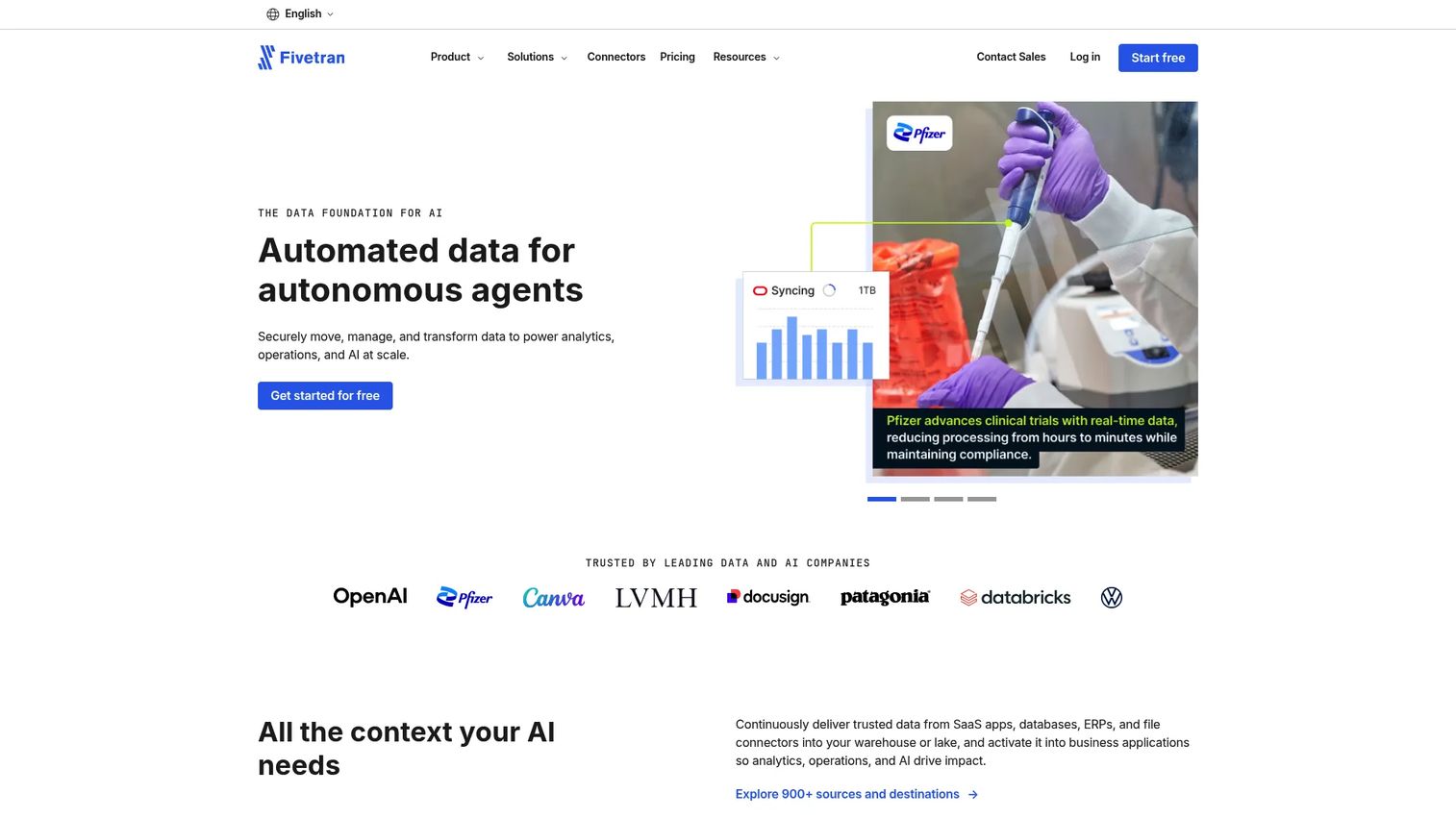
Fivetran is a managed data movement platform focused on connectors, automated ingestion, and delivery into cloud warehouses and lakes. It handles schema changes automatically, captures deletes, and monitors pipelines, removing the engineering maintenance burden that typically accompanies homegrown connector infrastructure. For Product teams that need product event data, CRM records, billing data, and support tickets landing reliably in the same warehouse, Fivetran shortens the gap between "we need this data" and "it's available for analysis." The platform supports over 700 managed connectors. For teams researching adjacent data movement approaches, the guide to change data capture software covers complementary tooling.
Best for: Teams that need managed ingestion into cloud warehouses and analytics environments without maintaining connector code.
Key features
- 700+ fully managed source connectors
- Automated schema handling and change data capture
- Warehouse and lake destinations including major cloud providers
- Pipeline monitoring and re-sync capabilities
- Role-based access control and REST API
Why choose Fivetran: Fivetran narrows the focus to ingestion and delivery, which makes it operationally simple to maintain. Teams still need separate decisions on transformation, governance, observability, and modeling. The platform fits well as the ingestion layer in a stack that includes a transformation tool and a warehouse.
Fivetran pricing: A free tier is available with up to 500,000 monthly active rows for connections, 3,500 for activations, and 5,000 monthly model runs. Paid plans are usage-based; standard connections begin with a $5 base charge for 1 to 1 million monthly active rows. Annual contracts can reduce the effective rate by up to 22%.
Fivetran holds a 4.4/5 rating on G2.
8. dbt
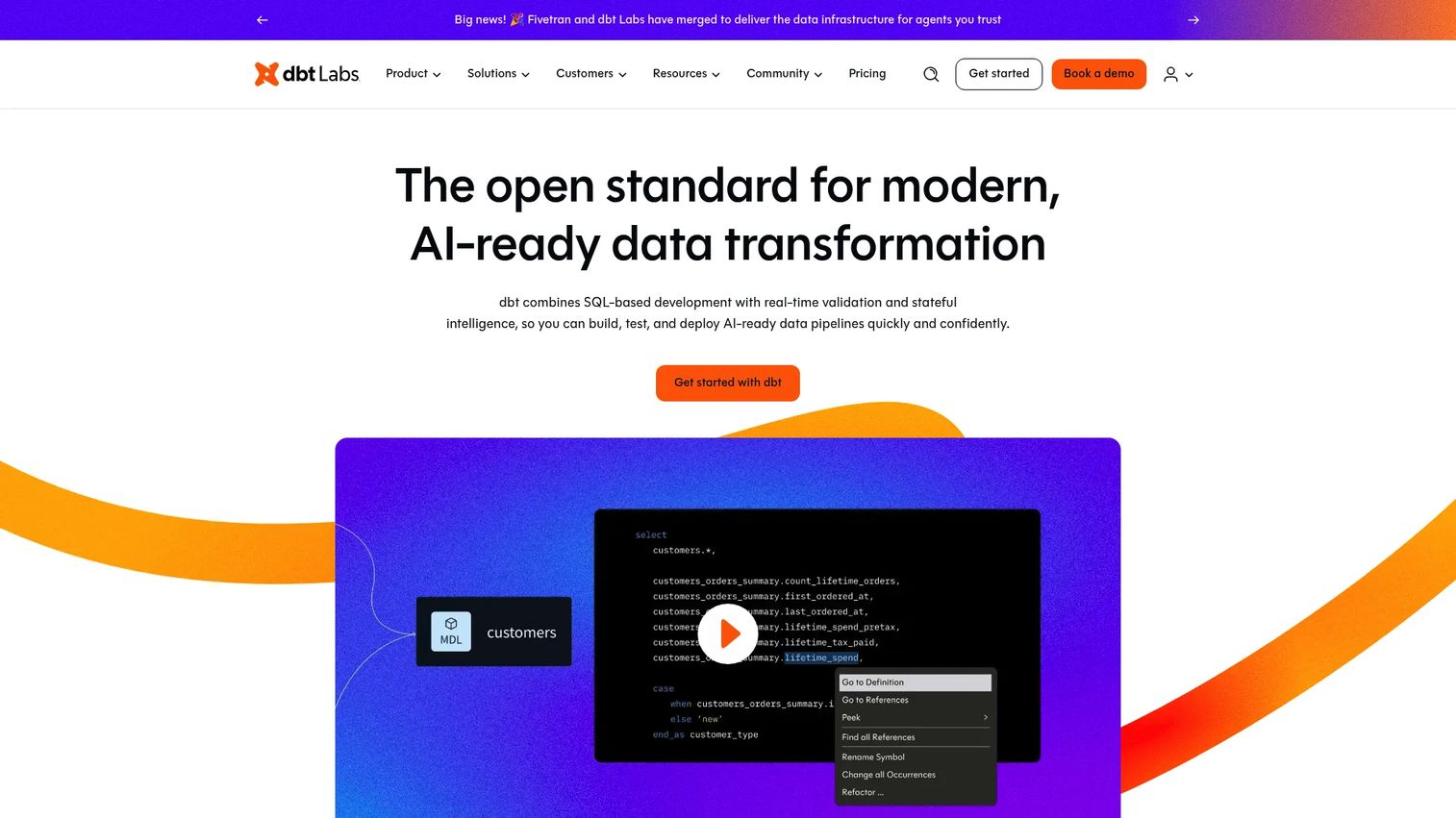
dbt (data build tool) is the standard for analytics engineering: SQL-based transformations, data testing, documentation, lineage, and collaborative development workflows for data teams that treat models like software. Its Semantic Layer and dbt Catalog capabilities extend it toward metric governance and discoverability. For Product Managers, dbt is often the layer where activation and retention definitions get formalized, tested, and made reviewable by anyone across engineering, data, and product. When instrumentation produces inconsistent results, looking at the dbt models that power your dashboards usually reveals where definitions diverge. Understanding how tools like dbt fit alongside business intelligence software helps Product Managers map the full analytics stack.
Best for: Analytics engineering teams that need versioned, tested, documented transformation workflows inside their warehouse.
Key features
- SQL-based modular data modeling and transformation
- Data testing, documentation, and lineage
- dbt Semantic Layer and dbt Catalog for metric governance
- Hosted CI/CD, scheduling, monitoring, and alerting
- AI-powered dbt Wizard for development assistance
Why choose dbt: dbt fits teams where data models are a shared product, not a black box. Its collaborative, code-first approach means changes are reviewable, testable, and auditable. dbt does not replace ingestion, storage, or governance platforms; it occupies the transformation layer between raw data and analytical outputs.
dbt pricing: A Developer tier is free with no stated usage limits for core functionality. The Starter plan costs $100 per user per month (billed monthly). Enterprise and Enterprise+ tiers use custom pricing. A usage-based dbt State option charges $0.094 per billable daily active target table.
dbt holds a 4.7/5 rating on G2.
9. Monte Carlo
Monte Carlo has evolved from a data observability platform into what it now calls an agent trust platform, covering data observability, ML observability, agent observability, automated incident triage, root-cause analysis, and PII monitoring. Its lineage-based impact analysis lets teams understand which downstream dashboards and models are affected when a pipeline breaks or a schema changes. For Product teams, this matters because broken event pipelines produce silent errors: Activation metrics look normal until someone investigates why cohort retention charts diverged. Monte Carlo catches those breaks earlier. For teams considering how observability connects to their broader analytics platforms strategy, observability belongs alongside the warehouse and transformation layers.
Best for: Data and AI teams that need proactive monitoring, automated incident detection, and lineage-based impact analysis across modern data pipelines and AI agents.
Key features
- Data observability: Freshness, quality, volume, and schema monitoring
- ML and agent observability for AI workload reliability
- Automated incident triage and root-cause analysis
- Lineage-based impact analysis for downstream assets
- PII and compliance monitoring
Why choose Monte Carlo: Observability adds the most value after critical data assets and pipelines have been identified. Teams that have established a warehouse, transformation layer, and key dashboards get measurable reliability improvements from Monte Carlo. For teams still in early pipeline setup, governance and ingestion tooling should come first.
Monte Carlo pricing: All tiers include data, ML, and agent observability. Plans are named Start, Scale, Enterprise, and Business Critical, all priced per monitor. Specific rates are available by request at the Monte Carlo pricing page.
Monte Carlo holds a 4.3/5 rating on G2.
10. Alteryx
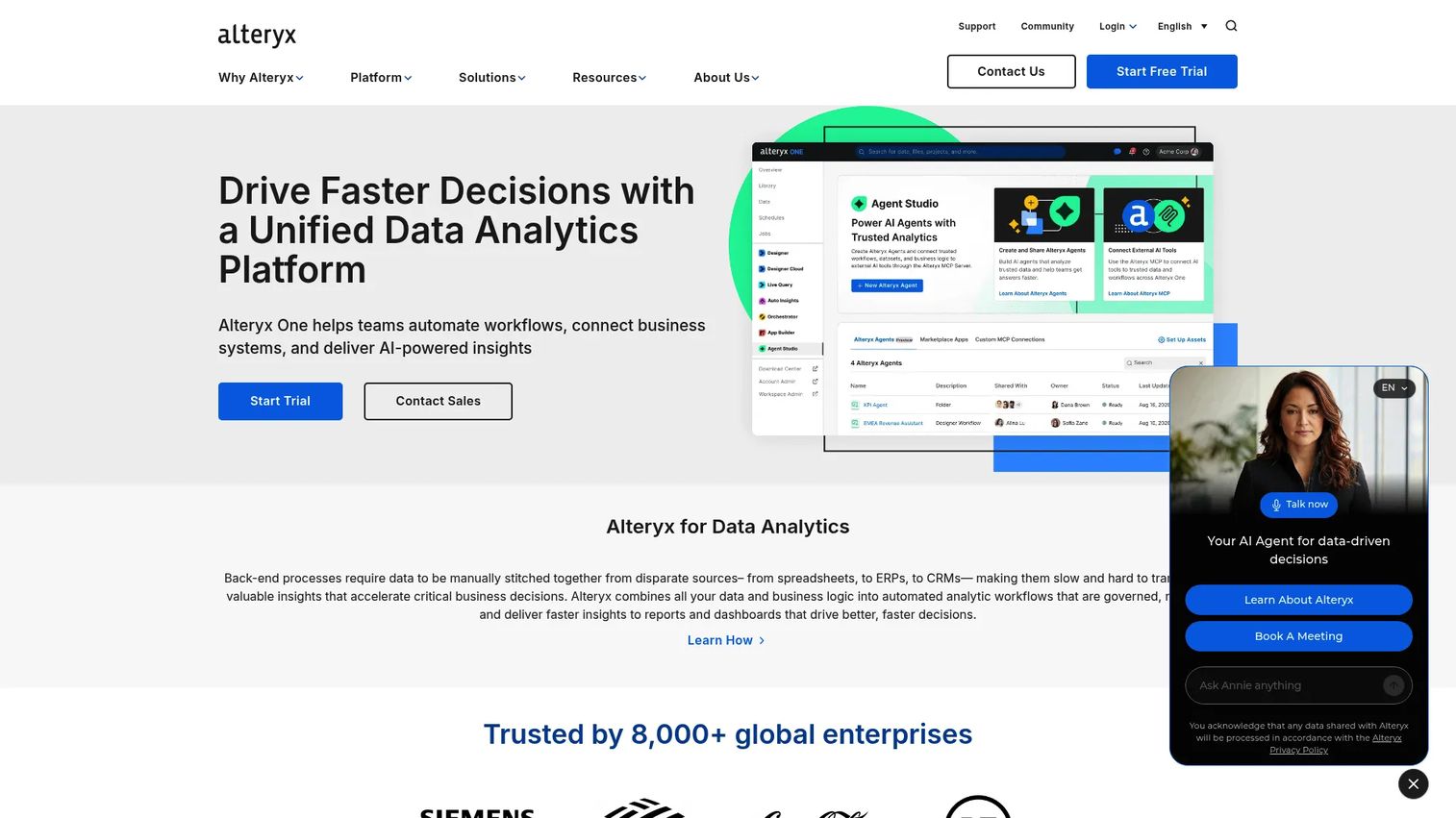
Alteryx is an AI-powered analytics and automation platform built around a visual, drag-and-drop workflow experience. It supports data preparation, blending, machine learning, spatial analytics, text mining, and workflow scheduling without requiring SQL or Python for most tasks. For product and analytics organizations where business stakeholders need to run their own analyses without waiting on engineering, Alteryx reduces that bottleneck meaningfully. Its governance and orchestration features at the enterprise tier support team-based deployment and scheduled workflow management. Teams researching data analysis tooling alongside Alteryx often look at the best business intelligence software category for the visualization layer.
Best for: Organizations supporting analyst-led and business-user-led data preparation, automation, and repeatable analytics workflows.
Key features
- Drag-and-drop data preparation, blending, and transformation
- Machine learning, predictive analytics, and text mining
- Analytics automation, workflow scheduling, and orchestration
- Spatial analytics and computer vision capabilities
- Enterprise governance and deployment management
Why choose Alteryx: Alteryx reduces the dependency on engineering for exploratory analysis and repeatable reporting workflows. At scale, governance and workflow standardization require careful administration, and per-user costs at the Professional and Enterprise tiers grow with headcount. Evaluate the seat model against team size before committing.
Alteryx pricing: The Starter Edition starts at $250 per user per month, billed annually. Professional and Enterprise editions use contact-sales pricing. A free trial is available.
Alteryx holds a 4.6/5 rating on G2.
11. Precisely
Precisely provides enterprise data integrity software covering data integration, quality, governance, enrichment, observability, geo addressing, and spatial analytics. Its focus on data integrity, meaning accurate, consistent, and contextually enriched data, makes it particularly relevant for organizations where customer records, geographic segmentation, and operational data quality directly affect product and business decisions. Master data management across customer and account domains is a core capability, which matters when CRM, ERP, and product analytics systems describe the same entity differently. Teams reviewing data quality alongside enrichment capabilities can also compare tools in the best product analytics software space to understand how quality feeds downstream.
Best for: Enterprise organizations that need data quality, enrichment, and master data capabilities across complex operational and analytical environments.
Key features
- Data integration across hybrid and cloud environments
- Data quality management and validation rules
- Data governance and cataloging workflows
- Geo addressing, spatial analytics, and location intelligence
- Data enrichment and observability
Why choose Precisely: Precisely's depth in data enrichment and location intelligence differentiates it from governance-only platforms. Teams should validate product analytics, CRM, ERP, and warehouse coverage before selection, since the breadth of integrations matters as much as the quality capabilities themselves.
Precisely pricing: The Precisely APIs offer a 30-day free trial with 2,500 credits. The Basic plan starts at $50 per month (pay-as-you-go, 5,000 credits). The Professional plan costs $900 per month on an annual commitment with 100,000 credits. Enterprise plans use custom pricing for volumes above 100,000 credits per month. Note that the API pricing reflects data services pricing; the full enterprise Data Integrity Suite is quoted separately.
Precisely holds a 4.2/5 rating on G2.
12. Syniti
Syniti provides the Syniti Knowledge Platform, a cloud-based enterprise data management solution covering data migration, quality, governance, replication, matching, deduplication, and master data management. It is particularly well-established in SAP environments and complex migration programs where data quality during transition directly affects business continuity. For Product Managers at organizations undergoing platform modernization, acquisitions, or ERP consolidations, Syniti addresses the risk that bad data in source systems gets carried forward into new environments. An integrated data catalog and metadata management layer supports governance continuity across the migration lifecycle. Teams managing enterprise transformation programs often research adjacent tooling in the business process management software category as well.
Best for: Large enterprises managing complex data migration, quality, governance, and master data programs, especially in SAP and cloud modernization contexts.
Key features
- Data migration workflows with profiling and validation
- Data quality management: Profiling, rule generation, matching, and deduplication
- Data governance and compliance tracking
- Data replication and change data capture
- Integrated data catalog and metadata management
Why choose Syniti: Syniti fits structured enterprise transformation programs better than lightweight analytics-focused stacks. Teams that need only ingestion or cataloging should evaluate simpler alternatives. Where data migration risk, SAP expertise, and governance continuity across a major change program are the primary concerns, Syniti's specialization is a meaningful differentiator.
Syniti pricing: Syniti uses custom, project-scoped pricing. Cost drivers include modules selected, data volume, services scope, and deployment model. Contact Syniti directly for a scoped estimate.
Syniti holds a 4.2/5 rating on G2.
Considerations when choosing a data management platform
Match the platform to the data problem
Identify the immediate bottleneck before evaluating vendors. Ingestion gaps, governance gaps, quality gaps, and observability gaps require different platforms. Buying a broad suite when a focused capability solves the current problem adds cost and maintenance overhead without proportional benefit. Buying a point tool when governance requires shared ownership across multiple domains creates the same fragmentation the platform was meant to solve.
Map the architecture and integrations
Inventory your product analytics, CRM, ERP, billing, support, warehouse, and marketing systems before shortlisting. Check connector depth, API quality, batch and streaming support, reverse ETL options, and deployment flexibility. A platform with strong governance but poor connector coverage for your operational systems creates integration debt immediately. For teams exploring how data management fits alongside cloud cost optimization software, the architectural fit question applies to cloud spend as well.
Evaluate governance and data quality depth
Look for ownership assignment, business glossaries, lineage tracking, policy management, sensitive data classification, access controls, quality rules, and issue workflow capabilities. The PM-specific question: Can the people making roadmap decisions see how metrics are defined and where the data comes from? If the answer is no after implementation, the governance layer hasn't done its job.
Model total cost of ownership
Entry pricing rarely reflects production cost. Include implementation, migration, connector fees, compute, storage, seats, professional services, support contracts, and governance staffing in the model. A platform that costs $500 per month at signup may cost ten times that at production scale with full module coverage, data volume, and team growth factored in.
Check AI readiness as an operating capability
Metadata quality, lineage completeness, permissioning depth, semantic models, data contracts, and auditability determine whether a platform supports trustworthy AI workflows. Evaluate these as operational disciplines the platform must sustain over time, not as features to check off during a demo. Teams researching the governance layer specifically for AI workflows can find more context in the guide to AI governance tools.
Conclusion
The right data management platform depends on which layer of your data stack is the current bottleneck.
Informatica IDMC covers the broadest enterprise surface across integration, governance, quality, and master data. Microsoft Purview is the most direct choice for organizations whose data estate runs primarily on Microsoft services. Databricks suits engineering-led teams building lakehouse foundations for analytics and AI. Snowflake works well as a scalable analytical foundation with strong data sharing across teams and organizations.
Collibra fits governance-led programs where operating model and stewardship accountability are the priority. Alation serves cross-functional teams that need collaborative data discovery and cataloging. Fivetran and dbt address focused, complementary layers: Ingestion and transformation, respectively. Monte Carlo adds observability and reliability monitoring after pipelines and critical assets are established.
Alteryx reduces analyst dependence on engineering for repeatable workflows. Precisely addresses data integrity, enrichment, and location intelligence across complex operational environments. Syniti handles enterprise migration and governance programs, particularly in SAP contexts.
Before requesting vendor demos, build a weighted scorecard with criteria, required integrations, security requirements, implementation ownership, and expected time to measurable value. The platforms that score highest on your criteria, not the ones with the most impressive feature lists, are the ones worth piloting.
Start your journey with Guideflow today!
FAQs
A data management platform is software that helps organizations collect, integrate, organize, govern, secure, analyze, and activate data across business systems. The category includes both broad suites that cover the full data lifecycle and focused platforms that specialize in a single layer: Ingestion, governance, quality, cataloging, observability, transformation, warehouse infrastructure, or master data management. The right scope depends on which data problem is the current organizational priority.
Data management platforms typically move through five stages: Ingesting data from sources, transforming and cleaning it, organizing it in a warehouse or catalog, governing access and ownership, and activating it for analysis or downstream workflows. Some platforms handle all five stages; most specialize in two or three. Understanding which stage your current bottleneck sits in helps narrow the shortlist before evaluating vendors.
A marketing DMP (data management platform) focuses on audience data, segmentation, and advertising activation, historically built around anonymous third-party cookie data. A CDP (customer data platform) typically unifies identified customer profiles for engagement across marketing and service workflows. Enterprise data management platforms cover a broader scope: Governance, integration, quality, cataloging, and organizational data across all domains, not only customer-facing activation. For a detailed comparison of CDP options, see the guide to the best customer data platform tools.
No. A data warehouse primarily stores and queries analytical data. A data management platform may include or connect to a warehouse, but it also covers governance, data quality, cataloging, integration, lineage, and activation. Snowflake and Databricks, for example, include governance capabilities alongside their warehousing and lakehouse architecture, which blurs the boundary. Purpose-built governance and cataloging platforms like Collibra and Alation sit above the warehouse layer rather than replacing it.
Cost varies significantly across the category. Pricing drivers include data volume, compute consumption, storage, connector count, user seats, module selection, deployment model, implementation services, support tier, and governance staffing. A warehouse like Snowflake or Databricks charges primarily for compute and storage on a consumption basis. Governance platforms like Collibra and Alation are quote-based with costs tied to users and module scope. Transformation tools like dbt start free for developers and scale to custom enterprise pricing. Evaluate total cost of ownership across a 12 to 24 month horizon, not the entry tier alone.
The best choice depends on which data problem affects product decisions most. For metric standardization across teams, governance and cataloging platforms like Collibra and Alation make definitions visible and owned. For instrumentation reliability, observability tools like Monte Carlo catch pipeline breaks before they distort activation and retention data. For building trustworthy analytical models that underpin product dashboards, dbt and Databricks address the transformation and engineering layer. Most Product Managers benefit from advocating for the data layer that sits between raw events and the reports they use, whether that's transformation quality, governance clarity, or pipeline reliability.
Core capabilities to evaluate: Data integration connectors, data quality monitoring and rules, metadata management, lineage and impact analysis, cataloging and business glossary, governance workflows and ownership assignment, role-based access and sensitive data classification, identity resolution and master data management, semantic models for AI readiness, and APIs or reverse ETL for activation. Not every platform covers all of these; the priority list should match the organization's current data maturity and the specific problem being solved.
A structured process reduces the risk of buying the wrong layer. Start by inventorying existing systems and identifying which critical data products are unreliable or inaccessible. Define the highest-cost data problem: Missing instrumentation, governance gaps, poor quality, or broken pipelines. Map the integrations that matter most. Build a weighted vendor scorecard with criteria, required connectors, security requirements, implementation ownership, and expected time to measurable value. Run a proof of concept with representative data before committing. Measure reliability, adoption, implementation effort, and time to first usable output, not just feature coverage during the demo.