Your CRM says one thing. Your ERP says another. Your data warehouse splits the difference, and the dashboard your CEO opens on Monday morning quietly disagrees with all three. Nobody is lying. The same customer simply exists five times across five systems, with five slightly different spellings, two stale addresses, and one merged account nobody remembers creating.
That fragmentation is not a cosmetic problem. It breaks segmentation, corrupts attribution, slows compliance reviews, and quietly poisons every AI initiative downstream. Garbage in, garbage out is not a cliche when your machine learning model is training on three conflicting versions of the same supplier.
Master data management (MDM) software exists to fix exactly this. It consolidates, cleanses, matches, and governs your core business data into a single trusted master record, then keeps that record in sync everywhere. Research summarized by Semarchy reports that organizations using MDM see up to a 20% increase in data accuracy and roughly a 10% reduction in operational costs after implementation, with nearly 60% of MDM deployments now running in the cloud. The category is growing fast: the global MDM market is projected to reach USD 34.5 billion by 2027.
If you have already accepted that you need MDM and you are now building a shortlist, this guide is for you. It compares the twelve most relevant master data management tools for 2026 with real per-tool depth, verified pricing where it exists, and an honest view of where each one fits.
What's inside
This is a practitioner guide for data and product leaders building an MDM shortlist: data architects, heads of data and analytics, RevOps owners, and product managers whose activation, retention, and segmentation metrics depend on clean records. We selected twelve master data management solutions that are actively developed, broadly deployed, and relevant for 2026, leaving aside legacy products that have seen little new investment.
We evaluated each tool against four criteria that matter most when MDM is doing real work:
- Multidomain coverage: how many master data domains (customer, product, supplier, location, asset) the platform governs in one place.
- Data quality and matching: the sophistication of match, merge, dedupe, and survivorship logic that builds the golden record.
- Governance and lineage: stewardship workflows, policy enforcement, auditability, and lineage for compliance.
- Integration depth and AI-readiness: connectors to your CRM, ERP, PIM, and warehouse, plus AI-assisted matching and AI-ready output.
TL;DR
Short on time? Here are the decision shortcuts by buyer type:
- Best for AI-driven multidomain enterprise MDM: Informatica, with CLAIRE AI across Customer, Product, and Supplier 360.
- Best for SAP-centric stacks: SAP Master Data Governance, native to S/4HANA and SAP ERP.
- Best for product and supplier data depth: Stibo Systems STEP, with deep PIM heritage for retail and manufacturing.
- Best for real-time, high-volume customer data: Reltio Data Cloud, cloud-native and graph-based.
- Best for fast Microsoft-stack mid-market rollout: Profisee, Azure-friendly and quick to deploy.
- Best for rapid multidomain time-to-value: Semarchy, with governed data products and a 4.8/5 G2 rating.
What is master data management software?
Master data management (MDM) software is a platform that consolidates, cleanses, and governs an organization's core business data (customers, products, suppliers, locations, and assets) into a single trusted master record, the golden record, shared across systems. In plain terms, MDM is how you stop having five versions of the same customer and start having one.
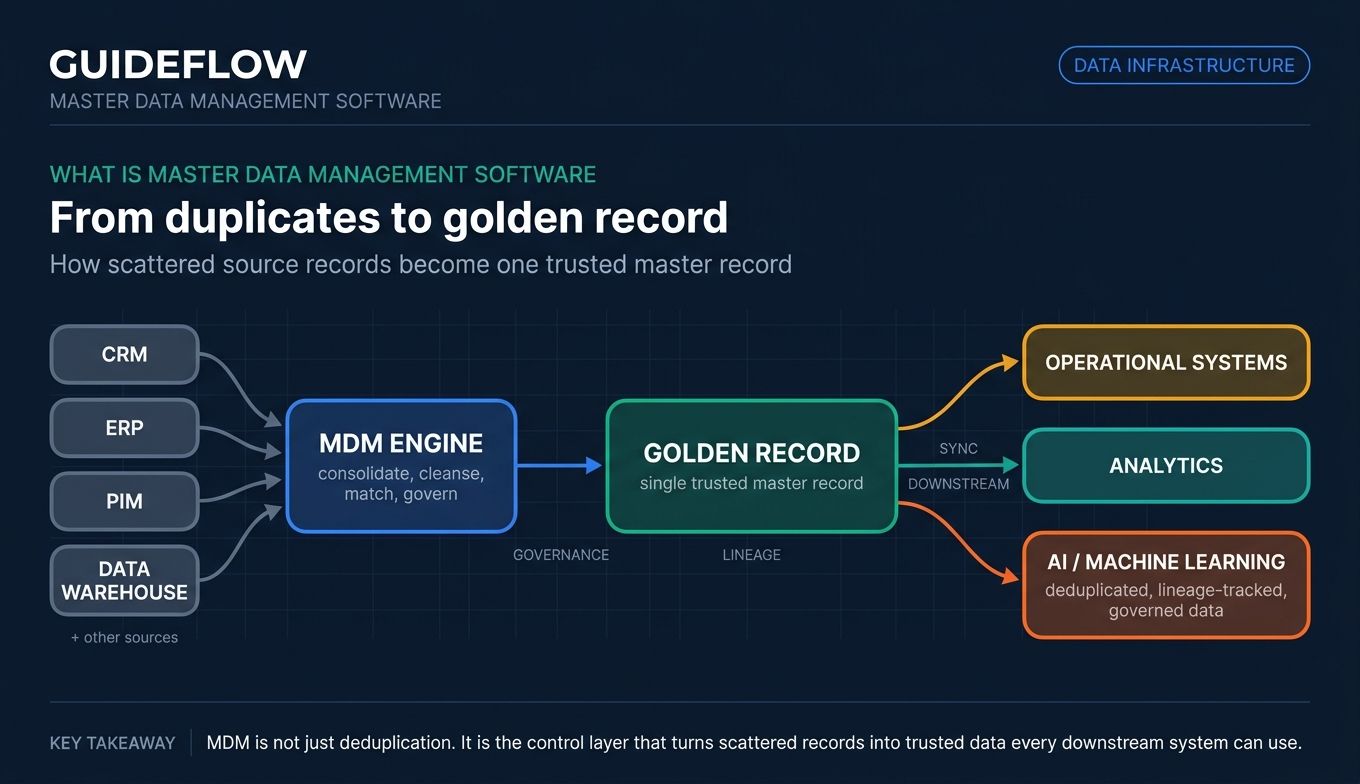
It helps to separate the discipline from the technology. MDM as a discipline is the practice of defining ownership, stewardship, and quality rules for master data. MDM software is the tooling that operationalizes that discipline at scale. You need both. A platform without governance becomes an expensive deduplication engine, and governance without tooling stays trapped in spreadsheets.
The acronym MDM also gets confused with PIM. Product information management (PIM) governs product data for commerce: descriptions, attributes, images, and channel-ready content. MDM governs all master data domains, product included, plus customer, supplier, location, and more. PIM is often a subset or close complement of a broader MDM program.
Core capabilities you should expect from any serious master data management platform:
- Data consolidation: ingest records from CRM, ERP, PIM, data warehouse, and other sources.
- Matching, merging, and dedupe: identify duplicate records using deterministic and fuzzy matching.
- Golden record creation: assemble the best-version-of-the-truth record using survivorship rules.
- Multidomain support: govern customer, product, supplier, location, and asset data in one platform.
- Governance and stewardship: enforce policies, route exceptions, and assign data ownership.
- Lineage and auditability: trace where data came from and how it changed for compliance.
- Downstream publishing and sync: push the golden record back to operational systems in real time.
- AI-ready data foundations: deliver clean, lineage-tracked data that analytics and machine learning can trust.
This is the same discipline that lets SaaS vendors keep their own customer and product data clean enough to power self-serve product experiences and accurate in-app personalization. Trustworthy master data is upstream of almost every data-dependent workflow you run.
When to use master data management software
Not every data problem needs an MDM program. These three situations are where master data management tools earn their cost.
Unify customer data into a single 360 view
When the same customer appears across CRM, marketing automation, support, and billing with conflicting details, segmentation and attribution fall apart. MDM resolves those duplicates into one golden customer record and keeps it synced across systems. The result is a single customer view your sales, marketing, and success teams can actually trust, plus cleaner inputs for lifecycle and retention analysis. If consolidating customer profiles is your priority, a dedicated customer data platform can complement an MDM program.
Govern product data for commerce and the digital thread
Product data sprawls fast across PIM, ERP, e-commerce, and supplier feeds. A master data management platform governs product attributes, hierarchies, and supplier relationships so that omnichannel commercialization stays consistent. This is also where supply chain master data management matters: clean supplier, location, and material data is the backbone of the digital thread from sourcing to fulfillment.
Build an AI-ready, trusted data foundation
Analytics and machine learning are only as good as the data underneath. If your models train on duplicated, inconsistent, unlineaged records, you get confident wrong answers. MDM gives you deduplicated, lineage-tracked, governed data that downstream analytics and AI can rely on. For any 2026 AI roadmap, an MDM program is increasingly a prerequisite, not a nice-to-have. The same logic applies when you evaluate product analytics software or marketing analytics software downstream.
Comparison table
Here is the shortlist at a glance. The table is sorted by relevance to broad multidomain enterprise MDM first, then specialized product and supply-chain tools. Pricing for most enterprise MDM is quote-based, so we note public figures where they exist and mark the rest as custom. Verify pricing, features, and vendor positioning for 2026 before you sign.
| # | Product | Intent | Key use case | Pricing | G2 rating |
|---|---|---|---|---|---|
| 1 | Informatica | Enterprise multidomain MDM | AI-driven Customer/Product/Supplier 360 at scale | Custom, consumption-based | 4.3/5 |
| 2 | SAP Master Data Governance | ERP-native MDM | Governance for SAP-centric enterprises | Custom | 4.2/5 |
| 3 | Stibo Systems | Multidomain + product MDM | Product and supplier data for retail/manufacturing | Custom | 4.1/5 |
| 4 | Reltio | Real-time customer MDM | High-volume, graph-based Customer 360 | Custom | 3.3/5 |
| 5 | Profisee | Mid-market multidomain MDM | Fast, Azure-friendly deployment | Custom | 4.4/5 |
| 6 | Semarchy | Rapid multidomain MDM | Governed data products, fast time-to-value | Custom | 4.8/5 |
| 7 | Ataccama | Data quality + MDM | Unified quality, governance, and MDM | Custom | 4.2/5 |
| 8 | IBM | Enterprise governance MDM | Regulated, on-prem and cloud MDM | Custom | 4.1/5 |
| 9 | TIBCO EBX | Flexible multidomain modeling | Custom data models, reference + master data | Custom | 4.2/5 |
| 10 | Oracle | Oracle-stack enterprise MDM | Cross-suite ERP/SCM/CX customer MDM | Usage-based | 4.1/5 |
| 11 | Pimcore | Open-source PIM + MDM | Budget-flexible product and master data | From $9,900/year | 4.5/5 |
| 12 | Syndigo | Commerce-focused MDM | Product content and syndication | Custom | 4.4/5 |
The 12 best master data management software tools
1. Informatica
Informatica runs its MDM and 360 applications inside the Intelligent Data Management Cloud, a broad platform spanning data cataloging, integration, quality, governance, privacy, and master data. Its CLAIRE AI engine powers matching, classification, and automation across Customer 360, Product 360, and Supplier 360. For large enterprises that want one cloud-native platform handling multidomain MDM alongside the rest of their data stack, Informatica is the default heavyweight.
Best for: Large enterprises needing a broad, consumption-priced cloud platform for data integration, governance, cataloging, quality, and MDM.
Key strengths
- CLAIRE AI: AI-assisted matching, classification, and automation that reduces manual stewardship load.
- 360 applications: Prebuilt Customer 360, Product 360, and Supplier 360 apps for faster domain rollout.
- Unified data stack: Cataloging, integration, quality, and MDM in one cloud platform rather than stitched-together point tools.
Why choose Informatica: If your data team already lives across multiple disciplines and you want governance, quality, and MDM under one roof, Informatica consolidates them. It scales to enterprise volume and complexity, which is exactly where lighter tools start to strain.
Informatica pricing: Informatica uses flexible, consumption-based pricing built on Informatica Processing Units (IPUs), with volume-based scaling. The first-party pricing page lists no public starting price and directs buyers to Get Quote or Contact Sales. Expect a custom quote tied to your processing volume and the modules you enable. Informatica holds a 4.3/5 rating on G2.
2. SAP Master Data Governance
SAP Master Data Governance (SAP MDG) is the natural MDM choice when your enterprise already runs on SAP. It integrates natively with S/4HANA and SAP ERP, governs domains including customer, supplier, product, and finance data, and builds governance workflows directly into the SAP environment your teams already use. For SAP-centric stacks, that native connection removes a significant integration burden.
Best for: Large enterprises running SAP ERP or S/4HANA that want master data governance embedded in their existing landscape.
Key strengths
- Native SAP integration: Direct connection to S/4HANA and SAP ERP without bolt-on middleware.
- Multidomain governance: Coverage across customer, supplier, product, and finance master data domains.
- Workflow-driven stewardship: Configurable governance workflows for data creation, change, and approval.
Why choose SAP MDG: If your operational core is SAP, MDG keeps master data governance inside that core, which simplifies lineage, security, and process alignment. The trade-off is that its strongest value shows up in SAP-heavy environments rather than neutral, multi-vendor estates.
SAP MDG pricing: SAP does not publish standalone list pricing for Master Data Governance, and packaging typically depends on your broader SAP licensing and deployment. For context, SAP's separately priced Integration Suite, which often accompanies MDM integration work, starts at USD 1,771 per month for its starter edition. SAP holds a 4.2/5 rating as a seller on G2. Confirm MDG-specific terms with SAP directly.
3. Stibo Systems
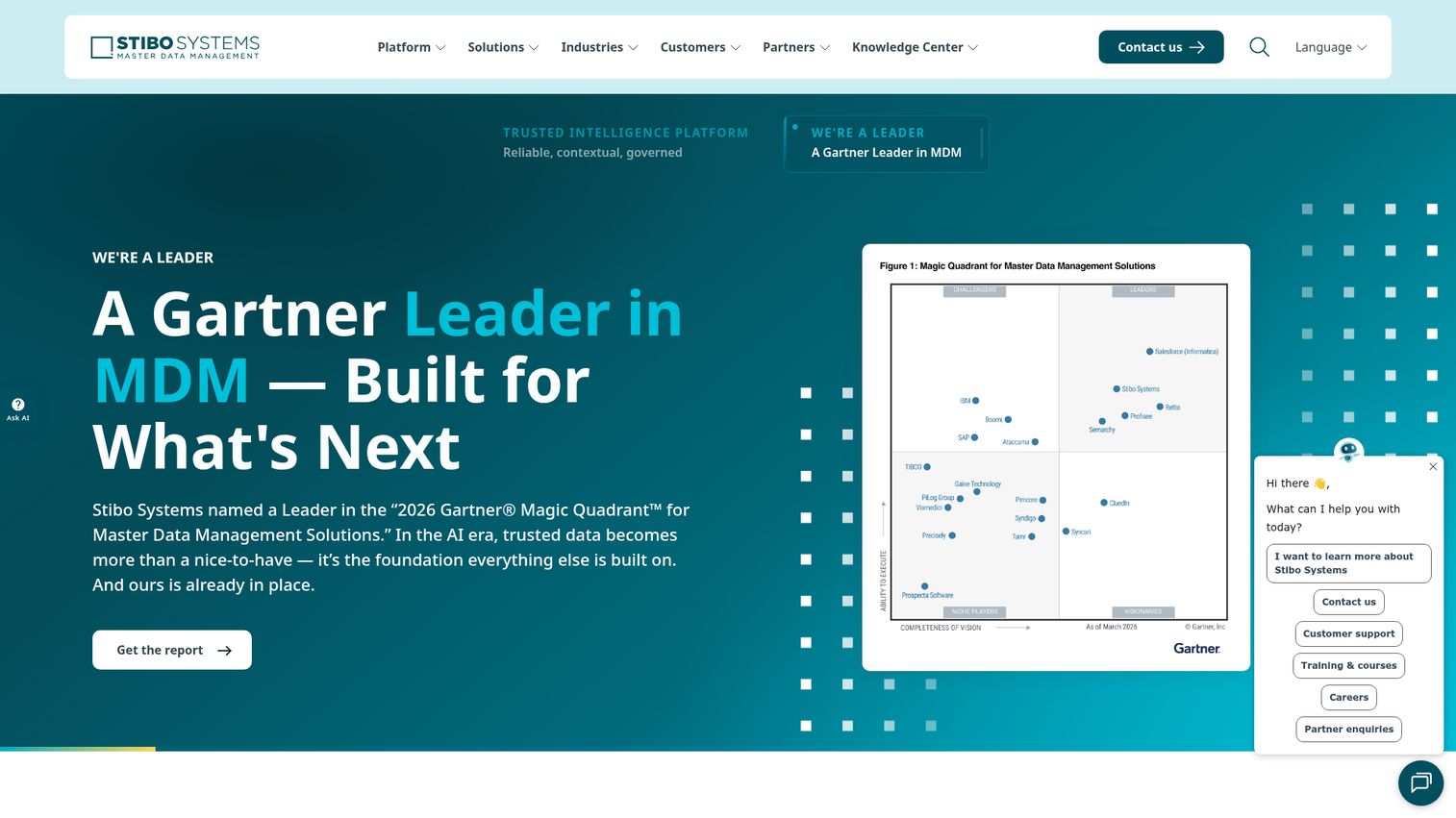
Stibo Systems is a multidomain MDM platform with deep roots in product information management. Its STEP platform and Product Experience Data Cloud govern product, customer, supplier, business partner, location, and sustainability data, with strong adoption in retail and manufacturing. If your master data center of gravity is product and supplier information, Stibo brings serious heritage.
Best for: Large enterprises needing governed, scalable multidomain MDM for product, customer, supplier, and related business data.
Key strengths
- Multidomain coverage: Product, customer, supplier, business partner, location, and sustainability domains in one platform.
- Product data depth: PIM, product data onboarding, and syndication built on years of product information heritage.
- End-to-end data lifecycle: Sourcing, modeling, integration, quality, governance, compliance, sharing, and delivery in one flow.
Why choose Stibo Systems: For retail, CPG, and manufacturing organizations where product and supplier data drive revenue, Stibo combines PIM depth with broader multidomain governance. That dual strength is its differentiator against pure customer-MDM tools.
Stibo Systems pricing: Stibo Systems does not publish public pricing or named tiers on its site, and emphasizes contacting sales rather than self-serve pricing. Expect an enterprise quote scoped to your domains, data volumes, and deployment model. Stibo Systems holds a 4.1/5 rating on G2.
4. Reltio
Reltio is a cloud-native data unification and context intelligence platform built for real-time, AI-ready master data. Its graph-based model and pretrained, LLM-driven matching make it a strong fit for high-volume Customer 360 use cases where records change constantly and latency matters. Reltio is purpose-built for the scale and speed that traditional batch-oriented MDM struggles with.
Best for: Enterprises that need real-time master data management, entity resolution, data quality, and AI-ready unified data across domains.
Key strengths
- LLM-driven entity resolution: Pretrained matching models that build AI-ready golden records.
- Continuous data quality: Real-time monitoring and curation for operations, analytics, and AI.
- Broad connectivity: Low-code and no-code integration with over 1,000 prebuilt connectors.
Why choose Reltio: If you are managing high-volume customer data that updates in real time and feeds AI workloads, Reltio's cloud-native, graph-based architecture is built for exactly that. It rewards teams that need speed and scale over batch-based traditional MDM.
Reltio pricing: Reltio does not publish public product pricing and routes buyers to request a demo or contact sales. Pricing is custom and typically scoped to data volume and domains. Reltio's Connected Data Platform holds a 3.3/5 rating on G2, so it is worth validating matching quality against a sample of your own messy data before committing.
5. Profisee
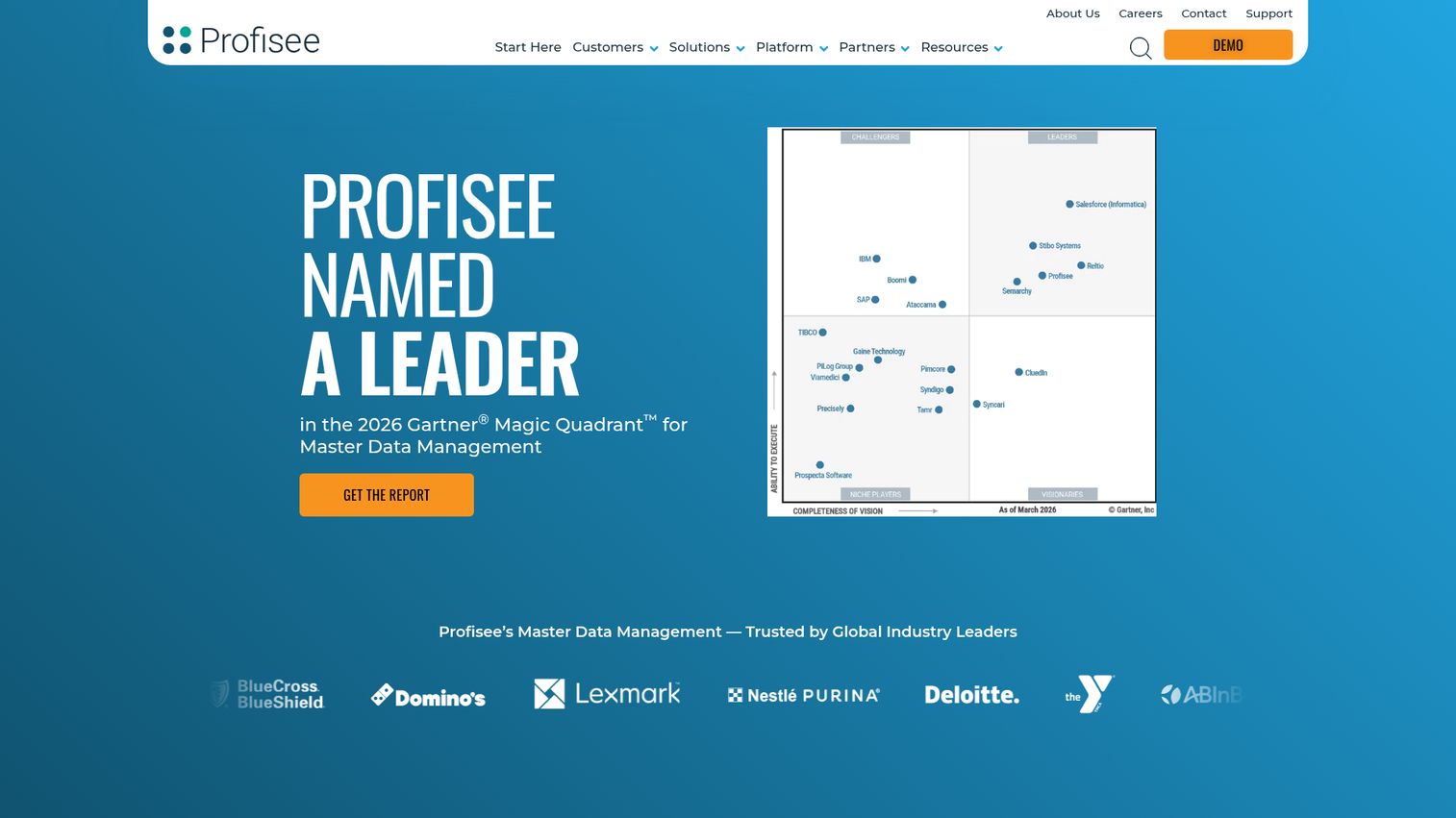
Profisee is a cloud-native, multidomain MDM platform known for being Azure-friendly and quick to deploy. It creates trusted, governed master data across domains like customers, products, suppliers, and locations, with fuzzy matching, survivorship-based golden records, and configurable governance. For Microsoft-stack mid-market teams that want MDM without a multi-year implementation, Profisee lowers the barrier to entry.
Best for: Enterprises that need multidomain master data management with matching, survivorship, data quality, governance, and flexible SaaS or PaaS deployment.
Key strengths
- Fuzzy matching and survivorship: Identify duplicates and build golden records through configurable survivorship.
- Pre-built connectors: Connect to source systems and databases with connectors and webhooks.
- Governance and workflows: Create and enforce governance policies, data quality rules, and stewardship workflows.
Why choose Profisee: For teams in the Microsoft and Azure ecosystem, Profisee fits naturally and deploys faster than the enterprise heavyweights. It is a strong pick when you need real multidomain MDM but cannot justify a year-long rollout.
Profisee pricing: Profisee uses domain-agnostic, volume-based pricing. You select an edition first (Application Edition for reference data management, or Enterprise Edition for full-featured MDM), then data volumes and deployment method. The pricing page requires a quote and shows no public numeric prices. Profisee holds a 4.4/5 rating on G2 across reviewer feedback.
6. Semarchy
Semarchy positions its Data Platform as an AI-driven foundation for master data management, governance, data quality, integration, and governed data products. It emphasizes federated governance, a data-as-a-product approach, and rapid time-to-value across customer, product, supplier, and reference data. For teams that want a fast multidomain rollout without sacrificing governance, Semarchy is a standout.
Best for: Enterprises that need flexible deployment for governed, AI-ready master data and reusable data products.
Key strengths
- Golden records across domains: Master data management for customer, product, supplier, and reference data.
- AI-powered governance: Cataloging, policy workflows, stewardship, and lineage in one platform.
- Data quality plus integration: Monitoring, cleansing, enrichment, and low-code integration pipelines.
Why choose Semarchy: Semarchy is built for speed without cutting governance corners, which makes it appealing to mid-market and enterprise teams that need results in quarters, not years. Its data-as-a-product framing fits modern, federated data organizations well.
Semarchy pricing: Semarchy publishes deployment cost models rather than public price figures, including annual subscription for its SaaS offering, Snowflake purchase options, annual license plus cloud infrastructure for self-hosted cloud, and subscription license plus hardware for on-premises. No public numeric pricing is listed, so request a quote scoped to your deployment. Semarchy xDM holds a strong 4.8/5 rating on G2.
7. Ataccama
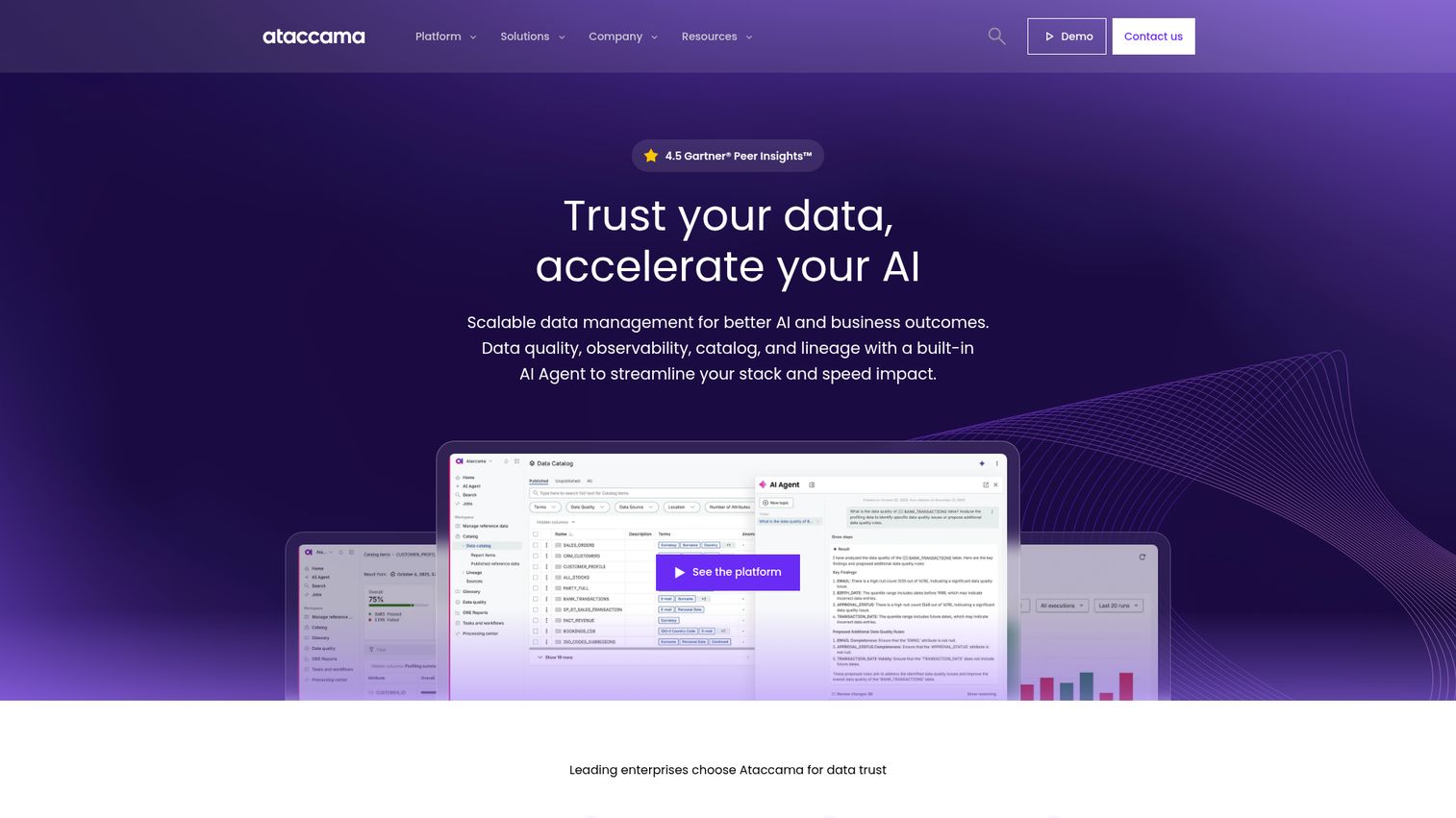
Ataccama delivers scalable data management for AI and business outcomes, combining data quality, observability, catalog, lineage, and master data in one platform with an AI Agent. If your priority is unifying data quality and MDM rather than treating them as separate tools, Ataccama ONE is designed for exactly that combination.
Best for: Enterprise data teams needing a unified platform for trusted, governed, AI-ready data across quality, catalog, lineage, observability, and master/reference data.
Key strengths
- Data quality core: Monitoring, cleansing, standardization, and rule management built in.
- Catalog and lineage: Data catalog, business glossary, lineage, and governance in one place.
- Data observability: Detect schema changes, freshness issues, anomalies, and record-volume problems.
Why choose Ataccama: Ataccama suits teams that see data quality and MDM as one job, not two. By unifying quality, observability, catalog, and master data, it reduces the tool sprawl that fragments many data programs.
Ataccama pricing: Ataccama does not publish public pricing on its site and routes buyers to demo and contact CTAs. Pricing is custom and scoped to your platform footprint. Ataccama ONE holds a 4.2/5 rating on G2 from reviewer feedback. Ask for a quote that covers the specific modules you plan to deploy.
8. IBM
IBM has long offered enterprise-grade master data management (formerly InfoSphere MDM) for large, regulated organizations. It supports on-premises and cloud deployment with strong governance and data quality, and fits enterprises that need deep control over how master data is created, matched, and audited. For regulated industries, IBM remains a serious contender.
Best for: Large regulated enterprises needing governed master data across on-premises, cloud, or hybrid deployments.
Key strengths
- Deployment flexibility: On-premises, cloud, and hybrid options for regulated environments.
- Deep governance: Strong stewardship, policy, and audit capabilities for compliance-heavy industries.
- Enterprise scale: Built to handle large, complex master data estates.
Why choose IBM: When compliance, auditability, and deployment control are non-negotiable, IBM's enterprise pedigree and governance depth carry weight. It is a fit for financial services, healthcare, and other regulated sectors that need on-prem options.
IBM pricing: IBM does not publish a single MDM list price, as its master data offerings are scoped per deployment and often bundled within broader data platforms. For reference on IBM's published-pricing posture, its Cognos Analytics On Demand starts at $11.25 USD per authorized user per month, though that is a separate analytics product. IBM holds a 4.1/5 rating on G2 across reviewed products. Expect a custom MDM quote.
9. TIBCO EBX
TIBCO EBX, now part of Cloud Software Group, is a flexible multidomain MDM and reference data platform known for adaptable data modeling. It governs both master data and reference data, and suits organizations with complex, custom data models that off-the-shelf domain apps cannot fully capture. EBX rewards teams that need modeling flexibility above all.
Best for: Large enterprises needing flexible multidomain modeling for reference and master data across hybrid environments.
Key strengths
- Flexible data modeling: Adaptable models for complex, custom multidomain requirements.
- Reference plus master data: Govern both reference data and master data in one platform.
- Enterprise integration: Real-time integration and messaging strengths from the broader TIBCO stack.
Why choose TIBCO EBX: If your master data does not fit neatly into prebuilt customer or product apps, EBX's modeling flexibility lets you shape the platform to your data, not the other way around. That makes it a fit for unusual or highly custom domain structures.
TIBCO EBX pricing: TIBCO does not publish public pricing for EBX, and its historical pricing pages redirect to product pages without figures or named tiers. Pricing is custom and quote-based. TIBCO Integration, which includes BusinessWorks and Flogo, holds a 4.2/5 rating on G2. Request a scoped quote based on your domains and deployment.
10. Oracle
Oracle offers enterprise and customer master data management integrated across its Fusion Cloud applications, spanning ERP, SCM, PLM, and CX. For organizations already standardized on Oracle, its cross-suite data model keeps master data consistent across the application landscape. Oracle Cloud Infrastructure underpins the deployment with broad platform services.
Best for: Enterprises needing broad cloud infrastructure, database, AI, integration, and application-platform services across distributed deployment models.
Key strengths
- Cross-suite data model: Consistent master data across Oracle ERP, SCM, PLM, and CX applications.
- Customer data management: Dedicated customer MDM alongside enterprise master data.
- Distributed cloud: Deploy across public, hybrid, dedicated, and multicloud environments.
Why choose Oracle: For Oracle-stack enterprises, native MDM across the Fusion suite removes integration friction and keeps master data aligned with operational applications. It is the path of least resistance when Oracle is already your operational core.
Oracle pricing: Oracle Cloud Infrastructure uses usage-based pricing by service, with an Oracle Cloud Free Tier offering US$300 in cloud credit for up to 30 days plus Always Free services, then Pay As You Go beyond those amounts. MDM application pricing itself is quote-based within Oracle's broader licensing. Oracle holds a 4.1/5 rating on G2 for its cloud infrastructure.
11. Pimcore

Pimcore is an open digital platform that unifies data management and experience delivery, combining PIM, MDM, DAM, CDP, DXP, and commerce capabilities. Its open-source core and published pricing make it the most budget-flexible option on this list, especially for teams that need product and master data without enterprise-scale licensing. Pimcore stands out for transparency in a category that hides pricing.
Best for: Enterprises needing a customizable platform to centralize product, asset, master, customer, content, and commerce data for omnichannel experiences.
Key strengths
- Multi-discipline platform: PIM, MDM, DAM, CDP, and DXP capabilities in one open platform.
- Open core: Free Community Edition based on the open-source core for teams that want to start small.
- Headless delivery: Data syndication and headless content delivery via APIs.
Why choose Pimcore: For budget-conscious or open-source-friendly teams that need product and master data, Pimcore offers transparent pricing and the flexibility to self-host or scale up. It is a practical entry point when enterprise MDM quotes are out of reach.
Pimcore pricing: Pimcore publishes its pricing. Professional On-Premises starts at $9,900 per year, Enterprise On-Premises at $29,900 per year, and the PaaS Platform-as-a-Service edition from $39,900 per year. A free Community Edition based on the open core is also available to try. Pimcore holds a 4.5/5 rating on G2.
12. Syndigo
Syndigo provides a Product Experience Cloud for managing, enriching, syndicating, and analyzing product content across brands, retailers, distributors, and marketplaces. Its MDM strength is commerce and supply-chain focused, with deep product content management, syndication, and digital shelf analytics. For product content and commerce data orchestration, Syndigo is purpose-built.
Best for: Enterprise brands, retailers, and distributors that need centralized product data, PIM/MDM/DAM capabilities, rich content, syndication, and digital shelf analytics across many commerce channels.
Key strengths
- Product content management: Catalog management, DAM, data modeling, and integrations to PLM, ERP, and e-commerce.
- Content syndication: Distribute validated product data across a large retail network.
- Digital shelf analytics: Data quality scoring, rich media, GDSN support, and agentic workflows via Syndigo Synapse.
Why choose Syndigo: For commerce-first organizations where product content drives sales across many channels, Syndigo combines product MDM with syndication and digital shelf insight. It fits supply chain and retail use cases better than general-purpose MDM tools.
Syndigo pricing: Syndigo does not publish public pricing and routes buyers to a request-demo or talk-to-sales flow. Pricing is custom and scoped to your channels, content volume, and modules. Syndigo holds a 4.4/5 rating on G2.
Considerations: how to evaluate MDM software
A shortlist is only useful if you score it against the criteria that actually predict success. Use this checklist when you compare master data management tools.
Domain coverage and multidomain support
Decide which domains you actually need now versus later. Single-domain customer MDM is cheaper and faster, but if product, supplier, and location data are also fragmented, a multidomain platform avoids buying twice. Match the tool's domain coverage to your real roadmap, not a hypothetical one.
Data quality, matching, and survivorship logic
The golden record is only as good as the match, merge, and dedupe logic behind it. Evaluate how configurable the survivorship rules are and whether matching handles your messiest real-world data, not clean demo data. Always test against a sample of your own records.
Governance, stewardship, lineage, and auditability
Compliance lives here. Check how policies are enforced, who owns stewardship, how exceptions are routed, and whether lineage is traceable for audits. In regulated industries, weak lineage is a deal-breaker.
Integration depth and deployment model
Confirm connectors for your CRM, ERP, PIM, and warehouse, and whether sync is real-time or batch. Decide whether cloud, on-premises, or hybrid fits your security posture. Integration gaps create exactly the silos MDM is meant to eliminate. When you map your stack, your CRM software is usually the first system to wire into the golden record.
AI-readiness and total cost of ownership
Weigh AI-assisted matching, consumption versus flat pricing, and implementation overhead. Consumption pricing scales with success but can surprise you at volume. The Gartner Magic Quadrant for master data management is a useful starting signal for vendor positioning, but validate it against your own evaluation.
Conclusion
There is no single best master data management platform, only the best fit for your stack and your domains. For AI-ready cloud enterprise MDM, Informatica and Reltio lead. For ERP-native programs, SAP Master Data Governance and Oracle keep master data aligned with your operational core. For product and supplier data depth, Stibo Systems, Syndigo, and Pimcore stand out, with Pimcore the most budget-flexible. For fast mid-market rollout, Profisee and Semarchy lower the barrier without sacrificing governance.
Your next step is concrete. Shortlist two or three tools by your actual domain need, request demos, and then validate each one's matching logic against a real sample of your own messy data. Clean demo data tells you nothing. Your duplicated, inconsistent, real records tell you everything. The tool that survives that test is the one worth buying. When you do request those demos, an interactive demo platform can help vendors walk you through matching workflows without a heavyweight POC.
FAQ
Master data management software is a platform that creates a single, trusted golden record of an organization's core business data across systems. It consolidates, cleanses, matches, and governs customer, product, supplier, and other master data so every system shares one consistent version of the truth.
PIM (product information management) manages product information for commerce, including descriptions, attributes, and channel-ready content. MDM governs all master data domains, including customer, supplier, and location data, with product as one of those domains. PIM is often a subset or complement of a broader MDM program.
Most enterprise MDM is custom and quote-based, often priced by consumption, record volume, domains, or deployment. Annual costs commonly run from the mid five figures into six figures depending on scale and scope. A few vendors publish pricing: Pimcore, for example, starts at $9,900 per year. Verify current pricing directly with each vendor.
The main master data domains are customer, product, supplier or vendor, location, asset, employee, and reference data. Multidomain MDM platforms govern several of these in one place, which is why domain coverage is a key evaluation criterion.
A golden record is the single, deduplicated, best-version-of-the-truth record assembled from multiple source systems. MDM builds it by matching duplicate records, merging them, and applying survivorship rules that decide which values win when sources disagree.
Yes, when data fragmentation is measurably hurting analytics, AI, or compliance. Cloud-native and Microsoft or Azure-friendly options like Profisee and Semarchy lower the entry barrier and deploy faster than enterprise heavyweights, making MDM accessible to mid-market teams that previously could not justify it.
AI and analytics are only as reliable as the data underneath them. MDM delivers deduplicated, lineage-tracked, governed data so models and dashboards train on one consistent version of the truth. Without it, garbage in produces garbage out, no matter how good the model is.
Evaluate five things: domain coverage, data quality and matching sophistication, governance and lineage, integration depth and deployment model, and AI-readiness with total cost of ownership. Use the Gartner Magic Quadrant for master data management as a starting signal, then validate each tool's matching against a sample of your own data.