Your production supervisor tracks batches in one spreadsheet. Your finance lead reconciles costs in another. When an auditor asks for a full lot trace, three people spend a day pulling records that should take thirty seconds. Sound familiar?
Most food manufacturers hit this wall the same way. They outgrow spreadsheets, buy a generic ERP built for discrete manufacturing, and discover it has no idea what catch weight, allergen tracking, or a recall response is. The result is a system that fights your operation instead of running it.
The stakes are not abstract. The global food manufacturing software market was valued at USD 7.55 billion in 2024 and is projected to reach USD 14.23 billion by 2034, according to Precedence Research, with cloud-based deployment already holding 52% of the market. That growth reflects a simple pressure: traceability, FSMA readiness, and margin visibility have moved from nice-to-have to non-negotiable.
The right food manufacturing ERP software does what a generic system cannot. It handles recipe management and formulation, lot traceability with FIFO and FEFO logic, quality management, and food-specific costing in one connected place. Pick well and your operations get predictable. Pick a generic tool and you inherit workarounds that never end.
This guide ranks seven food ERP software options for 2026. We focus on what actually matters when you buy: traceability, compliance readiness, inventory control, production planning, costing, and how fast you can go live.
What's inside
This list is for food manufacturers, processors, and food and beverage teams evaluating purpose-built software, not another generic ERP with a food skin bolted on. Whether you run a single co-packing line or multiple plants, the criteria below apply.
We selected and ranked platforms on six factors: lot traceability and recall readiness, compliance support for FSMA, HACCP, SQF, and BRC, inventory and warehouse control, production planning and batch workflow, food-specific costing and margin visibility, and realistic implementation fit. Vendors that only claim generic ERP capability did not make the cut. Every tool here handles real food-specific workflows.
TL;DR
- Best overall for fast implementation and growing teams: Wherefour delivers configurable inventory, batch control, and traceability without a multi-year rollout.
- Best for deep food ERP fit: BatchMaster is built around formulation and batch production for process manufacturers.
- Best for shortlisting and research: ERP Focus helps you compare food ERP systems before you commit budget.
- Best for Microsoft-centered stacks: inecta runs on Dynamics 365 Business Central with strong traceability and catch weight support.
- Best for smaller food and beverage teams: NutraSoft pairs food production software with nutrition labeling.
- Best for enterprise complexity: Aptean brings deep industry-specific ERP for complex categories like meat, seafood, and poultry.
What is food manufacturing software?
Food manufacturing software is a purpose-built platform that manages recipe formulation, production, inventory, quality, compliance, and costing for companies that make food and beverage products. It differs from generic ERP because it understands food-specific realities that discrete manufacturing systems ignore.
A generic ERP assumes fixed bills of materials, whole-unit inventory, and no regulatory recall obligation. Food operations break all three assumptions. You buy meat by variable weight, yields shift batch to batch, and you must trace every lot forward and backward within minutes. Food processing software encodes that logic natively instead of asking you to force it into fields that were never designed for it.
The core functional layers of any food and beverage ERP include:
- Inventory and lot tracking: Lot traceability, FIFO and FEFO rotation, expiry management, and catch weight or dual unit of measure handling.
- Recipe and formulation control: Recipe management, formulation, scaling, BOM structures, and version control for reformulations.
- Production planning and batch workflows: MRP, MPS, batch workflow scheduling, yield tracking, by-products, and rework.
- Quality and compliance: HACCP plans, allergen tracking, COA management, and audit readiness for FSMA, SQF, and BRC.
- Costing and finance integration: Landed cost, yield variance, margin visibility, and connections to accounting systems like QuickBooks, Sage, or Microsoft Dynamics.
The best food manufacturing ERP connects these layers so a single lot number carries context from receiving through shipping. That connection is what turns a recall from a fire drill into a query.
When to use food manufacturing software
Not every food business needs a full ERP on day one. Here is how to know you have crossed the line.
When spreadsheets stop being enough
You know the signal. Two people update the same inventory sheet and neither number is right. A batch record lives on paper in a binder. Month-end close takes a week because costs are scattered. When manual reconciliation eats more time than production, food manufacturing inventory software pays for itself fast.
When traceability and recall risk become real
Once you sell into retail, distribution, or across state lines, recall readiness stops being optional. If you cannot produce a full forward and backward lot trace in under an hour, you are exposed. Purpose-built traceability turns that exposure into a routine report.
When production, quality, and finance need one system
The moment your production team, quality lead, and finance function are working from three disconnected tools, errors multiply. A food manufacturing ERP puts batch data, quality holds, and cost actuals in one place so decisions use the same numbers.
When you need to replace a generic ERP gap with food-specific workflows
Plenty of teams already run a general ERP and hate it. It cannot handle catch weight, allergen flags, or FEFO picking without heavy customization. When the workarounds cost more than a replacement, it is time to move to food-specific workflows.
Comparison table
We selected these seven based on food-specific depth, traceability and compliance strength, and real-world implementation fit. Row order follows practical relevance to food manufacturing buyers, from fast-to-deploy platforms through enterprise-grade ERP for the food industry. Pricing reflects publicly available information as of 2026, and several vendors quote custom based on your operation.
| # | Product | Intent | Key differentiation | Pricing | G2 rating |
|---|---|---|---|---|---|
| 1 | Wherefour | Fast-deploy food and beverage ERP | Configurable inventory, batch control, and traceability | Custom quote | 4.5/5 |
| 2 | BatchMaster | Process-manufacturing ERP | Formula and recipe-driven batch production | Custom quote | 2.9/5 |
| 3 | ERP Focus | Vendor research and comparison | ERP comparison directory and pricing guides | Free resource | Not listed |
| 4 | inecta | Microsoft-centered food ERP | Built on Dynamics 365 Business Central | Custom quote | Not listed |
| 5 | NutraSoft | Smaller food and beverage teams | ERP plus nutrition labeling | From $69 CAD/mo (labeling) | Not listed |
| 6 | Aptean | Enterprise food ERP | Deep industry-specific depth and supply chain | Custom quote | 4.1/5 |
| 7 | FlexiBake | Recipe-based manufacturers and bakeries | End-to-end production and traceability | From $125/mo USD | 4.1/5 |
1. Wherefour
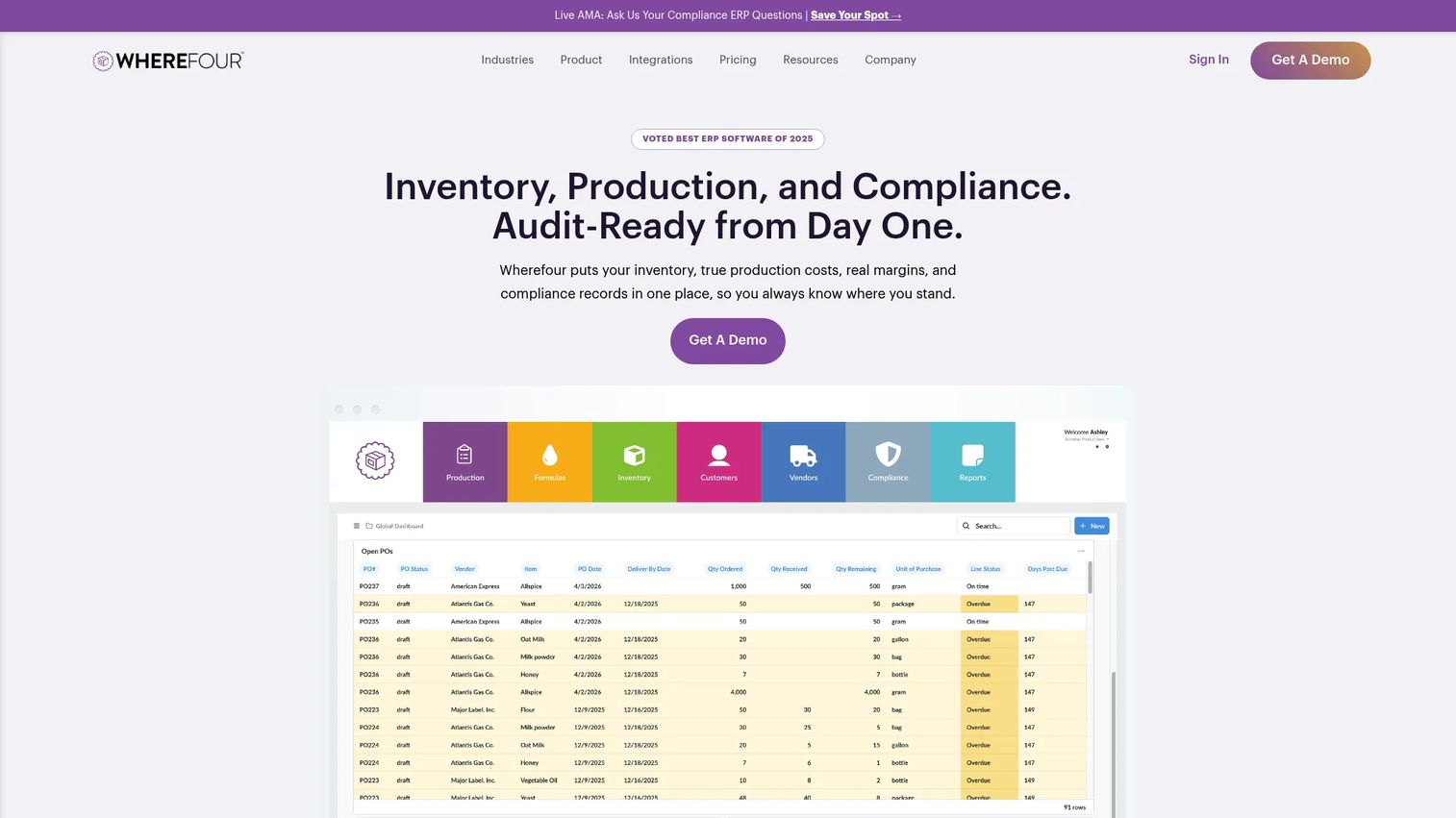
Wherefour is manufacturing ERP and traceability software built for food, beverage, and other regulated manufacturers. It focuses on the operational core most growing teams need first: inventory with lot tracking, batch production with cost tracking, and recall readiness. The platform is configurable enough to fit different workflows without demanding the long implementation timeline that heavier food ERP systems often carry.
For a team moving off spreadsheets or a generic ERP, Wherefour hits the practical sweet spot. You get barcode labeling, lot traceability, and production cost visibility without needing a dedicated internal team to run the system. That combination is why it leads this list for implementation speed.
Best for: Manufacturers needing configurable ERP, inventory, and traceability workflows without a multi-year rollout.
Key strengths
- Inventory and lot tracking: Lot-level inventory with barcode labeling for fast, accurate FIFO and FEFO rotation.
- Production and batch control: Batch production tracking with per-batch cost visibility for real margin insight.
- Compliance and recall readiness: Traceability built for quick forward and backward lot tracing when an audit or recall hits.
Why choose Wherefour: If your priority is getting food-specific control in place quickly, Wherefour balances depth and speed better than most. It suits smaller and growing operations that need real traceability and costing without the overhead of an enterprise deployment. Larger, highly complex multi-plant operations may eventually need broader supply chain depth, but for many teams this is the right first system.
Wherefour pricing: Wherefour does not publish public pricing. The company quotes custom based on your operation's needs, with monthly, quarterly, or annual billing options. Request a quote tied to your facility size and SKU count. Wherefour holds a 4.5/5 rating on G2.
2. BatchMaster
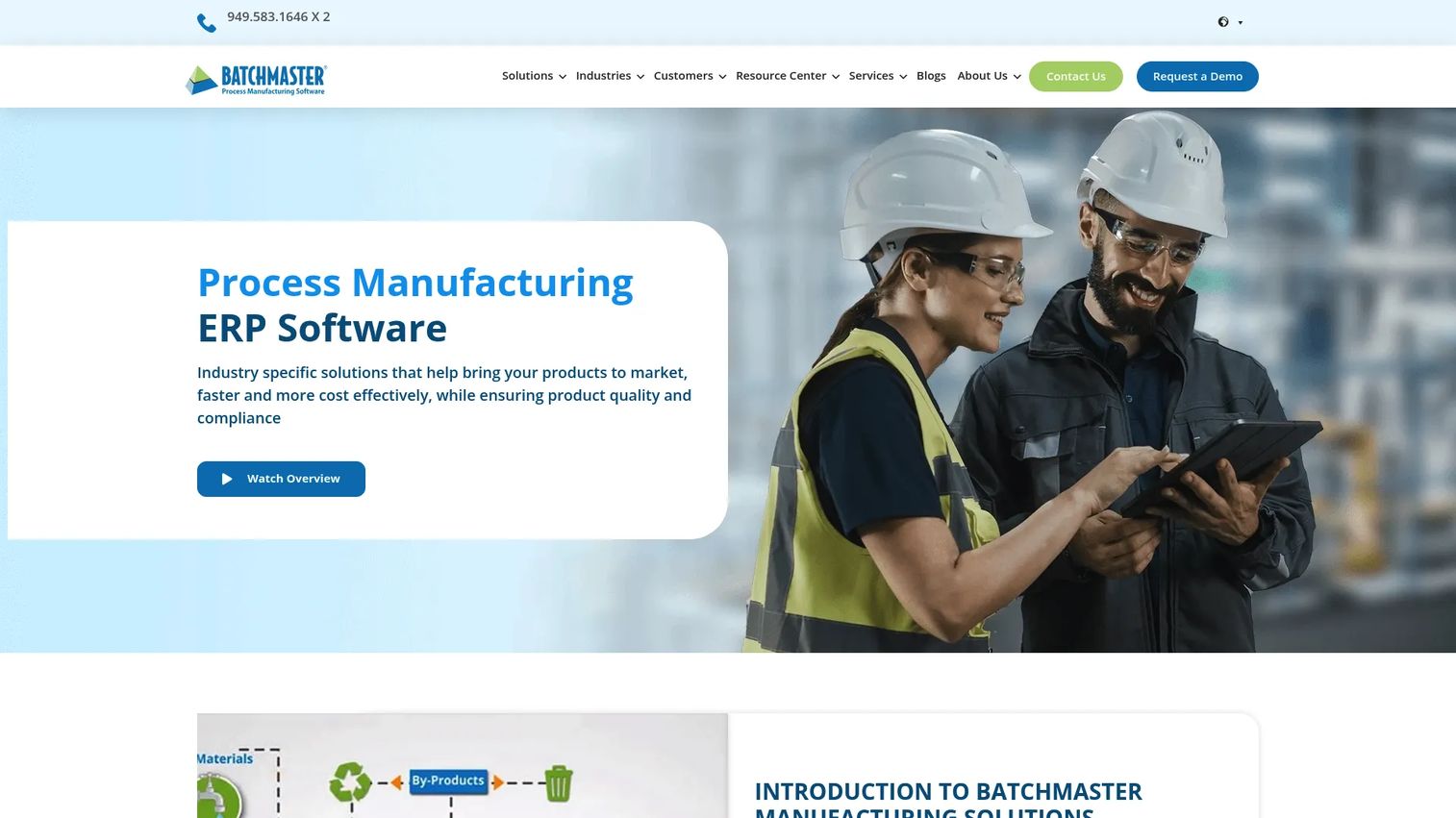
BatchMaster is process-manufacturing ERP built for formula-based manufacturers. Where discrete ERP thinks in assembled parts, BatchMaster thinks in formulas, batches, and yields, which is exactly how a food manufacturer operates. It covers formula and recipe management, batch production, quality control, compliance, traceability, and the financial workflows that tie them together.
The platform is aimed at mid-market process manufacturers who need genuine depth in formulation and batch execution. Recipe management, scaling, and BOM handling are core rather than bolted on, and mobile warehousing supports receiving, putaway, and pick pack ship on the floor.
Best for: Mid-market process manufacturers needing ERP for recipes, batches, and compliance.
Key strengths
- Formula and recipe management: Native formulation with scaling and version control for reformulations.
- Batch production and quality: Batch workflow execution paired with quality management, allergen tracking, and COA support.
- Compliance and traceability: Lot traceability and compliance features for FSMA, HACCP, and audit readiness.
Why choose BatchMaster: BatchMaster fits teams whose operation is genuinely formula-driven and who want ERP depth rather than a lightweight tool. It integrates with accounting and can sit alongside legacy ERP environments, which matters if you already run financials elsewhere. Public review volume is thinner than some competitors, so validate fit against your specific workflows during evaluation.
BatchMaster pricing: BatchMaster does not list public pricing. The company uses a registration-gated pricing process rather than posting figures, so plan to book a session for a quote scoped to your modules and users. Its current G2 rating sits at 2.9/5, which makes a hands-on evaluation especially worthwhile before you commit.
3. ERP Focus
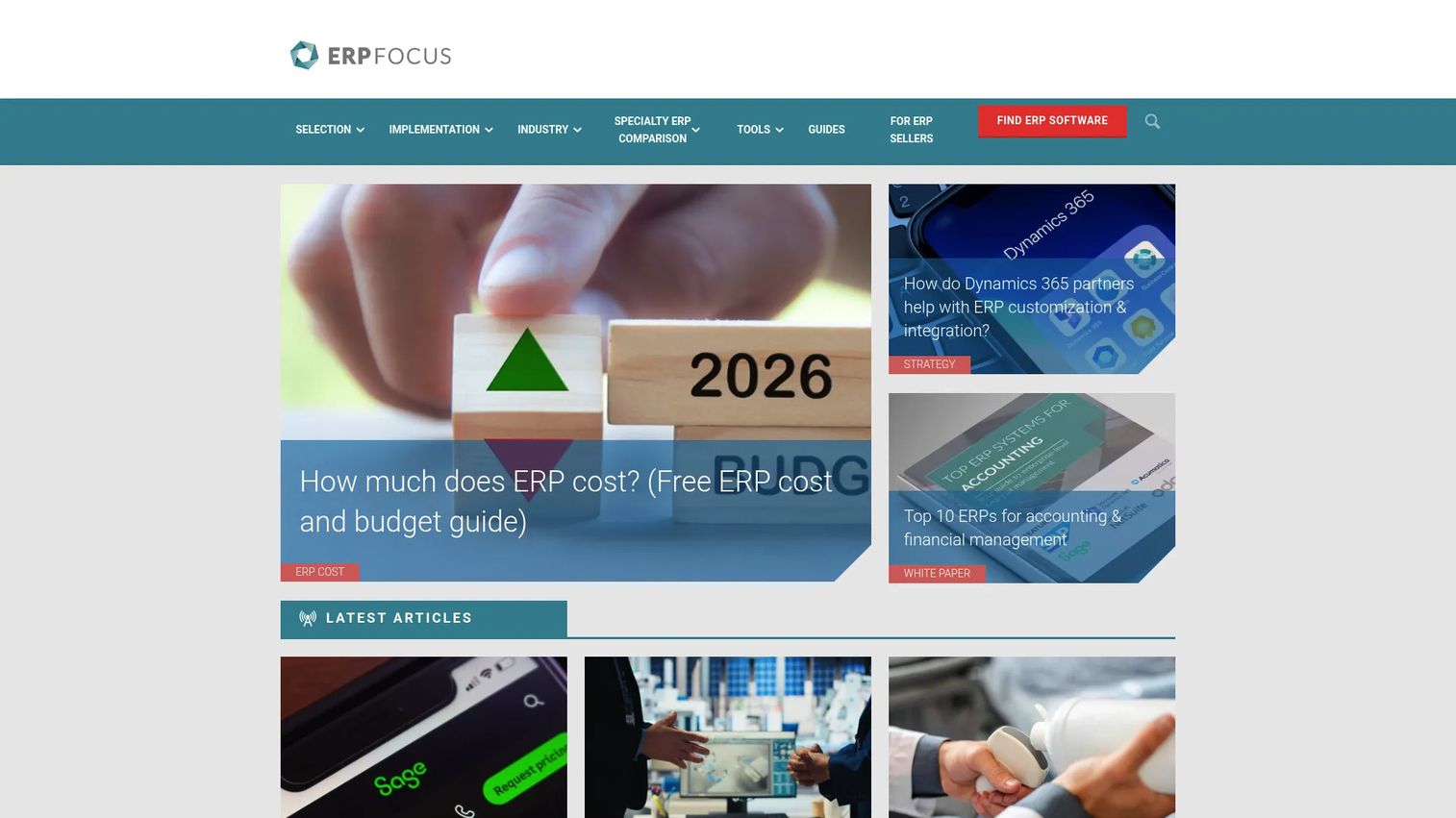
ERP Focus is not an operational system. It is an ERP software resource and comparison site that publishes guides, articles, and vendor comparisons. We include it here because shortlisting is half the battle, and ERP Focus is a genuinely useful research layer before you talk to any vendor.
Buyers use it to compare ERP for the food industry across features, pricing frameworks, and industry categories. If you are early in evaluation and unsure which food and beverage ERP even belongs on your list, it helps you build one grounded in requirements rather than sales calls.
Best for: Buyers researching food ERP options, pricing frameworks, and vendor comparisons before committing.
Key strengths
- ERP comparison directory: A structured way to compare vendors across features and categories.
- Pricing and cost guides: Articles that frame ERP budgeting and total cost of ownership.
- Industry resources: White papers and requirement guides specific to manufacturing verticals.
Why choose ERP Focus: Use ERP Focus as a research tool, not an operational system. It earns its place at the start of a buying process, helping you translate operational pain into a requirements list and a defensible shortlist. Once you have that list, you move on to the vendors that actually run your plant.
ERP Focus pricing: ERP Focus operates as a content and comparison publisher, so its guides and directory are free to use. There is no software subscription to evaluate because it is not an operational ERP product. Treat the time you spend here as research investment, not a line item.
4. inecta
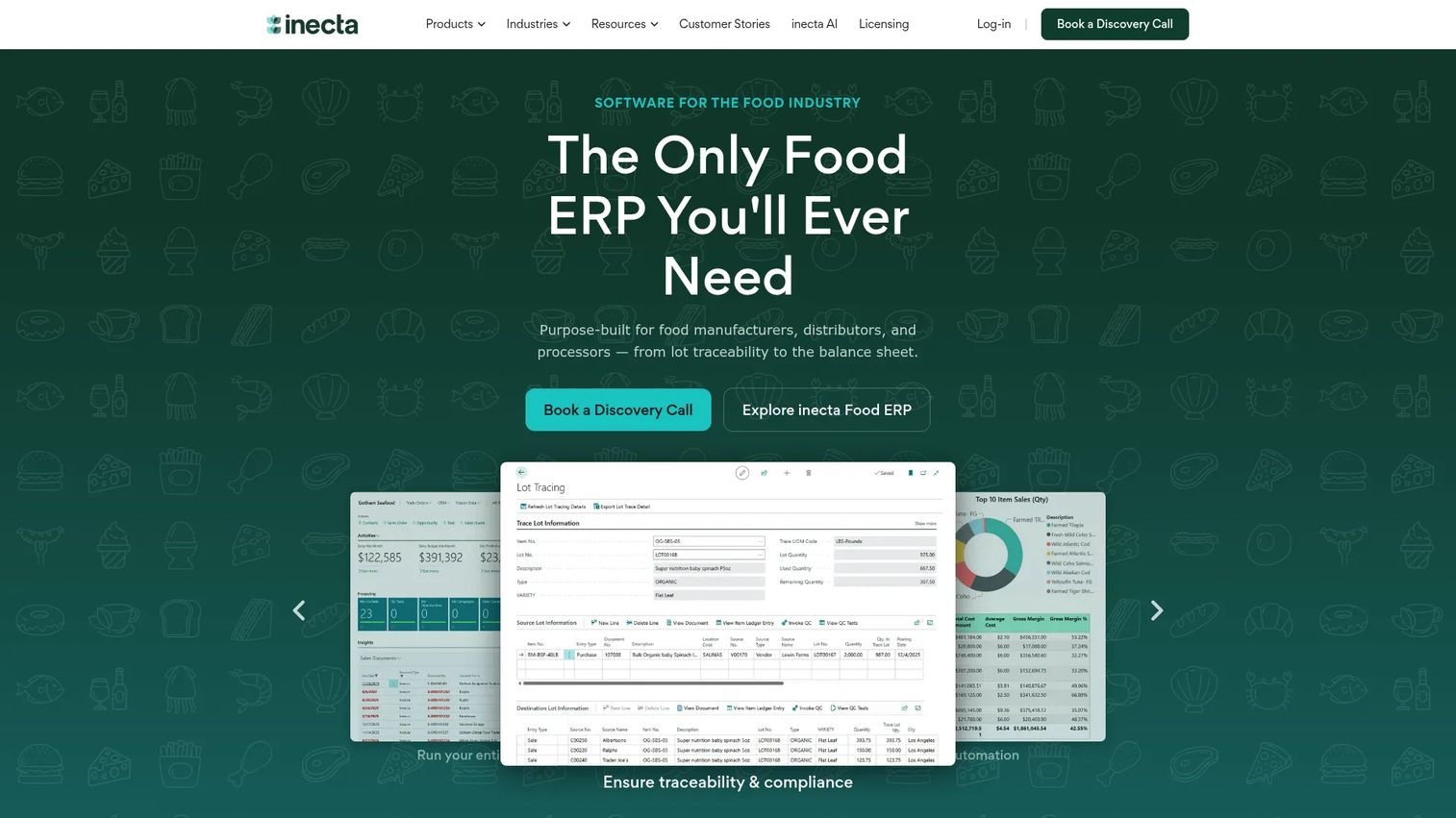
inecta is cloud ERP software built for food and beverage businesses on the Microsoft Dynamics 365 Business Central foundation. That base matters if your organization already lives in the Microsoft ecosystem, because it means your food ERP shares infrastructure, reporting, and identity with tools your team already uses.
inecta positions itself around one-system connectivity across purchasing, production, inventory, quality, compliance, and finance. It handles food manufacturing and distribution workflows, batch manufacturing, recipes, BOMs, and traceability, with practical support for allergen management, catch weight, and mobile execution on the floor.
Best for: Food and beverage manufacturers and distributors standardized on Microsoft who want food-specific ERP.
Key strengths
- Microsoft-native foundation: Built on Dynamics 365 Business Central for stack alignment and familiar reporting.
- Food workflows and traceability: Batch manufacturing, recipes, BOMs, and lot traceability in one system.
- Catch weight and mobile: Catch weight and dual unit handling with mobile workflows for warehouse execution.
Why choose inecta: If you are committed to Microsoft infrastructure, inecta reduces friction by keeping your ERP inside that world rather than bridging to a separate platform. It fits processors and distributors who value one connected system across operations and finance. Teams with no Microsoft footprint should weigh that ecosystem fit against alternatives built on other foundations.
inecta pricing: inecta uses subscription pricing based on users, modules, and operational complexity, and directs buyers to contact sales for a tailored quote. There is no public numeric price, so scope your requirements first. That upfront clarity makes the quote conversation faster and more accurate.
5. NutraSoft
NutraSoft is cloud-based food manufacturing ERP and nutrition labeling software built for small and mid-sized food and beverage businesses. Its distinguishing angle is pairing food production software with nutrition analysis and labeling in one platform, which removes a common gap for smaller manufacturers who otherwise juggle labeling separately.
The ERP side covers production planning, inventory with lot traceability, recipe management, and the compliance basics a growing food operation needs. For a smaller team, having labeling and production in the same system reduces the number of tools and handoffs.
Best for: Small and mid-sized food and beverage manufacturers needing ERP, traceability, and nutrition labeling together.
Key strengths
- Production planning: Planning and scheduling suited to smaller and mid-sized operations.
- Inventory and lot traceability: Lot-level inventory tracking for recall readiness and rotation.
- Nutrition labeling and recipes: Recipe management with integrated nutrition analysis and label generation.
Why choose NutraSoft: NutraSoft fits teams that want food-specific ERP without enterprise weight, especially when nutrition labeling is a recurring need. Consolidating labeling and production cuts busywork for lean teams. Larger operations with complex multi-plant supply chains will likely need a heavier platform, but for the smaller end of the market this is a practical, focused fit.
NutraSoft pricing: NutraSoft publishes a self-serve Nutrition Analysis and Labeling product starting at $69 CAD per month, billed monthly. The Food Manufacturing ERP product is quote-based and tailored to facility size and SKU count, so contact the company for ERP pricing. Note the official site is nutrasoft.ca.
6. Aptean
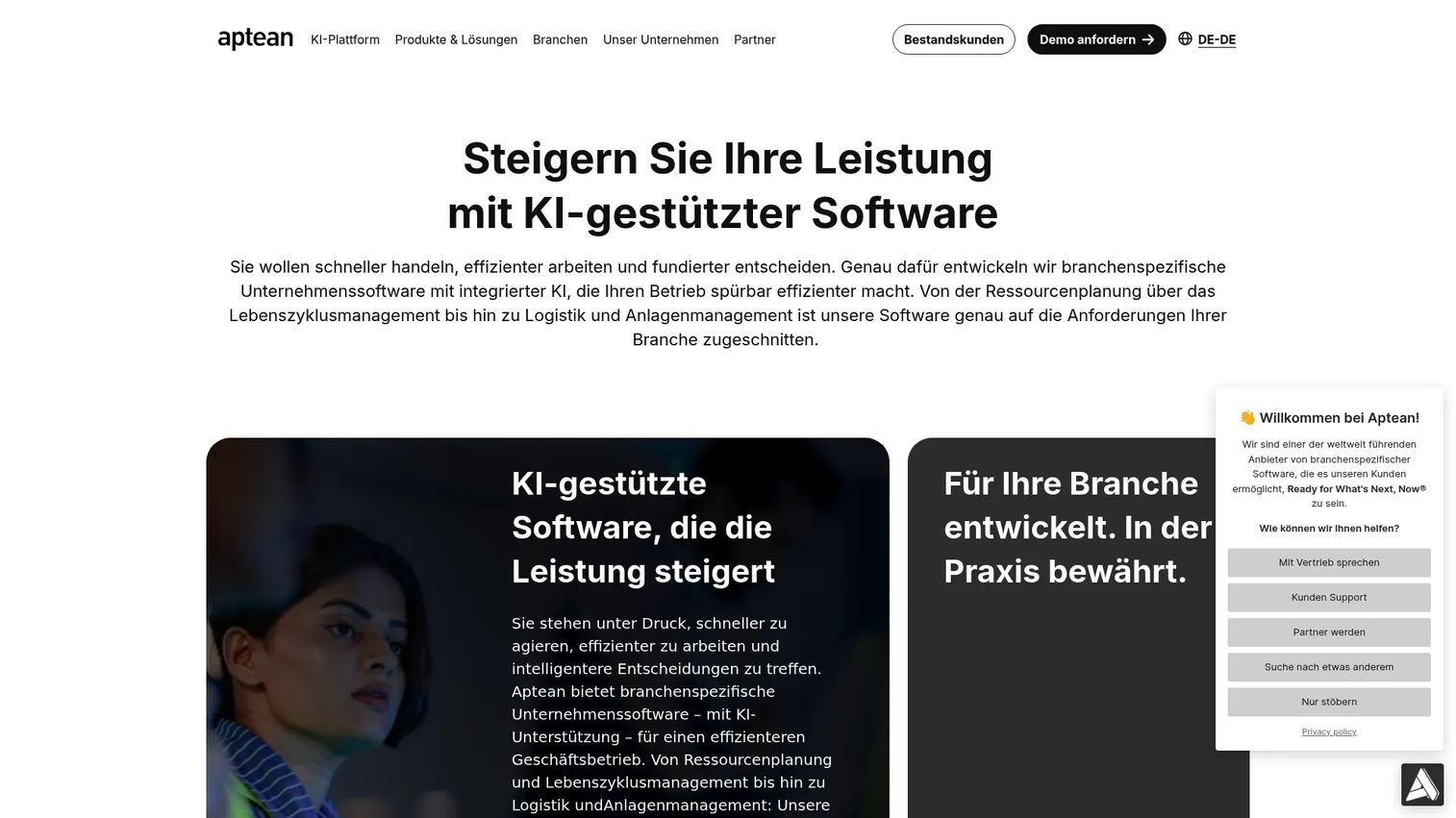
Aptean provides industry-specific enterprise software spanning ERP, supply chain, manufacturing, and distribution. For food manufacturers, Aptean matters when your complexity outgrows lighter platforms and you need deep vertical depth across categories like meat, seafood, poultry, and other demanding food segments.
Aptean's positioning centers on purpose-built industry solutions rather than a one-size-fits-all product, backed by its AppCentral connected platform. That depth is the point: enterprise food operations with intricate supply chains, multiple facilities, and heavy compliance obligations often need more than a fast-deploy tool can provide.
Best for: Mid-sized to enterprise organizations needing deep industry-specific operational software.
Key strengths
- Industry-specific ERP: Vertical solutions tailored to complex food categories rather than generic manufacturing.
- Supply chain depth: Broad supply chain and distribution capability for multi-facility operations.
- Connected platform: AppCentral ties operational software together across the business.
Why choose Aptean: Choose Aptean when enterprise depth matters more than speed to go-live. If you run complex protein or multi-plant operations with serious compliance and supply chain demands, that depth earns its cost. Smaller teams chasing a fast implementation will find lighter platforms on this list a better first step, then can graduate to enterprise depth as complexity grows.
Aptean pricing: Aptean does not display public pricing and directs buyers to contact sales for a tailored quote. Expect enterprise-oriented, quote-based packaging scoped to your industry, modules, and scale. Aptean holds a 4.1/5 rating on G2.
7. FlexiBake
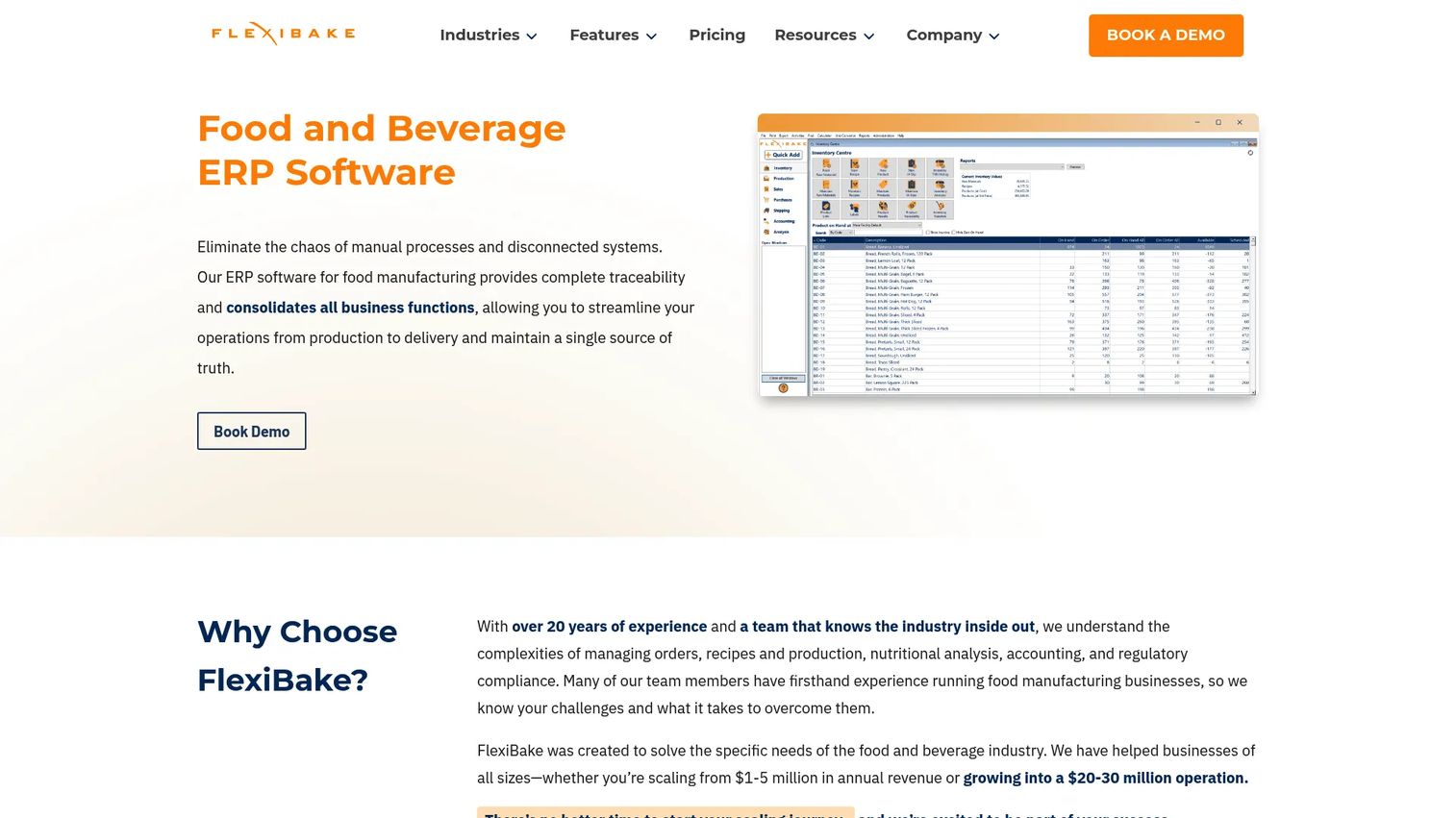
FlexiBake is cloud-based ERP software for recipe-based manufacturers and wholesalers, with particular strength for wholesale bakeries. It covers the end-to-end food and beverage ERP process: lot tracking, production planning and scheduling, inventory and food warehouse management, nutrition analysis, and food traceability with recall readiness.
The appeal is consolidated operations with traceability at the center. For a recipe-driven manufacturer that wants production control and compliance in one system, FlexiBake offers clear, tiered pricing that is unusually transparent for this category.
Best for: Food manufacturers and wholesale bakeries needing ERP, traceability, and production control in one system.
Key strengths
- Lot tracking and traceability: Food traceability and recall readiness built into daily operations.
- Production planning: Production scheduling with recipe and nutritional analysis support.
- Inventory and food WMS: Inventory management with warehouse workflows for food operations.
Why choose FlexiBake: FlexiBake suits recipe-based manufacturers who want end-to-end process visibility without piecing together separate tools. Its transparent, tiered pricing makes budgeting easier than the quote-only norm in food ERP. Highly complex enterprise supply chains may need broader depth, but for many bakeries and recipe manufacturers this is a strong, complete fit.
FlexiBake pricing: FlexiBake publishes five editions with public pricing: Nutritional at $125/month USD, Base at $295/month, Professional at $375/month, Corporate at $495/month, and an Enterprise plan quoted on request. That tiered transparency lets you match cost to operational scope. FlexiBake holds a 4.1/5 rating on G2.
Considerations before you buy
Before you sign anything, run every shortlisted food manufacturing ERP through this checklist. The gaps show up after go-live, not during the demo.
Traceability and recall readiness
Ask the vendor to demonstrate a live forward and backward lot trace, timed. Confirm the system handles FIFO and FEFO logic natively and can produce a recall report in minutes, not hours. Recall readiness is the single feature you cannot compromise on.
Compliance depth
Verify explicit support for the standards you actually face: FSMA, HACCP, SQF, or BRC. Check for allergen tracking, COA management, label printing, and GS1 support if you sell into retail. Audit readiness should be a query, not a scramble.
Costing and margin visibility
Food costing is not standard costing. Confirm the platform handles landed cost, yield variance, by-products, rework, and catch weight or dual unit of measure. Without real margin visibility, you are flying blind on the metric that keeps you alive.
Integration and stack fit
Map integrations before you buy. Confirm clean connections to your accounting system, whether QuickBooks, Sage, Microsoft Dynamics, or SAP Business One, and to warehouse and mobile workflows for receiving, putaway, and pick pack ship. A system that does not integrate becomes another island.
Implementation and go-live risk
Ask for a realistic implementation timeline, migration approach, and go-live plan with named milestones. The difference between a fast-deploy platform and an enterprise rollout is measured in months and internal effort. Match that reality to your team's capacity.
Conclusion
The seven platforms here map cleanly to fit profiles. Wherefour leads for fast implementation and growing teams that need real traceability quickly. BatchMaster and inecta suit process manufacturers who want deep food ERP fit, with inecta the natural pick for Microsoft-centered stacks. NutraSoft and FlexiBake serve smaller and recipe-based operations, and FlexiBake stands out for transparent pricing. Aptean is the choice when enterprise complexity and multi-plant supply chains demand vertical depth. ERP Focus helps you build the shortlist in the first place.
The biggest decision factor is not the feature list. It is whether the platform matches your production complexity and compliance burden. A lean bakery and a multi-plant protein processor need fundamentally different systems, and buying the wrong scale in either direction costs you.
Your next step is concrete. Build a requirements list around traceability, compliance, costing, and integration, then run a scored demo against your two or three finalists. Ask each to trace a lot live and quote a real implementation timeline. The vendor that answers cleanly is usually the one that will run your plant cleanly.
FAQs
Food manufacturing ERP software is a purpose-built platform that manages recipes, production, inventory, quality, compliance, and costing for food and beverage makers. Unlike generic ERP, it natively handles lot traceability, catch weight, allergen tracking, and recall readiness. It connects operations and finance so one lot number carries context from receiving through shipping.
General ERP assumes fixed bills of materials, whole-unit inventory, and no recall obligation. Food operations break all three: variable-weight ingredients, batch yields that shift, and mandatory forward and backward lot tracing. Food ERP encodes formulation, FIFO and FEFO logic, and compliance workflows natively instead of forcing them into fields never designed for them.
It depends on scope. A configurable, fast-deploy platform for a single facility can go live in weeks to a few months. Enterprise, multi-plant deployments with heavy customization and data migration run several months to over a year. Ask every vendor for a milestone-based go-live plan tied to your actual operation.
Food ERP builds compliance into daily work rather than treating it as paperwork. It supports HACCP plans, allergen tracking, COA management, and audit readiness for standards like FSMA, SQF, and BRC. Strong platforms also handle label printing and GS1 formats, so retail requirements are met without manual rework.
Every lot is tracked forward and backward across receiving, production, and shipping. FIFO and FEFO logic controls rotation automatically. When a recall hits, you run a query instead of digging through binders, producing a full trace in minutes. That recall readiness is the core reason food-specific systems exist.
Prioritize lot-level tracking, expiry management, and FIFO or FEFO rotation. Confirm catch weight and dual unit of measure handling if you buy by variable weight. Look for barcode and label support, plus warehouse workflows for receiving, putaway, and pick pack ship. Inventory accuracy is the foundation everything else depends on.
Yes. Recipe management and formulation are core to food ERP, not add-ons. Good systems handle recipe scaling, version control for reformulations, BOM structures, by-products, and yield tracking. This is a primary reason food manufacturers move off generic ERP, which was built for fixed, assembled bills of materials.
Purpose-built food software handles catch weight and dual unit of measure natively, which matters when you buy or sell by variable weight, like protein or produce. Generic ERP typically cannot without heavy customization. Confirm this capability explicitly during evaluation, since it directly affects costing and margin visibility accuracy.
Accounting integration comes first, whether QuickBooks, Sage, Microsoft Dynamics, or SAP Business One, so financials stay in sync. Warehouse and mobile workflows for receiving, putaway, and picking matter next. If you sell into retail, confirm label printing and GS1 support. Map every integration requirement before you sign anything.
Build a requirements list around traceability, compliance, costing, and integration, then score each vendor against it. Use a research resource like ERP Focus to shortlist, then run live demos with your two or three finalists. Ask each to trace a lot in real time and quote a realistic implementation timeline before committing.