Your staging environment passed every test case. Then a customer in Germany hit a broken payment step on a regional Android device, and three support tickets landed before you saw the Slack alert.
More internal test cases don't close that gap. The problem isn't coverage volume, it's coverage diversity. Internal QA labs represent your team's devices, your team's locale settings, and your team's mental model of the product. Real customers bring different operating systems, carriers, browsers, screen sizes, payment methods, and usage habits that no internal matrix fully replicates.
That's the job crowd testing tools exist to do. According to Global Market Insights (2026), the global crowdsourced testing market was valued at USD 3.1 billion in 2025 and is projected to reach USD 8.7 billion by 2035, reflecting how seriously product teams are taking real-world test coverage. Meanwhile, Tricentis (2025) found that 63% of organizations ship code changes without fully testing them, which means the escaped-defect risk is almost certainly landing somewhere in your release cycle.
This guide helps product managers choose the right crowd testing platform for their release goals, team capacity, and customer environment.
What's inside
This guide covers 10 crowd testing tools and crowd testing companies evaluated for 2026, structured for product managers making a release-readiness decision.
- Who it's for: PMs at B2B SaaS companies who need external device coverage, unbiased workflow feedback, and evidence for go or no-go calls
- Selection criteria: Provider model fit, real device and geographic coverage, bug report quality, and integration with engineering workflows
- What you'll find: Verified pricing from vendor pages, current G2 ratings, and honest notes on where each model fits your team's QA capacity
- Scope clarity: The list spans managed crowd testing services, tester marketplaces, usability research platforms, and specialist mobile providers
TL;DR
- Best for structured crowdtesting cycles: Test IO, for teams that need managed exploratory coverage across web and mobile releases
- Best for enterprise digital quality programs: Applause, for larger programs requiring broad device, geography, and specialist tester access
- Best for localization and international releases: Global App Testing, for teams validating regional workflows before a market launch
- Best for continuous managed QA: Testlio, for product teams that want a dedicated testing model across frequent release cycles
- Best for qualitative experience research: UserTesting, for understanding why users struggle, not just where the software breaks
- Best marketplace-style options: Tester Work and uTest, for teams with internal QA capacity that can write tight briefs and own triage
What is crowd testing software?
Crowd testing software connects product teams with distributed external testers who evaluate websites, mobile apps, and digital workflows across real devices, locations, languages, and user contexts.
The four provider models
Understanding provider models before comparing tools prevents false comparisons. The category includes four distinct types:
Managed crowd testing services handle test-cycle operations on your behalf. The provider scopes tests, matches testers to your target user profile, validates reports for quality, and often manages retesting. Choose this model when your team needs dependable output with minimal coordination overhead.
Tester marketplaces give you access to a broad tester community, but the operational responsibility stays with you. Your team writes the brief, launches the cycle, and triages the reports. This model works when you already have QA leadership who can define expected evidence and decide what gets fixed.
Usability research platforms focus on observing real users complete tasks and sharing qualitative insight. They're built for answering "Can users understand and complete this?" rather than "Does this function correctly?" Don't use them as the primary source for regression defects.
Security-focused crowdsourced programs address bug bounty and vulnerability discovery. This is a different job from release-validation testing and shouldn't be treated as a substitute.
Key capabilities to evaluate
When assessing any crowd testing platform, check for:
- Real-device and browser coverage that matches your customer base
- Tester vetting, matching, and incentive controls
- Functional, exploratory, and localization test-cycle support
- Bug evidence quality: Reproduction steps, screenshots, video, and environmental details
- Duplicate detection and severity triage
- Jira, Azure DevOps, or GitHub integration
- Confidentiality controls and environment access governance
- Retest and regression support
- Release reporting that supports a go or no-go decision
When to use crowd testing tools
Validate a release outside your internal device lab
When a mobile update or web release needs coverage across device, OS, carrier, or browser combinations your internal matrix can't represent, external crowd software testing fills the gap. Scope one workflow per cycle, such as signup, checkout, or permissions, and define the expected evidence before you launch.
Test local market workflows before a regional launch
Localization testing goes beyond translated strings. Local payment flows, address field formats, date conventions, and regional user expectations can all generate friction that translation review alone won't catch. A crowd testing service with testers in the target market gives you that real-user signal before the launch date.
Find friction in high-value customer journeys
Onboarding completion and trial-to-paid conversion both depend on users getting through critical flows without confusion or failure. Crowd testing can surface both functional defects and experience friction in the same cycle, especially when you combine a functional crowdtesting provider with a usability research session for the same workflow. Knowing which issues to fix first, rather than just how many exist, is where that combination pays off.
Crowd testing tools comparison
The right pick depends on whether your team needs managed execution, a broad tester community, usability research, or specialized mobile coverage. Use this table as a first filter, then read each entry to match the provider model to your release situation.
| # | Product | Best for | Key differentiator | Pricing | G2 rating |
|---|---|---|---|---|---|
| 1 | Test IO | Managed web and mobile release testing | Exploratory and functional crowdtesting with human testers | Custom pricing | 4.3/5 |
| 2 | Applause | Enterprise digital quality programs | Global testers across devices, geographies, and specializations | Custom pricing | 4.4/5 |
| 3 | Global App Testing | Localization and international releases | Real-device coverage across markets and user contexts | From \~$10,000 | 4.4/5 |
| 4 | Testlio | Continuous managed QA | AI-powered managed testing across languages, devices, and payment methods | Custom pricing | 4.7/5 |
| 5 | UberTesters | Mobile app testing | Managed QA with real devices and dedicated project managers | Custom pricing | 4.8/5 |
| 6 | UserTesting | Qualitative experience research | Task-based usability feedback with targeted participant recruitment | Custom pricing | 4.5/5 |
| 7 | Digivante Testing Services | Customer journey and e-commerce testing | Managed testing with Jira and Azure DevOps integrations | Custom pricing | 5.0/5 |
| 8 | Tester Work | Flexible marketplace-style test cycles | Exploratory testing and bug reporting via community testers | Contact for pricing | Not listed |
| 9 | uTest | Broad tester-community access | Functional, usability, and payment testing with global coverage | Contact for pricing | Not listed |
| 10 | 99tests | Budget-conscious real-device testing | Fixed-price plans with real devices and one-click re-runs | From ₹9,999 | 4.2/5 |
Best 10 crowd testing tools for 2026
1. Test IO

Test IO is a crowdtesting platform built for product teams that need human testers to evaluate websites and mobile apps under real-world conditions. It offers rapid testing, focused testing, coverage testing, usability testing, and exploratory test cycles, giving PMs a structured path from release scope to actionable bug evidence. The platform also uses AI to support test setup and optimize bug-report text, reducing noise in your triage queue.
Best for: Product teams that want managed exploratory and functional crowdtesting across web and mobile releases.
Key features
- Rapid, focused, coverage, usability, and exploratory test types
- Global tester community with real-device coverage
- AI-supported test setup and bug-text optimization
- Detailed bug reports with reproduction steps and environmental context
- Workflow integrations for engineering handoff
Why choose Test IO: This is a strong match for PMs who need structured exploratory coverage without managing tester recruitment themselves. Before committing, ask for sample bug reports from a comparable product to validate evidence quality and duplicate-handling before signing.
Test IO pricing: Test IO prices through a custom quote process. Contact sales to get a proposal matched to your test type, scope, and cadence. The pricing page requests contact information rather than displaying package rates.
G2 rating: 4.3/5, based on 73 reviews
2. Applause
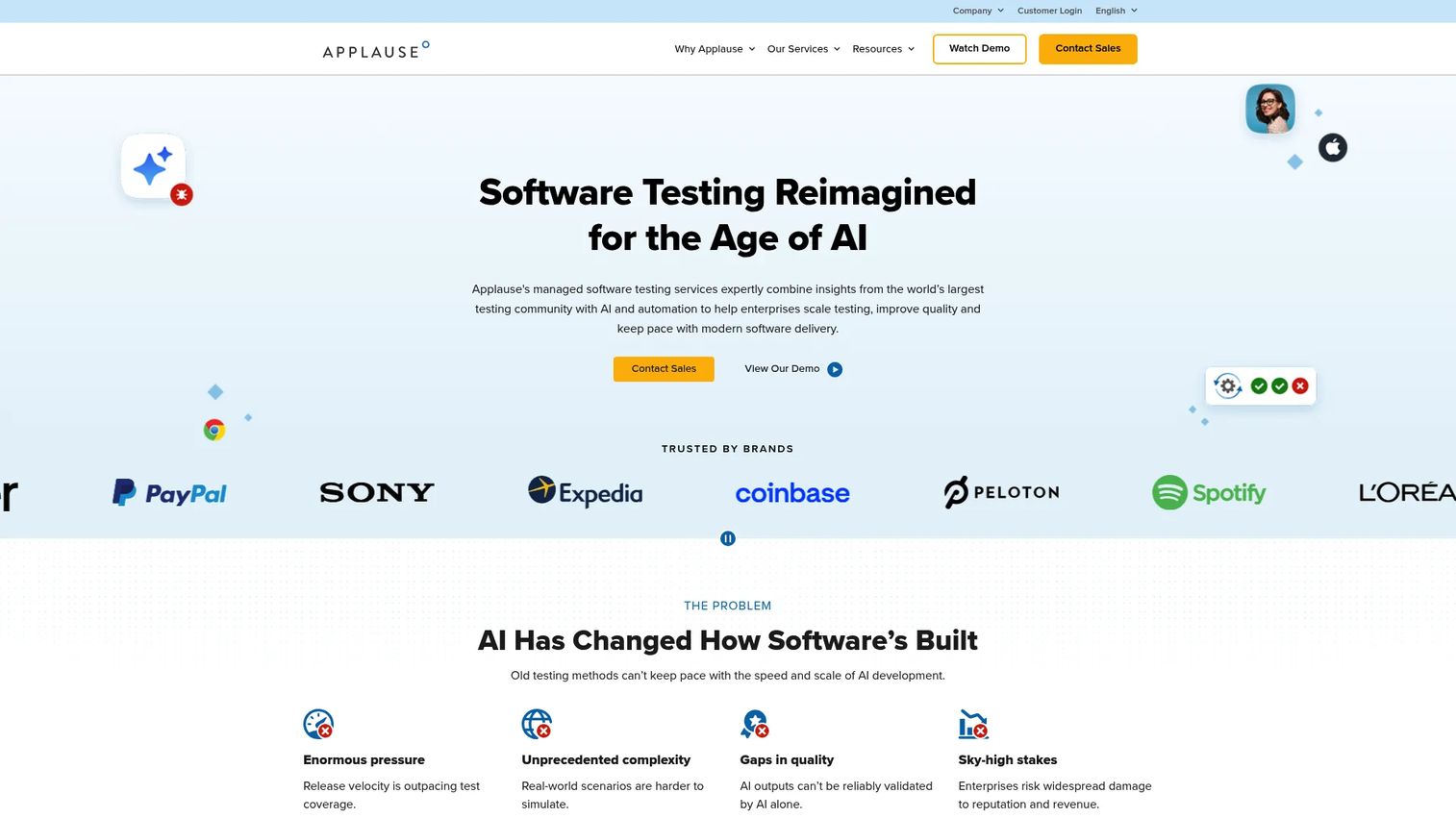
Applause provides managed software testing and digital quality services that combine human testers with AI and automation. Its scope covers functional testing, test automation, payment testing, accessibility testing, UX research, and customer journey testing. Applause also integrates with Jira, GitHub, and Azure DevOps, which matters when your team needs bug reports to flow directly into existing engineering workflows.
Best for: Larger product organizations that need global test coverage managed across markets, accessibility requirements, and complex release programs.
Why choose Applause: Choose Applause when your release risk spans multiple customer segments, regulated workflows, or multiple geographies at once. It's a managed program model, not a self-serve tool, so the right evaluation question is whether the onboarding and coordination investment pays off across your release cadence, not just for one cycle.
Key features
- Functional, accessibility, payment, and UX research testing
- Global tester network with real-device coverage
- Specialized test programs by use case and market
- Bug-fix verification and test case management
- Jira, GitHub, and Azure DevOps integrations
Applause pricing: Applause sells through a custom quote process. Pricing isn't displayed on the public page. Reach out to their sales team for a proposal matched to your program scope.
G2 rating: 4.4/5
3. Global App Testing

Global App Testing delivers crowdtesting and real-world software quality testing through testers distributed across global devices, environments, and markets. The platform covers functional testing, globalization testing, accessibility testing, regression, exploratory, and device or browser testing, including IoT and hardware. For PMs launching in multiple countries, it provides the local tester signal that internal QA cannot produce: Whether a regional onboarding flow, local payment method, address input, or date format actually works for users in that market.
Best for: Product teams validating localized experiences, international releases, or multi-market mobile and web workflows.
Key features
- International tester coverage across real devices and markets
- Functional, regression, exploratory, and globalization testing
- Accessibility and UX testing
- Device, browser, and IoT coverage
- Issue tracker integrations
Why choose Global App Testing: If your release hypothesis is "does this work for users in [specific market]," this platform is built around that question. Tie your brief to a concrete regional workflow and expected evidence standard rather than requesting general coverage.
Global App Testing pricing: Investment starts around $10,000, with custom pricing based on test frequency, scale, specialist requirements, and contract length. No free tier is available.
G2 rating: 4.4/5
4. Testlio
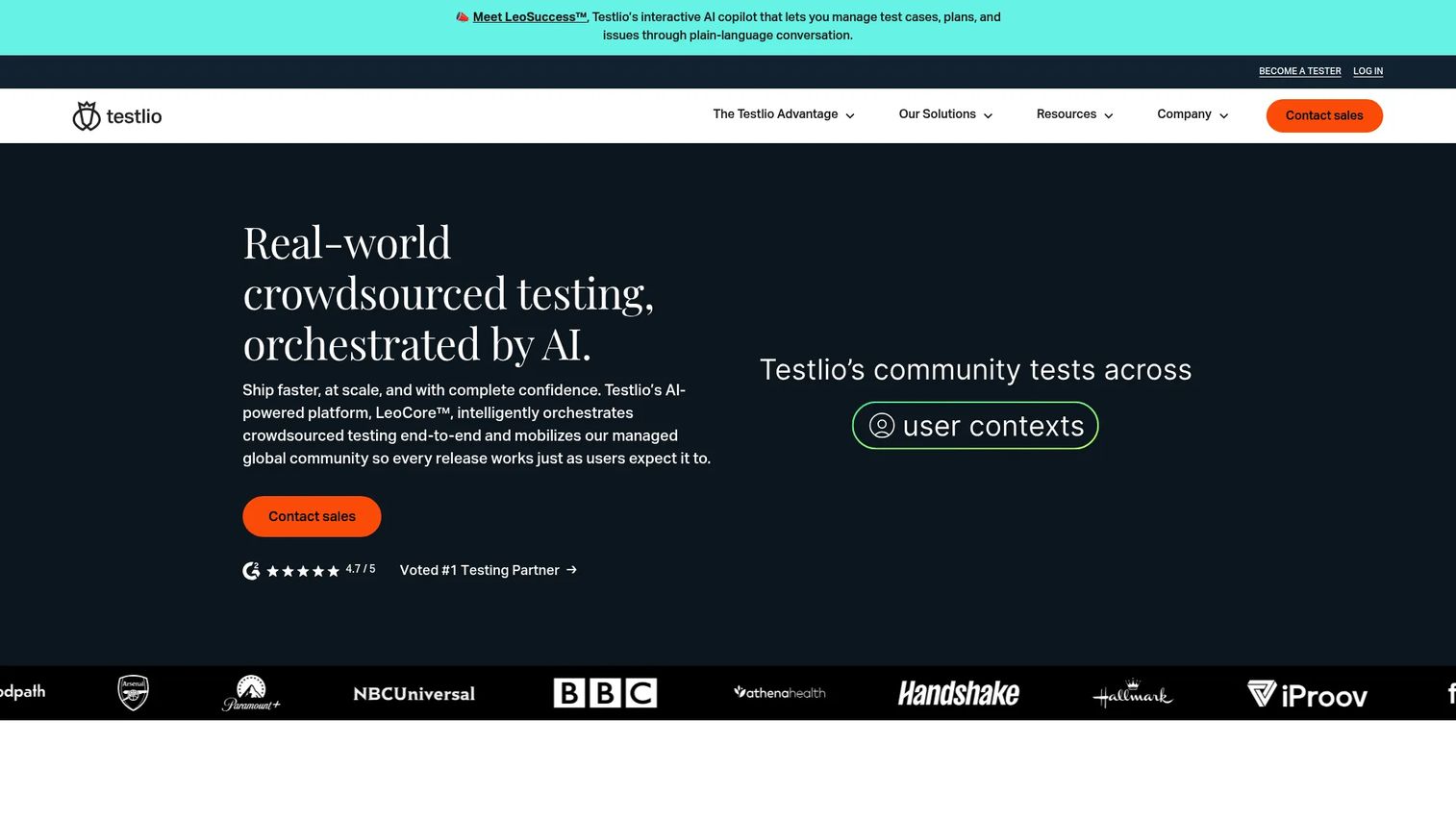
Testlio is an AI-powered, fully managed crowdsourced testing platform that combines human expertise with its LeoCore platform and LeoAI Engine for tester matching, orchestration, and reporting. It covers functional, exploratory, localization, payments, AI feature testing, usability, accessibility, and regression testing, with tester coverage across 150+ countries and 800+ payment methods. For PMs with a steady release cadence, the managed model reduces the repeated coordination overhead of recruiting testers, validating reports, and managing retests cycle after cycle.
Best for: Product organizations that need recurring, managed test coverage across devices, markets, and payment flows without rebuilding the process each release.
Key features
- Functional, localization, payments, accessibility, and regression testing
- LeoAI Engine for tester matching and orchestration
- Global coverage across 150+ countries and 800+ payment methods
- Essential, Advanced, and Enterprise packages
- Jira and TestRail integrations
Why choose Testlio: The managed model has an onboarding phase. The right evaluation question is whether the reduced triage overhead across subsequent releases justifies that setup investment compared to running individual cycles yourself.
Testlio pricing: Testlio offers Essential, Advanced, and Enterprise packages. Pricing combines a LeoCore platform fee with a flexible consumption fund. Contact sales for a quote; no figures are displayed publicly.
G2 rating: 4.7/5
5. UberTesters
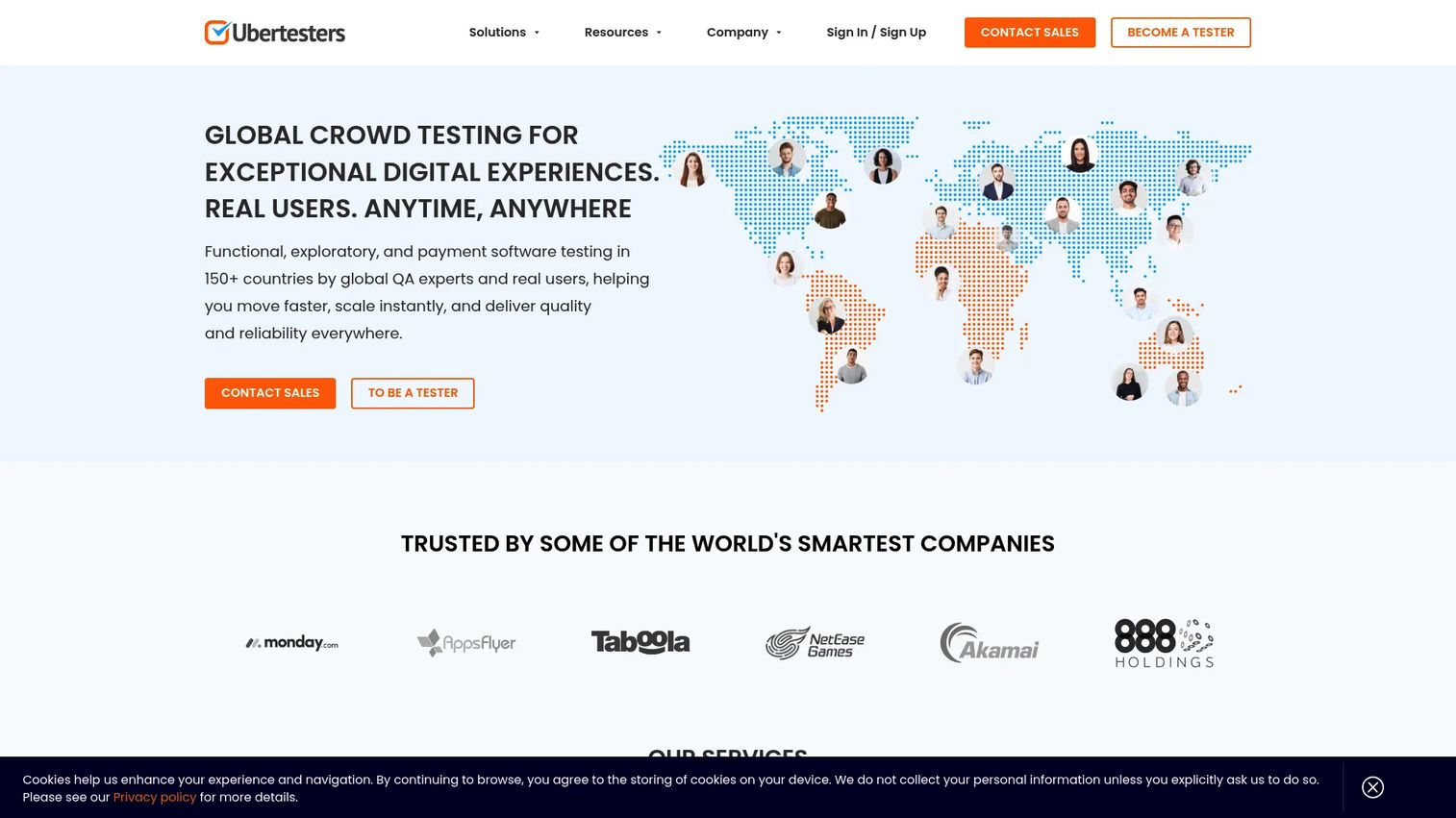
UberTesters provides crowdtesting and managed QA using vetted testers, real devices, and real-world conditions. Its mobile app beta testing platform includes build distribution, crash and bug reporting, video recording, and test-case management, alongside managed QA services with dedicated project managers. Mobile accounts for 46.85% of the crowdsourced testing market, according to Mordor Intelligence (2026), and UberTesters is specifically designed for the device fragmentation, OS version spread, and connectivity variations that mobile releases face.
Best for: Mobile product teams that need external validation before iOS or Android updates ship.
Key features
- Mobile app testing across real devices and global markets
- Managed QA with dedicated project managers and reporting
- Build distribution, crash reporting, and video bug evidence
- Pilot projects and ongoing retainer engagement models
- Coverage across app permissions, offline states, and mobile checkout flows
Why choose UberTesters: Use a mobile-focused provider when the release risk is specific to app behavior, device fragmentation, or OS version coverage. Ask for the exact device and OS matrix before purchase rather than accepting a general coverage claim.
UberTesters pricing: Pricing depends on test type, complexity, and engagement model. UberTesters offers both pilot projects and ongoing retainers. Contact sales to get a custom quote matched to your mobile release scope.
G2 rating: 4.8/5
6. UserTesting
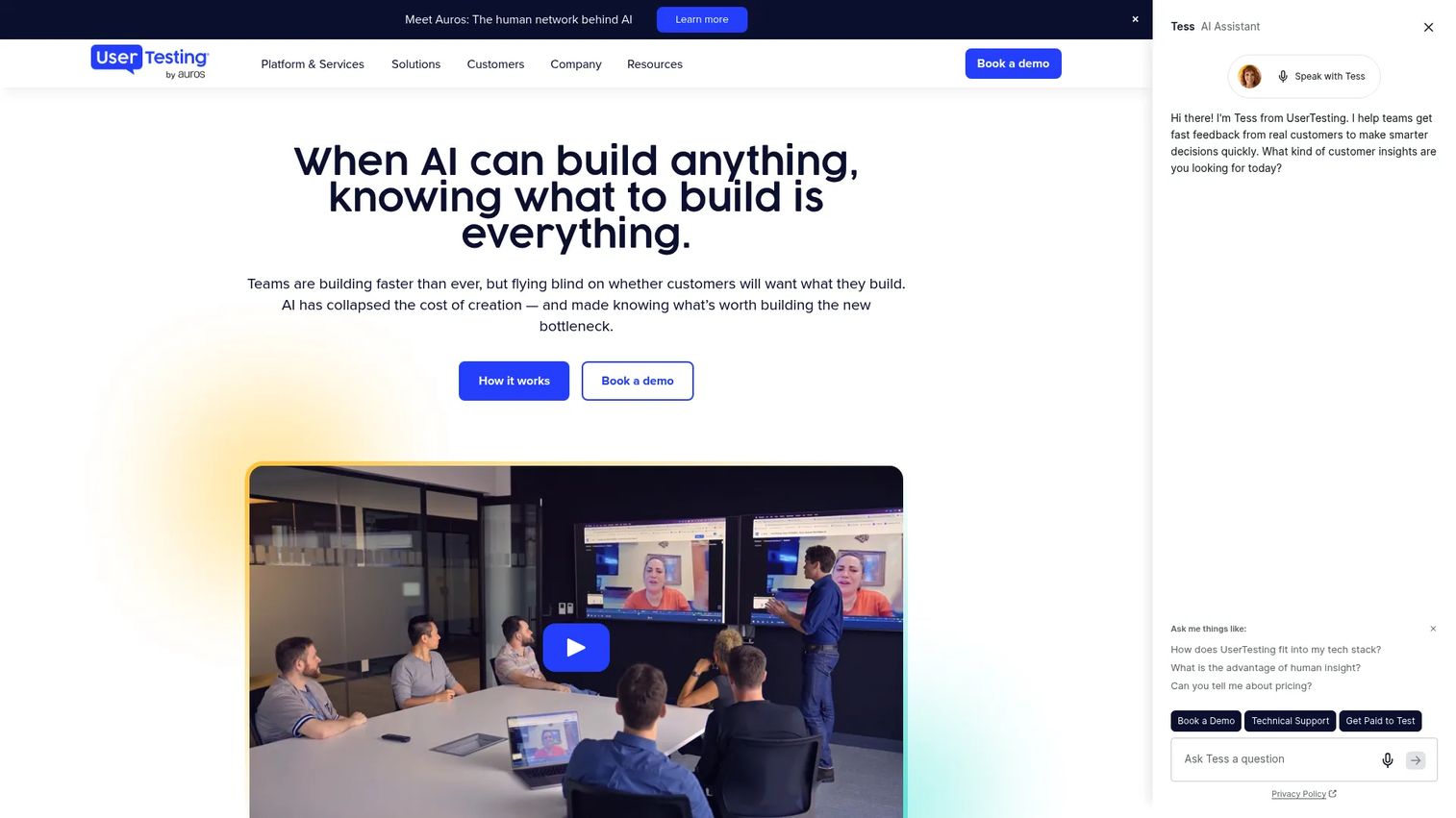
UserTesting is a human insight platform for collecting fast feedback from targeted real users on websites, apps, prototypes, and campaigns. It supports unmoderated tests, surveys, and moderated live conversations, backed by AI-powered test creation, insight summaries, video highlights, and global participant recruitment. The category distinction matters here: Choose UserTesting when the question is "Do users understand and complete this?" not "Does this function correctly?" It's the right tool for onboarding comprehension studies, pricing page clarity, navigation patterns, and feature discovery research, not for regression defect coverage.
Best for: Product managers who need qualitative insight into user comprehension, trust, and task completion on a specific workflow.
Key features
- Unmoderated tests, surveys, and moderated Live Conversations
- Targeted participant recruitment with global audience access
- AI-powered test creation, summaries, and insight analysis
- Video, audio, transcripts, and highlight reels
- Prototype, card sorting, and tree testing capabilities
Why choose UserTesting: Pair UserTesting with a functional crowdtesting provider when a release has both a defect risk and a comprehension risk. The combination answers both questions from one release cycle.
UserTesting pricing: Plans include Advanced, Ultimate, and Ultimate+ tiers. All plans require requesting a quote; no figures are displayed on the pricing page. UserTesting mentions a free test option, but a permanent free tier was not confirmed publicly.
G2 rating: 4.5/5
7. Digivante Testing Services
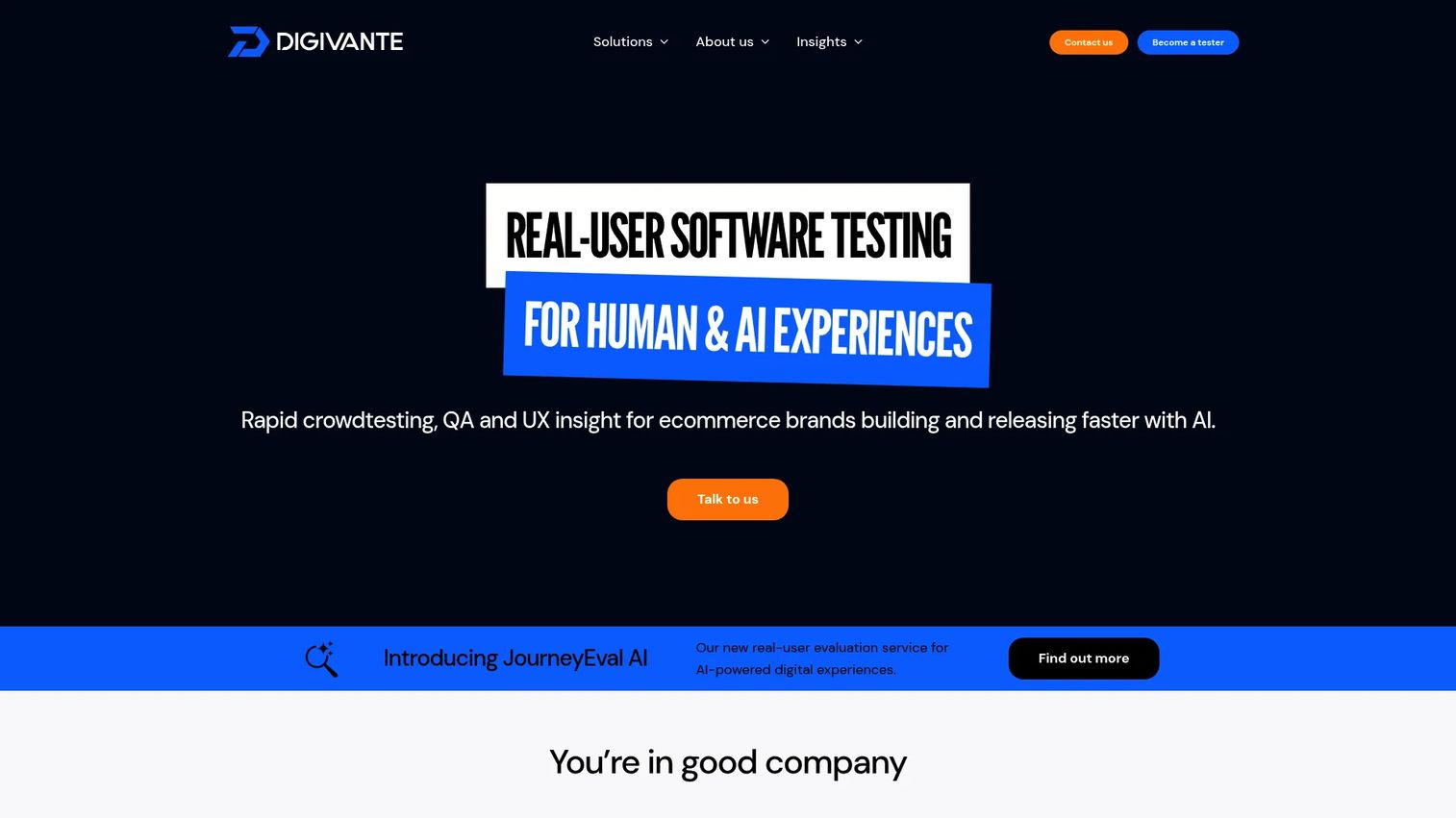
Digivante provides managed software testing, QA, UX insight, and crowdtesting for digital products and customer journeys. Its testing scope covers exploratory, regression, accessibility, localisation, payment, cross-browser, and post-release testing, across 300+ real device and browser combinations. The testing portal includes reporting, REST API access, and integrations with Jira and Azure DevOps. For PMs responsible for conversion-critical workflows, checkout flows, account creation, or billing paths, Digivante's customer journey focus is a strong fit.
Best for: Teams testing revenue-sensitive digital journeys where a defect affects conversion, order completion, or account access.
Key features
- Exploratory, regression, accessibility, localisation, and payment testing
- 300+ real device and browser combinations
- Testing portal with reporting and REST API access
- Jira and Azure DevOps integrations
- Cross-browser and post-release testing
Why choose Digivante: Before engaging, verify that the provider can cover the exact journey, regions, devices, and payment conditions that drive your conversion metrics. The broader lesson applies across the category: Prioritize the workflow where failure has the highest revenue or activation cost.
Digivante pricing: Pricing is quote-based, determined by release cycles, test scope, environments, and required services. No free tier is available. Contact Digivante for a proposal.
G2 rating: 5.0/5, based on 5 reviews
8. Tester Work
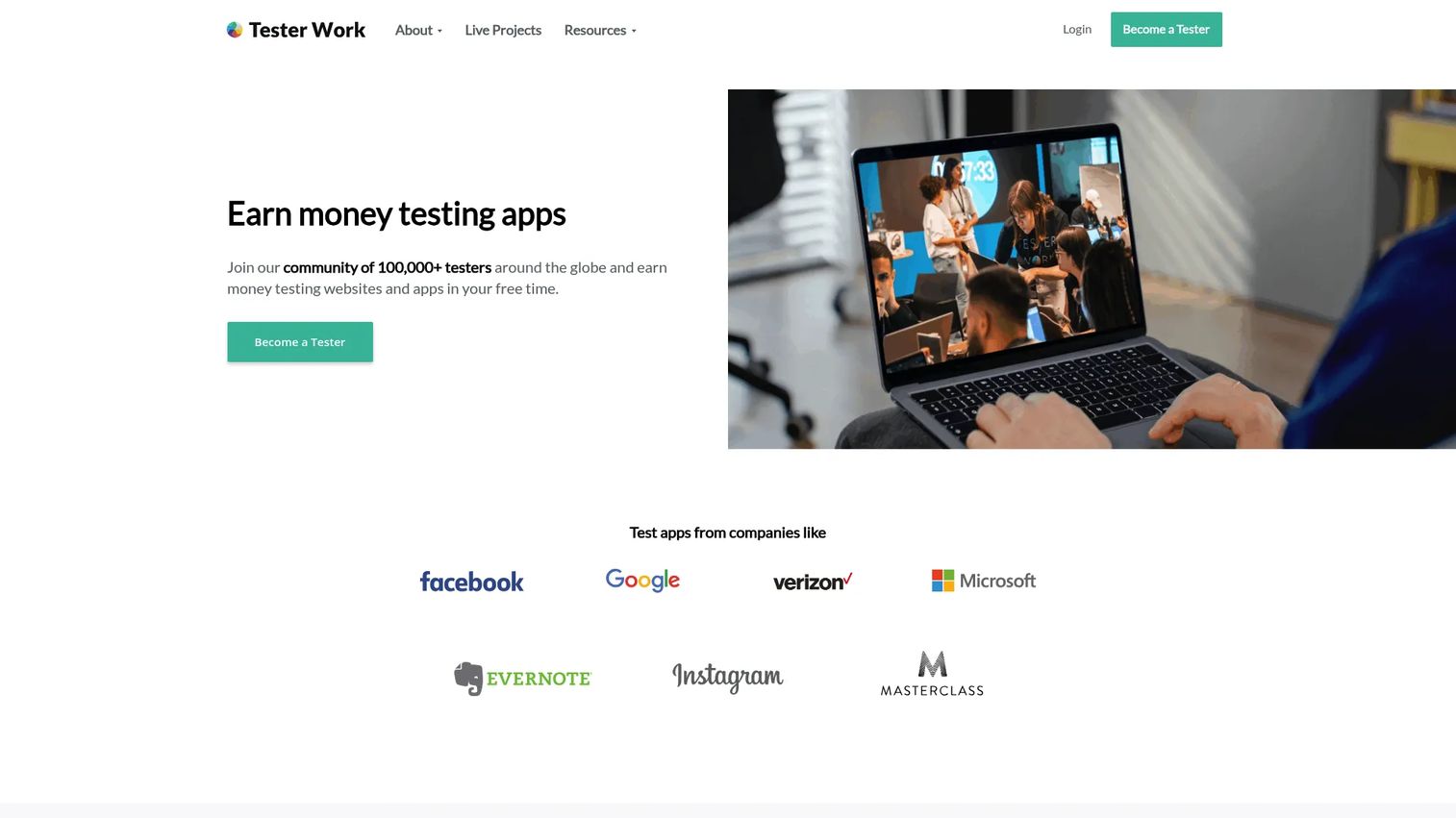
Tester Work is a crowdtesting platform that connects testers with software and app testing projects. It supports exploratory testing, test case execution, and bug reporting with evidence and categorization. The platform operates more as a community model for testers finding projects than as a full managed-service for buyers, which means the operational responsibility of brief writing, report triage, and severity decisions stays with your team.
Best for: Smaller product teams with internal QA capacity that can write focused briefs and want to extend their coverage with external testers.
Key features
- Exploratory testing through community testers
- Test case execution via the Tester Work platform
- Bug reporting with evidence and categorization
- Web and mobile testing scope
- Flexible project-based engagement
Why choose Tester Work: Start with a narrow workflow and clear severity rules rather than sending a broad product-access request. The marketplace model shifts operational responsibility to the buyer, which is a fit question, not a flaw. It works when someone on your team owns the triage outcome.
Tester Work pricing: Tester Work publishes project-specific payments for testers rather than buyer subscription tiers. Contact the platform for buyer-side pricing details.
9. uTest

uTest is a global community and platform providing crowd-based digital testing across functional, usability, AI, accessibility, and payment testing. It includes uTest Academy for tester training, a mobile app for project management, and Jira integration. For product teams purchasing test coverage, uTest provides access to a large distributed tester community with broad device diversity. The platform makes most sense when your team has QA leadership to define a tight test charter and can manage report triage internally.
Best for: Product teams that want access to a broad tester community for focused web and mobile test cycles, with internal QA capacity to guide execution.
Key features
- Functional, usability, AI, accessibility, and payment testing
- Global tester community with device diversity
- uTest Academy for tester training and quality
- Jira integration
- Mobile app for project management
Why choose uTest: Distinguish the buyer experience from the tester experience when evaluating. The platform is well-known on the tester side; buyer-side support and managed execution vary by engagement. A tightly defined test charter is non-negotiable.
uTest pricing: Tester registration on uTest is free. Buyer-side pricing for test coverage was not displayed publicly. Contact uTest for a quote on managed or community test cycle access.
10. 99tests
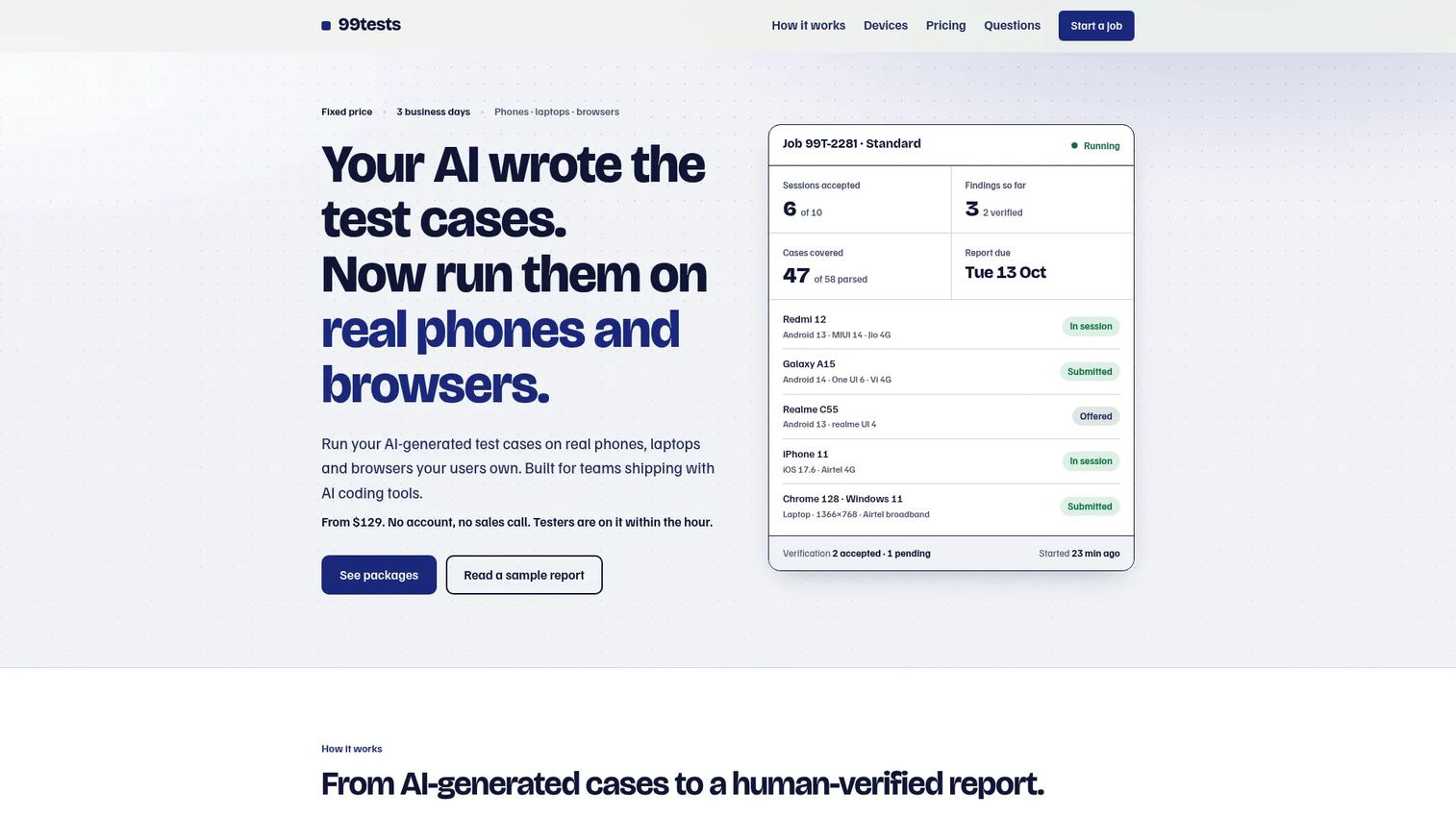
99tests is a real-device testing service that executes customer-provided test cases on testers' real phones, laptops, and browsers. Plans are fixed-price and include pass/fail coverage reports, screenshots, reproduction steps, and cross-browser testing across Chrome, Safari, Edge, and Firefox. One-click re-runs on the same plan reduce friction when you need to retest after a fix. For budget-conscious teams running focused validation before a feature release, the fixed-price structure makes cost predictable.
Best for: Smaller teams running targeted web or mobile validation, with a defined set of test cases and a clear pass/fail standard.
Key features
- Human execution of test cases on real devices
- Pass/fail reports with screenshots and reproduction steps
- Cross-browser coverage: Chrome, Safari, Edge, Firefox
- Device, OS, browser, network, and session details logged
- One-click re-runs on the same plan
Why choose 99tests: Lower-cost testing only creates value when the test brief, expected evidence standard, and triage owner are established before the cycle starts. Use it for one high-risk workflow per cycle, such as sign-up, checkout, or an integration handoff, rather than broad exploratory coverage.
99tests pricing: The Starter plan is ₹9,999+ GST (one-time, fixed price) and covers 5 sessions across 2 devices or browsers, up to approximately 25 test cases. Standard is ₹18,999+ GST for 10 sessions and 4 devices. Deep is ₹34,999+ GST for 20 sessions and 6 devices. Customers outside India are billed in USD; contact 99tests for the current USD equivalent. No free tier is available.
G2 rating: 4.2/5
Considerations when choosing crowd testing tools
Match the provider model to your internal QA capacity
A managed provider reduces coordination work but costs more and requires an onboarding phase. A marketplace model reduces cost but requires your team to write strong briefs, validate reports, and decide what gets fixed. Be honest about who owns the triage workflow before signing anything.
Define the customer environment before selecting a vendor
"Global coverage" is not specific enough to guide a release decision. Ask each provider for the exact device matrix, OS versions, browser combinations, geographies, carriers, languages, and payment methods they can cover for your product. Request documentation rather than a verbal assurance.
Evaluate bug-report quality, not tester count
A useful bug report includes reproduction steps, the specific device and OS, browser version, network conditions, severity reasoning, and visual evidence (screenshots or video). Ask to review sample reports from a comparable product category before committing to a longer engagement.
Confirm confidentiality and access controls
Document what testers can see, where builds are hosted, how credentials are issued and revoked, whether NDAs apply, and how access is removed after each cycle. Use test environments with representative data wherever possible, not production data or real customer records.
Measure impact at the release level
Track escaped defects per release, time from report to triage decision, retest completion rate, and post-release support ticket volume by device or region. Crowd testing earns its place when it changes release quality, not when it simply adds reports to your backlog.
Conclusion
The right crowd testing tool depends on the specific release risk you need to reduce, the customer environment your internal lab can't represent, and the amount of test-cycle coordination your team can absorb.
Test IO suits PMs who need structured exploratory and functional crowdtesting with managed execution. Applause handles larger programs with complex device and geography requirements. Global App Testing is the clearest choice for international and localization releases. Testlio works for teams with a steady release cadence who want a managed partner rather than a cycle-by-cycle arrangement. UberTesters is the practical pick for mobile-specific coverage. UserTesting belongs in the workflow when comprehension and task completion are the questions alongside defect discovery.
For teams with tighter budgets or strong internal QA, Tester Work, uTest, or 99tests provide access to real testers without the full managed-service overhead, provided your team owns the triage process.
Before you book a single demo, pick one release workflow that internal testing doesn't cover well. Define the users, devices, locations, evidence standard, and the go or no-go decision. Then evaluate providers against that specific test charter.
To see how AI software testing tools and API testing tools can complement a crowd testing program, explore those guides as part of building your broader QA stack. For teams also evaluating application security testing, that category covers a different job and warrants its own shortlist.
Start your journey with Guideflow today!
FAQs
A crowd testing tool is a platform or managed service that coordinates distributed external testers to evaluate software across real-world devices, browsers, locations, and user contexts. Some focus on functional defects and exploratory testing, others on usability research, and others on security vulnerability discovery. The provider model, managed service versus marketplace versus research platform, determines how much operational work lands with your team.
The terms are used interchangeably across the industry. Both describe using distributed external testers rather than an internal QA team. Providers differ significantly in whether they manage the test cycle end-to-end, provide a self-service marketplace, recruit research participants for task-based sessions, or run security programs. The model difference matters more than the label.
Reach for crowd testing when you need device diversity your internal lab can't replicate, real-user coverage in a specific geography or language, independent exploratory feedback on a high-risk workflow, or localization validation before a regional launch. It complements automation and internal QA; it doesn't replace either. A clear scope, including the specific workflow, expected evidence, and go or no-go criteria, makes the output actionable.
Yes, particularly for browser compatibility, onboarding flows, billing and permissions, integrations, and mobile companion apps. SaaS teams get the most value by scoping one workflow per cycle with a defined evidence standard. The escaped-defect rate and post-release support ticket volume by device or region are the clearest indicators of whether the investment is paying off.
It can add human feedback and assistive-technology perspectives, depending on the provider's tester matching capabilities and accessibility expertise. Verify that the provider can recruit testers with relevant accessibility profiles before assuming it's included. Use crowd findings alongside, not instead of, formal accessibility evaluation practices.
Use test environments rather than production, populate those environments with representative data rather than real customer records, issue limited-access credentials with expiration, and confirm the provider's confidentiality processes and tester agreements before access is granted. Remove all access immediately after each cycle closes and document the process in writing.
Pricing varies across the category. Fixed-price platforms like 99tests start from ₹9,999 for a defined test package. Managed services like Testlio, Applause, and Digivante price by quote based on scope, test types, geographic requirements, and engagement length. Global App Testing states investment starts around $10,000. When comparing, factor in the internal engineering and QA time required to create equivalent coverage, not just the vendor invoice.
No. Automation handles repeatable, fast checks across every build. Crowd testing adds human observation, real-device coverage, local context, exploratory behavior, and qualitative feedback that scripts can't replicate. The strongest QA programs use automation for speed and regression coverage, and crowd testing for the human signal that catches what automated cases miss.
A useful report includes the exact reproduction steps, device model, OS version, browser and version, network conditions, severity reasoning, and visual evidence such as a screenshot or screen recording. It gives engineering enough information to reproduce the issue without a follow-up call. Before committing to a provider, ask to review sample reports from a comparable product to assess whether the evidence quality meets your triage standard.