The visit ends. The clinician opens the EHR. The documentation work begins.
According to the American Medical Association's 2025 survey of 2024 data, physicians spend an average of 13 hours per week on indirect patient care, including documentation. And 22.5% report spending more than eight hours per week on the EHR outside normal working hours. That is not a documentation tool problem in the abstract. It is an operational cost with a specific number attached.
The category that tries to solve this spans everything from traditional AI dictation software to ambient AI scribes to speech-to-text APIs designed for developers. Those are not interchangeable tools. Comparing them on a single accuracy axis misses the actual decision: Which workflow type fits your organization, and what does safe rollout look like for your team?
This guide cuts through that. It compares 12 medical transcription software options by clinical documentation fit, EHR workflow compatibility, security posture, and pricing clarity so you can shortlist with confidence before any vendor conversation.
What's inside
This guide is for physicians evaluating documentation tools, clinical operations leaders choosing infrastructure for provider teams, and healthtech founders deciding whether to buy, partner, or build.
Tools were selected based on:
- Clinical documentation fit: Does the tool handle medical vocabulary, SOAP note structure, and specialty terminology?
- EHR workflow compatibility: Does it write into existing systems or require manual handoff?
- Security and privacy posture: Does the vendor support BAAs, access controls, and audit logs?
- Pricing clarity: Can you calculate actual cost before talking to sales?
Pricing and G2 ratings are verified from live vendor sources. Guideflow does not appear in this list because medical transcription is outside its category.
TL;DR
- Best for solo and small practice clinicians: Freed, with fast AI-generated visit notes and a 7-day free trial starting at $39/month
- Best for enterprise medical dictation: Nuance Dragon Medical One, built around medical speech recognition and EHR workflow depth
- Best for healthtech developers: Amazon Transcribe Medical for managed medical ASR, or Deepgram for customizable speech infrastructure
- Best for ambient documentation: DeepScribe, Suki, and Heidi, each suited to different EHR environments and practice types
- Best for EHR-native health systems: Epic, when documentation must stay inside existing health system workflows
- Best free starting point: Heidi, which offers a genuinely unlimited free plan for individual clinicians
What is medical transcription software?
Medical transcription software converts clinical speech, recorded visits, or dictated notes into structured medical documentation for EHRs, SOAP notes, referrals, coding workflows, or patient records.
The category blends several distinct tool types:
- Medical dictation software: The clinician speaks, the software transcribes in real time or near real time. Examples include Nuance Dragon Medical One and VoiceboxMD.
- AI medical scribes: The tool listens to the patient visit and drafts structured notes automatically. This is ambient clinical documentation. Examples include Freed, DeepScribe, Suki, and Heidi.
- Speech-to-text APIs: Developers embed clinical transcription capability into their own product. Examples include Amazon Transcribe Medical and Deepgram.
- Human-assisted transcription workflows: Software routes dictation to transcriptionists or editors, often with speech recognition assist. Philips SpeechLive operates in this space.
- EHR-native documentation: Documentation stays inside the health record system itself. Epic is the clearest example for health systems standardized on that platform.
Key capabilities to evaluate across all types:
- Clinical vocabulary, specialty terminology, and medical language model quality
- SOAP note generation and structured output formats
- EHR or EMR workflow fit, including whether the tool writes directly into fields
- Speaker identification and telehealth session support
- Medication name accuracy, dosage handling, negation detection, and qualifier capture
- BAA support, access controls, data retention policies, and audit logging
- Pricing model, whether per provider, per seat, per visit, per minute, or enterprise contract
The right choice depends on workflow type, not a generic accuracy claim. A solo therapist and a 200-clinician oncology group are asking fundamentally different questions. See our related guide on AI medical diagnostic platforms for adjacent tools at the clinical intelligence layer.
When to use medical transcription software
Reduce clinician documentation time after visits
Use this when providers spend evenings or weekends cleaning charts. Dictation tools and AI scribes can move documentation closer to the point of care, cutting after-hours burden. Note that AI-generated notes still require clinician review before signing, which is a workflow design decision, not a minor caveat.
Standardize SOAP notes and structured clinical output
Use this when note quality varies across providers, specialties, or care settings. Structured templates and specialty-specific formatting create consistency without restricting clinical judgment. For operator-led healthtech teams, this is also where documentation data quality starts to matter for downstream analytics.
Build medical speech recognition into a product
Use this when you are a healthtech founder or product team embedding transcription into your own application. APIs like Amazon Transcribe Medical and Deepgram give you the infrastructure layer. You still need to design the review workflow, the EHR handoff, and the clinical safety checks. Explore related infrastructure categories like API documentation tools and API generation software if you are building documentation tooling from scratch.
Medical transcription software comparison
Use this table as a shortlist starting point. Verify current pricing, BAA availability, G2 ratings, and EHR integration details before procurement. Pricing figures are drawn from live vendor sources as of November 2026.
| # | Product | Best for | Key differentiator | Pricing | G2 rating |
|---|---|---|---|---|---|
| 1 | Freed | Solo clinicians and small practices | Fast AI scribe workflow with coding and call handling | From $39/mo | 5.0/5 |
| 2 | Nuance Dragon Medical One | Enterprise medical dictation | Mature medical speech recognition with no voice training required | Quote-based | 3.9/5 |
| 3 | Amazon Transcribe Medical | Healthtech developers | Medical speech-to-text API with streaming and batch modes | From $0.075/min | N/A |
| 4 | DeepScribe | Specialty ambient documentation | AI scribing with pre-charting, coding, and a customization studio | Quote-based | 4.1/5 |
| 5 | Philips SpeechLive | Dictation and transcription teams | Cloud dictation plus transcription routing and healthcare AI | From $21.90/user/mo | 4.5/5 |
| 6 | Deepgram | Developers needing speech infrastructure | Customizable speech API with diarization and model flexibility | Free $200 credit, then usage-based | 4.6/5 |
| 7 | Epic | Epic health systems | EHR-native documentation within existing health system workflows | Enterprise contract | 4.2/5 |
| 8 | Suki | Provider teams needing AI assistant workflows | Ambient notes, coding, ordering, and chart retrieval in one assistant | Quote-based | 4.4/5 |
| 9 | Heidi | Clinicians wanting a free AI scribe | Unlimited free plan with AI notes, templates, and clinical evidence | Free; paid from $110/user/mo | 4.9/5 |
| 10 | Sonix | Research and non-EHR transcription | General transcription with translation, AI analysis, and exports | From $10/hr or $25/mo | 4.7/5 |
| 11 | VoiceboxMD | Medical dictation with EHR voice entry | Real-time medical dictation across Windows, macOS, and iOS | From $49/mo | 4.5/5 |
| 12 | INVOX Medical | Medical dictation in multilingual settings | Medical dictation with EHR, RIS, PACS, and LIS integrations | Free tier; paid from €30/mo | N/A |
Best 12 medical transcription software tools for 2026
1. Freed
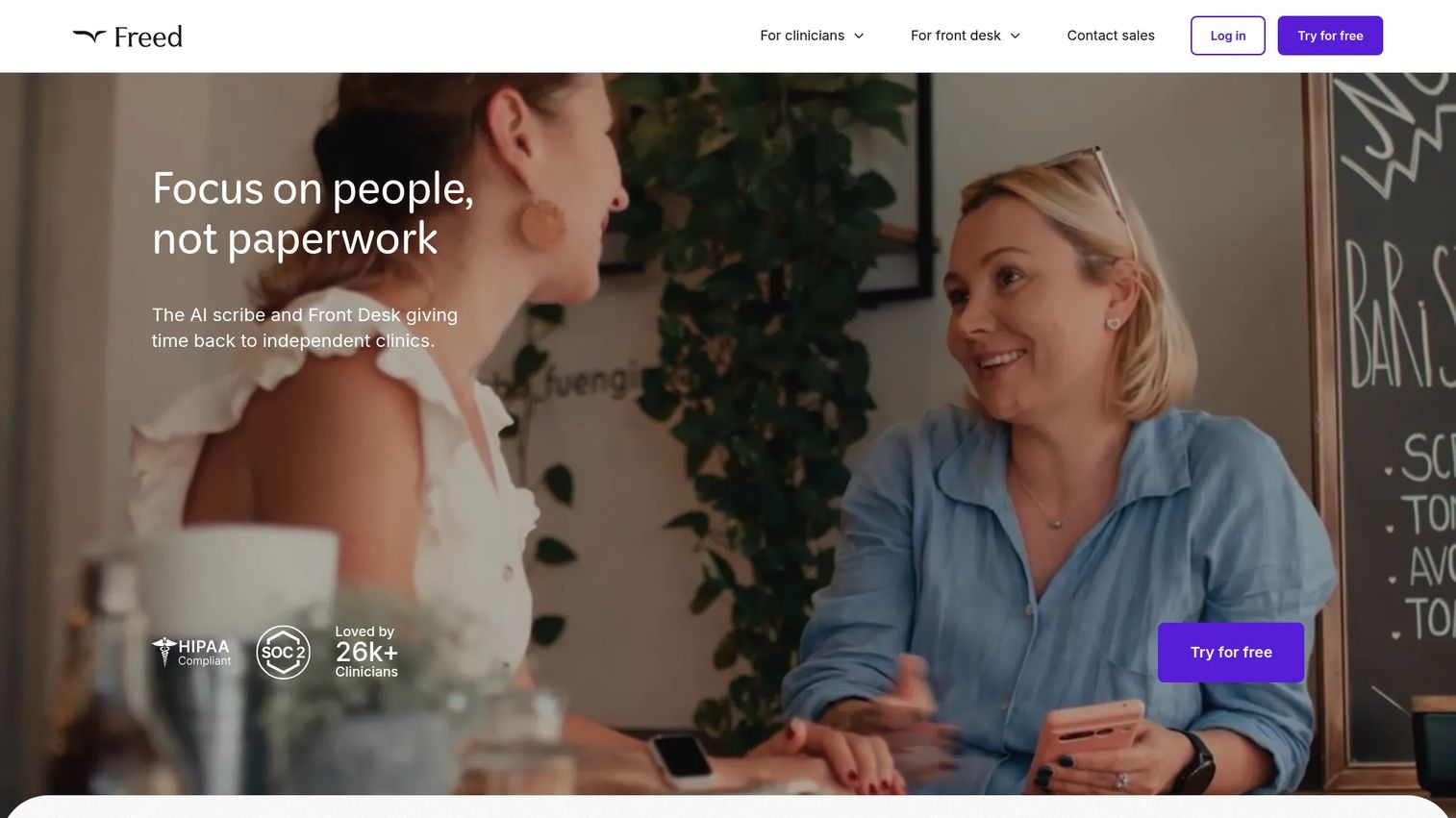
Freed is an AI medical scribe and front-desk platform built for independent clinics. The tool listens to patient conversations and generates clinical notes, then adds ICD-10 and CPT coding suggestions and clinical evidence answers alongside a receptionist layer for calls and after-hours coverage. It is designed for clinicians who want speed and lightweight deployment, not enterprise configuration overhead.
Best for: Solo clinicians, small practices, therapists, and independent providers who want AI-generated notes without a complex rollout.
Key features
- AI-generated clinical notes with EHR syncing
- ICD-10 and CPT coding suggestions
- Clinical evidence answers from 50+ trusted sources
- AI receptionist for calls and after-hours coverage
- Specialty note templates
Why choose Freed: Freed fits practices where the bottleneck is post-visit documentation time and the team does not have a dedicated IT or implementation function. Larger health systems should evaluate admin controls, governance, and EHR integration depth before committing.
Freed pricing: A 7-day free trial is available. Paid plans start at $39/month (billed annually) for the Starter tier, which includes up to 40 notes monthly. Core runs $79/month with unlimited notes and template building. Premier is $104/month and adds advanced integrations, visit summaries, and patient materials. Groups pricing is custom.
Freed holds a 5.0/5 rating on G2.
2. Nuance Dragon Medical One
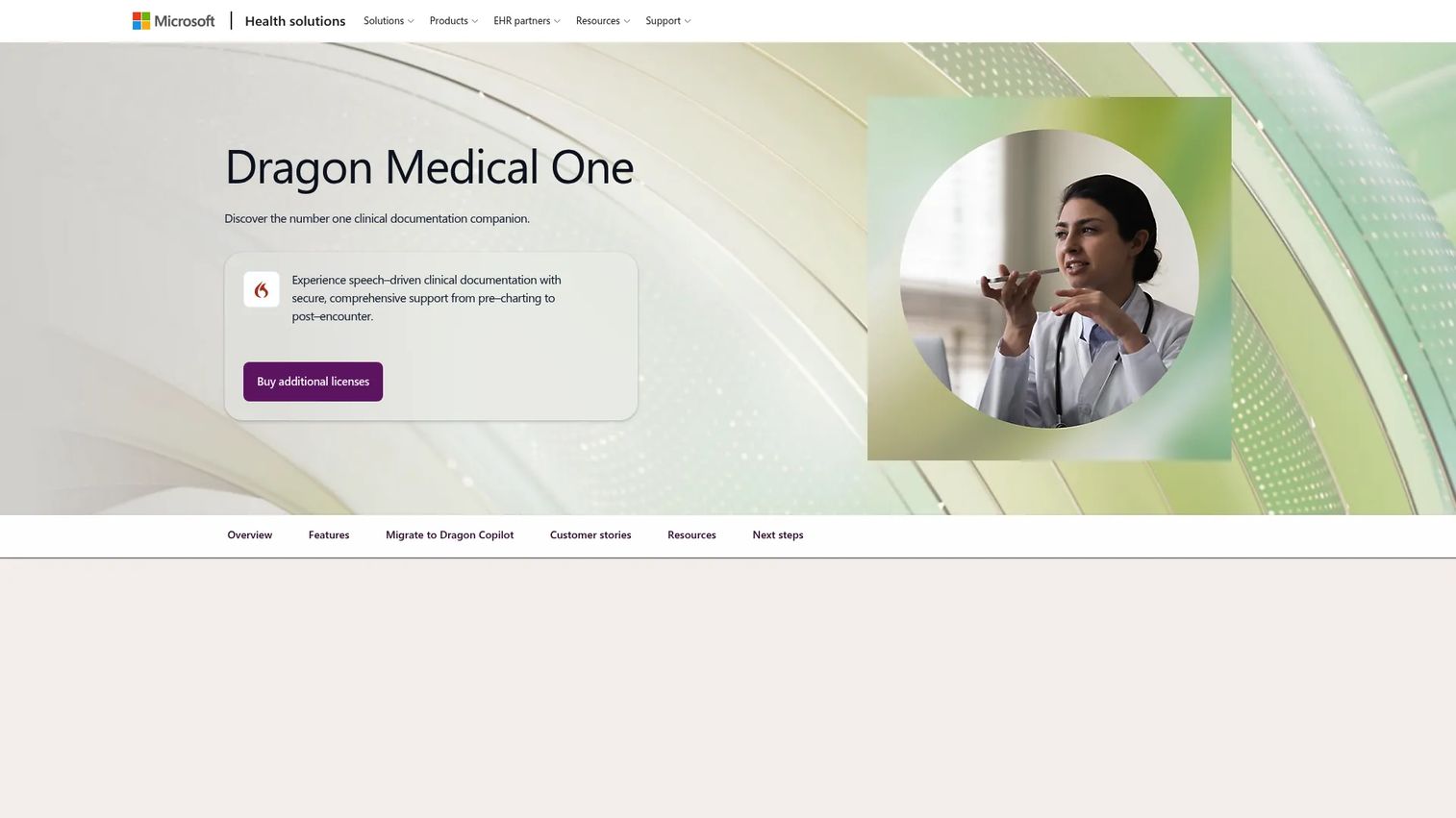
Nuance Dragon Medical One is cloud-based medical speech recognition for clinician dictation. Now part of Microsoft, it is built around voice-driven documentation with automatic accent detection and no voice profile training required. The tool covers direct dictation into EHRs, auto-texts, step-by-step commands, and Windows voice commands, making it the reference standard for physician dictation software in enterprise environments.
Best for: Health systems and practices standardizing physician dictation workflows with deep healthcare vocabulary support.
Key features
- Medical speech recognition without voice profile training
- Automatic accent detection and audio calibration
- EHR dictation workflows across supported systems
- Custom vocabulary and auto-text commands
- Integration with Microsoft Edge, Chrome, Word, and Outlook
Why choose Nuance Dragon Medical One: This is the right choice for organizations that want mature, physician-driven dictation rather than ambient AI scribing. If the workflow involves a clinician composing the note through speech, Dragon Medical One is the most proven option at enterprise scale.
Nuance Dragon Medical One pricing: Pricing is sold through Microsoft and authorized partners on a quote basis. Contact the vendor or a certified reseller to get figures for your provider count and EHR environment. G2 reviewers in the medical transcription category report pricing varies significantly by deployment size.
Nuance Dragon Medical One holds a 3.9/5 rating on G2.
3. Amazon Transcribe Medical
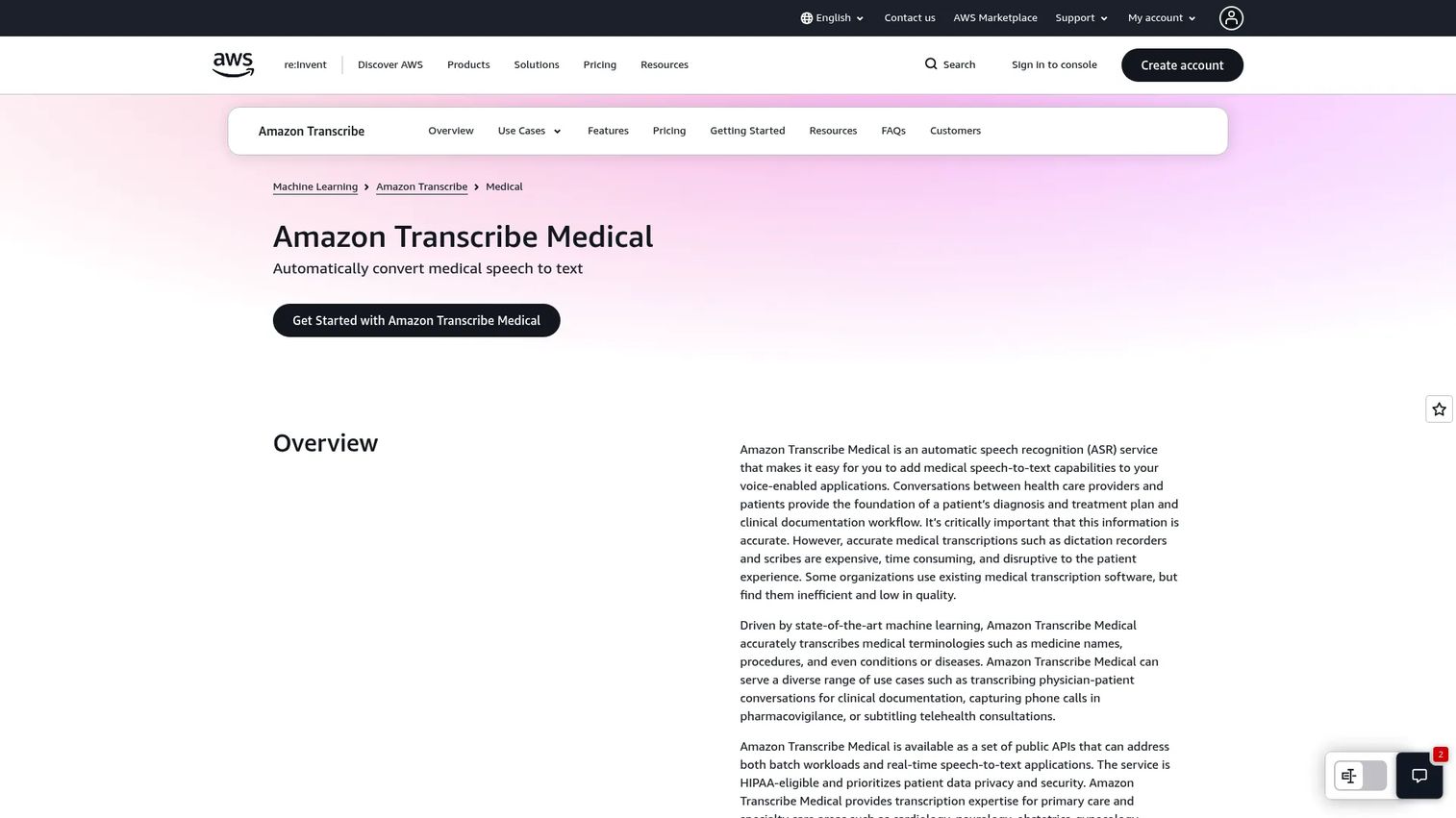
Amazon Transcribe Medical is a medical speech-to-text API service for developers building clinical transcription into applications. It supports both real-time streaming and batch transcription, handles speaker diarization, and offers custom medical vocabulary across specialties including cardiology, neurology, oncology, radiology, and urology. This is infrastructure, not a finished scribe product.
Best for: Healthtech product teams and engineering teams embedding transcription capability into clinical software built on AWS.
Key features
- Real-time streaming and batch medical speech-to-text
- Medical dictation and conversational transcription modes
- Speaker diarization for multi-participant visits
- Custom medical vocabulary by specialty
- PHI-aware output handling
Why choose Amazon Transcribe Medical: Choose this if your team has engineering resources and wants to own the transcription layer inside your own application. The API handles the audio-to-text conversion; your team designs the note review workflow, the EHR handoff, and the clinical safety checks around it. Related reading on building documentation tooling: AI note-taking tools.
Amazon Transcribe Medical pricing: Usage-based billing at $0.075 per minute for both streaming and batch modes. AWS offers 60 free minutes per month for the first 12 months under the free tier. Example costs from AWS: $1.125 for 15 minutes, $4.50 for 60 minutes. Use the AWS pricing calculator with your expected visit volume to project monthly spend.
4. DeepScribe
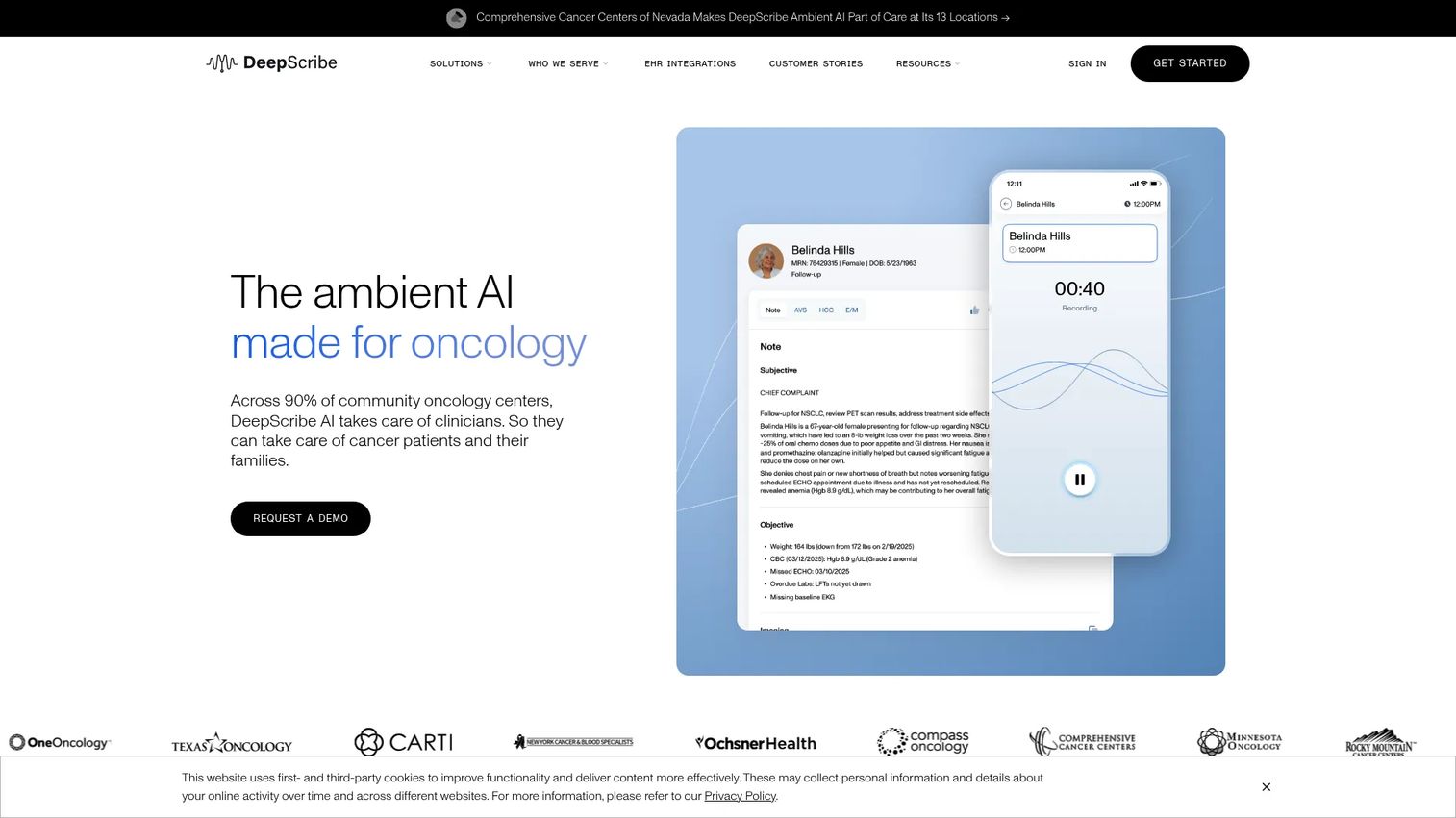
DeepScribe is an ambient AI clinical documentation platform built specifically for specialty healthcare, with particular depth in oncology. The tool listens to visits, generates structured clinical notes, and extends into AI pre-charting, coding recommendations, and a customization studio for note style preferences. It is designed for practices that want documentation automation across a provider group, not just a single clinician.
Best for: Provider groups and specialty practices evaluating ambient documentation across recurring patient visit types.
Key features
- Ambient visit documentation and AI medical scribing
- AI pre-charting with patient-care context
- ICD-10, HCC, and E/M coding recommendations
- Customization Studio for personalized note generation
- DeepScribe Assist for point-of-care clinical insights
Why choose DeepScribe: DeepScribe suits practices where reducing charting time across a provider group is the primary goal and where specialty-specific documentation quality matters more than a lightweight per-clinician app. Test it against your actual visit types and specialty terminology before broad deployment.
DeepScribe pricing: DeepScribe does not display pricing on its website. Plans are sold on a quote basis. Pricing drivers include provider count, EHR integration requirements, specialty focus, and support package. Contact the vendor directly to get a structured proposal. G2 reviewers rate the tool at 4.1/5, and reviewer notes describe it as enterprise-oriented.
DeepScribe holds a 4.1/5 rating on G2.
5. Philips SpeechLive
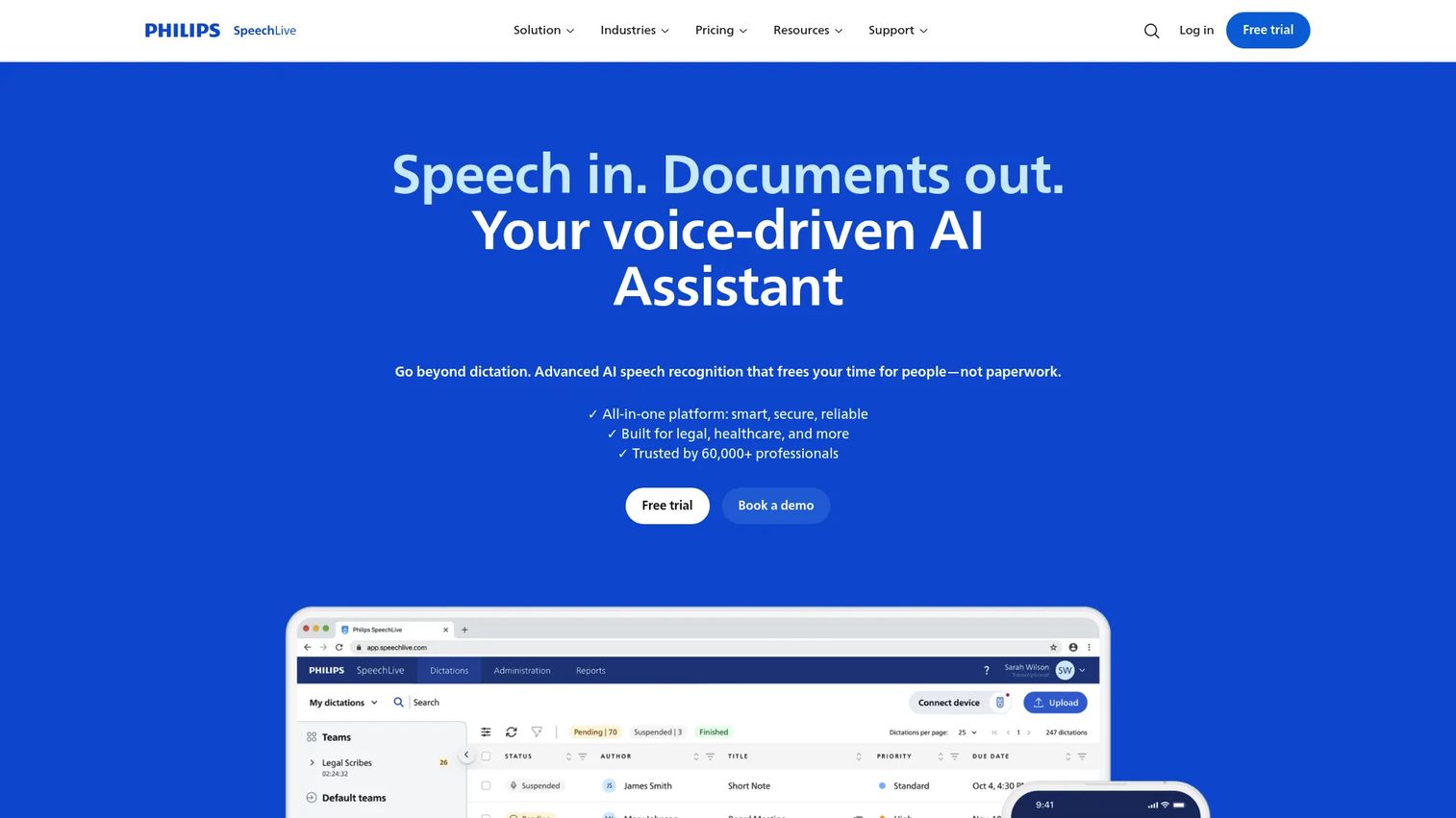
Philips SpeechLive is cloud-based dictation, transcription, and speech recognition software with a healthcare AI tier. It supports mobile and web recording, transcription routing to team members or professional transcriptionists, direct-at-cursor dictation, and AI-generated clinical notes with specialty templates. A Zapier integration and centralized admin round out the workflow management layer.
Best for: Medical practices and transcription operations that want cloud dictation combined with transcription routing and administrative workflow management.
Key features
- Mobile and web dictation with file upload
- Transcription task assignment and team routing
- Speech recognition with custom vocabulary and multi-speaker support
- AI-generated clinical notes with specialty templates
- Centralized administration and Zapier integration
Why choose Philips SpeechLive: Use Philips SpeechLive when the organization has established dictation habits or relies on a human transcription review step. It covers the full dictation-to-document workflow in one platform, which makes it a practical choice for practices not ready to shift entirely to ambient AI scribing.
Philips SpeechLive pricing: A two-week free trial is available with Enterprise-plan features. Paid plans start at $21.90/user/month (billed annually, excluding tax) for the Workflow tier. Professional Direct runs $47.80/user/month. The Health AI Assistant tier is $103.00/user/month and adds AI-generated clinical notes.
Philips SpeechLive holds a 4.5/5 rating on G2.
6. Deepgram
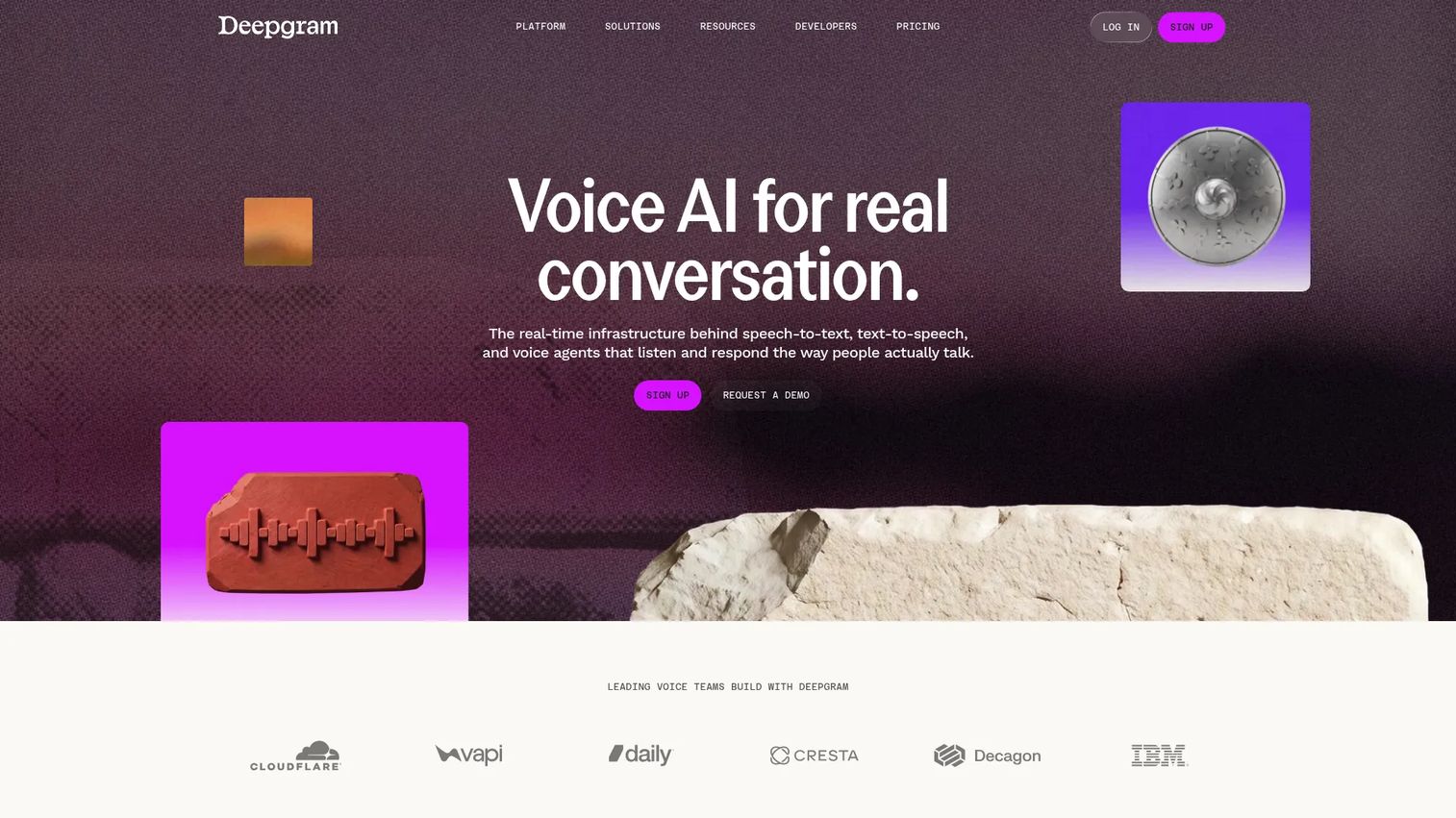
Deepgram is an enterprise voice AI platform providing speech-to-text, text-to-speech, voice agent, and audio intelligence APIs. It supports healthcare transcription use cases through custom vocabulary, low-latency streaming, speaker diarization, and model customization. Like Amazon Transcribe Medical, this is developer infrastructure, not a finished clinician-facing scribe.
Best for: Engineering teams that need customizable speech recognition, latency control, and API flexibility for building healthcare documentation features.
Key features
- Speech-to-text API for real-time and prerecorded audio
- Speaker diarization and smart formatting
- Custom vocabulary and model customization
- Audio intelligence: Summarization, topic detection, sentiment analysis
- Voice Agent API for conversational AI applications
Why choose Deepgram: Deepgram gives product teams more control over the transcription model and output format than managed medical ASR services. The trade-off is that documentation safety, review workflows, and EHR field mapping all require product design on your side. It is a better fit for teams building differentiated documentation experiences than for those wanting a turnkey clinical scribe. See also: best AI voice assistants for adjacent reference.
Deepgram pricing: New accounts receive $200 in free usage credit. After that, billing is usage-based with no seat minimums. The Growth plan starts at $4,000+ per year in prepaid annual credits. Enterprise pricing is custom. Check the Deepgram pricing page for current per-unit rates by model and feature.
Deepgram holds a 4.6/5 rating on G2.
7. Epic
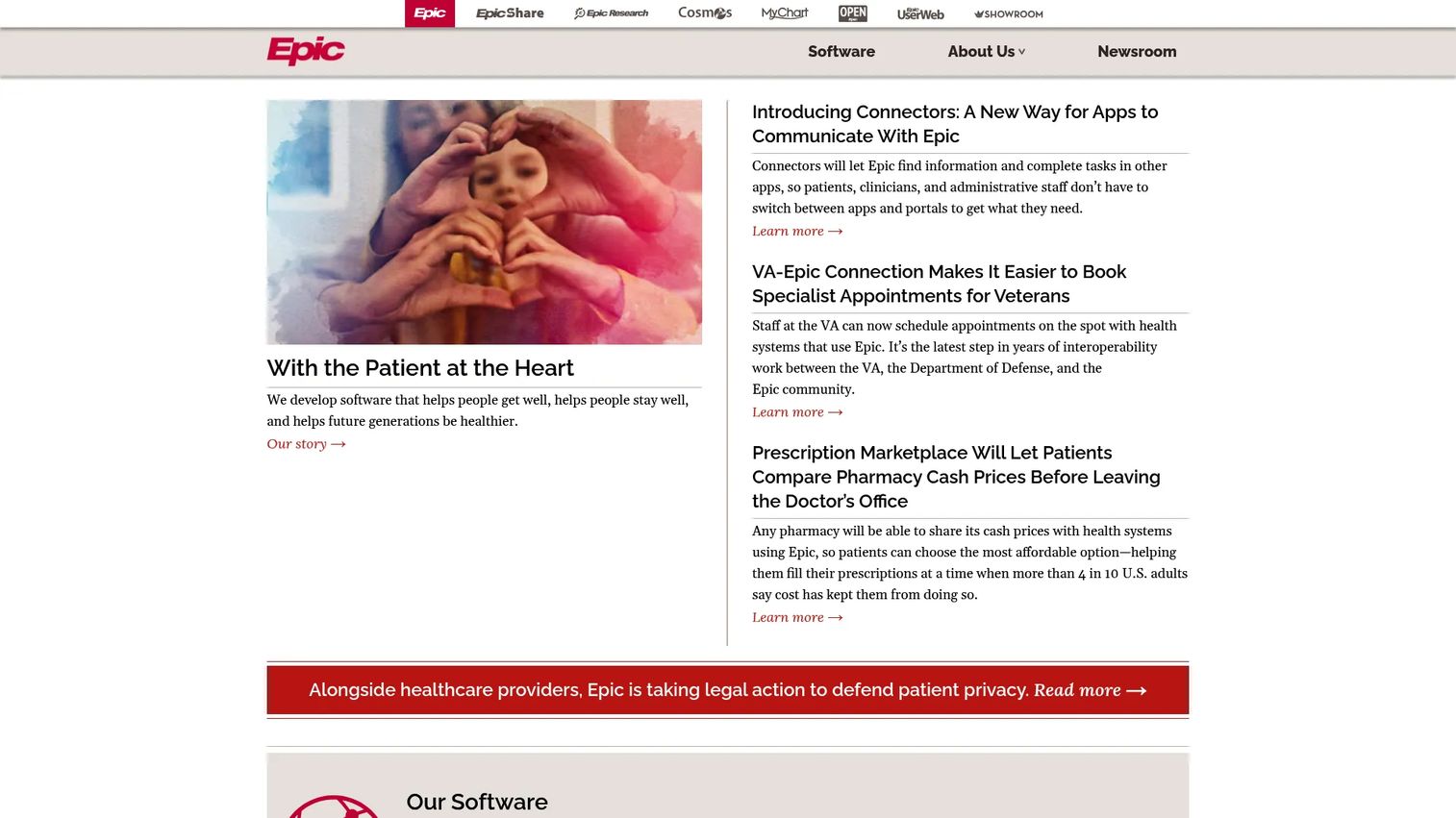
Epic is an integrated healthcare software platform, not a standalone transcription tool. Health systems evaluating clinical documentation often land here because Epic is where their providers already work. Epic offers EHR-native documentation workflows, ambient and dictation capabilities through its own features and partner integrations, and the governance infrastructure that large health systems require.
Best for: Health systems already standardized on Epic, where documentation must stay inside existing EHR workflows and governance structures.
Key features
- Integrated electronic health records across hospital and clinic settings
- EHR-native documentation with clinical workflow integration
- Patient experience tools including scheduling, check-in, and remote monitoring
- Healthcare intelligence with AI, real-world evidence, and peer benchmarks
- Enterprise deployment controls and health system governance
Why choose Epic: Epic is the right evaluation path when switching EHR workflows is not on the table and documentation improvement needs to happen inside the existing system. It is not a practical option for small practices or independent clinicians. Implementation is health-system scale, which means IT, governance, and procurement are part of the buying process.
Epic pricing: Pricing is enterprise contract based and determined through a procurement relationship with Epic. Organizations evaluating Epic typically go through a formal RFP and implementation scoping process before receiving cost proposals.
Epic holds a 4.2/5 rating on G2.
8. Suki
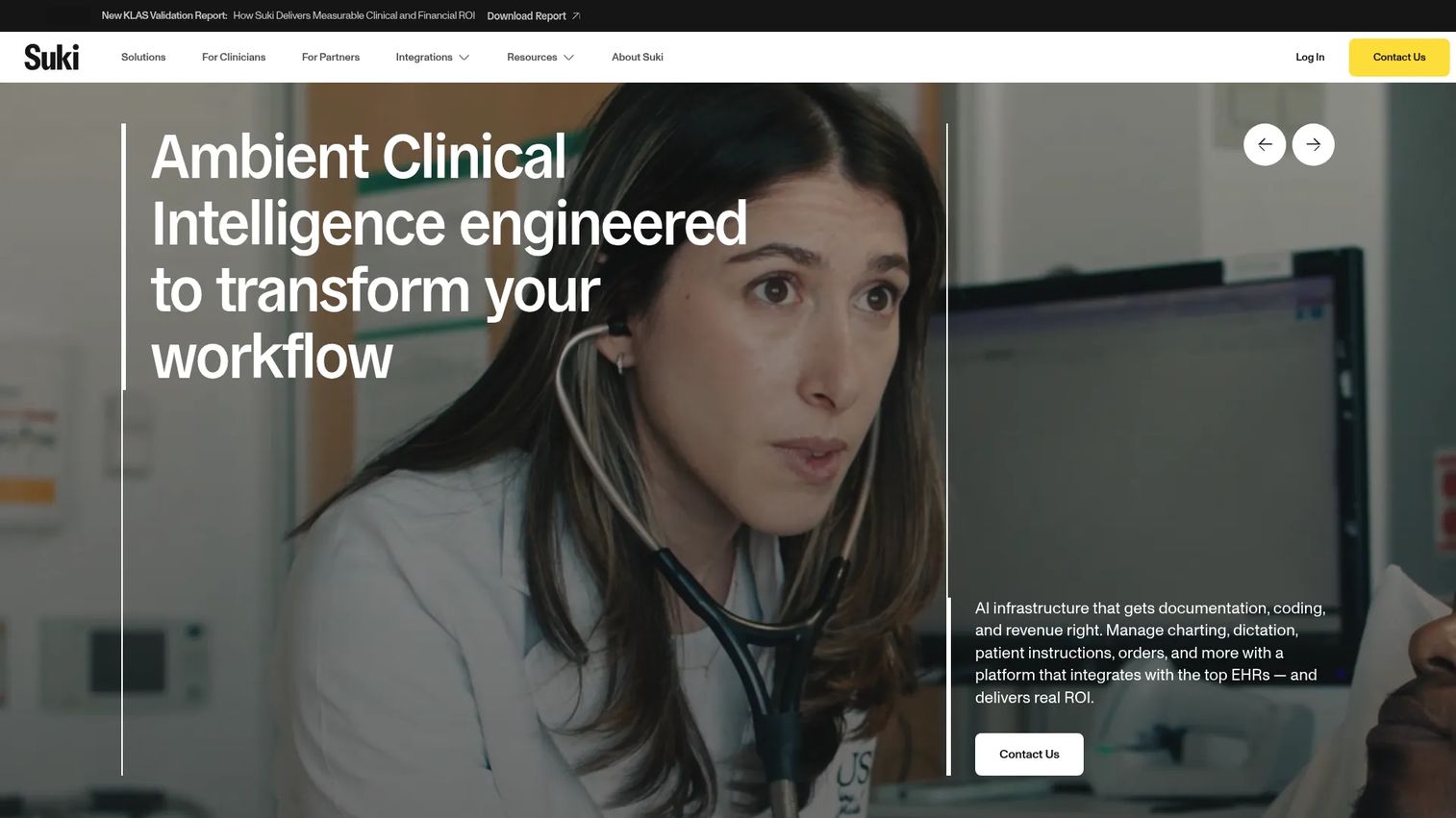
Suki is an AI-powered ambient clinical intelligence platform for clinicians. It covers ambient note generation, voice-enabled pre-charting, AI coding across ICD-10, HCC, and CPT codes, ambient order staging, and a clinical Q&A tool that retrieves chart data on demand. It integrates with Epic, Oracle Health, athenahealth, and MEDITECH, and supports multilingual patient instructions in 80 languages.
Best for: Provider organizations that want an AI assistant spanning documentation, coding, ordering, and chart retrieval in a single workflow.
Key features
- Ambient documentation and specialty-specific note generation
- Voice-enabled pre-charting and patient summaries
- AI coding: ICD-10, HCC, CPT, and E/M
- Ambient order staging and clinical Q&A
- EHR integrations with Epic, Oracle Health, athenahealth, and MEDITECH
Why choose Suki: Suki fits organizations that want to go beyond note generation and extend AI assistance into coding and ordering workflows. Verify supported EHR integrations and current specialty coverage before piloting. The breadth of the assistant model means implementation scope is wider than a single-purpose scribe.
Suki pricing: Plans are sold on a quote basis through the sales team. The pricing conversation typically covers provider count, EHR integration requirements, and deployment scope. Reach out directly to receive packaging options.
Suki holds a 4.4/5 rating on G2.
9. Heidi
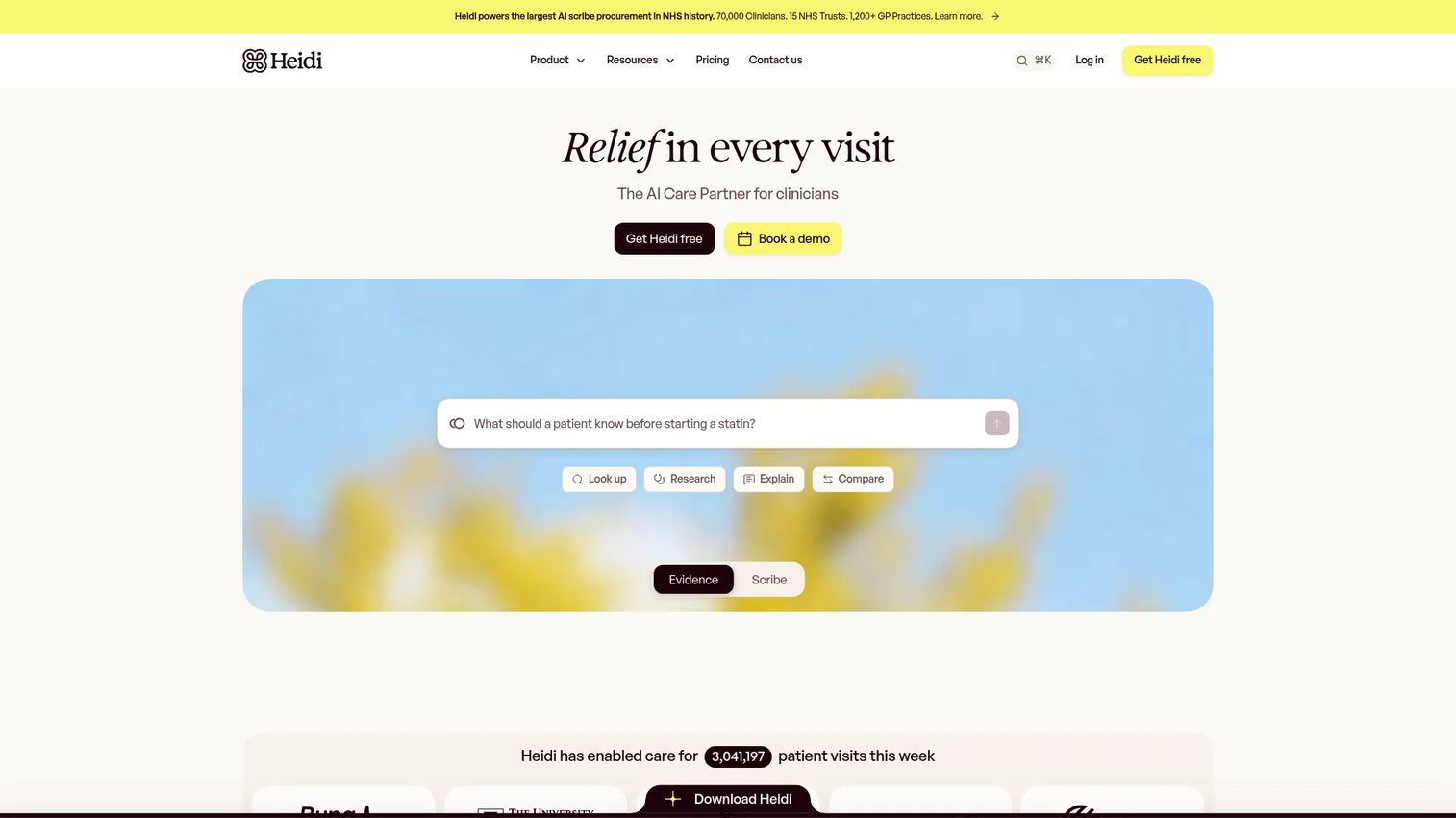
Heidi is an AI medical scribe that transcribes consultations, generates clinical notes, and supports related documentation tasks including referral letter drafting. The free plan is genuinely unlimited for individual clinicians, making it one of the most accessible entry points in the category. Paid tiers add advanced templates, live clinical evidence suggestions, team functionality, and enterprise governance.
Best for: Individual clinicians and small teams that want flexible AI note generation with a meaningful free starting point.
Key features
- AI consultation transcription and clinical note generation
- Custom templates and AI-assisted document creation
- Clinical evidence answers with citations
- Referral letter drafting
- Team sharing and collaboration on paid tiers
Why choose Heidi: Heidi is the fastest way to test AI scribing without a financial commitment. The free plan covers unlimited AI documentation, which means you can run a real-world pilot across your visit types before deciding whether to upgrade. Verify current privacy terms and EHR export options against your specific workflow before broader rollout.
Heidi pricing: The Free plan is available to all clinicians with no usage limits. The Clinician plan is $110/user/month billed annually and adds advanced templates and live evidence suggestions. Practice runs $180/user/month and adds team functionality. Enterprise pricing is custom and includes SSO, dedicated support, and custom hosting.
Heidi holds a 4.9/5 rating on G2.
10. Sonix
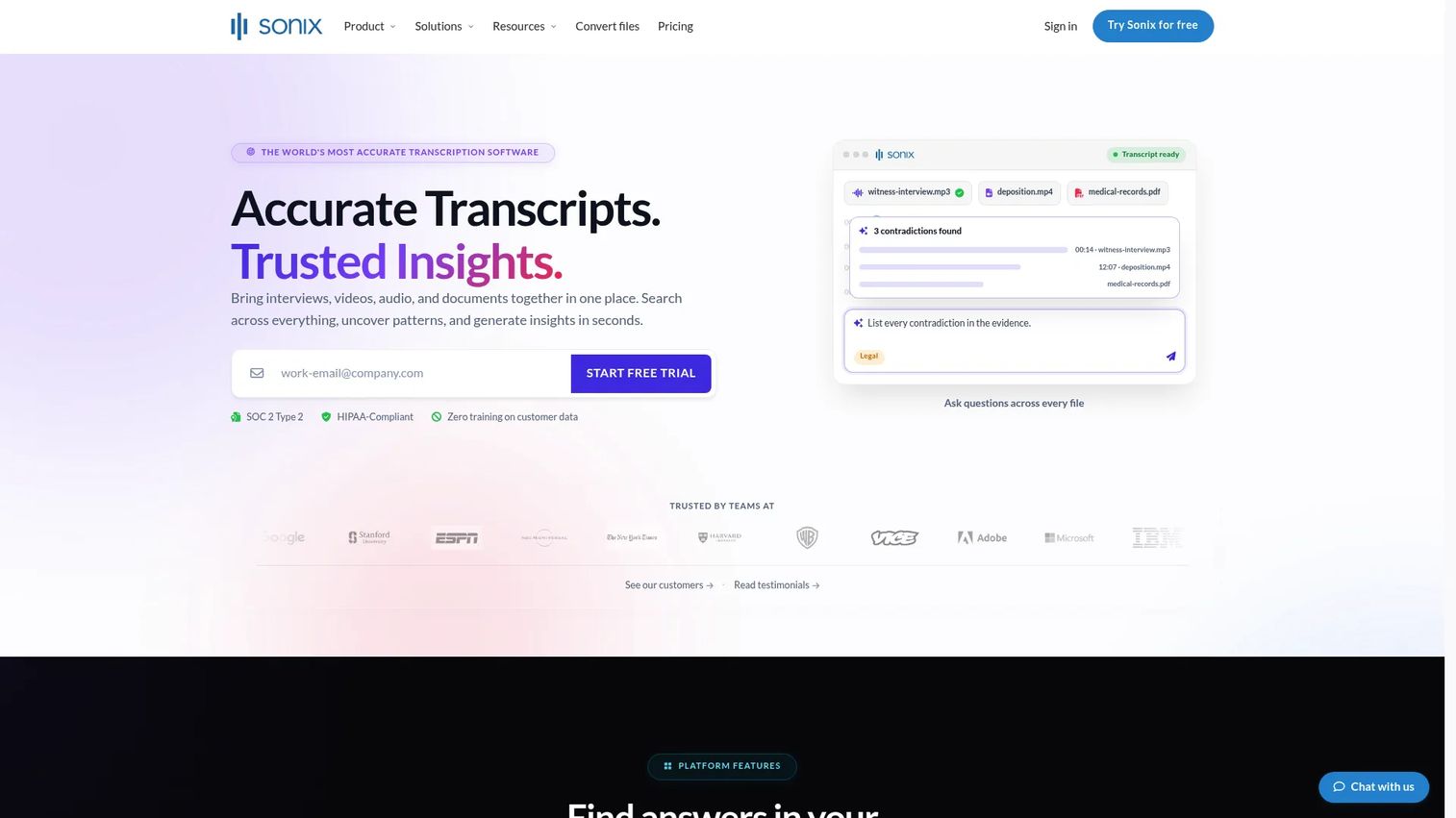
Sonix is a general-purpose AI transcription platform for audio and video. It handles speaker labeling, translation, subtitle generation, AI summaries, and multiple export formats. Sonix is not an EHR documentation tool, and it is not built for clinical note generation. It belongs on this list because clinical research teams, healthcare educators, and administrative functions often need audio and video transcription outside the EHR workflow.
Best for: Clinical research teams, healthcare educators, and administrative teams that need fast, searchable transcription for interviews, meetings, or educational content.
Key features
- Audio and video transcription with speaker labeling
- Translation and automated subtitle generation
- AI summaries, themes, and cited answers
- In-browser editing, collaboration, and export formats
- REST API, webhooks, and enterprise security
Why choose Sonix: Sonix fits non-clinical documentation workflows where the output is a searchable transcript or research artifact rather than a signed clinical note. Do not use it as a primary physician documentation system for protected health information without verifying the vendor's data handling commitments with your legal team.
Sonix pricing: Pay-as-you-go billing starts at $10/hour. Monthly subscription plans start at $25/month for Core, $50/month for Advanced, and $80/month for Pro. Annual plans are discounted: Core at $275/year, Advanced at $550/year, Pro at $880/year. New users receive a free transcription trial.
Sonix holds a 4.7/5 rating on G2.
11. VoiceboxMD
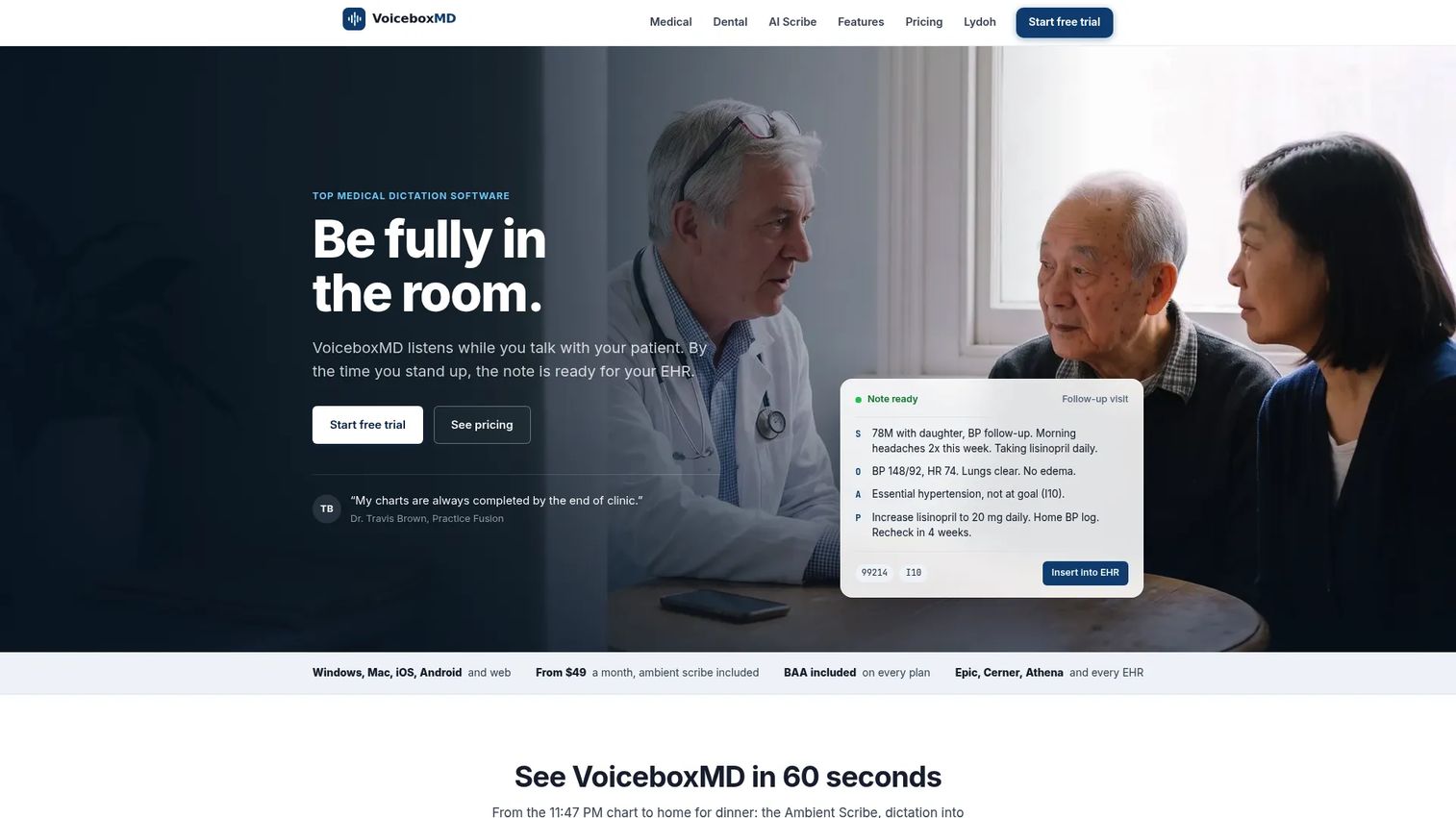
VoiceboxMD is medical dictation and AI scribe software with a vocabulary of 100,000+ medical terms. It handles real-time speech-to-text, generates structured SOAP notes from ambient visits, and supports EHR-agnostic dictation across Windows, macOS, and iOS. Higher-tier plans add CPT and ICD-10 code suggestions and a Chart Fill feature for populating structured EHR fields.
Best for: Physicians and healthcare practices that want healthcare-specific speech recognition for real-time dictation combined with an AI scribe layer.
Key features
- Real-time medical speech-to-text with 100,000+ medical terms
- AI Medical Scribe generating structured SOAP notes
- Custom templates, macros, and voice formatting commands
- EHR-agnostic dictation across Windows, macOS, and iOS
- CPT and ICD-10 code suggestions on higher-tier plans
Why choose VoiceboxMD: VoiceboxMD covers both real-time dictation and ambient AI scribing in one product, which reduces the number of tools in the clinical workflow. Verify integration depth with your specific EHR and supported platforms before rollout.
VoiceboxMD pricing: A 7-day free trial is available. The Essential plan is $49/month. Power runs $79/month and adds coding suggestions, letters, summaries, and audio upload. Premium is $99/month and adds Chart Fill and a guided setup with continuity learning. All plans are billed monthly.
VoiceboxMD holds a 4.5/5 rating on G2.
12. INVOX Medical
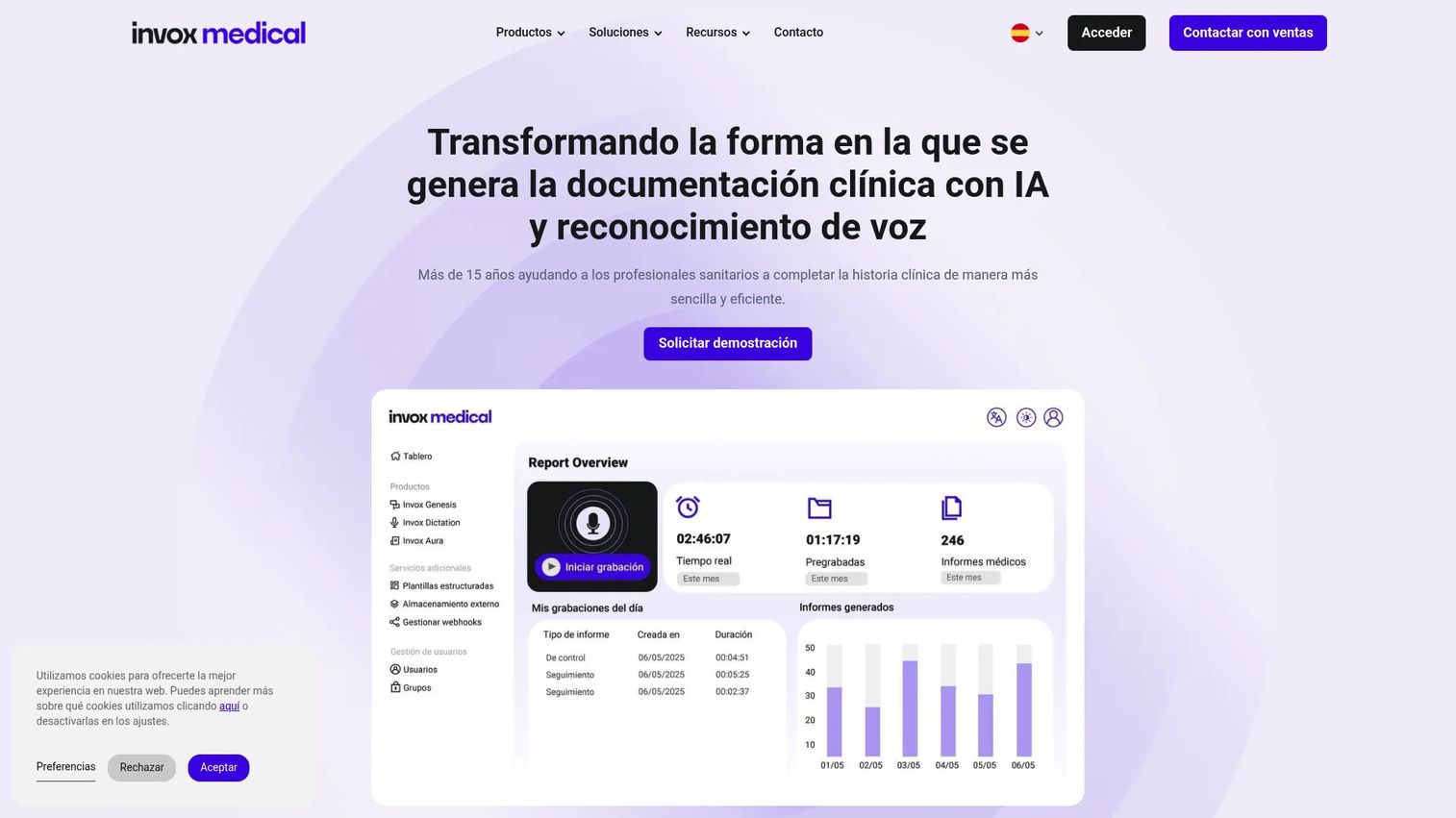
INVOX Medical is AI-powered medical documentation software for clinical note generation, real-time dictation, and transcription. It uses medical-specialty language models, supports integration with EHR, RIS, PACS, and LIS systems, and offers SDKs and APIs for product teams embedding dictation into their own applications. The multilingual focus and European pricing model make it relevant for international healthcare organizations.
Best for: Medical teams and healthcare organizations that need healthcare-specific dictation with EHR, RIS, or LIS workflow integration, particularly in multilingual or European contexts.
Key features
- Structured clinical notes from doctor-patient conversations
- Real-time dictation and transcription of medical reports
- Medical-specialty language models and custom dictionaries
- Integration with EHR, RIS, PACS, and LIS systems
- SDKs and APIs for product embedding
Why choose INVOX Medical: INVOX Medical is worth evaluating for teams that need dictation to feed into RIS, PACS, or LIS alongside EHR, which is common in radiology and laboratory workflows. Verify language support, local compliance requirements, and EHR integration depth for your specific environment.
INVOX Medical pricing: A free LITE plan is available with 10 minutes of daily dictation, three templates, and five custom dictionary words. The PRO plan runs €30/month with unlimited daily dictation and 10 templates. PREMIUM is €45/month and adds unlimited templates and offline access for seven days.
Considerations when choosing medical transcription software
Clinical accuracy matters more than word accuracy
Generic word error rate does not capture clinical risk. A tool that transcribes every word but misses "no chest pain" when the clinician said it creates a documentation error, not a transcription success. Test medications, dosages, negations, allergies, and time-sensitive qualifiers against your actual visit types before committing to any platform.
EHR workflow fit decides adoption
A tool that produces great notes but requires manual copy-paste into EHR fields will be abandoned within weeks. Evaluate whether the tool writes directly into structured fields, exports via an API, pushes through a third-party integration, or requires staff to move content manually. For founders and operators, the follow-on question is: Who owns that handoff step after the pilot ends?
Security review is part of the buying process
Before any procurement, verify BAA availability, data encryption standards, access controls, audit logging, retention settings, and model training policies. If the vendor trains on de-identified visit data and that is relevant to your organization's risk posture, that conversation happens in procurement, not after go-live. Do not frame this as HIPAA compliance status. Frame it as: What are the vendor's data handling commitments, and do they match your organization's requirements? Involve your legal and security teams early. See our guide on AI governance tools for a framework on evaluating data handling in AI products.
Pricing models are not directly comparable
Per-provider, per-seat, per-minute, per-visit, and enterprise contract pricing all land at very different monthly costs depending on visit volume and team size. Calculate effective monthly cost using expected visit load, review time, editing labor, and implementation support. A $39/month solo clinician plan and a quote-based enterprise contract are not alternatives to each other. They serve different organizational sizes.
Pilot before rolling out
Run a structured pilot with a defined cohort of clinicians across two or three specialties before committing to a full deployment. Score it on note acceptance rate, edits per note, time saved per visit, EHR handoff quality, clinician satisfaction, and patient consent workflow clarity. A clean vendor demo is not the same as a safe rollout. Your real signal comes from the first week after the pilot, when clinicians start editing notes on their own.
Conclusion
Documentation burden is a measurable cost, and the 13 hours per week physicians report spending on indirect patient care gives you a baseline to work against.
The right tool depends on workflow type before it depends on any feature. Freed and Heidi serve individual clinicians who want to start fast. Nuance Dragon Medical One and VoiceboxMD serve organizations that run physician dictation workflows. DeepScribe, Suki, and Heidi serve ambient documentation at different scales and EHR environments. Amazon Transcribe Medical and Deepgram serve product teams building documentation infrastructure. Epic serves health systems where documentation must stay inside the existing EHR. Philips SpeechLive serves teams that still rely on dictation and transcription routing. Sonix serves research and non-clinical healthcare content. INVOX Medical serves multilingual and European documentation workflows.
The practical next step: Shortlist two or three tools based on workflow type, not marketing claims. Run a pilot using real visit types and real clinicians. Score clinical accuracy, EHR handoff quality, review burden, security posture, and total monthly cost. The vendor demo tells you what is possible. The pilot tells you what is safe.
Start your journey with Guideflow today!
FAQs
The answer depends on workflow type. Freed suits solo clinicians and small practices that want fast AI-generated visit notes. Nuance Dragon Medical One is the enterprise standard for physician dictation. DeepScribe and Suki serve ambient documentation at provider-group scale. Amazon Transcribe Medical and Deepgram serve developers building speech infrastructure. There is no single best tool across all contexts.
Medical dictation software starts with a clinician speaking a composed note, and the software transcribes it in real time or near real time. Medical transcription software is the broader category and includes dictation, ambient AI scribing from recorded visits, batch audio processing, and API-driven speech-to-text. Dictation is one workflow type inside the transcription category, not a synonym for it.
AI scribes go beyond raw transcription. They turn a clinical conversation into a structured note, generating SOAP format, coding suggestions, or referral letters rather than producing a literal word-for-word transcript. Clinician review remains required after AI scribe output, particularly for medications, negations, diagnoses, and patient instructions. A transcript is a starting material; a scribe output is a draft clinical document.
Test with real visit scenarios, not vendor-supplied demos. Cover clinical terminology for your specialties, multiple accents on your provider team, background noise from your actual clinical settings, telehealth audio quality, multi-speaker visits with patients and family members, SOAP note structure against your documentation standards, EHR field handoff, and your vendor's security and BAA documentation. The first week after a pilot, when clinicians use it independently, reveals more than the evaluation period.
Vendors handling protected health information should support appropriate technical and contractual safeguards, including a Business Associate Agreement. A BAA is a legal agreement that defines each party's data handling responsibilities, not a certification that makes the buyer compliant. Your full workflow, how data moves from the tool into your EHR, who can access it, and how long it is retained, is part of your organization's overall compliance posture. Review vendor commitments with your legal and compliance teams. This article is not legal or regulatory advice.
Epic-native teams should evaluate Epic's own documentation capabilities and certified partner integrations first. Organizations using athenahealth or Oracle Health will find Suki's direct integrations relevant. Nuance Dragon Medical One covers a broad range of EHR environments through dictation workflows. For ambient AI scribes, verify the specific EHR integration depth from each vendor before a pilot, as supported field mapping varies significantly across platforms.
Heidi offers a genuinely unlimited free plan for individual clinicians covering AI documentation and clinical evidence. INVOX Medical offers a free LITE tier with 10 minutes of daily dictation. Amazon Transcribe Medical and Deepgram both offer free starting credits for developers. Most free tiers have meaningful limitations around usage volume, EHR integration depth, or security controls. For clinical use with protected health information, verify the vendor's data handling and BAA availability regardless of price tier.
Many tools support telehealth, but performance varies based on audio quality, connection stability, consent workflow, and speaker separation across virtual platforms. Ambient AI scribes generally handle telehealth by capturing audio from the call, but the accuracy depends on how clearly each speaker is captured. Test the exact telehealth platform you use and the visit type before rolling out to your full provider team.