A patient walks in with a sprained ankle. Before the provider ever sees them, your software has to check in the patient, verify insurance eligibility, capture intake, queue a chart, and set up a clean claim on the back end. If any one of those steps stalls, the whole visit slows down, and slow throughput is the one thing an urgent care clinic cannot afford.
That is the real test for urgent care software. It is not whether a system has an EMR. It is whether the front desk, the exam room, and the billing office run as one connected workflow instead of five disconnected tools passing patients between them.
The stakes are growing. The U.S. urgent care center software market was valued at USD 51.7 million in 2022 and is projected to grow at a 13.8% CAGR through 2030, according to SkyQuest (2023). More clinics, more visit volume, and tighter margins mean the software choice compounds over thousands of visits a year.
Most clinics do not fail because they picked a bad EMR. They struggle because they picked a system where documentation is fast but billing leaks, or where scheduling is clean but eligibility checks live in a separate portal. Fragmentation is the tax. The best urgent care software platform removes it.
What's inside
This guide compares seven urgent care software platforms built for walk-in and same-day care. Each one covers some mix of urgent care EMR, urgent care EHR, practice management, scheduling, patient engagement, eligibility verification, and revenue cycle management. We selected platforms on four criteria: workflow breadth across the full visit, urgent care fit rather than generic ambulatory support, automation that cuts manual steps, and billing plus claims depth. Where pricing and G2 ratings are public and verified, we include them. Where a vendor keeps pricing behind a sales conversation, we say so and describe what the tier structure covers instead.
TL;DR
- Best overall for end-to-end urgent care workflow: Experity, built specifically for the walk-in visit from pre-registration to claim.
- Best for ambient AI and closed-loop patient experience: NextGen, with strong documentation acceleration and interoperability.
- Best for cloud-based practice management and documentation: AdvancedMD, with transparent specialty-based pricing.
- Best for billing and self-check-in workflows: PrognoCIS, strong on front-desk acceleration and eligibility.
- Best for integrated patient experience and revenue operations: CareCloud, pairing EHR/PM with RCM services.
- Best for urgent care and occupational health teams: eClinicalWorks, with published tiered pricing and RCM as a service.
- Best for lightweight, urgent care-specific cloud workflow: UrgentCare-Cloud, a purpose-built urgent care EHR with integrated billing.
What is urgent care software?
Urgent care software is a unified platform that runs the clinical, administrative, and financial workflows of a walk-in or same-day care clinic, from patient check-in through documentation, coding, and claims.
Unlike a generic EHR built for scheduled primary care, urgent care software is tuned for unpredictable, high-volume, walk-in visits where speed and throughput decide profitability. A strong urgent care software platform brings the following together in one system:
- EMR and EHR documentation: fast, template-driven charting built for common urgent care presentations, so providers spend less time typing and more time seeing patients.
- Practice management: registration, patient records, provider scheduling, and reporting that keep the front office and back office on the same data.
- Scheduling and patient access: online booking, walk-in queue management, digital intake forms, and self-check-in that reduce manual registration.
- Billing and revenue cycle: urgent care billing software, coding support, claim scrubbing, and revenue cycle management that protect collections.
- Patient engagement: appointment reminders, patient messaging, portals, and post-visit follow-up that support urgent care patient engagement.
- Interoperability and eligibility: real-time urgent care eligibility verification, e-prescribing, lab connectivity, and data exchange with outside systems.
The point is not to assemble these as separate tools. It is to run them as one connected system where a check-in flows into a chart, a chart flows into a clean claim, and every step shares the same patient record.
When to use urgent care software
Different clinics feel the pain in different places. Here is how to match the decision to where your operation actually hurts.
Streamline front desk and intake
If your waiting room backs up during peak hours and staff spend visits re-keying patient data, the bottleneck is intake. Look for urgent care scheduling software with online booking, digital forms, automated reminders, and self-check-in. The goal is to move registration off the front desk and onto the patient's phone before they arrive, so the queue moves and staff handle exceptions instead of every keystroke.
Speed up charting and clinician workflows
When providers are staying late to finish notes, documentation is the constraint. The fix is charting efficiency: urgent care-specific templates, favorites, and AI-assisted or ambient documentation that turns the visit conversation into a structured note. Faster charts mean more patients per provider per shift and less burnout, which matters when staffing is tight.
Improve collections and claim accuracy
If clean claim rates are slipping or denials are climbing, the problem lives in the revenue cycle. Prioritize urgent care billing software with real-time eligibility verification, coding support, claim scrubbing, and denial management. Catching a coverage problem at check-in is far cheaper than chasing a denied claim three weeks later. Urgent care revenue cycle management is where margin is won or lost.
Comparison table
The table below sorts by relevance to the full urgent care workflow, from purpose-built walk-in suites to broader ambulatory platforms adapted for urgent care. Pricing and G2 ratings reflect the most recent verified vendor and G2 sources; confirm current figures directly before you buy, since vendors update tiers frequently.
| # | Product | Intent | Key use case | Pricing | G2 rating |
|---|---|---|---|---|---|
| 1 | Experity | End-to-end urgent care suite | Full walk-in visit from pre-reg to claim | Custom; select packages noted from $999/mo per clinic | 2.4/5 |
| 2 | NextGen | Broad EHR/EMR/PM with ambient AI | Documentation acceleration and interoperability | Custom / contact sales | 3.7/5 |
| 3 | AdvancedMD | Cloud EHR/PM with transparent pricing | Practice management and documentation | From $130/mo per provider (specialty-based) | 3.6/5 |
| 4 | PrognoCIS | Customizable EHR with billing | Self-check-in, eligibility, and billing | Custom / quote-based | 4.1/5 |
| 5 | CareCloud | Integrated EHR/PM/RCM | Patient experience and revenue operations | Custom / contact sales | 3.6/5 |
| 6 | eClinicalWorks | Ambulatory EHR/PM/RCM | Urgent care and occupational health | From $449/mo per provider | Not listed on G2 |
| 7 | UrgentCare-Cloud | Urgent care-native cloud EHR | Focused urgent care workflow and billing | Custom / contact sales | Not listed on G2 |
1. Experity
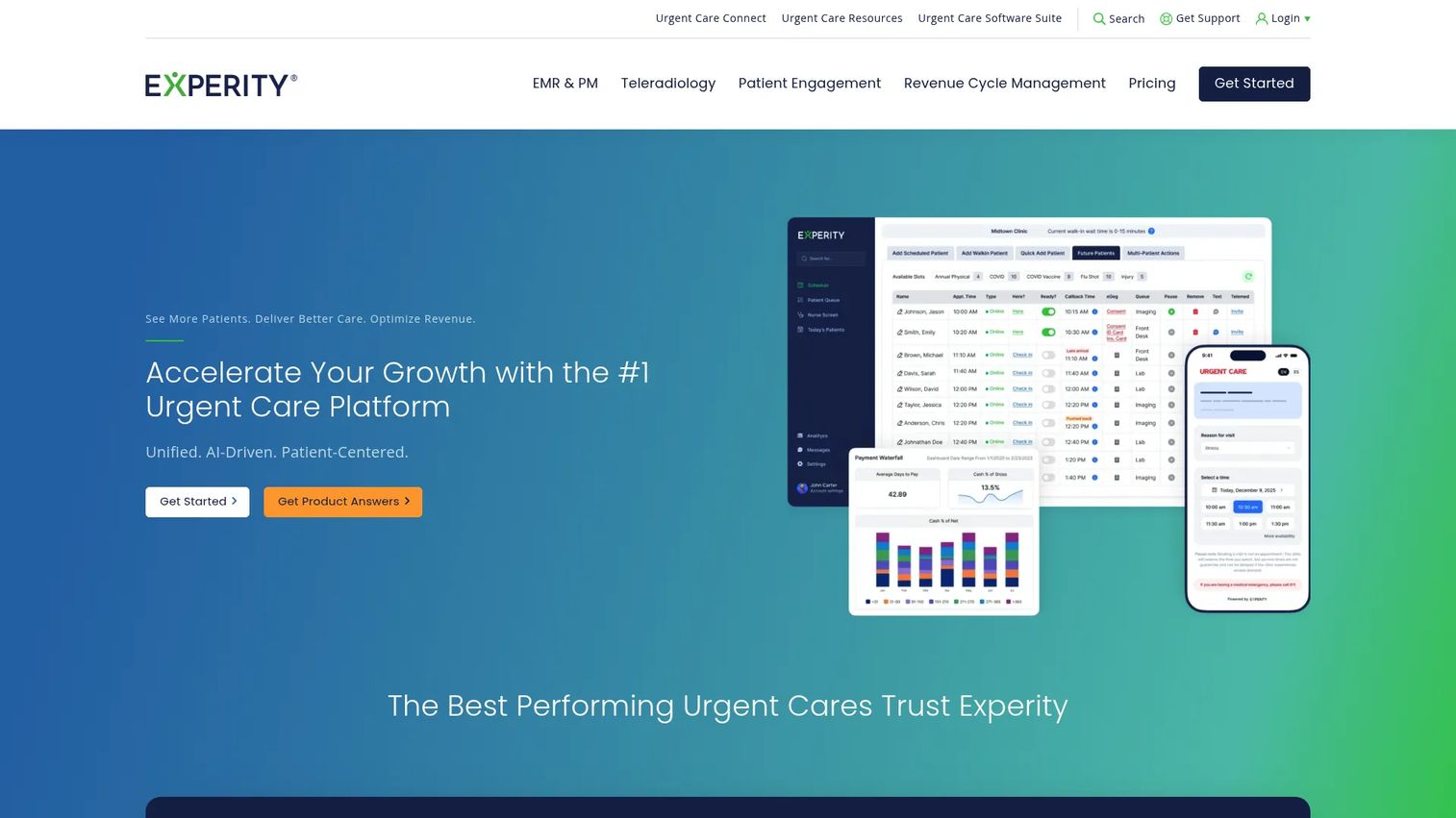
Experity is built for one job: running the urgent care visit end to end. Where most platforms adapt a general ambulatory EHR to walk-in care, Experity designs around the walk-in patient journey, from pre-registration and check-in through charting, patient engagement, payments, and the claim. It combines an urgent care EMR and practice management core with AI-enabled workflow tools aimed at the specific rhythm of same-day care.
Best for: Urgent care clinics that want a single integrated EMR/PM platform purpose-built for walk-in throughput.
Key strengths
- Urgent care EMR/PM core: Charting and billing designed for the walk-in visit, so documentation and coding move at the pace of a busy front line.
- Patient engagement and scheduling: Registration, reminders, and access tools that reduce front-desk load and keep the queue moving.
- Payments and revenue cycle: Integrated payment capture and revenue cycle tools that protect collections across high visit volume.
Why choose Experity: If urgent care is your entire business rather than one service line, a platform designed around that visit removes the friction of bending a general EHR to fit. The AI-enabled workflow layer and the tight coupling of clinical and billing steps are the differentiators for high-volume operators.
Experity pricing: Experity does not publish standard public pricing on its main site, and several pages route to discovery calls or contact forms. One product page notes select packages starting at $999/month per clinic, and a separate page states a Care Agent foundation package is free for existing Experity EMR clients. Confirm current numbers directly with Experity, since packaging varies by clinic size and modules. Experity's EMR & PM product holds a 2.4/5 rating on G2.
2. NextGen
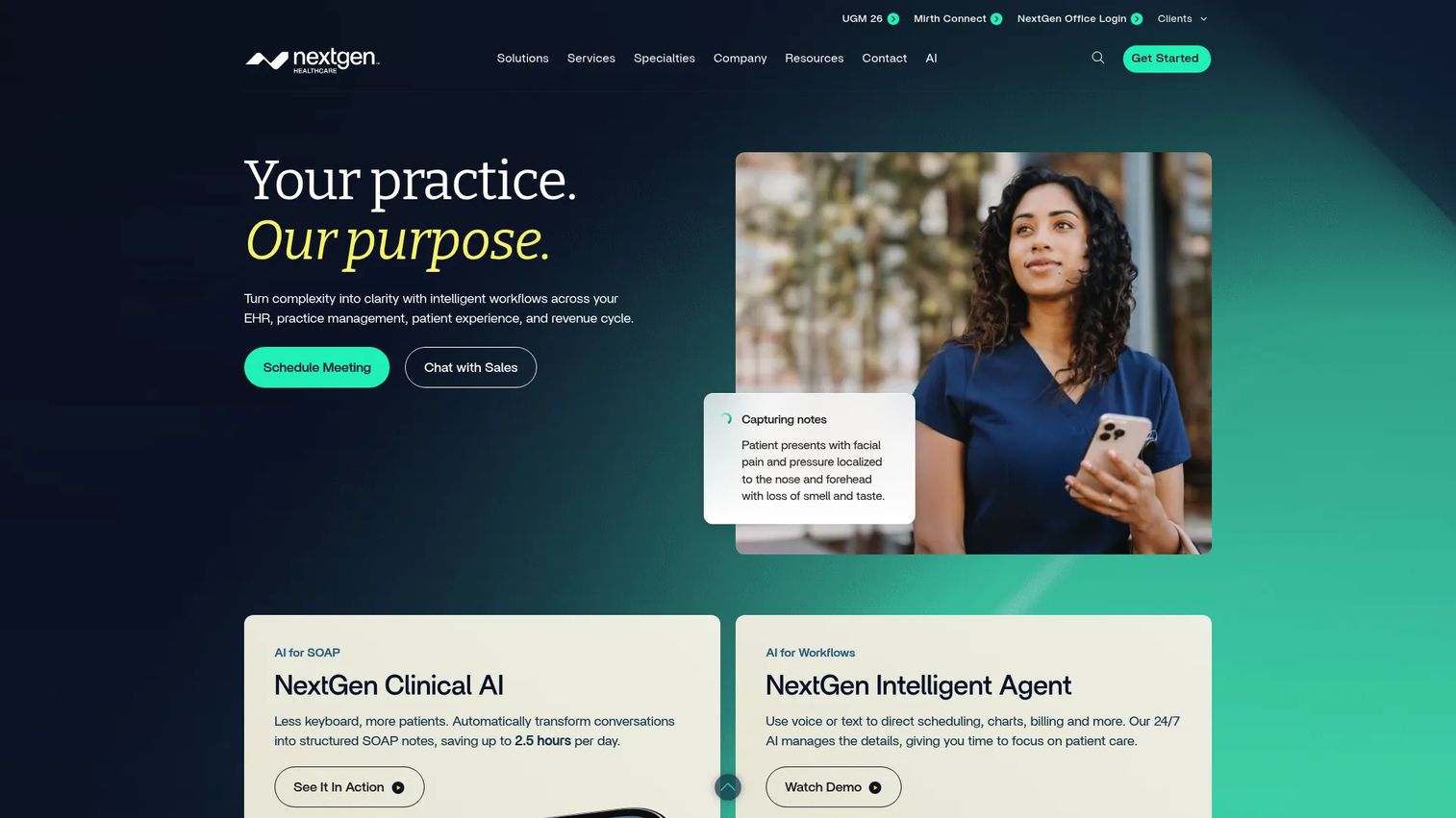
NextGen is a broad healthcare software platform spanning EHR, EMR, and practice management, with a strong push toward AI-driven workflow acceleration. For urgent care teams, the appeal is documentation speed through ambient listening plus a mature interoperability layer that connects the clinic to outside records, labs, and referral partners. It suits clinics that want an established, wide-coverage platform rather than a narrow point tool.
Best for: Multi-service or specialty practices, including urgent care lines, that want a broad EHR/EMR/PM platform with heavy automation.
Key strengths
- Cloud-based EHR and practice management: A unified clinical and administrative core that keeps documentation and operations on shared data.
- Patient portal and appointment management: Patient-facing tools for booking, messaging, and access that support urgent care patient engagement.
- AI documentation and ambient listening: Ambient capture that drafts the note from the visit conversation, cutting charting time for providers.
Why choose NextGen: The ambient documentation and closed-loop patient experience are the standout. If your providers are drowning in after-hours charting and you want a platform with deep interoperability and revenue cycle automation, NextGen's breadth fits. It rewards clinics ready to adopt a wide platform rather than assemble point tools.
NextGen pricing: NextGen does not publish public pricing on its website; pricing is handled through a sales conversation and scoped to practice size and modules. Request a quote for your specific configuration. NextGen's healthcare EHR holds a 3.7/5 rating on G2.
3. AdvancedMD
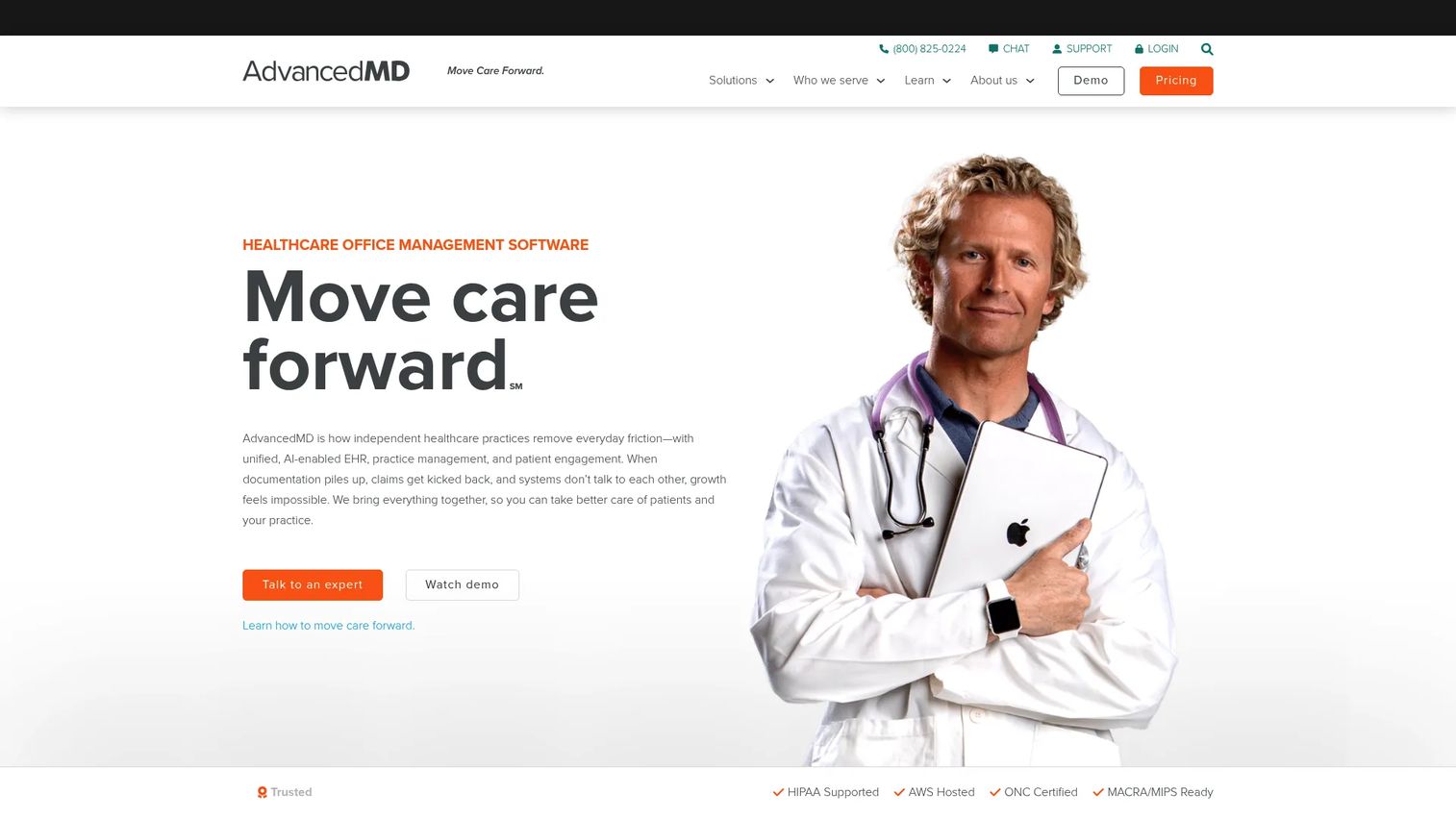
AdvancedMD is a cloud-based EHR, practice management, patient engagement, and revenue cycle platform for independent practices. Its draw for urgent care operators is the combination of an all-in-one clinical and billing workflow with unusually transparent, specialty-based pricing. Scheduling, insurance verification, claim scrubbing, and an AI-enabled clinical assistant sit in one system, with reporting and analytics on top.
Best for: Independent clinics that want an all-in-one cloud platform for documentation, billing, and engagement with clear published pricing.
Key strengths
- Unified EHR, PM, and engagement: One platform covering clinical documentation, practice management, and patient messaging on shared data.
- Scheduling, verification, and claim scrubbing: Built-in eligibility checks and claim scrubbing that catch coverage and coding issues before submission.
- AI clinical assistant and analytics: Documentation support plus reporting that gives operators visibility into throughput and collections.
Why choose AdvancedMD: For buyers who want to compare real numbers rather than sit through pricing calls, AdvancedMD's published specialty pricing is a practical advantage. The integrated eligibility and claim scrubbing directly serve urgent care revenue cycle management goals.
AdvancedMD pricing: AdvancedMD publishes specialty-based pricing starting at $130/month per provider for Mental Health, with Medical Specialties ranging $429 to $1,070 per provider per month, Physical Medicine at $399/month per provider, and MedSpa at $278/month per provider. RCM services run 4 to 8% of collections, and encounter-based pricing is also available. A 30-day free trial exists for AdvancedMD Now, though there is no permanent free tier. AdvancedMD holds a 3.6/5 rating on G2.
4. PrognoCIS
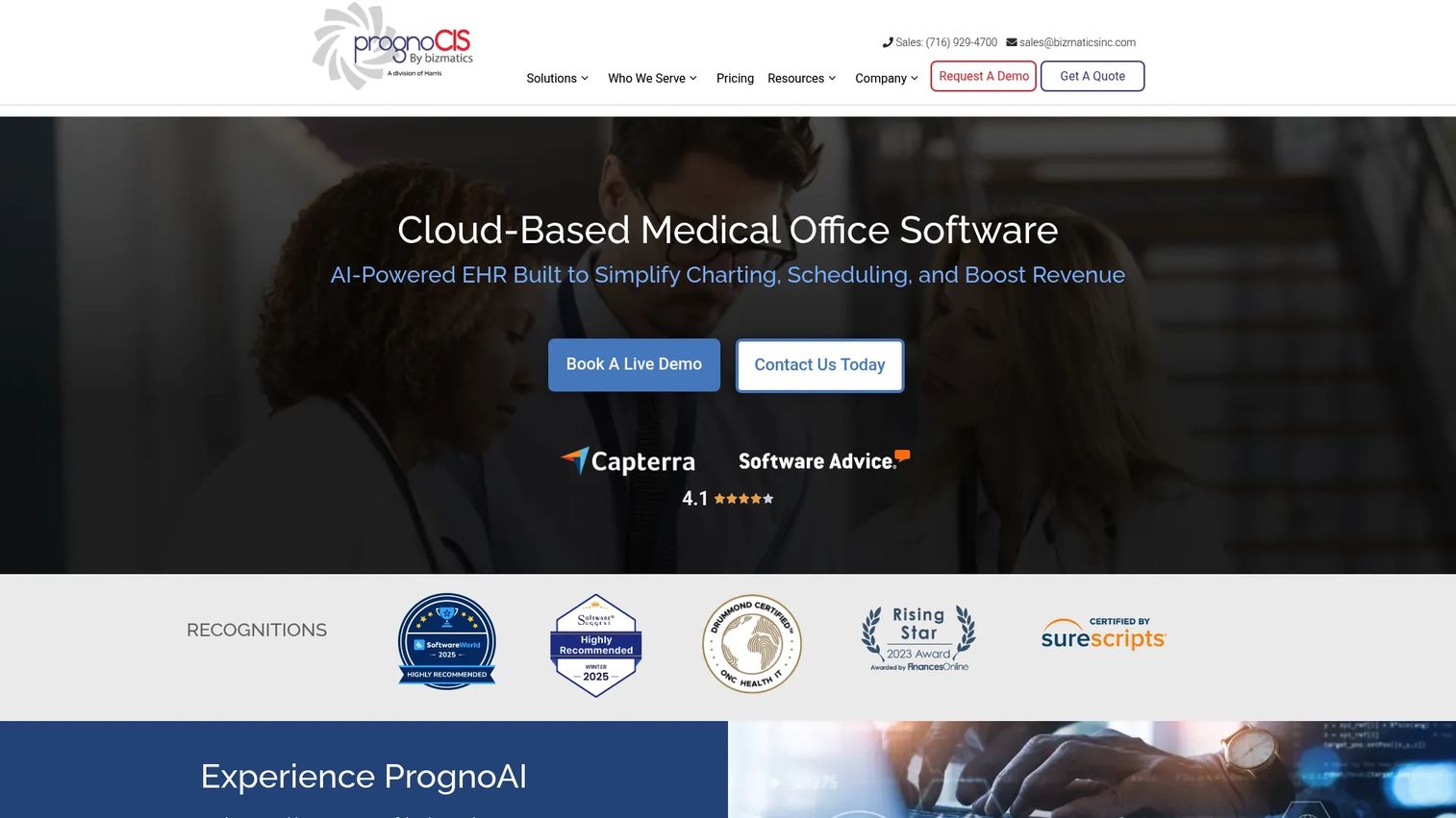
PrognoCIS is a cloud-based, AI-powered EHR and practice management platform with a strong front-desk and billing orientation. For urgent care, that means appointment booking, self-check-in, real-time eligibility, e-prescribing, and integrated billing that speed the moments where clinics lose time and money. It leans customizable, so clinics can shape workflows around their intake and Occ Med needs.
Best for: Clinics that prioritize front-desk acceleration, self-check-in, and tight billing integration, including urgent care plus occupational medicine.
Key strengths
- Electronic health records and charting: Configurable documentation that adapts to urgent care and occupational medicine visit types.
- Practice management and billing: Integrated billing with eligibility checks that keep claims clean from the point of check-in.
- Patient portal and engagement: Self-check-in, booking, and messaging that move registration off the front desk.
Why choose PrognoCIS: If your operation feels the pinch most at the front desk and in billing, PrognoCIS is tuned for those exact steps. Self-check-in and eligibility verification cut waiting-room friction, while integrated billing protects collections. Its customization suits clinics running both urgent care and Occ Med under one roof.
PrognoCIS pricing: PrognoCIS uses custom, quote-based pricing that varies by clinic size and feature set, with structures that can be per provider or per encounter, per its official FAQ. Request a scoped quote. PrognoCIS holds a 4.1/5 rating on G2, the highest verified rating in this comparison.
5. CareCloud
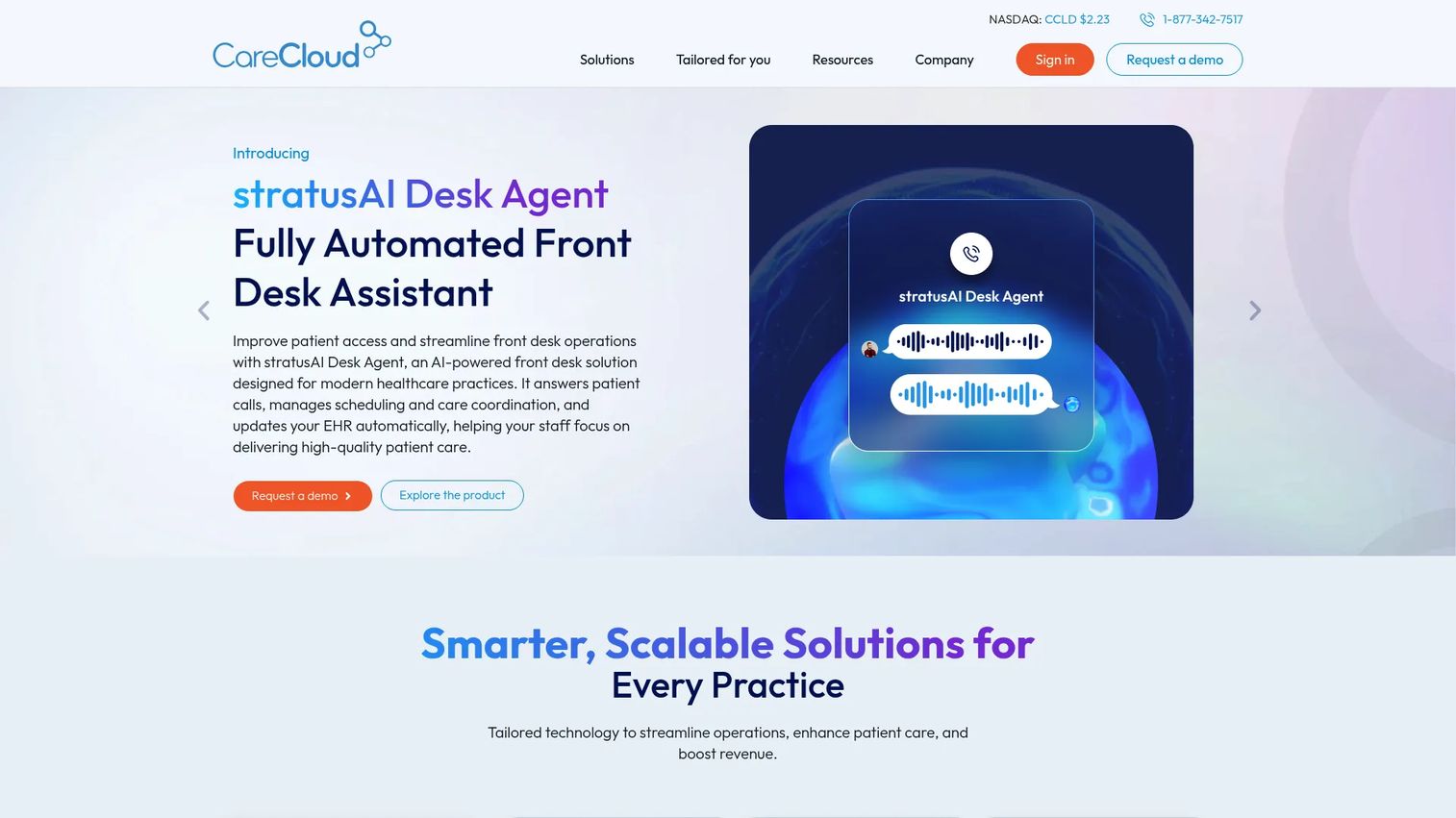
CareCloud is a cloud-based, AI-powered healthcare software and services platform combining EHR, practice management, and revenue cycle management. Its strength for urgent care is the pairing of an integrated patient experience with deep revenue operations, including eligibility verification, billing rules, and RCM services delivered as a managed layer. Clinics that want technology plus billing expertise in one relationship tend to gravitate here.
Best for: Practices seeking an integrated EHR, PM, and RCM platform with hands-on revenue cycle support.
Key strengths
- Electronic health records: A clinical core that keeps documentation connected to scheduling and billing.
- Practice management: Registration, scheduling, and reporting that unify front and back office operations.
- Revenue cycle management: Eligibility, billing rules, and managed RCM services aimed at maximizing collections.
Why choose CareCloud: CareCloud leans toward full-practice management and revenue cycle operations, so it fits clinics that want to hand off billing complexity rather than staff it internally. If your priority is an integrated patient experience backed by revenue optimization and RCM expertise, CareCloud is built around that combination.
CareCloud pricing: CareCloud uses customized pricing scoped to practice size, specialty, and feature needs, per its FAQ; no public starting price is listed on the brand site. Request a tailored quote. CareCloud holds a 3.6/5 rating on G2.
6. eClinicalWorks
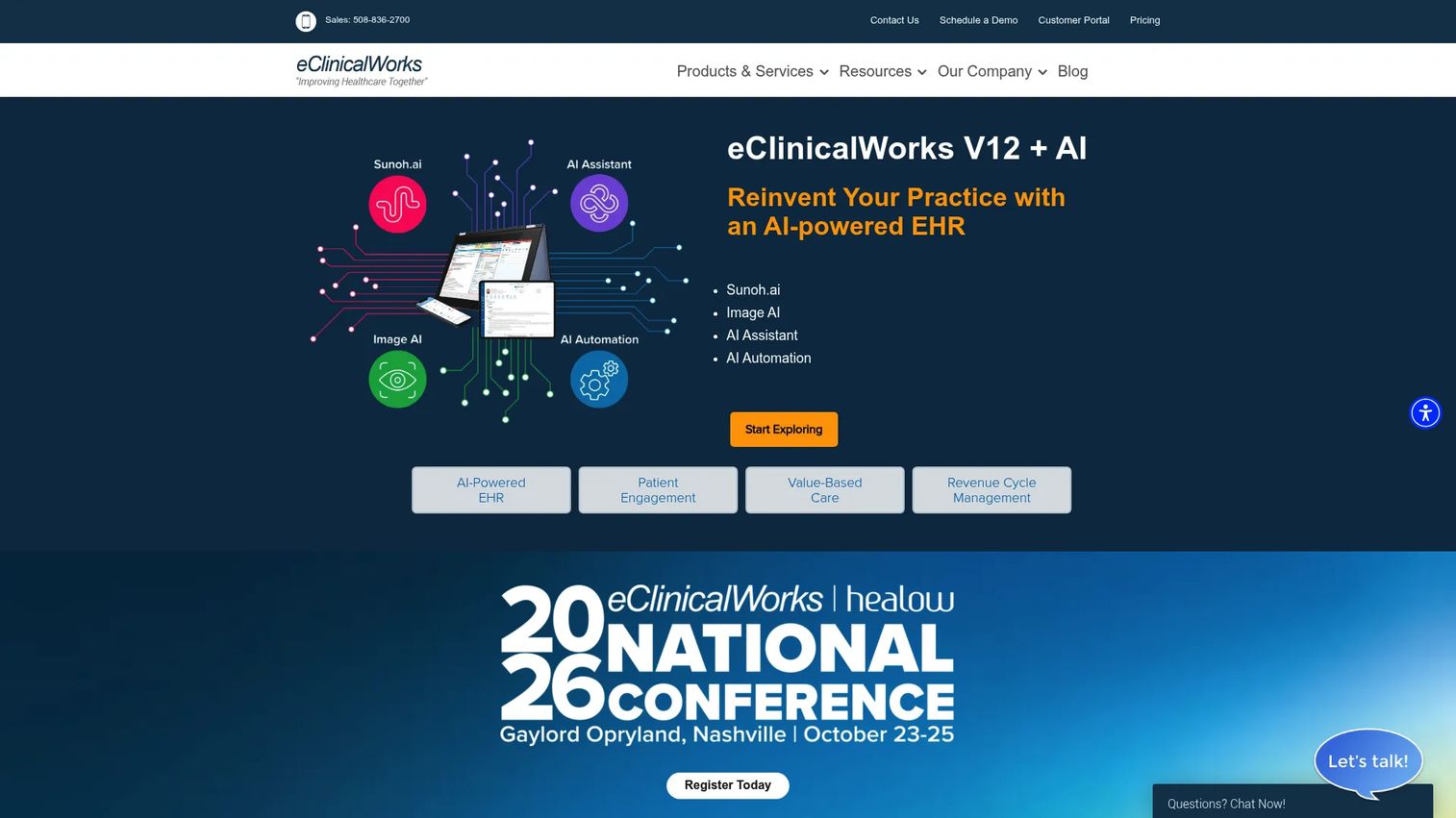
eClinicalWorks is a cloud-based EHR and practice management platform for ambulatory care, with strong coverage across urgent care and occupational health. It brings an AI-powered EHR, patient engagement tools, real-time eligibility, and AI-assisted claim and payment processing into one system, plus published tiered pricing that makes budgeting straightforward. Its breadth across intake, billing, and care coordination suits larger or more process-heavy clinics.
Best for: Larger or process-heavy clinics running urgent care and occupational health that want breadth across intake, billing, and coordination.
Key strengths
- AI-powered EHR: Documentation and clinical workflows with AI assistance that speed charting across high visit volume.
- Patient engagement tools: Portals, reminders, and messaging that support urgent care patient engagement and follow-up.
- Revenue cycle management: Real-time eligibility and AI-assisted claim and payment processing, with RCM available as a service.
Why choose eClinicalWorks: For clinics that need depth across many workflows and multiple service lines, eClinicalWorks offers broad coverage plus the option to outsource the revenue cycle. The published pricing removes guesswork for buyers who want a number before a sales call.
eClinicalWorks pricing: eClinicalWorks publishes three plans: EHR Only at $449/month per provider, EHR with Practice Management at $599/month per provider, and RCM as a Service at 2.9% of practice collections. No start-up costs are shown for these plans, and there is no free tier. A verified G2 rating was not available; buyers can cross-reference reviewer feedback on third-party sites during evaluation.
7. UrgentCare-Cloud
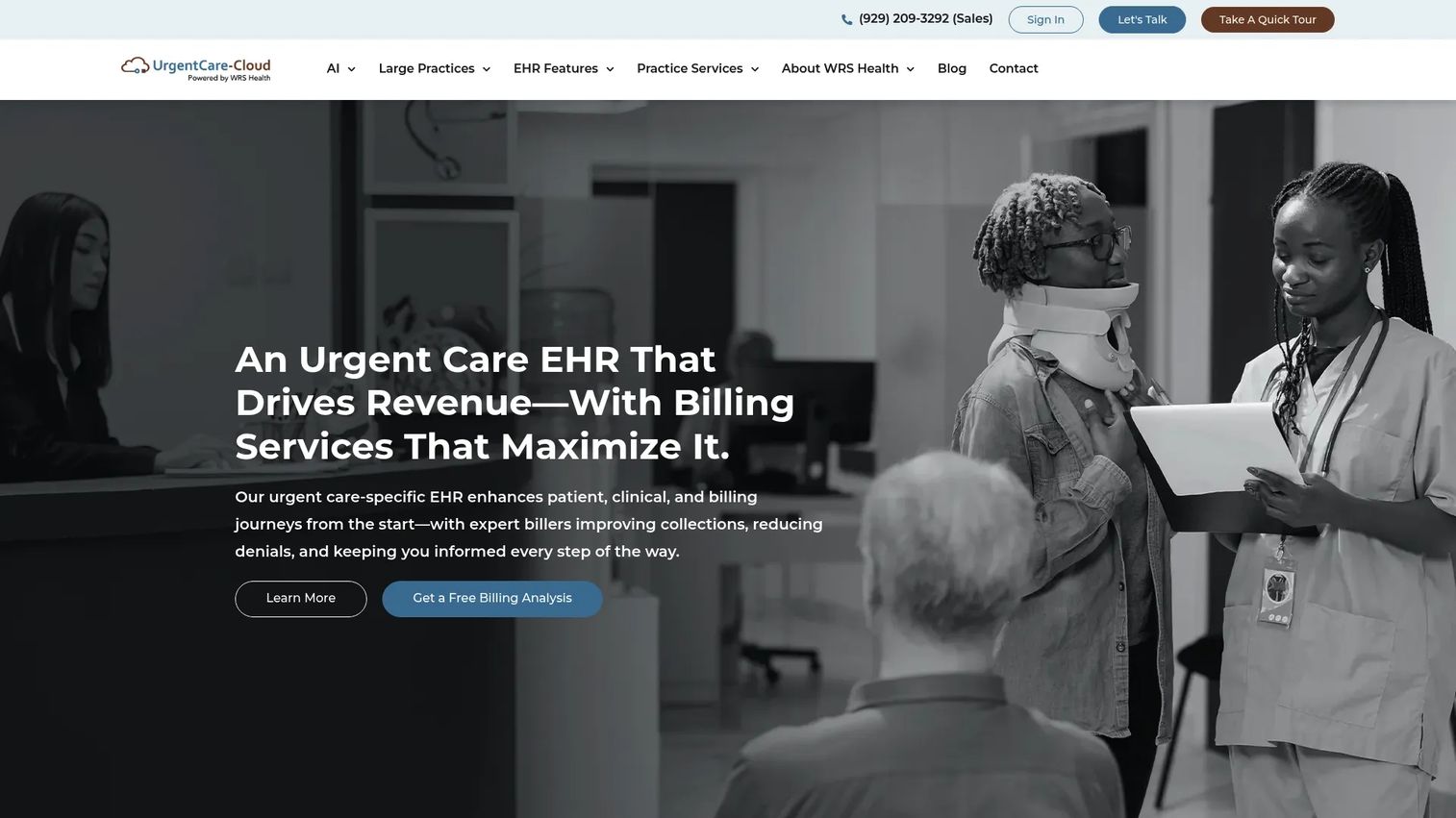
UrgentCare-Cloud is a purpose-built urgent care EHR and services platform focused on documentation, billing, scheduling, and patient workflows for walk-in clinics. It offers urgent care-specific workflows, AI-assisted documentation, integrated billing and RCM, a patient portal, and interoperability for data exchange. The pitch is a specialized, urgent care-native cloud system rather than a general platform adapted to walk-in care.
Best for: Urgent care teams that want a focused, urgent care-native platform combining EHR with billing and operations support.
Key strengths
- Urgent care EHR workflows: Templates and quick charting built around common urgent care presentations for fast documentation.
- Integrated billing and RCM: Billing and revenue cycle support connected to the clinical record to protect collections.
- Patient portal, scheduling, and interoperability: Appointments, patient access, and data exchange in one urgent care-specific system.
Why choose UrgentCare-Cloud: If you want software designed for urgent care from the ground up rather than a broad ambulatory suite, UrgentCare-Cloud's specialization is the draw. AI-assisted documentation, integrated billing, and interoperability serve the core workflow, and the narrow focus can mean fewer irrelevant features to work around.
UrgentCare-Cloud pricing: UrgentCare-Cloud does not publish a public software subscription price on its site; the only public figure found is a billing-services claim starting as low as 2.9%, which appears to be service pricing rather than software pricing. Request a scoped quote for your clinic. A verified G2 rating was not available at review time.
Considerations before you buy
The demo will look clean for every vendor on this list. The differences show up in the workflow details that decide your daily throughput and monthly collections. Here is what to pressure-test before you sign.
Match the platform to your visit type
A walk-in urgent care clinic and a scheduled specialty practice have different rhythms. Purpose-built urgent care software optimizes for unpredictable, high-volume, queue-driven visits. A general ambulatory EHR can work, but confirm it handles walk-in registration, provider assignment, and rapid documentation without extra clicks.
Test eligibility and billing end to end
Ask the vendor to run a live check-in through to a submitted claim. Watch where eligibility verification happens, how coding is supported, and how claim scrubbing catches errors. Urgent care revenue cycle management is where margin leaks, so this workflow deserves the hardest look.
Measure charting speed with your own visit types
Templates that look fast in a demo can slow down on your actual presentations. Have a real provider chart a typical urgent care visit end to end and count the clicks. Charting efficiency compounds across every visit, every shift.
Confirm interoperability and integrations
Your software has to exchange data with labs, pharmacies, referral partners, and any existing systems. Verify e-prescribing, lab connectivity, and record exchange work with your specific partners, not just in theory.
Weigh pricing against total workflow value
Published pricing makes budgeting easier, but the real question is cost per resolved visit. A slightly pricier platform that cuts denials and speeds throughput often pays for itself against a cheaper tool that leaks collections.
Conclusion
The right urgent care software depends less on feature checklists and more on where your operation strains. If urgent care is your entire business and you want one system built around the walk-in visit, Experity is the natural first look. If after-hours charting is the pain and you want ambient AI plus deep interoperability, NextGen fits. AdvancedMD and eClinicalWorks reward buyers who want transparent, published pricing and broad coverage, with eClinicalWorks adding strong occupational health support.
For front-desk and billing acceleration, PrognoCIS earns its place, carrying the highest verified rating here. CareCloud suits clinics that want to hand off revenue cycle work to a managed service. And UrgentCare-Cloud is the focused, urgent care-native option for teams that prefer specialization over breadth.
Shortlist the two or three that match your front-desk load, documentation burden, and billing complexity, then run a real check-in-to-claim workflow through each before you narrow further. The platform that removes friction across the whole visit, not just one step, is the one worth your commitment.
FAQs
A small clinic needs the full workflow in one system: an urgent care EMR for fast charting, scheduling and self-check-in to manage walk-ins, real-time eligibility verification, and integrated billing. The priority is consolidation, since a small team cannot afford to stitch together separate tools. Look for published or straightforward pricing so budget does not scale ahead of visit volume.
Standard EHR software is usually built for scheduled visits with predictable flow. Urgent care software is tuned for unscheduled, high-volume walk-in care where throughput decides profitability. That means walk-in queue management, rapid documentation templates for common presentations, and eligibility checks at check-in rather than days in advance. The workflow assumptions are different from the ground up.
Front desk teams benefit most from online booking, digital intake forms, self-check-in, automated reminders, and real-time eligibility verification. These move registration off the desk and onto the patient's phone, shorten the queue, and catch coverage problems before the visit. The goal is to have staff handle exceptions rather than re-key every patient's data manually.
Look for real-time eligibility verification, coding support, automated claim scrubbing, and denial management inside the same system as the chart. Urgent care billing software should catch errors before submission, not after a denial. Ask vendors to demonstrate a live check-in through to a submitted claim so you can see exactly where the revenue cycle is protected.
It is one of the highest-leverage features. Verifying coverage at check-in prevents claims from being denied weeks later, when chasing payment is far more expensive. Because urgent care patients often arrive without appointments, real-time urgent care eligibility verification is the difference between a clean claim and a write-off. Prioritize platforms that run it automatically at registration.
Most modern urgent care software platforms include online booking, digital intake, and self-check-in. These tools reduce front-desk workload and waiting-room congestion by letting patients register before or on arrival. Confirm the self-check-in flow works on mobile and integrates directly with your scheduling and eligibility steps, rather than functioning as a bolt-on that staff must reconcile.
Ask to run your own visit types end to end: a real check-in, a real chart, and a real claim. Count the clicks, watch where eligibility runs, and confirm interoperability with your labs, pharmacies, and referral partners. Push past the polished demo path and test the workflows where your clinic actually loses time and money today.
Some vendors publish pricing, such as AdvancedMD's specialty-based tiers or eClinicalWorks's per-provider plans, while others quote custom pricing scoped to practice size and modules. Compare on cost per resolved visit rather than headline price, and factor in whether revenue cycle management is included, add-on, or offered as a percentage-of-collections service. The cheapest platform that leaks collections is rarely the lowest total cost.