You are running a park with 120 sites, a camp store, a housekeeping crew, and a phone that rings every time someone wants to know if pull-through site 44 is open on the Fourth of July weekend. Your reservations live in one system, payments in another, guest texts in your personal phone, and your accountant is still waiting on a clean revenue report from last season. The busywork scales faster than the revenue.
That is the real problem campground management software solves. It is not a booking widget. It is the operating layer that turns a fragmented front desk into a repeatable system: online reservations, live availability, guest communication, point-of-sale, and reporting in one place, so the park runs without every decision routing through the owner.
The category is growing because the demand is real. The global campground management software market was valued at USD 120.75 million in 2024 and is projected to reach USD 265.40 million by 2032, a 10.2% CAGR, according to Future Market Report (2024). North America drives 38.5% of that revenue, and private campgrounds make up the largest customer segment at 45.3% of market share. Operators are moving off spreadsheets and inbox-based booking because occupancy pressure and seasonal revenue swings punish manual work.
This guide compares seven platforms for reservations, guest communication, operational automation, and reporting. Whether you run a single park or a multi-property portfolio, the goal here is the same one a SaaS founder would recognize: build an operation that scales predictably without founder heroics. If you want to see how modern software teams present those workflows to buyers, an interactive demo is a useful reference point, and Guideflow is worth a look for how self-serve product experiences get built.
What's inside
This guide covers campground reservation software and RV park software built for the daily reality of running a park: taking bookings, moving money, talking to guests, and keeping the back office clean. We looked at seven platforms and evaluated each on five criteria that actually change how a park runs.
Selection criteria:
- Booking workflow: online reservations, interactive site maps, and live availability
- Revenue tools: dynamic pricing, add-ons, upsells, and recurring billing
- Operations coverage: POS, work orders, housekeeping, and accounting
- Integrations and reporting: clean data, OTA channels, and financial visibility
- Scale fit: single-park simplicity versus multi-park reporting depth
TL;DR
- Best all-in-one for revenue and reporting: Campspot pairs dynamic pricing, grid optimization, and reporting with a marketplace channel, so occupancy and revenue tooling live together.
- Best free trial and low-friction start: Firefly Reservations starts free with no setup fees or contracts, and includes every feature on every plan.
- Best operations depth: CampLife bundles reservations, accounting, POS, dynamic pricing, and SMS texting for parks that want the back office covered.
- Best campground-focused booking for growing parks: RoverPass combines reservation management, dynamic pricing, and channel integrations at a low published entry point.
- Best for reservation-plus-marina versatility: Guest Tracker fits campgrounds, lodges, RV parks, and marinas with an online booking engine and payment processing.
- Multi-park operators should shortlist Campspot and Astra Campground Manager for combined reporting across properties.
What is campground management software?
Campground management software is a platform that centralizes reservations, guest communication, payments, and park operations for campgrounds, RV parks, and outdoor resorts into a single system. It replaces spreadsheets, paper ledgers, and disconnected booking tools with one operational layer that handles the full guest lifecycle from first booking to checkout.
The strongest camping reservation software platforms share a common set of core capabilities:
- Online reservations: self-serve booking that captures nights, sites, and payment without a phone call
- Site maps and booking flow: interactive maps and reservation grids that show live availability and let guests pick a specific site
- Guest messaging: automated confirmations, SMS texting, and email marketing across the guest lifecycle
- POS and add-ons: camp store point-of-sale, firewood, rentals, and upsell items tied to the reservation
- Dynamic pricing and revenue tools: rate rules, seasonal pricing, and length-of-stay controls that lift revenue per site
- Reporting and integrations: occupancy and revenue reporting, accounting sync, OTA channels, and gate or kiosk integrations
Read together, that feature set is why campground software is treated as an operations decision, not just a reservations decision. The booking engine is the front door. The value is in what happens behind it: fewer manual touches per reservation, cleaner financial data, and a guest experience that does not depend on who is working the desk.
When to use campground management software
Not every park needs every feature on day one. The trigger is usually a specific kind of pain. Here is how to pattern-match your situation.
Centralize reservations and availability
If you are still taking bookings by phone, email, or a shared spreadsheet, double-bookings and gaps in the grid are costing you real money. Campground booking software fixes this with online reservations, live availability, and site selection, so a guest sees exactly what is open and books it without a staff member in the loop. This is the first thing most operators fix, because it removes the single biggest source of front-desk chaos.
Grow revenue without adding manual work
Occupancy alone does not maximize revenue. Add-ons, upsells, recurring billing for long-term guests, and dynamic pricing do. When demand spikes on holiday weekends, rate rules let you capture that willingness to pay automatically instead of leaving money on the table. RV park software with revenue tooling turns seasonal swings into a pricing strategy rather than a scramble.
Reduce front-desk and back-office churn
The administrative load is where parks quietly lose margin. A guest portal handles self-service. SMS texting and email marketing automate the repetitive guest questions. POS ties store sales to the ledger. Work orders route maintenance without sticky notes, and accounting automation keeps the books current. When the same tasks repeat hundreds of times a season, automating them is where the payback shows up.
Comparison table
The table below sorts the seven platforms by relevance to campground management software. Pricing reflects publicly verifiable figures from each vendor at the time of writing; where a vendor gates pricing behind a quote, we note that rather than guess. Ratings are pulled from the most reliable public review source available for each product.
| # | Product | Intent | Key use case | Pricing | G2 rating |
|---|---|---|---|---|---|
| 1 | Campspot | All-in-one reservations and revenue | Parks wanting booking, dynamic pricing, and reporting together | $0 per reservation, 3% guest-paid booking fee | 4.6/5 |
| 2 | Firefly Reservations | Low-friction reservations and payments | Parks wanting a free, no-contract start | From $3.50 per unit booked | 5/5 |
| 3 | CampLife | Operations-depth all-in-one | Parks wanting reservations plus accounting and POS | From $99/mo or $3.00 per reservation | Rated 4.9/5 on Capterra |
| 4 | RoverPass | Campground-focused booking | Growing parks needing booking and channels | Integrations Plan from $29/mo | Not published |
| 5 | UltraCamp | Camp and retreat operations | Camps and retreats with sessions and health forms | Not published | Not published |
| 6 | Guest Tracker | Multi-property reservations | Campgrounds, lodges, RV parks, and marinas | Quote-based | 4.5/5 |
| 7 | Astra Campground Manager | Multi-park management | Private parks and resorts needing combined reporting | Quote-based | Not published |
1. Campspot
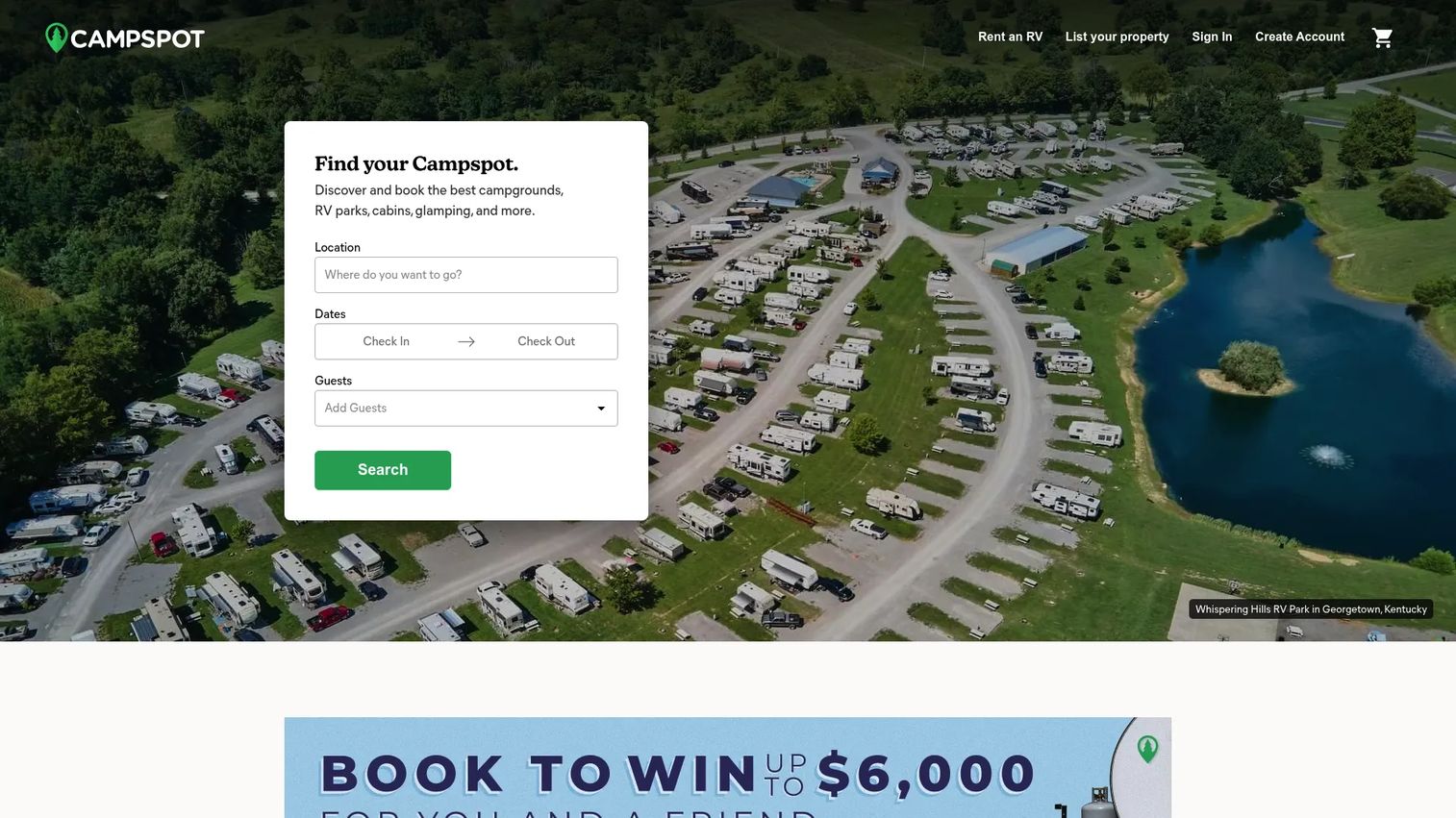
Campspot is a cloud-based campground management and reservation platform built for parks and campgrounds that want reservations, revenue optimization, and operations in one system. It bundles an interactive campground map, add-ons and POS management, dynamic pricing, grid optimization, and a marketplace OTA channel into a single Growth Package. The reporting and data layer is the reason many operators pick it: revenue and occupancy visibility that holds up when you actually need to make a pricing decision.
Best for: Campgrounds and RV parks that want an all-in-one reservation and operations platform with strong revenue tooling.
Key strengths
- Grid optimization and dynamic pricing: shifts bookings to maximize occupancy and lifts revenue per site automatically
- Marketplace OTA channel: exposes open sites to a booking marketplace to capture demand you would otherwise miss
- Reporting and integrations: data and reporting, marketing tools, and housekeeping management in one platform
Why choose Campspot: If your bottleneck is revenue rather than just booking, Campspot's combination of grid optimization, dynamic pricing, and its marketplace channel is hard to match. It reads like an operating system for occupancy, which is exactly what a multi-property operator focused on repeatable revenue wants.
Campspot pricing: Campspot's public pricing page lists a simple model: $0 per online and offline reservation, with a 3% online booking fee paid by the guest. The Growth Package includes data and reporting, integrations, dynamic pricing, grid optimization, marketing tools, add-ons, point-of-sale, a lock site fee option, marketplace OTA, and housekeeping management. The vendor site does not publish a separate subscription fee, so the verifiable public cost is the guest-paid booking fee. Campspot holds a 4.6/5 rating on G2.
2. Firefly Reservations
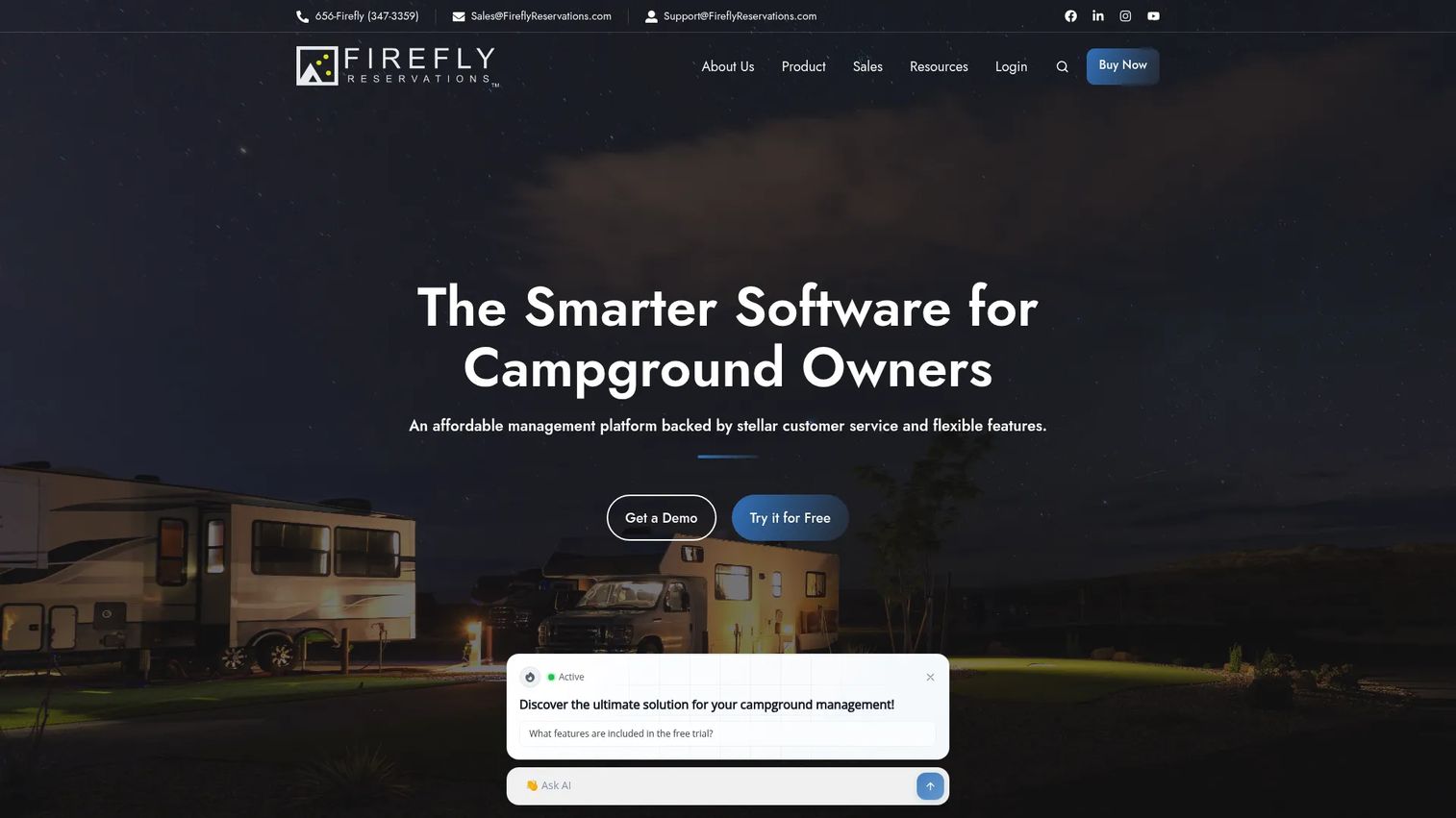
Firefly Reservations is campground and RV park reservation management software with a low-friction acquisition model that appeals to operators who want to start fast. It covers online reservations, an interactive map, automated guest emails, automatic recurring payments, a drag-and-drop reservation grid, and point-of-sale. The pitch is simplicity: every plan includes every feature, and you can start for free with no setup fees or contracts.
Best for: Campgrounds and RV parks needing reservation, payment, and guest-management software with a zero-commitment start.
Key strengths
- Free, no-contract start: every feature included on every plan, with no setup fees or long-term commitment
- Automatic recurring payments: handles long-term and seasonal guests without manual invoicing
- Drag-and-drop reservation grid: move and manage bookings visually instead of wrestling a spreadsheet
Why choose Firefly Reservations: For a founder-minded operator protecting cash, the ability to prove value in week one without a contract is the whole point. You can validate the booking flow and recurring billing before committing budget, which lowers the risk of the buy.
Firefly Reservations pricing: The public pricing page shows a $3.50 service fee per new unit booked, plus $3.50 per month for each current long-term reservation. All plans include all features and unlimited support, and the product starts for free with no setup fees or contracts. Firefly also offers tiered SMS texting add-ons for guest communication. On G2, Firefly Reservations shows a 5/5 rating, though the page notes there are not yet enough reviews for a full buying picture.
3. CampLife
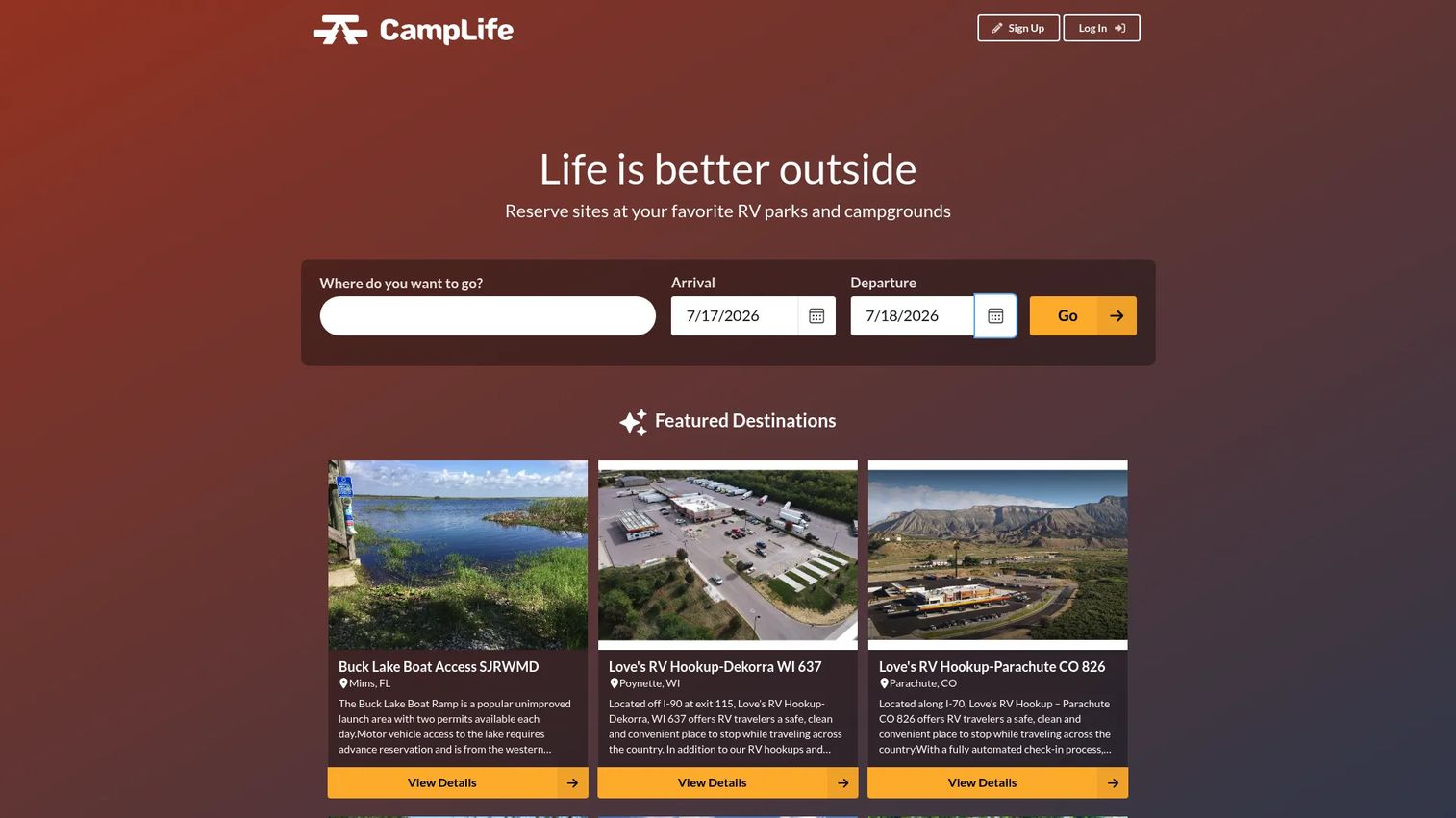
CampLife is campground reservation and park management software that leans hard into operations depth. It covers online reservations, interactive maps and a reservation grid, a dynamic pricing and rules engine, payments, POS, accounting, and guest communication. For operators who want the back office handled inside the same tool as the front desk, that breadth is the draw.
Best for: Campgrounds and RV parks that want reservations plus accounting, POS, and guest communication in one system.
Key strengths
- Dynamic pricing and rules engine: set rate rules and seasonal pricing without manual overrides
- Built-in accounting: keeps the financial ledger current alongside reservations and POS
- Add-on ecosystem: kiosk, gate integration, sign-and-store, recurring billing, and SMS texting
Why choose CampLife: If your park's real problem is administrative sprawl across reservations, payments, and books, CampLife's operations breadth consolidates the stack. That consolidation is exactly the "reduce tools while increasing signal" logic an operator uses to cut complexity.
CampLife pricing: CampLife publishes several plans. Standard starts at $99 per month, Premium starts at $249 per month, and Unlimited is quote-based. An All Features option runs $3.00 per reservation. The pricing page also lists add-ons including kiosk, gate integration, sign-and-store, recurring billing, and SMS texting. CampLife is rated 4.9/5 on Capterra based on public reviews.
4. RoverPass
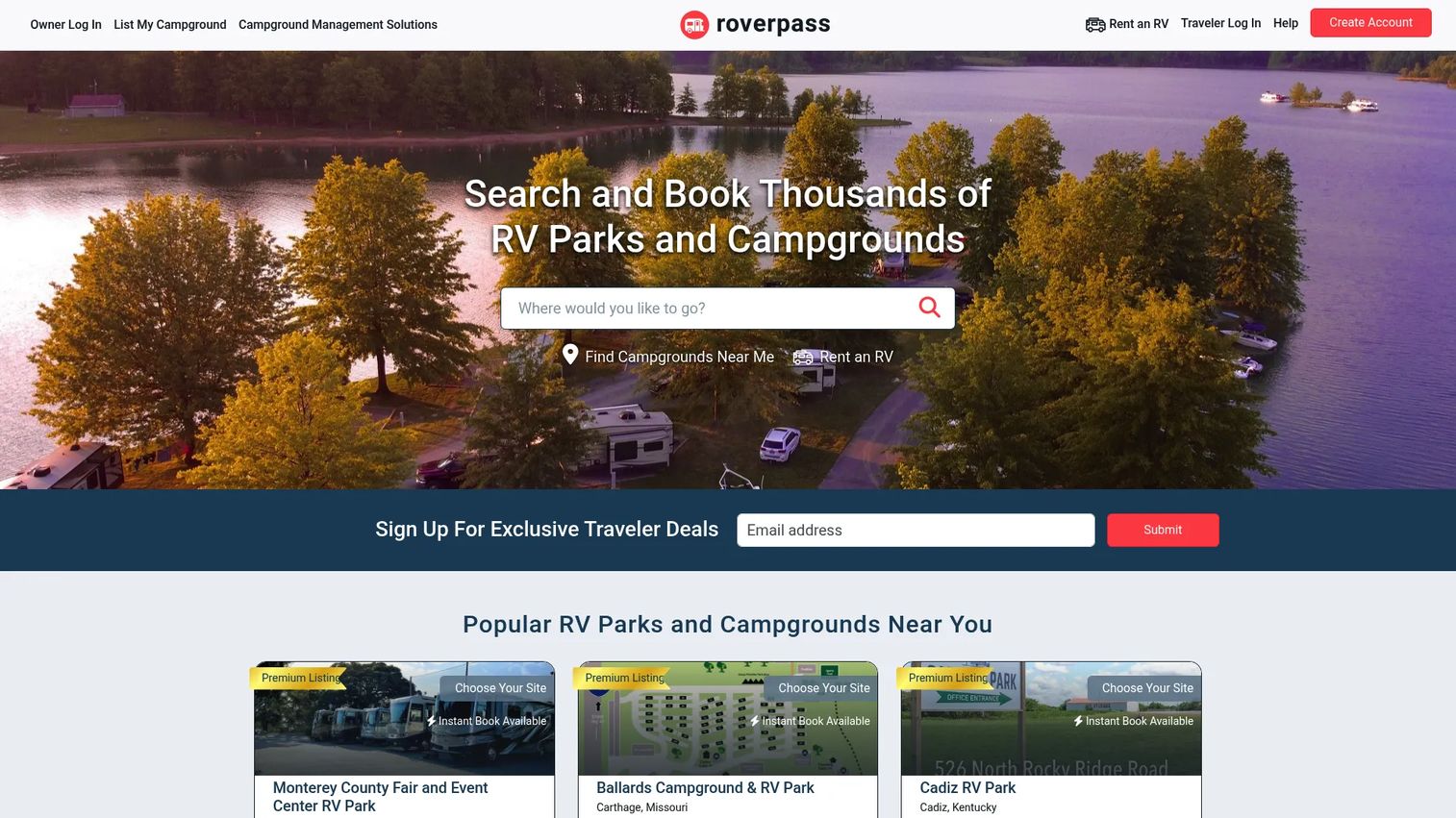
RoverPass is an all-in-one booking and reservation management platform for campgrounds, RV parks, and glamping sites. It handles reservation management with availability, payments, and guest messaging, plus dynamic pricing and rate rules. Its channel management and integrations layer is a differentiator for parks that want to distribute inventory beyond their own site.
Best for: Campground and RV park operators who want campground-focused booking software with channel distribution and integrations.
Key strengths
- Reservation management: availability, payments, and guest messaging in one workflow
- Dynamic pricing and rate rules: adjust rates by demand and season without manual work
- Channel management and integrations: distribute inventory across booking channels
Why choose RoverPass: RoverPass fits operators who want a purpose-built campground booking tool with a clear published entry point for its integrations tier. For a growing single park that wants distribution without enterprise pricing, it is a practical shortlist candidate.
RoverPass pricing: RoverPass publicly lists an Integrations Plan at $29 per month. Core platform pricing beyond that plan is not published as a public figure on the vendor site, so a quote is required for the full picture. RoverPass does not currently publish a G2 rating from a primary source, though it appears on third-party review directories.
5. UltraCamp
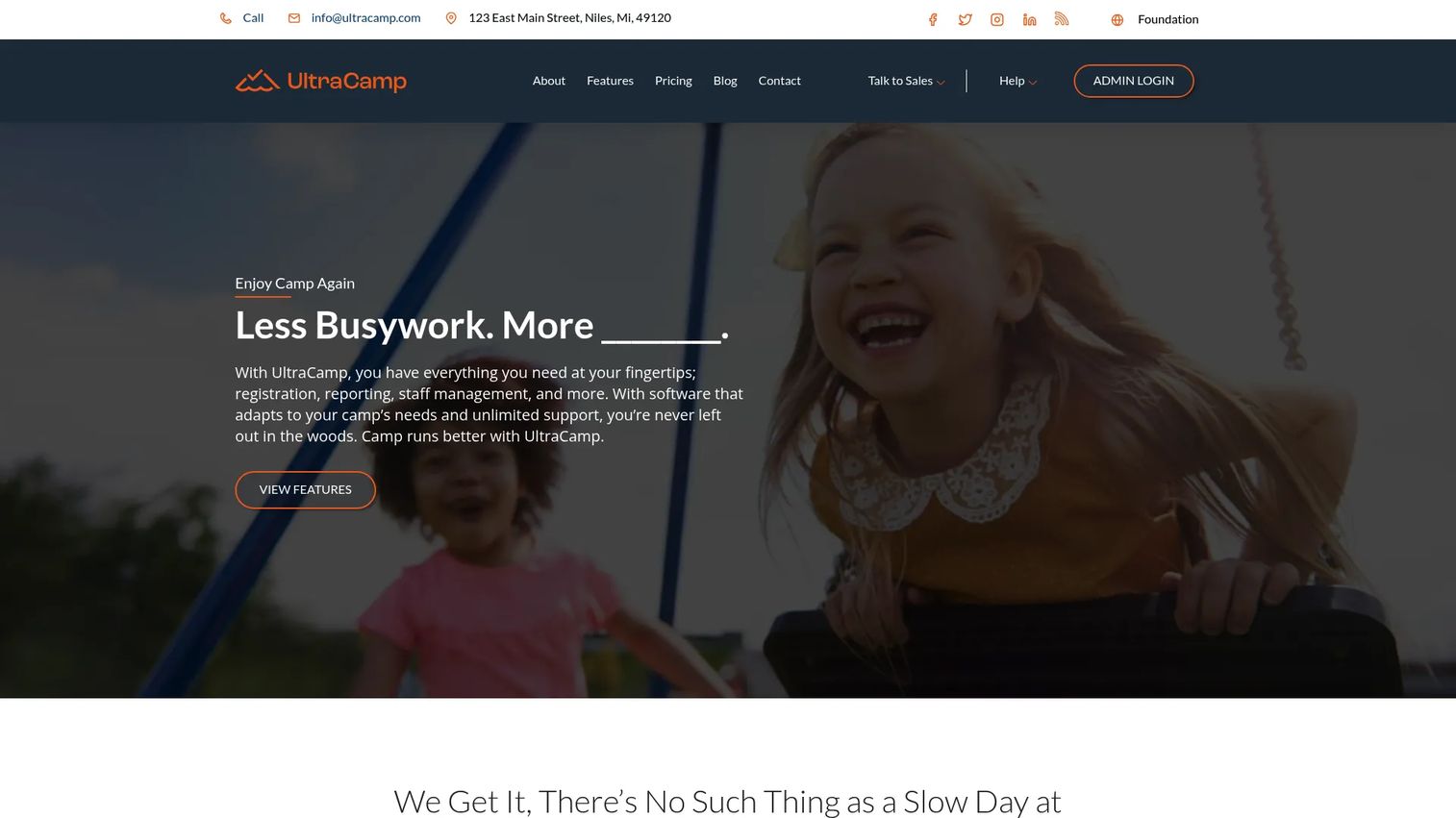
UltraCamp is camp and retreat registration, payments, and management software. Its strength sits in structured programs: session management, health management, and payment plans. That makes it a strong fit for organizations running scheduled camp sessions and retreats rather than nightly RV site turnover, though it is a recurring name in campground manager software comparisons.
Best for: Camps and retreat organizations that need registration and operations software built around sessions and participant management.
Key strengths
- Session management: organize and register participants across scheduled programs
- Health management: capture and manage participant health information
- Payment plans: offer flexible installment billing for program fees
Why choose UltraCamp: If your operation is program-driven rather than site-driven, UltraCamp's session and health management are purpose-built for that reality. Retreat centers and organized camps get registration depth that generic reservation tools do not offer.
UltraCamp pricing: UltraCamp does not publish a public software subscription price on its own site. The available pages describe configurable session pricing and fees for camp programs rather than the platform's own SaaS plan pricing, so a direct quote is required. A current G2 rating from a primary source was not verifiable at the time of writing, so evaluate it directly against your program requirements during a demo.
6. Guest Tracker
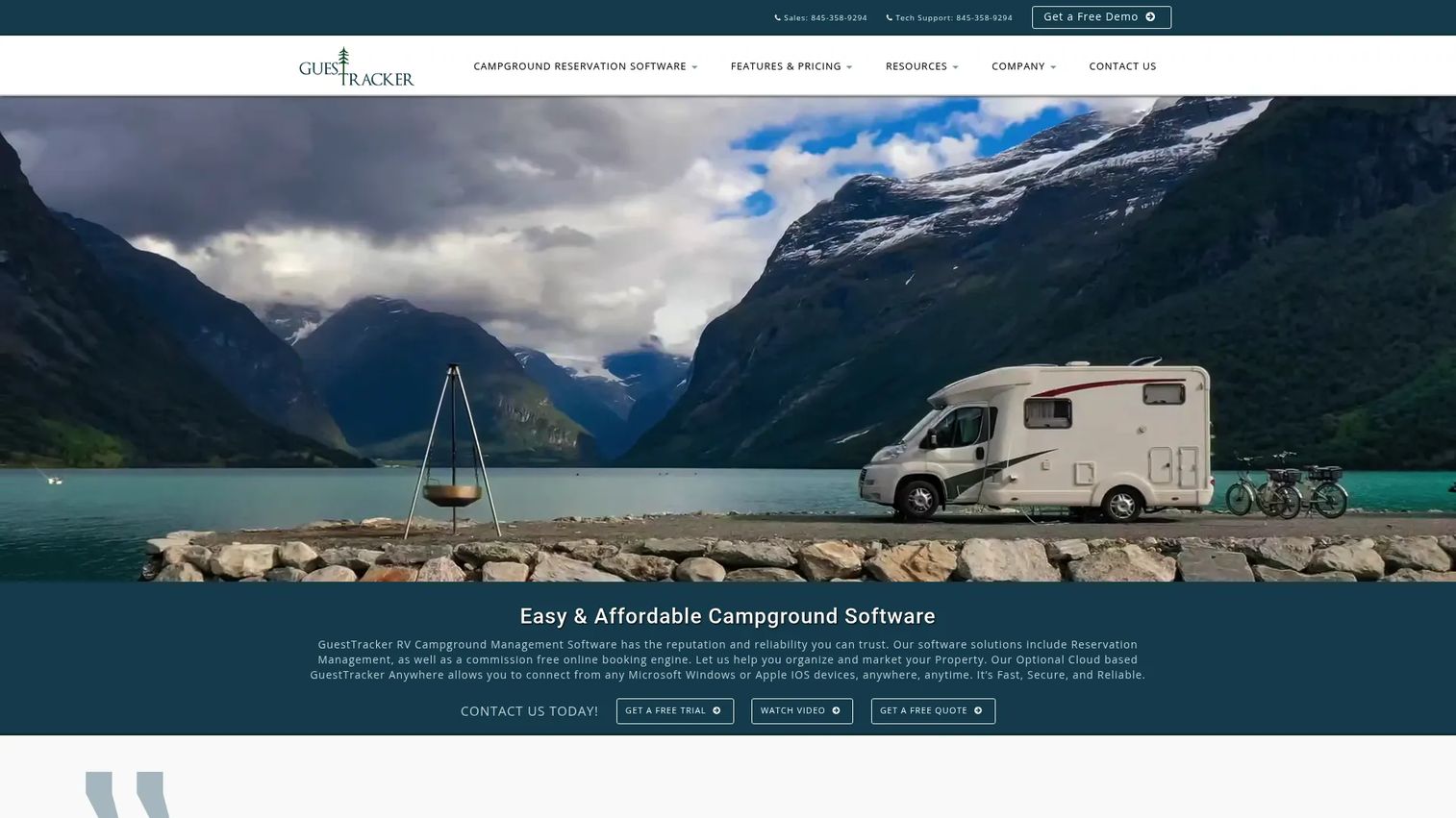
Guest Tracker is reservation management software for campgrounds, lodges, RV parks, and marinas. It covers reservation and activity charts, an online booking engine, and credit card payment processing. The versatility across property types is its calling card: one platform for operators who run more than just campsites.
Best for: Campgrounds, RV parks, lodges, and marinas that need reservation management with optional online booking and payments.
Key strengths
- Reservation and activity charts: manage sites and activities from a visual grid
- Online booking engine: accept self-serve reservations directly
- Credit card payment processing: take payments inside the reservation workflow
Why choose Guest Tracker: If your portfolio spans campgrounds and marinas or lodges, Guest Tracker's cross-property flexibility means one system instead of several. That single-platform coverage is attractive for mixed-hospitality operators who dislike stitching tools together.
Guest Tracker pricing: Guest Tracker offers Essentials and Enhanced packages, plus a Desktop Software option and a GT|Cloud deployment. The public pricing page does not show readable numeric prices and instead directs visitors to request a quote or build a package. Guest Tracker holds a 4.5/5 rating on G2 based on a small number of reviews, so weigh that alongside a hands-on evaluation.
7. Astra Campground Manager
Astra Campground Manager is campground and RV park management software aimed at private parks, RV resorts, and marinas. It offers real-time online bookings through its BookYourSite.com channel, an integrated point-of-sale for camp store sales and inventory, and multi-park support with combined reporting. That multi-park reporting is the reason it appears in campground manager software comparisons for operators running more than one property.
Best for: Private campgrounds, RV resorts, and marinas that need campground management software with multi-park reporting.
Key strengths
- Real-time online bookings: live availability booking through the BookYourSite.com channel
- Integrated point-of-sale: camp store sales and inventory tied to the platform
- Multi-park support with combined reporting: roll up reporting across multiple properties
Why choose Astra Campground Manager: For a portfolio operator, combined reporting across parks is the feature that separates a real multi-property system from a single-site tool. If you manage several locations and need one revenue picture, Astra is built for that job.
Astra Campground Manager pricing: Astra does not publish a public first-party price at the time of writing, so a direct quote is required. A G2 aggregate rating was not directly verifiable in the sources reviewed. Because pricing and rating transparency are limited here, treat the demo as your primary evaluation tool and press on multi-park reporting and POS depth specifically.
Considerations before you buy
The feature lists converge fast. What separates a good fit from an expensive mistake is how a platform handles your specific operational reality. Use this checklist when you narrow to two or three finalists.
Booking flow and guest self-service
Book a test reservation yourself, end to end, on desktop and mobile. Count the clicks. A guest portal that reduces phone calls is worth more than any feature sheet, so evaluate the actual self-serve experience, not the marketing screenshot.
Revenue tooling and dynamic pricing
Ask how dynamic pricing, add-ons, and recurring billing actually work in the tool. If your revenue upside is holiday-weekend demand, rate rules and length-of-stay controls need to be flexible enough to capture it without manual overrides every season.
Operations depth
Decide which back-office jobs you want inside the software: POS, work orders, housekeeping, and accounting. Consolidating these reduces tool sprawl, but only if the depth matches what you actually run. Do not pay for accounting you will never migrate to.
Integrations and reporting
Confirm the integrations you depend on: accounting sync, payment processing, OTA channels, gate and kiosk hardware, and SMS or email marketing. Then look hard at reporting. Clean occupancy and revenue data is what lets you make weekly decisions instead of guessing.
Scale fit
A single park and a five-property portfolio need different things. Multi-park operators should prioritize combined reporting and consistent workflows across sites; single-park operators should prioritize speed to launch and low overhead.
Conclusion
The right pick depends on your bottleneck, not the longest feature list. If revenue optimization is the priority, Campspot's grid optimization, dynamic pricing, and marketplace channel make it the strongest all-in-one for parks that live and die by occupancy. If you want to start without risk, Firefly Reservations lets you prove the booking and recurring-billing workflow for free before committing. For operations depth across reservations, accounting, and POS, CampLife consolidates the back office in one tool.
For a growing single park that wants campground-focused booking with channel distribution, RoverPass is a practical low-entry option. UltraCamp fits program and retreat operators. Guest Tracker suits mixed portfolios spanning marinas and lodges, and Astra Campground Manager earns a look from multi-park operators who need combined reporting.
The next step is simple: shortlist two or three finalists and compare them on the three things that matter most for repeatable operations: reservation flow, revenue automation, and reporting. Book demos, run a test booking yourself, and press each vendor on the workflows you repeat hundreds of times a season.
Start your journey with Guideflow today!
FAQs
Campground management software is a platform that centralizes reservations, payments, guest communication, and park operations for campgrounds, RV parks, and outdoor resorts. It replaces spreadsheets and disconnected booking tools with one system that manages the full guest lifecycle. The strongest platforms combine online reservations, POS, dynamic pricing, and reporting in a single operational layer.
The essentials are online reservations, an interactive site map with live availability, and guest messaging via SMS texting and email. Beyond booking, revenue tools like dynamic pricing and add-ons, plus operational features like POS, work orders, and accounting, separate a booking widget from a full operating system. Reporting and integrations tie it all together for clean weekly decisions.
Campground software lifts revenue in three ways: dynamic pricing captures demand on high-occupancy weekends automatically, add-ons and upsells increase revenue per reservation, and recurring billing keeps long-term and seasonal guests billed without manual work. Grid optimization and OTA channel distribution fill sites that would otherwise sit empty. Together, these tools turn seasonal swings into a pricing strategy.
Most modern platforms include point-of-sale for camp store sales and a guest portal for self-service booking and account management. POS ties store sales, firewood, and rentals to the reservation and the ledger, while a guest portal reduces front-desk phone calls. Confirm the depth of each during a demo, since coverage varies by platform and tier.
RV park operators should compare booking flow, dynamic pricing flexibility, recurring billing for long-term guests, POS and accounting depth, integrations with payment and OTA channels, and reporting quality. Run a test booking yourself on mobile and desktop. The tool that reduces the most repetitive manual work across a full season usually wins on total value.
Both are well served, but the priorities differ. Single-park operators should prioritize speed to launch, low overhead, and simple self-serve booking. Multi-park operators need combined reporting across properties, consistent workflows, and revenue tooling that scales, which is why platforms with strong multi-park support and grid optimization rise to the top for portfolios.
Integrations are where a platform either saves time or creates new busywork. Accounting sync keeps the books current without double entry, and SMS texting plus email marketing automate the repetitive guest questions that eat front-desk hours. Before buying, confirm the specific integrations you depend on, including payment processing, OTA channels, and any gate or kiosk hardware.
Ask the vendor to walk through a real reservation end to end, show exactly how dynamic pricing rules are set, and demonstrate reporting on occupancy and revenue. Press on what happens with long-term recurring billing, how POS ties to the ledger, and which integrations are included versus gated. For multi-park operators, insist on seeing combined reporting live before you commit.