Your development team is stitching together a spreadsheet of funders, a Google Doc full of half-finished narratives, a generic AI chatbot, and a wall calendar tracking submission deadlines. The proposal is due Friday. Two of those tools don't talk to each other, and nobody is sure which draft is current.
That is the daily reality for most grant teams. The work spans four distinct jobs: finding aligned funders, drafting proposals without starting from zero, keeping submissions moving, and reporting on what happened. Generic AI can draft a paragraph. It cannot run your grant workflow.
That gap matters because grants are big money. The global grant management software market reached roughly USD 2.88 billion in 2025, according to a GlobeNewswire market release, and Grand View Research (via Stealth Agents) projects a 10.2% CAGR through 2034. Mission-driven teams are investing in software because manual grant work does not scale.
This guide compares the best grant writing software for teams that want more than text generation. Some tools are true ai grant writing tools built for funder discovery and drafting. Others are grant proposal software that extends into tracking and reporting. A few are general-purpose assistants worth understanding for what they can and cannot do. If you are evaluating ai tools for grant writing for a nonprofit or a mission-driven organization, this is your shortlist.
What's inside
This list covers eight tools across the full grant workflow: funder discovery, proposal drafting, human review, and post-submission management. Some are purpose-built for nonprofits. Some are general AI assistants that grant writers use anyway.
We selected and ranked tools on four criteria that matter for buyers comparing consolidation value:
- Workflow coverage: how much of discover, draft, track, and report the tool handles
- AI quality: whether the drafting is grant-aware or generic
- Customization and collaboration: control over tone, structure, and team review
- Trust signals: pricing transparency, ratings, and nonprofit fit
This is written for teams choosing a stack, not just a text generator.
TL;DR
Short on time? Here are the shortcuts:
- Best all-in-one AI grant workspace: Grantable. Discovery, drafting, and tracking in a single memory-backed workspace with a free entry point.
- Best for end-to-end grant management: Instrumentl. Strong funder discovery plus post-award grant tracking, with a 4.9/5 G2 rating.
- Best purpose-built nonprofit option: Grant Assistant. Semantic AI tuned for nonprofit tone and accuracy, activated through a demo.
- Best budget-friendly AI drafting: Grantboost, with a free plan and paid tiers under $30/month.
- Best generic AI fallback: ChatGPT or Microsoft Copilot for ideation and first drafts, paired with careful human-in-the-loop review.
- Bottom line: purpose-built nonprofit grant writing software wins on workflow; generic AI wins on flexibility and price.
What grant writing software is
Grant writing software is a category of tools that help teams discover funders, draft proposals, manage deadlines, and collaborate on submissions, often with AI assistance. The strongest platforms treat these as one connected workflow rather than four disconnected tasks.
It helps to separate three overlapping categories that buyers often confuse:
- Purpose-built grant software: built specifically for grants, with funder matching, grant-aware AI drafting, and pipeline tracking. Examples include Grantable, Grant Assistant, and Grant Orb.
- General AI writing tools: flexible assistants like ChatGPT and Microsoft Copilot that draft text well but have no grant-specific workflow or funder data.
- Grant management software: systems that extend past drafting into award tracking, reporting, and compliance. Instrumentl sits closest to this end.
Most grant software buyers want some blend of all three. The question is how much of the workflow one tool can absorb.
A complete grant writing platform typically covers these core capabilities:
- Funder discovery: matching your organization to aligned opportunities and reducing manual grant prospecting
- Proposal drafting: AI-assisted first drafts, reusable content, and structured outlines
- Workflow tracking: deadlines, task assignments, and submission status
- Collaboration: shared drafts, comments, and version control across a team
- Customization: control over tone, structure, and mission-aligned language
- Reporting: post-award tracking and impact reporting for grant lifecycle management
The clearest divide in the market is between grant writing ai built on funder data and generic chatbots. One knows what a Program Officer wants to read. The other guesses.
When to use grant writing software
Find funders faster
Manual funder research eats hours. Development staff scroll databases, cross-check eligibility, and copy details into spreadsheets. Software with funder discovery matches your organization profile to aligned opportunities automatically. You spend time on the funders worth pursuing instead of the ones you never qualified for. This matters most when your pipeline is thin or your team is small.
Draft proposals without starting from scratch
Every proposal reuses language: mission statements, program descriptions, evaluation plans, budgets. Grant proposal drafting tools with content libraries and memory let you pull approved language into a new draft in seconds. AI generates the first pass, and your team refines it. The repeated work drops, and consistency across submissions goes up. This is where the time savings are most visible.
Keep grants moving after submission
The draft is only half the job. After you submit, deadlines for reports, renewals, and compliance keep coming. Software with grant tracking, reminders, collaboration, and reporting keeps every award on schedule. This matters when you manage more than a handful of grants at once and cannot afford a missed reporting deadline that jeopardizes future funding.
Comparison table
Here is a compact view of all eight tools, sorted by relevance to grant-specific workflows. Pricing and ratings reflect verified values where public.
| # | Product | Intent | Key use case | Pricing | G2 rating |
|---|---|---|---|---|---|
| 1 | Grantable | Purpose-built | All-in-one discovery, drafting, tracking | Free; Starter $50/mo; Pro $150/mo | Not yet rated |
| 2 | Instrumentl | Grant management | Funder discovery through post-award tracking | From $299/mo (annual) | 4.9/5 |
| 3 | Grant Assistant | Purpose-built | Semantic AI discovery and drafting | Custom pricing | Not listed |
| 4 | Kindsight Grant Writer | Purpose-built | Fast mission-aligned proposal drafting | Not publicly listed | Not listed |
| 5 | Grant Orb | Purpose-built | Automated discovery and submission-ready drafts | Learning $119; Starter from $499/yr | Not yet rated |
| 6 | Grantboost | Purpose-built | Budget-friendly AI drafting | Free; Pro $19.99/mo; Teams $29.99/mo | Not listed |
| 7 | ChatGPT | General AI | Ideation and first drafts | Free tier available | 4.6/5 |
| 8 | Microsoft Copilot | General AI | Drafting and summarizing | Free/eligible access | 4.4/5 |
The split is clear. Rows 1 through 6 are grant-aware tools built for the workflow. Rows 7 and 8 are general AI assistants that grant writers use as a supplement, not a grant management software replacement.
1. Grantable
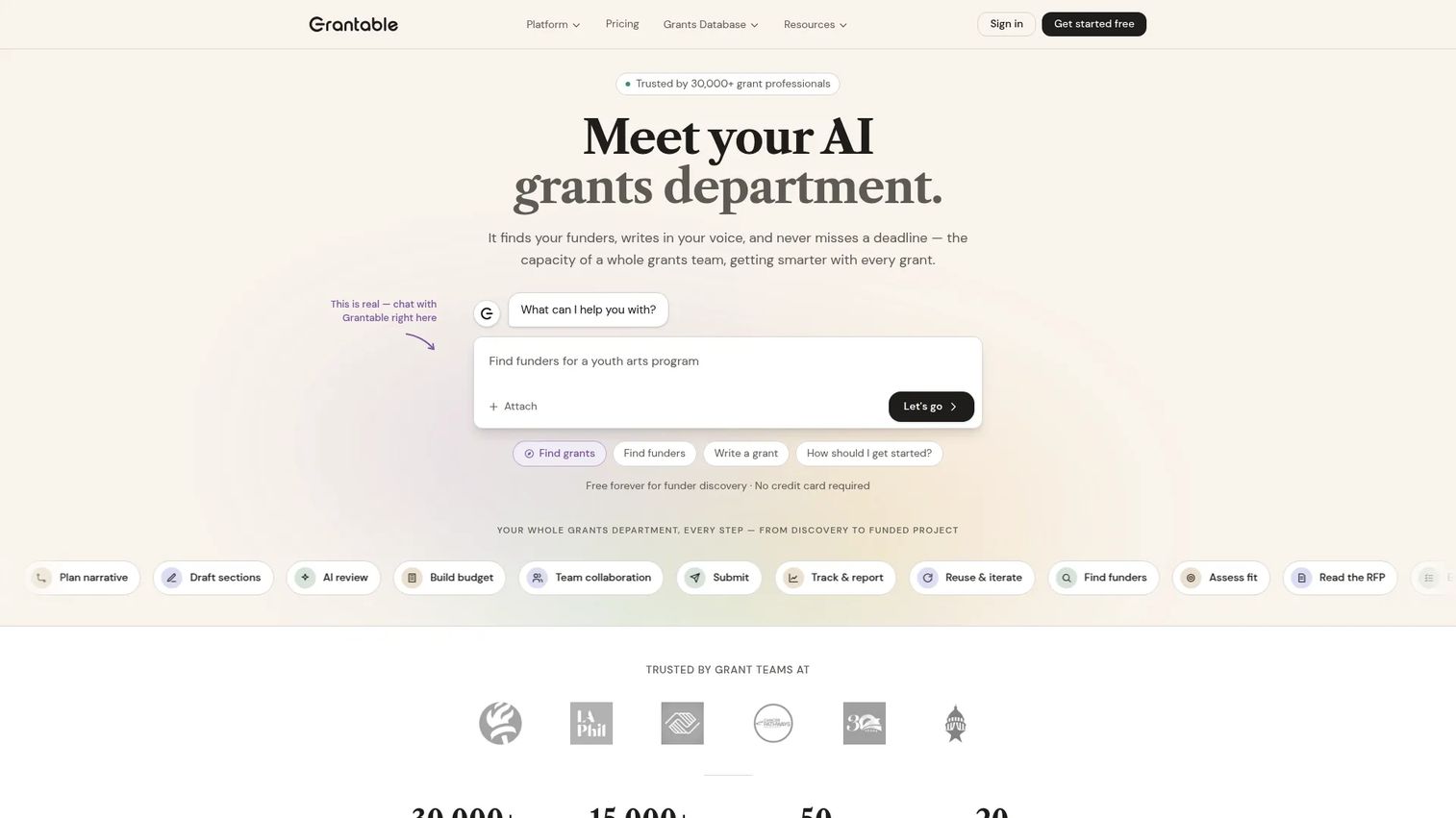
Grantable is an AI grant writing and management platform that pulls discovery, drafting, and tracking into a single workspace. Instead of jumping between a funder database, a doc editor, and a tracker, your team works in one place backed by memory that remembers your organization, past proposals, and approved language. It is the strongest consolidation play on this list for teams tired of stitching tools together.
The platform pairs prospecting agents that surface aligned funders with an AI writing workspace that drafts grant-aware first passes. Scheduled scans monitor for new opportunities, and a shared dashboard keeps the whole team aligned on status and deadlines. The memory layer is the differentiator: the more you use it, the more your drafts sound like your organization rather than a generic chatbot.
Best for: grant teams that want to replace several disconnected tools with one workspace for research, drafting, and tracking.
Key strengths
- Prospecting agents: surface aligned funders automatically instead of manual database searches
- Memory-backed drafting: reuse approved language and organizational context across every proposal
- Collaboration dashboard: track status, deadlines, and team assignments in one view
Why choose Grantable: If your bottleneck is tool sprawl, Grantable collapses the workflow into one place. Teams that manage funder research, grant proposal drafting, and tracking separately get the most value, because the memory layer compounds over time. It fits organizations ready to commit to a single connected workflow rather than a loose collection of apps.
Grantable pricing: A Free plan gives you an entry point at no cost. Starter runs $50 per month and Pro runs $150 per month, both billed monthly, with nonprofit discounts available on the paid tiers. An Agency Hub add-on is available at $300 per month for teams managing grants across multiple organizations. The capacity-based model and free tier make it easy to start small and scale as your pipeline grows.
2. Instrumentl
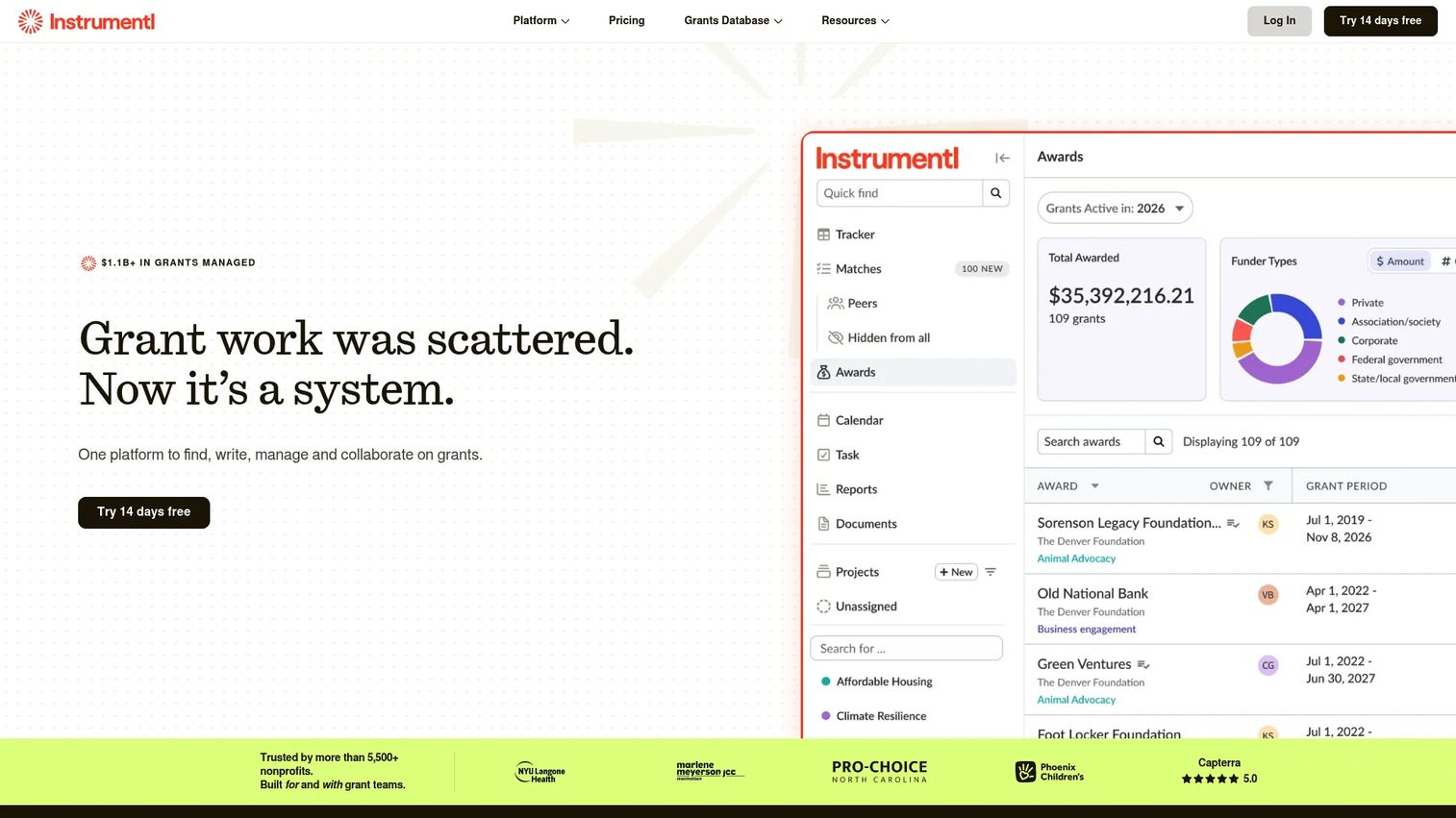
Instrumentl approaches grants as a full lifecycle: find, apply, track, manage, and collaborate. It is the closest thing on this list to true grant management software, with deep funder discovery on the front end and post-award spend tracking on the back end. For teams that need strong operations, not just drafting help, it is a serious option.
The platform uses AI-matched opportunity discovery to surface funders aligned to your mission and history. From there, application drafting and collaboration tools keep the team moving, and post-award grant tracking handles deadlines, tasks, and reporting after the check clears. Instrumentl carries a 4.9/5 rating on G2, and its security posture and trust signals appeal to organizations that answer to boards and funders.
Best for: nonprofits and grant consultants managing the full arc from funding discovery through post-award reporting.
Key strengths
- AI-matched discovery: surface aligned funders based on your mission and grant history
- Post-award tracking: manage spend, deadlines, and reporting after the award
- Lifecycle collaboration: shared drafting and task management across the team
Why choose Instrumentl: Instrumentl fits teams whose pain is operational, not just editorial. If you manage many grants and cannot afford a missed report, its grant lifecycle management depth earns its price. Consultants juggling multiple client portfolios get particular value from the tracking and collaboration layer.
Instrumentl pricing: Four plans are available. Discover starts at $299 per month paid annually, or $349 monthly. Pre-Award runs $499 per month annually, or $579 monthly. Full Lifecycle is $999 per month annually, or $1,159 monthly. Enterprise is custom priced. All plans include a 14-day free trial, and there is no free version.
3. Grant Assistant
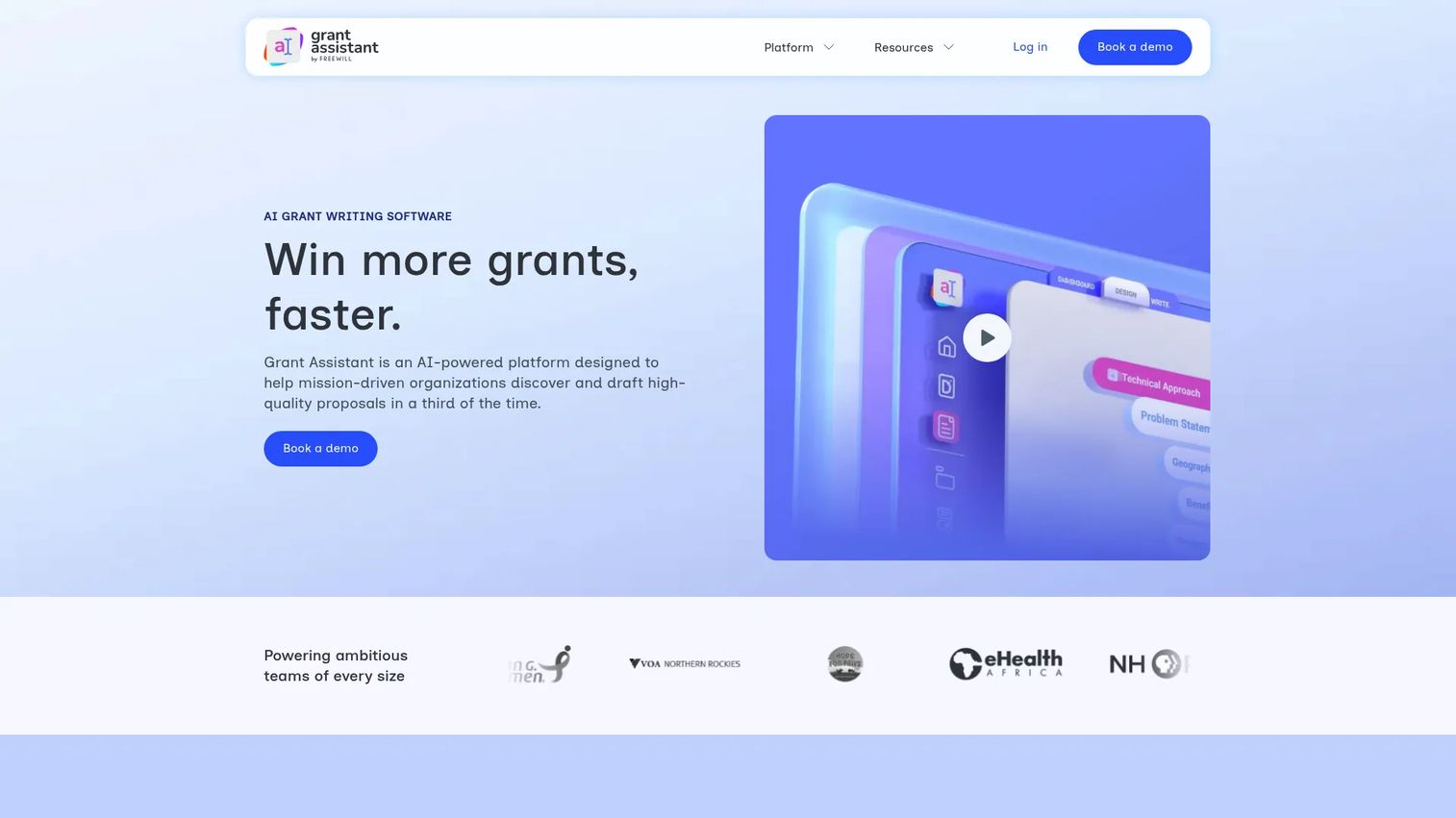
Grant Assistant is an AI grant writing and discovery platform built specifically for mission-driven organizations. Its nonprofit focus is the point: the semantic AI is tuned to understand the language, tone, and structure that funders expect, which reduces the generic-chatbot feel that plagues general tools. For grant-first teams, that specialization improves both accuracy and voice.
The platform combines opportunity discovery using semantic matching with AI proposal drafting and outline generation. A pre-award pipeline keeps funder notes and application status organized. Because it is purpose-built grant software, the drafting output aligns more closely with what Program Officers actually read, which shortens revision cycles.
Best for: nonprofits and grant teams that want AI help finding and drafting proposals with a nonprofit-native tone.
Key strengths
- Semantic funder matching: surface aligned opportunities using meaning, not just keywords
- Nonprofit-tuned drafting: generate outlines and drafts in a funder-appropriate voice
- Pre-award pipeline: organize funder notes and application status in one place
Why choose Grant Assistant: Choose it when tone and accuracy matter more than raw flexibility. Teams that have been burned by generic AI producing off-key nonprofit language will feel the difference. The nonprofit focus is the reason to look here over a general assistant.
Grant Assistant pricing: Pricing is customized based on organization size and grant program scope, so there is no public price. Activation is demo-led, which lets the team scope your needs before quoting. Contact the vendor through their site to get a tailored quote.
4. Kindsight Grant Writer
Kindsight Grant Writer positions itself around fast, mission-aligned proposal creation. The pitch is straightforward: draft winning proposals quickly, with AI that tailors output to your organization and expert-vetted structure that keeps beginners on track. For teams whose main need is faster drafting rather than a full lifecycle system, that simplicity is the appeal.
The tool leans on AI tailoring and data-driven structure to help writers move from blank page to a workable draft. Its beginner-friendly framing makes it approachable for smaller organizations without a dedicated grant professional on staff. The value proposition is speed and confidence, not operational depth.
Best for: organizations that mainly need faster, mission-aligned proposal creation without a heavy management layer.
Key strengths
- AI tailoring: adapt drafts to your mission and program specifics
- Customizable structure: start from expert-vetted proposal frameworks
- Beginner-friendly workflow: approachable for teams new to grant writing
Why choose Kindsight Grant Writer: Choose it when your team needs to produce solid drafts quickly and does not need a full tracking and reporting system. The beginner-friendly framing lowers the barrier for organizations building their grant capacity for the first time.
Kindsight Grant Writer pricing: Public pricing is not currently listed. Teams evaluating the tool should reach out through the brand's site for current plan and demo details before committing.
5. Grant Orb
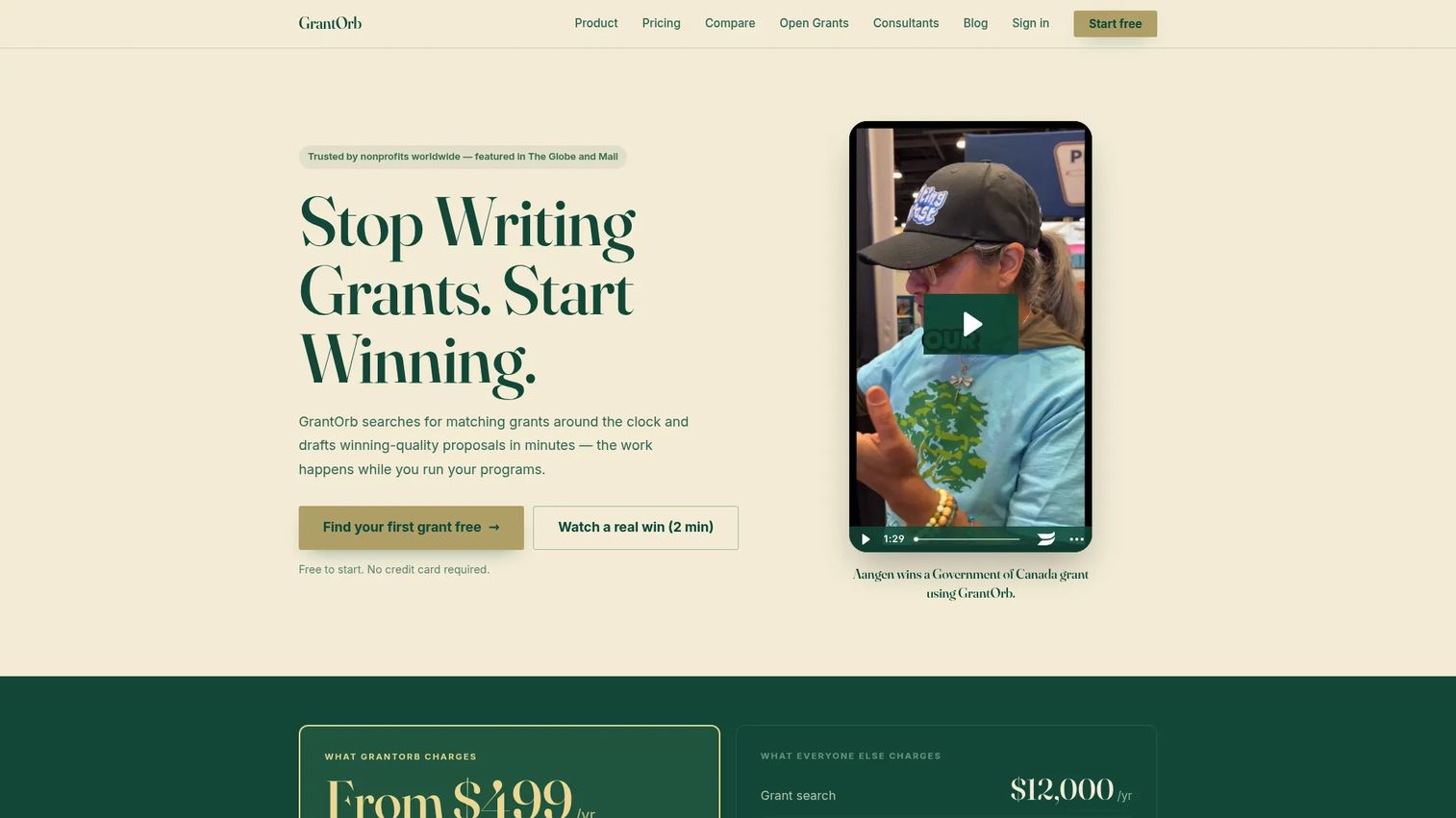
Grant Orb is an AI-powered grant search and proposal-writing platform aimed at nonprofits that want automated discovery and drafting without a steep setup. It runs continuous discovery matched to your organization profile and generates submission-ready proposals, which makes it a fit for smaller teams and early adopters who want speed over complexity.
Beyond drafting, Grant Orb adds eligibility and compliance validation plus budget building, so the output is closer to ready than a raw AI draft. The 24/7 discovery matched to your profile means new opportunities surface without you running searches. It is a practical option for lean teams that want the software to do more of the legwork.
Best for: nonprofits and mission-driven organizations that need automated grant discovery and proposal drafting on a modest budget.
Key strengths
- 24/7 discovery: continuously match opportunities to your organization profile
- Submission-ready drafts: generate proposals closer to final than raw AI output
- Compliance and budget tools: validate eligibility and build budgets in-app
Why choose Grant Orb: Choose it when you want automation without a big commitment. The free-to-start flow with no credit card required lowers the risk of trying it, and the eligibility validation saves lean teams from chasing grants they cannot win.
Grant Orb pricing: A Learning plan is available at $119 as a one-time purchase for a single application. Starter runs from $499 per year. A Growth plan is listed but its price is not publicly shown. The public site indicates a free-to-start flow with no credit card required.
6. Grantboost
Grantboost is AI-powered grant writing software built for nonprofits and mission-driven organizations that want to speed up discovery and drafting without a large budget. It is the lightest-weight, most affordable purpose-built option on this list, which makes it a natural fit for solo grant writers and small teams testing whether AI drafting works for them.
The platform offers AI-matched grant recommendations and a drafting agent that pulls in your organizational data to keep proposals on-message. Templates, word and character counts, and deadline tracking round out the workflow so writers stay inside funder limits. For teams comparing lighter-weight tools, Grantboost hits a clear price-to-value point.
Best for: nonprofits and grant writers who want to speed up discovery and drafting at a low monthly cost.
Key strengths
- AI-matched recommendations: surface relevant grants based on your profile
- Data-aware drafting agent: pull organizational data into on-message drafts
- Practical writing tools: templates, word counts, and deadline tracking built in
Why choose Grantboost: Choose it when budget is the deciding factor and you want purpose-built drafting rather than a generic chatbot. It fits solo writers and small shops that need grant-aware help without committing to a higher-priced platform.
Grantboost pricing: A Free plan is available at $0. Pro runs $19.99 per month and Teams runs $29.99 per month, both flat-rate. The low entry price and free tier make it one of the easiest tools here to trial without procurement approval.
7. ChatGPT
ChatGPT is OpenAI's general-purpose AI assistant, not a grant platform. Plenty of grant writers use it anyway, and for good reason: it is excellent at brainstorming angles, generating outlines, and producing a rough first draft you can shape. As a supplement to your workflow, it earns its place. As a system of record for grants, it does not have one.
The distinction matters. ChatGPT has no funder database, no eligibility checks, no deadline tracking, and no built-in human-in-the-loop review designed for grant compliance. It also does not know your organization unless you feed it context every session. Used well, it accelerates ideation and drafting. Used carelessly, it produces confident text that needs heavy verification before it goes to a funder.
Best for: grant writers who want fast ideation, outlines, and first drafts to refine inside a purpose-built tool.
Key strengths
- Fast ideation: brainstorm framing, angles, and narrative structure quickly
- Flexible drafting: generate outlines and first passes on any section
- Broad availability: access on web, iOS, and Android with file uploads and analysis
Why choose ChatGPT: Choose it as a supplement, not a replacement. It is the most flexible drafting assistant here, but it lacks grant-specific workflow and safety controls, so it works best paired with a purpose-built platform that handles discovery, tracking, and compliance.
ChatGPT pricing: A free tier is available. Paid plans include Go, Plus, Pro, Business, and Enterprise, with current prices listed on OpenAI's pricing page. ChatGPT holds a 4.6/5 rating on G2 across a large review base.
8. Microsoft Copilot
Microsoft Copilot is Microsoft's general-purpose AI companion, useful in grant-related workflows without being a grant-specific system. If your team already lives in Microsoft 365, Copilot can help draft narrative sections, summarize funder guidelines, and tidy up documents inside the tools you already use. That app-integrated convenience is its main draw.
Like ChatGPT, Copilot is not built for grants. It has no funder matching, no grant pipeline, and no compliance workflow. It helps with drafting and summarizing, and its document understanding is genuinely useful for digesting long RFP guidelines. But the grant-specific structure, discovery, and tracking still have to come from somewhere else.
Best for: teams already in the Microsoft ecosystem who want AI help drafting and summarizing inside familiar apps.
Key strengths
- Conversational assistance: draft and refine narrative sections on demand
- Document understanding: upload and summarize long funder guidelines and RFPs
- Microsoft-native integration: work inside the apps your team already uses
Why choose Microsoft Copilot: Choose it when your workflow is already Microsoft-centric and you want AI assistance without adding a new tab. It handles drafting and summarizing well, but pair it with a grant writing ai platform for the discovery, tracking, and compliance it does not cover.
Microsoft Copilot pricing: Microsoft offers free and eligible access to Copilot, with separate Microsoft 365 Copilot business plans for organizations. Standalone pricing for Copilot itself is not clearly published; check Microsoft's pages for current details. Copilot holds a 4.4/5 rating on G2.
What to check before you buy
Before you commit, run every candidate through this checklist.
Workflow coverage
Map the tool against your actual process: discover, draft, track, report. A drafting-only tool leaves you managing deadlines and awards elsewhere. If consolidation is the goal, favor platforms that absorb more of the workflow so you retire spreadsheets rather than add to them.
AI quality and grant-awareness
Test the drafting on a real proposal section. Grant-aware AI trained on funder language produces output closer to submission-ready. Generic AI produces competent prose that still needs heavy reshaping into nonprofit voice. The difference shows up in how much you edit.
Customization and collaboration
Check whether the tool lets multiple people draft, comment, and version-control a proposal. Solo tools work for solo writers; teams managing many grants need shared workspaces, assignments, and a clear source of truth for the current draft.
Trust and data controls
For nonprofits handling sensitive data, review how each tool stores and protects information, and whether it offers human-in-the-loop review before anything reaches a funder. Purpose-built platforms tend to design for grant compliance in ways general chatbots do not.
Pricing fit
Match the pricing model to your pipeline. A free tier or low monthly plan fits solo writers testing the water. Lifecycle platforms cost more but earn it when you manage many grants and cannot risk a missed report.
Conclusion
The best grant writing software depends on one question: do you want consolidation or just drafting help?
For nonprofit grant writing software that consolidates the whole workflow, Grantable is the strongest all-in-one pick, with discovery, drafting, and tracking in one memory-backed workspace and a free entry point. For end-to-end grant lifecycle management, Instrumentl leads on funder discovery paired with post-award grant tracking. For a purpose-built nonprofit option tuned for tone and accuracy, Grant Assistant is worth a demo. And for flexible, low-cost drafting, Grantboost, ChatGPT, and Microsoft Copilot each fill a role, as long as you pair generic AI with careful review.
If your team is drowning in disconnected tools, start with an all-in-one platform and consolidate. If you already have discovery and tracking handled and only need better drafts, a focused AI tool or general assistant will do. Either way, the winning grant software is the one that fits how your team actually works, not the one with the longest feature list.
FAQs
Grant writing software helps teams discover funders, draft proposals, manage deadlines, and collaborate on submissions, often with AI assistance. Purpose-built platforms treat these as one connected workflow, while general AI tools handle only the drafting piece. The best fit depends on how much of the workflow you want in one place.
Safety depends on data controls, review workflows, and whether the tool is purpose-built for grants. Look for platforms that protect sensitive organizational data and support human-in-the-loop review so nothing reaches a funder unchecked. Purpose-built ai grant writing tools generally design for grant compliance more carefully than general-purpose chatbots.
Grant writing software focuses on funder discovery and grant proposal drafting, helping you find opportunities and write strong applications. Grant management software extends further into tracking, reporting, and compliance after an award. Some platforms, like Instrumentl, cover both ends of that spectrum in one system.
Yes, for ideation, outlines, and first drafts. ChatGPT is flexible and fast, but it is not grant-specific: it has no funder database, deadline tracking, or built-in compliance controls. Use it to accelerate drafting, then verify everything and refine inside a purpose-built tool before submission.
The features that matter most are funder matching, AI drafting, collaboration, customization, deadline tracking, and reporting. Teams focused on drafting should weight AI quality and customization; teams managing many awards should weight tracking and reporting. The right mix depends on where your workflow currently breaks down.
Weigh workflow fit, trust and data controls, pricing, ease of use, and team collaboration. Start by mapping your actual process and finding the tool that absorbs the most of it. Then test the AI drafting on a real proposal section and confirm the pricing model matches your pipeline size.
No. Some tools suit solo grant writers, with free tiers and low monthly plans that need no procurement approval. Others are built for larger teams managing many grants, with shared workspaces, task assignments, and lifecycle tracking. Match the tool to your team size rather than paying for capacity you will not use.