You added telemedicine to your practice during a scramble. A video link, a HIPAA checkbox, a prayer that the connection held. It worked, sort of. Then patients started missing visits because they could not figure out the login. Front desk staff started copy-pasting notes between the video tool and the chart. Billing got messy. And nobody could tell you whether the whole thing was actually saving time or just moving the friction somewhere else.
That is the real problem with telemedicine software in 2026. The video call is the easy part. Every platform does it. The hard part is everything wrapped around the call: how patients get in without three password resets, how the visit ties back to documentation and scheduling, whether the tool respects the compliance obligations you already carry, and whether it plugs into the systems your practice already runs on.
The market reflects this shift. The global telehealth market is projected to grow from $219.31 billion in 2026 to $1,272.81 billion by 2034 at a 24.60% CAGR, with North America holding roughly 45% of the share, according to Fortune Business Insights (2024). Software is the fastest-growing component of that market, per MarketsandMarkets (2024). That growth means more vendors, more feature sprawl, and more noise for anyone trying to make a clean decision.
If you evaluate software for a living, whether you run a clinic or build healthtech, the discipline here is the same one you would apply to any operational purchase: judge the workflow, not the feature list. This guide treats telemedicine software the way a careful buyer treats any tool that carries real operational risk. If you also compare other software categories, our roundups of application performance monitoring tools and account based marketing software follow the same evaluation-first structure.
What's inside
This guide is for practice operators, clinic administrators, and founders at healthtech companies who need a current shortlist of telemedicine platforms and a repeatable way to compare them. We selected vendors based on four criteria that matter more than a demo reel: HIPAA-oriented security and secure video visits, ease of patient access, depth of EHR integration and workflow fit, and pricing transparency. We prioritized telemedicine software providers that solve real clinical operations, not just video calling. Where public pricing exists, we cite it. Where it does not, we say so plainly instead of guessing.
TL;DR
- Best overall for frictionless patient access: Doxy.me, browser-based with no patient downloads or logins.
- Best for all-in-one practice operations: AdvancedMD, telehealth bundled with scheduling, EHR, and billing.
- Best for physician-focused research and peer context: Sermo, a free verified physician community rather than a clinical vendor.
- Best for remote patient monitoring and care workflows: Health Recovery Solutions, built for RPM and program expansion.
- Best for enterprise virtual care infrastructure: Amwell, a unified platform for health systems and payers.
- Best for payer and health system scale: Teladoc Health, broad multi-service virtual care.
- Best for behavioral health engagement and intake: Mend, AI-driven patient readiness and scheduling.
What telemedicine software actually is
Telemedicine software is the technology that lets clinicians deliver care to patients remotely through secure video visits, messaging, scheduling, documentation, and integration with clinical systems. It is the operational layer that turns a remote encounter into a billable, documented, compliant visit.
People use the terms telemedicine and telehealth almost interchangeably, but they are not identical. Telemedicine refers specifically to remote clinical care: diagnosis, treatment, prescriptions delivered by a licensed provider to a patient. Telehealth is the broader umbrella that also covers non-clinical services like provider education, administrative meetings, and remote patient monitoring. When you shop for telehealth platforms, you are usually shopping for telemedicine capability plus the surrounding infrastructure.
Core capabilities to expect from modern telemedicine platforms:
- Secure video visits: Encrypted, HIPAA-oriented video with waiting rooms and patient queuing.
- Scheduling and reminders: Appointment booking, automated SMS and email reminders to cut no-shows.
- EHR integration: Connection to your EHR or EMR so visit data flows into the chart without manual re-entry.
- Consent workflows: Digital consent capture before the visit begins.
- Documentation: Notes, charting, and visit records tied to the encounter.
- Patient access: Browser-based or app-based entry, ideally with minimal setup friction.
- Secure messaging: Asynchronous communication between visits.
- Patient portal: A place for patients to view records, book appointments, and message providers.
Three things separate a good platform from a mediocre one. Security and compliance that hold up under audit. Accessibility that does not force elderly or low-tech patients through a setup wall. And operational workflow that keeps documentation, scheduling, and billing tied to the visit instead of scattered across tabs.
When to use telemedicine software
Run virtual visits without forcing patients through setup friction
The single biggest predictor of a completed virtual visit is how easy it is to join. Browser-based telemedicine, where the patient clicks a link and lands in a waiting room with no download and no account, removes the most common failure point. This matters most for older patients, first-time users, and anyone joining from a phone on a weak connection. If your no-show rate on virtual visits is climbing, access friction is usually the cause before anything clinical is.
Keep documentation and scheduling tied to the visit
A telemedicine tool that lives apart from your EHR and scheduling creates handoffs, and handoffs create errors. When the visit connects to the chart, notes land where they belong, billing codes attach cleanly, and staff stop copy-pasting between systems. EHR integration telemedicine is not a luxury feature for a busy practice. It is the difference between a tool that saves admin time and one that quietly adds it.
Support broader care delivery, not just video calls
Real virtual care workflow extends past the visit. Patient portals let people self-serve records and bookings. Reminders reduce no-shows. Secure messaging handles the questions that do not need a full appointment. Remote patient monitoring extends care between visits for chronic conditions. If you are building a program rather than plugging a gap, evaluate the whole journey.
Comparison table
Here is how the seven platforms compare on intent, differentiation, telemedicine pricing, and G2 rating. Pricing reflects publicly available figures at the time of writing; several vendors gate pricing behind a sales conversation, which we note directly.
| # | Product | Intent | Key differentiation | Pricing | G2 rating |
|---|---|---|---|---|---|
| 1 | Doxy.me | Frictionless secure video visits | Browser-based, no patient login or download | Free version; Premium billed annually | 4.5/5 |
| 2 | AdvancedMD | All-in-one practice operations | Telehealth bundled with EHR, scheduling, billing | From $130/mo per provider | 3.6/5 |
| 3 | Sermo | Physician research and peer community | Verified HCP network, not a clinical vendor | Free membership | Not published |
| 4 | Health Recovery Solutions | Remote patient monitoring programs | RPM plus telehealth for health systems | Custom, contact sales | Not established |
| 5 | Amwell | Enterprise virtual care infrastructure | Unified digital care platform with EHR integrations | Custom, contact sales | 3.5/5 |
| 6 | Teladoc Health | Payer and health system scale | Broad multi-service virtual care | From $0 with insurance | 3.0/5 |
| 7 | Mend | Behavioral health engagement | AI patient readiness and scheduling | Custom, contact sales | 4.7/5 |
1. Doxy.me

Doxy.me is a browser-based telehealth platform built around one principle: the patient should not have to do anything except click a link. There is no app to download, no account to create, and no password to reset mid-appointment. That design choice removes the friction that kills so many virtual visits before they start, which is why solo providers and clinics reach for it first.
Best for: Clinics and solo providers who need HIPAA-oriented telehealth visits with the lowest possible patient access friction.
Key strengths
- No-download patient access: Patients join secure video visits from a browser link, with nothing to install and no login to fumble.
- Virtual waiting room and queue: A branded waiting room lets providers see who has arrived and manage a patient queue in order.
- Screen sharing and group calls: Providers can share their screen, run group visits, and transfer patients between rooms.
Why choose Doxy.me: If your patient population skews older or less technical, access friction is your biggest enemy, and Doxy.me is engineered against it. The invite-by-SMS-or-email flow and waiting room mirror an in-person visit closely enough that patients rarely need instructions. For a practice that wants secure video visits without a heavy platform migration, it is the cleanest starting point.
Doxy.me pricing: Doxy.me offers a completely free version, which is rare in this category and useful for testing the workflow before committing. It also sells a Premium Plan billed annually per user per month. The exact Premium figure is not listed publicly on the pricing page at the time of writing, so confirm current numbers directly with Doxy.me. The platform holds a 4.5/5 rating on G2.
2. AdvancedMD
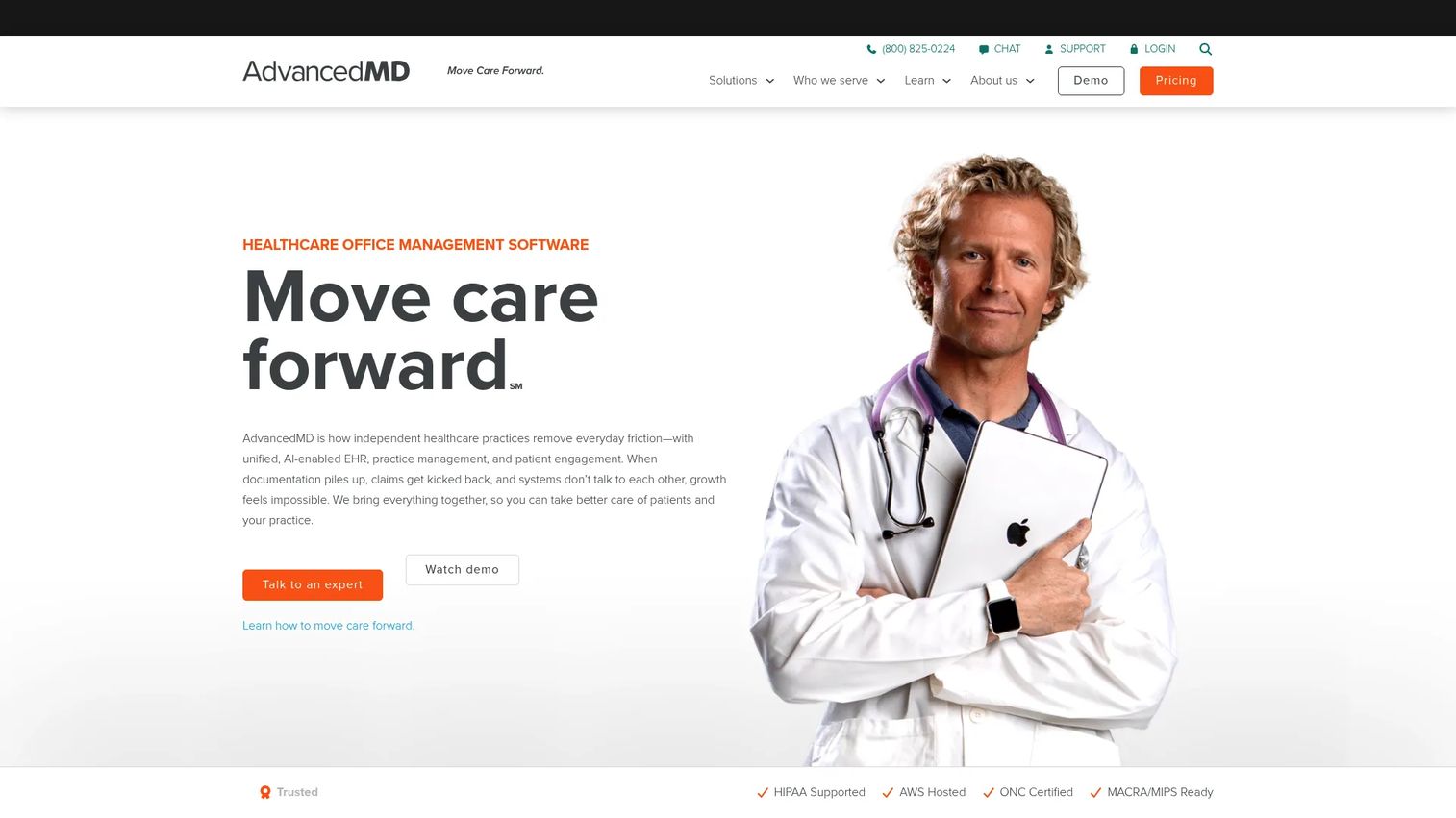
AdvancedMD approaches telemedicine as one module inside a full cloud practice management suite. Instead of bolting a video tool onto a separate chart and calendar, it bundles telehealth with EHR, scheduling, billing, ePrescribing, claims management, and patient engagement. For a practice tired of stitching point tools together, that consolidation is the pitch.
Best for: Independent and specialty medical practices that want an all-in-one cloud platform where telehealth lives inside the same system as charting and billing.
Key strengths
- Bundled practice management: Telehealth, EHR, scheduling, and billing run in one platform, so visit data flows without manual handoffs.
- Patient engagement tools: Automated appointment reminders and a patient portal reduce no-shows and administrative load.
- Specialty-tuned configurations: Packages are shaped for specific specialties rather than a generic one-size setup.
Why choose AdvancedMD: The value here is workflow depth, not video quality. When your telemedicine visit, your chart, and your claim all live in the same system, EHR integration telemedicine stops being a project and becomes the default. That matters most for practices billing volume where every handoff between systems is a chance to lose money or time.
AdvancedMD pricing: Pricing is specialty-based and published on their site. Mental Health starts at $130 per provider per month, MedSpa at $278, and Physical Medicine and Addiction Medicine at $399. Medical Specialties range from $429 to $1,070 per provider per month, and RCM services run 4 to 8% of collections. There is no permanent free tier. AdvancedMD holds a 3.6/5 rating on G2.
3. Sermo
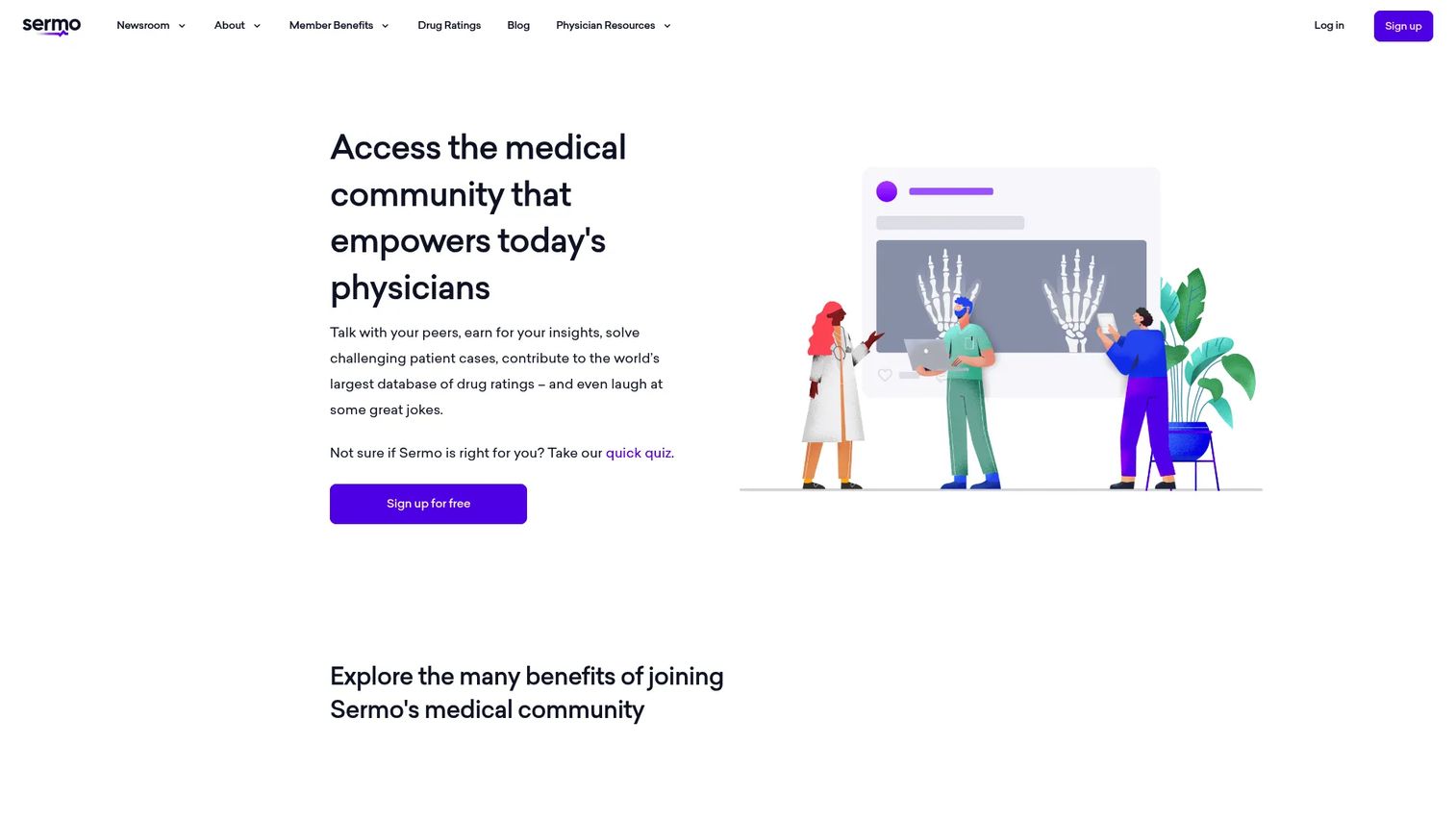
Sermo is not a telemedicine vendor, and it belongs on this list precisely because buyers should know the difference. It is a free, verified physician-only social network and research community where licensed clinicians discuss cases, rate drugs, and complete paid medical surveys. When founders and operators research telemedicine platforms, Sermo is where the physicians who use those platforms talk candidly about them.
Best for: Licensed healthcare professionals seeking peer discussion, clinical crowdsourcing, and survey earnings, plus buyers who want unfiltered practitioner sentiment.
Key strengths
- Verified HCP community: Every member is a credential-verified healthcare professional, which keeps peer discussion clinically grounded.
- Paid surveys and research: Physicians earn from medical surveys, and healthtech teams gather real practitioner research.
- Drug ratings and case insights: Crowdsourced clinical opinion surfaces on drugs, cases, and, often, the software providers use daily.
Why choose Sermo: Use Sermo as a research layer, not a care platform. If you are a founder validating how clinicians actually feel about telemedicine software providers, or a physician wanting peer input before adopting a tool, this is the community where that conversation happens without vendor spin.
Sermo pricing: Membership is completely free. Sermo monetizes through research partnerships and surveys rather than physician subscriptions, so there is no pricing tier to evaluate. A current G2 rating was not available at the time of writing.
4. Health Recovery Solutions
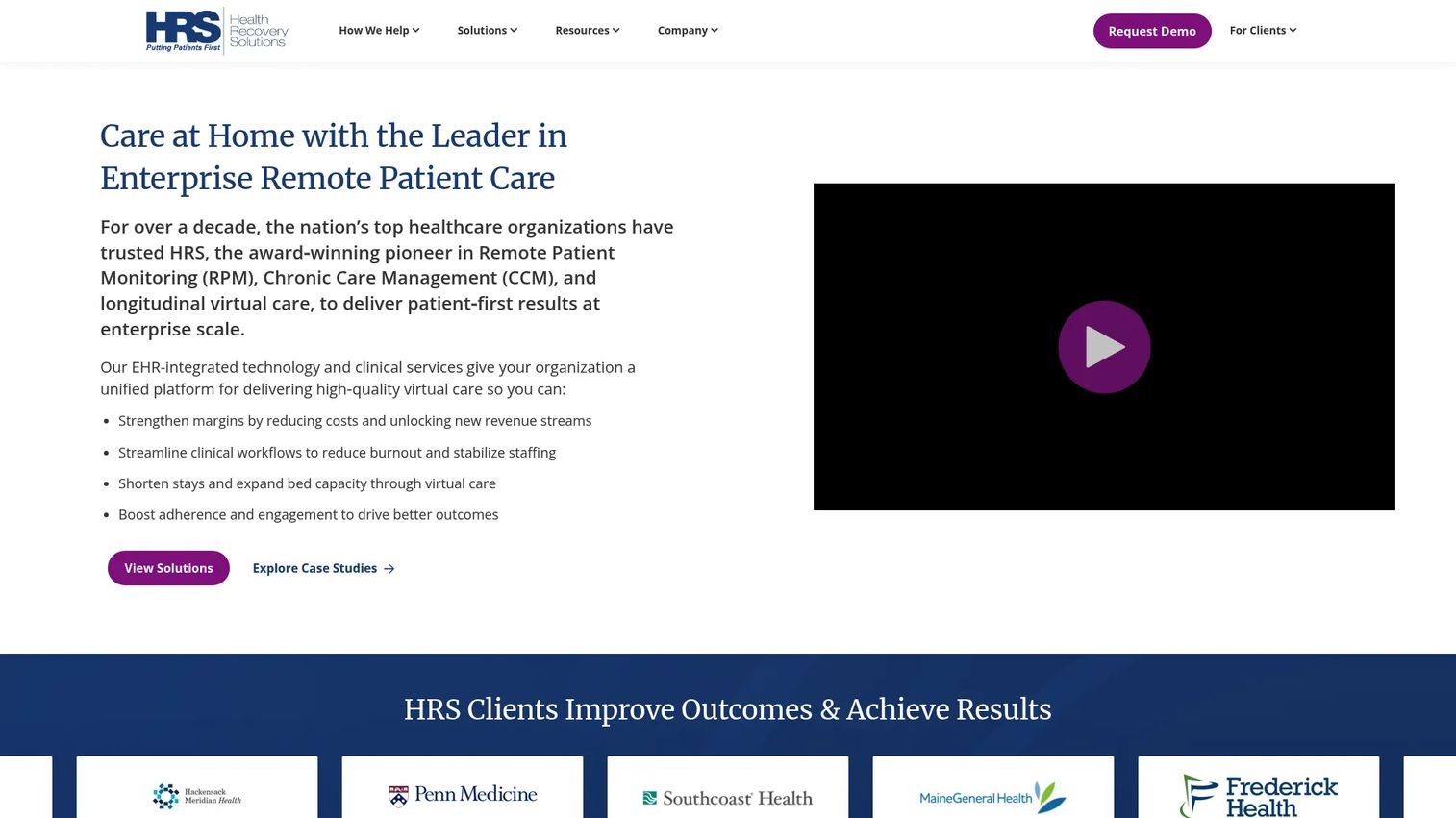
Health Recovery Solutions sits at the intersection of telehealth and remote patient monitoring. Rather than focusing on one-off video visits, it is built for organizations running continuous care programs: chronic condition management, post-discharge monitoring, and home health. The platform pairs telehealth with connected devices and reimbursement support so programs can actually get paid.
Best for: Hospitals, home health agencies, and health systems launching or expanding remote care and RPM programs.
Key strengths
- Remote patient monitoring: Connected devices feed patient vitals back to care teams for continuous monitoring between visits.
- EHR integration: Monitoring and visit data connect to the EHR so clinical teams work from one record.
- Reimbursement support: Built-in guidance helps organizations navigate RPM billing and reimbursement requirements.
Why choose Health Recovery Solutions: This is the platform for care that does not end when the video call does. If your program manages chronic conditions or high-risk discharges, the combination of RPM, secure messaging, and EMR integration supports a virtual care workflow that spans weeks, not minutes. It fits synchronous and asynchronous care rather than just scheduled visits.
Health Recovery Solutions pricing: Pricing is not published publicly. HRS states that cost depends on program factors like patient volume, device needs, and program scope, and directs prospects to contact sales for a quote. A G2 rating is not yet established from public reviews, so weigh references and case studies during evaluation.
5. Amwell
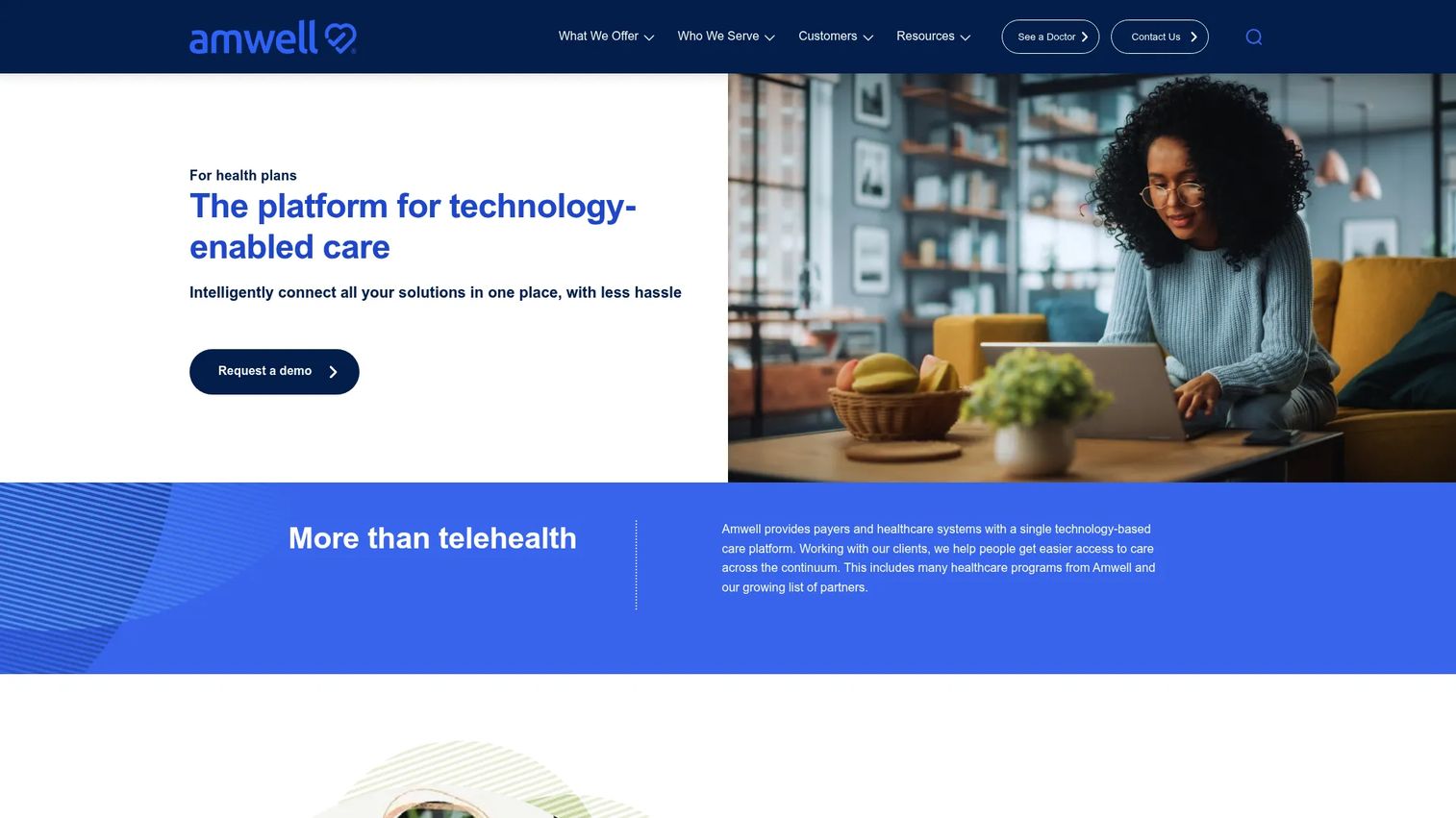
Amwell is enterprise telehealth infrastructure. Where lighter tools serve a single practice, Amwell provides a unified digital care platform designed for health systems and payers running virtual care at scale. It supports on-demand and scheduled visits, hybrid care models, and deep EHR integrations across a large organization.
Best for: Healthcare organizations that need enterprise telehealth and hybrid care infrastructure across many providers and service lines.
Key strengths
- Unified digital care platform: One platform coordinates on-demand, scheduled, and hybrid virtual care across an organization.
- EHR integrations: Deep connections to clinical systems keep enterprise workflows and records aligned.
- Scheduled and on-demand visits: Supports both booked appointments and immediate urgent care access.
Why choose Amwell: For a health system, the question is not whether video works but whether the platform can orchestrate virtual care across departments, integrate with existing clinical infrastructure, and meet regulated healthcare operational requirements. Amwell is built for that scale of complexity rather than a single clinic's needs.
Amwell pricing: Amwell does not publish public pricing. Its business pages use request-a-demo and contact-sales flows, which is typical for enterprise telehealth platforms where deployment scope drives cost. Expect a scoped quote based on organization size and integration needs. Amwell holds a 3.5/5 rating on G2.
6. Teladoc Health
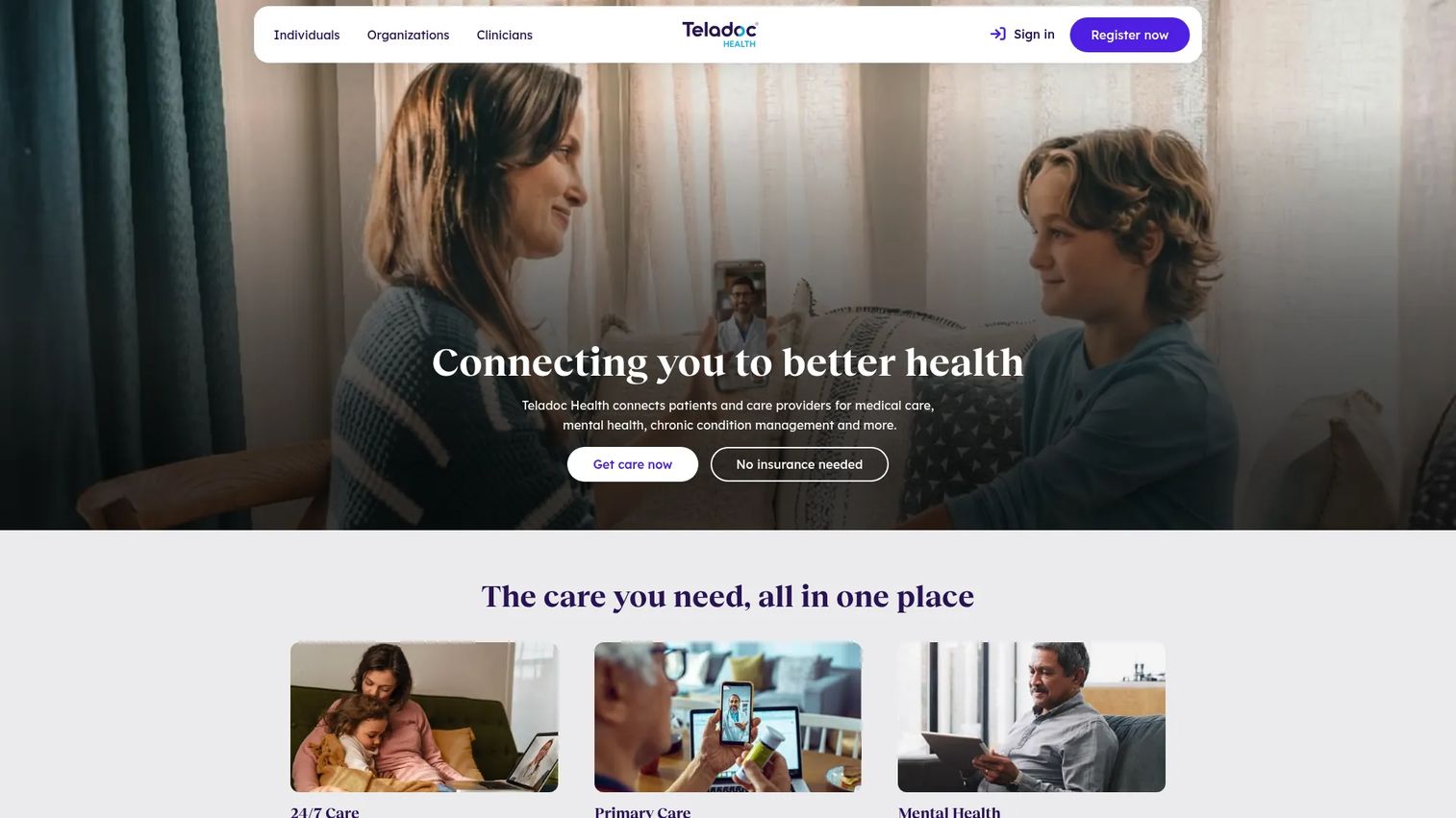
Teladoc Health is one of the most recognized names in virtual care, offering breadth across primary care, urgent care, mental health, dermatology, and chronic condition support. Its scale makes it a common choice for employers and health plans that need to give large populations access to on-demand telehealth rather than for a single clinic buying software to run.
Best for: Employers, health plans, and individuals seeking virtual primary care and on-demand telehealth at population scale.
Key strengths
- Virtual primary care: Patients access primary care by phone or video, with continuity across visits.
- 24/7 urgent care: Round-the-clock access covers common urgent issues without an in-person trip.
- Multi-service breadth: Mental health, dermatology, and chronic care sit alongside general virtual visits.
Why choose Teladoc Health: The differentiator is reach and service range. If the goal is broad patient access across a large covered population rather than software you configure and run in-house, Teladoc's multi-service model and payer relationships fit the enterprise and health-plan context better than a practice-level tool.
Teladoc Health pricing: Teladoc does not publish one universal subscription price because cost depends on coverage. Insured visits can start at $0, while self-pay pricing is listed for some services: 24/7 Care and Dermatology visits at $89, and Mental Health from $119 per visit. Employer and health-plan pricing is negotiated separately. Teladoc holds a 3.0/5 rating on G2.
7. Mend
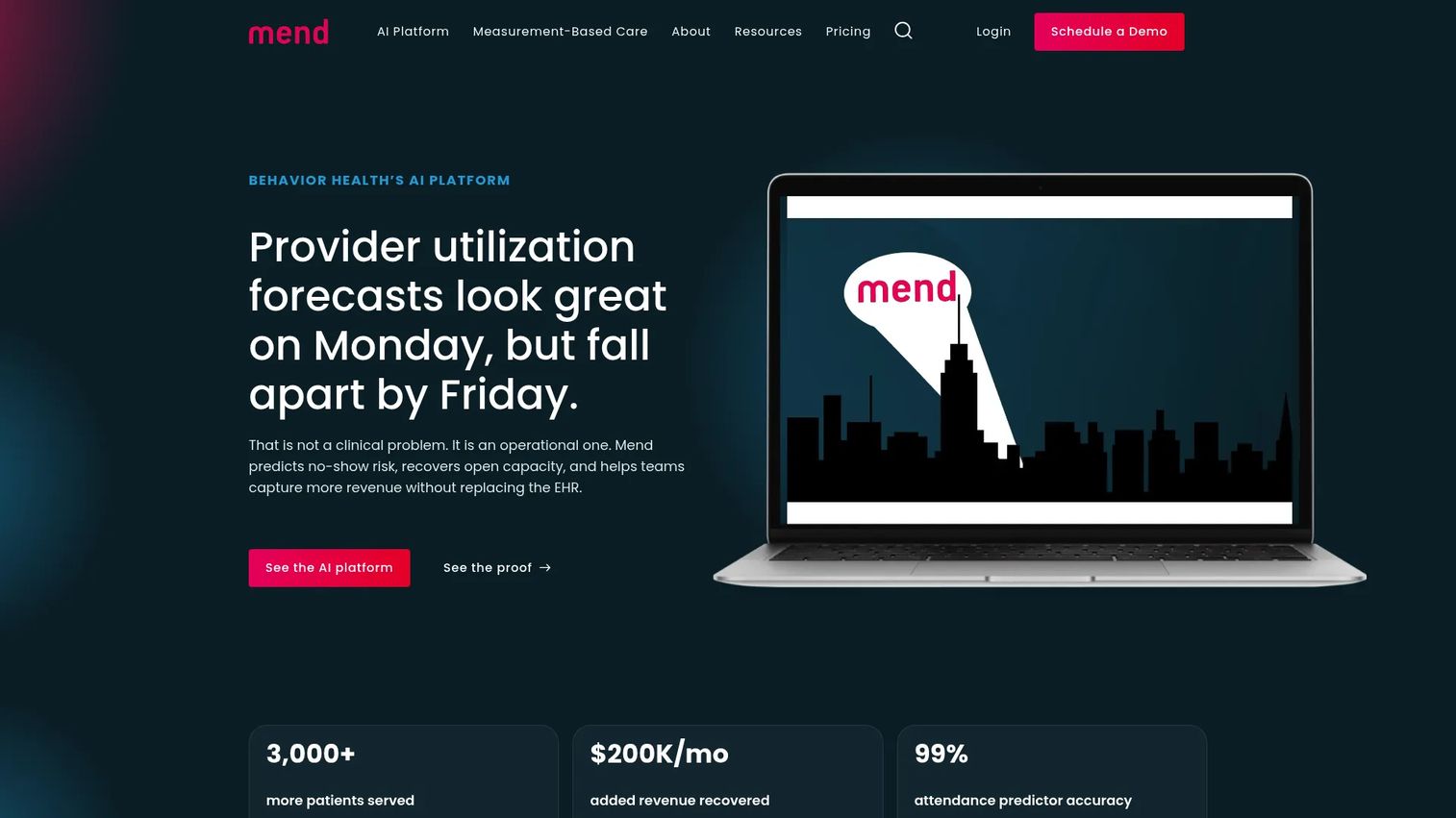
Mend focuses on behavioral health and leans hard into reducing friction across the patient journey with AI. Its standout components target the moments where virtual visits usually break down: getting patients ready to join, filling the schedule, and lightening the administrative load on staff. For behavioral health organizations, where no-shows and intake friction are chronic problems, that focus is pointed.
Best for: Behavioral health organizations that need telehealth plus workflow automation to reduce no-shows and intake friction.
Key strengths
- Patient Readiness Agent: Proactively prepares patients to join their visit, cutting the technical failures that cause no-shows.
- Scheduling Agent: Automates appointment handling and intake workflows so staff spend less time on coordination.
- AI Co-Pilot: Surfaces operational insights and supports providers during and around visits.
Why choose Mend: In behavioral health, engagement is the whole game. Mend frames itself around the patient journey rather than the video window, using AI to handle readiness, scheduling, and intake so clinicians focus on care. If missed appointments and manual coordination are draining your team, that is exactly the friction Mend targets.
Mend pricing: Pricing is not published and is handled through a custom-quote flow, so you contact Mend for numbers scoped to your organization. Among the platforms here, Mend carries the highest public G2 rating at 4.7/5, which is worth weighing alongside the private pricing.
Considerations before you buy
A shortlist narrows the field. These criteria help you close the decision.
HIPAA compliance and security
Every vendor here markets itself as HIPAA-oriented, but marketing is not a Business Associate Agreement. Confirm the vendor will sign a BAA, ask how data is encrypted in transit and at rest, and verify where patient data is stored. HIPAA compliant telemedicine software is table stakes, so treat any vagueness here as a red flag rather than a detail.
EHR and system integration
Ask specifically which EHR and EMR systems the platform integrates with and how deep that integration goes. A one-way data push is not the same as a bidirectional sync. If the tool does not connect to the systems you already run, you are buying a new silo, not a solution.
Patient access and experience
Test the join flow yourself the way a patient would, from a phone, on a browser, with no account. Count the clicks and the potential failure points. Browser-based telemedicine with no download consistently produces higher completion rates, and completion is what gets you paid.
Pricing model and total cost
Some platforms publish per-provider pricing, others gate everything behind sales. Look past the sticker price to per-encounter fees, setup costs, integration charges, and contract minimums. A low headline number with expensive add-ons can cost more than a transparent bundle.
Support and implementation
For anything beyond a solo video tool, implementation is where deals succeed or stall. Ask about onboarding timelines, training, and the support model. A platform your staff cannot operate confidently will underperform its spec sheet regardless of features.
Conclusion
There is no single best telemedicine software, only the best fit for your operation. For a solo provider or small clinic that wants frictionless secure video visits with minimal setup, Doxy.me is the cleanest starting point. For a practice that wants telehealth, scheduling, EHR, and billing in one system, AdvancedMD consolidates the whole workflow. Health systems and payers running virtual care at scale should look at Amwell for infrastructure depth and Teladoc Health for population reach. Behavioral health teams battling no-shows will find Mend's AI-driven engagement pointed at their exact problem, while Health Recovery Solutions fits continuous remote patient monitoring programs. Sermo, meanwhile, is the research layer where you hear how clinicians actually feel about these tools.
Your next step is simple. Shortlist two or three platforms that match your practice size and workflow complexity, then run the patient join flow yourself before booking a single sales call. The tool that feels effortless to a patient and clean to your staff is the one worth pursuing. If you evaluate software across categories, our guide to the best AI video generators applies the same test-before-you-commit discipline.
FAQs
Telemedicine refers specifically to remote clinical care, meaning diagnosis, treatment, and prescriptions delivered by a licensed provider through secure video visits or other channels. Telehealth is the broader term that also includes non-clinical services like provider education, administrative meetings, and remote patient monitoring. In practice, most telehealth platforms include telemedicine capability plus the surrounding scheduling, documentation, and messaging infrastructure.
At minimum, expect secure video visits, scheduling and reminders, digital consent workflows, documentation tied to the encounter, and a patient portal. Stronger platforms add EHR integration so visit data flows into the chart automatically, secure messaging for between-visit questions, and remote patient monitoring for chronic care. The features that matter most depend on your workflow, but integration and patient access separate a real tool from a bare video link.
Yes, when the vendor implements it properly. Browser-based telemedicine can be fully HIPAA-oriented with end-to-end encryption, and it removes the security risks that come with patients installing and mismanaging apps. Confirm the vendor signs a Business Associate Agreement, encrypts data in transit and at rest, and documents its compliance posture. Browser access improves patient completion rates without sacrificing security when configured correctly.
For any practice billing volume, yes. EHR integration telemedicine keeps documentation, coding, and scheduling tied to the visit instead of scattered across systems, which reduces manual re-entry and billing errors. A solo provider running occasional visits may get by without it, but growing practices almost always find that unintegrated tools quietly add administrative work rather than removing it.
For small practices and solo providers, Doxy.me is often the best fit because its browser-based access needs no patient downloads or logins and it offers a free version to test before committing. Practices wanting scheduling, billing, and charting in one system tend to prefer AdvancedMD, which starts at $130 per provider per month for mental health. The right choice depends on whether you need a focused video tool or full practice management.
Treat it as an operations decision, not a feature checklist. Verify HIPAA compliance and a signed BAA, confirm depth of EHR integration with your specific systems, test the patient join flow yourself, and map total cost including per-encounter and integration fees. Then weigh implementation and support, since a platform your staff cannot run confidently will underperform regardless of its spec sheet.
Models vary widely. Some vendors publish per-provider monthly pricing, like AdvancedMD from $130 per provider per month. Others use per-visit or coverage-dependent pricing, like Teladoc Health with insured visits starting at $0. Enterprise and RPM platforms such as Amwell, Health Recovery Solutions, and Mend typically gate pricing behind a custom quote scoped to organization size and integration needs. Always account for setup, integration, and contract minimums beyond the headline number.