

You paid for the click. The visitor landed. Then they left.
That's the part nobody puts in the campaign recap. You can pour budget into paid search, refine your targeting, and rewrite ad copy for weeks, but if the page they arrive on doesn't move them, none of it matters. The spend still leaves your account.
Most teams treat this as a traffic problem. Buy more clicks, they think. Wider audiences. Better keywords. They're optimizing the wrong end of the funnel. The bottleneck isn't attention. It's what happens in the 8 seconds after the page loads, when the visitor decides whether your offer is worth their next click.
Companies using optimization software report an average 30% lift in conversion rates compared with those not using such tools, according to GTM8020 (2024). That gap is not about traffic volume. It's about testing, diagnosing, and personalizing the page itself, then iterating faster than the campaign calendar moves.
This guide is a stack selection framework, not a shopping list. If you want your page to convert visitors into product experiences, an interactive demo embedded on that page is one of the highest-leverage moves available, and we'll cover where it fits. First, the tools.
What's inside
This guide is for growth marketers, demand gen leads, and product marketers who need to lift landing page conversion without adding an engineering dependency.
We picked tools based on four criteria that matter to this audience:
- Experimentation support: how fast you can test and iterate
- Integration quality: clean connections to CRM, analytics, and automation
- Measurement depth: quantitative and qualitative signal you can act on
- Speed to value: how quickly the tool earns its place in your stack
You'll get a comparison table, nine tool breakdowns, and guidance on how to assemble a stack, not just pick one tool.
TL;DR
- Best for conversion-focused teams turning traffic into product experiences: Guideflow, for embedding interactive demos, sandboxes, and demo centers on landing pages.
- Best landing page builder in one platform: Unbounce, for building, testing, and publishing fast.
- Best for paid media teams and agencies: Instapage, for post-click page creation and collaboration.
- Best all-in-one testing and analytics suite: VWO, for A/B testing plus behavior insights.
- Best for enterprise experimentation: Optimizely, for governance and statistical rigor at scale.
- Best for behavioral diagnostics: Hotjar for quick qualitative insight, FullStory for deep journey analytics.
- Best for message testing before launch: Wynter, for validating copy with real B2B buyers.
- Best for usability validation: UserTesting, for watching real users interpret your page.
What is landing page optimization software
Landing page optimization software is a category of tools that help teams improve conversion by testing, analyzing, personalizing, and iterating landing pages after traffic arrives.
Some tools in the category build the page. Others test variations, record behavior, run message research, or personalize content by audience. Most teams end up combining two or three, because no single tool covers building, testing, insight, and research equally well.
Core features across the category:
- A/B and multivariate testing to compare page variations and prove what converts
- Heatmaps and session recordings to see where visitors click, scroll, and drop off
- Message testing and user research to validate copy before you spend on traffic
- Personalization and traffic source targeting to match the page to the visitor's intent
- Form and funnel analysis to find friction points that lose conversions
- Integrations with analytics, CRM, and marketing automation so results feed the rest of your stack
The distinction that trips up buyers: a landing page builder creates the page, while a conversion rate optimization software layer tests and improves it. A landing page analysis tool tells you why a page underperforms. You often need more than one.
When to use
Launch a campaign faster without waiting on engineering
Campaign calendars don't wait for a sprint. When a launch date is fixed, marketers reach for tools that let them build, test, and publish pages without filing an engineering ticket. Speed here means shipping a variant this afternoon, not next quarter. That independence is the whole point of the category.
Fix traffic that is converting poorly
A campaign goes live. The clicks come. The conversions don't. Testing and behavioral analytics tools diagnose the problem after the fact, showing you where visitors hesitate, what they ignore, and which step loses them. You stop guessing and start reading the actual behavior on the page.
Personalize landing pages by audience or source
The same page rarely works for every traffic source. A visitor from a branded search knows you; a cold paid social click does not. Landing page personalization tools let you swap headlines, offers, and product framing by source, segment, or account, so the message matches the intent behind the click.
Comparison table
The best choice depends on what job you're hiring the tool for. Need to build pages? Start with a builder. Need to prove what converts? Start with a testing suite. Need to understand why a page fails? Start with an analytics or research layer. Here's how the nine stack up.
| # | Product | Best for | Key differentiator | Pricing | G2 rating |
|---|---|---|---|---|---|
| 1 | Guideflow | Turning landing page traffic into interactive product experiences | Interactive demos, sandboxes, and demo centers embedded on pages | Free; paid from $40/mo | 5.0/5 |
| 2 | Unbounce | Building and testing landing pages in one platform | Smart Traffic and AI optimization | From $29/mo | 4.2/5 |
| 3 | Instapage | Paid media teams and agencies | Post-click personalization and collaboration | From $79/mo | 4.3/5 |
| 4 | VWO | All-in-one CRO and experimentation | Testing plus heatmaps and recordings in one suite | Request pricing | 4.4/5 |
| 5 | Optimizely | Enterprise experimentation | Governance and statistical rigor at scale | Request pricing | 4.2/5 |
| 6 | Hotjar | Quick behavioral insight | Heatmaps, recordings, and surveys together | Free; paid from $31/mo | 4.3/5 |
| 7 | Wynter | Pre-launch message testing | Verified B2B buyer panels | From $20,000/yr | 4.8/5 |
| 8 | UserTesting | Usability validation | Real users narrating your page | Request pricing | 4.4/5 |
| 9 | FullStory | Deep behavioral diagnostics | Session replay plus product analytics | Free; paid on request | 4.5/5 |
Best 9 tools for landing page optimization
1. Guideflow
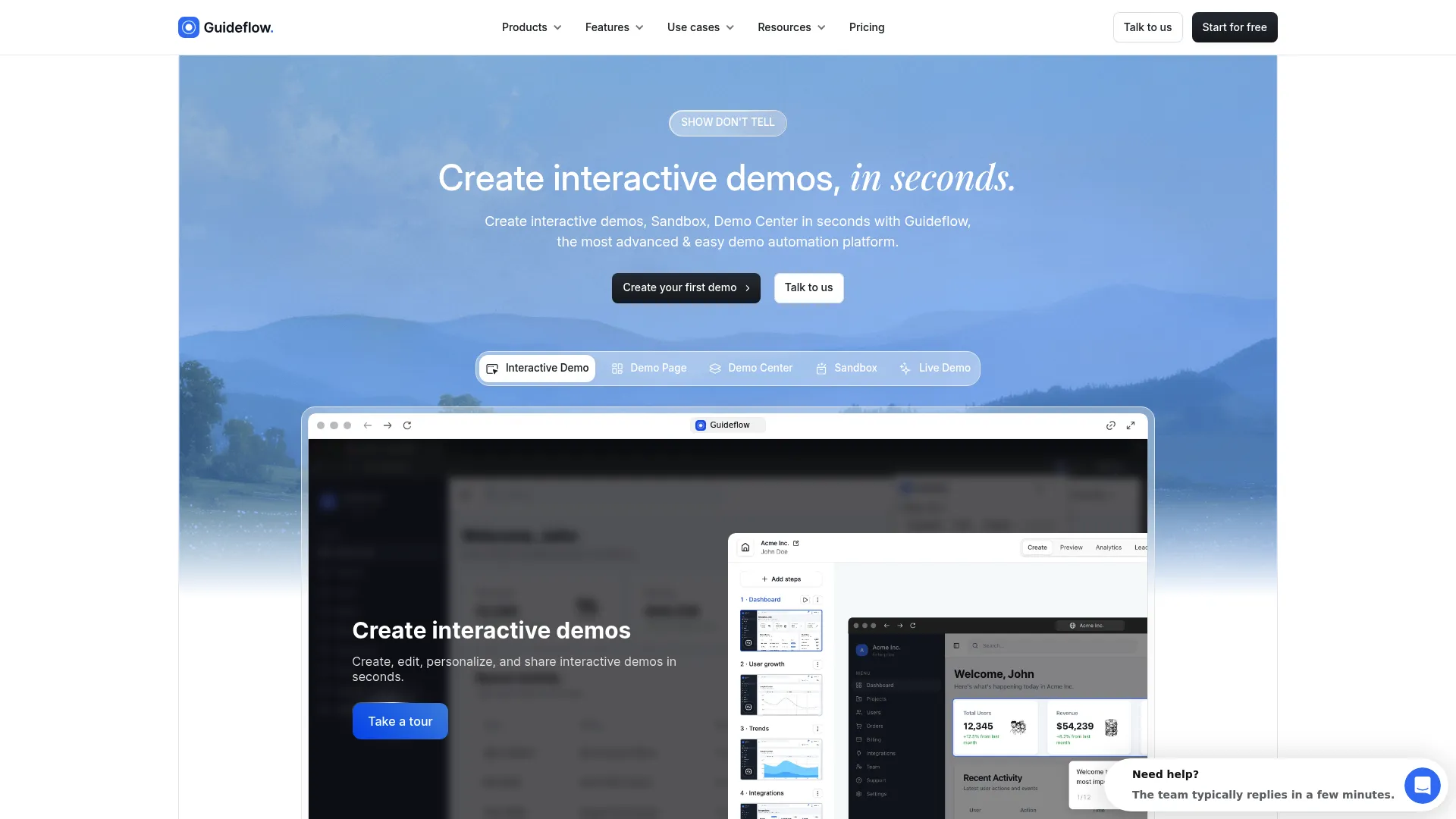
Guideflow is a demo automation platform that turns your product into self-serve interactive experiences you can embed directly on a landing page. Instead of asking a cold visitor to read three paragraphs or book a call, you let them click through your product themselves. For conversion-focused teams, that changes what a landing page can do: it stops describing value and starts showing it.
Best for: Growth and product marketing teams that want to convert landing page traffic by letting visitors experience the product, not just read about it.
Key strengths
- Interactive demos, sandboxes, and demo centers for landing pages, onboarding, sales follow-ups, and support docs
- No-code capture of your product in a few clicks
- Lead-level personalize of text, images, and flows by segment
- Session-level analyze: impressions, completion, drop-offs, conversion
- Clean integrations with CRM, marketing automation, and analytics
Guideflow's formats each serve different moments. An interactive demo guides a visitor through a curated path and performs best when you want to control the narrative. A sandbox gives users full freedom to explore the product on their own terms, which excels when a technical buyer wants to validate a specific workflow. A Demo Center gives your team a single branded hub to organize and track every demo by persona, product line, or funnel stage. Together, they let a landing page carry a full self-serve experience.
Why choose Guideflow: A landing page builder gets a visitor to the page. Guideflow gives them something to do once they arrive. It sits alongside your builder and testing suite as the interactive experience layer, and the engagement data feeds your CRM for lead scoring. Reported outcomes include a +30% conversion rate.
Guideflow pricing: Free plan with 5 guideflows and unlimited viewers. Solo is $40/month with unlimited guideflows and advanced analytics. Startup is $599/month, Advanced is $1,799/month, and Enterprise starts from $3,499/month.
Start your journey with Guideflow today!
2. Unbounce
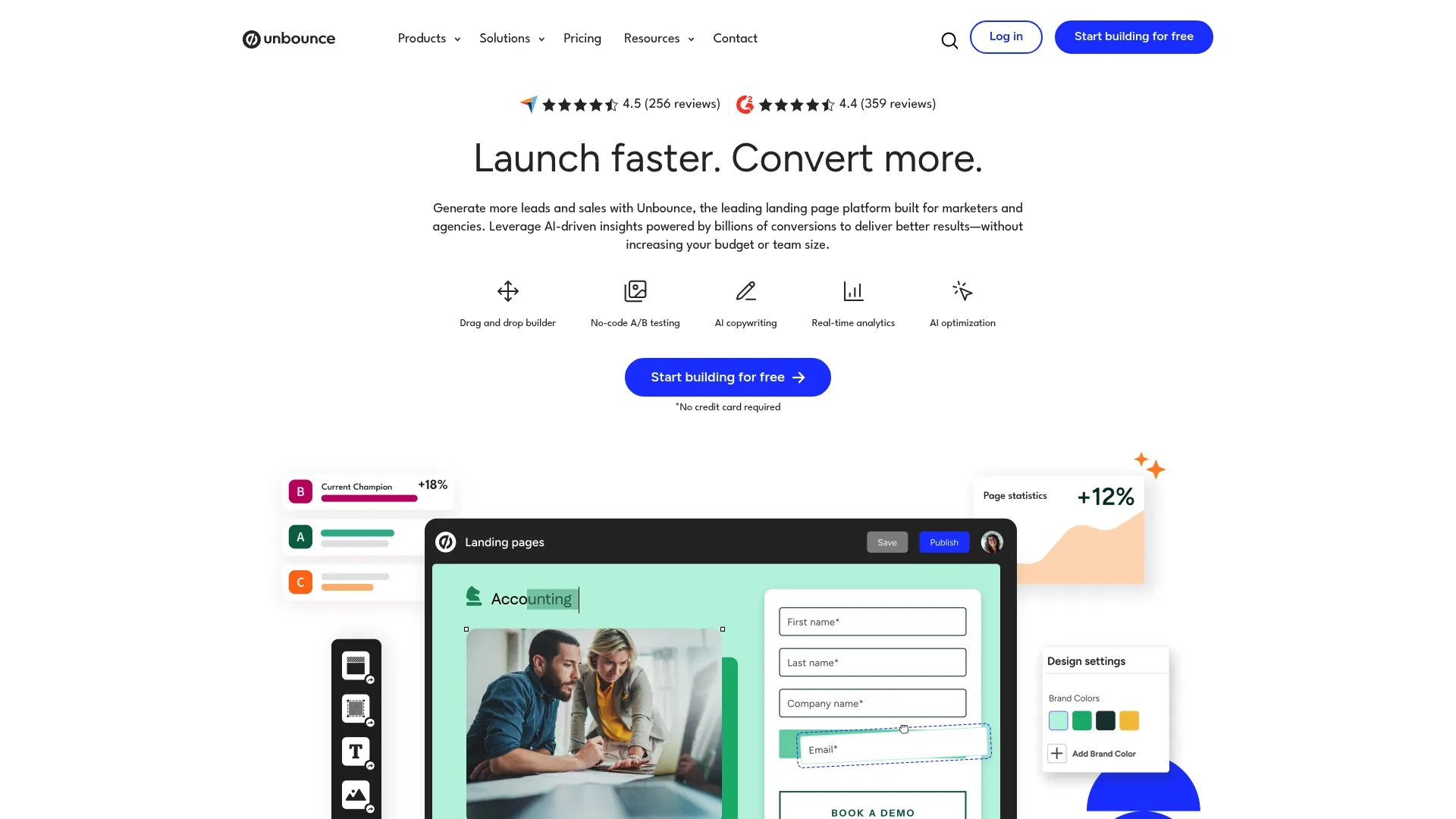
Unbounce is an AI-powered landing page builder and conversion platform built for marketers and agencies. You build pages with a drag-and-drop editor, then use its Smart Traffic feature to route visitors to the variant most likely to convert them. It combines page creation, A/B testing, and traffic optimization in one place, which suits teams that want to launch and iterate without switching tools.
Best for: Marketers and agencies that want to build, test, and publish landing pages in a single platform.
Key features
- Drag-and-drop landing page builder
- Smart Traffic AI conversion routing
- A/B testing on page variants
- Popups and sticky bars
- Dynamic text replacement for ad matching
Why choose Unbounce: If your bottleneck is publishing speed and you want testing built into the same tool you build in, Unbounce keeps the whole workflow in one place. It fits teams that live in the build-test-iterate loop daily.
Unbounce pricing: No permanent free tier, but a 14-day free trial is available. Starter is $29/month, Build is $99/month, Experiment is $149/month, and Optimize is $249/month. Concierge and Agency plans are custom.
3. Instapage
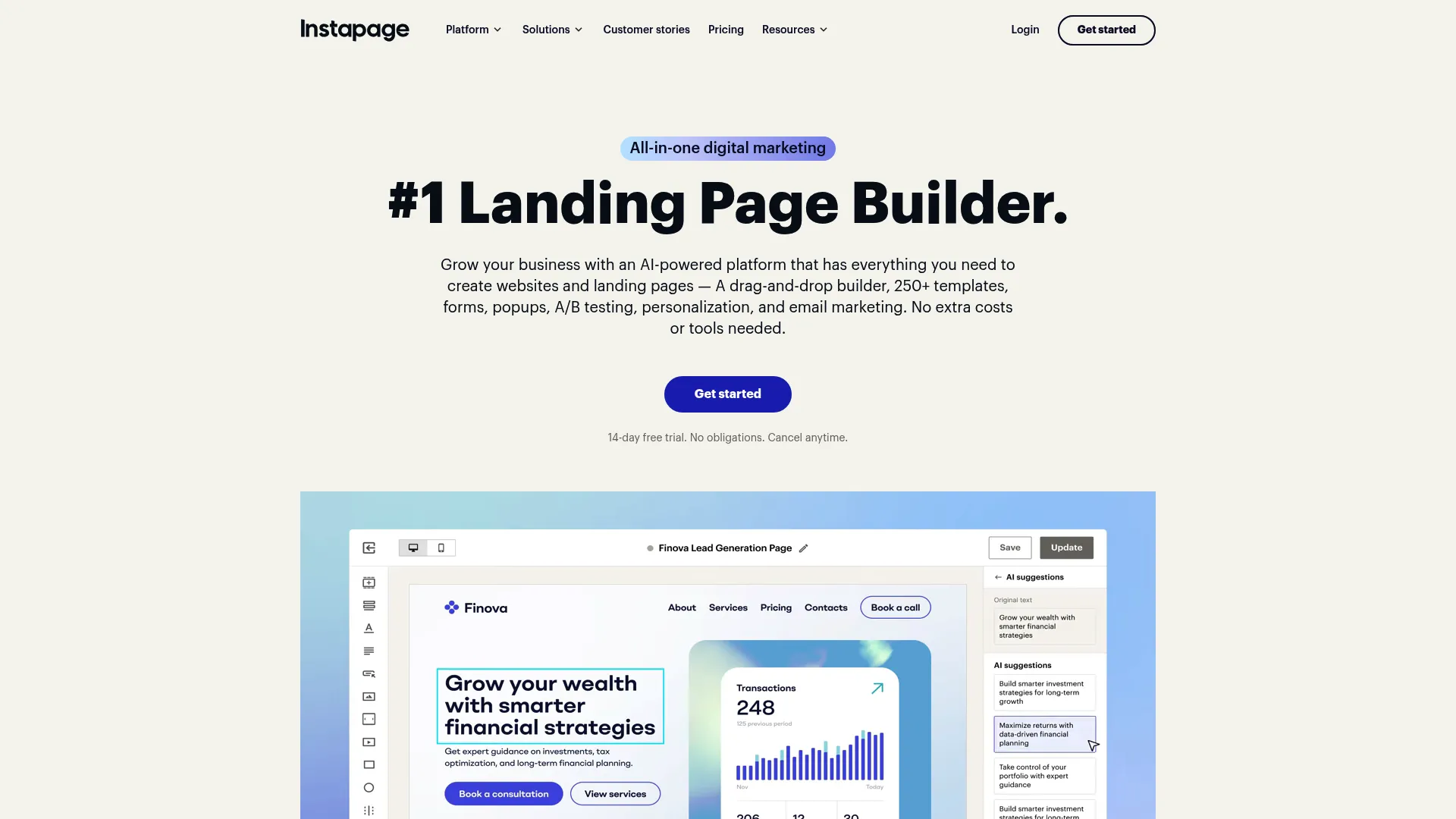
Instapage focuses on post-click optimization: the experience after someone clicks your ad. It pairs a landing page builder with personalization and strong collaboration features, which makes it a fit for paid media teams running many campaign-specific pages. Agencies use it to build and manage pages at scale while keeping clients in the review loop.
Best for: Paid media teams and agencies building high-converting, campaign-specific landing pages at scale.
Key features
- Landing page builder with conversion focus
- A/B testing and experimentation
- Personalization by audience and campaign
- Real-time team collaboration
- Ad-to-page relevance matching
Why choose Instapage: When you're running dozens of paid campaigns and each one needs its own tailored page, Instapage's collaboration and personalization tooling keeps the volume manageable. It suits teams whose primary job is post-click conversion from paid traffic.
Instapage pricing: No free tier. Create is $79/month and Optimize is $159/month on annual billing (shown as $99 and $199 monthly). The Convert plan is custom, contact sales.
4. VWO
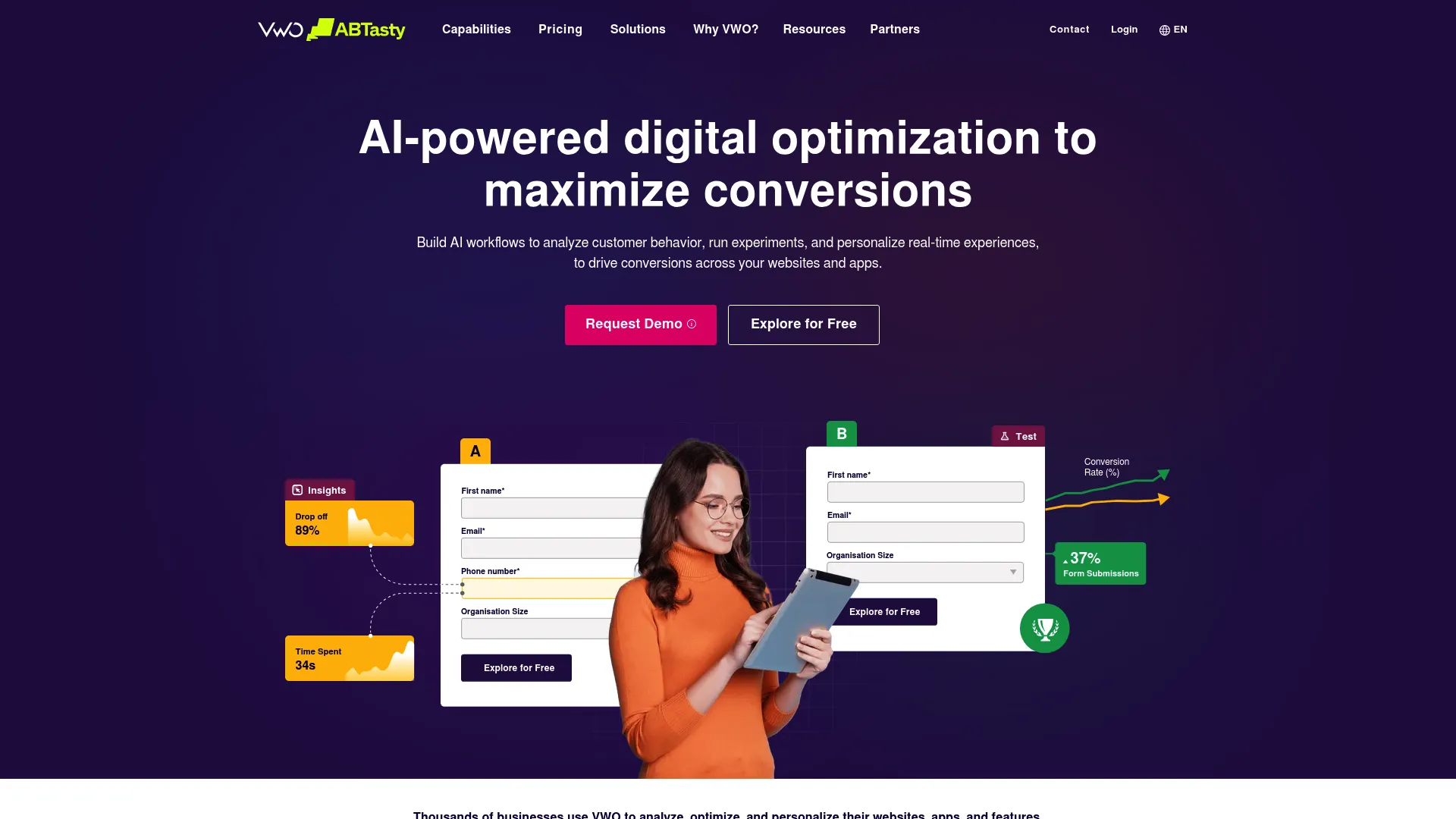
VWO is an experience optimization platform that combines experimentation with behavioral insight in one suite. You get A/B, split URL, and multivariate testing alongside heatmaps, session recordings, and surveys, so you can test a change and see the behavior behind the result without stitching tools together. That makes it a strong fit for scaling teams that want their testing and insight layers in the same place.
Best for: Teams that want an all-in-one CRO and experimentation suite rather than separate testing and analytics tools.
Key features
- A/B, split URL, and multivariate testing
- Personalization and feature experimentation
- Heatmaps and session recordings
- Surveys and on-page feedback
- Behavior analytics in one platform
Why choose VWO: If you're tired of exporting test results into a separate analytics tool to understand why a variant won, VWO keeps experimentation and behavioral data together. It fits teams scaling their optimization program past ad hoc tests.
VWO pricing: VWO offers a free tier. Public plan names are Growth, Pro, and Enterprise, with pricing shown as request pricing rather than public numbers on the pricing page.
5. Optimizely
Optimizely is an enterprise-grade digital experience platform with deep experimentation at its core. It supports A/B, multivariate, multi-page, feature, and server-side testing, with the statistical rigor and governance that larger organizations need. When multiple teams run experiments across web and product, Optimizely provides the controls, targeting, and audit trail to keep it coordinated.
Best for: Enterprise teams that need experimentation and personalization across web and product experiences with governance built in.
Key features
- A/B, multivariate, and server-side experimentation
- Feature experimentation and rollouts
- Personalization and audience targeting
- Statistical rigor for confident decisions
- AI-powered optimization tooling
Why choose Optimizely: When experimentation spans several teams and needs governance, permissions, and defensible statistics, Optimizely is built for that scale. It fits organizations where cross-team coordination and rigor matter more than speed of setup.
Optimizely pricing: Every plan is individually packaged, and public numeric pricing is not shown on the plans page. A free Rollouts plan is documented for Feature Experimentation. Request a demo for a quote.
6. Hotjar
Hotjar, now part of Contentsquare, is a behavior analytics and feedback tool built for quick qualitative insight. Heatmaps show where visitors click and scroll, session recordings show how they move through the page, and surveys capture what they think. It pairs well with a builder and a testing platform: Hotjar tells you where the friction is, and your other tools help you fix it.
Best for: Teams that want fast, qualitative insight into how visitors interact with a landing page.
Key features
- Heatmaps for clicks and scroll depth
- Session replay and recordings
- On-page surveys and feedback widgets
- Funnel and drop-off visualization
- Feedback polls tied to page elements
Why choose Hotjar: When you need to see why a page underperforms without setting up a full analytics implementation, Hotjar gets you qualitative signal fast. It complements rather than replaces your builder and testing tools.
Hotjar pricing: Basic is free forever. Plus is $31/month, Business is $79/month, and Scale is $170/month. Surveys and interview products have separate plan tiers.
7. Wynter
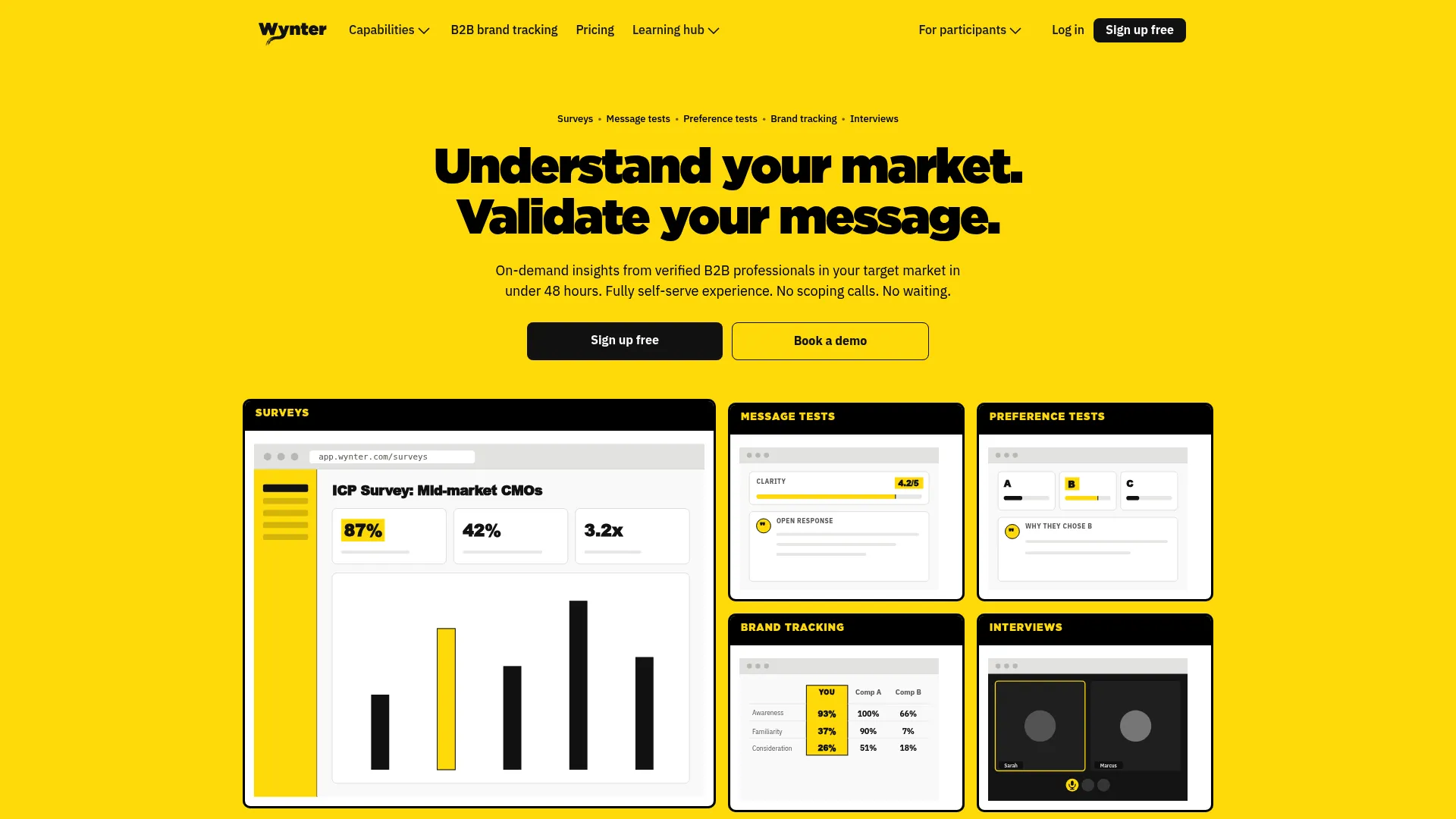
Wynter is an on-demand B2B market research platform for testing messaging before you commit budget to it. You submit a landing page or value prop, and verified buyers matching your ICP tell you what's clear, what's confusing, and what's missing, often within 12 to 48 hours. It answers a question testing tools can't: does your target buyer actually understand and believe your copy?
Best for: B2B SaaS and product marketing teams validating messaging, positioning, and headlines before launch.
Key features
- Verified B2B audience targeting by title and firmographics
- Message testing on pages and value props
- ICP surveys and buyer interviews
- Brand tracking over time
- Results in 12 to 48 hours
Why choose Wynter: Testing tools optimize a page you've already built. Wynter validates the message before you build or buy traffic, so you avoid pouring spend into copy your buyers don't understand. It fits teams that want to fix the message upstream.
Wynter pricing: No free tier. Pro is $20,000/year, Elite is $40,000/year, and Wynter Black is $100,000/year. Pay-as-you-go is available without a public listed price.
8. UserTesting
UserTesting is a human insight platform where real people narrate their experience as they move through your landing page. You watch where they hesitate, hear what confuses them, and learn how they interpret your offer. That qualitative depth catches clarity and friction issues that numbers alone miss, especially before a major launch.
Best for: Enterprise teams that need scalable user research and fast human insight on page clarity and friction.
Key features
- Unmoderated tests and surveys
- Moderated Live Conversation interviews
- Think-out-loud usability sessions
- AI-generated insight summaries
- Click maps and path flows
Why choose UserTesting: When your metrics show a drop-off but not the reason, watching real users interpret your page reveals the why. It fits teams validating message resonance and usability before committing to a page at scale.
UserTesting pricing: Advanced, Ultimate, and Ultimate+ plans are available with customized, quote-based pricing. You can run a free test, and qualifying education institutions can access the platform for free.
9. FullStory
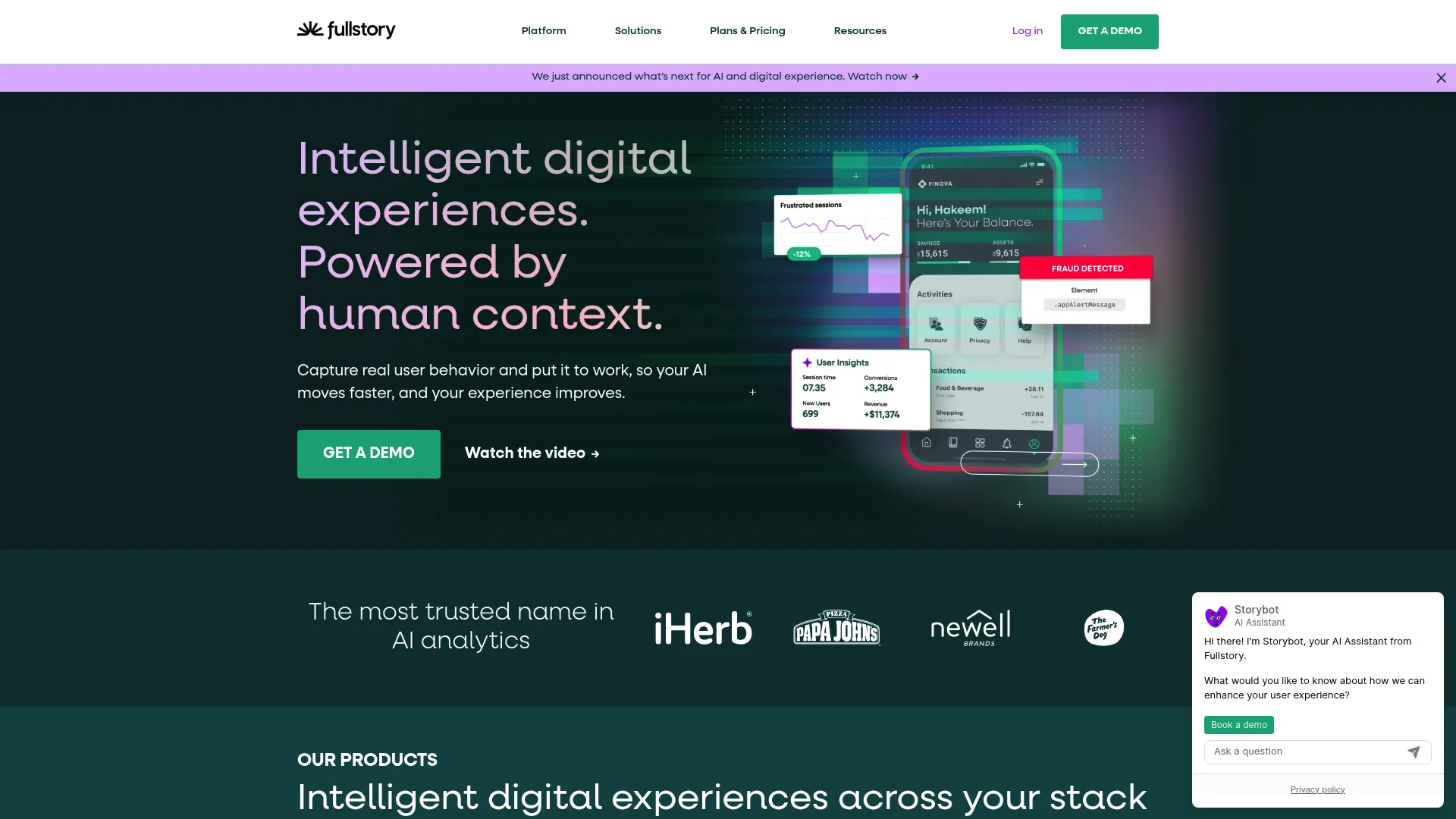
FullStory is a behavioral data and analytics platform that pairs session replay with product analytics. Beyond a single page, it captures the full journey, so you can trace how a landing page fits into the wider path a visitor takes across your site. For teams that need journey context and deep diagnostics rather than page-level snapshots, that breadth is the draw.
Best for: Teams that need deep behavioral diagnostics across the whole site journey, not just individual landing pages.
Key features
- Session replay and behavioral analytics
- Funnels, heatmaps, and click maps
- Scroll maps and rage-click detection
- StoryAI for AI-assisted insights
- Cross-page journey analysis
Why choose FullStory: When you need to understand a landing page in the context of the whole journey, not as an isolated snapshot, FullStory's depth pays off. It fits teams doing serious behavioral diagnostics across product and site.
FullStory pricing: FullStory offers a permanent free plan. Paid Business, Advanced, and Enterprise plans use request-based pricing rather than public numbers.
Considerations
What are you optimizing for?
Be clear on the job before you buy. A builder creates pages, a testing suite proves what converts, and an insight layer tells you why a page fails. Buying a builder when you need diagnostics, or vice versa, leaves the actual problem unsolved.
How fast do you need to ship tests?
Campaign timelines move fast. If you're launching weekly, prioritize tools that let you build and test without engineering involvement. A tool with a steep setup curve slows you down exactly when speed matters most.
Can your stack support personalization?
Personalization only works if the data feeding it is clean. Check that the tool connects to your CRM and analytics, and that traffic source and account data flow in reliably. Weak integrations make source-based targeting more trouble than it's worth.
Do you need qualitative or quantitative data?
Heatmaps and recordings show what happens on the page. Message tests and user interviews explain why. If your numbers already point to a clear problem, quantitative tools may be enough. If you don't know why a page fails, you need qualitative input.
Will the tool scale with your team?
Consider governance, permissions, collaboration, and pricing model before you commit. A tool that works for one marketer may not fit a team of fifteen with approval workflows and multiple stakeholders. Check that it grows with you.
Conclusion
There's no single best landing page optimization software, only the right layer for the job in front of you.
If you want to turn landing page traffic into hands-on product experiences, Guideflow lets you embed interactive demos, sandboxes, and demo centers directly on the page. If you need to build and iterate pages, Unbounce or Instapage keep creation and testing in one place. For experimentation depth, VWO suits scaling teams and Optimizely fits enterprise governance. For insight and research, pair Hotjar or FullStory for behavioral diagnostics with Wynter for message testing and UserTesting for usability validation.
Most strong stacks combine a builder, a testing suite, an insight layer, and an experience layer. Start with your biggest gap. If traffic arrives but doesn't convert, the fastest lever is often giving visitors something to do on the page, not just something to read.
Start your journey with Guideflow today!
FAQs
Landing page optimization software is a set of tools that help teams improve conversion by testing, analyzing, personalizing, and iterating landing pages. Some tools build the page, others test variations, record behavior, or run message research. Most teams combine two or three to cover building, testing, and insight.
For dedicated A/B testing software, VWO and Optimizely lead the category. VWO suits scaling teams that want testing plus heatmaps and recordings in one suite. Optimizely fits enterprise teams that need multivariate, server-side, and feature experimentation with governance and statistical rigor.
Usually, yes. A landing page builder creates and publishes the page, while an analytics or testing tool tells you how visitors behave and what converts. A builder alone leaves you guessing why a page underperforms; an analytics layer alone gives you nothing to change. Most teams run both.
Hotjar focuses on quick, qualitative insight for a single page or flow: heatmaps, recordings, and surveys that are fast to set up. FullStory goes deeper, capturing full-journey behavioral analytics and session replay across your whole site. Choose Hotjar for fast page-level signal, FullStory for deep cross-page diagnostics.
Use message testing when you're about to spend real budget on traffic or when a value proposition is new or unproven. Tools like Wynter let verified buyers tell you whether your copy is clear and believable before you build the page. It's cheaper to fix the message upstream than to burn spend on copy that doesn't land.
A strong stack for growth teams reduces the dependency on engineering, ships tests fast, and feeds clean data back into CRM and analytics. It should cover building, testing, behavioral insight, and, ideally, an interactive experience layer. The goal is fewer manual handoffs and defensible impact you can tie to pipeline.
Yes. An embedded interactive demo lets a visitor experience your product on the page instead of reading about it or booking a call, which lowers the friction to evaluate. Guideflow reports outcomes including a +30% conversion rate. Interactive demos also work in email, ads, onboarding flows, and help docs, so a single capture serves the whole funnel.
Start with your biggest gap and a tool with fast time-to-value. If you lack pages, pick a builder like Unbounce with testing built in. If pages get traffic but don't convert, add a behavioral analytics tool like Hotjar or an interactive demo layer. Prioritize free tiers and low setup overhead so one marketer can run it without engineering.