A single missed screening hit can cost more than a year of software. That is the uncomfortable math of trade compliance. You screen counterparties in a spreadsheet, someone forgets to refresh the sanctions list, one restricted party slips through, and now you are explaining a penalty to your board. The gap between "we thought we checked" and "we can prove we checked" is where fines, seized shipments, and reputational damage live.
The global trade compliance software market is projected to grow from USD 528.4 million in 2025 to USD 1,541.4 million by 2035, an 11.3% CAGR, according to Market.us (2025). Teams are not buying because compliance suddenly became interesting. They are buying because manual review does not scale, and because regulators expect audit trails, not good intentions. Cloud-based deployments already account for 68.4% of the market, per the same Market.us (2025) analysis, which tells you where operators are placing their bets.
For a founder or operating lead, trade compliance software is not a legal checkbox. It is operational leverage. It turns screening, classification, and customs work into repeatable workflows with clean evidence, so your team stops firefighting and your controls survive scrutiny.
What's inside
This guide compares seven trade compliance software platforms built for teams that import, export, screen counterparties, and classify goods at volume. We selected tools based on four criteria: screening depth (denied party, sanctions, OFAC), customs and classification coverage, regulatory content and data freshness, and integration fit with ERP and global trade management systems. The list favors platforms that give operating teams repeatable control and defensible audit trails, not just a compliance label. Each entry covers what the tool does best, who it fits, and what pricing looks like where public data exists.
TL;DR
- Best for denied party and OFAC screening depth: Descartes Visual Compliance, with online, batch, and integrated screening plus OFAC 50% rule coverage.
- Best for global tax, trade, and reporting automation: Thomson Reuters ONESOURCE, built for enterprises consolidating compliance across functions.
- Best operational platform balancing control and efficiency: QAD Global Trade Compliance, covering import, export, restricted party screening, FTZ, and FTA.
- Best for ERP-centered enterprises: Oracle Global Trade Management Cloud for Oracle stacks, SAP Global Trade Services for SAP-native governance.
- Best specialized trade compliance stack: AEB Trade Compliance Management, with public entry pricing and modular screening.
- Best for data-driven trade visibility: Trademo Global Trade Compliance, with HS classification across 140+ countries and regulatory intelligence.
What is trade compliance software?
Trade compliance software is a system that automates the screening, classification, documentation, and audit workflows companies use to stay compliant with import, export, sanctions, and customs regulations across the countries they operate in.
It sits at the intersection of legal, finance, supply chain, and sales. Where a spreadsheet forces one person to remember every rule, dedicated software encodes those rules into workflows, keeps regulatory data current, and logs every decision for later review.
It helps to separate three terms that get used interchangeably:
- Trade compliance software focuses on the compliance layer: denied party screening, export classification, license determination, and audit trails.
- Global trade compliance software extends the same functions across multiple jurisdictions, list sources, and regulatory regimes.
- Global trade management software (GTM) is the broader umbrella. It includes compliance but also adds logistics, transportation, landed cost, and supply chain orchestration.
Most platforms in this list live in the compliance and global trade management space, with different centers of gravity. Core capabilities you should expect:
- Denied and restricted party screening against sanctions and watchlists, including OFAC compliance and the BIS 50% Affiliates Rule
- Export and product classification (HS codes, ECCN determination) and license management
- Customs management workflows for import and export documentation, declarations, and duty deferral
- Trade content and regulatory data kept current across jurisdictions
- Audit trails and governance, with role permissions, approval history, and review evidence
- Trade compliance analytics and risk management dashboards
- ERP integration with systems like SAP-GTS and Oracle GTM
Large enterprises represent 73.9% of trade compliance software revenue, per Market.us (2025), which reflects how concentrated adoption still is among bigger, more regulated organizations.
When to use trade compliance software
Reduce manual screening risk
Spreadsheets work until they don't. The moment you cross a few hundred counterparties, or start dealing with parties in sanctioned regions, manual review becomes a liability. Sanctions lists change constantly. A denied party screening software platform checks names against current watchlists automatically and flags matches before a transaction closes.
If you handle high-volume counterparties, sell into export-controlled markets, or need OFAC compliance evidence for auditors, restricted party screening software removes the "did anyone actually check this" question. It runs the check, logs the result, and routes the hit to the right reviewer.
Automate import and export workflows
When your team is manually assembling customs documentation, classifying goods by hand, and chasing approvals over email, throughput suffers and errors multiply. Trade compliance software standardizes product classification, generates the right documentation, and routes approvals through defined steps.
The payoff is fewer bottlenecks as you scale. A new SKU gets classified once, correctly, and every shipment after that inherits the decision. Import management and export management stop depending on the one person who knows the rules.
Improve auditability and reporting
Leadership and regulators do not accept "we usually check." They want traceable controls and clean evidence. Audit trails capture who screened what, when, and what they decided. When a regulator asks for proof of your export compliance program, you export a report instead of reconstructing a year of decisions from memory.
This matters most before a fundraise, an acquisition, or an audit, when messy controls turn into diligence red flags.
Comparison table
The table below compares each platform by primary intent, key differentiation, pricing where public, and G2 rating. Tools are ordered by relevance to screening-first and compliance-first buyers.
| # | Product | Intent | Key differentiation | Pricing | G2 rating |
|---|---|---|---|---|---|
| 1 | Descartes Visual Compliance | Denied party and OFAC screening | Online, batch, dynamic, and integrated screening with OFAC 50% rule | From a few thousand USD/year; \~$20K/year to screen 50,000 entities | 4.8/5 |
| 2 | Thomson Reuters ONESOURCE | Global tax, trade, and reporting automation | End-to-end cloud automation across compliance functions | Contact sales | 3.8/5 |
| 3 | QAD Global Trade Compliance | Import/export operations and screening | Import, export, restricted party screening, FTZ, FTA | Contact sales | Not published |
| 4 | Oracle Global Trade Management Cloud | Enterprise GTM and customs | Tariff, trade agreement, customs, and screening in Oracle stack | Contact sales | 4.2/5 |
| 5 | SAP Global Trade Services | SAP-native compliance and customs | Sanctioned party screening and customs embedded in SAP | Price upon request | Not published |
| 6 | AEB Trade Compliance Management | Specialized screening and export controls | Modular screening with public entry pricing | From EUR 129/month | Not published |
| 7 | Trademo Global Trade Compliance | Data-driven trade visibility | HS classification across 140+ countries plus trade content | Custom | Not published |
Read the table as a starting point, not a verdict. The right fit depends on whether your priority is screening depth, customs throughput, enterprise ERP integration, or trade data intelligence.
The 7 best trade compliance software platforms
1. Descartes Visual Compliance
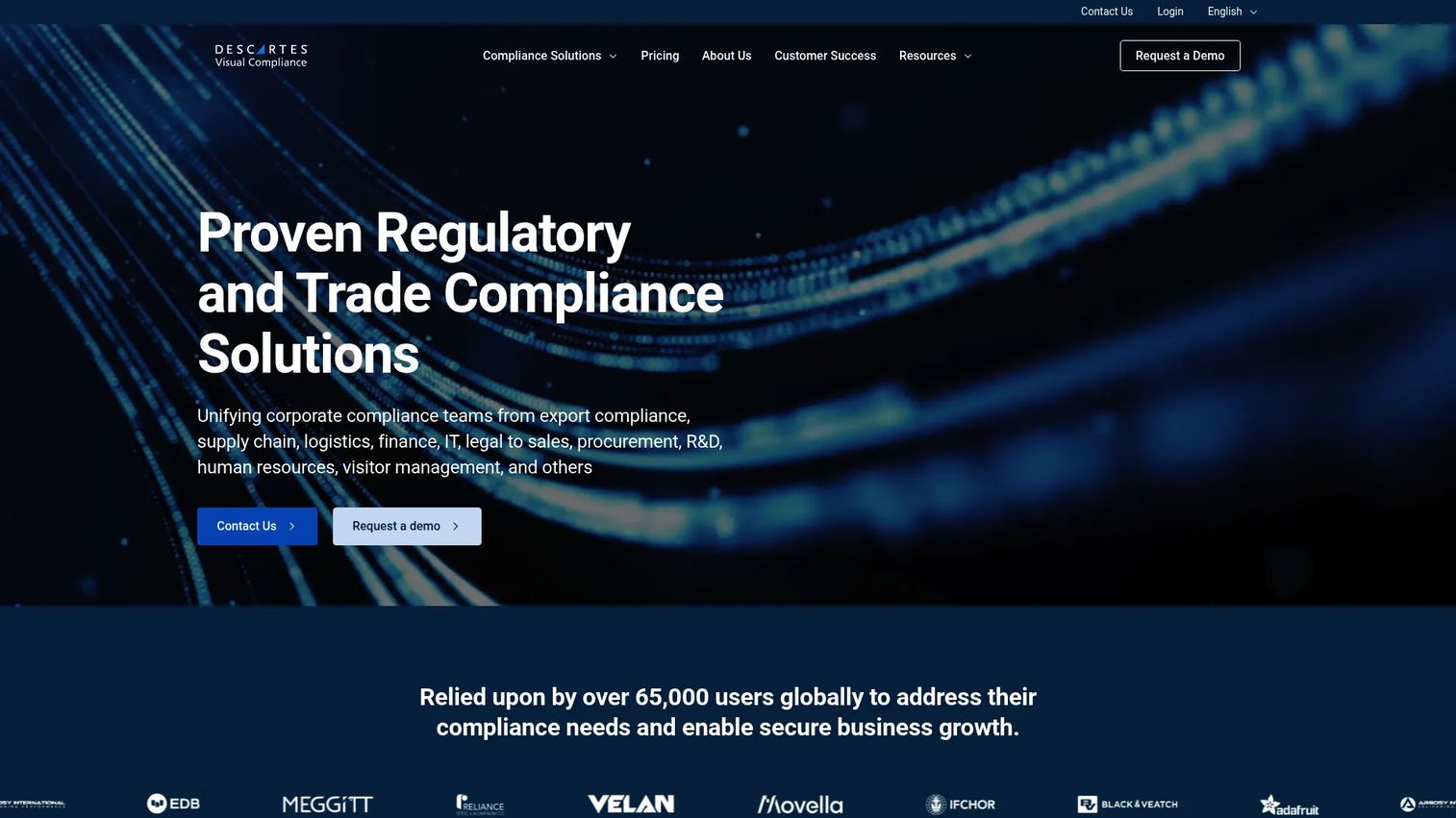
Descartes Visual Compliance is global trade compliance software built around denied and restricted party screening, OFAC compliance, and related trade workflows. It offers online, batch, dynamic, and integrated screening, so you can check a single counterparty in the moment or run your entire vendor list overnight. The platform extends into export classification, documentation, licensing, and risk management, which makes it a strong fit for teams that want screening as the backbone of a broader compliance program.
Best for: Companies that need deep denied party screening and OFAC coverage across legal, finance, supply chain, and sales.
Key strengths
- Multi-mode screening: Online, batch, dynamic, and integrated screening cover both ad hoc checks and high-volume list runs.
- OFAC and 50% rule coverage: Built-in OFAC compliance and OFAC 50% rule screening handle ownership-based sanctions exposure.
- Classification and licensing: Export classification, documentation, and license management extend the tool beyond screening alone.
Why choose Descartes Visual Compliance: If screening is your primary risk and you want it wired into finance, procurement, and sales workflows, this is one of the most established options available. Its 4.8/5 G2 rating (on the related Descartes Denied Party Screening listing) reflects strong operator sentiment. It suits teams that treat screening as an always-on control rather than a periodic task.
Descartes Visual Compliance pricing: The public pricing page states solutions start at a few thousand dollars a year for a basic implementation. A typical customer screening around 50,000 entities should budget roughly $20,000 per year. Standard, Mid-Market, and Enterprise plans are listed, with several requiring a direct quote. There is no free tier.
2. Thomson Reuters ONESOURCE
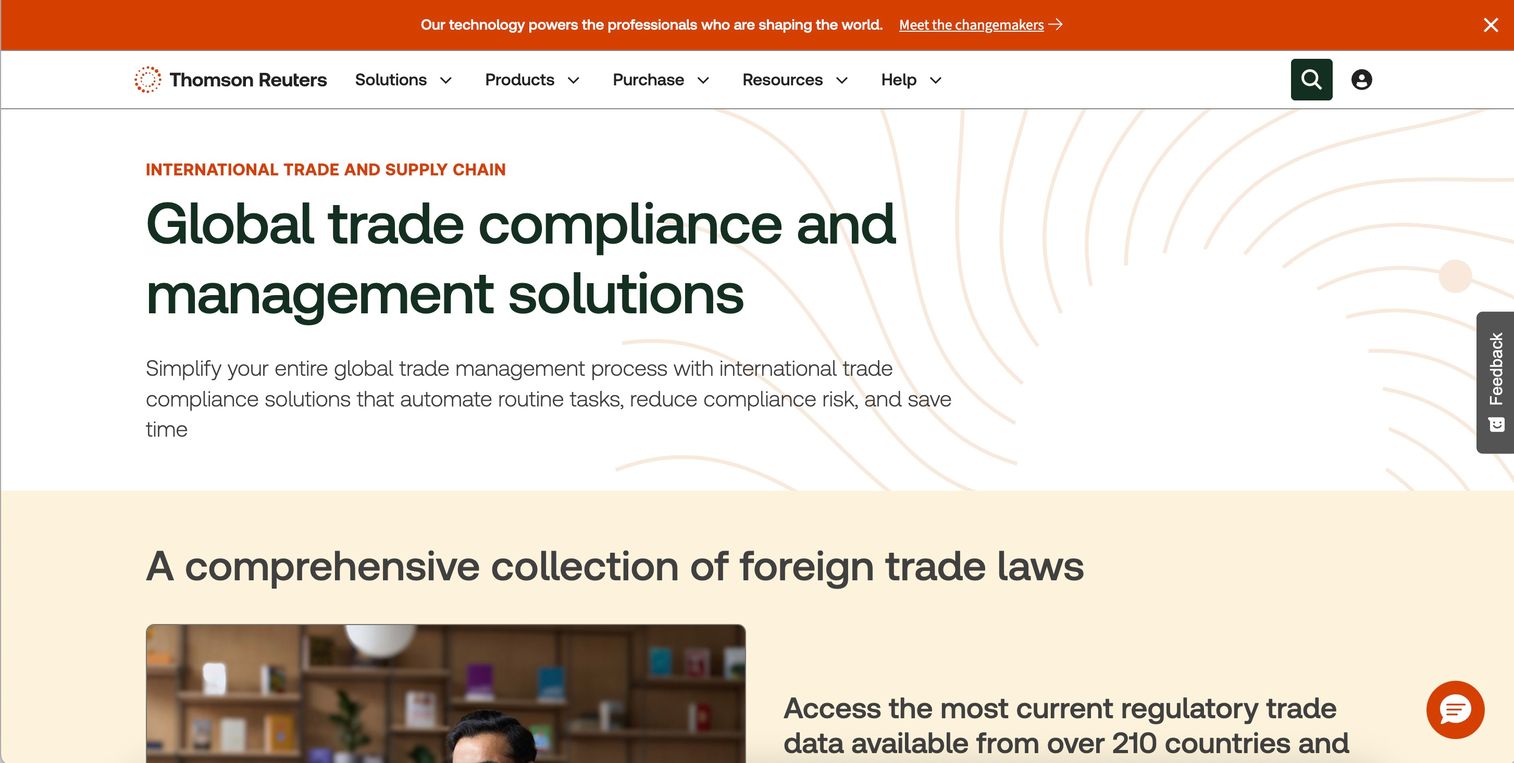
Thomson Reuters ONESOURCE is cloud automation software for tax, trade, and financial reporting compliance. Its trade compliance capabilities sit inside a broader platform, which appeals to enterprises that want to consolidate global trade compliance software with tax and reporting under one authority-grade vendor. Regulatory content depth is the draw here, along with dashboards, custom reports, and scorecards that give leadership a governance view.
Best for: Large organizations that need global tax, trade, and reporting compliance automation from a single vendor.
Key strengths
- End-to-end automation: Covers tax, trade, and financial reporting compliance in one cloud platform.
- Risk reduction: Replaces inefficient manual processes with structured, repeatable workflows.
- Reporting and scorecards: Dashboards, custom reports, and scorecards surface trade compliance analytics for leadership.
Why choose Thomson Reuters ONESOURCE: The pitch is breadth and authority. If your compliance footprint spans tax, trade, and financial reporting, keeping them under one roof reduces vendor sprawl and reconciliation headaches. It fits enterprise process environments where governance and regulatory content depth outrank speed of setup.
Thomson Reuters ONESOURCE pricing: Public pricing is not listed. The product uses a contact-sales model, so expect a scoped quote based on modules, jurisdictions, and volume. The platform carries a 3.8/5 G2 rating.
3. QAD Global Trade Compliance
QAD Global Trade Compliance is global trade compliance software for managing import and export controls, restricted party screening, foreign-trade zones, and free trade agreements. It leans operational, aimed at manufacturers and distributors that need control and efficiency in the same platform. That combination of import management, export management, and screening under one roof makes it a practical fit for teams running physical goods across borders.
Best for: Manufacturers and distributors that need enterprise global trade compliance automation tied to real supply chain operations.
Key strengths
- Import and export management: Standardizes documentation, classification, and controls on both sides of the border.
- Restricted party screening: Built-in screening flags denied and restricted parties before transactions proceed.
- FTZ and FTA support: Foreign-trade zone and free trade agreement handling unlock duty deferral and preferential treatment.
Why choose QAD Global Trade Compliance: For operators balancing compliance control with throughput, QAD keeps screening, classification, and customs workflows in the same operational context as the goods moving through them. It suits teams that want compliance embedded in supply chain operations rather than bolted on afterward.
QAD Global Trade Compliance pricing: QAD does not publish a public price. Its pages use request-a-demo and contact-style gating, so pricing is scoped per engagement. Confirmed capabilities include import management, export management, restricted party screening, FTZ, FTA, and analytics.
4. Oracle Global Trade Management Cloud
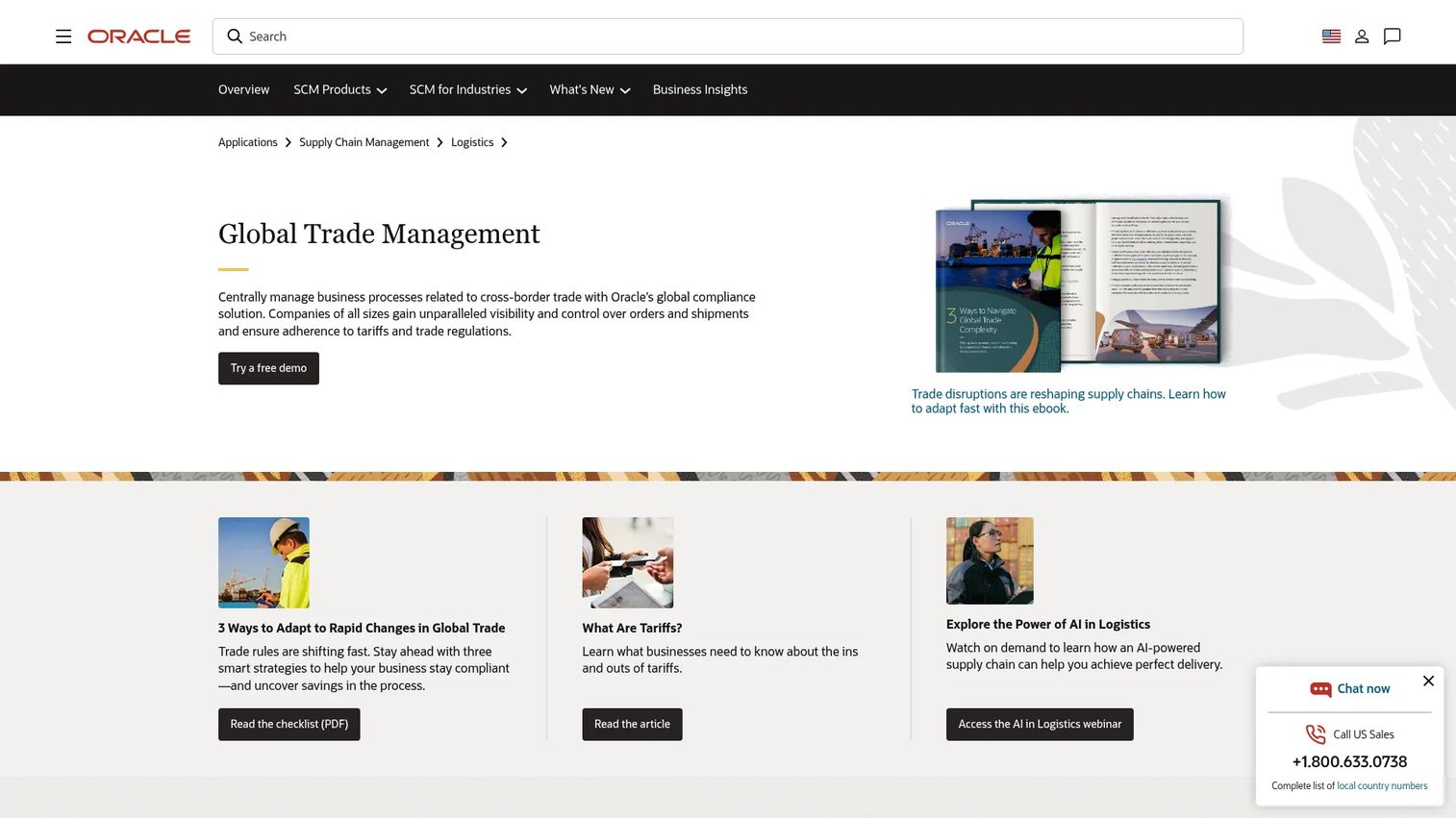
Oracle Global Trade Management Cloud is Oracle's cloud-based global trade management software for managing cross-border trade, tariffs, customs, and trade regulations. It centralizes tariff management, trade agreement qualification, restricted party screening, and customs documentation, and it fits naturally into organizations already standardized on Oracle. For enterprises running Oracle ERP, the integration story is the reason to look here first.
Best for: Enterprises that need centralized global trade compliance and customs automation inside an Oracle-centered stack.
Key strengths
- Tariff and trade agreement management: Handles tariff logic and trade agreement qualification to optimize duty outcomes.
- Screening and compliance automation: Restricted party screening and compliance automation reduce manual review.
- Customs and landed cost: Customs documentation, declarations, and landed cost simulation support end-to-end trade operations.
Why choose Oracle Global Trade Management Cloud: ERP integration is the deciding factor. If your systems of record already run on Oracle, trade compliance that plugs into that environment reduces data reconciliation and gives you one governance layer. It fits larger, ERP-centered organizations with complex customs and tariff exposure. The platform holds a 4.2/5 G2 rating.
Oracle Global Trade Management Cloud pricing: Oracle does not expose a readable product-specific price for this module publicly, and there is no verifiable free tier. Pricing is scoped through Oracle sales based on modules and usage.
5. SAP Global Trade Services
SAP Global Trade Services is SAP's trade compliance platform for managing import and export controls, customs, and cross-border trade processes. It delivers sanctioned party list screening, customs management, and import/export management embedded directly in the SAP environment. For SAP-heavy organizations, that native governance is the whole point: controls live where the transactions already do.
Best for: Enterprises that need centralized global trade compliance and customs management embedded in SAP.
Key strengths
- Sanctioned party screening: Screens counterparties against sanctioned party lists inside SAP workflows.
- Customs management: Handles customs declarations and documentation with a customs connection add-on.
- Import and export management: Manages controls and processes on both sides of cross-border trade.
Why choose SAP Global Trade Services: If your ERP backbone is SAP, embedding compliance and customs in the same system removes integration friction and keeps audit trails unified. SAP-GTS suits large enterprises that want controls native to their financial and logistics processes rather than in a separate tool.
SAP Global Trade Services pricing: SAP lists editions priced by users and a customs connection add-on priced per 1,000 documents per year, but shows price upon request rather than a public number. Editions include the SAP HANA private edition and a co-deployment option. There is no public free tier.
6. AEB Trade Compliance Management
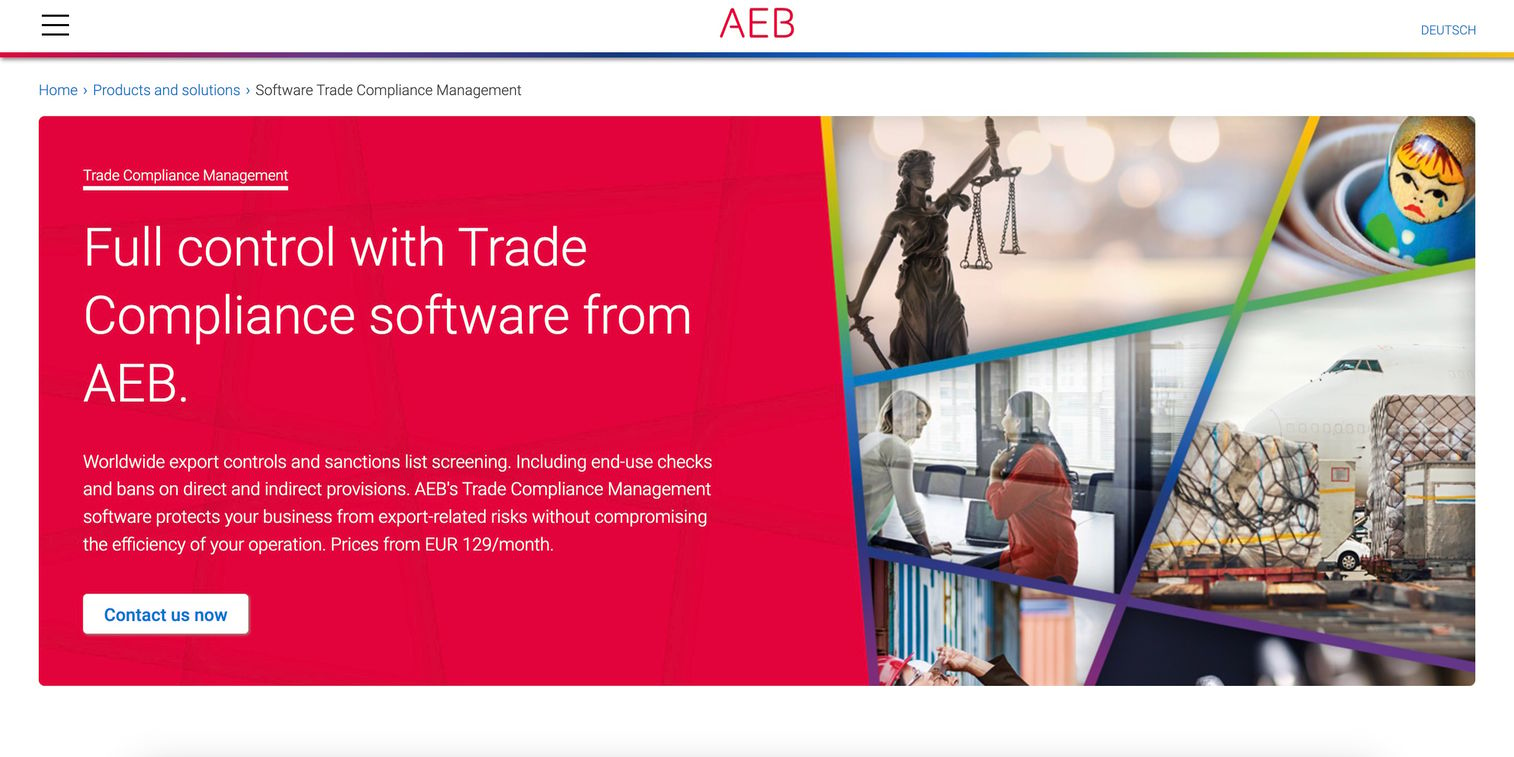
AEB Trade Compliance Management is a cloud trade compliance suite covering sanctions screening, export controls, license management, and risk assessment. It stands out for publishing an entry price, which is rare in this category, and for a modular approach that lets teams build a specialized trade compliance stack. That combination of worldwide export controls, sanctions list screening, and end-use checks makes it a focused option for compliance-first teams.
Best for: Companies that want integrated trade compliance controls for global screening and export restrictions without an enterprise-only commitment.
Key strengths
- Worldwide export controls: Covers export controls and sanctions list screening across global regimes.
- End-use and provision checks: Handles end-use checks and bans on direct and indirect provisions.
- Modular integration: Compliance screening with API and add-on integrations connects to existing systems.
Why choose AEB Trade Compliance Management: AEB matters for teams that want a dedicated, specialized trade compliance stack rather than a module inside a giant ERP suite. Public entry pricing lowers the barrier to evaluation, and the modular design lets you start with screening and add export controls and license management as you scale.
AEB Trade Compliance Management pricing: AEB publishes pricing from EUR 129 per month, with no detailed tier breakdown shown on the product page. That transparency is unusual in this category and makes early scoping easier.
7. Trademo Global Trade Compliance
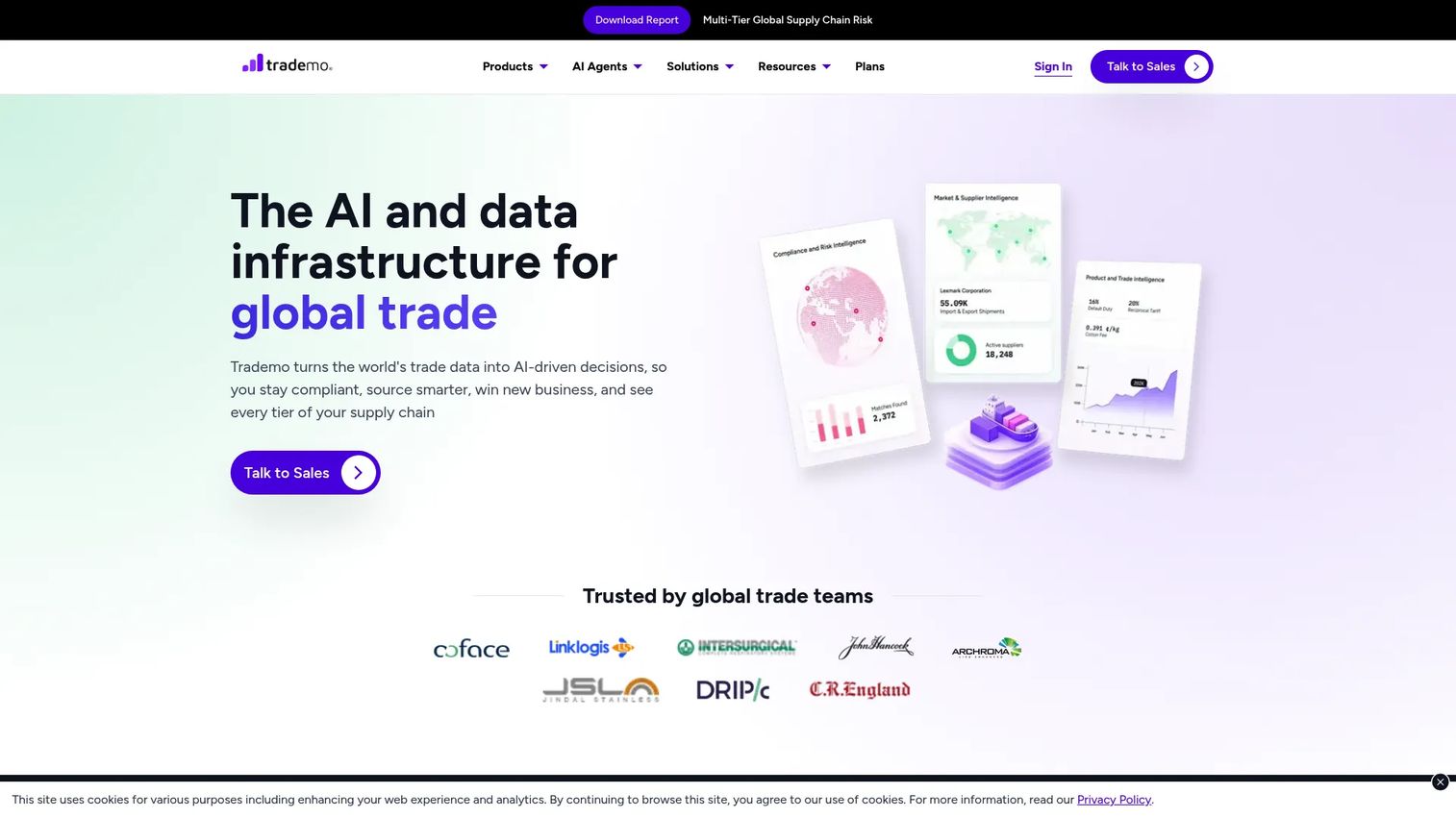
Trademo Global Trade Compliance is global trade compliance software for HS classification, trade content, export controls, free trade agreements, and landed cost analysis. It leans into data as the differentiator: HS code classification across 140+ countries, plus global trade content covering tariffs, duties, customs rulings, and regulatory updates. For teams that want data-driven trade visibility alongside compliance workflows, it is a modern option worth evaluating.
Best for: Teams that need centralized global trade compliance workflows paired with deep regulatory intelligence and classification data.
Key strengths
- Broad HS classification: Product classification via HS codes across 140+ countries supports global operations.
- Rich trade content: Global trade content with tariffs, duties, customs rulings, and regulatory data stays current.
- Landed cost and controls: Landed cost calculation plus export controls and compliance checks round out the workflow.
Why choose Trademo Global Trade Compliance: The draw is regulatory data breadth and classification coverage. If your pain is classifying goods correctly across many markets and keeping trade content current, Trademo centralizes that intelligence. It fits teams that treat trade data as a first-class input to compliance rather than an afterthought.
Trademo Global Trade Compliance pricing: Trademo uses custom pricing tailored to classification volume, feature requirements, and integration needs, delivered through an Enterprise plan. Public numeric pricing is not listed, so expect a scoped quote.
Considerations before you buy
Screening depth
Ask what lists a platform covers, how often that data refreshes, and whether false positives stay manageable. Broad coverage is table stakes, but stale lists create the exact risk you are trying to remove. Check whether the tool handles OFAC compliance, the BIS 50% Affiliates Rule, and ownership-based screening, not just exact name matches.
Customs and classification
Confirm the platform supports the workflows you actually run: import management, export management, product classification, and duty-related processes like duty deferral, FTZ, and FTA. A screening-only tool will not carry your customs load, and a customs-heavy tool may thin out on sanctions screening.
Integration fit
Trade compliance data should not live in isolation. Verify ERP integration with your systems of record, whether that is SAP-GTS, Oracle GTM, or another environment, plus your data pipelines. Clean integration is what turns a compliance tool from another silo into part of the operating stack.
Audit trails and governance
Check logging, role permissions, approval history, and review evidence. When a regulator or an acquirer asks how you know a screening happened, you want a report, not a story. Strong audit trails are what make your risk management defensible under scrutiny.
AI and automation
Evaluate whether AI actually reduces manual review without creating opaque decisions. The useful application is triage: clustering likely false positives so reviewers focus on real hits, not replacing human judgment on sanctions calls. Ask vendors to show how a match gets scored, not just that "AI" appears in the deck.
Conclusion
The right trade compliance software depends on the job you need it to do. For screening depth and OFAC coverage, Descartes Visual Compliance leads. For consolidating tax, trade, and reporting under one authority-grade vendor, Thomson Reuters ONESOURCE fits. QAD Global Trade Compliance suits operators balancing control and throughput, while Oracle Global Trade Management Cloud and SAP Global Trade Services are natural choices for Oracle- and SAP-centered enterprises that want ERP-native governance. AEB Trade Compliance Management offers a specialized stack with public entry pricing, and Trademo Global Trade Compliance brings data-driven trade visibility and broad classification.
The practical next step: shortlist two tools that match your primary need, then test one workflow end to end. Screen a real vendor list, classify a real SKU, or run a real customs document through each. The tool that produces cleaner evidence with fewer manual steps is the one that earns its place in your stack.
FAQs
Trade compliance software automates the screening, classification, documentation, and audit workflows that keep companies compliant with import, export, sanctions, and customs regulations. It replaces manual spreadsheet checks with repeatable workflows, keeps regulatory data current, and logs every decision so you can prove compliance later.
Denied party screening software checks the names of your customers, vendors, and other counterparties against sanctions lists and government watchlists. When it finds a potential match, it flags the hit and routes it to a reviewer before a transaction proceeds, so restricted parties do not slip through unnoticed.
Global trade management (GTM) is the broader umbrella. It includes compliance functions like screening and classification, but also adds logistics, transportation, landed cost, and supply chain orchestration. Trade compliance software focuses specifically on the compliance layer, so GTM is the wider system and compliance sits inside it.
An ERP records transactions, but it rarely delivers dedicated screening, current sanctions data, and export classification workflows out of the box. Trade compliance software either extends your ERP through integration (as with SAP-GTS or Oracle GTM) or runs alongside it to supply the compliance controls and audit trails an ERP alone does not provide.
Prioritize fresh regulatory content and frequent data updates, strong audit trails for defensible evidence, and reliable classification support for ECCN and HS codes. Also confirm it handles license determination and denied party screening for your export markets, since those are where export compliance risk concentrates.
AI is most useful for triage: clustering and scoring likely false positives so reviewers spend time on real matches instead of noise. It can speed up classification suggestions and surface risk patterns, but the decisions on sanctions and export controls should stay auditable, not hidden inside a black box.
Trade compliance touches supply chain, finance, legal, procurement, sales, and IT. Supply chain and procurement screen vendors and manage customs, finance watches duty and cost exposure, legal owns regulatory risk, sales screens customers, and IT handles the ERP integration that keeps the data connected across all of them.